DinoVerse Atlanta combines virtual reality, real fossils, dinosaur skeletons and interactive activities into an indoor prehistoric adventure designed especially for families and dinosaur enthusiasts. Located at the Exhibition Hub Atlanta Art Center in Doraville, the attraction takes visitors through a walking VR journey before continuing into a fossil-filled Dino Hall and hands-on discovery areas.
The experience is particularly appealing if you want something different from Atlanta’s conventional museums and attractions. Rather than simply looking at dinosaur displays, visitors put on a VR headset and enter a prehistoric environment where dinosaurs appear around them as they move through the experience.
DinoVerse Atlanta at a Glance
Location: Exhibition Hub Atlanta Art Center, 5660 Buford Highway Northeast, Doraville, Georgia 30340.
Main attraction: approximately 30-minute walking virtual-reality dinosaur adventure.
Overall visit: allow around 45–60 minutes.
Age: the experience is not considered suitable for children under six.
Venue: indoor and air-conditioned.
Parking: free parking is available at the venue.
Accessibility: the venue is listed as wheelchair accessible.
Current schedules and ticket availability can change, so visitors should check the booking page for the date they intend to visit. As of August 2026, tickets and future sessions continue to be listed for DinoVerse Atlanta. :contentReference[oaicite:2]{index=2}
Step Into the Age of Dinosaurs
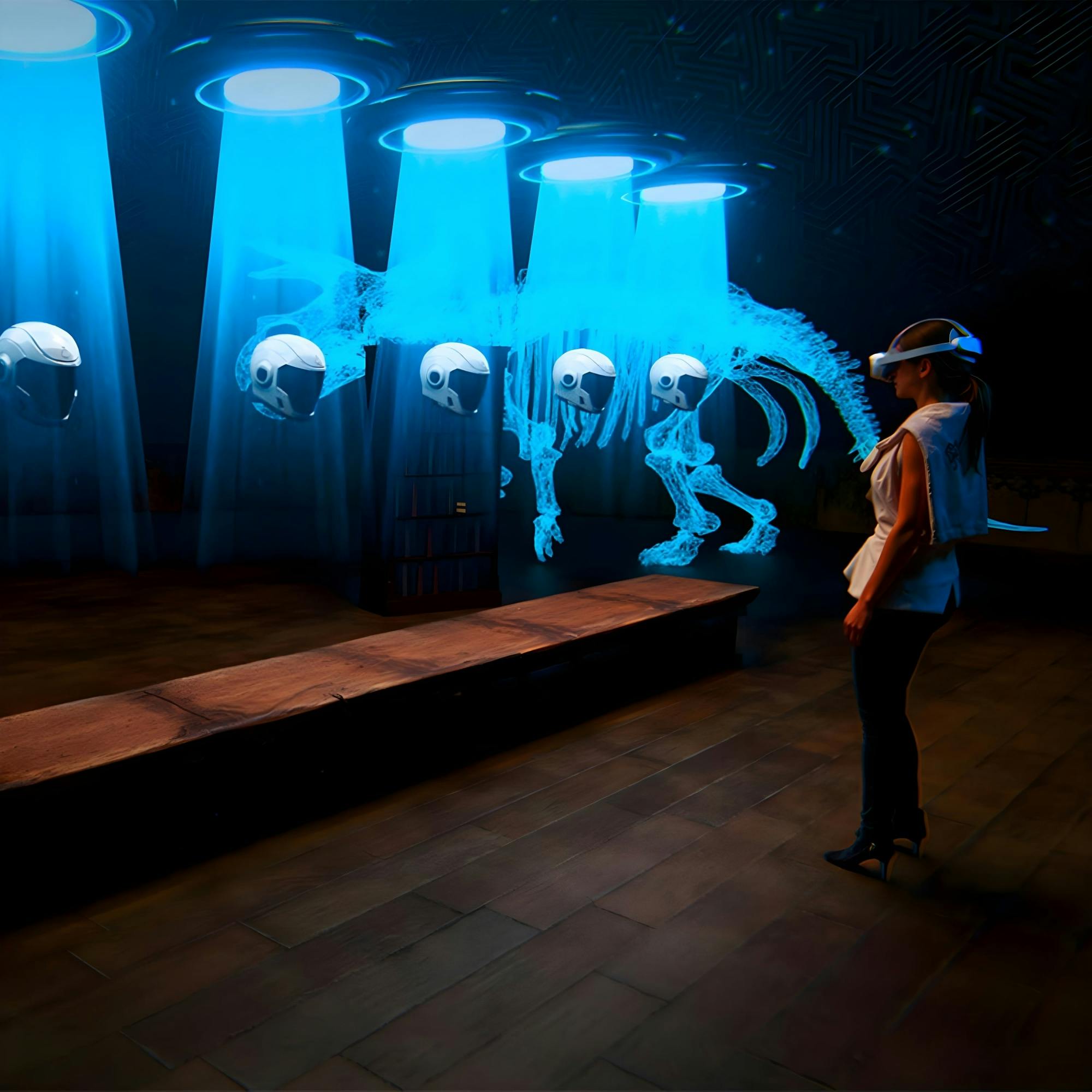
The centrepiece of DinoVerse is its 30-minute walking VR adventure. Visitors wear virtual-reality equipment and move through a digitally created prehistoric world rather than remaining seated in one position.
The idea is to create the feeling of travelling through a time portal and entering the age of dinosaurs. Prehistoric landscapes and life-sized digital creatures surround you as you make your way through the virtual environment.
Walking VR can feel considerably more immersive than conventional screen-based virtual reality because your physical movement becomes part of the experience. For younger visitors in particular, suddenly seeing enormous dinosaurs at apparently realistic scale can be one of the highlights of the attraction.
Visitors who have never used virtual reality before generally do not need previous experience. Staff provide the equipment and instructions before the experience begins.
Explore Dino Hall After the VR Adventure
DinoVerse is not entirely virtual. After travelling through its digital prehistoric world, visitors can explore the attraction’s Dino Hall.
The hall features more than 20 fossils, including a large Apatosaurus femur, together with two towering dinosaur skeletons. This gives the attraction an educational element and allows visitors to compare the computer-generated dinosaurs they have just encountered with evidence left behind by the real animals millions of years ago. :contentReference[oaicite:3]{index=3}
Interactive discovery areas introduce dinosaur science in a more hands-on format. There is also a dinosaur colouring area where younger visitors can create their own designs.
For families, this combination works well because the experience does not rely entirely on VR. Children have several different things to see and do during the visit.
Is DinoVerse Atlanta Good for Children?
DinoVerse is primarily promoted as a family attraction, but there is an important age restriction to consider. The organisers state that the experience is not suitable for children under six years of age. :contentReference[oaicite:4]{index=4}
For dinosaur-loving primary-school children and teenagers, however, DinoVerse can be particularly engaging. It combines entertainment with fossils, dinosaur anatomy and prehistoric science without feeling like a traditional classroom-style museum visit.
Adults do not need to be accompanying children to enjoy it. The scale of the virtual dinosaurs, walking VR technology and fossil collection can also make it interesting for adults who enjoy dinosaurs, immersive technology or unusual attractions.
How Long Does DinoVerse Take?
Allow approximately 45 to 60 minutes for the complete visit. The main walking VR experience lasts about 30 minutes, with additional time needed for Dino Hall and the interactive areas. :contentReference[oaicite:5]{index=5}
This makes DinoVerse relatively easy to fit into a day of sightseeing. It does not normally require half a day, although families with children who spend longer exploring the activities may want to allow some additional time.
Where Is DinoVerse Atlanta?
DinoVerse is held at:
Exhibition Hub Atlanta Art Center
5660 Buford Highway Northeast
Doraville, GA 30340
Doraville lies northeast of central Atlanta. The attraction’s official visitor information recommends travelling by car, and free parking is available on site. :contentReference[oaicite:6]{index=6}
Visitors staying in Downtown Atlanta, Midtown or elsewhere in the metropolitan area should allow additional time for Atlanta traffic, particularly during commuter periods.
DinoVerse Atlanta Tickets
DinoVerse uses timed admission, with visitors selecting a particular date and entry session when booking. The official experience information indicates that time slots are generally offered at regular intervals throughout operating days. :contentReference[oaicite:7]{index=7}
Ticket prices vary according to date, age category and demand. Rather than relying on a price seen weeks or months earlier, check the booking page for the exact cost of your preferred session.
Adult, child, senior/student and family ticket categories may be available. The ticketing platform was displaying sessions beyond August 2026 when checked, although availability can change. :contentReference[oaicite:8]{index=8}
Should You Book in Advance?
Advance booking is sensible, particularly if you want to visit on a weekend, during school holidays or at a particular time of day. Because admission is organised into timed sessions, arriving without a booking does not guarantee that your preferred session will be available.
Accessibility and Comfort
The venue is listed as wheelchair accessible. The attraction is also indoors and air-conditioned, which can make it a useful activity during Atlanta’s hot summer weather or on a rainy day. :contentReference[oaicite:9]{index=9}
The VR component involves wearing a headset and moving through the experience. Visitors with mobility, balance, vision or motion-sensitivity concerns should check the current accessibility requirements directly with the attraction before purchasing tickets.
Tips for Visiting DinoVerse Atlanta
Arrive before your ticket time. You may need time for admission and VR preparation.
Wear comfortable shoes. This is a walking VR experience rather than a seated simulator.
Allow about an hour. This gives you time for the VR adventure and the physical exhibits.
Check age requirements before booking. DinoVerse is not recommended for children under six.
Book popular sessions ahead. Weekends and school-holiday periods can be busier.
Do not rush out after the VR section. Dino Hall and its fossils are an important part of the experience.
Check current operating dates. Temporary immersive exhibitions can alter their schedules or eventually close.
Is DinoVerse Atlanta Worth Visiting?
DinoVerse is most worthwhile for families with dinosaur-obsessed children, visitors interested in VR and anyone looking for an unusual indoor Atlanta activity.
The strongest feature is the combination of technologies and traditional exhibits. A dinosaur museum might provide fossils and skeletons, while a VR attraction might offer impressive digital effects. DinoVerse attempts to combine both.
The attraction is comparatively short, so visitors looking for an entire day’s entertainment will need to combine it with other activities. As a one-hour experience, however, it can be an entertaining addition to an Atlanta itinerary.
Frequently Asked Questions
What is DinoVerse Atlanta?
DinoVerse is an immersive dinosaur attraction combining a walking virtual-reality adventure with fossils, dinosaur skeletons and interactive activities.
How long is the DinoVerse VR experience?
The walking VR section lasts approximately 30 minutes. Most visitors spend around 45–60 minutes at the complete attraction. :contentReference[oaicite:10]{index=10}
Where is DinoVerse Atlanta?
It is located at Exhibition Hub Atlanta Art Center, 5660 Buford Highway Northeast in Doraville, Georgia. :contentReference[oaicite:11]{index=11}
Is DinoVerse suitable for young children?
The organisers state that the experience is not suitable for children under six years old. :contentReference[oaicite:12]{index=12}
Is DinoVerse indoors?
Yes. The attraction is held indoors in an air-conditioned venue. :contentReference[oaicite:13]{index=13}
Does DinoVerse Atlanta have parking?
Yes. Free parking is available at the Exhibition Hub Atlanta Art Center. :contentReference[oaicite:14]{index=14}
Are there real dinosaur fossils?
Yes. Dino Hall features more than 20 fossils, including an Apatosaurus femur, together with two large dinosaur skeleton displays. :contentReference[oaicite:15]{index=15}
Do I need to buy tickets in advance?
Advance booking is advisable because entry uses timed sessions and your preferred date or time may sell out.
Final Thoughts
DinoVerse Atlanta offers a different way to explore prehistoric life by combining a walking VR adventure with real fossils, enormous skeletons and hands-on family activities. The attraction is relatively compact, making it easy to add to an Atlanta sightseeing day without committing several hours.
If dinosaurs are a major interest for your children—or you simply want to try an immersive VR attraction—the experience provides something considerably different from a conventional museum visit.
Before travelling: confirm the latest operating dates, ticket prices, session times, age restrictions and accessibility information with the attraction. Exhibition schedules and ticket conditions can change.
One useful point I found while checking these: your **Mainz Museum article should now carry a prominent 2026 closure warning**. The official Mainz and LEIZA pages both say the Museum of Ancient Seafaring is closed for renovation until **late autumn 2026**, when a redesigned permanent exhibition is expected to open. ([mainz.de][1])
[1]: https://www.mainz.de/en/vv/oe/Museum-fuer-Antike-Schifffahrt-des-LEIZA “Museum of Ancient Navigation of the LEIZA | Landeshauptstadt Mainz”
Sponsored Popular Items
Quick take: Musement.com offers a worldwide selection of tours and attractions
Entrance ticket to DinoVerse VR Experience in Atlanta United States Plan Entrance ticket to DinoVerse VR Experience in Atlanta, a ticket or attraction experience, with practical tips on timing, inclusions and what to check before booking. Compare current availability, prices and booking conditions before you go.
Atlanta Midtown Food Tour with Secret Dish United States Plan Atlanta Midtown Food Tour with Secret Dish, a food and drink experience, with practical tips on timing, inclusions and what to check before booking. Compare current availability, prices and booking conditions before you go.
Skydeck Chicago at Willis Tower is one of the city’s signature attractions, taking visitors to the 103rd floor of the former Sears Tower for panoramic views across Chicago and the famous Ledge—glass balconies projecting outside the face of the skyscraper.
The Skydeck stands approximately 1,353 feet (412 metres) above street level. On a clear day, the view can extend around 50 miles and potentially across parts of Illinois, Indiana, Wisconsin and Michigan.
The experience is no longer simply an elevator ride followed by a view. Admission now combines an interactive Chicago museum, the high-speed journey to the observation deck, 360-degree views and access to The Ledge.
Willis Tower Skydeck at a Glance
Visitor Information
Details
Location
Willis Tower, downtown Chicago
Address
233 S. Wacker Drive, Chicago, Illinois 60606
Skydeck entrance
Jackson Boulevard, south side of Willis Tower
Observation deck
103rd floor
Skydeck height
1,353 ft / 412 m
Willis Tower height
1,450 ft / 443 m to architectural roof
Building
110 stories
The Ledge
Five glass balconies projecting 4.3 ft outside the tower
2026 adult general admission
From US$32
2026 youth admission
From approximately US$22–24 depending on current pricing
Under age 3
Free
Expedited Entry
From US$55
Current summer hours
Generally 9:00 am–10:00 pm; Saturday from 8:30 am
Typical visit
45–60 minutes officially; allow 1½–2 hours for a relaxed visit
Accessibility
Wheelchair, scooter and stroller accessible, including The Ledge
Best for
City views, architecture, photography, families and first-time Chicago visitors
Willis Tower or Sears Tower?
They are the same building.
The skyscraper opened as the Sears Tower in 1973 after being commissioned as the headquarters of Sears, Roebuck and Company. The building was renamed Willis Tower in 2009, although many Chicago residents and visitors still refer to it by its original name.
If you search for “Sears Tower observation deck,” you are looking for Skydeck Chicago at Willis Tower.
A Skyscraper That Changed the Chicago Skyline
Construction began in 1970 and was substantially completed in 1973. More than 2,000 workers were involved in creating what was then the tallest building in the world.
Its structural design is closely associated with architect Bruce Graham and structural engineer Fazlur Rahman Khan of Skidmore, Owings & Merrill. Khan’s innovative bundled-tube structural system allowed an extraordinarily tall building to withstand Chicago’s powerful winds while remaining commercially practical.
The tower rises to approximately 1,450 feet and contains 110 stories. With its antennas included, its total height reaches around 1,730 feet.
It Was Once the World’s Tallest Building
When completed, the Sears Tower surpassed New York’s Empire State Building and remained the world’s tallest building for almost a quarter of a century.
Although newer skyscrapers have since surpassed it, Willis Tower remains Chicago’s most recognisable skyscraper and one of the most significant buildings in modern high-rise engineering.
What Is The Ledge?
The Ledge is the attraction that makes Skydeck different from a conventional observation deck.
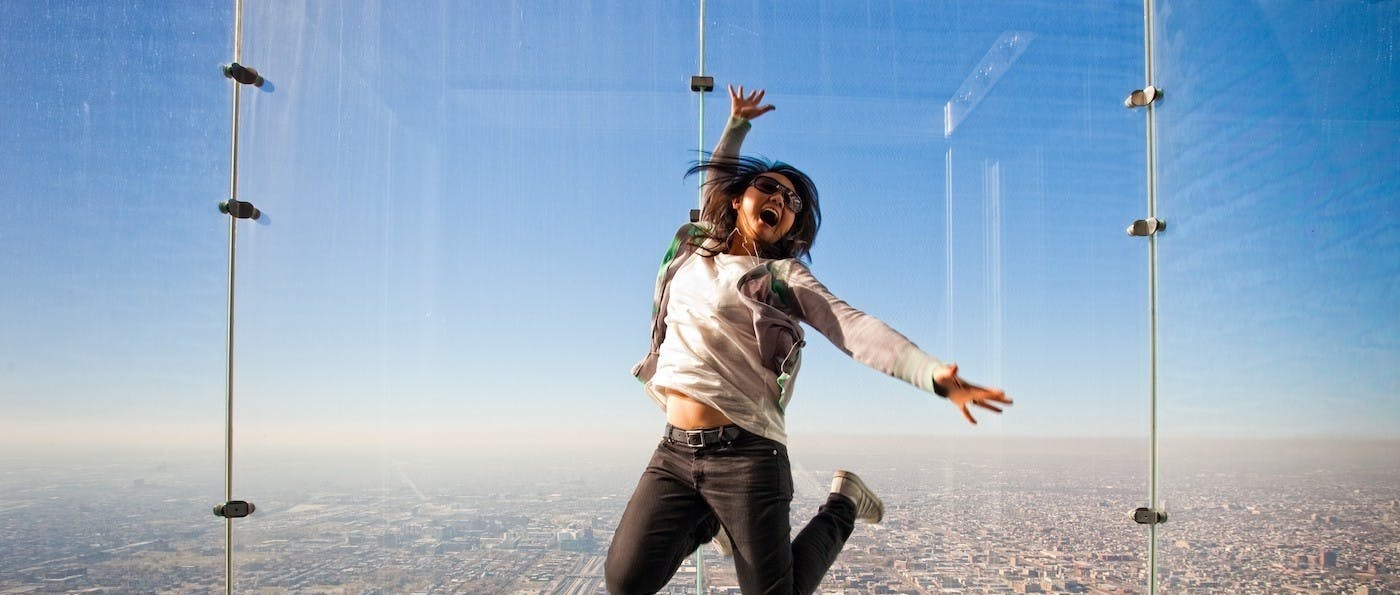
Five transparent glass balconies project approximately 4.3 feet outside the building from the 103rd floor. When you walk into one, the floor beneath your feet is transparent and the streets of Chicago appear more than 1,350 feet below.
The experience can look intimidating from inside the observation deck, but the balconies are fully enclosed. There is glass beneath your feet, around your sides and above you.
How Strong Is The Ledge?
Each balcony is constructed from three laminated layers of half-inch glass and is engineered to support up to approximately 10,000 pounds.
The glass boxes can retract back into the building for maintenance and cleaning. The original Ledge opened in July 2009.
How Long Do You Get on The Ledge?
The Ledge is extremely popular, so your private time inside a particular glass box is limited.
The official visitor guidance generally allows approximately 60 seconds for smaller parties and up to around 90 seconds for larger parties. Procedures can vary on busy days, and some Ledges may be shared between groups.
That sounds brief, but it is normally enough for several photographs if you decide what you want before entering.
Plan Your Ledge Photograph Before Your Turn
When the queue is busy, do not spend the first half of your allotted time deciding what pose to use.
Popular options include:
Standing and looking straight down
Sitting on the glass floor
Lying flat on the glass
A family photograph
A photograph looking towards the horizon
A photograph showing the city directly beneath your feet
Personal photography and video are encouraged, although tripods are not permitted. Monopods are currently allowed.
You Do Not Have to Step Onto The Ledge
If you dislike heights, you can still enjoy Skydeck without entering a glass balcony.
The observation floor provides enclosed panoramic windows around the building, so The Ledge is optional even though access is included in every standard admission ticket.
You can therefore accompany friends or family to the attraction without being forced to stand on transparent glass.
What Can You See From Skydeck?
The observation floor offers 360-degree views across downtown Chicago, Lake Michigan and the wider metropolitan area.
On exceptionally clear days, the official Skydeck information states that visibility may extend approximately 40–50 miles, allowing visitors to see territory belonging to four states:
Illinois
Indiana
Wisconsin
Michigan
Do not expect to see state borders marked on the landscape. The claim refers to the theoretical geographical distance visible under excellent atmospheric conditions.
Look Down at Chicago’s Street Grid
One of the most interesting aspects of Skydeck is not simply seeing distant scenery but understanding Chicago’s urban layout from above.
Railway lines, streets, the Chicago River, bridges and high-rise buildings form an enormous geometric pattern beneath the tower. The western and southern views are especially useful for appreciating how far the city’s regular grid extends beyond the downtown skyline.
Lake Michigan
Looking east, the enormous blue surface of Lake Michigan dominates the horizon. On clear days the contrast between the dense city and seemingly endless water is one of the strongest views from the tower.
The Chicago Museum Comes First
Visitors do not simply enter an elevator at street level.
The modern Skydeck experience begins with an interactive museum devoted to Chicago’s neighbourhoods, food, sports, music, architecture, history and popular culture.
Displays include playful recreations and photo opportunities rather than traditional rows of display cases. The attraction highlights subjects such as Chicago’s elevated trains, local food and entertainment history before you reach the skyscraper experience itself.
Allow Time for the Museum
Willis Tower currently describes the interactive section before the observation deck as approximately a 30–60 minute experience for visitors who explore it fully.
If your main interest is simply reaching The Ledge, you can move through more quickly. Families and first-time visitors may find the museum worth slowing down for.
The Elevator Ride
The ascent is part of the experience. Willis Tower’s elevators can operate at speeds of up to around 1,600 feet per minute.
Some passengers notice their ears popping as air pressure changes during the rapid climb. Swallowing or yawning usually helps in the same way it does during an aircraft ascent.
How Long Does a Skydeck Visit Take?
Skydeck’s current visitor information says most guests spend around 45–60 minutes completing the museum, observation deck and Ledge experience.
In practice, the time varies considerably.
45–60 Minutes
Enough for a relatively efficient visit when queues are short.
1½ Hours
A better allowance for most first-time visitors.
You can enjoy the museum, observation floor and Ledge without watching the clock continuously.
2 Hours
Recommended if you are visiting around sunset or during a busy holiday period.
Skydeck does not impose a normal fixed time limit on how long you remain on the observation deck after admission.
Current 2026 General Admission Prices
Skydeck uses timed and variable pricing, so the exact amount can depend on your chosen date and entry time.
As of August 2026, the official visitor page lists:
Visitor
Current Starting Price
Adult age 12+
US$32
Youth age 3–11
From approximately US$22
Child under 3
Free
Another current official Skydeck ticket page displays youth admission from US$24, confirming that advertised starting prices can vary. Use the live ticket calendar for the exact price on your chosen date.
What Does General Admission Include?
Standard admission includes:
The Chicago museum experience
The high-speed elevator journey
The 103rd-floor observation deck
360-degree views
Access to The Ledge
You do not need to buy a separate ticket simply to step onto The Ledge.
Expedited Entry
Visitors wanting to reduce waiting can purchase Expedited Entry, currently starting at approximately US$55 for visitors aged three and over.
This includes an express route to the elevators and a dedicated priority lane at The Ledge.
It becomes most valuable during weekends, holidays and popular sunset periods when ordinary lines are much longer.
Do You Need to Book Ahead?
Yes, advance booking is strongly recommended.
Skydeck now uses timed admission. Tickets are booked for a specific date and entry period, with the current system using approximately 30-minute entry windows.
Buying ahead does not mean the attraction will be empty, but it protects you against arriving when the available time slots have sold out.
Current Summer 2026 Opening Hours
For the current summer period from 26 May through 30 September 2026, Skydeck publishes:
Day
Hours
Sunday–Friday
9:00 am–10:00 pm
Saturday
8:30 am–10:00 pm
Last entry is 30 minutes before closing.
Skydeck operates 365 days a year, but seasonal hours change outside summer, so check the current schedule when visiting after September.
Best Time of Day to Visit
Opening Time
Best for shorter queues and clearer photographs.
Skydeck itself recommends early morning as one of the best periods for avoiding heavier visitor traffic.
Late Afternoon
Good if you want daylight views but prefer not to arrive first thing in the morning.
Sunset
Best overall experience if the weather cooperates.
You can see Chicago in daylight, watch the city change colour and then remain as the lights begin to appear.
Skydeck advises planning to arrive at least 30 minutes before sunset. Booking 45–60 minutes before sunset provides an additional buffer for queues and the museum.
Night
Nighttime views are dramatic, with Chicago’s illuminated street grid extending far into the distance.
The disadvantage is that you lose much of the detail visible across Lake Michigan and the surrounding landscape during daylight.
Sunset Tickets Can Be Popular
If sunset is important, reserve well ahead rather than waiting until the afternoon of your visit.
Timed admission limits the number of visitors entering during each period, and the combination of sunset views and city lights makes the late-afternoon slots particularly attractive.
What if the Weather Is Cloudy?
The view is naturally weather-dependent.
On a clear day, Skydeck advertises visibility of up to about 50 miles. Low cloud, fog, rain or haze can reduce that dramatically.
If panoramic views are the principal reason for your visit and your itinerary is flexible, check Chicago’s weather shortly before choosing your ticket time.
Accessibility
Skydeck is fully ADA compliant and The Ledge itself is wheelchair accessible.
Ramps and elevators accommodate:
Wheelchairs
Mobility scooters
Strollers
Complimentary wheelchairs are available on a first-come, first-served basis, and the attraction allows service animals.
Sensory Accessibility
Skydeck also provides options for guests who find highly stimulating environments difficult.
Current facilities include:
Sensory bypass doors around selected exhibits
Sensory kits
A quiet room available through staff
Is Skydeck Suitable for Children?
Yes.
The combination of interactive exhibits, elevators, skyline views and transparent balconies tends to work better for children than a traditional observation platform consisting only of windows.
Strollers are accommodated, and family bathrooms are available on Lower Level 2.
Children who are uncomfortable with heights can simply avoid stepping onto The Ledge.
There Are No Storage Lockers
Skydeck does not currently provide visitor storage lockers.
This is worth knowing if you are visiting between checking out of a hotel and travelling to the airport or railway station. Leave large luggage with your accommodation or use a dedicated luggage-storage service rather than arriving at Willis Tower expecting to store it onsite.
Photography Tips
Glass observation decks create reflections, particularly after dark.
For clearer photographs:
Move the camera or phone close to the window.
Turn off the flash.
Avoid brightly lit reflections behind you.
Photograph before sunset for better landscape detail.
Clean your phone camera lens before entering The Ledge.
The attraction itself recommends avoiding flash when shooting through windows and notes that tripods are prohibited.
Where Exactly Is the Entrance?
The official address is:
Willis Tower
233 South Wacker Drive
Chicago, IL 60606
United States
However, Skydeck visitors should enter from Jackson Boulevard on the south side of Willis Tower.
This detail can save time because arriving at the Wacker Drive side and assuming every entrance leads directly to Skydeck can be confusing in such a large building.
Arriving by Public Transport
Willis Tower sits in the heart of Chicago’s Loop and is straightforward to reach using downtown rail and bus services.
It is also within walking distance of Chicago Union Station, making Skydeck convenient for travellers arriving in central Chicago by intercity or commuter rail.
Because parking in downtown Chicago can be expensive and traffic can be heavy, public transport is usually the simplest choice for visitors already staying in the city centre.
Parking
Skydeck currently promotes advance discounted parking at garages at:
211 W. Adams Street
241 S. Franklin Street
Both are described as approximately a 2–5 minute walk from Willis Tower.
Food Inside Willis Tower
Willis Tower’s lower levels now contain a substantial dining and retail complex, so it is easy to eat before or after visiting Skydeck without immediately leaving the building.
Current options listed by Skydeck include businesses such as Shake Shack, Brown Bag Seafood, Do-Rite Donuts & Chicken, Tortazo, sweetgreen, Starbucks and Joe & The Juice.
These restaurants are separate from standard Skydeck admission.
Combine Skydeck With the Chicago Riverwalk
The Chicago Riverwalk makes a good addition before or after Skydeck because it provides the opposite architectural perspective: instead of looking down from one of Chicago’s tallest buildings, you walk among the skyscrapers at river level.
The combination works particularly well for anyone interested in architecture.
Combine It With Millennium Park
Millennium Park is another practical downtown addition. The contrast between Cloud Gate, landscaped public space and the panoramic tower view gives first-time visitors two very different perspectives on central Chicago.
If you have only half a day, Skydeck plus one of these nearby central attractions is usually more enjoyable than attempting to race through several major sights.
A Good Half-Day Chicago Plan
Morning
Explore central Chicago at street level.
Late Morning
Visit Willis Tower and work through the interactive museum.
Midday
Take the elevator to the 103rd floor, enjoy the panoramic views and step onto The Ledge.
Lunch
Eat inside Willis Tower or elsewhere in the Loop.
Afternoon
Continue to either the Chicago Riverwalk or Millennium Park.
Skydeck or 360 CHICAGO?
Chicago has another major observation deck at 875 North Michigan Avenue, commonly known as 360 CHICAGO.
Choose Skydeck If You Want:
The highest observation deck experience in Chicago
The famous glass Ledge
Willis Tower architecture and history
An interactive Chicago museum before the view
A classic first-time Chicago landmark
Consider 360 CHICAGO If:
Your itinerary is focused around the Magnificent Mile
You particularly want views along the Lake Michigan shoreline
You are interested in its separate TILT attraction
For a first visit to Chicago, Skydeck generally has the stronger historical connection because Willis Tower itself is such an important part of the city’s architectural identity.
Is Expedited Entry Worth the Extra Cost?
It depends heavily on when you visit.
Probably Not Essential
Early weekday mornings
Quiet periods outside holidays
When you have plenty of time
More Attractive
Summer weekends
School holidays
Sunset
When your Chicago itinerary is tightly scheduled
Expedited Entry currently provides priority access both for the elevator and The Ledge, so its main value is saving time rather than adding another attraction.
Best Time of Year
Spring
Potentially excellent visibility with fewer peak-summer visitors, although Chicago weather can change rapidly.
Summer
Long daylight hours make it easy to combine daytime and sunset views. This is also one of the busiest seasons, making advance tickets particularly useful.
Autumn
Often an excellent balance of comfortable weather and good visibility.
Winter
Clear winter air can produce extraordinary views, although seasonal opening hours are shorter on some days. Snow can transform the city grid into an especially striking landscape.
Common Mistakes to Avoid
Going to the Wrong Entrance
Remember that the visitor entrance for Skydeck is on Jackson Boulevard, not simply whichever Willis Tower door you reach first.
Assuming The Ledge Costs Extra
It is included with regular Skydeck admission.
Not Booking a Timed Ticket
Advance reservations are strongly recommended and secure your admission window.
Expecting Unlimited Time on The Ledge
Your observation-deck visit can be relaxed, but your individual Ledge turn is generally only around 60–90 seconds.
Arriving at Sunset Without a Reservation
Sunset is one of the most desirable visiting periods. Reserve ahead.
Bringing a Tripod
Tripods are not currently allowed.
Expecting Luggage Lockers
There are none.
Practical Tips
Book a timed ticket in advance.
Current adult admission starts at US$32.
The Ledge is already included.
Enter from Jackson Boulevard.
Allow 1½ hours even though the official average visit is shorter.
Book at least 30 minutes before sunset if you want changing light.
Prepare your Ledge photograph before your turn.
Turn off your flash when photographing through windows.
Do not bring a tripod.
Do not rely on Skydeck for luggage storage.
The entire experience, including The Ledge, is wheelchair accessible.
Is Willis Tower Skydeck Worth Visiting?
Yes, particularly on a first visit to Chicago.
The attraction combines several things that are strongly associated with the city: skyscraper engineering, Chicago’s architectural history, panoramic views and the unmistakable profile of what generations of visitors still know as the Sears Tower.
Willis Tower has dominated the skyline since 1973. At approximately 1,450 feet tall and 110 stories, it was the tallest building in the world for almost 25 years and remains one of the great achievements of 20th-century skyscraper engineering.
Skydeck itself sits at 1,353 feet on the 103rd floor. On a clear day, the view can extend roughly 50 miles, while The Ledge’s five glass balconies project 4.3 feet beyond the building and allow you to look directly down towards Chicago’s streets.
As of August 2026, general admission currently begins at about US$32 for adults, with children under three free. The ticket includes the Chicago museum, observation deck and The Ledge rather than charging separately for each component.
During the current summer period, Skydeck is open until 10:00 pm, making it possible to visit in daylight, at sunset or after dark.
For the strongest experience, reserve ahead, choose an early-morning slot for shorter queues or a late-afternoon slot for sunset, allow at least 90 minutes and do not rush through the museum purely to reach the elevator.
Even if stepping onto a transparent floor 103 stories above Chicago sounds terrifying, the combination of Willis Tower’s history, the extraordinary city panorama and The Ledge makes Skydeck one of the defining Chicago experiences.
Sponsored Popular Items
Quick take: Musement.com offers a worldwide selection of tours and attractions
Architecture cruise in Spanish on the Chicago River from Michigan Ave United States Chicago Architecture Cruise in Spanish from Michigan Avenue See Chicago's celebrated riverfront architecture on a Spanish-language cruise departing from Michigan Avenue. Check current availability, inclusions and booking details before you go.
Willis Tower Skydeck Chicago Tickets United States Plan Willis Tower Skydeck Chicago Tickets, a ticket or attraction experience, with practical tips on timing, inclusions and what to check before booking. Compare current availability, prices and booking conditions before you go.
Chicago Loop District Food Tour with Tastings United States Plan Chicago Loop District Food Tour with Tastings, a food and drink experience, with practical tips on timing, inclusions and what to check before booking. Compare current availability, prices and booking conditions before you go.
Giardini Naxos combines something that many Sicilian destinations struggle to offer in one place: a long Mediterranean coastline, beaches, restaurants and holiday accommodation together with an archaeological site dating back to the earliest period of Greek settlement in Sicily.
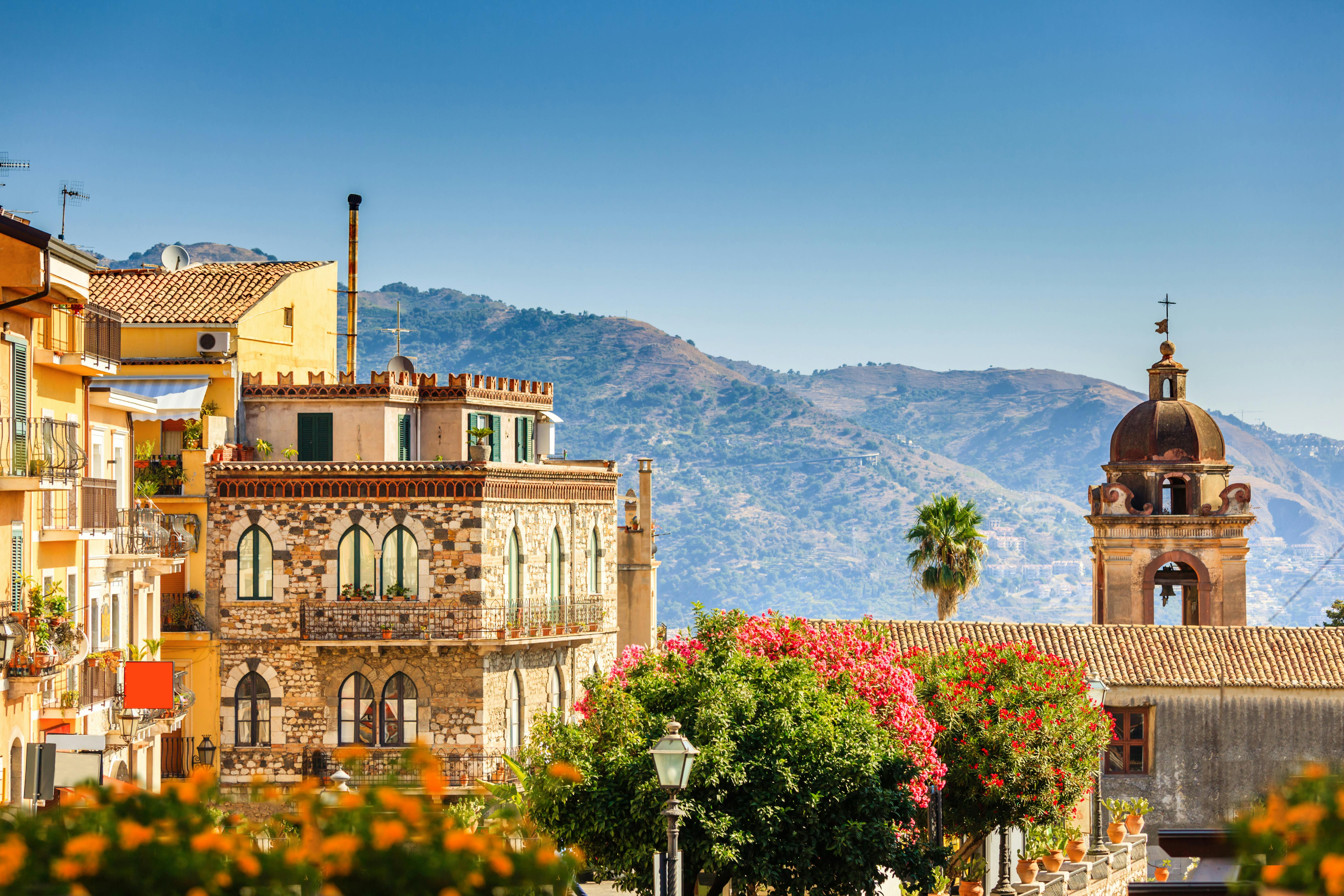
Located on Sicily’s Ionian coast below the hills surrounding Taormina, Giardini Naxos looks across a broad bay towards the mountains and Mount Etna. It works particularly well for travellers who want a beach holiday while remaining close to some of eastern Sicily’s most important attractions.
Giardini Naxos is also historically important. Ancient Naxos was founded in 734 BC and is traditionally regarded as the first Greek colony established in Sicily.
Giardini Naxos at a Glance
Visitor Information
Details
Location
Eastern Sicily, on the Ionian Sea
Province
Metropolitan City of Messina
Known for
Beaches, ancient Greek Naxos, seaside restaurants and views towards Mount Etna
Best nearby town
Taormina
Nearest major airport
Catania-Fontanarossa Airport
Railway station
Taormina-Giardini
Recommended stay
2–4 nights
Best for
Beach holidays, families, couples and exploring eastern Sicily
Why Visit Giardini Naxos?
Giardini Naxos is often overshadowed by glamorous Taormina, which sits high on the hillside immediately to the north.
That can actually work in Giardini Naxos’s favour.
Accommodation is generally concentrated close to the sea, the atmosphere is more obviously that of a beach resort, and you can spend the morning sightseeing before returning to the waterfront for a swim and dinner.
It is therefore an excellent base if you want to combine:
Beach time
Ancient Greek history
Taormina
Mount Etna excursions
Boat trips
Sicilian food and seafood
Sicily’s official tourism organisation describes Giardini Naxos as a major seaside resort and a convenient base for exploring Taormina, Mount Etna and the surrounding region.
The Beaches of Giardini Naxos
The coastline is the main reason many visitors choose Giardini Naxos.
The town extends along a broad bay with a mixture of sandy, pebbly and rocky stretches. During summer, much of the waterfront takes on the classic Italian seaside appearance of colourful umbrellas, sun loungers, beach clubs and cafés.
There are both private beach clubs, known as lidi, and sections of public beach.
A private lido can be worthwhile if you intend to spend most of the day beside the water because facilities commonly include sunbeds, umbrellas, changing facilities, showers, cafés or restaurants.
If you only want a quick swim, the public sections are a better option.
Schisò Beach
The coastline around Schisò is particularly convenient because it lies close to the archaeological area, harbour and central parts of Giardini Naxos.
This makes it easy to combine a morning exploring ancient Naxos with an afternoon beside the sea.
The nearby promenade has restaurants, cafés and accommodation, so you do not necessarily need a car once you are settled into this part of town.
Recanati
The Recanati area lies towards the southern end of Giardini Naxos and contains a concentration of hotels, holiday accommodation, restaurants and beach facilities.
It is a particularly practical base for travellers whose priority is a traditional seaside holiday rather than being in the busiest part of the waterfront.
Families may find this area convenient because many larger resort-style properties are located nearby.
The Lungomare
One of the simplest pleasures in Giardini Naxos is walking along the lungomare, or waterfront promenade.
The seafront becomes particularly attractive in the evening when the strongest heat has passed and restaurants begin filling with diners.
Walk without a strict itinerary, stop for a drink or gelato and watch fishing boats and excursion vessels moving across the bay.
On clear days, the surrounding mountains and Mount Etna add a dramatic backdrop to the coastline.
Giardini Naxos Was the First Greek Colony in Sicily
The modern beach resort occupies a site of exceptional archaeological importance.
According to the archaeological museum, Greek settlers established Naxos in 734 BC.
It is traditionally regarded as the first Greek colony in Sicily.
This makes the archaeological remains especially significant because they represent the beginning of a process that subsequently created some of the ancient Mediterranean’s great Sicilian Greek cities.
Naxos Archaeological Park
The Archaeological Park of Naxos occupies part of Capo Schisò and preserves remains of the ancient settlement.
The visitor route follows sections of the original urban area, including part of a street alignment dating from around the fifth century BC, and continues towards surviving sections of the city walls.
Do not expect enormous standing temples like those at Agrigento.
The experience here is subtler.
You are walking through the ground plan of an ancient Greek city, where archaeological remains reveal streets, defensive structures, sacred areas and the organisation of the settlement.
For travellers interested in archaeology, understanding that this was the first Greek colonial settlement in Sicily makes the ruins considerably more meaningful.
Archaeological Museum of Naxos
The Museo Archeologico di Naxos stands beside the archaeological park near Capo Schisò and the modern tourist harbour.
The museum occupies part of a former Bourbon fortification and incorporates an older defensive tower.
Its collections consist primarily of objects discovered during decades of excavations at ancient Naxos.
Displays include material from:
Prehistoric occupation of Capo Schisò
The earliest Greek settlement
Archaic and Classical Naxos
Ancient sanctuaries
Necropolises
Underwater archaeological discoveries
Ancient coins
Ceramics and architectural decoration
The museum is particularly useful before or after walking through the archaeological park because many of the excavated walls become easier to understand once you have seen the objects recovered from them.
What to Look For in the Museum
One of the more unusual sections contains archaeological material recovered from the sea around Naxos and nearby Taormina.
The collection includes numerous ancient stone anchors and lead anchor stocks discovered underwater during archaeological investigations.
Other important material includes early Greek pottery, terracotta architectural decoration, ancient silver coins and objects associated with the religious life of Naxos.
The museum also contains material documenting human occupation at Capo Schisò before the arrival of the Greeks, demonstrating that the history of the site extends much farther back than 734 BC.
Check Archaeological Park Opening Hours Before Visiting
Current published information for the archaeological museum and park has varied during 2026 because of operational changes and temporary works.
A 2026 Archaeological Park notice listed the Naxos museum and archaeological park as open Tuesday to Saturday from 10:00 am to 6:00 pm, while older municipal visitor information lists broader opening hours.
Because schedules can change, check the official Naxos Taormina Archaeological Park information immediately before visiting rather than relying on an older travel guide.
Take a Boat Trip
Giardini Naxos is a natural base for boat excursions along the eastern Sicilian coast.
Trips commonly explore the coastline around the bays beneath Taormina, providing views back towards the cliffs and hilltop town that you cannot obtain from land.
A boat trip works particularly well during summer when it combines sightseeing with time on the water.
Weather and sea conditions matter, so confirm the itinerary and swimming arrangements before booking.
Visit Taormina
Taormina is the obvious excursion from Giardini Naxos.
The town rises high above the coastline and is famous for its historic centre, ancient theatre, panoramic terraces and views across the Gulf of Giardini Naxos towards Mount Etna.
Highlights include:
Ancient Theatre of Taormina
Corso Umberto
Piazza IX Aprile
Villa Comunale
Historic churches and palaces
From the ancient theatre, the panorama across the Ionian coastline and Gulf of Giardini Naxos is one of the classic views of Sicily.
Giardini Naxos or Taormina: Where Should You Stay?
The two destinations are extremely close geographically but provide very different holiday experiences.
Choose Giardini Naxos
Choose Taormina
Beach is your priority
Historic atmosphere is your priority
You want accommodation close to the sea
You want panoramic hilltop views
You prefer a relaxed resort atmosphere
You prefer boutique shopping and historic streets
You plan to swim regularly
You want to walk Corso Umberto in the evening
You want a practical base for road trips
You want to stay among Taormina’s main monuments
For many travellers, Giardini Naxos provides better access to the beach while Taormina provides the more dramatic historic setting.
Because the two are so close, you can easily stay in one and visit the other.
Take a Day Trip to Mount Etna
Mount Etna is one of the great advantages of staying in Giardini Naxos.
The volcano dominates much of eastern Sicily and is one of the most active volcanoes in the world. It is also a UNESCO World Heritage Site.
Depending on volcanic activity, weather and the excursion selected, visitors can explore lava landscapes, volcanic craters, forests and high-altitude areas.
Conditions can be dramatically different from the beach.
Even during summer, higher elevations can be cool and windy, so closed shoes and a wind-resistant outer layer are sensible.
Access to summit areas can change because Etna is an active volcano. Follow current restrictions and use qualified guides where required.
Why Giardini Naxos Is a Good Base for Eastern Sicily
Some Sicilian beach resorts are excellent for relaxing but less useful for sightseeing.
Giardini Naxos offers both.
You can spend one day on the beach, another exploring Taormina and another visiting Mount Etna without repeatedly changing hotels.
This makes it particularly suitable for travellers who prefer a single comfortable base rather than packing and unpacking every night.
How Many Days Should You Spend in Giardini Naxos?
One Day
Enough for a quick visit to the waterfront and archaeological site, but too short to use Giardini Naxos as a beach destination.
Two Nights
A good minimum if you are moving around Sicily.
You could spend one day around Giardini Naxos and another visiting Taormina.
Three to Four Nights
Best for most travellers.
This provides time for:
Giardini Naxos beaches
Archaeological Park of Naxos
Taormina
Mount Etna
A boat trip or relaxed afternoon
Five to Seven Nights
A good choice if you want Giardini Naxos to function as a genuine beach holiday as well as a sightseeing base.
A Good Three-Day Giardini Naxos Itinerary
Day 1 – Giardini Naxos
Spend the morning exploring the archaeological park and museum around Capo Schisò.
Have lunch along the waterfront and spend the afternoon at the beach.
In the evening, walk along the lungomare and have dinner overlooking the sea.
Day 2 – Taormina
Travel to Taormina in the morning.
Visit the Ancient Theatre, walk along Corso Umberto and spend time around Piazza IX Aprile and Villa Comunale.
Return to Giardini Naxos for a late-afternoon swim and dinner.
Day 3 – Mount Etna
Take a guided excursion or drive towards Mount Etna.
Allow most of the day if you plan to explore the higher volcanic areas.
Return to the coast in the evening.
Where to Stay in Giardini Naxos
Schisò
Best for archaeology, harbour access and a central location.
Staying around Schisò places you close to the archaeological park while also keeping beaches and waterfront restaurants nearby.
This is a good choice for visitors who want to explore much of Giardini Naxos on foot.
Recanati
Best for a resort-style beach holiday.
Recanati contains larger accommodation properties and easy beach access.
It can be particularly convenient for families and travellers planning to spend a substantial amount of time beside the sea.
Central Waterfront
Best for restaurants and evening walks.
Accommodation around the main waterfront gives you immediate access to cafés, restaurants and beaches.
This can be particularly enjoyable if you prefer leaving the car parked in the evening and walking to dinner.
Taormina
Another possibility is to stay in Taormina and travel down to Giardini Naxos when you want the beach.
This is the better arrangement if historic architecture and evening atmosphere matter more to you than having the sea outside your hotel.
How to Reach Giardini Naxos From Catania Airport
Catania-Fontanarossa Airport is the most practical major airport for most visitors arriving in this part of eastern Sicily.
The airport’s official transport information lists regional bus connections serving Giardini Naxos, and Interbus operates routes linking Catania Airport with destinations including Giardini Naxos and Taormina.
If using public transport, check the current timetable for your travel date because seasonal schedules and temporary stop changes can occur.
Travelling by Train
The railway station serving the area is called Taormina-Giardini.
Do not assume from the name that the station is located in the centre of either resort.
It sits on the coastal railway line below Taormina, and onward local transport may be required depending on where your accommodation is located.
Trenitalia operates an integrated Taormina Link connection that combines regional rail travel to Taormina-Giardini station with a bus connection to central Taormina.
The current bus supplement from Taormina-Giardini station to Taormina Centro is €2 when purchased as part of the integrated Trenitalia journey.
Do You Need a Car?
Not necessarily.
If your plans are mainly Giardini Naxos and Taormina, buses, taxis and walking can be sufficient.
A car becomes considerably more useful if you want to explore:
Mount Etna independently
Smaller Sicilian villages
Rural wineries
Less accessible beaches
Several destinations during one road trip
Remember that driving and parking around Taormina can be considerably more complicated than around many ordinary Sicilian towns.
Best Time to Visit Giardini Naxos
April and May
Excellent for sightseeing.
Temperatures are generally milder and the busiest summer beach season has not yet arrived.
The sea may still feel cool for visitors wanting long swims.
June
One of the best months for combining sightseeing and beach time.
Days are long, the sea is warming and conditions are often more comfortable than during the hottest weeks of summer.
July and August
This is peak beach season.
Expect warm sea temperatures, busy beaches, lively evenings and higher demand for accommodation.
Book well ahead if travelling during the busiest summer weeks.
September
Another excellent period.
The sea retains much of its summer warmth while the most intense peak-season crowds begin to ease.
October
Early October can still provide pleasant coastal weather, although conditions become progressively less predictable later in the month.
Winter
Giardini Naxos becomes much quieter.
It can still work as a base for sightseeing, but visitors wanting a traditional beach-resort atmosphere should choose the warmer months.
Giardini Naxos for Families
Giardini Naxos can be a good choice for families because sightseeing does not have to dominate every day.
A practical family itinerary might alternate:
Beach day
Short archaeological visit
Taormina sightseeing
Boat excursion
Mount Etna adventure
This variety can work better with children than spending several consecutive days touring churches, museums and archaeological sites.
What to Eat in Giardini Naxos
The waterfront is an obvious place to look for Sicilian seafood and Mediterranean dishes.
Foods worth trying during a stay in eastern Sicily include:
Pasta alla Norma – pasta with tomato, aubergine, basil and ricotta salata
Arancini – filled and fried rice balls
Granita – particularly enjoyable at breakfast with a brioche
Cannoli
Fresh grilled fish
Swordfish
Seafood pasta
Sicilian pastries
For dinner, a waterfront table can be particularly enjoyable once the daytime heat has faded.
Is Giardini Naxos Good for Swimming?
Yes.
Swimming and beach holidays are central to the destination’s appeal.
Conditions vary according to weather, wind and the section of coastline, so always observe local warnings and flags.
If travelling with small children, inspect the particular beach before settling in because the seabed, waves and mixture of sand and pebbles can vary along the bay.
Giardini Naxos as a Cruise Excursion
Giardini Naxos and nearby Taormina are also popular stops for travellers exploring Sicily by sea.
If you have only a limited amount of time, prioritise according to your interests.
For history and views, go directly to Taormina.
For a relaxed coastal visit, remain around Giardini Naxos.
If you have enough time for both, spend the first part of the day in Taormina and return to the waterfront later.
A Relaxed Day in Giardini Naxos
9:00 am – Breakfast
Start with coffee, granita or a Sicilian pastry near the waterfront.
10:00 am – Archaeological Museum and Park
Explore the remains of ancient Naxos and learn why this site is so important to the history of Greek Sicily.
Noon – Lunch
Choose a waterfront restaurant or café.
1:30 pm – Beach
Spend the afternoon swimming or relaxing at a lido.
5:00 pm – Walk the Waterfront
Explore the lungomare and harbour as temperatures become cooler.
7:30 pm – Dinner
Finish with seafood or another Sicilian meal overlooking the Ionian Sea.
Is Giardini Naxos Better as a Day Trip or a Place to Stay?
If you are staying in Taormina and mainly want to see the archaeological site or beach, Giardini Naxos works perfectly well as a day trip.
However, it becomes much more useful as an accommodation base when you want to combine beaches with sightseeing.
Staying for several nights allows you to visit Taormina and Mount Etna while returning each afternoon or evening to the coast.
This can produce a much more relaxed holiday than staying somewhere where every swim requires a separate journey down to sea level.
Is Giardini Naxos Worth Visiting?
Yes, particularly if you want to combine a Sicilian beach holiday with history and day trips.
Giardini Naxos does not have the concentrated medieval atmosphere of Taormina, and visitors expecting a perfectly preserved historic old town may initially find it more modern than expected.
Its strengths are different.
You have a long Ionian coastline, swimming, waterfront restaurants and accommodation close to the sea. At the same time, you are staying on the site traditionally recognised as Sicily’s first Greek colony, with its archaeological museum and ancient city remains close at hand.
Taormina rises immediately nearby, while Mount Etna provides one of Europe’s great volcanic landscapes within easy excursion range.
For most first-time visitors, three or four nights works particularly well. Spend one day enjoying Giardini Naxos itself, one day exploring Taormina, one day visiting Mount Etna and leave some unplanned time for the beach.
That combination of sea, archaeology and easy access to eastern Sicily is what makes Giardini Naxos much more than simply the beach below Taormina.
Sponsored Popular Items
Quick take: Musement.com offers a worldwide selection of tours and attractions
Giardini Naxos, Taormina and Castelmola half-day tour. Italy Plan Giardini Naxos, Taormina and Castelmola half-day tour., a guided sightseeing experience, with practical tips on timing, inclusions and what to check before booking. Compare current availability, prices and booking conditions before you go.
Luxembourg may be one of Europe’s smallest countries, but its wooded valleys, rocky ridges and historic towns contain an extraordinary collection of castles, fortresses and noble residences. Some have been carefully restored and opened as museums, while others survive as romantic ruins overlooking rivers and medieval villages.
Sponsored Popular Items
Quick take: Musement.com offers a worldwide selection of tours and attractions
Luxembourg and Dinant Daytrip from Brussels – Guided Tour Belgium Luxembourg and Dinant daytrip from Brussels USD 78 adds structure, local context and purposeful sightseeing to the itinerary. Check current availability, inclusions and booking details before you go.
The best-known is Vianden Castle, a vast Romanesque and Gothic stronghold above the River Our. However, travellers who venture farther into the countryside can also explore Luxembourg’s largest medieval fortress at Bourscheid, two contrasting castles at Beaufort, the dramatic ruins of Larochette and the museums inside the rebuilt castle of Clervaux.
Luxembourg Castles: A Travel Guide to the Grand Duchy’s Finest Fortresses
Luxembourg’s compact size makes castle touring relatively easy. Visitors can stay in Luxembourg City and take day trips, create a self-drive castle route or use the country’s free domestic public transport network to reach many historic towns.
Luxembourg castle touring at a glance
Country
Grand Duchy of Luxembourg
Best-known castle
Vianden Castle
Largest medieval castle
Bourscheid Castle
Best castle base
Luxembourg City, Vianden, Clervaux or Larochette
Recommended trip length
Three to five days
Best for
History, architecture, photography, walking and scenic drives
Public transport
Domestic trains, trams and most buses are free in standard class
Why visit Luxembourg’s castles?
Luxembourg’s position between France, Belgium and Germany placed it at the centre of important European trade routes and military conflicts. Castles were constructed to control river valleys, roads, farmland and border territory.
The surviving buildings range from defensive medieval fortresses to Renaissance residences and elegant Baroque palaces. Together, they reveal how military strongholds gradually became more comfortable homes, administrative centres and symbols of wealth.
Luxembourg’s castles are particularly appealing to travellers interested in:
Medieval and European history
Romanesque, Gothic, Renaissance and Baroque architecture
Castles surrounded by forests and river valleys
Scenic road trips and photography
Walking and cycling routes
Small historic towns away from major tourist crowds
Museums dealing with art, photography and the Second World War
Easy excursions from Luxembourg City
Not every castle is open to the public. Some are private residences, while others can only be viewed from outside. Always check the current access arrangements before planning a journey around a particular building.
Best castles to visit in Luxembourg
The following castles offer the most rewarding combination of historic importance, scenery and visitor access.
Vianden Castle: Best for a complete medieval castle experience
Vianden Castle is Luxembourg’s most famous historic landmark and one of the finest restored feudal residences in Europe. It stands on a rocky ridge above the town of Vianden and the River Our in the northern Éislek region, close to the German border.
The castle was constructed between the 11th and 14th centuries on the foundations of earlier Roman and Carolingian structures. It became the seat of the powerful Counts of Vianden, whose family maintained connections with both the French royal court and the German imperial court.
After centuries of alterations and decline, the castle was extensively restored. Visitors can now walk through ceremonial halls, residential rooms, defensive passages, courtyards and a distinctive two-level chapel.
What to see at Vianden Castle
The Romanesque chapel
The Great Hall and banquet rooms
Restored residential chambers
Historic armour, furniture and displays
Castle courtyards and defensive walls
Views across Vianden and the Our Valley
Archaeological remains incorporated into the visitor route
The castle hosts exhibitions, concerts and seasonal events. Its annual medieval festival is one of the largest castle events in Luxembourg and normally includes performers, crafts, music and historical entertainment.
What else to see in Vianden
Do not leave immediately after touring the castle. Vianden is one of Luxembourg’s most attractive small towns and deserves several additional hours.
Walk through the old streets, cross the bridge near the Victor Hugo statue and follow the riverbank for views back towards the castle. The Victor Hugo Literary Museum occupies the house where the French writer stayed during his visits to Vianden.
Vianden also has Luxembourg’s only chairlift. It travels from the valley to a hillside viewpoint overlooking the town, castle and surrounding countryside. Operations are seasonal and weather-dependent.
Nearby towns and bases
Diekirch
Ettelbruck
Clervaux
Bourscheid
Luxembourg City
Recommended visit: Three hours for the castle or a full day for the castle, town, riverfront and chairlift.
Sponsored Popular Items
Quick take: Musement.com offers a worldwide selection of tours and attractions
Luxembourg and Dinant Daytrip from Brussels – Guided Tour Belgium Luxembourg and Dinant daytrip from Brussels USD 78 adds structure, local context and purposeful sightseeing to the itinerary. Check current availability, inclusions and booking details before you go.
Bourscheid Castle is Luxembourg’s largest medieval castle. Its round towers, defensive walls and central keep occupy a steep promontory approximately 150 metres above the River Sûre.
The castle’s origins probably date from around the 10th century. It was enlarged during the 14th and 15th centuries, when additional fortifications and Gothic towers strengthened the complex.
Unlike the heavily restored rooms at Vianden, Bourscheid retains the rugged atmosphere of a medieval fortress. Visitors can explore its walls, courtyards, towers and former residential buildings while enjoying extensive views over forested hills and the winding river valley.
What to see at Bourscheid Castle
The outer defensive wall
Round and Gothic towers
The central keep
Former residential buildings
Courtyards and stone passageways
Panoramic views across the Sûre Valley
Audio guides are available in several languages. Evening illumination can make the castle particularly dramatic, although access times and special events should be confirmed in advance.
Nearby towns and bases
Bourscheid village
Diekirch
Ettelbruck
Esch-sur-Sûre
Vianden
Recommended visit: Approximately one-and-a-half to two hours, plus additional time for nearby viewpoints or walking trails.
3. Beaufort Castles
Beaufort offers two castles within the same historic complex: the ruins of a medieval fortress and a neighbouring Renaissance castle dating from the 17th century.
The medieval castle developed over several centuries between approximately 1050 and 1650. Its imposing remains include defensive walls, towers, cellars and residential areas overlooking the surrounding countryside.
The later Renaissance castle provides a contrasting view of aristocratic life. Rather than concentrating entirely on military defence, it was designed as a more comfortable residence.
Why visit Beaufort?
See medieval and Renaissance architecture in one location
Explore atmospheric castle ruins
Learn how noble residences changed over time
Combine the castles with hiking in the Mullerthal region
Visit nearby Echternach and Larochette
Access to the two buildings may differ. The medieval castle normally has broader visitor access, while parts of the Renaissance castle may be shown through guided visits or during particular opening periods.
Nearby towns and bases
Beaufort
Echternach
Larochette
Berdorf
Luxembourg City
Recommended visit: Two hours for the castle complex or a full day when combined with a Mullerthal walk.
4. Larochette Castle
Larochette Castle occupies a sandstone promontory approximately 50 metres above the valley of the White Ernz. Its partly ruined walls dominate the attractive town of Larochette below.
The earliest buildings date from the 11th century. Several noble families constructed separate fortified residences within the larger complex, creating a group of connected manor houses rather than one simple building.
A major fire in 1565 left much of the castle in ruins. The Créhange House was restored during the 1980s and now provides a clearer impression of the castle’s former appearance.
What to see at Larochette Castle
Ruined medieval walls and buildings
The restored Créhange House
Views across Larochette and the Ernz Valley
Temporary art exhibitions and occasional concerts
Walking trails through the surrounding woodland
The ascent and historic surfaces may be difficult for visitors with restricted mobility. Parking is available near the castle entrance, while the nearest central bus stop is within walking distance.
Explore Larochette town
Larochette is a pleasant former market town with a central square, older houses, cafés and a history connected with textile production. Woodland surrounds the town, providing several walks with changing views of the castle.
Nearby towns and bases
Larochette
Mersch
Beaufort
Echternach
Luxembourg City
Recommended visit: Two to three hours for the castle and town, or longer when adding a forest walk.
5. Clervaux Castle
Clervaux Castle stands on a rocky promontory above the small northern town of Clervaux. Its origins date from the 12th century, although the building developed in several stages.
The castle was severely damaged during the Battle of the Bulge in December 1944. It was subsequently acquired and restored by the Luxembourg government.
Today, Clervaux Castle is known primarily for its museums and cultural collections rather than furnished medieval rooms.
Museums inside Clervaux Castle
The Family of Man: Edward Steichen’s landmark photography exhibition
Battle of the Bulge Museum: Displays connected with the fighting in northern Luxembourg
Model Castle Museum: Scale models of castles and fortified buildings across Luxembourg
The Family of Man is included in UNESCO’s Memory of the World International Register. The exhibition brings together photographs exploring everyday human experiences, relationships, work, childhood, conflict and community.
The individual museums may have different opening days and ticket arrangements. Check each exhibition rather than assuming the entire castle follows one schedule.
What else to see in Clervaux
The Benedictine Abbey of Saint Maurice and Saint Maurus
The town centre and riverside
Second World War memorials
Walking routes through the surrounding Éislek countryside
Nearby towns and bases
Clervaux
Wiltz
Vianden
Troisvierges
Luxembourg City
Recommended visit: At least half a day, particularly when visiting more than one museum.
6. Esch-sur-Sûre Castle
The freely accessible ruins of Esch-sur-Sûre Castle rise above one of Luxembourg’s most dramatically situated villages.
The River Sûre curves around the settlement, giving the old village the appearance of occupying a narrow peninsula. Stone houses cluster below the rocky castle site, creating one of the country’s most recognisable landscapes.
The castle was first mentioned during the early medieval period and served as the ancestral seat of the Lords of Esch. Its position allowed the surrounding valley and river route to be observed and controlled.
What to expect
Freely accessible castle ruins
Information panels explaining the site’s history
Views over the village and Sûre Valley
Steep stairs and uneven historic surfaces
Walking routes through the Upper Sûre Nature Park
The castle ruins are not wheelchair accessible. Visitors should wear secure footwear and take care on stairs, particularly during wet or icy weather.
Nearby towns and bases
Esch-sur-Sûre
Wiltz
Bourscheid
Ettelbruck
Clervaux
Recommended visit: Two to three hours for the ruins and village, or a full day when adding a nature-park walk.
7. The Valley of the Seven Castles
The Valley of the Seven Castles follows the Eisch Valley through Luxembourg’s central Guttland region. The scenic route brings together a remarkable concentration of medieval castles, fortified houses and later noble residences.
The seven castle sites are:
Mersch Castle
Schoenfels Castle
Hollenfels Castle
Old Ansembourg Castle
New Ansembourg Castle
Septfontaines Castle
Koerich Castle
The route extends for approximately 24 kilometres, although detours, stops and different route choices can increase the total travelling distance.
Not all seven castles can be toured internally. Some are private or have limited access, so the route is best understood as a journey through a historic landscape rather than seven separate museum visits.
Highlights of the route
The ruined walls of Koerich Castle
The imposing keep at Schoenfels
The fortified setting of Hollenfels
The formal gardens of New Ansembourg Castle
Traditional villages and quiet countryside
Walking and cycling routes through the Eisch Valley
The route can be explored by car, bicycle, organised tour or a long-distance walking trail. Mersch is a practical starting point because it has rail and bus connections with Luxembourg City.
Other castles and palaces worth knowing about
Berg Castle
Berg Castle in Colmar-Berg is the official residence of Luxembourg’s Grand Duke. It is not normally open to visitors, but it can be viewed from outside while respecting security signs and the privacy of the grand ducal family.
Wiltz Castle
Wiltz Castle contains cultural and visitor facilities and provides a setting for festivals and events. Its broad terraces overlook the northern town of Wiltz.
Useldange Castle
Useldange contains accessible castle ruins, a tower and a cultural route designed to help visitors understand the site. It can be combined with the western part of the Guttland region.
Bourglinster Castle
Bourglinster combines medieval origins with later architectural additions. The restored complex is used for cultural events, hospitality and dining.
Château d’Urspelt
Château d’Urspelt near Clervaux has been restored as a hotel. It is an option for travellers who would like to stay in a historic château rather than merely visit one during the day.
Suggested four-day Luxembourg castle itinerary
Day 1: Luxembourg City and the Valley of the Seven Castles
Begin in Luxembourg City, where the old fortifications, casemates and dramatic river valleys introduce the country’s defensive history.
In the afternoon, travel towards Mersch and follow part or all of the Valley of the Seven Castles. Prioritise Koerich, Schoenfels and New Ansembourg when time is limited.
Day 2: Vianden Castle
Spend the morning exploring Vianden Castle. After lunch, walk through Vianden’s old town and along the River Our.
During its operating season, add the chairlift for elevated views of the castle and valley. Stay overnight in Vianden or continue to Clervaux.
Day 3: Clervaux and Bourscheid
Visit Clervaux Castle and choose between The Family of Man, the Battle of the Bulge Museum and the collection of castle models.
Continue to Bourscheid Castle in the afternoon to explore the fortress and enjoy the views across the Sûre Valley.
Day 4: Beaufort and Larochette
Explore the medieval and Renaissance castles at Beaufort in the morning. Continue to Larochette for lunch, a walk through the town and a visit to its hilltop ruins.
Travellers with more time can stay in the Mullerthal region and add Echternach, Berdorf or part of the Mullerthal Trail.
Can you visit Luxembourg castles on a day trip?
Yes, but trying to visit too many castles in one day can turn the journey into a rushed drive.
Good one-day combinations include:
Vianden and Bourscheid: Best for major medieval fortresses
Beaufort and Larochette: Best for castles and Mullerthal scenery
Clervaux and Vianden: Best for museums and a restored castle
Valley of the Seven Castles: Best for a scenic route near Luxembourg City
Bourscheid and Esch-sur-Sûre: Best for castles above river valleys
Choose two main castle sites for a comfortable day. Add a third only when driving, starting early and checking all opening times beforehand.
How to travel between Luxembourg’s castles
By car
A car provides the greatest flexibility, particularly for Bourscheid, Beaufort, Esch-sur-Sûre and the Valley of the Seven Castles.
Road distances are relatively short, but many rural routes are narrow and winding. Travel times can therefore be longer than the map distance suggests.
Parking near historic sites may be limited. Follow local signs and avoid entering restricted village streets.
By public transport
Domestic public transport in Luxembourg is free for passengers using standard-class trains, trams and most buses. First-class rail travel and international sections still require valid tickets.
Vianden is commonly reached by travelling to Ettelbruck and continuing by regional bus. Clervaux has its own railway station, making it one of the easiest northern castle towns to reach without a car.
Other castles may require bus changes followed by an uphill walk. Use the official Mobiliteit journey planner immediately before travelling because rural schedules can vary by day and season.
By bicycle
Luxembourg has an extensive network of cycling routes. The Valley of the Seven Castles is particularly suitable for experienced recreational cyclists.
The northern Éislek region is hillier and can be physically demanding. Electric bicycles can make longer castle routes more manageable.
By organised tour
Guided castle excursions are available from Luxembourg City and other locations. These can be useful when visitors have limited time or do not wish to drive on rural roads.
Where to stay for a Luxembourg castle tour
Luxembourg City
Luxembourg City offers the largest selection of hotels, apartments, restaurants and transport connections. It is the most convenient base for first-time visitors and travellers without a car.
The city works particularly well for day trips to Vianden, Clervaux, Mersch and the Valley of the Seven Castles.
Vianden
Stay in Vianden for a traditional small-town atmosphere and evening views of the castle. Accommodation includes hotels, guesthouses, holiday apartments and a youth hostel near the castle.
Vianden is the best choice for travellers who want to photograph the castle early in the morning or after day visitors have departed.
Clervaux
Clervaux is a convenient northern base with a railway station, restaurants and several visitor attractions. It is well positioned for Vianden, Wiltz and the wider Éislek region.
Larochette
Larochette is centrally located and surrounded by woodland. It is a practical base for Beaufort, Echternach, the Mullerthal region and central Luxembourg.
Beaufort and the Mullerthal region
Choose Beaufort, Berdorf or Echternach when combining castle visits with hiking. Accommodation includes hotels, guesthouses, campsites and holiday rentals.
Esch-sur-Sûre or Bourscheid
These quieter rural areas suit travellers who value scenery, walking and peaceful evenings. A car is generally more convenient when staying in smaller villages.
Stay in a château
Several historic residences in Luxembourg have been converted into hotels or guesthouses. Château d’Urspelt near Clervaux is one of the best-known options.
Best time to visit Luxembourg’s castles
Spring
Spring brings fresh greenery, flowing rivers and comfortable walking conditions. Seasonal attractions begin extending their opening hours, although some services may remain limited early in the season.
Summer
Summer offers the longest opening hours and the greatest number of festivals, concerts and guided tours. Vianden and other popular sites can become busy during weekends and school holidays.
Autumn
Autumn is one of the most attractive seasons for castle photography. The forests around Vianden, Bourscheid, Larochette and Esch-sur-Sûre develop strong autumn colours.
Winter
Winter can create a quiet and atmospheric castle trip, particularly around Clervaux and Vianden. However, daylight is limited and some smaller castles, gardens and visitor facilities may close or reduce their hours.
Accessibility at Luxembourg’s castles
Accessibility varies considerably because many castles occupy steep hills and contain narrow stairs, cobbled courtyards and uneven stone floors.
Vianden, Bourscheid, Larochette and Esch-sur-Sûre may involve substantial climbing. Some restored museums, including sections of Clervaux Castle, offer lifts and step-free routes.
Before travelling, check the individual attraction’s official accessibility information. Visitors with restricted mobility should also confirm the distance between parking areas, bus stops and castle entrances.
Practical tips for visiting Luxembourg’s castles
Check opening times for each castle on the day of travel.
Do not assume that every castle is open throughout winter.
Wear shoes suitable for steep paths, stone stairs and uneven surfaces.
Allow extra time for photography and village walks.
Carry a light waterproof jacket, even during summer.
Book guided tours in advance when visiting Renaissance interiors.
Use Luxembourg’s free public transport when the connections are practical.
Choose no more than two major castle visits in one day.
Check whether the LuxembourgPass includes admission or a discount.
Respect signs around castles that remain private residences.
Download route information before entering rural areas.
Expect shorter daylight hours from late autumn through winter.
Frequently asked questions about Luxembourg castles
What is the best castle to visit in Luxembourg?
Vianden Castle is the best choice for most first-time visitors. It combines impressive architecture, restored interiors, historic displays and extensive views over a beautiful medieval town.
What is the largest castle in Luxembourg?
Bourscheid Castle is recognised as Luxembourg’s largest medieval castle. Its fortified complex occupies a high promontory above the River Sûre.
Are there castles near Luxembourg City?
Yes. The Valley of the Seven Castles begins around Mersch and extends through the Eisch Valley northwest of the capital. Koerich, Ansembourg and Schoenfels are among the most convenient castle stops in this area.
Can you visit Luxembourg’s castles without a car?
Yes. Vianden can be reached by train and connecting bus, while Clervaux has a railway station. Other rural castles may require several connections and an uphill walk, so check the Mobiliteit journey planner before travelling.
Is public transport free in Luxembourg?
Domestic trains, trams and most buses are free in standard class. Tickets are still required for first-class train travel and for journeys crossing Luxembourg’s international borders.
Are any Luxembourg castles free to visit?
Yes. The ruins of Esch-sur-Sûre Castle are freely accessible. Some other ruins and exterior areas can also be seen without charge, although museums, restored interiors and guided tours usually require admission.
What are the seven castles in Luxembourg’s castle valley?
They are Mersch, Schoenfels, Hollenfels, Old Ansembourg, New Ansembourg, Septfontaines and Koerich. Not all are open for interior visits.
How many days are needed for a Luxembourg castle tour?
Three days allows visitors to see several major castles. Four or five days provides a more comfortable journey including Vianden, Bourscheid, Clervaux, Beaufort, Larochette and the Valley of the Seven Castles.
Are Luxembourg’s castles suitable for children?
Many castles are suitable for families, particularly Vianden and Bourscheid. Parents should supervise children closely around steep stairs, high walls, uneven ground and open ruins.
Are Luxembourg’s castles wheelchair accessible?
Accessibility varies. Some restored museums have lifts and step-free routes, while ruined hilltop castles may be unsuitable for wheelchairs. Check directly with each attraction before travelling.
Can you stay overnight in a Luxembourg castle?
Some historic château buildings have been converted into hotels or guesthouses. Château d’Urspelt near Clervaux is one of the best-known examples, although the major museum castles themselves do not generally provide accommodation.
What is the best season for a Luxembourg castle route?
Late spring and early autumn offer comfortable weather, attractive scenery and fewer crowds than peak summer. Autumn is especially good for photographing castles surrounded by forest.
Check current castle and transport information
Opening hours, admission prices, exhibitions and guided-tour arrangements can change. Check the official websites shortly before travelling:
Luxembourg’s castles are among the country’s most rewarding attractions. Their appeal comes not only from the buildings themselves, but also from their dramatic settings above rivers, forests and historic villages.
Vianden provides the grandest restored interior, Bourscheid delivers the strongest fortress atmosphere, Beaufort reveals two different periods of castle life and Larochette offers romantic ruins above a traditional town. Clervaux adds internationally important photography and wartime history, while Esch-sur-Sûre combines accessible ruins with one of Luxembourg’s most beautiful village landscapes.
A castle route also encourages travellers to explore beyond Luxembourg City and discover the quieter Éislek, Mullerthal and Guttland regions. Whether travelling by car, free public transport, bicycle or walking trail, Luxembourg makes it possible to experience a remarkable variety of castles within a relatively compact journey.
Sponsored Popular Items
Quick take: Musement.com offers a worldwide selection of tours and attractions
Luxembourg and Dinant Daytrip from Brussels – Guided Tour Belgium Luxembourg and Dinant daytrip from Brussels USD 78 adds structure, local context and purposeful sightseeing to the itinerary. Check current availability, inclusions and booking details before you go.
Luxembourg City Sightseeing Bus Tour with Audio Guide – Travel Pass Luxembourg Luxembourg City Sightseeing Bus Tour with Audio Guide USD 30 gives independent travellers a flexible framework for organising several sightseeing stops. Check current availability, inclusions and booking details before you go.
Nottingham city centre combines medieval legends, hidden caves, handsome Victorian buildings, lively shopping streets and one of England’s most distinctive historic quarters. Best known for its connection with Robin Hood, Nottingham offers considerably more than folklore. Visitors can explore Nottingham Castle, descend into sandstone caves, tour a former courtroom and gaol, browse independent shops in Hockley and walk through streets once dominated by the international lace trade.
Sponsored Popular Items
Quick take: Musement.com offers a worldwide selection of tours and attractions
Murder Mystery in Nottingham United Kingdom Plan Murder Mystery in Nottingham, a self-guided game or exploration experience, with practical tips on timing, inclusions and what to check before booking. Compare current availability, prices and booking conditions before you go.
Most of the main attractions are within walking distance of Old Market Square, making Nottingham an excellent destination for a day trip, weekend break or longer exploration of the East Midlands.
Nottingham city centre at a glance
Location
Nottinghamshire, East Midlands, England
Main central square
Old Market Square
Main railway station
Nottingham Station
Nearest airport
East Midlands Airport
Recommended visit
One to three days
Best for
History, architecture, caves, shopping, restaurants and nightlife
Why visit Nottingham city centre?
Nottingham is a compact, walkable city with an unusual mixture of attractions. Its centre includes medieval streets, Georgian and Victorian buildings, modern galleries, busy entertainment venues and an extensive network of caves carved into the sandstone beneath the city.
Nottingham City Centre: Attractions, History and Travel Guide
Nottingham city centre is particularly suitable for travellers interested in:
Robin Hood stories and English folklore
Castles and medieval history
Underground caves and unusual historic sites
Independent shops, cafés and restaurants
Historic pubs and traditional English inns
Architecture and urban photography
Museums, galleries and live entertainment
Easy weekend breaks without needing a car
The centre is small enough to explore on foot, although Nottingham’s tram and bus networks are useful for reaching attractions outside the immediate central area.
Where is Nottingham city centre?
Nottingham is in the East Midlands region of England. Old Market Square is generally regarded as the heart of the city centre and provides a useful starting point for exploring the main attractions.
Nearby cities include:
Derby: approximately 25 kilometres west
Leicester: approximately 45 kilometres south
Sheffield: approximately 60 kilometres north
Lincoln: approximately 65 kilometres northeast
Nottingham Station is south of the main shopping and historic districts. Old Market Square can usually be reached from the station in around 10 to 15 minutes on foot, depending on pace and the chosen route.
Best things to see and do in Nottingham city centre
1. Begin at Old Market Square
Old Market Square is the natural starting point for a visit to Nottingham. It is one of the largest public squares in the United Kingdom and has served as an important meeting and trading place for centuries.
The square is overlooked by the grand Nottingham Council House, which is recognised by its large dome and clock. Two stone lions stand beside the building’s entrance and have become well-known local meeting points.
Markets, public celebrations, performances and seasonal events are regularly held in the square. Even when no major event is taking place, it is a useful place to pause, orient yourself and watch city life.
2. Visit Nottingham Castle
Nottingham Castle occupies an elevated site overlooking the city. Although the present building is not the medieval fortress associated with the earliest Robin Hood stories, the location has played an important part in English history for almost a thousand years.
The castle complex contains museum displays, art galleries, landscaped grounds and views across Nottingham. Exhibitions explore subjects including the city’s history, creativity, rebellion and its association with Robin Hood.
At the foot of Castle Rock, visitors can see the well-known Robin Hood statue with his bow drawn. Nearby sculptures represent members of his band of outlaws.
There is no general visitor parking within the castle grounds, so walking, public transport or a nearby public car park is usually the most practical option.
3. Explore the City of Caves
One of Nottingham’s most unusual characteristics is the network of sandstone caves beneath its streets. Hundreds of caves have been recorded beneath the city, although only selected sections are open to visitors.
The City of Caves attraction provides access to underground chambers that have been used for homes, workplaces, storage, medieval industries and wartime shelter.
Highlights include a medieval tannery and areas used as air-raid shelters during the Second World War. The spaces can be confined and the surfaces uneven, so visitors should wear suitable shoes and check accessibility information before booking.
Entry numbers are controlled, making advance reservations advisable during weekends, school holidays and other busy periods.
Nottingham Council House overlooking Old Market Square in the heart of Nottingham city centre.
Photo:
Bryn Holmes ,
licensed under
CC BY-SA 2.0 .
4. Walk through the Lace Market
The Lace Market is one of Nottingham’s most atmospheric neighbourhoods. Red-brick warehouses, former factories and ornate commercial buildings reflect the period when Nottingham was internationally important for lace design and manufacturing.
Many of these former industrial buildings have been converted into apartments, offices, cafés, restaurants and creative businesses. The district rewards unhurried exploration, particularly around High Pavement, Broadway, Stoney Street and Weekday Cross.
The Lace Market is not a conventional market with rows of stalls. Its name refers to the district where lace was designed, displayed, traded and sold.
5. Discover Hockley
Hockley lies beside the Lace Market and is one of Nottingham’s most distinctive independent shopping and entertainment areas.
The neighbourhood contains vintage clothing shops, second-hand bookshops, small boutiques, cafés, restaurants, bars and street art. It is lively during the day and becomes one of the city centre’s main dining and nightlife districts during the evening.
Hockley is a good choice for travellers who prefer locally owned businesses and creative neighbourhoods over conventional shopping centres.
6. Tour the National Justice Museum
The National Justice Museum is housed inside Nottingham’s former courthouse and county gaol at High Pavement.
Visitors can explore courtrooms, prison cells and exhibitions dealing with crime, punishment, policing and social justice. Historic interpreters and interactive displays help explain what happened to prisoners, judges, witnesses and court officials within the building.
Some exhibits deal with executions, imprisonment and harsh historic punishments, so parts of the museum may be intense for younger or sensitive visitors.
7. Visit St Mary’s Church
St Mary’s Church stands in the Lace Market and is one of the most important medieval buildings remaining in Nottingham.
Its large Perpendicular Gothic interior provides a peaceful contrast to the nearby cafés, roads and entertainment venues. Opening hours can vary because it remains an active place of worship, so check before planning a dedicated visit.
8. See an exhibition at Nottingham Contemporary
Nottingham Contemporary is a major contemporary art centre at Weekday Cross. Its distinctive exterior was inspired partly by the city’s lace heritage.
The gallery presents changing exhibitions, talks, performances and events. General exhibition admission is normally free, although some special events may require tickets.
It is located close to the City of Caves, National Justice Museum and Lace Market, making it easy to combine several attractions without additional transport.
9. See the Theatre Royal and Royal Concert Hall
The Theatre Royal and Royal Concert Hall form one of Nottingham’s principal entertainment complexes. The programme can include touring musicals, drama, ballet, comedy, concerts and family performances.
The Theatre Royal is a handsome Victorian building, while the adjoining Royal Concert Hall provides a larger modern performance venue.
Check the programme before travelling, as attending an evening performance can be an enjoyable conclusion to a day in the city.
10. Visit Ye Olde Trip to Jerusalem
Built against the sandstone beneath Nottingham Castle, Ye Olde Trip to Jerusalem is one of England’s best-known historic inns.
The pub is often described as one of the oldest inns in the country, although the exact age of Britain’s oldest surviving pub remains debated. Its cave rooms, low ceilings and castle-side location nevertheless make it an interesting place to visit.
The pub can become busy during weekends and major events, so visiting outside peak lunch and evening periods may provide a quieter experience.
11. Walk beside the Nottingham Canal
The Nottingham Canal passes close to the railway station and provides a quieter walking route away from the busiest shopping streets.
The canal area contains converted industrial buildings, modern apartments, waterside paths and places to eat and drink. It can be combined with the railway station, Castle Rock or a walk towards the southern side of the city centre.
Shopping in Nottingham city centre
Nottingham has a mixture of major retailers, shopping centres, independent boutiques and specialist shops.
Old Market Square and surrounding streets
Clumber Street, Long Row, Bridlesmith Gate, Albert Street and nearby pedestrian areas contain many familiar British and international retailers.
Victoria Centre
The Victoria Centre is Nottingham’s principal indoor shopping centre, with fashion, beauty, technology, food and household retailers.
Hockley and the Lace Market
These districts are better for independent fashion, vintage clothing, books, gifts, records and unusual locally produced items.
Flying Horse Walk
Flying Horse Walk is a smaller historic arcade connecting parts of the central shopping district. It contains a selection of independent and specialist businesses.
Store opening hours vary, particularly on Sundays, bank holidays and during seasonal events.
Food, pubs and nightlife in Nottingham
Nottingham city centre has a broad selection of restaurants, traditional pubs, cocktail bars, cafés and casual dining venues.
Useful dining areas include:
Hockley: Independent restaurants, cafés, bars and international food
Lace Market: Stylish restaurants, converted warehouse venues and cocktail bars
Old Market Square: Convenient central cafés and familiar restaurant chains
Castle area: Historic pubs and restaurants near Castle Rock
Canal and station area: Waterside venues and modern casual dining
Nottingham is a lively university city, and parts of the centre can become busy late at night, especially on Fridays and Saturdays. Travellers looking for a quieter stay may prefer accommodation slightly away from the main nightlife streets.
Suggested one-day Nottingham city centre itinerary
Morning: Old Market Square and Nottingham Castle
Begin at Old Market Square and look at the Council House, clock dome and stone lions. Walk west towards Nottingham Castle, stopping at the Robin Hood statue before entering the castle grounds and galleries.
Late morning: Castle Rock and historic pub
After visiting the castle, walk around Castle Rock and Brewhouse Yard. Stop near Ye Olde Trip to Jerusalem for a drink, lunch or a look at the historic cave-supported building.
Afternoon: City of Caves and National Justice Museum
Continue towards the Lace Market and join a pre-booked City of Caves visit. Afterwards, explore the National Justice Museum or Nottingham Contemporary at Weekday Cross.
Late afternoon: Lace Market and Hockley
Walk through the historic streets of the Lace Market, passing St Mary’s Church and former lace warehouses. Continue into Hockley for independent shops, cafés and street art.
Evening
Have dinner in Hockley or the Lace Market. Alternatively, book a performance at the Theatre Royal, Royal Concert Hall or another central entertainment venue.
Where to stay in Nottingham
Old Market Square and central shopping district
Staying near Old Market Square places visitors close to the main shops, tram stops, restaurants and entertainment venues.
This is the most convenient area for first-time visitors who want to walk to most central attractions.
Lace Market
The Lace Market offers historic architecture and easy access to restaurants, museums and nightlife. Accommodation includes hotels and apartments within converted commercial buildings.
This area suits couples, cultural travellers and visitors who enjoy dining and evening entertainment. Some streets may be noisy late at night.
Hockley
Hockley is ideal for travellers interested in independent shops, creative businesses, cafés and bars. It has a lively atmosphere but may not suit visitors seeking complete evening quiet.
Near Nottingham Station
The area around Nottingham Station is convenient for short visits, early departures and travellers carrying luggage.
The station is within walking distance of the castle, canal, Lace Market and Old Market Square.
Castle and canal area
Accommodation near the castle or canal offers convenient access to the historic attractions while being slightly removed from the busiest shopping streets.
West Bridgford
West Bridgford lies south of the River Trent and provides a more residential alternative to the city centre. It has restaurants, shops and convenient bus connections to central Nottingham.
This area is also useful for visitors attending sporting events at Trent Bridge or the City Ground.
How to get to Nottingham city centre
By train
Nottingham Station has direct or connecting rail services to cities including London, Birmingham, Leicester, Derby, Sheffield, Manchester and Lincoln.
The station is within walking distance of most central attractions. Trams and buses are also available for passengers carrying luggage or travelling farther across the city.
By tram
Nottingham’s tram network passes through the city centre, with convenient stops near the railway station, Lace Market, Old Market Square and the Theatre Royal.
Buy or validate the appropriate ticket before travelling and check current service information when engineering works or major events are taking place.
By bus
Nottingham has an extensive bus network serving the city centre, suburbs and surrounding towns. Different operators may use separate ticketing systems, although integrated ticket options are available for some journeys.
By car
Driving into the centre is possible, but one-way streets, bus lanes, tram routes and parking charges can make the journey less straightforward for unfamiliar visitors.
Follow current road signs rather than relying entirely on an older satellite-navigation map.
Park and ride
Nottingham has several tram park-and-ride sites outside the centre. Parking is available for tram users with a valid ticket, subject to the conditions displayed at each site.
Park and ride can be easier than driving into the central shopping and historic districts. Read the parking signs carefully and purchase the required tram ticket promptly after arriving.
From East Midlands Airport
East Midlands Airport is the nearest major airport. Bus, taxi and private-transfer options connect the airport with Nottingham, although travel times vary with traffic.
Places to visit near Nottingham
Wollaton Hall and Deer Park
Wollaton Hall is an Elizabethan mansion set within a large deer park west of the city centre. The building houses Nottingham Natural History Museum and is recognisable to film fans as a location used for Wayne Manor in The Dark Knight Rises.
Buses and taxis provide access from central Nottingham.
Sherwood Forest
Sherwood Forest is strongly associated with the legend of Robin Hood. Visitors can walk through ancient woodland and see the Major Oak near Edwinstowe.
The forest is outside Nottingham and requires additional travel planning. A car, organised tour or combination of public transport may be needed.
Newstead Abbey
Newstead Abbey was the ancestral home of poet Lord Byron. The estate includes historic rooms, gardens, lakes and woodland.
Southwell
Southwell is a small historic town known for Southwell Minster, independent shops and attractive streets. It makes a quieter contrast to central Nottingham.
Newark-on-Trent
Newark offers a traditional market square, castle ruins beside the River Trent and museums connected with the English Civil War.
Derby
Derby is a short rail journey from Nottingham and has connections with industry, engineering and the development of the modern factory system.
Best time to visit Nottingham
Spring
Spring generally offers comfortable walking conditions and longer daylight without the busiest summer crowds.
Summer
Summer is suitable for outdoor events, canal walks, castle grounds and excursions to Wollaton Park or Sherwood Forest. Weekends can be busy.
Autumn
Autumn is a good time for museums, shopping and cultural events. Parks outside the centre can be particularly attractive as the leaves change colour.
Winter
Winter brings seasonal lights, markets and events around Old Market Square. Daylight is limited and the weather can be wet or cold, but most central attractions are close together.
Accessibility in Nottingham city centre
Many central streets are pedestrianised, but Nottingham is not completely flat. The approach to Nottingham Castle includes slopes, while historic buildings and underground caves can present accessibility difficulties.
The City of Caves contains confined spaces and uneven surfaces. Visitors with limited mobility, claustrophobia or other concerns should review the official accessibility information before booking.
Modern shopping centres, major galleries and public transport services generally provide accessible facilities, although individual arrangements vary.
Practical tips for visiting Nottingham city centre
Pre-book the City of Caves during weekends and school holidays.
Check Nottingham Castle opening hours before travelling.
Wear comfortable shoes because many attractions are best reached on foot.
Expect hills around Nottingham Castle and parts of the historic centre.
Use park and ride when you do not need a car in the centre.
Read bus-lane and parking signs carefully when driving.
Allow additional time for museums rather than trying to see every attraction in one day.
Stay away from the busiest nightlife streets when quiet accommodation is important.
Carry a light waterproof jacket because English weather can change quickly.
Check event schedules, as large concerts and sporting fixtures can affect accommodation prices.
Frequently asked questions about Nottingham city centre
Is Nottingham city centre worth visiting?
Yes. Nottingham has a compact historic centre, a castle, underground caves, museums, independent shopping, restaurants and strong connections with the Robin Hood legend. Most major attractions can be reached on foot.
How many days do you need in Nottingham?
One day is enough to see several principal attractions, but two days provides a more comfortable visit. Three days allows time for Wollaton Hall, Sherwood Forest or another excursion outside the city centre.
Is Nottingham city centre walkable?
Yes. Old Market Square, Nottingham Castle, Hockley, the Lace Market, City of Caves and National Justice Museum are all within the central area. Some routes contain slopes, particularly near the castle.
What can you see in Nottingham connected with Robin Hood?
Visitors can see the Robin Hood statue near Nottingham Castle, explore castle exhibitions and join themed walking tours. Sherwood Forest and the Major Oak require a separate journey outside the city.
Are there caves beneath Nottingham?
Yes. Nottingham was built on soft sandstone, and hundreds of human-made caves have been recorded beneath the city. Some can be visited through attractions such as the City of Caves.
Is the Lace Market an actual market?
No. The Lace Market is a historic district where lace was designed, displayed and traded. Today it contains former warehouses, apartments, offices, museums, restaurants and creative businesses.
Are there free things to do in Nottingham?
Yes. Visitors can explore Old Market Square, walk around the Lace Market and Hockley, see the Robin Hood statue, walk beside the canal and visit general exhibitions at Nottingham Contemporary. Donations may be encouraged, and special events can carry a charge.
How far is Nottingham Station from the city centre?
Nottingham Station is approximately a 10 to 15-minute walk from Old Market Square. The Lace Market, canal and castle are also within walking distance.
What is the best area to stay in Nottingham?
Old Market Square is convenient for first-time visitors. The Lace Market and Hockley suit travellers interested in restaurants and nightlife, while the station area is practical for short stays and early train departures.
Do you need a car to visit Nottingham?
No. The city centre is walkable and well served by trains, trams and buses. A car may be useful for rural attractions such as Sherwood Forest, although public transport and tours may also be available.
Is Nottingham suitable for families?
Yes. Nottingham Castle, Wollaton Hall, the canal, parks and selected museum activities can appeal to families. Parents should check the content and accessibility of the City of Caves and National Justice Museum before visiting with younger children.
Is Nottingham city centre safe at night?
Central areas are generally busy and well used, but visitors should take normal precautions. Stay on well-lit streets, keep valuables secure and plan the return journey to your accommodation, particularly after late-night events.
Check current visitor information
Opening hours, ticket prices, public transport services and exhibition programmes can change. Check the following official websites shortly before travelling:
Is Nottingham city centre a good travel destination?
Nottingham city centre is an excellent destination for travellers who enjoy history but also want restaurants, shopping and entertainment within easy walking distance.
Its appeal lies in the layers beneath the familiar Robin Hood story. Visitors can stand above the city at Nottingham Castle, descend into sandstone caves, explore a former gaol, admire Victorian lace warehouses and finish the day among the cafés and restaurants of Hockley.
A single day provides a useful introduction, but a two-night stay allows enough time to explore the city without rushing and to add Wollaton Hall, Sherwood Forest or another Nottinghamshire attraction.
Sponsored Popular Items
Quick take: Musement.com offers a worldwide selection of tours and attractions
Nottingham's Secrets with Robin Hood City Adventure Game United Kingdom Plan Nottingham's Secrets with Robin Hood City Adventure Game, a outdoor experience, with practical tips on timing, inclusions and what to check before booking. Compare current availability, prices and booking conditions before you go.
Murder Mystery in Nottingham United Kingdom Plan Murder Mystery in Nottingham, a self-guided game or exploration experience, with practical tips on timing, inclusions and what to check before booking. Compare current availability, prices and booking conditions before you go.
Nottingham Detective Mystery City Exploration Game United Kingdom Plan Nottingham Detective Mystery City Exploration Game, a self-guided game or exploration experience, with practical tips on timing, inclusions and what to check before booking. Compare current availability, prices and booking conditions before you go.
Moritzburg Castle is a magnificent Baroque palace surrounded by water, woodland and historic parkland in Saxony, eastern Germany. Located in the small town of Moritzburg, approximately 15 kilometres northwest of Dresden, it is one of the most rewarding castle day trips in the region.
With pale-yellow walls, four rounded towers and distinctive red domed roofs reflected in the surrounding castle pond, Moritzburg looks like a palace from a storybook. Its appearance is certainly romantic, but the castle also offers a fascinating look at Saxon royal life, court celebrations, hunting traditions and extravagant Baroque design.
Moritzburg Castle, Germany: A Fairytale Palace Near Dresden
Why visit Moritzburg Castle?
Moritzburg Castle offers much more than an attractive exterior. Visitors can explore historic state rooms, unusual royal collections, landscaped grounds and a wider cultural landscape containing lakes, forest trails, the Little Pheasant Castle and Saxony’s only lighthouse.
The castle is particularly worthwhile for travellers interested in:
Baroque architecture and European royal history
Beautiful castles surrounded by water
Photography and easy lakeside walks
Historic interiors and unusual collections
Day trips from Dresden
The classic film Three Wishes for Cinderella
Steam-train journeys through the Saxon countryside
A quick visitor can see the main palace in a few hours. However, spending most of the day in Moritzburg provides enough time to explore the interior, walk around the water and continue through the park to the Little Pheasant Castle and lighthouse.
Where is Moritzburg Castle?
Moritzburg Castle is in the town of Moritzburg in Saxony, Germany, northwest of Dresden.
Location: Schloßallee, 01468 Moritzburg, Germany
Nearest major city: Dresden
Approximate distance from Dresden: 15 kilometres
Nearby towns: Radebeul, Coswig, Radeburg and Meissen
The town of Moritzburg is compact and easy to explore on foot. Its long central avenue leads directly towards the castle, creating an impressive first view of the palace across the water.
The history of Moritzburg Castle
The history of Moritzburg Castle began in 1542 when Duke Maurice of Saxony commissioned a hunting lodge in the forests near Dresden. The original Renaissance building was named after the duke and used by members of Saxony’s ruling family.
Beginning in 1723, Augustus the Strong ordered the hunting lodge to be transformed into a much grander Baroque pleasure palace. Architect Matthäus Daniel Pöppelmann, who was also associated with Dresden’s famous Zwinger Palace, directed much of the transformation.
The existing building was expanded and reorganised around four substantial corner towers. The surrounding pond, terraces and landscape became part of the overall design, allowing the palace to appear almost as though it were floating on the water.
Moritzburg was not simply a private royal residence. It was a setting for hunting gatherings, court celebrations, elaborate meals and entertainment intended to impress important guests.
What to see inside Moritzburg Castle
The Baroque rooms
The palace interior reveals the elaborate tastes of Saxony’s royal court. Visitors pass through historic rooms containing decorated ceilings, ceremonial furnishings, paintings and unusual wall coverings.
Many of the rooms focus on the royal family’s enthusiasm for hunting, entertainment and collecting rather than presenting Moritzburg as a conventional furnished home.
The historic hunting collection
Moritzburg Castle contains one of Europe’s most significant historic hunting-trophy collections. The displays include exceptionally large and unusually formed sets of antlers collected by Saxon rulers.
Some modern visitors may find the hunting displays confronting. However, they provide useful historical context because royal hunting once represented political power, wealth, land ownership and social status.
The gilt-leather wall coverings
Several rooms contain rare Baroque leather wall hangings decorated with elaborate patterns and mythological scenes. Some of the designs feature Diana, the Roman goddess traditionally associated with hunting.
These wall coverings help illustrate the richness and visual drama that royal visitors would have experienced during the palace’s 18th-century peak.
The Feather Room
The Feather Room is one of Moritzburg Castle’s most extraordinary attractions. More than one million coloured bird feathers were used to create the room’s intricate decorative hangings and the fabric surrounding its ceremonial four-poster bed.
The remarkably delicate craftsmanship makes the room unlike almost anything found in another European castle.
The Moritzburg treasure
The palace also displays precious objects connected with the Wettin dynasty, the ruling family of Saxony. Some pieces formed part of a treasure hidden during the final months of the Second World War and rediscovered decades later.
Walk around the castle pond and grounds
Even travellers who choose not to enter the palace should make time to walk around the castle pond. Different positions along the shoreline reveal changing views of the four towers, terraces and long approach road.
On a calm morning or late afternoon, the palace can be reflected almost perfectly in the water. These are generally the best times for photography because the light is softer and the grounds may be quieter.
The surrounding area is suitable for:
Gentle walking
Castle and landscape photography
Autumn foliage viewing
Quiet breaks away from Dresden
Exploring the wider Moritzburg lake district
Combining cultural sightseeing with outdoor activity
Comfortable footwear is recommended because a complete visit can involve considerably more walking than simply touring the main castle.
Little Pheasant Castle
The Little Pheasant Castle, called Fasanenschlösschen in German, is an important part of the Moritzburg estate but is sometimes missed by visitors concentrating only on the main palace.
This small late-Rococo palace was created as an intimate royal retreat. Although the building is compact, its rooms contain elaborate decorative details, including unusual feather, straw, pearl and embroidered wall decorations.
Because the interiors are small and fragile, visits are generally managed through guided tours. Opening periods and tour availability may be seasonal, so check the current arrangements before travelling.
The Little Pheasant Castle is separated from the main palace by the park and lake landscape. Allow enough time to walk between the two attractions rather than treating them as adjoining buildings.
Saxony’s only lighthouse
Near the Little Pheasant Castle is one of Moritzburg’s most unexpected attractions: a small inland lighthouse.
The lighthouse was constructed as part of an 18th-century miniature harbour and maritime entertainment complex. Members of the Saxon court used the lake for sailing displays, staged naval scenes and elaborate outdoor entertainment.
It is not a working coastal lighthouse, but its position beside a wooded lake makes it a distinctive and memorable place to visit.
The Three Wishes for Cinderella connection
Moritzburg Castle is closely associated with the 1973 German-Czech film Three Wishes for Cinderella, also known as Three Hazelnuts for Cinderella.
Exterior scenes were filmed at the castle, and Moritzburg remains a popular destination for fans from Germany, Czechia, Slovakia, Scandinavia and other parts of Europe.
A seasonal exhibition is sometimes held during the colder months, featuring costumes, props, filming stories and displays connected with the movie. Exhibition dates can change, so film fans should confirm the current programme before arranging a winter visit.
Ride the historic steam railway to Moritzburg
One of the most atmospheric ways to reach the area is aboard the Lößnitzgrundbahn, a historic narrow-gauge railway connecting Radebeul, Moritzburg and Radeburg.
Steam-hauled services operate on the route, taking passengers through woodland and the gentle countryside north of Dresden. The railway journey can become one of the highlights of the day rather than simply a method of transport.
Moritzburg railway station is outside the immediate castle grounds, so passengers should allow additional time to walk into the town centre. Always check the current timetable before travelling, particularly outside the main tourist season.
How to get to Moritzburg Castle
From Dresden by public transport
Moritzburg can be reached from Dresden using regional public transport. Bus services operate between Dresden-Neustadt and the Moritzburg area, although route numbers and departure times can change.
Check the current journey planner from the Verkehrsverbund Oberelbe regional transport authority before departure, especially when travelling on weekends or public holidays.
By historic railway
Travel from Radebeul to Moritzburg aboard the Lößnitzgrundbahn narrow-gauge railway. This option normally takes longer than a direct road journey but provides a much more memorable experience.
By car
Moritzburg is an easy drive from Dresden. Visitor parking is available in the town and near the main approach to the castle, although parking charges and access arrangements may vary.
During busy weekends, public holidays and special events, arriving earlier in the day can make parking easier.
By bicycle
The relatively flat countryside between Dresden, Radebeul and Moritzburg is suitable for cycling. Routes pass through a mixture of woodland, villages and lake scenery.
Check a current cycling map before departure because some roads may be busier or less suitable for recreational riders.
How long should you spend at Moritzburg Castle?
Two to three hours: Main palace and a short exterior walk
Four to five hours: Palace, lunch and a longer walk through the grounds
Full day: Main castle, Little Pheasant Castle, lighthouse, parkland and steam railway
Allow approximately 60 to 90 minutes for the main interior exhibition, depending on your pace and interest in the individual displays.
Suggested one-day Moritzburg itinerary
Morning
Arrive before the busiest part of the day and begin with a walk along the main approach. Photograph the palace from across the pond before entering.
Spend approximately 90 minutes exploring the Baroque rooms, hunting displays, Feather Room and other historic interiors.
Lunch
Stop for lunch in Moritzburg village or at one of the restaurants near the castle. The town contains traditional restaurants, cafés, hotel dining rooms and seasonal refreshment options.
Opening days can vary, particularly outside summer, so checking ahead is worthwhile when visiting on a quieter weekday.
Afternoon
Walk through the wider cultural landscape towards the Little Pheasant Castle. Join a guided tour when available, then continue to the miniature harbour and lighthouse.
Return through the forest and lake landscape to central Moritzburg. Travellers using the narrow-gauge railway should allow enough time to walk back to the station before their chosen departure.
Where to stay near Moritzburg Castle
Moritzburg
Stay in Moritzburg for a quiet rural atmosphere and convenient access to the castle grounds. Local accommodation includes small hotels, guesthouses, traditional inns and self-contained holiday apartments.
Moritzburg is the best base for travellers who want early-morning photographs, peaceful walks or a slower exploration of the surrounding lakes and forests.
Dresden
Dresden offers the largest selection of hotels, apartments, restaurants and evening activities. It is the most practical base for travellers combining Moritzburg with the Frauenkirche, Dresden Zwinger, Semperoper and museums of the historic city centre.
Accommodation near Dresden-Neustadt can be particularly convenient for public transport towards Moritzburg and Radebeul.
Radebeul
Radebeul is a good compromise between the city and countryside. The town is known for vineyards, historic villas and access to the Lößnitzgrundbahn railway.
Choose Radebeul when the steam-train journey forms an important part of your Moritzburg visit.
Meissen
Meissen is a suitable base for travellers planning a broader exploration of Saxony. The town contains a beautiful historic centre, riverside scenery, Albrechtsburg Castle, Meissen Cathedral and the famous porcelain tradition.
Other places to visit near Moritzburg Castle
Dresden
Saxony’s capital is known for world-class museums, reconstructed Baroque landmarks and an attractive position beside the River Elbe. Moritzburg works particularly well as a day trip from Dresden.
Radebeul
Explore vineyards, traditional village areas and historic villas, or use Radebeul as the starting point for the narrow-gauge railway.
Meissen
Visit Albrechtsburg Castle, Meissen Cathedral and the historic porcelain manufactory. The old town is compact and suitable for a half-day or full-day visit.
Wackerbarth Castle
Schloss Wackerbarth, near Radebeul, combines Baroque architecture with vineyards and sparkling-wine production. Tours, tastings and seasonal events may be available.
Moritzburg wildlife enclosure
The forest landscape near Moritzburg also contains a wildlife park featuring animals associated with the region. It can be combined with the castle for a family-oriented day out.
Best time to visit Moritzburg Castle
Spring
Spring brings fresh greenery, colourful gardens and comfortable conditions for walking. Seasonal tours of outlying attractions often resume during this period.
Summer
Summer is ideal for long walks, outdoor photography and exploring the complete estate. It is also the busiest season, especially on weekends and public holidays.
Autumn
Autumn colours make the surrounding woodland and lake scenery particularly photogenic. Cooler temperatures can also be more comfortable for longer walks.
Winter
Winter gives the castle a distinctive atmosphere and may coincide with the seasonal Three Wishes for Cinderella exhibition. However, some attractions can follow reduced or separate winter opening arrangements.
Opening hours and admission
Moritzburg Castle’s opening hours, ticket prices and available exhibitions vary according to the season. The Little Pheasant Castle also follows separate opening periods and guided-tour arrangements.
Checking current information is particularly important during winter, public holidays, restoration work and special events.
Accessibility at Moritzburg Castle
The main castle provides accessibility features including ramps and lifts serving the exhibition floors. Historic buildings can still present practical limitations, so wheelchair users may benefit from contacting visitor services before arriving.
The Little Pheasant Castle has steps and a fragile historic interior and may not be accessible to wheelchair users. Parts of the surrounding visitor facilities and outdoor landscape are more accessible.
Routes through the estate may include historic surfaces, gravel, slopes and extended distances between attractions.
Practical tips for visiting Moritzburg Castle
Arrive early for quieter views and better photographs.
Allow more time than expected if visiting the wider estate.
Wear comfortable shoes suitable for historic surfaces and park trails.
Carry a light rain jacket because much of the visit is outdoors.
Check guided-tour times for the Little Pheasant Castle.
Confirm public-transport times before leaving Dresden.
Do not assume every attraction follows the same opening schedule.
Allow extra walking time between the castle, railway station and lighthouse.
Check photography restrictions before taking pictures inside exhibition rooms.
Frequently asked questions about Moritzburg Castle
Is Moritzburg Castle worth visiting?
Yes. Its combination of Baroque architecture, lake scenery, historic interiors and surrounding parkland makes it one of the most worthwhile day trips from Dresden. It is especially suitable for travellers who enjoy castles, history, photography and gentle outdoor walks.
Can you see Moritzburg Castle without buying a ticket?
Visitors can admire the exterior and explore accessible areas of the surrounding grounds without entering the museum. A valid admission ticket is required to visit the palace exhibitions.
How far is Moritzburg Castle from Dresden?
Moritzburg Castle is approximately 15 kilometres northwest of central Dresden. The actual travel time depends on traffic, public-transport connections and the chosen route.
Can you reach Moritzburg Castle by public transport?
Yes. Regional buses connect Dresden with the Moritzburg area. Travellers can also reach Moritzburg from Radebeul using the historic Lößnitzgrundbahn narrow-gauge railway. Check current timetables before travelling.
How long does a Moritzburg Castle visit take?
Allow at least two to three hours for the main palace and nearby grounds. A full day is recommended when adding the Little Pheasant Castle, lighthouse, steam railway, lunch and longer walks.
Is Moritzburg Castle suitable for children?
Yes. The fairytale appearance, castle setting, open grounds, railway journey and Cinderella connection can appeal to families. Parents should check current rules concerning prams and pushchairs inside sensitive exhibition rooms.
Was Three Wishes for Cinderella filmed at Moritzburg Castle?
Yes. Moritzburg Castle was used as a filming location for the 1973 German-Czech production. A seasonal exhibition connected with the film is sometimes presented at the castle.
Is the Little Pheasant Castle included in the main ticket?
Ticket arrangements can vary. The Little Pheasant Castle has separate opening times and is generally visited through a guided tour. Check current ticket options before arriving.
Can wheelchair users visit Moritzburg Castle?
The main palace has accessibility features including ramps and lifts, although contacting visitor services in advance is recommended. The Little Pheasant Castle may not be wheelchair accessible because of steps and its historic layout.
What is the nearest city to Moritzburg Castle?
Dresden is the nearest major city and the most convenient base for most international and interstate visitors.
What is the best season to visit Moritzburg Castle?
Late spring through early autumn provides the best conditions for exploring the grounds. Autumn is especially attractive for photography, while winter may appeal to visitors interested in the castle’s Cinderella exhibition and seasonal atmosphere.
Is Moritzburg Castle worth adding to a Germany itinerary?
Moritzburg Castle succeeds because the palace and surrounding landscape feel inseparable. The building was designed to be admired across the water, approached ceremonially and experienced as part of a wider setting of forests, ponds, gardens and royal entertainment.
A hurried visitor can see the main castle in one morning. A more rewarding visit takes most of the day, leaving enough time to appreciate the unusual interiors, walk beside the lake, explore the Little Pheasant Castle and discover the unexpected lighthouse hidden in the Saxon countryside.
For travellers staying in Dresden, Moritzburg provides an easy change of pace from the city’s major museums and urban attractions. Its combination of history, architecture and peaceful scenery makes it one of Saxony’s most memorable destinations.
Explore Hunter Valley experiences including wine tours, cellar doors, hot air balloon rides, vineyard picnics, horse riding, helicopter flights, gourmet tastings and family-friendly attractions.
The Hunter Valley is one of New South Wales’ best-loved food and wine destinations, known for vineyards, cellar doors, restaurants, scenic countryside, boutique accommodation, gardens, hot air ballooning, horse riding and relaxed weekend escapes. Located within easy reach of Sydney and Newcastle, it is ideal for couples, friends, families, food lovers, wine travellers and visitors looking for a slower regional break.
Whether you want a guided wine tasting tour, a sunrise balloon flight, a picnic among the vines, a premium cheese and wine pairing, a scenic helicopter flight, a family wildlife day or a relaxed country drive, the Hunter Valley offers a broad mix of experiences beyond the cellar door.
Book Hunter Valley Experiences
Compare Hunter Valley wine tours, hot air balloon rides, cellar door tastings, helicopter flights, horse riding, vineyard picnics, gourmet food experiences, family activities and special occasion packages. Check live availability, current prices, inclusions, reviews, cancellation terms and pickup options before booking.
Wine tours are one of the easiest ways to experience the Hunter Valley, especially if you want to visit several cellar doors without driving. Tours may include boutique wineries, well-known estates, cheese tastings, chocolate tastings, lunch stops and commentary from local guides.
Cellar Door Tastings
The Hunter Valley is famous for cellar door tasting experiences, from relaxed casual tastings to premium seated flights and private wine education sessions. Pokolbin, Lovedale, Rothbury, Mount View, Broke Fordwich and Around Hermitage are popular areas to explore.
Hot Air Balloon Rides
A sunrise hot air balloon ride is one of the Hunter Valley’s most memorable experiences. Floating above vineyards, paddocks and rolling countryside gives a completely different perspective on the region, often followed by breakfast or a celebratory drink depending on the package.
Wine and Cheese Tastings
Wine and cheese pairings are ideal if you want a relaxed gourmet experience without committing to a full-day tour. These tastings suit couples, small groups, first-time visitors and travellers who want to understand how local wines match with regional produce.
Picnic Among the Vines
Vineyard picnic experiences are a relaxed way to enjoy the Hunter Valley at your own pace. They are well suited to couples, anniversaries, birthdays, proposals, slower travel days and visitors who prefer scenic food experiences over structured tours.
Hunter Valley Gardens
Hunter Valley Gardens is one of the region’s best-known non-wine attractions. It is useful for families, couples, garden lovers and travellers visiting during seasonal events, light displays or school holiday programs.
Horse Riding and Carriage Experiences
Horse riding, bushland trail rides and horse-drawn carriage tours offer a slower country-style experience. These are good options for travellers who want views of vineyards, paddocks and mountain backdrops without focusing only on wine tasting.
Scenic Helicopter Flights
Helicopter flights are a premium way to see the Hunter Valley from above. Short scenic flights suit travellers wanting a quick aerial view, while longer packages may include lunch, wine tasting or vineyard landings.
Premium Winery Experiences
Premium winery experiences can include private tastings, vertical tastings, behind-the-scenes cellar tours, vineyard walks, masterclasses and guided pairings. These suit wine enthusiasts who want more depth than a standard tasting.
Food, Chocolate and Gourmet Tastings
The Hunter Valley is not only about wine. Look for experiences involving chocolate, cheese, olive oil, craft beer, distilleries, long lunches, barbecue masterclasses and local produce tastings.
Family-Friendly Hunter Valley Experiences
Families can enjoy gardens, wildlife encounters, horse rides, chocolate tastings, picnics, farm-style activities and relaxed sightseeing. Choose experiences carefully if travelling with children, as some wine-focused tours are better suited to adults.
Adventure and Special Occasion Experiences
For something different, consider rally driving, helicopter dining packages, private tastings, gourmet masterclasses, spa days, romantic picnics or celebration packages. These are useful for birthdays, anniversaries, proposals and weekend escapes.
Best Areas to Explore in the Hunter Valley
Pokolbin
Pokolbin is the main visitor hub for many Hunter Valley cellar doors, restaurants, accommodation options, tasting rooms, gardens and tour departures. It is the best base for first-time visitors who want convenience and plenty of choice.
Lovedale
Lovedale is popular for boutique wineries, guesthouses, country lanes, food experiences and a slightly quieter atmosphere than the busiest parts of Pokolbin. It suits couples, small groups and slower weekend stays.
Rothbury
Rothbury is useful for vineyard accommodation, golf, countryside drives and access to larger wine estates. It suits visitors who want scenic surroundings and resort-style stays.
Mount View
Mount View is known for elevated vineyard scenery, restaurants, smaller cellar doors and peaceful drives. It works well for travellers who want a quieter and more romantic Hunter Valley setting.
Broke Fordwich
Broke Fordwich is a more relaxed wine area with boutique vineyards, rural scenery and a less crowded feel. It is a good choice for repeat visitors who have already explored Pokolbin.
Cessnock
Cessnock is a practical gateway town for the Hunter Valley, often offering more affordable accommodation, supermarkets, services and easy road access into wine country.
Maitland
Maitland adds heritage, dining, riverfront areas and attractions such as Maitland Gaol to a broader Hunter itinerary. It is useful if you want to combine wine country with history and regional town exploring.
Who Should Book Hunter Valley Experiences?
Couples: Wine tastings, vineyard picnics, balloon rides, scenic flights and long lunches make the Hunter Valley one of NSW’s strongest romantic getaway destinations.
Food and wine lovers: Cellar doors, cheese pairings, chocolate tastings, winery restaurants and guided tours make the region especially rewarding for gourmet travellers.
Families: Choose gardens, wildlife-style activities, horse riding, picnics and low-alcohol or non-wine experiences if travelling with children.
Groups of friends: Guided wine tours are practical because no one needs to drive, and the day can include multiple cellar doors and food stops.
Older travellers: Seated tastings, scenic drives, gardens, lunch packages and short tours can be more comfortable than active adventure experiences.
Special occasion travellers: Balloon flights, helicopter packages, private tastings, vineyard picnics and premium dining experiences suit anniversaries, birthdays and proposals.
Day trippers from Sydney: A guided day tour can work well if you want to visit the Hunter Valley without staying overnight or organising transport.
How to Choose the Best Hunter Valley Experience
Choose a guided wine tour if nobody wants to drive: This is the safest and easiest option for multi-cellar-door tasting days.
Choose a balloon flight for a special occasion: It is one of the region’s most memorable premium experiences.
Choose a picnic or tasting if you want a slower day: These are good for couples and visitors who do not want a full itinerary.
Choose Pokolbin for convenience: It has a high concentration of cellar doors, restaurants, accommodation and attractions.
Choose Lovedale, Broke or Mount View for a quieter feel: These areas can be better for repeat visitors and slower romantic trips.
Check pickup points carefully: Some tours depart from Sydney, while others require you to already be in the Hunter Valley.
Book early for weekends: Saturdays, long weekends, concert weekends and school holidays can sell out quickly.
Best Time to Visit the Hunter Valley
The Hunter Valley is a year-round destination, but the best season depends on your travel style. Autumn is popular for vineyard scenery, mild weather and food-focused weekends. Winter is cosy, with fireplaces, red wine, long lunches and quieter midweek stays. Spring brings gardens, fresh growth and pleasant touring weather. Summer can be hot, so early morning activities, shaded tastings and pool accommodation are useful.
Weekends are the busiest times, especially for wine tours, restaurants, concerts and weddings. For a quieter experience, consider midweek travel or Sunday-to-Thursday stays.
Suggested Hunter Valley Itinerary Ideas
One-Day Hunter Valley Wine Trip
Book a guided wine tour with several cellar doors, cheese or chocolate tasting, lunch and return transfers. This is the simplest option if you are visiting from Sydney or Newcastle and do not want to drive.
Romantic Weekend Escape
Start with a sunset tasting or long lunch, stay overnight in vineyard accommodation, take a sunrise balloon flight, then spend the afternoon enjoying a picnic, spa treatment or scenic drive.
Family Weekend
Combine Hunter Valley Gardens, chocolate tasting, a relaxed picnic, horse riding or family-friendly food experiences with accommodation that has a pool or open space.
Luxury Food and Wine Break
Choose premium wine tastings, a fine-dining winery lunch, a private transfer, a helicopter scenic flight and boutique accommodation for a more polished Hunter Valley experience.
Repeat Visitor Slow Weekend
Base yourself outside the busiest Pokolbin core and explore Lovedale, Mount View, Broke Fordwich or Around Hermitage. Choose fewer tastings and spend more time enjoying each venue.
What to Bring
Comfortable shoes: Useful for cellar doors, gardens, vineyards and uneven country paths.
Sun protection: Bring sunscreen, sunglasses and a hat, especially for outdoor tastings, picnics and ballooning.
Light jacket: Early mornings, balloon flights and winter evenings can be cool.
Water bottle: Important if wine tasting or travelling in warmer months.
Camera or phone: Vineyards, balloons, gardens and scenic lookouts are very photo-friendly.
Booking confirmations: Keep tasting times, pickup details and vouchers handy.
Designated driver plan: If not on a tour, organise a sober driver, transfer or local transport.
Booking Tips
Check the departure location: Some experiences start in Pokolbin or the Hunter Valley, while others offer Sydney transfers.
Read what is included: Tastings, meals, transfers, breakfast, hotel pickup and extras vary between products.
Book restaurants separately: Popular winery restaurants can require advance bookings, especially on weekends.
Allow travel time between venues: Distances can look short but take longer on country roads.
Do not overbook tastings: Two or three quality cellar doors can be more enjoyable than rushing between many venues.
Check age restrictions: Wine tasting experiences are adult-focused, but some venues and family packages are child-friendly.
Check weather rules: Ballooning, helicopter flights and outdoor activities may be affected by wind, rain or poor visibility.
Check cancellation terms: Special offers, vouchers and dated experiences may have specific conditions.
Responsible Wine Touring
The Hunter Valley is best enjoyed at a relaxed pace. If you are wine tasting, avoid driving after drinking, drink water between tastings, eat properly and use guided tours or transfers when visiting multiple wineries. Many cellar doors also offer low-alcohol, non-alcoholic, food-focused or scenic experiences for travellers who prefer not to drink.
Nearby Places to Combine with the Hunter Valley
Newcastle
Newcastle is a coastal city with beaches, restaurants, ocean baths and a lively waterfront. It pairs well with a Hunter Valley trip if you want both wine country and the coast.
Port Stephens
Port Stephens offers beaches, dolphin cruises, sand dunes and family-friendly coastal activities. It can be combined with the Hunter Valley for a longer NSW holiday.
Maitland
Maitland offers heritage streets, dining, riverfront walks and Maitland Gaol, making it a useful cultural add-on to a wine country itinerary.
Singleton
Singleton provides access to the Upper Hunter, rural history, country pubs and parts of wine country away from the busiest visitor areas.
Wollombi
Wollombi is a historic village with sandstone buildings, country atmosphere and a quieter wine-region feel. It suits scenic drives and slower weekends.
Hunter Valley Experiences FAQ
What is the Hunter Valley best known for?
The Hunter Valley is best known for wine, cellar doors, vineyard restaurants, gourmet food experiences, hot air ballooning, gardens, scenic countryside and romantic weekend escapes.
What are the best things to do in the Hunter Valley?
Popular things to do include guided wine tours, cellar door tastings, hot air balloon rides, wine and cheese pairings, vineyard picnics, Hunter Valley Gardens, horse riding, scenic helicopter flights and premium food experiences.
Can you visit the Hunter Valley as a day trip from Sydney?
Yes. The Hunter Valley can be visited as a day trip from Sydney, but it is a long day. A guided tour is usually the easiest option because it removes the need to drive after wine tasting.
Where is the best area to stay in the Hunter Valley?
Pokolbin is the most convenient base for first-time visitors because it is close to many wineries, restaurants, tours and attractions. Lovedale, Mount View, Rothbury and Broke Fordwich are good for quieter stays.
Do I need to book wine tastings in advance?
Booking ahead is recommended, especially on weekends, public holidays, concert weekends and during busy travel periods. Premium tastings and restaurants can fill quickly.
Is the Hunter Valley good for families?
Yes, if you choose the right activities. Hunter Valley Gardens, picnics, chocolate tastings, horse riding, wildlife-style experiences and family-friendly accommodation can work well for children.
What is the best special occasion experience in the Hunter Valley?
Hot air ballooning, helicopter flights, private wine tastings, vineyard picnics, spa experiences and long winery lunches are strong choices for anniversaries, proposals, birthdays and romantic weekends.
Can I visit Hunter Valley wineries without a car?
Yes. Guided wine tours, transfers and local transport options make it possible to visit wineries without driving. This is strongly recommended if you plan to taste wine at multiple venues.
What should I wear in the Hunter Valley?
Wear smart-casual comfortable clothing, practical shoes, sun protection and layers. For ballooning, wear warm clothing and closed shoes suitable for early morning outdoor conditions.
How do I find current Hunter Valley experience prices?
Prices vary by date, package, inclusions, transfer option, group size, meal inclusion and cancellation policy. Compare live availability, current prices, recent reviews and booking conditions before choosing.
Ready to Book Your Hunter Valley Experience?
Search live Hunter Valley experiences, compare wine tours, hot air balloon rides, vineyard picnics, horse riding, helicopter flights, tastings, family activities and gourmet packages, and choose the best option for your NSW wine country escape.
The Hunter Tasting - Wine Tasting Hunter Valley Australia Explore the flavors of the Hunter Valley with a wine tasting experience that highlights the history and future of Australian wine. Learn about the history of the region and the wines you are tasting.
Hunter Valley: Tastes of the Hunter Tour Australia Discover the Hunter Valley on a half-day tour visiting a trio of different venues. Enjoy tastings of premium wines, cheese plates, spirits, and artisan chocolates paired with wines.
Budva is Montenegro’s best-known coastal resort, combining a compact fortified Old Town with beaches, boat trips, waterfront restaurants and one of the liveliest summer entertainment scenes on the Adriatic.
The historic quarter occupies a small rocky peninsula surrounded by stone walls and clear blue water. Inside its gates, narrow lanes connect churches, small squares, cafés, galleries and the seaward Citadel. Immediately outside the walls are a marina, waterfront promenade and beaches that become extremely busy during July and August.
Sponsored Popular Items
Quick take: Musement.com offers a worldwide selection of tours and attractions
Budva & Lipa Cave Full-Day Tour from Kotor Montenegro Budva city and Lipa Cave full-day tour is a convenient way to add structure, local context and purposeful sightseeing to the itinerary. Check current availability, inclusions and booking details before you go.
Modern Budva extends well beyond the Old Town. Hotels, apartments, restaurants and nightlife venues line the coast towards Slovenska Beach and Bečići, while local buses connect the centre with Jaz, Pržno, Sveti Stefan and Petrovac.
Budva can be visited as a day trip from Kotor, but staying for at least two nights provides enough time to explore the Old Town early in the morning, spend an afternoon at the beach and visit Sveti Stefan or Sveti Nikola Island.
Budva Quick Facts
Visitor information
Details
Country
Montenegro
Coast
Adriatic Sea
Known for
Fortified Old Town, beaches, nightlife and the Budva Riviera
Local name for Old Town
Stari Grad
Recommended stay
Two or three nights
Nearest airport
Tivat Airport
Alternative airport
Podgorica Airport
Railway station
None in Budva
Main local transport
Bus, taxi, boat and walking
Best general seasons
May, June, September and early October
Busiest period
Mid-July through August
Main city beach
Slovenska Beach
Most scenic nearby beach
Mogren Beach
Popular island excursion
Sveti Nikola Island
Popular coastal excursion
Sveti Stefan and Pržno
Currency
Euro
Important: Beach concessions, boat timetables, attraction hours and bus schedules vary according to season. Recheck important arrangements after arriving.
Why Visit Budva?
Budva is a practical choice for travellers who want history, beaches and entertainment in one destination.
Its main advantages include:
A compact and attractive fortified Old Town.
Several beaches within walking distance.
Frequent buses along the Budva Riviera.
Boat trips to beaches and islands.
A large choice of hotels and apartments.
Restaurants ranging from traditional taverns to modern waterfront dining.
Easy excursions to Kotor, Cetinje and Lake Skadar.
A lively atmosphere after dark.
Budva is particularly suitable for visitors who enjoy active resort towns. Travellers seeking silence, empty beaches and an untouched medieval centre may prefer to stay in a smaller coastal village and visit Budva for the day.
A Short History of Budva
Budva is one of the oldest settlements on the Adriatic coast. Archaeological discoveries indicate that people lived in the area long before the Roman period.
According to legend, Budva was founded by Cadmus, a figure from Greek mythology, after he was exiled from Thebes. The story is commemorated in local cultural traditions, although archaeological evidence provides a more complex account of the settlement’s origins.
Greek and Roman Budva
Ancient Budva developed as a coastal settlement connected with Greek and later Roman trade networks.
Roman graves, mosaics, ceramics and other archaeological finds demonstrate the town’s importance during antiquity.
Medieval and Venetian Periods
During the Middle Ages, Budva was controlled at different times by regional rulers and states.
Venetian influence became particularly important from the 15th century. The stone walls, narrow streets and architectural details of the Old Town reflect Budva’s long connection with the Venetian Adriatic.
Austro-Hungarian and Yugoslav Periods
The region later passed through Habsburg, French, Russian and Austro-Hungarian control before becoming part of Yugoslavia.
Tourism expanded rapidly during the 20th century as roads, hotels and beach facilities developed along the coast.
The 1979 Earthquake
A major earthquake struck Montenegro’s coast in April 1979 and caused serious damage within Budva’s Old Town.
Extensive restoration followed. Many historic buildings were carefully reconstructed using archaeological research, older photographs and surviving architectural evidence.
How Long Should You Spend in Budva?
One Day
A single day allows visitors to explore:
The Old Town.
The Citadel or city walls.
Mogren Beach.
The waterfront promenade.
Two Days
Two days provide time for:
A slower Old Town visit.
Mogren or Jaz Beach.
A boat trip to Sveti Nikola Island.
An evening in the historic centre.
Three Days
Three days allow visitors to add:
Sveti Stefan.
Pržno and Miločer.
Bečići or Rafailovići.
A day trip to Kotor or Cetinje.
One Week
Budva can serve as a base for exploring much of coastal and central Montenegro, although summer road congestion makes journey times unpredictable.
Budva Old Town
Budva’s Old Town occupies a rocky peninsula surrounded by walls and the Adriatic Sea.
The historic centre is small and can be crossed in a few minutes, but its network of lanes, courtyards and passages rewards slower exploration.
What to Look For
Stone houses with green shutters.
Narrow cobbled lanes.
Small churches and chapels.
Venetian-style architectural details.
Art galleries and boutiques.
Hidden courtyards.
Sea views between buildings.
The Citadel at the southern end.
Best Time to Explore
Visit before 9:00 am for quiet lanes and easier photography.
During summer evenings, the Old Town becomes crowded with diners, shoppers and nightlife visitors. The atmosphere is lively, but it is less suitable for appreciating architectural details.
Old Town Entrances
Several gates provide access from the marina, main square and beach sides. Vehicles are not normally used within the pedestrian historic centre.
The Old Town Walls
Budva’s walls protect the historic peninsula and provide elevated views across rooftops, beaches and the marina.
Accessible sections may open seasonally and normally require a small admission payment.
What You Can See
Terracotta roofs.
Church bell towers.
Ričardova Glava Beach.
The marina.
Sveti Nikola Island.
Mogren headland.
The modern Budva waterfront.
Walking Conditions
Expect narrow passages, uneven stone, stairs and exposed edges.
The wall route is unsuitable for:
Wheelchairs.
Large pushchairs.
Visitors with serious balance difficulties.
Young children without close supervision.
Opening sections and entry arrangements can change because of maintenance and private event use.
Budva Citadel
The Citadel occupies the highest and most heavily fortified section of the Old Town.
Although its appearance reflects several construction periods, the site preserves the defensive character of Budva’s seaward stronghold.
What Is Inside?
Depending on current access, visitors may find:
Fortified terraces.
Sea viewpoints.
A small library or historical collection.
Displays of maps and maritime material.
A restaurant or event space.
Remains of earlier defensive structures.
Why Visit?
The main reason is the elevated view over the sea and Old Town.
Admission, hours and accessible areas may vary during concerts, private functions and seasonal programmes. Check at the entrance before purchasing a ticket.
Churches of the Old Town
Church of Saint John
The Church of Saint John is one of the most prominent buildings in Budva’s Old Town.
Its tall bell tower forms an important part of the city skyline.
The church contains religious artworks and an icon traditionally associated with the Virgin Mary, regarded as a protector of Budva.
Church of Santa Maria in Punta
Santa Maria in Punta stands close to the Citadel and is one of the Old Town’s oldest surviving churches.
The simple stone interior is used for exhibitions, concerts and cultural events as well as its historic religious role.
Church of the Holy Trinity
The Orthodox Church of the Holy Trinity stands near the Citadel.
It is recognisable by its alternating stonework and compact domed form.
Church of Saint Sava
The small church dedicated to Saint Sava stands beside Santa Maria in Punta and is another important element of the historic religious complex.
Visitor Etiquette
Dress respectfully.
Keep conversations quiet.
Do not use flash where prohibited.
Avoid interrupting services.
Follow signs concerning photography.
Budva City Museum
The City Museum presents archaeological and historical material connected with Budva and the surrounding coast.
Collections may include:
Greek and Roman ceramics.
Jewellery.
Coins.
Glassware.
Household objects.
Medieval stonework.
Ethnographic material.
The museum is particularly valuable for understanding the antiquity of Budva beyond its restored medieval appearance.
Opening hours are normally longer during summer and reduced outside the main season. Confirm locally before planning a visit around a specific time.
The Dancing Girl Statue
The bronze statue commonly called the Dancing Girl or Budva Ballerina stands on the coastal path between the Old Town and Mogren Beach.
The figure has become one of Budva’s most photographed landmarks.
The Legend
Several romantic stories are told about the statue, often involving a dancer or gymnast waiting for a sailor who never returned.
These stories form part of modern local folklore rather than firmly documented history.
Photography Advice
The best angle places the statue in the foreground with Budva’s walls behind it.
The rocks may be slippery, particularly after waves or rain. Do not climb onto unsafe edges for a photograph.
Mogren Beach
Mogren is the most scenic beach within easy walking distance of the Old Town.
A paved coastal path begins near the Avala hotel area and passes the Dancing Girl statue before reaching the beach.
Mogren consists of two connected sections, often called Mogren I and Mogren II, separated by a short passage through the rock.
Why Visit?
Clear water.
A sheltered setting beneath cliffs.
Easy access from the Old Town.
Views of the walls and coast.
Beach services during summer.
Limitations
It becomes extremely crowded.
Sunbed concessions occupy substantial space.
Natural shade is limited.
Rockfall warnings may affect sections of the path.
Waves can wash across the approach during rough weather.
Arrive early in July and August.
Slovenska Beach
Slovenska Beach stretches east from Budva’s marina along the main resort waterfront.
It is the city’s longest and busiest beach.
Facilities
Visitors can normally find:
Sunbeds and umbrellas.
Beach bars.
Restaurants.
Water sports.
Showers and changing areas.
Nearby supermarkets and shops.
Seasonal entertainment.
Advantages
Slovenska is convenient for families and travellers staying in central Budva because no taxi or bus is required.
Disadvantages
It is urban, busy and commercial. Visitors prioritising clear water and a peaceful landscape may prefer Mogren, Jaz, Kamenovo or Sveti Nikola Island.
Ričardova Glava Beach
Ričardova Glava, also known as Richard’s Head Beach, lies immediately beside the western walls of the Old Town.
Its principal attraction is the setting rather than its size.
Best For
A quick swim.
Old Town views.
Sunset drinks.
Visitors staying inside or beside the walls.
The beach is small and can be heavily occupied by sunbeds and restaurant seating during summer.
Jaz Beach
Jaz lies approximately 2.5 kilometres west of Budva in the direction of Tivat and Kotor.
It is one of the longest and best-known beaches on the Budva Riviera.
What to Expect
Long pebble and coarse-sand sections.
Clearer water than central urban beaches on many days.
Restaurants and beach bars.
Water-sports rentals.
Parking and camping facilities.
Space for large events.
Getting There
Seasonal local buses operate from central Budva towards Jaz, Trsteno and Ploče.
Taxis are convenient for groups, but agree on the fare or use a licensed meter.
Who Will Enjoy Jaz?
Jaz works well for travellers wanting a full beach day with facilities while remaining relatively close to Budva.
Bečići and Rafailovići
Bečići lies east of Budva and has a long beach backed by hotels and restaurants.
Rafailovići is a smaller former fishing village at the eastern end of the same bay.
Bečići Beach
Bečići provides:
A broad beach.
Resort hotels.
Water sports.
Restaurants and cafés.
A long promenade.
Easier space for families than central Budva.
Rafailovići
Rafailovići has a more compact waterfront with seafood restaurants and small boats.
It remains busy in summer but can feel more village-like than Budva’s main promenade.
Walking from Budva
A coastal promenade and tunnel route connect parts of Budva, Bečići and Rafailovići.
Construction, hotel access and seasonal maintenance can affect the exact walking route.
Sveti Nikola Island
Sveti Nikola Island lies less than one kilometre from Budva and is the largest island off this section of Montenegro’s coast.
It is sometimes promoted locally as “Hawaii Island.”
Why Visit?
Clear water.
Beaches away from the urban waterfront.
Views back towards Budva.
Rocky and wooded scenery.
Swimming and snorkelling.
Getting There
Seasonal taxi boats normally depart from Budva’s waterfront and marina area.
Before boarding, confirm:
The return timetable.
The final boat of the day.
Whether the fare is return or one way.
The exact landing beach.
Whether food and toilets are operating.
Walking on the Island
The island includes rough tracks and undeveloped sections. Wear footwear rather than assuming every area can be explored in beach sandals.
Sveti Stefan
Sveti Stefan is Montenegro’s most recognisable coastal landmark.
The fortified settlement occupies a small island linked to the mainland by a narrow causeway.
The historic houses were converted into an exclusive resort, and general public access to the island may be restricted when hotel operations or restoration arrangements apply.
What Visitors Can Do
Photograph the island from roadside viewpoints.
Visit the public sections of nearby beaches.
Walk towards Miločer and Pržno.
Eat at restaurants in the mainland village.
Use local buses from Budva.
Beach Access
The beaches on either side of the causeway may have different public-access and concession arrangements.
Check signs before selecting a place, as sunbed prices in the Sveti Stefan area can be considerably higher than elsewhere.
Pržno and Miločer
Pržno is a small coastal village set around a curved bay east of Budva.
Its waterfront contains fishing boats, stone houses and seafood restaurants.
Miločer Park
A shaded coastal path through the former royal estate connects the Pržno area with beaches and viewpoints around Miločer and Sveti Stefan.
Access to individual hotel-controlled areas may change, but the wider coastal scenery makes this one of the most attractive walks on the Budva Riviera.
Why Visit?
A quieter atmosphere than central Budva.
Attractive coastal paths.
Good seafood.
Views of Sveti Stefan.
Small beaches and pine shade.
Boat Trips and Water Activities
Budva’s marina and waterfront are departure points for several types of seasonal boat activity.
Common Options
Taxi boats to Sveti Nikola Island.
Short panorama cruises around Budva Bay.
Trips towards Sveti Stefan.
Private speedboat charters.
Sunset cruises.
Fishing excursions.
Kayak and paddleboard rentals.
Parasailing and personal watercraft.
Before Booking
Ask:
Is the quoted fare per person or per boat?
Is return transport included?
How long is each swimming stop?
Does the vessel have shade?
Are life jackets available for children?
What happens in poor weather?
Is insurance included?
Avoid booking solely from an unmarked individual without a clear vessel name, return time and price.
Budva Nightlife
Budva is Montenegro’s principal nightlife destination during summer.
Entertainment ranges from relaxed Old Town wine bars to open-air clubs, waterfront bars and live music.
Main Areas
Old Town lanes and squares.
Slovenska promenade.
Central Budva bars.
Large clubs on hills or outer roads.
Seasonal beach venues.
What to Expect
During July and August, music may continue late and central accommodation can be noisy.
Visitors seeking quiet nights should consider:
Bečići.
Rafailovići.
Pržno.
Residential areas away from the promenade.
Safety
Use licensed taxis after late-night events.
Keep drinks in sight.
Confirm prices before ordering premium bottles.
Avoid swimming after drinking alcohol.
Protect phones and wallets in crowded venues.
Food and Restaurants
Budva’s restaurant scene combines coastal Montenegrin food with Italian, Balkan and international influences.
Foods to Try
Grilled Adriatic fish.
Octopus salad.
Black risotto.
Mussels and shellfish.
Njeguški pršut, or smoked ham.
Njeguški cheese.
Kačamak, a mountain dish made with cornmeal and dairy products.
Ćevapi and grilled meat.
Burek.
Fresh salads and seasonal vegetables.
Where to Eat
Old Town: Atmosphere and convenience, often at higher prices.
Marina: Waterfront dining and seafood.
Central Budva: Broadest price range.
Rafailovići and Pržno: Strong seafood settings.
Residential streets: Often better value than the waterfront.
Ordering Fish
Fish may be priced by weight. Ask to confirm:
The price per kilogram.
The approximate weight.
Whether side dishes are included.
Whether bread and appetisers are charged separately.
Getting to Budva
Budva has no railway station.
Most visitors arrive by:
Intercity bus.
Airport transfer.
Taxi.
Rental car.
Organised tour.
From Kotor
Buses operate between Kotor and Budva, with journey times varying greatly according to traffic.
The road is especially congested during summer afternoons.
From Podgorica
Regular intercity buses connect Podgorica’s main bus station with Budva.
The route crosses mountainous terrain and can take considerably longer during weekend and holiday traffic.
From Dubrovnik
International buses operate seasonally or on selected dates.
The border crossing can add substantial waiting time, so do not make a tight onward connection.
Tivat and Podgorica Airports
Tivat Airport
Tivat is geographically the closest airport to Budva.
The road journey can be relatively quick outside summer congestion, but heavy traffic around Tivat and the Adriatic Highway may greatly increase travel time.
The airport does not have a railway connection.
Podgorica Airport
Podgorica Airport is farther away but often provides a broader range of flights.
Public transport generally requires travel through Podgorica or another transfer point rather than a simple frequent city-style airport bus.
Best Airport Transport
A prearranged transfer or licensed taxi is normally the easiest option, particularly for:
Families.
Late arrivals.
Travellers with luggage.
Groups sharing the fare.
Hotels outside central Budva.
Confirm the total price in writing before departure.
Buses and Public Transport
Budva has two types of bus service:
Intercity coaches using the main bus station.
Local coastal buses using stops around the town centre.
Main Intercity Bus Station
The station is within walking distance of central Budva but is not directly beside the Old Town.
Services connect Budva with destinations such as:
Kotor.
Tivat.
Podgorica.
Cetinje.
Bar.
Ulcinj.
Herceg Novi.
Petrovac.
Local Coastal Services
Frequent local buses serve the coastal corridor towards:
Bečići.
Rafailovići.
Kamenovo.
Pržno.
Miločer.
Sveti Stefan.
Petrovac.
Separate seasonal services operate towards Jaz, Trsteno and Ploče.
Bus Advice
Carry small cash.
Arrive early during summer.
Confirm the side of the road for the return stop.
Expect traffic-related delays.
Do not rely on the final bus without checking it locally.
Driving and Parking
A car is useful for reaching remote beaches and inland villages, but it is often inconvenient inside central Budva.
Summer Challenges
Heavy coastal traffic.
Limited parking.
Narrow hotel-access streets.
Pedestrians crossing frequently.
Higher parking charges near the Old Town.
Long queues towards Kotor and Sveti Stefan.
Parking Strategy
Book accommodation with confirmed parking when travelling by car.
For a day visit:
Arrive before 9:00 am.
Use a marked public car park.
Photograph parking signs and payment conditions.
Avoid entering narrow streets near the Old Town.
Never leave valuables visible.
Rental Cars
Check the rental contract before crossing into Croatia, Bosnia and Herzegovina, Albania or Serbia.
International travel may require additional documentation, insurance or prior approval.
Getting Around on Foot
The Old Town, marina, Slovenska Beach and central accommodation areas are generally walkable.
Typical Walking Times
Route
Approximate time
Old Town to Mogren Beach
10–15 minutes
Old Town to central Slovenska Beach
10 minutes
Old Town to main bus station
20–25 minutes
Old Town to Bečići
35–50 minutes, depending on route
Summer heat makes midday walking uncomfortable. Carry water and use buses or taxis for longer coastal journeys.
The Best Time to Visit
April
April is quiet and suitable for sightseeing, although sea temperatures remain cool and many seasonal businesses have not fully opened.
May
May provides warm weather, green landscapes and manageable crowds.
It is one of the best months for walking and cultural sightseeing.
June
June offers warm swimming conditions and a lively atmosphere without the maximum August congestion.
July and August
These are the hottest and busiest months.
Expect:
Crowded beaches.
Expensive accommodation.
Heavy traffic.
Late-night noise.
Frequent boat services.
A full events calendar.
September
September is often the best overall month. The sea remains warm, while crowds begin to decline after the main European holiday period.
October
Early October can still be pleasant, but rain and reduced boat or beach services become more likely.
Winter
Winter is quiet and suitable for Old Town walks, but many resort businesses close or use limited hours.
Where to Stay in Budva
Old Town
Best for:
Historic atmosphere.
Restaurants and nightlife.
Easy access to Mogren.
Short cultural visits.
Possible disadvantages include stairs, pedestrian luggage access and nighttime noise.
Central Budva
Best for:
Bus station access.
Supermarkets.
A broad range of apartments.
Lower prices than the Old Town waterfront.
Slovenska Beach
Best for beach access, resort facilities and families wanting everything nearby.
Bečići
Best for larger hotels, a long beach and a quieter night than central Budva.
Rafailovići
Best for waterfront dining and a smaller coastal-village atmosphere.
Pržno
Best for couples, seafood and access to Miločer and Sveti Stefan.
Budva with Children
Budva can work well for families when accommodation and beach access are chosen carefully.
Good Family Activities
Bečići Beach.
Slovenska Beach.
A short boat ride to Sveti Nikola.
Old Town exploration early in the day.
Jaz Beach.
Water sports for older children.
Coastal bus trips.
Challenges
Summer heat.
Traffic.
Late-night noise.
Crowded promenades.
Slippery Old Town stones.
Unprotected drops on walls and coastal rocks.
Bečići is generally easier than the Old Town for families needing a pool, lift, parking and broad beach access.
Accessibility
Budva’s modern promenade is more accessible than its historic centre.
Old Town Challenges
Cobbles.
Steps.
Narrow lanes.
Raised church entrances.
Inaccessible wall routes.
Historic buildings without lifts.
More Manageable Areas
Sections of Slovenska promenade.
Central marina area.
Modern Bečići resorts.
Selected beach boardwalks.
Large hotels with accessible facilities.
Contact accommodation directly to confirm entrance steps, lift dimensions, bathroom access and the route to the beach.
Boat accessibility varies greatly and should never be assumed.
The Best Day Trips from Budva
Kotor
Kotor combines a walled Old Town with the dramatic mountain scenery of the Bay of Kotor.
Leave early because both road traffic and cruise-ship crowds increase during the day.
Perast
Perast is a small Baroque town beside the Bay of Kotor.
Boat trips visit the island church of Our Lady of the Rocks.
Cetinje
Montenegro’s former royal capital contains museums, monasteries and historic diplomatic buildings.
Lovćen National Park
Lovćen offers mountain views and the mausoleum of Petar II Petrović-Njegoš.
The mausoleum involves a substantial stair climb.
Lake Skadar
Virpazar is the principal departure point for boat cruises through wetlands, waterlilies and bird habitat.
Petrovac
Petrovac is a smaller coastal town with a beach, promenade and Roman mosaic remains.
Bar and Stari Bar
Stari Bar contains atmospheric ruins beneath Mount Rumija, while modern Bar has a harbour and long coastal promenade.
Dubrovnik
Dubrovnik is possible as a long day trip, but border delays can make the schedule unpredictable.
An overnight stay is usually more practical.
Suggested One-Day Budva Itinerary
8:00 am: Old Town
Explore the lanes before the main crowds arrive.
9:00 am: Citadel and Churches
Visit the Citadel area, Saint John, Holy Trinity and Santa Maria in Punta.
10:30 am: City Museum
Spend time with Budva’s archaeological collection if open.
12:00 pm: Lunch
Eat inside the Old Town or along the marina.
1:30 pm: Mogren Beach
Follow the coastal path past the Dancing Girl statue.
5:00 pm: Waterfront Walk
Return through the marina and Slovenska promenade.
7:00 pm: Sunset and Dinner
Watch sunset near the walls and eat in the Old Town or central Budva.
Suggested Two-Day Budva Itinerary
Day One: Historic Budva
Old Town early in the morning.
City walls or Citadel.
City Museum.
Churches and small squares.
Mogren Beach.
Old Town dinner.
Day Two: Budva Riviera
Morning boat to Sveti Nikola Island.
Return for lunch.
Local bus to Pržno or Sveti Stefan.
Walk through Miločer Park.
Return to Budva after sunset.
Suggested Three-Day Budva Itinerary
Day One
Explore the Old Town, Mogren Beach and central waterfront.
Day Two
Visit Sveti Nikola Island, Bečići and Rafailovići.
Day Three
Choose one excursion:
Kotor and Perast.
Cetinje and Lovćen.
Lake Skadar.
Jaz, Trsteno and Ploče beaches.
Practical Visitor Tips
Carry cash for small buses, beach services and boat taxis.
Confirm restaurant prices before ordering fish by weight.
Book accommodation with parking when driving.
Register accommodation and pay any required visitor tax through the host or official system.
Keep your passport or identification secure.
Use reef-safe sun protection where practical.
Wear water shoes on pebble beaches.
Save return bus and boat times offline.
Expect travel delays on the coastal highway.
Avoid leaving valuables unattended on beaches.
Use licensed taxis and confirm the fare.
Check weather before taking a small boat.
Is Budva Worth Visiting?
Budva is worthwhile for travellers seeking a combination of beaches, history, restaurants and nightlife.
Main Advantages
Attractive fortified Old Town.
Beaches within walking distance.
Strong accommodation choice.
Frequent coastal buses.
Boat trips and water activities.
Excellent base for exploring southern Montenegro.
A lively summer atmosphere.
Possible Drawbacks
Severe summer congestion.
Crowded beaches.
High seasonal prices.
Late-night noise.
Extensive modern construction.
Limited parking.
Less peaceful than smaller Montenegrin coastal towns.
Budva is best experienced outside the busiest weeks of July and August. In May, June or September, visitors can enjoy the Old Town and coastline with warmer weather but fewer crowds.
Frequently Asked Questions About Budva
Where is Budva?
Budva is on Montenegro’s Adriatic coast, between the Bay of Kotor region and Petrovac.
What is Budva known for?
It is known for its fortified Old Town, beaches, nightlife and the wider Budva Riviera.
Is Budva Old Town free to enter?
Yes. Entry through the Old Town gates is free, although the Citadel, museum and accessible wall sections may charge admission.
How old is Budva?
The area has been settled for more than two thousand years and is commonly described as one of the oldest towns on the Adriatic.
How long do I need in Budva?
Two nights are sufficient for the Old Town and beaches. Three or more nights allow nearby excursions.
Can I visit Budva as a day trip from Kotor?
Yes, but summer traffic can substantially increase the journey time.
Can I visit Budva from Dubrovnik?
Yes, but border delays make it a long and unpredictable day trip.
Is Budva walkable?
The Old Town, marina and central beaches are walkable. Buses are useful for Bečići, Pržno and Sveti Stefan.
Does Budva have a railway station?
No. The nearest useful rail connections are reached through places such as Bar or Podgorica.
Which airport is closest?
Tivat Airport is geographically closest.
Is Podgorica Airport practical?
Yes, particularly when it offers better flights, but the road transfer is longer.
Is there a direct airport bus?
Airport services are limited and inconsistent. A transfer, taxi or journey through the main city bus station is often required.
What is the best beach in Budva?
Mogren is the most scenic near the Old Town, while Bečići and Jaz provide more space.
Is Mogren Beach free?
Public access is generally free, but sunbeds and umbrellas are charged separately.
How far is Mogren from the Old Town?
It is approximately a 10- to 15-minute walk.
Is Slovenska Beach sandy?
It contains a mixture of sand, gravel and small pebbles, varying along its length.
Is Jaz Beach worth visiting?
Yes. It is larger and more open than the central city beaches and has restaurants and water activities.
How do I reach Jaz Beach?
Use a seasonal local bus, taxi or car.
Can I visit Sveti Nikola Island?
Yes. Seasonal taxi boats operate from Budva’s waterfront.
How long is the boat ride?
The crossing is short, but duration depends on the departure point and landing beach.
Can I stay overnight on Sveti Nikola?
It is primarily a day-trip destination rather than a normal accommodation base.
Can I enter Sveti Stefan Island?
Public access depends on the resort’s current operating and restoration arrangements. The island can always be viewed from the mainland.
Can I reach Sveti Stefan by bus?
Yes. Frequent local buses operate along the coastal route during the visitor season.
What is the Dancing Girl statue?
It is a bronze figure on the coastal path between the Old Town and Mogren Beach.
Can I walk around the Old Town walls?
Accessible wall sections may open seasonally for a small fee. Availability can change.
Is the Citadel worth visiting?
Yes for elevated sea and rooftop views, although the accessible interior varies.
What churches should I see?
Visit Saint John, Holy Trinity, Santa Maria in Punta and Saint Sava.
Is Budva expensive?
Prices rise sharply in July and August, especially around the Old Town, marina and Sveti Stefan.
Is Budva cheaper than Dubrovnik?
It is often less expensive overall, but premium beach clubs, waterfront restaurants and summer hotels can still be costly.
What currency is used?
Montenegro uses the euro.
Are credit cards accepted?
Cards are widely accepted in hotels and larger restaurants, but cash remains useful for buses, boats and small businesses.
Do I need to pay a tourist tax?
Visitors normally need to be registered and pay an accommodation-related tourist tax. Hotels usually handle this, while private-apartment guests should confirm the arrangement with their host.
Is Budva safe?
Budva is generally straightforward for tourists, but normal precautions are required around beaches, nightlife and crowded promenades.
Is tap water safe?
Municipal water is generally treated, but temporary local issues can occur. Follow accommodation advice.
Is Budva suitable for families?
Yes. Bečići and quieter resort areas are particularly practical for families.
Is Budva accessible for wheelchairs?
Modern promenades and some resorts are accessible, but the Old Town has cobbles, steps and narrow entrances.
Does Budva have nightlife?
Yes. It has Montenegro’s most active summer nightlife scene.
Is the Old Town noisy at night?
It can be, especially during summer events and weekends.
When does the nightlife season operate?
The strongest period is generally from June through September, peaking in July and August.
What is the best month to visit?
June and September provide warm swimming conditions with fewer crowds than August.
Can I swim in May?
Yes, although the sea may still feel cool, particularly early in the month.
Is October a good time?
Early October can be pleasant, but weather and seasonal services become less predictable.
Does Budva close in winter?
The city remains inhabited, but many beach businesses, boat operators and seasonal restaurants close or reduce their hours.
What should I wear in the Old Town?
Wear comfortable shoes because the stone lanes can be slippery. Carry modest clothing when entering churches.
What food should I try?
Try grilled fish, black risotto, octopus salad, Njeguški ham and cheese, kačamak and Balkan grilled meats.
Lovćen National Park & Budva Full-Day Private Tour Montenegro Lovćen national park and Budva city full-day private tour places landscapes, habitats or wildlife at the centre of the experience. Check current availability, inclusions and booking details before you go.
Final Thoughts
Budva is one of Montenegro’s easiest places to combine sightseeing with a beach holiday.
The Old Town provides genuine historical interest, particularly when explored before the daytime crowds arrive. Mogren offers a scenic swim within walking distance, while buses and boats make it straightforward to reach Bečići, Sveti Nikola, Pržno and Sveti Stefan.
The city’s greatest strength is also its principal weakness. Budva is lively, convenient and full of choice, but it becomes crowded, noisy and congested during the height of summer.
Visit in June or September, stay within walking distance of the waterfront and begin each sightseeing day early.
With two or three days, Budva offers a balanced introduction to Montenegro’s coast: ancient stone walls, clear Adriatic water, seafood restaurants, island trips and easy access to some of the country’s most recognisable scenery.
Sponsored Popular Items
Quick take: Musement.com offers a worldwide selection of tours and attractions
Budva & Lipa Cave Full-Day Tour from Kotor Montenegro Budva city and Lipa Cave full-day tour is a convenient way to add structure, local context and purposeful sightseeing to the itinerary. Check current availability, inclusions and booking details before you go.
Lovćen National Park & Budva Full-Day Private Tour Montenegro Lovćen national park and Budva city full-day private tour places landscapes, habitats or wildlife at the centre of the experience. Check current availability, inclusions and booking details before you go.
Full-Day Tour to Kotor and Budva from Dubrovnik – Guided Sightseeing Croatia Full day tour to Kotor and Budva from Dubrovnik USD 165 adds structure, local context and purposeful sightseeing to the itinerary. Check current availability, inclusions and booking details before you go.
Bonn is often introduced as Ludwig van Beethoven’s birthplace or as the former capital of West Germany. Both descriptions are accurate, but neither fully explains the city.
Set beside the Rhine in North Rhine-Westphalia, Bonn combines a walkable historic centre, excellent museums, elegant 19th-century neighbourhoods, university gardens, modern international institutions and easy access to the wooded hills and castles of the Rhine Valley.
Sponsored Popular Items
Quick take: Musement.com offers a worldwide selection of tours and attractions
Bonn Torchlit Night Watchman Tour Germany Nightwatchman tour with torch through Bonn is a convenient way to add structure, local context and purposeful sightseeing to the itinerary. Check current availability, inclusions and booking details before you go.
It is quieter and more compact than nearby Cologne. Visitors can walk from Beethoven’s birthplace to the Rhine in minutes, travel by tram to the former government quarter, and finish the day with a river cruise or an excursion to Drachenfels and Schloss Drachenburg.
Bonn works particularly well for travellers interested in music, modern European history, art, gardens or riverside walking. One day is sufficient for the historic centre and one museum, but two or three days provide a much better introduction.
Bonn Quick Facts
Visitor information
Details
Country
Germany
State
North Rhine-Westphalia
River
Rhine
Known for
Beethoven, German political history, museums and the Rhine
Former national role
Capital of West Germany and later seat of government of reunified Germany
Recommended stay
Two nights
Historic-centre visit
Half a day
Main museum district
Museumsmeile, or Museum Mile
Principal railway station
Bonn Hauptbahnhof
Nearest major airport
Cologne Bonn Airport
Best local transport
Tram, Stadtbahn, bus and walking
Current Bonn 24-hour transport ticket
€10.30 for unlimited journeys within the city
Best seasons
April to June and September to early October
Cherry-blossom period
Usually April, depending entirely on weather
Best nearby excursion
Königswinter, Drachenfels and Schloss Drachenburg
Current-information note: Museum exhibitions, river-cruise timetables, public-transport fares and seasonal attractions can change. Check live information before travelling.
Why Visit Bonn?
Bonn offers an unusually broad range of experiences within a manageable city.
Its principal advantages include:
One of the world’s most important Beethoven museums.
A compact pedestrian centre.
Free entry to a major museum of modern German history.
International art exhibitions.
Walks beside the Rhine.
Elegant university and residential architecture.
Excellent regional train connections.
Direct access to the beginning of the Romantic Rhine landscape.
A quieter atmosphere than Cologne or Düsseldorf.
Bonn is also a useful base. Cologne is nearby, while Königswinter, the Siebengebirge hills, the Ahr wine region and several Rhine castles can be reached on day trips.
A Short History of Bonn
Bonn’s history extends back to Roman settlement along the Rhine.
The area later developed into an important ecclesiastical centre connected with the archbishops and electors of Cologne. Baroque palaces, university buildings and churches reflect this period.
Ludwig van Beethoven was born in Bonn in 1770 and spent his formative years in the city before moving to Vienna.
During the 19th century, Bonn became known for its university, elegant residential districts and Rhine tourism.
Its modern international importance began after the Second World War. In 1949, Bonn became the provisional capital of the Federal Republic of Germany, commonly known as West Germany.
Government ministries, parliament buildings, embassies and media organisations transformed what had previously been a relatively modest university city.
Following German reunification, parliament and much of the federal government moved to Berlin. Bonn nevertheless retained several federal ministries and developed into an important centre for the United Nations, international cooperation, science and sustainability policy.
How Long Should You Spend in Bonn?
One Day
One full day allows time for:
Beethoven-Haus.
Market Square.
Bonn Minster.
A walk beside the Rhine.
One Museum Mile attraction.
Two Days
Two days are ideal for a first visit. Add:
Haus der Geschichte.
Bundeskunsthalle or Kunstmuseum.
Poppelsdorf Palace and the Botanical Gardens.
The Südstadt district.
A longer Rhine walk.
Three Days
With three days, include:
A Rhine cruise.
Drachenfels and Schloss Drachenburg.
Bad Godesberg or Rheinaue Park.
A concert or seasonal event.
Beethoven-Haus
Beethoven-Haus is Bonn’s essential cultural attraction.
The museum occupies the house in which Ludwig van Beethoven was born, together with neighbouring buildings used for exhibitions, research, ticketing and visitor services.
What Is Inside?
The collection includes:
Original manuscripts and printed music.
Letters and personal documents.
Portraits and sculptures.
Musical instruments.
Objects connected with Beethoven’s hearing loss.
Early editions of his works.
Listening and multimedia installations.
Temporary exhibitions.
The museum focuses not only on Beethoven’s achievements but also on his personality, family, friendships, creative methods and health.
Current Hours
The museum currently opens from Wednesday through Monday between 10:00 am and 6:00 pm.
On Tuesdays, it opens only for registered groups.
Current Admission
Adults: €15.
Children: €10.
Family and reduced tickets: Available under current eligibility rules.
Online tickets can normally be purchased until the day before the visit.
How Long to Allow
Allow 60 to 90 minutes.
Music specialists and visitors using all multimedia material may spend two hours.
Accessibility Warning
The birthplace is a protected historic building with:
Uneven floors.
Different step heights.
Low beams.
Narrow spaces.
Several changes of level.
Contact the museum before travelling when full step-free access is required.
Following Beethoven Through Bonn
Beethoven’s connection with Bonn extends beyond his birthplace.
A self-guided route through the city can include:
Beethoven-Haus on Bonngasse.
The Beethoven Monument on Münsterplatz.
Remigius Church locations associated with his baptism and early life.
The electoral palace where court musicians worked.
Sites connected with his family and teachers.
The Rhine, which formed part of his childhood environment.
Beethovenhalle.
Modern information points and digital material help explain the places that have disappeared or changed substantially.
The complete route is best treated as a city walk rather than a series of major museum interiors.
Beethovenhalle and Beethovenfest
Beethovenhalle stands near the Rhine northeast of the historic centre.
The post-war concert hall reopened after an extensive restoration programme and again serves as an important performance venue and home of the Beethoven Orchestra Bonn.
Seeing the Hall
The building is normally visited by attending a concert, conference or scheduled event rather than as a continuously open museum.
Check the current programme before travelling.
Beethovenfest 2026
The 2026 Beethovenfest runs from 3 September to 3 October.
Concerts take place across Bonn in venues including:
Beethovenhalle.
Bonn Minster.
Beethoven-Haus.
Market Square.
Churches and university buildings.
Smaller neighbourhood venues.
Popular orchestral events can sell out well in advance, while some outdoor and community performances are free.
Market Square and Old Town Hall
Bonn’s central Market Square, or Marktplatz, is one of the most attractive public spaces in the historic centre.
The Rococo-style Old Town Hall dominates the square with its pink-and-gold façade, tall windows and external staircase.
The building witnessed many official visits during Bonn’s years as the national capital.
What to Do Around the Square
Browse the produce market when operating.
Sit at an outdoor café.
Walk towards the Rhine.
Continue to Beethoven-Haus.
Explore the surrounding pedestrian streets.
Market activity varies by day, weather and public events.
Bonn Minster
Bonn Minster is one of the city’s principal landmarks.
The church has almost one thousand years of architectural history and incorporates Romanesque, Gothic and later elements.
Highlights
The tall crossing tower.
Romanesque stonework.
The cloister.
Historic sculpture.
The crypt and religious traditions associated with the city’s patron saints.
The open space of Münsterplatz.
It remains an active church. Tourist access may pause during services, concerts, confessions and other religious activities.
Dress respectfully, keep conversations quiet and avoid photographing worshippers.
Exploring the Historic Centre
Bonn’s centre is compact and mostly pedestrianised.
A useful walking route connects:
Bonn Central Station.
Münsterplatz and the Beethoven Monument.
Bonn Minster.
Remigiusplatz.
Market Square and the Old Town Hall.
Bonngasse and Beethoven-Haus.
Bertha-von-Suttner-Platz.
The Rhine promenade.
What to Expect
International shops.
Department stores.
Cafés and bakeries.
Historic façades mixed with post-war buildings.
University students.
Frequent markets and public events.
Bonn was heavily damaged during the Second World War, so the centre is not an untouched medieval old town. Its appeal comes from the mixture of surviving monuments, reconstructed buildings and modern city life.
Bonn’s Cherry Blossoms
Bonn’s northern Altstadt district becomes famous each spring when ornamental Japanese cherry trees bloom along residential streets.
The best-known locations include:
Heerstraße.
Breite Straße.
Maxstraße and nearby streets.
When Do They Bloom?
Flowering usually occurs during April, but the exact period changes annually.
Warm weather can bring early flowering and shorten the display. Cold conditions can delay it.
The strongest colour may last only around one or two weeks.
Crowd Advice
Visit early in the morning on a weekday for:
Fewer photographers.
Less vehicle traffic.
Better light.
Less disruption to residents.
Respecting the Neighbourhood
The blossom streets are residential.
Do not enter private doorways.
Do not block roads or bicycle access.
Do not shake branches for photographs.
Keep noise low.
Use public transport rather than searching for scarce parking.
The Rhine Promenade
The Rhine gives Bonn much of its character.
Several walking areas connect the central waterfront with parks, museums and neighbourhoods farther south.
Central Rhine Walk
From the city centre, visitors can walk past:
The opera area.
Beethovenhalle.
Boat landings.
Riverside lawns.
Views towards Beuel on the eastern bank.
South Towards the Government Quarter
A longer walk leads towards:
Villa Hammerschmidt.
Palais Schaumburg.
The Bundeshaus.
Museum Mile.
The UN Campus.
Rheinaue Park.
The route is largely level and works well for walking or cycling.
Crossing to Beuel
Bridges and public transport connect the city centre with Beuel.
The eastern bank provides broad views of Bonn’s waterfront and often feels more residential and relaxed.
Bonn’s Museum Mile
The Museum Mile is not one enclosed complex. It is a group of museums and cultural institutions along and around the former government district.
Principal attractions include:
Haus der Geschichte.
Bundeskunsthalle.
Kunstmuseum Bonn.
Museum Koenig.
Deutsches Museum Bonn farther south.
The Heussallee/Museumsmeile Stadtbahn stop serves the central group.
Do not attempt to see every museum in one day. Choose one history museum and one art or science museum.
Haus der Geschichte
Haus der Geschichte is one of Germany’s most informative modern-history museums.
Its exhibitions examine Germany from the end of the Second World War to the present, covering both East and West Germany, reunification and subsequent political and social developments.
Subjects Covered
Division of Germany.
The Cold War.
Economic recovery.
Everyday life in East and West.
Protest movements.
Migration.
German reunification.
European integration.
Recent social change.
Current Admission
Entry is free.
Current Hours
Tuesday–Friday: 9:00 am–6:00 pm.
Saturday and Sunday: 10:00 am–6:00 pm.
Monday: Closed.
How Long to Allow
Allow at least two hours.
Visitors who read extensively and explore temporary exhibitions can spend half a day.
Accessibility
The museum is largely barrier-free and provides:
Level entrance access.
Lifts.
Accessible parking.
Seating.
Free cloakroom and lockers.
Space for pushchairs and mobility aids.
Bundeskunsthalle
The Bundeskunsthalle is a national exhibition venue rather than a museum with one fixed permanent collection.
Its programme can include:
Fine art.
Photography.
Archaeology.
Design.
Science and environmental subjects.
Cultural history.
Large international loan exhibitions.
Current Hours
Tuesday: 10:00 am–6:00 pm.
Wednesday: 10:00 am–9:00 pm.
Thursday–Sunday: 10:00 am–6:00 pm.
Monday: Normally closed, except selected public holidays.
Current Day Ticket
Regular: €14.
Reduced: €7.
Final-hour ticket: A reduced ticket may be available shortly before closing.
Roof Garden
The roof can host gardens, sculpture, installations and views, but access depends on weather and exhibition construction.
Do not assume it will be open during every visit.
Kunstmuseum Bonn
Kunstmuseum Bonn focuses particularly on modern and contemporary German art.
It is especially associated with:
August Macke and the Rhenish Expressionists.
German art after 1945.
Contemporary exhibitions.
Works on paper.
Large-scale sculpture and installation.
Current Hours
Tuesday–Sunday: 11:00 am–6:00 pm.
Wednesday: Open until 7:00 pm.
Monday: Closed.
Current Admission
Regular: €10.
Reduced: €5.
First Sunday of each month: Free under the current programme.
Visitors aged 18 or younger: Free.
Combined Art Ticket
A combined ticket with the neighbouring Bundeskunsthalle may be available. Confirm which temporary exhibitions it covers before purchasing.
Museum Koenig
Museum Koenig is a major natural-history museum and research institution.
Its historical importance extends beyond science. The opening session of the Parliamentary Council that prepared West Germany’s Basic Law took place in the museum in 1948.
Exhibitions
Displays explore habitats and biodiversity through reconstructed environments and zoological collections.
Subjects can include:
African savanna.
Central European wildlife.
Polar regions.
Rainforest ecosystems.
Birds and mammals.
Evolution and biodiversity.
Check current exhibition access, opening hours and renovation notices before visiting.
The Former Government Quarter
The government quarter explains Bonn’s role as the political centre of West Germany.
Many buildings are modest compared with monumental capital architecture elsewhere. That restraint reflected the idea that Bonn’s capital status was temporary and that the new republic should distance itself from authoritarian displays of power.
Important Sites
Bundeshaus: The former parliamentary complex.
Plenary Chamber: Associated with the Bundestag before the move to Berlin.
Palais Schaumburg: Former Chancellor’s Office.
Villa Hammerschmidt: Official residence associated with Germany’s federal president.
Chancellor’s Bungalow: Modern residence used by several chancellors.
Path of Democracy: Outdoor route connecting important political sites.
Some interiors are accessible only on scheduled guided tours and may require advance registration and identification.
The UN Campus
Bonn reinvented part of its former government district as an international centre after the capital moved to Berlin.
The UN Campus accommodates organisations working on subjects including:
Climate change.
Desertification.
Volunteering.
Environmental protection.
International development.
The tall former parliamentary office tower, now known as the Langer Eugen, is a visible symbol of this transition.
Security restrictions mean the campus is not generally explored like a public museum. Visitors can view the district from surrounding roads, the Rhine promenade and Rheinaue Park, or join a scheduled tour when offered.
Poppelsdorf Palace and Botanical Gardens
Poppelsdorf Palace stands at the end of a long, tree-lined avenue extending from the university’s main palace.
The Baroque building now forms part of the University of Bonn.
The Botanical Gardens
The gardens surrounding the palace contain:
Historic trees.
Systematic plant collections.
Greenhouses.
Water plants.
Succulents and tropical species.
Research and teaching collections.
Current Summer Hours
April–October: Daily from 10:00 am to 6:00 pm.
April–September Thursdays: Open until 8:00 pm.
Greenhouses: Close 30 minutes before the garden.
Weekday entry is normally free. A small admission charge applies on weekends and public holidays, and current visitor information indicates that payment facilities may be cash-only.
Current Winter Hours
From November through March, the gardens generally open Monday to Friday from 10:00 am to 4:00 pm and close on weekends and public holidays.
Walking from the Centre
The gardens are approximately a 15-minute walk from Bonn Central Station along Poppelsdorfer Allee.
Bonn’s Südstadt
Südstadt lies south of the central station and is one of Bonn’s most attractive residential districts.
Its broad, tree-lined streets contain a large concentration of late-19th-century and early-20th-century buildings.
What to Look For
Decorative historic façades.
Bay windows and balconies.
Mature street trees.
Small cafés and restaurants.
Connections towards Poppelsdorf and the Rhine.
The neighbourhood is best explored as a slow architectural walk rather than a checklist of individual monuments.
Rheinaue Park
Rheinaue is a large landscape park beside the Rhine south of the former government quarter.
It was created for the 1979 Federal Horticultural Show and remains one of Bonn’s principal outdoor spaces.
Activities
Walking and cycling.
Picnics.
Lake and garden views.
Outdoor concerts and festivals.
Flea markets on selected dates.
Views of the Post Tower and UN district.
The park is spacious and largely level, making it suitable for families and visitors wanting a break from museums.
Bad Godesberg
Bad Godesberg is a southern district of Bonn with its own town centre and historical identity.
It became particularly important during Bonn’s capital years because many embassies, diplomatic residences and international organisations were based nearby.
Things to See
Godesburg castle ruins and views.
Historic villas.
Redoute and surrounding architecture.
Residential embassy districts.
Rhine access at Plittersdorf and Rüngsdorf.
Bad Godesberg is more spread out than central Bonn. Use local transport rather than attempting to include every attraction on foot.
Rhine Cruises from Bonn
Seasonal sightseeing boats operate from Bonn along the Rhine.
Possible routes include:
Short Bonn panorama cruises.
Königswinter and Drachenfels.
Bad Godesberg.
Remagen and Linz.
Longer journeys into the Romantic Rhine.
What to Check Before Booking
Exact departure pier.
One-way or return arrangements.
Duration of shore stops.
Whether bicycles are accepted.
Accessibility of the vessel.
Food and drink availability.
The final return sailing.
Timetables vary substantially by month and day of the week. Early and late season services are less frequent than summer departures.
Drachenfels and Schloss Drachenburg
Königswinter and Drachenfels provide Bonn’s classic day trip.
The wooded hills of the Siebengebirge rise immediately south of the city, marking the beginning of the Romantic Rhine landscape.
Getting There
Take Stadtbahn Line 66 from Bonn towards Königswinter or Bad Honnef.
From Königswinter, visitors can continue:
On foot.
By the historic Drachenfels rack railway.
By combining the railway with walking.
Schloss Drachenburg
Schloss Drachenburg is an elaborate 19th-century villa designed to resemble a romantic castle.
It contains decorated rooms, exhibitions, terraces, a landscape park and Rhine views.
Current 2026 Admission
Adults: €10.
Children and concessions: €8.
Family ticket: €25.
Children under six: Free.
Current Hours
January–February: Daily, 12:00 pm–5:00 pm.
March–1 November: Daily, 11:00 am–6:00 pm.
Late November and December: Reduced seasonal hours.
24 and 31 December: Closed.
Drachenfels Summit
Above the castle, the Drachenfels summit has:
Ruined medieval fortifications.
Viewing terraces.
Rhine panoramas.
Walking trails.
Cafés and visitor facilities.
The final walk contains slopes and steps. Weather can be colder and windier than in Bonn.
Other Day Trips from Bonn
Cologne
Cologne is the easiest city excursion, with frequent regional trains and a journey that can take around 20 to 30 minutes depending on the service.
Main attractions include Cologne Cathedral, the Roman-Germanic heritage area, museums and the Rhine waterfront.
Brühl
Brühl is known for the UNESCO-listed Augustusburg and Falkenlust palaces.
It lies between Bonn and Cologne and can be reached by regional transport.
Linzer Altstadt
Linz am Rhein offers colourful half-timbered buildings and a small historic centre beside the Rhine.
Remagen
Remagen is associated with the famous Second World War bridge and has riverside walks and museums.
Ahr Valley
The Ahr region is known for red wine, vineyards and walking.
Transport and trail access can continue to be affected by long-term rebuilding, so check current local conditions before travelling.
Getting to Bonn
By Train
Bonn Hauptbahnhof is on the Rhine rail corridor and is served by regional and selected long-distance trains.
Bonn Folklore, Legends & Cultural Tours Germany Compare cultural experiences in Bonn Folklore, Legends & Cultural, with practical tips on timing, inclusions and choosing the right option. Check current availability, prices and booking conditions before you go.
Final Thoughts
Bonn is an understated city whose importance becomes clearer the longer a visitor stays.
Beethoven’s birthplace provides the obvious starting point, but the city’s wider story includes Roman settlement, Baroque university architecture, the creation of post-war German democracy and Bonn’s modern transformation into a United Nations centre.
The best visit combines several sides of the city: Beethoven-Haus in the historic centre, Haus der Geschichte on Museum Mile, a walk beside the Rhine and the gardens at Poppelsdorf.
With an additional day, travel to Königswinter for Drachenfels and Schloss Drachenburg. The journey introduces the wooded hills and castle scenery that mark the beginning of the Romantic Rhine.
Bonn may lack the dramatic cathedral skyline of Cologne or the nightlife of Düsseldorf, but its music, museums, political history and riverside setting make it one of western Germany’s most rewarding compact city breaks.
Sponsored Popular Items
Quick take: Musement.com offers a worldwide selection of tours and attractions
Bonn Torchlit Night Watchman Tour Germany Nightwatchman tour with torch through Bonn is a convenient way to add structure, local context and purposeful sightseeing to the itinerary. Check current availability, inclusions and booking details before you go.
Bonn Witch Commissioner Guided Walking Tour Germany Guided witch tour with the witch commissioner in Bonn is a convenient way to add structure, local context and purposeful sightseeing to the itinerary. Check current availability, inclusions and booking details before you go.
Mushroom Foraging Guided Hike in Bonn Süd – Outdoor Adventure Germany Mushroom Foraging Guided Hike in Bonn Süd USD 71 adds structure, local context and purposeful sightseeing to the itinerary. Check current availability, inclusions and booking details before you go.
A visit to the Auschwitz-Birkenau Memorial and Museum is unlike an ordinary museum visit or sightseeing excursion. The preserved barracks, railway tracks, personal possessions, ruins of gas chambers and vast open spaces are evidence of genocide, persecution, forced labour and mass murder committed by Nazi Germany in occupied Poland.
The Memorial consists principally of two sites: Auschwitz I, the original concentration camp, and Auschwitz II-Birkenau, the much larger concentration and extermination camp approximately 3.5 kilometres away.
Sponsored Popular Items
Quick take: Musement.com offers a worldwide selection of tours and attractions
Both should be visited to understand the history and scale of the camp complex. Auschwitz I contains exhibitions, brick prisoner blocks, the camp prison and the first gas chamber. Birkenau contains the railway entrance, unloading ramp, surviving barracks and the ruins of the main gas chambers and crematoria where the majority of Auschwitz victims were murdered.
This guide explains the history of the site, what visitors encounter, how to reserve entry, how to travel from Kraków and how to behave with the dignity appropriate to a place of remembrance.
Auschwitz-Birkenau Quick Facts
Visitor information
Details
Official name
Memorial and Museum Auschwitz-Birkenau, former German Nazi concentration and extermination camp
Location
Oświęcim and Brzezinka, southern Poland
Distance from Kraków
Approximately 65–70 kilometres by road
Main visitor entrance
55 Więźniów Oświęcimia Street, Oświęcim
Main sites
Auschwitz I and Auschwitz II-Birkenau
Distance between sites
Approximately 3.5 kilometres
Standard guided visit
Approximately 3.5 hours
Study visit
Approximately 6 hours or longer
Entry to grounds
Free with a reserved personalised entry pass
Guided visit
Paid; price varies by tour and visitor category
Reservation
Required online before arrival
Recommended arrival
At least 30 minutes before the reserved time
Maximum bag size
35 × 25 × 15 centimetres
Recommended minimum age
The Museum does not recommend visits for children under 14
UNESCO status
World Heritage Site since 1979
Important: Reservations, tour schedules and temporary closures can change. Always check the official booking calendar shortly before travelling.
A Memorial, Not a Conventional Tourist Attraction
Auschwitz-Birkenau should not be approached as entertainment or as a place to collect dramatic photographs. It is a cemetery, historical site, museum and place of mourning.
More than 1.1 million people died in the Auschwitz camp complex. The overwhelming majority were Jews murdered as part of Nazi Germany’s systematic attempt to destroy Europe’s Jewish population.
Other victims included Poles, Roma and Sinti, Soviet prisoners of war, political prisoners, resistance members, disabled people, gay men, Jehovah’s Witnesses and prisoners from many European countries.
The buildings and objects seen during the visit are not recreations designed for effect. They include authentic evidence connected with people who were deported, imprisoned and murdered.
A thoughtful visit involves listening, reading, observing and allowing time to consider individual lives rather than treating the site only as a symbol or historical statistic.
Auschwitz and Oświęcim: Understanding the Name
Oświęcim is the Polish town where the first camp was established. After invading and occupying Poland, Nazi Germany annexed the region and replaced the town’s Polish name with the German name Auschwitz.
The camp became known as Konzentrationslager Auschwitz, commonly abbreviated as KL Auschwitz.
Today, the town is again called Oświęcim. The historical name Auschwitz is used when referring to the German Nazi camp complex and the Memorial.
This distinction matters. Auschwitz was not a camp created or operated by Poland. It was established and run by Nazi Germany in German-occupied Polish territory.
A Short History of Auschwitz
The Establishment of Auschwitz I
Nazi Germany established Auschwitz I in 1940, initially using former Polish military barracks. The first large group of prisoners consisted mainly of Polish political prisoners and members of the resistance.
Prisoners were subjected to starvation, disease, beatings, executions and exhausting forced labour. German authorities expanded the camp as arrests and deportations increased.
The Construction of Birkenau
Construction of Auschwitz II-Birkenau began in 1941 near the village of Brzezinka. Polish residents were expelled and homes were demolished to make way for the camp.
Birkenau became the largest part of the Auschwitz complex. It contained hundreds of barracks and eventually held tens of thousands of prisoners at one time.
From 1942, Birkenau became a central location in the Nazi German extermination of European Jews. Deportation trains arrived from across occupied Europe.
Selection and Mass Murder
Many deportees were murdered shortly after arrival. SS doctors and officials conducted selections on the railway ramp.
Those selected for forced labour were registered as prisoners. Many others, including large numbers of children, older people, pregnant women and people considered unable to work, were sent directly to gas chambers.
The largest gas chambers and crematoria were constructed at Birkenau. Victims were murdered using Zyklon B, a cyanide-based pesticide.
Auschwitz III-Monowitz and the Subcamps
Auschwitz was not limited to the two sites visited by most people today. The complex included Auschwitz III-Monowitz and more than 40 subcamps.
Prisoners were exploited as forced labour in mines, factories, farms and industrial projects. Monowitz was closely connected with the IG Farben synthetic rubber and fuel plant.
Evacuation and Liberation
As Soviet forces approached in January 1945, the SS forced tens of thousands of prisoners to leave Auschwitz on evacuation marches in freezing conditions. These journeys became known as death marches because so many prisoners died or were murdered along the way.
The Soviet Red Army liberated Auschwitz on 27 January 1945. Only several thousand sick and exhausted prisoners remained in the main camps and subcamps.
January 27 is now observed internationally as International Holocaust Remembrance Day.
The Creation of the Museum
The Auschwitz-Birkenau State Museum was created in 1947. Its work includes conserving the original buildings and objects, maintaining archives, conducting historical research and educating future generations.
The site was placed on the UNESCO World Heritage List in 1979.
Who Was Imprisoned and Murdered?
Historical research estimates that approximately 1.1 million people died in the Auschwitz camp complex.
Victim group
Estimated number who died
Jews
Approximately 1 million
Poles
Approximately 70,000
Roma and Sinti
Approximately 21,000
Soviet prisoners of war
Approximately 15,000
People from other national and ethnic groups
Approximately 12,000
These figures should never be allowed to hide the individuality of the victims. Every number represents a person with a family, history, occupation, language and life before deportation.
The displays of shoes, suitcases, spectacles, household objects and other belongings are powerful precisely because they reconnect the scale of the crime with individual human lives.
Understanding Auschwitz I and Birkenau
The Memorial cannot be understood fully by visiting only one section.
Auschwitz I
Auschwitz I is the smaller, more densely built site. Its brick blocks contain historical exhibitions and preserved evidence relating to imprisonment, punishment, medical experiments and mass murder.
Visitors move through enclosed rooms, corridors and staircases. The experience is information-rich and often crowded because groups follow similar routes through the original buildings.
Auschwitz II-Birkenau
Birkenau is much larger and more open. Its scale becomes apparent only after walking along the tracks, roads and rows of barracks.
Many buildings were destroyed, but the foundations, chimneys, fences and ruins reveal the enormous size of the camp.
Birkenau was the principal site of mass extermination within the Auschwitz complex. Most Auschwitz victims died there.
What You See at Auschwitz I
The exact route can change because of conservation work, ceremonies and temporary closures. A standard guided visit commonly includes the following areas.
The Main Gate
The entrance gate bears the German phrase Arbeit macht frei, meaning “work sets you free.”
The words formed part of the camp’s system of humiliation and deception. Prisoners passed beneath the sign while entering and leaving for forced labour.
Brick Prisoner Blocks
Several former prisoner blocks contain the main historical exhibition. The displays explain the creation of the camp, deportations, living conditions, punishment and extermination.
Original photographs, documents, maps and prisoner records provide context for the buildings and objects.
Victims’ Possessions
Exhibitions contain items confiscated from deportees, including suitcases, shoes, spectacles, brushes and household objects.
Many suitcases still carry names and addresses. Deportees were encouraged to label their luggage because the Nazis wanted them to believe that their belongings might be returned.
One room contains human hair cut from victims. Photography is not permitted in this room.
Block 11
Block 11 served as the camp prison. Prisoners were interrogated, tortured and confined in punishment cells.
The basement includes standing cells and other spaces associated with severe punishment. Accessibility is restricted, and photography is not allowed in the basement.
The Death Wall
The courtyard between Blocks 10 and 11 contains the reconstructed execution wall commonly known as the Death Wall.
Thousands of prisoners, particularly Poles, were shot in this area. Visitors frequently leave flowers, candles and stones in remembrance.
Gas Chamber and Crematorium I
The route may include the surviving gas chamber and crematorium at Auschwitz I.
This building was used for killings before the larger extermination facilities at Birkenau became operational. Some sections were altered during and after the war, and the guide explains what is original and what was reconstructed.
The space should be entered quietly. It is not appropriate for posed photography.
What You See at Auschwitz II-Birkenau
Birkenau covers an extensive area and involves considerably more outdoor walking than Auschwitz I.
The Entrance Gate and Railway Tracks
The brick gatehouse and railway entrance have become among the most widely recognised images of the Holocaust.
From 1944, trains carrying deportees entered Birkenau through the gate and stopped at the internal unloading ramp.
The Unloading Ramp
The railway platform was the location where many deportees were forced from cattle wagons and subjected to selection.
For most arrivals, the process was rapid. Families were separated, possessions were taken and those selected for immediate murder were directed towards the gas chambers.
Prisoner Barracks
Surviving brick and wooden barracks show the primitive conditions in which prisoners were confined.
Bunks were overcrowded, sanitation was extremely poor and prisoners suffered from hunger, disease and exposure to severe weather.
Not every barrack is open, and access can change as conservation work progresses.
The Ruins of Gas Chambers and Crematoria
The SS attempted to destroy evidence of mass murder as Soviet forces approached. The ruins of the major gas chambers and crematoria remain at the far end of the camp.
The broken concrete, underground spaces and collapsed structures are among the most important surviving physical evidence at the Memorial.
The International Memorial
The International Monument to the Victims of the Camp stands between the ruins of crematoria II and III.
Commemorative plaques carry an inscription in multiple languages used by people deported to Auschwitz.
The Scale of the Camp
One of Birkenau’s most significant lessons comes from its size. Rows of chimneys mark the locations of wooden barracks that no longer survive.
The long distances between the entrance, prisoner sections and crematoria demonstrate that Birkenau was an enormous system designed for imprisonment, forced labour and extermination.
What to Expect on a Guided Visit
The standard tour for individual visitors lasts approximately three and a half hours and covers both Auschwitz I and Auschwitz II-Birkenau.
Arrival and Security
Visitors should arrive at least 30 minutes before the reserved time. Entry involves ticket verification and airport-style security screening.
The visit begins at the Visitor Services Center near Auschwitz I.
Headsets
Guided groups use a headset system so that visitors can hear the educator without the guide needing to speak loudly.
The guide controls the movement of the group through the exhibitions and historical spaces.
Time at Auschwitz I
The first section generally lasts around two hours, although the precise timing varies.
There are stairs in the brick blocks and relatively little opportunity to sit during the route.
Transfer to Birkenau
After Auschwitz I, visitors travel to Birkenau using the Museum shuttle or arranged group transport.
Time at Birkenau
The Birkenau section normally lasts around one to one and a half hours. Visitors walk across uneven outdoor ground and may enter selected barracks.
The amount covered depends on the tour type, weather, group pace and temporary site restrictions.
Sponsored Popular Items
Quick take: Musement.com offers a worldwide selection of tours and attractions
Auschwitz-Birkenau Memorial and Museum Tickets & Guided Tours Poland Compare cultural experiences in Auschwitz-Birkenau Memorial and Museum Tickets & Guided, with practical tips on timing, inclusions and choosing the right option. Check current availability, prices and booking conditions before you go.
Reservations and Entry Passes
All visitors need a personalised entry pass for Auschwitz I and Auschwitz II-Birkenau.
From March 2026, entry passes are available only through the official online reservation system. They are not issued at the Museum entrance.
Free Entry Does Not Mean Walk-In Entry
General admission to the Memorial grounds is free, but an online pass is still required.
Free independent-entry passes are limited and are available only during designated later hours.
Book Early
Demand is high throughout the year, particularly from spring to autumn. Guided tours in English and other languages may sell out.
Reserve as early as possible rather than waiting until arriving in Kraków.
Use the Official Reservation System
Many commercial companies sell transport and tour packages. These can be convenient, but some charge substantially more than the official guided-visit fee.
Check whether a third-party package includes:
A confirmed Museum entry pass.
An official Auschwitz Memorial guide-educator.
Transport from Kraków.
The transfer between Auschwitz I and Birkenau.
A fixed departure time or an estimated pickup window.
All booking and administration charges.
Guided or Independent Visit?
Guided Visit
A guided visit is the best choice for most first-time visitors.
The educator explains how individual buildings, objects and locations fit into the wider history. This prevents visitors from moving through the site without understanding what they are seeing.
Guided tours are available in several languages, although the number and timing vary by season.
Independent Visit
Individual visitors may enter without a guide during specific later hours, subject to obtaining a free personalised pass.
Month
Independent entry normally begins
January and November
2:00 pm
February
3:00 pm
March and October
4:00 pm
April to September
5:00 pm
December
1:00 pm
These times can leave independent visitors with limited daylight, particularly outside summer. A self-guided visit also requires advance historical preparation.
Do not assume that turning up late in the day guarantees free entry. The personalised pass must still be reserved online.
Opening Hours
The Memorial normally opens throughout the year except on January 1, December 25 and Easter Sunday.
Month
Last starting time
December
2:00 pm
January and November
3:00 pm
February
4:00 pm
March and October
5:00 pm
April, May and September
6:00 pm
June, July and August
7:00 pm
Opening begins at 7:30 am. Visitors may remain on the grounds for approximately 90 minutes after the final entrance time.
The general opening hours do not mean that guided tours in every language are available until closing. The time shown on the confirmed reservation is the schedule that matters.
The Memorial may close temporarily during official ceremonies, state visits, commemorations or severe weather.
How Long Should You Allow?
Standard Guided Visit
Allow approximately three and a half hours for the official visit itself.
Security, Waiting and Transfers
Add at least 45 to 60 minutes for early arrival, security screening and movement between sites.
Travel from Kraków
A complete day trip normally requires seven to nine hours, depending on transport and waiting time.
Independent Study Visit
Visitors with a serious historical interest may choose a six-hour study tour. This covers more buildings and provides greater depth than the standard route.
Do not plan a rushed visit of only one or two hours. The Museum recommends seeing both Auschwitz I and Birkenau.
Getting There from Kraków
By Direct Bus
Private bus services travel from Kraków to the Auschwitz I visitor car park.
This is often the simplest independent option because passengers arrive close to the main entrance.
Check the current departure location and return timetable. Services can become crowded, and the last departure may not suit a late independent visit.
By Train
Trains operate between Kraków and Oświęcim. The railway station is approximately 1.5 kilometres from the Visitor Services Center.
From the station, visitors can walk, take a local bus or use a taxi.
The walk generally takes around 20 minutes, but allow more time in snow, rain or when carrying luggage.
By Organised Tour
Organised tours offer pickup from central Kraków, reserved entry and return transport.
They can be convenient, but some advertise very early pickup windows or change departure times after booking.
Check:
Whether the Museum entry is confirmed.
Whether the visit uses an official Museum educator.
The total time spent at the Memorial.
Whether lunch is included.
Where the tour finishes in Kraków.
Whether the schedule combines Auschwitz with another attraction.
By Car
Paid parking is available near Auschwitz I and Birkenau.
The standard visit begins at Auschwitz I, so drivers should use the main car park near the Visitor Services Center.
Driving allows flexibility, but it does not remove the need for an online entry reservation.
Travelling Between Auschwitz I and Birkenau
Auschwitz I and Auschwitz II-Birkenau are approximately 3.5 kilometres apart.
Museum Shuttle
A free Museum shuttle transfers visitors between the sites. The buses operate according to the Museum’s visitor schedule.
The shuttle is equipped with a platform for wheelchair users.
Guided Groups
Visitors on official guided tours follow the transfer instructions provided by the educator. Do not leave the group to arrange independent transport without speaking to the guide.
Walking
It is possible to walk between the sites, but this adds approximately three kilometres each way and uses public streets.
The route passes former camp-related industrial and railway areas. Walking is practical only when sufficient time and suitable weather are available.
Taxi
Taxis operate from the Auschwitz I visitor area. They may be useful if shuttle waiting times do not suit an independent itinerary.
Respectful Conduct at the Memorial
Visitors are required to behave with solemnity and respect throughout the Memorial.
Speak quietly.
Keep phones on silent.
Follow staff and guide instructions.
Wear clothing appropriate to a cemetery and memorial.
Do not eat, smoke or use electronic cigarettes on the historical grounds.
Do not touch, climb or sit on original structures.
Do not remove stones, bricks, soil, flowers or any other material.
Do not display flags, banners or political messages without authorisation.
Do not film playful videos or social-media challenges.
Avoid posed smiling photographs and exaggerated reactions.
The purpose of these expectations is not to suppress emotion. Visitors may experience grief, anger, shock or silence. The essential principle is to avoid behaviour that diminishes the dignity of the victims.
Photography Rules and Etiquette
Personal photography is generally permitted without flash or photographic stands.
Photography is prohibited in:
The room containing victims’ hair in Block 4.
The basement of Block 11.
Any additional area identified by Museum signs or staff.
Commercial photography, drone operation and filming in areas closed to visitors require prior permission.
Responsible Photography
Permission to photograph does not mean every possible image is appropriate.
Consider whether the photograph helps preserve memory or merely uses the setting as a dramatic background.
Particularly inappropriate behaviour includes:
Balancing on railway tracks for a posed portrait.
Smiling selfies inside barracks or gas chambers.
Fashion-style photography.
Recreating prisoner poses.
Using humorous captions or music.
Blocking paths while repeatedly recording content.
Photography can be valuable, but it should never replace listening and observing.
Bags, Security and Personal Items
The maximum bag size permitted inside is approximately 35 × 25 × 15 centimetres.
Larger bags should be left:
At your accommodation.
In a tour vehicle.
In your parked car.
In the paid luggage-storage facilities near the Visitor Services Center.
Do not arrive with large suitcases and assume immediate storage will be available during busy periods.
Bring Only What You Need
Personalised entry pass.
Photo identification.
Phone or small camera.
Water in a compact bottle.
Necessary medication.
Weather-appropriate clothing.
Knives, weapons, alcohol and objects that may threaten safety are prohibited.
Accessibility
The historic character of the Memorial creates significant accessibility limitations.
Auschwitz I
The visit involves approximately 1.3 kilometres of movement through Auschwitz I, including an approach passage of around 600 metres.
Historical roads and paths are uneven. Most exhibition blocks have steps at the entrance, narrow corridors and upper floors without lifts.
The upper floors and basement of Block 11 are not accessible to wheelchair users.
Birkenau
Birkenau involves long outdoor distances over uneven roads, gravel and grass.
Some barracks have raised platforms or ramps, but interior space can be narrow.
The entrance through the gatehouse is at ground level, although the upper tower is not wheelchair accessible.
Wheelchairs and Walkers
Wheelchairs and walkers can be borrowed free of charge from the Visitor Services Center. Advance reservation is advisable.
Shuttle Bus
The shuttle between Auschwitz I and Birkenau includes a platform for wheelchair access.
Planning Ahead
Visitors with mobility, visual, hearing or other access requirements should contact the Museum before booking.
A standard group may move quickly and include areas that are inaccessible. Advance discussion allows the Museum to explain the most suitable visit format.
Visiting with Children
The Museum does not recommend that children under the age of 14 visit the Memorial.
The exhibitions include photographs, personal belongings, descriptions of murder and original spaces connected with death and suffering.
Parents and guardians must decide whether an older child is emotionally prepared.
Preparing a Young Person
Explain what the site was before arrival.
Use age-appropriate Holocaust educational material.
Discuss respectful conduct.
Warn them that some exhibits may be distressing.
Allow them to ask questions or step away when possible.
Do not force photography or emotional reactions.
Auschwitz should not be used as a shocking introduction to Holocaust history. Some prior knowledge makes the visit more meaningful and less overwhelming.
Weather and What to Wear
A considerable part of the visit, especially at Birkenau, takes place outdoors.
Summer
Birkenau has long exposed sections with limited shade. Bring water, sunscreen, a hat and light protective clothing.
Interior exhibitions at Auschwitz I can feel warm and crowded.
Winter
Southern Poland can be extremely cold. Wind across the open Birkenau site makes temperatures feel lower.
Wear insulated footwear, gloves, a warm coat and layers. Snow and ice can make historical surfaces slippery.
Rain
Bring a waterproof jacket or compact umbrella. Paths may become muddy, and there is limited shelter between Birkenau locations.
Footwear
Comfortable closed shoes are essential. The visit includes stairs, gravel, broken surfaces and extended periods of standing.
Food, Toilets and Visitor Facilities
Visitor Services Center
The modern Visitor Services Center at Auschwitz I contains information points, security facilities, toilets and visitor services.
Food
A restaurant near the visitor centre serves meals and also offers kosher snacks.
Eat before or after entering the historic grounds. Food should be consumed only in designated areas.
Toilets
Toilets are available near the visitor centres and selected areas of both sites.
Use the facilities before beginning the guided route because leaving the group is difficult once the tour has started.
Luggage Storage
Paid luggage storage is available near the main visitor centre. Locker sizes and availability are limited.
Bookshop
The Museum bookshop sells historical publications, survivor testimony, educational material and guidebooks in several languages.
Purchasing a serious historical work can be a useful way to continue learning after the visit.
The Best Time to Visit
There is no season in which Auschwitz becomes an easy place to visit. Practical conditions do, however, change throughout the year.
Spring
April and May generally provide moderate temperatures, although rain is common. Visitor numbers increase around Easter and school travel periods.
Summer
June to August offer long daylight hours and the largest choice of tour times. They are also the busiest months.
Reserve well in advance and prepare for heat at Birkenau.
Autumn
September and early October can provide manageable temperatures and slightly fewer visitors.
Later autumn may be cold, wet and dark by late afternoon.
Winter
Winter visits can be physically difficult because of cold, wind, snow and short daylight hours.
The conditions may also make the vulnerability of prisoners more immediately understandable, but this should not be romanticised. Dress carefully and allow extra transport time.
Morning or Afternoon?
Morning guided visits leave more daylight for Birkenau and reduce the risk of transport problems affecting arrival.
Late independent passes can be difficult in winter because the site becomes dark soon after entry.
Preparing Emotionally for the Visit
Visitors respond to Auschwitz in different ways. Some feel grief immediately. Others concentrate on information during the tour and process the experience later.
There is no required emotional reaction.
Before the Visit
Read a basic history of the Holocaust and Auschwitz.
Avoid scheduling a rushed evening immediately afterwards.
Eat and drink beforehand so physical discomfort does not distract from the visit.
Discuss expectations with travelling companions.
During the Visit
Listen carefully to the educator.
Focus on individual names and objects as well as statistics.
Step aside quietly when an area becomes emotionally overwhelming.
Do not feel obliged to photograph everything.
After the Visit
Allow time to sit, walk quietly or talk with trusted companions. It is common for the significance of the visit to become clearer later.
Avoid moving directly from the Memorial into loud entertainment when possible.
Suggested Day Trip from Kraków
7:00 am: Leave Kraków
Use a direct bus, train, private transfer or organised tour. Choose a service with enough margin for delays.
8:30 am: Arrive in Oświęcim
Locate the Visitor Services Center, store larger bags and use the toilets.
9:00 am: Security and Check-In
Have your personalised pass and identification ready.
9:30 am: Begin the Guided Visit at Auschwitz I
Follow the educator through the main exhibitions, prisoner blocks and preserved historical areas.
11:30 am: Transfer to Birkenau
Use the Museum shuttle or tour transport.
12:00 pm: Visit Auschwitz II-Birkenau
Walk through the entrance area, unloading ramp, barracks and ruins of the gas chambers and crematoria.
1:30 pm: Complete the Visit
Return to the visitor area, use the facilities and allow time before travelling.
2:00 pm: Light Meal
Eat near the Visitor Services Center or in Oświęcim.
3:00 pm: Return to Kraków
Aim for an early-evening arrival rather than adding another major attraction.
Actual times depend on the confirmed reservation. Build the transport schedule around the Museum entry time, not the other way around.
Should You Combine Auschwitz with Wieliczka Salt Mine?
Many commercial tours combine Auschwitz-Birkenau and the Wieliczka Salt Mine in a single day.
It is physically possible, but it creates a long and demanding schedule. The two experiences are also very different in tone.
A combined tour may involve:
Leaving Kraków before sunrise.
Several hours of road travel.
More than three hours at Auschwitz-Birkenau.
Hundreds of stairs at Wieliczka.
Limited meal and rest time.
A late return to Kraków.
Visiting on separate days provides more time to understand Auschwitz and avoids treating the Memorial as one stop in a rapid sightseeing programme.
When limited time makes a combined tour unavoidable, check that the Auschwitz section includes both Auschwitz I and Birkenau and is not shortened excessively.
Frequently Asked Questions About Auschwitz-Birkenau
Where is Auschwitz-Birkenau?
The Memorial is in and around the Polish town of Oświęcim, approximately 65–70 kilometres west of Kraków.
Was Auschwitz a Polish camp?
No. Auschwitz was created and operated by Nazi Germany in German-occupied Poland.
What is the difference between Auschwitz and Birkenau?
Auschwitz I was the original concentration camp and now contains the principal exhibitions. Auschwitz II-Birkenau was the much larger concentration and extermination camp where most victims were murdered.
Should I visit both sites?
Yes. Visiting only Auschwitz I provides an incomplete understanding of the camp complex and the scale of mass extermination at Birkenau.
How far apart are Auschwitz I and Birkenau?
They are approximately 3.5 kilometres apart.
Is there a shuttle between the sites?
Yes. A free Museum shuttle operates between Auschwitz I and Auschwitz II-Birkenau.
Is admission free?
Entry to the grounds is free, but every visitor needs a personalised online entry pass. Guided visits carry a fee.
Can I buy a pass at the entrance?
No. Entry passes are available only through the online reservation system.
How far ahead should I book?
Book as early as possible, especially for an English-language guided tour between spring and autumn.
Can I visit without a guide?
Yes, but only during designated independent-entry hours and with a reserved free pass.
Is a guided visit recommended?
Yes. An official educator provides essential historical context and explains the surviving buildings and evidence.
How long is the standard tour?
Approximately three and a half hours.
How long is the complete trip from Kraków?
Allow approximately seven to nine hours, depending on transport and waiting time.
What time should I arrive?
Arrive at least 30 minutes before the time shown on the entry pass.
Do I need identification?
Carry photo identification that matches the name on the personalised reservation.
What size bag can I bring?
The maximum permitted size is approximately 35 × 25 × 15 centimetres.
Can I leave luggage at the Museum?
Paid luggage-storage facilities are available, but space is limited.
Can I take photographs?
Personal photography is generally permitted without flash or tripods, except in restricted areas including the victims’ hair display and the basement of Block 11.
Are selfies allowed?
Photography is generally allowed, but playful, smiling or dramatic posed selfies are inappropriate at a cemetery and site of mass murder.
Can I use a drone?
No. Drone use requires advance Museum authorisation and compliance with aviation restrictions.
Are children allowed?
Children are not universally prohibited, but the Museum does not recommend visits for those under 14.
Is the site wheelchair accessible?
Accessibility is partial. Uneven surfaces, steps, narrow interiors and long distances create difficulties. Contact the Museum before booking.
Can I borrow a wheelchair?
Yes. Wheelchairs and walkers are available free of charge, preferably with advance notice.
Are there toilets?
Yes. Toilets are available at the visitor centres and selected areas of both sites.
Can I buy food there?
Food and drinks are available near the main Visitor Services Center. Eating is restricted to designated areas.
What should I wear?
Wear modest, weather-appropriate clothing and comfortable closed shoes suitable for several hours of walking.
Is Birkenau outdoors?
Most of the Birkenau visit takes place outdoors over long, exposed and uneven routes.
Does the tour operate in rain or snow?
Visits generally continue in poor weather unless the Museum announces a closure. Bring appropriate clothing.
What is the best way to travel from Kraków?
A direct bus is often simplest. Train, organised tour, private transfer and hire car are also possible.
How far is the railway station from the Museum?
Oświęcim railway station is approximately 1.5 kilometres from the Auschwitz I Visitor Services Center.
Can I visit Auschwitz and Wieliczka in one day?
Yes, but the day is long, physically tiring and rushed. Separate visits are preferable.
Is Auschwitz open every day?
It normally opens daily except January 1, December 25 and Easter Sunday. Temporary closures can occur for ceremonies and official events.
Why are some buildings closed?
Original structures require continuous conservation. Access may be restricted to protect fragile buildings, objects and visitors.
Is the visit emotionally difficult?
Many visitors find it deeply distressing. Reading about the history beforehand and leaving time to reflect afterwards can help.
Final Thoughts
Auschwitz-Birkenau is not a place to visit casually. It demands time, attention and respect.
The exhibitions at Auschwitz I explain the mechanisms of persecution and imprisonment. Birkenau reveals the physical scale of deportation, forced labour and extermination. Together, the two sites preserve evidence of what Nazi Germany did to Jews, Poles, Roma and Sinti, Soviet prisoners of war and many others.
The most important preparation is practical and intellectual: reserve a pass, arrive early, dress for the weather and understand the basic history before entering.
The most important responsibility is moral: remember that the barracks, possessions, ruins and railway tracks relate to real people rather than an abstract chapter in a textbook.
A visit cannot explain the Holocaust by itself, but it can confront visitors with evidence that makes denial, simplification and indifference much harder to sustain.
Sponsored Popular Items
Quick take: Musement.com offers a worldwide selection of tours and attractions
Auschwitz-Birkenau Memorial and Museum Tickets & Guided Tours Poland Compare cultural experiences in Auschwitz-Birkenau Memorial and Museum Tickets & Guided, with practical tips on timing, inclusions and choosing the right option. Check current availability, prices and booking conditions before you go.
A gondola cruise on the Vistula offers one of the easiest and most relaxing ways to see Kraków from a different perspective. Instead of walking through crowded streets, visitors can sit close to the water while Wawel Castle, church towers, bridges and riverside neighbourhoods pass slowly on either side.
The word “gondola” can create the wrong impression. Kraków’s river gondolas are not narrow Venetian boats propelled by a gondolier with a long pole. They are small motorised wooden sightseeing boats inspired by traditional vessels that once travelled along the Vistula.
Sponsored Popular Items
Quick take: Musement.com offers a worldwide selection of tours and attractions
Motorboat Cruise Along the Vistula River in Warsaw Poland Planning Motorboat Cruise Along the Vistula River in Warsaw For a boat or water-based experience, live details matter because routes and schedules can change with weather and sea conditions. Check current availability, inclusions and booking details before you go.
Most have open sides, a protective roof, bench seating and room for around 12 passengers. Their small size creates a quieter and more intimate experience than a large sightseeing ship.
Short cruises normally last 30 or 60 minutes and depart from the Vistula boulevards near Wawel Castle. Longer private trips and cruises towards Tyniec Abbey may also be available.
Vistula Gondola Cruise Quick Facts
Visitor information
Details
Location
Vistula River, central Kraków, Poland
Usual boarding area
Bulwar Czerwieński below Wawel Castle
Typical cruise length
30 or 60 minutes
Boat type
Small motorised wooden sightseeing boat
Typical capacity
Up to 12 passengers
Regular cruise price
From approximately 55 PLN, depending on duration and operator
Private gondola hire
Available from some operators
Main landmark
Wawel Royal Castle
Operating season
Mainly spring to autumn
Best weather
Dry, calm and reasonably warm
Commentary
May be live, recorded or unavailable, depending on the cruise
Advance booking
Recommended during weekends and summer
Important: Several companies operate boats on the Vistula. The boarding point, route, price, timetable, commentary and vessel may differ from one booking to another.
What Is a Kraków Gondola Cruise?
A Kraków gondola is a compact riverboat designed for short sightseeing trips and private cruises.
The boats are usually made or finished in wood and have bench seating along the sides. A roof provides some protection from sun or light rain, while the open sides allow passengers to see and photograph the riverbanks.
The boats travel under motor power. They do not move with poles or oars, and passengers should not expect the formal appearance or romantic traditions associated with Venice.
Some operators also refer to the gondola as a water tram. The name reflects the small size and traditional appearance of the vessel rather than a precise historical boat type.
How Is It Different from a Large River Cruise?
A gondola cruise generally offers:
A smaller number of passengers.
Seating closer to the water.
A quieter and more personal atmosphere.
Open views through the sides of the boat.
Greater exposure to wind and weather.
Fewer facilities than a large ship.
Larger sightseeing boats may offer indoor cabins, toilets, refreshments and upper observation decks. A gondola provides fewer comforts but feels less like a conventional coach tour on water.
Why Take a Cruise on the Vistula?
Kraków’s most famous attractions are usually explored on foot, but the river reveals a different side of the city.
From the water, Wawel Castle appears as a complete hilltop complex rather than a collection of individual courtyards and buildings. The walls, towers and cathedral spires rise directly above the riverbank.
The cruise also allows visitors to see several districts without walking between them. Depending on the route, the boat may pass Dębniki, Kazimierz, Podgórze and the modern riverside buildings surrounding the historic centre.
A gondola cruise is particularly useful when:
You want a break after several hours of walking.
You have limited time in Kraków.
You want unobstructed photographs of Wawel Hill.
You are travelling with children or older relatives.
You prefer a small boat to a large sightseeing vessel.
You want a relaxed activity before dinner.
Cruise Lengths and Options
Thirty-Minute City Cruise
The shorter cruise is designed as a quick introduction to the central Vistula riverfront.
It normally remains close to Wawel Hill and the surrounding districts. The precise turning point depends on river conditions, boat traffic and the operator’s chosen route.
This option suits visitors with a crowded itinerary or families uncertain how children will respond to a longer boat journey.
One-Hour City Cruise
A 60-minute cruise provides a more complete view of central Kraków.
The boat may travel east towards Kazimierz and Podgórze or west towards Dębniki and the Norbertine Sisters’ Monastery. Some routes combine sections in both directions.
The one-hour option usually offers better value for visitors who want to identify several landmarks and have time to take photographs without feeling rushed.
Evening or Sunset Cruise
Evening cruises show Kraków as its riverside buildings and bridges begin to light up.
The atmosphere is more romantic, but individual monuments can be harder to identify after dark. Photography also becomes more difficult from a moving boat.
Private Gondola Hire
Private hire is available for couples, families and small groups.
A private cruise allows passengers to occupy the complete boat and may offer more flexibility with timing, music, drinks or a prearranged route.
Private hire is considerably more expensive than purchasing an individual ticket, but the cost can become reasonable when divided between a larger group.
Long-Distance Cruise
Longer gondola journeys may operate from central Kraków towards Tyniec Abbey. These trips are very different from the standard city cruise and can take several hours.
What Will You See from the Gondola?
No two routes are exactly identical, but several important Kraków landmarks are commonly visible from the river.
Wawel Royal Castle
Wawel Castle is the highlight of almost every central Vistula cruise.
The royal complex dominates a limestone hill above the river and includes palace buildings, defensive walls, towers and Wawel Cathedral.
The view from the water is one of the best ways to understand the scale of the site.
Wawel Cathedral
The cathedral’s towers and domes rise above the castle walls. It served as the coronation and burial church of Polish monarchs and remains one of the country’s most important religious buildings.
From the river, the cathedral forms part of the broader Wawel skyline rather than appearing as an isolated monument.
The Wawel Dragon
Near the base of Wawel Hill stands the statue of the legendary Wawel Dragon.
The dragon occasionally breathes fire and is one of Kraków’s most popular family attractions. It can usually be seen near the riverbank shortly after departure.
Dębniki
Dębniki lies across the river from Wawel Castle. Its embankment provides one of the classic land-based views of the castle and is also clearly visible from the boat.
Manggha Museum
The Manggha Museum of Japanese Art and Technology stands directly opposite Wawel Hill.
Its sweeping contemporary roofline provides a strong architectural contrast with the medieval and Renaissance buildings across the river.
Grunwaldzki Bridge
This important road and tram bridge connects the city centre with the southern side of the Vistula.
Passing beneath the bridge briefly changes the scale and sound of the journey before the wider river view opens again.
Church on the Rock
The Church of St Michael the Archangel and St Stanislaus, commonly called Skałka or the Church on the Rock, stands near the river in Kazimierz.
Its pale Baroque façade and twin towers are prominent from some eastbound cruise routes.
Kazimierz
Kazimierz is Kraków’s historic Jewish quarter and one of its best-known dining and nightlife districts.
The most famous synagogues and streets are set back from the water, but the cruise provides a view of the district’s riverside edge.
Bernatek Footbridge
The Father Bernatek Footbridge links Kazimierz with Podgórze.
The bridge is known for suspended acrobatic sculptures that appear to float above pedestrians and cyclists.
Cricoteka
Cricoteka is a museum and cultural centre devoted to the work of theatre director and artist Tadeusz Kantor.
Its dramatic modern structure incorporates and rises above a former power-station building on the Podgórze riverbank.
Norbertine Sisters’ Monastery
Westbound routes may pass the historic convent of the Norbertine Sisters in the Zwierzyniec area.
The white walls and green-roofed towers stand close to the river and form one of the most attractive views outside the immediate Old Town.
Kościuszko Mound
On clearer days, the Kościuszko Mound may be visible on a hill west of the centre.
It was built to commemorate the Polish and American military leader Tadeusz Kościuszko.
Where Do Gondola Cruises Depart?
Most central sightseeing cruises leave from the Vistula boulevards beneath or close to Wawel Castle.
A commonly used location is Bulwar Czerwieński, the riverside promenade running below Wawel Hill.
Several boats and floating restaurants operate along this section of the river. Do not assume that the first ticket desk or vessel you see belongs to your operator.
How to Find the Correct Boat
Read the meeting instructions on your booking confirmation.
Check the operator’s name rather than relying only on the word “gondola.”
Look for the specified boat, barge or numbered berth.
Arrive at least 15 minutes before departure.
Ask staff before joining a queue.
Walking from Kraków Old Town
The riverfront is approximately 10 to 20 minutes on foot from the Main Market Square, depending on the exact departure point.
Walk south along Grodzka Street towards Wawel Hill, then follow signs or paths down to the river boulevards.
By Tram
The Wawel tram stop is close to the northern side of the castle. From there, walk towards the river and descend to Bulwar Czerwieński.
By Taxi
Ask to be dropped near Wawel Castle or the Vistula boulevards. Vehicles may not be able to reach the exact boarding platform, so expect a short walk.
Tickets and Prices
Prices vary by operator, duration, time of day and whether the boat is shared or privately hired.
At the time of writing, one established Kraków operator publishes the following prices:
Cruise
Published price
30-minute city cruise, standard
55 PLN
30-minute city cruise, reduced
50 PLN
One-hour city cruise, standard
80 PLN
One-hour city cruise, reduced
70 PLN
One-hour sunset cruise, standard
90 PLN
Private gondola for up to 12 passengers, one hour
640 PLN
Private gondola for up to 12 passengers, two hours
1,200 PLN
These figures should be treated as a current example rather than a universal tariff. Online resellers may charge different prices or bundle the cruise with other activities.
Should You Book in Advance?
Advance booking is sensible during:
July and August.
Weekends.
Public holidays.
Warm evenings.
Major city events.
Christmas-market periods when winter cruises are offered.
Walk-up tickets may be available, but the next departure may use a larger ship or may not match the cruise length you want.
The Best Time to Take a Gondola Cruise
Morning
Morning cruises are usually quieter and provide clearer views of the riverside landmarks.
The light can be attractive on Wawel Hill, and the Vistula boulevards are less crowded.
Early Afternoon
Afternoon departures are easy to combine with a morning visit to Wawel Castle.
In summer, however, the sun can feel strong on an open-sided boat.
Late Afternoon
Late afternoon often provides warm light and a relaxed atmosphere.
This is a good choice for photography, especially when the sky is clear and the sun is beginning to fall behind the city.
Sunset
A sunset cruise can be attractive for couples and small groups. The sky, river and city lights gradually change during the journey.
Exact sunset timing varies considerably between summer and winter, so check the local sunset time rather than relying on a cruise title alone.
After Dark
Night cruises emphasise illuminated bridges, Wawel Hill and reflections on the river.
They are atmospheric but less useful for visitors who want detailed sightseeing commentary or clear photographs of every monument.
Daytime or Evening Cruise?
Daytime cruise
Evening cruise
Clearer landmark views
More atmospheric lighting
Better for first-time visitors
Better for couples and relaxed groups
Easier photography
More difficult photography
Often warmer
Can feel cold on the river
Easier to combine with Wawel
Easy to combine with dinner in Kazimierz
For a first visit, a late-morning or afternoon cruise is generally the most useful. An evening cruise works well as a second, more atmospheric experience.
Weather and Seasonal Operation
Small wooden gondolas are more exposed to the weather than enclosed sightseeing ships.
The principal operating season is normally spring to autumn. Some Kraków operators advertise cruises from March until November, while enclosed vessels may continue in colder conditions.
Rain
A roof may protect passengers from light rain, but open sides allow wind-driven rain to enter.
Heavy rain, storms, high water or strong wind may lead to delays, a change of boat or cancellation.
Wind
The temperature on the river can feel several degrees colder than in the sheltered Old Town streets.
Even on a sunny day, a light jacket can make the journey more comfortable.
Hot Weather
During very warm summer afternoons, choose a shaded seat and carry water. The boat roof provides protection, but low-angle sunlight can still enter through the sides.
Winter
Traditional open gondola services are limited during winter. Check whether your booking uses an enclosed boat, heated catamaran or seasonal wooden gondola.
What to Expect on Board
A traditional gondola is simple rather than luxurious.
Typical features include:
Bench seating along both sides.
A central table or narrow surface.
A fixed roof.
Open views through the sides.
Safety equipment carried by the operator.
A small sound system on some boats.
Lighting for evening cruises.
Seating
Seats may not be allocated. Arriving early can provide a better choice, although passengers often change their viewing direction as the boat turns.
Commentary
Some cruises include recorded or live commentary in Polish and English. Others focus entirely on the scenery.
Recorded commentary can be difficult to hear when the boat is busy, the engine is running or passengers are talking.
Food and Drinks
Standard short cruises may not include refreshments. Private gondolas may allow prearranged drinks, glassware or catering.
Do not bring alcohol without confirming the operator’s rules.
Toilets
Small gondolas generally do not have toilets. Use the facilities before boarding, particularly when taking a longer private cruise.
Luggage
Space is limited. Large suitcases and bulky luggage may be refused or difficult to store safely.
Cruising with Children
A short Vistula cruise can be a good family activity because children can see the castle, dragon, boats and bridges without walking long distances.
The 30-minute option is useful for younger children with limited patience.
Parents should:
Supervise children throughout the journey.
Prevent them from standing on benches.
Keep hands inside the boat near docks and bridges.
Follow instructions during boarding.
Bring a warm layer.
Check whether a child ticket or infant ticket is required.
Pushchairs may need to be folded and may not fit comfortably on a small gondola.
Accessibility
Traditional gondolas are not the easiest choice for passengers with reduced mobility.
Boarding may involve:
Steps down the river embankment.
A narrow gangway.
A height difference between the dock and boat.
Movement caused by passing vessels.
Limited space for wheelchairs.
Passengers who use a wheelchair or have significant mobility limitations should contact the operator before purchasing a ticket.
A larger sightseeing boat may provide easier boarding, more space and better access to indoor seating.
What to Bring
Booking confirmation: Keep it available on your phone or in print.
Light jacket: The river often feels cooler than the city streets.
Sun protection: Bring sunscreen and sunglasses in summer.
Water: Particularly useful on hot days.
Small bag: Space on board is limited.
Camera or phone: Charge it before departure.
Secure strap: Useful when photographing close to the open side.
Comfortable shoes: Riverside steps and gangways may be uneven.
Motion-sickness medication: Rarely necessary, but useful for sensitive passengers.
Photography Tips
The low position of a gondola provides excellent views of the riverbanks, but the boat is constantly moving.
Use a fast shutter speed when possible.
Keep the camera strap secure.
Use a wide-angle lens for Wawel Castle.
Photograph the castle before and after the boat turns.
Avoid leaning outside the boat.
Watch for bridge supports entering the frame.
Use reflections when the water is calm.
At night, stabilise the phone or camera against the boat structure.
Reduce digital zoom where possible.
Take several photographs rather than waiting for one perfect moment.
The best complete view of Wawel often appears shortly after leaving the dock or as the boat returns towards it.
Longer Gondola Cruise to Tyniec
Some operators offer a longer journey from Wawel towards the Benedictine Abbey at Tyniec.
This route leaves central Kraków and continues through quieter western districts and greener river scenery.
Possible sights include:
Dębniki.
The Manggha Museum.
The Norbertine Sisters’ Monastery.
Kościuszko Mound.
Przegorzały.
Bielany Monastery.
Wolski Forest.
The Kościuszko water-control structure.
Tyniec Benedictine Abbey.
The journey may involve passing through a lock and can take around four hours, including a short period ashore at Tyniec.
This is a genuine half-day excursion rather than an extended version of the city cruise.
Before booking, confirm:
The complete duration.
Whether passengers can leave the boat at Tyniec.
The amount of free time.
Whether food or drinks are included.
Whether there is a toilet on board.
The cancellation policy.
Things to Do Near the Cruise Departure Point
Wawel Royal Castle
Visit the castle courtyards, state rooms, royal apartments or exhibitions before the cruise.
Individual sections use timed tickets, so plan the boat departure around your castle booking.
Wawel Cathedral
The cathedral contains royal tombs, historic chapels and the Sigismund Bell.
Climbing the tower involves narrow stairs and should be allowed additional time.
Wawel Dragon
The dragon statue stands beside the river near the usual cruise area and is particularly popular with families.
Vistula Boulevards
The broad riverside paths are suitable for walking and cycling. They offer clear views of Wawel Hill and access to several bridges.
Kazimierz
Kazimierz is within walking distance and contains synagogues, churches, museums, cafés, restaurants and nightlife.
Podgórze
Cross the Bernatek Footbridge to explore Podgórze, including Ghetto Heroes Square and the area surrounding Oskar Schindler’s Factory.
Manggha Museum
The museum stands directly across the river from Wawel and contains exhibitions relating to Japanese art and culture.
Suggested Half-Day Itinerary
9:00 am: Visit Wawel Hill
Explore the castle courtyard and one prebooked interior exhibition.
11:00 am: Visit Wawel Cathedral
Allow time for the cathedral, royal tombs or tower.
12:15 pm: Walk Down to the River
See the Wawel Dragon and locate the correct cruise operator on Bulwar Czerwieński.
12:45 pm: Board the Gondola
Arrive approximately 15 minutes before the scheduled departure.
1:00 pm: One-Hour Vistula Cruise
Relax and view Wawel, Dębniki, Kazimierz or other landmarks included in the route.
2:15 pm: Lunch Near the River
Choose a riverside restaurant, walk into Kazimierz or return towards the Old Town.
3:30 pm: Explore Kazimierz
Visit the district’s historic streets, synagogues, churches and cafés.
Is a Vistula Gondola Cruise Worth It?
A gondola cruise is worthwhile for travellers who want a calm, uncomplicated activity in central Kraków.
Its greatest strengths are:
Excellent views of Wawel Castle.
A convenient boarding point near major attractions.
A manageable 30- or 60-minute duration.
A small and intimate boat.
Relief from long periods of walking.
Good photographic opportunities.
The experience may be less suitable for visitors who expect:
A Venetian-style gondola.
A luxury dining cruise.
A detailed guided history tour.
Indoor heating and full facilities.
A long journey through rural scenery.
The standard city cruise is relatively short, and much of the riverfront can also be explored on foot. Its value comes from the changing water-level perspective and the chance to see Wawel as part of the wider city landscape.
Frequently Asked Questions About a Vistula Gondola Cruise
Where does the gondola cruise take place?
It takes place on the Vistula River in central Kraków, usually close to Wawel Castle.
Is it like a gondola in Venice?
No. Kraków’s gondolas are small motorised wooden riverboats. They are not propelled by a standing gondolier.
How many people fit on the boat?
Traditional sightseeing gondolas commonly carry up to 12 passengers.
How long does the cruise take?
Regular city cruises usually last 30 or 60 minutes.
How much does it cost?
One current operator lists prices from 55 PLN for 30 minutes and 80 PLN for one hour. Prices vary between operators and booking platforms.
Where do cruises depart?
Most depart from Bulwar Czerwieński or another section of the Vistula boulevards beneath Wawel Castle.
Should I arrive early?
Yes. Arrive approximately 15 minutes before departure so you can identify the correct boat and complete boarding.
What landmarks can I see?
Common sights include Wawel Castle, Wawel Cathedral, the Manggha Museum, Dębniki, Kazimierz, Skałka Church and riverside bridges. The exact route varies.
Is commentary included?
Some cruises include recorded or live commentary, while others do not. Check the ticket description.
Does the boat have a toilet?
Small gondolas generally do not have toilets.
Can I buy drinks on board?
Usually not on a standard short gondola cruise. Private cruises may offer prearranged refreshments or catering.
Is the cruise suitable for children?
Yes. Children should remain supervised and follow crew instructions throughout boarding and the journey.
Can I bring a pushchair?
Space is limited. A small folding pushchair may be accepted, but this should be confirmed with the operator.
Is the boat wheelchair accessible?
Traditional wooden gondolas are generally not wheelchair accessible because of narrow gangways, steps and limited onboard space.
Will the cruise operate in rain?
Light rain may not stop the cruise, particularly when the boat has a roof. Severe weather, strong wind or unsafe river conditions may cause cancellation.
What should I wear?
Wear clothing suitable for the weather and bring an extra layer because it can feel cooler on the river.
What is the best time of day?
Morning and late afternoon are best for sightseeing and photography. Evening is more atmospheric.
Do cruises operate all year?
Traditional gondola cruises mainly operate from spring to autumn. Winter services may use larger enclosed vessels.
Can I book the whole gondola?
Yes. Private hire is available from some operators for families, couples and groups.
Can I travel all the way to Tyniec?
Some operators offer longer gondola excursions to Tyniec Abbey. These can take around four hours and require separate booking.
Can I take photographs?
Yes. Photography is encouraged, but passengers should keep cameras and phones secure and avoid leaning outside the boat.
Is the water rough?
The central Vistula is usually relatively calm, but the boat may move when passing larger vessels or during windy weather.
Is the cruise romantic?
The small boat, river views and evening light can create a romantic atmosphere, particularly on a private or sunset cruise.
Is a 30-minute cruise long enough?
It is enough for a quick view of the Wawel riverfront. Choose the one-hour option for a more complete sightseeing experience.
Can tickets be purchased at the river?
Often yes, subject to availability. Online booking is safer during busy periods.
Sponsored Popular Items
Quick take: Musement.com offers a worldwide selection of tours and attractions
Krakow Evening Cruise on Vistula River Krakow evening cruise on Vistula River combines sightseeing with the relaxed sense of movement that comes from a boat-based experience. Check current availability, inclusions and booking details before you go.
Final Thoughts
A gondola cruise on the Vistula is not one of Kraków’s essential historic monuments, but it can be one of the city’s most pleasant breaks.
The small wooden boat keeps passengers close to the river and provides a wide view of Wawel Castle that is difficult to appreciate from the narrow streets above.
The experience works best when visitors understand what they are booking. It is a compact sightseeing journey rather than a Venetian gondola ride, luxury cruise or detailed historical tour.
Choose a one-hour daytime cruise for the clearest introduction, an evening departure for atmosphere or a private gondola for a quieter group experience. Arrive early, carry a warm layer and check that the boat, route and boarding point match the information on your ticket.
Sponsored Popular Items
Quick take: Musement.com offers a worldwide selection of tours and attractions
Motorboat Cruise Along the Vistula River in Warsaw Poland Planning Motorboat Cruise Along the Vistula River in Warsaw For a boat or water-based experience, live details matter because routes and schedules can change with weather and sea conditions. Check current availability, inclusions and booking details before you go.
Krakow Evening Cruise on Vistula River Krakow evening cruise on Vistula River combines sightseeing with the relaxed sense of movement that comes from a boat-based experience. Check current availability, inclusions and booking details before you go.
1-Hour Krakow Vistula River Cruise with Audio Guide 1-hour Krakow Vistula River cruise with audio guide combines sightseeing with the relaxed sense of movement that comes from a boat-based experience. Check current availability, inclusions and booking details before you go.
Galeries Lafayette Haussmann is far more than a place to buy clothes. Beneath its immense stained-glass dome, Parisian fashion, architecture, food and theatre come together in one of the city’s most recognisable interiors.
Visitors can browse major French and international brands, stand on a glass walkway suspended above the central atrium, explore a gourmet food hall and finish on a rooftop terrace overlooking the Opéra Garnier, Eiffel Tower, Montmartre and the rooftops of central Paris.
Sponsored Popular Items
Quick take: Musement.com offers a worldwide selection of tours and attractions
Galeries Lafayette Haussmann 90-Minute Guided Tour France Galeries Lafayette Haussmann Exclusive Guided Tour is a convenient way to add structure, local context and purposeful sightseeing to the itinerary. Check current availability, inclusions and booking details before you go.
The store is particularly useful for travellers because many of its best features can be enjoyed without making a purchase. Entry to the department store is free, the dome can be viewed from several levels, and access to the rooftop panorama is normally free during opening hours.
Galeries Lafayette Haussmann is also spread across several buildings rather than one simple shopping centre. Knowing which building contains the dome, menswear, food hall and home departments can save a considerable amount of time.
Galeries Lafayette Haussmann Quick Facts
Visitor information
Details
Main address
40 Boulevard Haussmann, 75009 Paris
Main building
Coupole Store
Admission
Free
Rooftop terrace
Normally free to access
Dome height
Approximately 43 metres
Glasswalk
Timed reservation required
Monday to Saturday
Normally 10:00 am to 8:30 pm
Sunday
Normally 11:00 am to 8:00 pm
Closest metro
Chaussée d’Antin–La Fayette
Closest RER stations
Auber and Haussmann–Saint-Lazare
Typical sightseeing visit
One to two hours
Shopping and meal visit
Three hours or more
Best known for
Art Nouveau dome, luxury shopping, rooftop views and Christmas displays
Important: Opening hours, rooftop access, restaurant operations and scheduled experiences can change during public holidays, special events and severe weather.
What Is Galeries Lafayette Haussmann?
Galeries Lafayette Haussmann is the flagship location of the French Galeries Lafayette department-store group. It occupies several connected or closely positioned buildings in the Opéra district of central Paris.
The best-known building is the Coupole Store, named after its elaborate stained-glass dome. This is the building most visitors imagine when they hear the name Galeries Lafayette.
The complex combines:
Luxury fashion.
Affordable and mid-range labels.
Beauty and fragrance departments.
Watches and jewellery.
Children’s fashion.
Menswear.
Homewares.
French food and wine.
Restaurants and cafés.
Visitor experiences and events.
Although shopping remains its main commercial purpose, the architecture and rooftop view have turned the store into a major Paris attraction.
A Short History of Galeries Lafayette Haussmann
Théophile Bader and Alphonse Kahn opened a small fashion shop near the intersection of Rue La Fayette and Rue de la Chaussée d’Antin in the late 19th century.
The location was well chosen. It stood near the railway stations, theatres, cafés and affluent neighbourhoods of a rapidly modernising Paris.
As the business expanded, the founders acquired neighbouring buildings along Boulevard Haussmann. Their aim was not merely to build a larger shop but to create a destination where shopping became a form of entertainment.
The great central hall and dome were inaugurated in 1912. The enlarged store included multiple departments, elegant balconies, restaurants, reading rooms and a rooftop terrace.
This approach reflected the changing culture of Paris. Department stores offered fixed prices, large displays, seasonal promotions and the ability to compare many products in one building.
Galeries Lafayette became closely associated with French fashion and the idea that style should be available to a much broader public than the traditional clients of exclusive couture houses.
The Famous Art Nouveau Dome
The main reason many travellers enter Galeries Lafayette is to see the dome.
Rising approximately 43 metres above the central atrium, the structure combines coloured glass, metal framing, gilded balconies and Neo-Byzantine decorative influences.
Master glassmaker Jacques Gruber designed the stained-glass panels, while the elaborate ironwork is associated with the decorative artist Louis Majorelle and the École de Nancy.
Natural light enters through the glass and changes the appearance of the atrium during the day. The colours are often most noticeable when the sky is bright but not excessively harsh.
Where Is the Best View of the Dome?
The central ground-floor atrium provides the classic view looking directly upwards. This is the best position for appreciating the complete height of the building.
The upper balconies offer a different perspective. From these levels, visitors can inspect the stained glass, ironwork and decorative details more closely.
Photography is often easier from a balcony because the camera can be held level rather than pointed vertically towards the ceiling.
Christmas Beneath the Dome
During the Christmas season, an enormous themed tree is traditionally installed in the centre of the atrium beneath the dome.
The design changes each year and is accompanied by animated window displays along Boulevard Haussmann.
The holiday period is visually impressive but extremely busy. Visitors who want clear photographs should arrive soon after opening on a weekday.
The Glasswalk
The Glasswalk is a transparent walkway extending from an upper balcony into the open central atrium beneath the dome.
The walkway is approximately nine metres long and suspended about 16 metres above the floor. From its outer end, visitors can photograph the dome, balconies and central shopping hall from an unusual position.
Do You Need to Book?
Yes. Access is controlled through short timed sessions, and reservations are normally required.
Slots are brief because the platform has limited capacity. Visitors should arrive before the stated appointment time and keep the reservation available on their phone.
Late arrivals may lose their booking.
Is the Glasswalk Frightening?
The structure is secure, but the transparent floor can feel uncomfortable for visitors who dislike heights.
There is no need to use the Glasswalk to enjoy the dome. Excellent views are available from the surrounding balconies.
Photography on the Glasswalk
The walkway is one of the most popular photo locations in the store. Use a wide-angle phone or camera setting to include both the person and the dome.
Because time is limited, decide on your pose before stepping onto the platform.
The Rooftop Terrace
The rooftop terrace is one of the best free viewpoints in central Paris.
Located on the eighth floor of the main Coupole building, it overlooks the roof of the Opéra Garnier and the dense streets of the 9th arrondissement.
On a clear day, visitors can identify:
The Eiffel Tower.
Opéra Garnier.
Sacré-Cœur and Montmartre.
Notre-Dame in the distance.
La Défense.
The Paris rooftops surrounding Boulevard Haussmann.
Is the Rooftop Free?
General access is normally free. A purchase from a rooftop café or seasonal restaurant is not required simply to view the panorama.
How Do You Reach the Rooftop?
Use the escalators or lifts in the Coupole building to reach the upper floors, then follow signs marked “Terrasse” or “Rooftop.”
The final section may involve stairs, queues or controlled access depending on current arrangements.
Can the Rooftop Close?
Yes. Strong wind, rain, storms, maintenance or special events can cause temporary closure.
Visitors should treat rooftop access as weather-dependent rather than guaranteed.
Best Time for the View
Morning provides clearer space and softer crowds. Late afternoon is better for warmer light and possible sunset views.
Sunset is popular, and the terrace can become crowded with photographers. Arrive early enough to secure a position near the edge.
Understanding the Different Buildings
Galeries Lafayette Haussmann is divided into three principal stores. They are close together, but each has a different focus.
Building
Address
Main departments
Coupole Store
40 Boulevard Haussmann
Women’s fashion, luxury, beauty, jewellery, children, wellness, dome and rooftop
Men’s Store
48 Boulevard Haussmann
Menswear, shoes, accessories and lifestyle brands
Gourmet & Home Store
35 Boulevard Haussmann
Food hall, restaurants, wine, delicatessen, furniture and homewares
The Coupole Store
This is the essential building for first-time visitors. It contains the central dome, major luxury concessions, beauty halls, women’s fashion, the Glasswalk and access to the rooftop terrace.
The Men’s Store
The separate Men’s Store spreads menswear across several floors. It carries both established labels and more contemporary brands.
The Gourmet & Home Store
Located across Boulevard Haussmann, this building is valuable even for visitors who are not interested in fashion.
Its food halls contain pastries, cheese, charcuterie, seafood, chocolate, wine and ready-to-eat meals. Upper floors focus on furniture, kitchenware and interior design.
What Can You Buy?
Galeries Lafayette carries thousands of brands across a broad range of prices.
Luxury Fashion
The main building contains concessions and boutiques for major French and international luxury houses.
Popular departments can become crowded, and queues may form outside individual boutiques during busy periods.
French Fashion
The store is a practical place to compare French labels in one location. Visitors can move between established designers, contemporary brands and more affordable fashion without travelling across Paris.
Beauty and Fragrance
The ground-floor beauty area is one of the busiest sections. It includes cosmetics, skincare, perfume and specialist beauty services.
Visitors looking for French pharmacy products should check the dedicated beauty and care areas as well as ordinary cosmetic counters.
Jewellery and Watches
Watch and jewellery departments range from fashion accessories to luxury timepieces and fine jewellery.
Children’s Fashion
The Coupole building includes children’s clothing, footwear and gifts from French and international brands.
Souvenirs
The store sells Paris-themed gifts, gourmet food, confectionery, accessories and French-made items. These can be more polished than souvenirs sold beside major monuments, although prices may be higher.
Galeries Lafayette Gourmet
Galeries Lafayette Gourmet is one of the most useful food destinations in the Opéra district.
Rather than functioning only as a supermarket, it combines food retail, delicatessen counters, bakeries, wine merchants and casual dining.
Visitors can browse:
French cheeses.
Charcuterie.
Fresh bread.
Pastries and macarons.
Chocolate.
Wine and champagne.
Foie gras and preserved foods.
Spices and condiments.
International dishes.
Prepared meals.
Buying Food to Take Home
Packaged biscuits, chocolate, tea, preserves and sealed delicatessen products are the easiest souvenirs to transport.
Travellers should check the customs and biosecurity regulations of their home country before buying meat, dairy or fresh food.
Buying a Picnic
The food hall is a convenient place to assemble a Paris picnic. Bread, cheese, fruit, pastries and drinks can be purchased in one building.
Food bought in the Gourmet building should not automatically be taken onto every restaurant terrace or consumption area. Follow the signs and staff instructions.
The Gourmet building is the best option for a fast lunch. Several counters serve dishes that can be eaten immediately.
Pastries and Coffee
Cafés throughout the complex offer pastries, coffee and lighter snacks. These are useful when sightseeing but can become crowded in the afternoon.
French and International Food
The restaurant selection includes French, Mediterranean and international options. The exact businesses change periodically, so current listings should be checked before planning a specific meal.
Rooftop Dining
Seasonal restaurants and bars often operate on the rooftop during warmer months.
These venues provide impressive views but may require reservations. The general viewing terrace can normally still be visited without dining.
Tours, Fashion Shows and Experiences
Galeries Lafayette offers several bookable activities that turn the visit into more than a shopping trip.
Guided Heritage Tours
Heritage tours explain the history of the store, the architecture of the dome and the development of the Paris department-store tradition.
These tours are worthwhile for visitors interested in Art Nouveau architecture and retail history.
Fashion Shows
Short fashion presentations are held on selected dates. They provide an accessible introduction to contemporary French style rather than the invitation-only atmosphere of Paris Fashion Week.
Cooking and Macaron Classes
Bookable workshops may include French cooking, pastry or macaron preparation.
These activities are popular and should be reserved in advance.
Wine Tastings
Wine and food experiences introduce visitors to French wine regions, tasting techniques and food pairings.
Temporary Exhibitions and Pop-Ups
The store regularly hosts fashion installations, brand launches, art exhibitions and seasonal events.
Check the current events calendar before visiting because temporary displays can significantly change the appearance of the atrium and rooftop.
Opening Hours
The normal opening schedule for the main Coupole building is:
Monday to Saturday: 10:00 am to 8:30 pm.
Sunday: 11:00 am to 8:00 pm.
The Men’s and Home stores generally follow similar hours.
The Gourmet food hall may open earlier and close later than the main fashion buildings.
Hours can vary on:
Public holidays.
Christmas Eve.
New Year’s Eve.
Major sales days.
Special events.
The rooftop may close before the store itself, particularly during poor weather.
How to Get to Galeries Lafayette Haussmann
By Metro
The most convenient station is Chaussée d’Antin–La Fayette, served by Metro Lines 7 and 9.
Other useful stations include:
Opéra: Lines 3, 7 and 8.
Havre–Caumartin: Lines 3 and 9.
Trinité–d’Estienne d’Orves: Line 12.
Madeleine: Lines 8, 12 and 14.
By RER
Auber on RER Line A is close to the store.
Haussmann–Saint-Lazare on RER Line E is also within walking distance.
From Gare du Nord
Metro Line 7 provides a relatively direct route to Chaussée d’Antin–La Fayette.
From the Louvre
Visitors can take Metro Line 7 from Palais Royal–Musée du Louvre towards Chaussée d’Antin–La Fayette.
From the Eiffel Tower
Several routes are possible. A practical option is to use Metro Line 9 from Trocadéro towards Chaussée d’Antin–La Fayette.
On Foot
Galeries Lafayette is easy to reach on foot from:
Opéra Garnier.
Place de la Madeleine.
Saint-Lazare station.
Place Vendôme.
Rue de la Paix.
Printemps Haussmann.
By Taxi or Rideshare
Traffic around Boulevard Haussmann can be heavy. Allow extra time during weekday afternoons and the Christmas shopping period.
Tax-Free Shopping for International Visitors
Eligible visitors who live outside the European Union may be able to claim a VAT refund on qualifying purchases.
At the time of writing, Galeries Lafayette advertises a standard refund of approximately 12 percent, excluding some fees, on eligible purchases above the required minimum threshold.
General Eligibility
Visitors generally need to:
Be permanently resident outside the European Union.
Be at least 16 years old.
Stay in the European Union for fewer than six months.
Make qualifying purchases above the required minimum.
Export the goods from the European Union within the permitted period.
Present an original passport and any required supporting documents.
Where to Process the Refund
The tax-refund area is located in the Coupole Store.
Keep all original receipts and allow enough time to complete the paperwork before the service closes.
Important Airport Step
Receiving paperwork or a preliminary refund in the store does not remove the requirement to validate the export when leaving the European Union.
Customs may ask to inspect the purchased items, so keep them accessible and unused where required.
Tax rules can change. Confirm the current minimum spend, documentation and departure procedure before purchasing expensive goods.
Accessibility
The main retail floors are served by lifts and escalators, and the department stores are generally accessible to visitors with reduced mobility.
However, crowded conditions can make movement difficult during weekends, sales periods and Christmas.
Accessibility may vary for:
The final approach to the rooftop.
The Glasswalk.
Temporary exhibitions.
Seasonal rooftop restaurants.
Historic or restricted areas used during heritage tours.
Visitors who require step-free rooftop access or specific assistance should contact the store before travelling.
The Best Time to Visit
Weekday Morning
This is the best time for viewing the dome, browsing beauty counters and taking photographs with fewer people.
Late Afternoon
Late afternoon is ideal for combining shopping with the rooftop near sunset.
The drawback is that the store and rooftop are usually busier.
Sunday
Sunday is convenient because many smaller Paris shops close or reduce their hours. Galeries Lafayette remains a useful shopping and sightseeing destination.
Christmas Season
The Christmas tree and animated windows are spectacular, but crowds can be intense.
Visit shortly after opening and avoid Saturday afternoon where possible.
Sales Periods
French winter and summer sales attract large crowds and may create queues at fitting rooms, payment desks and tax-refund services.
How Long Should You Allow?
Quick Sightseeing Visit
Allow approximately one hour to see the dome, walk through several levels and visit the rooftop.
Dome, Glasswalk and Rooftop
Allow 90 minutes to two hours, especially when waiting for lifts or timed Glasswalk access.
Shopping Visit
Allow three hours or more when comparing brands, using tax-refund services or visiting several buildings.
Shopping and Meal
A complete visit involving the Coupole, Men’s or Home stores, Gourmet food hall and lunch can easily occupy half a day.
Photography Tips
Stand near the centre of the ground floor for the classic upward view of the dome.
Use a wide-angle setting to capture the full atrium.
Move to an upper balcony for less distortion.
Avoid blocking escalator exits or shop entrances.
Reserve the Glasswalk before arrival.
Visit the rooftop when visibility is clear.
Use the Opéra Garnier as a foreground subject on the terrace.
Bring a lens cloth because rain and wind can affect rooftop photography.
Respect restrictions near individual luxury boutiques and security areas.
Tripods and large photographic equipment may be restricted because of crowds and safety concerns.
Things to Do Near Galeries Lafayette Haussmann
Opéra Garnier
The Palais Garnier is only a short walk away. Visitors can admire the exterior, book a self-guided interior visit or attend a performance.
Printemps Haussmann
Another historic Paris department store stands nearby. Its architecture, food areas and rooftop options make it an easy addition to a shopping-focused day.
Place de la Madeleine
The monumental Madeleine church is surrounded by specialist food shops, confectioners and delicatessens.
Place Vendôme
Place Vendôme is known for luxury jewellery, elegant façades and the column at its centre.
Rue de la Paix
This street links Opéra Garnier with Place Vendôme and contains several prestigious jewellery and watch houses.
Musée du Parfum Fragonard
The nearby perfume museum introduces the history and techniques of French fragrance production.
Montmartre
Montmartre can be reached by metro or a longer uphill walk. The Sacré-Cœur visible from the rooftop stands at its summit.
Suggested Half-Day Itinerary
9:45 am: Arrive Near Boulevard Haussmann
Walk around the exterior and view the display windows before the main store becomes busy.
10:00 am: Enter the Coupole Store
Begin beneath the dome and take photographs from the ground floor.
10:30 am: Explore the Upper Balconies
Use the escalators to inspect the dome and decorative ironwork from several levels.
11:00 am: Glasswalk Reservation
Complete the timed experience and take your photographs from the transparent walkway.
11:30 am: Visit the Rooftop Terrace
Look across the Opéra Garnier towards the Eiffel Tower and Montmartre.
12:15 pm: Browse the Fashion or Beauty Floors
Choose one or two departments rather than attempting to inspect every floor.
1:15 pm: Lunch at Galeries Lafayette Gourmet
Cross Boulevard Haussmann and choose a restaurant, delicatessen counter or pastry shop.
2:30 pm: Continue to Opéra Garnier
End the outing with a visit to the opera house or walk towards Place Vendôme and the Tuileries Garden.
Practical Visitor Tips
Use the Coupole entrance when visiting primarily for the dome and rooftop.
Book the Glasswalk before arriving.
Visit early for clearer photographs.
Check the weather before planning a rooftop visit.
Download or photograph the store map.
Keep your passport with you when planning a tax refund.
Retain all purchase receipts.
Allow extra time for tax-refund queues.
Do not assume all three buildings have identical opening hours.
Use the Gourmet building for lunch or edible souvenirs.
Secure valuables in crowded areas.
Wear comfortable shoes because the complex is large.
Frequently Asked Questions About Galeries Lafayette Haussmann
Is Galeries Lafayette Haussmann free to enter?
Yes. There is no general admission fee to enter the department store.
Is the rooftop terrace free?
General access is normally free, although seasonal restaurants and special events may charge separately.
Where is the famous dome?
The dome is inside the main Coupole Store at 40 Boulevard Haussmann.
What floor is the rooftop?
The terrace is on the eighth floor of the main building.
Can the rooftop close?
Yes. It may close because of rain, strong wind, storms, maintenance or private events.
Do I need to book the rooftop?
Normal terrace access usually does not require a reservation.
Do I need to book the Glasswalk?
Yes. Timed reservations are normally required because capacity is limited.
How long is the Glasswalk visit?
Each timed slot is brief, usually around five minutes.
Is the Glasswalk free?
Access arrangements can change. Check the current booking page when reserving.
What are the opening hours?
The main store normally opens from 10:00 am to 8:30 pm Monday to Saturday and from 11:00 am to 8:00 pm on Sunday.
What is the nearest metro station?
Chaussée d’Antin–La Fayette on Lines 7 and 9 is the most convenient station.
How far is Galeries Lafayette from the Opéra Garnier?
It is only a few minutes away on foot.
Can you see the Eiffel Tower from the rooftop?
Yes, provided visibility is good.
Can you see Sacré-Cœur?
Yes. Sacré-Cœur and the hill of Montmartre can normally be seen from the terrace.
Is Galeries Lafayette worth visiting without shopping?
Yes. The dome, balconies and rooftop make it worthwhile even for visitors who do not intend to buy anything.
Which building contains the food hall?
The Gourmet & Home Store at 35 Boulevard Haussmann contains the main food hall.
Can I eat on the rooftop?
Seasonal restaurants and bars often operate there, but availability changes throughout the year.
Are there toilets?
Yes. Customer toilets are available within the complex, although some facilities or services may carry a charge or require access through particular floors.
Is Galeries Lafayette accessible to wheelchair users?
The main shopping floors have lifts, but access to the rooftop, Glasswalk and temporary installations should be confirmed in advance.
Can tourists receive a VAT refund?
Eligible non-European Union residents may claim a refund on qualifying purchases when the current conditions are met.
Do I need my passport for the tax refund?
Yes. The original passport and any required supporting documentation should be presented.
Can I process purchases from different Galeries Lafayette buildings together?
Qualifying purchases from the Haussmann Coupole, Men’s, Home and Gourmet stores may generally be combined under the store’s current rules. Keep every receipt.
When are the Christmas decorations displayed?
The Christmas windows and central tree normally appear during the weeks leading into the holiday season. Exact dates and themes change annually.
Is it crowded?
It can be very crowded during weekends, sales periods, Christmas and late afternoons. Weekday mornings are usually quieter.
How long should a first-time visitor stay?
Allow at least 90 minutes for the dome, upper floors and rooftop. Add more time for shopping, dining or the Glasswalk.
Sponsored Popular Items
Quick take: Musement.com offers a worldwide selection of tours and attractions
Galeries Lafayette Haussmann Tours & Activities France Compare sightseeing experiences in Galeries Lafayette Haussmann, with practical tips on timing, inclusions and choosing the right option. Check current availability, prices and booking conditions before you go.
Final Thoughts
Galeries Lafayette Haussmann succeeds because it offers more than shopping. The building turns retail into theatre, with fashion counters arranged beneath one of Paris’s most remarkable commercial interiors.
The dome provides the architectural drama, the Glasswalk offers a modern viewpoint and the rooftop reveals how closely the store is connected to the surrounding city. Opéra Garnier appears almost within reach, while the Eiffel Tower and Sacré-Cœur rise beyond layers of grey Parisian roofs.
Visitors with limited time can see the highlights in little more than an hour. Those interested in fashion, food, architecture or photography can easily spend half a day exploring the three buildings.
Arrive early, begin beneath the dome, reserve the Glasswalk in advance and leave the rooftop until the light is at its best. Even without buying anything, Galeries Lafayette Haussmann provides one of the most enjoyable free indoor-and-outdoor experiences in central Paris.
Sponsored Popular Items
Quick take: Musement.com offers a worldwide selection of tours and attractions
Galeries Lafayette Haussmann 90-Minute Guided Tour France Galeries Lafayette Haussmann Exclusive Guided Tour is a convenient way to add structure, local context and purposeful sightseeing to the itinerary. Check current availability, inclusions and booking details before you go.
Galeries Lafayette Haussmann Tours & Activities France Compare sightseeing experiences in Galeries Lafayette Haussmann, with practical tips on timing, inclusions and choosing the right option. Check current availability, prices and booking conditions before you go.