The Pantheon in Rome is one of the best-preserved buildings to survive from the ancient Roman world and one of the most remarkable pieces of architecture anywhere in Italy.
Standing in Piazza della Rotonda in Rome’s historic centre, the Pantheon appears relatively conventional from the front, with an enormous classical portico supported by granite Corinthian columns. Walk through its ancient bronze doors, however, and you enter a vast circular space covered by a concrete dome more than 43 metres across.
At the centre of that dome is the famous oculus, an opening almost nine metres wide that provides the principal source of natural light inside the building.
The Pantheon began as a Roman temple and has functioned as a Christian church since AD 609. That continuous use is one of the main reasons it survived when many other monumental buildings of ancient Rome were dismantled or fell into ruin.
Pantheon Rome at a Glance
Visitor Information
Details
Location
Piazza della Rotonda, Rome
Original temple
Commissioned by Marcus Agrippa in 27 BC
Present building
Mainly reconstructed under Emperor Hadrian between AD 118 and 125
Current use
Basilica of Santa Maria ad Martyres
Dome diameter
Just over 43 metres
Oculus diameter
8.92 metres
2026 adult admission
€7
Reduced admission
€2 for eligible EU citizens aged 18–25
Opening hours
Daily 9:00 am–7:00 pm
Last individual admission
6:30 pm
Recommended visit
45–60 minutes
Best for
Roman history, architecture, art and photography
A Temple That Has Survived for Nearly 2,000 Years
The history of the Pantheon begins in 27 BC, when Marcus Vipsanius Agrippa, an important military commander, statesman and son-in-law of Emperor Augustus, commissioned a temple on the site.
The original building did not survive in its initial form.
The structure seen today is principally the result of a major rebuilding undertaken during the reign of Emperor Hadrian between approximately AD 118 and 125.
Despite Hadrian’s reconstruction, the famous inscription across the front continued to honour Agrippa.
What Does the Inscription Mean?
Across the front of the Pantheon you will see the enormous inscription:
M·AGRIPPA·L·F·COS·TERTIVM·FECIT
It refers to Marcus Agrippa and essentially records that he built the original temple while serving as consul for the third time.
Many first-time visitors therefore understandably assume that the complete building dates from Agrippa’s period. In reality, most of the surviving monument belongs to the later reconstruction under Hadrian.
The Pantheon Became a Christian Church
A crucial moment in the building’s survival came in AD 609.
Byzantine Emperor Phocas gave the Pantheon to Pope Boniface IV, who consecrated it as the Christian church of Santa Maria ad Martyres.
The Pantheon remains a functioning Catholic church today.
This distinguishes it from many of Rome’s other ancient monuments. You are not simply entering an archaeological site; you are visiting a building that has continued to serve a religious function for more than 1,400 years.
The Extraordinary Pantheon Dome
The great dome is the feature that makes the Pantheon an engineering masterpiece.
The internal diameter is just over 43 metres, while the interior height from the floor to the top of the dome is also approximately 43 metres.
The proportions mean that a perfect imaginary sphere could fit within the interior rotunda.
Even after almost two millennia, the dome remains one of the great achievements of Roman concrete construction.
Look Up at the Coffered Ceiling
The interior of the dome is divided into enormous recessed panels known as coffers.
There are five concentric rings containing 28 coffers in each ring.
The coffering provides a striking visual pattern while also reducing the amount of material required within the dome.
As your eyes move upward, the structure appears to become progressively lighter until everything converges on the open circle of the oculus.
The Oculus
The circular opening in the centre of the dome is known as the oculus.
It measures approximately 8.92 metres across.
There is no glass covering it.
The opening is genuinely open to the sky.
Sunlight therefore moves around the walls and floor of the Pantheon as the position of the sun changes throughout the day.
The effect can be extraordinary when a clearly defined beam of sunlight enters through the opening and illuminates part of the interior.
What Happens When It Rains?
Rain comes through the oculus.
The Romans expected this and designed the building accordingly.
The floor contains a drainage system incorporating 22 drainage holes that allows rainwater entering through the dome to escape.
If you happen to visit Rome during rain, seeing water entering an almost 2,000-year-old Roman building through its open roof can actually make the visit more memorable.
Look at the Floor
Do not spend the entire visit looking upward.
The geometric marble floor is an important part of the architecture.
Circles and squares appear repeatedly throughout the interior design, reinforcing the remarkable geometric order of the building.
The coloured stone and marble also provide an impression of how richly decorated monumental Roman interiors could be.
Raphael’s Tomb
The Pantheon is also the burial place of Raphael, one of the greatest artists of the Italian Renaissance.
Raphael died in Rome in 1520 at only 37 years of age and was buried inside the Pantheon.
His tomb is one of the most important features to look for around the edge of the rotunda.
Visitors interested in Renaissance Rome sometimes overlook this because the building itself is so overwhelmingly associated with antiquity.
The Tombs of the Kings of Italy
The Pantheon later became associated with the modern Italian state.
Following Italian unification, it became a memorial location for members of the royal House of Savoy.
Among those buried here are:
Victor Emmanuel II, the first king of a unified Italy
Umberto I
Queen Margherita of Savoy
Their tombs add another historical layer to a building that had already existed for more than 1,600 years before the creation of modern Italy.
The Pantheon Is Still a Church
The official name is the Basilica of Santa Maria ad Martyres.
Religious celebrations continue to take place inside, and opening hours or tourist access can therefore change when services are being held.
Visitors should behave as they would when entering any functioning Catholic church.
Appropriate clothing is required, including covered shoulders and knees.
Current 2026 Pantheon Ticket Price
The standard admission price changed during 2026.
From 1 July 2026, the full adult ticket increased from €5 to:
€7 per person
The standard reduced ticket remains:
€2
The reduced rate applies to eligible European Union citizens between the ages of 18 and 25.
Who Can Enter the Pantheon Free?
Current free-admission categories include:
Visitors under 18
Residents of the Municipality of Rome
Visitors qualifying under other statutory Italian cultural-site exemptions
The Pantheon also participates in Italy’s first Sunday of the month free-admission programme.
On these Sundays, admission is free, but the monument can become particularly busy.
Current Opening Hours
The Pantheon currently opens:
Daily from 9:00 am to 7:00 pm
The ticket office closes at 6:00 pm.
The normal last admission for individual visitors is 6:30 pm.
Opening times may change because of religious services, special events and major holidays.
Should You Book Pantheon Tickets in Advance?
Yes, particularly during busy periods.
The Pantheon is one of the most visited monuments in central Rome, and queues can become substantial.
Advance admission is particularly sensible:
At weekends
During Easter
During summer
During major Rome events
If you have a tightly scheduled sightseeing day
Official tickets can be purchased through the Italian state museum ticketing system.
Be careful when searching online because numerous third-party websites sell Pantheon tickets bundled with audio guides or tours at substantially higher prices than the basic €7 admission charge.
How Long Do You Need at the Pantheon?
30 Minutes
Enough for a quick visit if your time in Rome is limited.
You can see the dome, oculus, main chapels and important tombs without reading everything in detail.
45–60 Minutes
Best for most first-time visitors.
This gives you time to examine the architecture, watch the changing light from the oculus and look properly at Raphael’s tomb and the royal memorials.
More Than One Hour
Worthwhile for visitors with a serious interest in Roman architecture, engineering or church history.
Beyond the Pantheon: A Special 2026 Experience
Visitors during 2026 also have access to a special experience known as Oltre il Pantheon – Beyond the Pantheon.
The route explores previously inaccessible spaces connected with the Basilica of Neptune behind the Pantheon’s rotunda.
The experience incorporates:
Archaeological remains
Historic marble fragments
Frescoes
Architectural reconstructions
3D models
Video mapping
Displays explaining the Roman and Christian phases of the Pantheon
The current programme is scheduled to operate until 31 December 2026, with visits offered in both Italian and English at selected times.
A new internal lift has also made this special route accessible to visitors with mobility difficulties.
Best Time of Day to Visit
Opening Time
Best for avoiding the largest crowds.
Arriving close to 9:00 am also leaves the rest of your day free for nearby attractions.
Late Morning
This can produce beautiful effects as sunlight moves through the oculus, although visitor numbers are normally higher.
Late Afternoon
A late-afternoon visit can work well if you have spent the day exploring central Rome and want to finish around Piazza della Rotonda.
Do not leave your arrival too close to the 6:30 pm last admission.
Visit Piazza della Rotonda
The Pantheon opens directly onto Piazza della Rotonda, one of central Rome’s most atmospheric squares.
In the centre stands the Fontana del Pantheon.
The fountain originated from a 1575 design by Giacomo della Porta and was subsequently modified. An ancient Egyptian obelisk associated with Pharaoh Ramses II was added to the fountain in the early 18th century.
Do not rush immediately into the Pantheon when you arrive.
Stand on the opposite side of the square first and look at the complete façade.
After your visit, return to the square and look back at the building again. Having seen the enormous circular interior, it becomes easier to appreciate how much of the rotunda is hidden behind the apparently conventional classical portico.
Combine the Pantheon With Piazza Navona
Piazza Navona is only a short walk from the Pantheon and makes an ideal next stop.
The piazza occupies the general footprint of the ancient Stadium of Domitian and is now one of Rome’s finest Baroque public spaces.
Its centrepiece is Bernini’s magnificent Fountain of the Four Rivers.
Combining the two attractions provides an excellent contrast between ancient Roman engineering at the Pantheon and the theatrical architecture and sculpture of Baroque Rome at Piazza Navona.
Combine the Pantheon With the Trevi Fountain
The Trevi Fountain is also within easy walking distance through the historic centre.
The route passes through narrow Roman streets filled with churches, cafés, palaces and small piazzas.
Trevi provides another striking contrast with the Pantheon. The Pantheon is dominated by the controlled geometry of ancient Roman architecture, while Trevi is a spectacular Baroque composition of water, sculpture and architecture.
How to Get to the Pantheon
The Pantheon is located at:
Piazza della Rotonda
00186 Rome
Italy
It lies directly within Rome’s historic centre.
There is no Metro station immediately beside the Pantheon, so most visitors reach it by walking or using a combination of public transport and walking.
If you are already sightseeing around Piazza Navona, Trevi Fountain or other central attractions, walking is usually the easiest option.
Driving is generally unnecessary and inconvenient because the surrounding historic streets are narrow and subject to traffic restrictions.
Where to Stay Near the Pantheon
Pantheon and Piazza Navona Area
Best for first-time visitors who want to walk almost everywhere.
Staying around the Pantheon places you within easy walking distance of many of central Rome’s major sights.
The area is particularly enjoyable in the evening, when day-trip crowds begin to decrease and the historic centre becomes more atmospheric.
The disadvantage is price. Accommodation in this extremely central part of Rome can be expensive.
Trevi and Spanish Steps Area
Best for combining sightseeing with shopping and easier access towards Metro Line A.
This area remains close enough to walk to the Pantheon while offering convenient access to other parts of Rome.
For a first visit to Rome, either location provides an excellent central base.
Is the Pantheon Suitable for Children?
Yes.
The Pantheon works surprisingly well with children because the visit does not need to be long.
Rather than expecting them to study every historical detail, draw their attention to:
The enormous dome
The open hole in the roof
Rain entering through the oculus
The ancient columns
The idea that the building has stood here for almost 2,000 years
The architecture itself usually communicates the scale of Roman engineering more effectively than a long explanation.
Accessibility
The main Pantheon visitor experience is at ground level, making it considerably easier to visit than many historic Roman attractions containing extensive staircases.
The newer Beyond the Pantheon route also includes an internal lift specifically intended to improve access for visitors with mobility difficulties.
Photography Inside the Pantheon
The interior is particularly rewarding for photography because the appearance changes throughout the day as light moves through the oculus.
Useful photographic subjects include:
The complete dome and oculus
The geometric marble floor
The Corinthian columns
The bronze entrance doors
The beam of sunlight entering through the dome
The view back towards Piazza della Rotonda
Remember that the Pantheon is an active church, so photography should never interfere with religious services or other visitors.
What Happens at the Pantheon on Pentecost?
One of the Pantheon’s most famous traditions occurs around Pentecost.
Rose petals are released through the enormous oculus and fall through the interior of the church.
The event attracts significant interest and is very different from an ordinary sightseeing visit, so anyone hoping to experience it should check the official religious and visitor arrangements well in advance.
What to Look for Before Leaving
Before walking out, stop near the centre of the rotunda and slowly look around the complete space.
Notice how carefully the architecture balances:
Circle and square
Light and shadow
Heavy concrete and apparently weightless space
Ancient Roman architecture and later Christian decoration
Then look directly upward through the oculus.
That view has remained fundamentally familiar to generations of people for nearly two millennia.
Is the Pantheon Worth Visiting?
Absolutely.
If you visit only a handful of ancient Roman buildings, the Pantheon should be one of them.
The Colosseum impresses through enormous scale and ruin. The Roman Forum requires imagination to reconstruct the city that once surrounded its surviving columns.
The Pantheon is different.
You can actually walk through the monumental entrance and stand inside an enormous Roman interior that remains roofed and in continuous use.
The dome measures more than 43 metres across, the open oculus remains its principal natural light source and the Roman drainage system still deals with rain entering through the roof.
The building also contains layers of later history, from its conversion into a Christian church in AD 609 to the tomb of Raphael and memorials to the kings of modern Italy.
For a first visit, allow approximately 45–60 minutes, book ahead during busy periods and arrive close to opening time if you want a quieter experience.
As of August 2026, standard admission is €7, the Pantheon normally opens daily from 9:00 am until 7:00 pm, and individual visitors can normally enter until 6:30 pm.
Most importantly, spend some time simply standing beneath the dome.
Almost 2,000 years after Hadrian’s architects created it, the Pantheon still has the ability to make visitors wonder how the Romans managed to build something so enormous, precise and enduring.
Sponsored Popular Items
Quick take: Musement.com offers a worldwide selection of tours and attractions
A Wrocław River Cruise is one of the most relaxing ways to explore this beautiful Polish city. Wrocław is built around the Oder River, known in Polish as the Odra, with islands, canals, historic bridges and waterfront architecture creating an unusually attractive cityscape from the water.
Wrocław’s official tourism organisation describes the city as having 12 islands and 112 bridges. Sightseeing boats travel through the historic centre, around the islands and beneath some of the bridges, giving visitors views that are difficult to appreciate from the streets.
There is no single Wrocław River Cruise. Visitors can choose from traditional passenger ships, small sightseeing boats, catamarans, motorboats and quiet solar-powered electric boats. Routes also vary, with some concentrating on the Old Town and Cathedral Island while others travel farther towards Wrocław Zoo and the eastern parts of the city.
Wrocław River Cruise at a Glance
Visitor Information
Details
River
Oder River / Odra River
Main cruise area
Wrocław Old Town and Ostrów Tumski
Typical sightseeing cruise
Approximately 25–60 minutes depending on route
Example 2026 cruise duration
40 minutes
Example 2026 adult fare
60 PLN
Typical main season
Spring to autumn
Popular departure areas
Ostrów Tumski, Piasek Island and Dunikowski Boulevard
Popular sights
Cathedral Island, Grunwald Bridge, University district and Old Town islands
Best time
Late afternoon or evening
Recommended for
First-time visitors, couples, families and photographers
Why Take a River Cruise in Wrocław?
Wrocław is particularly well suited to sightseeing from the water because the river runs directly through the historic city.
Unlike river cruises where most interesting landmarks are far from the water, a Wrocław cruise can take you directly past historic islands, churches, university buildings, bridges, boulevards and distinctive modern architecture.
It also provides a welcome opportunity to sit down after exploring the Old Town on foot.
A cruise can therefore work particularly well during the middle or later part of a sightseeing day.
Why Wrocław Is Sometimes Called the Venice of the North
Wrocław’s network of rivers, canals, islands and bridges has led to comparisons with Venice.
The city developed around different branches of the Oder, creating a complicated waterscape that is particularly obvious when viewed from a boat.
The official tourism authority lists 12 islands and 112 bridges within the city.
You should not expect Venice-style canals lined entirely with historic palaces. Wrocław has its own character, combining Gothic churches, Baroque buildings, modern architecture, university campuses and extensive riverside green spaces.
Where Do Wrocław River Cruises Depart?
There are numerous marinas around central Wrocław rather than one single cruise terminal.
The official tourism organisation identifies many departure points around:
Dunikowski Boulevard
Ostrów Tumski
Piasek Island
Słodowa Island
The University district
The area around Wrocław Zoo
This variety is convenient because several marinas are close to Wrocław’s principal tourist attractions.
Always check the exact marina printed on your booking confirmation. Two boats advertised as a “Wrocław River Cruise” may depart from completely different sides of the Old Town.
Przystań Latarnika on Ostrów Tumski
One current 2026 sightseeing operator departs from Przystań Latarnika, or Lighthouse Keeper’s Marina, on Father Aleksander Zienkiewicz Boulevard at Ostrów Tumski.
Its guided sightseeing cruise lasts approximately 40 minutes and travels around the central waterways and Old Town island system.
This is a particularly convenient departure area because Ostrów Tumski is itself one of Wrocław’s most important historic districts.
What Will You See on a Wrocław River Cruise?
The precise landmarks depend on the boat and route, but central cruises can provide views of many of Wrocław’s best-known riverside sights.
A current 40-minute route from Ostrów Tumski passes or provides views towards:
Ostrów Tumski is one of the highlights of many Wrocław cruises.
Despite often being translated as Cathedral Island, it is no longer technically an island because an old branch of the river was filled in. It remains the historic ecclesiastical heart of Wrocław.
The skyline is dominated by the twin towers of the Cathedral of St John the Baptist.
Seeing the cathedral towers rising behind the embankment from the river is one of the classic views of Wrocław.
Piasek Island
Piasek Island lies immediately west of Ostrów Tumski and is surrounded by waterways and historic bridges.
Smaller sightseeing boats often pass through this area because they can navigate waterways and lower bridges that larger vessels may not be able to use.
Wrocław’s official tourism organisation notes that small boats and water trams commonly travel around the Old Town past Piasek Island, the University area and Mill Bridge.
Grunwald Bridge
The enormous Grunwald Bridge is one of Wrocław’s most recognisable bridges.
Seeing it from below is very different from walking or travelling across it.
The official tourism authority specifically highlights the view of Grunwald Bridge from the water as one of the attractions of the popular route between Ostrów Tumski and Wrocław Zoo.
Wrocław University of Technology
Some cruises continue past the campus of Wrocław University of Science and Technology.
This part of the route offers a contrast with the medieval and Baroque buildings around Ostrów Tumski, showing how the city developed along the river during later periods.
The distinctive Polinka cable car crossing the Oder near the university is another unusual sight from the river.
University of Wrocław
Other central cruises travel west towards the University of Wrocław.
The university’s historic riverside buildings provide some of the most attractive architecture along this section of the Oder.
Smaller boats can navigate the waterways around the Old Town islands and give visitors a particularly good view of the university district from river level.
Wrocław Zoo Route
One of the most popular longer routes connects Ostrów Tumski with the area around Wrocław Zoo.
According to Wrocław’s official tourism organisation, this route includes views of:
Ostrów Tumski
Grunwald Bridge
Wrocław University of Science and Technology
Historic water tower
Riverside neighbourhoods
This can be particularly useful if you are planning to visit the zoo and Afrykarium, although you should check whether your particular boat operates as a return sightseeing cruise or offers useful point-to-point transport.
Different Types of Wrocław River Cruises
There is considerably more variety than many first-time visitors expect.
Traditional Passenger Ships
Larger sightseeing vessels provide a conventional river-cruise experience with more passenger capacity and often covered seating.
These are a good choice for families and groups.
Small Sightseeing Boats
Smaller boats can travel through narrower waterways and beneath lower bridges in the historic centre.
This can provide a more intimate view of Wrocław’s islands.
Catamaran Cruises
Several operators use compact catamarans carrying relatively small groups.
One current operator’s Viper catamaran accommodates up to 12 passengers and has transparent weather protection, heating, comfortable seating and onboard facilities.
Solar-Powered Boats
Wrocław also has electric solar-powered catamarans.
City Boats operates quiet electric craft around the Old Town islands, Ostrów Tumski and towards Grunwald Bridge and the university area.
Because the boats use electric propulsion, they provide a particularly quiet sightseeing experience without conventional engine noise and exhaust emissions.
Private Boat Charters
Small vessels can also be hired privately for:
Families
Groups of friends
Birthdays
Private sightseeing
Celebrations
Corporate events
One current operator lists private catamaran hire from 650 PLN for the first hour, while its larger Viking-style boat starts from 700 PLN for the first hour.
How Much Does a Wrocław River Cruise Cost in 2026?
Prices vary considerably according to the vessel, length and route.
As a current example, one operator running from Ostrów Tumski lists the following prices for a 40-minute sightseeing cruise:
Ticket
2026 Price
Regular adult
60 PLN
School-age reduced ticket
50 PLN
Student or senior
55 PLN
Children up to 3 years
Free
These prices should be treated as an example rather than a universal Wrocław cruise tariff because the city has many independent operators.
Check the price, route and duration of the particular cruise you intend to take before booking.
How Long Does a Wrocław River Cruise Take?
Most sightseeing cruises are relatively short.
Wrocław’s official tourism organisation states that scheduled river cruises generally range from approximately 25 minutes to one hour, depending on the route.
A short 40–60 minute cruise works particularly well because it can easily be incorporated into a day of walking around the Old Town.
You do not need to devote an entire day to the river.
When Do River Cruises Operate?
Wrocław river cruising is primarily a spring-to-autumn activity.
One current operator runs its regular ticketed cruises from May through October.
Other boats can operate during different periods, and enclosed or heated vessels may extend farther into cooler weather.
Heavy rain, strong wind, high or low water conditions and other operational factors can affect departures.
If a river cruise is important to your plans, check the operating schedule on the day.
Daytime or Evening Cruise?
Morning Cruise
A morning cruise is useful if you want clearer views of architectural details and intend to spend the afternoon sightseeing elsewhere.
Afternoon Cruise
Best for fitting naturally into a sightseeing day.
Spend the morning walking through the Old Town, have lunch and then sit down for a relaxing cruise.
Evening Cruise
One of the most atmospheric options.
Evening and night cruises are popular during the main season, when bridges and historic buildings become illuminated.
Some evening cruises also offer refreshments, music or additional stops.
Best Time for Photography
Late afternoon and early evening are particularly attractive because lower sunlight can create warmer colours on Wrocław’s churches and historic façades.
If you take an evening cruise, the changing light also allows photographs of both the daytime architecture and illuminated riverfront.
For photography, an open-deck or small boat can be preferable to a fully enclosed vessel because you are less likely to photograph through glass.
Is It Worth Booking in Advance?
Yes during weekends and the main summer season.
Wrocław has numerous boats, so finding some form of river cruise is often possible, but smaller catamarans may carry only around a dozen passengers.
If you specifically want:
A sunset departure
A small-group boat
A solar catamaran
A private cruise
A particular route
booking ahead is sensible.
What to Bring
Comfortable clothing
Sunglasses
Sun hat during summer
Sunscreen
Camera or phone
Light jacket or jumper
Rain jacket if showers are forecast
Even on a warm day, moving air over the river can feel noticeably cooler than the streets of the Old Town.
Is the Cruise Suitable for Children?
Yes.
A short Wrocław River Cruise can work particularly well with children because it breaks up a day of walking and sightseeing.
The official Wrocław tourism authority specifically promotes river cruising as part of its family sightseeing suggestions.
Smaller children should remain supervised at all times around boarding areas and open decks.
Is a Wrocław River Cruise Suitable for Older Travellers?
A sightseeing cruise is a particularly useful activity for visitors who want to see more of Wrocław without spending another hour walking.
Most of the experience is seated.
However, accessibility varies significantly between boats and marinas. Some involve steps, narrow gangways or changes in river level.
If mobility is limited, contact the operator before booking and ask specifically about boarding arrangements rather than assuming every boat is wheelchair accessible.
Combine the Cruise With Ostrów Tumski
If your cruise departs around Ostrów Tumski, arrive early and explore the district before boarding.
Highlights include:
Cathedral of St John the Baptist
Historic ecclesiastical buildings
Cathedral Bridge area
Riverside boulevards
Nearby Botanical Garden
The historic district is particularly attractive towards evening.
Combine the Cruise With Wrocław Market Square
Wrocław Market Square, or Rynek, should be part of almost every first visit to the city.
The enormous square is surrounded by colourful historic buildings and dominated by the Old Town Hall.
A good sightseeing sequence is:
Market Square → University district → Piasek Island → Ostrów Tumski → River Cruise
This allows you to explore the historic centre on foot before seeing much of the same city from a completely different perspective.
Combine the Cruise With Wrocław Zoo
If you have children or enjoy wildlife attractions, consider combining a longer river route with Wrocław Zoo and Afrykarium.
The official tourism organisation identifies the Ostrów Tumski-to-Zoo route as one of the city’s most popular river journeys.
Afrykarium is one of Wrocław’s major attractions and concentrates on aquatic ecosystems and animals associated with Africa.
Allow several hours for the zoo rather than treating it as a quick stop.
Centennial Hall
Close to Wrocław Zoo is Centennial Hall, another major attraction that can be added to the same day.
The surrounding area also includes gardens, parkland and the Multimedia Fountain.
This makes the eastern side of Wrocław particularly suitable for a full day combining river travel and sightseeing.
A Good Half-Day Wrocław River Itinerary
Morning – Market Square
Explore Rynek and the surrounding Old Town streets.
Late Morning – University Quarter
Walk towards the University of Wrocław and continue alongside the river.
Lunch
Stop around the Old Town before continuing towards the islands.
Afternoon – Ostrów Tumski
Explore Cathedral Island and its historic churches.
Late Afternoon – River Cruise
Board a sightseeing vessel for a 40–60 minute journey through the central waterways.
Evening
Return to the Old Town for dinner, or remain around Ostrów Tumski as the historic district begins to illuminate.
Where to Stay for a Wrocław River Cruise
Old Town / Rynek
Best overall choice for first-time visitors.
Staying around the Old Town puts you close to the Market Square, restaurants, historic sights and several riverfront areas.
Most central cruise marinas are easily incorporated into a sightseeing day from here.
Ostrów Tumski
Best for atmosphere and river access.
This quieter historic area is particularly attractive in the evening and places you close to several cruise departure points.
University and Northern Old Town Area
Best for access to the river and nightlife around the islands.
This location places you between the Market Square and waterways around Słodowa Island.
Near Centennial Hall and the Zoo
Best if Wrocław Zoo and the eastern attractions are a priority.
This area is farther from the Market Square but can be convenient for families spending substantial time around the zoo, Afrykarium and Centennial Hall.
River Cruise or Walking Tour?
The best answer is to do both.
A river cruise does not replace exploring Wrocław on foot.
From the streets you can enter churches, courtyards, museums and the Market Square.
From the river you understand something different: how Wrocław’s islands, bridges and neighbourhoods fit together.
A 40–60 minute cruise is short enough to combine comfortably with a walking tour during the same day.
Which Wrocław River Cruise Should You Choose?
Choose an Old Town Cruise if:
This is your first visit
You have limited time
You want historic architecture
You want to see Cathedral Island and the central bridges
Choose a Zoo Route if:
You want a longer journey
You are visiting Wrocław Zoo
You want to see Grunwald Bridge from the water
You want to explore beyond the Old Town
Choose a Solar Catamaran if:
You prefer a small-group experience
You want a quieter boat
You are interested in navigating smaller waterways
Choose an Evening Cruise if:
You are travelling as a couple
You enjoy photography
You want to see illuminated Wrocław
You have already explored the main sights during the day
Is a Wrocław River Cruise Worth Doing?
Yes.
Wrocław is one of those cities where a river cruise genuinely adds something to the sightseeing experience rather than simply repeating views available from the street.
The Oder divides around islands, passes beneath dozens of bridges and flows directly beside historic and modern landmarks. A short cruise helps explain why the river has played such an important role in shaping Wrocław.
Current options range from large passenger vessels to small motorboats and solar-powered catamarans, while sightseeing journeys generally last between about 25 minutes and one hour.
For a simple first experience, a 40–60 minute Old Town cruise is ideal. One current 2026 operator charges 60 PLN for a regular 40-minute ticket and operates from May through October.
If you have more time, consider a route towards Wrocław Zoo, which passes beneath the impressive Grunwald Bridge and shows more of the eastern riverfront.
For the best overall experience, spend part of the day exploring the Old Town and Ostrów Tumski on foot, then take a late-afternoon or evening cruise.
You will see many of the places you have just walked through from a completely different angle—and gain a much better understanding of why Wrocław is a city defined as much by its river and bridges as by its beautiful Market Square.
Sponsored Popular Items
Quick take: Musement.com offers a worldwide selection of tours and attractions
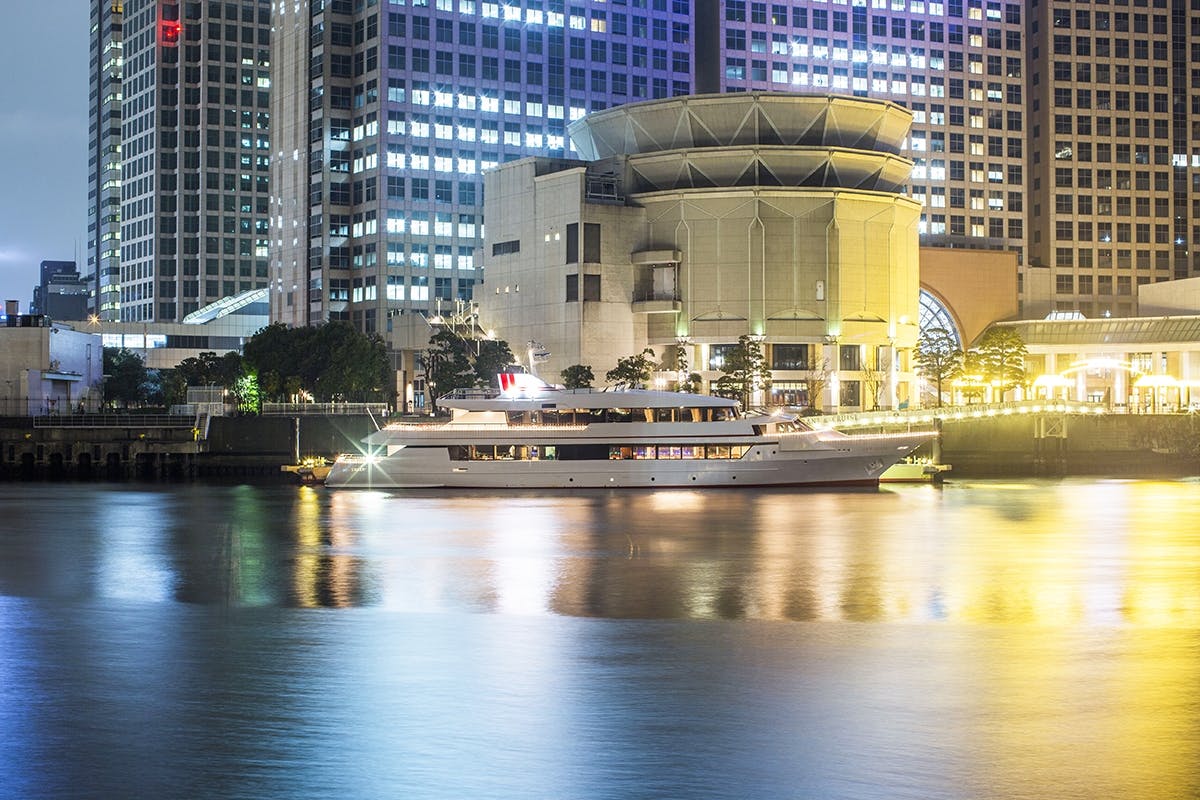
Tokyo Bay Cruising - Scenic Water Experience Japan Tokyo Bay Cruising combines sightseeing with the relaxed sense of movement that comes from a boat-based experience. Check current availability, inclusions and booking details before you go.
Yogyakarta: The Art of Practical Gamelan Music Class Indonesia Immerse yourself in the rich culture of Yogyakarta with this practical guide designed especially for beginners. You will learn to recognize the beat, tune the feel and immediately try playing the instrument
Parc des Princes is one of France’s most famous football stadiums and the long-time home of Paris Saint-Germain (PSG). Located in the 16th arrondissement of Paris, the stadium combines distinctive 1970s architecture, passionate football history and an excellent behind-the-scenes Stadium Tour.
The current Parc des Princes opened in 1972, while Paris Saint-Germain made it their permanent home in 1974. Today the stadium holds approximately 48,000 spectators and is known for its steep stands, excellent acoustics and intense atmosphere on match nights.
You do not need to attend a PSG match to explore the stadium. The official PSG Stadium Tour allows visitors to enter areas normally reserved for players, officials and VIP guests, including the dressing room, players’ tunnel, substitutes’ bench, press conference room and hospitality areas.
For football supporters visiting Paris, Parc des Princes is well worth adding to an itinerary, particularly because it is easy to reach by Metro from central Paris.
Parc des Princes at a Glance
Visitor Information
Details
Home club
Paris Saint-Germain
Address
24 Rue du Commandant Guilbaud, 75016 Paris
Current stadium opened
4 June 1972
PSG home since
1974
Capacity
Approximately 48,000
Classic Stadium Tour
Currently from approximately €28 per adult
Guided Tour
From approximately €37 per adult
Matchday Tour
From approximately €55 per adult
Children under 3
Free on the standard Stadium Tour
Nearest Metro
Porte de Saint-Cloud – Line 9
Alternative Metro
Porte d’Auteuil – Line 10
Recommended visit
1½–2 hours
Best for
Football fans, PSG supporters and families
A Brief History of Parc des Princes
The history of Parc des Princes began long before Paris Saint-Germain existed.
The first stadium on the site opened in 1897 as an outdoor cycling velodrome capable of holding around 3,000 spectators.
It became closely associated with cycling and was used as a finishing point for the Tour de France.
A larger stadium opened in 1932 with space for approximately 45,000 spectators and began accommodating other sports, including football and rugby.
The structure visitors see today is the third major version of Parc des Princes.
Architect Roger Taillibert designed the striking new stadium during the 1960s. It officially opened on 4 June 1972.
The Architecture of Parc des Princes
Even visitors who are not PSG supporters may find the stadium architecturally interesting.
Roger Taillibert created an unusual concrete structure with sweeping curved stands and distinctive external supporting ribs.
There are no conventional pillars obstructing views from the seating areas.
The steeply arranged stands also keep spectators unusually close to the playing field, creating the compact atmosphere for which Parc des Princes is famous.
The design contributes to the stadium’s impressive acoustics. On major match nights, crowd noise from the steep stands can make the stadium feel much larger than its approximately 48,000-seat capacity would suggest.
Paris Saint-Germain and Parc des Princes
Paris Saint-Germain was founded in 1970 and settled permanently at Parc des Princes in 1974.
Since then, the stadium has witnessed generations of celebrated PSG players, including:
Mustapha Dahleb
Safet Sušić
George Weah
Ronaldinho
Zlatan Ibrahimović
Edinson Cavani
Kylian Mbappé
PSG has now played more than 1,000 official matches at Parc des Princes.
The Modern Parc des Princes
Although the basic architecture remains recognisably from the 1970s, the interior has undergone substantial modernisation.
A major renovation completed before UEFA Euro 2016 involved an investment of approximately €75 million.
Improvements included:
47,929 replacement seats
Improved hospitality areas
New giant screens
Modern media facilities
HD Wi-Fi
Improved sightlines
Modernised VIP boxes and lounges
Updated pitch technology
The stadium retains Roger Taillibert’s distinctive external architecture while operating as a modern football venue.
PSG Stadium Tour
The Parc des Princes Stadium Tour is the best way to explore the stadium when PSG is not playing.
The standard Classic Tour provides access to areas that ordinary match ticket holders would normally never see.
The route currently includes highlights such as:
Upper stadium stands
VIP areas
Players’ dressing room
Players’ tunnel
Pitchside areas
Substitutes’ bench
Press conference room
Trophy displays
Jersey displays
Club memorabilia
The tour is designed to be immersive rather than simply a walk through an empty football stadium.
Visit the PSG Dressing Room
For many football fans, the PSG dressing room is one of the highlights.
This is one of the areas where some of the biggest names in world football have prepared before walking onto the pitch at Parc des Princes.
The dressing-room section provides a very different perspective from simply watching a match from the stands.
You are seeing the stadium from the players’ side of the experience.
Walk Through the Players’ Tunnel
The tour also follows the route taken by players towards the pitch.
Walking through the players’ tunnel is one of the most atmospheric moments of the visit.
You emerge towards the playing area with the steep stands surrounding you, providing a much better idea of what players experience immediately before kickoff.
Sit Beside the Pitch
Visitors can get close to the playing field and see the substitutes’ bench area.
This provides an excellent perspective on just how close supporters sit to the action at Parc des Princes.
The stadium’s compact design is one of the main reasons its atmosphere can be so intense during major matches.
Press Conference Room
The tour includes the press conference room, where players and coaches face journalists before and after important matches.
For visitors who regularly watch football press conferences on television, being inside the actual room makes an interesting addition to the tour.
PSG Trophy Display
Another major stop is the trophy area.
Following PSG’s recent European successes, the current Stadium Tour specifically includes the opportunity to see the club’s UEFA Champions League trophies.
The displays also help explain the development of PSG from a relatively young Parisian football club into one of Europe’s most internationally recognised teams.
Classic Stadium Tour
The Classic Tour is the best option for most visitors.
The current official booking page lists adult admission from approximately:
€28 per adult
Prices can vary according to date, promotion and ticket category, and PSG’s general pricing page sometimes lists promotional Classic Tour rates below the standard booking price.
Children under three can currently enter free, while reduced prices are available for certain younger visitors and seniors.
Advance booking is strongly recommended because visitor numbers are limited for each session.
Guided Stadium Tour
Visitors who want more background and explanation can choose the Guided Tour.
The current price starts at approximately:
€37 per adult
Guided tours operate in English and French and are conducted in smaller groups.
The guide accompanies visitors through the major stadium areas while explaining the history of Parc des Princes, Paris Saint-Germain and memorable events associated with the ground.
Current scheduling normally provides a limited number of guided departures each day, so advance booking is advisable.
Matchday Stadium Tour
One of the more unusual options is the Matchday Tour.
Rather than seeing an empty stadium on an ordinary day, this guided experience takes place as Parc des Princes prepares for a PSG home match.
The current price starts at approximately:
€55 per adult
The tour can include:
Press auditorium
Dressing room
Players’ tunnel
Presidential areas
Behind-the-scenes match preparations
Guided commentary in English or French
It gives you the opportunity to experience the building gradually changing from an empty stadium into a match venue.
The Matchday Tour does not automatically mean that you have a ticket to the football match afterwards. Check exactly what your booking includes.
Special Summer Experiences
PSG also operates seasonal experiences at Parc des Princes.
During summer 2026, these have included Night Sessions and the unusual Zippin’ Paris experience.
Zippin’ Paris allows visitors to finish their stadium experience with a zip line running across part of Parc des Princes.
For summer 2026, this experience has been scheduled through 16 August, while the Night Sessions programme ran from 22 July to 15 August.
These are seasonal offers rather than permanent attractions, so future visitors should check what is available for their dates.
How Long Does the Stadium Tour Take?
For the normal Stadium Tour, allow approximately 1 to 1½ hours inside the stadium.
I would allow around two hours in total so you are not rushing your arrival, photographs or time around the stadium.
If you intend to visit the PSG shop or have food afterwards, allow additional time.
Opening Hours
Parc des Princes Stadium Tours do not operate to one simple permanent timetable.
Availability changes according to:
PSG home matches
Football competitions
Stadium events
Special tours
Seasonal programmes
Private functions
The official PSG Stadium Tour website publishes a booking calendar showing available dates and entry times.
Always check the official calendar before travelling to the stadium.
This is particularly important during the football season, when match preparations can alter ordinary tour operations.
Book the Stadium Tour in Advance
PSG recommends purchasing tickets online before visiting.
Tickets can sometimes be purchased at the stadium subject to availability, but individual sessions have limited capacity.
Advance booking is especially sensible:
During school holidays
At weekends
During summer
When PSG has a home match nearby
When booking an English-language guided tour
Digital tickets displayed on a smartphone are accepted.
Attending a Paris Saint-Germain Match
A stadium tour is interesting, but watching PSG play at Parc des Princes provides a completely different experience.
The steep stands place supporters close to the field, while the enclosed architecture retains noise extremely effectively.
PSG home matches include competitions such as:
Ligue 1
UEFA Champions League
Domestic cup competitions
For match tickets, use the official Paris Saint-Germain ticketing system or authorised resale channels.
High-profile Champions League matches and fixtures against major Ligue 1 opponents can be significantly more expensive and difficult to obtain than ordinary league games.
Virage Auteuil
The Virage Auteuil is the part of Parc des Princes most closely associated with PSG’s organised and highly vocal supporters.
This is where much of the chanting, flags and coordinated support originates during matches.
Visitors wanting the strongest atmosphere may find this side of the stadium particularly interesting, although families or spectators wanting a quieter match may prefer seats elsewhere.
How to Reach Parc des Princes
The stadium is located at:
24 Rue du Commandant Guilbaud
75016 Paris
France
Public transport is usually the easiest way to reach the stadium.
Metro Line 9 – Porte de Saint-Cloud
Porte de Saint-Cloud on Metro Line 9 is generally the most convenient station.
From the station, Parc des Princes is only a short walk away.
Line 9 is particularly useful because it crosses a large section of Paris and connects with numerous other Metro lines.
Metro Line 10 – Porte d’Auteuil
The alternative is Porte d’Auteuil on Metro Line 10.
This station is also within walking distance of Parc des Princes and can be particularly convenient if you are travelling from the Left Bank.
PSG also lists Exelmans on Line 9 as another useful nearby station.
Should You Drive to Parc des Princes?
For most tourists, no.
Paris traffic and parking make the Metro considerably easier, particularly on match days.
If you do drive, the stadium is accessible from the Boulevard Périphérique via the Porte de Saint-Cloud or Porte d’Auteuil area.
Expect traffic around the stadium to become considerably heavier before and after major matches.
Parc des Princes With Children
The Stadium Tour is particularly suitable for families with children who follow football.
Instead of spending the entire visit looking through museum display cases, children can physically move through the stadium and see places they recognise from television.
Highlights for younger visitors usually include:
Dressing room
Players’ tunnel
Substitutes’ bench
Pitchside area
Trophy display
PSG shirts and memorabilia
The tour is officially promoted as a family-friendly experience, and children under three currently enter the standard tour free.
Accessibility
PSG provides specific arrangements for visitors with disabilities and directs visitors with accessibility requirements to its dedicated accessibility service.
Because the exact route can change according to the tour and stadium operations, visitors requiring step-free access or other assistance should check the current arrangements before booking.
Food at Parc des Princes
Food and drink are available during many Stadium Tour operating periods.
The current Stadium Tour catering area offers items including:
Burgers
Hot dogs
Nachos
Pancakes
Ice cream
Sweets
Cold drinks
Coffee
The Deck area provides views towards the stadium and pitch, making it a convenient place to stop after completing the tour.
Visit Roland-Garros
Parc des Princes is located close to another of Paris’s great sporting venues: Roland-Garros.
The tennis complex hosts the French Open each year and contains the famous Court Philippe-Chatrier.
If you are particularly interested in sport, Parc des Princes and Roland-Garros can be combined into the same part of a Paris itinerary.
Explore the Bois de Boulogne
The enormous Bois de Boulogne lies nearby and provides a complete contrast with the football stadium.
This extensive green area contains lakes, walking paths, gardens and recreational spaces.
It can be a pleasant addition if you are visiting the stadium on a good-weather day and want to explore western Paris afterwards.
A Good Half-Day Parc des Princes Itinerary
Morning – Travel to Porte de Saint-Cloud
Take Metro Line 9 and walk to Parc des Princes.
Stadium Tour
Allow approximately 1½ hours to explore the stands, dressing room, players’ tunnel, pitchside areas, press room and trophy displays.
Lunch
Have lunch around Porte de Saint-Cloud or inside the stadium if the catering area is operating.
Afternoon – Roland-Garros
Continue towards the Roland-Garros area or spend some time walking around the Bois de Boulogne.
You can then return to central Paris by Metro.
Where to Stay Near Parc des Princes
16th Arrondissement
Best for easy access to the stadium while remaining within Paris.
The 16th arrondissement is one of the quieter and more residential parts of the city.
It works well if you are attending a late PSG match and want to avoid travelling across Paris afterwards.
Boulogne-Billancourt
Best for accommodation close to Parc des Princes.
Boulogne-Billancourt begins immediately west of the stadium and has numerous hotels, restaurants and Metro connections.
It can be particularly practical if football or events at Parc des Princes are a major part of your visit.
Stay in Central Paris if Football Is Only One Attraction
If you are visiting Parc des Princes only once during a longer Paris holiday, there is little reason to choose your hotel solely because it is close to the stadium.
Paris Metro Line 9 makes the stadium straightforward to reach from many central neighbourhoods.
For most first-time visitors, staying centrally and travelling to Parc des Princes for the tour or match is the better option.
Stadium Tour or Match: Which Is Better?
The experiences are completely different.
Choose the Stadium Tour if you want:
Dressing-room access
Players’ tunnel access
Pitchside photographs
Substitutes’ bench
Trophy displays
PSG history
A relaxed visit
Choose a Match if you want:
Atmosphere
Supporter chants
Live football
Virage Auteuil displays
The full match-night experience
If you are a serious PSG supporter and your schedule allows it, do both.
Take the tour on a separate day so you can explore behind the scenes, then return for a match and see the same stadium filled with almost 48,000 supporters.
Is Parc des Princes Worth Visiting?
Yes, especially if you enjoy football.
Parc des Princes has a character quite different from many enormous modern stadiums.
Its approximately 48,000-seat capacity makes it relatively compact, while Roger Taillibert’s steep concrete design places spectators close to the playing field and creates excellent acoustics.
The Stadium Tour makes the visit worthwhile even when PSG is not playing.
You can walk through the dressing room, follow the players’ route through the tunnel, stand beside the pitch, see the substitutes’ bench, visit the press room and explore PSG’s trophy displays.
For most visitors, the Classic Tour currently priced from around €28 per adult provides everything needed for a first visit. Football enthusiasts wanting more explanation should consider the guided tour from approximately €37, while the Matchday Tour from €55 offers the unusual opportunity to see the stadium preparing for a PSG fixture.
Book ahead because tour availability changes according to matches and events, and use the Metro rather than driving. Porte de Saint-Cloud on Line 9 is normally the easiest station.
Allow around 1½ to 2 hours for the experience and consider combining the stadium with nearby Roland-Garros if you want to make a sporting half-day of your visit to western Paris.
Whether you follow Paris Saint-Germain passionately or simply enjoy visiting famous sporting venues, Parc des Princes provides an enjoyable look behind the scenes of one of European football’s most recognisable stadiums.
Sponsored Popular Items
Quick take: Musement.com offers a worldwide selection of tours and attractions
Parc des Princes Stadium Ticket with Paris Audio Guide France This Parc des Princes ticket gives football fans a behind-the-scenes look inside the home stadium of Paris Saint-Germain. Check current availability, inclusions and booking details before you go.
Princes Street Edinburgh – Guided Tours & Visitor Guide United Kingdom A listing may offer admission, a guided visit, transport, a combination package or premium access. Check current availability, inclusions and booking details before you go.
Princes' Island Ferry Round-Trip Ticket – Istanbul Guided Tour Turkey Princes' Island ferry round-trip ticket is a convenient way to add structure, local context and purposeful sightseeing to the itinerary. Check current availability, inclusions and booking details before you go.
A Guadiana River cruise is one of the most relaxing ways to discover the quieter eastern Algarve. Instead of the busy beaches and resort towns of Portugal’s southern coast, the cruise takes you inland through a landscape of rolling hills, small riverside villages and largely undeveloped countryside.
The River Guadiana forms much of the natural border between Portugal and Spain in this part of the Algarve. Cruises normally depart from Vila Real de Santo António, with Portugal on one side of the boat and Spain on the other as you travel upstream.
One of the most popular full-day cruises continues towards Foz de Odeleite, where passengers can explore a small riverside village before visiting Quinta do Rio for swimming, a traditional Algarve lunch, regional wine and live Portuguese entertainment.
For travellers who have already explored the Algarve’s beaches, a Guadiana cruise provides a completely different perspective on the region.
The standard full-day cruise currently lasts around eight hours, making it a relaxed day trip rather than simply a short sightseeing boat ride. :contentReference[oaicite:0]{index=0}
Guadiana River Cruise at a Glance
Visitor Information
Details
Main departure point
Vila Real de Santo António, eastern Algarve
Typical full-day duration
Around 8 hours
Current adult price
From approximately €66
Current child price
From approximately €36 for ages 4–12
Infants
Free with some operators
Typical destination
Foz de Odeleite and Quinta do Rio
Lunch
Included on many full-day cruises
Swimming
Included on some itineraries
Languages
English, Portuguese, Spanish and French available on some cruises
Best for
Scenery, relaxation, local culture, couples and families
One established operator currently lists its eight-hour cruise at €66 for adults, €36 for children aged 4–12 and free for infants aged three and under. Prices and operating dates can change, so confirm the actual itinerary and price before booking. :contentReference[oaicite:1]{index=1}
Where Is the Guadiana River?
The Guadiana is one of the Iberian Peninsula’s major rivers.
It begins in Spain and travels for approximately 850 kilometres before reaching the Atlantic Ocean between Vila Real de Santo António in Portugal and Ayamonte in Spain. :contentReference[oaicite:2]{index=2}
The lower section of the river forms an international boundary.
This makes a cruise particularly interesting because for much of the journey you are effectively sailing between two countries:
Portugal on the western bank
Spain on the eastern bank
The lower Guadiana feels dramatically different from the heavily developed central Algarve.
Once the boat leaves Vila Real de Santo António, urban development gradually gives way to open countryside, isolated homes, small settlements and low hills.
Where Does the Guadiana River Cruise Depart?
The most common departure point is Vila Real de Santo António, at the southeastern corner of Portugal.
The town stands beside the Guadiana close to the river’s mouth and directly opposite the Spanish town of Ayamonte.
One major cruise operator currently boards passengers from its riverfront kiosk on Avenida da República in Vila Real de Santo António.
The cruise returns to the same area at the end of the day. :contentReference[oaicite:3]{index=3}
What Happens on a Guadiana River Cruise?
Although itineraries vary between operators, one of the established full-day excursions follows a route from Vila Real de Santo António upstream towards Foz de Odeleite.
A typical day includes:
Morning departure from Vila Real de Santo António
Scenic cruise upstream between Portugal and Spain
Views of riverside countryside and villages
Optional guided walk at Foz de Odeleite
Swimming opportunity
Traditional Algarve lunch at Quinta do Rio
Regional red and white wine with lunch
Live Portuguese music and entertainment
Relaxed afternoon cruise back downstream
The complete excursion is designed as a leisurely day on the river rather than a fast sightseeing tour. :contentReference[oaicite:4]{index=4}
The Journey Up the Guadiana
The scenery is one of the major attractions.
Leaving Vila Real de Santo António, the boat heads away from the Atlantic and deeper into the countryside.
The river becomes increasingly rural as you travel north.
Look for:
Small riverside settlements
Fishing boats
Sailing yachts
Rolling hills
Traditional farms
Mediterranean vegetation
Birdlife
Occasional isolated houses
It is a very different Algarve from the high-rise hotels and beaches around some of the larger coastal resorts.
Portugal on One Side and Spain on the Other
One of the most enjoyable aspects of the trip is simply knowing that you are sailing along an international frontier.
The Guadiana separates the Portuguese Algarve from the Spanish province of Huelva.
You can therefore sit on the boat looking towards Portugal, turn your head and look across the water towards Spain.
Despite centuries of border history, today the river has a peaceful atmosphere dominated by fishing, leisure craft, small villages and natural scenery.
Foz de Odeleite
Many full-day Guadiana cruises stop at Foz de Odeleite.
This small settlement lies where the Odeleite River meets the Guadiana.
Some cruises include an optional guided walk through the village before passengers continue towards their lunch stop.
The village experience is deliberately low-key.
You are not visiting a major tourist attraction filled with souvenir stores and large monuments. Instead, the appeal lies in seeing one of the small communities that developed beside the Guadiana.
The current Riosultravel and Transguadiana itineraries both include a stop at Foz de Odeleite. :contentReference[oaicite:5]{index=5}
Quinta do Rio
One of the highlights of the popular full-day cruise is the stop at Quinta do Rio.
The private riverside property provides a place to leave the boat, relax and enjoy lunch surrounded by countryside.
Depending on conditions and the excursion selected, passengers may also have an opportunity to swim.
The standard lunch currently includes traditional Algarve food accompanied by regional red and white wine and mineral water. :contentReference[oaicite:6]{index=6}
Lunch and Live Portuguese Music
The lunch stop is intended to be part of the experience rather than simply a quick meal before returning to the boat.
Live Portuguese music and entertainment accompany lunch on the principal full-day itinerary.
This gives the excursion a social atmosphere and distinguishes it from a conventional sightseeing cruise where passengers remain seated on the boat for the entire day.
Extra drinks, coffee and tea may not be included in the base price, so check the inclusions when booking. :contentReference[oaicite:7]{index=7}
Swimming During the Cruise
Some full-day cruises provide an opportunity to swim during the stop near Quinta do Rio.
If you plan to swim, bring:
Swimwear
Towel
Sun protection
Change of clothing if desired
Towels are not included on at least one of the major current cruise itineraries. :contentReference[oaicite:8]{index=8}
The Return Cruise
After lunch, the boat travels back downstream towards Vila Real de Santo António.
This tends to be the most relaxed part of the day.
You can sit on the open upper deck enjoying the countryside or move into the lower saloon.
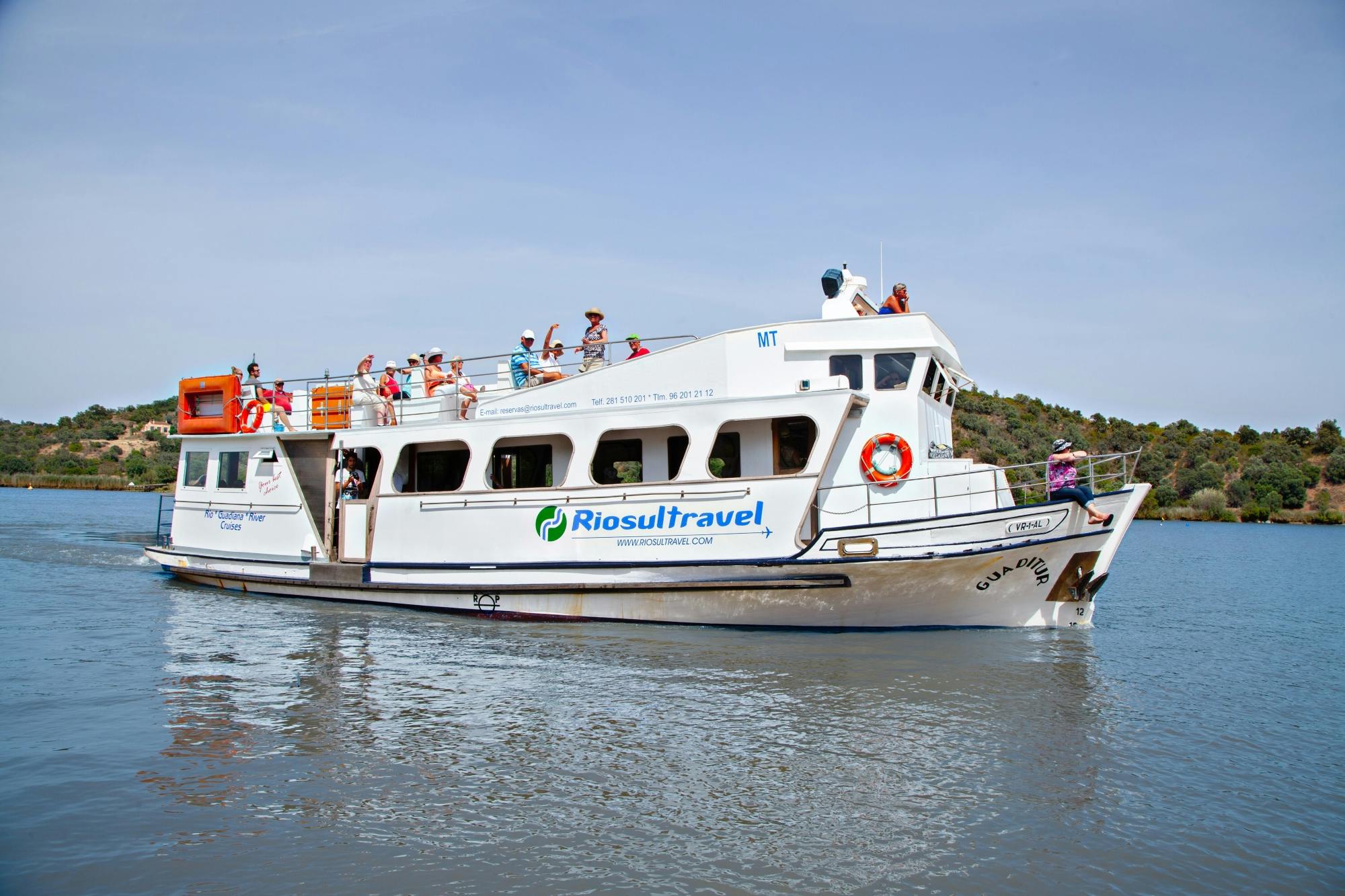
One of the main vessels currently used for Guadiana cruises has an open sightseeing deck, shaded area, lower saloon-bar, passenger toilets and side walkways. :contentReference[oaicite:9]{index=9}
Does the Cruise Go to Alcoutim?
Some Guadiana cruises do, but not all of them.
This is important when booking.
The popular eight-hour cruise described above travels towards Foz de Odeleite and Quinta do Rio.
Other operators offer routes farther upstream towards Alcoutim.
Therefore, do not assume that every excursion advertised as a “Guadiana River Cruise” follows the same route.
Check the destination before paying if Alcoutim is somewhere you particularly want to visit.
Alcoutim
Alcoutim is one of the most attractive villages of the lower Guadiana and is worth visiting either on a suitable cruise or as a separate excursion.
The village developed at an important point in the tidal river where vessels historically had to wait for suitable conditions before continuing downstream.
Its narrow streets retain the peaceful atmosphere of a traditional Algarve riverside settlement. :contentReference[oaicite:10]{index=10}
Places of interest include:
Alcoutim Castle
The riverside
Historic churches
Small marina
River beach
Across the river is Spain, making Alcoutim another place where the international character of the Guadiana is particularly obvious.
A River With a History of Smuggling
The border between Portugal and Spain was not always as easy to cross as it is today.
For generations, remote parts of the Guadiana became associated with informal trade and smuggling between communities on opposite riverbanks.
Goods could be moved quietly across the river between Portugal and Spain, particularly when economic conditions and prices differed significantly between the two countries.
Several modern tours make reference to this border history, and some excursions are specifically marketed around the old smugglers’ routes.
Wildlife Along the Lower Guadiana
The river mouth is close to the Castro Marim and Vila Real de Santo António Marsh Natural Reserve.
The Guadiana reaches this low-lying landscape shortly before flowing into the Atlantic, creating creeks, marshes, lagoons and salt pans.
The wetlands provide important habitat for fish, shellfish and numerous birds.
Birds found within the reserve include:
Flamingos
White storks
Black-winged stilts
Numerous other wetland species
Visit Portugal notes that birds can be observed within the reserve throughout the year. :contentReference[oaicite:11]{index=11}
The Salt Pans of the Eastern Algarve
Salt production has played an important role in this part of the Algarve for centuries.
Salt pans occupy a substantial part of the protected wetlands around Castro Marim and Vila Real de Santo António, and traditional salt production continues today. :contentReference[oaicite:12]{index=12}
If you are staying in the area for several days, the nature reserve and salt pans make an interesting contrast with the river cruise.
How Much Does a Guadiana River Cruise Cost?
Current 2026 prices vary according to operator and itinerary.
One of the principal eight-hour full-day cruises currently lists:
Passenger
Current Price
Adult aged 13+
From €66
Child aged 4–12
From €36
Infant aged 0–3
Free
The price includes the cruise, lunch, wine and mineral water with lunch, entertainment and the optional village walk on the itinerary described above. :contentReference[oaicite:13]{index=13}
Another established Guadiana cruise operator currently advertises a similar full-day excursion at €66 for adults and €36 for children. :contentReference[oaicite:14]{index=14}
Always check the final price when booking because transfers, private tours and optional extras can cost more.
Book Ahead
Advance booking is recommended.
Guadiana cruises do not necessarily operate every day of the year, and schedules vary according to season, demand, weather and operator.
This is particularly important if you are visiting the eastern Algarve specifically to take the cruise.
Do not travel a long distance to Vila Real de Santo António without first confirming that your chosen boat is operating.
What Is Included?
On the current eight-hour Riosultravel excursion, the published inclusions are:
Full-day Guadiana River cruise
Open upper sightseeing deck
Lower saloon-bar
Traditional lunch
Red wine
White wine
Mineral water with lunch
Live Portuguese music and entertainment
Optional guided village walk
Extra drinks, coffee, tea, towels, sunscreen and footwear are not included. :contentReference[oaicite:15]{index=15}
What Should You Bring?
Comfortable clothing
Sun hat
Sunscreen
Sunglasses
Comfortable shoes for the village walk
Swimwear
Towel
Camera or phone
Light layer for cooler or breezy conditions
Water for additional hydration
Even when temperatures on land are very warm, the open deck can feel noticeably cooler when the boat is moving.
Best Time of Year for a Guadiana Cruise
Spring
One of the best periods.
Temperatures are generally comfortable, the countryside can be greener and conditions are well suited to spending several hours outdoors.
Summer
Summer provides reliably warm conditions but temperatures in inland Algarve areas can become very high.
Bring strong sun protection and plenty of water.
The swimming opportunity at the lunch stop can be particularly welcome during July and August.
September and October
Another excellent period.
The weather is often warm while the extreme heat of midsummer becomes less likely.
Winter
Boat schedules are generally more limited and weather is less predictable.
Check availability before planning your journey around a winter cruise.
Is the Guadiana Cruise Suitable for Children?
For many families, yes.
The day involves relatively little strenuous activity and combines time on the boat with a village stop, swimming and lunch.
Children who become restless during long boat journeys may find the stop at Quinta do Rio particularly useful.
Parents should check current age rules, safety arrangements and swimming supervision with the chosen operator before booking.
Is It Suitable for Older Travellers?
A Guadiana cruise can be a very good option for travellers who want to see the Algarve without undertaking a strenuous walking tour.
Most of the day is spent sitting on the boat or relaxing during the lunch stop.
However, boarding boats and walking through small villages may involve steps or uneven surfaces.
If mobility is limited, contact the cruise company before booking and explain your requirements.
Vila Real de Santo António
Do not rush away immediately after the cruise.
Vila Real de Santo António is worth exploring in its own right.
The riverside town was largely planned and rebuilt during the 18th century and has a more orderly street pattern than many older Algarve settlements.
Its riverfront is ideal for an evening stroll after returning from the cruise. Visit Portugal particularly highlights the former Customs House and gardens beside the Guadiana. :contentReference[oaicite:16]{index=16}
Take the Ferry to Spain
Another enjoyable excursion is the ferry across the Guadiana between Vila Real de Santo António and Ayamonte.
This is a transport ferry rather than a sightseeing cruise, but it provides an easy way to visit Spain while staying in Portugal.
Transporte Fluvial del Guadiana currently operates the cross-border ferry and also offers separate river cruises and charter trips. :contentReference[oaicite:17]{index=17}
Remember that mainland Spain is normally one hour ahead of Portugal, so take the time difference into account when checking return transport.
Monte Gordo
Monte Gordo is one of the most convenient beach resorts for travellers taking a Guadiana cruise.
It lies only a short distance west of Vila Real de Santo António and offers:
Long sandy beach
Hotels
Holiday apartments
Restaurants
Cafés
Easy access to Vila Real de Santo António
Some tour operators can arrange pickup and drop-off services, although these should be confirmed at the time of booking. :contentReference[oaicite:18]{index=18}
Castro Marim
Castro Marim is another worthwhile nearby destination.
The town’s castle provides panoramic views over the surrounding salt marshes and towards the mouth of the Guadiana.
The area is particularly interesting for visitors who enjoy:
Birdwatching
Walking
Historic castles
Salt production
Wetland landscapes
Portugal’s official tourism organisation also notes that organised boat trips on the Guadiana are a popular local activity, with many incorporating regional food. :contentReference[oaicite:19]{index=19}
Where to Stay for a Guadiana River Cruise
Vila Real de Santo António
Best overall choice.
Stay here if the cruise is a priority.
You will be within easy reach of the departure point and can explore the riverfront before and after the excursion.
Monte Gordo
Best for combining the cruise with a beach holiday.
Monte Gordo has a larger concentration of resort-style accommodation and a long sandy beach while remaining close to Vila Real de Santo António.
Castro Marim
Best for nature and history.
This quieter alternative works well for visitors interested in the nature reserve, castle and salt pans.
Alcoutim
Best for a peaceful inland Algarve experience.
Alcoutim is much quieter than the coastal resorts and provides a completely different atmosphere beside the upper section of the lower Guadiana.
Its steep streets, castle and riverfront make it particularly appealing for a slow-travel itinerary. :contentReference[oaicite:20]{index=20}
A Good Two-Day Guadiana Itinerary
Day 1 – Guadiana River Cruise
Arrive in Vila Real de Santo António before departure.
Spend the day cruising upstream, visiting Foz de Odeleite and enjoying lunch at Quinta do Rio.
After returning, walk along the Vila Real de Santo António riverfront and have dinner in town or nearby Monte Gordo.
Day 2 – Border and Nature
Spend the morning exploring Castro Marim and the surrounding salt-marsh landscape.
Later, return to Vila Real de Santo António and take the passenger ferry across the river for a visit to the Spanish side if ferry times suit your itinerary.
Guadiana Cruise or Algarve Coastal Cruise?
The experience is quite different from a typical Algarve coastal boat trip.
Choose a Guadiana River Cruise if you prefer:
Peaceful river scenery
Small villages
Portuguese culture
Lunch and wine
Relaxed sightseeing
Portugal and Spain in the same landscape
Choose an Algarve Coastal Cruise if you prefer:
Sea caves
Cliffs
Atlantic beaches
Faster boats
Marine wildlife excursions
Ocean swimming
If you have enough time, the two experiences complement each other very well.
Is a Guadiana River Cruise Worth Doing?
Yes, especially if you want to see a quieter side of the Algarve.
The cruise is not about dramatic cliffs or famous monuments.
Its attraction is the pace of the day.
You leave Vila Real de Santo António and gradually travel away from the busy coast, following a river that has shaped the history and geography of both Portugal and Spain.
Small villages appear beside the water, hills replace beach resorts and much of the landscape remains rural.
The popular full-day itinerary adds enough variety to keep the experience interesting: a scenic cruise, optional village walk, swimming, traditional lunch, Portuguese wine and live entertainment. :contentReference[oaicite:21]{index=21}
For most visitors, the best option is to stay around Vila Real de Santo António or Monte Gordo, book the cruise in advance and allow the entire day rather than planning another major activity afterwards.
Most importantly, check exactly which cruise you are booking. Some Guadiana excursions travel to Foz de Odeleite and Quinta do Rio, while others continue farther towards Alcoutim.
Choose the itinerary that matches what you want to see, then settle onto the deck and enjoy one of the Algarve’s most peaceful journeys.
Sponsored Popular Items
Quick take: Musement.com offers a worldwide selection of tours and attractions
Small-Group Sunset Guadiana River Cruise Spain Unwind at the end of the day on a relaxed sunset cruise along the Guadiana River, the natural border between Spain and Portugal. Check current availability, inclusions and booking details before you go.
Small-group Guadiana River cultural cruise Spain Plan Small-group Guadiana River cultural cruise, a water-based experience, with practical tips on timing, inclusions and what to check before booking. Compare current availability, prices and booking conditions before you go.
Guadiana River cruise with barbecue – Scenic Water Experience Portugal As the natural border between Spain and Portugal, the River Guadiana cuts through areas of natural beauty. Check current availability, inclusions and booking details before you go.
The Space Needle is Seattle’s most recognisable landmark and one of the defining symbols of the Pacific Northwest. Rising above Seattle Center, the futuristic tower was built for the 1962 World’s Fair and continues to provide some of the best panoramic views in the city.
At 605 feet tall, the Space Needle offers two main observation levels, including an outdoor viewing deck at 520 feet and The Loupe, the world’s first and only revolving glass floor, at 500 feet.
On a clear day, visitors can see across downtown Seattle, Puget Sound, Lake Union, the Olympic Mountains, the Cascade Range and potentially Mount Rainier rising dramatically in the distance.
The Space Needle sits within Seattle Center, making it extremely easy to combine with Chihuly Garden and Glass, the Museum of Pop Culture, the International Fountain and other nearby attractions.
Seattle Space Needle at a Glance
Visitor Information
Details
Location
Seattle Center, Seattle, Washington
Address
400 Broad Street, Seattle, WA 98109
Height
605 feet / approximately 184 metres
Opened
21 April 1962
Upper observation level
520 feet / approximately 158 metres
The Loupe glass floor
500 feet / approximately 152 metres
2026 general admission
US$35–US$55 depending on date and time
Space Needle + Chihuly combo
US$74
Children aged 4 and under
Free
Recommended visit
1–2 hours
Best time
Late afternoon through sunset
Best nearby attractions
Chihuly Garden and Glass and Museum of Pop Culture
Why Was the Space Needle Built?
The Space Needle was created as the architectural centrepiece of the 1962 Seattle World’s Fair, officially known as the Century 21 Exposition.
The fair’s theme was “The Age of Space”, reflecting the enormous international excitement surrounding science, technology and space exploration during the early 1960s.
Seattle hotel executive Edward E. Carlson helped organise the fair and conceived the idea for a tower after seeing a broadcast tower during a trip to Stuttgart, Germany, in 1959.
He sketched his initial idea on a napkin.
That rough drawing eventually evolved into the futuristic tower that now defines Seattle’s skyline.
The Space Needle Is 605 Feet Tall
The finished Space Needle rises 605 feet above Seattle.
The saucer-shaped top house sits around 520 feet above ground and contains the primary observation areas.
When it opened on 21 April 1962, the tower perfectly captured the Space Age optimism of the period.
More than six decades later, its unusual shape still appears surprisingly futuristic.
Ride the Glass Skyliner Elevator
The journey to the observation level has become part of the attraction itself.
The Space Needle’s new Skyliner elevator opened in 2025 as part of the tower’s long-term elevator modernisation project.
It is described by the Space Needle as the first all-glass, double-deck outdoor elevator in North America and the first of its kind on a tower anywhere in the world.
The elevator travels at speeds of up to approximately 10 miles per hour and reaches the observation level in about 41 seconds.
The floor-to-ceiling glass allows views of Seattle to expand dramatically as you climb.
The 520-Foot Observation Deck
The main observation level sits approximately 520 feet above Seattle.
Visitors can move between indoor viewing areas and an open-air deck surrounded by large glass panels.
The modern design provides almost uninterrupted 360-degree views.
Depending on the weather, you may be able to see:
Downtown Seattle
Puget Sound
Lake Union
Mount Rainier
The Cascade Mountains
The Olympic Mountains
Elliott Bay
Seattle’s waterfront
Seattle’s changeable weather means the view can be completely different from one day to another.
Try the Skyriser Glass Benches
One of the more unusual features of the outdoor observation deck is the series of Skyriser glass benches.
These transparent benches are attached to outward-leaning glass walls.
You sit facing into the observation deck while leaning backwards towards the Seattle skyline, creating the impression that you are suspended above the city.
They are particularly popular for photographs.
If heights make you uncomfortable, you can enjoy the same panorama without using them.
The Loupe: The Revolving Glass Floor
The most distinctive modern feature of the Space Needle is The Loupe.
Located at approximately 500 feet above ground, it is the world’s first and only revolving glass floor.
Rather than looking only across the skyline, you can look directly downward through the floor at the Space Needle’s steel structure and the city far below.
The floor rotates slowly using a mechanical system powered by multiple motors.
You can even see parts of the mechanism through the glass.
Is the Glass Floor Safe?
Yes.
The Loupe was engineered specifically for heavy visitor use.
The rotating floor contains multiple layers of structural glass and weighs approximately 37 tons.
The glass system was designed with substantial safety redundancy and load capacity.
Of course, knowing this does not necessarily stop your brain from reacting when you first step onto transparent glass 500 feet above the ground.
The Oculus Staircase
The upper observation level and The Loupe are connected by the dramatic Oculus Staircase.
The circular staircase incorporates wood, steel and glass.
At its base is another transparent section allowing visitors to look directly down through the structure of the Space Needle.
Take your time rather than simply treating the staircase as a route between floors.
It has become an architectural feature in its own right.
The Space Needle’s Major Renovation
The Space Needle underwent its most extensive renovation beginning in 2017.
Known as the Century Project, the privately funded redevelopment transformed the viewing experience while retaining the tower’s historic architectural character.
Major changes included:
Floor-to-ceiling glass
New outdoor glass barriers
Skyriser glass benches
The Oculus Staircase
The Loupe revolving glass floor
Structural and seismic improvements
Modernised elevators
The renovation used more than 176 tons of glass.
Is There Still a Revolving Restaurant?
No.
This is worth knowing because many older Seattle travel guides still mention the Space Needle’s revolving restaurant.
The former SkyCity Restaurant closed in September 2017 as part of the major renovation.
There is currently no traditional full-service revolving restaurant at the Space Needle.
However, there are several food and drink options within the observation levels.
The Revolving Bar
A walk-up bar operates on The Loupe level, allowing visitors to enjoy a drink while standing above the revolving glass floor.
Offerings can include cocktails, local beer and wine.
The combination of a slowly moving floor and panoramic Seattle views makes this considerably more unusual than an ordinary observation-deck bar.
TipTop Cafe
The upper observation level contains the TipTop Cafe.
It provides a more casual option for snacks, drinks and desserts without requiring a separate restaurant reservation.
If your main priority is the view rather than a full meal, this can be a convenient way to stay at the top longer.
The Loupe Lounge
The Loupe Lounge operates seasonally and offers a more substantial food-and-drink experience on the revolving glass floor.
The Space Needle currently states that the lounge normally operates between fall and spring.
If this experience interests you, check whether it is operating during your visit rather than assuming it is available year-round.
Current 2026 Space Needle Ticket Prices
Space Needle admission uses variable pricing.
Current general admission prices range from approximately:
US$35 to US$55 per person
The exact amount depends on the date, season and time of day.
Sunset and other popular times can cost more.
Discounts are available for:
Youth aged 5–12
Seniors aged 65 and over
Qualifying military visitors
King County residents
Some groups and special programmes
Children aged four and under enter free.
Space Needle and Chihuly Combination Ticket
One of the best-value options for many visitors is the combination ticket covering:
Space Needle
Chihuly Garden and Glass
IMAX at the Center
The current combination ticket costs approximately US$74.
The attractions are only steps apart, making this one of Seattle’s easiest sightseeing combinations.
Should You Buy Tickets in Advance?
Yes, particularly if you want a specific time.
The Space Needle uses timed entry.
Current admission slots are scheduled at regular intervals throughout the day.
Tickets can be purchased:
Online
By mobile device
At the on-site ticket office
At self-service kiosks
Visitors who buy in advance generally save time, while same-day walk-up tickets are subject to availability and possible waits.
How Long Can You Stay?
Your ticket gives you a scheduled arrival time, but it does not limit you to a short visit once you reach the observation levels.
After entering, you can remain on the upper observation level and The Loupe until the Space Needle closes for the day.
This is particularly useful for sunset visits because you can arrive while it is still daylight and remain until after the city lights appear.
How Long Should You Allow?
45–60 Minutes
Enough for a relatively quick visit to both observation levels.
1–1½ Hours
Best for most visitors.
This provides enough time for the views, Skyrisers, glass floor, photographs and a drink or snack.
2 Hours or More
Worthwhile if you arrive before sunset and want to watch Seattle change from daylight to night.
What Is the Best Time to Visit the Space Needle?
Morning
Best for potentially clearer visibility and smaller crowds.
Morning can be particularly attractive if Mount Rainier and the surrounding mountains are your priority.
Afternoon
A convenient option if you are spending the rest of the day exploring Seattle Center.
Sunset
Arguably the best overall experience.
Book an entry time before sunset and you may be able to see Seattle in daylight, watch the sky change colour and then remain as the downtown skyline begins to illuminate.
Sunset is popular, so advance reservations are particularly worthwhile.
Night
The experience becomes completely different after dark.
Instead of mountain views, the focus shifts towards the lights of downtown Seattle, surrounding neighbourhoods and traffic moving through the city.
What Happens if the Weather Is Cloudy?
Seattle weather can be unpredictable.
Cloud, rain and mist occasionally reduce the long-distance views significantly.
If Mount Rainier is completely hidden, you can still enjoy:
Downtown skyline views
The revolving glass floor
The Skyriser benches
The architecture of the tower
The nearby Seattle Center campus
If the weather forecast is flexible and panoramic views are your main priority, choose the clearest day available during your Seattle stay.
Mount Rainier From the Space Needle
On a clear day, Mount Rainier is one of the great highlights of the view.
The enormous volcano rises southeast of Seattle and can appear to tower above the surrounding landscape when atmospheric conditions are good.
It is much farther away than photographs sometimes make it appear, and cloud often hides it completely.
Seattle locals sometimes describe a particularly clear day by saying, “The mountain is out.”
Chihuly Garden and Glass
If you visit only one other attraction at Seattle Center, make it Chihuly Garden and Glass.
The exhibition celebrates the work of Washington-born glass artist Dale Chihuly.
It contains:
Eight galleries
Large-scale glass installations
The spectacular Glasshouse
An outdoor garden incorporating colourful glass artworks
The entrance is only steps from the Space Needle.
Current 2026 standard admission is approximately US$40–US$45, while the combination ticket with the Space Needle and IMAX costs US$74.
Museum of Pop Culture
The Museum of Pop Culture, or MOPOP, stands almost directly beside the Space Needle.
Its unusual flowing building was designed by architect Frank Gehry and is itself worth seeing from the outside.
Inside, exhibitions explore subjects including:
Popular music
Film
Science fiction
Fantasy
Horror
Video games
Contemporary popular culture
MOPOP currently opens daily and is located at 325 Fifth Avenue North within Seattle Center.
International Fountain
The International Fountain is another surviving feature of the 1962 World’s Fair.
It sits within a large open lawn area at Seattle Center and provides an easy free attraction between museum visits.
The fountain was originally designed around themes of space exploration, matching the futuristic spirit of the World’s Fair.
Climate Pledge Arena
Climate Pledge Arena is also part of Seattle Center.
The building incorporates the historic roofline of the arena originally constructed for the 1962 World’s Fair while containing an extensively redeveloped modern venue beneath it.
Today it hosts major concerts and sporting events.
If an event is taking place on the evening of your Space Needle visit, expect Seattle Center and surrounding restaurants to become considerably busier.
A Good Half-Day at Seattle Center
9:00 am – Space Needle
Begin with the tower while conditions may be clearer and crowds lighter.
10:30 am – Chihuly Garden and Glass
Allow approximately 1½ hours.
Noon – Seattle Center Armory
Stop for lunch at one of the food outlets inside the Armory.
1:00 pm – Museum of Pop Culture
Spend the afternoon exploring MOPOP.
This itinerary allows you to experience three very different Seattle attractions without needing a car or public transport between them.
A Good Sunset Visit
Another excellent approach is to spend your morning around downtown Seattle and return to Seattle Center later.
Afternoon – Chihuly Garden and Glass
Explore the galleries and garden.
Early Evening – Dinner or Drink
Have a meal around Seattle Center or Uptown.
Before Sunset – Space Needle
Enter approximately 45–60 minutes before sunset.
Enjoy the views during daylight and remain as the city changes after dark.
This is one of the best ways to experience the Space Needle.
How to Reach the Space Needle
The Space Needle is located at:
400 Broad Street
Seattle, WA 98109
It sits within Seattle Center, north of the main downtown commercial district.
Seattle Center Monorail
One of the easiest and most enjoyable ways to reach the Space Needle from downtown is the Seattle Center Monorail.
The monorail connects:
Westlake Center in downtown Seattle → Seattle Center
The journey takes less than two minutes.
The Seattle Center station is immediately beside the Space Needle and MOPOP.
The monorail is particularly useful if you are staying around downtown, Pike Place Market or Westlake.
Current 2026 Monorail Hours
During the current summer operating period through early September 2026, the normal schedule is:
Monday–Friday: 7:30 am–11:00 pm
Saturday–Sunday: 8:30 am–11:00 pm
Hours are frequently extended for concerts and sporting events at Seattle Center.
From after Labor Day through the following spring, the regular timetable becomes shorter on some weekdays and Sundays.
Walking From Downtown
You can also walk to the Space Needle from central Seattle.
From the Westlake and northern downtown area, the walk is relatively straightforward.
If you are staying around Pike Place Market, allow roughly 20–30 minutes depending on your route and walking pace.
The monorail is faster, but walking gives you a better sense of Seattle’s neighbourhoods.
Driving and Parking
Parking garages and paid parking areas are available around Seattle Center, but a car is unnecessary if you are already staying downtown.
Traffic can become heavier when Climate Pledge Arena hosts a major event.
If your hotel is centrally located, walking or using the monorail is often easier than driving and paying for parking.
Accessibility
The Space Needle has made significant improvements to accessibility through its renovation.
Current facilities include lifts providing access to both the upper observation level and revolving glass-floor level.
Mobility scooters are permitted.
Because the tower is a historic structure, not every individual area has identical accessibility, so visitors with specific requirements may wish to check arrangements before arrival.
Can You Bring a Stroller?
Strollers cannot be taken through the main Space Needle visitor experience because of limited elevator space.
They need to be left in the designated stroller area or elsewhere before entry.
Infant car seats are permitted.
Can You Take Photographs?
Yes.
Photography is strongly encouraged.
The Space Needle also includes complimentary digital photo experiences with general admission.
Current admission includes professional-style digital photo opportunities such as welcome photographs and high-level selfies.
Can You Bring a Water Bottle?
Plastic and metal water bottles are allowed.
Glass containers are prohibited.
Water-bottle filling stations are available at the top.
Where to Stay Near the Space Needle
Uptown / Lower Queen Anne
Best for being closest to the Space Needle.
Stay here if you want to walk to:
Space Needle
Chihuly Garden and Glass
MOPOP
Climate Pledge Arena
Seattle Center
The area has numerous restaurants and is particularly convenient if you are attending a concert or sporting event.
Belltown
Best compromise between Seattle Center and downtown.
Belltown lies between the Space Needle and Pike Place Market.
Staying here allows you to walk in either direction and gives easy access to restaurants and nightlife.
Downtown / Westlake
Best for first-time visitors.
This area provides easy access to:
Seattle Center Monorail
Pike Place Market
Seattle waterfront
Downtown shopping
Light rail
The monorail makes reaching the Space Needle particularly easy.
Pike Place Market Area
Best for classic Seattle atmosphere.
Staying close to Pike Place Market places you near the waterfront while keeping Seattle Center within walking or monorail distance.
This is one of the strongest locations for travellers visiting Seattle for the first time.
Space Needle for Cruise Passengers
The Space Needle is particularly convenient for visitors arriving on an Alaska cruise because Seattle’s cruise terminals are relatively close to Seattle Center.
Passengers using Pier 66 are especially well positioned for downtown sightseeing.
If you have several hours before embarkation or after disembarking, the Space Needle can easily be combined with Chihuly Garden and Glass.
However, allow plenty of time for luggage storage, transport and returning to your ship.
Space Needle or Columbia Center?
Seattle has other high-level viewpoints, but the Space Needle provides something different.
The main advantage is that you are visiting an internationally recognised landmark rather than simply observing Seattle from a tall building.
The Space Needle also provides:
Outdoor viewing
The Loupe revolving glass floor
Skyriser glass benches
A glass elevator experience
Direct access to Seattle Center attractions
If panoramic height alone is your priority, other viewpoints may compete with it.
If you want the classic Seattle experience, the Space Needle remains the obvious choice.
Is the Space Needle Worth Visiting?
Yes, particularly on a clear day.
The Space Needle is undeniably one of Seattle’s major tourist attractions, but its appeal goes beyond simply checking off a famous landmark.
The 2017–2018 renovation transformed the old observation deck into a much more interesting experience, adding enormous glass walls, leaning glass benches and the extraordinary revolving glass floor.
You can now move between a 520-foot indoor and outdoor observation level and The Loupe at 500 feet, while looking across Puget Sound, downtown Seattle and the surrounding mountain ranges.
For the best first visit, book your timed ticket in advance and aim for late afternoon or approximately an hour before sunset.
If the weather is clear, you can see the city and mountains in daylight, watch the sky change colour and stay until Seattle begins illuminating below you.
Allow around 1–1½ hours for the Space Needle itself.
Then take advantage of its location. Chihuly Garden and Glass is immediately beside the tower, MOPOP is only steps away and the Seattle Center Monorail can return you to downtown in less than two minutes.
That combination makes the Space Needle much more than an isolated observation tower. It sits at the centre of one of Seattle’s easiest and most enjoyable sightseeing districts.
Sponsored Popular Items
Quick take: Musement.com offers a worldwide selection of tours and attractions
Seattle Space Needle and Chihuly Garden and Glass Combo Ticket United States Combine panoramic views from Seattle's Space Needle with the colourful glass installations of Chihuly Garden and Glass. Check current availability, inclusions and booking details before you go.
Seattle Space Needle tickets United States Plan Seattle Space Needle tickets, a water-based experience, with practical tips on timing, inclusions and what to check before booking. Compare current availability, prices and booking conditions before you go.
Seattle's Space Needle Area Self-Guided Walking Tour - Wellness Experience Seattle's Space Needle Area Self-Guided Walking Tour combines independent exploration with recorded commentary, allowing travellers to discover Seattle at their own pace. Check current availability, inclusions and booking details before you go.
Kennedy Space Center Visitor Complex is one of Florida’s most fascinating attractions and one of the few places where visitors can explore the history of human spaceflight while looking across an active spaceport that continues to launch rockets today.
Located on Merritt Island on Florida’s Space Coast, Kennedy Space Center has been central to the American space program since the 1960s. Apollo astronauts departed from here for the Moon, every Space Shuttle mission was launched from Kennedy, and the spaceport now supports NASA’s Artemis program alongside commercial launch operations.
The Visitor Complex brings that history together through real spacecraft, enormous rockets, interactive exhibits, simulators, astronaut presentations and a bus tour that travels behind NASA’s restricted gates.
This is not an attraction that should be rushed. For most first-time visitors, allow a full day. Space enthusiasts and families who want to experience almost everything should seriously consider the two-day ticket.
Kennedy Space Center at a Glance
Visitor Information
Details
Location
Merritt Island, Florida
Nearest towns
Titusville, Cape Canaveral and Cocoa Beach
Distance from Orlando
Approximately 50 miles / 80 kilometres by road
2026 adult one-day admission
US$77 plus applicable tax
2026 child one-day admission
US$67 for ages 3–11 plus applicable tax
Two-day adult admission
US$91 plus applicable tax
Two-day child admission
US$81 for ages 3–11 plus applicable tax
Current opening hours
9:00 am–5:00 pm through 13 December 2026
Recommended visit
Full day
Best for
Space exploration, NASA history, families, science and technology
Kennedy Space Center or Kennedy Space Center Visitor Complex?
There is an important distinction.
Kennedy Space Center is the enormous working NASA facility containing launch pads, the Vehicle Assembly Building and numerous operational facilities.
Kennedy Space Center Visitor Complex is the public attraction where tourists enter.
When using GPS navigation, search specifically for “Kennedy Space Center Visitor Complex”.
The official visitor information warns that simply entering “Kennedy Space Center” into a navigation system can direct motorists to the wrong location.
The visitor entrance is on Space Commerce Way, Merritt Island, Florida 32953.
Why Kennedy Space Center Is Historically Important
NASA established the Launch Operations Center on Merritt Island in 1962. It was renamed the John F. Kennedy Space Center in December 1963 following President Kennedy’s assassination.
Kennedy subsequently became the launch site for many of America’s most important human spaceflight missions.
Its history includes:
The Apollo lunar program
Skylab
Apollo-Soyuz
All 135 Space Shuttle launches
International Space Station assembly missions
Commercial Crew launches
NASA’s Artemis lunar exploration program
This history is what makes Kennedy different from a conventional science museum.
You are exploring exhibits about events that actually happened only a short distance from where you are standing.
Start With the Kennedy Space Center Bus Tour
One of the most important pieces of advice for a first visit is simple:
Do not leave the Kennedy Space Center Bus Tour until late in the day.
The bus tour is included with normal admission and takes visitors beyond the main Visitor Complex and through NASA-controlled areas.
The current tour includes stops at:
The Gantry at LC-39
Apollo/Saturn V Center
The Visitor Complex recommends allowing approximately three hours for the complete bus experience, including time at both stops.
How the Bus Tour Works
The bus tour uses a virtual queue system during current operations.
After entering the Visitor Complex, visitors scan an on-site QR code using a mobile device to reserve a position in the queue.
You can then continue exploring other attractions while waiting to be called.
When your turn arrives, you receive an alert and proceed to the physical bus line.
The last bus normally departs approximately 2½ hours before the Visitor Complex closes.
This is another reason to organise the bus tour early.
The Gantry at LC-39
The Gantry at LC-39 is one of the newest major attractions at Kennedy Space Center.
Opened as part of the expanded bus tour, it provides panoramic views across the working spaceport and nearby launch complexes.
Visitors can look towards active launch pads while learning about rocket technology, NASA science and the unusual relationship between space exploration and the surrounding natural environment.
Highlights include:
360-degree spaceport views
Launch-pad views
NASA Earth Information Center
Interactive rocket-building displays
Outdoor launch-viewing areas
Exhibits about the Merritt Island National Wildlife Refuge
The attraction provides an excellent reminder that Kennedy Space Center is both a major technological facility and part of an extensive wildlife environment.
A Space Center Surrounded by Wildlife
One of the most surprising things about Kennedy Space Center is how much undeveloped land surrounds the launch facilities.
Kennedy shares its environment with the Merritt Island National Wildlife Refuge.
NASA has documented more than 300 bird species along with numerous mammals, fish, reptiles and amphibians in the surrounding refuge.
During the bus tour, keep an eye outside rather than looking only for launch pads.
Depending on conditions, visitors occasionally see wildlife including alligators, turtles and large birds.
Apollo/Saturn V Center
The Apollo/Saturn V Center is one of the highlights of the entire Kennedy Space Center experience.
The building tells the story of the Apollo missions and America’s race to land astronauts on the Moon.
Its centrepiece is an enormous Saturn V rocket.
Rather than seeing a small model, visitors can walk beneath the stages of the enormous launch vehicle used during the Apollo era.
The scale is difficult to understand from photographs.
Standing beneath it gives a far better sense of the engineering required to send astronauts towards the Moon.
The Apollo 8 Firing Room
The Apollo/Saturn V Center includes a recreation of the atmosphere surrounding an Apollo-era launch.
Visitors experience the countdown through historic consoles, audio and audiovisual effects.
This provides useful context before exploring the rest of the Apollo exhibits.
Touch a Moon Rock
One of the most memorable opportunities at Kennedy Space Center is seeing material connected with the Apollo lunar missions.
The Apollo exhibits contain spacecraft, equipment, spacesuits and lunar material associated with NASA’s journeys to the Moon.
For many visitors, these objects make the Apollo story feel far more immediate than watching archive footage at home.
Apollo 1 Tribute
The Apollo/Saturn V Center also contains the moving Apollo 1 Tribute.
It commemorates astronauts Gus Grissom, Ed White and Roger Chaffee, who died during a ground test in 1967.
The exhibit explores both their lives and the lessons learned from the tragedy.
Space Shuttle Atlantis
Back at the main Visitor Complex, Space Shuttle Atlantis should be one of your highest priorities.
The real orbiter Atlantis is displayed inside a purpose-built exhibition space.
Unlike many aircraft and spacecraft displayed horizontally, Atlantis is presented with its payload-bay doors open and tilted as though it were flying in orbit.
The Visitor Complex describes Atlantis as the only Space Shuttle displayed in flight configuration.
The exhibition includes more than 60 interactive displays exploring NASA’s 30-year Space Shuttle Program.
Why Atlantis Matters
Atlantis first flew into space in 1985 and eventually completed dozens of missions.
The shuttle participated in satellite deployments, International Space Station missions and major scientific work.
It also flew the final mission of NASA’s Space Shuttle Program in 2011.
Seeing the actual orbiter is very different from viewing a replica.
You can inspect its thermal-protection tiles, payload bay, engines and overall structure from several levels within the exhibition.
Shuttle Launch Experience
Inside the Atlantis complex is the Shuttle Launch Experience, a simulator designed to recreate some of the physical sensations associated with a Space Shuttle launch.
The experience includes a pre-launch briefing followed by a simulated ascent.
The minimum height is currently 44 inches.
Visitors who do not want to participate in the motion experience can use a nearby observation room and watch other members of their group.
Forever Remembered
The Atlantis building also contains Forever Remembered, a memorial dedicated to the crews of Space Shuttles Challenger and Columbia.
The exhibition provides a much quieter and more reflective experience than the simulators and interactive displays surrounding it.
It reminds visitors that the achievements of the Space Shuttle Program came with significant human cost.
Gateway: The Deep Space Launch Complex
Gateway: The Deep Space Launch Complex shifts the focus from historic spaceflight towards the present and future.
The attraction includes authentic spacecraft, modern technology and displays relating to NASA and commercial spaceflight.
It is particularly useful for understanding how dramatically the space industry has changed since the Space Shuttle era.
The Visitor Complex recommends allowing around 45–60 minutes for Gateway and its associated experiences.
Spaceport KSC
Inside Gateway is Spaceport KSC, an immersive ride experience that imagines future space travel destinations.
The minimum height requirement is currently 44 inches.
Reservations may be required through an on-site QR-code system, and daily availability can fill quickly.
If Spaceport KSC is a priority, reserve it shortly after entering the Visitor Complex rather than waiting until late afternoon.
Rocket Garden
The Rocket Garden is one of Kennedy Space Center’s classic attractions.
A collection of historic rockets rises above the outdoor visitor area, representing different periods in America’s early space program.
Walking among the rockets provides an immediate visual lesson in how rapidly launch technology changed during the first decades of spaceflight.
Guided Rocket Garden tours are included with regular admission when scheduled.
Heroes & Legends
Heroes & Legends explores the early pioneers of America’s human spaceflight program.
The attraction includes the U.S. Astronaut Hall of Fame and tells the stories of astronauts who participated in the Mercury, Gemini and later programs.
Allow approximately 30 minutes for this section, although serious space-history enthusiasts may want considerably longer.
Meet an Astronaut
One of Kennedy Space Center’s unusual features is the opportunity to see and sometimes meet veteran NASA astronauts.
Astronaut Encounter presentations are included with admission when scheduled.
The Visitor Complex states that an Astronaut of the Day is normally available, although individual astronauts and schedules vary.
This can be one of the most memorable experiences for children and anyone who followed NASA missions when they were younger.
Chat With an Astronaut
Visitors wanting a more personal experience can book Chat With an Astronaut.
This is an additional paid experience rather than part of normal admission.
Availability is limited and advance booking is recommended because specialist experiences can sell out.
Planet Play
Families with younger children should consider spending some time at Planet Play.
The indoor play area provides a chance for children to climb, explore and burn off energy between the more structured museum exhibits.
It can also provide a welcome indoor break during Florida’s hottest or wettest weather.
IMAX Space Films
Space films in the IMAX theatre are included with admission when scheduled.
The large-screen presentations can be useful during the middle of the day when you want a seated, air-conditioned break.
Check the daily schedule after arriving rather than designing your day around old film times found online.
How Long Should You Spend at Kennedy Space Center?
Half Day
Possible, but you will have to make significant compromises.
Kennedy Space Center itself publishes a half-day itinerary, but even its suggested priority attractions require around five hours before allowing for waiting time.
If you have only half a day, prioritise:
Kennedy Space Center Bus Tour
Apollo/Saturn V Center
Space Shuttle Atlantis
Gateway
One Full Day
Best choice for most first-time visitors.
Arrive before opening and stay until late afternoon.
A full day allows you to experience the major attractions without constantly checking the clock.
Two Days
Best for space enthusiasts and families.
The Visitor Complex itself recommends two days to experience everything properly.
The difference in ticket cost is surprisingly small: the current adult one-day ticket is US$77 compared with US$91 for two days.
If Kennedy Space Center is one of the principal reasons for your Florida trip, the two-day ticket can represent excellent value.
Current 2026 Ticket Prices
Ticket
Current Price
1-Day Adult, age 12+
US$77
1-Day Child, age 3–11
US$67
2-Day Adult
US$91
2-Day Child
US$81
1-Day Military Adult
US$72
1-Day Military Child
US$62
Taxes and charges may apply.
Ticket prices and promotions can change, so confirm the price for your actual travel date before booking.
Current Opening Hours
Kennedy Space Center Visitor Complex opens daily, with closing times changing through the year.
For 10 August to 13 December 2026, the current published hours are:
9:00 am–5:00 pm
Entry ends one hour before closing, and the last bus tour normally departs 2½ hours before closing.
Hours from 14–31 December 2026 had not yet been finalised when the current schedule was published.
Arrive Before Opening
If you have only one day, aim to arrive around 8:30 am.
The parking area normally opens 30 minutes before the Visitor Complex.
Being near the entrance at opening gives you a useful head start on:
Bus-tour virtual queue
Spaceport KSC reservations
Popular simulators
Astronaut presentations
An extra 30 minutes in bed is rarely worth sacrificing the first hour inside Kennedy Space Center.
Parking at Kennedy Space Center
Current parking prices are:
Vehicle
Parking Fee
Motorcycle
US$5
Car
US$15
RV / motorhome / oversized vehicle
US$20
Accessible parking is available for visitors displaying a valid permit.
There Is No Regular Public Transport to Kennedy Space Center
This is important if you are visiting Florida without a rental car.
The Visitor Complex states that regular public transportation is not available directly to Kennedy Space Center Visitor Complex.
Your main options are:
Rental car
Taxi or rideshare
Organised tour
Tour transport from Orlando
If staying in Orlando without a car, booking a package that includes transport can be much simpler than arranging separate connections.
Driving From Orlando
Kennedy Space Center is roughly 50 miles or 80 kilometres east of Orlando.
Depending on where you stay and traffic conditions, allow approximately an hour to 90 minutes each way.
From the Orlando area, common driving routes use either State Road 50 or State Road 528 before connecting towards the Visitor Complex.
If you want to arrive for the 9:00 am opening, leave Orlando considerably earlier than you might initially expect.
Can You See a Real Rocket Launch?
Possibly — and if the timing works, it can transform your visit.
Kennedy Space Center and nearby Cape Canaveral Space Force Station are active launch facilities.
NASA, SpaceX, United Launch Alliance and other organisations regularly operate missions from the Space Coast.
However, never assume a launch will happen simply because it appears on a schedule.
Rocket launches can be delayed because of:
Weather
Technical problems
Range restrictions
Spacecraft issues
Other operational requirements
A launch scheduled for Tuesday can easily become a Wednesday, Thursday or later launch.
Launch Viewing From Kennedy Space Center
The Visitor Complex offers several potential launch-viewing areas, depending on which launch pad is being used and operational requirements.
These can include:
Main Visitor Complex areas
Banana Creek at the Apollo/Saturn V Center
The Gantry at LC-39
Availability changes for every launch.
Some premium viewing locations require additional tickets.
For example, Banana Creek is approximately 3.9 miles / 6.3 kilometres from Launch Complex 39A, while The Gantry can provide views from only a few miles away for launches from certain Cape Canaveral pads.
Safety restrictions mean that a viewing area may be unavailable when the launch pad is too close.
Do Not Plan Your Entire Holiday Around One Launch Date
If seeing a launch is important, give yourself flexibility.
A better strategy is to spend several nights on Florida’s Space Coast rather than arriving for only one scheduled launch window.
If the rocket is delayed by 24 hours, you may then have another opportunity.
Always check the official launch calendar close to your visit.
A Good One-Day Kennedy Space Center Itinerary
8:30 am – Arrive and Park
Walk towards the entrance so you are ready when the Visitor Complex opens.
9:00 am – Enter
Check the daily schedule and reserve any attractions using the on-site QR reservation system.
Morning – Kennedy Space Center Bus Tour
Join the virtual queue as early as possible.
Visit The Gantry at LC-39 and continue to the Apollo/Saturn V Center.
Allow approximately three hours for the complete experience.
Lunch
Eat either at the Apollo/Saturn V Center or after returning to the main Visitor Complex.
Early Afternoon – Space Shuttle Atlantis
Allow at least an hour for the orbiter and exhibits, plus extra time if experiencing Shuttle Launch Experience.
Mid-Afternoon – Gateway
Explore modern spacecraft and the future of space exploration.
Late Afternoon – Heroes & Legends and Rocket Garden
Use the remaining time for the astronaut exhibits, Rocket Garden and any presentations that fit your schedule.
Where to Stay Near Kennedy Space Center
Titusville
Best for being close to Kennedy Space Center.
Titusville sits on the mainland directly across the Indian River from the Kennedy Space Center area.
It is one of the most convenient bases if your priority is arriving early at the Visitor Complex or watching launches from the surrounding Space Coast.
Choose Titusville if:
Kennedy Space Center is your main attraction
You are visiting for two days
You want to minimise morning driving
You hope to see a rocket launch
Cocoa Beach
Best for combining Kennedy Space Center with the beach.
Cocoa Beach is farther south but provides a much more traditional Florida holiday atmosphere.
You can spend a full day at Kennedy and then return to a beachfront hotel, restaurants and the Atlantic coast.
This is an excellent choice for families or travellers who want something more than space attractions during their stay.
Cape Canaveral
Best for cruise passengers and Space Coast sightseeing.
Cape Canaveral lies close to Port Canaveral and is convenient for travellers combining Kennedy Space Center with a cruise.
It also provides easy access to Cocoa Beach.
Orlando
Best if Kennedy Space Center is only one day of a larger Florida holiday.
Staying in Orlando makes sense if most of your trip is focused on Walt Disney World, Universal Orlando and other Central Florida attractions.
The disadvantage is the drive.
A Kennedy Space Center day from Orlando usually means an early start and a lengthy return journey after spending most of the day walking around the Visitor Complex.
If your itinerary allows it, one or two nights on the Space Coast can make the experience considerably more relaxed.
Kennedy Space Center Before or After a Cruise
Kennedy Space Center works particularly well with cruises departing from Port Canaveral.
If you are already staying near the port, it makes little sense to return to Orlando simply to visit Kennedy.
Consider spending an extra night on the Space Coast either before or after your cruise and devoting a full day to the Visitor Complex.
Do not attempt a full Kennedy Space Center visit on the morning your ship departs.
The attraction deserves far more time, and cruise embarkation deadlines should never be placed at risk.
Food at Kennedy Space Center
There are several places to eat around the Visitor Complex and Apollo/Saturn V Center.
You can also bring your own food and snacks.
Current rules allow visitors to bring food in soft-sided coolers.
Glass containers and alcohol are not permitted.
Bringing water and a few snacks can be particularly useful when visiting with children.
Kennedy Space Center Is Cashless
The Visitor Complex currently operates on a cashless basis.
Major credit cards, debit cards and Apple Pay are accepted.
Visitors arriving with cash can convert it to a prepaid Mastercard for use inside the complex.
Accessibility
Kennedy Space Center has extensive accessibility arrangements.
Current services include:
Accessible parking
Wheelchair-accessible bus lifts
Wheelchair and mobility-scooter rentals
Accessible IMAX seating
Accessible seating for Shuttle Launch Experience
Sensory guidance
Noise-reduction earphones subject to availability
Services for visitors with visual or hearing disabilities
The Visitor Complex is also a Certified Autism Center and provides a detailed sensory guide.
Wheelchair and Scooter Rentals
Current rental prices include:
Equipment
Current Rental Price
Electric scooter
US$30 plus tax
Wheelchair
US$10 plus tax
Single stroller
US$8 plus tax
Double stroller
US$10 plus tax
Equipment is limited and available on a first-come basis unless reserved ahead where available.
Security Screening
Remember that Kennedy Space Center Visitor Complex is located on federal property.
Visitors pass through security screening before entering.
Items such as weapons, pocket knives and pepper spray should be left elsewhere.
Check the current prohibited-items policy before travelling if you are carrying anything unusual.
Best Time of Year to Visit
January to March
Often excellent for comfortable outdoor temperatures.
This can be one of the most pleasant periods for walking between exhibits and waiting outdoors.
April and May
Warm but generally before the most intense summer heat.
June to September
Expect hot, humid Florida weather with a greater chance of afternoon thunderstorms.
Fortunately, many major Kennedy attractions are indoors and air-conditioned.
Use outdoor areas during the morning and move between indoor exhibits during the hottest periods when possible.
October and November
Temperatures can become more comfortable, although Atlantic hurricane season remains an important consideration.
Christmas and Holiday Period
This can be particularly busy.
The Visitor Complex specifically recommends advance ticket purchases during major holiday periods because attendance can reach capacity.
What to Bring
Comfortable walking shoes
Sun hat
Sunscreen
Sunglasses
Refillable water bottle
Phone for QR-code queues and reservations
Portable phone charger
Light rain protection during Florida’s wetter months
Camera
Light jacket for strongly air-conditioned indoor exhibits if required
A portable phone battery is particularly useful because the current visitor experience relies increasingly on phones for schedules, reservations and virtual queues.
Is Kennedy Space Center Good for Children?
Yes.
In fact, Kennedy is one of Florida’s better attractions for combining entertainment with genuine science and history.
Children can:
Stand beneath enormous rockets
See a real Space Shuttle
Experience simulators
Explore Planet Play
Meet an astronaut
Ride through an active spaceport
Learn about missions to the Moon and Mars
Check height restrictions before promising younger children particular simulator experiences.
Is Kennedy Space Center Only for Space Enthusiasts?
No.
You do not need to know the difference between a Saturn V and a Falcon 9 before arriving.
The attraction works because so much of what you see is real.
You can stand beside a genuine Space Shuttle, walk beneath a Saturn V rocket and travel past infrastructure used by an operating space program.
The combination of engineering, human stories and enormous physical objects makes the experience accessible even to people who do not normally visit science museums.
Kennedy Space Center or a Theme Park?
Kennedy should not be approached like another Orlando theme park.
There are simulators and interactive experiences, but the main attraction is real space history.
If you visit only looking for rides, you may miss the best parts.
Take time to look at Atlantis.
Walk beneath Saturn V.
Listen to the stories of astronauts.
Look through the bus windows towards the launch pads.
Those are the experiences that make Kennedy unique.
Is the Two-Day Ticket Worth It?
For serious space enthusiasts, yes.
The current ticket structure makes the second day relatively inexpensive.
An adult one-day ticket costs US$77, while the two-day ticket costs US$91.
For just US$14 more, you can return and explore the attractions at a much slower pace.
A family that wants to experience presentations, simulators and the full bus tour without rushing may also appreciate the second day.
A Good Two-Day Kennedy Space Center Plan
Day 1
Kennedy Space Center Bus Tour
The Gantry at LC-39
Apollo/Saturn V Center
Space Shuttle Atlantis
Shuttle Launch Experience
Day 2
Gateway: The Deep Space Launch Complex
Spaceport KSC
Heroes & Legends
U.S. Astronaut Hall of Fame
Rocket Garden
IMAX
Astronaut presentation
Planet Play for families
This allows time to read the displays instead of simply moving from one headline attraction to the next.
Is Kennedy Space Center Worth Visiting?
Absolutely.
Kennedy Space Center is one of the most distinctive attractions in Florida because its history cannot be separated from the place itself.
The Apollo missions departed from this coast. Every Space Shuttle launch began here. Today, rockets still lift off from nearby pads while NASA prepares for new missions beyond Earth orbit.
The Visitor Complex allows you to see a real Space Shuttle Atlantis, walk beneath an enormous Saturn V, learn about the astronauts who travelled to the Moon, explore the future of spaceflight and ride through part of an active launch facility.
For the best first visit, arrive before the 9:00 am opening, join the bus-tour virtual queue early, allow a full day and make Space Shuttle Atlantis and the Apollo/Saturn V Center your highest priorities.
If your budget and itinerary allow it, consider the two-day admission ticket. The relatively small difference in cost makes it much easier to explore Kennedy without rushing.
And if a rocket happens to be scheduled during your visit, keep your plans flexible.
Watching a real spacecraft leave Earth from the same area where Apollo astronauts once began their journeys to the Moon can turn an already fascinating visit into an experience you are unlikely to forget.
Sponsored Popular Items
Quick take: Musement.com offers a worldwide selection of tours and attractions
Kennedy Space Center 1-Day Admission – Adults at Kids Rates Florida Kennedy Space Center 1-Day Admission: Adults at Kids Rates Promo Explore the history, technology and future of spaceflight with a full day at Kennedy Space Center Visitor Complex. Check current availability, inclusions and booking details before you go.
Kennedy Space Center Day Trip with Explore Experience United States Plan Kennedy Space Center Day Trip with Explore Experience, a wellness experience, with practical tips on timing, inclusions and what to check before booking. Compare current availability, prices and booking conditions before you go.
A Mount Etna tour from Catania is one of the easiest ways to experience Sicily’s famous active volcano without hiring a car or organising mountain transport yourself.
Catania sits directly beneath Mount Etna, making it one of the best bases for visiting the volcano. Most organised excursions include transport from central Catania, a guide and several stops on the mountain. Depending on the tour you choose, you may walk across old lava flows, explore volcanic craters, enter a lava cave, ride the Etna cable car, travel higher by 4WD vehicle or combine the volcano with wine tasting, the Alcantara Gorges or Taormina.
For most first-time visitors, a half-day tour lasting around five to six hours provides a good introduction. Choose a full-day or high-altitude excursion if Mount Etna is one of the main reasons for your visit to Sicily.
Mount Etna Tours from Catania at a Glance
Tour Type
Typical Duration
Best For
Half-day Etna tour
5–6 hours
First-time visitors and limited itineraries
4×4 Etna tour
About 5 hours
Lava landscapes, craters and easy adventure
Etna 3000 high-altitude tour
Full-day when including Catania transfers
Visitors wanting higher volcanic terrain
Summit trekking
About 6 hours plus transfers
Fit and experienced walkers
Etna and wine tour
About 8 hours
Volcano scenery plus Sicilian food and wine
Etna and Taormina
About 9 hours
Travellers with only one sightseeing day
Etna and Alcantara Gorges
Full day
Nature and landscape lovers
Why Take a Tour From Catania?
Mount Etna is visible from much of Catania, but the volcano covers an enormous area and there is no single visitor entrance.
Taking an organised tour removes several practical problems.
Depending on the operator, a tour can include:
Pickup from your accommodation in Catania
Return transport
English-speaking guide
Walking through volcanic landscapes
Visits to old craters and lava flows
Lava cave equipment
Trekking poles
Helmet and flashlight
Optional cable-car and high-altitude experiences
Some current operators provide pickup directly from hotels and other accommodation within the Catania area, so you may not need to reach a distant meeting point early in the morning.
How Far Is Mount Etna From Catania?
The main tourist area at Rifugio Sapienza on Etna South is roughly an hour’s drive from central Catania under normal conditions.
The drive itself is interesting because the landscape changes dramatically as you climb.
You leave the busy streets of Catania and gradually pass through towns on Etna’s lower slopes, agricultural areas, woodland and increasingly stark volcanic terrain.
By the time you reach the upper road, dark lava fields dominate the landscape.
Half-Day Mount Etna Tour From Catania
A half-day excursion is the best choice for most first-time visitors.
Current guided 4×4 excursions commonly last around five hours.
A typical itinerary may include:
Pickup in Catania
Drive towards Mount Etna
Walk across an old lava flow
Visit extinct lateral craters
Short guided hike
Visit to a lava cave
Volcanic geology explanation
Panoramic viewpoints
Return to Catania
One current operator lists its five-hour half-day 4×4 tour at €90 per person with hotel pickup in the Catania or Taormina area. Prices vary by operator, date and inclusions, so compare the full itinerary rather than choosing solely on headline price.
What Will You See on a Half-Day Tour?
Half-day tours generally concentrate on the lower and middle slopes rather than attempting to reach Etna’s summit.
This can actually provide a better introduction to the volcano because you see several different environments instead of spending most of your time travelling towards one high-altitude destination.
Old Lava Flows
Your guide may take you onto hardened lava produced by previous eruptions.
From a distance, a lava field can look like an ordinary black hillside. Walking across it reveals twisted, fractured and layered volcanic rock that demonstrates how lava cooled while moving down the mountain.
Extinct Craters
Mount Etna contains hundreds of secondary cones and craters created during eruptions away from the principal summit vents.
Many tours include a relatively easy walk around one of these older craters.
Lava Caves
Some excursions include a short visit inside a lava tube.
Lava tubes form when the outer surface of a lava flow solidifies while molten lava continues moving underneath. Once the lava drains away, a tunnel can remain.
Operators offering cave visits generally provide helmets and flashlights.
Mount Etna 3000 Tour From Catania
If you want a more dramatic high-altitude experience, look for an excursion incorporating the Funivia dell’Etna cable car and Tour 3000.
The official cable-car experience begins at Rifugio Sapienza at approximately 1,923 metres.
The cable car climbs to approximately 2,500 metres. Visitors then continue in a special 4×4 bus, or snowcat during winter conditions, towards the highest area currently authorised by the authorities.
The final section includes a guided walk with an Alpine or volcanological guide.
The complete official Tour 3000 currently costs €82 per person and takes approximately 2½ hours once you are at Rifugio Sapienza.
This price does not necessarily include your transport from Catania, so check carefully when comparing tours.
What Is Included in the Official Tour 3000?
Return fast-track cable-car ticket
Return 4×4 bus or snowcat transport
Alpine or volcanological guide
High-altitude volcanic landscape
Recent lava flows and crater areas, subject to conditions
The official ticket is currently valid during the day from 8:30 am until 3:15 pm, with operations subject to weather, volcanic activity and technical requirements.
Do You Need to Go to 3,000 Metres?
No.
Mount Etna is impressive at many different elevations.
If you want an easier and less expensive excursion, a lower-level guided tour can still provide:
Volcanic craters
Lava flows
Lava caves
Forest scenery
Views towards the coast
Information about Etna’s eruptions
Higher altitude becomes most worthwhile when you are particularly interested in volcanology, dramatic barren landscapes or simply want to experience being close to 3,000 metres on an active volcano.
Summit Trekking From Catania
More demanding tours offer summit or high-altitude trekking.
These excursions are very different from a normal sightseeing tour.
Expect:
Several hours of walking
Steep volcanic terrain
Loose ash and gravel
High altitude
Strong wind
Rapid temperature changes
Current Etna trekking excursions are advertised from around €130 before considering possible transfers or other high-altitude transport costs.
Access to the summit area is controlled and can change rapidly during volcanic activity.
Etna and Wine Tour From Catania
A wine tour provides one of the best alternatives for visitors who want to experience Mount Etna without spending the whole day climbing volcanic terrain.
The lower slopes of Etna contain an important wine region where vines grow in mineral-rich volcanic soils.
A typical full-day experience combines:
Volcanic sightseeing
Short guided walks
Lava landscapes
Etna winery visit
Wine tasting
Sicilian food
Current organised Etna wine tours are available from roughly €170 per person, depending on the operator and inclusions.
Etna and Taormina Tour From Catania
If you have only one free sightseeing day in Catania, an Etna and Taormina combination tour can make excellent use of your time.
The two destinations could hardly be more different.
Mount Etna provides black lava fields, craters and mountain landscapes.
Taormina offers:
Historic streets
Ancient Greek and Roman theatre
Corso Umberto
Piazza IX Aprile
Views across the Ionian coast
Current organised combination excursions can last around nine hours and are advertised from approximately €135 per person.
Etna and Alcantara Gorges Tour
Another popular full-day combination adds the Alcantara Gorges.
The Alcantara River cuts through ancient lava, revealing spectacular basalt formations created when volcanic rock cooled and fractured.
This combination works particularly well in warmer weather.
You spend the first part of the day exploring the dry volcanic landscape of Etna before travelling towards the cooler river gorge.
Some current full-day 4×4 tours include the Alcantara Gorges, lunch and hotel pickup from the Catania area.
Typical Current Tour Prices From Catania
Tour
Approximate Current Price
Half-day guided tour
Approximately €70–€90+
4×4 half-day with Catania hotel pickup
Around €90
Official Tour 3000 from Rifugio Sapienza
€82 plus Catania transport if not included
Full-day 4×4 with Catania pickup and lunch
Around €135
Summit trekking
From around €130 plus applicable transport
Etna and Taormina
From around €135
Etna wine tour
From around €170
These prices are examples based on tours available in August 2026 and should be treated as a planning guide rather than a guaranteed price.
Always check what is actually included. A cheaper tour may exclude cable-car tickets, 4×4 transport, lunch or hotel pickup.
Hotel Pickup in Catania
Many Mount Etna tours offer pickup from accommodation in central Catania.
Depending on the operator, pickup may be available from:
Hotels
Guesthouses
Holiday apartments
Catania railway station
Catania port
Designated central meeting points
Confirm your exact pickup point when booking.
Some narrow streets in Catania’s historic centre cannot easily accommodate tour vehicles, so you may be asked to walk a short distance to a nearby meeting location.
Mount Etna Tour From Catania for Cruise Passengers
If your ship calls at Catania Port, Mount Etna is one of the most interesting shore excursions available.
Dedicated cruise excursions are offered with pickup and return arrangements designed around ships’ schedules.
A current five-hour Etna excursion for cruise passengers is advertised from approximately €85 per person.
When booking independently, make sure the operator understands your ship’s all-aboard time and allows a generous margin for the return to port.
Morning or Afternoon Tour?
Morning Tour
Best overall choice.
Morning excursions usually provide:
More time if conditions change
Cooler hiking temperatures in summer
A chance of clearer mountain visibility
Time to return to Catania for the evening
Afternoon or Sunset Tour
Sunset tours can be especially atmospheric.
Current 4×4 sunset tours commonly last around five hours.
The light across Etna’s lava fields can be beautiful as the sun drops towards western Sicily.
However, volcanic safety restrictions may affect access after dark during periods of heightened activity.
What Should You Wear?
Do not dress for Mount Etna based solely on the temperature in Catania.
Catania may be extremely warm while high areas of Etna are cold and windy.
Bring:
Comfortable closed shoes
Long trousers or suitable hiking clothing
Light jacket during summer
Warmer layers outside summer
Wind-resistant jacket for high-altitude excursions
Sun hat
Sunglasses
Sunscreen
Drinking water
Small backpack
Some operators provide trekking poles, helmets and flashlights, while suitable boots or jackets may be available to rent.
Is the Tour Suitable for Children?
Many lower-altitude Etna tours are suitable for families.
One current 4×4 operator describes its half-day excursion as easy and suitable for children, with an approximately 45-minute walk and child seats available on request.
Higher-altitude and summit tours require more careful consideration.
Cold, wind, altitude and longer walks can make these excursions unsuitable for very young children.
High Altitude and Health
The official Tour 3000 can take visitors close to 3,000 metres above sea level.
At this height, some people experience:
Shortness of breath
Headache
Dizziness
Fatigue
Increased heart rate
The official Funivia dell’Etna advises that its high-altitude experience is not recommended for people with certain heart or respiratory conditions.
If you have significant medical concerns, consider a lower-altitude excursion instead.
What Happens if the Weather Is Bad?
Etna’s weather can change rapidly.
Cloud, strong winds, thunderstorms and snow can affect excursions even when conditions in Catania appear perfectly normal.
Reputable operators monitor mountain conditions and may alter, postpone or cancel an excursion if necessary.
The official cable-car service is also subject to weather, volcanic activity and technical conditions.
Important August 2026 Volcanic Activity
Mount Etna is currently experiencing significant eruptive activity.
Volcanic ash from the current eruption has caused major disruption at Catania Airport, including temporary suspension of arrivals during August 2026.
This does not automatically mean all Mount Etna tours are cancelled. The mountain is enormous, and authorised tourism can continue in areas considered safe.
However, routes can change at short notice.
Always follow instructions from local authorities, volcanological guides and tour operators. Never attempt to approach an active lava flow or enter a closed area independently.
If You Are Flying Into Catania
During periods of increased Etna activity, volcanic ash can disrupt flights at Catania-Fontanarossa Airport.
If your Mount Etna excursion is scheduled close to your arrival or departure day, leave some flexibility in your itinerary.
Check your airline and Catania Airport flight status before travelling to the airport whenever Etna is producing significant ash.
Half-Day or Full-Day Tour?
Choose a Half-Day Tour If:
You are visiting Catania for only a few days
You want an introduction to Etna
You prefer easier walking
You want time to explore Catania afterwards
You are travelling with children
Choose a Full-Day Tour If:
Mount Etna is a major reason for your Sicily trip
You want to visit the Alcantara Gorges
You want a wine tasting
You want to combine Etna with Taormina
You want a higher-altitude experience
A Good Half-Day Mount Etna Tour Itinerary
8:00–8:30 am – Pickup in Catania
Meet your guide at your hotel or designated central pickup point.
Morning – Drive Onto Mount Etna
Travel through the villages and vegetation of Etna’s lower slopes.
Volcanic Walk
Explore an extinct crater or historic lava flow while your guide explains Etna’s geology and eruptions.
Lava Cave
Where included, enter a lava tube using a helmet and flashlight.
Panoramic Stops
Stop at viewpoints overlooking Catania, the Ionian coastline and surrounding volcanic terrain.
Early Afternoon – Return to Catania
A five- to six-hour tour normally leaves the remainder of the afternoon or evening free.
A Good Full-Day Mount Etna Tour
A full-day excursion can include:
Morning pickup in Catania
Volcanic craters
Lava cave
Guided volcanic walk
Sicilian lunch
Alcantara Gorges, Taormina or wine tasting
Return to Catania during the late afternoon or evening
Current full-day 4×4 excursions with Catania hotel pickup, lunch and additional sightseeing are available from around €135 per person.
Can You Visit Mount Etna Without a Tour?
Yes.
You can independently travel to Rifugio Sapienza and explore the accessible lower volcanic landscape.
From there you can purchase the cable car or Tour 3000 separately.
Independent travel is a good choice if you:
Have a rental car
Prefer travelling at your own pace
Only want the Silvestri Craters and cable car
Do not require detailed geological explanation
A guided tour becomes considerably more valuable if you want lava caves, less obvious walking routes, geological interpretation or access to high-altitude areas requiring qualified guides.
Is a Mount Etna Tour From Catania Worth It?
Absolutely.
Catania is one of the most convenient places in Sicily from which to visit Mount Etna, and an organised excursion makes the experience particularly simple.
You can be collected in the city in the morning and, within roughly an hour, find yourself walking across hardened lava on the slopes of one of the world’s most active volcanoes.
For most visitors, a five- to six-hour half-day excursion provides the best balance of sightseeing, walking and convenience.
If you want a more dramatic experience, choose a tour incorporating the cable car and high-altitude 4×4 journey towards 3,000 metres.
For a more relaxed full day, combine Etna with wine tasting, Taormina or the Alcantara Gorges.
The most important point is to book according to what you actually want to experience. A basic lower-level excursion and a summit trekking tour may both be advertised as a “Mount Etna tour,” but they are completely different days.
Check the altitude reached, walking difficulty, pickup arrangements, cable-car costs and what is included before booking.
And because Etna is genuinely active, particularly during the current period of volcanic activity in August 2026, always accept that the planned route may be changed for safety reasons.
That unpredictability is part of what makes a Mount Etna tour from Catania so memorable: you are not visiting a dormant geological monument, but exploring a living volcano that continues to reshape the landscape of Sicily.
Sponsored Popular Items
Quick take: Musement.com offers a worldwide selection of tours and attractions
Etna Wine Tasting and Volcano Tour from Catania – Food Experience Italy Etna Wine Tasting and Volcano Tour from Catania USD 132 explores the destination through flavour and regional customs. Check current availability, inclusions and booking details before you go.
Sicily Day Trip from Malta with Mount Etna Visit Malta Sicily Tour with Mount Etna Visit is a convenient way to add structure, local context and purposeful sightseeing to the itinerary. Check current availability, inclusions and booking details before you go.
Mount Etna is one of Sicily’s most extraordinary natural attractions and one of the world’s most active volcanoes. Rising above the eastern side of the island, its enormous volcanic landscape can be seen from Catania, Taormina, Giardini Naxos and many surrounding towns.
A visit to Etna can be as easy or adventurous as you want it to be. You can walk around volcanic craters close to the road, ride a cable car above vast black lava fields, travel higher by 4WD vehicle, explore lava caves, hike with a volcanological guide or simply enjoy the views from the lower slopes.
Mount Etna is also a UNESCO World Heritage Site. UNESCO recognises its exceptional volcanic activity, geological importance and remarkably long documented history of eruptions.
Mount Etna at a Glance
Visitor Information
Details
Location
Eastern Sicily, near Catania
Type
Active stratovolcano
Height
Approximately 3,400 metres, although the summit height changes after eruptions
UNESCO status
World Heritage Site since 2013
Main southern access
Rifugio Sapienza, approximately 1,920 metres
Main northern access
Piano Provenzana, approximately 1,810 metres
Cable car
Etna South from Rifugio Sapienza
Best nearby city
Catania
Best nearby resort areas
Taormina and Giardini Naxos
Best gateway towns
Nicolosi, Zafferana Etnea and Linguaglossa
Recommended visit
Half day to full day
Is Mount Etna Really Active?
Yes. Mount Etna is an active volcano.
This is not an extinct volcanic landscape where eruptions ended thousands of years ago. Etna continues to produce lava flows, ash emissions, Strombolian explosions and occasional lava fountains.
At the time of writing in August 2026, Italy’s Civil Protection Department lists Etna at yellow alert level.
The latest weekly bulletin issued by Italy’s National Institute of Geophysics and Volcanology on 11 August 2026 reported significant recent activity at the summit, including strong Strombolian activity, a lava fountain from Voragine crater and active lava flows during the previous week.
This does not mean that the entire mountain is necessarily closed. Etna is enormous, and tourism frequently continues safely in authorised areas while activity occurs elsewhere.
However, access to higher sections can change with little notice.
Always check current volcanic activity, weather and official access restrictions on the day of your visit.
Why Mount Etna Is So Important
Etna has been erupting for hundreds of thousands of years, and humans have documented its volcanic activity for at least 2,700 years.
UNESCO describes it as an outstanding example of continuing geological and volcanic processes and one of the best-studied and most closely monitored volcanoes in the world.
The UNESCO World Heritage area covers more than 19,000 hectares of the highest and most scientifically important part of the volcano.
The landscape includes:
Summit craters
Historic lava flows
Hundreds of smaller volcanic cones
Lava caves
Ash fields
Forests
Vineyards and orchards
The enormous Valle del Bove depression
This diversity is one reason Etna deserves considerably more than a quick photograph from the coast.
Etna South or Etna North?
Mount Etna is so large that there is no single entrance.
Most visitors choose between two principal areas:
Etna South – Rifugio Sapienza
Etna North – Piano Provenzana
They offer different experiences.
Etna South – Rifugio Sapienza
Best for first-time visitors.
Etna South is the most developed and most frequently visited side of the volcano.
Rifugio Sapienza sits at approximately 1,920 metres and is the starting point for the Mount Etna cable car.
There are parking areas, restaurants, cafés, souvenir shops and tour operators around the base area.
This is also where you will find the easily accessible Silvestri Craters.
Etna North – Piano Provenzana
Best for a quieter and more natural experience.
Piano Provenzana lies at approximately 1,810 metres on Etna’s northern side and is normally approached from Linguaglossa.
The landscape is noticeably different from the south.
Forests extend higher onto the mountain, while old lava flows and craters created during major eruptions provide dramatic contrasts.
Etna North is also used for guided 4WD excursions and hiking.
Rifugio Sapienza
For most independent visitors, Rifugio Sapienza is the easiest introduction to Mount Etna.
The road climbs from the towns below through vegetation and old lava fields until reaching the large visitor area at around 1,920 metres.
From here you can:
Walk around the Silvestri Craters
Ride the Mount Etna cable car
Join a guided high-altitude excursion
Eat at one of the restaurants
Explore surrounding lava landscapes
Join organised hikes or tours
You do not have to take the cable car to have an interesting Etna experience.
Silvestri Craters
The Silvestri Craters are among the easiest volcanic features to visit on Mount Etna.
They lie immediately around the Rifugio Sapienza area and were formed during the eruption of 1892.
Walking trails allow visitors to explore crater rims and volcanic terrain without undertaking a strenuous summit expedition.
The dark and reddish volcanic rock creates a dramatic landscape, while clear days provide extensive views towards the Sicilian coast.
This is an excellent option for:
Families
Older travellers
Visitors with limited time
Anyone who does not want a difficult hike
Footwear with good grip is still advisable because volcanic ash and loose gravel can be slippery.
Mount Etna Cable Car
The Funivia dell’Etna operates from Etna South at Rifugio Sapienza.
The lower station is at approximately 1,920 metres.
The cable car climbs roughly 650 vertical metres to approximately 2,500 metres.
The journey provides increasingly dramatic views across lava fields and, in clear weather, across eastern Sicily.
The cable car operates throughout the year, although weather and volcanic activity can affect operations.
How Much Does the Etna Cable Car Cost?
Current 2026 online prices published by Funivia dell’Etna include:
Experience
Adult
Child
Cable car to approximately 2,500 metres
€54
€31 for ages 5–10
Tour 3000
€82
€51 for ages 5–10
Prices can change, particularly between seasons, so confirm the current price before travelling.
What Is the Tour 3000?
The Tour 3000 is one of the easiest ways to experience Etna’s higher volcanic landscape without completing a demanding climb from the lower station.
The current tour combines three stages:
Cable car from approximately 1,920 metres to 2,500 metres
4WD bus in summer or snow vehicle in winter to around 2,800 metres
Short guided walk with a volcanological guide towards approximately 3,000 metres
The precise route depends on volcanic activity, weather and safety restrictions.
When Etna becomes more active, tours may be shortened, redirected or cancelled.
Do You Need to Go to 3,000 Metres?
No.
A great Etna visit does not require reaching the highest permitted altitude.
You can have an excellent experience simply by:
Driving to Rifugio Sapienza
Walking the Silvestri Craters
Taking the cable car to 2,500 metres
Exploring lower hiking trails
Visiting lava flows and volcanic caves with a guide
Going higher adds drama and a stronger sense of the active volcanic environment, but it also means colder temperatures, stronger wind, thinner air and greater dependence on conditions.
Can You Climb to the Summit Craters?
Access to Etna’s highest summit areas is controlled and changes according to volcanic activity.
Do not assume that because an old blog or map shows a summit trail you are permitted to walk there independently.
High-altitude routes should be undertaken with appropriately qualified guides where required, and temporary safety limits must be respected.
Sicily’s official tourism authority specifically recommends visiting the summit craters with expert guides and suitable clothing.
On an active volcano, yesterday’s permitted route may not be today’s permitted route.
Valle del Bove
One of Etna’s most impressive geological features is the enormous Valle del Bove on the eastern side of the volcano.
This vast depression is approximately 5 kilometres wide and 8 kilometres long, with steep walls reaching around 1,200 metres in places.
It acts as a natural collection area for many lava flows from the summit and eastern side of Etna.
Several hiking routes and viewpoints provide views into the valley.
From above, it looks like an enormous amphitheatre filled with layer upon layer of dark lava.
Explore a Lava Cave
Etna contains numerous lava tubes and volcanic caves.
These form when the outer surface of a lava flow cools and solidifies while molten lava continues moving underneath. When the lava drains away, a hollow tunnel can remain.
Some caves can be visited on organised excursions.
Sicily’s official tourism authority recommends exploring lava caves with experienced speleological guides.
Do not enter unknown caves independently. They can contain unstable rock, difficult passages, darkness and confusing routes.
Mount Etna in Winter
Etna is not only a summer destination.
During winter, snow can cover the upper slopes while the Mediterranean coast remains comparatively mild.
Skiing and snow activities operate when conditions allow, particularly around Piano Provenzana on Etna North.
The sight of snow-covered volcanic slopes above the blue Mediterranean is one of the more unusual landscapes in Europe.
Winter visitors need proper mountain clothing and should check road and lift conditions before leaving the coast.
What Is the Best Time of Year to Visit Mount Etna?
April to June
One of the best periods for hiking.
Temperatures on the lower slopes are generally pleasant, although snow can remain at high altitude.
July and August
The most popular period for visitors to Sicily.
Conditions around Catania and the coast can be extremely hot, but Etna’s high-altitude areas are considerably cooler.
Even in August, take warm clothing if travelling above 2,500 metres.
September and October
Another excellent period.
Temperatures generally become more comfortable while days remain suitable for hiking.
November to March
Expect winter mountain conditions at altitude.
Snow, wind and cold can significantly affect trails and transport, but Etna can be spectacular during this period.
What Should You Wear on Mount Etna?
One of the most common mistakes is leaving a warm Sicilian beach wearing shorts and sandals and assuming the weather will be similar on Etna.
It may not be.
The official Sicily tourism authority recommends closed footwear and a windproof jacket even during summer.
A sensible packing list includes:
Closed walking shoes or hiking boots
Windproof jacket
Warm layer
Long trousers for high-altitude excursions
Hat
Sunglasses
Sunscreen
Drinking water
Small backpack
Volcanic ash and loose rock can be rough on footwear, so this is not the place for your best white shoes.
Altitude and Health
The cable car and 4WD excursions can take visitors from near sea level to around 3,000 metres surprisingly quickly.
Some people may notice:
Shortness of breath
Headache
Light-headedness
Increased heart rate
Fatigue
Take your time and avoid unnecessary rushing at altitude.
Visitors with significant heart, lung or mobility problems should check whether a high-altitude excursion is appropriate before booking.
Mount Etna With Children
Etna can be an excellent family excursion if you choose an appropriate route.
Good options include:
Silvestri Craters
Rifugio Sapienza
The cable car
Lower volcanic trails
Guided family excursions
The Tour 3000 is marketed as suitable for families, although parents should still consider altitude, cold, wind and the individual child’s walking ability.
How Long Should You Allow?
2–3 Hours
Enough for Rifugio Sapienza and the Silvestri Craters.
Half Day
A good minimum for most visitors.
You can explore the Silvestri Craters and take the cable car or join a shorter guided excursion.
Full Day
Best overall experience.
A full day gives you time to travel from the coast, explore high-altitude areas, have lunch and stop at viewpoints or an Etna village on the return journey.
How to Reach Mount Etna
The easiest ways to visit Etna are:
Rental car
Organised tour
Private transfer
Limited public transport
Public transport on the volcano is considerably less flexible than in Sicily’s major cities.
If you want to explore independently, a car is usually the most practical option.
Driving to Etna South
For Etna South, follow the mountain roads towards Nicolosi and Rifugio Sapienza.
The drive climbs steadily through changing vegetation and increasingly dramatic lava fields.
Allow additional time for:
Photographic stops
Slow mountain traffic
Weather
Parking
Do not rush the drive itself. The changing landscape is part of the experience.
Driving to Etna North
Etna North is normally approached through Linguaglossa and the mountain road towards Piano Provenzana.
This side feels greener and more heavily forested than Etna South before eventually reaching the stark volcanic zone.
Where to Stay for Mount Etna
Catania
Best overall base for first-time visitors.
Catania sits directly beneath Etna and offers:
A major international airport
Extensive accommodation
Restaurants and markets
Historic Baroque architecture
Numerous organised Etna tours
Catania works particularly well if Mount Etna is one of several attractions on your eastern Sicily itinerary.
Nicolosi
Best for Etna South.
Nicolosi lies on the southern slopes and is one of the principal gateway towns for Rifugio Sapienza.
Choose Nicolosi if your priority is spending more time on the mountain rather than travelling up from the coast each day.
Zafferana Etnea
Best for a quieter foothill stay.
Zafferana Etnea sits on the southeastern slopes and is known for its mountain setting, local food and honey production.
It is well positioned for combining Etna with the Ionian coast.
Linguaglossa
Best for Etna North.
Linguaglossa provides convenient access towards Piano Provenzana and the northern slopes.
It is a good choice for hiking, nature and travellers wanting a quieter alternative to the southern tourist area.
Taormina
Best for combining Etna with one of Sicily’s most beautiful historic towns.
Numerous excursions operate from Taormina to Mount Etna.
This arrangement is particularly attractive if you want panoramic scenery, restaurants and sightseeing rather than staying directly on the volcano.
Giardini Naxos
Best for combining Mount Etna with a beach holiday.
Giardini Naxos sits below Taormina on the Ionian coast.
You can spend one day exploring Etna and return to the sea for an evening swim and dinner.
This combination of volcano in the morning and Mediterranean beach in the afternoon is one of eastern Sicily’s great travel experiences.
Combine Mount Etna With Taormina
Etna and Taormina are frequently combined because they offer completely different experiences within a relatively compact area.
A good two-day plan is:
Day 1 – Mount Etna
Spend the day exploring Rifugio Sapienza, the volcanic craters and higher slopes.
Day 2 – Taormina
Visit the Ancient Theatre, Corso Umberto, Piazza IX Aprile and the historic centre.
From Taormina’s ancient theatre you may also have magnificent views back towards Mount Etna.
Combine Etna With Giardini Naxos
If you prefer the beach to a hilltop town, stay in Giardini Naxos.
A particularly good itinerary is:
Day 1: Giardini Naxos beaches and ancient Naxos
Day 2: Mount Etna excursion
Day 3: Taormina
This makes Giardini Naxos an excellent base for a three- or four-night stay in eastern Sicily.
Visit the Alcantara Gorges
The Alcantara Gorges are another excellent natural attraction around the northern side of Etna.
The river has carved a dramatic canyon through ancient lava, exposing remarkable basalt formations.
In places, the gorge walls rise approximately 50 metres.
The contrast between the cold river, dark volcanic rock and vegetation makes the Alcantara landscape completely different from Etna’s exposed summit areas.
Mount Etna and the Alcantara Gorges can be combined during a full-day excursion, particularly from Taormina or Giardini Naxos.
Etna Wine Country
Volcanic soil also supports one of Sicily’s most interesting wine regions.
Vineyards cover parts of the lower slopes, particularly around the north and east of the volcano.
The landscape can change rapidly from black lava to vineyards, orchards and historic stone terraces.
A wine tasting can therefore be an excellent addition to an Etna visit.
For a less strenuous day, consider combining a lower volcanic walk with an Etna winery rather than travelling towards the highest permitted altitude.
Food Produced Around Mount Etna
The fertile volcanic soils surrounding Etna support an impressive range of local produce.
Depending on the area, you may encounter:
Etna wines
Bronte pistachios
Chestnuts
Hazelnuts
Apples
Pears
Peaches
Cherries
Honey
Olive oil
Mushrooms
The contrast between the apparently barren volcanic summit and fertile agricultural lower slopes is one of the most interesting features of the Etna region.
A Good Full-Day Mount Etna Itinerary
8:00 am – Leave Catania, Taormina or Giardini Naxos
Start early to give yourself plenty of time and improve your chances of clearer morning weather.
9:30 am – Arrive at Rifugio Sapienza
Park and spend some time taking in the volcanic landscape.
10:00 am – Silvestri Craters
Walk around one or more of the easily accessible crater areas.
11:00 am – Cable Car
Take the cable car towards approximately 2,500 metres.
Late Morning – High-Altitude Experience
Either remain around the upper cable-car station or continue on an authorised guided excursion if conditions permit.
1:30 pm – Lunch
Return towards Rifugio Sapienza or stop in one of the Etna villages.
3:00 pm – Lower-Slope Stop
Choose a winery, lava-flow viewpoint or another volcanic attraction.
Late Afternoon
Return to Catania, Taormina or Giardini Naxos.
Current 2026 Volcanic Activity
Mount Etna deserves additional planning in 2026 because the volcano remains actively erupting.
Italy’s National Institute of Geophysics and Volcanology reported significant activity during early August 2026, including:
Intense Strombolian activity at Voragine
A lava fountain during the night of 6–7 August
Ash emissions
Lava flows towards Valle del Leone and Valle del Bove
Explosive activity at the Northeast Crater
Italy’s Civil Protection Department currently lists the volcano at yellow alert level.
Conditions can evolve rapidly.
Do not use a travel article, printed guidebook or social-media post as confirmation that a particular trail is open.
Check official INGV information and follow instructions from local authorities, the Etna Park, cable-car staff and qualified guides.
What Happens if Etna Erupts During Your Visit?
An eruption does not automatically mean panic or evacuation across eastern Sicily.
Etna is extensively monitored, and authorities establish safety zones according to the type and location of activity.
However, eruptions can affect:
Summit access
Cable-car operations
Guided tours
Roads
Air quality
Flights at Catania Airport
Volcanic ash can occasionally disrupt aviation, so travellers flying from Catania during active periods should monitor their airline and airport information.
Important Mount Etna Safety Advice
Respect all barriers and closure notices.
Do not approach active lava or eruptive vents.
Use qualified guides for high-altitude routes where required.
Carry proper clothing even in summer.
Check the weather before travelling uphill.
Be prepared for strong wind and rapid temperature changes.
Take care on loose volcanic ash and gravel.
Carry water.
Do not enter lava caves without suitable knowledge or a guide.
The Etna Park notes that volcanic trails cross varied terrain including recent and historic lava flows, forests and areas without vegetation, with gradients changing according to the volcanic landscape.
Is a Guided Mount Etna Tour Worth It?
For many visitors, yes.
A knowledgeable guide can explain:
How Etna’s eruptions occur
Different types of lava
Historic eruptions
The formation of craters
Lava caves
Volcanic vegetation
Current safety zones
A guided tour is particularly worthwhile if you want to explore higher altitudes or less obvious parts of the volcano.
If you simply want to visit Rifugio Sapienza and walk around the Silvestri Craters, independent travel is much easier.
Is the Cable Car Worth It?
Yes, particularly on a clear day.
The cable car quickly transports you from the busy Rifugio Sapienza area into a much more dramatic high-altitude landscape.
At around 2,500 metres, vegetation becomes sparse and enormous lava fields dominate the scenery.
The main reason to skip it would be poor visibility, high winds, budget considerations or a preference for lower-level hiking.
If cloud completely covers the upper mountain, the expensive journey may provide fewer views than expected.
Mount Etna or Mount Vesuvius?
Travellers sometimes compare Etna with Mount Vesuvius near Naples.
They provide very different experiences.
Mount Etna
Much larger volcanic complex
Currently very active
Multiple summit craters
Cable car and 4WD excursions
Extensive hiking
Lava caves
Large vineyards and forests on lower slopes
Mount Vesuvius
More compact visit
Famous for the AD 79 destruction of Pompeii and Herculaneum
Simple crater-rim experience
Best combined with Pompeii
Etna generally offers the more varied volcanic landscape, while Vesuvius has the stronger connection with Roman history.
Is Mount Etna Worth Visiting?
Absolutely.
Mount Etna is much more than a mountain visible in the distance from Taormina or Catania.
It is an enormous living volcanic landscape where forests and vineyards gradually give way to old lava fields, craters, black ash and high-altitude terrain.
You can make the visit easy by driving to Rifugio Sapienza and walking around the Silvestri Craters, or turn it into a much bigger adventure by taking the cable car and continuing higher with an authorised guide.
For most first-time visitors, a good plan is to allow at least half a day, and preferably a full day.
If you are staying in Catania, Taormina or Giardini Naxos, Etna is close enough to become one of the major highlights of an eastern Sicily itinerary.
Just remember that this is a genuinely active volcano.
In August 2026 Etna remains at yellow alert level and has experienced recent eruptive activity, so access conditions can change rapidly.
Check official conditions shortly before leaving, dress for mountain weather rather than beach weather, and respect every restriction you encounter.
Do that, and Mount Etna can provide one of the most memorable experiences anywhere in Sicily.
Sponsored Popular Items
Quick take: Musement.com offers a worldwide selection of tours and attractions
Sicily Day Trip from Malta with Mount Etna Visit Malta Sicily Tour with Mount Etna Visit is a convenient way to add structure, local context and purposeful sightseeing to the itinerary. Check current availability, inclusions and booking details before you go.
Visiting the former territory of William Adams in Miura Japan Best deals for Visiting the former territory of William Adams in Miura. Receiving a fiefdom from the first Shogun, William Adams became Japan's sole foreign feudal lord. We visit sites his former domain in Miura Peninsula to evoke closely his life. Available from getyourguide.com.
Giardini Naxos combines something that many Sicilian destinations struggle to offer in one place: a long Mediterranean coastline, beaches, restaurants and holiday accommodation together with an archaeological site dating back to the earliest period of Greek settlement in Sicily.
Located on Sicily’s Ionian coast below the hills surrounding Taormina, Giardini Naxos looks across a broad bay towards the mountains and Mount Etna. It works particularly well for travellers who want a beach holiday while remaining close to some of eastern Sicily’s most important attractions.
Giardini Naxos is also historically important. Ancient Naxos was founded in 734 BC and is traditionally regarded as the first Greek colony established in Sicily.
Giardini Naxos at a Glance
Visitor Information
Details
Location
Eastern Sicily, on the Ionian Sea
Province
Metropolitan City of Messina
Known for
Beaches, ancient Greek Naxos, seaside restaurants and views towards Mount Etna
Best nearby town
Taormina
Nearest major airport
Catania-Fontanarossa Airport
Railway station
Taormina-Giardini
Recommended stay
2–4 nights
Best for
Beach holidays, families, couples and exploring eastern Sicily
Why Visit Giardini Naxos?
Giardini Naxos is often overshadowed by glamorous Taormina, which sits high on the hillside immediately to the north.
That can actually work in Giardini Naxos’s favour.
Accommodation is generally concentrated close to the sea, the atmosphere is more obviously that of a beach resort, and you can spend the morning sightseeing before returning to the waterfront for a swim and dinner.
It is therefore an excellent base if you want to combine:
Beach time
Ancient Greek history
Taormina
Mount Etna excursions
Boat trips
Sicilian food and seafood
Sicily’s official tourism organisation describes Giardini Naxos as a major seaside resort and a convenient base for exploring Taormina, Mount Etna and the surrounding region.
The Beaches of Giardini Naxos
The coastline is the main reason many visitors choose Giardini Naxos.
The town extends along a broad bay with a mixture of sandy, pebbly and rocky stretches. During summer, much of the waterfront takes on the classic Italian seaside appearance of colourful umbrellas, sun loungers, beach clubs and cafés.
There are both private beach clubs, known as lidi, and sections of public beach.
A private lido can be worthwhile if you intend to spend most of the day beside the water because facilities commonly include sunbeds, umbrellas, changing facilities, showers, cafés or restaurants.
If you only want a quick swim, the public sections are a better option.
Schisò Beach
The coastline around Schisò is particularly convenient because it lies close to the archaeological area, harbour and central parts of Giardini Naxos.
This makes it easy to combine a morning exploring ancient Naxos with an afternoon beside the sea.
The nearby promenade has restaurants, cafés and accommodation, so you do not necessarily need a car once you are settled into this part of town.
Recanati
The Recanati area lies towards the southern end of Giardini Naxos and contains a concentration of hotels, holiday accommodation, restaurants and beach facilities.
It is a particularly practical base for travellers whose priority is a traditional seaside holiday rather than being in the busiest part of the waterfront.
Families may find this area convenient because many larger resort-style properties are located nearby.
The Lungomare
One of the simplest pleasures in Giardini Naxos is walking along the lungomare, or waterfront promenade.
The seafront becomes particularly attractive in the evening when the strongest heat has passed and restaurants begin filling with diners.
Walk without a strict itinerary, stop for a drink or gelato and watch fishing boats and excursion vessels moving across the bay.
On clear days, the surrounding mountains and Mount Etna add a dramatic backdrop to the coastline.
Giardini Naxos Was the First Greek Colony in Sicily
The modern beach resort occupies a site of exceptional archaeological importance.
According to the archaeological museum, Greek settlers established Naxos in 734 BC.
It is traditionally regarded as the first Greek colony in Sicily.
This makes the archaeological remains especially significant because they represent the beginning of a process that subsequently created some of the ancient Mediterranean’s great Sicilian Greek cities.
Naxos Archaeological Park
The Archaeological Park of Naxos occupies part of Capo Schisò and preserves remains of the ancient settlement.
The visitor route follows sections of the original urban area, including part of a street alignment dating from around the fifth century BC, and continues towards surviving sections of the city walls.
Do not expect enormous standing temples like those at Agrigento.
The experience here is subtler.
You are walking through the ground plan of an ancient Greek city, where archaeological remains reveal streets, defensive structures, sacred areas and the organisation of the settlement.
For travellers interested in archaeology, understanding that this was the first Greek colonial settlement in Sicily makes the ruins considerably more meaningful.
Archaeological Museum of Naxos
The Museo Archeologico di Naxos stands beside the archaeological park near Capo Schisò and the modern tourist harbour.
The museum occupies part of a former Bourbon fortification and incorporates an older defensive tower.
Its collections consist primarily of objects discovered during decades of excavations at ancient Naxos.
Displays include material from:
Prehistoric occupation of Capo Schisò
The earliest Greek settlement
Archaic and Classical Naxos
Ancient sanctuaries
Necropolises
Underwater archaeological discoveries
Ancient coins
Ceramics and architectural decoration
The museum is particularly useful before or after walking through the archaeological park because many of the excavated walls become easier to understand once you have seen the objects recovered from them.
What to Look For in the Museum
One of the more unusual sections contains archaeological material recovered from the sea around Naxos and nearby Taormina.
The collection includes numerous ancient stone anchors and lead anchor stocks discovered underwater during archaeological investigations.
Other important material includes early Greek pottery, terracotta architectural decoration, ancient silver coins and objects associated with the religious life of Naxos.
The museum also contains material documenting human occupation at Capo Schisò before the arrival of the Greeks, demonstrating that the history of the site extends much farther back than 734 BC.
Check Archaeological Park Opening Hours Before Visiting
Current published information for the archaeological museum and park has varied during 2026 because of operational changes and temporary works.
A 2026 Archaeological Park notice listed the Naxos museum and archaeological park as open Tuesday to Saturday from 10:00 am to 6:00 pm, while older municipal visitor information lists broader opening hours.
Because schedules can change, check the official Naxos Taormina Archaeological Park information immediately before visiting rather than relying on an older travel guide.
Take a Boat Trip
Giardini Naxos is a natural base for boat excursions along the eastern Sicilian coast.
Trips commonly explore the coastline around the bays beneath Taormina, providing views back towards the cliffs and hilltop town that you cannot obtain from land.
A boat trip works particularly well during summer when it combines sightseeing with time on the water.
Weather and sea conditions matter, so confirm the itinerary and swimming arrangements before booking.
Visit Taormina
Taormina is the obvious excursion from Giardini Naxos.
The town rises high above the coastline and is famous for its historic centre, ancient theatre, panoramic terraces and views across the Gulf of Giardini Naxos towards Mount Etna.
Highlights include:
Ancient Theatre of Taormina
Corso Umberto
Piazza IX Aprile
Villa Comunale
Historic churches and palaces
From the ancient theatre, the panorama across the Ionian coastline and Gulf of Giardini Naxos is one of the classic views of Sicily.
Giardini Naxos or Taormina: Where Should You Stay?
The two destinations are extremely close geographically but provide very different holiday experiences.
Choose Giardini Naxos
Choose Taormina
Beach is your priority
Historic atmosphere is your priority
You want accommodation close to the sea
You want panoramic hilltop views
You prefer a relaxed resort atmosphere
You prefer boutique shopping and historic streets
You plan to swim regularly
You want to walk Corso Umberto in the evening
You want a practical base for road trips
You want to stay among Taormina’s main monuments
For many travellers, Giardini Naxos provides better access to the beach while Taormina provides the more dramatic historic setting.
Because the two are so close, you can easily stay in one and visit the other.
Take a Day Trip to Mount Etna
Mount Etna is one of the great advantages of staying in Giardini Naxos.
The volcano dominates much of eastern Sicily and is one of the most active volcanoes in the world. It is also a UNESCO World Heritage Site.
Depending on volcanic activity, weather and the excursion selected, visitors can explore lava landscapes, volcanic craters, forests and high-altitude areas.
Conditions can be dramatically different from the beach.
Even during summer, higher elevations can be cool and windy, so closed shoes and a wind-resistant outer layer are sensible.
Access to summit areas can change because Etna is an active volcano. Follow current restrictions and use qualified guides where required.
Why Giardini Naxos Is a Good Base for Eastern Sicily
Some Sicilian beach resorts are excellent for relaxing but less useful for sightseeing.
Giardini Naxos offers both.
You can spend one day on the beach, another exploring Taormina and another visiting Mount Etna without repeatedly changing hotels.
This makes it particularly suitable for travellers who prefer a single comfortable base rather than packing and unpacking every night.
How Many Days Should You Spend in Giardini Naxos?
One Day
Enough for a quick visit to the waterfront and archaeological site, but too short to use Giardini Naxos as a beach destination.
Two Nights
A good minimum if you are moving around Sicily.
You could spend one day around Giardini Naxos and another visiting Taormina.
Three to Four Nights
Best for most travellers.
This provides time for:
Giardini Naxos beaches
Archaeological Park of Naxos
Taormina
Mount Etna
A boat trip or relaxed afternoon
Five to Seven Nights
A good choice if you want Giardini Naxos to function as a genuine beach holiday as well as a sightseeing base.
A Good Three-Day Giardini Naxos Itinerary
Day 1 – Giardini Naxos
Spend the morning exploring the archaeological park and museum around Capo Schisò.
Have lunch along the waterfront and spend the afternoon at the beach.
In the evening, walk along the lungomare and have dinner overlooking the sea.
Day 2 – Taormina
Travel to Taormina in the morning.
Visit the Ancient Theatre, walk along Corso Umberto and spend time around Piazza IX Aprile and Villa Comunale.
Return to Giardini Naxos for a late-afternoon swim and dinner.
Day 3 – Mount Etna
Take a guided excursion or drive towards Mount Etna.
Allow most of the day if you plan to explore the higher volcanic areas.
Return to the coast in the evening.
Where to Stay in Giardini Naxos
Schisò
Best for archaeology, harbour access and a central location.
Staying around Schisò places you close to the archaeological park while also keeping beaches and waterfront restaurants nearby.
This is a good choice for visitors who want to explore much of Giardini Naxos on foot.
Recanati
Best for a resort-style beach holiday.
Recanati contains larger accommodation properties and easy beach access.
It can be particularly convenient for families and travellers planning to spend a substantial amount of time beside the sea.
Central Waterfront
Best for restaurants and evening walks.
Accommodation around the main waterfront gives you immediate access to cafés, restaurants and beaches.
This can be particularly enjoyable if you prefer leaving the car parked in the evening and walking to dinner.
Taormina
Another possibility is to stay in Taormina and travel down to Giardini Naxos when you want the beach.
This is the better arrangement if historic architecture and evening atmosphere matter more to you than having the sea outside your hotel.
How to Reach Giardini Naxos From Catania Airport
Catania-Fontanarossa Airport is the most practical major airport for most visitors arriving in this part of eastern Sicily.
The airport’s official transport information lists regional bus connections serving Giardini Naxos, and Interbus operates routes linking Catania Airport with destinations including Giardini Naxos and Taormina.
If using public transport, check the current timetable for your travel date because seasonal schedules and temporary stop changes can occur.
Travelling by Train
The railway station serving the area is called Taormina-Giardini.
Do not assume from the name that the station is located in the centre of either resort.
It sits on the coastal railway line below Taormina, and onward local transport may be required depending on where your accommodation is located.
Trenitalia operates an integrated Taormina Link connection that combines regional rail travel to Taormina-Giardini station with a bus connection to central Taormina.
The current bus supplement from Taormina-Giardini station to Taormina Centro is €2 when purchased as part of the integrated Trenitalia journey.
Do You Need a Car?
Not necessarily.
If your plans are mainly Giardini Naxos and Taormina, buses, taxis and walking can be sufficient.
A car becomes considerably more useful if you want to explore:
Mount Etna independently
Smaller Sicilian villages
Rural wineries
Less accessible beaches
Several destinations during one road trip
Remember that driving and parking around Taormina can be considerably more complicated than around many ordinary Sicilian towns.
Best Time to Visit Giardini Naxos
April and May
Excellent for sightseeing.
Temperatures are generally milder and the busiest summer beach season has not yet arrived.
The sea may still feel cool for visitors wanting long swims.
June
One of the best months for combining sightseeing and beach time.
Days are long, the sea is warming and conditions are often more comfortable than during the hottest weeks of summer.
July and August
This is peak beach season.
Expect warm sea temperatures, busy beaches, lively evenings and higher demand for accommodation.
Book well ahead if travelling during the busiest summer weeks.
September
Another excellent period.
The sea retains much of its summer warmth while the most intense peak-season crowds begin to ease.
October
Early October can still provide pleasant coastal weather, although conditions become progressively less predictable later in the month.
Winter
Giardini Naxos becomes much quieter.
It can still work as a base for sightseeing, but visitors wanting a traditional beach-resort atmosphere should choose the warmer months.
Giardini Naxos for Families
Giardini Naxos can be a good choice for families because sightseeing does not have to dominate every day.
A practical family itinerary might alternate:
Beach day
Short archaeological visit
Taormina sightseeing
Boat excursion
Mount Etna adventure
This variety can work better with children than spending several consecutive days touring churches, museums and archaeological sites.
What to Eat in Giardini Naxos
The waterfront is an obvious place to look for Sicilian seafood and Mediterranean dishes.
Foods worth trying during a stay in eastern Sicily include:
Pasta alla Norma – pasta with tomato, aubergine, basil and ricotta salata
Arancini – filled and fried rice balls
Granita – particularly enjoyable at breakfast with a brioche
Cannoli
Fresh grilled fish
Swordfish
Seafood pasta
Sicilian pastries
For dinner, a waterfront table can be particularly enjoyable once the daytime heat has faded.
Is Giardini Naxos Good for Swimming?
Yes.
Swimming and beach holidays are central to the destination’s appeal.
Conditions vary according to weather, wind and the section of coastline, so always observe local warnings and flags.
If travelling with small children, inspect the particular beach before settling in because the seabed, waves and mixture of sand and pebbles can vary along the bay.
Giardini Naxos as a Cruise Excursion
Giardini Naxos and nearby Taormina are also popular stops for travellers exploring Sicily by sea.
If you have only a limited amount of time, prioritise according to your interests.
For history and views, go directly to Taormina.
For a relaxed coastal visit, remain around Giardini Naxos.
If you have enough time for both, spend the first part of the day in Taormina and return to the waterfront later.
A Relaxed Day in Giardini Naxos
9:00 am – Breakfast
Start with coffee, granita or a Sicilian pastry near the waterfront.
10:00 am – Archaeological Museum and Park
Explore the remains of ancient Naxos and learn why this site is so important to the history of Greek Sicily.
Noon – Lunch
Choose a waterfront restaurant or café.
1:30 pm – Beach
Spend the afternoon swimming or relaxing at a lido.
5:00 pm – Walk the Waterfront
Explore the lungomare and harbour as temperatures become cooler.
7:30 pm – Dinner
Finish with seafood or another Sicilian meal overlooking the Ionian Sea.
Is Giardini Naxos Better as a Day Trip or a Place to Stay?
If you are staying in Taormina and mainly want to see the archaeological site or beach, Giardini Naxos works perfectly well as a day trip.
However, it becomes much more useful as an accommodation base when you want to combine beaches with sightseeing.
Staying for several nights allows you to visit Taormina and Mount Etna while returning each afternoon or evening to the coast.
This can produce a much more relaxed holiday than staying somewhere where every swim requires a separate journey down to sea level.
Is Giardini Naxos Worth Visiting?
Yes, particularly if you want to combine a Sicilian beach holiday with history and day trips.
Giardini Naxos does not have the concentrated medieval atmosphere of Taormina, and visitors expecting a perfectly preserved historic old town may initially find it more modern than expected.
Its strengths are different.
You have a long Ionian coastline, swimming, waterfront restaurants and accommodation close to the sea. At the same time, you are staying on the site traditionally recognised as Sicily’s first Greek colony, with its archaeological museum and ancient city remains close at hand.
Taormina rises immediately nearby, while Mount Etna provides one of Europe’s great volcanic landscapes within easy excursion range.
For most first-time visitors, three or four nights works particularly well. Spend one day enjoying Giardini Naxos itself, one day exploring Taormina, one day visiting Mount Etna and leave some unplanned time for the beach.
That combination of sea, archaeology and easy access to eastern Sicily is what makes Giardini Naxos much more than simply the beach below Taormina.
Sponsored Popular Items
Quick take: Musement.com offers a worldwide selection of tours and attractions
Giardini Naxos, Taormina and Castelmola half-day tour. Italy Plan Giardini Naxos, Taormina and Castelmola half-day tour., a guided sightseeing experience, with practical tips on timing, inclusions and what to check before booking. Compare current availability, prices and booking conditions before you go.
Scala dei Turchi is one of the most distinctive natural landmarks in Sicily. Rising from the Mediterranean coast near Realmonte in the province of Agrigento, the brilliant white cliff forms a series of smooth natural terraces that appear almost like a giant staircase descending into the blue sea.
The contrast is extraordinary: intensely white rock, turquoise water and the deep blue Sicilian sky combine to create one of the most photographed coastal landscapes in southern Italy.
The cliff lies on the coast between Realmonte and Porto Empedocle, making it particularly easy to combine with Agrigento and the famous Valley of the Temples.
Scala dei Turchi at a Glance
Visitor Information
Details
Location
Realmonte, Province of Agrigento, Sicily
Italian meaning
Stair of the Turks
Rock type
White marl containing limestone and clay
2026 controlled-access ticket
€6 per person
Current visiting hours
8:00 am–7:40 pm last entry
Controlled cliff visit
20 minutes
Closest town
Realmonte
Best larger base
Agrigento
Best combined with
Valley of the Temples
Best for
Scenery, photography, beach visits and coastal sightseeing
What Is Scala dei Turchi?
Scala dei Turchi is not a staircase constructed by people.
It is a natural white cliff made predominantly from marl, a relatively soft sedimentary material containing limestone and clay.
Over a very long period, wind, sea spray and waves have eroded the rock into smooth curves and broad horizontal terraces. The result resembles an enormous flight of irregular white steps leading towards the Mediterranean.
The official Sicily tourism authority describes the rock as soft, calcareous and clay-rich, with the sea and salty breeze gradually creating its distinctive rounded terraces.
Why Is It Called the Stair of the Turks?
Scala dei Turchi translates as the Stair of the Turks.
The name is traditionally associated with Arab and Turkish raiders who used this stretch of coastline as a sheltered landing area during periods when Mediterranean pirates attacked settlements along Sicily’s coast.
The smooth stepped shape of the cliff provided a relatively accessible route between the sea and higher ground, leading to the name that survives today.
Can You Walk on Scala dei Turchi?
Yes, but access is now controlled.
This is one of the most important things to know before visiting.
For years, the fragile white marl suffered from erosion, uncontrolled visitor traffic and damage. Access has therefore been regulated to protect the formation.
As of August 2026, the Municipality of Realmonte is allowing controlled pedestrian visits to part of Scala dei Turchi.
The current system requires visitors to reserve their visit in advance.
Current 2026 Scala dei Turchi Ticket
The Municipality of Realmonte currently charges:
€6 per person
Payment is made at the entrance by credit or debit card using the POS payment system.
According to the municipality’s current instructions, reservations are presently made by email rather than through a conventional online ticketing calendar.
Visitors are asked to provide:
Number of people visiting
Date of visit
Preferred or approximate visiting time
The municipality currently lists the reservation email as:
Because access arrangements have changed several times in recent years, check the Municipality of Realmonte’s latest information shortly before travelling.
Current Opening Times
The currently published visiting period is:
Daily from 8:00 am until 7:40 pm last admission.
The controlled visit to the protected section of Scala dei Turchi currently lasts approximately 20 minutes.
This does not mean that your entire visit to the surrounding coastline needs to last only 20 minutes. You can allow additional time for walking, viewpoints and the nearby beach.
Access Can Be Closed at Short Notice
Scala dei Turchi is a fragile natural site, so access depends on weather and safety conditions.
The Municipality of Realmonte can close the protected area because of:
Rain
Weather alerts
Strong winds
Rough seas
Very high temperatures
Recent seismic activity
Other conditions considered unsafe
Current municipal rules specifically allow closure during particularly high temperatures, including conditions above approximately 34–35°C.
This is especially relevant during July and August.
What Shoes Should You Wear?
The white marl is both smooth and fragile.
The current visitor rules recommend footwear with a soft, non-slip sole.
Shoes containing sharp projections or features capable of cutting, scratching or removing the marl should not be worn on the protected formation.
A good pair of comfortable walking shoes or suitable soft-soled footwear is preferable.
Do Not Remove the White Rock
Do not break pieces from the cliff or take marl home as a souvenir.
Removing material or deliberately damaging the formation is prohibited.
The official Visit Sicily tourism authority also warns visitors not to remove fragments of the marl and specifically dismisses claims that the white material has cosmetic or therapeutic properties.
Protecting the surface is particularly important because the softness that makes Scala dei Turchi so beautiful also makes it vulnerable to erosion.
Photography at Scala dei Turchi
Scala dei Turchi is an exceptional photography location.
The most striking feature is the contrast between the white cliff and blue Mediterranean.
For better photographs, consider visiting early in the morning or later in the afternoon rather than under the harshest midday sun.
Late-afternoon light can create subtle shadows along the horizontal layers of the rock, making the natural staircase effect more visible.
Current protection rules also state that photographic and video equipment should not be placed directly onto the marl surface.
Best Time of Day to Visit
Early Morning
One of the best choices.
Temperatures are cooler, particularly during summer, and the coastline generally feels more peaceful.
Late Afternoon
Excellent for photography and softer light.
It can also be more comfortable than visiting during the hottest part of a Sicilian summer day.
Midday
The white cliff can appear spectacular under strong sunshine, but midsummer temperatures can become intense and there is limited natural shade around exposed coastal areas.
Because access can be suspended during extreme heat, early or later visits are generally more sensible during July and August.
How Long Should You Allow?
About 1 Hour
Enough for the controlled cliff visit plus a relatively quick look around the surrounding coastline.
1½–2 Hours
Best for most visitors.
This provides enough time to walk from parking, enjoy the beach area, complete your controlled visit and take photographs.
Half a Day
A good option if you also want time at the beach and a relaxed coastal visit.
How to Get to Scala dei Turchi
Scala dei Turchi lies on Sicily’s southern coast near Realmonte.
The Municipality of Realmonte directs motorists towards Provincial Road SP68 between Realmonte and Porto Empedocle.
This road provides access to parking areas and routes leading down towards the beach and the entrance to the protected cliff area.
Parking at Scala dei Turchi
The Municipality of Realmonte currently identifies several paid car parks along SP68 and additional parking around the end of Discesa Majata.
From the parking areas, visitors continue on foot towards beach access points leading to Scala dei Turchi.
Do not assume you will be able to park immediately beside the cliff.
Allow time to park and walk to the site, particularly during the busy summer season.
Is There a Beach at Scala dei Turchi?
Yes.
There are sandy coastal areas around Scala dei Turchi, and reaching the protected cliff generally involves approaching along the beach.
The combination of beach and unusual white geology makes the area attractive even for visitors who do not enter the controlled section of the formation itself.
Sea conditions vary, so exercise normal caution before swimming and pay attention to local warnings.
Closest Town: Realmonte
Realmonte is the municipality containing Scala dei Turchi and the closest practical town.
It is a convenient choice if your main priority is spending time around the coast.
Accommodation around Realmonte can work particularly well for travellers who want to visit Scala dei Turchi early in the morning or late in the afternoon without travelling back and forth from Agrigento.
Where to Stay: Agrigento or Realmonte?
Realmonte
Best for Scala dei Turchi and the beach.
Choose Realmonte if you want:
Easy access to Scala dei Turchi
A coastal stay
Quieter evenings
More time around nearby beaches
Agrigento
Best overall for first-time visitors.
Agrigento provides a much wider selection of accommodation, restaurants and services and is the obvious base if your itinerary also includes the Valley of the Temples.
The official Sicilian tourism authority specifically promotes Scala dei Turchi as one of the major coastal attractions complementing a visit to Agrigento and its archaeological heritage.
Combine Scala dei Turchi With the Valley of the Temples
The best sightseeing combination in this part of Sicily is undoubtedly:
Valley of the Temples + Scala dei Turchi
The experiences could hardly be more different.
At the Valley of the Temples, you explore one of Sicily’s great archaeological landscapes, filled with remains of ancient Greek temples.
At Scala dei Turchi, the attraction is entirely natural: white marl, sea and erosion.
The two can comfortably form part of the same day if you have a car, although separating them over two days provides a more relaxed experience.
A Good One-Day Agrigento and Scala dei Turchi Itinerary
Morning – Valley of the Temples
Visit the archaeological park before the strongest afternoon heat.
Allow several hours if you want to explore the principal temples properly rather than simply photographing one or two monuments.
Lunch – Agrigento Area
Stop for lunch and take a break during the hotter part of the day.
Late Afternoon – Scala dei Turchi
Drive towards Realmonte and arrive in time for your reserved access period.
Enjoy the coastline and beach before or after entering the protected cliff area.
Early Evening
Stay for the softer late-afternoon light before returning to Agrigento or your coastal accommodation.
Best Time of Year to Visit Scala dei Turchi
April to June
One of the best periods.
The weather is generally warmer without the extreme temperatures that can occur during high summer.
July and August
The busiest and hottest period.
The Mediterranean is attractive for swimming, but temperatures can become very high and access to the protected cliff may be suspended during unsafe heat or weather conditions.
September and October
Another excellent period, particularly if you want warm weather with fewer peak-season crowds.
Winter
The coastline remains beautiful, but swimming conditions and weather are much less predictable.
Because access to the marl depends on weather, wind and sea conditions, check current arrangements before making a special journey.
What to Bring
Soft-soled, non-slip footwear
Sun hat
Sunscreen
Drinking water
Sunglasses
Swimwear if planning a beach visit
Towel
Camera or phone
Credit or debit card for the controlled-access fee
What Not to Do
Do not remove pieces of marl
Do not carve or scratch the rock
Do not place tripods or photographic equipment directly on the marl
Do not ignore barriers or closed areas
Do not attempt to enter during dangerous sea or weather conditions
Do not leave rubbish behind
The cliff is a naturally eroding formation, and protecting it is essential if future visitors are to experience it in anything close to its present form.
Is Scala dei Turchi Suitable for Children?
Families can certainly enjoy the beach and views, but parents should take additional care around the smooth rock, water and steeper areas.
The marl can become slippery, particularly when wet.
Children should remain closely supervised and must follow the same conservation rules as adults.
Is Scala dei Turchi Suitable for Visitors With Limited Mobility?
Scala dei Turchi is a natural coastal formation rather than a fully accessible constructed attraction.
Reaching the protected area involves parking away from the formation and approaching via beach access routes.
Sand, uneven ground and the smooth natural marl can therefore create difficulties for visitors with limited mobility.
If accessibility is important, check the latest conditions with the Municipality of Realmonte before travelling.
Is Scala dei Turchi Worth Visiting?
Yes.
Scala dei Turchi is one of those places where a relatively simple geological feature produces an extraordinary landscape.
There are no ancient ruins, elaborate buildings or man-made monuments.
Instead, the attraction is the combination of brilliant white marl, naturally sculpted terraces and the intensely blue Mediterranean Sea.
Its location also makes it particularly easy to include in an Agrigento itinerary.
Spend the morning among ancient Greek temples and the late afternoon beside one of Sicily’s most unusual natural formations.
Just remember that visiting Scala dei Turchi is different in 2026 from the uncontrolled experience shown in many older photographs and travel articles.
Access to the protected cliff is currently controlled, reservations are required, the entrance fee is €6 per person and the permitted visit lasts approximately 20 minutes. Weather, extreme heat and sea conditions can also cause temporary closures.
Plan ahead, wear suitable soft-soled footwear, respect the barriers and never remove any of the white marl.
For most travellers, the best approach is to combine Scala dei Turchi with the Valley of the Temples, stay in either Agrigento or Realmonte, and visit the coast in the cooler early morning or late afternoon.
Handled that way, Scala dei Turchi can be one of the most memorable natural stops on a journey through southern Sicily.
Sponsored Popular Items
Quick take: Musement.com offers a worldwide selection of tours and attractions
Valley of the Temples & Scala dei Turchi Full-Day Tour Agrigento Italy Full-day Valley of the Temples and Scala dei Turchi tour is a convenient way to add structure, local context and purposeful sightseeing to the itinerary. Check current availability, inclusions and booking details before you go.
Few buildings explain Venice as well as the Doge’s Palace (Palazzo Ducale).
Standing beside St Mark’s Basilica on the edge of the Venetian Lagoon, the palace is one of Venice’s most recognisable landmarks. Its pale patterned stone, Gothic arches and waterfront position make it beautiful from the outside, but the real experience begins once you step inside.
For centuries, Doge’s Palace was the political and administrative heart of the Venetian Republic. The Doge lived here, but the building also contained government chambers, courts, administrative offices, an armoury and prisons.
A normal visit takes you through lavish state rooms decorated by some of Venice’s greatest artists, the enormous Hall of the Great Council, the historic armoury, the famous Bridge of Sighs and the former prison complex.
For most visitors, allow around 2½ to 3 hours. History and art enthusiasts could easily spend longer.
Doge’s Palace at a Glance
Visitor Information
Details
Italian name
Palazzo Ducale
Location
Piazza San Marco, Venice
Origins
9th century
Architectural style
Venetian Gothic with later Renaissance additions
Recommended visit
2½–3 hours
Nearest useful vaporetto stop
San Zaccaria
Best for
Venetian history, architecture, art and photography
What Was a Doge?
Venice did not have a conventional hereditary king.
The Doge was the highest-ranking figure in the Venetian Republic and was elected for life through an elaborate political process.
Although the Doge became the symbolic leader of Venice, his powers were restricted by a complicated system of councils and laws designed to prevent one person from gaining absolute control.
This is important when visiting Doge’s Palace because much of the enormous building was not the Doge’s private home.
The palace functioned as a combination of:
Royal residence
Government headquarters
Parliament
Law courts
Security administration
Armoury
Prison
Prisoners could literally be sentenced in rooms inside the palace and then walk across the Bridge of Sighs into their cells.
More Than 1,000 Years of History
The origins of Doge’s Palace date back to the 9th century, although the building visitors see today developed over many centuries.
Major rebuilding during the 14th and 15th centuries created much of the magnificent Venetian Gothic exterior that faces St Mark’s Basin and the Piazzetta.
A major fire in 1483 resulted in further reconstruction and the introduction of important Renaissance elements.
Additional fires in 1574 and 1577 damaged sections of the palace, although its established appearance was largely preserved during reconstruction.
The Venetian Republic finally came to an end in 1797 following Napoleon Bonaparte’s advance into northern Italy. The last Doge, Ludovico Manin, abdicated that year.
Look at the Exterior Before Going Inside
Before entering, spend a few minutes walking around the palace.
The façade is unusual because it seems to reverse normal architectural expectations.
The lower levels are light and open, supported by rows of elegant Gothic arches and columns. Above them sits an enormous wall of patterned stone.
Despite the size of the building, the design makes the palace appear surprisingly light.
Walk around both principal façades.
The Piazzetta façade faces St Mark’s Campanile and the Marciana Library.
The lagoon façade faces St Mark’s Basin.
The waterfront side is particularly beautiful early in the morning.
The Palace Courtyard
Once inside, visitors enter the large central courtyard.
The atmosphere changes immediately from the open waterfront outside to a grand enclosed ceremonial space surrounded by arcades and ornate façades.
One of the most important features is the Giants’ Staircase, which became associated with the ceremonial installation of Venice’s Doges.
The palace was designed not only to function as a centre of government but also to impress ambassadors, foreign dignitaries and citizens.
The Golden Staircase
The magnificent Scala d’Oro, or Golden Staircase, leads visitors towards the palace’s great state rooms.
Its elaborate gilded decoration provides a taste of the extraordinary interiors ahead.
Throughout Doge’s Palace, remember to look upwards. Some of the most impressive paintings and decorative details are found on the ceilings.
The Doge’s Apartments
The Doge maintained private apartments inside the palace, although they are less extravagant than many visitors expect.
This reflects the unusual political position of Venice’s leader.
The palace belonged to the Venetian Republic rather than to the Doge personally. When a Doge died, his family had to remove its belongings so that the newly elected Doge could occupy the rooms.
The Great Government Chambers
Much of the visitor route passes through rooms once used by the institutions that governed Venice.
These included chambers associated with:
The Senate
The Great Council
The Council of Ten
The Councils of Forty
State advocates
Judicial magistrates
The decoration was highly political.
Paintings and sculptures celebrated ideas including justice, peace, good government and the power of the Venetian state.
Major Venetian artists represented throughout the palace include Tintoretto and Paolo Veronese.
The Council of Ten
One of Venice’s most intriguing political institutions was the Council of Ten.
Originally created following a conspiracy against the state, the council became closely associated with security, intelligence and politically sensitive investigations.
Its rooms form part of the judicial section of the palace.
This darker side of Venetian political history becomes particularly interesting when combined with the prison areas later in the visit.
The Hall of the Great Council
One of the highlights of Doge’s Palace is the enormous Sala del Maggior Consiglio, or Hall of the Great Council.
The room is approximately 53 metres long and 25 metres wide and once accommodated huge gatherings of Venice’s ruling patrician class.
The scale is difficult to appreciate until you stand inside.
There are almost no internal columns interrupting the enormous space. Paintings cover the walls, while the ceiling is filled with gilded decoration.
The entire room was designed to demonstrate the wealth, confidence and political power of Venice.
Tintoretto’s Paradise
At one end of the Great Council Hall is one of the palace’s most famous paintings: Tintoretto’s Paradise.
The enormous canvas was produced by Jacopo Tintoretto and his workshop following the rebuilding and redecoration required after the palace fire of 1577.
Stand close enough to examine some of the extraordinary number of figures within the painting, but then move farther back.
The work is most impressive when seen as part of the entire ceremonial hall.
Look for the Missing Doge
Around the upper walls of the Great Council Hall is a sequence of portraits representing the Doges of Venice.
One position is noticeably different.
The portrait of Marino Faliero, a 14th-century Doge executed after being accused of plotting against the Republic, was replaced by a black painted area.
It provides a powerful reminder that even the Doge was considered subordinate to the Venetian state.
The Armoury
The normal visitor route includes the historic Armoury.
Its collection contains more than 2,000 weapons and military objects, including:
Suits of armour
Swords
Halberds
Crossbows
Firearms
Turkish weapons
The collection helps demonstrate that Doge’s Palace was a genuine centre of government and state power rather than simply an ornate royal residence.
The Bridge of Sighs
One of the most memorable parts of the visit comes when the luxurious palace interiors gradually give way to narrow corridors.
You then reach the famous Bridge of Sighs.
The enclosed bridge was built in the early 17th century to connect Doge’s Palace with the New Prisons on the opposite side of the canal.
Visitors can actually walk through the Bridge of Sighs.
Small stone openings offer restricted views of the lagoon and Venice outside.
The romantic name became popular much later and refers to the imagined sighs of prisoners taking a final look at Venice as they passed from the courts towards imprisonment.
Despite its romantic reputation today, the bridge’s original purpose was anything but romantic.
The New Prisons
After crossing the Bridge of Sighs, visitors enter the former New Prisons.
The atmosphere is dramatically different from the palace.
Only minutes earlier you may have been standing beneath gilded ceilings and enormous paintings. Now you are walking along confined corridors and looking into prison cells.
This contrast between ceremonial splendour and imprisonment is one of the most powerful aspects of the entire visit.
The Secret Itineraries Tour
Visitors who are particularly interested in Venetian political intrigue should consider the separate Secret Itineraries Tour.
This guided route enters parts of the palace that are not normally accessible on the standard visit.
It includes areas associated with confidential government administration, justice and imprisonment.
Highlights may include:
The old Pozzi prison cells
Secret government offices
Interrogation rooms
The Secret Chancellery
The Piombi roof-level prison cells
The Piombi are particularly famous because the Venetian adventurer and writer Giacomo Casanova was imprisoned there.
The tour is especially worthwhile for visitors who want to understand the darker side of the Venetian Republic.
Who Should Avoid the Secret Itineraries Tour?
The route contains narrow stairways and confined historic spaces.
It may not be suitable for visitors with:
Mobility difficulties
Severe claustrophobia
Vertigo
Certain respiratory or cardiovascular conditions
Check the official access requirements before booking.
The Doge’s Hidden Treasures
Another specialist guided option explores more private sections of the Doge’s residence.
The route can include areas around the Doge’s private chapel, treasury and other spaces not normally included in the standard visitor route.
This is a better choice than the Secret Itineraries Tour for visitors more interested in royal life, art and architecture than prisons and political investigations.
How Long Should You Spend at Doge’s Palace?
1½ Hours
Possible, but rushed. You would need to move relatively quickly through the principal rooms and prisons.
2½–3 Hours
The best amount of time for most first-time visitors.
This gives you enough time to appreciate the state rooms, Great Council Hall, armoury, Bridge of Sighs and prisons.
3–4 Hours
Ideal for visitors with a strong interest in art, architecture or Venetian history.
Secret Itineraries Plus Palace
Allow at least 3–4 hours in total.
Best Time to Visit
Early Morning
The best choice for most visitors is to enter close to opening time.
Advantages include:
Fewer visitors initially
Quieter state rooms
Cooler temperatures in summer
More time for St Mark’s Basilica afterwards
Evening
During periods when evening opening is offered, a later visit can be especially atmospheric.
It also allows you to use your daylight hours for exploring outdoor Venice.
Accessibility
Much of the main palace visitor route is accessible, although some historic sections are not.
The prisons, armoury and some specialist itineraries may involve stairs and restricted spaces.
Visitors with specific mobility requirements should check the current official accessibility information before travelling.
Do Not Bring Large Luggage
Doge’s Palace is not suitable for visiting with large suitcases or bulky travel bags.
If you are visiting after checking out of a hotel or before travelling to Venice Santa Lucia railway station, leave your luggage at your hotel or an authorised luggage-storage facility first.
How to Reach Doge’s Palace
Doge’s Palace is located beside Piazza San Marco in central Venice.
There are no roads leading directly to the palace.
You either arrive on foot or by boat.
From Venice Santa Lucia Railway Station
One of the most scenic options is to take a vaporetto along the Grand Canal towards the St Mark’s area.
Although slower than some alternative routes, it provides an excellent first introduction to Venice.
San Zaccaria Vaporetto Stop
San Zaccaria is one of the most convenient stops for Doge’s Palace.
From there it is a short waterfront walk along Riva degli Schiavoni.
St Mark’s Basilica
St Mark’s Basilica stands immediately beside Doge’s Palace.
The two attractions are closely connected historically.
Doge’s Palace represented the political power of Venice, while St Mark’s represented its religious and ceremonial identity.
A good first-time itinerary is:
Morning: Doge’s Palace
Late morning or early afternoon: St Mark’s Basilica
Afterwards: St Mark’s Campanile and Piazza San Marco
St Mark’s Campanile
The Campanile di San Marco stands directly across the Piazzetta.
The view from the top provides an excellent understanding of Venice’s geography and the surrounding lagoon.
On a clear day, it is one of the best viewpoints in the city.
Museo Correr
Many Doge’s Palace tickets also include access to Museo Correr on the opposite side of Piazza San Marco.
The museum explores the history, culture and art of Venice and can provide useful additional context after visiting the palace.
However, do not feel that you need to visit immediately after spending three hours inside Doge’s Palace.
Museum fatigue can quickly reduce your enjoyment.
Walk Along Riva degli Schiavoni
After leaving the palace, turn towards the lagoon and walk east along Riva degli Schiavoni.
You will pass the classic exterior viewpoint of the Bridge of Sighs.
Even though you have already crossed the bridge from inside, seeing it from the canal is worthwhile.
Continue along the waterfront for excellent views towards San Giorgio Maggiore and the Venetian Lagoon.
Walk to Rialto Bridge
From Piazza San Marco, Rialto Bridge is an enjoyable walk through central Venice.
There is no need to obsess over finding the shortest route.
Part of the pleasure of Venice is wandering through narrow lanes, across small bridges and beside quiet canals.
A good sequence is:
Doge’s Palace → St Mark’s Basilica → Piazza San Marco → Rialto Bridge → Grand Canal
A Good Half-Day Doge’s Palace Itinerary
8:30 am – Arrive at Piazza San Marco
Enjoy the square before the largest daytime crowds arrive.
9:00 am – Enter Doge’s Palace
Begin with the courtyard and work through the state apartments.
9:00 am–11:30 am – Explore the Palace
See the government chambers, Great Council Hall, armoury, Bridge of Sighs and prisons.
11:30 am – Bridge of Sighs Viewpoint
Walk outside to see the bridge you have just crossed.
Late Morning – St Mark’s Basilica
Continue to the basilica if you have booked a suitable admission time.
Lunch
Consider walking a few streets away from Piazza San Marco before choosing a restaurant. Prices and quality can improve once you move away from the busiest tourist frontage.
Where to Stay Near Doge’s Palace
San Marco
Best for first-time visitors who want Venice’s major landmarks on the doorstep.
You can walk easily to:
Doge’s Palace
St Mark’s Basilica
St Mark’s Campanile
Teatro La Fenice
Rialto Bridge
The main disadvantage is that San Marco is one of Venice’s busiest and usually more expensive districts.
The major advantage is being able to explore Piazza San Marco early in the morning and after many day visitors have left.
Castello
One of the best nearby alternatives.
Castello begins immediately east of Doge’s Palace.
The western section keeps you within easy walking distance of St Mark’s while becoming quieter as you move farther east.
Cannaregio
Best for a more residential Venetian atmosphere.
Cannaregio offers canals, restaurants and easier access to Venice Santa Lucia railway station.
It is farther from Doge’s Palace but remains a good choice for travellers wanting a less intensely tourist-oriented neighbourhood.
Dorsoduro
Best for art and quieter evenings.
Dorsoduro is home to attractions including the Peggy Guggenheim Collection and Gallerie dell’Accademia.
You can reach Doge’s Palace by walking or vaporetto.
Mestre
Best mainly for budget-conscious travellers.
Mestre is on the mainland rather than within historic Venice.
Accommodation may be cheaper, but you will need to travel into Venice each day.
For a short first trip, staying within Venice itself is usually worth the extra expense if your budget permits.
Doge’s Palace or St Mark’s Basilica?
Ideally, visit both.
Choose Doge’s Palace if you are most interested in:
Venetian history
Government and politics
Tintoretto and Veronese
Grand palace interiors
Bridge of Sighs
Historic prisons
Architecture
Choose St Mark’s Basilica if you are most interested in:
Byzantine mosaics
Church architecture
Religious history
Medieval art
Sacred treasures
If forced to choose only one for a broad historical experience, Doge’s Palace tells a more complete story about how Venice functioned as a powerful independent state.
Is Doge’s Palace Worth Visiting?
Absolutely.
Seeing the exterior from Piazza San Marco is not enough.
The real attraction is the progression through the building.
You begin in elegant courtyards and climb into richly decorated government chambers. You stand inside the enormous Hall of the Great Council beneath gilded ceilings and Tintoretto’s vast Paradise. You pass through a collection of historic weapons before entering increasingly narrow corridors.
Then you walk through the Bridge of Sighs and into the prisons.
That transition from splendour to confinement tells the story of Venetian power better than almost any single exhibit could.
For the best experience, book ahead, visit early, allow at least 2½ to 3 hours and do not skip the prison section.
If Venetian political intrigue particularly interests you, consider booking the Secret Itineraries Tour.
After leaving the palace, walk a few metres to the Ponte della Paglia and look back at the Bridge of Sighs from outside.
You will have just walked through one of Venice’s most famous landmarks—and it will suddenly mean considerably more than it did before you entered the palace.
Sponsored Popular Items
Quick take: Musement.com offers a worldwide selection of tours and attractions
Shared Gondola Ride Underneath the Bridge of Sighs - Scenic Water Experience Italy Seeing the destination from a boat or waterside route can change the perspective, and Shared gondola ride underneath the Bridge of Sighs is designed around that contrast. Check current availability, inclusions and booking details before you go.
Zion National Park and Bryce Canyon National Park are two of the great natural attractions of the American Southwest. They are close enough to combine into one road trip, yet their landscapes are completely different.
At Zion, enormous sandstone cliffs rise above the Virgin River while narrow canyons, hanging gardens and high viewpoints create some of the most dramatic scenery in Utah. Bryce Canyon sits much higher in the mountains and is famous for thousands of orange, pink and white rock spires known as hoodoos.
The two parks are separated by an exceptionally scenic drive of roughly 85 miles (137 kilometres) between Springdale and Bryce Canyon. The route passes through eastern Zion, the Zion–Mount Carmel area, US-89 and Utah Highway 12.
If your itinerary allows it, spend at least two days at Zion and one full day at Bryce Canyon. Four or five days between the two parks provides a much more relaxed visit.
Zion and Bryce Canyon at a Glance
Feature
Zion National Park
Bryce Canyon National Park
Landscape
Deep canyon, towering sandstone cliffs and the Virgin River
High plateau filled with hoodoos and natural amphitheatres
Best base
Springdale
Bryce Canyon City or Tropic
Suggested stay
2–3 days
1–2 days
Famous experiences
The Narrows, Angels Landing, Zion Canyon
Bryce Amphitheatre, Navajo Loop, Sunrise Point
Altitude
Generally much lower and warmer
Around 8,000 feet at the main visitor area and over 9,000 feet at the highest points
Park shuttle
Essential for Zion Canyon during much of the busy season
Optional seasonal shuttle
Zion National Park
Zion National Park lies in southwestern Utah beside the small town of Springdale.
The park is dominated by Zion Canyon, a deep valley carved by the Virgin River through massive layers of sandstone. In places the cliffs rise thousands of feet above the canyon floor.
One of the unusual things about Zion is that many of its best views begin from the bottom of the canyon looking upward. Huge rock walls surround you, while cottonwoods and the Virgin River create a ribbon of green through the otherwise dry landscape.
What to See in Zion National Park
Zion Canyon
For a first visit, concentrate on Zion Canyon.
The scenic canyon contains many of the park’s best-known trailheads and viewpoints, including access to Angels Landing, Emerald Pools and the Riverside Walk leading towards The Narrows.
During the main shuttle season, private vehicles are generally not permitted on Zion Canyon Scenic Drive beyond Canyon Junction. Visitors normally park near the Zion Canyon Visitor Center or in Springdale and use the park shuttle.
The shuttle itself does not require a separate reservation or ticket, although normal park entrance requirements still apply.
The Narrows
The Narrows is one of Zion’s most unusual adventures.
Instead of following a conventional trail, visitors walk through the Virgin River between towering canyon walls.
The popular bottom-up route begins beyond the Temple of Sinawava after walking the Riverside Walk.
The experience can range from walking through ankle-deep water to wading through considerably deeper sections depending on river conditions.
Always check conditions before entering The Narrows. Flash floods are a serious hazard in slot canyons, and water levels can change rapidly after storms elsewhere in the watershed.
Angels Landing
Angels Landing is Zion’s most famous high-level hike.
The trail climbs from the canyon floor through Refrigerator Canyon and the tight switchbacks known as Walter’s Wiggles before reaching Scout Lookout.
From there, the final route to Angels Landing follows a narrow exposed ridge with chains installed for assistance.
This final section involves considerable exposure and is not appropriate for everyone, particularly visitors uncomfortable with heights.
A permit is required to hike the Angels Landing chain section. Permits are required every day and at all times. A seasonal advance lottery and a day-before lottery are used to allocate permits.
You do not need an Angels Landing permit simply to hike to Scout Lookout on the West Rim Trail.
Emerald Pools
The Emerald Pools area offers a good alternative for visitors wanting impressive Zion scenery without attempting Angels Landing or The Narrows.
Trails lead towards pools, sandstone cliffs and seasonal waterfalls.
Trail closures can occur because of rockfalls, weather and maintenance, so check current park conditions before setting out.
Canyon Overlook Trail
The Canyon Overlook Trail begins near the eastern side of the Zion–Mount Carmel Tunnel.
It is relatively short but provides an impressive elevated view across the Zion landscape.
Parking around the trailhead is limited, so arriving early is helpful.
Pa’rus Trail
The Pa’rus Trail is one of Zion’s easier walks.
It follows the Virgin River near the visitor centre and is particularly attractive towards sunset when the surrounding cliffs begin changing colour.
It is a useful choice for visitors wanting scenery without a major climb.
Kolob Canyons
If you have an extra day, consider visiting Kolob Canyons in the northwestern part of Zion National Park.
This separate section receives fewer visitors than Zion Canyon and offers another perspective on Zion’s towering red sandstone landscapes.
The Zion Canyon Shuttle
Understanding the shuttle system is important when planning Zion.
During much of the busy season, private vehicles are not allowed along Zion Canyon Scenic Drive north of Canyon Junction.
The free park shuttle transports visitors between major stops and trailheads throughout Zion Canyon.
You do not need a separate shuttle reservation.
If the visitor-centre parking area is full, another practical option is to park in Springdale and use the town shuttle towards the park entrance.
Where to Stay for Zion National Park
Springdale
Springdale is the best base for most first-time visitors.
The town sits immediately outside Zion’s main south entrance and contains hotels, restaurants, cafés, shops and transport connections.
Staying here can be particularly convenient during shuttle season because you may be able to leave your vehicle at your accommodation and use local transport to reach the park.
Zion Lodge
Zion Lodge is the only hotel-style lodging located inside Zion National Park.
It sits directly within Zion Canyon and provides exceptional access to scenery and nearby trailheads.
The lodge has hotel rooms, suites and historic cabins, but accommodation can book well ahead during popular periods.
Rockville
Rockville is a small community just west of Springdale.
It can be a useful alternative if Springdale accommodation is expensive or unavailable.
Hurricane
Hurricane is farther from Zion but offers a wider range of accommodation, restaurants and everyday services.
It can suit road-trip travellers who prefer lower accommodation prices and do not mind driving to the park each morning.
St George
St George is the largest city in the surrounding region.
It is farther from Zion than Springdale, but it has extensive accommodation, restaurants, shopping and other services.
St George is particularly useful if Zion forms part of a larger southwest Utah or Las Vegas road trip.
Bryce Canyon National Park
Drive from Zion to Bryce Canyon and the scenery changes dramatically.
Bryce Canyon is not actually one enormous canyon. It consists largely of natural amphitheatres eroded into the edge of the Paunsaugunt Plateau.
The park is famous for its extraordinary concentration of hoodoos — tall, irregular columns of rock created by weathering and erosion.
Bryce Canyon has the largest concentration of hoodoos in the world.
Its elevation is another major difference from Zion. The main visitor areas are around 8,000 feet (2,438 metres) above sea level, while the highest parts of the park exceed 9,000 feet.
This makes Bryce considerably cooler than Zion and means snow can arrive early and remain late into the year.
What to See at Bryce Canyon
Bryce Amphitheatre
If you have limited time, concentrate on the spectacular Bryce Amphitheatre.
Many of the park’s most famous viewpoints are concentrated within the first few miles of the park road.
These include:
Sunrise Point
Sunset Point
Inspiration Point
Bryce Point
Each gives a different perspective over the dense landscape of hoodoos.
Sunrise Point
Sunrise Point is understandably popular early in the morning.
The first sunlight can transform the hoodoos into brilliant shades of orange and gold.
However, the viewpoint remains worthwhile throughout the day.
Sunset Point
Sunset Point is another essential stop and provides access to the Navajo Loop Trail.
The walk between Sunrise Point and Sunset Point along the Rim Trail is relatively easy and gives excellent amphitheatre views.
Navajo Loop and Queen’s Garden
Looking down from the rim is impressive, but walking among the hoodoos provides a completely different experience.
The Queen’s Garden and Navajo Loop routes can be combined into one of Bryce Canyon’s classic hikes.
The important thing to remember is that Bryce operates in reverse compared with many mountain hikes.
You begin at the top, descend into the amphitheatre and then have to climb back to the rim at the end.
The high altitude can make the return climb more tiring than expected.
Inspiration Point
Inspiration Point provides broad views across multiple levels of hoodoos and is particularly good for photography.
There are several viewing areas at different heights.
Bryce Point
Bryce Point provides another sweeping panorama of the amphitheatre.
Changing light and shadows across the formations mean that revisiting a viewpoint at another time of day can produce a surprisingly different landscape.
Drive the Southern Scenic Road
Do not assume Bryce Canyon ends at the main amphitheatre.
The park road continues south through forests and high-country scenery towards Rainbow Point and Yovimpa Point.
Along the way are viewpoints including:
Natural Bridge
Farview Point
Swamp Canyon
Agua Canyon
Ponderosa Canyon
Rainbow Point
Yovimpa Point
This scenic drive is an excellent option for visitors who prefer sightseeing from shorter walks and viewpoints rather than undertaking a long hike.
Bryce Canyon Shuttle
Bryce Canyon operates a free seasonal shuttle that serves many of the main amphitheatre viewpoints and visitor areas.
Unlike Zion, using the shuttle is not compulsory for ordinary private vehicles.
You can generally drive into Bryce Canyon yourself, although parking at popular viewpoints can become busy.
The shuttle can therefore be a convenient way to avoid repeatedly searching for parking.
Stay for the Stars
Bryce Canyon is particularly impressive after dark.
Its high elevation, relatively remote location and dark skies make it an excellent place for stargazing.
On a clear moonless night, the difference between Bryce Canyon and a brightly illuminated city can be dramatic.
This is one reason I recommend staying overnight rather than treating Bryce as a quick daytime stop between other destinations.
Where to Stay for Bryce Canyon
The Lodge at Bryce Canyon
The Lodge at Bryce Canyon is located inside the park only a short walk from the Bryce Amphitheatre.
It offers lodge rooms, motel-style accommodation and cabins.
This is the most convenient option for visitors who want to experience sunrise, sunset and the night sky without driving back to another town.
Reservations are strongly recommended.
Bryce Canyon City
Bryce Canyon City is immediately outside the park and is the easiest external base.
It has accommodation, restaurants and visitor services and is served by the seasonal Bryce Canyon shuttle.
For a one-night Bryce stay, this is often the most practical choice.
Tropic
Tropic is a small town east of Bryce Canyon and another good accommodation base.
It has a quieter small-town atmosphere than the immediate park entrance area and is convenient for travellers continuing along Scenic Byway 12.
Panguitch
Panguitch is farther from Bryce Canyon but is a larger community with accommodation, restaurants, fuel and other services.
It can be useful when rooms close to the park are unavailable.
Driving From Zion to Bryce Canyon
The drive between Springdale and Bryce Canyon is approximately 85 miles (137 kilometres).
Allow around two hours of driving under normal conditions, but considerably longer if you stop for photographs and short walks.
And you should stop.
This is one of the most scenic transfer days of a Utah road trip.
The usual route travels:
Springdale → Zion National Park → Zion–Mount Carmel Highway → East Zion → US-89 → Utah Highway 12 → Bryce Canyon
Zion–Mount Carmel Highway
The road climbs dramatically from Zion Canyon through switchbacks and the historic Zion–Mount Carmel Tunnel before reaching the higher eastern side of the park.
The scenery is very different from the main canyon, with rounded sandstone formations and open high-country landscapes.
Checkerboard Mesa
Checkerboard Mesa is one of the easiest scenic stops on Zion’s eastern side.
The pale sandstone has distinctive horizontal and vertical lines that resemble a giant grid.
Large Vehicles
Motorhomes, buses and other large vehicles need to check Zion’s current vehicle restrictions carefully.
From June 2026, new size limits apply to vehicles using the Zion–Mount Carmel Highway between Canyon Junction and the East Entrance.
If travelling with an RV, trailer or oversized vehicle, check the official Zion National Park vehicle information before planning this route.
How Many Days Do You Need?
Three Days
A useful minimum:
Day 1: Zion Canyon
Day 2: More Zion, then drive towards Bryce Canyon
Day 3: Bryce Canyon
Four Days
A much better first visit:
Day 1: Zion Canyon and easier trails
Day 2: Angels Landing, The Narrows or another major Zion hike
Day 3: Scenic drive from Zion to Bryce and sunset viewpoints
Day 4: Bryce Amphitheatre and Scenic Drive
Five Days
Ideal if you enjoy walking, photography and slower travel.
You can explore both parks without turning every day into a race between trailheads.
A Good Four-Day Zion and Bryce Itinerary
Day 1 – Zion Canyon
Start early and use the Zion Canyon shuttle.
Choose several of the main canyon stops and undertake a moderate walk such as Emerald Pools or the Pa’rus Trail.
Day 2 – Zion Hiking
Choose one major experience.
Options include:
The Narrows
Angels Landing if you have a permit
Scout Lookout
West Rim Trail
Canyon Overlook
Do not attempt to fit every famous hike into one day.
Day 3 – Zion to Bryce Canyon
Drive east through Zion and stop around Checkerboard Mesa before continuing towards Bryce Canyon.
After checking into your accommodation, visit Sunset Point, Sunrise Point or Inspiration Point in the late afternoon.
Stay after dark if skies are clear.
Day 4 – Bryce Canyon
Start around sunrise if you are an early riser.
Walk part of the Rim Trail or descend into the amphitheatre on the Queen’s Garden/Navajo Loop area.
During the afternoon, drive towards Rainbow Point and stop at the viewpoints along the Southern Scenic Drive.
Best Time of Year to Visit
Spring
Spring can be an excellent time for Zion because temperatures are generally more comfortable than in midsummer.
Bryce Canyon is much higher, however, so snow and icy trail conditions can persist considerably later than visitors expect.
Summer
Summer brings long days but also crowds and significant heat in Zion.
Temperatures in Zion Canyon can become extremely hot, making early morning hiking particularly important.
Summer also overlaps with the monsoon period, when thunderstorms can increase the danger of flash floods in narrow canyons.
Bryce Canyon is usually considerably cooler because of its elevation.
Autumn
Autumn is one of the best periods for combining the two parks.
Zion begins cooling from its summer extremes while Bryce often has crisp mountain weather.
Cold nights can arrive early at Bryce, so carry warm clothing.
Winter
Winter creates a completely different experience.
Snow covering Bryce Canyon’s orange hoodoos can be spectacular.
Zion’s lower elevations may remain relatively accessible, although snow and ice can affect high trails.
Some roads, trails and visitor services may operate differently in winter.
Why Bryce Canyon Feels Much Colder Than Zion
Visitors are sometimes surprised by the temperature difference between the parks.
The reason is altitude.
Bryce Canyon averages around 8,000 feet above sea level and reaches above 9,000 feet.
It can therefore be cool in Bryce when Zion feels hot.
If visiting both parks on the same trip, pack layers rather than assuming one set of desert clothing will suit every day.
Altitude at Bryce Canyon
The elevation also means some visitors notice the thinner air.
Take your time when climbing back from below the rim, drink plenty of water and do not assume that a relatively short trail will feel the same as it would at sea level.
Visitors with significant heart, lung or other medical conditions should consider the effect of high altitude when planning strenuous activity.
Entrance Fees in 2026
The standard private-vehicle entrance fee at both Zion and Bryce Canyon is currently US$35 per vehicle, with a standard pass valid for up to seven days at the individual park.
Important for international visitors: in 2026, the National Park Service also requires non-US residents aged 16 and over visiting Zion or Bryce Canyon to pay an additional US$100 per person nonresident fee unless they are admitted under a qualifying Annual or America the Beautiful Pass.
For international travellers visiting several US national parks, it is therefore worth comparing the cost of individual entrance charges with the current non-resident America the Beautiful annual pass before travelling.
National park fee policies can change, so always check the official National Park Service fee pages before your trip.
Important Zion Safety Advice
Flash Floods
Never enter a narrow canyon simply because the weather directly overhead looks clear.
Rain falling many kilometres away can send floodwater through a slot canyon.
Check the official flash-flood forecast before entering The Narrows or other narrow canyons.
Heat
Zion can become extremely hot in summer.
Start strenuous hikes early, carry more water than you think you will need and protect yourself from direct sun.
Angels Landing
The final chain section is exposed and involves serious fall hazards.
Do not attempt it merely because it appears on a list of “must-do” attractions.
Scout Lookout provides excellent scenery without continuing onto the narrow chain route.
Practical Bryce Canyon Safety Advice
High Altitude
Allow your body time to adjust and expect uphill walking to feel harder than it does at lower elevations.
Lightning
Summer thunderstorms can develop quickly.
Exposed viewpoints and the rim are not good places to remain during nearby lightning.
Ice and Snow
Bryce can experience snow and ice well outside what many travellers would consider the normal winter season.
Check trail conditions and use appropriate footwear.
What Should You Pack?
Comfortable walking shoes or hiking boots
Refillable water bottles
Sun hat
Sunscreen
Sunglasses
Lightweight layers
A warm jacket for Bryce Canyon mornings and evenings
Rain protection during storm season
Camera or phone
Binoculars if you enjoy wildlife
Walking poles for steep Bryce Canyon trails if useful
Which Park Is Better?
Trying to choose a winner between Zion and Bryce Canyon misses the point.
They provide completely different experiences.
Choose Zion if you prefer:
Dramatic high cliffs
River canyons
Longer hikes
Adventurous trails
Large-scale scenery
Choose Bryce Canyon if you prefer:
Extraordinary rock formations
Sunrise and sunset photography
Easy access to spectacular viewpoints
Shorter hikes
Cooler high-altitude scenery
For most travellers, the best answer is simple: visit both.
Is a Zion and Bryce Canyon Road Trip Worth Doing?
Absolutely.
Few short drives connect two landscapes that look so completely different.
At Zion you can stand beside the Virgin River while sandstone walls rise thousands of feet above you. You can walk towards The Narrows, climb towards Scout Lookout or simply travel through Zion Canyon beneath immense cliffs.
Only a few hours away, you can stand on the rim at Bryce Canyon and look across thousands of strange orange hoodoos before descending among them on foot.
The drive connecting the parks is part of the experience, passing through Zion’s eastern sandstone country before continuing towards Utah Highway 12.
For the best first trip, spend at least two nights around Springdale and one night near Bryce Canyon. If time permits, add another night at each park.
Most importantly, do not treat Bryce Canyon as a quick photograph on the way somewhere else and do not try to see Zion entirely from a vehicle.
Walk into both landscapes.
That is when the enormous difference between Zion and Bryce Canyon becomes clear — and why visiting them together creates one of the finest national-park road trips in the American Southwest.
Sponsored Popular Items
Quick take: Musement.com offers a worldwide selection of tours and attractions
Zion and Bryce National Park with Camping United States Plan Zion and Bryce National Park with Camping, a ticket or attraction experience, with practical tips on timing, inclusions and what to check before booking. Compare current availability, prices and booking conditions before you go.