The Museo Galileo in Florence contains one of the world’s most important collections of historic scientific instruments. Its galleries reveal how astronomy, navigation, medicine, physics, chemistry, measurement and engineering developed from the Renaissance through the 19th century.
The museum is best known for preserving Galileo Galilei’s original instruments. Visitors can see the only two surviving telescopes made by Galileo, the damaged objective lens associated with his observations of Jupiter’s moons, his geometric and military compass and several unusual personal relics.
Sponsored Popular Items
Quick take: Musement.com offers a worldwide selection of tours and attractions
Galileo Museum Private Guided Tour Italy Galileo Museum private tour is a convenient way to add structure, local context and purposeful sightseeing to the itinerary. Check current availability, inclusions and booking details before you go.
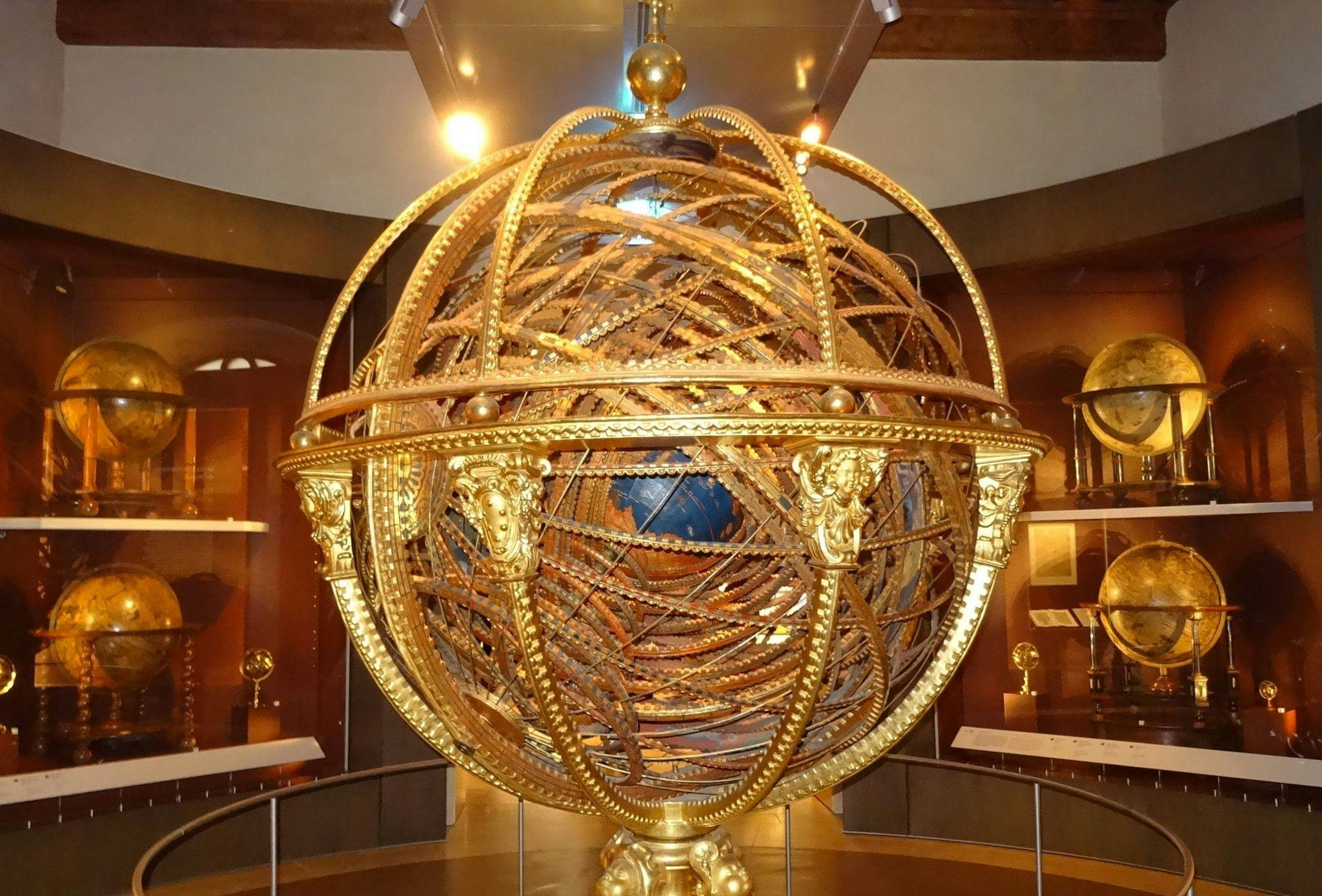
Galileo is only part of the story. The collection also includes elaborate celestial globes, astrolabes, thermometers, microscopes, mechanical clocks, electrical machines, air pumps, surveying instruments and an enormous gilded armillary sphere built for the Medici court.
The museum occupies Palazzo Castellani beside the River Arno, immediately behind the Uffizi Gallery and a short walk from Palazzo Vecchio and Ponte Vecchio. Its central location makes it easy to add to a day of sightseeing without crossing Florence.
Unlike a modern hands-on science centre, the Museo Galileo is primarily a museum of original historical objects. Its instruments are displayed as evidence of experimentation, courtly collecting, craftsmanship and changing ideas about the universe.
This guide explains what to see, current ticket prices and opening hours, how long to allow, whether the museum suits children, accessibility arrangements and how to combine it with other attractions in central Florence.
Museo Galileo Quick Facts
Visitor information
Details
Official name
Museo Galileo – Istituto e Museo di Storia della Scienza
Location
Piazza dei Giudici 1, Florence
Building
Palazzo Castellani
Main subject
History of science and scientific instruments
Best-known exhibits
Galileo’s telescopes, lens and personal relics
Current adult admission
€14
Visitors aged 6–18
€7
Children under six
Free
Current family ticket
€32
Usual opening time
9:30 am
Usual closing time
6:00 pm
Tuesday closing time
1:00 pm, except selected public holidays
Closed
1 January and 25 December
Recommended visit
One and a half to two hours
Collection floors
Two principal exhibition floors
Nearest major landmark
Uffizi Gallery
Firenze Card
Included under current conditions
Free museum app
Available for smartphones and tablets
Accessibility
All floors accessible using lifts and stairlifts
Important: Tuesday hours are considerably shorter than on other days. Avoid planning an afternoon Tuesday visit unless the date is specifically listed as having extended public-holiday hours.
What Is the Museo Galileo?
The Museo Galileo is a museum and international research institute devoted to the history of science.
Its collection consists primarily of original scientific instruments assembled by two ruling families of Tuscany:
The Medici dynasty.
The Habsburg-Lorraine grand dukes.
These objects were not collected only for practical scientific work. Many were also designed to demonstrate wealth, education, craftsmanship and intellectual authority.
An astronomical instrument made for a grand duke could therefore be:
A working measurement device.
An educational model.
A decorative court object.
A statement of political power.
Evidence of patronage of mathematics and astronomy.
The displays help explain how scientific knowledge developed through an interaction between observers, instrument makers, mathematicians, physicians, sailors, engineers and wealthy patrons.
Why Visit the Galileo Museum?
The museum provides a different experience from Florence’s famous art galleries and churches.
Reasons to visit include:
Seeing Galileo’s original telescopes.
Understanding how early astronomical observations were made.
Seeing the development of thermometers, barometers and microscopes.
Discovering early experiments in electricity and air pressure.
Exploring the relationship between navigation and astronomy.
Visiting a quieter museum close to the Uffizi.
Adding scientific history to a Renaissance-focused Florence itinerary.
The museum is particularly rewarding for visitors interested in astronomy, engineering, medicine, mathematics, navigation or the intellectual history of the Renaissance.
A Short History of the Museum
Medici Collecting
The scientific collection began during the 16th century under Cosimo I de’ Medici.
Instruments were initially displayed in the Palazzo Vecchio’s Map Room, where painted maps and cosmographical devices presented a courtly vision of the known world.
Ferdinando I later transferred important objects to a mathematics room in the Uffizi. The space contained instruments used for:
Astronomy.
Surveying.
Navigation.
Military engineering.
Timekeeping.
Mathematical calculation.
Galileo and the Medici Court
Galileo deliberately connected his scientific work with the Medici family.
After observing four moons orbiting Jupiter in 1610, he named them the Medicean Stars in honour of Grand Duke Cosimo II and his brothers.
The strategy helped secure Galileo a prestigious position as mathematician and philosopher to the Tuscan court.
His instruments, publications and observations subsequently became closely connected with the Medici scientific collection.
Accademia del Cimento
During the 17th century, Prince Leopold de’ Medici and Grand Duke Ferdinando II supported the Accademia del Cimento.
The academy promoted the experimental investigation of nature and adopted the principle of testing claims through carefully organised observation.
Its members conducted research involving:
Temperature.
Air pressure.
Vacuum.
Freezing.
Sound.
Motion.
Properties of liquids.
The Lorraine Grand Dukes
After the Medici dynasty ended, Tuscany passed to the House of Lorraine.
Grand Duke Peter Leopold reorganised scientific collecting and supported the creation of the Imperial and Royal Museum of Physics and Natural History.
The Lorraine collection expanded through instruments relating to:
Mechanics.
Electricity.
Pneumatics.
Chemistry.
Medicine.
Pharmacy.
Natural philosophy.
The Modern Museum
During the early 20th century, historians and scientists worked to protect Italy’s scientific heritage.
The permanent History of Science Museum opened in Palazzo Castellani in 1930.
The collection suffered serious damage during Florence’s 1966 flood, when water affected objects stored on lower floors. Conservation and restoration work followed.
The institution adopted the name Museo Galileo in 2010 after a major renovation and redesign of its galleries.
Palazzo Castellani
The museum occupies Palazzo Castellani, a historic stone building overlooking the River Arno.
The site has origins dating to the late 11th century and was formerly known as Castello d’Altafronte.
The building formed part of Florence’s early defensive environment near the river and city walls.
Over time, the structure changed from a fortified medieval building into an urban palace.
What to Notice Outside
The rough stone façade.
Arched lower windows.
The museum’s vertical banner.
The monumental sundial in Piazza dei Giudici.
Views towards the Arno and Uffizi.
The Monumental Sundial
A modern monumental sundial stands outside the museum.
Its gnomon casts a shadow across markings embedded in the pavement, demonstrating the connection between the Sun’s apparent movement and the measurement of time.
It provides an effective introduction to the museum because it turns the public square itself into a scientific instrument.
How the Collection Is Arranged
The permanent displays occupy two principal floors.
First Floor
The first floor concentrates on the Medici collections.
Its themes include:
Early mathematical instruments.
Cosmography.
Astronomy.
Navigation.
Military engineering.
Galileo and his observations.
The Accademia del Cimento.
Second Floor
The second floor presents instruments collected or commissioned during the Lorraine period.
Subjects include:
Electricity.
Air pressure.
Mechanics.
Timekeeping.
Chemistry.
Medicine.
Pharmacy.
Weights and measures.
The distinction between the floors helps visitors follow a broad historical transition from Renaissance court science to the increasingly public and institutional science of the 18th and 19th centuries.
The Medici Collection
The Medici collection is both scientific and artistic.
Many objects are made from brass, wood, silver, glass or gilded materials and were decorated to a standard appropriate for a royal court.
The collection includes:
Astrolabes.
Armillary spheres.
Celestial and terrestrial globes.
Sundials.
Military compasses.
Surveying instruments.
Astronomical clocks.
Galileo’s telescopes.
Experimental glassware.
Early thermometers.
Scientific instruments gave Medici rulers a way to associate their court with knowledge, order and control of the natural world.
The Lorraine Collection
The Lorraine galleries reflect a later period in which science was increasingly organised through museums, teaching collections, laboratories and public demonstrations.
The instruments include:
Electrostatic machines.
Air pumps.
Mechanical demonstration devices.
Hydraulic instruments.
Chemical apparatus.
Microscopes.
Medical instruments.
Pharmaceutical containers.
Clocks and automata.
Precision measuring devices.
Some machines were intended to produce dramatic demonstrations for students and visitors. Sparks, moving mechanisms, vacuum experiments and electrical effects made scientific principles visible.
Essential Museum Highlights
Exhibit
Why it matters
Galileo’s two telescopes
The only surviving telescopes made by Galileo
Galileo’s objective lens
Associated with his revolutionary observations of Jupiter’s moons
Galileo’s middle finger
An unusual example of his later treatment as a scientific hero
Geometric and military compass
Shows Galileo’s practical work in calculation and engineering
Galileo’s astrolabe
A Renaissance instrument used for astronomical calculation
Santucci armillary sphere
A huge gilded model of the Ptolemaic universe
Accademia del Cimento thermometers
Evidence of early systematic experimental science
Celestial globes
Show how stars and constellations were mapped
Grand Duke’s chemistry cabinet
A rare surviving court laboratory installation
Electrostatic machines
Demonstrate the experimental culture of the 18th century
Galileo’s Original Telescopes
The museum preserves the only two surviving telescopes constructed by Galileo.
They appear modest compared with modern astronomical equipment. Their wooden tubes are narrow, and their lenses provide a restricted field of view.
Galileo did not invent the telescope. Reports of a Dutch optical device reached him in 1609, and he rapidly developed improved versions with greater magnification.
What Galileo Saw
Using his telescopes, Galileo observed:
Mountains and craters on the Moon.
Large numbers of previously invisible stars.
Four moons orbiting Jupiter.
The phases of Venus.
Sunspots.
The unusual appearance of Saturn.
These observations challenged the belief that the heavens were perfect, unchanging and organised entirely around Earth.
Looking at the Instruments
Notice:
The length and narrowness of the tubes.
The decorative covering.
The small lens openings.
The absence of a modern stable mount.
The craftsmanship required to align the optics.
The instruments show how much Galileo achieved using equipment that was far less powerful than an inexpensive modern telescope.
Galileo’s Objective Lens
The museum preserves a cracked objective lens associated with Galileo’s observations of 1609 and 1610.
Galileo donated the lens to Grand Duke Cosimo II.
It is traditionally connected with the telescope used when Galileo observed Jupiter’s four largest moons.
Those moons are now known as:
Io.
Europa.
Ganymede.
Callisto.
The discovery provided visible evidence that not every celestial body orbited Earth.
Why the Lens Matters
The lens is physically small but historically exceptional.
It represents the point where:
Craftsmanship in glass met astronomy.
A new instrument expanded human vision.
Direct observation challenged established theory.
Scientific evidence became politically significant.
Galileo’s Finger and Other Relics
One of the museum’s most unexpected displays contains Galileo’s preserved middle finger.
The finger was removed in 1737 when Galileo’s remains were transferred to a new monumental tomb in the Basilica of Santa Croce.
It was preserved as a relic by admirers who viewed Galileo as a hero and martyr of science.
Other bodily relics connected with Galileo include a thumb, another finger and a tooth.
Why Was the Finger Preserved?
The practice reflects the way scientific figures could be honoured in a manner resembling the veneration of religious saints.
The display therefore reveals as much about Galileo’s later reputation as it does about his life.
Some visitors find the relic fascinating, while others find it unsettling. It remains one of Florence’s most unusual museum objects.
Galileo’s Geometric and Military Compass
Galileo developed a proportional compass used for practical mathematical calculations.
Despite its name, it was not simply a device for finding direction.
Its graduated arms could assist with:
Calculating proportions.
Determining areas and volumes.
Currency conversions.
Artillery calculations.
Scaling designs.
Engineering problems.
Galileo taught wealthy students how to use the instrument and published instructions explaining its operation.
The compass shows that his career involved commercial teaching and practical technology as well as astronomy and theoretical physics.
Galileo’s Astrolabe
An astrolabe is an instrument used to model the sky and solve problems involving time, celestial positions and latitude.
The museum’s so-called Galileo astrolabe was preserved in the Uffizi and used by Galileo for astronomical calculation.
Its components include:
A planispheric representation of the sky.
Graduated scales.
A calendar.
Zodiac markings.
A rotating sighting device.
Astrolabes required extensive mathematical knowledge but could perform many functions within one compact device.
The Santucci Armillary Sphere
The enormous armillary sphere built under Antonio Santucci’s supervision is one of the museum’s most visually spectacular objects.
Construction began in 1588 and was completed in 1593 for Grand Duke Ferdinando I de’ Medici.
The sphere represents the universe according to the geocentric system associated with Aristotle and Ptolemy.
Earth sits at the centre, surrounded by rings representing celestial circles and planetary motions.
What to Notice
The gilded wooden framework.
The concentric astronomical rings.
The central terrestrial globe.
The elaborately decorated supporting structure.
The combination of science, art and royal display.
Its geocentric arrangement may seem scientifically outdated, but the sphere accurately demonstrates an influential historical model of the cosmos.
Celestial and Terrestrial Globes
The museum contains an important collection of globes.
Terrestrial Globes
These represent geographical knowledge at the time they were produced.
Look for:
Coastlines based on incomplete exploration.
Changing names of countries and regions.
Decorative ships and sea creatures.
Areas left uncertain or incorrectly drawn.
Celestial Globes
Celestial globes map stars onto a sphere.
Constellations are often shown as elaborate figures from Greek mythology, Arabic astronomy and other traditions.
The globes demonstrate how astronomy, navigation, art and mythology were closely connected.
Accademia del Cimento Instruments
The Accademia del Cimento was founded in Florence in 1657.
Its motto, often translated as “try and try again,” expressed a commitment to experimentation.
The academy did not survive for many decades, but its work was influential.
Its instruments investigated:
Changes in temperature.
Atmospheric pressure.
Behaviour of liquids.
Freezing and expansion.
Vacuum.
Sound.
The glass devices are also beautiful examples of Florentine craftsmanship.
Early Thermometers and Barometers
Before modern standardised thermometers, researchers experimented with sealed glass tubes containing liquids.
The museum’s early thermometric instruments include:
Long glass tubes.
Spiral forms.
Multi-bulb devices.
Decorative glass arrangements.
Instruments intended to compare temperature changes.
These devices did not always use the same numerical scales, making direct comparison difficult.
The displays show that measuring temperature required the development of:
Reliable liquids.
Sealed containers.
Repeatable reference points.
Standard scales.
Carefully made glass tubes.
Microscopes and Optical Instruments
Galileo developed an early compound microscope after his work with telescopes.
The museum’s optical displays trace the use of lenses to enlarge both distant and very small objects.
Instruments may include:
Simple microscopes.
Compound microscopes.
Optical demonstration devices.
Perspective instruments.
Lenses.
Visual toys.
The development of microscopy opened new fields of investigation in anatomy, biology and medicine.
Clocks and Timekeeping
Accurate timekeeping was essential for astronomy, navigation and scientific experimentation.
The museum contains sophisticated clocks that combine:
Hours and minutes.
Calendars.
Astronomical information.
Planetary cycles.
Religious feast days.
Chiming mechanisms.
Some clocks were designed as prestigious court objects, while others supported practical observation.
Early scientists increasingly needed to measure short intervals accurately when studying motion, pendulums and falling bodies.
Navigation and Surveying Instruments
Florence was not a major seaport, but navigation remained important to its rulers, merchants and instrument makers.
The collection includes devices for:
Measuring angles.
Determining latitude.
Surveying land.
Calculating distances.
Planning fortifications.
Aiming artillery.
Mapping territory.
Look for quadrants, compasses, astrolabes, sectors and sighting instruments.
Many devices served more than one purpose. The same basic geometry could be applied to astronomy, architecture, warfare and land measurement.
Mechanical, Pneumatic and Electrical Experiments
The Lorraine galleries contain machines designed to demonstrate physical principles.
Mechanics
Mechanical models illustrate:
Gravity.
Falling bodies.
Pendulums.
Centrifugal force.
Levers.
Equilibrium.
Motion along curved paths.
Pneumatics
Air pumps allowed researchers to remove air from a container and investigate vacuum-related effects.
Experiments could examine:
Sound in reduced air.
Combustion.
Animal respiration.
Pressure.
Boiling and evaporation.
Electricity
Early electrostatic machines generated charge through friction.
Demonstrations could produce:
Sparks.
Attraction and repulsion.
Charged conductors.
Visible electrical effects.
These dramatic experiments made electricity a popular subject for court and public demonstrations.
The Grand Duke’s Chemistry Cabinet
The Lorraine collection includes a chemistry bench associated with Grand Duke Peter Leopold.
The installation contains:
A work surface.
Compartments and drawers.
Glass containers.
Mortars.
Combustion equipment.
Storage for preparations.
It provides a rare view of chemistry as practised before the modern laboratory developed.
Early chemistry combined:
Pharmacy.
Metallurgy.
Analysis of minerals.
Manufacture of pigments.
Investigation of gases.
Older alchemical traditions.
Medical and Pharmaceutical Instruments
The museum’s later collections include objects connected with medicine, surgery and pharmacy.
Possible displays include:
Surgical instruments.
Anatomical teaching material.
Pharmaceutical containers.
Measuring instruments.
Devices for diagnosis or treatment.
Some instruments may appear severe by modern standards. They demonstrate how medical practice changed alongside developments in anatomy, materials and experimental science.
The 2026 Temporary Exhibition
From 18 June to 18 October 2026, the museum is presenting Mirabilia Graphica: Micrographic Calligrams of Ignazio Muligino.
The exhibition examines an extraordinary late-17th-century calligram created using writing so small that it becomes difficult to read without optical assistance.
The microscopic script forms a religious image based on a painting associated with Pietro da Cortona.
The exhibition connects:
Calligraphy.
Microscopy.
Optical science.
Religious imagery.
Technical virtuosity.
Admission to the exhibition is included with the normal museum ticket.
Current Ticket Prices
Ticket category
Current price
Full adult admission
€14
Visitors aged 6–18
€7
Children under six
Free
Groups of at least 15
€7 per person, plus booking charge
School groups aged 6–15
€6 per student, plus booking charge
Family ticket
€32
Selected discounted categories
€10
Family Ticket
The family ticket currently covers either:
Two adults and up to two visitors aged 18 or younger.
One adult and up to three visitors aged 18 or younger.
Free Admission
Free admission may apply to eligible categories including:
Children under six.
Visitors with disabilities.
One accompanying person.
ICOM members.
Selected museum and professional cardholders.
Carry appropriate identification or documentation.
Online Booking Charge
Online and telephone reservations currently carry a service charge of €1 per ticket.
Firenze Card
The museum participates in the Firenze Card circuit under current arrangements.
Check whether the card’s activation and reservation rules fit the rest of your itinerary before purchasing it solely for this museum.
Current Opening Hours
Day
Opening hours
Monday
9:30 am–6:00 pm
Tuesday
9:30 am–1:00 pm
Wednesday
9:30 am–6:00 pm
Thursday
9:30 am–6:00 pm
Friday
9:30 am–6:00 pm
Saturday
9:30 am–6:00 pm
Sunday
9:30 am–6:00 pm
Ticket sales end 30 minutes before closing.
The museum is closed on:
1 January.
25 December.
Selected public-holiday Tuesdays may use the full 6:00 pm closing time. The current 2026 calendar lists extended Tuesday hours on 2 June and 8 December.
Do You Need to Book?
Individual visitors do not normally need an advance reservation.
Booking is still useful when:
Visiting during Easter.
Travelling in the busiest summer period.
Arriving with a strict schedule.
Visiting as a large family group.
Planning a guided tour or workshop.
Groups
Groups containing at least 15 people must reserve in advance, whether visiting independently or with a guide.
Large groups may be divided into smaller sections for safety within the galleries.
Ticket Validity
A ticket bought at the museum is valid for that day.
Online tickets are tied to the selected date, although date changes may be possible for a small administrative charge under current conditions.
How Long Should You Spend?
Time available
Realistic experience
45 minutes
Galileo rooms and the armillary sphere
One hour
Principal Medici highlights
90 minutes
Comfortable overview of both floors
Two hours
Detailed first visit
Three hours
In-depth visit using the app and videos
The museum’s official estimate is one to two hours.
Visitors with a strong interest in astronomy, engineering or antique instruments can easily spend longer.
The Best Route Through the Museum
Begin with the Medici collections on the first floor.
A logical sequence is:
Early mathematical and astronomical instruments.
Astrolabes and clocks.
Terrestrial and celestial globes.
The Santucci armillary sphere.
Surveying and military instruments.
Galileo’s telescopes and relics.
Accademia del Cimento experiments.
Lorraine physics and chemistry galleries.
This order allows visitors to see how courtly cosmography developed into an increasingly experimental and institutional scientific culture.
A One-Hour Highlights Route
When time is limited, prioritise:
The Santucci armillary sphere.
One major celestial globe.
Galileo’s geometric and military compass.
Galileo’s two telescopes.
The objective lens.
Galileo’s finger and relic display.
Accademia del Cimento thermometers.
One electrostatic machine.
The Lorraine chemistry cabinet.
Use the museum app or ask staff for the quickest route to Room VII when Galileo’s instruments are your main priority.
A Detailed Two-Hour Visit
First 30 Minutes
Explore early mathematical instruments, astronomical clocks and astrolabes.
Second 30 Minutes
Spend time with the globes and monumental armillary sphere.
Third 30 Minutes
Concentrate on Galileo’s telescopes, lens, compass, portraits and relics.
Final 30 Minutes
Visit the Accademia del Cimento instruments and selected Lorraine displays involving electricity, mechanics and chemistry.
Visitors attending the 2026 temporary exhibition should add approximately 20–30 minutes.
Museum App and Digital Guide
The museum provides a free app for smartphones and tablets.
The app highlights approximately 80 important instruments and also provides access to information about the wider collection.
Before Visiting
Download the app in advance.
Bring charged earphones.
Charge the phone fully.
Consider carrying a small power bank.
The app requires an internet connection, and free Wi-Fi is available inside the museum.
Printed Mini Guides
Downloadable mini guides are available in several languages, including English, Italian, French, Spanish, Portuguese, Chinese and Japanese.
Guided Tours
The museum offers reservable guided visits for small and large groups.
Groups of Up to 14
A 60-minute private guided service currently costs €65 in addition to each participant’s museum admission.
A €1-per-ticket reservation charge also applies.
Groups of 15 or More
Guided visits for larger groups currently cost €3 per person in addition to museum admission and the booking fee.
Why Consider a Guide?
Many instruments are difficult to understand from appearance alone.
A guide can explain:
How an astrolabe works.
What Galileo could see through his telescope.
How the Medici used science politically.
How early thermometers differed from modern ones.
What electrostatic machines demonstrated.
Visiting with Children
The Museo Galileo can appeal to children, but it is not a conventional interactive science centre.
Most displays consist of original objects inside cases.
Children May Enjoy
Galileo’s telescopes.
The enormous armillary sphere.
Globes and star maps.
Galileo’s preserved finger.
Mechanical clocks.
Electrical machines.
Videos and digital reconstructions.
Potential Difficulties
Complex historical labels.
Limited opportunities to touch objects.
Technical mathematical concepts.
Many instruments that appear similar without explanation.
The museum advises that children younger than approximately seven or eight may find an independent visit difficult to understand.
Family Strategy
Keep the visit to around one hour.
Focus on five or six memorable objects.
Use the app or a family activity.
Ask children what each instrument might measure.
Explain the preserved finger before reaching it.
Take a break beside the Arno afterwards.
Accessibility
The museum provides wheelchair access to all exhibition floors.
Accessible Entrance
The designated entrance is at Lungarno Anna Maria Luisa de’ Medici 2.
Use the intercom to request assistance from museum staff.
Mobility Facilities
Two elevators.
Two stairlifts with a maximum capacity of approximately 325 kilograms.
Accessible toilets on all floors.
A manual wheelchair available to borrow.
Free admission for an eligible visitor and one companion.
Visual Accessibility
Facilities include:
Tactile maps.
A three-dimensional model of Palazzo Castellani.
Braille and large-print guides.
Audio guidance for a tactile route.
Tactile models of selected scientific instruments.
Audible floor announcements in lifts.
Guided Tactile Tours
A guided tactile tour can be booked in advance.
The activity uses replicas and three-dimensional models to explain selected instruments.
Assistance Animals
Properly restrained guide dogs are permitted inside the museum.
Lockers and Bag Rules
Free lockers are available near the museum entrance.
Two larger locked storage containers can accommodate student backpacks and bulky bags.
Visitors should store:
Large backpacks.
Bulky shopping bags.
Umbrellas.
Items that could strike display cases.
Capacity is limited. Do not arrive with large suitcases expecting airport-style luggage storage.
Photography Rules
Visitors may take photographs inside the museum for private, non-commercial purposes.
The following are prohibited:
Flash photography.
Tripods.
Selfie sticks.
Professional filming without authorisation.
Keep cameras and phones away from display cases and avoid blocking narrow gallery routes.
Toilets, Wi-Fi and Bookshop
Toilets
Restrooms are available within the building, including accessible toilets on every floor.
Wi-Fi
Free Wi-Fi is available and is useful when operating the museum app.
Bookshop
The ground-floor shop sells:
Museum catalogues.
Books about Galileo.
Histories of science.
Educational books for children.
Guides.
Science-related gifts.
Food and Drink
The museum does not function as a major food destination. Eat before or after visiting at one of the many cafés and restaurants around Piazza della Signoria, Santa Croce or the Arno.
Getting to the Museo Galileo
The museum’s address is:
Piazza dei Giudici 1, 50122 Florence, Italy.
It is located:
Immediately behind the Uffizi Gallery.
Beside the River Arno.
Approximately five minutes from Palazzo Vecchio.
Approximately five to ten minutes from Ponte Vecchio.
The historic centre is largely pedestrianised, so walking is the easiest method for most visitors.
Walking from Florence Station
From Firenze Santa Maria Novella station, allow approximately 20–25 minutes on foot.
A practical route passes through or near:
Piazza Santa Maria Novella.
Via de’ Cerretani or central shopping streets.
Piazza del Duomo.
Via dei Calzaiuoli.
Piazza della Signoria.
The Uffizi.
Piazza dei Giudici.
Visitors with luggage should store it at their hotel or a proper luggage facility rather than carrying it through the museum.
Arriving by Car
Do not attempt to drive directly to the entrance.
Central Florence has restricted-traffic zones monitored by cameras. Unauthorised entry can result in a fine.
Use an authorised garage outside or within the controlled zone and confirm that staff will register the vehicle correctly.
Attractions Near the Museum
Uffizi Gallery
The Uffizi stands immediately beside the museum and contains masterpieces by Botticelli, Leonardo, Michelangelo, Raphael, Titian and Caravaggio.
Combining both museums in one morning is possible but creates a demanding concentration of indoor exhibits.
Palazzo Vecchio
Florence’s historic town hall is only a few minutes away.
Its rooms, tower and archaeological areas explain the city’s political history.
Ponte Vecchio
The famous bridge is approximately five to ten minutes away along the river.
Santa Croce
The Basilica of Santa Croce contains Galileo’s monumental tomb.
Combining the museum with Santa Croce creates a particularly strong Galileo-themed itinerary.
Bargello Museum
The Bargello contains major Renaissance sculpture by artists including Donatello, Michelangelo and Verrocchio.
Florence Cathedral
The cathedral, baptistery, bell tower and Museo dell’Opera del Duomo are within walking distance.
Where to Eat Nearby
Piazza della Signoria
The square has many restaurants, but the most prominent terraces generally charge for their landmark location.
Santa Croce
The streets between the museum and Santa Croce provide:
Trattorias.
Sandwich shops.
Wine bars.
Gelaterias.
Small cafés.
Florentine Foods to Try
Lampredotto sandwich.
Ribollita.
Pappa al pomodoro.
Crostini toscani.
Bistecca alla fiorentina.
Pecorino cheese.
Cantucci with dessert wine.
Check prices before sitting at a table directly beside a major landmark.
The Best Time to Visit
At Opening Time
Arriving at 9:30 am usually provides:
Quieter galleries.
More space around Galileo’s telescopes.
Cooler walking conditions in summer.
Time to visit Santa Croce or the Uffizi afterwards.
Late Afternoon
Late afternoon can be quiet on ordinary full-opening days.
Enter no later than approximately 4:00 pm when planning a detailed visit.
Tuesdays
Tuesday is the least flexible day because the museum normally closes at 1:00 pm.
Arrive at opening and do not schedule it after lunch.
Seasonal Crowds
The museum reports particularly high numbers of school groups during March and April and large tourist numbers during summer.
Autumn and winter, outside national holidays, generally provide the calmest experience.
Suggested Half-Day Galileo Itinerary
9:30 am: Museo Galileo
Spend approximately 90 minutes exploring the Medici collection, Galileo rooms and selected Lorraine instruments.
11:00 am: Walk Beside the Arno
See the monumental sundial and continue towards Ponte Vecchio.
11:30 am: Piazza della Signoria
Explore the square, Loggia dei Lanzi and exterior of Palazzo Vecchio.
12:15 pm: Lunch
Eat around Santa Croce or in the smaller streets away from the main square.
1:30 pm: Basilica of Santa Croce
Visit Galileo’s monumental tomb and the church’s major artworks.
Suggested Full-Day Florence Itinerary
9:00 am: Uffizi Gallery
Spend approximately two and a half hours with the principal Renaissance rooms.
11:45 am: Museo Galileo
Allow 90 minutes for the science collection.
1:30 pm: Lunch
Choose a trattoria between Piazza della Signoria and Santa Croce.
3:00 pm: Santa Croce
See Galileo’s tomb, the Pazzi Chapel and important frescoes.
4:30 pm: Arno and Ponte Vecchio
Walk along the river and cross the bridge.
5:00 pm: Oltrarno
Explore Santo Spirito or continue towards Piazzale Michelangelo for an evening view.
Is the Museo Galileo Worth Visiting?
The Museo Galileo is highly worthwhile for travellers interested in science, astronomy, engineering or Renaissance history.
Main Advantages
Galileo’s original telescopes.
One of the world’s leading scientific-instrument collections.
Beautifully constructed Medici objects.
Clear organisation across two floors.
Central location beside the Uffizi.
Generally smaller crowds than Florence’s principal art museums.
Strong accessibility facilities.
A manageable one- to two-hour visit.
Possible Drawbacks
Limited hands-on exhibits.
Technical instruments can be difficult to understand without the app.
Young children may lose interest.
Short Tuesday opening hours.
Visitors expecting a general biography of Galileo may find the focus more specialised.
The museum is best approached as a collection about the development of scientific observation and measurement rather than simply as a memorial to one famous scientist.
Frequently Asked Questions About the Museo Galileo
Where is the Galileo Museum?
It is in Piazza dei Giudici beside the River Arno, immediately behind the Uffizi Gallery in central Florence.
What is its official name?
Its official name is Museo Galileo – Istituto e Museo di Storia della Scienza.
Is it the same as the Museum of the History of Science?
Yes. The institution previously used that name and became the Museo Galileo in 2010.
What is the museum famous for?
It is famous for Galileo’s surviving telescopes and the Medici-Lorraine collection of historic scientific instruments.
Are Galileo’s telescopes original?
Yes. The museum preserves the only two surviving telescopes constructed by Galileo.
Can visitors look through Galileo’s telescopes?
No. They are fragile original objects protected inside display cases.
Did Galileo invent the telescope?
No. He developed and improved an existing optical idea and applied it to astronomical observation.
What did Galileo discover with his telescope?
His observations included Jupiter’s moons, the phases of Venus, lunar mountains, sunspots and previously invisible stars.
Is the lens used to discover Jupiter’s moons displayed?
The museum preserves and displays a damaged objective lens associated with Galileo’s observations of 1609–1610.
Is Galileo’s finger really inside the museum?
Yes. His preserved middle finger is displayed with other Galilean relics.
Why was Galileo’s finger removed?
It was taken when his remains were transferred to a monumental tomb in 1737 and was preserved as a relic.
Where is Galileo buried?
He is buried in the Basilica of Santa Croce in Florence.
Can I visit the museum and Galileo’s tomb on the same day?
Yes. Santa Croce is within easy walking distance and forms an excellent combination.
How much is admission?
Current full adult admission is €14.
How much do children pay?
Visitors aged 6–18 currently pay €7. Children under six enter free.
Is there a family ticket?
Yes. The current family ticket costs €32.
Is the museum included in the Firenze Card?
Yes, under current arrangements.
Is the museum free on the first Sunday of the month?
No. It is a private institution and does not participate in the standard state-museum first-Sunday programme.
What are the opening hours?
It normally opens from 9:30 am to 6:00 pm, except on Tuesdays when it usually closes at 1:00 pm.
What days is it closed?
It is closed on 1 January and 25 December.
Is the museum open on Monday?
Yes. It normally opens from 9:30 am to 6:00 pm on Mondays.
Why does it close early on Tuesday?
Tuesday is the museum’s regular reduced-hours day, except on selected public holidays.
What time is last admission?
Ticket sales end 30 minutes before closing.
Do I need to book?
Individual visitors normally do not need to reserve, although online booking can be useful during busy periods.
Do groups need reservations?
Yes. Groups of 15 or more must book in advance.
How long does the museum take?
Most visitors need between one and two hours.
Can I see the highlights in 45 minutes?
Yes. Focus on the armillary sphere, Galileo rooms and selected experimental instruments.
How many floors does the museum have?
The main permanent collection occupies two exhibition floors, with services on the ground floor.
What is on the first floor?
The first floor contains the Medici scientific collections, including Galileo’s instruments.
What is on the second floor?
The second floor contains the Lorraine collection, including machines for mechanics, pneumatics, electricity and chemistry.
What is the large golden sphere?
It is the monumental armillary sphere built under Antonio Santucci’s supervision for Ferdinando I de’ Medici.
Does the sphere show the Sun at the centre?
No. It represents a historical geocentric model with Earth at the centre.
What is an armillary sphere?
It is a model made from rings representing important circles and movements in the heavens.
What is an astrolabe?
An astrolabe is a mathematical instrument used to model the sky and solve problems involving celestial positions, time and latitude.
What was Galileo’s military compass used for?
It helped calculate proportions, artillery problems, areas, volumes, currency conversions and engineering measurements.
Are there interactive exhibits?
There are multimedia displays and selected working models, but the museum is not primarily a hands-on science centre.
Is there an audio guide?
The museum provides a free app that functions as a digital collection guide.
Does the app work offline?
It requires an internet connection. Free museum Wi-Fi is available.
Should I bring earphones?
Yes, particularly when planning to use audio material in the museum app.
Is the museum suitable for children?
It can be, particularly for children interested in astronomy and machines. Children younger than seven or eight may need an organised activity or substantial adult explanation.
Are workshops available?
Educational workshops and guided family activities are offered on selected dates or by reservation.
Can I take a pushchair?
Yes. Lifts and accessible routes serve the museum floors, although a compact pushchair is easier in gallery spaces.
Is the museum wheelchair accessible?
Yes. A separate accessible entrance, elevators, stairlifts and accessible toilets are provided.
Where is the wheelchair entrance?
It is at Lungarno Anna Maria Luisa de’ Medici 2. Use the intercom for assistance.
Can I borrow a wheelchair?
A manual wheelchair is available on request.
Are tactile exhibits available?
Yes. The museum provides tactile maps, three-dimensional models, Braille material and a reservable tactile tour.
Are guide dogs permitted?
Yes, when properly restrained on a lead.
Are there lockers?
Yes. Free lockers are available near the entrance.
Can I leave a suitcase?
Large-item capacity is limited. Use a dedicated luggage facility for substantial suitcases.
Can I take photographs?
Yes, for private non-commercial use, without flash, tripods or selfie sticks.
Is there a café?
The museum does not have a major visitor café, but numerous cafés and restaurants are nearby.
Is there a bookshop?
Yes. It sells museum guides, histories of science, Galileo books and children’s publications.
Is there free Wi-Fi?
Yes.
How far is it from the Uffizi?
The museum is immediately beside and behind the Uffizi complex.
How far is it from Ponte Vecchio?
Approximately five to ten minutes on foot.
How far is it from Florence Cathedral?
Approximately 15 minutes on foot.
How far is it from Santa Maria Novella station?
Allow approximately 20–25 minutes on foot.
Can I drive to the museum?
Private vehicles cannot conveniently reach the entrance because it lies in Florence’s restricted historic centre.
Where is the nearest parking?
Use a recognised central garage or parking facility and continue on foot. Confirm restricted-zone registration with the operator.
Is the museum crowded?
It is usually less crowded than the Uffizi or Accademia Gallery, although school groups are common during spring.
What is the quietest time to visit?
Arrive at 9:30 am or visit during autumn and winter outside national holidays.
Can I combine it with the Uffizi?
Yes, but spending several continuous hours in both museums can be tiring. Include a lunch or outdoor break.
What is the best nearby combination?
The museum and Santa Croce create the strongest Galileo-focused itinerary because Santa Croce contains his tomb.
What temporary exhibition is running in 2026?
Mirabilia Graphica runs from 18 June to 18 October 2026 and is included with museum admission.
What is the biggest visitor mistake?
Visiting on a Tuesday afternoon or rushing directly to Galileo’s telescopes without seeing the broader Medici collection.
Final Thoughts
The Museo Galileo offers one of Florence’s most distinctive museum experiences.
Its galleries demonstrate that the Renaissance was not only an age of painting, sculpture and architecture. It was also a period of measurement, observation, navigation, engineering and debate about the structure of the universe.
Galileo’s telescopes are the principal attraction, but the larger collection provides the context needed to understand them. The astrolabes, globes, clocks and military instruments show the mathematical culture from which Galileo emerged, while the thermometers and experimental apparatus reveal how his emphasis on observation continued after his death.
Allow at least 90 minutes, download the free museum app and avoid an ordinary Tuesday afternoon. Spend time with the Santucci armillary sphere before reaching Galileo’s rooms, then continue to the Lorraine machines upstairs.
Afterwards, walk to Santa Croce to see Galileo’s tomb or continue beside the Arno towards Ponte Vecchio. Together, the museum and Florence’s surrounding landmarks reveal how science, art, political power and craftsmanship shaped the Renaissance city.
Sponsored Popular Items
Quick take: Musement.com offers a worldwide selection of tours and attractions
Galileo Museum Private Guided Tour Italy Galileo Museum private tour is a convenient way to add structure, local context and purposeful sightseeing to the itinerary. Check current availability, inclusions and booking details before you go.