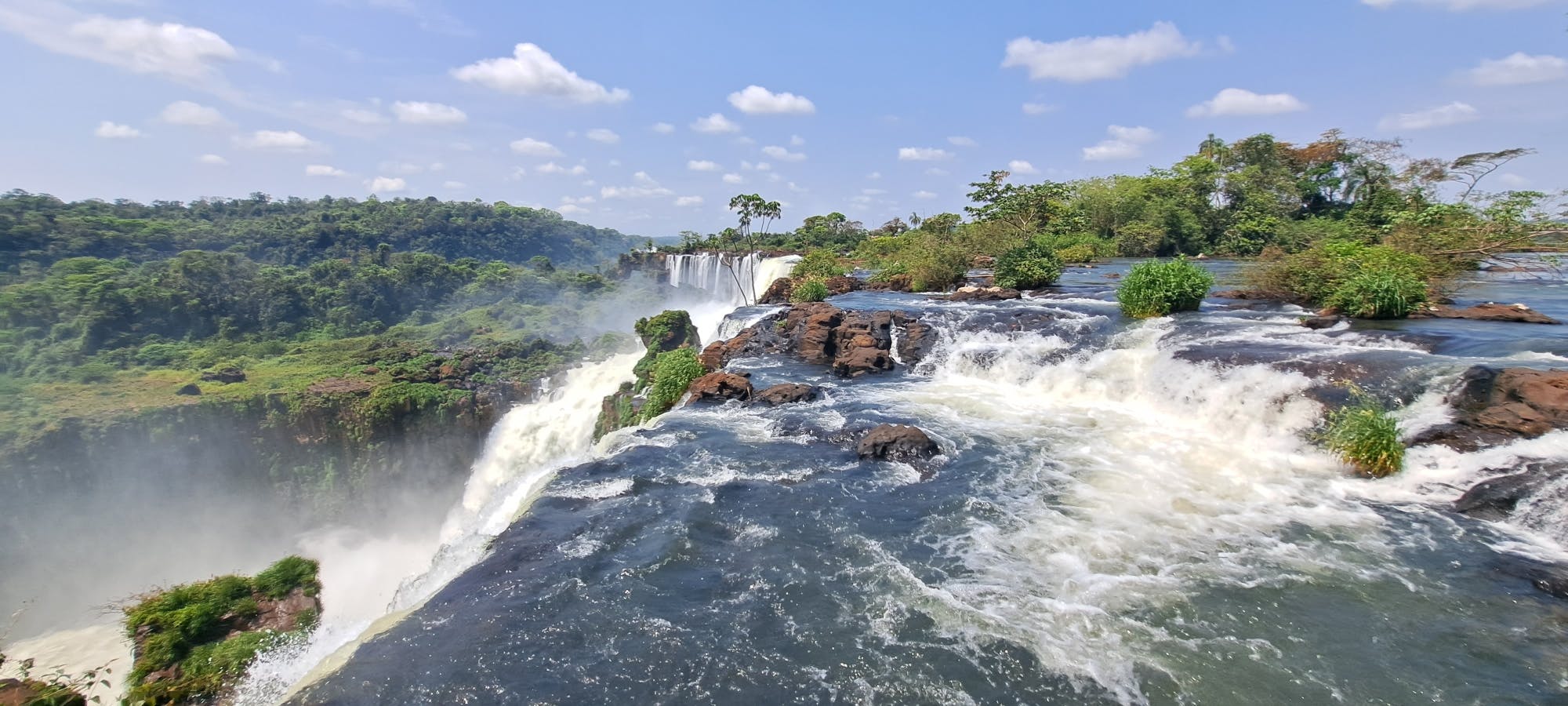
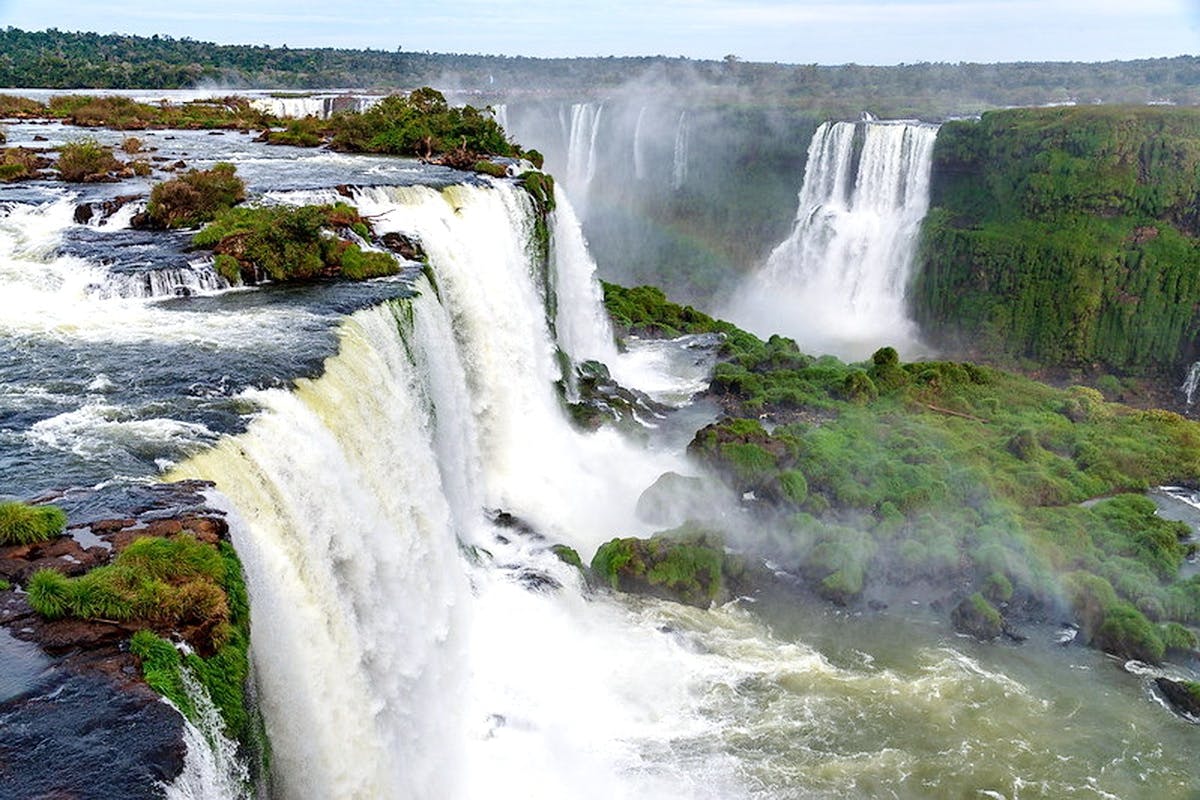
Iguazu Falls is one of South America’s great natural experiences: an immense system of waterfalls cutting through subtropical rainforest on the border between Argentina and Brazil. Rather than one single waterfall, Iguazu is a vast semicircular complex of cascades spread across roughly 2.7 kilometres, with major drops reaching about 80 metres.
The waterfalls are protected by two adjoining national parks: Iguazú National Park in Argentina and Iguaçu National Park in Brazil. Argentina’s park became a UNESCO World Heritage Site in 1984 and Brazil’s neighbouring park followed in 1986. Together they protect one of the most significant surviving areas of the Interior Atlantic Forest.
If your itinerary allows it, visit both countries. The experiences are genuinely different. Argentina provides the longer and more immersive visit, with extensive walkways taking you above and close to the waterfalls. Brazil provides the great panoramic view, allowing you to stand back and appreciate the extraordinary scale of the entire landscape.
Important August 2026 Devil’s Throat Update
As of 17 August 2026, the Argentine Circuito Garganta del Diablo is temporarily CLOSED. The official Iguazú Argentina visitor page currently states that the circuit has been closed preventively because of increased flow in the Iguazú River.
This is a temporary safety measure and can change quickly. The Argentine Upper and Lower Circuits remain separate attractions, so a visit to the Argentine park is still worthwhile even when the Devil’s Throat walkway is unavailable. Check the official circuit status immediately before travelling.
On the Brazilian side, the official park reported on 5 August 2026 that its main Cataratas walkway remained open for visitors and that conditions were being continually monitored. River conditions can change rapidly, so the same advice applies: verify the latest status before setting out.
Iguazu Falls at a Glance
Visitor Information
Details
Countries
Argentina and Brazil
Main gateway towns
Puerto Iguazú, Argentina and Foz do Iguaçu, Brazil
Waterfall frontage
About 2.7 km
Major drop height
Up to approximately 80 m
Commonly quoted number of cascades
About 275, varying with water conditions and definition
Argentina UNESCO status
1984
Brazil UNESCO status
1986
Argentina 2026 international admission
AR$60,000
Brazil 2026 international/full admission
R$134
Argentina visit
Allow most of a day
Brazil traditional visit
Approximately 2 hours
Recommended total stay
2 full days; 3 nights is comfortable
Best overall plan
One day Argentina + half to full day Brazil
Why Iguazu Falls Is So Impressive
The scale is difficult to appreciate from photographs. The Iguazú River reaches a broad basaltic escarpment and breaks into numerous channels, islands and cascades before plunging into the gorge below.
Official Argentine information commonly describes the system as containing approximately 275 separate falls, while UNESCO describes the main semicircular waterfall system as roughly 2,700 metres across and up to about 80 metres high.
The surrounding rainforest is equally important. UNESCO records more than 2,000 species of vascular plants and wildlife including tapirs, howler monkeys, ocelots, jaguars and caimans within the protected ecosystem.
Argentina or Brazil: Which Side Is Better?
The best answer is both.
The two sides are complementary rather than repetitive.
Argentina
Brazil
Longer visit
Shorter visit
Extensive walking circuits
Outstanding panoramic views
Walk above and close to numerous falls
Look across towards a broad wall of waterfalls
Eco-train inside the park
Internal park transport from visitor centre
Upper and Lower Circuits
Approximately 1 km traditional waterfall trail
Usually needs most of a day
Traditional experience approximately 2 hours
Best for exploring
Best for appreciating overall scale
If You Have Only One Day
If you must choose only one side, the decision depends on what you want from the experience.
Choose Argentina If:
You want the longest waterfall experience.
You enjoy walking.
You want several different viewpoints.
You want to move through the rainforest rather than simply view the falls from a distance.
You have most of the day available.
Choose Brazil If:
You have limited time.
You want the strongest overall panoramic view.
You prefer less walking.
You have reduced mobility.
You want to combine the falls with another Foz do Iguaçu activity.
Argentina: Parque Nacional Iguazú
The Argentine side provides the most extensive network of visitor trails and walkways.
Current admission includes access to the Upper Circuit, Lower Circuit, Green Trail, Ecological Train, Devil’s Throat Circuit when open, Macuco Trail and visitor facilities.
Iguazú National Park protects more than 67,000 hectares of the Selva Paranaense ecosystem in Misiones Province.
Argentina 2026 Admission Prices
Current official rates have applied since 1 June 2026.
Category
Current Admission
General / international visitor
AR$60,000
Argentine resident
AR$25,000
Misiones provincial resident
AR$8,000
Student qualifying for concession
AR$15,000
Children age 0–6
Free
Other exemptions apply to specified categories such as qualifying visitors with disabilities and certain Argentine resident groups. Bring appropriate documentation if claiming a concession.
50% Discount for a Second Argentine National Park Day
Argentina’s current National Parks tariff system provides a 50% reduction for a second visit under its applicable repeat-visit arrangements. This can make a second day particularly attractive if you want to explore Iguazú without rushing.
Confirm the validation procedure when buying the first ticket so that your return visit qualifies correctly.
Argentina Opening Hours
The Argentine Cataratas area is normally open:
Every day: 8:00 am–6:00 pm
including public holidays and rainy days.
General entry to the park is currently permitted until 4:00 pm. You should not arrive anywhere near that late if this is your first visit.
Arrive close to 8:00 am. There is enough to see that the Argentine side deserves most of the day.
The Ecological Jungle Train
The Tren Ecológico de la Selva connects the principal visitor areas inside the Argentine park and is included with admission.
The normal timetable currently begins with the first train at about 8:20 am. The final scheduled train towards the Devil’s Throat area is around 3:30 pm, although the Devil’s Throat circuit is currently closed because of river conditions.
Trains normally operate at intervals of roughly 30–40 minutes.
Do not assume the train is always the fastest option. The short Green Trail can be an enjoyable walking alternative between the main visitor services and Cataratas Station.
The Green Trail
Sendero Verde is a straightforward rainforest path connecting the service area with Cataratas Station.
Current details are:
Length: 650 metres one way
Walking time: approximately 15 minutes
Difficulty: low
Wheelchair accessibility: 100%
It is a pleasant way to begin the day and gives you a better feeling for the forest than spending every internal journey on the train.
The Upper Circuit
Circuito Superior provides broad views from above the waterfalls.
The newly expanded current route is approximately:
3.7 km return
About 90 minutes
Low difficulty
100% wheelchair accessible
The circuit provides viewpoints over falls including Dos Hermanas, Ramírez and Bossetti as well as wider panoramas over the San Martín area.
This is one of the best sections for photography because you look across and down onto the water rather than constantly standing within heavy spray.
The Lower Circuit
Circuito Inferior takes you closer to the base and sides of several cascades and consequently feels more physical and immersive.
Current official information gives:
Length: approximately 2.9 km return
Duration: around 90 minutes
Difficulty: medium
Wheelchair accessible: approximately 70%
Parts of the circuit involve steep stairs, although an adapted alternative path is available for some sections.
If you have enough mobility, do both the Upper and Lower Circuits. They present the same waterfall system from completely different levels.
Devil’s Throat – Garganta del Diablo
Garganta del Diablo, or Devil’s Throat, is the most powerful and famous section of Iguazu Falls.
The main drop is approximately 80 metres and funnels enormous volumes of water into a horseshoe-shaped gorge, producing a continuous cloud of spray.
Under normal conditions, the Argentine experience involves travelling towards Garganta Station and then following a long raised walkway across islands and channels of the upper Iguazú River until suddenly reaching the edge of the chasm.
The official circuit is approximately 2.2 km return and normally fully wheelchair accessible.
Current Devil’s Throat Closure
Do not plan your August 2026 itinerary assuming this circuit is open.
At the time of writing, the official operator marks it:
“CERRADO – Cierre preventivo por aumento del caudal del Río Iguazú.”
High water is part of the natural behaviour of Iguazu. Walkways on both sides can be temporarily restricted when river volume reaches safety thresholds.
Check again on the morning of your visit because conditions can improve or deteriorate quickly.
Macuco Trail
Visitors wanting more rainforest and fewer crowds can consider Sendero Macuco.
The current route is approximately:
7.6 km return
About 3 hours
Medium difficulty
Natural trail without normal visitor services
The trail finishes at Salto Arrechea, a 23-metre rainforest waterfall. Opening depends on weather and trail conditions and is decided by park rangers.
Do not add Macuco to a first one-day visit unless you are a keen walker and have already allowed enough time for the principal waterfall circuits.
Brazil: Parque Nacional do Iguaçu
The Brazilian side gives the great panoramic experience.
Instead of spending hours moving between numerous separate circuits, the traditional visit is more linear. Internal park transport takes visitors from the entrance area into the protected zone, after which a waterfall trail passes a succession of viewpoints before reaching the most dramatic section close to Devil’s Throat.
Brazil’s Iguaçu National Park covers approximately 169,696 hectares and has been a UNESCO World Heritage Site since 1986.
Brazil 2026 Admission Prices
Current official 2026 admission is:
Ticket
Current Price
Full / international admission
R$134
Brazil / Mercosur tariff
R$121
Local Community Pass
R$26
Children up to age 6
Free
The published R$134 full price includes R$131 admission plus a R$3 voluntary contribution to Fundo Iguaçu.
Book the Brazilian Side Ahead
The park strongly recommends purchasing tickets online and selecting your day and entry time when booking. Availability is controlled by time period, making advance booking particularly sensible during busy weekends and holiday seasons.
Brazil Opening Hours
Current normal opening times are:
Day
Current Entry Hours
Monday–Friday
9:00 am–4:00 pm
Saturday–Sunday
8:30 am–4:00 pm
Your booking time is an entry time rather than a compulsory exit time. Once admitted, visitors can currently remain inside until the park’s full closing time of approximately 5:30 pm.
What Is Included on the Brazilian Side?
Regular admission currently includes:
Internal transport between the Visitor Centre and waterfall area
Approximately 12 km of internal park transport each way
Access to the traditional Cataratas Trail
Approximately 1 km of waterfall walking trail
Main walkways and viewpoints
Elevator access in the principal visitor area
Additional included nature trails within the park
The park estimates about two hours for the standard waterfalls experience.
The Brazilian Cataratas Trail
The traditional Brazilian walkway is roughly 1 kilometre long.
It begins with more distant views and gradually becomes increasingly dramatic as you approach the principal viewing areas.
This progressive reveal is one of the strengths of the Brazilian side. Instead of immediately reaching the biggest waterfall, the view expands as you walk.
Prepare to Get Wet
At the principal Brazilian walkway near Devil’s Throat, mist can become heavy enough to soak clothing.
Bring:
A lightweight rain jacket or poncho
Water-resistant bag or phone pouch
Comfortable shoes with grip
Quick-drying clothing where possible
A bright sunny day does not mean you will remain dry beside Iguazu Falls.
Additional Brazil Nature Trails
The Brazilian park has expanded considerably beyond the traditional one-kilometre waterfall walk.
Current regular admission also provides access to several longer routes, including the Caminho do Poço Preto, Caminho das Bananeiras, Circuito São João and other nature trails.
For example, the Caminho do Poço Preto extends approximately nine kilometres into Atlantic Forest, while Caminho das Bananeiras covers about 2.6 kilometres return.
These additions make the Brazilian park much more suitable for a full-day nature visit than older travel guides suggest.
Boat Trips
Both sides offer optional adventure experiences associated with the falls, including boat trips that take passengers into the river below the cascades.
Expect to become extremely wet on the more adventurous versions.
Boat excursions cost extra and operate separately from the normal national-park admission. Availability and safety conditions depend on water levels, so check the day’s operation before committing to the experience.
Should You Do a Boat Ride?
Yes, if you enjoy adventure and do not mind getting soaked.
A waterfall walkway shows you Iguazu. A river boat gives you a much stronger feeling for the sheer force of the water.
However, skip it if:
You dislike rough boat rides.
You have a relevant back or neck problem.
You need to keep cameras or medical equipment dry.
You have limited time and have not yet walked the main circuits.
Wildlife
Iguazu is not only about waterfalls.
The surrounding Atlantic Forest supports exceptional biodiversity, and wildlife commonly seen around the visitor areas can include:
Coatis
Toucans
Monkeys
Butterflies
Lizards
Numerous forest birds
Much rarer animals protected within the wider national parks include jaguars, tapirs and ocelots.
Do Not Feed the Coatis
Coatis frequently approach areas where tourists eat.
Do not feed them and do not encourage them to approach for photographs.
Keep food securely packed away and maintain distance from wildlife. Animals that appear accustomed to people are still wild animals and can bite or scratch.
Accessibility on the Argentine Side
The Argentine park has made significant sections accessible.
Current official information states that:
Upper Circuit: 100% wheelchair accessible
Devil’s Throat Circuit: normally 100% accessible when open
Green Trail: 100% accessible
Lower Circuit: approximately 70% accessible with some stairs
Conventional wheelchairs are available free at train stations and need to be pushed by a companion. A free golf-cart transfer is also available for qualifying visitors with reduced mobility between the entrance area and Central Station.
Accessibility on the Brazilian Side
The Brazilian park provides accessible internal transport and access at its principal viewpoints.
Conventional wheelchairs can currently be borrowed free from the Visitor Centre, and elevators form part of the traditional waterfall visit.
For travellers with substantially reduced mobility, the Brazilian side is often the easier of the two experiences to manage because the traditional itinerary is shorter.
Visiting With Children
Iguazu works very well for families, although young children may become tired during a full Argentine day.
Useful strategies include:
Start early.
Do not attempt every optional jungle trail.
Carry water and snacks where permitted.
Use the train when children become tired.
Keep children close around wildlife.
Bring a waterproof layer.
The Argentine park currently offers stroller rental for children up to about two years old, and many main walkways are suitable for pushchairs.
Where Should You Stay?
Puerto Iguazú, Argentina
Best if your priority is the extensive Argentine park.
Puerto Iguazú has a broad range of hotels, restaurants and tour services and provides easy access to the Argentine national-park entrance.
Foz do Iguaçu, Brazil
Best for a larger city base and the Brazilian park.
Foz has a wider urban infrastructure and straightforward road access towards the national park and airport.
Stay Close to the Parks
Several accommodation options lie closer to the protected areas for travellers who value rainforest surroundings and early access more than nightlife and town restaurants.
Do You Need to Change Hotels to See Both Countries?
No.
Many travellers stay entirely in either Puerto Iguazú or Foz do Iguaçu and cross the international border for the other park.
Changing hotels for a two-night visit usually creates unnecessary luggage handling.
The important issue is allowing enough time for immigration and border procedures. Crossing between Argentina and Brazil is an international border journey, so carry the required travel documents and verify entry requirements applying to your nationality before travelling.
Puerto Iguazú or Foz do Iguaçu?
Puerto Iguazú Is Particularly Good For:
Immediate focus on the Argentine falls
A smaller tourism-oriented town
Restaurants and hotels within a compact centre
Foz do Iguaçu Is Particularly Good For:
Larger choice of urban services
Easy Brazilian park access
Longer stays in the wider Triple Frontier region
For a short waterfall-focused trip, either makes a perfectly practical base.
Getting to the Brazilian Falls
The Brazilian park lies on BR-469 outside central Foz do Iguaçu.
The current official visitor information identifies local bus 120 – Parque Nacional/Aeroporto as the public bus linking the urban terminal with the national park.
Taxi, ride-hailing services and organised transfers are also practical.
Driving to the Brazilian Park
Private vehicles are left at the Visitor Centre because normal visitor cars do not continue into the protected waterfall area. Internal transport is included with the admission ticket.
Current public parking for cars and motorcycles is approximately R$65 per day.
How Many Days Do You Need?
One Day
Possible but compromised.
Choose one country rather than trying to race through both parks unless you have a private transfer and are comfortable with a tightly scheduled day.
Two Days
Best minimum.
Devote one day to Argentina and the second to Brazil.
Three Days
Best for a relaxed visit.
You gain flexibility for weather, border delays, a boat activity or additional forest walking.
A Sensible Two-Day Strategy
Day 1 – Argentina
Arrive at opening and concentrate on the main circuits.
With the current August 2026 Devil’s Throat closure, devote additional time to the Upper and Lower Circuits and rainforest areas rather than rushing through the park.
Day 2 – Brazil
Book an early entry time for the Brazilian park and take the traditional waterfall route at a relaxed pace.
If you still have energy, add one of the park’s newer forest trails or another local activity afterwards.
What Is the Best Time of Year?
Iguazu can be visited throughout the year.
The region has a warm, humid subtropical climate without a strongly defined dry season. Official Argentine park information gives average temperatures of approximately 24°C in summer and 14°C in winter, with around 1,800 mm of annual rainfall and heavier precipitation generally concentrated in summer.
December–February
Hot, humid and generally wetter.
High rainfall can produce spectacular water volumes, but also increases the possibility of weather-related walkway restrictions.
March–May
Often a good compromise between warmth, greenery and walking conditions.
June–August
Cooler and generally pleasant for walking. August conditions can be excellent, although—as the current 2026 Devil’s Throat closure demonstrates—river levels do not always follow a simple seasonal pattern.
September–November
Warmer spring conditions return and the forest remains intensely green.
High Water or Lower Water?
There is no single “perfect” river level.
High Water
Provides astonishing power, noise and spray.
The disadvantage is that extreme river levels can force temporary closure of exposed walkways.
Moderate Water
Often provides the best balance between strong cascades and full visitor access.
Lower Water
Exposes more individual rock faces and separates the falls into clearer individual cascades.
Each condition produces a different landscape.
Rain Is Not Necessarily Bad
The Argentine park remains open during normal rainy weather and specifically advises visitors to carry waterproof clothing and use suitable footwear.
Heavy storms and exceptional river flows are different: individual circuits can be closed temporarily for safety.
Do not cancel automatically because your forecast shows showers. Iguazu is a rainforest waterfall destination; getting wet is part of the experience.
What to Wear
Comfortable walking shoes with grip
Quick-drying clothes
Light rain jacket or poncho
Hat
Sunscreen
Insect repellent
Water-resistant protection for phone and camera
Avoid footwear that becomes dangerously slippery when wet.
Protect Your Camera and Phone
Mist can behave like heavy rain around some platforms.
A simple waterproof phone pouch is extremely useful. If carrying a large camera, bring a rain cover or dry bag rather than assuming you can keep the equipment beneath your shirt.
Lockers and Luggage
The Argentine visitor area currently provides lockers and larger supervised luggage storage for items that do not fit normal lockers.
The Brazilian park also has visitor lockers. Current Brazilian information lists a large locker at approximately R$45.
Even so, visiting the falls with a suitcase is inconvenient. Leave luggage at your hotel whenever possible.
Full-Moon Visits in Argentina
The Argentine side operates a special Full Moon Walk on only a handful of nights around each full moon.
The experience takes place after normal daytime visiting hours and has limited capacity.
If your trip happens to coincide with the moon schedule, book ahead rather than assuming tickets will remain available.
Brazilian Sunrise and Sunset Experiences
The Brazilian park also operates separately ticketed special experiences outside normal opening hours, including sunrise and sunset programmes on selected days.
These can be attractive for photographers because they provide access when light is softer and visitor numbers are more controlled.
Is Paraguay Part of Iguazu Falls?
The wider area is known as the Triple Frontier because Argentina, Brazil and Paraguay meet nearby.
The waterfalls themselves, however, lie on the Argentina–Brazil border, not in Paraguay.
Photography Tips
Argentina
Use the Upper Circuit for wider compositions and the Lower Circuit for more dramatic close-range photographs.
Brazil
The Brazilian side is generally stronger for broad panoramas showing multiple waterfall sections within one frame.
Mist
Clean your lens regularly. Fine spray can cover a camera lens within seconds without you noticing.
Rainbows
Sunlight interacting with enormous quantities of mist frequently produces rainbows, so watch areas opposite the sun rather than staring only at the waterfall itself.
Do You Need a Guided Tour?
No, the parks can be visited independently.
Trails are organised and clearly established, while internal transport makes navigation relatively straightforward.
A guide becomes more useful if:
You want help crossing the international border.
You have limited time.
You are particularly interested in wildlife.
You want transport arranged from your hotel.
You prefer not to manage tickets and logistics yourself.
Can You Visit Both Sides in One Day?
Technically yes, but it is not the best plan.
The Argentine circuits alone deserve most of a day. Add an international border crossing and the Brazilian park and you risk spending too much of the day looking at the clock.
If one day is genuinely all you have, a private tour or transfer can make a two-country itinerary more realistic, but you will sacrifice the slower rainforest experience.
Common Mistakes
Visiting Only One Side When You Have Time for Both
The second country is not simply a duplicate viewpoint.
Arriving Late in Argentina
The park is far larger than first-time visitors expect.
Assuming Devil’s Throat Is Always Open
River conditions can force temporary closures. This is particularly relevant in August 2026, with the Argentine Devil’s Throat circuit currently closed.
Not Protecting Electronics
The spray can soak a phone surprisingly quickly.
Feeding Wildlife
Do not turn coatis or monkeys into part of your lunch stop.
Trying to Complete Every Trail
A first visit should concentrate on the waterfalls. Save long rainforest trails for additional time.
Forgetting the Border
Argentina and Brazil are separate countries. Allow time for immigration and carry appropriate travel documents.
Practical Tips
Give Iguazu at least two days.
Visit both Argentina and Brazil if possible.
Use Argentina for close-up exploration and Brazil for panoramas.
Book the Brazilian side ahead with an entry time.
Arrive at the Argentine side near 8:00 am.
Check live circuit status before leaving your hotel.
The Argentine Devil’s Throat Circuit is currently closed as of 17 August 2026.
Wear shoes with good grip.
Carry waterproof protection for electronics.
Do not feed wildlife.
Carry the correct documents when crossing between Argentina and Brazil.
Is Iguazu Falls Worth Visiting?
Absolutely. Iguazu is one of the world’s great waterfall landscapes and deserves far more than a hurried photograph.
UNESCO describes a waterfall system roughly 2.7 kilometres across and up to about 80 metres high, surrounded by an internationally important subtropical rainforest ecosystem.
The strongest itinerary combines both countries. Spend most of one day exploring the Argentine Upper and Lower Circuits and then devote another visit to Brazil’s panoramic walkway.
Current 2026 admission is AR$60,000 for a general international visitor on the Argentine side and R$134 for standard international/full admission on the Brazilian side.
The Argentine park normally operates from 8:00 am to 6:00 pm every day, while the Brazilian park currently admits visitors from 9:00 am on weekdays and 8:30 am on weekends, with normal entry ending at 4:00 pm.
At present, travellers need to be particularly flexible. The Argentine Garganta del Diablo circuit is temporarily closed because of increased river flow, while the Brazilian principal walkway was reported open by its operator in early August. These conditions can change quickly.
Do not let a temporary closure convince you that the entire trip is wasted. Iguazu is far larger than one viewing platform. The Upper and Lower Circuits, rainforest, wildlife and Brazilian panoramas still provide an extraordinary experience.
The best way to appreciate Iguazu Falls is not to ask whether Argentina or Brazil is better. Stand beside the water in Argentina, then cross the border and look back at the enormous panorama from Brazil. Only after seeing both perspectives does the true scale of Iguazu become clear.
Sponsored Popular Items
Quick take: Musement.com offers a worldwide selection of tours and attractions
Full-Day Guided Tour Through Iguazu Falls Argentina Plan Full-Day Guided Tour Through Iguazu Falls, a guided sightseeing experience, with practical tips on timing, inclusions and what to check before booking. Compare current availability, prices and booking conditions before you go.
Full-Day Tour of the Argentine Side of Iguazu Falls Argentina Full-day tour of the Argentine side of Iguazu Falls is a convenient way to add structure, local context and purposeful sightseeing to the itinerary. Check current availability, inclusions and booking details before you go.
Full-Day Tour of the Brazilian Side of Iguazu Falls Brazil Full-day tour of the Brazilian side of Iguazu Falls brings several elements of the destination together in one organised experience. Check current availability, inclusions and booking details before you go.
The Ammochostos Motor Museum is a relatively new attraction in the centre of Ayia Napa, Cyprus, displaying more than 100 classic cars, motorcycles and other historic vehicles in a modern indoor museum.
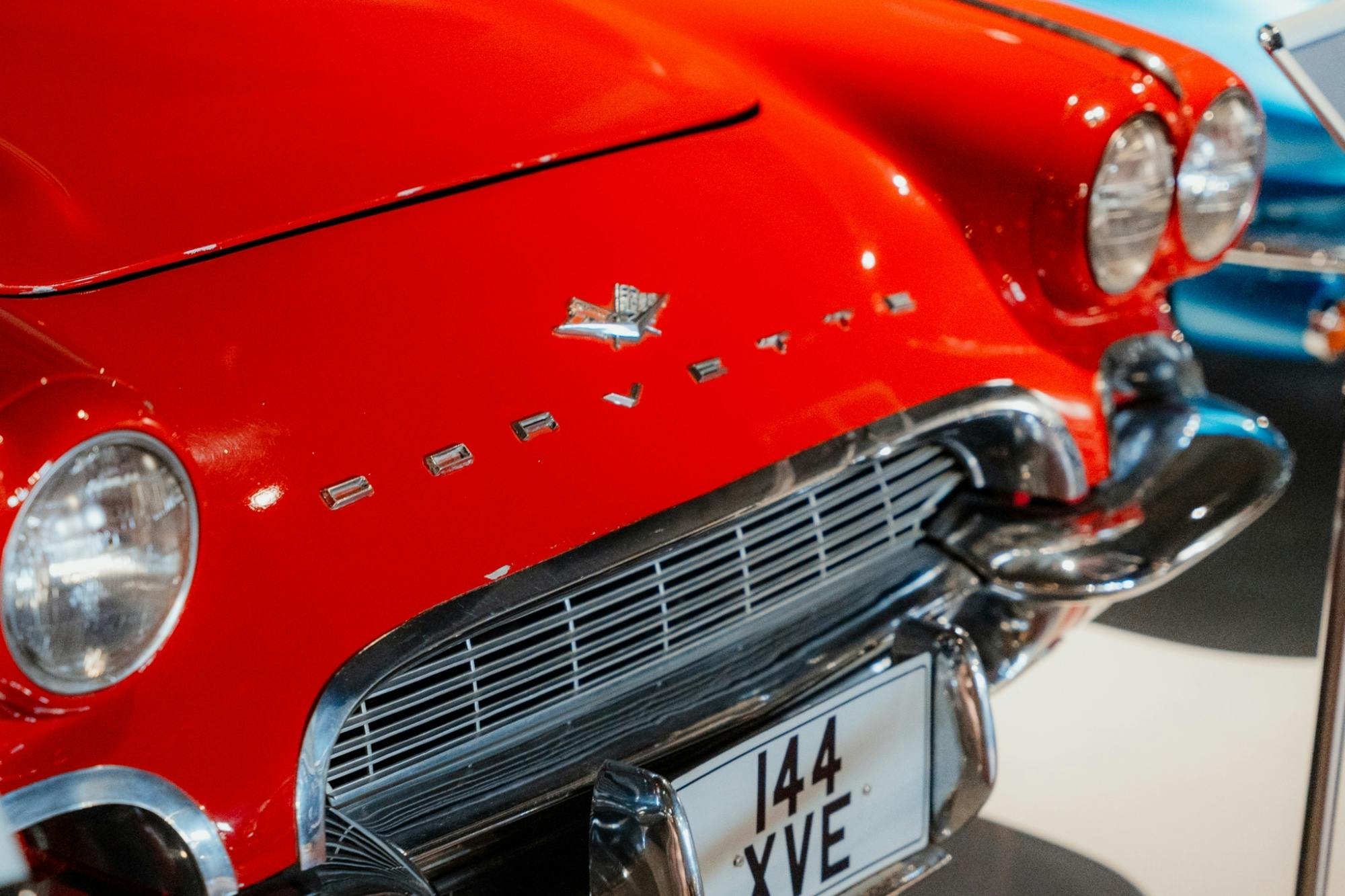
The collection ranges from elegant cars of the 1920s through post-war classics and colourful vehicles of the 1960s and 1970s to 1980s performance cars. Highlights promoted by the museum include a 1927 Fiat 509, 1928 Renault Tourer, 1955 Rolls-Royce Silver Cloud I and a dramatic Batmobile built from a 1940 Lincoln Zephyr.
The museum is particularly convenient for holidaymakers because it is not hidden in an industrial estate outside town. It is located at 20 Kryou Nerou in central Ayia Napa, close to other attractions, restaurants and hotels. The museum also provides free parking behind the building and has a bus stop nearby.
As of August 2026, general admission is €12 for adults, €10 for visitors over 65 and €6 for children aged 4–12. Children under four enter free. Current published opening hours are 10:00 am–10:00 pm daily, although the museum warns that hours can vary during the season.
Ammochostos Motor Museum at a Glance
Visitor Information
Details
Location
Ayia Napa, Famagusta District, Cyprus
Address
Kryou Nerou 20, Ayia Napa 5330
Opened
2025
Total collection
About 105 exhibits
Classic cars
70
Motorcycles
29
Small vehicles
3
Historic tractors
2
Special display
Batmobile based on a 1940 Lincoln Zephyr
Adult admission
€12
Age 4–12
€6
Age 65+
€10
Under 4
Free
Current hours
10:00 am–10:00 pm daily
Typical visit
About 1–1½ hours
Tour style
Self-guided
Accessibility
Wheelchair-accessible attraction
Parking
Free parking behind the museum
Best for
Car enthusiasts, families, teenagers and rainy or very hot days
A New Attraction in Ayia Napa
The Ammochostos Motor Museum opened in 2025, adding something quite different to a destination better known for beaches, nightlife and water activities.
Local reporting when the museum opened described a collection of restored vehicles ranging broadly from the 1920s through the 1980s, including traditional classics and sporting machines.
The museum’s own description places a strong emphasis on restoration. Vehicles were located, restored and prepared for display so that visitors can see examples representing different stages in the development of motoring.
Why Is It Called Ammochostos Motor Museum?
Ammochostos is the Greek name associated with the Famagusta district of Cyprus. Ayia Napa lies within the Famagusta region.
The name can occasionally confuse visitors into assuming that the museum is located in the city of Famagusta. It is not.
The museum itself is in Ayia Napa at 20 Kryou Nerou.
What Is Inside?
The current collection contains approximately 105 exhibits.
Published regional tourism information breaks this down as:
70 classic cars
29 motorcycles
3 small or compact vehicles
2 historic tractors
A Batmobile display
The collection therefore covers much more than expensive sports cars. Part of the attraction is seeing how ordinary personal transport changed alongside luxury and performance vehicles.
The Batmobile
The Batmobile is likely to be one of the biggest attractions for children and movie-car enthusiasts.
The museum describes its example as being constructed from a 1940 Lincoln Zephyr and styled as Gotham City’s famous crime-fighting vehicle.
It should be viewed as a themed automotive display rather than automatically assuming it is an original vehicle used in a particular Batman film or television production.
The dramatic black bodywork makes it one of the easiest exhibits for younger visitors to recognise immediately.
1955 Rolls-Royce Silver Cloud I
At the opposite end of the automotive spectrum is the Rolls-Royce Silver Cloud I.
The museum highlights a 1955 example representing the tradition of large British luxury cars.
The Silver Cloud is worth examining for details such as:
The prominent Rolls-Royce grille
Long bonnet
Formal body proportions
Chrome work
Luxury interior treatment
It provides an excellent comparison with much smaller European cars built during roughly the same period.
1928 Renault Tourer
The 1928 Renault Tourer takes visitors much closer to the early days of practical motoring.
The museum describes it as an open-air vintage vehicle that captures the character of the period when automobiles were still dramatically different from modern cars in their controls, construction and everyday usability.
Look at details such as the wheels, lighting, instrumentation and passenger compartment and compare them with a car built only 30 or 40 years later.
1927 Fiat 509
Another officially highlighted early car is the 1927 Fiat 509.
Produced during a period when manufacturers were trying to make automobiles smaller and more accessible, the 509 represents a completely different philosophy from enormous prestige cars.
For visitors interested in automotive history, these ordinary early cars can actually be more revealing than a modern supercar because they demonstrate how quickly the basic automobile evolved.
Cars From the 1920s to the 1980s
The museum describes its collection as spanning much of the golden age of motoring, from the 1920s through the 1980s.
That means the displays allow you to compare radically different eras:
Pre-war touring cars
Large luxury automobiles
Post-war family cars
European compact vehicles
Sports cars
Motorcycles
Later performance machinery
Even visitors who know little about engines can easily see the changes in styling, comfort, aerodynamics and vehicle size.
The Motorcycle Collection
With approximately 29 motorcycles, bikes form a substantial part of the exhibition rather than a token addition beside the cars.
The motorcycles are useful for comparing the evolution of two-wheeled transport with changes happening simultaneously in the automobile industry.
Look at:
Engine size
Frame design
Suspension
Braking systems
Fuel tanks
Seating
Lighting
Instrument panels
Compact Vehicles
The museum also lists three small vehicles within its current collection.
Compact and unusual cars can be particularly entertaining because they show some of the different solutions manufacturers developed for cheap and efficient personal transport.
They also provide an amusing contrast with the enormous luxury cars nearby.
Historic Tractors
Two historic tractors broaden the story beyond cars and motorcycles.
Agricultural mechanisation had an enormous impact on rural life, so these machines represent an important branch of motoring history that is easy to overlook in a museum dominated by attractive road cars.
Restoration Is a Major Part of the Story
The Ammochostos Motor Museum is not simply a room containing old vehicles acquired in perfect condition.
The museum states that considerable restoration work went into bringing vehicles back to display standard, with attention paid to bodywork, engines and individual details.
That makes it worth looking closely at:
Paintwork
Chrome
Wheels
Interior upholstery
Badges
Dashboard instruments
Engine-bay details where visible
A Self-Guided Museum
The standard experience is self-guided.
Your admission ticket covers entry to the permanent exhibition, but a personal guided tour is not included in the regular ticket sold through current booking platforms.
This works well for a car museum because different visitors naturally want to spend very different amounts of time with individual vehicles.
How Long Does the Ammochostos Motor Museum Take?
45 Minutes
Enough for a quick look if only one member of your group is genuinely interested in cars.
1 Hour
A realistic visit for many holidaymakers.
Recent visitors commonly describe spending around an hour exploring the collection.
1½ Hours
Better for anyone interested in classic vehicles.
You can stop to read the information, photograph favourite cars and look more carefully at the motorcycles and smaller exhibits.
Up to 2 Hours
Current commercial ticket listings allow up to approximately two hours for the experience.
Serious collectors and enthusiasts may naturally remain longer than casual visitors.
Current 2026 Ticket Prices
As of August 2026, the official museum prices are:
Visitor
Current Admission
Adult age 13+
€12
Child age 4–12
€6
Pensioner age 65+
€10
Child under 4
Free
The museum’s current flexible online tickets remain valid for a single admission during the stated validity period rather than requiring visitors to commit to one particular hour.
Current 2026 Opening Hours
The museum currently publishes the following hours:
Daily: 10:00 am–10:00 pm
This unusually late closing time makes the museum easy to include around a beach day.
However, the museum specifically states that opening hours are subject to change during the season, so check the current schedule if visiting outside the main summer period.
Seasonal Opening
The museum reopened for its 2026 season on 15 April 2026, indicating that travellers visiting Ayia Napa during the quieter winter period should not assume the long summer opening schedule operates year-round.
For summer visitors, the current daily 10:00 am–10:00 pm schedule provides considerable flexibility.
Best Time of Day to Visit
Late Morning
Good if you want to see the museum before heading to lunch or the beach.
Mid-Afternoon
One of the best times in summer.
Ayia Napa can be extremely hot in the afternoon, and the museum provides an indoor break from several hours in the sun.
Recent visitor reports also describe the museum as air-conditioned.
Early Evening
Excellent for fitting the museum around a beach holiday.
Because the current summer schedule extends until 10:00 pm, you can spend the day swimming and visit the collection after returning from the beach.
Do You Need to Book in Advance?
Flexible tickets are currently available online, but this is not the type of attraction where ordinary admission is tied to one short timed slot.
For most visitors, advance booking is mainly useful for convenience.
Groups travelling during busy holiday periods may still prefer to arrange admission beforehand.
Check Cancellation Conditions
Booking conditions can differ according to where you buy the ticket.
One current third-party self-guided ticket specifically states that the booking is non-refundable and cannot be changed.
If flexibility matters, compare the conditions with the museum’s direct ticket before purchasing through an intermediary.
Is the Museum Suitable for Children?
Yes, particularly for school-age children and teenagers who like cars.
Unlike an art gallery where younger visitors may struggle with lengthy interpretation, the exhibits here are large and immediately understandable.
Children may especially enjoy:
The Batmobile
Brightly coloured classic cars
Motorcycles
Unusual compact vehicles
Comparing very old cars with modern vehicles
The museum specifically promotes itself for families as well as enthusiasts and collectors.
A Good Activity for Teenagers
The attraction can work particularly well for teenagers who are less enthusiastic about churches, archaeological sites or conventional museums.
Performance cars, motorcycles and film-inspired displays provide a very different experience from the cultural attractions elsewhere in Cyprus.
Current visitor feedback also describes the museum as particularly enjoyable for families and teenagers.
Is It Only for Serious Car Enthusiasts?
No.
A knowledgeable collector may be interested in specific engines, production history and restoration details, but casual visitors can simply enjoy the changing designs.
The easiest way to appreciate the collection without knowing anything about automotive engineering is to compare:
A 1920s car with a 1950s car
Luxury vehicles with people’s cars
European compact cars with large cruisers
Early motorcycles with later machines
Traditional cars with the Batmobile display
Photography
The museum actively encourages visitors to get close enough to appreciate and photograph its restored vehicles.
Useful photographic subjects include:
Front grilles and badges
Steering wheels
Dashboard details
Chrome work
Motorcycle fuel tanks
Classic wheel designs
The Batmobile
The Rolls-Royce
Do not cross display barriers or touch vehicles unless museum staff specifically indicate that it is permitted.
Wheelchair Accessibility
The current self-guided attraction listing describes the Ammochostos Motor Museum as wheelchair accessible.
As with any visitor requiring a particular facility, it is sensible to contact the museum directly before travelling if you need confirmation about toilets, lifts or a specific type of mobility equipment.
Free Parking
Free visitor parking is available behind the museum.
This is particularly useful for visitors travelling around eastern Cyprus by rental car.
Cyprus drives on the left-hand side of the road, an important point for overseas visitors renting a vehicle.
Getting There by Bus
The museum states that there is a bus stop directly outside or immediately beside the attraction.
Ayia Napa and the wider Protaras/Paralimni region are served by OSEA local buses.
A particularly useful central Ayia Napa service is Route 201, which passes the nearby Thalassa Museum on Kryou Nerou before continuing through central Ayia Napa and towards the Nissi Avenue side of town.
Because routes and seasonal frequencies can change, check the current OSEA schedule on the day you travel.
Getting There From Protaras
Visitors staying in Protaras can travel towards Ayia Napa using the regional bus network or by taxi.
Current OSEA routes 101 and 102 connect the Ayia Napa, Cape Greco, Konnos, Protaras, Pernera and Paralimni corridor.
Once in central Ayia Napa, the museum’s Kryou Nerou location is straightforward to reach on foot, by local bus or taxi.
Getting There From Larnaca
Ayia Napa is connected with Larnaca by intercity bus services, while airport transfer services also connect the Ammochostos region with Larnaca International Airport.
If the motor museum is only one stop in a full eastern-Cyprus day trip, a rental car generally provides the greatest flexibility.
Where Is the Museum in Ayia Napa?
The museum is located at:
Ammochostos Motor Museum
20 Kryou Nerou
Ayia Napa 5330
Cyprus
This is a very convenient location because Kryou Nerou runs through the eastern side of central Ayia Napa towards Cape Greco.
Combine It With Thalassa Museum
The Thalassa Ayia Napa Municipal Museum is only a short distance away on the same street.
Thalassa is devoted to Cyprus and its relationship with the sea, with exhibits including a full-size replica of the ancient Kyrenia ship, archaeological material, fossils and displays about marine life.
The two museums work surprisingly well together:
Ammochostos Motor Museum → lunch or coffee → Thalassa Museum
One explores the history of vehicles; the other explores maritime and natural history.
Combine It With the Ayia Napa Sculpture Park
If you prefer to mix indoor and outdoor sightseeing, continue east from central Ayia Napa towards the International Sculpture Park.
It provides an open-air contrast after spending an hour among vehicles and is particularly attractive later in the afternoon when the heat begins to decrease.
A Good Half-Day Ayia Napa Plan
Late Morning – Motor Museum
Allow around 60–90 minutes to see the complete collection.
Lunch
Stop in central Ayia Napa.
Afternoon – Another Museum or Beach
Visit the nearby maritime museum or return to the coast.
Evening
Explore central Ayia Napa once temperatures become more comfortable.
An Excellent Hot-Weather Activity
Most visitors come to Ayia Napa for the beaches, but summer temperatures can make continuous outdoor sightseeing tiring.
The Motor Museum provides a useful indoor activity during the hottest part of the day.
A practical summer schedule is:
Beach during the morning
Lunch
Motor Museum during the hotter afternoon
Return outdoors in the late afternoon
Good on a Rare Rainy Day
Cyprus is famous for sunshine, but poor-weather days do occur.
Because the collection is indoors, the museum becomes a particularly useful backup attraction when beaches, boat trips or Cape Greco activities are less appealing.
Where to Stay
Central Ayia Napa
Best choice for visiting the museum.
Staying centrally means you can normally reach Kryou Nerou easily and combine the museum with restaurants, shops and other attractions without needing a car.
Eastern Ayia Napa
Best for quieter surroundings and easier access towards Cape Greco.
This side of town is particularly convenient if your itinerary combines the museum with coastal sightseeing.
Protaras
Best if beaches and a quieter resort atmosphere are your priority.
You can still visit Ayia Napa using a rental car, taxi or the regional bus network.
Ayia Napa Motor Museum or Cyprus Motor Museum in Limassol?
Do not confuse the Ammochostos Motor Museum in Ayia Napa with the older Cyprus Historic & Classic Motor Museum in Limassol.
They are separate attractions in different parts of Cyprus.
Choose Ammochostos Motor Museum If:
You are staying in Ayia Napa
You are staying in Protaras or Paralimni
You want a compact one-hour museum visit
You want an activity near eastern Cyprus beaches
You want to see the Batmobile display
Choose the Limassol Motor Museum If:
You are staying around Limassol
You are touring southern Cyprus by car
You specifically want another large historic vehicle collection
There is little reason for an Ayia Napa holidaymaker to drive across Cyprus purely because an older guide refers generically to the “Cyprus Motor Museum.” Make sure you are looking at the correct attraction.
What Should Car Enthusiasts Look For?
Rather than simply photographing the whole vehicle, compare the details that changed through different decades.
Headlights
Watch them change from separate external lamps to integrated body designs.
Wheels and Tyres
Early narrow wheels gradually evolve into increasingly wide performance tyres.
Dashboard
Compare sparse early instrumentation with later speedometers, gauges, switches and entertainment systems.
Body Shape
Look at the transition from upright bodies and running boards to lower, smoother and increasingly aerodynamic forms.
Interiors
Compare early utilitarian seating with the leather, wood and comfort features of prestige cars.
Tips for Visiting With Someone Who Does Not Like Cars
The museum is compact enough that a mixed-interest couple or family can still visit without committing half a day.
If one person is a serious enthusiast and the other is not:
Allow around an hour
Concentrate on visually interesting cars
Find the oldest and newest vehicles
Look for the Batmobile
Compare luxury and ordinary cars
Continue afterwards to another Ayia Napa attraction
This makes the museum easier to include than a huge specialist collection that takes three or four hours to explore.
Is There a Café?
The museum’s own website currently includes visitor feedback referring to an upstairs café.
Because café opening arrangements can be seasonal, do not make it an essential part of your meal plans without checking when you arrive.
Central Ayia Napa has plenty of alternative cafés and restaurants within the surrounding area.
What to Bring
You do not need special equipment for the visit.
Useful items include:
Phone or camera
Comfortable walking shoes
Water during very hot weather
Proof of age if claiming the pensioner rate
Your mobile ticket if booked online
Practical Tips
Allow around 1–1½ hours.
Current adult admission is €12.
Children aged 4–12 currently pay €6.
Children under four enter free.
Visitors over 65 currently pay €10.
Summer opening hours are currently 10:00 am–10:00 pm daily.
Hours can change seasonally.
Free parking is available behind the museum.
There is public transport close to the entrance.
Look for the Batmobile, Rolls-Royce, Renault Tourer and Fiat 509.
Use the museum as a hot-afternoon or rainy-day activity.
Combine it with another central Ayia Napa attraction rather than dedicating an entire day to it.
Is the Ammochostos Motor Museum Worth Visiting?
Yes, particularly if you are interested in classic cars or want an easy indoor attraction during an Ayia Napa holiday.
The biggest advantage is the combination of a substantial collection and a very convenient location. The museum currently contains around 105 exhibits, including 70 cars, 29 motorcycles, three small vehicles and two historic tractors, together with its distinctive Batmobile display.
The variety is important. You are not simply looking at a row of modern supercars. The collection stretches back into the 1920s and includes vehicles representing very different approaches to motoring, from small practical cars to prestigious luxury machines.
Officially highlighted exhibits include the 1927 Fiat 509, 1928 Renault Tourer, 1955 Rolls-Royce Silver Cloud I and the Batmobile constructed from a 1940 Lincoln Zephyr.
Admission is also relatively straightforward. Current 2026 prices are €12 for adults, €10 for visitors over 65 and €6 for children aged 4–12, with children under four admitted free.
The current 10:00 am–10:00 pm daily schedule is particularly useful in a beach destination. You do not need to sacrifice the best part of a sunny morning to visit the museum; it can easily be saved for the hottest afternoon period or early evening.
Most visitors will need only around one to one-and-a-half hours, making it easy to combine with the rest of Ayia Napa.
For car enthusiasts it is an obvious addition to an eastern Cyprus itinerary, but even casual visitors may find that an hour surrounded by beautifully restored vehicles makes a surprisingly enjoyable change from another day on the beach.
Sponsored Popular Items
Quick take: Musement.com offers a worldwide selection of tours and attractions
Ayia Napa Ammochostos Motor Museum entry ticket Cyprus Plan Ayia Napa Ammochostos Motor Museum entry ticket, a cultural or heritage experience, with practical tips on timing, inclusions and what to check before booking. Compare current availability, prices and booking conditions before you go.
Ayia Napa Ammochostos Motor Museum entry ticket Cyprus Plan Ayia Napa Ammochostos Motor Museum entry ticket, a cultural or heritage experience, with practical tips on timing, inclusions and what to check before booking. Compare current availability, prices and booking conditions before you go.
The Musée des Arts et Métiers is one of Paris’s most fascinating museums for anyone interested in inventions, engineering, transport, science or the machines that changed everyday life. Its collection includes early automobiles, calculating machines, scientific instruments, mechanical automata, steam engines, communication technology, pioneering aircraft and the famous Foucault Pendulum.
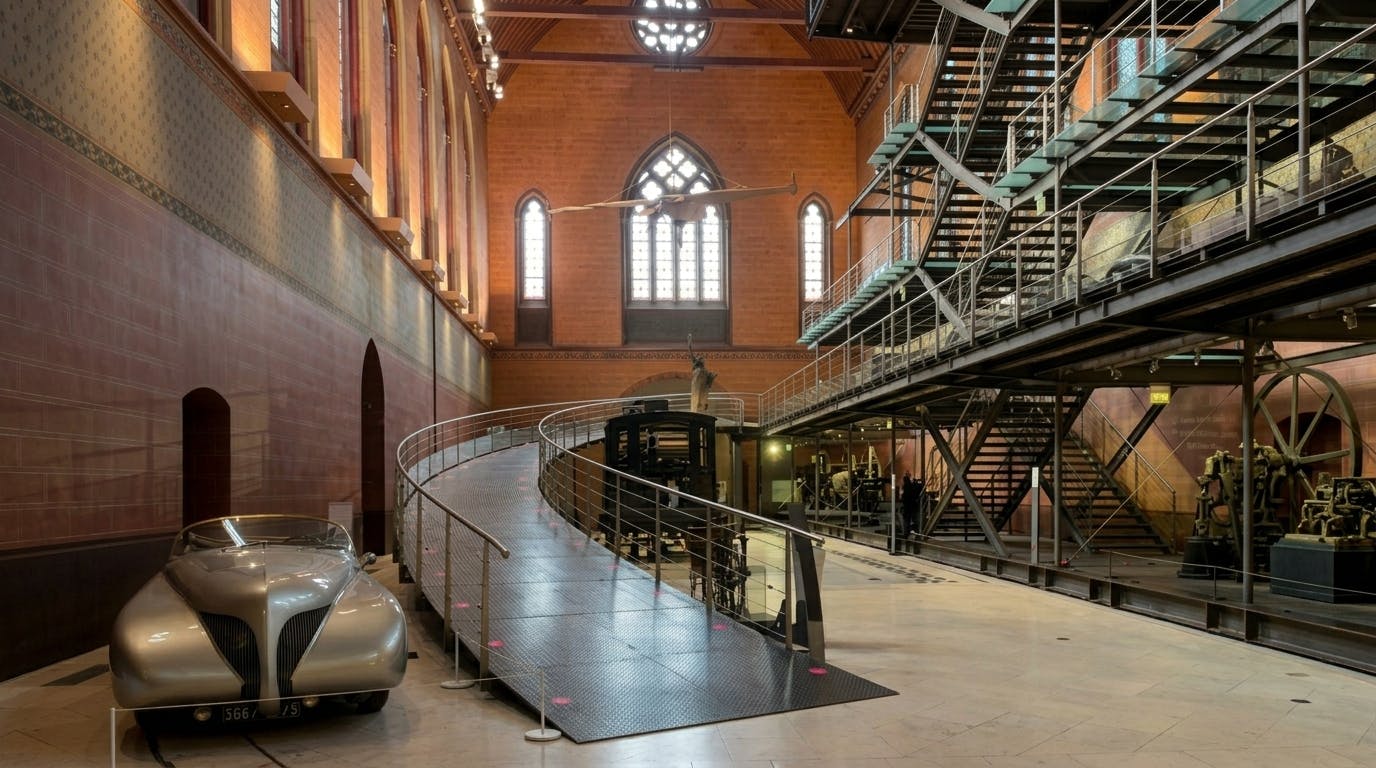
The setting makes the experience even more unusual. More than 2,400 inventions and technical objects are displayed partly inside the historic former Saint-Martin-des-Champs priory, with some of the museum’s largest transport exhibits dramatically suspended inside the old church.
The Conservatoire national des arts et métiers was founded in 1794 by Henri Grégoire as a repository for useful inventions and technological knowledge. The present museum was extensively refurbished and reopened in its modern form in 2000.
For a first visit, allow around 2 to 3 hours. Visitors with a serious interest in engineering or technological history can easily spend half a day examining the collections.
Musée des Arts et Métiers at a Glance
Visitor Information
Details
Location
3rd arrondissement, Paris
Address
60 rue Réaumur, 75003 Paris
Institution founded
1794
Objects displayed
More than 2,400
Permanent collection sections
7
Current standard ticket
€12
Current reduced ticket
€9
Free for everyone
First Sunday of each month and Fridays 6:00–9:00 pm
Normal opening hours
Tuesday–Sunday, 10:00 am–6:00 pm
Friday late opening
Until 9:00 pm
Monday
Closed
Typical visit
2–3 hours
Nearest Metro
Arts et Métiers
Best for
Science, inventions, engineering, aviation, transport and families
What Is the Musée des Arts et Métiers?
The name can be slightly confusing for English-speaking visitors. This is not a decorative-arts museum.
“Arts et Métiers” is closer to the idea of practical arts, engineering, trades and technology. The museum follows the development of machines and scientific knowledge through seven permanent collections:
Scientific Instruments
Materials
Construction
Communication
Energy
Mechanics
Transport
The result is effectively a history of how humans learned to measure, calculate, build, communicate, generate power and travel.
A Museum Created During the French Revolution
The Conservatoire national des arts et métiers was established in 1794 during the French Revolution. Henri Grégoire envisioned a public repository in which machines, models and useful inventions could be collected and demonstrated so that technical knowledge could be shared.
In 1798, the former Saint-Martin-des-Champs priory was assigned to the newly created Conservatoire. The historic religious buildings gradually became home to scientific collections, teaching facilities and eventually the museum visitors explore today.
The Former Saint-Martin-des-Champs Priory
The historic architecture is one of the unexpected pleasures of the visit.
Instead of seeing early aircraft and steam engines in an industrial warehouse, you eventually enter the former church of Saint-Martin-des-Champs, where machines are displayed beneath Gothic vaults and stained-glass windows.
This contrast is particularly dramatic in the Transport collection, where historic aircraft appear to float above medieval architecture.
More Than 2,400 Inventions
The museum currently displays more than 2,400 objects, while its broader holdings are far larger. The permanent route is organised so that technological developments can be followed chronologically as well as thematically.
You can move from instruments used by early scientists through mechanical calculation, steam power, industrial machinery, photography, cinema, telecommunications, automobiles and aviation.
The 7 Permanent Collections
1. Scientific Instruments
This section explores how scientists learned to measure and describe the physical world.
Expect objects connected with:
Astronomy
Measurement
Timekeeping
Optics
Chemistry
Electricity
Mathematics
Physics
Several of the museum’s most historically important objects are found here, including equipment connected with Antoine Lavoisier, early calculation and precision measurement.
2. Materials
The Materials collection looks at how humans learned to extract, process and transform substances into useful products.
The displays connect traditional craftsmanship with industrial manufacturing and help explain why advances in metallurgy, glass, ceramics, textiles and synthetic materials were essential to technological development.
3. Construction
The Construction galleries concentrate on the engineering required to create buildings and infrastructure.
Models are particularly important here. Before computer modelling existed, highly detailed physical models allowed engineers, architects and students to understand structures, bridges and construction techniques.
4. Communication
The Communication collection traces the enormous transformation in the way information is recorded and transmitted.
The route includes technology associated with printing, photography, telegraphy, sound recording, cinema and later forms of electronic communication.
5. Energy
The Energy galleries explain the machines that turned heat, water, electricity and other energy sources into usable power.
Steam engines are particularly important because industrialisation depended on the ability to generate reliable mechanical power without relying exclusively on animals, wind or flowing water.
6. Mechanics
Gears, transmissions, mechanisms and machine tools show how apparently simple mechanical ideas can be combined into increasingly sophisticated machines.
This section is especially worthwhile if you enjoy seeing how things actually work rather than simply reading about the finished invention.
7. Transport
The Transport collection contains some of the museum’s most spectacular objects.
Cars, steam-powered vehicles and aircraft eventually lead visitors into the former church, where enormous machines occupy multiple levels of the historic space.
Do Not Miss the Foucault Pendulum
The Foucault Pendulum is one of the museum’s signature exhibits.
French physicist Léon Foucault demonstrated in 1851 that a freely swinging pendulum could provide visible evidence that Earth rotates on its axis.
The idea is beautifully simple. A heavy sphere hangs from a long wire and swings back and forth. The pendulum’s plane of oscillation remains comparatively stable while Earth rotates beneath it, so its path appears gradually to change relative to the floor.
The museum preserves Foucault’s historic pendulum sphere and displays the pendulum in the former church, giving the experiment an unusually dramatic architectural setting.
Watch a Foucault Pendulum Demonstration
The museum currently schedules demonstrations of the pendulum at:
12:00 noon
5:00 pm
from Tuesday to Sunday except public holidays. Each explanation lasts around 20 minutes.
There are occasional exceptions, so check the day’s programme if seeing the demonstration is particularly important.
Cugnot’s Steam-Powered Fardier
Another essential exhibit is Nicolas-Joseph Cugnot’s steam-powered fardier.
In 1769, military engineer Cugnot constructed a vehicle able to propel itself without animal traction. The enormous three-wheeled machine was intended to move heavy artillery equipment and is widely regarded as one of the earliest self-propelled road vehicles and an ancestor of the automobile.
The front is dominated by a large boiler positioned ahead of a single driven wheel, giving the machine a wonderfully unconventional appearance by modern standards.
Why the Fardier Matters
Modern cars look nothing like Cugnot’s machine, but the principle was revolutionary: a vehicle could move under its own mechanical power rather than being pulled by horses.
Seeing the full-size machine helps make the leap from stationary steam engines to powered transport much easier to understand.
Clément Ader’s Avion No. 3
One of the most visually impressive exhibits is Clément Ader’s Avion No. 3, built in 1897.
The aircraft looks almost organic. Its broad wings resemble those of a giant bat, reflecting Ader’s interest in using forms from nature to solve the problem of powered flight.
The aircraft measures roughly 15 metres across and weighs about 258 kilograms.
Ader later presented the machine to the Conservatoire, and today it hangs dramatically above the museum’s grand staircase and transport galleries.
The Beginnings of Powered Flight
Ader’s experiments belong to the period immediately before controlled powered aviation became practical.
The museum uses his aircraft to tell a broader story about the enormous engineering problems early aviation pioneers had to solve: weight, engines, lift, control and structural strength.
The Lumière Cinématographe
Film enthusiasts should look for the museum’s early Lumière Cinématographe.
The brothers Auguste and Louis Lumière patented their cinematograph in 1895. Jules Carpentier manufactured the apparatus based on their patent, creating a compact machine capable of recording and projecting moving images.
The Lumière technology helped transform moving pictures from a scientific and technical curiosity into public entertainment.
Lavoisier’s Laboratory
The museum also preserves instruments and equipment associated with Antoine Lavoisier, one of the foundational figures of modern chemistry.
The displays connect physical objects with experiments and theories developed during the 18th century, allowing visitors to see the types of equipment with which chemical science was being transformed into a quantitative discipline.
The Pascaline
The history of computing starts far earlier than electronic computers.
Blaise Pascal created his mechanical calculating machine, generally known as the Pascaline, in the 1640s. Its gear mechanism could perform arithmetic while automatically handling numerical carrying.
Seeing mechanical calculation alongside later communication and computing technologies helps illustrate how many modern digital ideas have surprisingly old ancestors.
The Standard Metre
The museum’s collections also connect directly with the creation of the modern metric system.
A metre standard produced by Étienne Lenoir in 1799 forms part of the museum’s interpretation of measurement and scientific standardisation.
The object may not have the theatrical impact of an aircraft or steam vehicle, but agreeing on reliable universal measurements was essential for modern science, engineering and international trade.
The Joueuse de Tympanon
One of the museum’s most charming objects is the Joueuse de Tympanon, an extraordinary mechanical automaton dating from 1784.
The figure represents an elegantly dressed young woman playing a small hammered string instrument. A complex internal mechanism created by clockmaker Pierre Kintzing controls the movements required to play.
The automaton demonstrates that the desire to reproduce human actions mechanically existed centuries before modern robotics.
The Automata Theatre
The museum maintains a dedicated area devoted to automata and mechanical toys, including the Joueuse de Tympanon and later moving figures.
This is particularly engaging for children because gears, cams and mechanical movement are easier to understand when they cause a figure to walk, play music or perform an action.
Why the Church Is the Best Part of the Building
Even visitors who begin to experience “museum fatigue” often regain their enthusiasm when the route enters the former church.
The architecture suddenly opens into a large Gothic space filled with transport technology.
Here the museum feels almost theatrical:
Early aircraft hang overhead
Historic vehicles sit below
Mechanical machinery occupies platforms
The Foucault Pendulum swings beneath medieval vaults
The combination of ancient architecture and industrial technology is one of the reasons the Musée des Arts et Métiers feels different from a conventional science museum.
Zeus, the Metallic Horse
Visitors in 2026 may also encounter Zeus, the striking mechanical horse created for the Paris 2024 Olympic Games opening ceremony.
The large metallic horse is currently displayed on the museum forecourt as a free outdoor installation, allowing visitors to see it even without entering the paid galleries.
The accompanying indoor exhibition about its design and construction finished earlier in 2026, but the exterior installation is scheduled to remain for a longer period.
Current 2026 Ticket Prices
As of August 2026, the museum’s standard combined ticket for the permanent collections and any applicable temporary exhibition is:
Ticket
Current Price
Full price
€12
Reduced price
€9
Reduced and free categories have eligibility requirements, so bring proof if you intend to claim a concession.
Free Entry for Visitors Under 26
Current Paris visitor information lists free museum admission for visitors under 26, including both EU and non-EU visitors.
Check the current eligibility conditions when obtaining the ticket, particularly if temporary exhibitions or special events are involved.
Free First Sunday of the Month
Admission is currently free for everyone on the first Sunday of each month.
This can be excellent for budget travellers, although free days naturally tend to attract more visitors.
Free Friday Evening
One of the best-value museum opportunities in Paris is the museum’s Friday late opening.
Admission is currently free for everyone from 6:00 pm until 9:00 pm on Fridays.
This is particularly useful if you want to save daytime hours for outdoor sightseeing.
Current Opening Hours
Day
Hours
Monday
Closed
Tuesday
10:00 am–6:00 pm
Wednesday
10:00 am–6:00 pm
Thursday
10:00 am–6:00 pm
Friday
10:00 am–9:00 pm
Saturday
10:00 am–6:00 pm
Sunday
10:00 am–6:00 pm
The museum is also closed on 1 January, 1 May and 25 December.
Current Temporary Exhibition Situation in August 2026
The previous major temporary exhibition, Flops?!, finished on 17 May 2026, while the next major exhibition, Lady Liberté: De la sueur, de l’audace, du génie, is scheduled to begin on 22 September 2026.
Visitors in August 2026 should therefore treat the outstanding permanent collection as the main attraction rather than planning the trip around a large temporary exhibition.
How Long Do You Need?
1 Hour
Too short for the full museum, but possible for a highlights-only visit.
Concentrate on:
Foucault Pendulum
Cugnot’s Fardier
Avion No. 3
Lumière Cinématographe
The former church
2 Hours
Good minimum for a first visit.
You can move through all seven collections while slowing down for the most important objects.
3 Hours
Best for most interested adults.
This gives you enough time to read the interpretation, examine models and mechanisms and include a Foucault Pendulum demonstration.
Half a Day
Appropriate for engineering, aviation, transport or industrial-history enthusiasts.
The museum contains enough technical material that a specialist visitor can easily spend four hours or more.
Best Time of Day to Visit
10:00 am
Best if the museum is a major priority.
You can explore the upper collections first and then position yourself in the church for the noon Foucault demonstration.
Late Morning
A particularly good choice if you specifically want the 12:00 noon pendulum demonstration.
Friday Evening
Best for value.
The museum remains open until 9:00 pm and general admission is free from 6:00 pm.
Suggested Route Through the Museum
The museum is large enough that attempting to examine every label can become exhausting.
A useful first-visit strategy is:
Begin with the Scientific Instruments.
See the Lavoisier material and calculating machines.
Move through Materials and Construction at a moderate pace.
Spend extra time in Communication for photography and cinema.
Follow the development of steam and mechanical power through Energy and Mechanics.
Finish with Transport and the former church.
Time your arrival in the church for a Foucault demonstration.
If You Have Only 90 Minutes
Prioritise the museum’s flagship objects rather than trying to complete every room.
Pascaline and early scientific instruments
Lavoisier displays
Lumière Cinématographe
Cugnot’s Fardier
Clément Ader’s Avion No. 3
Foucault Pendulum
The museum itself identifies a selection of around 150 flagship objects for visitors wanting a faster route.
Guided Visits and Demonstrations
The museum offers guided tours, short interpretive visits, demonstrations, workshops and family programmes throughout the year.
Current programmes can include explanations of:
Foucault Pendulum
Cugnot’s Fardier
Lavoisier’s laboratory
Automata
Aviation
Major inventions
Check the programme for your specific date because activities vary during school holidays and special events.
Visiting With Children
The Musée des Arts et Métiers can be excellent for children, particularly from primary-school age onwards.
The strongest exhibits are large, mechanical and visually understandable.
Children may particularly enjoy:
The giant bat-shaped Ader aircraft
Steam vehicles
Automata
The Foucault Pendulum
Mechanical gears
Old cameras
Early cars
Scientific demonstrations
The museum also runs dedicated family workshops and children’s activities throughout its programme.
A Good Museum for Curious Children
Rather than asking children to memorise dates, try questions such as:
How did this machine move?
What powered it?
Why was this invention useful?
What modern object replaced it?
Which parts are still used today?
The museum works particularly well when children are encouraged to compare old technologies with devices they recognise.
Accessibility
The museum provides step-free access directly from rue Réaumur and has adapted circulation for visitors with reduced mobility.
Two wheelchairs can currently be borrowed at reception in exchange for identification, and seating is positioned around the route to provide opportunities for regular rest.
The museum also provides accessibility information and services for visitors with visual, hearing, intellectual and psychological disabilities.
Luggage and Cloakroom Rules
The museum has cloakroom facilities, but luggage rules are important.
Small bags up to approximately 55 × 35 × 25 centimetres can be accommodated within the current restrictions.
Rolling suitcases are not admitted regardless of size, and luggage larger than cabin dimensions is prohibited.
If you are visiting between hotel check-out and a train or flight, arrange proper luggage storage elsewhere rather than relying on the museum.
Where Is the Museum?
The address is:
Musée des Arts et Métiers
60 rue Réaumur
75003 Paris
France
It lies in the 3rd arrondissement, on the northern side of the historic Marais area.
Getting There by Metro
The most convenient station is appropriately named:
Arts et Métiers
The museum also lists Réaumur–Sébastopol as a nearby Metro option.
The Arts et Métiers Metro station itself is worth noticing. Its unusual metallic design makes it one of the more distinctive stations on the Paris Métro network.
Getting There by Bus
The museum currently lists bus routes:
20
38
39
as useful public-transport connections.
Combine the Museum With Le Marais
The museum sits close to Le Marais, making it easy to combine technology and science with several hours exploring one of central Paris’s most interesting historic neighbourhoods.
A particularly good plan is to visit the museum in the morning and then walk south into the Marais for lunch and afternoon sightseeing.
Continue Towards Place de la République
Another easy option is to continue northeast towards Place de la République after the museum.
This works particularly well if you are using the museum as part of a broader walking day rather than making a dedicated return journey from another part of Paris.
A Good Half-Day Itinerary
10:00 am – Enter the Museum
Begin with Scientific Instruments and the early history of measurement and calculation.
11:00 am – Communication, Energy and Mechanics
Concentrate on inventions whose purpose you can compare with modern equivalents.
Noon – Foucault Pendulum
Reach the former church for the scheduled 12:00 demonstration.
12:30 pm – Transport
Spend time with Cugnot’s Fardier and Clément Ader’s aircraft.
1:00 pm – Leave for Lunch
Continue into Le Marais or the surrounding 3rd arrondissement.
A Good Rainy-Day Paris Attraction
The museum is particularly useful when poor weather makes long outdoor walks less appealing.
Because the collections are extensive, you can easily spend several hours indoors without feeling that you chose a minor attraction simply because it was raining.
Is It Good During Hot Weather?
Yes. A long visit provides a useful break from exposed streets during the warmest part of a summer day.
Another strategy is to visit outdoor Paris during the morning and then use the museum during the afternoon before returning outside for the evening.
Friday Night Is an Excellent Option
For travellers trying to maximise sightseeing time, the Friday schedule is particularly valuable.
The museum remains open until 9:00 pm, and entrance is free from 6:00–9:00 pm.
This makes it possible to spend the entire day elsewhere in Paris and visit Arts et Métiers after many other museums have closed.
Is This Museum Mainly for Engineers?
No.
Engineers will obviously find enormous amounts of technical detail, but the best exhibits tell stories that are easy to appreciate without specialist knowledge.
You do not need to understand thermodynamics to appreciate an enormous steam vehicle, aerodynamics to enjoy Ader’s bat-shaped aircraft or advanced physics to understand the basic idea behind Foucault’s Pendulum.
Musée des Arts et Métiers or a Traditional Science Museum?
The experience is slightly different from a modern interactive science centre.
Choose Arts et Métiers If You Want:
Original historic machines
Engineering history
Early automobiles
Aviation pioneers
Scientific instruments
Mechanical automata
The history of inventions
Choose a Modern Science Centre If You Want:
Large numbers of hands-on experiments
Interactive digital exhibits
Contemporary science demonstrations
Activities designed primarily for children
Arts et Métiers is best understood as a museum of technological history containing real landmark inventions rather than a giant interactive playground.
Photography
The former church is one of the most photogenic areas.
Look for compositions involving:
Aircraft beneath Gothic vaults
The reflection of the Foucault Pendulum
Steam machinery against historic architecture
Mechanical details and gears
Early automobiles
Low light can make photography difficult in some galleries, so hold your camera or phone steady and follow any photography restrictions displayed by the museum.
Where to Stay
Le Marais
Best for atmosphere and walking access.
Staying in or around the Marais places the museum within easy walking distance while also giving convenient access to restaurants, historic streets and central Paris.
République
Best for transport connections and a wider range of accommodation.
The museum remains close while several Metro lines make travelling to other parts of Paris straightforward.
Common Mistakes to Avoid
Confusing It With the Musée des Arts Décoratifs
They are completely different museums.
The Musée des Arts et Métiers is devoted to science, technology, engineering and inventions.
Allowing Only 30 Minutes
The collection contains more than 2,400 displayed objects across seven major themes. A quick visit misses much of what makes the museum worthwhile.
Missing the Former Church
The Transport collection, early aircraft and Foucault Pendulum make this one of the most memorable sections.
Not Checking the Pendulum Times
The current regular demonstrations are at noon and 5:00 pm from Tuesday to Sunday, subject to exceptions.
Arriving on Monday
The museum is closed every Monday.
Bringing a Rolling Suitcase
Rolling luggage is currently prohibited even when it is relatively small.
Ten Things Not to Miss
Foucault Pendulum
Cugnot’s steam-powered Fardier
Clément Ader’s Avion No. 3
Lumière Cinématographe
Lavoisier laboratory instruments
Pascaline and early calculation
The Joueuse de Tympanon automaton
The historic measurement collections
The Transport gallery inside the former church
Zeus, the metallic horse, while it remains on display
Practical Tips
Allow 2–3 hours for a first visit.
Do not visit on Monday because the museum is closed.
Try to see a Foucault Pendulum demonstration at noon or 5:00 pm.
Use Friday evening for free admission from 6:00–9:00 pm.
The first Sunday of each month is also free.
Do not bring a rolling suitcase.
Spend extra time in the former church.
Look for the original machines rather than trying to read every label.
Families should check the current workshop programme.
Combine the museum with a walk through Le Marais.
Is the Musée des Arts et Métiers Worth Visiting?
Yes, particularly if you want to visit a Paris museum that feels completely different from the Louvre, Musée d’Orsay and the city’s traditional art collections.
The Conservatoire was founded in 1794, and the modern museum now displays more than 2,400 inventions across seven technological collections.
Its great strength is that many of the objects are not replicas created simply to illustrate an idea. You are looking at machines connected directly with important stages in technological history: Cugnot’s pioneering steam vehicle, Clément Ader’s experimental aircraft, the Lumière cinematograph, mechanical calculation, Lavoisier’s scientific apparatus and Foucault’s famous pendulum experiment.
The building adds another dimension. Finishing the visit beneath the Gothic vaults of the former Saint-Martin-des-Champs church, surrounded by early aircraft, machines and a swinging Foucault Pendulum, is an experience few other technology museums can reproduce.
Current admission is also reasonable by Paris standards at €12 full price and €9 reduced. Better still, admission is free for everyone on the first Sunday of each month and every Friday from 6:00 pm until the 9:00 pm closing time.
The museum is normally open Tuesday through Sunday from 10:00 am to 6:00 pm, with the Friday late opening until 9:00 pm. It closes on Mondays as well as 1 January, 1 May and 25 December.
For the best visit, give yourself around three hours, choose several inventions you genuinely want to understand and arrange your route so that you reach the former church in time for one of the Foucault Pendulum demonstrations.
The Musée des Arts et Métiers is ultimately a museum about how ideas became machines—and how those machines gradually created the technological world we now take for granted.
Sponsored Popular Items
Quick take: Musement.com offers a worldwide selection of tours and attractions
Musée des Arts et Métiers with City Audio Tour and eSIM France Plan Musée des Arts et Métiers with City Audio Tour and eSIM, a guided sightseeing experience, with practical tips on timing, inclusions and what to check before booking. Compare current availability, prices and booking conditions before you go.
Entrance Ticket for the Musée des Confluences – Attraction Entry France Entrance Ticket for the Musée des Confluences USD 16 provides a structured way to visit a notable attraction or cultural site. Check current availability, inclusions and booking details before you go.
Tickets & Guided Tours for the Musée des Confluences in Lyon France Compare sightseeing experiences in Tickets & Guided, with practical tips on timing, inclusions and choosing the right option. Check current availability, prices and booking conditions before you go.
The Royal Monastery of Brou in Bourg-en-Bresse is one of the most remarkable late-Gothic monuments in France. Its brilliant glazed-tile roof, intricate white-stone church, three cloisters and spectacular Renaissance tombs were created from a deeply personal story: Margaret of Austria built the monastery as a memorial to her husband, Philibert the Handsome, Duke of Savoy, after his sudden death.
Construction began in 1506 and was largely completed by 1532. Margaret recruited artists, stonecutters and craftsmen from across Europe, producing a building that combines Flamboyant Gothic architecture, Flemish artistic influence and Burgundian decorative traditions.
The monastery is much more than a church. A standard ticket also gives access to the three historic cloisters, Margaret of Austria’s apartments and the Musée des Beaux-Arts, whose collection ranges from medieval and Flemish art to Gustave Doré and major modern artists.
Allow around 1½ to 2 hours for a good first visit. Art enthusiasts can easily spend considerably longer.
Royal Monastery of Brou at a Glance
Visitor Information
Details
French name
Monastère royal de Brou
Location
Bourg-en-Bresse, Ain, eastern France
Address
63 boulevard de Brou, 01000 Bourg-en-Bresse
Founder
Margaret of Austria
Construction began
1506
Church completed
1532
Architectural style
Flamboyant Gothic with strong Flemish influence
Current general admission
€11
April–September
9:00 am–6:00 pm
October–March
9:00 am–5:00 pm
Typical self-guided visit
About 1½ hours
Audio-guide visit
About 1 hour 45 minutes
Audio guide
€4 extra
Nearest railway station
Bourg-en-Bresse
Walk from station
About 20 minutes
Accessibility
Main monument fully accessible to visitors with reduced mobility
Best for
Architecture, history, Renaissance sculpture, art and photography
A Monument Built From Love and Loss
The story of Brou begins with Margaret of Austria, one of the most powerful women in early 16th-century Europe.
Margaret married Philibert II of Savoy, known as Philibert the Handsome, in 1501. Contemporary accounts portray the marriage as unusually happy, but it lasted only three years. Philibert died suddenly in 1504.
Margaret decided to create an exceptional religious complex and mausoleum in his memory.
The church would ultimately contain three monumental tombs:
Philibert the Handsome
Margaret of Austria
Margaret of Bourbon, Philibert’s mother
It is this personal story that has given Brou its reputation as a “monument to eternal love”.
Margaret of Austria
Margaret was not simply a wealthy widow commissioning an elaborate tomb.
She was the daughter of Emperor Maximilian I, aunt of Emperor Charles V, Duchess of Savoy and later Regent of the Habsburg Netherlands.
She governed from Mechelen in present-day Belgium while directing construction of Brou from a distance.
Margaret spent a substantial part of her fortune on the project and demanded exceptional craftsmanship. Artists, architects, sculptors and materials came from different parts of Europe.
She died in 1530, two years before the work was completed. Remarkably, although she controlled the project from Mechelen, she never returned to Brou during the construction.
Her body was finally brought to the monastery and buried beside Philibert in 1532.
Construction Began in 1506
Margaret laid the first stone on 28 August 1506.
The project proceeded remarkably quickly for such an ambitious complex. The three cloisters were completed by approximately 1513, while construction of the present church began in 1512.
By 1532 the ensemble had become one of the finest expressions of late Flamboyant Gothic architecture in Europe.
The Spectacular Glazed-Tile Roof
Before entering the church, look carefully at the roof.
Its geometric pattern of brown, green, ochre and pale-yellow glazed tiles immediately distinguishes Brou from most French Gothic churches.
More than 150,000 tiles were required to cover the nave and choir roofs.
The colourful design is associated with the great glazed roofs of Burgundy and deliberately recalled Margaret’s connections with the Burgundian territories.
Similar decorative traditions can be seen at famous buildings such as the Hôtel-Dieu in Beaune.
The Roof You See Today Is a Restoration
The roof changed considerably over the centuries.
By the 18th century the original structure had deteriorated badly. Major reconstruction in 1758 altered the shape of the roof and removed its colourful glazed tiles.
Only in 1998 was the church given a roof intended to recreate the appearance and profile of the original 16th-century design.
The current roof has now become one of the monastery’s defining visual features.
Enter the Church
The interior creates an interesting contrast with the exterior.
The nave is relatively restrained, drawing the eye towards the richly decorated choir.
This distinction was intentional. The comparatively sober public areas make the extraordinarily detailed funerary and religious decoration beyond the rood screen appear even more dramatic.
The Extraordinary Rood Screen
Do not rush past the rood screen.
It is one of the monastery’s masterpieces and one of the relatively few historic rood screens to survive in France.
The screen originally separated the nave used by the faithful from the choir occupied by the religious community.
Its carved decoration resembles exceptionally delicate stone lace.
Look carefully for:
Intertwined letters P and M for Philibert and Margaret
Flamboyant Gothic foliage
Daisy motifs
Burgundian symbols
Finely carved architectural details
The Hidden Love Symbol
The intertwined P and M initials are connected by decorative “love knots”, symbolically joining Philibert and Margaret for eternity.
Once you know to look for them, the couple’s initials appear repeatedly within the church decoration.
Walk Across the Rood Screen
One of the unusual aspects of visiting Brou is that you can actually walk across the upper level of the rood screen.
The passage was originally designed to connect Margaret’s apartments with her private chapel, allowing the princess to reach the church without moving through public areas.
Today visitors can follow essentially the same route.
From above, you get an excellent view over:
The church nave
The choir
The princely tombs
The stained-glass windows
This elevated viewpoint is one of the best places for appreciating the overall design of the interior.
The Three Princely Tombs
The three tombs in the choir are the artistic heart of the monastery.
Their carved pinnacles, arches, statuettes and canopies are so intricate that the official monument describes them as resembling stone lace.
Philibert the Handsome
Philibert’s tomb occupies the central position.
It is particularly fascinating because it presents him at two different levels.
The upper recumbent figure portrays the duke magnificently dressed as a prince.
Beneath it is a second representation, the transi, depicting him much more simply in death.
Margaret of Austria
Margaret’s tomb stands to one side beneath an exceptionally elaborate architectural canopy appropriate to her imperial rank.
Like Philibert’s monument, it contains both an idealised living figure and a lower funerary representation.
Margaret of Bourbon
The third monument commemorates Philibert’s mother, Margaret of Bourbon.
Her original vow to restore the religious community at Brou helped inspire Margaret of Austria’s much more ambitious project.
Look Closely at the Materials
Margaret selected luxurious stone from several parts of Europe.
The tombs incorporate:
Black stone from Belgian and Swiss quarries
White Carrara marble from Italy
Jura alabaster for fine sculptural details
The alabaster was especially suitable for the intricate carving of small figures, pinnacles and decorative elements.
The Tombs Were Restored in 2018
A major restoration completed in 2018 cleaned the funerary monuments and revealed details that had become difficult to see beneath centuries of accumulated dirt.
The work was intentionally delicate, using water, steam, brushes, absorbent materials and even tools as simple as cotton and toothbrushes.
The Renaissance Stained Glass
The choir contains an exceptional group of stained-glass windows produced between 1525 and 1531 from designs created in Brussels.
The central window presents scenes connected with the risen Christ, while neighbouring windows include images of Philibert and Margaret accompanied by their patron saints.
Heraldic emblems celebrate the distinguished ancestry of both families.
Look closely at the windows after viewing the tombs: sculpture, heraldry and stained glass were designed to work together as one dynastic memorial.
Margaret’s Private Chapel
The decoration becomes particularly elaborate around Margaret of Austria’s chapel.
Highlights include:
White alabaster
Black marble
Highly detailed carving
A large Assumption stained-glass window
An elaborate alabaster altarpiece
The great altarpiece depicts the Seven Joys of the Virgin.
The Three Cloisters
Brou is unusual because it has three separate cloisters rather than one.
The official monument describes this arrangement as unique in France.
Together their galleries cover more than 4,000 square metres.
Each cloister served a different community and function:
Guest Cloister
Monks’ Cloister
Clerks’ Cloister
1. The Guest Cloister
The first cloister acted as a transition between the outside world and the enclosed religious community.
Guest accommodation overlooked it, and apartments were intended for Margaret and her ladies-in-waiting if she visited Brou.
Look for the sculpted supports beneath the vaulting. Small figures include:
Angels
Monks
Fantastic animals
Foliage
Heraldic shields
Many visitors walk through the galleries without noticing these details.
2. The Monks’ Cloister
The second cloister is the largest of the three.
It has a more austere appearance and was used by the Augustinian monks for contemplation and walking.
Seven open arches along each gallery provided a symbolic rhythm that could recall ideas such as the seven virtues, seven sacraments or seven days of the week.
3. The Clerks’ Cloister
The third cloister is simpler and more functional.
It served the practical working life of the monastery.
Buildings around it contained facilities including:
Refectory
Kitchens
Furnaces
Wine cellar
Infirmary
Servants’ rooms
Even a small prison
Its more rustic character provides a useful contrast with the extraordinary decoration of the church.
Contemporary Art in the Cloisters
Brou is not frozen in the 16th century.
The monastery deliberately places contemporary artworks within its historic architecture.
In the second cloister, look for two huge forged-steel works by American sculptor Richard Serra.
Created in 1985 and titled Marguerite and Philibert, the two blocks weigh approximately 7.5 and 8.5 tonnes.
The massive industrial forms deliberately contrast with the extraordinarily delicate stone carving of the 16th-century tombs.
The Musée des Beaux-Arts
A major advantage of visiting Brou is that your admission ticket includes the Fine Arts Museum.
The museum has occupied part of the monastery since 1922.
The permanent museum route covers several centuries of European art and currently displays more than 400 works.
Collections include:
Medieval art
15th- and 16th-century Flemish painting
Renaissance works
17th-century European art
18th-century painting and decorative arts
19th-century art
Orientalist works
Modern and contemporary art
An Important Flemish Collection
The museum’s Flemish collection is especially appropriate because Margaret governed the Netherlands from Mechelen and brought northern European artistic influence to Brou.
The collection includes works connected with Margaret’s own period, including portraits by Bernard van Orley of Margaret and her nephew Emperor Charles V.
Do Not Miss Gustave Doré’s Dante and Virgil
One of the museum’s most dramatic paintings is Dante and Virgil in the Ninth Circle of Hell by Gustave Doré.
Painted in 1861, the enormous canvas is more than four metres wide.
The scene comes from Dante’s Divine Comedy and depicts Dante and his guide Virgil observing condemned traitors trapped in a frozen lake.
The painting caused a sensation when it was exhibited at the Paris Salon and is now one of the principal works in the Brou museum.
The Wider Gustave Doré Collection
The museum holds an important group of works by Doré, including paintings and sculptures, while the City of Bourg-en-Bresse preserves more than 220 works connected with the artist.
If you mainly came for the Gothic monastery, this collection may be an unexpected highlight.
Modern and Contemporary Art
The museum continues far beyond the Renaissance.
Its modern collections include works by artists such as:
Pierre Soulages
Judith Reigl
Olivier Debré
Joan Mitchell
Simon Hantaï
This broad time span makes the museum considerably more substantial than the small collection sometimes found inside historic monuments.
Why Is It Called a “Royal” Monastery?
Although Margaret was the daughter of an emperor and a major European princess, the monastery was not originally called “royal”.
For more than a century it was occupied by Augustinian monks from Lombardy.
They were replaced by French Augustinians in 1659. At that point the monastery was placed under the protection of the French king and acquired the title Royal Monastery of Brou.
What Happened During the French Revolution?
The monks were expelled following the French Revolution in 1789.
The monastery narrowly escaped demolition in 1791 when a local deputy successfully argued that the complex should be preserved at national expense.
Over subsequent years it served several unexpected purposes, including:
Prison for refractory priests
Cavalry barracks
Begging depot
Psychiatric institution
A diocesan seminary moved into the buildings in 1823 and remained for much of the 19th century.
The monastery finally ceased religious use in 1906.
A Cultural Monument Today
The site opened increasingly to the public during the early 20th century and became a permanent cultural institution when the municipal museum was installed in 1922.
The visitor route was extensively renewed in 2018 and 2022 to integrate the history of Margaret, the architecture and the museum collection.
In 2014, Brou was voted France’s Favourite Monument during the inaugural edition of the national television competition.
Current 2026 Admission
As of August 2026, general admission is:
€11 per adult
The ticket includes:
The church
The three cloisters
Margaret of Austria’s apartments
Musée des Beaux-Arts
Temporary exhibitions when operating
Free Admission
Current free-entry categories include:
Visitors under 18 under the applicable individual-visitor conditions
European Union nationals under 26
Visitors with disabilities and an accompanying adult
Qualifying jobseekers and RSA recipients
Education Pass holders
Architecture students
ICOM cardholders
Supporting documentation may be required.
Free First Sundays in Winter
The monastery also currently offers free admission for everyone on the first Sunday of January, February, March, November and December.
Discount for Recent SNCF Travellers
An unusual current discount may be useful for visitors arriving by train.
A passenger presenting a qualifying recent SNCF TGV INOUI ticket less than five days old currently qualifies for a reduced monument rate of €9.50.
Check current conditions at the ticket office before relying on the discount.
Current Opening Hours
Season
Opening Hours
1 April–30 September
9:00 am–6:00 pm
1 October–31 March
9:00 am–5:00 pm
Last admission is currently 30 minutes before closing, and visitors begin being cleared from the monument approximately 15 minutes before closing.
Annual Closing Days
The monastery is closed on:
1 January
1 May
25 December
How Long Should You Allow?
1 Hour
Too short for the complete complex. You could concentrate on the church and princely tombs, but would miss much of the museum and cloisters.
1½ Hours
The official approximate duration for a normal self-guided visit.
2 Hours
Best for most first-time visitors.
This gives you time to appreciate the tombs, stained glass, rood screen and cloisters while seeing the museum highlights.
3 Hours
Recommended for visitors particularly interested in painting, sculpture, architecture or photography.
Audio Guide
The current audio-guide experience costs an additional:
€4
It provides more than an hour of commentary covering the monastery’s history, architecture, Margaret’s apartments and museum collections.
Current languages are:
French
English
German
Spanish
Italian
The complete audio-guided visit takes approximately 1 hour 45 minutes.
Free Guided Church Visits
The monument currently offers approximately one-hour guided visits of the church led by site staff.
These are included with normal admission but are conducted in French.
Times vary and are displayed at the monument.
Upcoming 2026 Exhibition
Visitors travelling later in 2026 can see a major temporary exhibition entitled The Moulins Triptych: A Renaissance Masterpiece Restored to Its Former Glory.
The current exhibition dates are:
12 September 2026–3 January 2027
Temporary exhibitions are included within the normal monument admission ticket.
Visiting With Children
Brou is surprisingly suitable for families.
The attraction provides child-oriented interpretation, booklets and QR-code games, while special activities and workshops are scheduled for children throughout the year.
Things children may particularly enjoy include:
Searching for strange carved animals in the cloisters
Finding the hidden P and M initials
Walking across the elevated rood screen
The huge tomb sculptures
The colourful tiled roof
The dramatic Gustave Doré painting
Accessibility
The entire main monument is accessible to visitors with reduced mobility.
A lift provides access to the upper level, including:
Upper gallery of the rood screen
Margaret’s apartments
Musée des Beaux-Arts
Additional facilities include:
Accessible toilets
Wheelchairs available on request
Folding seats
Accessible interpretation
Adaptations for visually and hearing-impaired visitors
The monument received the Tourisme & Handicap designation in 2026.
Pushchairs and Babies
Pushchairs are permitted, and a baby-changing facility is available.
This makes the monument considerably easier for families than many historic monasteries with extensive staircases and inaccessible galleries.
Luggage Lockers
Luggage lockers are available.
This is particularly useful if visiting Bourg-en-Bresse as a train stop between other destinations.
Can You Bring Food Inside?
No. Food is currently prohibited inside the monument.
Dogs are also prohibited except for guide and assistance dogs.
Where Is the Royal Monastery of Brou?
The address is:
63 boulevard de Brou
01000 Bourg-en-Bresse
France
The monastery lies just southeast of central Bourg-en-Bresse and is close enough to the historic centre to combine both on foot.
Getting There From Lyon
Bourg-en-Bresse is particularly easy to visit from Lyon.
The official monument information gives a typical direct regional train journey of approximately:
45 minutes from Lyon to Bourg-en-Bresse.
This makes Brou practical as a day trip if you are staying in Lyon but want to see somewhere much less crowded than the city’s principal tourist attractions.
Getting There From Paris
Direct high-speed trains can connect Paris with Bourg-en-Bresse in approximately:
1 hour 50 minutes
This technically makes a day trip possible, although Bourg-en-Bresse deserves more than simply arriving, visiting Brou and immediately returning.
From Bourg-en-Bresse Railway Station
The monastery is approximately:
20 minutes on foot
10 minutes by bicycle
Current local bus options include:
Line 2 to Valéry
Line 6 to Monastère de Brou
Arriving by Car
Typical driving times published by the monument are approximately:
Lyon: 1 hour
Mâcon: 35 minutes
Geneva: 1 hour 15 minutes
Actual journey times naturally depend on traffic.
Combine Brou With the Historic Centre of Bourg-en-Bresse
Do not leave Bourg-en-Bresse immediately after seeing the monastery.
The town centre contains historic streets, timber-framed buildings, shops and restaurants and is compact enough to explore on foot.
A useful day is:
Royal Monastery of Brou → lunch in Bourg-en-Bresse → historic-centre walk.
Visit the Old Apothecary
Only a short distance from Brou is the historic Apothicairerie de Bourg-en-Bresse, preserved inside the former Hôtel-Dieu.
The pharmacy moved to this location at the end of the 18th century and remained in use until 1963.
Its rooms still contain:
18th-century oak cabinetry
Historic medicine jars
Glass containers
Mortars
Distillation equipment
Medical books
Old pharmaceutical substances
Visits are generally organised as guided experiences, so check the current programme before building it into your day.
What to Eat in Bourg-en-Bresse
Bourg-en-Bresse is an excellent destination for travellers interested in French regional food.
The area is particularly famous for Bresse chicken, but menus may also feature:
Quenelles
Frogs’ legs
Comté
Bleu de Bresse
Local poultry dishes
A traditional lunch makes a natural break between a morning visit to Brou and an afternoon walk through the town.
A Good Half-Day Visit
9:00 am – Arrive at Brou
Begin early while the monument is relatively quiet.
9:15 am – Explore the Church
Take time with the roof, nave, rood screen, stained glass and three tombs.
10:15 am – Walk Across the Rood Screen
Follow Margaret’s private route towards her apartments.
10:30 am – Musée des Beaux-Arts
Concentrate on the Flemish Renaissance works and Gustave Doré if you are short on time.
11:15 am – Three Cloisters
Walk through each cloister and look for the carved figures hidden beneath the vaults.
Noon – Walk Towards Central Bourg-en-Bresse
Continue into town for lunch.
A Good Full-Day Bourg-en-Bresse Itinerary
Morning
Royal Monastery of Brou
Church and princely tombs
Three cloisters
Fine Arts Museum
Lunch
Try Bresse regional cuisine in the town centre.
Afternoon
Historic Bourg-en-Bresse streets
Old Apothecary if a tour is available
Cafés and local shops
Where to Stay
Central Bourg-en-Bresse
Best overall choice.
Staying centrally gives you access to restaurants and historic streets while keeping Brou within walking distance or a short local bus ride.
Near the Railway Station
Best for an overnight rail stop.
This is practical if Bourg-en-Bresse forms part of a larger rail journey between Lyon, Geneva, Paris or eastern France.
The monastery is still only around a 20-minute walk from the station.
Best Time of Day to Visit
9:00 am
Best overall choice.
You have plenty of time to explore the church before moving into the museum and cloisters.
Late Morning
Good if you plan to continue directly into town for lunch.
Afternoon
Still worthwhile, but avoid arriving close to the final admission time because the complex is considerably larger than the church exterior suggests.
Best Time of Year
Spring
Comfortable temperatures make it easy to combine the monastery with walking around Bourg-en-Bresse.
Summer
The monument operates its longer 9:00 am–6:00 pm schedule and the cloisters provide pleasant shaded spaces.
Autumn
Often excellent for architecture and photography with fewer peak-season visitors.
Winter
The shorter 9:00 am–5:00 pm schedule applies, but the monastery is a strong indoor cultural attraction. First-Sunday free admission also operates in several winter months.
Photography Tips
The monastery offers excellent architectural photography.
Useful subjects include:
Patterned glazed roof
White Flamboyant Gothic façade
Rood-screen carving
Princely tombs
Stained glass
Cloister arcades
Reflections and shadows within the galleries
For the exterior, move away from the façade rather than photographing only from immediately outside the entrance. A wider position makes it easier to include the distinctive roof.
What Should You Make Sure You See?
If you have limited time, prioritise:
The colourful Burgundian-style roof
The Flamboyant Gothic church
The rood screen
Philibert’s tomb
Margaret of Austria’s tomb
The Renaissance stained glass
Margaret’s private passage
The three cloisters
Flemish paintings in the museum
Dante and Virgil by Gustave Doré
Common Mistakes to Avoid
Thinking Brou Is Only a Church
Your ticket includes an extensive art museum, three cloisters and historic apartments.
Walking Straight Past the Rood Screen
Look closely at the carvings and then use the upper passage for a completely different view of the church.
Ignoring the Museum
The collection is much stronger than many visitors expect and includes important Flemish art and Gustave Doré.
Allowing Only 30 Minutes
The official self-guided route alone takes approximately 1½ hours.
Looking Only at the Tombs From Ground Level
Use the upper rood-screen gallery for one of the best overall views of the choir.
Royal Monastery of Brou or a Day in Lyon?
Brou is not a replacement for Lyon. It offers a completely different experience.
Choose Brou If You Want:
Flamboyant Gothic architecture
Renaissance tomb sculpture
A quieter historic attraction
Flemish art
An unusual French regional day trip
Stay in Lyon If You Want:
A larger city
More museums
Roman monuments
Extensive restaurants and nightlife
Several days of sightseeing
Because the train journey from Lyon to Bourg-en-Bresse can take only around 45 minutes, it is easy to combine both during the same French itinerary.
Practical Tips
Allow at least 1½–2 hours.
Visit the church before the museum so the story of Margaret and Philibert is clear.
Look carefully at the roof before entering.
Do not miss the three tombs.
Walk across the rood screen.
Use the audio guide if you want a detailed independent visit.
Check for temporary exhibitions because they are included in admission.
Use the luggage lockers if visiting during a rail journey.
Spend some time in Bourg-en-Bresse rather than immediately returning to Lyon.
Is the Royal Monastery of Brou Worth Visiting?
Absolutely, especially if you enjoy architecture, Renaissance art or historic buildings with a strong personal story.
Brou is unusual because virtually every major part of the monument connects back to one woman and one relationship. After Philibert the Handsome died only three years into their marriage, Margaret of Austria transformed her grief into an architectural project of extraordinary ambition.
She laid the first stone in 1506, recruited artists and craftsmen from across Europe and created a monastery intended to preserve the memory of Philibert, his mother and ultimately Margaret herself.
The result includes an exceptional Flamboyant Gothic church, a roof containing more than 150,000 coloured tiles, three richly sculpted princely tombs, Renaissance stained glass and one of France’s surviving historic rood screens.
The visit becomes even more worthwhile because the €11 admission ticket also includes the three cloisters and Musée des Beaux-Arts. The museum adds Flemish Renaissance paintings, decorative arts, 19th-century works and one of Gustave Doré’s most dramatic monumental paintings.
Current opening hours are 9:00 am–6:00 pm from April through September and 9:00 am–5:00 pm from October through March.
Brou is also surprisingly easy to reach. Bourg-en-Bresse is around 45 minutes by train from Lyon, and the monastery is approximately a 20-minute walk from Bourg-en-Bresse station.
For the strongest experience, give yourself about two hours, spend time examining the tombs rather than simply photographing them and follow Margaret’s old passage across the rood screen before exploring the cloisters and art museum.
The Royal Monastery of Brou is memorable not simply because it is beautiful, but because its architecture, sculpture and symbolism were all designed around one central idea: preserving the memory of Margaret and Philibert’s love long after both of them were gone.
Sponsored Popular Items
Quick take: Musement.com offers a worldwide selection of tours and attractions
Aquarium du Grand Lyon Entrance Ticket and 1GB eSIM France Plan Aquarium du Grand Lyon Entrance Ticket and 1GB eSIM, a ticket or attraction experience, with practical tips on timing, inclusions and what to check before booking. Compare current availability, prices and booking conditions before you go.
Guided Crime History Walking Tour in Lyon Presqu'île France Plan Guided Crime History Walking Tour in Lyon Presqu'île, a outdoor experience, with practical tips on timing, inclusions and what to check before booking. Compare current availability, prices and booking conditions before you go.
Lyon Murder Mystery City Exploration Game France Plan Lyon Murder Mystery City Exploration Game, a self-guided game or exploration experience, with practical tips on timing, inclusions and what to check before booking. Compare current availability, prices and booking conditions before you go.
Villa Ephrussi de Rothschild is one of the most elegant historic houses on the French Riviera. Perched on the narrow isthmus of Saint-Jean-Cap-Ferrat, the pink Belle Époque villa looks across the Mediterranean towards both Villefranche Bay and Beaulieu Bay and is surrounded by an extraordinary collection of themed gardens.
The estate was created for Baroness Béatrice Ephrussi de Rothschild, a wealthy art collector and member of the Rothschild banking family. She acquired the site in 1905 and spent years creating a home filled with 18th-century furniture, paintings, tapestries, porcelain and decorative art. The villa was completed by 1912.
Today the villa and its collections belong to the Académie des Beaux-Arts. Visitors can explore the furnished interiors and then wander through nine themed gardens, including French, Spanish, Florentine, Japanese, exotic and Provençal landscapes.
For most visitors, allow around 2½ to 3 hours. Garden enthusiasts, photographers and anyone planning lunch at the on-site restaurant can comfortably spend half a day here.
Villa Ephrussi de Rothschild at a Glance
Visitor Information
Details
Location
Saint-Jean-Cap-Ferrat, French Riviera
Setting
Between Villefranche Bay and Beaulieu Bay
Estate created
From 1905
Villa completed
1912
Founder
Baroness Béatrice Ephrussi de Rothschild
Estate
Approximately 7 hectares
Themed gardens
9
Current 2026 adult admission
€18
Reduced admission
€12
Children under 7
Free
July–August opening hours
10:00 am–7:00 pm
Last admission
30 minutes before closing
Audio guide
Included
Parking
Free on site, subject to availability
Recommended visit
2½–3 hours
Best for
Gardens, architecture, art, history and photography
Who Was Béatrice Ephrussi de Rothschild?
Charlotte Béatrice de Rothschild was born in 1864 to Baron Alphonse de Rothschild and Léonora de Rothschild. She grew up surrounded by major art collections and lavish residences, including the family’s Château de Ferrières outside Paris.
At 19 she married banker Maurice Ephrussi. The marriage ended in divorce in 1904, after which Béatrice increasingly devoted herself to collecting art, furniture and decorative objects.
When her father died in 1905, Béatrice inherited a considerable fortune. In the same year she discovered the Cap Ferrat site and decided to create her dream residence there.
Building a Palace on Cap Ferrat
The site was beautiful but difficult. It occupied a rocky ridge exposed to coastal winds and was not naturally suited to the kind of elaborate gardens Béatrice envisioned.
Land had to be reshaped extensively, with large quantities of soil brought onto the property. Work on the gardens ultimately took about seven years.
Several architects contributed ideas during the project. French heritage records identify Aaron Messiah as the principal architect responsible for carrying out the building work, while other architects and landscape designers also contributed to the estate.
The resulting villa draws heavily on Italian Renaissance architecture, with Tuscan, Venetian and Lombard influences combined with Béatrice’s highly personal taste.
Why Is the Villa Pink?
The soft pink-and-white exterior has become one of the villa’s defining features.
The building was not always painted exactly as it appears today. After the Second World War, restoration work introduced the reddish-pink colour scheme that gives the villa its distinctive Venetian character.
The Villa Was Originally Called Île-de-France
Béatrice named her home Villa Île-de-France after a memorable voyage aboard a ship bearing that name.
The nautical idea also influenced the gardens. From the villa’s loggia, the long French Garden was intended to resemble the deck of a ship, with the Mediterranean visible on either side.
Béatrice even dressed her gardeners in sailor-style berets with red pompoms, allowing her to imagine herself commanding a vessel from the villa above.
Inside Villa Ephrussi
The interior is not arranged like a conventional museum full of glass cases. Instead, the rooms retain the atmosphere of a wealthy Belle Époque residence furnished with objects collected from several periods.
Béatrice particularly loved 18th-century French decorative arts, although her tastes were eclectic.
The collections include:
French furniture
Sèvres porcelain
Meissen porcelain
Tapestries
Paintings
Sculpture
Clocks
Decorative objects
Asian works of art
When Béatrice bequeathed the estate, the Académie des Beaux-Arts received approximately 5,000 works of art together with the seven-hectare property.
The Central Patio
One of the villa’s most attractive architectural spaces is the covered central patio.
The light-filled courtyard acts as the heart of the residence and reflects the Italian Renaissance influences seen throughout the building.
When visiting, pause here rather than immediately continuing through the rooms. The patio helps explain how Béatrice wanted the villa to feel: Mediterranean, theatrical and more like a private palace than a simple seaside holiday house.
The Grand Salon
The Grand Salon contains some of the estate’s most important furnishings.
Among the objects highlighted by the villa are an 18th-century games table, a large Savonnerie carpet and an elaborate ceiling painting associated with Venetian artist Giandomenico Tiepolo.
The room also demonstrates what is sometimes called the Rothschild style: exceptional works from several periods brought together because of their quality rather than because they originally formed one decorative ensemble.
Marie Antoinette’s Games Table
One of the villa’s more intriguing objects is a games table traditionally associated with Marie Antoinette.
Béatrice was particularly attracted to furniture and decorative art from 18th-century France, and the royal connection made pieces such as this especially desirable to collectors of her generation.
Sèvres Porcelain
The villa holds an important collection of porcelain from the Sèvres manufactory.
Among the highlighted pieces are large ornamental vases and smaller objects associated with elite domestic life during the 18th century.
Even visitors who are not particularly interested in porcelain should look closely at the craftsmanship, painted decoration and gilding. These objects were luxury products at the highest end of European decorative art.
The Monkey Room
Béatrice had a well-known affection for animals, and one of the villa’s more playful spaces contains porcelain figures of musician monkeys produced by Meissen.
The room provides a lighter contrast to the grand formal salons and illustrates the whimsical side of Béatrice’s collecting.
The Baroness’s Private Rooms
The visit also provides glimpses into Béatrice’s private life through her bedroom and associated apartments.
These rooms are particularly useful because they make it easier to imagine the villa as an actual home rather than simply an art museum.
Béatrice used the villa primarily as a winter residence and divided her time between Cap Ferrat, Paris, Monaco and other fashionable destinations.
The Nine Gardens
The gardens are at least as important as the house.
The estate officially presents nine distinct garden environments:
French Garden
Spanish Garden
Florentine Garden
Sèvres Garden
Stone Garden
Japanese Garden
Exotic Garden
Provençal Garden
Rose Garden
The result is almost a miniature journey around the world. Within a relatively compact estate, visitors move from formal French landscaping to cacti, Japanese water features, roses, Mediterranean planting and architectural fragments.
1. The French Garden
The French Garden is the centrepiece of the estate.
It extends directly behind the villa along a long water basin framed by flowerbeds, lawns, clipped vegetation and ornamental urns.
At the far end stands a Temple of Love, completing the carefully controlled perspective.
The garden was designed to resemble the deck of a ship. From the villa’s upper viewpoint, the sea appears on both sides of the property and reinforces the illusion of travelling across the Mediterranean.
The Fountains
Water is essential to the French Garden’s design.
Basins, cascades and fountains animate what might otherwise be a very formal geometric landscape. The best overall view is from the villa looking down the long axis towards the Temple of Love.
When the fountains are operating, spend several minutes here rather than immediately continuing into the smaller gardens.
2. The Spanish Garden
The Spanish Garden feels much more enclosed than the French Garden.
It resembles a shaded courtyard with arcades, water channels and lush planting. Ochre-coloured walls, Corinthian-style columns and tropical plants create an atmosphere with both Mediterranean and Moorish influences.
This is particularly pleasant during hot weather because the shaded setting provides relief from the more exposed gardens.
3. The Florentine Garden
The Florentine Garden is a surviving section of what was once a much larger Italian-style garden.
Features include a dramatic horseshoe staircase, a grotto-like setting, marble sculpture and luxuriant planting.
Its position overlooking the surrounding coastline makes it feel particularly appropriate to the Italian Renaissance character of the villa itself.
4. The Sèvres Garden
The Sèvres Garden reflects Béatrice’s fascination with porcelain and decorative arts.
It also lies close to the villa’s restaurant and tea-room area and looks towards the Bay of Villefranche.
5. The Stone Garden
The Stone Garden, sometimes called the lapidary garden, combines plants with architectural fragments that did not find a permanent place inside the villa.
The collection includes:
Bas-reliefs
Gargoyles
Columns
Arches
Fountains
Medieval and Renaissance architectural elements
The mixture feels intentionally romantic rather than archaeological. It is a garden of fragments and atmosphere rather than a chronological architectural display.
6. The Japanese Garden
The Japanese garden is known as Cho-Seki-Tei, translated by the villa as the garden where one can calmly listen to the sound of waves at twilight.
Features include:
A wooden pavilion
Bridge
Lanterns
White gravel
Water basins
Koi
The garden underwent a major restoration in 2016.
7. The Exotic Garden
The Exotic Garden is a dramatic contrast to the formal French and shaded Spanish gardens.
It contains large collections of:
Agaves
Aloes
Prickly pears
Barrel cacti
Other succulents
The area was formerly known as the Mexican Garden. Severe frost in 1985 destroyed much of the collection, after which it was replanted with assistance from the neighbouring Marnier-Lapostolle family.
8. The Rose Garden
The Rose Garden occupies a beautiful section of the estate overlooking the Mediterranean.
Approximately 100 varieties of rose grow here, including a variety bearing the Baroness’s name.
The villa identifies May to July as the best period for seeing the rose garden at its most abundant and fragrant.
August visitors can still enjoy the garden, but travellers whose primary interest is roses may prefer a late-spring or early-summer visit.
9. The Provençal Garden
The Provençal Garden returns you firmly to the landscape of southern France.
Paths are bordered by plants associated with the Mediterranean climate, including:
Olive trees
Pines
Lavender
Agapanthus
After the more exotic garden styles, this section is a reminder that Cap Ferrat itself already has a distinctive and beautiful natural environment.
Current 2026 Ticket Prices
As of August 2026, standard admission for the villa and gardens is:
Visitor
Current Price
Adult
€18
Age 7–17
€12
Student age 18–25 with valid student card
€12
Child under 7
Free
The audio guide is included in the admission price.
Audio Guide
A free audio guide is available for self-guided visits.
Current languages include:
French
English
German
Italian
Spanish
Dutch
Japanese
Chinese
Russian
The commentary covers Béatrice, the history of the villa, the collections, the Rothschild family and Riviera life during the Belle Époque.
Combined Ticket With Villa Kérylos
If you enjoy historic houses, consider the current combined ticket with nearby Villa Kérylos, a remarkable recreation of an ancient Greek residence at Beaulieu-sur-Mer.
The combined ticket is currently available only at the Villa Ephrussi ticket office.
Combined Ticket
Current Price
Age 26+
€24
Age 7–25
€20
The ticket remains valid for eight days, so you do not need to rush both villas into the same afternoon.
Current 2026 Opening Hours
For most of 2026, the villa operates:
2 February–1 November: 10:00 am–6:00 pm
During July and August, opening is extended until:
7:00 pm
Last admission is 30 minutes before closing.
Important 2026 Closure Dates
Although the villa normally operates throughout the year, several exceptional closure dates are currently listed for late summer and autumn 2026:
Saturday 29 August
Saturday 5 September
Sunday 6 September
Saturday 12 September
Saturday 26 September
Saturday 3 October
If your trip falls around one of these dates, check the current calendar before travelling to Cap Ferrat.
Do You Need to Book Ahead?
Online booking is recommended but ordinary visits do not currently require a fixed time slot.
The villa specifically advises visitors to disregard the time printed on the ticket because no scheduled entrance slot is required.
Buying online also does not provide priority entrance, and online tickets are currently non-refundable and non-exchangeable.
How Long Should You Allow?
1½ Hours
Possible if you concentrate on the main rooms and French Garden, but you will miss much of the estate.
2 Hours
A reasonable visit if you are travelling on a tight schedule.
2½–3 Hours
Best for most visitors.
This gives you time to see the interiors, use part of the audio guide and walk through all nine garden areas without constantly watching the clock.
Half a Day
Best for garden lovers and photographers.
Add lunch or afternoon tea and spend more time enjoying the Mediterranean viewpoints rather than treating the estate as a checklist.
Best Time of Day to Visit
10:00 am
Best overall choice during summer.
Arriving near opening gives you cooler conditions for exploring the gardens and leaves the villa interiors available once the day becomes warmer.
Late Afternoon
A later visit can also be beautiful because the light softens and the surrounding Mediterranean views become more atmospheric.
During July and August the 7:00 pm closing time gives visitors greater flexibility.
Best Time of Year
April–May
Excellent for spring growth and comfortable garden temperatures.
May–July
Best for the Rose Garden.
The villa itself identifies this period as the strongest season for its approximately 100 varieties of rose.
July–August
Excellent for long opening hours and Riviera weather, but garden areas can be hot during the middle of the day.
September–October
Often pleasant for exploring the gardens without the peak summer heat, although visitors in 2026 should check the listed special closure dates.
Restaurant and Tea Room Béatrice
The Restaurant and Tea Room Béatrice occupies what was once Béatrice Ephrussi de Rothschild’s dining room.
Its terrace overlooks the Bay of Villefranche, making it one of the most attractive places on the estate to stop for lunch or coffee.
The menu focuses on relatively light meals such as salads, quiches and a daily dish.
Current Restaurant Hours
The restaurant currently opens from approximately:
11:00 am–5:30 pm
with:
Lunch: noon–3:00 pm
Coffee and tea service: 3:00 pm–5:30 pm
July and August: service extends until 6:30 pm
The restaurant is reserved for visitors to the villa, so admission to the estate is required.
Getting to Villa Ephrussi by Bus
The villa’s current transport information lists:
Bus 15 – use the Passable–Rothschild stop
Bus 607 – use the Pont Saint Jean stop and walk approximately 15 minutes
During July and August, the villa currently notes that Line 15 operates late into the evening, which can be useful during the extended summer season.
Getting There by Train
The nearest useful railway station is Beaulieu-sur-Mer.
From there, continue by local bus, taxi or on foot depending on your mobility and the weather.
Walking can be attractive in mild weather, but remember that the villa itself occupies an elevated site and the final approach involves slopes.
Driving and Parking
The villa is reached by the lower coastal road and provides free on-site parking, subject to availability.
Parking can fill during busy periods, particularly in summer. The villa also notes that Saint-Jean-Cap-Ferrat operates an alternative valet-parking service when necessary.
Motorhomes are not permitted in the villa’s parking area.
Luggage and Bags
Do not arrive with large suitcases.
The current security rules prohibit bags larger than:
55 × 35 × 20 cm
and the villa states that it does not provide luggage storage for travellers.
A small left-bag facility may be available for appropriate items, but it should not be treated as a suitcase-storage service.
Accessibility
The villa is accessible to visitors with reduced mobility.
The current visitor policy states that qualifying visitors with reduced mobility can receive free admission together with one accompanying person when appropriate supporting documentation is presented.
Pushchairs are also permitted.
Some garden paths naturally involve slopes and outdoor surfaces, so visitors with particular mobility concerns may wish to ask staff which garden route is most comfortable.
Visiting With Children
The estate can work surprisingly well for families because children are not confined to indoor galleries for the entire visit.
After seeing the villa, they can move through gardens containing:
Fountains
Koi
Cacti
Bridges
Flowers
Water features
Children under seven currently enter free, and a children’s activity booklet is available for ages approximately 7–12.
Food, Animals and Drones
Current visitor rules state that:
Food may not be brought into the site
Pets are prohibited
Guide and assistance dogs are permitted
Drones require specific authorisation
Appropriate clothing is required
Combine the Visit With Villa Kérylos
If you enjoy Belle Époque villas and architecture, Villa Kérylos makes an excellent companion attraction.
The experiences are completely different.
Villa Ephrussi
Italian Renaissance-inspired architecture
18th-century decorative art
Nine themed gardens
Rothschild collecting
Formal landscaping
Villa Kérylos
Ancient Greek architectural inspiration
Archaeological reconstruction
Classical furniture and decoration
Seafront location
The current €24 adult combined ticket makes visiting both especially attractive if historic villas are a major interest.
A Good Half-Day Visit
10:00 am – Arrive
Begin when the villa opens, especially during the warmer months.
10:15 am – Explore the Interiors
Use the audio guide and concentrate on the Grand Salon, Béatrice’s apartments, porcelain and highlighted decorative pieces.
11:15 am – French Garden
Walk the central axis and enjoy the long perspective towards the Temple of Love.
11:45 am – Themed Gardens
Continue through the Spanish, Florentine, Japanese, exotic, rose and Provençal sections.
1:00 pm – Lunch
Finish with lunch at Restaurant Béatrice overlooking Villefranche Bay.
Where to Stay
Saint-Jean-Cap-Ferrat
Best for a relaxed Riviera stay.
Staying on Cap Ferrat places you close to the villa, coastal walks and the peninsula’s Mediterranean scenery.
This is the strongest choice if Villa Ephrussi is part of a slower, luxury-oriented Côte d’Azur holiday rather than a quick sightseeing excursion.
Nice
Best overall base for most visitors.
Nice provides a much larger choice of accommodation, restaurants and transport while Villa Ephrussi remains an easy day or half-day excursion.
There is little reason to change hotels simply to visit the estate.
Is Villa Ephrussi Mainly About the Gardens or the House?
Both are important, but many visitors ultimately remember the gardens most clearly.
The villa contains genuinely valuable art and furniture, and Béatrice’s personal story makes the interiors much more interesting than a generic historic mansion.
However, the combination of formal gardens, Mediterranean views and contrasting garden styles makes the estate unusually memorable.
If you have limited time, do not spend your entire visit indoors.
Is It Worth Visiting if You Are Not Interested in Gardening?
Yes.
The villa also works as:
A Belle Époque history attraction
An art museum
A decorative-arts collection
An architectural visit
A photography location
A Riviera viewpoint
The gardens enhance the experience rather than requiring specialist horticultural knowledge.
Practical Tips
Allow at least 2½ hours.
Visit close to opening in summer.
Use the included audio guide.
Do not skip the smaller gardens after seeing the French Garden.
Allow extra time for lunch or tea.
Check exceptional 2026 closure dates before travelling.
Do not arrive with large luggage.
Use the combined Villa Kérylos ticket if you plan to visit both.
Garden lovers should consider May–July for the roses.
Remember that online tickets are currently non-refundable.
Is Villa Ephrussi de Rothschild Worth Visiting?
Yes. It is one of the most rewarding historic-house visits on the French Riviera.
The attraction combines three things unusually well: an extravagant Belle Époque residence, a serious decorative-art collection and one of the Côte d’Azur’s most imaginative garden ensembles.
Béatrice Ephrussi de Rothschild began developing the estate after acquiring the Cap Ferrat site in 1905. By 1912 she had created a villa that reflected both her passion for art and her taste for theatrical surroundings. A year before her death, she bequeathed the property, its seven hectares of land and around 5,000 works of art to the Académie des Beaux-Arts.
The nine gardens are particularly impressive because each creates a different atmosphere within a relatively small area. Within one visit you move between formal French landscaping, a shaded Spanish courtyard, Japanese water features, monumental cacti, Provençal planting and a rose garden containing around 100 varieties.
Current 2026 admission is €18 for adults and €12 for visitors aged 7–17 and qualifying students aged 18–25. Children under seven currently enter free, and the multilingual audio guide is included.
During July and August the villa is normally open from 10:00 am until 7:00 pm, although several exceptional closure dates apply later in the 2026 season.
For the best experience, arrive early, explore the villa before the day becomes too warm, then devote plenty of time to the gardens. If your schedule permits, finish with lunch or afternoon tea overlooking Villefranche Bay.
Villa Ephrussi de Rothschild is much more than a beautiful pink mansion. It is the highly personal creation of one of the Belle Époque’s great collectors, set inside gardens designed to make a rocky Mediterranean peninsula feel like a voyage around the world.
Sponsored Popular Items
Quick take: Musement.com offers a worldwide selection of tours and attractions
Stone Town is the historic heart of Zanzibar City and one of the most fascinating old towns on the East African coast. Behind its Indian Ocean waterfront lies a maze of narrow lanes filled with coral-stone houses, elaborately carved wooden doors, mosques, churches, former palaces, merchants’ houses, markets and small courtyards.
Stone Town was inscribed on the UNESCO World Heritage List in 2000. UNESCO describes it as an outstanding example of a Swahili coastal trading town whose architecture reflects more than a thousand years of interaction between African, Arab, Indian and European cultures.
This is not an open-air museum. Around the historic buildings are homes, schools, workshops, cafés, shops, mosques and markets used every day by local residents. That mixture of monumental history and ordinary life is a large part of Stone Town’s appeal.
Stone Town at a Glance
Visitor Information
Details
Location
Zanzibar City, Unguja Island, Tanzania
UNESCO World Heritage
Since 2000
UNESCO property area
96 hectares
Best known for
Swahili architecture, carved doors, trading history and waterfront
Essential sights
Old Fort, Forodhani Gardens, Anglican Cathedral, Darajani Market, Old Dispensary and historic lanes
Time needed
At least half a day; 1–2 days is better
Best way to explore
On foot
Stone Town admission
Free – individual museums and monuments may charge admission
Main airport
Abeid Amani Karume International Airport
Airport location
About 5 km south of Zanzibar City
Best for
History, architecture, culture, food, photography and walking
Why Is Stone Town So Important?
Stone Town developed as part of the network of Swahili trading communities along the East African coast. Its position in the Indian Ocean connected Zanzibar with mainland Africa, Arabia, Persia, India and eventually European trading powers.
Those connections are visible in the buildings. A single street can contain African and Swahili building traditions beside Omani Arab houses, Indian merchant architecture and European colonial structures.
UNESCO considers Stone Town an exceptional example of cultural fusion rather than a town representing only one civilisation. Its winding street pattern, low-rise buildings, large seafront mansions and enclosed courtyards remain key elements of its historic character.
A Town Built From Coral Stone
The name Stone Town distinguishes the historic stone-built centre from surrounding neighbourhoods that traditionally contained simpler structures.
UNESCO notes that many historic buildings were constructed primarily from coralline ragstone and mangrove timber, held together with thick lime mortar before being plastered and limewashed.
These traditional materials helped create the distinctive pale buildings and irregular walls that line the narrow streets today.
The Famous Zanzibar Doors
One of the first architectural details most visitors notice is the collection of enormous carved wooden doors.
Historic houses often have double doors surrounded by deeply carved timber frames. Some incorporate floral motifs, geometric patterns, Arabic inscriptions or metal studs.
UNESCO identifies these elaborately carved double doors as one of the distinctive external features of Stone Town’s traditional houses.
Do not concentrate only on the most elaborate examples. Once you begin looking carefully, even ordinary lanes reveal beautiful old doors, balconies, shutters and decorated entrances.
Getting Lost Is Part of the Experience
Stone Town’s lanes were never laid out as a modern grid.
UNESCO describes a network of narrow, winding streets and alleys created as different communities and groups of buildings developed around courtyards and shared spaces.
You will frequently turn a corner expecting another street and instead discover:
A tiny square
A mosque entrance
A carved doorway
A small café
A textile shop
A courtyard
A glimpse of the sea
Navigation apps are useful, but Stone Town is one of those destinations where following every instruction on your phone can actually make the visit less interesting.
1. Start at Forodhani Gardens
Forodhani Gardens is one of the easiest places to begin exploring Stone Town.
The waterfront park sits beside several of the historic centre’s best-known monuments, including the Old Fort and the House of Wonders area.
During the day it is a convenient landmark and meeting place. During the evening it becomes much livelier as food vendors set up stalls around the waterfront.
Forodhani Gardens at Night
The evening food market is one of Stone Town’s most popular experiences.
Depending on the stalls operating that night, food can include:
Grilled seafood
Mishkaki meat skewers
Chapati
Fresh sugar-cane juice
Local snacks
Zanzibar-style pizza
Go for the atmosphere as much as the food. Families, visitors and local residents gather along the waterfront as the temperature becomes more comfortable after sunset.
2. Explore the Old Fort
The imposing Old Fort, also known as the Arab Fort or Ngome Kongwe, is one of Stone Town’s most obvious landmarks.
UNESCO lists it among the major 18th- and 19th-century monuments contributing to Stone Town’s World Heritage significance. The fort occupies the site of an earlier Portuguese church.
Its thick defensive walls and battlements provide a striking contrast to the elaborate merchant houses elsewhere in the old town.
The interior has been adapted over time for cultural uses and events, while the building remains an excellent landmark for orientating yourself near the waterfront.
3. See the House of Wonders
Beit al-Ajaib, or the House of Wonders, is one of Zanzibar’s most important historic buildings.
UNESCO describes it as a large ceremonial palace built by Sultan Barghash and identifies it as one of the major monuments defining Stone Town’s historic waterfront.
Important 2026 House of Wonders Information
The House of Wonders should not currently be treated as a normal museum attraction with guaranteed interior access.
A major section of the building collapsed in December 2020 while restoration work was underway. UNESCO and Zanzibar authorities subsequently began extensive assessment, documentation and rehabilitation planning.
A UNESCO technical mission published in 2026 was still examining rehabilitation, reconstruction and future-use plans for the House of Wonders. Visitors should therefore check its latest status locally rather than relying on older guides that describe it as an operating museum.
Even when the interior is unavailable, the site remains an important part of understanding Stone Town’s seafront history.
4. Visit the Anglican Cathedral and Former Slave Market Site
One of the most important historical stops is Christ Church Anglican Cathedral.
The cathedral stands on the site of Zanzibar’s former slave market. UNESCO describes it as a monument associated with the abolition of the slave trade and highlights Zanzibar’s wider symbolic importance in the suppression of slavery.
This is an essential part of Stone Town’s history and should not be reduced to a brief photographic stop.
Zanzibar was one of East Africa’s major slave-trading ports. Enslaved people from the African mainland were transported through Zanzibar as part of Indian Ocean trading networks.
The site provides an opportunity to learn about this history and the human consequences of the trade that contributed to Zanzibar’s commercial wealth.
Take Time at the Memorial
The experience is naturally much more sombre than visiting the waterfront or markets.
Give yourself enough time to read the interpretation and understand why UNESCO specifically includes Zanzibar’s role in both the slave trade and its abolition among the reasons Stone Town has international historical significance.
5. Walk Through Darajani Market
Darajani Market lies beside the historic district and provides one of the best opportunities to experience everyday Zanzibar rather than solely its preserved monuments.
Expect a busy working market selling combinations of:
Fruit
Vegetables
Spices
Fish
Meat
Household products
Clothing
The market can be hot, crowded and chaotic, which is precisely why it feels completely different from Stone Town’s boutique shops and heritage hotels.
Current Zanzibar travel information continues to identify Darajani as one of the principal markets for spices and tropical produce in the historic city area.
Photography at the Market
Ask before taking close photographs of individual stallholders.
A busy market is a workplace rather than simply a tourist attraction, and respecting people who do not want to be photographed makes for a better visit.
6. See the Old Dispensary
The Old Dispensary is one of Stone Town’s most distinctive buildings.
UNESCO’s Urban Heritage Atlas describes it as a symbol of the different peoples and cultural influences that contributed to Zanzibar’s development during the 19th century.
Its architecture is particularly notable for:
Decorative balconies
Carved timber
Indian-influenced ornamentation
Multiple levels overlooking the waterfront area
Even if you are not visiting every museum, the building is worth seeking out for its architecture.
7. Find St Joseph’s Cathedral
St Joseph’s Roman Catholic Cathedral provides another example of Stone Town’s cultural and religious diversity.
UNESCO identifies the cathedral as one of the major religious monuments contributing to the World Heritage townscape.
Its twin spires occasionally appear above the surrounding rooftops while walking through the narrow lanes, helping you orientate yourself when the streets become confusing.
8. Look for the Hamamni Persian Baths
Hamamni is one of Stone Town’s surviving Persian-style bath complexes.
UNESCO describes it as one of the town’s largest and best-preserved historic monuments originally constructed for public bathing.
The baths are particularly interesting because they reveal a different side of urban life from palaces, churches and forts.
Where access is available, look for the interconnected rooms traditionally associated with changing, washing, hot-water bathing and cooling.
9. Explore Stone Town’s Mosques Respectfully
Mosques remain an important part of Stone Town’s living character.
UNESCO specifically identifies historic religious structures including the Malindi Bamnara Mosque, whose distinctive minaret dates to the 19th century.
Many mosques are active places of worship rather than tourist monuments. Do not assume non-Muslim visitors may enter every building.
Observe signs, dress respectfully and avoid interrupting prayer.
10. Walk the Waterfront at Sunset
Stone Town’s relationship with the Indian Ocean is fundamental to its history.
The historic city developed as a trading port, and UNESCO considers the relationship between its buildings, open spaces and the sea an important part of the World Heritage site’s integrity.
Late afternoon is an excellent time to walk along the waterfront. The heat begins to ease, fishing and passenger boats move across the water and the old seafront buildings catch the softer evening light.
11. Take a Traditional Dhow Trip
Traditional sailing vessels remain one of the most recognisable sights around Zanzibar.
Sunset dhow cruises and short boat trips leave from areas around Stone Town and can provide excellent views back towards the historic skyline from the water.
This is particularly worthwhile after spending the day walking the lanes because the town looks completely different from offshore.
12. Visit Prison Island
Changuu Island, commonly called Prison Island, is a popular boat excursion from Stone Town.
It is normally visited as a half-day outing rather than being included within a walking tour of the city.
If you only have one day in Stone Town, prioritise the historic centre first. If you have two days, an offshore excursion becomes much easier to include.
13. Visit Nakupenda Sandbank
Nakupenda is another popular boat excursion from Stone Town.
The sandbank lies offshore and is generally visited for swimming, beach time and seafood lunches.
Current destination information places Nakupenda approximately 20 minutes by boat from Zanzibar’s port, although journey times naturally depend on boat and sea conditions.
A common full-day combination is:
Prison Island → Nakupenda Sandbank → Stone Town sunset
Stone Town’s Connection With the Indian Ocean Trade
The architecture makes much more sense once you understand why so many cultures are represented.
For centuries the East African coast participated in trade connecting:
Inland Africa
The Swahili coast
Arabia
Persia
India
Other parts of the Indian Ocean
UNESCO states that the architecture and urban structure of Stone Town provide exceptional evidence of this long period of seaborne trading between Africa and Asia.
Omani Influence
Omani Arab influence became particularly important in Zanzibar’s later history and is clearly visible in some of the town’s palaces, houses and defensive structures.
The large mansions facing the sea and enclosed courtyard houses illustrate how imported traditions were adapted to local Swahili urban life rather than simply copied unchanged.
Indian Merchant Influence
Indian traders also left a strong architectural legacy.
UNESCO identifies narrow-fronted Indian shop houses along Stone Town’s bazaar streets, with commercial areas at ground level and residential space above.
Decorative balconies and elaborately worked timber on several important buildings also reflect Indian architectural traditions.
Stone Town Is Still a Living City
This may be the most important thing to remember.
UNESCO describes Stone Town not simply as a historic settlement but as an important commercial and socio-cultural centre of the Zanzibar Archipelago.
People live above the shops, children walk to school, residents meet on stone benches outside houses and businesses operate inside buildings that may themselves be several generations old.
Visitors should therefore avoid treating every doorway or courtyard as public property.
The Baraza
As you explore, look for stone or concrete benches built along the front of buildings.
These social spaces, often referred to as baraza, are an important element of Swahili urban life and provide places for residents to sit, talk and interact with neighbours.
UNESCO heritage-planning work in Zanzibar specifically identifies the importance of protecting traditional baraza and other shared public and semi-public spaces.
Should You Take a Guided Walking Tour?
A guided tour is very worthwhile on your first morning.
Stone Town’s greatest sights are not difficult to find, but understanding what you are looking at is much harder.
A knowledgeable guide can explain:
Swahili architecture
The slave trade
Omani rule
Indian merchant communities
Carved door symbolism
Historic houses
Religious buildings
Local customs
After the tour, spend additional time exploring independently rather than leaving immediately.
How Long Do You Need in Stone Town?
3 Hours
Enough for a guided highlights walk, but too short to understand the town properly.
Half a Day
Good minimum.
You can see the Old Fort, waterfront, Anglican Cathedral area, Darajani Market and some of the historic lanes.
One Full Day
Good for most visitors.
Add museums, shopping, a long lunch, sunset and the Forodhani evening market.
Two Days
Best if you enjoy culture and photography.
You can explore without rushing and add Prison Island, Nakupenda or another short boat excursion.
A Good One-Day Stone Town Itinerary
8:30 am – Historic Lanes
Begin before the strongest heat and explore the quieter streets while shops are opening.
9:30 am – Anglican Cathedral and Former Slave Market
Give this site enough time to understand Zanzibar’s role in the East African slave trade and its abolition.
11:00 am – Darajani Market
Walk through the busy market and surrounding commercial streets.
Noon – Hamamni and Historic Lanes
Continue through the old residential area, watching for carved doors and courtyards.
1:00 pm – Lunch
Stop for Swahili or Zanzibari food and escape the strongest midday heat.
3:00 pm – Old Dispensary and Waterfront
Explore the northern side of the historic town before gradually returning along the sea.
4:30 pm – Old Fort and House of Wonders Area
Explore the fort and view the historic palace area from outside, remembering that House of Wonders access remains affected by rehabilitation work.
6:00 pm – Sunset
Walk along the waterfront.
Evening – Forodhani Gardens
Finish with the night food market and the atmosphere around the harbour.
A Better Two-Day Stone Town Itinerary
Day 1 – History and Architecture
Guided walking tour
Anglican Cathedral and former slave-market site
Darajani Market
Hamamni Baths
Old Dispensary
Old Fort
Waterfront sunset
Forodhani Gardens
Day 2 – Sea and Slow Exploration
Prison Island or Nakupenda excursion
Lunch in Stone Town
Carved-door photography
Shopping
St Joseph’s Cathedral area
Rooftop sunset
What to Eat in Stone Town
Zanzibar’s food reflects the same cultural mixture seen in its architecture.
Look for dishes involving:
Fresh fish
Octopus
Coconut
Rice
Cardamom
Cinnamon
Cloves
Chilli
Tropical fruit
Current Zanzibar travel guidance highlights dishes such as coconut octopus curry, pilau and grilled seafood as characteristic island foods.
Try Mishkaki
Mishkaki are seasoned grilled meat skewers and are easy to find at casual food stalls.
They make a good addition to an evening at Forodhani, especially if you prefer tasting several small dishes rather than sitting down for a formal meal.
Zanzibar Pizza
Despite the name, Zanzibar pizza bears little resemblance to a traditional Italian pizza.
A thin piece of dough is filled, folded and fried on a hot plate. Savoury and sweet versions are available.
Forodhani Gardens is one of the best-known places for visitors to try it.
Shopping in Stone Town
The old centre contains everything from inexpensive souvenirs to high-quality craft and design shops.
Popular purchases include:
Spices
Textiles
Woven bags and baskets
Paintings
Wood carvings
Jewellery
Locally designed clothing
If buying an item represented as locally handmade, ask where it was produced rather than assuming every souvenir is made in Zanzibar.
Spice Shopping
Zanzibar is strongly associated with spices, particularly cloves as well as cinnamon, pepper, nutmeg and other products.
Darajani and numerous specialist shops sell packaged spices, but a dedicated spice-farm tour elsewhere on Unguja gives a much better explanation of how the plants actually grow.
What Should You Wear?
Zanzibar has a predominantly Muslim culture, and Stone Town is a lived-in urban community rather than a beach resort.
Visitors should generally choose relatively modest clothing while walking around town.
Lightweight clothing is important in the tropical climate, but beachwear is better kept for beaches, pools and boats rather than historic residential lanes and religious sites.
Walking Conditions
Stone Town is compact but not particularly smooth.
Expect:
Uneven paving
Narrow alleys
Occasional steps
Busy market areas
Motorbikes in some lanes
Strong heat and humidity
Comfortable closed shoes or secure sandals are preferable to footwear that becomes uncomfortable after several hours of walking.
Accessibility
Stone Town can be challenging for travellers with significant mobility limitations.
The historic street pattern includes narrow lanes and uneven surfaces, while many older buildings were constructed long before modern accessibility standards.
A traveller who uses a wheelchair or has limited walking ability may still enjoy the waterfront and selected accessible sites, but a specialised vehicle and guide can make the visit much easier.
Stone Town With Children
Families can enjoy Stone Town, especially if the visit is broken into shorter sections.
Children may particularly enjoy:
Exploring the maze-like streets
Finding carved doors
Watching boats
Old Fort
Fresh fruit juices
Forodhani Gardens
A short boat trip
The former slave-market site naturally involves distressing history, so parents may want to decide how much detail is appropriate for younger children.
Getting to Stone Town From Zanzibar Airport
Abeid Amani Karume International Airport is the principal airport serving Zanzibar.
The Zanzibar Airports Authority places it approximately 5 kilometres south of Zanzibar City.
A taxi or pre-arranged hotel transfer is normally the simplest option when arriving with luggage.
Stone Town’s narrow interior streets mean vehicles cannot necessarily drive directly to every hotel entrance. If your accommodation is deep inside the historic lanes, you may need to walk the final section with your luggage.
Arriving by Ferry From Dar es Salaam
Fast passenger ferries operate between Dar es Salaam and Zanzibar.
Azam Marine currently operates daily services on the route.
As a current 2026 example, Azam Marine lists non-resident economy fares at:
Passenger
Current Economy Fare
Adult
US$35
Child aged 5–11
US$30
Schedules and fares can change, so check the operator directly before travelling.
The ferry company also warns passengers to purchase tickets through its official offices, website or approved agents rather than unofficial sellers approaching travellers in the street.
Important 2026 Zanzibar Travel Insurance Requirement
International visitors should be aware of Zanzibar’s mandatory inbound travel insurance.
The Zanzibar Insurance Corporation currently states that this insurance is compulsory for foreign visitors even when they already hold private travel or medical insurance from another provider.
Current 2026 prices are:
Visitor
Current Mandatory Insurance Cost
Adult
US$44
Child
US$22
SADC/EAC traveller
US$22
The official insurer notes that fees and coverage can change, so verify the requirement before departure.
Where to Stay in Stone Town
Waterfront and Shangani
Best for first-time visitors.
This area places you close to:
Forodhani Gardens
Old Fort
Restaurants
Waterfront sunsets
Boat excursions
Accommodation ranges from converted historic buildings to larger international-style hotels.
Inside the Historic Lanes
Best for atmosphere.
Staying inside an old merchant house or traditional building can become part of the Stone Town experience.
The trade-off is access. Taxis may be unable to reach the door, and luggage sometimes needs to be carried through narrow streets.
Near Darajani
Best for markets and local activity.
This side of the historic centre is busier and less polished than the waterfront but provides quick access to everyday shopping and transport.
Stay in Stone Town or at a Beach Resort?
The best solution for many visitors is to do both.
Stay in Stone Town If You Want:
History
Architecture
Restaurants
Walking
Markets
Boat excursions
Evening atmosphere
Stay at Nungwi, Kendwa, Paje or Another Beach If You Want:
Swimming
Beachfront resorts
Long days beside the sea
Diving
Snorkelling
Kitesurfing in suitable areas
A very good Zanzibar holiday combines one or two nights in Stone Town with several nights on the coast.
Stone Town Is Not Zanzibar’s Best Swimming Beach
The waterfront is attractive, but travellers coming to Zanzibar primarily for white-sand beaches will find much better swimming areas elsewhere around Unguja.
Use Stone Town for history, culture, food and atmosphere and then move to one of the island’s dedicated beach areas.
Best Time of Day for Photography
Early Morning
Best for streets and doors.
There are fewer visitors, temperatures are lower and the commercial lanes are only beginning to wake up.
Late Afternoon
Best for waterfront photography.
Warm light reaches the seafront buildings before sunset.
Evening
Best for people and atmosphere.
Forodhani and surrounding streets become lively after dark.
Do Not Rush Stone Town
It is easy to treat Stone Town as a checklist:
Old Fort – photograph. Cathedral – photograph. Door – photograph. Market – photograph.
That misses much of what makes the place special.
Some of the most memorable moments come from sitting for a drink, watching people in a small square or deliberately taking a lane that does not appear to lead to a major attraction.
Heritage Conservation Matters
The historic buildings are vulnerable.
UNESCO has repeatedly identified challenges including deterioration, maintenance problems and development pressure within and around the World Heritage area.
The partial collapse of the House of Wonders in 2020 dramatically demonstrated the difficulties involved in preserving historic coral-stone architecture in a busy tropical city.
Visitors can help by respecting protected buildings, avoiding damage to old doors and plasterwork and supporting responsible heritage businesses and local guides.
Practical Stone Town Tips
Allow at least one full day if history interests you.
Take a guided walk first and explore independently afterwards.
Wear comfortable shoes for uneven streets.
Dress respectfully in residential and religious areas.
Ask before photographing people closely.
Carry drinking water in the heat.
Visit Darajani earlier in the day for the busiest market atmosphere.
Return to Forodhani after sunset.
Do not rely on old information about House of Wonders access.
Arrange airport transfers if carrying heavy luggage.
Check mandatory Zanzibar travel insurance before departure.
Is Historic Stone Town Zanzibar Worth Visiting?
Absolutely. Stone Town is essential to understanding Zanzibar.
The beaches explain why Zanzibar is a famous holiday destination, but Stone Town explains much of why Zanzibar became historically important in the first place.
UNESCO recognises the town because its remarkably intact urban structure demonstrates centuries of cultural interchange between Africa, Arabia, India and Europe. Its houses were constructed from coral stone and mangrove timber; its streets grew into a maze of interconnected communities; and its architecture records centuries of Indian Ocean trade.
The same history also contains a much darker chapter. Zanzibar became one of East Africa’s major slave-trading ports, and the Anglican Cathedral now stands on the site of the last open slave market. Understanding that history is essential to appreciating Stone Town honestly rather than seeing it only as a collection of beautiful old buildings.
Allow at least a full day. Start in the lanes while the morning is cooler, visit the former slave-market site and Darajani, examine the carved doors and historic houses, then move towards the Old Fort and waterfront during the afternoon.
Finish at Forodhani Gardens after sunset, when the waterfront fills with food stalls and people and the historic city becomes a living public space rather than simply a heritage attraction.
If your itinerary allows it, stay overnight. Stone Town is at its most atmospheric early in the morning and after the day-trippers have left.
Stone Town’s greatest attraction is not any single palace, fort or museum. It is the entire historic city: a living Swahili trading town where centuries of African, Arab, Indian and European history remain visible around almost every corner.
Sponsored Popular Items
Quick take: Musement.com offers a worldwide selection of tours and attractions
Zanzibar historic stone town tour and Masingini Forest walk Tanzania Plan Zanzibar historic stone town tour and Masingini Forest walk, a cultural or heritage experience, with practical tips on timing, inclusions and what to check before booking. Compare current availability, prices and booking conditions before you go.
Zanzibar historic stone town and Masingini Forest walk private tour Tanzania Plan Zanzibar historic stone town and Masingini Forest walk private tour, a cultural or heritage experience, with practical tips on timing, inclusions and what to check before booking. Compare current availability, prices and booking conditions before you go.
Zanzibar Historic Stone Town Private Tour – Guided Tour Tanzania You’ll find African, Indian, European and Arabic influences all muddled together in the UNESCO World Heritage Site of Stone Town. Check current availability, inclusions and booking details before you go.
A Saranda Rafting Tour offers a very different experience from the beaches, boat trips and archaeological sites normally associated with Albania’s southern coast. Just outside Sarandë, the clear waters of the Bistrica River flow through green countryside before approaching the Ionian coast, creating an accessible rafting route suitable for many first-time paddlers.
The local Bistrica experience is better described as a scenic rafting and swimming adventure than an extreme white-water expedition. There are moving sections and rapids, but much of the river can be relatively gentle, particularly when water levels are lower later in summer.
That makes the tour particularly attractive for families, couples and travellers who want to try rafting without committing to the more demanding full-day journey from Sarandë to the Vjosa River near Përmet.
Saranda Rafting Tour at a Glance
Tour Information
Details
Main river
Bistrica River
Location
Approximately 15–20 minutes from Sarandë
Direct operator season
June–September
Direct operator price
€50 per person
Time on river
Approximately 2–2½ hours on one current direct tour
Packaged tour duration
Approximately 4–5 hours
Experience required
None
Equipment
Provided
Guide
Professional rafting guide
Swimming
Often included when conditions allow
Best for
Beginners, families, couples and outdoor travellers
High-adrenaline alternative
Vjosa River rafting near Përmet
Where Does the Saranda Rafting Tour Take Place?
The closest rafting experience to Sarandë takes place on the Bistrica River.
The river rises in the mountains of southern Albania and runs through a lush landscape before approaching the Ionian coast. Local activity operators describe the Bistrica as approximately 25 kilometres long and particularly well suited to rafting, kayaking and other outdoor activities close to Sarandë.
The big advantage is location. You do not need to spend several hours travelling inland before reaching the river.
Some current tours require only around a 15–20 minute vehicle transfer from the Sarandë area to the rafting start.
What Is Bistrica River Rafting Like?
The Bistrica combines short faster sections with calmer water, allowing participants to alternate between paddling, enjoying the surrounding scenery and, on suitable tours, swimming.
Current operators market the activity specifically as beginner-friendly and suitable for people who have never rafted before.
The scenery can include:
Clear river water
Dense green vegetation
Mountain views
Olive-growing countryside
Rocky riverbanks
Quiet stretches away from Sarandë’s busy waterfront
Do Not Expect Extreme White Water
This is an important point when deciding whether the tour is right for you.
The Bistrica experience is generally more scenic than extreme.
Water levels vary through the season. A current operator describes lower-difficulty rafting as accessible to beginners, while recent travellers have reported that late-summer conditions can be particularly calm, with only a few easy faster sections.
If you are looking for large waves and sustained white-water action, consider the Vjosa River near Përmet instead. If you want a fun half-day activity close to Sarandë, the Bistrica is usually the better fit.
Current Direct Bistrica Rafting Experience
One of the established current operators is Albania Rafting Group.
Its direct Bistrica River and Ionian Sea experience currently operates from June through September and is listed at:
€50 per person
The current meeting time is approximately 5:00 pm at Kanali i Çukës near Camping Ekuador, followed by a short minivan journey of around 20 minutes to the river.
Why an Evening Rafting Tour Works Well
A late-afternoon departure can be an excellent choice during the hot Albanian summer.
You avoid much of the strongest midday heat and finish the activity closer to evening, when the coastal light is softer.
The direct operator’s current route is designed to combine the river with the coastal environment, with the later portion of the experience moving towards the Ionian Sea.
A River-to-Sea Experience
One unusual feature of the local tour is the transition from river scenery towards the coast.
Participants begin surrounded by vegetation and freshwater landscapes before moving closer to open coastal views. The operator describes the experience as combining calm river rafting with a finish towards the Ionian Sea.
This is one of the biggest differences between Bistrica rafting and the inland Vjosa experience.
How Long Does the Rafting Take?
The direct current Bistrica experience lists approximately:
2 to 2½ hours of rafting and swimming.
Once you include:
Meeting your guide
Vehicle transfer
Changing and equipment
Safety briefing
Rafting
Swimming
Return transport
you should allow approximately four hours for the complete outing.
Some current packaged versions advertise a total duration of 4–5 hours.
What Happens Before You Enter the River?
Before launching, the guides provide safety equipment and explain the basic commands used while rafting.
You will normally learn how to:
Hold the paddle
Paddle forward
Paddle backwards
Stop paddling
Move your weight safely inside the raft
Respond if someone falls into the water
Follow the guide’s instructions through faster sections
Current booking platforms specifically state that participants receive safety instructions and rafting equipment before starting.
No Previous Experience Is Required
You do not need previous rafting experience.
Current Bistrica tours specifically advertise the activity for beginners, with professional guides accompanying the raft throughout the experience.
You should, however, be comfortable around water and capable of light to moderate physical activity.
Swimming During the Tour
Swimming opportunities can be part of the Bistrica experience when river and weather conditions permit.
The direct operator describes the tour as combining rafting with refreshing swimming stops, while recent traveller reports also mention entering the water during the route.
Always wait for your guide to identify a suitable swimming area rather than jumping into the river independently.
What Equipment Is Provided?
Current operators provide the main rafting equipment needed for the activity.
This normally includes:
Inflatable raft
Paddles
Life jacket or buoyancy aid
Safety equipment
Professional guide
The direct operator also currently lists useful extras such as a waterproof bag and other outdoor equipment among its provisions.
What Should You Bring?
Bring clothing suitable for getting completely wet.
Swimsuit
Towel
Dry change of clothes
Sunscreen
Water
Secure footwear
Waterproof camera or phone protection if required
Current booking guidance recommends wearing your swimsuit under your clothes and bringing a towel and dry clothing for afterwards.
Wear Proper Shoes
Do not wear loose flip-flops.
Closed water shoes, trainers that can get wet or sandals with secure heel straps are much better.
One current operator specifically recommends closed water shoes or strapped sandals because participants need footwear that remains attached while walking around the riverbank and moving through the raft.
Can You Take a Phone?
You can, but assume anything taken onto a raft may get wet.
If you want your phone with you, use a reliable waterproof pouch and ask the guide whether carrying it is appropriate.
Some current Bistrica tour packages include photos and videos, which can be a better option than risking your own phone during the activity.
Current Tour Prices
Prices vary depending on how you book.
Current 2026 Example
Price
Direct Bistrica operator
€50 per person
Current packaged Saranda tour
From approximately US$67–68 per person
The higher packaged-tour price may include a different meeting point, additional transport arrangements, booking-platform conditions or other services.
Different Tours Have Different Meeting Points
This is important because current listings do not all use the same starting location.
The direct Albania Rafting Group experience currently meets at Kanali i Çukës near Camping Ekuador.
Other packaged versions currently use a more central Sarandë meeting point near Restaurant Centrali before transferring participants to the river.
Use the meeting location on your actual booking confirmation rather than relying on an older review.
How Far Is the River From Sarandë?
The transfer is short compared with most rafting excursions.
Current tours describe journeys of approximately:
15–20 minutes from the Sarandë area to the Bistrica River.
This makes Bistrica rafting easy to fit into a beach holiday without sacrificing an entire day.
Age Restrictions
Age rules differ between operators.
The current direct operator states that children over five years old can participate in its Bistrica experience.
Some booking-platform versions instead set the minimum age at eight years.
Families should therefore check the rule applying to the exact product they book rather than assuming one age limit applies to every Saranda rafting tour.
Is It Good for Families?
Yes, provided children meet the operator’s minimum age and are comfortable around water.
The Bistrica’s calmer stretches and beginner-friendly character make it a more approachable introduction to rafting than a genuinely demanding white-water river.
Recent visitor feedback has specifically described the activity as enjoyable for families and teenagers.
Is It Good for Couples?
Yes.
The experience provides several hours away from the busy beach resorts and combines activity with attractive scenery.
An evening trip can be particularly appealing for couples because you return towards the Ionian coast as the temperature and light begin to soften.
Is It Suitable for Older Travellers?
Age alone does not necessarily exclude participation, but rafting requires enough mobility to enter and leave the raft, paddle and respond to instructions.
Current operators advise participants to be in good general health and comfortable with light physical activity.
If you have significant mobility limitations, heart problems, serious back problems or another medical concern, discuss it with the operator before booking.
Accessibility
The rafting tours are not wheelchair accessible and are generally unsuitable for travellers with substantial mobility limitations.
The challenge is not only the paddling. Participants may need to walk across uneven riverbanks, enter the raft from the shore and move around wet surfaces.
Medical Considerations
Current tour information advises against participation for some people with serious medical conditions, including significant heart or back problems.
The direct operator also advises that rafting may not be appropriate during pregnancy or when a health condition could affect balance, mobility or reaction time.
If there is any doubt, check with your doctor and the tour operator before booking.
What Happens if the Weather Is Bad?
Rafting is dependent on river and weather conditions.
Tour operators may change the itinerary, departure or activity for safety reasons if conditions become unsuitable.
This is normal for outdoor adventure activities and should be seen as a safety measure rather than poor organisation.
Best Time of Year for Bistrica Rafting
The current direct Bistrica rafting programme operates from approximately June through September.
June
Water levels can provide a livelier rafting experience earlier in the summer.
July
Excellent weather for combining rafting and swimming, although temperatures can be high.
August
Expect the possibility of calmer water.
The operator has previously noted that lower summer water levels can reduce the intensity of the rapids. That can be ideal for beginners and families but may disappoint travellers looking for challenging white water.
September
Still within the current operating season and often attractive for visitors wanting slightly cooler conditions than the height of summer.
Bistrica or Vjosa Rafting?
Sarandë travellers effectively have two different rafting choices.
Feature
Bistrica River
Vjosa River
Distance from Sarandë
About 15–20 minutes
Several hours inland towards Përmet
Total commitment
Half day
Usually most or all of a day
Difficulty
Generally easier
More active white-water sections
Best for
Beginners and families
Travellers wanting more rafting and scenery
Main advantage
Very close to Sarandë
Rafting inside Vjosa Wild River National Park
Vjosa River Rafting From Sarandë
If rafting is one of the main reasons for your visit, consider travelling inland to the Vjosa River near Përmet.
The Vjosa became part of Vjosa Wild River National Park in March 2023, creating Europe’s first national park centred on a wild, free-flowing river.
The park protects the Vjosa in Albania from the Greek border towards the Adriatic together with several major tributaries.
Current Vjosa Tour From Saranda
A current 2026 excursion departs Sarandë at approximately 7:00 am, travels to Përmet and begins rafting at around 10:00 am.
The rafting portion lasts approximately three hours.
The current package includes:
Return transportation from Sarandë
Professional rafting guides
Safety equipment
Three-hour rafting experience
Water and snacks
Professional photographs
Swimming opportunities where safe
Lunch
Who Should Choose the Vjosa?
Choose Vjosa rafting if:
Rafting is one of the main activities of your holiday
You want a longer river experience
You want more white-water action
You want to visit Vjosa Wild River National Park
You do not mind several hours of road travel
Choose the Bistrica if:
You mainly want a fun half-day activity
You are staying in Sarandë or Ksamil
You are a first-time rafter
You are travelling with children
You want to keep most of your day free
Combine Rafting With the Blue Eye
If you have your own transport or are organising a private itinerary, the Blue Eye, or Syri i Kaltër, can make a logical additional nature excursion while exploring the inland area behind Sarandë.
The intensely coloured freshwater spring is one of southern Albania’s most recognisable natural attractions and also relates directly to the wider Bistrica water system.
Do not try to squeeze the Blue Eye into a tightly scheduled rafting departure unless your transport arrangements leave enough time.
Combine Rafting With Butrint
Another option is to keep rafting and sightseeing on separate halves of the day.
A morning cultural visit to Butrint followed by a late-afternoon Bistrica rafting session can create a very varied day, moving from ancient ruins to outdoor adventure.
This works particularly well with the current direct rafting departure around 5:00 pm.
A Good Half-Day Rafting Plan
Before the Tour
Have a proper meal several hours beforehand but avoid eating a very heavy meal immediately before rafting.
4:30 pm
Travel towards the meeting area if using the direct local experience.
5:00 pm
Meet the guide, organise equipment and transfer to the river.
Early Evening
Complete approximately two to two-and-a-half hours of rafting and swimming.
After Rafting
Change into dry clothes and return towards Sarandë.
You should still have time for a late dinner on the waterfront.
Where to Stay
Sarandë
Best overall option.
Stay in Sarandë if rafting is only one activity during a wider coastal holiday. You remain close to restaurants, beaches, boat tours and transport while the Bistrica is only a short drive away.
Ksamil
Best for a beach-focused holiday.
Ksamil is also a practical base for the southern coast, although confirm whether your rafting operator includes transport from Ksamil or requires you to reach the Sarandë meeting point independently.
Is Saranda Rafting Good for Cruise Passengers?
Potentially, but timing requires care.
A four- or five-hour excursion may fit within a long port call, but cruise passengers must allow enough time to return to the ship well before departure.
The direct evening tour is unlikely to suit many cruise itineraries unless the ship remains in port very late.
If you are arriving by cruise ship, choose a tour whose pickup, return time and cancellation conditions are clearly confirmed in advance.
Cancellation Conditions
Booking-platform conditions vary.
Current Musement and Viator versions allow a full refund when cancelled at least 24 hours before the experience.
Direct-booking conditions may be different, so always read the specific cancellation terms before paying.
Practical Rafting Tips
Choose Bistrica for convenience rather than extreme rapids.
Expect to get completely wet.
Wear secure footwear, not flip-flops.
Bring dry clothes and a towel.
Apply sunscreen before starting.
Follow the guide’s commands immediately.
Keep valuables to a minimum.
Check the exact meeting point on your booking.
Ask about age restrictions when travelling with children.
Expect water levels and rafting intensity to vary through the season.
Is the Saranda Rafting Tour Worth Doing?
Yes, especially if you want a half-day outdoor activity without travelling far from the Albanian Riviera.
The Bistrica River is only around 15–20 minutes from Sarandë, yet the experience quickly takes you away from the busy beaches and restaurants into greener, quieter countryside.
The direct current tour costs approximately €50 per person, operates from June through September and provides about 2–2½ hours on the river. Professional guidance and the necessary rafting equipment are included.
The main thing is to choose the experience for the right reason. Bistrica is particularly good for beginners, families and visitors who want scenery, swimming and moderate adventure. In late summer, water levels can make it quite gentle.
If you specifically want a bigger rafting adventure, make the longer journey to Përmet and raft the Vjosa River instead. The Vjosa flows through Europe’s first Wild River National Park and provides a substantially larger wilderness experience.
For most holidaymakers staying in Sarandë, however, the local Bistrica tour has one major advantage: you can spend several hours rafting through southern Albania’s countryside and still be back on the Ionian coast in time for dinner.
Sponsored Popular Items
Quick take: Musement.com offers a worldwide selection of tours and attractions
Kallmi ATV Adventure Tour in Albania – Outdoor Adventure Albania Kallmi ATV Adventure Tour in Albania USD 66 adds movement, scenery and a more active element to the itinerary. Check current availability, inclusions and booking details before you go.
Day Trip to Albania – Corfu Guided Tour Greece Day Trip to Albania is a convenient way to add structure, local context and purposeful sightseeing to the itinerary. Check current availability, inclusions and booking details before you go.
Sarande Albania Visitor Guide: Attractions, Tours & Activities Albania What to see and do in Sarande Albania Tucked along Albania’s stunning Ionian coastline, Sarandë is a sun-soaked seaside gem known for its turquoise waters, charming promenade, and easy access to some of…. Check current availability, inclusions and booking details before you go.
The Mosque-Cathedral of Córdoba, often simply called the Mezquita of Córdoba, is one of the most remarkable historic buildings in Spain. Rows of red-and-white arches stretch through a vast former Islamic prayer hall, an elaborately decorated 10th-century mihrab survives near the qibla wall, and a monumental Christian cathedral rises unexpectedly from the centre of the earlier mosque.
Few European monuments reveal so many architectural layers within a single building. Construction of the original Umayyad mosque began under Abd al-Rahman I in 786. It was enlarged repeatedly as Córdoba grew into one of the great cities of medieval al-Andalus. Following Córdoba’s Christian conquest, the building was consecrated for Catholic worship in 1236. Major Christian additions followed over subsequent centuries, including the Renaissance cathedral transept begun in 1523. :contentReference[oaicite:2]{index=2}
The result is not simply a mosque beside a cathedral. The two histories physically occupy the same enormous structure, which is why walking through the building can feel unlike visiting almost any other religious monument in Europe.
Mosque-Cathedral of Córdoba at a Glance
Visitor Information
Details
Spanish name
Mezquita-Catedral de Córdoba
Location
Historic centre of Córdoba, Andalusia, Spain
Address
Calle Cardenal Herrero 1, 14003 Córdoba
Original mosque
Built 786–788
Christian dedication
1236
Cathedral transept begun
1523
UNESCO World Heritage status
1984
2026 general admission
€15
Bell Tower
€4
Night visit
€25
Children under 10
Free for the standard monument visit
Recommended visit
1½–2 hours
With Bell Tower
Allow 2–2½ hours
Best for
Architecture, Islamic history, Christian art, photography and Spanish history
The official site currently lists general admission at €15, with several reduced and free-entry categories. Opening times are date-specific because the building remains an active cathedral and schedules can change for religious celebrations. :contentReference[oaicite:3]{index=3}
Why the Mosque-Cathedral Is So Important
The building is an exceptional physical record of Córdoba’s long history. Earlier remains on the site include the Visigothic Basilica of San Vicente, while the great mosque that followed became one of the most important architectural expressions of Umayyad rule in al-Andalus. :contentReference[oaicite:4]{index=4}
The original mosque established architectural features that would define the building throughout its Islamic expansions, particularly its rows of columns and distinctive superimposed arches. The official monument history notes influences from Hellenistic, Roman and Visigothic architecture and describes the system as enormously influential in later architectural history. :contentReference[oaicite:5]{index=5}
After 1236, Christian worship adapted the existing building rather than demolishing it. Chapels, a Gothic nave, choir, transept, altarpieces and other Christian elements were gradually inserted into the former mosque. The unusual visual tension between these layers is one of the main reasons the monument is so memorable. :contentReference[oaicite:6]{index=6}
UNESCO World Heritage Site
The Mosque-Cathedral was declared a Spanish National Monument in 1882 and became a UNESCO World Heritage Site in 1984. UNESCO recognition was later incorporated into the wider designation of Córdoba’s historic centre. :contentReference[oaicite:7]{index=7}
Its significance rests not only on its scale or age but also on the extraordinary concentration of Islamic, medieval Christian, Mudéjar, Gothic, Renaissance and Baroque elements found within one continuously used religious complex.
The Original Mosque of Abd al-Rahman I
The first major mosque was constructed between 786 and 788 under Abd al-Rahman I, founder of the independent Umayyad Emirate of Córdoba. Its prayer hall was organised into eleven naves running perpendicular to the qibla wall. :contentReference[oaicite:8]{index=8}
One of its great architectural innovations was the use of two levels of arches. Lower horseshoe arches helped brace the columns while the upper arches increased the height of the roof.
Roman and Visigothic architectural materials were reused in the early mosque, contributing to the remarkable variety of columns and capitals visible throughout the hall. :contentReference[oaicite:9]{index=9}
The Famous Red-and-White Arches
The endless ranks of arches are the image most visitors associate with Córdoba.
From many positions inside the prayer hall, columns and striped arches seem to repeat indefinitely. Walking slowly rather than following the shortest route gives you the best sense of the building’s scale.
The alternating light and dark voussoirs emphasise the rhythm of the arches and make the interior instantly recognisable. The effect is especially impressive where the historic lighting and forest of columns allow one section of the building to disappear into another.
Three Great Islamic Expansions
The mosque expanded several times as Córdoba’s population and political importance increased.
Abd al-Rahman II – 833 to 848
Eight additional sections were added towards the south, extending the prayer hall and enlarging the courtyard. :contentReference[oaicite:10]{index=10}
Al-Hakam II – 962 to 966
This expansion produced some of the most sophisticated Islamic architecture in the monument, including the magnificent maqsura and mihrab. Twelve additional sections extended the building southwards, while decorated domes and skylights created a ceremonial focus near the qibla wall. :contentReference[oaicite:11]{index=11}
Almanzor – 991 to 994
Because the nearby Guadalquivir River prevented another major extension southwards, Almanzor expanded the mosque eastward instead. This created the immense rectangular footprint that helps explain the extraordinary breadth of the prayer hall today. :contentReference[oaicite:12]{index=12}
Do Not Miss the Mihrab
The mihrab is one of the absolute highlights of the visit.
Created during the expansion of Al-Hakam II, it is far more elaborate than a simple wall niche. The structure opens through a horseshoe arch into a small octagonal chamber beneath a shell-like dome. :contentReference[oaicite:13]{index=13}
The entrance is surrounded by extraordinary gold and coloured mosaics, Qur’anic inscriptions, marble and stylised plant decoration. The official monument history attributes the mosaic tradition to craftsmen sent by Byzantine Emperor Nicephorus II. :contentReference[oaicite:14]{index=14}
Many visitors instinctively move towards the cathedral in the centre and only later search for the mihrab. It is better to make a point of finding it rather than accidentally passing through the building without seeing one of its greatest masterpieces.
The Maqsura
The maqsura is the highly decorated area immediately associated with the mihrab.
This part of the mosque was developed during the 10th-century reign of Al-Hakam II and represents the political, cultural and artistic prosperity of the Caliphate of Córdoba. Decorative marble, mosaics, interlacing arches and sophisticated ribbed domes combine to create one of the richest spaces in the entire monument. :contentReference[oaicite:15]{index=15}
Spend time looking upward. Some of the most remarkable architecture is above eye level.
The Cathedral Inside the Mosque
The most dramatic change in atmosphere comes when you reach the Christian cathedral complex inserted into the centre of the former Islamic prayer hall.
The building was dedicated to Catholic worship in 1236, but the large Renaissance intervention began much later. In 1523, Bishop Alonso Manrique ordered work on a new cathedral transept under architect Hernán Ruiz I. :contentReference[oaicite:16]{index=16}
The vertical scale suddenly changes. Instead of low repeating arches extending horizontally through the building, the cathedral rises upward with monumental vaulting, clerestory light, carved choir stalls and a richly decorated high altar.
The Main Chapel and Transept
The Renaissance cathedral occupies the visual centre of the complex.
Even visitors primarily interested in Islamic architecture should take time here, because understanding the Mosque-Cathedral means seeing how later Christian architecture interacted with the earlier building.
The transition is deliberately dramatic: a comparatively low forest of columns gives way to towering stone vaults and a traditional Christian liturgical arrangement.
The Choir Stalls
The cathedral choir contains an extraordinary group of carved wooden stalls created under Pedro Duque Cornejo during the 18th century.
Work began in 1748 and produced an ensemble of upper and lower seating together with an elaborate episcopal throne. The carving includes a large series of religious scenes and decorative imagery. :contentReference[oaicite:17]{index=17}
The contrast between these highly sculptural Baroque furnishings and the geometric Islamic architecture surrounding the cathedral is one of the building’s defining experiences.
Villaviciosa Chapel
The Villaviciosa Chapel occupies another historically important area.
Its Christian architectural history was superimposed on part of the former mosque, and restoration work in the 20th century exposed earlier architectural elements that had been hidden beneath later vaults and altarpieces. :contentReference[oaicite:18]{index=18}
It is worth slowing down here because the space demonstrates how many times parts of the monument have been adapted, covered, uncovered and restored.
The Patio de los Naranjos
Before or after entering the main building, spend time in the Patio de los Naranjos, or Courtyard of the Orange Trees.
During the Islamic period, the courtyard was associated with ritual ablutions before prayer. After the Christian conversion of the complex, it became an important ceremonial courtyard for the cathedral. :contentReference[oaicite:19]{index=19}
Today the courtyard contains rows of orange trees, fountains and views towards the Bell Tower.
It is one of the most pleasant places to pause after the dark interior of the building, particularly outside the hottest part of an Andalusian summer afternoon.
The Bell Tower
The Bell Tower is the tallest structure in Córdoba, reaching approximately 54 metres. Its story reflects the larger monument: the existing Christian tower incorporates remains of the earlier Islamic minaret. :contentReference[oaicite:20]{index=20}
Abd al-Rahman III constructed a major minaret in the 10th century. After the Christian conquest, it became a bell tower. Damage and later reconstruction eventually resulted in the present structure, which envelops surviving parts of the Caliphate minaret. :contentReference[oaicite:21]{index=21}
Should You Climb the Bell Tower?
Yes, if you are physically comfortable with stairs.
The tower provides elevated views across:
The Mosque-Cathedral roof
The Patio de los Naranjos
The historic centre
The Guadalquivir River
The Roman Bridge
The surrounding rooftops of Córdoba
Bell Tower visits currently cost €4 and operate in fixed 30-minute slots with a maximum of 22 visitors per group. :contentReference[oaicite:22]{index=22}
The Bell Tower Is Not Suitable for Everyone
The climb rises approximately 40 metres, roughly equivalent to a 12-storey building, using numerous narrow and relatively steep steps. :contentReference[oaicite:23]{index=23}
For safety reasons, the official rules exclude several visitor groups, including:
Children under 7
Visitors using wheelchairs
People with reduced mobility
Pregnant visitors
People affected by significant vertigo or claustrophobia
People with certain heart or respiratory conditions
Children aged 7–14 must be accompanied by an adult. :contentReference[oaicite:24]{index=24}
Current 2026 Mosque-Cathedral Ticket Prices
As of August 2026, official admission prices are:
Visitor
Current Price
General admission
€15
Over 65 / students 15–26 / Youth Card
€12
Children 10–14
€8
Disability up to 64%
€8
Large-family adult
€8
Large-family child 10–14
€6
Children under 10
Free
Bell Tower
€4
Other free categories include qualifying Córdoba diocesan residents, holders of the Andalucía Junta 65 card, people with disability above 64% together with one companion, and ICOMOS members. Appropriate identification or accreditation may be required. :contentReference[oaicite:25]{index=25}
Can You Visit for Free?
Yes, during a limited early-morning period from Monday to Saturday.
The current official arrangement allows individual visitors to enter free between:
8:30 am and 9:30 am, Monday to Saturday
This does not operate when extraordinary celebrations interfere with the visit. Group visits are not permitted during the free period, entry stops at approximately 9:20 am, and visitors then begin leaving before the normal tourist programme starts. :contentReference[oaicite:26]{index=26}
This is a particularly useful option for travellers on a budget, but it is short. If you want to examine the building carefully, use an audio guide or spend two hours inside, a normal paid visit is more practical.
Current Opening Hours
Opening times vary according to the date and the cathedral’s religious schedule. The official site therefore provides a date-specific calendar rather than one permanent year-round timetable. :contentReference[oaicite:27]{index=27}
For example, on Sunday 16 August 2026, the official schedule lists the Mosque-Cathedral open:
8:30 am–11:30 am
3:00 pm–7:00 pm
Last entry is normally 30 minutes before closing. :contentReference[oaicite:28]{index=28}
Always check the official schedule for the actual day you intend to visit, especially on Sundays, religious feast days and during Holy Week.
Best Time of Day to Visit
Early Morning
Best overall for atmosphere and generally lower crowds.
If visiting Monday to Saturday, the limited free early session can be attractive, although the time available is short.
10:00 am to Noon
This is a convenient mainstream visiting period but can become busy, particularly during major tourism seasons.
Late Afternoon
A later visit can work very well because the building is usually cooler and you can continue directly towards the Roman Bridge for evening light.
How Long Should You Allow?
1 Hour
Possible if you mainly want to see the arches, cathedral and mihrab, but it will feel rushed.
1½ Hours
Good minimum for most visitors.
You can see the principal Islamic and Christian architectural highlights without hurrying excessively.
2 Hours
Best for a first visit.
This gives you time to study the architecture, listen to an audio guide and spend longer around the mihrab and cathedral choir.
2–2½ Hours With Bell Tower
Add at least another 30 minutes for the fixed Bell Tower visit, plus time to reach the tower entrance.
Audio Guides
Audio guides are available from the Patio de San Eulogio Information and Reception Center. The service ends approximately one hour before the monument closes. :contentReference[oaicite:29]{index=29}
The monument also supplies an explanatory map in several languages, including:
Spanish
English
French
German
Italian
Arabic
Japanese
Official guides can also be hired. :contentReference[oaicite:30]{index=30}
Start at the Patio de San Eulogio Visitor Centre
The newer Patio de San Eulogio Information and Reception Center is designed to introduce visitors to the monument before they enter the main historic complex.
It contains information services, exhibition and audiovisual areas, ticket sales, audio-guide collection, a shop and toilets. Entry to the centre is included with the Mosque-Cathedral ticket. :contentReference[oaicite:31]{index=31}
Using it first is worthwhile if you arrive knowing little about the difference between the original mosque, later Islamic enlargements and Christian cathedral additions.
The Soul of Córdoba Night Visit
For a very different experience, the monument operates an audiovisual night visit called The Soul of Córdoba.
Current prices are:
Night Visit
Price
General
€25
Reduced
€18
Children under 7
Free when accompanied by a ticketed adult
The visit lasts approximately one hour and is offered in several languages. During June, July and August, the standard scheduled time slots are normally around 10:00 pm and 11:30 pm, although actual performance dates depend on the monument calendar. :contentReference[oaicite:32]{index=32}
Day Visit or Night Visit?
Choose the Day Visit If You Want:
To examine architectural details closely
More freedom to move at your own pace
To photograph the interior where permitted
To add the Bell Tower
A first introduction to the building
Choose The Soul of Córdoba If You Want:
A more atmospheric presentation
Dramatic lighting
An evening cultural activity
A structured one-hour experience
If the Mosque-Cathedral is one of the main reasons you are visiting Córdoba, the daytime visit is the more important of the two.
Photography Rules
Personal photography is generally possible in the normal tourist areas, but tripods and stands are prohibited. Photography and filming of liturgical celebrations are not allowed. :contentReference[oaicite:33]{index=33}
For the special Soul of Córdoba night programme, photography and filming are prohibited. :contentReference[oaicite:34]{index=34}
The interior is relatively dark, so modern phones with good low-light capability often perform better than attempting to use flash.
Dress Code and Behaviour
The Mosque-Cathedral is not simply a historic attraction; it remains the principal Catholic church of Córdoba.
Visitors are expected to wear appropriate clothing, maintain a respectful tone and observe silence during religious celebrations. :contentReference[oaicite:35]{index=35}
Current rules also state:
Remove hats or caps inside
Do not enter barefoot
Do not remove footwear inside
No food or drink
No smoking
No large bags or packages
No pets except guide dogs
Children must be supervised
These rules reflect the building’s continuing religious use. :contentReference[oaicite:36]{index=36}
Accessibility
The main Mosque-Cathedral visit provides several accessibility services.
Current facilities include:
Accessible entrance through Deanes Gate
Adapted toilets
Wheelchairs available
Guide dogs permitted
Information material for blind visitors
The main monument is therefore considerably more accessible than the Bell Tower. :contentReference[oaicite:37]{index=37}
The tower itself requires a long stair climb and is not accessible to wheelchairs or people with significant mobility limitations. :contentReference[oaicite:38]{index=38}
Visiting With Children
The Mosque-Cathedral can work very well with older children, particularly if they enjoy architecture or history.
Children under 10 currently receive free standard admission. :contentReference[oaicite:39]{index=39}
The arches, enormous scale and changing styles can also be easier for children to appreciate visually than a museum consisting mainly of display cases.
Children under 14 must remain appropriately supervised inside the monument. Children under 7 cannot climb the Bell Tower, while those aged 7–14 need an accompanying adult. :contentReference[oaicite:40]{index=40}
Where Is the Mosque-Cathedral?
The official address is:
Calle Cardenal Herrero 1
14003 Córdoba
Spain
The building stands in the heart of Córdoba’s historic centre, immediately beside the old Jewish Quarter and only a short walk from the Guadalquivir River and Roman Bridge. :contentReference[oaicite:41]{index=41}
Getting There by Bus
The official monument information lists the Puerta del Puente stop as a useful public-transport stop, served by urban bus routes 3 and 12. :contentReference[oaicite:42]{index=42}
If you are already staying in Córdoba’s historic centre, walking is usually easier because many surrounding streets are narrow and pedestrian-oriented.
Getting There From Córdoba Railway Station
Córdoba’s railway station lies outside the historic core.
From the station, you can reach the Mosque-Cathedral by:
Taxi
Local bus
Walking through the city centre
If you arrive on a high-speed train for a Córdoba day trip, allow enough time to walk or transfer into the historic centre before your scheduled monument entry.
Combine the Mosque-Cathedral With the Roman Bridge
The Roman Bridge is one of the easiest attractions to combine with your visit.
The bridge, river, Gate of the Bridge and Mosque-Cathedral together create one of Córdoba’s most famous views. Córdoba Tourism particularly recommends the area around sunset, when the final light illuminates the historic stonework. :contentReference[oaicite:43]{index=43}
The bridge has Roman origins but has been altered substantially through later centuries. Its current appearance reflects many medieval and later interventions. :contentReference[oaicite:44]{index=44}
Explore the Jewish Quarter
The Judería surrounds the Mosque-Cathedral and should not be treated as a separate distant attraction.
This historic Jewish neighbourhood forms part of Córdoba’s UNESCO-listed historic centre. Its narrow streets preserve a street pattern characterised by winding lanes, small squares and occasional dead-end alleys. :contentReference[oaicite:45]{index=45}
Highlights include:
Córdoba Synagogue
Calle Judíos
Small courtyards
Traditional whitewashed streets
Local craft shops
Visit Córdoba Synagogue
The Córdoba Synagogue dates from the 14th century and is one of the city’s most important reminders of medieval Jewish life.
It lies within comfortable walking distance of the Mosque-Cathedral, making the two sites easy to see during the same historic-centre walk. Córdoba’s official tourism service identifies it among the principal monuments of the Judería. :contentReference[oaicite:46]{index=46}
Visit the Alcázar of the Christian Monarchs
The Alcázar de los Reyes Cristianos is another major historic monument close to the Mosque-Cathedral.
The fortified complex developed over Roman and Islamic remains and later became associated with the Christian monarchy. Córdoba Tourism identifies it as one of the city’s essential heritage sites. :contentReference[oaicite:47]{index=47}
The combination of Mosque-Cathedral, Judería, Alcázar and Roman Bridge creates an excellent full day without requiring significant transport.
A Good Half-Day Around the Mosque-Cathedral
9:30 am – Mosque-Cathedral
Spend approximately two hours exploring the monument.
11:30 am – Patio de los Naranjos and Exterior
Walk around the perimeter and inspect the historic doors and tower.
Noon – Judería
Explore the narrow streets around Calle Judíos and the Synagogue area.
1:00 pm – Lunch
Stop in the historic centre for a traditional Córdoba lunch.
Afternoon – Alcázar
Continue towards the nearby Alcázar of the Christian Monarchs.
Late Afternoon – Roman Bridge
Finish beside the Guadalquivir for views back towards the Mosque-Cathedral.
A Good One-Day Córdoba Itinerary
Morning
Mosque-Cathedral
Bell Tower if booked
Judería
Córdoba Synagogue
Lunch
Eat in the historic centre.
Afternoon
Alcázar of the Christian Monarchs
Historic streets and patios
Roman Bridge
Evening
Return towards the Mosque-Cathedral area for dinner or, on an available date, book The Soul of Córdoba night visit.
Where to Stay Near the Mosque-Cathedral
Judería
Best overall area for a first visit.
Staying in the Jewish Quarter places you within easy walking distance of the Mosque-Cathedral, Synagogue, Roman Bridge and Alcázar.
The atmosphere is particularly attractive early in the morning and later in the evening after many day visitors have left.
Around the Mosque-Cathedral
Best for maximum convenience.
Several small hotels and guesthouses sit within only a few minutes’ walk of the monument.
This is ideal if you want an early entrance or a late evening walk around the illuminated historic centre.
Central Córdoba
Best for combining monuments with shopping and restaurants.
Staying slightly north of the Judería provides easier access to modern city facilities while keeping the monument within walking distance.
What to Eat Nearby
Córdoba has several distinctive dishes worth trying after your visit.
Look for:
Salmorejo – thick chilled tomato and bread soup
Flamenquín – rolled pork and ham, breaded and fried
Rabo de toro – slow-cooked oxtail
Berenjenas con miel – fried aubergine traditionally served with a sweet syrup or honey-style topping
A leisurely lunch is especially appealing during the hot middle of the day before returning to outdoor sightseeing later in the afternoon.
Summer Visits
Córdoba can be extremely hot in summer, so the Mosque-Cathedral works especially well as an early-morning activity.
The vast stone interior is generally more comfortable than walking exposed streets during peak afternoon heat.
A practical summer plan is:
Visit the Mosque-Cathedral in the morning
Have a long lunch during the hottest period
Return to sightseeing later in the afternoon
Walk the Roman Bridge around sunset
Do You Need a Guide?
No, but a guide can add considerable value.
The building’s history is complicated, and without explanation it is easy to see only beautiful arches and a cathedral without understanding which ruler built each section.
Visit Independently If:
You prefer moving slowly
You are comfortable using an audio guide
You mainly want architecture and photography
Choose a Guide If:
You want a detailed explanation of Islamic Córdoba
You want help identifying the different expansions
You are interested in religious history
You only have one visit and want to understand the building properly
Official guides can be hired through the monument, and audio-guide services are also available. :contentReference[oaicite:48]{index=48}
What Should You Look For?
If you are visiting without a guide, prioritise these features:
The double red-and-white arches
The oldest section of Abd al-Rahman I
The Al-Hakam II expansion
The maqsura
The mihrab mosaics
Villaviciosa Chapel
The Renaissance cathedral transept
The carved choir stalls
The Patio de los Naranjos
The Bell Tower
Mosque or Cathedral?
Visitors sometimes wonder which name is correct.
Historically, the building was the great mosque of Islamic Córdoba. Since its Christian dedication in 1236, it has functioned as a Catholic church and cathedral. The official name used today is Mosque-Cathedral of Córdoba, reflecting both the surviving Islamic monument and its continuing cathedral function. :contentReference[oaicite:49]{index=49}
Is It Still Used for Worship?
Yes.
The building remains Córdoba’s principal Catholic cathedral and operates regular liturgical celebrations. Tourist access may therefore be interrupted or adjusted around worship and special religious events. :contentReference[oaicite:50]{index=50}
This is why current opening hours should always be checked for the exact date of your visit.
Common Mistakes to Avoid
Rushing Straight to the Cathedral
The Christian cathedral is spectacular, but the mihrab and Al-Hakam II section are equally important.
Missing the Mihrab
It is one of the greatest surviving artistic features of Islamic Córdoba.
Assuming the Bell Tower Is Included
It currently requires a separate €4 ticket. :contentReference[oaicite:51]{index=51}
Assuming Opening Hours Are the Same Every Day
They vary around religious services and special events. :contentReference[oaicite:52]{index=52}
Bringing Large Luggage
Large objects and packages are not allowed inside. :contentReference[oaicite:53]{index=53}
Planning the Bell Tower Without Considering the Stairs
The climb is substantial and access restrictions are strict. :contentReference[oaicite:54]{index=54}
Practical Tips
Allow around two hours for your first visit.
Book the Bell Tower separately if you want panoramic views.
Check the official opening calendar for your exact date.
Visit early in summer to avoid the strongest heat.
Do not miss the mihrab.
Look upward around the maqsura and cathedral crossing.
Use an audio guide or guided tour if the history is important to you.
Dress appropriately because the monument remains a functioning cathedral.
Leave large luggage elsewhere.
Combine the visit with the Judería and Roman Bridge.
Is the Mosque-Cathedral of Córdoba Worth Visiting?
Absolutely. It is the essential monument in Córdoba and one of the most extraordinary buildings in Spain.
The original mosque was begun under Abd al-Rahman I between 786 and 788 and expanded repeatedly as Córdoba became the political and cultural centre of Umayyad al-Andalus. The 10th-century additions of Al-Hakam II produced the magnificent maqsura and mihrab that remain among the building’s greatest masterpieces. :contentReference[oaicite:55]{index=55}
After the building was consecrated for Catholic worship in 1236, successive generations added chapels, a Gothic nave, Renaissance transept, choir and Baroque decoration without completely erasing the earlier mosque. :contentReference[oaicite:56]{index=56}
Current general admission in 2026 is €15, while the Bell Tower costs an additional €4. Children under 10 currently enter the main monument free. :contentReference[oaicite:57]{index=57}
For the strongest experience, allow around two hours, spend time among the arches rather than following the shortest route, study the mihrab and maqsura carefully and then step into the cathedral to see just how dramatically the architecture changes.
Afterwards, walk through the Patio de los Naranjos and continue down towards the Roman Bridge for one of the classic views back towards the monument and the historic skyline of Córdoba. :contentReference[oaicite:58]{index=58}
The Mosque-Cathedral is remarkable not because one culture simply replaced another, but because the architecture allows visitors to see centuries of Córdoba’s history occupying the same space at the same time.
Sponsored Popular Items
Quick take: Musement.com offers a worldwide selection of tours and attractions
Guided Tour of the Mezquita-Catedral of Córdoba with Skip-the-Line Tickets Spain Guided tour of the Mezquita-Catedral of Córdoba with skip-the-line tickets is a convenient way to add structure, local context and purposeful sightseeing to the itinerary. Check current availability, inclusions and booking details before you go.
Fuengirola, Spain Visitor Guide: Top Attractions, Tours & Activities Spain It combines a long Mediterranean beachfront, a busy promenade, family attractions, restaurants, boat excursions and useful public transport connections with Málaga Airport and Málaga city. Check current availability, inclusions and booking details before you go.
The Aquarium du Grand Lyon, officially known as the Aquarium de Lyon, is one of the best family attractions in Lyon for discovering freshwater and marine life. Located at La Mulatière, where the Rhône and Saône meet just south of central Lyon, the aquarium takes visitors from European rivers and tropical freshwater habitats to colourful coral reefs and a huge shark tank.
The attraction has changed substantially in recent years. A major 1,400-square-metre extension opened in December 2025, adding three new marine ecosystems and a large immersive attraction called Océan 360°. The expanded aquarium now reports approximately 3,500 specimens from 310 species, 42 recreated ecosystems and 3,500 square metres of public exhibition space. :contentReference[oaicite:1]{index=1}
Most visitors should allow around 1½ to 2 hours, although families who stop for educational presentations and the new immersive film can easily remain longer. :contentReference[oaicite:2]{index=2}
Aquarium de Lyon at a Glance
Visitor Information
Details
Official name
Aquarium de Lyon
Location
La Mulatière, Greater Lyon, France
Address
7 rue Stéphane Déchant, 69350 La Mulatière
Opened
2002
Major extension
December 2025
Current public exhibition area
Approximately 3,500 m²
Species
Approximately 310
Animals
Approximately 3,500 specimens
Ecosystems
42
Largest tank
Approximately 500,000 litres
Current opening hours
10:30 am–6:30 pm daily
Last admission
5:30 pm
Standard adult ticket
€19.50
Advance-dated adult ticket
€17
Children under 3
Free
Typical visit
1½–2 hours
Parking
Free
Best for
Families, children, marine life and rainy-day sightseeing
These figures reflect the aquarium after its 2025 expansion. The official history page now lists 42 ecosystems, while some older pages still refer to the pre-expansion total of 39. :contentReference[oaicite:3]{index=3}
Aquarium de Lyon Has Been Open Since 2002
The Aquarium de Lyon opened in the spring of 2002 after approximately two years of construction. It was developed at La Mulatière close to the confluence of Lyon’s two major rivers, an especially appropriate location for an attraction devoted to aquatic environments. :contentReference[oaicite:4]{index=4}
The aquarium was acquired by the Aspro group in 2005 and underwent a major redevelopment before a new version of the visitor experience opened in 2010. Another major transformation followed in December 2025 with the opening of the 1,400-square-metre extension. :contentReference[oaicite:5]{index=5}
A Journey From Rivers to Oceans
The aquarium is arranged as a journey through contrasting aquatic environments rather than simply displaying rows of unrelated tanks.
During the visit you encounter habitats including:
Temperate European freshwater
Tropical rivers and lakes
African freshwater ecosystems
Amazonian environments
Asian mangroves
Coral reefs
Tropical oceans
Cold-water kelp forests
Deep-water marine habitats
The large shark ecosystem
The current aquarium reports 42 ecosystems containing approximately 1.2 million litres of water in total. :contentReference[oaicite:6]{index=6}
Start With the Freshwater World
The first section introduces the freshwater ecosystems closest to Lyon and the rest of Europe.
These environments may appear less exotic than coral reefs, but they are important because visitors can discover fish that inhabit rivers and lakes relatively close to home.
Species highlighted by the aquarium include:
European catfish
Carp
Pike
Other freshwater river and lake species
The aquarium deliberately begins with local freshwater biodiversity to explain that conservation does not apply only to distant tropical oceans. :contentReference[oaicite:7]{index=7}
The Tropical Freshwater Zone
The journey then moves into warmer freshwater environments around the world.
Habitats represented include:
Lake Malawi in Africa
The Amazon basin
Asian mangrove environments
These tanks demonstrate the enormous differences that can exist between freshwater ecosystems, from colourful African lake fish to species adapted to large tropical rivers and flooded forests. :contentReference[oaicite:8]{index=8}
Lake Malawi
The African lake displays are particularly colourful.
Lake Malawi is famous for its extraordinary diversity of cichlid fish, many of which evolved only within the lake and occur nowhere else naturally.
The vivid colours make this part of the aquarium particularly popular with younger visitors and photographers.
The Amazon
The Amazonian exhibits introduce the much darker waters and large-scale river environments of South America.
The Amazon is important to the aquarium’s wider conservation message because freshwater ecosystems can be threatened by pollution, habitat destruction and changes to surrounding forests.
From Freshwater Into the Sea
As the route progresses, the displays move from rivers and lakes towards saltwater environments.
The visual transformation is dramatic. Freshwater greens and browns give way to brilliant reef fish, corals, anemones and the larger marine animals that many visitors associate with a major public aquarium.
Les Récifs du Monde – Reefs of the World
Les Récifs du Monde explores coral-reef ecosystems and some of the colourful species associated with tropical seas.
Displays draw inspiration from regions such as:
New Caledonia
The Banggai Islands
Indo-Pacific coral reefs
Fish represented in these environments can include surgeonfish, clownfish and Banggai cardinalfish. :contentReference[oaicite:9]{index=9}
Clownfish and Anemones
Clownfish are among the aquarium’s most recognisable residents.
The reef displays also help explain the relationship between clownfish and sea anemones. The fish obtain protection among the anemone’s tentacles while participating in a relationship that can also benefit the anemone.
This is a useful exhibit for children because it demonstrates that marine ecosystems depend on relationships between species rather than simply collections of individual animals. :contentReference[oaicite:10]{index=10}
The Shark Tank
The shark tank is one of the main highlights of the Aquarium de Lyon.
The aquarium’s largest ecosystem contains approximately:
500,000 litres of seawater.
The viewing window is made from thick methacrylate designed to withstand the enormous water pressure. The aquarium states that the panel varies from approximately 15 centimetres thick at the top to 25 centimetres at the bottom. :contentReference[oaicite:11]{index=11}
Rather than containing only sharks, the large ecosystem is shared by several species.
What Can You See in the Shark Tank?
Current educational programmes specifically identify animals including:
Leopard sharks
Stingrays
Napoleon wrasse
Large groupers
Other tropical marine fish
The enormous window provides one of the best places in the aquarium to stop for several minutes rather than simply moving from tank to tank. :contentReference[oaicite:12]{index=12}
Watch the Sharks Being Fed
One of the most useful times to visit the main tank is during a scheduled educational presentation.
The aquarium currently schedules feeding of the main shark ecosystem at 3:00 pm on Wednesdays and Sundays. Visitors can watch from the surrounding viewing areas while staff explain the animals’ diets and behaviour. :contentReference[oaicite:13]{index=13}
These programmes can occasionally be changed or cancelled for veterinary or operational reasons, so treat the schedule as planned rather than guaranteed.
Daily Shark Talks
When a feeding session is not taking place, the aquarium currently schedules commentary about the large tank at:
11:30 am
3:00 pm
The presentations explain the sharks, rays and other species sharing the ecosystem. :contentReference[oaicite:14]{index=14}
If you are visiting with children, arranging your route so that you reach the shark tank near one of these times can make the experience considerably more educational.
New for 2026: Les Lueurs Marines
One of the major reasons to revisit the aquarium in 2026 is the new Les Lueurs Marines section.
The experience explores the relationship between underwater life and light through three contrasting ecosystems:
Japan and deeper marine environments
Bali and tropical coral reefs
Brittany and cold-water kelp forests
The new habitats formed part of the major extension that opened in December 2025. :contentReference[oaicite:15]{index=15}
Japan and the Deep Ocean
The Japanese section introduces the mysterious conditions associated with deeper water.
The display explores adaptations that allow marine animals to survive where sunlight becomes extremely weak or disappears altogether.
The aquarium discusses features such as:
Bioluminescence
Translucent bodies
Specialised feeding adaptations
Slow metabolism
Adaptation to high pressure
An emblematic species highlighted in this section is the unusual snipefish, recognisable by its elongated body and long tubular snout. :contentReference[oaicite:16]{index=16}
Bali’s Coral Reefs
The Bali-inspired ecosystem provides a complete visual contrast.
Here the emphasis is on shallow, sunlit tropical water and colourful reef life.
The blue surgeonfish is one of the species highlighted in this environment. These herbivorous fish play an ecological role by grazing algae that could otherwise compete with reef-building corals. :contentReference[oaicite:17]{index=17}
Brittany’s Kelp Forests
The third new ecosystem looks much closer to France.
Cold coastal waters around Brittany support large kelp forests, where giant brown algae create complex underwater habitats for fish and invertebrates.
The section illustrates how marine biodiversity is not restricted to warm tropical reefs. France’s own Atlantic waters contain highly productive ecosystems with their own distinctive wildlife. :contentReference[oaicite:18]{index=18}
New for 2026: Océan 360°
Océan 360° is the aquarium’s major new immersive attraction.
Instead of looking through aquarium glass, visitors enter a 300-square-metre projection environment where imagery is displayed across the walls and floor. :contentReference[oaicite:19]{index=19}
The story places visitors aboard the fictional Subaqua Explorer submarine on an expedition into the deepest parts of the ocean.
The experience includes life-size representations of animals ranging from sea turtles to a giant sperm whale and deep-ocean species. :contentReference[oaicite:20]{index=20}
How Long Is Océan 360°?
The immersive film lasts approximately:
15 minutes.
The current final projection of the day begins at 5:45 pm. :contentReference[oaicite:21]{index=21}
If you arrive late in the afternoon, make sure you have enough time to reach this area before the final showing.
Marine Curiosities
The Curiosités Marines area concentrates on some of the stranger and less familiar forms of underwater life.
This is a useful contrast to the large charismatic animals because it encourages visitors to notice unusual body shapes, behaviours and adaptations among smaller species.
Children who arrive expecting only sharks frequently find these smaller tanks surprisingly interesting.
How Big Is the Aquarium?
Following the latest expansion, the aquarium reports:
3,500 m² of visitor exhibition space
2,000 m² of behind-the-scenes facilities
Approximately 3,500 animals
Approximately 310 species
42 ecosystems
Approximately 1,200 m³ of water
The aquarium also contains a 200-seat cinema and the new 300-square-metre Océan 360° projection space. :contentReference[oaicite:22]{index=22}
What Happens Behind the Scenes?
Maintaining dozens of different aquatic habitats requires much more than filling tanks with water.
The aquarium also operates separate warm- and cold-water quarantine facilities for newly arrived animals. :contentReference[oaicite:23]{index=23}
Shark Feeding Behind the Scenes
The aquarium states that its sharks can receive approximately 2–8 kilograms of fish per week, depending on species and requirements.
At the other extreme, smaller animals such as seahorses may require multiple daily feedings of tiny live foods. :contentReference[oaicite:24]{index=24}
This gives children an interesting understanding of just how different the care requirements can be across one aquarium.
Current 2026 Opening Hours
As of August 2026, the Aquarium de Lyon is currently open:
10:30 am–6:30 pm every day
with:
Last admission: 5:30 pm
Final Océan 360° projection: 5:45 pm
The aquarium operates throughout the year, including most public holidays, but is normally closed on 25 December and 1 January. :contentReference[oaicite:25]{index=25}
Current 2026 Ticket Prices
The aquarium currently offers two principal ticket types: the flexible Billet Liberté and cheaper advance-dated Billet Malin. :contentReference[oaicite:26]{index=26}
Billet Liberté
Visitor
Current Price
Age 11+
€19.50
Age 5–10
€15
Age 3–4
€10
Under 3
Free
Post-secondary student
€16.50 at ticket office with proof
The Liberté ticket can currently be used once within a 180-day validity period. :contentReference[oaicite:27]{index=27}
Billet Malin – Advance-Dated Ticket
Visitor
Current Price
Age 11+
€17
Age 5–10
€12.50
Age 3–4
€7
Under 3
Free
The cheaper Billet Malin must be purchased for a future date and cannot currently be bought for the same day. It is non-refundable and cannot be changed after purchase. :contentReference[oaicite:28]{index=28}
Summer 2026 Promotion
Visitors travelling during summer 2026 should also check the aquarium’s current booking page before paying the normal rate. As of August 2026, the aquarium homepage is advertising a seasonal promotion with full-price admission from approximately €14.50 and a reduced promotional rate from €10. Promotional availability and conditions can change. :contentReference[oaicite:29]{index=29}
Family Ticket
The aquarium currently sells family packages online.
A Family Malin package for two full-price visitors and two reduced-price visitors is currently listed at approximately €56, while the more flexible Family Liberté ticket is approximately €58 online. :contentReference[oaicite:30]{index=30}
For a family of four, checking the package price before buying four separate tickets can therefore save money.
Discount for Visitors With Disabilities
Current disability admission is:
Age 11+: €12.50
Age 5–10: €8
Supporting documentation is required. :contentReference[oaicite:31]{index=31}
Lyon City Card Discount
Visitors holding a qualifying Lyon City Card currently receive preferential aquarium rates rather than free admission.
The aquarium lists preferential prices of approximately:
€16.50 full rate
€12 reduced rate
€8 mini rate
The preferential rate can currently apply to the cardholder plus up to three accompanying people. :contentReference[oaicite:32]{index=32}
Do You Need to Book in Advance?
No, advance booking is not compulsory for ordinary individual visitors.
Tickets can be purchased at the aquarium ticket desk. However, online booking is recommended because it can provide cheaper ticket options and faster access once inside. :contentReference[oaicite:33]{index=33}
If you want the Billet Malin price, remember that it cannot be purchased for the same day.
Possible if you simply want to see the main tanks, but you will move quickly and may miss scheduled presentations.
1½ Hours
A reasonable visit for adults travelling without children.
2 Hours
Best for most first-time visitors.
You can spend time at the shark tank, explore the new 2026 ecosystems and include Océan 360°.
2½–3 Hours
Allow this if visiting with young children, attending a shark feeding or stopping for food during the visit.
Best Time of Day to Visit
The aquarium currently recommends visiting around lunchtime if you want to avoid the busiest periods. :contentReference[oaicite:35]{index=35}
10:30 am
Good if you want to begin shortly after opening and then continue sightseeing elsewhere in Lyon.
11:00 am–Noon
Useful if you want to catch the current 11:30 am shark presentation.
Lunch Period
Best for lower crowds according to the aquarium.
Mid-Afternoon
Excellent if you want to see the 3:00 pm shark commentary or Wednesday/Sunday feeding.
Excellent on a Rainy Day
The Aquarium de Lyon is one of the easiest attractions to add to a rainy-day itinerary because virtually the entire visitor route is indoors.
It also works well during extreme summer heat. The aquarium currently specifically promotes the building as air-conditioned. :contentReference[oaicite:36]{index=36}
Is the Aquarium Good for Children?
Yes. It is particularly well suited to families with younger children.
Children can move between very different displays relatively quickly, so they are not expected to spend an hour reading museum labels before encountering something new.
Popular family highlights include:
Sharks
Rays
Colourful reef fish
Clownfish
Freshwater giants
The new Lueurs Marines habitats
Océan 360°
Educational talks
The aquarium also runs special holiday activities, many of which are included with normal admission. :contentReference[oaicite:37]{index=37}
Summer 2026 Family Activities
During the current summer holiday programme, running from 4 July to 31 August 2026, the aquarium is offering additional activities for children on selected dates. These are included with admission and do not require a separate reservation. :contentReference[oaicite:38]{index=38}
Because the programme changes during each school holiday period, check the current schedule if visiting with children.
Are There Marine Mammals?
No.
The Aquarium de Lyon specifically states that it does not keep marine mammals. :contentReference[oaicite:39]{index=39}
The focus is instead on fish, sharks, rays, corals, invertebrates and different aquatic ecosystems.
Accessibility
The aquarium is accessible to visitors with reduced mobility and to families using pushchairs.
Lifts are available throughout the visitor route to make it easier to move between exhibition levels. :contentReference[oaicite:40]{index=40}
Several seats are also positioned around the route for visitors who need regular rest stops.
Pushchairs
Pushchairs are permitted and the lifts make the aquarium relatively straightforward for families with babies and toddlers. :contentReference[oaicite:41]{index=41}
The dark lighting in some aquarium areas can make it useful to keep young children close while moving between exhibits.
No Cloakroom or Luggage Storage
An important practical detail is that the aquarium currently has no cloakroom or luggage-storage service. :contentReference[oaicite:42]{index=42}
If you are travelling through Lyon with large suitcases, arrange luggage storage elsewhere rather than arriving at the aquarium expecting to leave bags at reception.
Can You Eat Inside?
The aquarium has a snack area partway through the visitor route.
Outside Zone A school holidays, the snack currently operates on:
Wednesday
Saturday
Sunday
During Zone A school holidays it operates daily. :contentReference[oaicite:43]{index=43}
Picnicking inside the aquarium is not permitted.
Can You Leave and Come Back?
No. The aquarium currently operates a no re-entry policy.
Once you leave, your visit is finished. :contentReference[oaicite:44]{index=44}
Use the toilets, shop and snack facilities before exiting if required.
Where Is the Aquarium de Lyon?
The aquarium is located at:
Aquarium de Lyon
7 rue Stéphane Déchant
69350 La Mulatière
France
It stands immediately south of central Lyon near the point where the Rhône and Saône rivers converge. :contentReference[oaicite:45]{index=45}
Getting There by Bus
Several current TCL bus services stop close to the aquarium.
Bus
Useful Stop
C7
Bastero Aquarium
C10
Bastero Aquarium
8
Bastero Aquarium
63
Bastero Aquarium
15
Maison du Confluent
The aquarium’s own current access information lists these routes as the principal bus connections. :contentReference[oaicite:46]{index=46}
Getting There by Tram
A particularly useful sightseeing route is to take Tram T1 to:
Musée des Confluences
From there, cross the bridge between the museum and the aquarium and continue on foot. :contentReference[oaicite:47]{index=47}
This makes it very easy to combine the Aquarium de Lyon and Musée des Confluences during the same day.
Getting There From Lyon Part-Dieu
Visitors arriving at Lyon Part-Dieu railway station can connect to the aquarium using Lyon’s TCL public transport network.
The journey requires more time than travelling from the Confluence or Perrache area, so allow enough time if you have a fixed train later in the day. :contentReference[oaicite:48]{index=48}
Getting There From Lyon Perrache
Perrache is a particularly convenient transport hub for the aquarium because it lies close to the Confluence district.
Bus and tram connections make the journey relatively straightforward, and you can easily combine the aquarium with a visit to southern Lyon.
Getting There by Bicycle
A cycle route from Lyon’s Voies Lyonnaises network runs alongside the aquarium.
The aquarium provides:
Covered bicycle parking near the entrance
A Vélo’v bike-share station above the aquarium
This can be an enjoyable option in good weather if you are already exploring the Rhône or Saône riverfronts by bicycle. :contentReference[oaicite:49]{index=49}
Driving and Parking
The aquarium has its own parking area.
Parking is currently free for aquarium visitors. :contentReference[oaicite:50]{index=50}
The parking area is not supervised, so do not leave luggage, cameras or valuables visible inside your vehicle.
Combine the Aquarium With Musée des Confluences
The Musée des Confluences is the most obvious nearby attraction to combine with the aquarium.
The striking contemporary museum stands across the river connection only a relatively short walk away.
A very good family day is:
Musée des Confluences → lunch → Aquarium de Lyon
This pairing works particularly well because both attractions are indoors and the subjects are very different.
Explore the Confluence District
The broader Lyon Confluence area is also worth exploring before or after the aquarium.
The former industrial district has been transformed with contemporary architecture, waterfront walks, restaurants and shops.
If you have already spent several days among the Renaissance streets of Vieux Lyon, Confluence provides a completely different view of the city.
A Good Half-Day Aquarium Itinerary
10:30 am – Arrive at the Aquarium
Begin shortly after opening and explore the freshwater galleries.
11:30 am – Shark Presentation
Reach the large shark ecosystem in time for the scheduled educational commentary.
Noon – Reefs and Marine Displays
Continue through the tropical and coral-reef areas.
12:45 pm – Lueurs Marines
Explore the three new marine ecosystems introduced for 2026.
1:15 pm – Océan 360°
Finish with the 15-minute immersive submarine experience.
1:30–2:00 pm – Continue to Confluence
Have lunch and explore the nearby district or visit Musée des Confluences.
A Good Family Day in Southern Lyon
Morning
Visit Musée des Confluences.
Lunch
Eat around the Confluence district.
2:00 pm – Aquarium
Walk or travel across to the Aquarium de Lyon.
3:00 pm – Shark Presentation
Catch the afternoon educational session or Wednesday/Sunday feeding.
Late Afternoon
Experience Océan 360° and finish your visit before closing.
Where to Stay Near the Aquarium
Lyon Confluence
Best if the aquarium, Musée des Confluences and modern Lyon are major parts of your visit.
This area offers:
Modern hotels
Riverfront walks
Restaurants
Shopping
Tram connections
Easy access to Perrache
The aquarium’s current accommodation information identifies several hotels around Confluence within approximately 5–15 minutes of the attraction by walking or public transport. :contentReference[oaicite:51]{index=51}
Presqu’île and Perrache
Best for visitors wanting easier access to the rest of central Lyon.
Staying farther north on the Presqu’île gives you better access to central restaurants, historic attractions and shopping while keeping the aquarium within an easy public-transport journey.
Is the Aquarium Suitable for Adults Without Children?
Yes, although it is especially family-oriented.
Adults interested in marine life can still enjoy the large shark ecosystem, freshwater biodiversity, reef displays and new 2026 areas.
The aquarium becomes particularly worthwhile for adults if you attend one of the educational presentations rather than simply walking quickly past every tank.
Is It Worth Visiting if You Have Seen Bigger Aquariums?
The Aquarium de Lyon is not attempting to compete in physical scale with the world’s largest aquariums.
Its strength is that it offers a manageable 1½–2-hour experience within easy reach of central Lyon.
The 2025 expansion has also substantially improved the attraction. Current figures now list 42 ecosystems, 310 species and 3,500 specimens, while the new Océan 360° installation adds a different type of immersive experience beyond traditional tanks. :contentReference[oaicite:52]{index=52}
Good Choice During Hot Weather
Summer days in Lyon can become extremely hot.
Because the aquarium is indoors and currently promotes itself as air-conditioned, it can be particularly useful during the middle of a hot afternoon. :contentReference[oaicite:53]{index=53}
You can visit outdoor attractions during the cooler morning and move into the aquarium during the hottest part of the day.
Tips for Photographing the Fish
Aquarium photography can be difficult because of reflections and low light.
Turn off your flash.
Move the camera or phone close to the glass.
Avoid standing directly opposite bright lights.
Wait for fish to swim into better-lit sections of the tank.
Use night or low-light mode carefully because moving fish can blur.
Spend several minutes at the shark tank rather than trying one quick photograph.
Always follow any photography restrictions displayed beside individual exhibits.
Practical Tips for Visiting
Allow around two hours.
Check advance tickets before paying full price.
Children under three enter free.
Try to catch a shark presentation.
Wednesday and Sunday at 3:00 pm currently feature shark feeding.
Do not arrive after 5:30 pm.
See Océan 360° before its final 5:45 pm projection.
Remember there is no luggage storage.
Picnics are not permitted inside.
Re-entry is not allowed once you leave.
Parking is free.
Lunch time is currently recommended for lower crowds.
Aquarium de Lyon or Musée des Confluences?
Choose the Aquarium If You Want:
Live animals
Sharks and rays
Colourful tropical fish
A family-focused attraction
An easy 1½–2-hour visit
An activity particularly suited to younger children
Choose Musée des Confluences If You Want:
Natural history
Science
Anthropology
Architecture
A larger traditional museum experience
If you have enough time, the best answer is to visit both. Their proximity makes them one of Lyon’s easiest two-attraction combinations.
Is the Aquarium du Grand Lyon Worth Visiting?
Yes, particularly for families, visitors travelling with children and anyone looking for an indoor attraction in Lyon.
The Aquarium de Lyon has become considerably more substantial since its latest expansion. It now reports around 3,500 specimens representing 310 species across 42 ecosystems, with the largest shark environment alone containing approximately half a million litres of seawater. :contentReference[oaicite:54]{index=54}
The new Les Lueurs Marines section adds three very different environments inspired by Japan’s deeper waters, Bali’s coral reefs and Brittany’s kelp forests. :contentReference[oaicite:55]{index=55}
The 2026 Océan 360° experience is another major addition, using floor and wall projections across a 300-square-metre space to simulate an underwater expedition. The film lasts approximately 15 minutes and is included within the broader aquarium experience. :contentReference[oaicite:56]{index=56}
Current standard admission is €19.50 for visitors aged 11 and over, while the advance-dated Billet Malin reduces that to €17. Children under three enter free. Seasonal promotions can reduce the price further. :contentReference[oaicite:57]{index=57}
The aquarium is currently open daily from 10:30 am to 6:30 pm, with last admission at 5:30 pm. :contentReference[oaicite:58]{index=58}
Its location is another advantage. Tram T1 takes visitors to Musée des Confluences, from where the aquarium can be reached across the bridge, while several bus routes stop at Bastero Aquarium. Drivers also have access to free parking. :contentReference[oaicite:59]{index=59}
For the best experience, allow about two hours, check the day’s educational programme before entering and try to time your route around a shark presentation.
With sharks, tropical reefs, freshwater giants and two major new immersive areas, the Aquarium de Lyon is an easy and worthwhile addition to a family visit to Lyon—especially when combined with the nearby Musée des Confluences.
Sponsored Popular Items
Quick take: Musement.com offers a worldwide selection of tours and attractions
Aquarium du Grand Lyon Entrance Ticket and 1GB eSIM France Plan Aquarium du Grand Lyon Entrance Ticket and 1GB eSIM, a ticket or attraction experience, with practical tips on timing, inclusions and what to check before booking. Compare current availability, prices and booking conditions before you go.
Guided Crime History Walking Tour in Lyon Presqu'île France Plan Guided Crime History Walking Tour in Lyon Presqu'île, a outdoor experience, with practical tips on timing, inclusions and what to check before booking. Compare current availability, prices and booking conditions before you go.
Lyon Murder Mystery City Exploration Game France Plan Lyon Murder Mystery City Exploration Game, a self-guided game or exploration experience, with practical tips on timing, inclusions and what to check before booking. Compare current availability, prices and booking conditions before you go.
Sommarøy is one of the most beautiful coastal destinations within easy reach of Tromsø, combining brilliant white beaches, clear turquoise water, rocky islands, fishing boats and rugged Arctic mountains.
Often described as the “Caribbean of Northern Norway”, Sommarøy looks surprisingly tropical on a sunny summer day. The difference becomes obvious when you touch the water: this is still the Norwegian Sea, well above the Arctic Circle.
Sommarøy is both a small island and a working fishing community. The neighbouring island of Hillesøy forms part of the same settlement, while bridges connect the islands with larger Kvaløya. This means you can drive all the way from Tromsø without taking a ferry. :contentReference[oaicite:2]{index=2}
The destination works equally well as a scenic day trip or an overnight escape. Summer brings white beaches and the midnight sun, while the darker months provide opportunities for northern lights, winter landscapes, snowshoeing and other Arctic activities. :contentReference[oaicite:3]{index=3}
Sommarøy at a Glance
Visitor Information
Details
Location
West of Kvaløya, Tromsø Municipality, Northern Norway
From Tromsø
Approximately 1 hour by car
Arctic Route bus
Approximately 1½ hours each way
Summer 2026 self-guided bus trip
Approximately 590 NOK return
Main attractions
White beaches, turquoise water, fishing village and island scenery
Popular activities
Walking, hiking, kayaking, wildlife watching and photography
Midnight sun season
Approximately 20 May–22 July in the Tromsø region
Northern lights season
Approximately late August–early April
Best length of visit
Full day or 1–2 nights
Ferry required from Tromsø?
No
Best for
Scenery, photography, beaches, hiking, kayaking and Arctic nature
Driving time is typically around an hour from Tromsø, while the current direct Arctic Route service takes around 1½ hours each way. :contentReference[oaicite:4]{index=4}
Sommarøy or Sommarøy Islands?
Travellers frequently refer to the destination as the Sommarøy Islands because the landscape is made up of numerous small islands, skerries and shallow channels.
The principal inhabited island is Sommarøy itself. Immediately beside it is Hillesøy, connected by a low bridge. Sommarøy is then connected by the larger Sommarøy Bridge to Kvaløya and the road back towards Tromsø. :contentReference[oaicite:5]{index=5}
From viewpoints above the village, the surrounding geography becomes one of the highlights: instead of one large island, you see countless small rocky outcrops and pale-green sandbanks scattered across the sea.
A Working Arctic Fishing Village
Sommarøy is not simply a resort created for tourists. It remains an active fishing community of around 300 residents and is one of the busier fishing villages in Troms. Herring is an important local product and is processed for export. :contentReference[oaicite:6]{index=6}
Walking through the settlement, you will see fishing boats, harbour facilities, colourful houses and modern homes rather than a preserved historical village.
This is worth remembering when exploring: people live and work here. Stay on public roads and paths, do not walk across private gardens to reach beaches, and keep noise down near homes, particularly late at night during the endless summer daylight. :contentReference[oaicite:7]{index=7}
Why Is Sommarøy Famous?
The scenery is the main attraction.
Sommarøy combines:
White sandy beaches
Clear turquoise and blue-green water
Rocky islets
Small sheltered coves
Distant mountain ranges
Traditional fishing scenery
Open views towards the Norwegian Sea
Official Northern Norway tourism information describes numerous shallow coves and unusually pale beaches around Sommarøy, while Visit Norway highlights the island for its beaches, clear water, kayaking and easy hiking. :contentReference[oaicite:8]{index=8}
The White Beaches of Sommarøy
The beaches are the signature attraction.
On a clear summer day, the combination of white sand and shallow turquoise water can look more like the Mediterranean than Arctic Norway.
Several small beaches and coves are scattered around Sommarøy and Hillesøy rather than concentrated into one enormous resort beach.
This makes exploring on foot particularly rewarding: around another bend in the road, you may discover a small crescent of pale sand framed by rocks and mountains.
The shallow coves can warm somewhat during fine weather, but official regional tourism guidance still warns that the sea cannot generally be described as warm. Beach walking is considerably more common than prolonged swimming. :contentReference[oaicite:9]{index=9}
Can You Swim at Sommarøy?
Yes, but expect cold water.
Visitors do swim from Sommarøy’s beaches during summer, especially during calm, sunny weather, but this remains an Arctic marine environment.
If you decide to swim:
Enter cold water gradually
Stay close to shore
Do not underestimate cold-water shock
Avoid swimming alone
Watch currents and changing weather
Keep warm clothing ready for afterwards
The clear appearance of the water should not be mistaken for tropical temperatures.
Walk Around Sommarøy Village
One of the simplest activities is simply walking around the village.
Small roads wind between houses, harbour areas and sections of coastline. Official regional guidance encourages visitors to slow down and appreciate the character of the community rather than treating it as merely a series of photographic stops. :contentReference[oaicite:10]{index=10}
Look for the small Kongeparken, or Royal Park, where a commemorative stone bears the signatures of King Harald and Queen Sonja following their visit in 1992. :contentReference[oaicite:11]{index=11}
Låvhaugen Local Museum
Sommarøy also has a tiny local museum at Låvhaugen.
The modest house dates from around 1890 and illustrates the living conditions of fishing families during the early period when Sommarøy was developing as an important fishing settlement. :contentReference[oaicite:12]{index=12}
Opening arrangements can be irregular, so treat this as an interesting bonus rather than the main reason for visiting.
Hillesøy
Hillesøy is immediately beside Sommarøy and connected by a bridge.
Historically, more people lived on Hillesøy, while Sommarøy was used seasonally for grazing animals. The growth of motorised fishing and the need for a better harbour contributed to Sommarøy developing into the main fishing settlement during the 20th century. :contentReference[oaicite:13]{index=13}
Today, Hillesøy is particularly attractive to walkers because its hills provide some of the best elevated views over the archipelago.
Hike Above the Islands
You do not need to climb a major Arctic mountain to obtain a spectacular view.
Several relatively modest hills overlook the islands, beaches and surrounding sea.
Visit Tromsø’s current self-guided Sommarøy information specifically recommends hiking Sørkollen or Nordkollen on Hillesøy. :contentReference[oaicite:14]{index=14}
Regional tourism information also highlights Hillesøytoppen and Ørnfløya as excellent short hikes. :contentReference[oaicite:15]{index=15}
Hillesøytoppen
Hillesøytoppen rises to approximately 214 metres.
That does not sound particularly high, but the hill rises immediately above the low-lying islands, creating panoramic views over Sommarøy, the surrounding skerries and the open sea.
Several paths lead towards the summit. From above, you get a much clearer impression of the extraordinary geography: dozens of islands, rocks and pale-green shallows extending across the water. :contentReference[oaicite:16]{index=16}
Ørnfløya Viewpoint
Another excellent option is Ørnfløya on Kvaløya, near the approach to Sommarøy.
The summit is only around 154 metres high, but the viewpoint looks directly towards the elegant curve of Sommarøy Bridge and across the surrounding sandbanks, islands and coastline towards Senja. :contentReference[oaicite:17]{index=17}
If you are driving from Tromsø, this is a particularly worthwhile stop either shortly before reaching Sommarøy or on your return journey.
Summer Hiking Safety
Even short Arctic hikes deserve preparation.
Weather around Tromsø can change rapidly, and official tourism advice recommends carrying layers even during summer. Conditions near the sea and on exposed hills can feel much colder than the temperature in sheltered areas suggests. :contentReference[oaicite:18]{index=18}
Bring:
Walking shoes with good grip
Windproof outer layer
Warm layer
Water
Phone
Sun protection in summer
Winter Hiking Requires More Caution
Conditions are very different in winter.
Regional tourism advice specifically warns that short hills such as Hillesøytoppen and Ørnfløya can become unsuitable when trails are icy. Proper traction equipment may be necessary, and visitors without winter mountain experience should not assume a low elevation makes a trail safe. :contentReference[oaicite:19]{index=19}
Sea Kayaking Around Sommarøy
Kayaking is one of the best ways to experience the archipelago.
The sheltered channels, tiny islands, white beaches and unusually clear water make the coastline especially attractive from sea level.
Sommarøy Adventure currently operates guided kayaking throughout the year, including summer, autumn and winter experiences. :contentReference[oaicite:20]{index=20}
Current Guided Kayaking Experience
A current guided morning kayak tour with return transport from Tromsø is advertised from approximately 1,690 NOK per person. Participants travel to Sommarøy, receive equipment and a safety briefing, then paddle through bays and around small islands, with a beach stop included. :contentReference[oaicite:21]{index=21}
The experience is currently suitable for both beginners and experienced paddlers. Stable tandem kayaks are used for many participants, certified local instructors lead the tour, and no previous kayaking experience is required. :contentReference[oaicite:22]{index=22}
The current minimum age is 10 years, and the tour is weather-dependent. :contentReference[oaicite:23]{index=23}
Wildlife Around Sommarøy
The coastal environment supports a variety of Arctic wildlife.
Depending on season and luck, visitors may encounter:
White-tailed sea eagles
Seabirds
Seals
Reindeer
Moose on Kvaløya
Other marine wildlife
Guided tours around Kvaløya and Sommarøy also encourage visitors to watch for whales, seals, foxes, moose, reindeer and sea eagles, although sightings can never be guaranteed. :contentReference[oaicite:24]{index=24}
Sea Eagle Trips
The outer islands are particularly good territory for white-tailed sea eagles.
Seasonal boat trips can travel towards places such as Hekkingen and the dramatic offshore island of Håja. Regional tourism information identifies spring and summer as periods when these boat excursions can include sea-eagle watching. :contentReference[oaicite:25]{index=25}
Håja – The Dramatic Island on the Horizon
One of the most distinctive landmarks visible from Sommarøy is Håja.
The island rises approximately 486 metres from the sea and forms a striking silhouette on the horizon. It is one of the region’s favourite photographic subjects. :contentReference[oaicite:26]{index=26}
From Sommarøy, you can often see Håja without needing to take a boat trip.
The Midnight Sun
Summer is an extraordinary time to stay overnight because darkness essentially disappears.
In the Tromsø region, the midnight sun normally lasts from around 20 May until 22 July. During this period, the sun remains above the horizon throughout the night. :contentReference[oaicite:27]{index=27}
Sommarøy is particularly well positioned for the experience because of its open western horizon over the sea.
Instead of going to bed after dinner, you can walk along a beach or climb a viewpoint near midnight while the landscape remains illuminated by warm, low-angle sunlight.
Best Places for Midnight Sun Views
Good options include:
West-facing beaches on Sommarøy
Hillesøy viewpoints
Hillesøytoppen
Ørnfløya
Open shoreline facing Håja
Hillesøytoppen and Ørnfløya are both specifically recommended by regional tourism sources for summer midnight-sun hiking. :contentReference[oaicite:28]{index=28}
Remember: Midnight Sun Does Not Mean Guaranteed Sunshine
The sun may remain above the horizon, but clouds can still hide it.
Weather along the Arctic coast changes quickly. Even during the midnight-sun period, conditions can range from brilliant sunshine to rain, fog, wind and low cloud. :contentReference[oaicite:29]{index=29}
If you stay overnight, you gain more flexibility to wait for clearer weather than visitors confined to a short day tour.
Northern Lights at Sommarøy
Sommarøy becomes a very different destination as summer ends.
The Tromsø region’s northern lights season generally extends from late August until early April, whenever skies are sufficiently dark and clear. :contentReference[oaicite:30]{index=30}
Sommarøy can be particularly attractive for aurora photography because the surrounding sea, beaches and mountains provide much more dramatic foregrounds than a simple dark roadside location.
Are the Northern Lights Guaranteed?
No.
You need both auroral activity and sufficiently clear skies. Cloud can completely obscure a strong display.
Visit Tromsø notes that aurora can appear at any time during darkness, although activity is commonly seen between approximately 8:00 pm and 2:00 am. :contentReference[oaicite:31]{index=31}
An overnight stay gives you the advantage of being able to check the sky repeatedly rather than depending on a single short visit.
The Polar Night
During the darkest part of winter, the sun remains below the horizon in the Tromsø region from roughly mid-November to mid-January.
This does not mean complete darkness for 24 hours. There are still periods of colourful twilight, often producing remarkable pink and blue Arctic light around the middle of the day. :contentReference[oaicite:32]{index=32}
Winter visitors should plan activities around limited daylight, snow conditions and rapidly changing weather.
Best Time to Visit Sommarøy
Late May to July
Best for midnight sun, hiking, beaches and kayaking.
This is the most popular period for enjoying the island’s famous bright-night landscapes. The midnight sun normally lasts until around 22 July in the Tromsø region. :contentReference[oaicite:33]{index=33}
August
Excellent for hiking and long daylight.
The midnight sun has ended, but nights remain light at first. By late August, sufficiently dark conditions begin returning for possible northern-light sightings. :contentReference[oaicite:34]{index=34}
September and October
Excellent for autumn landscapes and aurora.
Days become noticeably shorter and northern-light opportunities increase.
November to March
Best for a true Arctic winter experience.
Expect snow, darkness, winter storms and the possibility of northern lights. Activities can include snowshoeing, winter kayaking and other guided Arctic experiences. :contentReference[oaicite:35]{index=35}
April and Early May
Increasing daylight transforms the landscape quickly. Late winter can still offer snow in the mountains while longer days make outdoor exploration easier.
How to Get From Tromsø to Sommarøy by Car
Driving gives you the greatest flexibility.
The direct route from Tromsø travels across Kvaløya towards the western coast and reaches Sommarøy entirely by road and bridge. No ferry is required. Regional tourism information recommends the direct Route 862 approach through Eidkjosen and Sjøtun. :contentReference[oaicite:36]{index=36}
Allow approximately one hour under normal conditions, but considerably more if you stop repeatedly for photographs.
Turn the Drive Into a Scenic Loop
Rather than travelling out and back on exactly the same road, drivers can create a longer loop through Kvaløya.
Regional tourism information describes an alternative route through areas including Larseng, Straumsbukta and Buvika. It is longer and narrower but allows you to see considerably more of the island landscape. :contentReference[oaicite:37]{index=37}
This is an excellent option in summer when daylight is long and road conditions are good.
Driving in Winter
Winter driving should not be treated like summer sightseeing.
Expect possible:
Snow
Ice
Strong wind
Poor visibility
Rapidly changing conditions
If you are uncomfortable driving on Arctic winter roads, use an organised tour or scheduled transport instead.
Public Bus 420
Sommarøy is served by the regional public bus network. Route 420 operates between Tromsø, Straumsbukta and Sommarøy, and the official Svipper timetable currently lists a schedule valid from 20 June to 31 December 2026. :contentReference[oaicite:38]{index=38}
Public transport is inexpensive, but the timetable is designed for local transport needs rather than sightseeing. Regional visitor information specifically warns that some public-bus timings can be inconvenient for a same-day tourist excursion. :contentReference[oaicite:39]{index=39}
Check the Svipper journey planner shortly before travelling because departure times can change. :contentReference[oaicite:40]{index=40}
Arctic Route Bus From Tromsø
For visitors without a car, the seasonal Arctic Route provides a much easier sightseeing option.
The direct shuttle runs between Tromsø and Sommarøy with a journey time of approximately 1½ hours each way. It departs Tromsø from Prostneset Harbour Terminal and uses Sommarøy Arctic Hotel as its Sommarøy stop. :contentReference[oaicite:41]{index=41}
Summer 2026 Self-Guided Sommarøy Trip
For summer 2026, Visit Tromsø lists a self-guided Arctic Route excursion at around 590 NOK return per person. :contentReference[oaicite:42]{index=42}
The current half-day itinerary includes:
11:30 am: Departure from Tromsø Prostneset
1:10 pm: Arrival at Sommarøy
Approximately 1 hour: Independent exploration
2:15 pm: Return departure
4:00 pm: Arrival in Tromsø
The total experience is approximately 4½ hours. :contentReference[oaicite:43]{index=43}
This is convenient and inexpensive, although one hour on Sommarøy is relatively brief. If hiking, kayaking or a relaxed beach walk is important, choose a longer day-trip schedule or stay overnight.
Organised Day Tours From Tromsø
Another option is a guided scenic tour covering both Kvaløya and Sommarøy.
Current programmes typically include scenic driving, photography stops and time around the coastal settlements. Some last about five hours and may include lunch. :contentReference[oaicite:44]{index=44}
Choose an organised tour if:
You do not want to drive
You want frequent photography stops
You are visiting in winter
You want local commentary
You have limited time
Continue to Senja
Sommarøy can also form part of a much larger Northern Norway road trip.
From nearby Brensholmen, a ferry crosses to Botnhamn on Senja. The route operates with several departures and provides access to Senja and its Norwegian Scenic Route. :contentReference[oaicite:45]{index=45}
This creates an excellent itinerary:
Tromsø → Kvaløya → Sommarøy → Brensholmen → Senja
If using the ferry, always check the current timetable before travelling rather than relying on an older itinerary.
Where to Stay
Sommarøy
Best for midnight sun, northern lights and a relaxed coastal stay.
Staying on the island allows you to experience the beaches after most day visitors leave and gives you much greater flexibility for photography.
Sommarøy Arctic Hotel currently offers hotel rooms, seaside cabins, restaurant facilities and outdoor activities, including seasonal kayaking and winter experiences. :contentReference[oaicite:46]{index=46}
Hillesøy
Best for a quiet island atmosphere and easy access to local hikes.
Holiday houses and smaller accommodation options can provide a more independent stay.
Tromsø
Best if Sommarøy is only one day trip during a broader Arctic holiday.
Tromsø provides far more restaurants, hotels and organised tours while remaining close enough for a full-day excursion. Visit Norway describes Sommarøy as approximately an hour’s drive from Tromsø. :contentReference[oaicite:47]{index=47}
Day Trip or Overnight?
Half-Day Trip
Suitable if you mainly want scenery and photographs.
The current Arctic Route half-day product gives only about one hour for exploring the island itself. :contentReference[oaicite:48]{index=48}
Full-Day Trip
Good for most visitors.
You can explore beaches, walk through the village and complete a short hike without rushing.
One Night
Much better for photography.
In summer, you can experience the midnight sun; during aurora season, you can watch the skies after dark without worrying about immediately driving back to Tromsø.
Two Nights
Best for kayaking and a relaxed Arctic escape.
You gain enough time to add a guided sea activity, hiking and beach exploration while retaining some protection against poor weather.
A Good One-Day Sommarøy Road Trip
Morning – Leave Tromsø
Depart after breakfast and cross Kvaløya towards the coast.
Late Morning – Ørnfløya
Stop for the short walk to the viewpoint overlooking Sommarøy Bridge and the surrounding islands.
Midday – Sommarøy
Cross the bridge and explore the fishing village on foot.
Lunch
Have lunch locally or bring food for a picnic in an appropriate public area.
Afternoon – Beaches
Spend time walking along the coast and exploring the shallow white-sand coves.
Late Afternoon – Hillesøy
Cross to neighbouring Hillesøy and, if weather and conditions are suitable, complete a short viewpoint walk.
Evening
Return to Tromsø or remain overnight for sunset, midnight sun or northern-light opportunities according to season.
A Better Two-Day Sommarøy Itinerary
Day 1 – Scenic Drive and Island Exploration
Drive from Tromsø through Kvaløya
Stop at Ørnfløya
Cross Sommarøy Bridge
Walk around the village
Explore the beaches
Visit Hillesøy
Stay overnight
Day 2 – Choose an Arctic Activity
Summer: kayaking, hiking or wildlife boat trip.
Autumn: hiking, photography and northern-light watching.
Winter: guided snowshoeing, winter kayaking or aurora activities.
Sommarøy Adventure currently operates outdoor experiences throughout the year, adapting activities to the season. :contentReference[oaicite:49]{index=49}
Sommarøy With Children
Sommarøy can be excellent for families because the attraction is primarily the landscape rather than a strict sightseeing programme.
Good family activities include:
Beach walks
Shell collecting
Short village walks
Picnics
Easy viewpoints
Wildlife spotting
The current Arctic Route service is family-friendly and has booster seats available; baby seats need to be requested in advance or provided by the family.
Current guided kayak tours with transport have a minimum age of 10. :contentReference[oaicite:51]{index=51}
Accessibility
The easiest parts of Sommarøy for visitors with reduced mobility are the scenic drive, village roads and viewpoints reached by vehicle.
Beaches naturally involve sand and uneven surfaces, while hill walks are not suitable for everyone.
The current Arctic Route service is listed as adapted for visitors with disabilities, although anyone requiring specific assistance should confirm arrangements before booking.
Facilities Are Limited
Sommarøy is a small village rather than a large tourism centre.
Regional visitor information specifically notes that there are no general public toilets in the village. Facilities are available to customers at places such as the local café and hotel. :contentReference[oaicite:53]{index=53}
This is worth knowing before beginning a long beach walk or hike.
What to Bring
Even during summer, pack for rapidly changing Arctic weather.
Windproof jacket
Warm mid-layer
Comfortable walking shoes
Hat
Sunglasses
Sunscreen
Water
Camera
Portable phone charger
Swimsuit if you are determined to try the water
Visit Tromsø specifically recommends layers during the midnight-sun season because temperatures can vary and exposed coastal locations may feel cool even on sunny days. :contentReference[oaicite:54]{index=54}
Photography Tips
Sommarøy is one of the easiest places near Tromsø to photograph classic Arctic coastal scenery.
Good subjects include:
Sommarøy Bridge
White beaches
Turquoise shallows
Fishing boats
Håja Island
Midnight sun
Northern lights
Hillesøy viewpoints
In summer, the long period of low-angle evening light can produce particularly attractive colours and shadows. Visit Tromsø specifically highlights the warm tones and long shadows of the midnight-sun period for photographers. :contentReference[oaicite:55]{index=55}
Respect the Local Community
Tourism has grown considerably, but Sommarøy remains a small residential community.
Regional tourism authorities ask visitors to avoid entering private gardens, avoid photographing children without permission, keep noise under control and remove everything they bring to the beach. :contentReference[oaicite:56]{index=56}
Supporting local cafés, accommodation and activity providers is also one of the simplest ways to ensure tourism contributes to the community.
The “Time-Free Zone” Story
You may see Sommarøy described online as a place that has abolished time or removed clocks during summer.
This should not be interpreted literally as a different legal time system.
The idea grew from a playful tourism campaign reflecting the strange experience of living through weeks of continuous daylight. Visit Norway has described Sommarøy’s desire for a “time-free zone” in connection with the midnight sun and the relaxed summer lifestyle. :contentReference[oaicite:57]{index=57}
Your bus, hotel checkout and restaurant booking will still operate according to normal Norwegian time.
Sommarøy or Tromsø?
Choose Tromsø If You Want:
Restaurants and nightlife
Museums
Large choice of hotels
Many organised activities
Easy airport access
Choose Sommarøy If You Want:
Beaches
Quiet coastal scenery
Fishing-village atmosphere
Kayaking
Midnight-sun photography
Dark skies for aurora
A slower Arctic experience
The destinations work particularly well together because Sommarøy is close enough to Tromsø to combine city and nature within the same trip. :contentReference[oaicite:58]{index=58}
Sommarøy or Senja?
Sommarøy is easier for a short excursion from Tromsø.
Senja is vastly larger and deserves several days if you want to drive its scenic route and explore its mountains and coastal villages.
A good extended road trip combines both by travelling from Sommarøy to nearby Brensholmen and taking the ferry to Botnhamn on Senja. :contentReference[oaicite:59]{index=59}
Practical Tips for Visiting Sommarøy
Rent a car if possible. It gives you much more freedom for beaches and viewpoints.
Allow a full day. A short bus stop barely scratches the surface.
Stay overnight for the midnight sun or aurora.
Bring layers even in July.
Check the weather before hiking or kayaking.
Expect cold sea water despite the tropical-looking beaches.
Use the Svipper app for current Route 420 information. :contentReference[oaicite:60]{index=60}
Consider the Arctic Route if you do not have a car. :contentReference[oaicite:61]{index=61}
Do not enter private gardens to reach photographs. :contentReference[oaicite:62]{index=62}
Take all rubbish away from beaches.
Is Sommarøy Worth Visiting From Tromsø?
Absolutely.
Sommarøy is one of the easiest ways to experience the wild coastal landscapes surrounding Tromsø without committing to a multi-day road trip through Northern Norway.
Within roughly an hour of the city by car, the scenery changes to white beaches, turquoise shallows, fishing harbours and dozens of rocky islands. Sommarøy and neighbouring Hillesøy remain connected to Kvaløya by bridges, so there is no ferry complication when travelling from Tromsø. :contentReference[oaicite:63]{index=63}
Summer is particularly memorable. The Tromsø region normally experiences the midnight sun from around 20 May to 22 July, allowing you to walk a beach or climb a viewpoint near midnight in full natural light. :contentReference[oaicite:64]{index=64}
From late August into early April, the experience changes again as sufficiently dark nights return and the northern lights become possible. :contentReference[oaicite:65]{index=65}
If you have no car, visiting has also become easier. The current summer 2026 self-guided Arctic Route trip costs about 590 NOK return and connects central Tromsø directly with Sommarøy, although the half-day version allows only around an hour on the island. :contentReference[oaicite:66]{index=66}
For a much better experience, give Sommarøy a full day. Walk the beaches, explore Hillesøy and climb a short viewpoint. If your itinerary allows it, stay overnight and add kayaking or another coastal activity the following morning.
The turquoise water may create the first impression, but it is the combination of Arctic light, fishing-village life, mountains, beaches and dozens of tiny islands that makes Sommarøy genuinely special.
Sponsored Popular Items
Quick take: Musement.com offers a worldwide selection of tours and attractions
Fjords and Sommarøy Islands Tour with Salmon Picnic from Tromsø Norway Plan Fjords and Sommarøy Islands Tour with Salmon Picnic from Tromsø, a guided sightseeing experience, with practical tips on timing, inclusions and what to check before booking. Compare current availability, prices and booking conditions before you go.
Tromsø Must-See Arctic Attractions & Experiences Guide Norway Must-Sees in Tromsø: The Arctic Experiences Worth Building Your Trip Around Tromsø is compact and easy to base yourself in—then you head out for fjords, mountains and seasonal “bucket list” moments. Check current availability, inclusions and booking details before you go.
A Rug Tufting Workshop in Ho Chi Minh City is a hands-on creative experience where you design and make your own colourful textile rug using a professional electric tufting gun. Instead of buying another conventional souvenir, you spend several hours learning a new craft and leave with a piece you created yourself.
Current Saigon workshops are specifically designed for beginners. Instructors explain how the tufting gun works, help prepare the fabric, show you how to follow your design and assist with trimming and finishing the completed rug. Everything from the frame and yarn to the tufting equipment is normally provided. :contentReference[oaicite:1]{index=1}
Depending on the studio and the size of rug selected, allow approximately 3 to 5½ hours. Current 2026 options start at around 350,000 VND at specialist studio Tuft Saigon, while a separately listed guided workshop currently starts at approximately US$26. :contentReference[oaicite:2]{index=2}
Rug Tufting Workshop at a Glance
Workshop Information
Details
Location
Ho Chi Minh City, Vietnam
Activity
Design and create your own tufted rug
Typical duration
Approximately 3–5½ hours depending on package
Current budget option
From 350,000 VND for a 20 × 20 cm rug at Tuft Saigon
Current guided activity example
From approximately US$26
Experience required
None
Instruction
English available
Materials
Normally included
Equipment
Tufting gun, frame, canvas, yarn and finishing tools supplied
Design
Choose a template or create your own
Souvenir
Your finished handmade rug
Best for
Couples, solo travellers, friends and creative activities
Current workshop details vary between operators, particularly with respect to rug size, duration, age restrictions and cancellation policy, so check the exact package before booking. :contentReference[oaicite:3]{index=3}
What Is Rug Tufting?
Tufting is a textile technique used to insert loops or cut lengths of yarn through a stretched backing fabric.
Modern craft workshops usually use an electric tufting gun. The gun rapidly pushes yarn through the fabric while you guide it along the lines of your design.
Instead of manually tying thousands of individual knots, the tufting gun allows you to build areas of colour relatively quickly.
The result can be used as:
A small floor rug
A wall hanging
A decorative textile panel
A table or shelf decoration
A personalised gift
A travel souvenir
What Happens During a Rug Tufting Workshop?
The exact procedure varies slightly between studios, but current Ho Chi Minh City workshops follow a broadly similar process. :contentReference[oaicite:4]{index=4}
1. Choose Your Design
You normally begin by choosing a design from available examples or bringing your own idea.
Beginner-friendly designs can include:
Flowers
Fruit
Cartoon-style characters
Animals
Faces
Initials
Names
Hearts
Geometric patterns
Simple logos
Abstract designs
Tuft Saigon currently allows visitors either to select a template at the studio or bring their own design sketch. :contentReference[oaicite:5]{index=5}
2. Transfer the Design to the Canvas
Your design needs to be visible on the stretched backing fabric so that you can follow its outlines with the tufting gun.
Simple shapes are much easier for a first attempt than intricate illustrations containing dozens of tiny details.
3. Learn to Use the Tufting Gun
The instructor demonstrates how to:
Thread the machine
Hold the tufting gun correctly
Keep the gun against the fabric
Follow straight and curved lines
Control the direction of movement
Fill larger areas evenly
Change colours
Current workshops specifically include an introduction to the tufting gun, yarn selection and canvas preparation before participants begin their own rug. :contentReference[oaicite:6]{index=6}
4. Start Tufting
This is where the design begins to come alive.
You guide the tufting gun across the reverse of the canvas while the machine inserts yarn through the fabric.
You gradually fill the design colour by colour.
It can look surprisingly rough from the side you are working on, while the opposite side develops the fluffy rug surface.
5. Change Colours and Add Details
Studios provide a range of yarn colours, allowing you to personalise the design rather than simply copying an example exactly.
The current Saigon experiences actively encourage participants to experiment with different colours and textures. :contentReference[oaicite:7]{index=7}
6. Finish the Rug
Once all the tufting is complete, the piece needs to be secured and finished.
Depending on the studio, this can involve:
Applying backing adhesive
Attaching backing material
Trimming excess fabric
Cleaning the edges
Trimming uneven yarn
Shaping the pile
At Tuft Saigon, instructors help trim and back the rug, using fast-setting latex so participants can currently take their finished piece home the same day. :contentReference[oaicite:8]{index=8}
You Do Not Need Any Experience
Rug tufting workshops in Ho Chi Minh City are designed for beginners.
You do not need previous experience with sewing, weaving, textiles or electrical craft tools.
The instructor demonstrates the equipment before you begin and remains available to correct your technique as you work. Current operators specifically advertise their sessions as suitable for first-time makers. :contentReference[oaicite:9]{index=9}
The most important skill is patience rather than artistic ability.
Choose a Simple Design for Your First Rug
A complex drawing may look fantastic on your phone but can be considerably harder to reproduce with thick yarn.
For a first attempt, bold designs tend to work best.
Good choices include:
Large flowers
Smiley faces
Simple animals
Fruit
Initials
Checkerboards
Large hearts
Simple landscapes
Very small lettering, narrow lines and highly detailed faces require much greater control.
Current Tuft Saigon Workshop Sizes and Prices
Tuft Saigon is a current specialist rug-tufting studio in District 1. As of August 2026, it offers three main rug sizes. :contentReference[oaicite:10]{index=10}
Rug Size
Current Price
Duration
20 × 20 cm
350,000 VND
Approximately 3 hours
30 × 30 cm
500,000 VND
Approximately 3 hours
40 × 40 cm
690,000 VND
Approximately 3 hours
All tools and materials are included, and the studio states that participants can take the completed rug away on the same day. :contentReference[oaicite:11]{index=11}
Which Rug Size Should You Choose?
20 × 20 cm
Best for beginners, short visits and luggage-conscious travellers.
This size works particularly well for:
Initials
Simple icons
Small flowers
Basic geometric designs
It is also easier to pack into luggage.
30 × 30 cm
Probably the best compromise for most travellers.
You have enough room to create a recognisable design while avoiding the additional bulk of a larger finished rug.
40 × 40 cm
Best if the rug itself is the main reason you are attending.
The larger canvas allows more colours, detail and complicated patterns.
Remember that you still need to carry the finished piece for the rest of your trip.
Another Current Guided Rug Tufting Experience
A separate current Saigon workshop sold through activity platforms is operated by Viva Vietnam and includes professional equipment, local instruction and the completed rug.
As of August 2026, the Musement listing advertises:
Price: from approximately US$26.23
Duration: approximately 3½–5½ hours
Language: English
Equipment: included
Instructor: included
Meeting location: workshop studio in Ho Chi Minh City
The same activity is also currently sold through GetYourGuide, where the listed duration is 3½–5½ hours and participants create one rug to take home. :contentReference[oaicite:12]{index=12}
Why Workshop Durations Vary
You may see the same general activity advertised as three hours on one site and up to five or more hours on another.
This can depend on:
Size of the rug
Complexity of your design
Number of colours
Your working speed
Finishing process
Whether punch needle is included
Number of people sharing instructor assistance
If you have an evening flight, dinner reservation or other fixed commitment afterwards, allow more time than the minimum advertised duration.
Tufting Gun or Punch Needle?
Some Saigon activity listings refer to both rug tufting and punch needle. They are related textile crafts but use different techniques.
Tufting Gun
An electrically powered tool rapidly pushes yarn through stretched fabric.
It is much faster and commonly used for the larger fluffy rugs seen in contemporary tufting studios.
Punch Needle
A handheld needle tool is used to manually push loops of yarn through fabric.
The process is slower and quieter and can work well for smaller pieces and detailed craft projects.
The current KKday Saigon listing markets a combined Rug Tufting & Punch Needle experience, so check exactly which technique your selected package uses. :contentReference[oaicite:13]{index=13}
What Is Included?
Current rug-tufting workshops generally provide everything required to make the piece.
Typical inclusions are:
Tufting frame
Backing canvas
Tufting gun
Yarn
Design assistance
Instructor
Finishing equipment
Backing materials
Your completed rug
GetYourGuide currently specifically lists yarn, canvas, tufting gun, finishing tools, instruction and one completed rug among the inclusions. :contentReference[oaicite:14]{index=14}
What Is Usually Not Included?
Current packaged workshops do not generally include:
Transport to the studio
Hotel pickup
Meals
Personal expenses
The Viva Vietnam workshop listing specifically excludes transport and personal expenses. :contentReference[oaicite:15]{index=15}
Current Workshop Times
Tuft Saigon currently operates Tuesday to Sunday with hourly starting times between:
10:00 am and 4:00 pm
The studio is closed on Mondays under its current schedule. :contentReference[oaicite:16]{index=16}
A separate KKday-listed activity currently offers meeting times at hourly intervals between approximately 10:00 am and 5:00 pm. :contentReference[oaicite:17]{index=17}
Availability can change, so reserve your preferred start time rather than assuming you can simply arrive without a booking.
Where Is Tuft Saigon?
Tuft Saigon currently lists its studio at:
2/3A Nguyễn Thị Minh Khai
District 1
Ho Chi Minh City
Vietnam
The location places it conveniently in central Ho Chi Minh City, making the workshop easy to combine with other District 1 sightseeing. :contentReference[oaicite:18]{index=18}
Different Listings May Use Different Studios
Do not assume every online Rug Tufting Workshop refers to the same venue.
For example, the current Musement/Viva Vietnam activity lists a studio at 29/23 Đoàn Thị Điểm, while the current Tuft Saigon studio is on Nguyễn Thị Minh Khai. :contentReference[oaicite:19]{index=19}
Always use the meeting point supplied on your actual confirmation voucher.
Arrive Early
The current Musement and KKday listings ask participants to arrive approximately 10 minutes before the scheduled starting time. :contentReference[oaicite:20]{index=20}
This gives you time to:
Find the studio
Check in
Choose a design
Look through yarn colours
Prepare before the instruction begins
What Should You Wear?
Wear comfortable clothes that you do not mind getting a little dirty.
Current booking guidance specifically recommends comfortable clothing and clothing that can get dirty. :contentReference[oaicite:21]{index=21}
Tufting can produce:
Loose yarn fibres
Small textile fragments
Dust from trimming
Occasional adhesive contact during finishing
Closed comfortable shoes are also sensible when working around electrical equipment and craft tools.
Is a Tufting Gun Difficult to Use?
It feels unusual at first because the machine has both weight and vibration.
The important technique is maintaining steady contact between the tufting gun and the stretched fabric while moving in the correct direction.
Most beginners become considerably more confident after completing the first few lines.
The instructor normally has you practise before beginning an important part of the design.
Safety
A tufting gun is a powered craft tool containing a rapidly moving needle mechanism, so it should always be used according to the instructor’s directions.
Do not place fingers near the working end of the machine and do not attempt to adjust, thread or repair equipment while it is operating.
Follow the studio’s safety demonstration before starting.
Age Restrictions
Age rules differ between operators.
The current Musement listing for one Ho Chi Minh City workshop states that participants under 12 and over 70 are not accepted. This is an operator-specific rule and should not be assumed to apply to every tufting studio in Saigon. :contentReference[oaicite:22]{index=22}
If you are travelling with children, check the minimum age on your chosen workshop before booking.
Is It Good for Couples?
Yes.
Rug tufting works particularly well as a couples activity because you can either:
Create one design each
Choose matching designs
Create complementary pieces
Make a rug as a gift for each other
The activity also gives you several hours together without requiring a guide to lead you from one sightseeing attraction to another.
Is It Suitable for Solo Travellers?
Yes.
The process is individual, so you do not need a partner or group.
The instructor provides assistance and workshops often have several participants working simultaneously, making the experience naturally social without requiring you to arrive with someone else.
Good Activity for Friends
A small group of friends can each create a completely different rug while sharing colours and comparing designs.
Because everyone works at roughly the same pace, a tufting session can be a more interactive group activity than attending a conventional attraction.
An Excellent Rainy-Day Activity
One of the biggest practical advantages is that rug tufting takes place indoors.
During Ho Chi Minh City’s wetter periods, a three- or four-hour craft workshop can be an excellent alternative to spending the afternoon trying to move between outdoor sights in heavy rain.
It is equally useful during the hottest part of the day when several hours of outdoor walking becomes less appealing.
How Much Time Should You Allow?
3 Hours
Possible for a smaller, relatively simple design at studios offering fixed three-hour sessions.
4 Hours
A sensible amount of time for most visitors.
This gives you time to learn the equipment, create the rug and complete basic finishing without constantly watching the clock.
5 Hours or More
Allow longer if you choose a more complex design or book an activity whose published duration extends to 5½ hours. :contentReference[oaicite:23]{index=23}
Morning or Afternoon?
Morning Workshop
A morning session is good if you want to complete your rug before lunch or early afternoon and leave the rest of the day available for sightseeing.
Afternoon Workshop
Excellent during hot or rainy weather.
Explore outdoors in the morning and spend the afternoon inside the studio.
Late Afternoon
Be careful with late starting times if your design could require several hours. Do not make important evening reservations immediately after the advertised minimum finishing time.
Combine the Workshop With Independence Palace
If your studio is in or near District 1, Independence Palace can be an easy sightseeing attraction to visit before your workshop.
A practical schedule is to explore the palace during the morning, have lunch and then spend the hotter afternoon making your rug.
Combine It With the War Remnants Museum
The War Remnants Museum is another major central Ho Chi Minh City attraction that can fit naturally around a craft workshop.
The experiences are completely different, which can actually make for a well-balanced day: history and museum sightseeing followed by several hours of relaxed creative work.
A Good Rug Tufting Workshop Day
Morning
Visit one major central Ho Chi Minh City attraction while temperatures are more comfortable.
Noon
Have lunch before the workshop. Tufting can take several hours, so arriving hungry is not ideal.
1:00 pm – Workshop
Choose your design, select yarn colours and learn to operate the tufting gun.
Afternoon
Complete the rug and work through the finishing process with your instructor.
Evening
Return the finished rug to your accommodation before going out for dinner.
How to Choose Your Design Before Arriving
If you want to make the most of your workshop time, think about the design in advance.
Consider:
How many colours you want
Whether the outline is simple
Whether small details can be enlarged
The final rug dimensions
Whether you want a square or free-form appearance
How easily the finished rug will fit in your luggage
Save a reference image on your phone if the studio permits custom designs.
Do Not Make the Design Too Complicated
A four-colour cartoon with large shapes can sometimes look more impressive as a finished rug than a highly detailed image containing 15 colours and tiny lines.
Remember that the design is being recreated with relatively thick yarn rather than a fine paintbrush.
Ask the instructor whether your idea should be simplified before starting.
Can You Take the Rug Home Immediately?
At current Tuft Saigon workshops, yes. The studio states that the backing sets quickly enough for participants to take their completed piece home on the day of the session. :contentReference[oaicite:24]{index=24}
Other studios may use a different backing or finishing process, so confirm this if you are attending shortly before leaving Ho Chi Minh City.
Travelling With Your Finished Rug
A small tufted rug is easier to transport than many handmade souvenirs because it is relatively light and not fragile.
However, it can be bulky.
When choosing the size, think about:
Suitcase dimensions
Remaining luggage space
Whether the rug can be rolled
Whether adhesive has fully cured
Whether you still have several destinations ahead
If Ho Chi Minh City is the beginning of a long international trip, a 20 × 20 cm or 30 × 30 cm piece may be more practical than the largest available option.
Is Rug Tufting a Traditional Vietnamese Craft?
Modern electric rug tufting should be understood primarily as a contemporary creative workshop rather than an ancient Vietnamese textile tradition.
The value of the activity lies in meeting local makers, learning a craft technique and producing something personally meaningful while visiting Saigon.
If you specifically want a historic Vietnamese craft, alternatives in Ho Chi Minh City include workshops involving traditional painting, wood carving or other established local art forms.
Cancellation Policies Can Differ
Check this carefully when comparing booking platforms.
The current GetYourGuide listing offers free cancellation up to 24 hours before the activity, while the current Musement listing states that its particular booking is non-refundable and cannot be changed or cancelled. :contentReference[oaicite:25]{index=25}
The experience may be similar, but the booking conditions can therefore be substantially different.
Holiday Surcharges
One current KKday listing notes a 200,000 VND per-person surcharge during certain Vietnamese public-holiday periods, including Lunar New Year and specified national holidays. :contentReference[oaicite:26]{index=26}
If travelling during Tết or another major holiday, check whether your quoted price includes any compulsory surcharge.
Where to Stay
District 1
Best overall choice.
Several current tufting options are located in or very close to central District 1, making this the most convenient area for visitors who want to combine workshops with sightseeing, restaurants and nightlife.
Ben Thanh Area
Best for markets, food and central sightseeing.
It provides convenient access to much of central Saigon and makes reaching a workshop by taxi or ride-hailing service straightforward.
Practical Tips for Your Rug Tufting Workshop
Book ahead if you want a particular start time.
Choose your design before arriving if possible.
Keep a beginner design relatively simple.
Arrive about 10 minutes early.
Wear comfortable clothes that can get dirty.
Follow the instructor’s safety directions carefully.
Allow more than the minimum advertised time.
Consider luggage space before choosing the largest rug.
Check whether the finished rug can leave with you immediately.
Compare cancellation rules between booking platforms.
Is a Rug Tufting Workshop in Ho Chi Minh City Worth Doing?
Yes, particularly if you enjoy creative activities and want a break from conventional sightseeing.
The experience is much more interactive than simply visiting another attraction. You begin with a blank piece of fabric and an idea, learn to operate a professional tufting gun, select your yarn colours and gradually turn the design into a finished textile piece.
Current Ho Chi Minh City workshops welcome complete beginners and provide the required tools and materials. The guided activity currently sold through major booking platforms generally lasts around 3½–5½ hours and can be found from approximately US$26. :contentReference[oaicite:27]{index=27}
For an alternative with transparent local pricing, Tuft Saigon currently offers three-hour sessions from 350,000 VND for a 20 × 20 cm rug, rising to 690,000 VND for a 40 × 40 cm piece. Everything is supplied and the finished rug can be taken home that day. :contentReference[oaicite:28]{index=28}
It is particularly useful as a rainy-day or hot-afternoon activity and works equally well for solo travellers, couples or groups of friends.
Most importantly, you finish with a souvenir that cannot be exactly replicated in a shop.
Instead of simply bringing home something made in Ho Chi Minh City, you bring home something you actually made while you were there.
Sponsored Popular Items
Quick take: Musement.com offers a worldwide selection of tours and attractions
Ho Chi Minh: 4-Day Mekong & U Minh Thuong Tour to Phu Quoc Vietnam Travel from Ho Chi Minh City to Phu Quoc through the Mekong: cycle Can Tho’s countryside, explore Mua Xuan wetlands and U Minh Thuong National Park, with your ferry to Phu Quoc included
The Áo Dài Museum in Ho Chi Minh City is one of the best places in Vietnam to understand the history, craftsmanship and cultural significance of the country’s most recognisable traditional garment.
Located in the peaceful Long Phước area of Ho Chi Minh City, well away from the high-rises and traffic of central Saigon, the museum combines exhibitions of historic áo dài with traditional Vietnamese architecture, gardens, ponds, wooden bridges and opportunities to wear an áo dài yourself.
The museum currently holds more than 1,500 artefacts, regularly displays around 150 áo dài and keeps hundreds of garments available for visitor experiences and photography.
The setting is an important part of the attraction. Rather than occupying a conventional urban gallery, the museum sits within a large green estate designed to evoke the architecture and atmosphere of traditional southern Vietnam.
Áo Dài Museum at a Glance
Visitor Information
Details
Vietnamese name
Bảo Tàng Áo Dài
Location
Long Phước, Ho Chi Minh City
Address
206/19/30 Long Thuận Street, Long Phước Ward, Ho Chi Minh City
Opened
22 January 2014
Founder
Designer and artist Sĩ Hoàng
Grounds
Approximately 16,000 m²
Current opening hours
8:30 am–5:30 pm daily
Current adult admission
50,000 VND
Student / child admission
30,000 VND
Under 2 / visitors with disabilities
Free
Recommended visit
1½–2 hours
Allow with áo dài photography
2–3 hours
From central Ho Chi Minh City
Approximately 45–60 minutes by car depending on traffic
Best for
Vietnamese culture, fashion, photography, history and families
What Is the Áo Dài?
The áo dài is one of the most recognisable symbols of Vietnamese culture.
The modern garment usually consists of a long fitted tunic with high side slits worn over loose trousers. Although frequently associated with women, traditional and contemporary áo dài are also worn by men, particularly for weddings, festivals, ceremonies and important cultural occasions.
The áo dài appears throughout modern Vietnamese life at:
Weddings
Tết celebrations
School ceremonies
Official events
Religious and cultural festivals
Graduations
Family photographs
Tourism and hospitality events
The garment has continually changed rather than remaining frozen in one historical form. That evolution is the central story told by the Áo Dài Museum.
The Origins of the Modern Áo Dài
The history is more complicated than simply saying the áo dài has always looked as it does today.
Vietnam Tourism traces an important predecessor to 1744, when Nguyễn Phúc Khoát, ruler of Đàng Trong in southern Vietnam, introduced a front-buttoned gown worn with trousers. The five-panel áo ngũ thân that developed from this tradition became an important ancestor of the modern áo dài.
The Áo Ngũ Thân
The áo ngũ thân, or five-panel robe, is particularly important when trying to understand how the familiar modern silhouette developed.
Its construction and styling were different from the highly fitted áo dài commonly seen today, but many elements of the modern garment can be traced through these earlier forms.
The museum’s historical displays allow visitors to compare older garments with later designs rather than seeing the áo dài as one unchanging costume.
The Le Mur Revolution of the 1930s
A major transformation occurred during the 1930s.
Vietnamese artist and designer Nguyễn Cát Tường, whose French-influenced design name was Le Mur, reworked the traditional garment into a slimmer, more modern form.
The resulting áo dài Lemur incorporated contemporary tailoring and Western fashion influences while retaining recognisably Vietnamese characteristics.
The museum’s own historical material identifies Nguyễn Cát Tường as one of the key figures in this transformation.
The Áo Dài Continued to Change
The áo dài did not stop evolving in the 1930s.
Later designers experimented with:
Different collars
Different sleeve lengths
More fitted waists
New fabrics
Embroidery
Printed patterns
Hand painting
Brocade
Beadwork
Modern cuts
Contemporary designers continue to reinterpret it today, which is one reason the garment remains culturally relevant rather than existing only as a museum piece.
Why the Áo Dài Museum Was Created
The museum grew from the vision of Vietnamese designer and artist Sĩ Hoàng, who wanted to preserve and explain the history of the áo dài and its role in Vietnamese society.
The museum officially opened on 22 January 2014.
It was established not simply to display attractive dresses but also to collect garments, photographs, documents and other material connected with áo dài history.
A Large Collection of Historic Áo Dài
Current reporting states that the museum holds more than 1,500 artefacts and regularly exhibits approximately 150 áo dài, while broader museum collections include hundreds of designs representing different periods and styles.
The exhibitions can include examples associated with:
Áo tứ thân
Áo ngũ thân
Le Mur designs
French colonial-era fashions
Mid-20th-century áo dài
Brocade áo dài
Hand-painted áo dài
Contemporary fashion designs
Seeing them together makes it much easier to understand how dramatically the garment has changed.
Áo Dài Worn by Important Vietnamese Women
One side of the museum’s collection concentrates on the historical development of the garment, while another important section preserves áo dài connected with women who made significant contributions to Vietnamese public, cultural and artistic life.
This makes the collection more than a history of fashion.
The garments are connected with individual stories involving:
Politics
Education
Diplomacy
Literature
Music
Film
Art
Social movements
When possible, read the information accompanying the garment rather than looking only at the embroidery or fabric. The person who wore an áo dài can be just as important as the design itself.
The Traditional Architecture
The museum building is almost as interesting as the clothing.
The complex incorporates traditional nhà rường-style architecture with timber construction and yin-yang tiled roofs. Elements were influenced by traditional architecture from Quảng Nam and the famous Kim Bồng woodworking tradition.
Inside, dark timber columns, warm lighting and long galleries create a completely different atmosphere from a modern white-walled fashion museum.
The architecture deliberately places the áo dài within a broader Vietnamese cultural setting.
The Gardens Are Part of the Attraction
The museum occupies approximately 16,000 square metres of landscaped grounds.
The official Thủ Đức tourism service describes the setting as reflecting the green, waterside character of southern Vietnam while blending this with traditional central Vietnamese architectural influences.
Around the grounds you may encounter:
Ponds
Traditional houses
Wooden structures
Bridges
Tropical vegetation
Courtyards
Garden paths
Traditional decorative elements
This is why it is worth allowing more time than you would for the clothing galleries alone.
Try on an Áo Dài
One of the most enjoyable experiences is the opportunity to wear an áo dài yourself.
The museum keeps a large selection of garments in different colours and styles for visitor experiences, and recent Vietnamese television coverage reported more than 300 designs available for visitors to try.
Wearing one while walking around the traditional buildings and gardens can also help explain the relationship between the garment, movement and Vietnamese architecture in a way that simply looking at a mannequin cannot.
Excellent Location for Photography
The museum has become particularly popular for photography because you can combine traditional clothing with:
Wooden bridges
Ponds
Traditional houses
Gardens
Verandas
Historic-style architecture
The museum and tourism sources actively promote áo dài photography as part of the visitor experience.
If you are planning a professional photo shoot, large equipment setup or commercial filming, contact the museum beforehand because different rules can apply from ordinary visitor photography.
Do You Have to Wear an Áo Dài?
No.
You can enjoy the museum entirely as a conventional cultural attraction.
Trying one on simply adds another dimension to the visit.
If you are travelling as a couple or family, the experience can also make for much more distinctive photographs than another standard sightseeing stop.
Special Exhibitions
The museum also presents broader exhibitions connecting áo dài with different parts of Vietnamese culture.
Published exhibition themes have included:
Áo dài and cultural heritage
Áo dài and Vietnamese intangible heritage
Bàu Trúc pottery
Traditional performance arts
Regional crafts
ASEAN-themed áo dài
Temporary exhibitions and cultural programmes change, so what you see may differ from photographs taken by previous visitors.
Vietnamese Cultural Heritage Beyond Clothing
One of the strengths of the museum is that it does not treat the áo dài in isolation.
The official local tourism authority notes that the complex also preserves and presents other aspects of Vietnamese heritage, including specialised exhibition areas and traditional architectural environments.
This helps place fashion within a wider story involving craft, architecture, music, ceramics and regional identity.
Áo Dài Workshops
Depending on the programme operating during your visit, the museum can offer practical activities connected with designing, cutting, sewing, decorating or embroidering áo dài.
These provide an opportunity to understand how much skill lies behind a finished garment.
If a workshop is important to your visit, arrange it in advance rather than assuming one will operate continuously throughout the day.
Children’s Experiences
The Áo Dài Museum has a dedicated experiential space intended to introduce younger visitors to traditional clothing and Vietnamese culture.
This makes it a more family-friendly attraction than the word “fashion museum” might initially suggest.
Children may particularly enjoy:
Trying traditional clothing
Walking through the gardens
Photography
Craft activities
Exploring traditional buildings
Current 2026 Entrance Fee
Current published visitor information lists:
Visitor
Admission
Adult
50,000 VND
Student / school-age visitor
30,000 VND
Child under 2
Free
Visitor with a disability
Free
Additional activities such as áo dài rental, professional photography or workshops may involve separate charges.
Current Opening Hours
The museum currently publishes operating hours of:
8:30 am–5:30 pm daily
The local government tourism service and the museum’s own current public information both list these hours for every day of the week.
Older online guides sometimes state that the museum closes on Mondays. Current local tourism and museum information instead lists daily opening, so use the current schedule rather than relying on older reviews.
Best Time of Day to Visit
8:30 am–10:30 am
Best overall choice.
Temperatures are usually more comfortable for walking through the gardens, and early light can be particularly attractive for photography.
Late Morning
Good for the galleries, although outdoor areas can become warmer.
Afternoon
Still perfectly suitable, especially if you want to combine the visit with morning sightseeing elsewhere.
If photography is important, avoid arriving too close to closing time because the gardens are a substantial part of the experience.
How Long Do You Need?
1 Hour
Enough for a quick look at the main exhibition, but you will miss much of the atmosphere of the grounds.
1½–2 Hours
Best for most visitors.
This gives you enough time to examine the main exhibits and explore the gardens.
2–3 Hours
Best if you want to wear an áo dài and take photographs.
The grounds contain enough different backgrounds that photography can easily add another hour to the visit.
Where Is the Áo Dài Museum?
The current address is:
206/19/30 Long Thuận Street
Long Phước Ward
Ho Chi Minh City
Vietnam
The museum is on the eastern outskirts of the metropolitan area rather than in central District 1.
This is important when planning your day because it is not an attraction that you can casually walk to from Ben Thanh Market or Nguyen Hue.
How Far Is the Museum From Central Saigon?
Allow roughly 45–60 minutes by car from central Ho Chi Minh City under typical conditions, although heavy traffic can extend the journey.
The distance is one reason it makes sense to give the museum at least 1½–2 hours rather than travelling all the way out for a very short visit.
Taxi or Ride-Hailing Service
For most international travellers, a taxi or ride-hailing vehicle is the simplest option.
When booking the return journey, allow some flexibility because vehicle availability may not be as immediate as it is in central District 1.
Keep the museum’s Vietnamese name and full address available on your phone:
Bảo Tàng Áo Dài – 206/19/30 Long Thuận, Long Phước, TP.HCM
Getting There by Bus
Current visitor information identifies bus routes 76 and 88 as public-transport options serving the broader museum area.
Bus travel is considerably cheaper than a private vehicle but can take substantially longer and may require additional walking or connections.
If your time in Ho Chi Minh City is limited, a car or ride-hailing service is normally more practical.
Should You Book in Advance?
Individual visitors can normally purchase admission directly at the museum.
Current visitor guidance says advance booking is not generally required for ordinary individual admission, although larger groups should contact the museum beforehand.
Advance contact is also sensible if you specifically want:
An English-speaking guide
An áo dài workshop
A professional photography session
A large group visit
A special cultural programme
Weekend Cultural Activities
The museum has hosted weekend activities including rural-style markets, food experiences and traditional cultural performances.
These programmes should be treated as scheduled events rather than guaranteed daily attractions. If one is an important reason for visiting, confirm that it is operating on your particular date.
What to Wear
Comfortable clothing and shoes are sensible because part of the visit involves walking outdoors.
The museum asks visitors to dress neatly and appropriately and to respect the cultural environment.
Bring:
Comfortable shoes
Lightweight clothing
Sunscreen
Umbrella or rain protection during wet weather
Water
Camera or phone
If you intend to change into an áo dài, lightweight clothes that are easy to change out of can make the process simpler.
Photography Tips
The combination of clothing and traditional architecture makes this one of Ho Chi Minh City’s more unusual photography locations.
Useful backgrounds include:
Wooden corridors
Traditional columns
Garden paths
Ponds
Bridges
Historic-style houses
Tropical vegetation
Try to arrive earlier in the morning if photography is one of your main reasons for visiting. The temperature is usually more comfortable and the grounds may be quieter.
Professional Photography
Professional photography and filming can be subject to different rules from ordinary personal snapshots.
Current visitor guidance recommends contacting the museum in advance if you intend to conduct a professional photo or video shoot.
Is the Museum Accessible?
The museum offers free admission to visitors with disabilities, but the attraction combines galleries with traditional buildings, garden paths, bridges and outdoor spaces.
Visitors with significant mobility requirements should contact the museum before travelling to confirm which parts of the site are step-free and suitable for their needs.
Is It Suitable for Children?
Yes.
The combination of costumes, gardens and interactive experiences can make it more engaging for children than a museum consisting entirely of display cases.
The dedicated children’s activity area also reflects the museum’s emphasis on introducing younger generations to áo dài heritage.
Is the Museum Mainly for Fashion Lovers?
No.
Fashion enthusiasts will obviously find plenty to appreciate, but the museum is equally useful for travellers interested in:
Vietnamese history
Social change
Women’s history
Traditional architecture
Textiles
Embroidery
Photography
Vietnamese cultural identity
The áo dài provides the central theme, but the larger story is about the way Vietnamese culture has adapted across different historical periods.
Combine the Museum With Long Phước
The museum is located in a quieter, greener part of Ho Chi Minh City than most international visitors normally see.
Rather than immediately returning to District 1, consider allowing some extra time to appreciate the surrounding Long Phước area.
The change from central Saigon’s traffic and high-rise skyline is one of the pleasures of making the journey out to the museum.
Where to Stay
District 1
Best overall choice for first-time visitors.
Stay centrally and treat the Áo Dài Museum as a half-day excursion.
District 1 gives you much easier access to Ho Chi Minh City’s main restaurants, nightlife and historical attractions.
Thảo Điền and Eastern Ho Chi Minh City
Useful if you prefer a quieter base east of the city centre.
You will be somewhat closer to Long Phước while still having a good selection of restaurants and accommodation.
Long Phước Area
Only necessary if you specifically want a quieter outer-city stay.
For most international visitors, there is little reason to move accommodation solely to be close to the Áo Dài Museum.
A Good Half-Day Áo Dài Museum Itinerary
8:00 am – Leave Central Ho Chi Minh City
Allow approximately 45–60 minutes depending on traffic.
9:00 am – Arrive at the Museum
Begin with the main exhibition before spending too much time taking photographs.
9:30 am – Explore Áo Dài History
Follow the development from earlier garments through Le Mur and later modern designs.
10:15 am – Famous Garments and Special Exhibitions
Spend time with áo dài connected with significant Vietnamese figures and any temporary exhibitions operating during your visit.
10:45 am – Try on an Áo Dài
If you want the full experience, select a garment and begin exploring the gardens.
11:15 am – Gardens and Photography
Use the traditional buildings, wooden bridges and landscape as backgrounds.
Noon – Leave for Central Ho Chi Minh City
Return to the city for lunch or continue with your afternoon sightseeing.
Áo Dài Museum or an Áo Dài Painting Workshop?
The experiences are different and complement each other well.
Choose the Áo Dài Museum If You Want:
Historical clothing
Traditional Vietnamese fashion
Gardens and architecture
Photography
To wear an áo dài
A broader cultural experience
Choose a Craft Workshop If You Want:
A hands-on activity
Painting or designing something yourself
A shorter experience
A souvenir you have personally created
If you have several days in Ho Chi Minh City, doing both provides a very different perspective on Vietnamese design and traditional craftsmanship.
Common Mistakes When Visiting
Assuming It Is in Central District 1
It is not. Allow substantial travel time.
Allowing Only 30 Minutes
The gardens are part of the experience, so rushing only through the exhibition misses much of what makes this museum unusual.
Not Trying an Áo Dài
You do not have to wear one, but the opportunity is worth considering, particularly if you enjoy photography.
Relying on Old Opening Information
Some older travel guides say the museum closes on Mondays. Current museum and local tourism information lists opening from 8:30 am to 5:30 pm every day.
Arriving Too Late for Photography
If you want to explore the gardens and change clothing, give yourself plenty of time before the 5:30 pm closing.
Practical Tips
Allow 45–60 minutes each way from central Saigon.
Visit in the morning if you want cooler conditions and photography.
Allow at least 1½–2 hours.
Add another hour if you plan to wear an áo dài.
Bring sun and rain protection because much of the attraction is outdoors.
Ask before arranging professional photography.
Contact the museum ahead for workshops or group visits.
Do not rush the gardens. They are an important part of the museum.
Is the Áo Dài Museum Worth Visiting?
Yes, particularly if you want to understand Vietnamese culture beyond the major war-history attractions of central Ho Chi Minh City.
The museum tells the story of a garment that has changed continually alongside Vietnam itself. Its displays follow áo dài from earlier traditional forms through the transformations of the 20th century and into contemporary Vietnamese fashion.
The collection is substantial. Recent reporting states that the museum now preserves more than 1,500 artefacts, with around 150 garments regularly displayed and more than 300 áo dài available for visitor experiences.
The setting makes the experience particularly memorable. The official local tourism authority describes a landscaped site of around 16,000 square metres, combining southern Vietnamese garden scenery with traditional timber architecture inspired by central Vietnam.
Current visitor information lists admission at only 50,000 VND for adults and 30,000 VND for students and children, with free admission for children under two and visitors with disabilities.
The main disadvantage is location. The museum is outside central Saigon, so allow around 45–60 minutes each way by road depending on traffic.
For most visitors, the best plan is to arrive shortly after opening, spend around two hours exploring the historical displays and gardens, and add extra time if you want to wear an áo dài and take photographs.
If fashion, photography, textiles or Vietnamese culture interest you, the journey is worthwhile. Instead of simply seeing people wearing áo dài during your travels, you leave with a much better understanding of where the garment came from, how it changed and why it remains such an enduring symbol of Vietnam.
Sponsored Popular Items
Quick take: Musement.com offers a worldwide selection of tours and attractions
Ho Chi Minh: Cu Chi, Black Lady Mountain, and Cao Dai Tour Vietnam Discover the Cu Chi tunnel network and learn about the Vietnam War. Immerse yourself in a holy ceremony of the Cao Dai religion. Admire breathtaking landscapes and a sense of tranquility on Black Virgin Mountain
From Ho Chi Minh: Cu Chi Tunnels, Cao Dai, & Ba Den Tour Vietnam Discover the Cu Chi Tunnels, Cao Dai Temple, and Ba Den Mountain on a day trip from Ho Chi Minh City. Learn about Vietnam's history, enjoy a traditional lunch, and join a Cao Dai ceremony