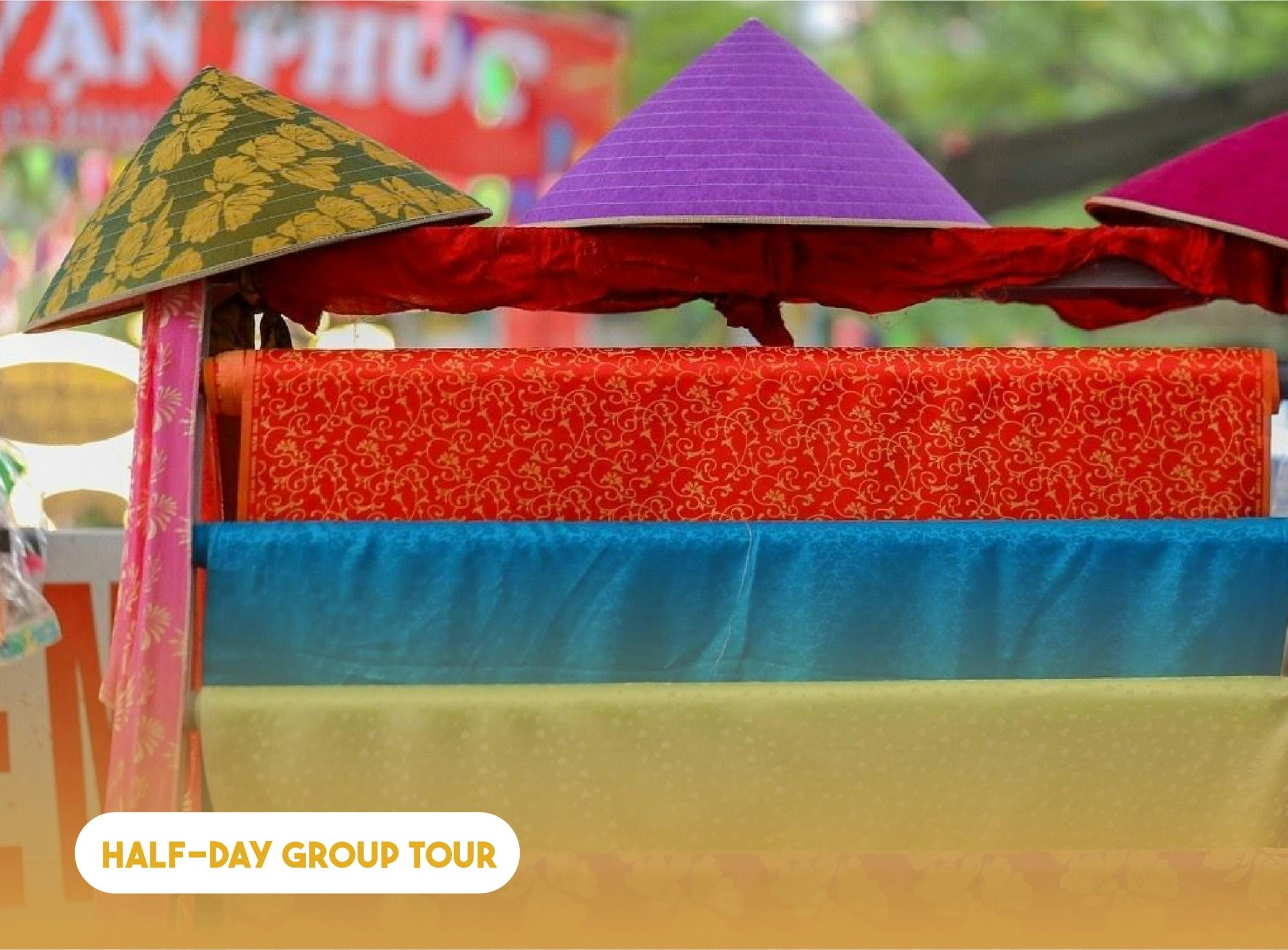
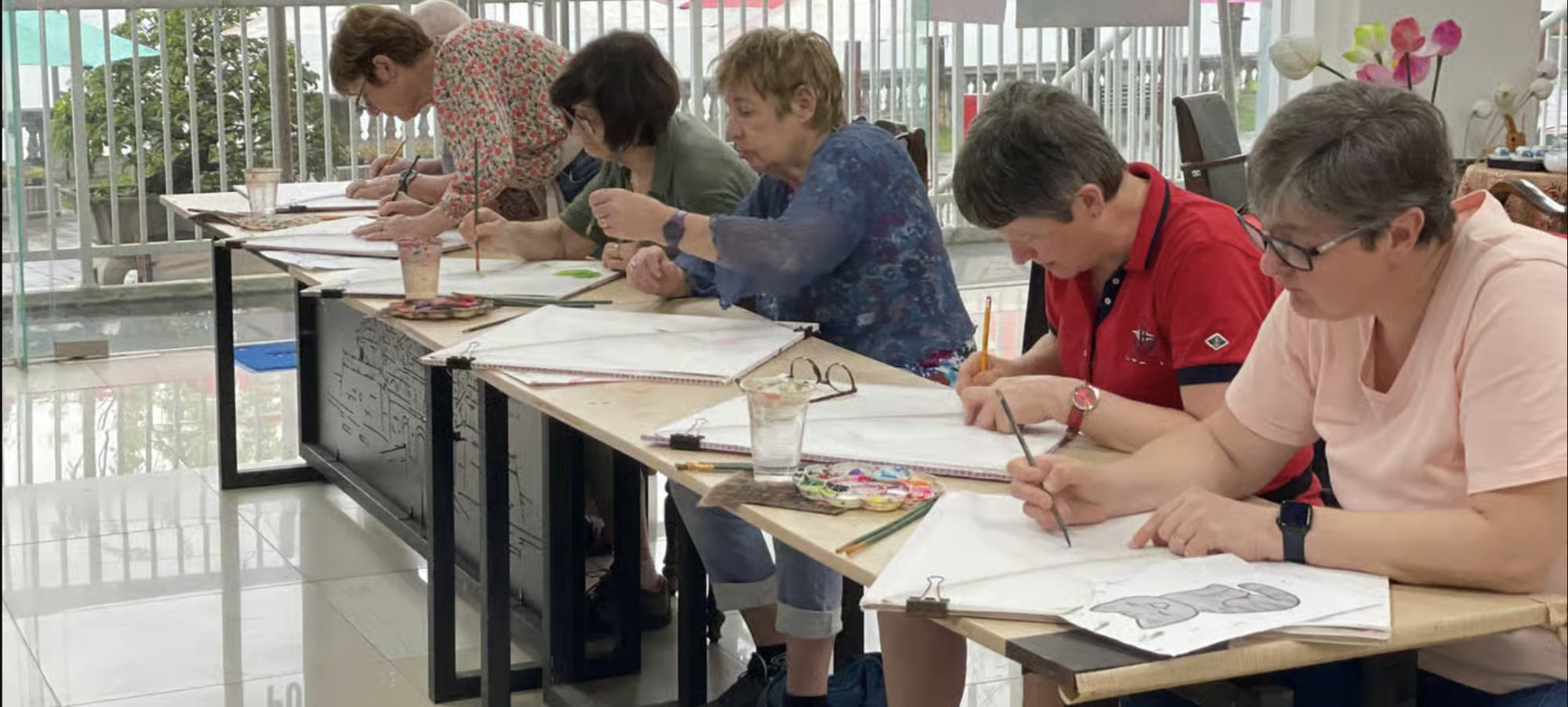
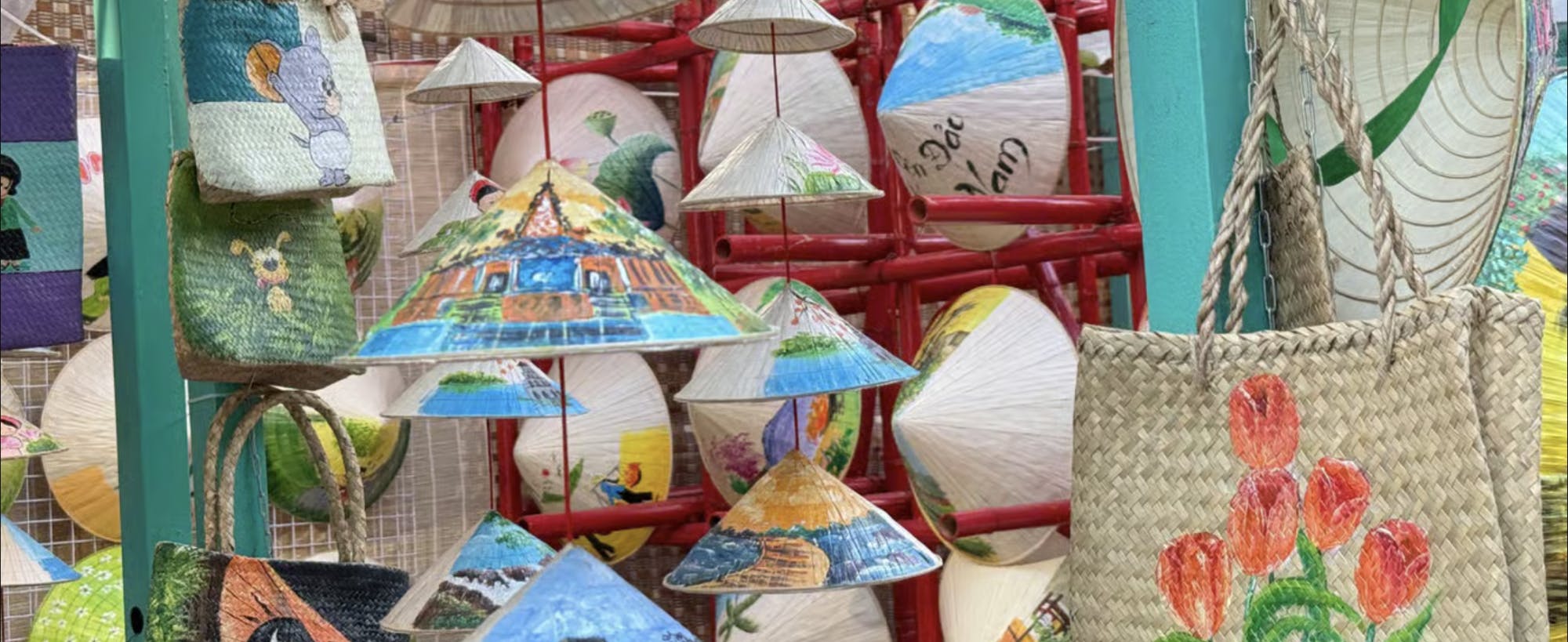
A Silk and Bamboo Villages tour from Hanoi provides an opportunity to leave the busy city centre and meet artisans preserving two of northern Vietnam’s best-known traditional crafts. The experience combines Vạn Phúc Silk Village, famous for weaving fine Vietnamese silk, with Phú Vinh Bamboo and Rattan Village, where craftspeople transform natural fibres into baskets, furniture, decorative pieces and intricate works of art.
Rather than simply shopping for handicrafts, a guided tour allows visitors to watch the production process, learn how the traditions developed and, at Phú Vinh, try some basic bamboo or rattan weaving themselves.
A current 2026 organised experience from Hanoi lasts approximately five hours, includes transport, entrance fees, an English-speaking local guide and bottled water, and currently starts from approximately US$97 per person.
Silk and Bamboo Villages Tour at a Glance
Tour Information
Details
Starting city
Hanoi
Main villages
Vạn Phúc Silk Village and Phú Vinh Bamboo & Rattan Village
Current tour duration
Approximately 5 hours
Current starting price
Approximately US$97
Language
English
Transport
Included on the current organised tour
Entrance fees
Included
Bottled water
Included
Food
Not included
Hotel pickup
Not included on the current Musement-listed tour
Meeting point
Tràng Tiền Plaza, central Hanoi
Hands-on activity
Bamboo and rattan weaving at Phú Vinh
Best for
Traditional crafts, culture, photography, shopping and artisan experiences
Why Visit Hanoi’s Traditional Craft Villages?
Hanoi is surrounded by communities that developed highly specialised crafts over generations. Individual villages became associated with products such as ceramics, silk, embroidery, conical hats, lacquerware, bamboo and rattan weaving.
Visiting one of these communities gives a different perspective on Vietnamese culture from exploring monuments and museums in central Hanoi.
You can see:
Traditional wooden looms in operation
Silk threads becoming patterned fabric
Bamboo and rattan being prepared for weaving
Artisans using skills inherited through generations
Traditional designs alongside contemporary products
Working craft communities rather than museum reconstructions
The combined Silk and Bamboo Villages tour concentrates on two contrasting materials: delicate silk at Vạn Phúc and strong natural bamboo and rattan at Phú Vinh.
Vạn Phúc Silk Village
Vạn Phúc Silk Village lies beside the Nhuệ River in Hà Đông, around 10 kilometres from central Hanoi.
Vietnam’s national tourism authority describes Vạn Phúc as one of the country’s most celebrated silk-weaving centres, with a tradition extending for more than 1,000 years.
Silk production has shaped the identity of the community for generations. While modern machinery is now used alongside older techniques, visitors can still see the relationship between traditional weaving knowledge and contemporary Vietnamese textile production.
More Than 1,000 Years of Silk Weaving
Traditional accounts associate the development of Vạn Phúc’s silk industry with the period of King Lý Thái Tổ.
Local legend tells of A La Thị Nương, a skilled woman from the old Sơn Tây region who introduced silk weaving to the community.
Over the centuries, Vạn Phúc silk became highly regarded for its quality and was associated with textiles supplied to Vietnam’s royal courts.
What Makes Vạn Phúc Silk Special?
Traditional Vạn Phúc silk is valued for characteristics including:
A smooth texture
Natural sheen
Light weight
Breathability
Durability
Detailed woven patterns
Traditional motifs can include:
Dragons and phoenixes
Lotus flowers
Cloud patterns
Seasonal motifs
Geometric designs
Modern Vạn Phúc workshops also produce contemporary colours and designs for clothing, scarves and interior decoration.
Watching Silk Being Woven
One of the main attractions of the guided tour is watching artisans working at looms.
The weaving process requires carefully controlled threads running in different directions to create a finished textile. More elaborate patterns require considerable precision because the decorative design is incorporated into the fabric rather than simply printed onto its surface.
The current half-day tour includes time walking through Vạn Phúc and observing artisans turn fine silk threads into finished material using established weaving techniques.
How Silk Becomes Fabric
The complete silk-making process involves considerably more than weaving.
Traditional production can include:
Raising silkworms
Collecting cocoons
Softening the cocoons
Reeling very fine silk filaments
Combining threads
Dyeing
Preparing the loom
Weaving
Finishing the fabric
Vạn Phúc tourism displays and workshops can introduce visitors to different parts of this process, including cocoon preparation, fibre reeling, weaving, dyeing and finishing.
Walk Through Vạn Phúc’s Silk Streets
Vạn Phúc is now both a working craft community and a visitor destination.
The village has streets containing textile workshops, showrooms and stores selling silk products.
The current organised tour includes time to explore the local market and browse items such as:
Silk scarves
Ties
Shirts
Dresses
Áo dài fabric
Shawls
Decorative textiles
Tailored clothing
Buying Silk at Vạn Phúc
Shopping is optional, but Vạn Phúc can be an interesting place to purchase Vietnamese textiles because you are visiting an established production centre rather than an ordinary souvenir market.
However, not every textile sold in a craft village should automatically be assumed to be handwoven locally or made from 100% natural silk.
If the material matters to you, ask:
Is it 100% silk?
Was it woven in Vạn Phúc?
Is the pattern woven or printed?
Can the seller explain where it was produced?
Is the quoted price for fabric by the metre or for a finished item?
A knowledgeable guide can be particularly helpful when distinguishing traditional locally produced material from the large variety of commercial textiles sold in the area.
The Vạn Phúc Silk Festival
Vạn Phúc’s craft heritage is celebrated through an annual cultural programme typically associated with November.
Activities can include:
Weaving demonstrations
Silk exhibitions
Traditional performances
Áo dài fashion presentations
Displays of local handicrafts
Festival dates and programmes can change from year to year, so travellers visiting Hanoi in November should check the current schedule before making a special trip.
From Silk to Bamboo
After exploring Vạn Phúc, the tour continues to Phú Vinh Bamboo and Rattan Village.
The contrast between the villages is one of the strengths of the excursion.
At Vạn Phúc, the emphasis is on extremely fine textile threads. At Phú Vinh, artisans work with much firmer natural materials that must first be split, smoothed and prepared before they can be woven.
Phú Vinh Bamboo and Rattan Village
Phú Vinh is in the Chương Mỹ area west of central Hanoi and has been associated with bamboo and rattan craftsmanship for more than 400 years.
According to Vietnam’s national rural-tourism authority, the craft developed around the 17th century, originally producing practical household objects.
Over time, the skills became increasingly sophisticated and artisans began producing decorative and artistic pieces alongside everyday items.
From Everyday Baskets to Works of Art
Early Phú Vinh products were practical objects used in everyday rural life, including:
Baskets
Trays
Sieves
Winnowing trays
Storage containers
Today artisans also produce:
Decorative baskets
Lamps
Furniture
Homewares
Souvenirs
Decorative panels
Complex artistic pieces
Products for export
National Intangible Cultural Heritage
Phú Vinh’s bamboo and rattan weaving received important national recognition in 2021, when the craft was inscribed as part of Vietnam’s National Intangible Cultural Heritage.
The recognition reflects not simply the finished products but also the accumulated knowledge involved in selecting, preparing and weaving natural materials.
How Bamboo and Rattan Are Prepared
Before an artisan can begin weaving, the raw material requires careful preparation.
The process can include:
Selecting bamboo or rattan of the correct age and quality
Cutting the material
Splitting it into workable lengths
Shaving the strands
Smoothing the fibres
Drying or treating the material
Dyeing when required
Sorting strands by thickness
Beginning the weaving process
Even a simple basket therefore represents far more work than may be apparent when looking at the finished product.
Watch the Artisans Work
Visitors can observe craftspeople weaving strands into increasingly complex shapes.
Patterns can incorporate traditional Vietnamese imagery, including:
Lotus flowers
Dragons
Phoenixes
Decorative geometric patterns
Stylised characters
The precision is easier to appreciate once you have attempted the process yourself.
Try Bamboo and Rattan Weaving Yourself
The current half-day tour goes beyond simply observing.
At Phú Vinh, participants take part in a hands-on weaving activity under the guidance of local craftspeople.
You learn some basic techniques and try weaving a simple piece yourself.
This is often one of the most memorable parts of the excursion because even a basic pattern demonstrates how much control is needed to keep the fibres evenly spaced and maintain the shape.
A task that looks effortless when performed by an experienced craftsperson can quickly reveal the years of practice behind the finished products.
Traditional Craft Meets Modern Design
Phú Vinh has survived partly because artisans have adapted their products to changing markets.
Traditional weaving techniques are now used for contemporary furniture, decorative objects and environmentally conscious homewares as well as classic baskets and household products.
Vietnam’s rural-tourism authority notes that artisans increasingly combine inherited techniques with contemporary design while responding to demand for products made from natural and sustainable materials.
Buying Bamboo and Rattan Products
Visitors may have opportunities to buy work directly from local producers.
Possible souvenirs include:
Small baskets
Trays
Coasters
Decorative containers
Handbags
Small ornaments
Home accessories
If you are travelling internationally, smaller products are obviously easier to pack than furniture or large decorative baskets.
Buying directly from genuine local craftspeople can also provide more direct support to the community preserving the tradition.
Current Half-Day Tour Itinerary
The exact sequence can change, but the current organised tour is structured around the two craft villages.
Meet in Central Hanoi
The current Musement-listed tour meets at:
Tràng Tiền Plaza
Hai Bà Trưng Street
Central Hanoi
Participants are asked to arrive approximately 10 minutes before departure.
Visit Vạn Phúc Silk Village
Walk through the silk village, see traditional weaving techniques and learn about the community’s long association with silk production.
There is also time to explore shops and the local textile market.
Continue to Phú Vinh
Travel onward to the bamboo and rattan weaving community.
Meet Local Craftspeople
Watch how bamboo and rattan are prepared and woven into everyday and decorative objects.
Try Weaving
Join a simple practical workshop with assistance from local artisans.
Return to Hanoi
The complete current programme lasts approximately five hours.
Current 2026 Tour Price
As of August 2026, the current US version of the tour listing advertises prices from approximately:
US$97 per person
Prices can vary according to date, availability, number of participants and whether a shared or private option is selected.
What Is Included?
The current tour includes:
Transportation during the excursion
Entrance fees
Local guide
English-language guiding
Bottled water
Visits to Vạn Phúc and Phú Vinh
Craft demonstrations
Bamboo and rattan weaving experience
What Is Not Included?
The current tour does not include:
Food
Additional drinks
Hotel pickup and drop-off
Personal purchases
Silk or bamboo souvenirs
Shared or Private Tour?
The current programme can be offered as either a shared tour or private tour.
The basic itinerary and inclusions remain similar, but the private option is reserved for your own booking party.
Choose the Shared Tour If:
You want the lower-cost option
You enjoy meeting other travellers
You do not need a flexible itinerary
Choose the Private Tour If:
You are travelling as a family or group
You want more interaction with your guide
You are particularly interested in textiles or crafts
You prefer not to travel with other participants
Important Cancellation Condition
Check the cancellation terms carefully before booking.
The current Musement listing states that this particular product is non-refundable and cannot be changed or cancelled under the provider’s present policy.
Other booking platforms may offer different conditions, so compare the exact terms before paying if flexibility is important.
What Should You Wear?
The current provider recommends comfortable clothes and comfortable shoes.
You will spend time walking through village streets and working areas, so practical footwear is preferable to formal shoes.
During hot weather, also consider:
Lightweight clothing
Hat
Sunscreen
Additional drinking water
Small umbrella or rain jacket during wet weather
Is the Tour Suitable for Children?
The combination of demonstrations and hands-on weaving can make this a more engaging cultural excursion for children than a long museum visit.
The current provider asks families travelling with children to advise them during the booking process.
Older children may particularly enjoy trying to weave bamboo and rattan.
For very young children, remember that the complete excursion lasts around five hours and includes road travel between the villages.
Accessibility
Traditional Vietnamese craft villages were not originally designed as modern tourist attractions.
Visitors may encounter:
Narrow village lanes
Uneven surfaces
Workshop thresholds
Steps
Small production spaces
If wheelchair access or limited walking is a concern, ask the tour provider about the specific vehicle, workshop entrances and toilet facilities before booking.
Photography
Both villages can be excellent places for photography.
Potential subjects include:
Traditional wooden looms
Rows of silk threads
Colourful fabric
Artisans working by hand
Bundles of bamboo and rattan
Partially completed baskets
Traditional village architecture
Always ask before taking close photographs of individual artisans or entering private workshop areas.
Should You Buy Souvenirs?
There is no obligation to buy anything, but craft villages are one of the better places to purchase souvenirs if you value knowing more about where an object was made.
Useful purchases include:
From Vạn Phúc
Silk scarves
Silk ties
Fabric
Shawls
Traditional clothing
From Phú Vinh
Small woven baskets
Trays
Decorative pieces
Natural-fibre accessories
Small household items
If you are flying home, think about size and fragility before purchasing large bamboo products.
Why a Guide Is Useful
It is possible to visit Vạn Phúc independently, but a combined guided tour has several advantages.
A guide can explain:
How the crafts developed
The difference between materials
How weaving techniques work
Which workshops participate in demonstrations
The meaning of traditional motifs
How the villages have adapted to modern markets
Transport between Vạn Phúc and Phú Vinh is also easier when already organised as part of the excursion.
Can You Visit Vạn Phúc Independently?
Yes.
Vạn Phúc is only around 10 kilometres from central Hanoi and is considerably easier to reach independently than some of the more distant craft villages.
Taxi or ride-hailing transport can be practical if your main interest is simply exploring the silk village and shopping.
A dedicated Vạn Phúc-only excursion may also suit travellers who have little interest in bamboo weaving.
Why the Combined Tour Is Better for Craft Enthusiasts
Visiting both communities illustrates how different materials lead to completely different skills.
At Vạn Phúc you see artisans handling very fine textile threads and controlling complex looms.
At Phú Vinh you see craftsmen shaping tougher natural fibres by splitting, smoothing and interlacing them.
The two traditions therefore complement each other rather than feeling repetitive.
Best Time of Day
A half-day departure works well because the activity does not require an entire day away from Hanoi.
A morning excursion allows you to return to the city for late-afternoon sightseeing and dinner.
An afternoon tour can be useful if you want to spend the morning visiting central Hanoi attractions.
Actual starting times depend on the tour date, so check availability when booking.
Best Time of Year
The villages can be visited throughout the year.
October to April
Generally more comfortable for outdoor walking because conditions are often cooler than during the height of summer.
May to September
Expect greater heat, humidity and periods of heavy rain.
The workshops themselves provide some shelter, but you will still walk outdoors between different areas.
November
Can be particularly interesting at Vạn Phúc because of cultural events associated with the village’s annual silk celebrations, although dates vary each year.
Combine the Tour With Hanoi’s Old Quarter
Because the tour begins and ends in central Hanoi, it can easily be combined with sightseeing around Hoàn Kiếm Lake and the Old Quarter.
A useful day could look like:
Morning
Explore the Old Quarter, Hoàn Kiếm Lake and surrounding streets.
Lunch
Eat in central Hanoi before meeting your tour.
Afternoon
Visit Vạn Phúc and Phú Vinh.
Evening
Return to central Hanoi for street food, a water-puppet performance or an evening walk.
Other Hanoi Craft Villages
Travellers particularly interested in traditional crafts can build a larger Hanoi itinerary around several specialist villages.
Other well-known craft traditions around Hanoi include:
Bát Tràng – ceramics
Quảng Phú Cầu – incense
Chàng Sơn – traditional fans
Chuyên Mỹ – mother-of-pearl inlay
Chương Village – conical hats
Vietnam has thousands of craft communities, and the Hanoi region remains one of the easiest places for travellers to experience several traditions during a single trip.
Silk and Bamboo Villages or Bát Tràng?
Choose Vạn Phúc and Phú Vinh If You Want:
Textile weaving
Bamboo craftsmanship
Rattan weaving
Two villages in one excursion
Hands-on weaving
Natural-fibre souvenirs
Choose Bát Tràng If You Want:
Pottery
Ceramic workshops
Painting ceramics
A larger established craft-tourism destination
If you have several days in Hanoi, the experiences are different enough to do both.
A Good Hanoi Craft Day
If traditional crafts are a major interest, dedicate an entire day to exploring them.
Morning – Vạn Phúc
Learn how silk is prepared and woven and browse the textile shops.
Late Morning – Phú Vinh
Watch bamboo and rattan craftspeople and try a simple weaving activity.
Afternoon – Return to Hanoi
Visit galleries or traditional shops around the Old Quarter.
Evening
Finish with a Vietnamese cultural performance or traditional meal.
Where to Stay
Hanoi Old Quarter
Best overall option for first-time visitors.
You remain close to restaurants, historical attractions, Hoàn Kiếm Lake and tour meeting points while using craft-village excursions as half-day trips outside the centre.
French Quarter
Particularly convenient for the current Tràng Tiền Plaza meeting point.
The area is quieter than parts of the Old Quarter and remains within easy walking distance of many central attractions.
Hà Đông
Only worth considering if Vạn Phúc is a major focus of your visit.
Most international visitors will find central Hanoi more convenient for the remainder of their sightseeing.
Practical Tips
Arrive at the meeting point 10 minutes early.
Wear comfortable shoes.
Carry some cash if you intend to buy directly from artisans.
Ask before photographing people closely.
Check whether silk is genuinely 100% silk before buying.
Choose compact bamboo souvenirs if flying home.
Do not expect every workshop to use only historic techniques. Modern equipment is part of today’s working craft economy.
Check cancellation conditions carefully.
Allow around five hours for the organised combined tour.
Is the Silk and Bamboo Villages Tour Worth Doing?
Yes, particularly for travellers who want to experience living Vietnamese craftsmanship rather than spend another half-day visiting monuments.
Vạn Phúc and Phú Vinh preserve two very different traditions.
Vạn Phúc has been associated with silk weaving for more than 1,000 years and remains one of Vietnam’s best-known silk communities. Visitors can see looms in operation, learn how silk moves from thread to finished fabric and browse products made in a village whose craft heritage stretches back through generations.
Phú Vinh adds a completely different experience. Its bamboo and rattan craft dates back more than 400 years and was recognised as National Intangible Cultural Heritage in 2021. Here, artisans transform relatively simple natural fibres into remarkably complex household and decorative objects.
The hands-on weaving element makes the combined tour particularly worthwhile. Trying even a basic pattern gives you a much better understanding of the patience and dexterity required to produce the finished pieces.
As of August 2026, the current organised experience lasts around five hours and starts at approximately US$97. Transport, entrance fees, an English-speaking local guide and bottled water are included, while meals, personal purchases and hotel pickup or drop-off are not.
For visitors staying in Hanoi, the excursion is also easy to fit into a larger itinerary. You can spend half a day among traditional looms and bamboo workshops and still return to the capital with enough time for an evening in the Old Quarter.
The real attraction is not simply seeing silk scarves and woven baskets. It is meeting the communities and observing the knowledge, precision and patience required to make them.
Sponsored Popular Items
Quick take: Musement.com offers a worldwide selection of tours and attractions
Private Transfer Between Vinh Airport and Vinh City Center - Travel Service Vietnam Private transfer between Vinh Airport and Vinh City Center is a practical option for travellers who want to simplify an important journey and reduce last-minute transport decisions. Check current availability, inclusions and booking details before you go.
VINSEUM – Museum of the Wine Cultures of Catalonia is one of Spain’s most interesting destinations for anyone wanting to understand wine as more than something poured into a glass. Located in Vilafranca del Penedès, at the heart of one of Catalonia’s most important wine-producing regions, the museum explores thousands of years of relationships between vineyards, people, landscape, food, religion, trade and culture.
The museum combines a historic medieval royal palace with a striking modern extension that opened in its completed form in November 2024. The redevelopment expanded VINSEUM to almost 5,000 square metres, with three major permanent exhibitions spread through the complex.
VINSEUM is particularly easy to include in a Barcelona itinerary because Vilafranca del Penedès lies around 55 kilometres from Barcelona and the museum is only about a 10-minute walk from Vilafranca railway station.
For most visitors, allow at least 1½ to 2 hours. The museum itself recommends a minimum of 90 minutes because the permanent exhibition extends across four visitor floors.
VINSEUM at a Glance
Visitor Information
Details
Full name
VINSEUM – Museum of the Wine Cultures of Catalonia
Location
Vilafranca del Penedès, Catalonia, Spain
Address
Plaça Jaume I, 1-5, 08720 Vilafranca del Penedès
Museum origins
1935
Wine collection developed
From 1943
New museum inaugurated
November 2024
Total museum area
Almost 5,000 m²
General admission
€10
Reduced admission
€7
Visit with DO tasting
€20
Premium tasting option
€30
Children 0–12
Free
Tuesday–Saturday
10:00 am–7:00 pm
Sunday and public holidays
10:00 am–2:00 pm
Monday
Closed
Recommended visit
At least 1½ hours
From Vilafranca station
Approximately 10 minutes on foot
What Is VINSEUM?
VINSEUM is not simply a museum explaining how grapes are crushed and fermented.
Its subject is the much broader concept of wine culture.
The exhibitions explore questions such as:
Why vineyards developed in particular landscapes
How grape growing shaped rural communities
How wine was produced and stored
How wine became part of trade and commerce
Its place in religion and ritual
The design of bottles, glasses and drinking vessels
Changing agricultural technology
Wine in art and popular culture
The relationship between wine, identity and Catalonia
The challenges facing vineyards in the future
This broader approach makes the museum worthwhile even for visitors who are interested in history and culture but are not particularly knowledgeable about wine.
One of Europe’s Oldest Wine Museums
VINSEUM has much deeper roots than its modern exterior suggests.
The institution was founded in 1935 as a local museum intended to preserve the heritage of Vilafranca and the surrounding Penedès region.
Wine-related collections became increasingly important after the First Vine and Wine Fair in 1943. Wine eventually became the defining subject of the institution.
The museum describes itself as the first wine museum founded in Spain and one of the earliest of its type in Europe.
The New VINSEUM
The present museum is the result of a major redevelopment lasting almost eight years.
The completed new VINSEUM was officially inaugurated in November 2024.
A new building added approximately 3,500 square metres to the existing historic spaces, creating a museum complex of almost 5,000 square metres.
The modern building contains six levels – a basement, ground floor and four upper floors – and connects internally with the historic Palau Reial, or Royal Palace.
The result is an interesting architectural experience in its own right. During the visit, you move between contemporary exhibition spaces and sections of a medieval palace rather than remaining inside a conventional modern museum building.
The Royal Palace
Part of VINSEUM occupies the former Royal Palace of Vilafranca, associated with the medieval monarchs of the Crown of Aragon.
The palace dates principally from the 12th and 13th centuries and provides an appropriate historic setting for collections tracing the long relationship between people, agriculture and wine.
This combination of medieval architecture and modern museum design is one reason VINSEUM is worth visiting even if you normally prefer historic attractions to specialist food-and-drink museums.
Three Permanent Exhibitions
The redesigned museum is organised around three principal permanent exhibition areas:
La Plaça del Vi – The Wine Square
Les Arrels – The Roots
Les Cultures del Vi de Catalunya – The Wine Cultures of Catalonia
Together they occupy more than half of the renovated museum’s total floor area.
La Plaça del Vi – The Wine Square
Your introduction begins on the ground floor with La Plaça del Vi.
This freely accessible space focuses on the vitality and diversity of Catalan wine in the present day.
Rather than beginning immediately with ancient history, the exhibition introduces wine as a living part of modern Catalonia and then encourages visitors to explore how that culture developed.
Les Arrels – The Roots
Downstairs, Les Arrels explores origins.
The exhibition looks at the history of VINSEUM itself and the development of the Penedès region.
The wider museum collection contains archaeological material from more than 600 excavated sites, documenting human activity across Alt Penedès, Baix Penedès and Garraf from the Palaeolithic period through Iberian, Roman and medieval times.
Archaeology helps explain that wine culture did not suddenly appear with modern wineries. Drinking, storage vessels, agriculture and trade have evolved through thousands of years of Mediterranean history.
The Wine Cultures of Catalonia
The largest exhibition extends across the first, second and third floors.
Les Cultures del Vi de Catalunya tells the story of vineyards and wine throughout Catalonia from a broad social and cultural perspective.
The emphasis is not solely on famous producers or expensive bottles. The exhibition considers the people who worked the vineyards, the tools they used, the landscapes they created and the changing role wine has played in Catalan society.
Wine-Making Tools and Equipment
VINSEUM’s ethnographic collection contains agricultural and cellar equipment representing centuries of vineyard work and wine production.
You can see objects connected with:
Planting and maintaining vines
Harvesting grapes
Transporting grapes
Pressing
Fermentation
Storage
Barrel making
Bottling
Serving and drinking wine
These objects show how dramatically wine production changed as agriculture moved from manual labour towards mechanised and scientifically controlled processes.
Ancient Wine Vessels
Among the wider collections are objects such as ancient amphorae and other ceramic vessels associated with the storage, transportation and consumption of liquids.
These help explain how wine moved through ancient Mediterranean trading networks long before glass bottles became the normal container.
Wine Glasses, Ceramics and Drinking Culture
The museum is particularly interesting when it moves from how wine is produced to how people actually drink it.
Its collections include ceramic vessels, glassware and other objects associated with drinking customs.
VINSEUM also holds more than 1,500 pieces of pottery, documenting Catalan ceramic production from approximately the 14th through the 19th centuries, together with examples from several other important Spanish ceramic centres.
The Wine Dioramas
One of VINSEUM’s distinctive historic collections is a series of wine dioramas.
These detailed miniature scenes were created to illustrate the history of vineyards and wine production.
The broader collection has included scenes representing wine environments from different periods, including ancient Egypt, Rome and the medieval monastery of Poblet.
The dioramas are interesting partly because they belong to an earlier tradition of museum interpretation. They show how museums attempted to make history visually understandable before digital projections and interactive screens became common.
VINSEUM Is Also an Art Museum
Wine may provide the central story, but VINSEUM owns significant collections beyond viticulture.
The art collection includes:
Painting
Sculpture
Drawings
Religious art
Gold and silver work
Ceramics
Some works date from the 12th century, while others illustrate Catalan artistic developments during the 19th and 20th centuries.
More Than 17,000 Objects
The museum’s complete collection exceeds 17,000 items.
It extends across fields including:
Wine culture
Archaeology
Art
Ethnology
Ceramics
Natural history
Historical documentation
This breadth reflects VINSEUM’s origins as a general museum for Vilafranca and the Penedès before wine culture became its principal identity.
The Audio Guide
The standard admission price includes an audio guide at no additional charge.
Current audio-guide languages include:
Catalan
Spanish
English
French
This makes the museum easy to visit independently without needing to join a guided group.
Current 2026 General Admission
The standard permanent-exhibition ticket currently costs:
€10 per person
Importantly, the normal ticket includes:
Permanent museum exhibitions
Audio guide
One wine tasting from the museum’s featured winery
This makes the tasting part of the normal museum experience rather than an expensive optional extra.
Reduced Admission
The current reduced ticket costs:
€7
It applies to qualifying visitors including:
Young people aged 13–17
University students
Retired visitors
Groups of 20 or more
Holders of the qualifying Barcelona Provincial Council library card
The reduced ticket includes the audio guide. Minors receive grape must rather than wine for the tasting component.
Free Admission
VINSEUM currently offers free admission to several visitor categories, including:
Children aged 0–12
People with disabilities
Eligible unemployed visitors
Accredited active teachers
Official guides
Accredited journalists
ICOM members
Admission is also free for everyone on the first Sunday of each month.
Free admission does not include the wine tasting.
The €20 DO Wine Experience
Visitors who want to make wine tasting a larger part of the experience can choose the Visit with DO ticket.
Current price:
€20
The ticket includes:
Permanent exhibitions
Audio guide
Three wines from the featured Catalan Denomination of Origin
The featured wine region changes, providing visitors with an opportunity to discover different Catalan appellations.
Premium Wine Tasting
Vilafranca’s official tourism service also currently lists a €30 premium tasting visit.
This includes the museum and audio guide together with three tastings selected from some of the more distinctive wines of Catalonia.
The Wine Tasting at the End
For adult visitors using standard admission, finishing the museum with a glass of wine is a fitting conclusion.
After spending the visit learning how landscape, agriculture, technology and culture come together to produce wine, you finally experience the subject through taste.
The standard ticket’s featured wine changes as different wineries are highlighted.
The VINSEUM Tavern
If one tasting is not enough, VINSEUM also has its own wine tavern.
The tavern specialises in Catalan wines by the glass, with particular attention given to wineries associated with the museum.
Food is based around simple, uncooked tapas-style accompaniments rather than operating as a conventional full-service restaurant.
Current Tavern Opening Hours
Day
Hours
Monday
Closed
Tuesday–Wednesday
4:00 pm–7:00 pm
Thursday–Saturday
12:00 pm–10:00 pm
Sunday and public holidays
12:00 pm–3:00 pm
Current Museum Opening Hours
Day
Opening Hours
Monday
Closed
Tuesday
10:00 am–7:00 pm
Wednesday
10:00 am–7:00 pm
Thursday
10:00 am–7:00 pm
Friday
10:00 am–7:00 pm
Saturday
10:00 am–7:00 pm
Sunday
10:00 am–2:00 pm
Public holidays
10:00 am–2:00 pm
Ticket sales currently close at 6:00 pm Tuesday to Saturday and at 1:00 pm on Sundays and public holidays.
Annual Closing Dates
VINSEUM is currently closed on:
Every Monday
1 January
6 January
1 May
25 December
26 December
Several other dates, including 5 January, 30 and 31 August and 24 and 31 December, currently operate on reduced hours from 10:00 am to 2:00 pm.
How Long Should You Allow?
1 Hour
Too short for most first-time visitors.
You could see highlights, but you would need to move rapidly through the exhibitions.
1½ Hours
The museum’s recommended minimum.
This gives you time to explore the four main visitor levels and finish with the included tasting.
2 Hours
Best for most visitors.
You can use the audio guide, examine the most interesting objects and avoid rushing through the final floors.
2½–3 Hours
Worthwhile for people with a serious interest in wine, archaeology, social history or Catalan culture.
Add extra time if you intend to remain in the tavern afterwards.
Do You Need to Book Ahead?
Individual visitors can purchase tickets through the museum’s ticketing system, and booking ahead can be useful if VINSEUM is an important part of a day trip from Barcelona.
Advance arrangements become particularly important for organised groups. VINSEUM considers 20 or more people a group and recommends reserving group visits well in advance.
Guided Tours
Formal guided visits of the permanent collection are currently available to groups of 20–25 people.
The guide service costs €80 and must currently be reserved at least 15 days in advance.
Guided tours last approximately 90 minutes and are available in:
Catalan
Spanish
English
French
Independent visitors do not need a guide because the included audio-guide system covers the museum.
Is VINSEUM Suitable for Children?
Yes.
Children do not need to be interested in drinking wine to find worthwhile material here.
The museum also deals with:
Farming
Ancient objects
Archaeology
Machinery
Landscapes
Art
Social history
Children aged 12 and younger currently enter free, while visitors aged 13–17 qualify for the €7 reduced rate. Where a reduced ticket contains a tasting component, minors receive grape must instead of alcoholic wine.
Accessibility
VINSEUM has been designed with substantial accessibility provision.
The building is wheelchair accessible and has lifts serving the different floors.
Facilities include:
Accessible toilets
A wheelchair available for visitors
Portable stools
Braille exhibition guides
Multisensory interpretation modules
Magnetic-loop service
Sign-language versions of selected audiovisual material
Admission for service dogs
Lockers and Bags
Lockers are available on the ground floor.
Objects larger than 35 × 35 × 25 centimetres and sharp objects must currently be placed in the lockers rather than taken through the galleries.
Where Is VINSEUM?
VINSEUM is located at:
Plaça Jaume I, 1-5
08720 Vilafranca del Penedès
Catalonia
Spain
The location is right in the historic centre of Vilafranca, directly opposite the Basilica of Santa Maria.
Getting to VINSEUM by Train
Vilafranca del Penedès is connected to the Barcelona metropolitan rail network, making VINSEUM possible as a day trip without hiring a car.
Once you arrive at Vilafranca del Penedès railway station, the museum states that VINSEUM is approximately a 10-minute walk away.
Train schedules can change, so check the current service from your Barcelona station on the day you travel rather than relying on an old timetable.
Getting There by Car
Vilafranca can be reached using major routes including the AP-7, N-340 and C-15.
The museum is located inside the largely pedestrianised historic centre, so you should not expect to drive directly to the entrance and park outside.
Both paid and free parking areas are available elsewhere around the town.
Combine VINSEUM With Santa Maria Basilica
The Basilica of Santa Maria stands immediately opposite VINSEUM and is the easiest historic attraction to combine with your museum visit.
The present Gothic building has roots in the 13th century, while later modifications have added further architectural layers.
Its prominent bell tower is one of the defining features of Vilafranca’s historic centre.
Visiting the basilica before or after VINSEUM helps put the museum’s medieval Royal Palace setting into a wider historical context.
Explore Vilafranca del Penedès
Do not travel to Vilafranca only to enter the museum and immediately return to Barcelona.
The historic centre contains medieval, Gothic and later architectural elements, while the broader town has been shaped heavily by its role as the commercial and cultural centre of the Penedès wine region.
A few hours walking through Vilafranca makes the VINSEUM exhibitions much easier to understand because the influence of wine extends beyond the museum walls into the architecture, businesses and identity of the town itself.
Combine VINSEUM With a Penedès Winery
For wine enthusiasts, the ideal day combines VINSEUM with a winery or vineyard visit.
The museum teaches you why wine developed as it did across Catalonia. A winery then shows you how grapes are actually grown, fermented and matured today.
This sequence can work particularly well:
VINSEUM in the morning → lunch in Vilafranca → vineyard or winery experience in the afternoon.
Penedès Tourism identifies wine culture as one of the defining characteristics of Vilafranca and the surrounding region.
A Good Half-Day in Vilafranca
Morning – Arrive in Vilafranca
Walk approximately 10 minutes from the railway station into the historic centre.
VINSEUM
Allow around two hours to explore the permanent exhibitions and enjoy the included tasting.
Santa Maria Basilica
Step outside VINSEUM and explore the historic area surrounding the basilica.
Lunch
Stay in Vilafranca for lunch and try local Catalan or Penedès cuisine.
Afternoon
Either continue exploring Vilafranca or arrange a vineyard or winery experience in the surrounding Penedès countryside.
Local Food to Look For
Wine is naturally central to Penedès gastronomy, but the region also has distinctive foods worth trying.
Specialities associated with Vilafranca and the surrounding region include:
Penedès black chicken
Xató
Seasonal vegetables
Cured meats
Local pastries
Ordal peaches when in season
These regional foods reinforce the same message presented inside VINSEUM: wine is part of a much broader agricultural and culinary landscape.
Where to Stay
Vilafranca Historic Centre
Best if you want to explore the wine capital on foot.
Staying centrally gives you easy access to VINSEUM, restaurants and the historic streets while allowing you to enjoy Vilafranca after day visitors have left.
Penedès Countryside
Best for a wine-focused holiday.
A rural hotel or vineyard accommodation makes more sense if VINSEUM forms part of several days exploring wineries and the landscape rather than a single day trip.
Barcelona
Best if VINSEUM is simply one excursion during a wider city holiday.
Vilafranca lies around 55 kilometres from Barcelona, and its railway connection means there is no need to move accommodation simply to visit the museum.
VINSEUM for People Who Do Not Drink Alcohol
The museum can still be worthwhile if you do not drink wine.
The main exhibitions deal with agriculture, archaeology, history, architecture, trade, technology and culture rather than requiring visitors to consume alcohol.
The standard tasting is only a small part of the overall visit.
Free admission categories do not include wine tasting, and minors using reduced admission receive grape must rather than wine.
Is VINSEUM Just for Wine Experts?
No.
In fact, one of the museum’s strengths is that you do not need to understand grape varieties, vintages or winemaking terminology before arriving.
The story begins with people, land and history and gradually explains how wine became embedded in Catalan society.
Someone interested in archaeology or social history can therefore enjoy the museum for completely different reasons from a dedicated wine enthusiast.
VINSEUM or a Winery Tour?
The two experiences complement rather than replace each other.
Choose VINSEUM If You Want:
Wine history
Catalan culture
Archaeology
Historic objects
Art and ceramics
An easy activity accessible by train
An indoor attraction in poor weather
Choose a Winery If You Want:
Vineyard scenery
Modern wine-production equipment
Cellar tours
More extensive tasting
Direct contact with a producer
If you have a full day available, doing both provides the strongest introduction to Penedès wine culture.
Is VINSEUM Worth Visiting From Barcelona?
Yes, particularly if you are interested in wine, Catalan culture or destinations beyond central Barcelona.
VINSEUM is unusual because it places wine into a much broader historical story instead of functioning mainly as a promotional tasting centre.
The museum’s origins stretch back to 1935, while the completely renewed museum that visitors experience today opened in November 2024 after almost eight years of redevelopment. The complex now covers nearly 5,000 square metres and combines new galleries with the medieval Royal Palace.
The permanent exhibitions progress from the roots of the Penedès through the wider history of Catalan wine culture, using archaeology, agricultural equipment, ceramics, art, audiovisual material and historic wine collections to tell the story.
Current general admission is also good value at €10, including the English-language audio guide and a wine tasting. Visitors wanting a more substantial tasting can currently choose a €20 DO experience or the €30 premium option.
The museum is open Tuesday to Saturday from 10:00 am to 7:00 pm and Sundays and public holidays from 10:00 am to 2:00 pm. It is closed on Mondays.
For the best experience, allow around two hours rather than rushing through the galleries. Afterwards, explore the historic centre, have lunch in Vilafranca and, if time allows, continue into the surrounding Penedès countryside for a winery or vineyard visit.
VINSEUM works particularly well because it explains the story behind the glass of wine: the land it came from, the people who produced it, the technology that changed it and the culture that grew around it.
Sponsored Popular Items
Quick take: Musement.com offers a worldwide selection of tours and attractions
Magic World Vienna is one of the newer entertainment attractions in Austria’s capital, bringing international magicians, illusionists, mentalists and close-up performers together in an intimate purpose-designed theatre in the Vienna Prater.
Opened in June 2024 by world champion mentalists Anca and Lucca Lucian, Magic World Vienna is located directly on Riesenradplatz, close to Vienna’s famous Giant Ferris Wheel. The concept is quite different from seeing a magician in a large concert hall: the main theatre has only 161 seats, arranged across eight rising rows, and no seat for the main variety show is more than approximately eight metres from the stage.
The programme changes throughout the year and can include international variety shows, mentalism, grand illusions, comedy magic, close-up performances and dedicated shows for young children.
For visitors looking for something different to do in Vienna after a day of palaces and museums, Magic World can make an excellent evening activity.
Magic World Vienna at a Glance
Visitor Information
Details
Location
Vienna Prater
Address
Riesenradplatz 6, 1020 Vienna, Austria
Opened
June 2024
Founders
Anca & Lucca
Main theatre capacity
161 seats
Main Magic Variety Show
Approximately 100 minutes including interval
2026 Variety Show price
From €49 standard / €29 discounted
Magic Table
10 minutes, 10 seats, €10
Family shows
Available, including dedicated children’s magic
Accessibility
Main shows listed as wheelchair accessible
Nearest major transport stop
Praterstern
Metro
U1 and U2
Best for
Couples, families, groups and evening entertainment
What Is Magic World Vienna?
Magic World Vienna is a specialist theatre devoted primarily to live magic.
Rather than presenting one resident magician performing the same production every night, the venue brings together performers from different countries and different branches of magic.
Depending on when you visit, a show may feature:
Grand illusions
Sleight of hand
Card magic
Mentalism
Comedy magic
Manipulation
Close-up magic
Classical magic
Interactive audience participation
Vienna’s official tourism organisation describes it as a theatre covering different genres of magic and different age groups.
Founded by World Champion Mentalists Anca & Lucca
Magic World Vienna was founded by Anca and Lucca, performers particularly known for mental magic.
The pair won the World Championship of Mental Magic and opened Magic World Vienna in June 2024.
They do not perform every show themselves. Part of the concept is bringing other prominent international magicians to Vienna so that the cast and styles of magic can change throughout the year.
The Magic Theater
The main theatre is deliberately small.
There are only 161 seats arranged across eight rising rows, which creates a much more intimate experience than a large theatre or arena.
The first row is essentially at stage level, while the stage itself is more than 13 metres wide but only around six metres deep.
The design allows the venue to adapt to different types of performance, from close-up and parlour magic to larger stage illusions.
Why the Small Theatre Matters
Magic often becomes more impressive the closer you are to the performer.
At a large arena, audiences may watch most of the detail on video screens. Magic World Vienna takes almost the opposite approach.
For the principal Magic Variety Show, the venue states that no seat is more than approximately eight metres from the stage.
This makes subtle card work, manipulation and audience interaction much easier to appreciate.
Magic Variety Show
For a first-time visitor, the Magic Variety Show is probably the easiest introduction to Magic World Vienna.
Instead of concentrating on one particular style, the production combines several international performers in the same show.
The programme typically includes four to six performers and mixes different branches of magic.
The cast changes regularly, so returning visitors can see a substantially different production at another time of year.
Current August 2026 Magic Variety Show
For performances running from 4 August to 30 August 2026, the currently advertised international cast includes:
Mag Edgard & Company from Spain – grand illusions
Gaëtan Bloom from France – comedy magic
Winston Fuenmayor from Venezuela – visual magic
Hannu Juntunen from Finland – stage magic
The line-up changes after this period, which is an important reason to check the programme for your exact date rather than relying on an older review or video.
How Long Is the Magic Variety Show?
The main variety programme currently runs for approximately:
100 minutes, including a 15-minute interval.
Allow around two hours in total once you include arriving early, finding your seat and leaving after the performance.
Current 2026 Magic Variety Show Tickets
As of August 2026, official published prices start from:
Ticket
Starting Price
Standard admission
From €49
Discounted admission
From €29
Discounted tickets are currently available for qualifying children, students and visitors with disabilities.
Premium and VIP seating may cost more, and prices can vary according to the performance.
Are the More Expensive Seats Necessary?
One advantage of the venue is that even the more distant seats are relatively close to the stage.
If your main priority is simply seeing the show, a standard seat can therefore offer good value.
A premium or front-row seat becomes more attractive if you particularly enjoy audience interaction and want to see detailed sleight of hand from very close range.
Because seating and categories can differ between productions, check the seating plan when booking.
Anca & Lucca – Evolution
Visitors specifically interested in mentalism can look for performances by the venue’s founders, Anca & Lucca.
Their current theatrical production, Evolution, expands on the mental-magic act that earned them their world championship title.
The show combines mentalism, storytelling and audience participation and runs for approximately 100 minutes including a 15-minute interval.
Current 2026 prices are advertised from:
€39 standard
€25 discounted
The recommended age is six years and older.
Close Up Wonders
If you prefer sleight of hand to large illusions, look at the Close Up Wonders programme.
Close-up magic is performed within a much smaller setting, where cards, coins and other objects can be manipulated only a short distance from the audience.
The current programme uses visiting international performers, so the magician and performance language can vary by date.
The show normally lasts approximately:
60 minutes
and is recommended for visitors aged six and above.
The Magic Table
You do not necessarily need to commit to a full evening show to experience Magic World.
The venue also operates the tiny Magic Table, described as its smallest theatre.
The format is extremely simple:
Magic Table
Details
Audience
10 people
Duration
10 minutes
Price
€10
Tickets are available directly at the Magic Table.
This can be an excellent spontaneous option if you are already visiting the Prater and want a quick introduction to close-up magic.
Magic for Kids
Families with younger children have a separate programme called Magie für Kids.
The current show is designed principally for children between approximately two and eight years old.
Rather than expecting young children to remain silent while watching complicated illusion techniques, the production encourages them to participate, laugh, shout, sing and become part of the performance.
The show lasts approximately 60 minutes.
An Important Language Point for Families
The dedicated children’s show is currently performed in German.
That does not necessarily prevent non-German-speaking children from enjoying the visual magic, movement and audience participation, but parents should know about the language before booking.
The main international variety programme is generally a better option for older international visitors because many acts rely heavily on visual performance, music or English-language presentation.
Current Kids Show Ticket Arrangement
The current family programme has an unusual ticket arrangement:
Children under two enter free.
One adult accompanying each paying child can currently attend free.
The free accompanying-adult ticket must still be reserved.
Additional accompanying people currently require a reduced ticket.
The official page currently lists the extra accompanying-person ticket at €10.
Magic Grand Festival
Magic World also stages larger special programmes such as the Magic Grand Festival.
The 2026 festival brings several internationally recognised magicians together for a gala containing different magical disciplines, including mentalism, card magic, manipulation and illusion.
The 2026 programme advertises five international magic stars, including world champion performers.
Like the standard variety show, the festival lasts approximately 100 minutes including an interval.
Magic Garden
The Magic Garden is a bistro directly in front of the main theatre.
It serves snacks and drinks before and after performances, and some refreshments can be taken into the theatre.
This makes it possible to arrive early without needing to search for somewhere else to wait before your show.
Should You Eat Before the Show?
If you want a substantial dinner, it is generally better to eat elsewhere in the Prater or central Vienna before your performance and use the Magic Garden for drinks or a lighter snack.
If your ticket is connected with one of the venue’s dedicated dining experiences, follow the timing provided with that particular booking.
Ticket Office Opening Hours
The venue currently publishes the following regular ticket-office hours:
Day
Ticket Office
Tuesday–Friday
4:00 pm–7:30 pm
Saturday–Sunday
11:30 am–6:00 pm or until the final show begins
These are ticket-office hours rather than a guarantee of show times. Performances follow the separate events calendar.
Book Your Show in Advance
Advance booking is recommended.
With only 161 seats in the main theatre, popular dates can fill much more quickly than they would in a large performance hall.
Booking ahead is particularly sensible:
On weekends
During school holidays
For special festivals
For performances by Anca & Lucca
If you want a particular seating category
The Vienna Tourist Board also recommends booking Magic World Vienna in advance.
Vienna City Card Discount
Visitors holding a valid Vienna City Card can currently receive a:
20% discount on full-price tickets
subject to availability.
The Vienna Tourist Board lists a booking code for this offer and recommends booking ahead.
Where Is Magic World Vienna?
Magic World Vienna is located at:
Riesenradplatz 6
1020 Vienna
Austria
The location is right inside the Vienna Prater amusement area, immediately convenient for combining your magic show with other Prater attractions.
Getting There by Metro
The easiest major public transport interchange is:
Praterstern
It is served by:
U1 Metro
U2 Metro
Tram O
Tram 5
Several bus services
S-Bahn suburban trains
From Praterstern, walk directly towards Riesenradplatz and the main Prater entrance.
Driving and Parking
Public transport is generally easier than driving to the Prater, particularly if you are staying in central Vienna.
If you do drive, parking garages are available around the amusement park. The official Prater information identifies the garages around Ausstellungsstraße and Waldsteingartenstraße among the closest options.
Street parking in Vienna’s 2nd district is regulated, so do not assume you can leave a car nearby without checking the applicable parking rules.
Combine Magic World With the Vienna Prater
The location makes it easy to create a complete afternoon and evening around the Prater.
You can arrive several hours before the magic show, explore the amusement area, ride one or two attractions and then have dinner before heading into the theatre.
The biggest advantage is that you do not need additional transport between the afternoon sightseeing and evening entertainment.
See the Giant Ferris Wheel
The famous Wiener Riesenrad, or Vienna Giant Ferris Wheel, is immediately associated with the Prater and sits very close to Magic World Vienna.
It makes a particularly good combination with an evening magic show.
Ride the Ferris Wheel before sunset for views across Vienna, then walk the short distance to Magic World for your performance.
Magic World Vienna With Children
The attraction can work very well for families, but choose the performance according to the age of the children.
Ages 2–8
The dedicated German-language Magic for Kids show is specifically designed for this age range.
Ages 6+
The main Magic Variety Show and Close Up Wonders are currently recommended from approximately six years old.
Teenagers
Teenagers who enjoy magic, puzzles, mentalism or illusion may particularly enjoy the standard international productions.
The intimate theatre can also make these shows more engaging for younger audiences than a long traditional theatre performance.
Accessibility
The current Magic Variety Show, Close Up Wonders, Anca & Lucca show and children’s programme are all listed as fully wheelchair accessible.
Visitors requiring wheelchair positions or other specific arrangements should still identify their needs when booking so appropriate seating can be organised.
Is There an Age Restriction?
The Prater’s general listing states that Magic World Vienna has no overall age restriction, but individual productions have their own recommendations.
For example:
Magic for Kids: primarily designed for ages 2–8
Magic Variety Show: recommended from age 6
Close Up Wonders: recommended from age 6
Anca & Lucca: recommended from age 6
Always check the exact production rather than relying on the venue’s general admission information.
How Early Should You Arrive?
Arriving approximately 20–30 minutes before your performance is sensible.
This gives you time to:
Find Magic World inside the Prater
Collect or check tickets if required
Use the facilities
Buy a drink
Find your seat without rushing
If you are unfamiliar with Vienna’s public transport system, allow additional time on your first journey to Praterstern.
What Should You Wear?
There is no need for formal evening clothing.
Smart casual or ordinary comfortable sightseeing clothes are appropriate for most performances.
The atmosphere is entertainment-focused rather than formal opera or classical concert etiquette.
Do You Need to Speak German?
Not necessarily.
Magic World Vienna hosts both German- and English-language performances, and many international variety acts use music and visual magic requiring little spoken explanation.
However, language varies between individual performers and shows.
The dedicated Magic for Kids programme is currently in German, while the August 2026 main variety show contains a mixture of English-language and music-based acts.
Best Time to Visit
Magic World Vienna is primarily a scheduled theatre attraction, so the best time depends more on the performance calendar than the season.
Afternoon
A daytime family show or close-up performance can work well with several hours exploring the Prater afterwards.
Evening
Best overall choice for adults and couples.
Spend the afternoon sightseeing elsewhere in Vienna, travel to the Prater, have dinner and finish with a magic performance.
Rainy or Cold Weather
The indoor theatre makes Magic World particularly useful when Vienna’s weather is poor.
You can still explore indoor Prater attractions and finish the day with live entertainment regardless of rain or winter temperatures.
A Good Half-Day Prater and Magic World Itinerary
3:00 pm – Arrive at Praterstern
Walk into the Prater and familiarise yourself with Riesenradplatz.
3:30 pm – Explore the Prater
Choose several attractions depending on your interests.
5:00 pm – Giant Ferris Wheel
Ride the famous Riesenrad for panoramic views over Vienna.
6:00 pm – Dinner
Have dinner in or around the Prater.
Before the Show
Arrive at Magic World approximately 20–30 minutes before your scheduled performance.
Evening – Magic Variety Show
Allow approximately 100 minutes for the performance.
Afterwards
Walk through the illuminated Prater before returning to central Vienna by U1, U2 or another service from Praterstern.
Where to Stay Near Magic World Vienna
Prater and Leopoldstadt
Best if the Prater is an important part of your Vienna visit.
Staying in Vienna’s 2nd district gives you convenient access to Magic World, Praterstern and the amusement park while keeping the historic centre within a short Metro journey.
Historic Centre
Best overall choice for a first visit to Vienna.
If Magic World is only one evening activity during a larger Vienna holiday, staying around the historic centre normally makes more sense.
U1 provides a straightforward connection towards Praterstern, so there is little need to select your hotel solely because it is close to the theatre.
Magic World or a Traditional Vienna Concert?
The experiences are completely different.
Choose Magic World Vienna If You Want:
Interactive entertainment
Comedy
Illusions and mentalism
A small theatre
A family-friendly performance
Something different from Vienna’s classical attractions
Choose a Classical Concert If You Want:
Mozart or Strauss
Historic concert halls
Orchestral or chamber music
A more traditional Vienna evening
There is no reason you cannot do both on different evenings if you have several days in Vienna.
Is the Magic Table Worth Trying?
The €10 Magic Table is particularly appealing if you are unsure whether you want a full show.
Ten minutes is short, but with only ten spectators the magic happens extremely close to you.
It can also work as a small additional attraction while visiting the Prater rather than the focus of an entire evening.
Practical Tips for Magic World Vienna
Check the current cast before booking. Performers change regularly.
Book ahead. The main theatre contains only 161 seats.
Look at the performance language. Not every show is fully in English.
Consider standard seats. The theatre is small enough that even the back is relatively close.
Arrive 20–30 minutes early.
Use public transport. Praterstern is served by U1 and U2.
Combine your visit with the Prater.
Check Vienna City Card discounts.
Choose the children’s show carefully. It is currently in German.
Try the Magic Table if you only have a short time.
Is Magic World Vienna Worth Visiting?
Yes, especially if you want an evening in Vienna that is completely different from palaces, museums and classical concerts.
The main strength of Magic World Vienna is its intimacy. The Magic Theater contains just 161 seats, while the principal Magic Variety Show keeps every visitor within approximately eight metres of the stage.
The changing international cast is another advantage. Rather than relying on one resident production indefinitely, the theatre regularly introduces different performers and styles of magic.
As of August 2026, the main Magic Variety Show lasts approximately 100 minutes, with standard tickets starting from €49 and qualifying discounted tickets from €29. The current August cast includes performers from Spain, France, Venezuela and Finland.
Families have dedicated children’s performances, serious magic enthusiasts can choose close-up shows, and visitors who only want a quick taste of the experience can try the 10-minute, €10 Magic Table.
The location is also exceptionally convenient. Magic World sits directly in the Vienna Prater beside the famous Riesenradplatz, while Praterstern station provides U1, U2, tram, bus and suburban rail connections.
For a particularly enjoyable evening, spend a few hours exploring the Prater, ride the Giant Ferris Wheel before sunset, have dinner and then finish with an international magic performance.
For travellers who enjoy live entertainment, Magic World Vienna is a relatively new Vienna attraction that deserves a place alongside the city’s much older evening traditions.
Sponsored Popular Items
Quick take: Musement.com offers a worldwide selection of tours and attractions
City Exploration Game in Prater Vienna Austria Plan City Exploration Game in Prater Vienna, a self-guided game or exploration experience, with practical tips on timing, inclusions and what to check before booking. Compare current availability, prices and booking conditions before you go.
Prater Vienna Tickets, Attractions & Guided Tours Austria Compare sightseeing experiences in Prater Vienna Tickets,, with practical tips on timing, inclusions and choosing the right option. Check current availability, prices and booking conditions before you go.
Kyoto Geisha & Maiko Dinner: Intimate Cultural Experience Best deals for Kyoto Geisha & Maiko Dinner: Intimate Cultural Experience. Go beyond the standard "1-hour Maiko viewing show"! Enjoy a Gion walking tour, savor a premium Machiya dinner with free-flowing drinks, and experience a once-in-a-lifetime encounter with an authentic Maiko. Available from getyourguide.com.
Nha Trang combines one of Vietnam’s best-known city beaches with tropical islands, snorkelling and diving, ancient Cham architecture, Buddhist temples, mud baths, seafood and a lively waterfront. It is a destination where you can spend the morning exploring a centuries-old temple, the afternoon swimming in Nha Trang Bay and the evening eating seafood beside the sea.
The city’s greatest natural attraction is Nha Trang Bay, where a long sandy waterfront faces a bay dotted with 19 islands and islets. The central beach is lively and urban, while boat trips make it easy to escape to quieter islands and swimming areas offshore.
Nha Trang works particularly well for travellers who want a beach holiday without being isolated inside a resort. Major sights, restaurants, cafés and nightlife are concentrated around the city, while island excursions and nature trips can easily be added as day tours.
Nha Trang Highlights at a Glance
Highlight
Why Visit?
Tran Phu Beach
Long city beach, swimming, promenade and watersports
Nha Trang Islands
Snorkelling, swimming, diving and boat trips
Hon Mun
Coral reefs and marine life
VinWonders Nha Trang
Theme park, water attractions, shows and cable car
Po Nagar Cham Towers
Ancient Cham architecture and living religious site
Long Son Pagoda
Large white Buddha and city views
Hon Chong
Rock formations and views across the bay
Museum of Oceanography
Marine-life and ocean-science collections
Mud Baths
One of Nha Trang’s signature relaxation experiences
Seafood
Fresh fish, shellfish and local coastal dishes
Recommended Stay
3–4 days
Rainier Months
September–December
Good Island-Hopping Period
Approximately February–August
1. Relax on Tran Phu Beach
Tran Phu Beach is the natural starting point for a Nha Trang visit.
The broad sandy beach follows the central waterfront, with hotels, restaurants, parks and cafés immediately behind it. Unlike an isolated tropical resort beach, Tran Phu allows you to move easily between swimming, sightseeing, dining and nightlife.
Activities available along the waterfront can include:
Swimming
Sunbathing
Parasailing
Stand-up paddleboarding
Jet skiing
Kitesurfing
Beachfront dining
Vietnam Tourism identifies the beach and watersports as some of the main reasons travellers visit Nha Trang.
Go to the Beach Early in the Morning
Nha Trang’s waterfront has a very different atmosphere early in the morning.
Before the strongest daytime heat arrives, local residents walk, exercise and swim along the beach. An early-morning visit gives you a better impression of everyday life in Nha Trang than simply arriving during the busiest afternoon period.
It is also one of the most comfortable times for a long walk along the beachfront promenade.
2. Take an Island-Hopping Tour
If you spend several days in Nha Trang, make sure at least one of them takes you out onto Nha Trang Bay.
Island-hopping excursions are one of the city’s signature activities. Group tours commonly visit several islands and include combinations of:
Swimming
Snorkelling
Beach stops
Lunch
Watersports
Glass-bottom boats
Private speedboats and smaller charters are also available for travellers wanting a more flexible day.
Hon Mun Island
Hon Mun is one of the best-known islands for snorkelling and diving around Nha Trang.
The island lies around 10 kilometres from the traditional Cau Da departure area and is known for its dark rocky cliffs and rich marine environment.
Vietnam Tourism highlights the waters around Hon Mun for their coral and tropical marine life, making the area particularly popular with snorkellers and scuba divers.
Boat travel to Hon Mun has traditionally taken approximately 45 minutes, although the actual journey depends on the departure pier, vessel and sea conditions.
Snorkelling and Coral
Snorkelling is one of Nha Trang’s most popular activities, but treat the reef as a protected natural environment rather than an underwater playground.
A responsible visit means:
Do not stand on coral
Do not break or collect coral
Do not chase or handle marine animals
Follow the instructions of guides and marine authorities
Choose a reputable boat and snorkelling operator
Specific swimming and reef-access arrangements can change as authorities protect damaged or vulnerable marine areas, so ask your operator where snorkelling is permitted on the day of your excursion.
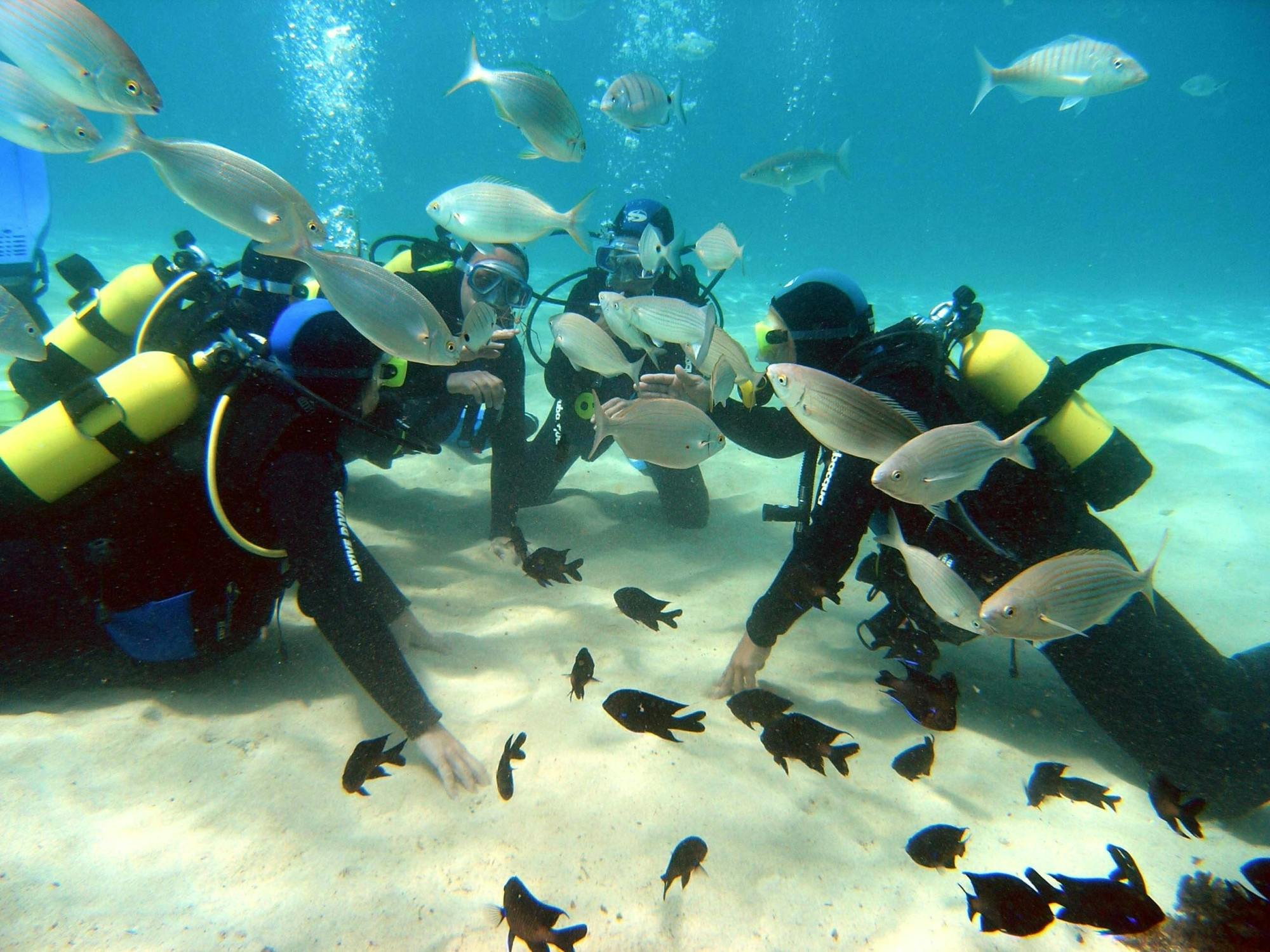
Scuba Diving
Nha Trang is also one of Vietnam’s established scuba-diving centres.
Beginners can book introductory dives with qualified operators, while certified divers can arrange more extensive trips to offshore sites.
Vietnam Tourism identifies approximately February through October as a generally favourable period for diving around Nha Trang, when sea conditions are often more suitable.
3. Spend a Day at VinWonders Nha Trang
VinWonders Nha Trang occupies part of Hon Tre Island and is one of the region’s biggest family attractions.
The experience combines amusement rides, water attractions, gardens, entertainment and shows with a spectacular journey across Nha Trang Bay.
For many visitors, the journey is part of the attraction: the island can be reached by the sea-crossing cable car, which provides wide views across the water and city.
Current 2026 VinWonders Ticket Prices
As of August 2026, official standard prices are:
Ticket
Adult 140 cm+
Child 100–under 140 cm / Senior 60+
Standard admission + return cable car
1,050,000 VND
800,000 VND
After 4:00 pm + return cable car
700,000 VND
550,000 VND
2-Day Unlimited Ticket
1,350,000 VND
1,050,000 VND
Children under 100 cm currently enter free. Seniors need identification to qualify for the senior rate.
Current VinWonders Opening Hours
The official park currently lists general operating hours of approximately:
8:30 am–9:30 pm
Individual rides, water attractions and shows may operate on shorter schedules, so check the current daily programme when you arrive.
Allow Most of a Day
If you purchase full admission, plan on spending most of the day at VinWonders rather than trying to squeeze it into two hours.
The after-4:00 pm ticket is better suited to visitors mainly interested in the cable car, atmosphere, selected attractions and evening entertainment.
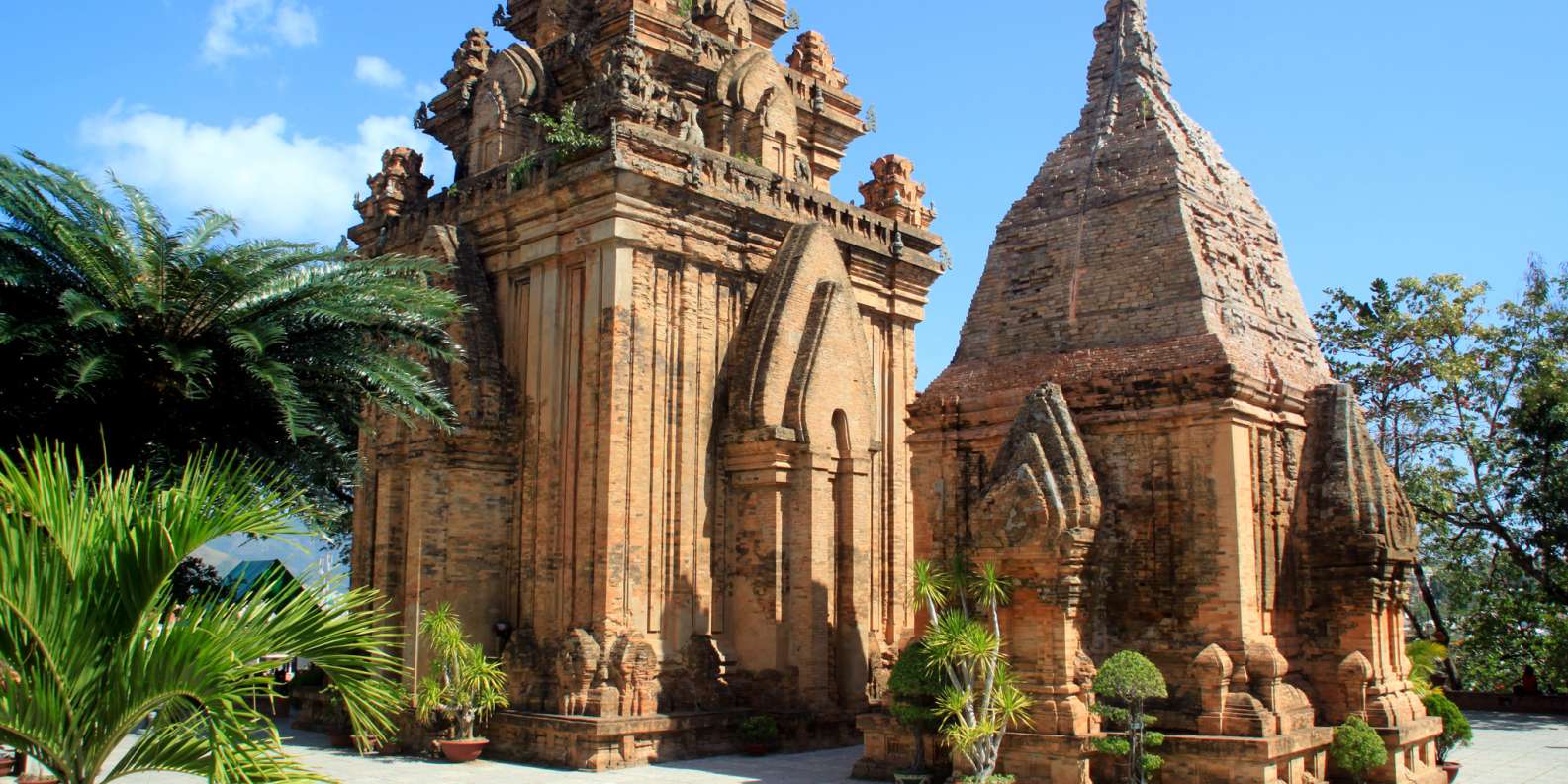
4. Visit Po Nagar Cham Towers
Po Nagar Cham Towers provide one of Nha Trang’s most important historical experiences.
The complex stands on Cu Lao Hill, approximately two kilometres north of the city centre near the mouth of the Cai River.
The surviving structures were built by the Cham civilisation between approximately the 8th and 13th centuries. The site was dedicated to Po Nagar, an important mother goddess associated with the ancient Cham region of Kauthara.
The towers are particularly interesting because this is not simply an abandoned archaeological ruin.
Religious traditions continued to develop around the site, and the worship of Po Nagar became associated with Vietnamese devotion to the Holy Mother Thiên Y A Na. The complex therefore reflects both Cham heritage and later Vietnamese religious traditions.
What to See at Po Nagar
Look for:
The surviving red-brick towers
Cham architectural details
Stone columns of the mandapa
Religious shrines
Views towards the Cai River
Xom Bong Bridge
Nha Trang city and bay
The main tower rises to approximately 23 metres.
Dress Respectfully
Po Nagar remains a sacred site.
Dress appropriately when entering worship areas and follow instructions regarding shoes, photography and access to shrines.
Allow roughly 45 minutes to one hour unless you have a particular interest in Cham history.
5. Visit Long Son Pagoda and the Giant White Buddha
Long Son Pagoda is one of Nha Trang’s principal Buddhist sites.
The complex is particularly famous for the enormous white Buddha seated on the hillside above the pagoda. Vietnam Tourism describes the statue as approximately 78 feet, or 24 metres, high.
The climb towards the Buddha also gives you changing views over Nha Trang.
Along the route, take time to explore the temple architecture rather than simply rushing to the summit for photographs.
Visiting Long Son Pagoda
Because it is an active religious complex:
Dress modestly
Keep voices low
Do not interrupt worshippers
Remove footwear where requested
Be cautious of unsolicited services or requests for donations
Visits to Buddhist places of worship are generally most rewarding when treated as religious sites first and tourist attractions second.
6. See Hon Chong Promontory
Hon Chong is a rocky coastal viewpoint on the northern side of Nha Trang.
Large weathered boulders sit beside the sea with views across Nha Trang Bay and towards offshore islands.
The attraction is easy to combine with Po Nagar because both lie north of the main central beach.
The current Khánh Hòa digital tourism platform lists admission to Hon Chong at approximately 30,000 VND.
Best Time for Hon Chong
Early morning or later afternoon is usually preferable to the hottest middle of the day.
Photographers may particularly enjoy the changing light over the bay.
7. Visit Nha Trang Cathedral
Nha Trang Cathedral, sometimes called the Stone Church or Mountain Church, provides another architectural contrast to the city’s beaches and Cham heritage.
The hilltop Roman Catholic church was constructed during the French colonial period and remains an active place of worship.
It is relatively easy to combine with Long Son Pagoda because both lie inland from the main beachfront.
Tourist access can be affected by Mass and church activities, so visit respectfully and avoid treating services as sightseeing opportunities.
8. Explore the Museum of Oceanography
Nha Trang has a long association with marine science, making the Museum of Oceanography a useful addition to a coastal itinerary.
The museum explores marine biodiversity, ocean science and the environments surrounding Vietnam’s coastline.
The official museum currently lists standard admission at:
40,000 VND per adult
It also lists:
Students: 20,000 VND
School pupils: 10,000 VND
Children under 6: Free
The museum has also been expanding its exhibition programme, including the opening of a new deep-ocean exhibition in 2025.
Good for a Rainy or Very Hot Day
The museum can be particularly useful when beach weather is poor or when you want an indoor activity during the hottest part of the afternoon.
Families interested in marine life may also find it a useful educational addition to an island-hopping trip.
9. Take a Traditional Nha Trang Mud Bath
Mineral mud bathing has become one of Nha Trang’s signature tourism experiences.
Visitors soak in warm mineral-rich mud before using showers, mineral-water pools and other spa facilities depending on the package purchased.
Established mud-bath destinations around Nha Trang include:
Thap Ba Mud Bath
I-Resort
100 Egg Tourist Area
Hon Tam mud-bath experiences
100 Egg Tourist Area
The 100 Egg Tourist Area lies roughly 10 kilometres south of central Nha Trang and is known for its unusual egg-shaped mud-bath tubs.
The larger complex also includes pools, landscaped areas, restaurants and family activities, so it can occupy considerably more time than a basic mud soak.
When to Take a Mud Bath
A mud-bath session works particularly well:
After an island-hopping day
After several days of walking
During poor beach weather
During the hottest part of the afternoon
Prices vary according to whether you choose shared tubs, private tubs, spa packages or additional pools and treatments.
10. Try Nha Trang’s Watersports
If lying on a beach all day is not enough, Nha Trang offers an extensive range of water activities.
Options can include:
Jet skiing
Parasailing
Stand-up paddleboarding
Kayaking
Snorkelling
Scuba diving
Glass-bottom boat trips
Vietnam Tourism specifically highlights watersports as a major part of the Nha Trang beach experience.
11. Take a Sunset Cruise
A sunset trip on Nha Trang Bay provides a quieter alternative to a daytime island tour.
Current operators offer excursions that can include:
Bay cruising
Sunset views
Live music
Light meals or dinner
Drinks
Stand-up paddleboarding
Optional watersports
Some current sunset cruises leave from Nha Trang Tourist Wharf during the afternoon and return after seeing the city lights along the coast.
12. Eat Nha Trang Seafood
A coastal holiday in Nha Trang should include at least one proper seafood meal.
Depending on the restaurant and season, you may find:
Fish
Prawns
Crab
Squid
Shellfish
Lobster
At seafood restaurants where items are priced by weight, confirm the price and approximate weight before ordering.
Try Local Nha Trang Specialities
Do not limit yourself to seafood platters. Regional dishes associated with Nha Trang include:
Bún cá – fish noodle soup
Bún sứa – jellyfish noodle soup
Nem nướng – grilled pork served with rice paper, vegetables and dipping sauce
Bánh căn – small savoury rice-flour cakes
Grilled beef
The Khánh Hòa tourism authority particularly highlights jellyfish vermicelli, grilled spring rolls, small Vietnamese pancakes and local grilled beef among regional food experiences.
13. Experience Nha Trang After Dark
Nha Trang does not become quiet when the beach closes.
The central waterfront has a strong evening scene with restaurants, rooftop venues, bars and entertainment.
Visitors who prefer a quieter night can simply walk along Tran Phu, have seafood and enjoy the illuminated waterfront rather than joining the nightlife.
Vietnam Tourism describes Nha Trang as one of Vietnam’s more energetic beach destinations after dark.
14. Escape to Long Beach
If the central beach feels too developed, consider travelling south towards Long Beach.
Vietnam Tourism highlights it as an alternative to busy Tran Phu, with shallower turquoise water and casual restaurants serving fresh seafood.
This can be a good half-day trip if you want a more relaxed beach atmosphere without committing to an offshore island excursion.
Best Time to Visit Nha Trang
Nha Trang has a comparatively favourable coastal climate and receives a high amount of sunshine.
The main wetter period generally occurs from:
September through December
July and August can be hot and sunny, while approximately February through August is usually one of the better periods for island trips and beach activities.
January to April
A very good overall period for sightseeing and beach activities.
May to August
Hotter, sunnier weather is common and sea activities can be excellent. Sun protection becomes particularly important.
September to December
Expect a greater chance of rain and rougher weather.
Boat tours can be changed or cancelled when sea conditions are unsuitable, so keep some flexibility in your itinerary.
How Many Days Do You Need in Nha Trang?
One Day
Enough for a quick introduction but not enough to experience the destination properly.
Concentrate on the beach, Po Nagar, Long Son Pagoda and the central city.
Two Days
Allows one sightseeing day and one island or VinWonders day.
Three Days
Good minimum for most first-time visitors.
You can combine:
City highlights
Island hopping
Beach time
Mud bath or VinWonders
Four or Five Days
Ideal if you want a genuine beach holiday rather than a rapid sightseeing stop.
A Good Two-Day Nha Trang Itinerary
Day 1 – City Highlights
Early morning: Walk or swim at Tran Phu Beach.
Morning: Visit Long Son Pagoda and Nha Trang Cathedral.
Late morning: Continue to Po Nagar Cham Towers.
Lunch: Try a local noodle dish or seafood.
Afternoon: Visit Hon Chong and then take a mud bath.
Evening: Dinner near the waterfront and a walk along Tran Phu.
Day 2 – Nha Trang Bay
Book an island-hopping excursion with swimming and snorkelling.
Return during the afternoon, relax at your hotel and finish with seafood or a sunset drink.
A Better Three-Day Nha Trang Itinerary
Day 1 – History and City
Tran Phu Beach
Long Son Pagoda
Nha Trang Cathedral
Po Nagar Cham Towers
Hon Chong
Mud bath
Day 2 – Islands
Boat trip
Snorkelling or diving
Swimming
Island lunch
Relaxed evening
Day 3 – Choose Your Style
Families: VinWonders Nha Trang.
Beach lovers: Long Beach or another quieter coastal area.
Culture and science: Museum of Oceanography and local museums.
Relaxation: Longer mud-bath and spa experience.
Getting to Nha Trang
By Air
The main aviation gateway is Cam Ranh International Airport.
Current official airport transport information lists the journey between Nha Trang and the airport at approximately 45–60 minutes by private vehicle, depending on traffic.
Airport Bus
The airport currently lists bus services at approximately:
50,000 VND per passenger
with a typical journey of around 50–60 minutes.
Private Transfer
Cam Ranh Airport currently gives a reference private-car price of around:
350,000–500,000 VND
Prices vary by provider and travel time, so confirm the fare before departure.
By Train
Nha Trang is on Vietnam’s main north-south railway line.
Train travel can be an enjoyable option if your broader itinerary includes destinations such as Ho Chi Minh City, Da Nang or Huế.
Nha Trang railway station is conveniently close to the central city.
Getting Around Nha Trang
The central beachfront is relatively easy to explore, but several major attractions lie outside comfortable walking distance.
Useful transport options include:
Taxi
Ride-hailing services
Motorbike
Private driver
Organised sightseeing tours
Bicycle for shorter trips
Vietnam Tourism specifically notes taxis, motorbike tours and cycling as useful ways to explore Nha Trang.
Where to Stay in Nha Trang
Tran Phu Beachfront
Best overall choice for first-time visitors.
Stay here if you want:
Easy beach access
Restaurants
Nightlife
Central sightseeing
Large choice of hotels
You can walk to many central attractions and easily arrange taxis or tour pickups for places farther away.
Central Nha Trang Behind Tran Phu
Best for value and food.
Hotels a few streets back from the beachfront can often offer better value while remaining within walking distance of the sea.
North Nha Trang and Pham Van Dong
Best for a quieter city beach atmosphere.
The northern coast places you closer to Hon Chong and gives a different feel from the busiest central resort strip.
Hon Tre Island
Best for resort holidays and VinWonders.
This is a good option if the resort itself is a major part of your holiday rather than simply somewhere to sleep between sightseeing trips.
Bai Dai and Cam Ranh Area
Best for large beachfront resorts and relaxation.
This coastal area south of Nha Trang is closer to Cam Ranh Airport but farther from the main city attractions.
Choose it if you prioritise a resort holiday over walking access to Nha Trang’s restaurants and historic sights.
Nha Trang With Children
Nha Trang works very well for families because there is more to do than simply sit on the beach.
Good family activities include:
Tran Phu Beach
VinWonders
Island boat trips
Museum of Oceanography
Mud baths
Short visits to Po Nagar and Long Son Pagoda
For younger children, check sea conditions carefully before booking a long island tour and make sure suitable child-sized life jackets are available.
Is Nha Trang Suitable for Older Travellers?
Yes.
Many of the main experiences can be adapted to different mobility levels.
Travellers who prefer less walking can enjoy:
Beachfront hotels
Scenic drives
Mud baths
Boat cruises
Restaurants
Hon Chong viewpoints
Long Son Pagoda involves stairs if you want to climb towards the large Buddha, while boat boarding and island beaches may also present mobility challenges.
Practical Nha Trang Tips
Use strong sun protection. Coastal sunshine can be intense.
Keep hydrated.
Book reputable island and diving operators.
Check sea conditions before boat trips.
Do not touch or stand on coral.
Dress respectfully at temples and pagodas.
Confirm seafood prices before ordering by weight.
Carry some Vietnamese dong for small purchases.
Allow extra airport travel time during busy periods.
Do not schedule every day. Leave time simply to enjoy the beach.
Which Nha Trang Highlights Should You Prioritise?
If you have limited time, prioritise these five experiences:
Island-hopping trip – see why the bay is the city’s biggest attraction.
Po Nagar Cham Towers – understand the region’s history and Cham heritage.
Long Son Pagoda – see the giant white Buddha and Buddhist architecture.
Mud bath or VinWonders – choose relaxation or entertainment according to your travel style.
Is Nha Trang Worth Visiting?
Yes, particularly if you want to combine a beach holiday with sightseeing and activities.
Nha Trang is not an untouched tropical village. It is a busy, developed coastal city with high-rise hotels, restaurants, nightlife and a popular urban beach.
That is also one of its strengths.
You can swim at Tran Phu Beach in the morning, stand among the 8th–13th-century Po Nagar Cham Towers before lunch, spend the afternoon soaking in a mud bath and eat fresh seafood beside the water that evening.
Stay another day and you can head onto Nha Trang Bay for snorkelling and island hopping. Families can devote a full day to VinWonders, where current 2026 standard admission including the return cable car is 1,050,000 VND for an adult.
For most first-time visitors, three days is a good minimum and four days is better. Use one day for the city and cultural attractions, one for the islands, and another for VinWonders, a mud bath or simply relaxing on the beach.
The combination of sea, islands, Cham heritage, Buddhist sites, watersports, food and easy resort living is what makes Nha Trang one of Vietnam’s most versatile coastal destinations.
Sponsored Popular Items
Quick take: Musement.com offers a worldwide selection of tours and attractions
Egg Coffee & Course on 4 Famous Traditional Vietnam Coffee Vietnam Learn to brew 4 different types of Vietnamese coffee. Discover the history and cultural significance of coffee in Vietnam and enjoy the subtle interplay of textures and flavors of your creations
A Saigon Perfume-Making Workshop offers a creative alternative to Ho Chi Minh City’s museums, markets and historical attractions. During the experience, you learn how different fragrance notes work together, experiment with a selection of aromas and then create a personalised perfume to take home.
One current workshop in central Ho Chi Minh City lasts approximately 90 minutes and is designed for complete beginners. A local instructor introduces the basics of perfume composition before helping participants combine top, middle and base notes into a fragrance reflecting their own preferences.
At the end of the session, your creation is transferred into a perfume bottle that you take home as a particularly personal souvenir of Vietnam.
Saigon Perfume-Making Workshop at a Glance
Visitor Information
Details
Location
Central Ho Chi Minh City
Current meeting point
The Scent, 14 Lê Anh Xuân Street, Ben Thanh, Ho Chi Minh City
Duration
Approximately 1 hour 30 minutes
Current starting price
From approximately US$19
Language
English
Experience required
None
Perfume options
15 ml, 30 ml or 50 ml depending on package
Equipment
Included
Instructor
Included
Transport
Not normally included
Recommended arrival
10 minutes before starting time
Best for
Couples, solo travellers, friends and creative experiences
Current prices and availability vary according to the date and bottle size selected, so check the final booking price before confirming.
What Happens During the Workshop?
The experience begins with an introduction to the basic structure of perfume.
Your instructor explains how perfumers organise fragrances into different layers and families before you begin smelling and comparing individual ingredients.
You then choose the aromas you like and experiment with different combinations until you develop a fragrance that works for you.
A typical session involves:
Introduction to perfume composition
Learning about fragrance families
Understanding top, middle and base notes
Smelling different fragrance ingredients
Selecting your favourite notes
Experimenting with combinations
Adjusting the balance of your perfume
Creating your final formula
Bottling your finished fragrance
Taking your perfume home
Understanding Top, Middle and Base Notes
One of the most useful parts of the workshop is learning why a perfume can smell different several minutes or several hours after it is applied.
Top Notes
Top notes are usually the first aromas you notice.
They often include bright, fresh fragrances such as:
Citrus
Bergamot
Lemon
Light herbs
Fresh green aromas
Top notes generally make the initial impression but tend to fade more quickly than the other layers.
Middle Notes
Middle notes, sometimes called heart notes, emerge after the initial fragrance begins to settle.
They often provide much of the character of a perfume.
Examples can include:
Jasmine
Rose
Other flowers
Spices
Fruity aromas
Base Notes
Base notes develop more slowly and usually remain on the skin longest.
They can include richer aromas such as:
Amber
Sandalwood
Musk-style accords
Vanilla
Other woody fragrances
Learning how these three layers interact makes creating your own perfume much easier than simply mixing several pleasant-smelling oils together.
Choose a Fragrance That Suits You
There is no requirement to reproduce an existing commercial perfume.
The main attraction is creating something individual.
You might prefer:
Fresh and citrusy – bright and clean
Floral – rose, jasmine and softer flower notes
Woody – warmer sandalwood and wood-style aromas
Amber – deeper and warmer
Sweet – softer dessert-like or vanilla-style notes
Green – fresh leaves, herbs and natural aromas
Spicy – warm and distinctive
The current Saigon workshop specifically allows participants to explore styles ranging from fresh citrus and warm amber to romantic florals before developing their final fragrance.
You Do Not Need to Know Anything About Perfume
No previous knowledge is required.
You do not need to understand perfume terminology or be able to identify individual fragrance ingredients before arriving.
The instructor guides you through the process step by step.
This makes the workshop suitable even for someone who normally chooses perfume simply because they like the smell rather than knowing whether it is floral, woody, oriental, citrus or aromatic.
Smelling the Ingredients
Much of the session involves smelling individual notes and deciding how they make you feel.
This can be surprisingly interesting because an aroma that smells pleasant on its own may behave very differently once mixed with other ingredients.
You will gradually begin narrowing your choices rather than simply adding everything you like.
Some specialist workshops in Ho Chi Minh City provide more than 30 different fragrance ingredients for participants to explore.
Testing Different Combinations
Your first attempt does not have to become your finished perfume.
Part of the experience is adjusting the formula.
You may decide that:
The floral note is too dominant
You need more freshness
The fragrance is too sweet
A woody note needs strengthening
A citrus note disappears too quickly
The base needs more depth
The instructor can suggest which ingredients to increase or reduce while still allowing the finished fragrance to remain your own creation.
Your Skin Changes How Perfume Smells
Perfume does not necessarily smell exactly the same on a paper testing strip as it does on your skin.
Body temperature, skin chemistry and the evaporation of individual fragrance components all affect how the perfume develops.
For this reason, specialist workshops encourage participants to experience the finished fragrance on their own skin before finalising the creation.
Choose Your Perfume Bottle Size
The current Saigon workshop offers several package sizes:
Package
Perfume Size
Mini Creation
15 ml
Full Experience
30 ml
Premium Experience
50 ml
The package you select can affect the final booking price.
If you are travelling for several weeks and carrying your perfume in hand luggage, the smaller bottle can also be particularly convenient.
Take Your Perfume Home
The finished fragrance is bottled at the end of the session and becomes yours to keep.
This is one of the main advantages of a workshop over an ordinary sightseeing activity.
You leave with something that is:
Created by you
Different from a standard souvenir
Small enough to pack easily
Connected with a particular travel experience
Useful long after your holiday ends
Scent is also strongly connected with memory, so wearing the fragrance later may remind you of your time in Saigon in a way that an ordinary souvenir cannot.
Current 2026 Price
The currently listed Saigon Perfume-Making Workshop Experience starts at approximately:
US$19 per person
This is a starting price and may correspond to the smaller perfume option. The final amount can vary according to bottle size, date and booking conditions.
As another current comparison, NOTE – The Scent Lab workshops can be found from roughly US$17–US$24 for some perfume-making packages, depending on the platform and available promotion.
What Is Included?
The currently advertised Saigon workshop includes:
Local instructor
Introduction to fragrance composition
Fragrance ingredients
Perfume-making equipment
Essential oils and aroma blends
Your selected perfume bottle
Your finished personalised fragrance
Transport to the workshop is not included.
How Long Does the Workshop Take?
The current activity is listed at:
Approximately 1 hour 28 minutes
For planning purposes, allow about 1½ to 2 hours including your arrival and time to find the studio.
This makes it particularly easy to fit into a Ho Chi Minh City itinerary without sacrificing half a day of sightseeing.
Where Is the Workshop?
The current meeting point for this particular experience is:
The Scent
14 Lê Anh Xuân Street
Ben Thanh
Ho Chi Minh City
Vietnam
Participants are currently asked to arrive approximately 10 minutes before the scheduled starting time.
A Convenient Central Location
The Ben Thanh area is particularly convenient for travellers because it sits within the central sightseeing district of Ho Chi Minh City.
You can easily combine the perfume workshop with:
Ben Thanh Market
Independence Palace
War Remnants Museum
Nguyen Hue Walking Street
Dong Khoi Street
Saigon Opera House
Vietnam’s official tourism organisation describes District 1 as the heart of central Ho Chi Minh City, with many hotels, restaurants, attractions and nightlife options concentrated within the area.
Visit Ben Thanh Market
Ben Thanh Market is one of the easiest attractions to combine with the workshop.
The historic indoor market contains stalls selling:
Fresh produce
Vietnamese food
Clothing
Coffee
Conical hats
Lacquerware
Souvenirs
Admission to the market itself is free.
A good itinerary is to explore the market before the workshop and then move towards Nguyen Hue or Dong Khoi later in the day.
Combine the Workshop With Independence Palace
Independence Palace is another major attraction in the central area.
Combining historical sightseeing with a perfume workshop works particularly well because the activities are completely different.
You can spend the morning learning about Vietnam’s 20th-century history and then use the afternoon for a relaxed creative experience.
Combine It With Nguyen Hue Walking Street
Nguyen Hue becomes particularly lively later in the day.
An afternoon perfume workshop followed by an evening walk through central Saigon creates an easy itinerary:
Perfume workshop → coffee or dinner → Nguyen Hue → Dong Khoi → Saigon Opera House
Vietnam Tourism recommends the surrounding central streets for exploring many of Ho Chi Minh City’s best-known landmarks on foot.
Another Option: NOTE – The Scent Lab
Ho Chi Minh City now has several perfume-making experiences, so you are not limited to one studio.
NOTE – The Scent Lab is another established option.
Its perfume workshops guide participants through:
The fragrance wheel
Top, middle and base notes
Personal fragrance preferences
Creating a perfume formula
Naming the finished fragrance
Bottling the perfume
The company currently advertises more than 30 fragrance ingredients and bottle choices ranging from approximately 10 ml to 50 ml.
NOTE – The Scent Lab in Thảo Điền
One current NOTE workshop is located at:
34 Nguyễn Duy Hiệu
Thảo Điền
Ho Chi Minh City
The listed perfume-making experience lasts around two hours and is available in English and Vietnamese.
Thảo Điền is farther from the main District 1 sightseeing area, so allow additional travel time if you choose this option.
Which Perfume Workshop Should You Choose?
Choose the Central Ben Thanh Workshop If:
You are staying in District 1
You want a shorter 90-minute experience
You want to combine the workshop with sightseeing
You prefer a 15 ml, 30 ml or 50 ml bottle choice
Choose NOTE – The Scent Lab If:
You want to explore a large fragrance library
You prefer a longer session
You want to visit Thảo Điền
You are particularly interested in perfume creation
Perfume Workshop or Perfume and Floral Gift Box?
Another current Saigon experience combines perfume creation with floral gift-box design.
This programme currently lasts around 1½ hours and starts at approximately US$30.
It can be a good alternative if you are creating a gift rather than simply making perfume for yourself.
Is the Workshop Good for Couples?
Yes.
Perfume making is particularly well suited to couples because each person can create something completely different.
You can compare fragrance preferences, help each other choose combinations or deliberately create contrasting scents.
The experience is also quieter and more interactive than another conventional city tour.
Is It Good for Solo Travellers?
Yes.
Solo travellers can participate without needing to arrive as part of a group.
The structured process naturally creates interaction with the instructor, so the activity does not depend on having a travelling companion.
Is It Suitable for Beginners?
Absolutely.
Current workshops specifically state that no previous perfume knowledge is required.
The entire process is designed around teaching you the basics before you begin blending.
Age Restrictions
Check the exact workshop before booking for a family.
The current Musement listing for this particular Saigon Perfume-Making Workshop states that participants under 12 and over 64 are not accepted.
This restriction is specific to that particular listed experience and should not be assumed to apply to every perfume workshop in Ho Chi Minh City.
Other perfume workshops may have different age policies, so families should compare operators if younger children are travelling with them.
Accessibility
The current Scent of Saigon workshop listing is described as wheelchair accessible.
If you have specific mobility requirements, it is still sensible to confirm access with the operator before travelling because workshop layouts and entrances can change.
A Good Rainy-Day Activity
A perfume workshop is particularly useful during Ho Chi Minh City’s rainy season because the activity takes place indoors.
Rather than losing part of the day to a heavy tropical downpour, you can spend approximately 90 minutes creating your fragrance and continue sightseeing after the weather improves.
Ho Chi Minh City is warm throughout the year, with its wetter season broadly extending from around May through November.
Morning or Afternoon Workshop?
Morning
A morning session works well if you want to complete the workshop before the busiest part of your sightseeing day.
You can then have lunch and spend the afternoon visiting central Ho Chi Minh City.
Afternoon
Excellent during hot or rainy weather.
Spend the morning exploring outdoor attractions and move indoors for your perfume workshop during the afternoon.
Late Afternoon
A later session fits particularly well with an evening around Nguyen Hue, Dong Khoi or the Saigon Opera House.
What Should You Wear?
No special clothing is required.
The current activity simply recommends comfortable clothes.
Because the experience is indoors and involves small quantities of fragrance ingredients rather than messy craft materials, ordinary sightseeing clothing is generally suitable.
What if You Are Sensitive to Fragrance?
A perfume workshop naturally involves repeatedly smelling concentrated fragrance materials.
If strong scents trigger headaches, nausea, respiratory symptoms or migraines, consider whether the experience is appropriate before booking.
You will be exposed to many different aromas within a relatively short period.
Avoid Scent Fatigue
After smelling many fragrances, your sense of smell can become temporarily less sensitive.
Do not rush through every bottle.
Take short breaks and follow your instructor’s advice.
It is usually better to carefully evaluate a smaller number of promising notes than to repeatedly smell everything available.
Travelling With Your Finished Perfume
Perfume is usually an easy souvenir to transport, but remember airline liquid restrictions.
The currently available 15 ml, 30 ml and 50 ml bottles are all below the common 100 ml individual-container limit used for liquids in cabin baggage on many international flights.
Nevertheless, airline and airport security requirements can vary, so check the rules applying to your flights.
Protect the bottle carefully against breakage and leakage inside your luggage.
A Good Half-Day Perfume Workshop Itinerary
9:00 am – Independence Palace
Begin with one of central Ho Chi Minh City’s major historical attractions.
11:00 am – Ben Thanh Market
Explore the stalls and surrounding streets.
Noon – Lunch
Try Vietnamese food in the Ben Thanh or central District 1 area.
1:30 pm – Perfume-Making Workshop
Arrive approximately 10 minutes early and allow around 90 minutes for the experience.
3:15 pm – Coffee
Stop at one of central Saigon’s numerous cafés.
Late Afternoon – Nguyen Hue and Dong Khoi
Continue towards the heart of District 1.
Evening – Saigon Opera House
See the illuminated theatre or attend a scheduled performance.
Where to Stay
Ben Thanh Area
Best for easy access to this particular workshop.
The area provides numerous hotels, restaurants and cafés while keeping many major central attractions within walking or short taxi distance.
Dong Khoi and Nguyen Hue
Best for a more polished central location.
You will be close to:
Saigon Opera House
Nguyen Hue Walking Street
Restaurants
Shopping
Historic central architecture
Thảo Điền
Best if you prefer cafés, restaurants and a more relaxed neighbourhood atmosphere.
This is also convenient if you specifically want to attend the NOTE – The Scent Lab workshop on Nguyễn Duy Hiệu.
Practical Tips
Book ahead if you want a particular session.
Check the bottle size before paying.
Arrive approximately 10 minutes early.
Do not wear a strong perfume to the workshop if you want to evaluate the ingredients accurately.
Take your time smelling individual notes.
Tell the instructor what types of perfume you normally enjoy.
Test the fragrance on your skin before finalising it where permitted.
Check age restrictions if booking for children.
Allow extra travel time during busy Saigon traffic.
Protect your finished bottle when packing.
Is a Saigon Perfume-Making Workshop Worth Doing?
Yes, particularly if you want something different from another sightseeing tour.
The experience is short enough to fit easily into a day in Ho Chi Minh City but long enough to teach you something genuinely useful about how perfumes are constructed.
You learn the difference between top, middle and base notes, explore different fragrance families, experiment with scent combinations and gradually build a formula reflecting your personal preferences.
The current central Saigon experience takes approximately 90 minutes, is conducted in English and offers a choice of 15 ml, 30 ml and 50 ml perfume packages. Current pricing begins at around US$19, although the final price depends on your chosen option and travel date.
The location near Ben Thanh also makes the workshop extremely easy to combine with other attractions. You can explore the market or Independence Palace beforehand and continue towards Nguyen Hue, Dong Khoi and the Saigon Opera House afterwards.
Most importantly, the activity produces a souvenir with a stronger personal connection than something selected from a shop.
You leave Saigon carrying a fragrance you designed yourself—and each time you wear it later, the scent has the potential to bring back memories of the city where you created it.
Sponsored Popular Items
Quick take: Musement.com offers a worldwide selection of tours and attractions
Dunsborough: Create Your Own Signature Fragrance Experience Australia Unleash your creativity and delve into the captivating world of perfumery with a hands-on fragrance-making workshop. Create a 30ml bottle of Eau De Parfum and have your private formula stored on file.
Queenstown: Create Your Own Bespoke Fragrance New Zealand Create your own bespoke fragrance at a perfume-making workshop in Queenstown. Choose from 60 different perfumery materials to create your fragrance and take home a 30ml bottle of eau de parfum
Auckland: Create Your Own Bespoke Fragrance New Zealand Create your own bespoke fragrance at a perfume-making workshop in Auckland. Choose from 60 different perfumery materials to create your fragrance and take home a 30ml bottle of eau de parfum
A Vietnamese Kite Painting Workshop is an enjoyable way to experience the traditional arts of Huế while creating a personalised souvenir to take home. Rather than simply watching an artisan at work, participants decorate their own traditional Vietnamese kite using colours, patterns and imagery inspired by the landscapes and culture of central Vietnam.
Current workshops in Huế introduce visitors to the history and cultural significance of Vietnamese kite flying before providing a traditional kite frame, paints and decorative materials. No previous artistic experience is required, making the activity suitable for complete beginners as well as experienced artists. :contentReference[oaicite:0]{index=0}
A dedicated kite-painting session currently takes approximately one hour, making it particularly easy to combine with the Imperial City, Perfume River, Dong Ba Market or another Huế attraction during the same day. :contentReference[oaicite:1]{index=1}
Vietnamese Kite Painting Workshop at a Glance
Visitor Information
Details
Location
Huế, central Vietnam
Activity
Painting a traditional Vietnamese kite
Typical dedicated workshop
Approximately 1 hour
Current example start times
8:30 am, 10:00 am, 1:30 pm and 3:00 pm
Difficulty
Easy
Art experience required
No
Instructor
Local instructor; English available on current tours
Materials
Normally included
Souvenir
Your completed painted kite
Best for
Families, couples, solo travellers and cultural travellers
Advance booking
Recommended
Why Huế Is a Good Place to Learn About Vietnamese Kites
Huế is particularly well suited to this type of experience because traditional crafts remain an important part of the city’s cultural identity.
Kite flying is also still visible in everyday life. Vietnam’s official tourism organisation specifically notes that the large open space in front of Huế’s Imperial City becomes a popular gathering place in the late afternoon, with children flying kites as the temperature begins to fall. :contentReference[oaicite:3]{index=3}
The city has also hosted international kite festivals as part of its broader programme of traditional craft and cultural events. :contentReference[oaicite:4]{index=4}
A painting workshop therefore connects with a living recreational and artistic tradition rather than presenting kites solely as decorative souvenirs.
What Is a Traditional Huế Kite?
Vietnamese kites appear in many forms, ranging from simple field kites traditionally flown by children to elaborate artistic creations depicting animals, dragons and other imaginative forms.
The kite used in current Huế painting workshops is commonly described as a traditional field kite, or Diều Đồng Nội. Participants learn about its connection with Vietnamese countryside culture and the symbolism associated with its design before beginning to paint. :contentReference[oaicite:5]{index=5}
The workshop concentrates primarily on decorating the kite rather than spending many hours constructing a complex frame from raw bamboo.
What Happens During the Workshop?
A typical one-hour Huế kite-painting experience follows a simple and relaxed format.
Welcome and Introduction
You meet your local instructor and receive a short introduction to Vietnamese kite traditions.
Some current workshops begin with a welcome drink before the instructor explains the cultural role of kite flying and introduces the traditional field-kite design. :contentReference[oaicite:6]{index=6}
Learn About Kite Design
The instructor explains how colour, shape and decoration can be adapted to the surface of the kite.
You may be shown traditional examples or suggested motifs before deciding how you would like your own kite to look.
Paint Your Kite
You then use the supplied paints and decorative materials to customise your kite.
Possible inspiration includes:
Lotus flowers
Bamboo
Mountains
Rice fields
Vietnamese countryside scenes
Birds and butterflies
Traditional patterns
Clouds and sky
Dragons
Abstract colour designs
Your own original artwork
Current activity descriptions specifically encourage visitors to use Vietnamese landscapes, nature or their own imagination as inspiration. :contentReference[oaicite:7]{index=7}
Take Your Kite Home
At the end of the class, the completed painted kite is yours to keep.
The traditional kite frame, painting supplies, decorative materials and instructor guidance are all included in the currently advertised dedicated workshop. :contentReference[oaicite:8]{index=8}
You Do Not Need Painting Experience
No artistic experience is necessary.
The workshop is designed as a cultural activity rather than an advanced painting lesson.
Your instructor can help with:
Choosing a simple design
Positioning the main image
Selecting colours
Creating outlines
Adding decorative details
The current dedicated Huế workshop specifically describes the experience as easy and suitable for participants without previous artistic experience. :contentReference[oaicite:9]{index=9}
How Long Does the Workshop Take?
The dedicated traditional kite-painting experience currently lasts approximately:
1 hour
Current published start times include:
8:30 am
10:00 am
1:30 pm
3:00 pm
Times can change, so confirm availability for your travel date before organising the rest of your sightseeing itinerary. :contentReference[oaicite:10]{index=10}
What Is Included?
The currently advertised dedicated workshop includes:
Admission to the workshop
Welcome drink
Traditional kite frame
Materials
Paints
Decorative supplies
Local instructor
Your completed kite to take home
How Much Does a Kite Painting Workshop Cost?
Prices vary according to whether you book only the kite-painting session or a broader Huế craft experience.
The standalone one-hour kite workshop currently asks visitors to check the selected date for its applicable booking price rather than publishing a fixed headline rate.
As a useful 2026 comparison, a current Huế Craft & Creative Hub experience that includes kite painting together with several other traditional crafts is advertised from approximately A$22 per person. That programme lasts around one hour and includes materials, English-language explanation, royal tea, Huế ginger jam and finished craft products to take home. :contentReference[oaicite:12]{index=12}
Because prices can change by date and booking platform, check the final rate and exactly which crafts are included before purchasing.
A Broader Huế Craft Workshop
Visitors who want more than kite painting can currently book a broader one-hour Huế craft programme combining several traditional activities.
The published experience includes:
Painting a Huế conical hat
Learning about the famous poem hat
Painting a traditional Vietnamese kite
Making a paper lotus flower
Royal tea
Huế ginger jam
All tools and materials are provided, and participants take their finished craft items home. :contentReference[oaicite:13]{index=13}
This can be a particularly good choice if you have only a short stay in Huế and want to sample several local crafts rather than spending all your workshop time on one item.
Kite Painting or Kite Making?
It is important to read the activity description carefully because kite painting and kite making are not necessarily the same experience.
Kite Painting Workshop
The kite frame is normally prepared for you.
Your main activity is learning about the tradition and then painting and decorating the surface.
Kite-Making Workshop
A more extensive workshop may teach participants how to create parts of the kite itself before painting it.
A separate half-day Huế experience, for example, combines cycling through the city with a visit to a local kite artist, where participants learn to make and paint a traditional kite. The complete activity lasts approximately four hours. :contentReference[oaicite:14]{index=14}
If you are mainly interested in craft techniques rather than painting, the longer option may be more rewarding.
Half-Day Kite-Making Tour by Bicycle
For travellers wanting a more substantial cultural experience, Huế also offers a half-day kite-making tour by bicycle.
The current activity lasts around four hours and includes:
Bicycle and helmet
English-speaking guide
Easy cycling through Huế
Visit to a local kite artisan
Traditional kite-making demonstration
Kite painting
Café refreshments
Bottled water
The route is described as an easy ride without hills and involves relatively little walking. Morning and afternoon departures are currently offered. :contentReference[oaicite:15]{index=15}
Which Experience Should You Choose?
Choose the One-Hour Painting Workshop If:
You have limited time
You mainly enjoy painting
You want an indoor activity
You are travelling with children
You want an easy cultural experience
You are fitting the workshop between major Huế attractions
Choose the Multi-Craft Workshop If:
You want to try several Huế crafts
You are interested in conical hats and lotus crafts as well as kites
You want a broader introduction to local traditions
Choose the Half-Day Kite-Making Bicycle Tour If:
You want to learn more about construction
You enjoy cycling
You want interaction with a local artisan
You prefer a longer cultural experience
You want to see more of Huế beyond the workshop
Is the Workshop Suitable for Children?
Yes, the current Huế craft and kite-painting experiences are promoted as family-friendly.
The broader Huế craft programme describes traditional kite painting as suitable for all ages, while children are expected to participate with an accompanying adult. :contentReference[oaicite:16]{index=16}
The activity can work particularly well with children because they are producing something themselves rather than spending another hour listening to historical explanations.
Is It Suitable for Solo Travellers?
Yes.
A workshop provides a natural way for solo travellers to interact with a local instructor and other participants without needing to join a full-day group tour.
Because the activity concentrates on a shared task, conversation usually develops much more naturally than on a conventional sightseeing excursion.
Is It Suitable for Couples?
A kite workshop is also an enjoyable activity for couples.
You can each paint your own design or create matching or complementary kites.
It also provides a useful change from temples, tombs and historical sightseeing during a multi-day Huế itinerary.
A Good Rainy-Day Activity in Huế
The currently advertised Huế Craft & Creative Hub workshop is conducted indoors, making it particularly useful when weather conditions are poor. :contentReference[oaicite:17]{index=17}
This can be important in Huế because central Vietnam experiences periods of substantial rainfall.
Keeping one indoor workshop available as a flexible activity can prevent rain from disrupting an entire sightseeing day.
What Should You Wear?
Comfortable everyday clothing is suitable.
The current Huế craft programme recommends comfortable clothes and asks participants to arrive approximately 5–10 minutes before the session begins. :contentReference[oaicite:18]{index=18}
Because paint is involved, avoid wearing something you would be particularly upset to stain accidentally.
Accessibility
Accessibility depends on the particular workshop you choose.
The current one-hour Huế Craft & Creative Hub experience is listed as wheelchair accessible. :contentReference[oaicite:19]{index=19}
The separate four-hour bicycle-based kite-making tour is not wheelchair accessible and is naturally unsuitable for anyone who cannot comfortably cycle. :contentReference[oaicite:20]{index=20}
Check the exact listing before booking if step-free access or other assistance is important.
Take Your Kite Home
One of the main advantages of the activity is that the souvenir is included in the experience.
Instead of buying another object in a tourist shop, you leave with something you have personally decorated.
Your finished kite can become:
A wall decoration
A travel souvenir
A gift
A keepsake for children
A reminder of Huế
Current dedicated and multi-craft workshops both allow participants to take their completed creations home. :contentReference[oaicite:21]{index=21}
Can You Actually Fly the Kite?
That depends on the type of kite, the workshop and weather conditions.
A traditional kite is designed around flight, but a heavily decorated souvenir may be treated more carefully after painting.
If you specifically want to fly your completed kite, ask the instructor whether the particular model is intended for flying and what wind conditions are suitable.
Where to See Kites Flying in Huế
The large open area near the Noon Gate of the Imperial City is one of the easiest places to see local kite flying.
Vietnam Tourism notes that children often fly kites there in the late afternoon as local residents gather in the open space. :contentReference[oaicite:22]{index=22}
If you complete your workshop earlier in the day, visiting the Imperial City and returning to the area towards evening can provide a fitting conclusion to the experience.
Combine the Workshop With Huế Imperial City
The Imperial City is the obvious major attraction to combine with a kite workshop.
A good schedule is:
Morning
Visit the Imperial City while temperatures are relatively comfortable.
Lunch
Have lunch in central Huế.
Early Afternoon
Join your one-hour kite-painting workshop.
Late Afternoon
Walk beside the Perfume River or return towards the Citadel area.
Evening
Watch local life around the open spaces near the Imperial City and continue to dinner.
Combine the Workshop With Dong Ba Market
Dong Ba Market is another easy addition to a craft-focused day.
Browsing the market before or after a workshop gives you the opportunity to compare handmade products, local foods and everyday household goods with the more carefully explained craft traditions presented during the class.
Combine the Workshop With the Perfume River
A short craft session also fits comfortably around a Perfume River cruise.
You could spend the morning visiting the Imperial City, paint your kite in the afternoon and then take an evening boat trip or walk beside the river.
Combine It With Other Huế Crafts
Huế is particularly rewarding for travellers interested in traditional craftsmanship.
Other hands-on or artisan experiences can include:
Conical hat painting
Poem-hat making
Paper lotus crafting
Incense making
Traditional paper art
Royal-style crafts
The current Huế Craft & Creative Hub deliberately combines kite painting with several of these traditions in a single short programme. :contentReference[oaicite:23]{index=23}
Where to Stay in Huế
Central Huế
Best overall choice for most visitors.
Staying centrally gives you easy access to workshops, restaurants, the Perfume River and transport to the Imperial City and royal tombs.
Perfume River Area
Best for evening walks and river views.
This area works particularly well if you want to combine cultural workshops with river cruises and central sightseeing.
Near the Imperial City
Best for history-focused travellers.
Accommodation north of the river can place you closer to the Citadel while central craft workshops remain a short taxi or ride-hailing journey away.
A Good Half-Day Creative Huế Itinerary
9:00 am – Traditional Craft Workshop
Begin with a one-hour kite painting or multi-craft session.
10:30 am – Coffee
Stop at a café and allow your finished craft to dry fully if necessary.
11:30 am – Dong Ba Market
Browse local produce and handicrafts.
Lunch
Try one of Huế’s distinctive local dishes.
Afternoon – Imperial City
Spend several hours exploring the former imperial complex.
Late Afternoon
Remain near the Noon Gate and you may see local children flying kites in the open spaces as the day cools. :contentReference[oaicite:24]{index=24}
Practical Tips
Book ahead if you have a specific preferred time.
Arrive 5–10 minutes early.
Wear comfortable clothing.
Do not worry if you cannot draw. The instructor will help.
Choose a simple design if you only have one hour.
Ask whether your finished kite is designed to be flown.
Allow the paint to dry before packing it.
Check whether you are booking painting only or full kite making.
Consider the broader craft workshop if you want several souvenirs.
Is a Vietnamese Kite Painting Workshop Worth Doing?
Yes, especially if you want a short cultural activity that is more interactive than ordinary sightseeing.
Huế is famous for its imperial monuments, royal tombs and historic architecture, but traditional crafts provide another perspective on the city.
A kite-painting workshop takes only around one hour, requires no artistic experience and gives you the opportunity to learn about Vietnamese kite traditions while creating something yourself. Current dedicated sessions include the kite, painting materials, instructor guidance and the completed artwork to take home. :contentReference[oaicite:25]{index=25}
If you want a broader introduction to Huế craftsmanship, a current multi-craft experience combines kite painting, conical-hat decoration, poem-hat craftsmanship and paper lotus making in a one-hour indoor session, with prices currently advertised from approximately A$22. :contentReference[oaicite:26]{index=26}
Visitors wanting a deeper experience can instead choose the four-hour bicycle tour and learn more about both making and decorating traditional kites with a local artisan. :contentReference[oaicite:27]{index=27}
For most travellers, the simple painting workshop is easy to fit into a Huế itinerary. Schedule it between major attractions, take your finished kite home and then, if the weather cooperates, head towards the Imperial City in the late afternoon to see a tradition you have just learned about continuing in everyday life.
Sponsored Popular Items
Quick take: Musement.com offers a worldwide selection of tours and attractions
Traditional Vietnamese Kite Painting Workshop in Hue Vietnam Plan Traditional Vietnamese Kite Painting Workshop in Hue, a guided sightseeing experience, with practical tips on timing, inclusions and what to check before booking. Compare current availability, prices and booking conditions before you go.
Transfer to International Kite Festival in Corralejo - 15.11.2026 – Seasonal Experience Spain Plan Transfer to International Kite Festival in Corralejo - 15.11.2026 – Seasonal Experience, a water-based experience, with practical tips on timing, inclusions and what to check before booking. Compare current availability, prices and booking conditions before you go.
A Nón Lá Conical Hat Painting Workshop offers a very different way to experience Vietnamese culture while visiting Ho Chi Minh City. Instead of simply buying a traditional conical hat as a souvenir, you decorate your own under the guidance of a local artist and take the finished hat home with you.
The nón lá is one of Vietnam’s most instantly recognisable cultural symbols. Traditionally made from palm leaves attached to a lightweight bamboo frame, the conical shape provides practical protection from both tropical sunshine and rain. Vietnam’s national tourism organisation describes the handwoven palm-leaf hat as one of the country’s classic traditional souvenirs and a familiar part of Vietnamese daily life. :contentReference[oaicite:1]{index=1}
In Ho Chi Minh City, visitors can join dedicated workshops where a plain nón lá becomes the canvas for flowers, landscapes, traditional patterns, calligraphy or an entirely personal design.
One current workshop runs for approximately 2½ hours and includes the conical hat, painting materials, water and instruction from a local guide. Current booking prices are around US$25–US$30 per person, depending on the booking platform and date. :contentReference[oaicite:2]{index=2}
Nón Lá Painting Workshop at a Glance
Visitor Information
Details
Location
Ho Chi Minh City, Vietnam
Workshop
Vietnamese conical hat painting
Traditional name
Nón lá
Typical duration
Approximately 1½–2½ hours
Current example price
Approximately US$25–US$30 per person
Instruction
English available
Painting experience required
No
Materials
Provided
Souvenir
Your own hand-painted nón lá
Transport
Normally not included
Advance booking
Recommended
Best for
Culture, crafts, couples, solo travellers and creative activities
The exact duration differs between providers. The Sun Art describes its own conical-hat experience as approximately 1½ to 2 hours, while the currently listed packaged activity is approximately 2½ hours. :contentReference[oaicite:3]{index=3}
What Is a Nón Lá?
The nón lá is the traditional Vietnamese conical hat.
Its simple appearance hides a surprisingly skilled construction process. Traditional hats are made using leaves arranged over a lightweight framework, commonly incorporating bamboo, before being carefully stitched into their familiar conical shape.
The design is extremely practical.
The broad circular brim protects the wearer from intense sunshine, while the sloping surface helps shed rain during Vietnam’s tropical downpours.
Vietnam Tourism notes that conical hats have traditionally been worn by men and women of different ages and are particularly associated with people working outdoors in markets, rice fields and on the water. :contentReference[oaicite:4]{index=4}
More Than a Tourist Souvenir
The conical hat is now strongly associated with images of Vietnam, but it remains connected with genuine traditional craftsmanship.
Hat-making communities continue to preserve the techniques required to select and prepare leaves, create the frame and stitch the finished hat.
In traditional craft villages such as Chuong Village near Hanoi, the craft has been passed between generations and remains part of the community’s cultural identity. :contentReference[oaicite:5]{index=5}
A painting workshop does not normally teach every stage required to construct a traditional hat from scratch. Instead, it uses the completed nón lá as the surface for a hands-on artistic experience.
This distinction is worth understanding when booking: a conical hat painting class and a complete conical hat-making workshop are not necessarily the same activity.
What Happens During the Workshop?
A typical Ho Chi Minh City workshop begins with an introduction to the nón lá and its place in Vietnamese culture.
The instructor explains how the traditional hat is made and discusses the materials used in its construction.
You are then given your own hat and painting materials.
Depending on the workshop, inspiration may include:
Lotus flowers
Bamboo
Vietnamese landscapes
Traditional patterns
Flowers and leaves
Calligraphy
Rural scenes
Modern decorative designs
Your own original artwork
The currently listed Nón Lá workshop encourages participants to use colours and designs inspired by Vietnamese landscapes, traditional patterns, flowers and calligraphy. :contentReference[oaicite:6]{index=6}
You Do Not Need to Be an Artist
No previous painting experience is necessary.
This is intended as an accessible cultural activity rather than a professional art course.
A local artist or instructor helps participants plan and complete their design, so beginners can create something attractive without needing advanced drawing skills. Current activity descriptions specifically state that previous painting experience is not required. :contentReference[oaicite:7]{index=7}
If you are confident with art, you can naturally make the design considerably more detailed.
Choosing Your Nón Lá Design
One of the enjoyable parts of the workshop is deciding what should go on your hat.
Lotus Flowers
Lotus imagery works particularly well because the large curved surface allows petals and leaves to spread naturally across the hat.
Vietnamese Landscape
Rice fields, mountains, waterways and village landscapes can turn the hat into a reminder of your travels through Vietnam.
Bamboo
Bamboo designs suit the natural material of the hat and can be relatively easy for beginners to paint.
Traditional Patterns
Your instructor may provide examples or guidance based on Vietnamese decorative art.
Calligraphy
Visitors interested in lettering can incorporate Vietnamese words or stylised calligraphy.
Your Own Design
There is no requirement to reproduce an existing traditional image.
A personalised design can turn the hat into a much more individual travel souvenir.
Natural Colours and Vietnamese Inspiration
The currently advertised workshop emphasises colours and designs inspired by Vietnamese nature and traditional visual motifs.
This can make the activity more interesting than simply colouring a tourist souvenir because the instructor can explain some of the cultural references behind the imagery. :contentReference[oaicite:8]{index=8}
Before starting, look through the examples available at the studio rather than immediately choosing the first design you see.
The curved surface of a conical hat works very differently from painting on flat paper or canvas.
What Is Included?
The currently listed 2½-hour Ho Chi Minh City experience includes:
Your conical hat
Painting and art equipment
Local guide or instructor
Water
Cultural introduction
The completed hat to take home
Transport to and from the studio and personal expenses are not included in the standard package. :contentReference[oaicite:9]{index=9}
The Best Part: You Keep Your Hat
Unlike many cultural tours where the experience ends when you leave, this workshop produces something you can physically take home.
Your finished hand-painted nón lá is yours to keep. :contentReference[oaicite:10]{index=10}
That makes it a particularly personal souvenir.
Rather than buying a mass-produced object from a souvenir store, you return home with something connected to several hours of your own time in Vietnam.
Where Is the Workshop?
One of the workshops currently offering this experience is The Sun Art Vietnam in central Ho Chi Minh City.
The studio publishes its location as:
TK26/40–41 Nguyễn Cảnh Chân Street
Ho Chi Minh City
Vietnam
The studio specialises in painted Vietnamese conical hats and other customised art and craft products.
Its current workshop information recommends making an advance reservation. :contentReference[oaicite:11]{index=11}
How Long Does the Workshop Take?
Allow approximately two to three hours in your sightseeing schedule.
The exact experience varies:
The Sun Art describes its workshop as approximately 1½–2 hours.
The currently listed Nón Lá workshop through Musement and GetYourGuide lasts approximately 2½ hours.
Allow a little extra time to find the studio and arrive before the scheduled starting time. :contentReference[oaicite:12]{index=12}
How Much Does a Nón Lá Painting Workshop Cost?
Prices depend on the provider, booking platform and date.
Current August 2026 examples include:
Current Example
Approximate Price
Listed Nón Lá Painting Workshop
From approximately US$28.50
Other current Ho Chi Minh City conical-hat workshops
From approximately US$25
Prices change, so check the final amount for your preferred date before booking. :contentReference[oaicite:13]{index=13}
Should You Book in Advance?
Yes.
This is a small workshop rather than a large attraction with thousands of daily visitors.
Advance reservations give the studio time to prepare hats, painting equipment and an instructor for the expected number of participants.
The Sun Art itself currently recommends booking in advance. :contentReference[oaicite:14]{index=14}
Arrive Early
One current booking provider asks participants to arrive approximately 10 minutes before the scheduled workshop. :contentReference[oaicite:15]{index=15}
This is sensible in Ho Chi Minh City because traffic can be unpredictable.
If you are travelling by taxi or ride-hailing service, avoid planning to arrive at the exact starting time.
What Should You Wear?
This is an art workshop, so wear comfortable clothing.
One current booking listing specifically recommends clothes that you do not mind accidentally getting paint on. :contentReference[oaicite:16]{index=16}
You do not need specialist equipment.
The painting materials required for the activity are provided.
Is the Workshop Suitable for Children?
Age policies need to be checked carefully because the current booking sources are inconsistent.
Some current listings describe conical-hat painting generally as suitable for families and different skill levels, while the specific Musement Nón Lá workshop currently states that children under 12 are not permitted. :contentReference[oaicite:17]{index=17}
If booking for a family, check the age requirement shown on the exact session you intend to purchase rather than relying on a general description of the activity.
Is It Suitable for Solo Travellers?
Yes.
A workshop can actually be an excellent activity for someone travelling alone because you are naturally interacting with the instructor and other participants.
You do not need to arrive as part of a group or couple to enjoy it.
Is It Good for Couples?
A conical-hat workshop makes an unusual alternative to another sightseeing tour.
Couples can each create a different design or produce complementary hats.
Because the activity involves sitting, talking and creating something rather than simply following a guide through another attraction, it also provides a useful change of pace during a busy Ho Chi Minh City itinerary.
A Good Rainy-Day Activity
A craft workshop is particularly useful during Ho Chi Minh City’s wetter months.
Instead of losing an afternoon to heavy tropical rain, you can spend several hours indoors and still experience something distinctly Vietnamese.
It is also a useful activity during the hottest part of the day when lengthy outdoor walking becomes less appealing.
Combine the Workshop With Ben Thanh Market
Ben Thanh Market can be combined easily with a central Ho Chi Minh City workshop.
The market provides a complete contrast with the quiet concentration of an art class.
You can browse food, clothing and souvenir stalls before or after your painting session.
If you have just painted your own nón lá, you may also find yourself looking at commercially sold hats quite differently once you understand more about their construction.
Combine the Workshop With Nguyen Hue
Another easy option is to continue towards Nguyen Hue Walking Street and the central District 1 area later in the day.
This works particularly well with an afternoon workshop because you can move towards the city centre for dinner and evening sightseeing afterwards.
A Good Half-Day Nón Lá Workshop Itinerary
Morning – Explore Central Ho Chi Minh City
Spend the morning visiting one or two of the city’s major attractions.
Lunch
Have lunch before travelling to the workshop.
Early Afternoon – Nón Lá Painting Workshop
Allow approximately two to three hours including arrival and painting time.
Late Afternoon
Take your completed hat back to your accommodation or continue exploring the central city.
Evening
Walk around Nguyen Hue, Dong Khoi or the surrounding District 1 area and have dinner.
Where to Stay
Central District 1
Best overall choice for first-time visitors.
Central Ho Chi Minh City provides easy access to:
Restaurants
Markets
Historic architecture
Shopping
Cultural workshops
Evening attractions
It also makes reaching the workshop by taxi or ride-hailing service straightforward.
Ben Thanh Area
Best for markets and a busy central atmosphere.
The area provides a large choice of hotels and restaurants while remaining convenient for most central sightseeing.
Will the Hat Be Difficult to Take Home?
A nón lá is lightweight but considerably wider than an ordinary souvenir.
Think about how you will transport it if Ho Chi Minh City is near the beginning of a long multi-country trip.
The safest approach is generally to avoid placing heavy luggage directly on top of it and to keep the hat with you where practical.
The unusual shape is part of the charm of the souvenir, but it does require slightly more thought than packing a postcard.
Painting Workshop or Buying a Nón Lá?
Buy a Nón Lá If:
You have very limited time
You simply want a traditional souvenir
You are not interested in painting
Take a Painting Workshop If:
You enjoy creative activities
You want to meet a local artist
You want to understand the hat’s cultural significance
You want a personalised souvenir
You want an indoor activity
You are looking for something different from another sightseeing tour
Painting Workshop or Full Hat-Making Workshop?
These activities should not be confused.
In a painting workshop, the hat is generally already constructed and your main activity is decorating it.
A genuine hat-making workshop may involve processes such as preparing leaves, arranging them over a frame and stitching the hat.
Traditional construction requires considerable skill. Contemporary accounts from Vietnam’s hat-making villages describe artisans selecting and preparing palm leaves, arranging them on moulds and carefully sewing the structure together. :contentReference[oaicite:18]{index=18}
If learning the complete manufacturing process is important to you, read the activity description carefully before booking.
The Special Nón Lá of Huế
Visitors travelling through Vietnam may encounter a particularly interesting variation in Huế.
The city is famous for the nón bài thơ, or poem hat.
Images or poetry can be placed between layers of leaves so the design becomes visible when the hat is held against the light.
Contemporary cultural sources describe motifs such as Truong Tien Bridge, Ngu Binh Mountain and women wearing áo dài incorporated into these Huế hats. :contentReference[oaicite:19]{index=19}
This demonstrates how much regional variation and artistic expression can exist within the apparently simple conical-hat design.
A Useful Cultural Souvenir
The nón lá is not merely decorative.
Its form developed around a practical need for portable shade and rain protection in a tropical climate.
That is part of what makes it an interesting souvenir: the object connects craftsmanship, climate, agriculture, fashion and Vietnamese visual identity.
A painting workshop adds your own design to that existing cultural form.
Photography
Your completed hat naturally makes an excellent photographic prop later in your Vietnam trip.
Rather than photographing only the workshop table, consider using the finished nón lá during later visits to gardens, rivers or rural landscapes.
Just remember that the design is your own artwork, so take reasonable care of it during the remainder of your journey.
Practical Tips for the Workshop
Book ahead. Workshop space can be limited.
Arrive approximately 10 minutes early.
Wear clothes suitable for painting.
Think about your design beforehand if you want something specific.
Ask the artist for help rather than worrying about making mistakes.
Check age requirements when booking for children.
Remember that transport is normally not included.
Leave enough luggage space to take your hat home safely.
Is the Nón Lá Conical Hat Painting Workshop Worth Doing?
Yes, particularly if you want an activity that goes beyond conventional sightseeing.
Ho Chi Minh City has major museums, historic buildings, markets and nightlife, but spending every day moving from one landmark to another can become repetitive.
A nón lá workshop gives you time to sit down, meet a local artist and learn something about an object that you will see throughout Vietnam.
The traditional palm-leaf conical hat remains one of the country’s most recognisable cultural symbols and developed as a practical means of protection from both sunshine and rain. :contentReference[oaicite:20]{index=20}
The workshop then gives that tradition a personal element by allowing you to paint your own design.
Current Ho Chi Minh City experiences generally take around 1½ to 2½ hours, with current booking examples starting at roughly US$25–US$30 per person. Materials and instruction are provided, and you leave with the hat you painted yourself. :contentReference[oaicite:21]{index=21}
For most travellers, schedule the workshop during the middle or later part of the day and combine it with central Ho Chi Minh City sightseeing before or afterwards.
It is creative without requiring artistic experience, culturally interesting without feeling like a formal lesson and, unlike most tours, leaves you with something completely unique at the end.
Your hand-painted nón lá becomes both a Vietnamese souvenir and a record of something you actually did while travelling.
Sponsored Popular Items
Quick take: Musement.com offers a worldwide selection of tours and attractions
Nón Lá Conical Hat Painting Workshop Vietnam Plan Nón Lá Conical Hat Painting Workshop, a guided sightseeing experience, with practical tips on timing, inclusions and what to check before booking. Compare current availability, prices and booking conditions before you go.
Da Nang: Conical Hat Painting or Pottery Workshop Vietnam Create your own Vietnamese souvenir in Da Nang. Choose between painting a traditional conical hat or shaping your own clay pottery with guidance from a local host
Conical Hat Painting Workshop with Royal Tea in Hue Vietnam Plan Conical Hat Painting Workshop with Royal Tea in Hue, a guided sightseeing experience, with practical tips on timing, inclusions and what to check before booking. Compare current availability, prices and booking conditions before you go.
The Saigon Opera House, officially known as the Ho Chi Minh City Municipal Theatre, is one of the most elegant surviving examples of French-era architecture in Vietnam. Standing in the heart of District 1, the ornate theatre provides a striking contrast to the glass towers, luxury hotels and constant traffic of modern Ho Chi Minh City.
The theatre was completed at the beginning of the 20th century and remains a working performance venue rather than simply a historic monument. Visitors may see Vietnamese cultural productions, ballet, music, theatre and other special performances depending on the programme. :contentReference[oaicite:1]{index=1}
For international visitors, one of the easiest ways to experience the interior is to book a performance such as the acclaimed A O Show, a Vietnamese bamboo-circus production combining acrobatics, physical theatre, live music and imaginative bamboo staging. Performances are scheduled at the Opera House on selected dates rather than every day. :contentReference[oaicite:2]{index=2}
Saigon Opera House at a Glance
Visitor Information
Details
Official name
Ho Chi Minh City Municipal Theatre
Common name
Saigon Opera House
Location
Lam Son Square, District 1, Ho Chi Minh City
Construction began
1898
Opened
1 January 1900
First performance
17 January 1900
Capacity
Approximately 468 seats
National heritage status
National architectural and artistic relic
Popular visitor performance
A O Show
2026 A O Show tickets
Currently from approximately 800,000 VND
Best time to see exterior
Late afternoon and evening
Recommended performance visit
Allow around 1½–2 hours including arrival time
The theatre’s official cultural organisation states that construction began in 1898, the building was inaugurated on 1 January 1900 and the first performance took place later that month. The venue currently lists a capacity of approximately 468 spectators. :contentReference[oaicite:3]{index=3}
A Landmark From French-Era Saigon
The Opera House was constructed during a period when French colonial authorities were transforming central Saigon with broad streets, administrative buildings, hotels and European-inspired public architecture.
Its elaborate façade reflects the theatrical architectural tastes of late-19th-century France. Look closely at the building and you will notice ornamental reliefs, sculpted figures, decorative arches, classical columns and a richly decorated central entrance.
The building is particularly attractive because it occupies a prominent position at the end of one of central Ho Chi Minh City’s most important urban spaces rather than being hidden among narrow streets.
More Than 120 Years of History
The theatre has served several purposes during its long history.
It was originally created as a performance venue for colonial Saigon. During later periods of political change, its use altered considerably before it eventually returned to its role as a theatre.
The building was closed for major restoration in 1996 and reopened on 18 December 1998, coinciding with celebrations marking 300 years of Ho Chi Minh City. It was recognised as a national relic in 2012. :contentReference[oaicite:4]{index=4}
The Architecture
The Opera House is worth seeing even if you do not attend a performance.
Its symmetrical façade is dominated by a large central arch surrounded by elaborate decorative work. Sculptural details and ornamental panels give the building a distinctly European appearance.
The contrast becomes particularly noticeable when you turn around and look at the modern skyline surrounding Lam Son Square.
This mixture of historic French architecture and contemporary Asian cityscape is one of the defining characteristics of central Ho Chi Minh City.
See the Opera House After Dark
The Opera House is especially attractive in the evening.
Exterior lighting highlights the arches, columns and decorative details, while the surrounding streets become increasingly lively as restaurants, cafés and hotels fill with evening visitors.
If you are not attending a performance, late afternoon is an excellent time to arrive. Photograph the building in daylight, have dinner or a drink nearby and return after dark to see the illuminated façade.
Can You Go Inside the Saigon Opera House?
The Saigon Opera House is a working theatre, not a conventional museum with unrestricted daytime sightseeing.
The most reliable way for tourists to experience the interior is therefore to attend a scheduled performance or special event.
Do not assume that simply arriving during the day will allow you to walk through the auditorium. Access arrangements depend on rehearsals, performances and theatre operations.
Visitors primarily interested in seeing the interior should check the current performance calendar and purchase a ticket in advance.
A O Show
One of the best-known performances staged at the Saigon Opera House is the A O Show.
The production is described by its producer, Lune Production, as a form of Vietnamese Bamboo Circus. Rather than presenting a traditional Western circus, it combines:
Acrobatics
Contemporary dance
Physical theatre
Traditional Vietnamese elements
Live music
Bamboo props
Visual storytelling
The story moves between images of rural Vietnamese life and the rapid energy of modern urban Vietnam. Because the performance relies heavily on movement, music and visual storytelling, visitors do not need to understand Vietnamese to follow the experience. :contentReference[oaicite:5]{index=5}
Current 2026 A O Show Information
As of August 2026, Lune Production is continuing to schedule A O Show performances at the Saigon Opera House. Its current booking information lists performances from 17 August 2026 onward on selected dates. :contentReference[oaicite:6]{index=6}
Current ticket prices start at approximately:
800,000 VND per person
Higher-priced seating categories are also available.
Performance dates and prices can change, so check the programme for your actual travel date rather than assuming that the show operates every evening. :contentReference[oaicite:7]{index=7}
Which Seats Should You Choose?
The Opera House is relatively intimate, with only around 468 seats, so you are not dealing with the huge distances found in a modern arena. :contentReference[oaicite:8]{index=8}
For a visual production such as A O Show, a central seat provides the best overall perspective on the choreography and stage formations.
Premium seating is useful if you want to be closer to the performers, but a slightly more distant central position can sometimes give a better view of the complete stage.
How Early Should You Arrive?
For a performance, arrive approximately 30 minutes before the advertised starting time.
This gives you time to:
Find the correct entrance
Have your ticket checked
Use the facilities
Find your seat
Photograph the exterior before the performance
Avoid arriving at the last minute. Ho Chi Minh City traffic can be unpredictable, particularly during the evening rush.
What Should You Wear?
You do not generally need formal evening wear for a tourist-oriented cultural performance.
Smart casual clothing is a sensible choice.
Ho Chi Minh City is hot and humid for much of the year, but indoor air conditioning can feel cool after spending time outside, so carrying a light layer can be useful.
Photography During Performances
Performance photography and video rules depend on the production.
Do not assume that photography is allowed simply because phones are permitted inside the theatre.
Follow announcements and instructions from staff, particularly regarding flash photography and video recording.
The exterior, however, is an excellent photography subject both during the day and after dark.
Where Is the Saigon Opera House?
The Opera House stands in Lam Son Square in central District 1.
This is one of the most convenient locations for sightseeing in Ho Chi Minh City.
Vietnam’s official tourism authority recommends walking along Dong Khoi Street as a way to connect several of the city’s best-known central landmarks, including the Opera House. :contentReference[oaicite:9]{index=9}
Getting There
Walking
If you are staying in central District 1, walking is often the easiest option.
The theatre is surrounded by hotels, restaurants, shopping streets and major city attractions, making it easy to include in a walking itinerary.
Taxi or Grab
Taxi and ride-hailing services are widely available throughout Ho Chi Minh City.
Vietnam’s official tourism organisation notes that taxis are common and that travellers with mobile data can use ride-hailing services such as Grab. :contentReference[oaicite:10]{index=10}
Allow extra travel time before an evening performance because traffic can move slowly through central Ho Chi Minh City.
Walk Along Dong Khoi Street
Dong Khoi Street is one of the best streets to explore before or after visiting the Opera House.
The street connects historic architecture, hotels, shops and cafés within a compact part of central Ho Chi Minh City.
Vietnam’s national tourism authority specifically recommends Dong Khoi as a walking route for seeing central landmarks including the Opera House. :contentReference[oaicite:11]{index=11}
Visit Nguyen Hue Walking Street
The nearby Nguyen Hue Walking Street is particularly enjoyable in the evening.
The broad pedestrian boulevard becomes a major gathering place after temperatures fall, with families, couples, street performers and visitors enjoying the illuminated city centre.
A good evening plan is:
Nguyen Hue Walking Street → dinner → Saigon Opera House performance → evening drink in District 1
Visit the Central Post Office
Another worthwhile nearby landmark is the Saigon Central Post Office.
The historic building can be combined easily with Dong Khoi Street and the Opera House during a central Ho Chi Minh City walking tour.
Vietnam’s official tourism organisation recommends the Opera House and Central Post Office as part of the same central sightseeing area. :contentReference[oaicite:12]{index=12}
A Good Half-Day Around the Opera House
Afternoon – Explore Central District 1
Walk through the historic centre and explore the architecture surrounding Dong Khoi Street.
Late Afternoon – Opera House Photographs
Visit Lam Son Square while there is still daylight and photograph the building from several angles.
Early Evening – Dinner
Have dinner around central District 1.
Evening – Attend a Performance
Return to the theatre approximately 30 minutes before your scheduled performance.
After the Show
Walk towards Nguyen Hue and enjoy central Ho Chi Minh City after dark.
Saigon Opera House for Families
The building itself is easy to incorporate into a family sightseeing day because it is located in a very walkable part of District 1.
A visual performance such as A O Show can also work better for international children than a dialogue-heavy traditional theatre production because much of the storytelling uses movement, music and acrobatics.
Parents should check the current production’s age recommendations and ticket rules before booking.
Accessibility
The Opera House is a historic building dating from around 1900, so visitors with reduced mobility should check current access arrangements directly with the theatre or performance organiser before booking.
If stairs, wheelchair positioning or accessible seating are important, request confirmation for the specific performance and seating category rather than relying on general visitor information.
Best Time of Year to Visit
Because the main attraction is indoors, the Opera House can be visited throughout the year.
December to February
Generally one of the more comfortable periods for exploring Ho Chi Minh City on foot.
March to May
Conditions can become very hot, so an evening theatre performance provides a welcome indoor activity.
May to November
This is broadly Ho Chi Minh City’s wetter period. Vietnam Tourism describes the rainy season as extending from around May to November. :contentReference[oaicite:13]{index=13}
A performance can be an excellent evening option during the rainy season, but allow extra travelling time when heavy rain affects traffic.
Where to Stay Near the Saigon Opera House
Opera House and Dong Khoi Area
Best for first-time visitors wanting a very central location.
This part of District 1 places you within easy walking distance of the Opera House, Nguyen Hue, restaurants, shopping and several major historic landmarks.
It is particularly convenient if you enjoy exploring a city on foot and want plenty of evening dining choices close to your hotel.
Ben Thanh Area
Best for markets, food and easy access to the broader city centre.
Accommodation around Ben Thanh provides a busy, energetic atmosphere and remains close enough to reach the Opera House easily by walking, taxi or Grab.
Is It Worth Seeing the Exterior if You Are Not Attending a Show?
Yes.
The Opera House is one of the architectural highlights of central Ho Chi Minh City and can easily be included in a walking tour without purchasing a ticket.
The building is especially worth seeing twice:
Once during daylight, when the decorative façade is easiest to examine
Again after dark, when the exterior is illuminated
If you only have a short visit to Ho Chi Minh City, you can photograph the Opera House while exploring Dong Khoi and the surrounding central streets.
Is Attending a Performance Worth It?
Yes, if you want to experience more than the exterior architecture.
The key advantage of attending a performance is that it gives you a reason to enter a historic building that is otherwise not operated primarily as a daytime tourist museum.
A production such as A O Show also adds Vietnamese culture to what could otherwise be a sightseeing itinerary dominated by colonial architecture and historical museums.
Saigon Opera House or Hanoi Opera House?
Visitors travelling throughout Vietnam sometimes confuse the two.
They are separate historic theatres in different cities.
Saigon Opera House
Located in Ho Chi Minh City
Opened in 1900
Approximately 468 seats
Located in central District 1
Hosts Vietnamese cultural productions and other performances
Hanoi Opera House
Located in Hanoi
A separate French-era theatre
Considerably larger
Located in Hanoi’s French Quarter
Make sure you are booking the correct city when buying performance tickets online.
Practical Tips for Visiting
Check the performance calendar. Shows do not necessarily operate every evening.
Book popular productions ahead.
Allow for Ho Chi Minh City traffic.
Arrive around 30 minutes early for a performance.
Photograph the exterior before sunset and again after dark.
Combine the visit with Dong Khoi and Nguyen Hue.
Bring a light layer if you find air conditioning cool.
Check photography rules once inside.
Is the Saigon Opera House Worth Visiting?
Yes.
The Saigon Opera House is one of those attractions that works on two levels.
During the day it is an elegant architectural landmark that helps tell the story of French-era Saigon. After dark it becomes a living theatre, with illuminated façades outside and cultural performances taking place inside.
The building has stood in the centre of the city since 1900, has survived dramatic political and social changes and today remains an active cultural venue recognised as a national architectural and artistic relic. :contentReference[oaicite:14]{index=14}
For a quick visit, spend 15–30 minutes admiring the exterior while walking through District 1.
For the more memorable experience, book an evening performance. As of August 2026, A O Show continues to be scheduled at the Saigon Opera House on selected dates, with current tickets starting at approximately 800,000 VND. :contentReference[oaicite:15]{index=15}
Its central location also makes planning extremely easy. Combine the theatre with a walk along Dong Khoi, explore nearby central Ho Chi Minh City during the afternoon, have dinner and return to the illuminated Opera House for an evening performance.
That combination of architecture, history and live Vietnamese culture makes the Saigon Opera House one of the most rewarding evening attractions in Ho Chi Minh City.
Sponsored Popular Items
Quick take: Musement.com offers a worldwide selection of tours and attractions
Saigon Opera House and Café Tour in Ho Chi Minh City Vietnam Plan Saigon Opera House and Café Tour in Ho Chi Minh City, a guided sightseeing experience, with practical tips on timing, inclusions and what to check before booking. Compare current availability, prices and booking conditions before you go.
Ho Chi Minh City: Cu Chi Tunnels & Saigon Highlights Tour Vietnam Journey from the legendary Cu Chi Tunnels to Saigon’s iconic landmarks on a full-day adventure combining wartime history, colonial architecture, vibrant markets, culture, and local life
Sydney: Great Opera Hits Ticket at the Sydney Opera House Australia Join the stars of Opera Australia at the Sydney Opera House and listen to famous arias performed by some of Australia's finest singers. Check current availability, inclusions and booking conditions.
Nam Cat Tien National Park is one of southern Vietnam’s best destinations for rainforest trekking, wildlife watching, cycling and nature-based travel. Located roughly midway between Ho Chi Minh City and Da Lat, the park protects a vast landscape of tropical forest, wetlands, rivers and grasslands.
The name Nam Cat Tien is commonly used for the southern section and principal visitor area of the larger Cat Tien National Park. For most travellers, this is the part of the park they will visit.
Cat Tien is particularly rewarding because it is a genuine protected wilderness rather than a landscaped wildlife attraction. Visitors may hear yellow-cheeked gibbons calling through the forest at dawn, see deer during an evening wildlife drive, search for colourful tropical birds, walk beneath enormous ancient trees and trek deep into the forest to Bàu Sấu, or Crocodile Lake, where Siamese crocodiles have been successfully re-established.
For the best experience, stay for at least two days and one night. Three days gives considerably more time for wildlife watching and allows you to explore the park without rushing.
Nam Cat Tien National Park at a Glance
Visitor Information
Details
Official name
Cat Tien National Park
Main visitor area
Nam Cat Tien
Park area
Approximately 71,188 hectares
From Ho Chi Minh City
Approximately 150 km
Typical travel time
About 3–4 hours
From Da Lat
Approximately 175 km
Best season
December to July
Major attraction
Bàu Sấu / Crocodile Lake
Popular activities
Trekking, cycling, birdwatching, wildlife watching and night safari
Recommended stay
2 nights if possible
Best for
Nature, wildlife, hiking, photography and eco-tourism
Why Cat Tien National Park Is Important
Cat Tien protects one of southern Vietnam’s most important remaining areas of tropical forest.
The national park currently states that it covers approximately 71,187.9 hectares, with more than 80 kilometres of the Đồng Nai River surrounding parts of the protected landscape.
The park records more than 1,600 plant species and an exceptionally diverse wildlife population.
Its habitats include:
Evergreen tropical forest
Bamboo forest
Mixed forest
Wetlands
Grasslands
River habitats
Lakes and ponds
UNESCO, Ramsar and IUCN Recognition
Cat Tien has several important international conservation designations, although they are sometimes confused.
The former Cat Tien Biosphere Reserve was designated by UNESCO in 2001. The larger biosphere reserve is now known as the Dong Nai Biosphere Reserve.
This does not mean Cat Tien National Park is currently a UNESCO World Heritage Site. Cat Tien appears on Vietnam’s UNESCO World Heritage Tentative List, which is different from full inscription.
The Bàu Sấu wetland was recognised as a Ramsar Wetland of International Importance in 2005.
In April 2024, Cat Tien National Park was also recognised on the IUCN Green List for protected and conserved areas.
Wildlife in Cat Tien National Park
Wildlife is the main reason many people visit Cat Tien, but expectations should be realistic.
This is a wild forest, not a safari park. Animals are not positioned beside tourist trails, and sightings are never guaranteed.
Species associated with the park include:
Yellow-cheeked gibbons
Silvered langurs
Macaques
Sambar deer
Wild boar
Gaur
Asian elephants
Civets
Porcupines
Siamese crocodiles
Numerous reptiles and amphibians
Hundreds of bird species
The park reports a population of more than 500 yellow-cheeked black gibbons, making these remarkable primates one of Cat Tien’s signature species.
Listen for Gibbons at Dawn
One of Cat Tien’s most memorable experiences may happen before breakfast.
Yellow-cheeked gibbons are famous for their loud morning calls, which can travel a considerable distance through the forest.
Staying inside or immediately beside the park gives you a much better opportunity to experience the forest early in the morning, when wildlife tends to be more active and temperatures are cooler.
You may hear gibbons without actually seeing them, which is still an extraordinary way to begin the day.
Bàu Sấu – Crocodile Lake
Bàu Sấu, usually translated as Crocodile Lake, is one of the great highlights of Cat Tien National Park.
The wetland lies deep within the forest and is internationally important for conservation.
It is particularly significant because of a successful programme to restore the Siamese crocodile population.
From 2001 to 2005, 60 crocodiles were released as part of the restoration programme. Successful breeding was subsequently recorded, helping re-establish a wild population within the wetland.
Getting to Crocodile Lake Requires a Real Hike
Visitors should understand what a trip to Bàu Sấu involves before booking.
The lake is approximately 14 kilometres from the main park headquarters.
The journey is divided into:
First 9 km: travel by park vehicle or bicycle
Final 5 km: compulsory walking through the forest
There is no vehicle alternative for the final five-kilometre trail.
If returning on the same day, this means approximately 10 kilometres of walking in addition to the vehicle or bicycle section.
The park recommends starting in the morning for a same-day visit.
How Difficult Is the Crocodile Lake Walk?
The trail is manageable for reasonably fit visitors, but tropical conditions make it more demanding than the distance alone suggests.
Expect:
Heat
Humidity
Uneven forest trails
Mud after rain
Insects
Leeches during wetter conditions
The park itself sells or rents anti-leech socks and repellent, which gives a good indication of what walkers may encounter during wetter periods.
Current Reference Price for Crocodile Lake
The latest detailed official tariff sheet I could verify is the park’s domestic visitor price schedule. It states that the tariff became effective on 1 June 2024 and remains valid until replaced.
That schedule lists the Bàu Sấu admission component at:
250,000 VND per person
This does not include optional park transport or a private guide.
Because the published sheet is specifically marked for domestic visitors, international travellers should confirm the applicable 2026 rate directly with Cat Tien National Park before relying on these figures.
Stay Overnight at Crocodile Lake
For a deeper wilderness experience, limited accommodation is available at Bàu Sấu.
The official tariff lists basic rooms and simple wooden bungalows near the wetland.
This can provide a very different experience from making the long return hike on the same day.
The area is isolated, accommodation is basic and capacity is extremely limited.
Camping at Bàu Sấu is not permitted.
Night Wildlife Safari
A night wildlife drive is one of the easiest activities to add to a Cat Tien visit.
After dark, visitors travel through part of the park in a specialised open vehicle while staff use a spotlight to search for animals.
Possible sightings can include:
Sambar deer
Wild boar
Porcupines
Civets
Nocturnal birds
Other small mammals
Wildlife sightings vary enormously from one evening to another.
The latest official service schedule describes the drive as approximately six kilometres and 50 minutes. Departure time is confirmed when the activity is booked.
Night Safari Reference Prices
The official domestic tariff currently published by the park lists the following reference prices:
Group Size
Published Price
4 or more people
180,000 VND per person
3 people
300,000 VND per person
2 people
500,000 VND per person
1 person
900,000 VND
The park notes that places are limited and advance booking is required. These figures come from the currently published domestic visitor tariff, so international visitors should verify their applicable price.
Đảo Tiên Primate Rescue Centre
The Đảo Tiên Primate Rescue Centre provides another perspective on Cat Tien’s conservation work.
The centre has been involved in rescuing and rehabilitating threatened primates, including lorises and yellow-cheeked gibbons, with animals released back into appropriate natural habitat when possible.
According to the latest detailed park service schedule, the visitor programme:
Operates once each morning at 8:30 am
Has a maximum of 30 visitors
Includes a short boat journey
Includes approximately 700 metres of walking
Takes about two hours
Advance reservation is advisable because of the limited capacity.
Nature Museum and Wildlife Rescue Centre
Closer to park headquarters is the Nature Museum and Wildlife Rescue Centre.
The park’s current detailed service sheet lists approximately 45-minute visits beginning at:
8:30 am
10:00 am
1:30 pm
3:00 pm
This can be an easy activity to fit around your arrival or departure day.
Walk Among Ancient Tropical Trees
Not every Cat Tien experience needs to involve difficult wildlife trekking.
Several routes close to the main visitor area lead through tropical forest to enormous old trees and river landscapes.
One of the best-known is the ancient Tung tree, estimated by the park to be more than 400 years old.
Its enormous buttress roots demonstrate the scale tropical trees can achieve when forests are allowed to mature.
Forest Routes Near Park Headquarters
The park’s latest detailed route schedule lists several options combining specialised park vehicles with short walks.
Examples include:
Route
Approximate Distance
Approximate Time
Ancient Tung Tree – Gõ Tree – Bến Cự Rapids
3 km
1 hour
Tung Tree – Bến Cự – Bác Đồng Tree – Lộc Giao Banyan
5 km
1½ hours
Tung Tree – Bác Đồng Tree – Thác Trời – Bằng Lăng Forest
8 km
2 hours
These routes are useful for visitors who want to experience Cat Tien’s tropical vegetation without committing to the long Crocodile Lake trek.
Explore Cat Tien by Bicycle
Cycling is one of the most enjoyable ways to explore the relatively flat roads and tracks around the main section of the park.
You can cover more ground than on foot while remaining quiet enough to hear birds and other wildlife.
The park’s latest detailed tariff lists bicycle hire at approximately:
30,000 VND per hour
100,000 VND for four hours
150,000 VND for up to eight hours
These are reference rates from the domestic visitor schedule and should be confirmed for your travel date.
Tà Lài Village
Another park excursion leads towards Tà Lài and the surrounding rice fields.
The area is associated with communities including the Mạ people and provides an opportunity to experience something beyond forest and wildlife.
The park’s published route schedule lists a Tà Lài village and rice-field excursion covering approximately 12 kilometres and 2½ hours, although the appearance of the rice fields naturally depends on the agricultural season.
Birdwatching in Cat Tien
Cat Tien is one of southern Vietnam’s important birdwatching destinations.
The broader biosphere reserve supports hundreds of bird species, and the variety of forest, wetland and grassland habitats creates opportunities to see very different birds within a relatively compact region.
The best birdwatching is normally:
Early morning
Late afternoon
Away from noisy groups
With a knowledgeable local guide
Bring binoculars if birding is an important part of your visit.
Best Time of Year to Visit Cat Tien
December to March
Excellent overall period.
Conditions are generally drier, making forest trails easier to walk and cycle.
April to July
Still considered part of the better visiting season by Vietnam’s official tourism authority, although temperatures and humidity can be high.
August to November
This is the wetter part of the year.
Heavy rain can turn tracks muddy and make some journeys significantly slower.
The forest is particularly lush, but hikers should be prepared for rain, wet trails and leeches.
August therefore falls within the wetter season at Cat Tien.
What Should You Wear?
Dress for a humid tropical forest rather than a city sightseeing trip.
Bring:
Comfortable walking or hiking shoes
Lightweight long trousers
Breathable shirt
Rain jacket or poncho
Hat
Insect repellent
Sunscreen
Reusable water bottle
Small backpack
Binoculars
Flashlight or headlamp
Anti-leech socks during wet conditions
Avoid unnecessarily bright clothing if wildlife observation is one of your priorities.
How to Get to Cat Tien From Ho Chi Minh City
Cat Tien National Park is approximately 150 kilometres from Ho Chi Minh City.
Allow roughly three to four hours depending on traffic and transport arrangements.
Your main options are:
Private car and driver
Organised tour
Long-distance bus combined with local transfer
Motorcycle for experienced riders
For travellers with limited time, a private transfer or organised two-day excursion is generally the easiest option.
Getting From Da Lat to Cat Tien
Cat Tien is also conveniently positioned between the southern lowlands and Da Lat.
The park lists Da Lat at approximately 175 kilometres away, while Vietnam’s tourism authority suggests allowing around three to four hours from either Da Lat or Ho Chi Minh City.
This means Cat Tien can fit naturally into an overland itinerary:
Ho Chi Minh City → Cat Tien National Park → Da Lat
Rather than returning to Ho Chi Minh City after your visit, you can continue north towards the Central Highlands.
Entering the Park
The principal visitor facilities lie across the Đồng Nai River from the road-access side of Nam Cat Tien.
The official park tariff states that the standard entrance ticket includes one ferry or boat transfer into the park and the return crossing.
This river crossing makes the arrival feel appropriately different from entering an ordinary tourist attraction.
Current Entrance Fee
The latest detailed official price sheet currently available through the park is specifically labelled for domestic visitors. It states that the prices became effective from 1 June 2024 and continue until superseded.
It lists:
Visitor
Published Domestic Rate
Adult aged 16+
60,000 VND
Senior over 60 with eligible ID
30,000 VND
Student with qualifying ID
20,000 VND
Child under 16
10,000 VND
International visitors should confirm the applicable 2026 entrance price directly with the park, as the detailed tariff document available online is explicitly marked as a domestic price schedule.
Where to Stay in Cat Tien National Park
Inside the Main Park Area
Best for wildlife and early starts.
The national park operates accommodation around its main headquarters, ranging from simple rooms and dormitory-style accommodation to air-conditioned rooms and small bungalows.
Staying inside makes it much easier to:
Join an evening wildlife safari
Wake early for birdwatching
Listen for gibbons at dawn
Begin Crocodile Lake trips early
Avoid repeating the river crossing each day
Kơ Nia Area
The park also operates simpler accommodation around Kơ Nia, approximately six kilometres from park headquarters.
This provides a more isolated forest experience than sleeping at the main visitor centre.
Bàu Sấu
Best for a genuine wilderness overnight.
Only a handful of rooms are available at Crocodile Lake, so reservations are important.
Expect simple conditions rather than luxury accommodation.
Nam Cat Tien Village Outside the Park
Best for a wider choice of guesthouses and eco-lodges.
Accommodation is available close to the park entrance on the opposite side of the river.
This can provide greater comfort and more dining choices while keeping you within easy reach of the park.
One Day or Overnight?
One-Day Visit
A day trip is possible, but travelling from Ho Chi Minh City and back on the same day means spending a large part of the day in a vehicle.
You will also miss the best early-morning and evening wildlife periods.
Two Days and One Night
Good minimum.
This gives you time for a forest walk, night safari and another activity the following morning.
Three Days and Two Nights
Best overall choice.
You can add the Crocodile Lake trek without squeezing every activity into one exhausting schedule.
A Good Two-Day Cat Tien Itinerary
Day 1 – Arrive and Explore the Forest
Travel from Ho Chi Minh City in the morning and reach Nam Cat Tien around midday.
Cross the river, check into your accommodation and have lunch.
During the afternoon, choose a forest route to the ancient Tung tree and other giant tropical trees.
Return before dark, have dinner and join the night wildlife drive.
Day 2 – Primates and Forest
Wake early and listen for gibbons.
If booked, join the morning Đảo Tiên primate conservation visit.
Have lunch before returning to Ho Chi Minh City or continuing towards Da Lat.
A Better Three-Day Cat Tien Itinerary
Day 1
Travel from Ho Chi Minh City
Check in
Ancient tree walk
Night wildlife safari
Day 2
Early breakfast
Travel towards Bàu Sấu
Walk the final 5 km through the forest
Explore Crocodile Lake
Walk 5 km back
Return to park headquarters
Day 3
Early birdwatching or gibbon listening
Primate rescue-centre visit if booked
Nature museum
Lunch
Return to Ho Chi Minh City or continue to Da Lat
This itinerary provides a much better balance between wildlife, trekking and travel time.
Is Cat Tien Suitable for Children?
Yes, provided activities are chosen according to age and fitness.
Good family options include:
Short forest walks
Cycling
Nature museum
Wildlife rescue facilities
Night safari
The Crocodile Lake trip is much more demanding because the final five kilometres must be walked in each direction.
The park’s own two-day Crocodile Lake itinerary specifically warns that the 10-kilometre return walk may not be suitable for very young children or older travellers with limited fitness.
Accessibility
Cat Tien is a natural forest environment, so accessibility is more limited than at a conventional urban attraction.
Visitors may encounter:
Boat or ferry boarding
Uneven trails
Mud
Roots
Gravel roads
Steps
Long walking distances
Visitors with restricted mobility should contact the park before travelling and concentrate on activities near headquarters or those using park vehicles.
Important Wildlife Rules
The park asks visitors to minimise their impact on the forest.
Good practice includes:
Keep voices low
Do not disturb wildlife
Do not feed animals
Do not remove plants, rocks or other natural objects
Do not carve names into trees
Take rubbish back to designated disposal areas
Reduce single-use plastic
Remain on approved routes
Follow instructions from rangers and guides
The simple principle promoted by the park is particularly appropriate here: take photographs and leave only footprints.
Should You Hire a Guide?
A guide is not essential for every forest route, and the park notes that some trails are straightforward enough to follow independently.
However, a knowledgeable guide can dramatically improve a wildlife-focused visit.
Guides know:
Where particular birds are commonly found
Which animal calls to listen for
How to identify tracks and signs
Where gibbon groups are active
How the forest ecosystem works
Which plants and trees are significant
If seeing wildlife is more important than simply walking through the forest, hiring a guide is worthwhile.
What Not to Expect
Do not arrive expecting an African-style safari with large mammals constantly visible beside the road.
Cat Tien is dense tropical forest.
You may spend an hour walking without seeing a large mammal, then suddenly hear gibbons above the canopy, spot a hornbill crossing the sky or see deer emerging during a night drive.
The forest itself is part of the attraction.
Is Nam Cat Tien National Park Worth Visiting?
Yes, particularly if you enjoy wildlife, hiking and natural environments.
Cat Tien provides a side of southern Vietnam that is completely different from the traffic and high-rise buildings of Ho Chi Minh City or the beaches of the coast.
Within a few hours of leaving the city, you can be cycling beneath tropical trees, listening to gibbons, travelling through the forest after dark or hiking towards a Ramsar wetland inhabited by Siamese crocodiles.
The biggest mistake is trying to visit too quickly.
Although Cat Tien is only around 150 kilometres from Ho Chi Minh City, road travel takes approximately three to four hours. A rushed day trip means missing the two best wildlife periods: early morning and evening.
For most visitors, two nights is ideal. Spend the first afternoon exploring the tropical forest, take a night wildlife safari, use the next day for Bàu Sấu and keep your final morning for primates or birdwatching.
If you are physically active and enjoy hiking, make Crocodile Lake a priority. Just remember that the final five kilometres must be walked both in and out, making it a genuine 10-kilometre rainforest trek rather than a simple roadside attraction.
Visitors travelling in the wetter months should also come prepared for mud, heavy rain and leeches. Vietnam’s official tourism authority identifies December through July as the generally better period for visiting.
With realistic expectations, enough time and an early start, Nam Cat Tien can provide one of the most rewarding nature experiences in southern Vietnam.
Sponsored Popular Items
Quick take: Musement.com offers a worldwide selection of tours and attractions
Nam Cat Tien National Park Guided Tour Vietnam Plan Nam Cat Tien National Park Guided Tour, a ticket or attraction experience, with practical tips on timing, inclusions and what to check before booking. Compare current availability, prices and booking conditions before you go.
From Ho Chi Minh City: 2-Day Cat Tien National Park Tour Vietnam Escape to Cat Tien National Park on a 2-day adventure featuring rainforest trekking, a night safari, Crocodile Lake, wildlife spotting, and an overnight stay in the heart of nature
Ho Chi Minh: Exploring Cat Tien national park Vietnam Discover the lush landscapes of Cat Tien National Park on a day trip from Ho Chi Minh City. Trek through the jungle, enjoy the lunch. Visit the Giant Tung Tree, Thac Troi waterfall and more
A Marrakech cooking class is one of the best ways to experience Moroccan culture beyond sightseeing. Instead of simply ordering a tagine in a restaurant, you can visit a local market, learn how Moroccan spices are combined, prepare traditional dishes with a local cook or chef and then sit down to eat the meal you have created.
Most Marrakech cooking experiences last around three to four hours. Many include a market visit, Moroccan mint tea, hands-on preparation of several dishes and a shared lunch or dinner. Some schools also offer short one-hour workshops, private classes and specialist Moroccan culinary programmes. :contentReference[oaicite:1]{index=1}
The experience works particularly well in Marrakech because food is such an important part of everyday life in the city. Markets overflow with vegetables, herbs, olives, preserved lemons and spices, while traditional Moroccan recipes combine influences accumulated over generations.
Marrakech Cooking Classes at a Glance
Experience
Typical Details
Typical duration
3–4 hours
Short classes
About 1 hour at selected cooking schools
Popular dishes
Tagine, couscous, Moroccan salads and pastilla
Market visit
Included with many classes
Mint tea
Commonly included
Meal
Usually eat what you prepare
Current budget example
From approximately €30 per person
Vegetarian options
Widely available if requested
Best for
Couples, families, solo travellers and food lovers
Recommended booking
Reserve ahead
As a current 2026 example, one Marrakech operator offers a four-hour class from €30 per person, including a market visit, mint-tea session, ingredients, hands-on cooking and the meal afterwards. :contentReference[oaicite:2]{index=2}
What Happens During a Marrakech Cooking Class?
Every school is slightly different, but a typical class follows a relaxed sequence rather than feeling like a formal culinary lesson.
You may:
Meet your chef or local host
Visit a neighbourhood food market
Shop for vegetables, herbs and spices
Learn how Moroccan mint tea is prepared
Discuss common Moroccan spices
Prepare salads or starters
Make a tagine or couscous dish
Learn how traditional clay cookware is used
Prepare or watch a dessert demonstration
Sit down with the group and eat your meal
For example, the current Cook in Marrakech experience lasts around four hours and combines a short local market visit with mint tea, approximately three hours of cooking and time to eat the finished dishes. :contentReference[oaicite:3]{index=3}
Start With a Marrakech Market Visit
A class that includes a market visit can provide more insight than one that begins with every ingredient already arranged on the kitchen bench.
A guide or chef can explain ingredients you may otherwise walk past without recognising.
You may encounter:
Fresh coriander and parsley
Tomatoes and peppers
Aubergine
Olives
Preserved lemons
Dates and dried fruit
Almonds
Fresh bread
Cinnamon
Cumin
Paprika
Ginger
Turmeric
Saffron and saffron substitutes
Some cooking experiences specifically take participants shopping for fresh vegetables, herbs and spices before returning to the kitchen. :contentReference[oaicite:4]{index=4}
Learning About Moroccan Spices
One useful lesson from a good cooking class is that Moroccan cooking is not simply about adding as many spices as possible.
The balance varies according to the dish.
Commonly used seasonings include:
Cumin
Ginger
Turmeric
Paprika
Cinnamon
Black pepper
Saffron
Fresh coriander
Parsley
You may also hear about ras el hanout, a spice blend whose composition varies considerably between shops, cooks and families.
A hands-on class is useful because you can smell and taste individual seasonings instead of simply receiving a list of ingredients in a recipe.
Make a Traditional Moroccan Tagine
Tagine is one of the dishes most commonly associated with Moroccan cooking classes.
The word refers both to the dish and to the distinctive earthenware cooking vessel with its conical lid.
Depending on your class, you might prepare:
Chicken with preserved lemon and olives
Vegetable tagine
Lamb tagine
Beef tagine
Fish tagine
Kefta meatball tagine
The lesson is usually much more useful than simply copying a recipe because you learn how the ingredients are layered, seasoned and cooked.
Some classes deliberately teach techniques that can be recreated at home with ordinary kitchen equipment rather than requiring specialist Moroccan cookware. La Maison Arabe specifically structures its workshops around techniques and recipes that participants can reproduce using modern home kitchens. :contentReference[oaicite:5]{index=5}
Learn to Make Couscous
Couscous is another fundamental Moroccan dish, although not every class includes it because traditional preparation can take considerable time.
A good class can demonstrate the difference between properly steamed couscous and the very quick preparation commonly used outside North Africa.
Depending on the programme, it may be accompanied by vegetables, chickpeas, meat, caramelised onion or raisins.
Moroccan Salads
A Moroccan meal may begin with several small salads rather than one large bowl of raw leaves.
Cooking classes can introduce dishes such as:
Zaalouk – cooked aubergine and tomato salad
Taktouka – cooked pepper and tomato salad
Carrot salad
Tomato and cucumber salad
Various cooked vegetable starters
These dishes are particularly useful to learn because many are easy to recreate after returning home.
Pastilla
Some cooking schools also teach or demonstrate pastilla.
This elaborate Moroccan pastry combines thin pastry with savoury or sweet fillings and is very different from tagine or couscous.
Marrakech Food Tours currently lists tagine and fruit pastilla among dishes used in its cooking-class programme. :contentReference[oaicite:6]{index=6}
The Moroccan Mint Tea Ceremony
Tea is an important part of Moroccan hospitality, so many cooking classes include a demonstration of Moroccan mint tea.
The preparation is often more ceremonial than simply placing tea leaves in hot water.
You may learn about:
Green tea
Fresh mint
Sugar
Rinsing and brewing the tea
Pouring from height
Serving guests
Some current classes dedicate a separate part of the experience to the mint-tea ceremony before the main cooking session begins. :contentReference[oaicite:7]{index=7}
You Eat What You Cook
The reward comes at the end.
Rather than finishing the lesson and leaving, participants usually sit together and eat the dishes they have prepared.
This turns the activity into both a cooking lesson and a meal.
When comparing prices, take this into account. A class that includes several hours of instruction, ingredients, a market experience and lunch or dinner may represent better value than the initial price suggests.
How Much Does a Marrakech Cooking Class Cost?
Prices vary substantially according to the size of the group, location, length of the class and whether market visits, transport or premium ingredients are included.
Example
Current Published Details
Local small-group class
From €30, approximately 4 hours
Marrakech Food Tours class
From US$54
La Maison Arabe
3-hour workshop or 1-hour express option; enquire for current price
The €30 example currently includes the chef, market visit, cooking lesson, mint tea, ingredients and recipes, while Marrakech Food Tours currently advertises classes from US$54. :contentReference[oaicite:8]{index=8}
Prices can change, so always check the final amount and inclusions for your chosen date.
La Maison Arabe Cooking School
One of Marrakech’s established cooking-school options is La Maison Arabe.
Its culinary history dates to 1946, when the property established a restaurant in the medina. Today its cooking workshops are open both to hotel guests and outside visitors. :contentReference[oaicite:9]{index=9}
The standard workshop lasts approximately three hours.
Participants typically prepare an appetiser and main course, watch a dessert demonstration and then eat the finished dishes.
Each individual cooking station is equipped so participants can follow the demonstrations closely.
For visitors with less time, La Maison Arabe also offers an approximately one-hour express class. :contentReference[oaicite:10]{index=10}
Amal Cooking Experience
Another well-known name associated with Marrakech cooking experiences is Amal, a nonprofit organisation that provides training intended to help women develop employable culinary skills.
Its cooking programme has offered visitors the chance to prepare Moroccan food with local cooks while learning more about Moroccan cuisine and culture.
The traditional format has included a multi-hour lesson, Moroccan tea and a meal prepared during the class. :contentReference[oaicite:11]{index=11}
If supporting a social enterprise is important to you, this type of programme can be worth investigating when comparing cooking classes.
Local Home Cooking Classes
Some of the most relaxed Marrakech cooking experiences take place in homes or small local kitchens.
These usually involve smaller groups than hotel cooking schools and may feel less formal.
One current Marrakech class meets near Bab Doukkala, visits a neighbourhood market and then continues to a home kitchen for tea and cooking with a local chef. :contentReference[oaicite:12]{index=12}
This type of class is particularly suitable if you want interaction with the host rather than a highly polished culinary-school environment.
Which Type of Cooking Class Should You Choose?
Choose a Market and Cooking Class If:
You want to understand Moroccan ingredients
You enjoy local markets
This is your first visit to Marrakech
You want more cultural context
Choose a Hotel Cooking School If:
You prefer a highly organised experience
You want individual cooking stations
You value professional facilities
You have limited time
Choose a Home Cooking Class If:
You prefer smaller groups
You want more conversation with local hosts
You prefer an informal atmosphere
Choose a Private Class If:
You are travelling as a family or group
You have specific dietary requirements
You want to choose particular dishes
You prefer individual attention
Morning or Afternoon Cooking Class?
Morning Class
Best overall choice if a market visit is included.
Markets are active, ingredients are being purchased for the day and the class naturally finishes with lunch.
Afternoon Class
An afternoon class allows you to spend the morning sightseeing and then move indoors during part of the hotter afternoon.
Some current Marrakech cooking programmes offer both late-morning and afternoon departures. :contentReference[oaicite:13]{index=13}
Evening Class
An evening cooking class can work particularly well for travellers with a short itinerary because it leaves most of the sightseeing day free.
Availability is less universal than morning and afternoon sessions, so check individual operators.
How Long Should You Allow?
1 Hour
Suitable for a quick introduction or learning one particular Moroccan dish.
3 Hours
A good choice if you mainly want the cooking experience.
This is long enough to prepare several components without occupying most of the day.
4 Hours
Best overall experience.
A four-hour programme can comfortably include a market visit, tea, preparation, cooking and the final meal.
Current local classes using this format take approximately four hours. :contentReference[oaicite:14]{index=14}
Vegetarian and Vegan Cooking Classes
Moroccan cuisine lends itself well to vegetarian cooking.
Vegetable tagines, salads, couscous and other dishes can often be adapted without meat.
Several current Marrakech cooking providers explicitly offer vegetarian and vegan options when requested in advance. :contentReference[oaicite:15]{index=15}
Do not wait until the class begins to mention dietary restrictions. Give the operator advance notice so ingredients and menus can be adjusted.
Food Allergies and Special Diets
If you have a significant food allergy, contact the cooking school before booking rather than relying solely on a general statement that dietary requirements can be accommodated.
Ask about the actual ingredients being used and whether there is a possibility of cross-contact in a shared kitchen.
Current operators may be able to cater for requirements including vegetarian, vegan, dairy-free and gluten-free diets, but the exact ability to manage an allergy varies from one kitchen to another. :contentReference[oaicite:16]{index=16}
Are Marrakech Cooking Classes Suitable for Beginners?
Yes.
You generally do not need any previous cooking experience.
The objective is normally to teach approachable Moroccan dishes rather than test professional kitchen skills.
La Maison Arabe, for example, explicitly teaches traditional recipes using techniques and equipment intended to be practical for ordinary home cooks. :contentReference[oaicite:17]{index=17}
Are Cooking Classes Suitable for Children?
Many classes can be enjoyable for families, particularly children who already like helping in the kitchen.
Chopping herbs, arranging vegetables, mixing spices and preparing bread can make the experience more engaging than a conventional sightseeing tour.
However, minimum ages vary. One current four-hour local programme states that its standard class is not suitable for children under six. :contentReference[oaicite:18]{index=18}
Families should therefore check the operator’s age rules before booking.
Accessibility
Accessibility varies considerably.
Some classes take place inside historic riads or traditional homes reached through narrow medina streets, stairs or uneven entrances.
Do not assume that a cooking class is wheelchair accessible simply because most of the activity takes place around a kitchen table.
At least some current Marrakech cooking experiences specifically state that their premises are not wheelchair accessible. :contentReference[oaicite:19]{index=19}
If mobility is an issue, confirm step-free access directly with the provider before paying.
What Should You Wear?
You do not need specialised clothing.
Wear:
Comfortable lightweight clothing
Closed or comfortable shoes
Clothing suitable for walking through markets
A hat if the market section is outdoors in summer
Aprons are usually supplied where required.
Remember that Marrakech can become extremely hot, particularly in summer, although the cooking itself may take place indoors or in a shaded riad courtyard.
What Should Be Included?
Before booking, check whether the quoted price includes:
Market visit
Chef or instructor
All ingredients
Cooking equipment
Mint tea
Lunch or dinner
Recipes
Drinking water
Hotel pickup
Do not assume transport is included. For example, one current four-hour Marrakech class specifically excludes hotel pickup and drop-off. :contentReference[oaicite:20]{index=20}
Will You Get the Recipes Afterwards?
Many operators provide recipes so you can recreate the dishes after returning home.
This is worth confirming when booking.
The best cooking classes teach recipes using ingredients and equipment that can realistically be found outside Morocco.
One current local class specifically includes take-home recipes as part of its €30 experience. :contentReference[oaicite:21]{index=21}
Cooking Class or Marrakech Food Tour?
Both are worthwhile, but they provide different experiences.
Choose a Cooking Class If You Want To:
Prepare food yourself
Learn recipes
Understand spices and techniques
Sit down for a meal you have made
Spend more time with a local chef or host
Choose a Food Tour If You Want To:
Taste more different dishes
Explore several food stalls
Walk through more of Marrakech
Learn about street food
Avoid spending several hours cooking
If you have enough time, the experiences complement each other very well.
Combine a Cooking Class With Jemaa el-Fna
If your class is in or around the medina, Jemaa el-Fna is an obvious activity to combine with it.
The famous square becomes especially lively towards evening when food stalls begin operating and the atmosphere changes dramatically from the daytime.
A morning cooking class followed by an afternoon exploring the medina and an evening around Jemaa el-Fna creates an excellent food-focused Marrakech day.
Combine a Cooking Class With Bahia Palace
Bahia Palace also works well with a cooking class because it provides a completely different kind of cultural experience without requiring a journey outside central Marrakech.
Visit the palace during the morning and book an afternoon class, or reverse the order if your cooking programme begins early.
Where to Stay for a Marrakech Cooking Class
The Medina
Best overall choice for atmosphere and convenience.
Many cooking classes take place within or close to the historic medina.
Staying in a riad gives you easy access to markets, traditional restaurants and many cultural attractions.
Gueliz
Best for modern hotels, restaurants and easier road access.
Gueliz provides a very different atmosphere from the old city.
You can stay in a modern hotel and travel into the medina for a cooking experience when required.
A Good Marrakech Cooking-Class Day
Morning – Meet Your Chef
Meet at the designated location and begin with an introduction to Moroccan cuisine.
Visit the Market
Shop for vegetables, herbs and spices while learning how local cooks choose their ingredients.
Mint Tea
Return to the kitchen and learn about Moroccan tea preparation.
Cook
Prepare your starters and main course with guidance from your chef.
Lunch
Sit down with the group and eat what you have prepared.
Afternoon
Continue sightseeing or return to your accommodation for a break.
Evening
Visit Jemaa el-Fna and compare the dishes and aromas of Marrakech’s food stalls with what you learned during the class.
Tips for Choosing a Good Marrakech Cooking Class
Check whether it is genuinely hands-on. Some experiences involve more demonstration than cooking.
Look at the group size. Smaller groups usually provide more interaction with the chef.
Check whether the market visit is included.
Confirm the menu. Particularly important if you already eat tagine frequently during your trip.
Ask about dietary requirements before booking.
Check the exact meeting point. Medina addresses can be difficult to locate.
Confirm whether transport is included.
Check whether you eat the finished meal.
Choose morning or afternoon according to the rest of your itinerary.
Is a Marrakech Cooking Class Worth Doing?
Yes.
A Marrakech cooking class is more than simply another meal.
A good experience helps explain why Moroccan food tastes the way it does: how spices are balanced, how vegetables are prepared, how tagines are assembled and why tea, bread and shared dishes play such an important role in hospitality.
For most first-time visitors, the best option is a three- to four-hour hands-on class that includes a market visit, mint tea and a meal.
Current 2026 options demonstrate that the experience does not need to be expensive. One local four-hour programme currently starts at approximately €30 per person and includes the market, chef, ingredients, tea, cooking session and recipes. :contentReference[oaicite:22]{index=22}
Visitors wanting a more polished culinary-school experience can consider an established institution such as La Maison Arabe, which currently offers both a three-hour workshop and a shorter one-hour express option. :contentReference[oaicite:23]{index=23}
Whichever class you choose, look for one where you actually prepare the food rather than simply watch it being made.
The real value comes when you return home able to open your spice cupboard, prepare a Moroccan salad or tagine and recreate a small part of Marrakech in your own kitchen.
Sponsored Popular Items
Quick take: Musement.com offers a worldwide selection of tours and attractions
Native Diving Learning - Try Dive Spain Plan Native Diving Learning - Try Dive, a guided sightseeing experience, with practical tips on timing, inclusions and what to check before booking. Compare current availability, prices and booking conditions before you go.
Moroccan Cooking Class in Marrakech - Food & Drink Experience Morocco Moroccan cooking class in Marrakech offers a hands-on way to engage with local skills, traditions or creativity. Check current availability, inclusions and booking details before you go.
The Musée d’Orsay is one of Paris’s great art museums and an ideal choice for visitors interested in Impressionism, Post-Impressionism and the extraordinary artistic changes that transformed Europe during the second half of the 19th century.
Standing beside the River Seine opposite the Tuileries Garden, the museum is almost as interesting architecturally as the artworks it contains. The enormous building began life as the Gare d’Orsay railway station, constructed for the 1900 Universal Exhibition and later transformed into a museum.
Today its collections concentrate primarily on art created between 1848 and 1914, providing an important chronological bridge between the collections of the Louvre and the development of modern art.
Visitors can see works by artists including Claude Monet, Pierre-Auguste Renoir, Edgar Degas, Édouard Manet, Vincent van Gogh, Paul Cézanne, Paul Gauguin and many others, together with sculpture, decorative arts, photography and architecture.
For most first-time visitors, allow approximately 2½ to 4 hours. The museum is considerably smaller and easier to navigate than the Louvre, making it possible to see many major works without devoting an entire day to one museum.
Musée d’Orsay at a Glance
Visitor Information
Details
Location
7th arrondissement, Paris
Address
Esplanade Valéry Giscard d’Estaing, 75007 Paris
Original building
Gare d’Orsay railway station
Railway station built
1898–1900
Museum opened
1986
Main collection period
1848–1914
2026 online adult admission
€16
Adult admission purchased at museum
€14
Thursday evening online rate
€12 from 6:00 pm
Under 18
Free
Eligible EEA visitors aged 18–25
Free
Closed
Monday
Late opening
Thursday until 9:45 pm
Recommended visit
2½–4 hours
Nearest Metro
Solférino – Line 12
Nearest RER
Musée d’Orsay – RER C
The Musée d’Orsay Was Originally a Railway Station
One of the things that makes the Musée d’Orsay unusual is its building.
The Gare d’Orsay was constructed between 1898 and 1900 to designs by architect Victor Laloux. It was built in preparation for the enormous 1900 Universal Exhibition, when Paris welcomed millions of visitors and showcased new technology, architecture and culture.
The station occupied an exceptionally prestigious location beside the Seine, only a short distance from the Louvre and the Tuileries.
Why Did the Railway Station Close?
Railway technology changed rapidly during the first half of the 20th century.
The platforms at Gare d’Orsay eventually became too short for the increasingly long trains used for major services.
The building subsequently served several purposes before plans developed to transform it into a museum.
In 1977, the French government decided to create a museum of 19th-century art within the former station.
The resulting Musée d’Orsay opened to the public in 1986.
The Building Is Part of the Experience
Do not treat the Musée d’Orsay simply as a container for paintings.
When you enter the main nave, look at the enormous vaulted roof and the scale of the former railway station.
Sculptures occupy the centre of the long hall while galleries rise along both sides.
The architecture provides far more natural orientation than many traditional museums. Even if you lose track of individual room numbers, returning to the central nave quickly helps you understand where you are.
The Famous Musée d’Orsay Clocks
Large clocks survive as reminders of the building’s railway history.
The most famous are the enormous clocks incorporated into the exterior of the former station.
From the upper levels of the museum, visitors can look through one of these giant clock faces towards the Paris skyline.
It has become one of the museum’s most popular photography locations.
Do not rush past it simply because there is a queue for photographs. The view through the clock towards Paris is one of the features that makes the Orsay experience different from visiting a conventional gallery.
What Period Does the Musée d’Orsay Cover?
The collection primarily focuses on the period from 1848 to 1914.
This was an extraordinary period in European art.
During these decades, artists moved from traditional academic painting towards Realism, Impressionism, Post-Impressionism, Symbolism and other approaches that eventually helped create modern art.
The museum therefore works particularly well after visiting the Louvre.
The Louvre contains great collections from antiquity through earlier European art, while Orsay picks up much of the story during the second half of the 19th century.
The Impressionist Galleries
For many visitors, the Impressionist collection is the main reason to come.
The upper galleries contain an extraordinary concentration of works associated with artists who rejected many of the traditions of official academic painting.
Rather than concentrating solely on historical, religious and mythological subjects, Impressionist painters increasingly explored:
Modern Paris
Railway stations
Cafés and theatres
Dance halls
Landscapes
Gardens
Leisure activities
Changing sunlight
Everyday urban life
Move slowly through this part of the museum. Many visitors arrive determined to see only the most famous Monet or Renoir paintings and overlook equally interesting works in the surrounding rooms.
Claude Monet
Claude Monet is one of the artists most closely associated with Impressionism and one of the principal reasons people visit the Musée d’Orsay.
The museum holds important examples from different stages of his career.
Monet became fascinated with changing light, weather and atmosphere. Rather than attempting to reproduce a landscape as a fixed image, he often painted the same or similar subjects repeatedly under different conditions.
Look closely at the surface of his paintings.
From nearby, individual brushstrokes and patches of colour can appear loose and disconnected. Move several metres back and the landscape begins to resolve.
Monet’s Gare Saint-Lazare
One particularly appropriate work to see inside a former railway station is Monet’s Gare Saint-Lazare.
In 1877 Monet produced a series of paintings depicting the busy Paris railway terminal.
Steam, smoke, iron, glass and modern locomotives allowed him to explore the changing atmosphere of an industrial environment.
Seeing a painting of a great Parisian railway station while standing inside another historic Parisian railway station creates an interesting connection between the artwork and the museum building itself.
Pierre-Auguste Renoir
Pierre-Auguste Renoir provides another very different version of Impressionist life.
His paintings frequently focus on people: friends, dancers, couples, fashionable Parisians and groups enjoying social occasions.
Among the works associated with Orsay is the celebrated Bal du moulin de la Galette, depicting a lively Sunday afternoon at a popular Montmartre dance venue.
Look at how sunlight appears to filter through the trees and scatter across clothing and faces.
Rather than presenting a formal historical event, Renoir turns an ordinary Parisian leisure scene into a monumental painting.
Edgar Degas
Edgar Degas is particularly famous for his images of ballet dancers.
His interest extended beyond glamorous performances to rehearsals, stretching, preparation and moments when dancers were not performing for an audience.
The Musée d’Orsay collection also contains the famous sculpture Little Dancer Aged Fourteen.
Degas exhibited the original version in 1881, making it one of the very few sculptures he showed publicly during his lifetime.
Édouard Manet
Édouard Manet occupies an important position in the transition towards modern art.
His paintings often shocked contemporary audiences because of their subjects, compositions and direct treatment of modern life.
Among the works strongly associated with the Musée d’Orsay is Olympia, one of the most discussed paintings of 19th-century France.
Rather than idealising its subject according to established traditions, Manet presented a modern woman staring directly at the viewer.
The reaction when the work was exhibited in the 1860s was intense.
Vincent van Gogh
The Musée d’Orsay is also an essential stop for anyone interested in Vincent van Gogh.
The museum contains important works from the final years of his life, when his painting became increasingly expressive in its use of line, colour and movement.
One of the best-known works in the collection is Starry Night Over the Rhône.
Van Gogh painted the night sky over Arles while reflections of artificial lights shimmer across the river.
When looking at Van Gogh’s paintings, move closer than you might with a highly detailed academic work. The thickness and direction of the paint itself are part of the experience.
Van Gogh’s Self-Portraits
Van Gogh repeatedly painted himself, partly because a self-portrait required no paid model.
These works have become particularly powerful because they allow viewers to follow changes in his style and appearance through the final years of his career.
If a Van Gogh self-portrait is on display during your visit, spend time looking at the direction of the brushwork around the face and background rather than focusing only on his expression.
Paul Cézanne
Paul Cézanne forms another important link between Impressionism and later modern art.
His landscapes, portraits and still lifes increasingly reduced objects to basic shapes and carefully organised areas of colour.
Artists including Picasso later regarded Cézanne as enormously influential.
If you are continuing your Paris art itinerary into 20th-century collections, spending time with Cézanne at Orsay helps explain how European painting moved towards Cubism and abstraction.
Paul Gauguin
Paul Gauguin rejected naturalistic colour and perspective increasingly strongly during his career.
His paintings use flattened shapes, intense colour and simplified forms.
His work also raises important modern questions about colonialism, representation and the way European artists portrayed cultures outside Europe.
The Orsay collection allows visitors to place Gauguin alongside Van Gogh and other Post-Impressionists rather than viewing him in isolation.
More Than Impressionism
One common mistake is to think of the Musée d’Orsay simply as the “Impressionist museum.”
The collections are much broader.
They include:
Painting
Sculpture
Photography
Decorative arts
Architecture
Drawings
Pastels
Medals
Early cinema-related material
The diversity reflects the museum’s goal of presenting the artistic and cultural world of the period from 1848 to 1914 rather than focusing on one movement alone.
The Sculpture in the Central Nave
The long central nave contains large-scale sculpture displayed beneath the former station roof.
This section is worth exploring even if paintings are your main interest.
The combination of sculpture and railway architecture makes the central hall one of the museum’s most impressive spaces.
It is also an excellent place to regain your bearings before moving to another level.
The Upper Floor
For many first-time visitors, the upper level should be a priority.
This is where you will find important Impressionist and Post-Impressionist galleries as well as access to the famous clock and excellent views across Paris.
If you have limited time, consider heading towards the upper galleries relatively early rather than slowly working your way through every room from the ground floor upwards.
The View Across Paris
The museum’s position beside the Seine provides excellent views across the city.
From the upper levels you can look towards the opposite bank and the historic centre of Paris.
During warmer months, the museum terrace provides another attractive viewpoint over the rooftops and across the river.
Café Campana
Café Campana sits near the exit from the Impressionist Gallery on the fifth floor.
It is located beside one of the museum’s monumental exterior clocks, making it a particularly memorable place for a break.
Current opening hours are:
Tuesday–Sunday: 10:30 am–4:45 pm
Thursday: 10:30 am–8:45 pm
The café serves light meals, salads, desserts and drinks.
The Musée d’Orsay Restaurant
The museum also contains a more formal restaurant within the historic building.
Its elaborate interior makes it an attraction in itself and provides a very different experience from a standard museum café.
If you are planning to spend four or five hours at Orsay, taking a proper break can make the second half of the visit far more enjoyable.
Current 2026 Musée d’Orsay Ticket Prices
Ticket
Online
At Museum
General admission
€16
€14
Reduced admission
Not sold online
€11
Thursday evening after 6:00 pm
€12
€10
Enfant & Cie
€13
€11
The admission ticket provides access to the permanent collections and temporary exhibitions, subject to availability.
Once you leave the museum, re-entry is not permitted on the same ticket.
Why Is the Online Ticket More Expensive?
Visitors may notice the unusual situation in which the standard online ticket currently costs €16 compared with €14 when purchased at the museum.
The main advantage of booking online is not the price but the ability to reserve a timed entry and reduce uncertainty during busy periods.
In 2026 this is particularly useful because major renovation work is affecting the museum’s reception and entrance arrangements.
Who Can Visit for Free?
Current free-admission categories include:
Visitors under 18
Visitors aged 18–25 who are citizens or residents of the European Union or European Economic Area
Certain long-term EU residents aged 18–25
Visitors with disabilities and one accompanying person
Eligible jobseekers
Other qualifying categories
The museum is also free for everyone on the first Sunday of each month, but a reserved visiting time is mandatory.
The Thursday Evening Ticket
Thursday is particularly useful for travellers trying to fit several Paris attractions into a short stay.
The Musée d’Orsay remains open until 9:45 pm, and a reduced night rate applies for visits beginning after 6:00 pm.
The current online evening rate is €12, while the ticket purchased at the museum is €10.
An evening visit can also feel more relaxed than trying to fit Orsay into the middle of a busy sightseeing day.
Current Opening Hours
Day
Opening Hours
Monday
Closed
Tuesday
9:30 am–6:00 pm
Wednesday
9:30 am–6:00 pm
Thursday
9:30 am–9:45 pm
Friday
9:30 am–6:00 pm
Saturday
9:30 am–6:00 pm
Sunday
9:30 am–6:00 pm
On ordinary days, last admission to the museum is currently at 5:00 pm, and galleries begin closing at 5:30 pm.
On Thursday evenings, last admission is at 9:00 pm and galleries begin closing at 9:15 pm.
The museum is closed every Monday as well as 1 May and 25 December.
Important 2026–2028 Renovation Work
Visitors during 2026 should know that the Musée d’Orsay is undergoing a major renovation of its public reception areas.
The project began on 10 March 2026 and is expected to continue until summer 2028.
The museum remains open during the work.
The museum states that the permanent collections and temporary exhibitions remain accessible, but entrance routes and some visitor arrangements have changed.
Which Entrance Should You Use in 2026?
During the renovation period, access currently works as follows:
Entrance 1 – Quay
Use this entrance if you have:
A timed ticket for the permanent collection
A timed ticket for a temporary exhibition
A Paris Museum Pass with a reserved time slot
Entrance 2 – Forecourt
This entrance currently serves:
Priority visitors
Visitors with disabilities
Visitors with tickets that do not specify a time
Visitors who have not yet purchased a ticket
Visitors carrying luggage
Your electronic ticket should identify the appropriate entrance.
The museum recommends arriving at least 15 minutes before your scheduled entry time.
Book Ahead During the Renovation
Online reservations are currently highly recommended.
The museum remains fully operational, but construction has altered normal entrance arrangements.
Booking a timed ticket provides a clearer arrival procedure and can be particularly helpful during weekends, school holidays and major exhibitions.
How Long Should You Spend at the Musée d’Orsay?
1½ Hours
Possible if you mainly want to see the Impressionists and a handful of famous works.
Head towards the upper galleries and concentrate on artists such as Monet, Renoir, Degas, Manet and Van Gogh.
2½–3 Hours
Best for most first-time visitors.
This gives you enough time for the principal paintings, the upper-floor clock, some sculpture and a short break.
4–5 Hours
Ideal for visitors with a strong interest in art.
You can explore Impressionism, Post-Impressionism, sculpture, decorative arts and photography without feeling that every gallery has become a race.
A Good Two-Hour Musée d’Orsay Route
1. Begin in the Central Nave
Take a few minutes to appreciate the architecture of the former railway station and the sculpture displays.
2. Head Towards the Upper Impressionist Galleries
Prioritise Monet, Renoir, Degas and other Impressionists.
3. Continue to Van Gogh and the Post-Impressionists
Look for major works by Van Gogh, Cézanne and Gauguin.
4. Visit the Famous Clock
Stop for the view through the enormous station clock towards Paris.
5. Return Through Selected Lower Galleries
Choose Manet, major sculpture or another collection according to your interests.
This provides a much better experience than trying to enter every room.
A Better Three- to Four-Hour Visit
If you have more time, explore the museum in greater depth.
Add:
Realist painting
Additional Manet works
More Degas
Decorative arts
Photography
Architecture displays
Central-nave sculpture
A café or restaurant break
The museum is large enough to reward several hours but compact enough that you do not need the same military-style planning sometimes required at the Louvre.
Best Time to Visit
9:30 am
Best choice for most visitors.
Arrive for opening and head towards your priority collection before visitor numbers increase.
Thursday Evening
Excellent for a shorter visit.
The museum remains open until 9:45 pm and offers reduced evening admission from 6:00 pm.
Late Afternoon
Another useful option if you have already spent the morning sightseeing outdoors.
Just remember that ordinary galleries begin closing at 5:30 pm on non-Thursday days.
Musée d’Orsay or Louvre Museum?
If you have enough time, visit both because they cover very different periods.
Choose the Louvre if you are most interested in:
Ancient Egypt
Greek and Roman antiquities
Renaissance painting
Leonardo da Vinci
Large historic collections
A full-day museum experience
Choose the Musée d’Orsay if you are most interested in:
Monet
Renoir
Degas
Manet
Van Gogh
Cézanne
Impressionism and Post-Impressionism
A more manageable museum visit
If someone who does not usually enjoy large museums asked which of the two was easier to experience in one morning, Musée d’Orsay would generally be the more manageable choice.
How to Reach the Musée d’Orsay
The museum is located at:
Esplanade Valéry Giscard d’Estaing
75007 Paris
France
Metro
The nearest Metro station is:
Solférino – Line 12
RER
The most convenient suburban railway station is:
Musée d’Orsay – RER C
Bus
Current bus routes serving the area include:
63, 68, 69, 73, 83, 84, 87 and 94.
Walk From the Louvre
The Louvre and Musée d’Orsay sit on opposite sides of the Seine and can easily be combined geographically.
However, visiting both major museums intensively on the same day can create serious museum fatigue.
A better approach for many travellers is to visit one in the morning and spend the remainder of the day outdoors, or place the museums on separate days.
Visit the Tuileries Garden
The Tuileries Garden lies across the Seine and provides an excellent place for a walk after several hours inside the museum.
Leaving Orsay and spending time outdoors beside the river or in the gardens helps break up a museum-heavy Paris itinerary.
Where to Stay Near Musée d’Orsay
Saint-Germain-des-Prés
Best overall nearby area for many first-time visitors.
Staying around Saint-Germain-des-Prés gives you historic streets, cafés, restaurants and easy walking access to the Seine and Musée d’Orsay.
It also places you within comfortable reach of many Left Bank attractions.
7th Arrondissement
Best for a quieter central Paris stay.
The museum itself is in the 7th arrondissement.
Parts of the district provide convenient access to Orsay while offering a more residential atmosphere than some of Paris’s busiest tourist areas.
Accessibility
The Musée d’Orsay provides priority access for visitors with disabilities and one accompanying person, with free admission on presentation of appropriate documentation.
During the current renovation period, visitors with reduced mobility should use Entrance 2 on the forecourt.
The museum also provides lifts, accessible facilities and various services for visitors with visual or hearing disabilities.
Visiting With Children
Musée d’Orsay can work well for families because it is more manageable than some of Paris’s largest museums.
Instead of attempting to explain every art movement, choose visual subjects children can understand easily:
Degas’s dancers
Monet’s trains
Van Gogh’s colourful skies
Large sculptures
The enormous railway clocks
The former station building
Visitors under 18 currently receive free admission.
Audio Guides
The museum offers audio guides containing almost 300 commentaries covering works in the permanent collection as well as temporary exhibitions.
During the 2026 renovation period, audio guides are collected from a dedicated counter in the Upper Nave.
Photography
Photography is one of the pleasures of visiting Orsay, particularly around the main nave and monumental clocks.
Remember that temporary exhibition rules can differ and that flash, tripods or other equipment may be restricted.
Always follow the signage beside individual works.
Do Not Spend the Entire Visit Taking Photographs
The large clock can attract a crowd of visitors waiting for the same photograph.
Take your picture, but then turn your attention back towards the galleries.
The main reason to visit Orsay remains the collection.
A photograph through the clock may become your social-media memory of the museum, but a Van Gogh, Monet, Renoir or Degas may be the thing you remember years later.
Is the Musée d’Orsay Worth Visiting?
Absolutely.
The Musée d’Orsay succeeds because the building and collection complement each other unusually well.
You enter a magnificent railway station built for the 1900 Universal Exhibition and then explore artworks created during roughly the same era in which railways, photography, modern Paris and new forms of entertainment were transforming European life.
The collection covers the crucial period from 1848 to 1914, with major works associated with Monet, Renoir, Degas, Manet, Van Gogh, Cézanne and Gauguin alongside sculpture, photography, decorative arts and architecture.
Unlike the Louvre, Orsay can also be explored meaningfully in a few hours.
For most first-time visitors, 2½ to 3 hours provides an excellent introduction. Start with the building itself, prioritise the upper Impressionist galleries, spend time with Van Gogh and the Post-Impressionists, and do not leave without looking through one of the enormous station clocks towards Paris.
As of August 2026, the standard admission price is €16 online or €14 at the museum. The museum opens from 9:30 am to 6:00 pm Tuesday to Sunday, remains open until 9:45 pm on Thursday and closes every Monday.
Visitors in 2026 should also remember that major entrance renovations are continuing until summer 2028. The museum remains open and its collections continue to be accessible, but entrance arrangements have changed, making advance online booking particularly useful.
If the Louvre tells the story of centuries of art before the modern age, the Musée d’Orsay shows the moment when that modern world began to emerge.
That combination of Impressionist masterpieces, railway architecture and a manageable scale makes it one of the most rewarding museums to include in a Paris itinerary.
Sponsored Popular Items
Quick take: Musement.com offers a worldwide selection of tours and attractions
Paris Art Museum Guide: Louvre, Musée d’Orsay & Smaller Collections France The city has blockbuster museums, smaller specialist collections, and enough variety to overwhelm anyone who tries to do everything at once. Check current availability, inclusions and booking details before you go.
The Louvre Museum is one of Paris’s greatest attractions and one of the most important art museums in the world. Housed inside a former royal palace beside the River Seine, its galleries contain everything from ancient Egyptian sculpture and Greek antiquities to Renaissance masterpieces and monumental 19th-century French paintings.
The collection includes some of the most recognisable artworks ever created, including Leonardo da Vinci’s Mona Lisa, the Venus de Milo and the Winged Victory of Samothrace.
But the Louvre is much larger than those three famous works. Around 35,000 objects are displayed across more than 400 rooms, and the museum itself advises visitors that seeing everything in a single day is impossible.
For a first visit, allow at least three hours. Four to five hours provides a much more comfortable experience, while serious art and history enthusiasts could easily spend an entire day or return for a second visit.
Louvre Museum at a Glance
Visitor Information
Details
Location
1st arrondissement, central Paris
Address
Musée du Louvre, Rue de Rivoli, 75001 Paris
Museum opened
1793
Works on display
Approximately 35,000
EEA visitor admission
€22
Non-EEA visitor admission
€32
Under 18
Free
EEA residents and citizens under 26
Free
Monday
9:00 am–6:00 pm
Tuesday
Closed
Wednesday
9:00 am–9:00 pm
Thursday
9:00 am–6:00 pm
Friday
9:00 am–9:00 pm
Saturday and Sunday
9:00 am–6:00 pm
Recommended visit
3–5 hours
Nearest Metro
Palais Royal–Musée du Louvre, Lines 1 and 7
The Louvre Was Originally a Fortress
The Louvre did not begin as an art museum.
Its history stretches back to medieval Paris, when a fortress was constructed on the site under King Philippe Auguste around the end of the 12th century.
Over subsequent centuries the fortress was transformed, expanded and eventually incorporated into an enormous royal palace.
Visitors can still see remains associated with the medieval Louvre beneath the modern museum in the Sully Wing.
This underground section is worth visiting because it demonstrates just how much older the Louvre is than the elegant palace façades visible from the courtyard today.
From Royal Palace to Museum
Generations of French monarchs enlarged and transformed the Louvre Palace.
Eventually the royal court moved its principal residence to Versailles, although the Louvre continued to be used for artistic, governmental and cultural purposes.
The French Revolution fundamentally changed the building’s role.
On 10 August 1793, the Louvre opened to the public as the Muséum central des arts.
Over the following two centuries, both the palace and its collections continued to expand.
The Louvre Pyramid
The glass Louvre Pyramid in Cour Napoléon is now almost as recognisable as many of the artworks inside the museum.
Designed by Chinese-American architect I. M. Pei, the pyramid was inaugurated in 1989 as part of the major modernisation of the Louvre.
Its transparent glass structure provides the principal public entrance to the museum.
The pyramid rises approximately 19 metres and was deliberately constructed using exceptionally transparent glass so visitors could continue to see the historic palace façades through it.
Which Louvre Entrance Should You Use?
The Pyramid is the Louvre’s main entrance.
Visitors with a timed reservation will find a designated queue around the Pyramid according to their entry arrangements.
During busy periods, additional entrances may also operate:
Carrousel du Louvre
Porte des Lions
The Carrousel and Porte des Lions entrances are generally intended for visitors already holding valid admission tickets.
Entrance arrangements can change according to visitor numbers and museum operations, so check the official Louvre information shortly before travelling.
Book a Timed Ticket Before You Visit
Advance booking is strongly recommended.
The Louvre uses timed admission, and popular dates can fill well in advance.
This is particularly important during:
Summer
School holidays
Weekends
Easter
Christmas and New Year periods
Major Paris events
During July and August 2026, advance reservations are required for almost all visitors, including many people who qualify for free admission.
Visitors entitled to free admission should therefore not assume they can simply arrive without reserving a time.
Current 2026 Louvre Ticket Prices
The Louvre introduced separate EEA and non-EEA admission rates from January 2026.
Visitor
2026 Admission
EEA resident or citizen
€22
Non-EEA resident and citizen
€32
Visitor under 18
Free
EEA resident or citizen under 26
Free
Audio guide
€6
The admission ticket includes access to the Louvre’s permanent collection and temporary exhibitions as well as admission to the Musée National Eugène-Delacroix on the same day or the following day.
When Is the Louvre Free?
In addition to its normal free-admission categories, the Louvre currently offers free entry for all visitors on the first Friday evening of each month after 6:00 pm, except during July and August.
The museum is also free for all visitors on 14 July.
These free periods can be extremely popular, so booking ahead remains advisable.
Current Louvre Opening Hours
Day
Opening Hours
Monday
9:00 am–6:00 pm
Tuesday
Closed
Wednesday
9:00 am–9:00 pm
Thursday
9:00 am–6:00 pm
Friday
9:00 am–9:00 pm
Saturday
9:00 am–6:00 pm
Sunday
9:00 am–6:00 pm
Last admission is one hour before closing, and visitors begin being cleared from galleries 30 minutes before closing.
The museum is closed on 1 January, 1 May and 25 December.
Wednesday and Friday Evening Visits
The late opening until 9:00 pm on Wednesdays and Fridays can be extremely useful.
An evening visit allows you to spend most of the day elsewhere in Paris before entering the museum in the late afternoon.
It can also feel less exhausting than attempting to spend seven or eight consecutive hours inside.
A good approach is to reserve a late-afternoon entry and remain for several hours.
Do Not Try to See the Entire Louvre
This is perhaps the most useful advice for a first-time visitor.
Do not try to see everything.
The Louvre itself states that the palace contains more than 400 rooms and approximately 35,000 displayed artworks.
Trying to walk through every gallery usually results in exhaustion and seeing very little properly.
Instead, decide what interests you most before entering.
The Three Louvre Wings
The museum is organised principally into three wings:
Denon
Sully
Richelieu
Each contains several floors and multiple collections.
Denon Wing
The Denon Wing contains many of the Louvre’s most famous works, including:
Mona Lisa
Winged Victory of Samothrace
Italian Renaissance paintings
The Wedding Feast at Cana
The Raft of the Medusa
Liberty Leading the People
If you have only one or two hours, the Louvre itself recommends concentrating on the Denon Wing.
Sully Wing
The Sully Wing is particularly useful for visitors interested in:
Ancient Egypt
Greek antiquities
Venus de Milo
Medieval Louvre
French decorative arts
Richelieu Wing
The Richelieu Wing includes major collections of:
French sculpture
Northern European paintings
Decorative arts
Near Eastern antiquities
Second Empire interiors
The quieter Sully and Richelieu wings can provide a welcome change after the busy galleries surrounding the Mona Lisa.
The Mona Lisa
For many first-time visitors, the Mona Lisa is the first artwork they want to see.
Leonardo da Vinci’s famous portrait is displayed in:
Salle des États
Room 711
Denon Wing
Level 1
The painting depicts Lisa Gherardini, wife of the Florentine merchant Francesco del Giocondo.
King François I acquired the painting after inviting Leonardo da Vinci to France, and it subsequently entered the French royal collection.
The Mona Lisa Is Smaller Than Many Visitors Expect
Many people are surprised by the physical size of the Mona Lisa.
The viewing experience is also unusual because large numbers of visitors gather in front of the painting.
Since 2005, it has been displayed inside a climate-controlled protective glass case because the work was painted on a poplar panel rather than canvas.
Look Behind You After Seeing the Mona Lisa
This is one of the most useful Louvre tips.
After reaching the Mona Lisa, turn around.
Directly opposite Leonardo’s relatively small portrait is Veronese’s enormous The Wedding Feast at Cana.
At more than six metres high and almost ten metres wide, it is the largest painting in the Louvre.
Because so many visitors remain focused entirely on the Mona Lisa, they can overlook one of the museum’s most spectacular paintings only a few metres away.
Winged Victory of Samothrace
The Winged Victory of Samothrace occupies one of the most dramatic positions in the museum.
The ancient Greek marble sculpture stands at the top of the monumental Daru Staircase in:
Room 703
Denon Wing
Level 1
The sculpture represents Nike, the Greek goddess of Victory, apparently descending onto the prow of a ship.
It probably dates from around 190 BC and was discovered on the Greek island of Samothrace in 1863.
Why the Winged Victory Is So Impressive
The statue is intentionally displayed high above the staircase.
Its original setting in ancient Samothrace also placed it prominently so worshippers could see it from a distance.
As you climb the Daru Staircase, the sculpture gradually becomes more imposing.
Stop at the bottom of the staircase before approaching it. The combination of ancient sculpture and monumental architecture creates one of the finest views inside the entire Louvre.
Venus de Milo
The famous Venus de Milo is another essential stop.
You will find her in:
Room 345
Sully Wing
Level 0
The marble sculpture was discovered on the Greek island of Milos in 1820 and entered the Louvre the following year.
It is generally identified as Aphrodite, the Greek goddess of beauty and love, although its missing arms mean the identification cannot be absolutely certain.
Why Are the Venus de Milo’s Arms Missing?
The sculpture was already incomplete when discovered.
Early proposals suggested reconstructing the missing arms, but the Louvre ultimately decided against altering the ancient statue.
Parts of the original sculpture were carved separately and attached, a technique visible through evidence remaining on the marble.
The Great Sphinx of Tanis
If ancient Egypt interests you, look for the Great Sphinx of Tanis.
The enormous granite sphinx stands near the beginning of the Louvre’s Egyptian Antiquities displays.
It introduces a collection containing more than 6,000 displayed works spanning almost 5,000 years of Egyptian history.
Egyptian Antiquities
The Egyptian galleries are among the best sections of the Louvre for visitors who want more than European paintings.
The collection explores many aspects of ancient Egyptian civilisation, including:
Pharaohs
Gods and religion
Sarcophagi
Mummification
Hieroglyphics
Everyday life
Sculpture
Temples
Funerary beliefs
Families may find this area particularly appealing because the objects are visually varied and easier for children to engage with than long galleries of paintings.
The Raft of the Medusa
Théodore Géricault’s enormous The Raft of the Medusa is one of the masterpieces of French Romantic painting.
The work was inspired by the real 1816 wreck of the French frigate Méduse.
Approximately 150 people were left drifting on an improvised raft for nearly two weeks. Only a small number survived.
The painting transformed the contemporary disaster into a monumental image of desperation, survival and political scandal.
Liberty Leading the People
Nearby is another of France’s most recognisable paintings: Eugène Delacroix’s Liberty Leading the People.
The painting was inspired by the July Revolution of 1830.
The central female figure represents Liberty and carries the French tricolour while leading revolutionaries across a barricade.
Napoleon III Apartments
If open during your visit, the Napoleon III Apartments provide one of the biggest surprises in the Louvre.
These lavish rooms contain:
Gilded ceilings
Enormous chandeliers
Red velvet furnishings
Decorative furniture
Elaborate Second Empire interiors
Despite their name, Napoleon III did not live in these apartments. They formed part of the Ministry of State during the Second Empire and are named for their decorative style and historical period.
The rooms opened to the public as part of the Louvre in 1993.
Check Which Galleries Are Open
The Louvre is so large that individual galleries are sometimes closed because of renovations, staffing, maintenance or environmental conditions.
This becomes particularly important if you are travelling specifically to see a less famous collection.
The museum publishes a current schedule of available galleries and room closures.
During periods of extreme summer heat, some galleries may also close because not every section of the historic palace is fully air-conditioned.
How Long Should You Spend at the Louvre?
1–2 Hours
Only suitable if your time in Paris is extremely limited.
Concentrate mainly on the Denon Wing.
A possible route is:
Winged Victory → Mona Lisa → Wedding Feast at Cana → French Romantic paintings
The Louvre itself recommends Denon for visitors with only an hour or two.
3 Hours
A good minimum for most first-time visitors.
You can see:
Mona Lisa
Winged Victory
Venus de Milo
Selected Italian paintings
Several major French paintings
A small section of Egyptian Antiquities
4–5 Hours
The best choice for a substantial first visit.
This allows you to slow down, explore several departments and take a rest or refreshment break.
Full Day
Worthwhile for serious art, archaeology and history enthusiasts.
Even then, you will see only a fraction of the collection.
A Good Three-Hour Louvre Route
1. Enter Through the Pyramid
Collect or photograph a museum map before beginning.
2. Head to the Denon Wing
Follow signs towards the major Italian collections.
3. Winged Victory of Samothrace
Stop at the Daru Staircase before continuing upstairs.
4. Mona Lisa
Continue to the Salle des États.
5. Wedding Feast at Cana
Turn around after seeing the Mona Lisa and examine Veronese’s enormous painting.
6. French Romantic Paintings
See major works including The Raft of the Medusa and Liberty Leading the People.
7. Venus de Milo
Continue towards the Greek antiquities in the Sully Wing.
8. Egyptian Antiquities
Finish with the Great Sphinx of Tanis and a selection of Egyptian galleries.
This gives a first-time visitor a mixture of painting, sculpture and archaeology rather than spending the entire visit in one collection.
A Better Half-Day Louvre Route
If you have four to five hours, use the same route but add:
More Italian Renaissance paintings
Medieval Louvre
Additional Egyptian galleries
French sculpture
Decorative arts
Napoleon III Apartments if open
Take at least one break.
The Louvre contains approximately 13.5 kilometres of exhibition space, so museum fatigue is a genuine problem.
Best Time to Visit the Louvre
At 9:00 am
Best for most first-time visitors.
Book the earliest available time and arrive before your reservation.
Head towards one of your priority masterpieces immediately rather than spending the first half-hour wandering through the entrance hall.
Wednesday or Friday Evening
Best alternative.
The Louvre remains open until 9:00 pm on these evenings.
An evening visit can be particularly attractive if you prefer splitting your sightseeing day into outdoor and indoor sections.
Middle of the Day
This is often one of the busiest periods, particularly around the Mona Lisa and main circulation routes.
If you enter at midday, consider beginning with a quieter section rather than immediately joining the largest crowds.
How to Avoid Spending Your Entire Visit in Crowds
The area around the Mona Lisa is rarely quiet.
Instead of allowing the crowd there to define your entire impression of the museum:
See the Mona Lisa early
Move into the Sully or Richelieu wings afterwards
Explore less famous rooms
Use an evening opening if convenient
Plan a few priority works rather than following crowds
Some of the most enjoyable Louvre experiences happen when you turn into a quieter gallery and discover an extraordinary object you had never intended to see.
The Louvre Audio Guide
The official audio guide currently costs €6.
It is available in nine languages:
English
French
Spanish
German
Italian
Portuguese
Chinese
Korean
Japanese
Advance reservation is sensible because same-day audio-guide availability is not guaranteed.
Should You Take a Guided Louvre Tour?
A guided tour can be particularly worthwhile for a first visit because one of the biggest difficulties at the Louvre is not the lack of things to see but deciding what not to see.
A good guide can provide context while navigating efficiently between major works.
A guided highlights tour is especially useful if:
You have only two or three hours
This is your first visit
You want historical context
You find very large museums overwhelming
You want to concentrate on a particular period
If you prefer independent exploration, the official audio guide and museum map are perfectly adequate.
Visiting the Louvre With Children
The Louvre can be excellent for children, but trying to keep them inside for an entire day is rarely a good plan.
The museum itself advises families to keep visits manageable because of the building’s enormous size.
Good family highlights include:
Egyptian mummies and antiquities
Great Sphinx of Tanis
Venus de Milo
Winged Victory
Mona Lisa
Medieval fortress remains
Large-scale paintings
Children under 18 receive free admission.
Prams and Baby Carriers
Prams are permitted inside the Louvre.
If your stroller is too large for the museum lifts, smaller prams can be borrowed beneath the Pyramid.
Only front-worn baby carriers are permitted; back-mounted carriers are not allowed.
Accessibility
The Louvre provides accessibility services for visitors with physical, visual, hearing, developmental and learning disabilities.
Visitors with disabilities and one accompanying person are among those eligible for free admission.
Because the museum occupies a huge historic palace with numerous levels and interconnected wings, visitors with specific mobility requirements should plan their route before arriving.
Can You Leave and Re-enter?
No.
The Louvre currently states that once you leave the museum, your exit is final.
Plan your meals, breaks and itinerary accordingly before leaving the secure museum area.
Food and Cafés
The Louvre has restaurants, cafés and takeaway counters within the museum and surrounding palace complex.
Taking a break can make a significant difference if you are visiting for four hours or more.
Rather than rushing through galleries because you are tired or hungry, stop for 20–30 minutes and then continue.
How to Get to the Louvre by Metro
The most convenient station is:
Palais Royal–Musée du Louvre
It is served by:
Metro Line 1
Metro Line 7
RATP recommends these lines as the most direct Metro options for reaching the museum.
Walking to the Louvre
The Louvre sits in one of the best walking areas of central Paris.
If you are already staying around the 1st arrondissement, Saint-Germain-des-Prés, Île de la Cité or central Right Bank, walking may be easier than using the Metro.
Approaching across the Seine also gives you impressive views of the long Louvre Palace façades before you enter Cour Napoléon.
Tuileries Garden
The Tuileries Garden begins immediately west of the Louvre.
After several hours inside the museum, walking through the gardens is an excellent way to recover from museum fatigue.
The garden is free to enter.
During August 2026, it currently opens from 7:00 am until 9:30 pm.
Palais Royal
Palais Royal is another easy nearby stop.
Its arcades, courtyard and garden provide a quieter contrast with the crowds around the Louvre Pyramid.
The area also contains cafés, restaurants and elegant streets, making it a useful place for lunch before or after a museum visit.
A Good Half-Day Louvre Itinerary
8:30 am – Arrive at Cour Napoléon
Take photographs of the Pyramid and palace before entering.
9:00 am – Enter the Louvre
Have your timed ticket ready and collect a museum map.
9:15 am – Winged Victory
Walk towards the Daru Staircase.
9:30 am – Mona Lisa
Continue to the Salle des États before the largest daytime crowds arrive.
9:45 am – Wedding Feast at Cana
Turn around and examine Veronese’s enormous masterpiece.
10:00 am – Italian Paintings
Explore more of the surrounding galleries.
10:45 am – French Paintings
See The Raft of the Medusa and Liberty Leading the People.
11:30 am – Venus de Milo
Move into the Sully Wing and explore Greek sculpture.
Noon – Egyptian Antiquities
Visit the Great Sphinx and selected Egyptian galleries.
1:00 pm – Finish or Take a Break
Either leave for lunch or stop inside and continue into the quieter sections of the museum.
Where to Stay Near the Louvre
1st Arrondissement
Best for being within walking distance of the Louvre.
Staying here puts you close to:
Louvre Museum
Tuileries Garden
Palais Royal
River Seine
Central Paris shopping and restaurants
The main disadvantage is price. This is one of Paris’s most central and desirable accommodation areas.
Saint-Germain-des-Prés
Best for atmosphere, restaurants and a Left Bank stay.
The Louvre can be reached by walking across the Seine.
This is an excellent choice if you want historic Parisian streets and cafés while remaining close to the museum.
Opera and Madeleine Area
Best for transport and shopping.
This area provides easy access to central Paris while remaining within walking or short Metro distance of the Louvre.
Le Marais
Best for restaurants, nightlife and historic streets.
Le Marais is farther east but still convenient for the Louvre and many other central Paris attractions.
Is It Worth Visiting the Louvre if You Do Not Like Art Museums?
Yes, but keep the visit relatively short.
The Louvre is as much a historic building as an art collection.
You can explore:
A former royal palace
Medieval fortress remains
Ancient Egyptian monuments
Greek sculpture
Imperial interiors
The architecture of the Pyramid
A two- or three-hour highlights visit can therefore be worthwhile even if you normally avoid large art museums.
Common Louvre Mistakes
Trying to See Everything
The museum is simply too large.
Not Booking Ahead
Timed slots can fill, particularly during peak periods.
Going Straight to the Mona Lisa and Leaving
You will miss extraordinary works only metres away.
Ignoring the Building
The palace itself is part of the attraction.
Not Checking Gallery Closures
A specific collection may not be accessible on the day you visit.
Visiting When Exhausted
The Louvre requires considerable walking. Avoid placing it at the end of an already exhausting sightseeing day unless you are deliberately using a shorter evening visit.
Is the Louvre Museum Worth Visiting?
Absolutely.
The Louvre is not famous simply because it contains the Mona Lisa.
Its significance comes from the extraordinary combination of palace, archaeology, sculpture, painting and history gathered into one enormous complex.
You can walk past the remains of a medieval fortress, stand beneath the Winged Victory of Samothrace, examine a monumental Egyptian sphinx, see the Venus de Milo and then enter a gallery containing Leonardo da Vinci, Veronese, Titian and Tintoretto.
The collection displayed throughout the palace contains around 35,000 works, which is precisely why attempting to see everything is the wrong approach.
For a first visit, book a timed ticket, allow at least three hours and decide on your priority works before entering.
If you only have a couple of hours, concentrate on the Denon Wing and the Louvre’s headline masterpieces. If you have four or five hours, add the Venus de Milo, Egyptian Antiquities, medieval palace and quieter galleries.
As of 2026, admission is €22 for eligible EEA visitors and €32 for non-EEA visitors. The museum opens from 9:00 am to 6:00 pm on Monday, Thursday, Saturday and Sunday, remains open until 9:00 pm on Wednesday and Friday, and is closed every Tuesday.
Most importantly, do not judge the Louvre solely by the crowd around the Mona Lisa.
See the famous painting, then walk away from the busiest galleries and explore.
The moments when you unexpectedly find yourself almost alone with an ancient sculpture, enormous painting or lavish palace room are often what make a visit to the Louvre genuinely memorable.
Sponsored Popular Items
Quick take: Musement.com offers a worldwide selection of tours and attractions
Louvre Museum France Book your Louvre Museum tickets online. Save time and money with our best price guarantee. Check current availability, inclusions and booking conditions.