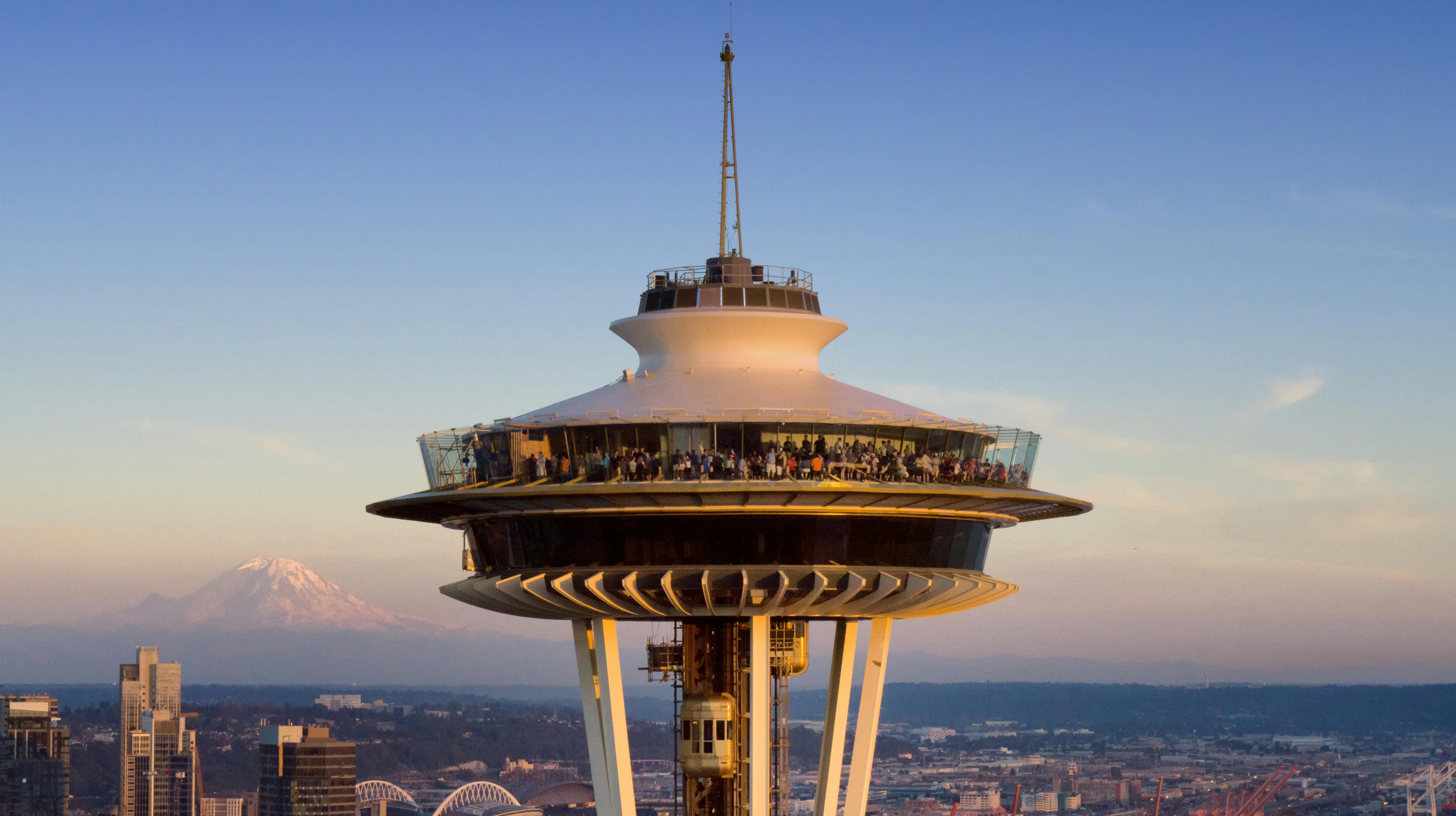
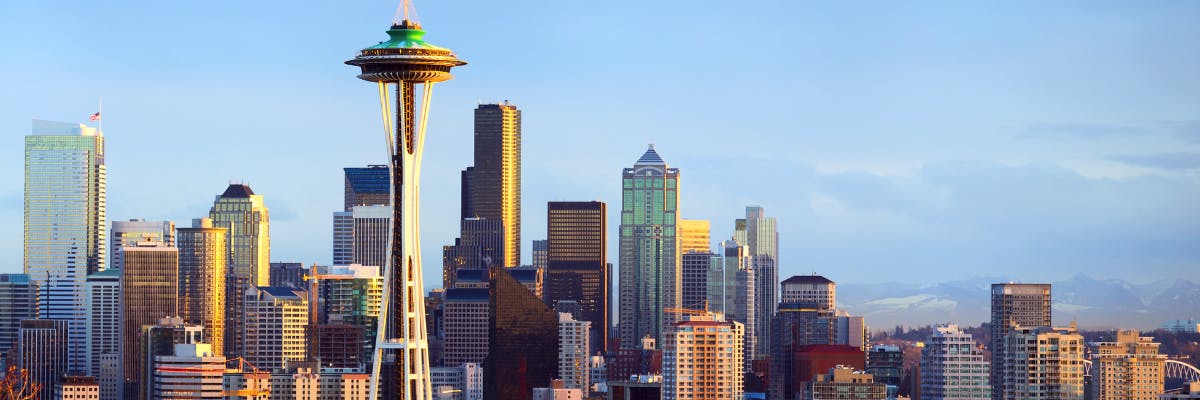
The Space Needle is Seattle’s most recognisable landmark and one of the defining symbols of the Pacific Northwest. Rising above Seattle Center, the futuristic tower was built for the 1962 World’s Fair and continues to provide some of the best panoramic views in the city.
At 605 feet tall, the Space Needle offers two main observation levels, including an outdoor viewing deck at 520 feet and The Loupe, the world’s first and only revolving glass floor, at 500 feet.
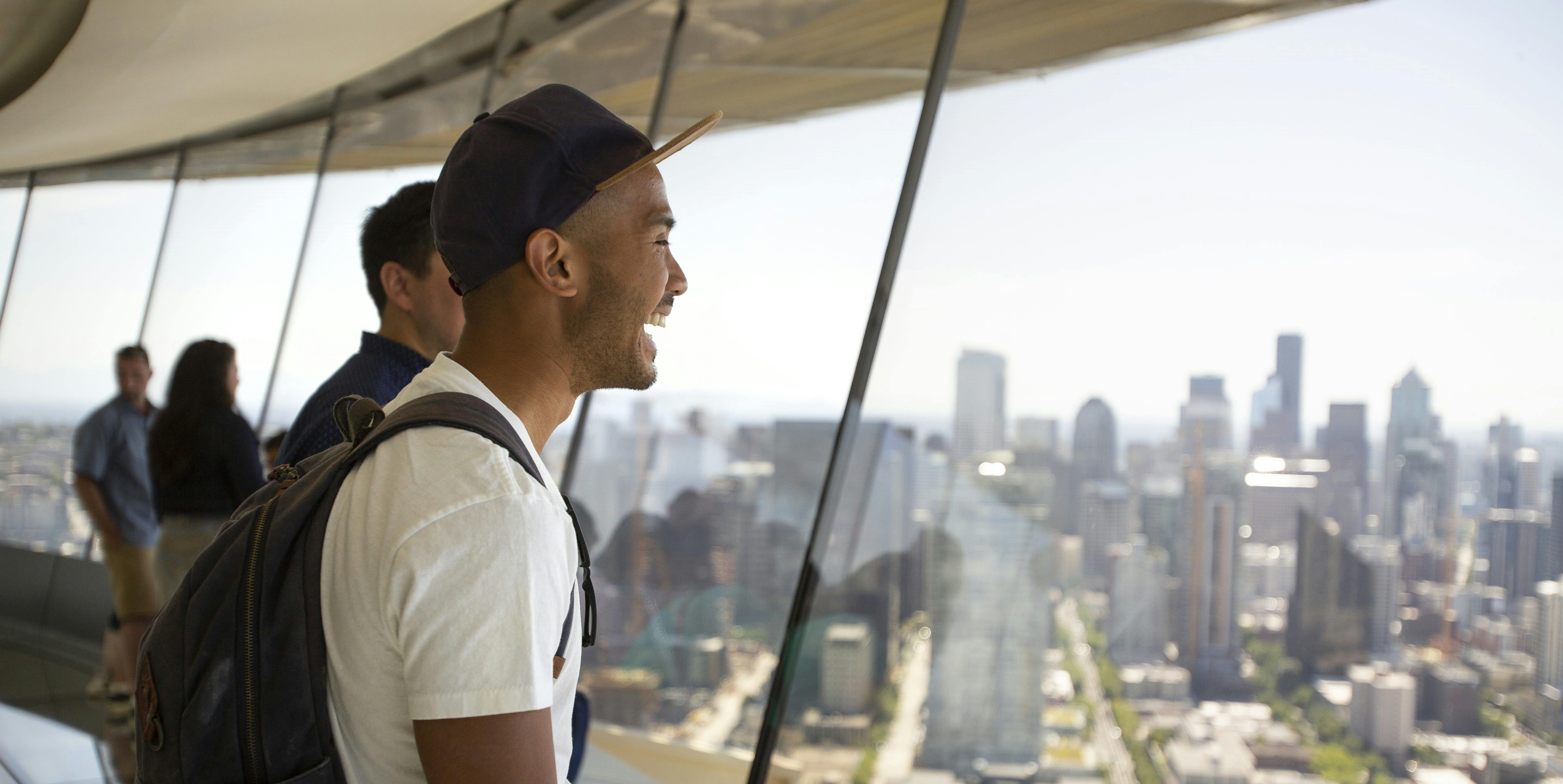
On a clear day, visitors can see across downtown Seattle, Puget Sound, Lake Union, the Olympic Mountains, the Cascade Range and potentially Mount Rainier rising dramatically in the distance.
The Space Needle sits within Seattle Center, making it extremely easy to combine with Chihuly Garden and Glass, the Museum of Pop Culture, the International Fountain and other nearby attractions.
Seattle Space Needle at a Glance
Visitor Information
Details
Location
Seattle Center, Seattle, Washington
Address
400 Broad Street, Seattle, WA 98109
Height
605 feet / approximately 184 metres
Opened
21 April 1962
Upper observation level
520 feet / approximately 158 metres
The Loupe glass floor
500 feet / approximately 152 metres
2026 general admission
US$35–US$55 depending on date and time
Space Needle + Chihuly combo
US$74
Children aged 4 and under
Free
Recommended visit
1–2 hours
Best time
Late afternoon through sunset
Best nearby attractions
Chihuly Garden and Glass and Museum of Pop Culture
Why Was the Space Needle Built?
The Space Needle was created as the architectural centrepiece of the 1962 Seattle World’s Fair, officially known as the Century 21 Exposition.
The fair’s theme was “The Age of Space”, reflecting the enormous international excitement surrounding science, technology and space exploration during the early 1960s.
Seattle hotel executive Edward E. Carlson helped organise the fair and conceived the idea for a tower after seeing a broadcast tower during a trip to Stuttgart, Germany, in 1959.
He sketched his initial idea on a napkin.
That rough drawing eventually evolved into the futuristic tower that now defines Seattle’s skyline.
The Space Needle Is 605 Feet Tall
The finished Space Needle rises 605 feet above Seattle.
The saucer-shaped top house sits around 520 feet above ground and contains the primary observation areas.
When it opened on 21 April 1962, the tower perfectly captured the Space Age optimism of the period.
More than six decades later, its unusual shape still appears surprisingly futuristic.
Ride the Glass Skyliner Elevator
The journey to the observation level has become part of the attraction itself.
The Space Needle’s new Skyliner elevator opened in 2025 as part of the tower’s long-term elevator modernisation project.
It is described by the Space Needle as the first all-glass, double-deck outdoor elevator in North America and the first of its kind on a tower anywhere in the world.
The elevator travels at speeds of up to approximately 10 miles per hour and reaches the observation level in about 41 seconds.
The floor-to-ceiling glass allows views of Seattle to expand dramatically as you climb.
The 520-Foot Observation Deck
The main observation level sits approximately 520 feet above Seattle.
Visitors can move between indoor viewing areas and an open-air deck surrounded by large glass panels.
The modern design provides almost uninterrupted 360-degree views.
Depending on the weather, you may be able to see:
Downtown Seattle
Puget Sound
Lake Union
Mount Rainier
The Cascade Mountains
The Olympic Mountains
Elliott Bay
Seattle’s waterfront
Seattle’s changeable weather means the view can be completely different from one day to another.
Try the Skyriser Glass Benches
One of the more unusual features of the outdoor observation deck is the series of Skyriser glass benches.
These transparent benches are attached to outward-leaning glass walls.
You sit facing into the observation deck while leaning backwards towards the Seattle skyline, creating the impression that you are suspended above the city.
They are particularly popular for photographs.
If heights make you uncomfortable, you can enjoy the same panorama without using them.
The Loupe: The Revolving Glass Floor
The most distinctive modern feature of the Space Needle is The Loupe.
Located at approximately 500 feet above ground, it is the world’s first and only revolving glass floor.
Rather than looking only across the skyline, you can look directly downward through the floor at the Space Needle’s steel structure and the city far below.
The floor rotates slowly using a mechanical system powered by multiple motors.
You can even see parts of the mechanism through the glass.
Is the Glass Floor Safe?
Yes.
The Loupe was engineered specifically for heavy visitor use.
The rotating floor contains multiple layers of structural glass and weighs approximately 37 tons.
The glass system was designed with substantial safety redundancy and load capacity.
Of course, knowing this does not necessarily stop your brain from reacting when you first step onto transparent glass 500 feet above the ground.
The Oculus Staircase
The upper observation level and The Loupe are connected by the dramatic Oculus Staircase.
The circular staircase incorporates wood, steel and glass.
At its base is another transparent section allowing visitors to look directly down through the structure of the Space Needle.
Take your time rather than simply treating the staircase as a route between floors.
It has become an architectural feature in its own right.
The Space Needle’s Major Renovation
The Space Needle underwent its most extensive renovation beginning in 2017.
Known as the Century Project, the privately funded redevelopment transformed the viewing experience while retaining the tower’s historic architectural character.
Major changes included:
Floor-to-ceiling glass
New outdoor glass barriers
Skyriser glass benches
The Oculus Staircase
The Loupe revolving glass floor
Structural and seismic improvements
Modernised elevators
The renovation used more than 176 tons of glass.
Is There Still a Revolving Restaurant?
No.
This is worth knowing because many older Seattle travel guides still mention the Space Needle’s revolving restaurant.
The former SkyCity Restaurant closed in September 2017 as part of the major renovation.
There is currently no traditional full-service revolving restaurant at the Space Needle.
However, there are several food and drink options within the observation levels.
The Revolving Bar
A walk-up bar operates on The Loupe level, allowing visitors to enjoy a drink while standing above the revolving glass floor.
Offerings can include cocktails, local beer and wine.
The combination of a slowly moving floor and panoramic Seattle views makes this considerably more unusual than an ordinary observation-deck bar.
TipTop Cafe
The upper observation level contains the TipTop Cafe.
It provides a more casual option for snacks, drinks and desserts without requiring a separate restaurant reservation.
If your main priority is the view rather than a full meal, this can be a convenient way to stay at the top longer.
The Loupe Lounge
The Loupe Lounge operates seasonally and offers a more substantial food-and-drink experience on the revolving glass floor.
The Space Needle currently states that the lounge normally operates between fall and spring.
If this experience interests you, check whether it is operating during your visit rather than assuming it is available year-round.
Current 2026 Space Needle Ticket Prices
Space Needle admission uses variable pricing.
Current general admission prices range from approximately:
US$35 to US$55 per person
The exact amount depends on the date, season and time of day.
Sunset and other popular times can cost more.
Discounts are available for:
Youth aged 5–12
Seniors aged 65 and over
Qualifying military visitors
King County residents
Some groups and special programmes
Children aged four and under enter free.
Space Needle and Chihuly Combination Ticket
One of the best-value options for many visitors is the combination ticket covering:
Space Needle
Chihuly Garden and Glass
IMAX at the Center
The current combination ticket costs approximately US$74.
The attractions are only steps apart, making this one of Seattle’s easiest sightseeing combinations.
Should You Buy Tickets in Advance?
Yes, particularly if you want a specific time.
The Space Needle uses timed entry.
Current admission slots are scheduled at regular intervals throughout the day.
Tickets can be purchased:
Online
By mobile device
At the on-site ticket office
At self-service kiosks
Visitors who buy in advance generally save time, while same-day walk-up tickets are subject to availability and possible waits.
How Long Can You Stay?
Your ticket gives you a scheduled arrival time, but it does not limit you to a short visit once you reach the observation levels.
After entering, you can remain on the upper observation level and The Loupe until the Space Needle closes for the day.
This is particularly useful for sunset visits because you can arrive while it is still daylight and remain until after the city lights appear.
How Long Should You Allow?
45–60 Minutes
Enough for a relatively quick visit to both observation levels.
1–1½ Hours
Best for most visitors.
This provides enough time for the views, Skyrisers, glass floor, photographs and a drink or snack.
2 Hours or More
Worthwhile if you arrive before sunset and want to watch Seattle change from daylight to night.
What Is the Best Time to Visit the Space Needle?
Morning
Best for potentially clearer visibility and smaller crowds.
Morning can be particularly attractive if Mount Rainier and the surrounding mountains are your priority.
Afternoon
A convenient option if you are spending the rest of the day exploring Seattle Center.
Sunset
Arguably the best overall experience.
Book an entry time before sunset and you may be able to see Seattle in daylight, watch the sky change colour and then remain as the downtown skyline begins to illuminate.
Sunset is popular, so advance reservations are particularly worthwhile.
Night
The experience becomes completely different after dark.
Instead of mountain views, the focus shifts towards the lights of downtown Seattle, surrounding neighbourhoods and traffic moving through the city.
What Happens if the Weather Is Cloudy?
Seattle weather can be unpredictable.
Cloud, rain and mist occasionally reduce the long-distance views significantly.
If Mount Rainier is completely hidden, you can still enjoy:
Downtown skyline views
The revolving glass floor
The Skyriser benches
The architecture of the tower
The nearby Seattle Center campus
If the weather forecast is flexible and panoramic views are your main priority, choose the clearest day available during your Seattle stay.
Mount Rainier From the Space Needle
On a clear day, Mount Rainier is one of the great highlights of the view.
The enormous volcano rises southeast of Seattle and can appear to tower above the surrounding landscape when atmospheric conditions are good.
It is much farther away than photographs sometimes make it appear, and cloud often hides it completely.
Seattle locals sometimes describe a particularly clear day by saying, “The mountain is out.”
Chihuly Garden and Glass
If you visit only one other attraction at Seattle Center, make it Chihuly Garden and Glass.
The exhibition celebrates the work of Washington-born glass artist Dale Chihuly.
It contains:
Eight galleries
Large-scale glass installations
The spectacular Glasshouse
An outdoor garden incorporating colourful glass artworks
The entrance is only steps from the Space Needle.
Current 2026 standard admission is approximately US$40–US$45, while the combination ticket with the Space Needle and IMAX costs US$74.
Museum of Pop Culture
The Museum of Pop Culture, or MOPOP, stands almost directly beside the Space Needle.
Its unusual flowing building was designed by architect Frank Gehry and is itself worth seeing from the outside.
Inside, exhibitions explore subjects including:
Popular music
Film
Science fiction
Fantasy
Horror
Video games
Contemporary popular culture
MOPOP currently opens daily and is located at 325 Fifth Avenue North within Seattle Center.
International Fountain
The International Fountain is another surviving feature of the 1962 World’s Fair.
It sits within a large open lawn area at Seattle Center and provides an easy free attraction between museum visits.
The fountain was originally designed around themes of space exploration, matching the futuristic spirit of the World’s Fair.
Climate Pledge Arena
Climate Pledge Arena is also part of Seattle Center.
The building incorporates the historic roofline of the arena originally constructed for the 1962 World’s Fair while containing an extensively redeveloped modern venue beneath it.
Today it hosts major concerts and sporting events.
If an event is taking place on the evening of your Space Needle visit, expect Seattle Center and surrounding restaurants to become considerably busier.
A Good Half-Day at Seattle Center
9:00 am – Space Needle
Begin with the tower while conditions may be clearer and crowds lighter.
10:30 am – Chihuly Garden and Glass
Allow approximately 1½ hours.
Noon – Seattle Center Armory
Stop for lunch at one of the food outlets inside the Armory.
1:00 pm – Museum of Pop Culture
Spend the afternoon exploring MOPOP.
This itinerary allows you to experience three very different Seattle attractions without needing a car or public transport between them.
A Good Sunset Visit
Another excellent approach is to spend your morning around downtown Seattle and return to Seattle Center later.
Afternoon – Chihuly Garden and Glass
Explore the galleries and garden.
Early Evening – Dinner or Drink
Have a meal around Seattle Center or Uptown.
Before Sunset – Space Needle
Enter approximately 45–60 minutes before sunset.
Enjoy the views during daylight and remain as the city changes after dark.
This is one of the best ways to experience the Space Needle.
How to Reach the Space Needle
The Space Needle is located at:
400 Broad Street
Seattle, WA 98109
It sits within Seattle Center, north of the main downtown commercial district.
Seattle Center Monorail
One of the easiest and most enjoyable ways to reach the Space Needle from downtown is the Seattle Center Monorail.
The monorail connects:
Westlake Center in downtown Seattle → Seattle Center
The journey takes less than two minutes.
The Seattle Center station is immediately beside the Space Needle and MOPOP.
The monorail is particularly useful if you are staying around downtown, Pike Place Market or Westlake.
Current 2026 Monorail Hours
During the current summer operating period through early September 2026, the normal schedule is:
Monday–Friday: 7:30 am–11:00 pm
Saturday–Sunday: 8:30 am–11:00 pm
Hours are frequently extended for concerts and sporting events at Seattle Center.
From after Labor Day through the following spring, the regular timetable becomes shorter on some weekdays and Sundays.
Walking From Downtown
You can also walk to the Space Needle from central Seattle.
From the Westlake and northern downtown area, the walk is relatively straightforward.
If you are staying around Pike Place Market, allow roughly 20–30 minutes depending on your route and walking pace.
The monorail is faster, but walking gives you a better sense of Seattle’s neighbourhoods.
Driving and Parking
Parking garages and paid parking areas are available around Seattle Center, but a car is unnecessary if you are already staying downtown.
Traffic can become heavier when Climate Pledge Arena hosts a major event.
If your hotel is centrally located, walking or using the monorail is often easier than driving and paying for parking.
Accessibility
The Space Needle has made significant improvements to accessibility through its renovation.
Current facilities include lifts providing access to both the upper observation level and revolving glass-floor level.
Mobility scooters are permitted.
Because the tower is a historic structure, not every individual area has identical accessibility, so visitors with specific requirements may wish to check arrangements before arrival.
Can You Bring a Stroller?
Strollers cannot be taken through the main Space Needle visitor experience because of limited elevator space.
They need to be left in the designated stroller area or elsewhere before entry.
Infant car seats are permitted.
Can You Take Photographs?
Yes.
Photography is strongly encouraged.
The Space Needle also includes complimentary digital photo experiences with general admission.
Current admission includes professional-style digital photo opportunities such as welcome photographs and high-level selfies.
Can You Bring a Water Bottle?
Plastic and metal water bottles are allowed.
Glass containers are prohibited.
Water-bottle filling stations are available at the top.
Where to Stay Near the Space Needle
Uptown / Lower Queen Anne
Best for being closest to the Space Needle.
Stay here if you want to walk to:
Space Needle
Chihuly Garden and Glass
MOPOP
Climate Pledge Arena
Seattle Center
The area has numerous restaurants and is particularly convenient if you are attending a concert or sporting event.
Belltown
Best compromise between Seattle Center and downtown.
Belltown lies between the Space Needle and Pike Place Market.
Staying here allows you to walk in either direction and gives easy access to restaurants and nightlife.
Downtown / Westlake
Best for first-time visitors.
This area provides easy access to:
Seattle Center Monorail
Pike Place Market
Seattle waterfront
Downtown shopping
Light rail
The monorail makes reaching the Space Needle particularly easy.
Pike Place Market Area
Best for classic Seattle atmosphere.
Staying close to Pike Place Market places you near the waterfront while keeping Seattle Center within walking or monorail distance.
This is one of the strongest locations for travellers visiting Seattle for the first time.
Space Needle for Cruise Passengers
The Space Needle is particularly convenient for visitors arriving on an Alaska cruise because Seattle’s cruise terminals are relatively close to Seattle Center.
Passengers using Pier 66 are especially well positioned for downtown sightseeing.
If you have several hours before embarkation or after disembarking, the Space Needle can easily be combined with Chihuly Garden and Glass.
However, allow plenty of time for luggage storage, transport and returning to your ship.
Space Needle or Columbia Center?
Seattle has other high-level viewpoints, but the Space Needle provides something different.
The main advantage is that you are visiting an internationally recognised landmark rather than simply observing Seattle from a tall building.
The Space Needle also provides:
Outdoor viewing
The Loupe revolving glass floor
Skyriser glass benches
A glass elevator experience
Direct access to Seattle Center attractions
If panoramic height alone is your priority, other viewpoints may compete with it.
If you want the classic Seattle experience, the Space Needle remains the obvious choice.
Is the Space Needle Worth Visiting?
Yes, particularly on a clear day.
The Space Needle is undeniably one of Seattle’s major tourist attractions, but its appeal goes beyond simply checking off a famous landmark.
The 2017–2018 renovation transformed the old observation deck into a much more interesting experience, adding enormous glass walls, leaning glass benches and the extraordinary revolving glass floor.
You can now move between a 520-foot indoor and outdoor observation level and The Loupe at 500 feet, while looking across Puget Sound, downtown Seattle and the surrounding mountain ranges.
For the best first visit, book your timed ticket in advance and aim for late afternoon or approximately an hour before sunset.
If the weather is clear, you can see the city and mountains in daylight, watch the sky change colour and stay until Seattle begins illuminating below you.
Allow around 1–1½ hours for the Space Needle itself.
Then take advantage of its location. Chihuly Garden and Glass is immediately beside the tower, MOPOP is only steps away and the Seattle Center Monorail can return you to downtown in less than two minutes.
That combination makes the Space Needle much more than an isolated observation tower. It sits at the centre of one of Seattle’s easiest and most enjoyable sightseeing districts.
Sponsored Popular Items
Quick take: Musement.com offers a worldwide selection of tours and attractions
Seattle Space Needle and Chihuly Garden and Glass Combo Ticket United States Combine panoramic views from Seattle's Space Needle with the colourful glass installations of Chihuly Garden and Glass. Check current availability, inclusions and booking details before you go.
Seattle Space Needle tickets United States Plan Seattle Space Needle tickets, a water-based experience, with practical tips on timing, inclusions and what to check before booking. Compare current availability, prices and booking conditions before you go.
Seattle's Space Needle Area Self-Guided Walking Tour - Wellness Experience Seattle's Space Needle Area Self-Guided Walking Tour combines independent exploration with recorded commentary, allowing travellers to discover Seattle at their own pace. Check current availability, inclusions and booking details before you go.
Screen Print a Dublin Landmark - Creative Workshop Best deals for Screen Print a Dublin Landmark - Creative Workshop. Step into the world of printmaking with JANDO to screen print your own Dublin Landmark. These 2-hour sessions are beginner-friendly, hands-on & everyone leaves with a handcrafted masterpiece souvenir. Available from getyourguide.com.
Krabi: Ao Nang Landmark Stadium Muay Thai Entry Ticket Thailand Witness thrilling Muay Thai fights at Ao Nang Landmark Stadium. Experience authentic Thai martial arts, cultural traditions, and exciting live competition in Krabi
Gourmet Tour and Landmark Exploration in Izmir – Guided Tour Gourmet Tour and Landmark Exploration in Izmir is a convenient way to add structure, local context and purposeful sightseeing to the itinerary. Check current availability, inclusions and booking details before you go.