Paphos Archaeological Park, Cyprus: Discover Magnificent Roman Mosaics and Ancient Mediterranean Treasures
Imagine wandering through an extraordinary ancient city overlooking the sparkling blue Mediterranean Sea, where magnificent Roman villas, beautifully preserved mosaic floors and fascinating archaeological ruins reveal stories stretching back more than 2,000 years.
Welcome to the spectacular Paphos Archaeological Park in Cyprus, one of the Mediterranean’s most remarkable historical treasures and an unforgettable destination for travellers fascinated by ancient civilisations, Greek mythology and beautiful coastal scenery.
Situated beside the picturesque harbour of Kato Paphos, this extraordinary UNESCO World Heritage attraction offers visitors the opportunity to walk through the remains of a once-thriving ancient city.
Here, breathtaking Roman mosaics depict legendary gods and heroes, ancient theatres recall centuries of entertainment, and the ruins of impressive villas reveal the luxurious lifestyles of wealthy inhabitants.
From the magnificent House of Dionysos to the fascinating House of Theseus, every corner of this remarkable archaeological park holds another exciting discovery.
Whether you’re exploring Cyprus for the first time, enjoying a relaxing Mediterranean holiday or searching for fascinating cultural experiences, Paphos Archaeological Park deserves a place near the top of your travel itinerary.
What Is Paphos Archaeological Park?
Paphos Archaeological Park, also known as the Archaeological Park of Kato Paphos or Nea Paphos Archaeological Park, is an extensive archaeological site containing the remains of an important ancient city on the southwestern coast of Cyprus.
The site includes monuments dating from the fourth century BC through the Roman, Byzantine and medieval periods.
Its greatest treasures are the extraordinarily preserved mosaic floors discovered within the remains of luxurious Roman residences.
These magnificent artworks, created using thousands of tiny pieces of coloured stone, depict elaborate scenes from Greek mythology, including gods, heroes, legendary creatures and dramatic adventures.
The quality, beauty and remarkable preservation of these mosaics have made Paphos one of the most important archaeological destinations in the eastern Mediterranean.
In 1980, Paphos was inscribed on the UNESCO World Heritage List, recognising its exceptional cultural and archaeological importance.
Today, the park allows visitors to explore a fascinating landscape of Roman villas, ancient public buildings, historic fortifications and early Christian remains, all set against the beautiful Mediterranean coastline.
Where Is Paphos Archaeological Park?
Paphos Archaeological Park is located in Kato Paphos, Cyprus, near the city’s picturesque harbour and waterfront promenade.
Location: Kato Paphos, Paphos, Cyprus.
Main Entrance: Near Paphos Harbour, close to the harbour bus station and waterfront area.
Nearest Major Airport: Paphos International Airport.
Getting There: The park is within easy walking distance of many hotels, restaurants and attractions in the Kato Paphos harbour area.
Visitors staying farther away can reach the harbour by public bus, taxi or rental car.
The convenient coastal location makes it easy to combine an archaeological visit with a relaxing stroll along the harbour or a delicious meal overlooking the Mediterranean Sea.
The story of Paphos Archaeological Park begins more than two millennia ago, during a remarkable period of Greek cultural influence in the eastern Mediterranean.
The ancient city of Nea Paphos, meaning New Paphos, was established towards the end of the fourth century BC.
Its development is traditionally associated with Nicocles, the last king of Palaepaphos, who transferred the city’s centre from the older settlement near modern Kouklia to the new coastal location.
With its sheltered harbour and strategic position along Mediterranean trading routes, Nea Paphos developed into an important commercial and administrative centre.
During the Hellenistic period, the city became increasingly prosperous, benefiting from connections with the wider Greek-speaking world.
Paphos Becomes the Capital of Roman Cyprus
When Cyprus came under Roman control, Paphos continued to flourish.
The city served as the administrative capital of Cyprus for centuries, developing impressive public buildings, luxurious private residences and sophisticated urban infrastructure.
Wealthy inhabitants commissioned magnificent homes decorated with elaborate mosaics, reflecting their prosperity and appreciation of classical art and mythology.
These remarkable residences are among the greatest treasures visitors can discover today.
The Roman period also brought important changes in religion, government and daily life.
The city eventually became associated with the spread of Christianity, adding another fascinating chapter to its extraordinary history.
Earthquakes, Changing Empires and Rediscovery
Over the centuries, earthquakes and political changes dramatically affected the fortunes of ancient Paphos.
Some magnificent Roman buildings were damaged or abandoned, while new structures and settlements developed during the Byzantine and medieval periods.
Eventually, parts of the ancient city disappeared beneath layers of soil and debris.
Modern archaeological excavations brought its extraordinary treasures back into view.
One of the most exciting discoveries came in 1962, when the remarkable mosaics of the House of Dionysos were uncovered during construction-related work.
Subsequent excavations revealed an exceptional collection of Roman villas, public monuments and archaeological remains.
Today, ongoing research and conservation efforts continue to deepen our understanding of this remarkable ancient city.
What to See at Paphos Archaeological Park
Paphos Archaeological Park is filled with extraordinary historical treasures.
From beautiful Roman mosaics to ancient theatres and imposing medieval ruins, there’s plenty to discover during your visit.
Here are the highlights you shouldn’t miss.
1. House of Dionysos: Marvel at Extraordinary Roman Mosaics
One of the absolute highlights of Paphos Archaeological Park is the magnificent House of Dionysos.
This extraordinary Roman residence takes its name from Dionysos, the Greek god of wine, celebration and theatre, who features in several of the house’s beautiful mosaic decorations.
The residence dates largely from the second century AD and occupied an area of approximately 2,000 square metres.
More than 500 square metres of its floors were decorated with intricate mosaics, demonstrating the wealth and sophisticated artistic tastes of its inhabitants.
Imagine walking through the rooms of this luxurious Roman home, where every beautifully decorated floor told a fascinating mythological story.
Among the extraordinary mosaic scenes are depictions of Dionysos, mythological adventures, hunting scenes and beautifully arranged decorative patterns.
The skill involved in creating these artworks is astonishing.
Thousands of tiny coloured stones were carefully arranged to create detailed figures, expressive faces and elaborate scenes that remain impressive nearly two millennia later.
Don’t miss: Spend time examining the intricate details of the mosaics. The extraordinary craftsmanship and storytelling make the House of Dionysos one of the finest attractions in Cyprus.
2. House of Theseus: Discover the Legendary Battle with the Minotaur
Another spectacular attraction within the archaeological park is the enormous House of Theseus.
This impressive Roman villa is believed to have served as the residence of a high-ranking official during the Roman period.
The extensive complex contained more than 100 rooms arranged around a large central courtyard, reflecting the luxurious lifestyle enjoyed by its inhabitants.
Its most celebrated feature is a magnificent mosaic depicting the legendary Greek hero Theseus confronting the terrifying Minotaur.
According to ancient Greek mythology, the Minotaur was a fearsome creature with the body of a man and the head of a bull.
It lived inside a labyrinth on the island of Crete, where it was eventually defeated by Theseus.
The mosaic captures this famous mythological story in extraordinary detail.
Look closely at the beautiful arrangement of coloured stones and the dramatic composition of the figures.
It’s a wonderful opportunity to discover how Roman artists transformed Greek mythology into spectacular decorative artworks.
The remains of the enormous villa also reveal fascinating details about Roman domestic architecture, including courtyards, living quarters and bathing facilities.
3. House of Aion: Discover Some of the Most Beautiful Mosaics in Cyprus
The House of Aion is another extraordinary attraction that deserves special attention.
Although smaller than some of the other Roman residences, it contains some of the most sophisticated and beautifully preserved mosaic artwork in the archaeological park.
Its magnificent fourth-century AD mosaics depict a series of elaborate mythological scenes.
Among the fascinating subjects are the birth and celebration of Dionysos, Leda and the Swan, the beauty contest involving Cassiopeia and the Nereids, and the dramatic story of Apollo and Marsyas.
The artwork is remarkable for its vivid colours, expressive figures and intricate decorative details.
These mosaics demonstrate the extraordinary sophistication of Roman-era artists working in Cyprus.
For visitors who appreciate ancient art, the House of Aion is an absolute treasure.
Photography tip: Where photography is permitted, capture the details of individual mythological scenes as well as the overall mosaic compositions.
4. House of Orpheus: Explore the Magical World of Greek Mythology
The House of Orpheus is another fascinating Roman residence within the archaeological park.
Its name comes from an elaborate mosaic depicting Orpheus, the legendary musician of Greek mythology.
According to ancient stories, Orpheus possessed such extraordinary musical talent that his melodies could charm wild animals, move trees and even influence the gods.
The mosaic portrays Orpheus with his musical instrument, surrounded by animals captivated by his music.
Other mosaic scenes discovered in the house depict mythological subjects, including Heracles and the Nemean Lion.
The residence provides another wonderful glimpse into the artistic tastes and cultural traditions of wealthy inhabitants of Roman Cyprus.
Access to individual mosaic areas may vary depending on conservation and archaeological work.
5. Ancient Odeon: Step Inside a Roman Theatre
One of the most atmospheric places within Paphos Archaeological Park is the beautiful Ancient Odeon.
This impressive stone theatre dates largely from the Roman period and once provided a venue for musical performances, theatrical entertainment and public gatherings.
Its semicircular seating arrangement offers a fascinating insight into the social and cultural life of ancient Paphos.
Imagine audiences gathering beneath the Mediterranean sky to enjoy music, dramatic performances and celebrations.
The Odeon has undergone restoration and has also served as a venue for modern cultural performances.
Today, visitors can admire its elegant stone seating and appreciate the impressive engineering involved in creating public entertainment spaces nearly 2,000 years ago.
6. Ancient Agora: Discover the Heart of Roman Public Life
The Ancient Agora of Nea Paphos was the city’s central public square and an important gathering place during the Roman period.
Surrounded by impressive colonnades and public buildings, it played an essential role in civic and commercial life.
Here, residents could conduct business, meet friends, exchange news and participate in public activities.
Although much of the original architecture survives only as archaeological remains, the site’s layout helps visitors imagine the enormous public space that once formed the heart of the ancient city.
It provides a fascinating glimpse into Roman urban planning and the importance of public gathering places in Mediterranean society.
7. Asklepieion: Discover an Ancient Sanctuary of Healing
Another fascinating feature of the archaeological park is the Asklepieion, a sanctuary associated with Asclepius, the ancient Greek god of medicine and healing.
In ancient Greece and Rome, sanctuaries dedicated to Asclepius were important religious centres where worshippers sought divine assistance with health and wellbeing.
The remains at Paphos reveal another aspect of ancient religious and community life.
Imagine visitors arriving at the sanctuary to offer prayers, seek healing or participate in ceremonies dedicated to the god of medicine.
The surviving architectural remains offer a fascinating connection with the history of medicine, religion and healing traditions in the ancient Mediterranean world.
8. Saranta Kolones Castle: Explore the Ruins of a Medieval Fortress
Paphos Archaeological Park isn’t exclusively about Greek and Roman history.
It also contains the impressive remains of Saranta Kolones Castle, a medieval fortress whose name means Forty Columns.
The castle was constructed during the Byzantine period to help defend the strategically important harbour and surrounding settlement.
Its name refers to the numerous granite columns associated with the structure.
The fortress was later rebuilt and modified before being devastated by an earthquake in 1223.
Today, visitors can explore the surviving walls, arches and foundations of this fascinating medieval stronghold.
Its dramatic ruins provide a wonderful contrast to the elegant mosaics and Roman buildings elsewhere in the archaeological park.
9. Panagia Limeniotissa Basilica: Discover Early Christian Paphos
The archaeological park also contains the remains of Panagia Limeniotissa Basilica, an early Christian church dating from approximately the fifth century AD.
Its name refers to the Virgin Mary as Our Lady of the Harbour, reflecting its connection with the nearby coastal settlement.
The surviving foundations and architectural remains reveal the importance of Christianity during the Byzantine period.
Fragments of decorative flooring and other archaeological features help visitors imagine the beauty of the original religious building.
The basilica provides a fascinating reminder that Paphos continued to evolve long after the Roman Empire’s classical period.
Standing near the archaeological remains is the attractive Paphos Lighthouse, a distinctive landmark overlooking the Mediterranean coastline.
Constructed in 1888 during the British colonial period, the lighthouse adds another fascinating chapter to the area’s long maritime history.
Although it is much younger than the surrounding archaeological monuments, its location provides wonderful coastal scenery.
From nearby permitted pathways, visitors can enjoy views across the sparkling Mediterranean Sea and appreciate the beautiful setting of ancient Paphos.
The combination of archaeological ruins, coastal landscapes and the historic lighthouse creates wonderful photographic opportunities.
Why Are the Paphos Roman Mosaics So Special?
The extraordinary Roman mosaics are undoubtedly the greatest treasures of Paphos Archaeological Park.
They are regarded as some of the finest surviving mosaic artworks in the eastern Mediterranean.
What makes them particularly remarkable is the exceptional combination of artistic sophistication, fascinating storytelling and preservation.
Each mosaic was created from thousands of tiny pieces of coloured stone, known as tesserae.
Skilled craftspeople arranged these pieces to create elaborate images depicting gods, heroes, animals, hunting scenes and decorative patterns.
Many of the scenes were inspired by Greek mythology, demonstrating how classical Greek traditions continued to influence art and culture during the Roman period.
The mosaics also reveal the extraordinary wealth of some of the city’s inhabitants.
Decorating entire rooms with intricate stone artworks required enormous resources, artistic expertise and considerable labour.
Today, these magnificent floors allow visitors to appreciate the luxurious surroundings enjoyed by wealthy residents of Roman Paphos.
They also provide a fascinating opportunity to discover stories that captivated audiences thousands of years ago.
Why Is Paphos Archaeological Park a UNESCO World Heritage Site?
In 1980, Paphos was added to the UNESCO World Heritage List because of its outstanding cultural and historical significance.
The wider UNESCO-listed property includes archaeological remains in Kato Paphos and the ancient sanctuary area of Palaepaphos near Kouklia.
These locations preserve extraordinary evidence of ancient religious traditions, architecture, urban development and artistic achievement.
The remarkable Roman mosaics are among the most celebrated archaeological discoveries associated with the designation.
The wider Paphos region is also closely connected with the ancient worship of Aphrodite, the Greek goddess of love and beauty.
For travellers, this UNESCO recognition highlights the extraordinary importance of protecting and appreciating the archaeological heritage of Cyprus.
Paphos Archaeological Park Tickets and Opening Hours
Paphos Archaeological Park is managed by the Department of Antiquities of Cyprus and is open to visitors throughout the year, apart from certain public holidays.
Visitor Information
Details
Attraction
Paphos Archaeological Park
Location
Kato Paphos, Cyprus
Standard Admission
€4.50
16 April–15 September
8:30 am–7:30 pm
16 September–15 April
8:30 am–5:00 pm
Opening Days
Daily, subject to public holiday closures
Recommended Visit
2–3 hours, or longer for detailed exploration
Accessibility
Partially wheelchair accessible
Contact Telephone
+357 26 306 217
Nearby Attraction
Paphos Harbour
The park is normally closed on Christmas Day, New Year’s Day and Orthodox Easter Sunday.
Additional admission: The nearby Tombs of the Kings archaeological site requires a separate ticket, currently listed at €2.50.
Multi-site passes: Visitors exploring several archaeological attractions in Cyprus may wish to investigate Department of Antiquities entry cards. Published options include one-day, three-day and seven-day passes.
Important: Ticket prices, opening hours and monument access arrangements may change without notice. Conservation work can occasionally affect access to individual houses and mosaic displays.
Paphos is a wonderful destination throughout the year, but choosing the right season can make exploring the archaeological park even more enjoyable.
Spring: Beautiful Weather and Wonderful Scenery
Spring is one of the loveliest seasons to discover the archaeological treasures of Paphos.
Temperatures are generally pleasant, wildflowers may brighten the surrounding countryside, and the Mediterranean sunshine creates wonderful conditions for sightseeing.
It’s an excellent season for exploring the extensive archaeological grounds without the intense heat of midsummer.
Summer: Brilliant Sunshine and Mediterranean Atmosphere
Summer brings beautiful blue skies, warm Mediterranean weather and a lively holiday atmosphere to Paphos.
However, temperatures can become very high during July and August.
Much of the archaeological park is exposed to the sun, so visiting early in the morning or later in the afternoon is strongly recommended.
Bring drinking water, sunscreen, sunglasses and a comfortable hat.
Autumn: A Fantastic Time for Cultural Exploration
Autumn offers another wonderful opportunity to discover Paphos Archaeological Park.
The weather often remains pleasantly warm, while the intense heat of summer begins to ease.
It’s a lovely season for combining archaeological sightseeing with relaxed walks along the waterfront.
Winter: Discover a More Peaceful Side of Cyprus
Winter can offer a quieter and more relaxed experience.
Although occasional rain is possible, Cyprus often enjoys relatively mild winter conditions compared with many European destinations.
The archaeological park remains an excellent destination for visitors interested in history and culture.
Remember that winter opening hours are shorter than during the summer months.
Insider Tips for Visiting Paphos Archaeological Park
Allow plenty of time: The archaeological park covers a large area, so allow at least two to three hours to appreciate its most important attractions.
Don’t miss the mosaics: The Houses of Dionysos, Theseus and Aion contain some of the park’s most spectacular treasures.
Visit early in summer: Morning temperatures are generally more comfortable for exploring the exposed archaeological grounds.
Wear comfortable walking shoes: Many pathways are uneven and some areas contain rough archaeological surfaces.
Bring drinking water: Shade can be limited across large sections of the park.
Use sun protection: A hat, sunscreen and sunglasses are particularly important during warmer months.
Look closely at the mythological scenes: Understanding the stories of Dionysos, Theseus and Orpheus makes the mosaics even more fascinating.
Consider the official audio guide: Additional explanations can make the history and significance of the ruins easier to appreciate.
Bring a camera: The mosaics, ancient theatre, archaeological ruins and Mediterranean views provide wonderful photographic opportunities.
Check current access arrangements: Individual monuments may occasionally be closed for archaeological research or conservation.
Combine your visit with the harbour: Paphos Harbour is ideal for enjoying a relaxing meal or waterfront stroll after exploring the park.
Other Wonderful Attractions Near Paphos Archaeological Park
One of the greatest advantages of visiting the archaeological park is its wonderful location near the charming harbour and historic attractions of Paphos.
Several fascinating destinations are within easy reach, making it simple to enjoy a full day of sightseeing.
Paphos Harbour
Just moments from the archaeological park, the picturesque Paphos Harbour is one of the most attractive places to visit in the city.
Fishing boats, waterfront restaurants, lively cafés and beautiful Mediterranean views create a wonderfully relaxed atmosphere.
It’s a fantastic place to enjoy fresh seafood or traditional Cypriot cuisine after exploring the ancient ruins.
Paphos Castle
Standing proudly at the western end of the harbour, Paphos Castle is one of the city’s most recognisable historic landmarks.
The fortress has experienced several transformations during Byzantine, medieval, Venetian and Ottoman periods.
Today, its impressive stone walls and beautiful harbour setting make it a fascinating attraction.
Tombs of the Kings
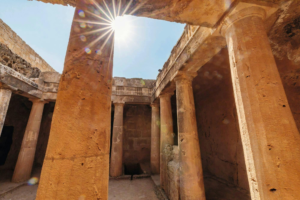
Another extraordinary archaeological treasure is the Tombs of the Kings, located approximately two kilometres north of Kato Paphos Harbour.
This magnificent ancient necropolis features elaborate underground tombs carved directly into the rock.
Some contain impressive courtyards surrounded by stone columns, creating an extraordinary architectural spectacle.
Despite the royal-sounding name, the tombs were associated with high-ranking officials and wealthy individuals rather than actual kings.
The site forms part of the wider UNESCO World Heritage property of Paphos and requires separate admission.
Agia Kyriaki Chrysopolitissa and Saint Paul’s Pillar
Discover another fascinating chapter of Cypriot history at the beautiful Agia Kyriaki Chrysopolitissa archaeological complex.
The site contains the remains of an impressive early Christian basilica and the historic church of Agia Kyriaki.
It is also associated with Saint Paul’s Pillar, where local religious tradition holds that the apostle was punished during his visit to Cyprus.
The combination of ancient Christian remains, beautiful architecture and religious history makes this a rewarding cultural attraction.
Paphos Old Town
For a wonderful contrast to the ancient archaeological sites, explore the charming streets of Paphos Old Town.
Discover traditional markets, colourful street art, interesting boutiques and welcoming cafés.
The area offers an appealing combination of local culture, historic architecture and contemporary Cypriot life.
Coral Bay
If you’re looking to combine cultural exploration with a little relaxation, the beautiful sandy beach at Coral Bay is a wonderful destination.
Located a short drive north of Paphos, this popular coastal area offers golden sand, clear Mediterranean waters and attractive seaside scenery.
It’s a lovely place to unwind after spending time exploring the region’s fascinating archaeological treasures.
Aphrodite’s Rock
One of Cyprus’s most famous natural landmarks is Aphrodite’s Rock, also known as Petra tou Romiou.
According to Greek mythology, the goddess Aphrodite emerged from the sea near this dramatic coastal location.
The beautiful rock formations and sweeping Mediterranean views make it one of the most romantic and photogenic places in Cyprus.
Located approximately 25 kilometres southeast of Paphos, it’s a wonderful destination for a scenic drive.
Make a Day of It: Ancient Ruins, Mediterranean Views and Delicious Cypriot Food
Why not turn your visit to Paphos Archaeological Park into an unforgettable day discovering the history, culture and beautiful coastal atmosphere of Cyprus?
Begin your morning at the archaeological park, where you can explore magnificent Roman villas and discover the extraordinary mosaics of Dionysos, Theseus and Aion.
Take your time admiring the intricate details of the ancient artworks and imagining the luxurious homes that once occupied the site.
Continue towards the Ancient Odeon and Agora, where the surviving monuments reveal the public and cultural life of Roman Paphos.
Explore the atmospheric ruins of Saranta Kolones Castle and enjoy beautiful views towards the Mediterranean coastline.
When lunchtime arrives, head towards nearby Paphos Harbour.
Find a welcoming waterfront restaurant and enjoy some of Cyprus’s delicious traditional cuisine.
Imagine relaxing over grilled halloumi, fresh seafood, souvlaki, traditional meze or a refreshing Cypriot salad while watching fishing boats gently bobbing in the harbour.
After lunch, visit the historic Paphos Castle or explore the nearby Agia Kyriaki Chrysopolitissa complex.
If you have additional time and energy, continue towards the remarkable Tombs of the Kings for another extraordinary archaeological experience.
Finish your day with a leisurely stroll along the waterfront as the Mediterranean sunlight begins to soften.
It’s a wonderful way to combine remarkable ancient history, beautiful scenery, delicious food and the welcoming atmosphere of Cyprus.
Is Paphos Archaeological Park Worth Visiting?
Absolutely!
Paphos Archaeological Park is one of the most remarkable cultural attractions in Cyprus and a genuine highlight of any Mediterranean holiday.
Its extraordinary Roman mosaics are among the finest surviving examples in the eastern Mediterranean, while its ancient villas, public buildings and medieval ruins offer fascinating insights into the city’s long history.
What makes the park especially memorable is the opportunity to explore the remains of an entire ancient urban landscape rather than a single monument.
Here, you can discover luxurious Roman residences, admire beautiful artwork, explore an ancient theatre and enjoy spectacular coastal scenery.
Its UNESCO World Heritage recognition reflects the exceptional historical importance of the site.
Whether you’re passionate about archaeology, interested in Greek mythology, travelling with family or simply curious about the ancient world, this extraordinary attraction offers a rich and rewarding experience.
Frequently Asked Questions About Paphos Archaeological Park
Is Paphos Archaeological Park a UNESCO World Heritage Site?
Yes. Paphos was inscribed on the UNESCO World Heritage List in 1980. The wider World Heritage property includes the ancient remains at Kato Paphos and the sanctuary area of Palaepaphos near Kouklia.
How much does it cost to enter Paphos Archaeological Park?
The published standard admission price is €4.50 per person. Prices can change, so visitors should check the official Cyprus tourism website before travelling.
How long should you spend at Paphos Archaeological Park?
Allow approximately two to three hours to explore the main attractions. Visitors with a particular interest in archaeology, ancient art or photography may prefer to spend longer.
What is the most famous attraction in the park?
The magnificent Roman mosaics are the park’s most celebrated treasures, particularly those found in the Houses of Dionysos, Theseus and Aion.
Can you see the Tombs of the Kings with the same ticket?
No. The Tombs of the Kings are located at a separate archaeological site and normally require an additional admission ticket.
Is Paphos Archaeological Park suitable for children?
Yes. Children interested in mythology, ancient civilisations and exploring historic ruins may find the park particularly fascinating. Families should bring suitable footwear, drinking water and sun protection.
Is the park wheelchair accessible?
The archaeological park is partially accessible to wheelchair users. Some paths and monument areas have uneven surfaces or restricted access. Visitors with mobility requirements should check current facilities before arrival.
What is the best time of day to visit?
Early morning is particularly appealing during warmer months because temperatures are generally more comfortable. Late afternoon can also offer attractive lighting for photography, provided sufficient time remains before closing.
Final Thoughts: Discover the Extraordinary Ancient Treasures of Paphos
Cyprus is an island celebrated for its beautiful beaches, welcoming atmosphere, delicious cuisine and fascinating cultural heritage.
Yet few attractions capture the extraordinary history of the island quite like Paphos Archaeological Park.
Here, beside the sparkling Mediterranean Sea, the remains of an ancient city reveal remarkable stories of Greek mythology, Roman luxury, religious traditions and centuries of cultural transformation.
From the breathtaking mosaics of the House of Dionysos to the dramatic mythological scenes of the House of Theseus, every discovery brings the ancient world vividly to life.
Explore the impressive Odeon, wander among the ruins of the Ancient Agora and imagine the bustling city that once flourished along this beautiful coastline.
Whether you’re visiting Paphos for a relaxing seaside holiday or exploring the cultural wonders of Cyprus, this magnificent archaeological park deserves a prominent place on your itinerary.
Come for the extraordinary Roman mosaics, stay for the fascinating history and beautiful Mediterranean scenery, and leave with unforgettable memories of one of Cyprus’s greatest cultural treasures.
Paphos Archaeological Park isn’t simply a collection of ancient ruins. It’s a remarkable journey through thousands of years of Mediterranean history, waiting to be discovered.
Sponsored Popular Items
Quick take: Musement.com offers a worldwide selection of tours and attractions
Centro Palacio Mediterranean Creative Rices Workshop Centro Palacio Mediterranean Creative Rices Workshop is an individual GetYourGuide-listed activity associated with Madrid, Spain. Spain’s capital combines world-class art museums, royal architecture, flamenco performances and lively tapas neighbourhoods. Excursions into central Spain visit medieval cities such as Toledo, Segovia and Ávila. The listing focuses…
Ancient Kourion tour with Paphos Harbour visit Book here to tour Paphos from Ayia Napa. Visit Aphrodite’s Rock, ancient Paphos and the Tombs of the Kings, then enjoy free time in the Paphos harbour area.