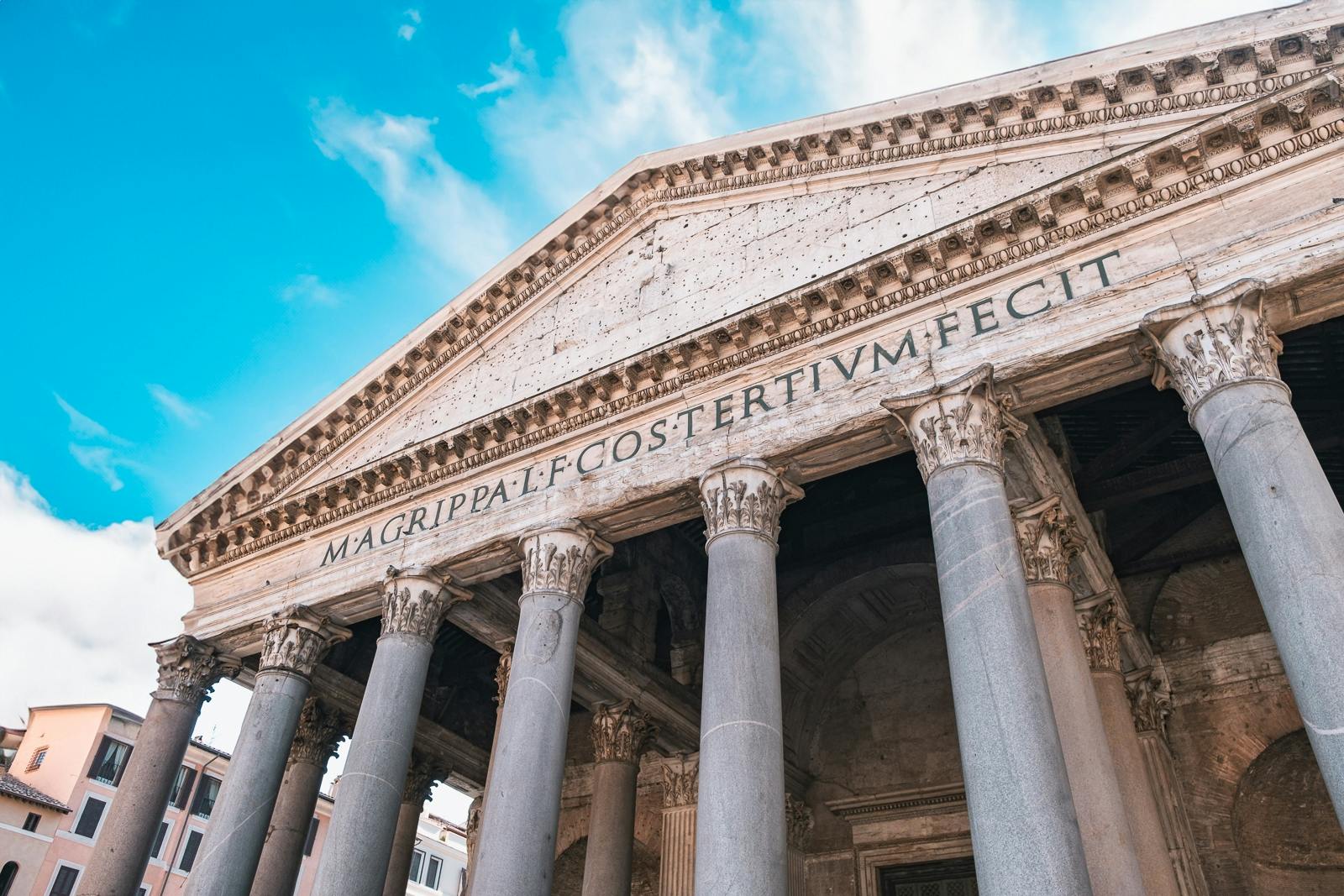
The Pantheon in Rome is one of the best-preserved buildings to survive from the ancient Roman world and one of the most remarkable pieces of architecture anywhere in Italy.
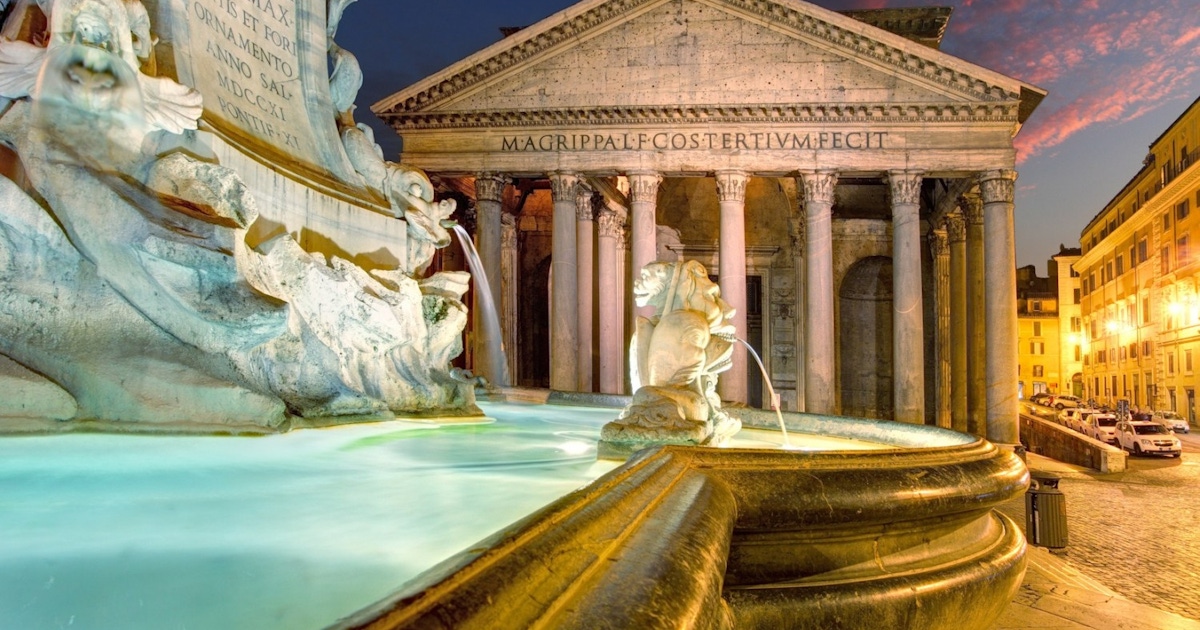
Standing in Piazza della Rotonda in Rome’s historic centre, the Pantheon appears relatively conventional from the front, with an enormous classical portico supported by granite Corinthian columns. Walk through its ancient bronze doors, however, and you enter a vast circular space covered by a concrete dome more than 43 metres across.
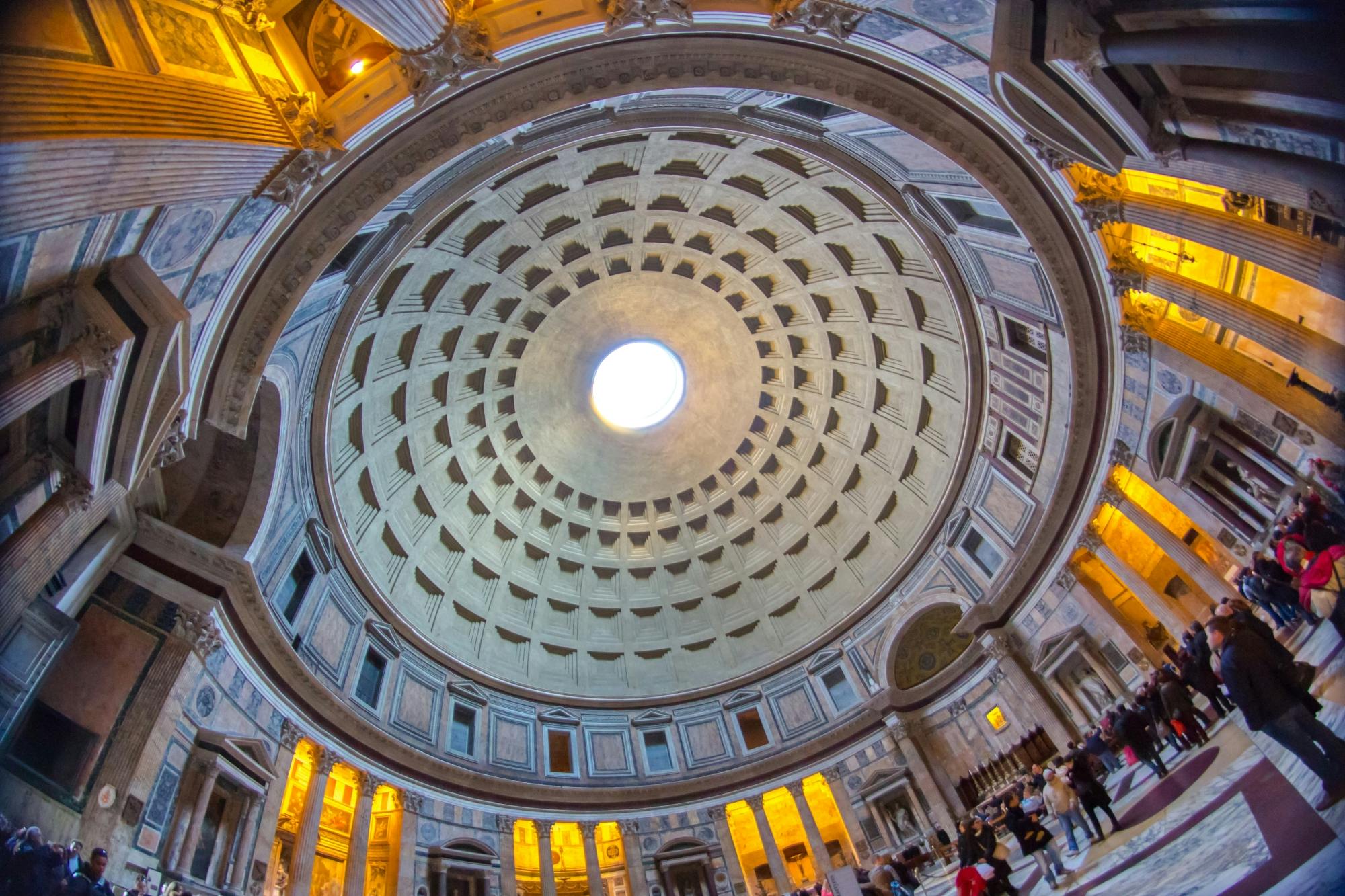
At the centre of that dome is the famous oculus, an opening almost nine metres wide that provides the principal source of natural light inside the building.
The Pantheon began as a Roman temple and has functioned as a Christian church since AD 609. That continuous use is one of the main reasons it survived when many other monumental buildings of ancient Rome were dismantled or fell into ruin.
Pantheon Rome at a Glance
Visitor Information
Details
Location
Piazza della Rotonda, Rome
Original temple
Commissioned by Marcus Agrippa in 27 BC
Present building
Mainly reconstructed under Emperor Hadrian between AD 118 and 125
Current use
Basilica of Santa Maria ad Martyres
Dome diameter
Just over 43 metres
Oculus diameter
8.92 metres
2026 adult admission
€7
Reduced admission
€2 for eligible EU citizens aged 18–25
Opening hours
Daily 9:00 am–7:00 pm
Last individual admission
6:30 pm
Recommended visit
45–60 minutes
Best for
Roman history, architecture, art and photography
A Temple That Has Survived for Nearly 2,000 Years
The history of the Pantheon begins in 27 BC, when Marcus Vipsanius Agrippa, an important military commander, statesman and son-in-law of Emperor Augustus, commissioned a temple on the site.
The original building did not survive in its initial form.
The structure seen today is principally the result of a major rebuilding undertaken during the reign of Emperor Hadrian between approximately AD 118 and 125.
Despite Hadrian’s reconstruction, the famous inscription across the front continued to honour Agrippa.
What Does the Inscription Mean?
Across the front of the Pantheon you will see the enormous inscription:
M·AGRIPPA·L·F·COS·TERTIVM·FECIT
It refers to Marcus Agrippa and essentially records that he built the original temple while serving as consul for the third time.
Many first-time visitors therefore understandably assume that the complete building dates from Agrippa’s period. In reality, most of the surviving monument belongs to the later reconstruction under Hadrian.
The Pantheon Became a Christian Church
A crucial moment in the building’s survival came in AD 609.
Byzantine Emperor Phocas gave the Pantheon to Pope Boniface IV, who consecrated it as the Christian church of Santa Maria ad Martyres.
The Pantheon remains a functioning Catholic church today.
This distinguishes it from many of Rome’s other ancient monuments. You are not simply entering an archaeological site; you are visiting a building that has continued to serve a religious function for more than 1,400 years.
The Extraordinary Pantheon Dome
The great dome is the feature that makes the Pantheon an engineering masterpiece.
The internal diameter is just over 43 metres, while the interior height from the floor to the top of the dome is also approximately 43 metres.
The proportions mean that a perfect imaginary sphere could fit within the interior rotunda.
Even after almost two millennia, the dome remains one of the great achievements of Roman concrete construction.
Look Up at the Coffered Ceiling
The interior of the dome is divided into enormous recessed panels known as coffers.
There are five concentric rings containing 28 coffers in each ring.
The coffering provides a striking visual pattern while also reducing the amount of material required within the dome.
As your eyes move upward, the structure appears to become progressively lighter until everything converges on the open circle of the oculus.
The Oculus
The circular opening in the centre of the dome is known as the oculus.
It measures approximately 8.92 metres across.
There is no glass covering it.
The opening is genuinely open to the sky.
Sunlight therefore moves around the walls and floor of the Pantheon as the position of the sun changes throughout the day.
The effect can be extraordinary when a clearly defined beam of sunlight enters through the opening and illuminates part of the interior.
What Happens When It Rains?
Rain comes through the oculus.
The Romans expected this and designed the building accordingly.
The floor contains a drainage system incorporating 22 drainage holes that allows rainwater entering through the dome to escape.
If you happen to visit Rome during rain, seeing water entering an almost 2,000-year-old Roman building through its open roof can actually make the visit more memorable.
Look at the Floor
Do not spend the entire visit looking upward.
The geometric marble floor is an important part of the architecture.
Circles and squares appear repeatedly throughout the interior design, reinforcing the remarkable geometric order of the building.
The coloured stone and marble also provide an impression of how richly decorated monumental Roman interiors could be.
Raphael’s Tomb
The Pantheon is also the burial place of Raphael, one of the greatest artists of the Italian Renaissance.
Raphael died in Rome in 1520 at only 37 years of age and was buried inside the Pantheon.
His tomb is one of the most important features to look for around the edge of the rotunda.
Visitors interested in Renaissance Rome sometimes overlook this because the building itself is so overwhelmingly associated with antiquity.
The Tombs of the Kings of Italy
The Pantheon later became associated with the modern Italian state.
Following Italian unification, it became a memorial location for members of the royal House of Savoy.
Among those buried here are:
Victor Emmanuel II, the first king of a unified Italy
Umberto I
Queen Margherita of Savoy
Their tombs add another historical layer to a building that had already existed for more than 1,600 years before the creation of modern Italy.
The Pantheon Is Still a Church
The official name is the Basilica of Santa Maria ad Martyres.
Religious celebrations continue to take place inside, and opening hours or tourist access can therefore change when services are being held.
Visitors should behave as they would when entering any functioning Catholic church.
Appropriate clothing is required, including covered shoulders and knees.
Current 2026 Pantheon Ticket Price
The standard admission price changed during 2026.
From 1 July 2026, the full adult ticket increased from €5 to:
€7 per person
The standard reduced ticket remains:
€2
The reduced rate applies to eligible European Union citizens between the ages of 18 and 25.
Who Can Enter the Pantheon Free?
Current free-admission categories include:
Visitors under 18
Residents of the Municipality of Rome
Visitors qualifying under other statutory Italian cultural-site exemptions
The Pantheon also participates in Italy’s first Sunday of the month free-admission programme.
On these Sundays, admission is free, but the monument can become particularly busy.
Current Opening Hours
The Pantheon currently opens:
Daily from 9:00 am to 7:00 pm
The ticket office closes at 6:00 pm.
The normal last admission for individual visitors is 6:30 pm.
Opening times may change because of religious services, special events and major holidays.
Should You Book Pantheon Tickets in Advance?
Yes, particularly during busy periods.
The Pantheon is one of the most visited monuments in central Rome, and queues can become substantial.
Advance admission is particularly sensible:
At weekends
During Easter
During summer
During major Rome events
If you have a tightly scheduled sightseeing day
Official tickets can be purchased through the Italian state museum ticketing system.
Be careful when searching online because numerous third-party websites sell Pantheon tickets bundled with audio guides or tours at substantially higher prices than the basic €7 admission charge.
How Long Do You Need at the Pantheon?
30 Minutes
Enough for a quick visit if your time in Rome is limited.
You can see the dome, oculus, main chapels and important tombs without reading everything in detail.
45–60 Minutes
Best for most first-time visitors.
This gives you time to examine the architecture, watch the changing light from the oculus and look properly at Raphael’s tomb and the royal memorials.
More Than One Hour
Worthwhile for visitors with a serious interest in Roman architecture, engineering or church history.
Beyond the Pantheon: A Special 2026 Experience
Visitors during 2026 also have access to a special experience known as Oltre il Pantheon – Beyond the Pantheon.
The route explores previously inaccessible spaces connected with the Basilica of Neptune behind the Pantheon’s rotunda.
The experience incorporates:
Archaeological remains
Historic marble fragments
Frescoes
Architectural reconstructions
3D models
Video mapping
Displays explaining the Roman and Christian phases of the Pantheon
The current programme is scheduled to operate until 31 December 2026, with visits offered in both Italian and English at selected times.
A new internal lift has also made this special route accessible to visitors with mobility difficulties.
Best Time of Day to Visit
Opening Time
Best for avoiding the largest crowds.
Arriving close to 9:00 am also leaves the rest of your day free for nearby attractions.
Late Morning
This can produce beautiful effects as sunlight moves through the oculus, although visitor numbers are normally higher.
Late Afternoon
A late-afternoon visit can work well if you have spent the day exploring central Rome and want to finish around Piazza della Rotonda.
Do not leave your arrival too close to the 6:30 pm last admission.
Visit Piazza della Rotonda
The Pantheon opens directly onto Piazza della Rotonda, one of central Rome’s most atmospheric squares.
In the centre stands the Fontana del Pantheon.
The fountain originated from a 1575 design by Giacomo della Porta and was subsequently modified. An ancient Egyptian obelisk associated with Pharaoh Ramses II was added to the fountain in the early 18th century.
Do not rush immediately into the Pantheon when you arrive.
Stand on the opposite side of the square first and look at the complete façade.
After your visit, return to the square and look back at the building again. Having seen the enormous circular interior, it becomes easier to appreciate how much of the rotunda is hidden behind the apparently conventional classical portico.
Combine the Pantheon With Piazza Navona
Piazza Navona is only a short walk from the Pantheon and makes an ideal next stop.
The piazza occupies the general footprint of the ancient Stadium of Domitian and is now one of Rome’s finest Baroque public spaces.
Its centrepiece is Bernini’s magnificent Fountain of the Four Rivers.
Combining the two attractions provides an excellent contrast between ancient Roman engineering at the Pantheon and the theatrical architecture and sculpture of Baroque Rome at Piazza Navona.
Combine the Pantheon With the Trevi Fountain
The Trevi Fountain is also within easy walking distance through the historic centre.
The route passes through narrow Roman streets filled with churches, cafés, palaces and small piazzas.
Trevi provides another striking contrast with the Pantheon. The Pantheon is dominated by the controlled geometry of ancient Roman architecture, while Trevi is a spectacular Baroque composition of water, sculpture and architecture.
How to Get to the Pantheon
The Pantheon is located at:
Piazza della Rotonda
00186 Rome
Italy
It lies directly within Rome’s historic centre.
There is no Metro station immediately beside the Pantheon, so most visitors reach it by walking or using a combination of public transport and walking.
If you are already sightseeing around Piazza Navona, Trevi Fountain or other central attractions, walking is usually the easiest option.
Driving is generally unnecessary and inconvenient because the surrounding historic streets are narrow and subject to traffic restrictions.
Where to Stay Near the Pantheon
Pantheon and Piazza Navona Area
Best for first-time visitors who want to walk almost everywhere.
Staying around the Pantheon places you within easy walking distance of many of central Rome’s major sights.
The area is particularly enjoyable in the evening, when day-trip crowds begin to decrease and the historic centre becomes more atmospheric.
The disadvantage is price. Accommodation in this extremely central part of Rome can be expensive.
Trevi and Spanish Steps Area
Best for combining sightseeing with shopping and easier access towards Metro Line A.
This area remains close enough to walk to the Pantheon while offering convenient access to other parts of Rome.
For a first visit to Rome, either location provides an excellent central base.
Is the Pantheon Suitable for Children?
Yes.
The Pantheon works surprisingly well with children because the visit does not need to be long.
Rather than expecting them to study every historical detail, draw their attention to:
The enormous dome
The open hole in the roof
Rain entering through the oculus
The ancient columns
The idea that the building has stood here for almost 2,000 years
The architecture itself usually communicates the scale of Roman engineering more effectively than a long explanation.
Accessibility
The main Pantheon visitor experience is at ground level, making it considerably easier to visit than many historic Roman attractions containing extensive staircases.
The newer Beyond the Pantheon route also includes an internal lift specifically intended to improve access for visitors with mobility difficulties.
Photography Inside the Pantheon
The interior is particularly rewarding for photography because the appearance changes throughout the day as light moves through the oculus.
Useful photographic subjects include:
The complete dome and oculus
The geometric marble floor
The Corinthian columns
The bronze entrance doors
The beam of sunlight entering through the dome
The view back towards Piazza della Rotonda
Remember that the Pantheon is an active church, so photography should never interfere with religious services or other visitors.
What Happens at the Pantheon on Pentecost?
One of the Pantheon’s most famous traditions occurs around Pentecost.
Rose petals are released through the enormous oculus and fall through the interior of the church.
The event attracts significant interest and is very different from an ordinary sightseeing visit, so anyone hoping to experience it should check the official religious and visitor arrangements well in advance.
What to Look for Before Leaving
Before walking out, stop near the centre of the rotunda and slowly look around the complete space.
Notice how carefully the architecture balances:
Circle and square
Light and shadow
Heavy concrete and apparently weightless space
Ancient Roman architecture and later Christian decoration
Then look directly upward through the oculus.
That view has remained fundamentally familiar to generations of people for nearly two millennia.
Is the Pantheon Worth Visiting?
Absolutely.
If you visit only a handful of ancient Roman buildings, the Pantheon should be one of them.
The Colosseum impresses through enormous scale and ruin. The Roman Forum requires imagination to reconstruct the city that once surrounded its surviving columns.
The Pantheon is different.
You can actually walk through the monumental entrance and stand inside an enormous Roman interior that remains roofed and in continuous use.
The dome measures more than 43 metres across, the open oculus remains its principal natural light source and the Roman drainage system still deals with rain entering through the roof.
The building also contains layers of later history, from its conversion into a Christian church in AD 609 to the tomb of Raphael and memorials to the kings of modern Italy.
For a first visit, allow approximately 45–60 minutes, book ahead during busy periods and arrive close to opening time if you want a quieter experience.
As of August 2026, standard admission is €7, the Pantheon normally opens daily from 9:00 am until 7:00 pm, and individual visitors can normally enter until 6:30 pm.
Most importantly, spend some time simply standing beneath the dome.
Almost 2,000 years after Hadrian’s architects created it, the Pantheon still has the ability to make visitors wonder how the Romans managed to build something so enormous, precise and enduring.
Sponsored Popular Items
Quick take: Musement.com offers a worldwide selection of tours and attractions
Pantheon Tickets & Guided Tours in Rome Italy Compare sightseeing experiences in Pantheon Tickets & Guided, with practical tips on timing, inclusions and choosing the right option. Check current availability, prices and booking conditions before you go.
Yogyakarta: The Art of Practical Gamelan Music Class Indonesia Immerse yourself in the rich culture of Yogyakarta with this practical guide designed especially for beginners. You will learn to recognize the beat, tune the feel and immediately try playing the instrument
Pantheon Fast Track Entry Ticket with Audio Guide - Attraction Entry Italy Visitors who prefer flexibility over a fixed group schedule may appreciate the self-guided format of Pantheon fast track entrance tickets with audio guide. Check current availability, inclusions and booking details before you go.