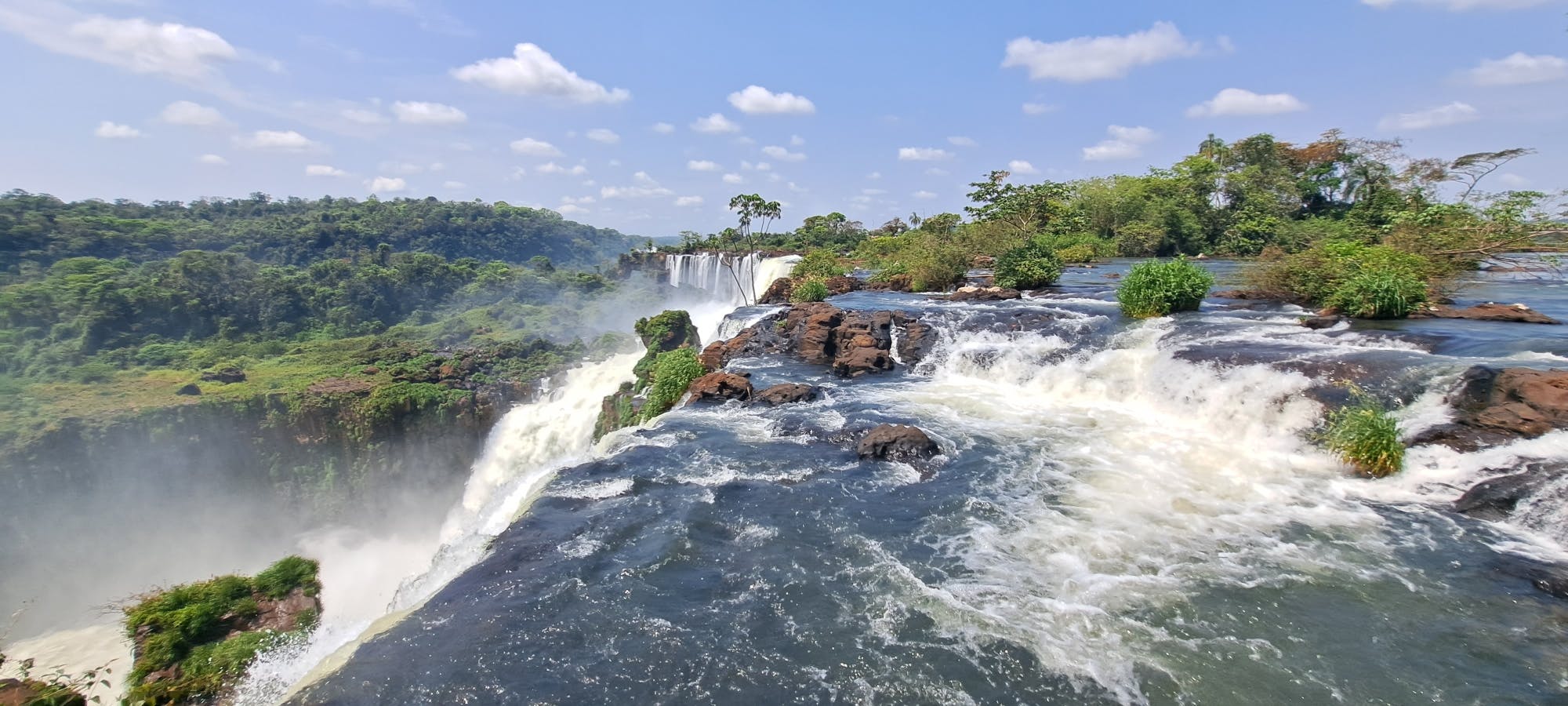
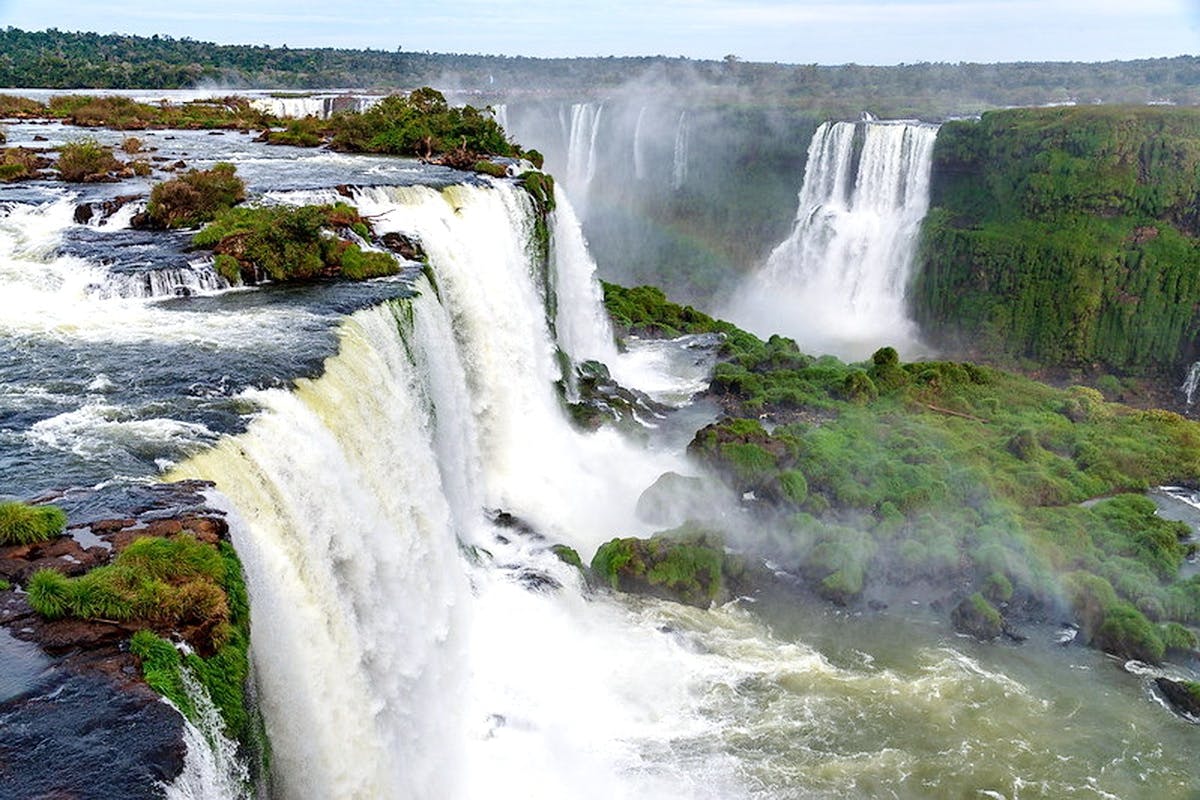
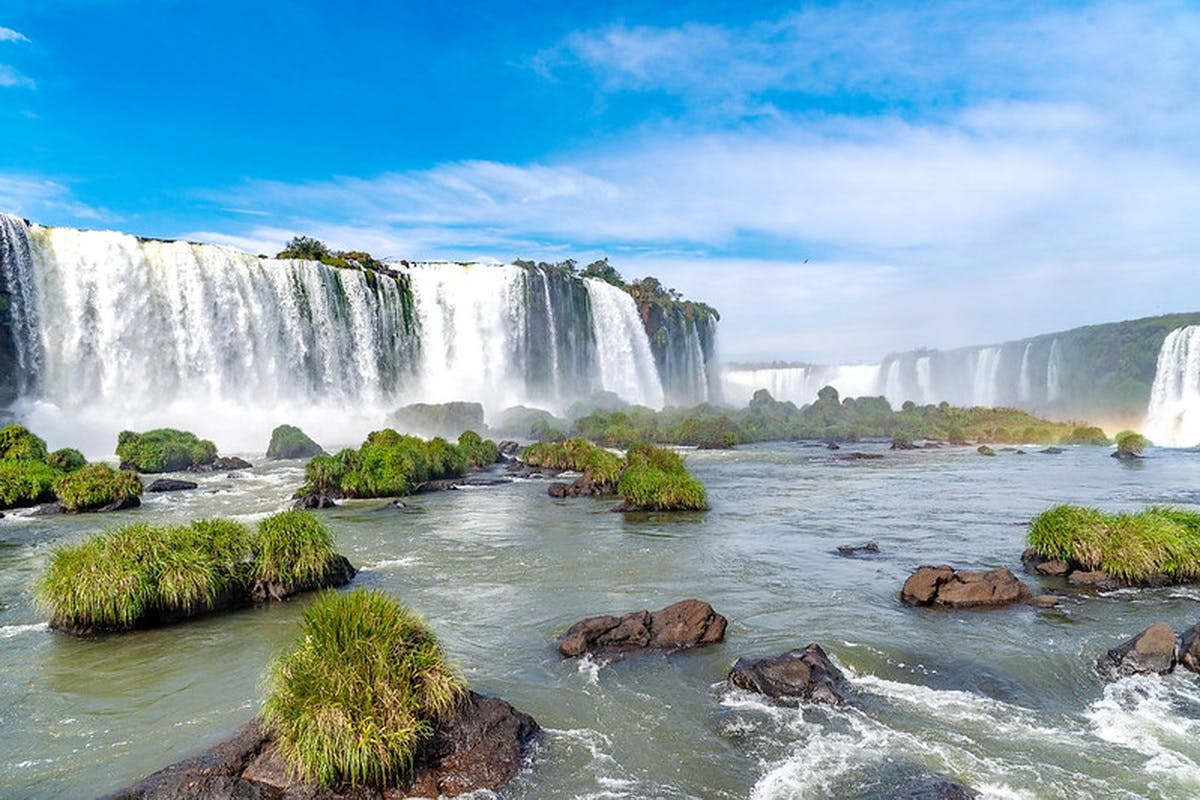
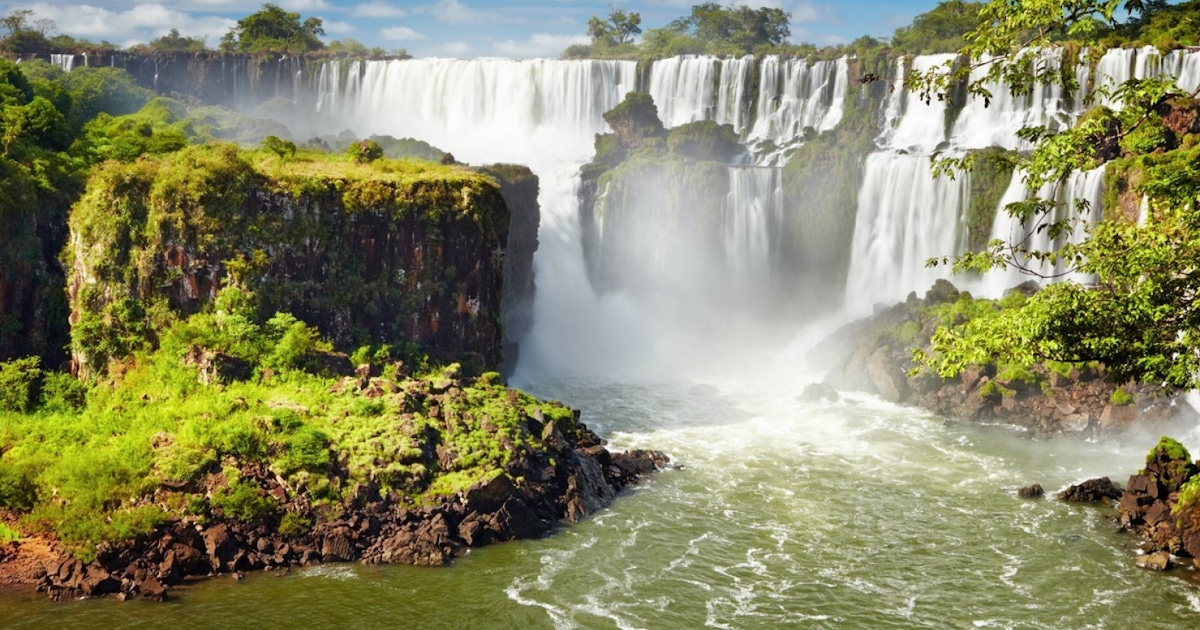
Iguazu Falls is one of South America’s great natural experiences: an immense system of waterfalls cutting through subtropical rainforest on the border between Argentina and Brazil. Rather than one single waterfall, Iguazu is a vast semicircular complex of cascades spread across roughly 2.7 kilometres, with major drops reaching about 80 metres.
The waterfalls are protected by two adjoining national parks: Iguazú National Park in Argentina and Iguaçu National Park in Brazil. Argentina’s park became a UNESCO World Heritage Site in 1984 and Brazil’s neighbouring park followed in 1986. Together they protect one of the most significant surviving areas of the Interior Atlantic Forest.
If your itinerary allows it, visit both countries. The experiences are genuinely different. Argentina provides the longer and more immersive visit, with extensive walkways taking you above and close to the waterfalls. Brazil provides the great panoramic view, allowing you to stand back and appreciate the extraordinary scale of the entire landscape.
Important August 2026 Devil’s Throat Update
As of 17 August 2026, the Argentine Circuito Garganta del Diablo is temporarily CLOSED. The official Iguazú Argentina visitor page currently states that the circuit has been closed preventively because of increased flow in the Iguazú River.
This is a temporary safety measure and can change quickly. The Argentine Upper and Lower Circuits remain separate attractions, so a visit to the Argentine park is still worthwhile even when the Devil’s Throat walkway is unavailable. Check the official circuit status immediately before travelling.
On the Brazilian side, the official park reported on 5 August 2026 that its main Cataratas walkway remained open for visitors and that conditions were being continually monitored. River conditions can change rapidly, so the same advice applies: verify the latest status before setting out.
Iguazu Falls at a Glance
Visitor Information
Details
Countries
Argentina and Brazil
Main gateway towns
Puerto Iguazú, Argentina and Foz do Iguaçu, Brazil
Waterfall frontage
About 2.7 km
Major drop height
Up to approximately 80 m
Commonly quoted number of cascades
About 275, varying with water conditions and definition
Argentina UNESCO status
1984
Brazil UNESCO status
1986
Argentina 2026 international admission
AR$60,000
Brazil 2026 international/full admission
R$134
Argentina visit
Allow most of a day
Brazil traditional visit
Approximately 2 hours
Recommended total stay
2 full days; 3 nights is comfortable
Best overall plan
One day Argentina + half to full day Brazil
Why Iguazu Falls Is So Impressive
The scale is difficult to appreciate from photographs. The Iguazú River reaches a broad basaltic escarpment and breaks into numerous channels, islands and cascades before plunging into the gorge below.
Official Argentine information commonly describes the system as containing approximately 275 separate falls, while UNESCO describes the main semicircular waterfall system as roughly 2,700 metres across and up to about 80 metres high.
The surrounding rainforest is equally important. UNESCO records more than 2,000 species of vascular plants and wildlife including tapirs, howler monkeys, ocelots, jaguars and caimans within the protected ecosystem.
Argentina or Brazil: Which Side Is Better?
The best answer is both.
The two sides are complementary rather than repetitive.
Argentina
Brazil
Longer visit
Shorter visit
Extensive walking circuits
Outstanding panoramic views
Walk above and close to numerous falls
Look across towards a broad wall of waterfalls
Eco-train inside the park
Internal park transport from visitor centre
Upper and Lower Circuits
Approximately 1 km traditional waterfall trail
Usually needs most of a day
Traditional experience approximately 2 hours
Best for exploring
Best for appreciating overall scale
If You Have Only One Day
If you must choose only one side, the decision depends on what you want from the experience.
Choose Argentina If:
You want the longest waterfall experience.
You enjoy walking.
You want several different viewpoints.
You want to move through the rainforest rather than simply view the falls from a distance.
You have most of the day available.
Choose Brazil If:
You have limited time.
You want the strongest overall panoramic view.
You prefer less walking.
You have reduced mobility.
You want to combine the falls with another Foz do Iguaçu activity.
Argentina: Parque Nacional Iguazú
The Argentine side provides the most extensive network of visitor trails and walkways.
Current admission includes access to the Upper Circuit, Lower Circuit, Green Trail, Ecological Train, Devil’s Throat Circuit when open, Macuco Trail and visitor facilities.
Iguazú National Park protects more than 67,000 hectares of the Selva Paranaense ecosystem in Misiones Province.
Argentina 2026 Admission Prices
Current official rates have applied since 1 June 2026.
Category
Current Admission
General / international visitor
AR$60,000
Argentine resident
AR$25,000
Misiones provincial resident
AR$8,000
Student qualifying for concession
AR$15,000
Children age 0–6
Free
Other exemptions apply to specified categories such as qualifying visitors with disabilities and certain Argentine resident groups. Bring appropriate documentation if claiming a concession.
50% Discount for a Second Argentine National Park Day
Argentina’s current National Parks tariff system provides a 50% reduction for a second visit under its applicable repeat-visit arrangements. This can make a second day particularly attractive if you want to explore Iguazú without rushing.
Confirm the validation procedure when buying the first ticket so that your return visit qualifies correctly.
Argentina Opening Hours
The Argentine Cataratas area is normally open:
Every day: 8:00 am–6:00 pm
including public holidays and rainy days.
General entry to the park is currently permitted until 4:00 pm. You should not arrive anywhere near that late if this is your first visit.
Arrive close to 8:00 am. There is enough to see that the Argentine side deserves most of the day.
The Ecological Jungle Train
The Tren Ecológico de la Selva connects the principal visitor areas inside the Argentine park and is included with admission.
The normal timetable currently begins with the first train at about 8:20 am. The final scheduled train towards the Devil’s Throat area is around 3:30 pm, although the Devil’s Throat circuit is currently closed because of river conditions.
Trains normally operate at intervals of roughly 30–40 minutes.
Do not assume the train is always the fastest option. The short Green Trail can be an enjoyable walking alternative between the main visitor services and Cataratas Station.
The Green Trail
Sendero Verde is a straightforward rainforest path connecting the service area with Cataratas Station.
Current details are:
Length: 650 metres one way
Walking time: approximately 15 minutes
Difficulty: low
Wheelchair accessibility: 100%
It is a pleasant way to begin the day and gives you a better feeling for the forest than spending every internal journey on the train.
The Upper Circuit
Circuito Superior provides broad views from above the waterfalls.
The newly expanded current route is approximately:
3.7 km return
About 90 minutes
Low difficulty
100% wheelchair accessible
The circuit provides viewpoints over falls including Dos Hermanas, Ramírez and Bossetti as well as wider panoramas over the San Martín area.
This is one of the best sections for photography because you look across and down onto the water rather than constantly standing within heavy spray.
The Lower Circuit
Circuito Inferior takes you closer to the base and sides of several cascades and consequently feels more physical and immersive.
Current official information gives:
Length: approximately 2.9 km return
Duration: around 90 minutes
Difficulty: medium
Wheelchair accessible: approximately 70%
Parts of the circuit involve steep stairs, although an adapted alternative path is available for some sections.
If you have enough mobility, do both the Upper and Lower Circuits. They present the same waterfall system from completely different levels.
Devil’s Throat – Garganta del Diablo
Garganta del Diablo, or Devil’s Throat, is the most powerful and famous section of Iguazu Falls.
The main drop is approximately 80 metres and funnels enormous volumes of water into a horseshoe-shaped gorge, producing a continuous cloud of spray.
Under normal conditions, the Argentine experience involves travelling towards Garganta Station and then following a long raised walkway across islands and channels of the upper Iguazú River until suddenly reaching the edge of the chasm.
The official circuit is approximately 2.2 km return and normally fully wheelchair accessible.
Current Devil’s Throat Closure
Do not plan your August 2026 itinerary assuming this circuit is open.
At the time of writing, the official operator marks it:
“CERRADO – Cierre preventivo por aumento del caudal del Río Iguazú.”
High water is part of the natural behaviour of Iguazu. Walkways on both sides can be temporarily restricted when river volume reaches safety thresholds.
Check again on the morning of your visit because conditions can improve or deteriorate quickly.
Macuco Trail
Visitors wanting more rainforest and fewer crowds can consider Sendero Macuco.
The current route is approximately:
7.6 km return
About 3 hours
Medium difficulty
Natural trail without normal visitor services
The trail finishes at Salto Arrechea, a 23-metre rainforest waterfall. Opening depends on weather and trail conditions and is decided by park rangers.
Do not add Macuco to a first one-day visit unless you are a keen walker and have already allowed enough time for the principal waterfall circuits.
Brazil: Parque Nacional do Iguaçu
The Brazilian side gives the great panoramic experience.
Instead of spending hours moving between numerous separate circuits, the traditional visit is more linear. Internal park transport takes visitors from the entrance area into the protected zone, after which a waterfall trail passes a succession of viewpoints before reaching the most dramatic section close to Devil’s Throat.
Brazil’s Iguaçu National Park covers approximately 169,696 hectares and has been a UNESCO World Heritage Site since 1986.
Brazil 2026 Admission Prices
Current official 2026 admission is:
Ticket
Current Price
Full / international admission
R$134
Brazil / Mercosur tariff
R$121
Local Community Pass
R$26
Children up to age 6
Free
The published R$134 full price includes R$131 admission plus a R$3 voluntary contribution to Fundo Iguaçu.
Book the Brazilian Side Ahead
The park strongly recommends purchasing tickets online and selecting your day and entry time when booking. Availability is controlled by time period, making advance booking particularly sensible during busy weekends and holiday seasons.
Brazil Opening Hours
Current normal opening times are:
Day
Current Entry Hours
Monday–Friday
9:00 am–4:00 pm
Saturday–Sunday
8:30 am–4:00 pm
Your booking time is an entry time rather than a compulsory exit time. Once admitted, visitors can currently remain inside until the park’s full closing time of approximately 5:30 pm.
What Is Included on the Brazilian Side?
Regular admission currently includes:
Internal transport between the Visitor Centre and waterfall area
Approximately 12 km of internal park transport each way
Access to the traditional Cataratas Trail
Approximately 1 km of waterfall walking trail
Main walkways and viewpoints
Elevator access in the principal visitor area
Additional included nature trails within the park
The park estimates about two hours for the standard waterfalls experience.
The Brazilian Cataratas Trail
The traditional Brazilian walkway is roughly 1 kilometre long.
It begins with more distant views and gradually becomes increasingly dramatic as you approach the principal viewing areas.
This progressive reveal is one of the strengths of the Brazilian side. Instead of immediately reaching the biggest waterfall, the view expands as you walk.
Prepare to Get Wet
At the principal Brazilian walkway near Devil’s Throat, mist can become heavy enough to soak clothing.
Bring:
A lightweight rain jacket or poncho
Water-resistant bag or phone pouch
Comfortable shoes with grip
Quick-drying clothing where possible
A bright sunny day does not mean you will remain dry beside Iguazu Falls.
Additional Brazil Nature Trails
The Brazilian park has expanded considerably beyond the traditional one-kilometre waterfall walk.
Current regular admission also provides access to several longer routes, including the Caminho do Poço Preto, Caminho das Bananeiras, Circuito São João and other nature trails.
For example, the Caminho do Poço Preto extends approximately nine kilometres into Atlantic Forest, while Caminho das Bananeiras covers about 2.6 kilometres return.
These additions make the Brazilian park much more suitable for a full-day nature visit than older travel guides suggest.
Boat Trips
Both sides offer optional adventure experiences associated with the falls, including boat trips that take passengers into the river below the cascades.
Expect to become extremely wet on the more adventurous versions.
Boat excursions cost extra and operate separately from the normal national-park admission. Availability and safety conditions depend on water levels, so check the day’s operation before committing to the experience.
Should You Do a Boat Ride?
Yes, if you enjoy adventure and do not mind getting soaked.
A waterfall walkway shows you Iguazu. A river boat gives you a much stronger feeling for the sheer force of the water.
However, skip it if:
You dislike rough boat rides.
You have a relevant back or neck problem.
You need to keep cameras or medical equipment dry.
You have limited time and have not yet walked the main circuits.
Wildlife
Iguazu is not only about waterfalls.
The surrounding Atlantic Forest supports exceptional biodiversity, and wildlife commonly seen around the visitor areas can include:
Coatis
Toucans
Monkeys
Butterflies
Lizards
Numerous forest birds
Much rarer animals protected within the wider national parks include jaguars, tapirs and ocelots.
Do Not Feed the Coatis
Coatis frequently approach areas where tourists eat.
Do not feed them and do not encourage them to approach for photographs.
Keep food securely packed away and maintain distance from wildlife. Animals that appear accustomed to people are still wild animals and can bite or scratch.
Accessibility on the Argentine Side
The Argentine park has made significant sections accessible.
Current official information states that:
Upper Circuit: 100% wheelchair accessible
Devil’s Throat Circuit: normally 100% accessible when open
Green Trail: 100% accessible
Lower Circuit: approximately 70% accessible with some stairs
Conventional wheelchairs are available free at train stations and need to be pushed by a companion. A free golf-cart transfer is also available for qualifying visitors with reduced mobility between the entrance area and Central Station.
Accessibility on the Brazilian Side
The Brazilian park provides accessible internal transport and access at its principal viewpoints.
Conventional wheelchairs can currently be borrowed free from the Visitor Centre, and elevators form part of the traditional waterfall visit.
For travellers with substantially reduced mobility, the Brazilian side is often the easier of the two experiences to manage because the traditional itinerary is shorter.
Visiting With Children
Iguazu works very well for families, although young children may become tired during a full Argentine day.
Useful strategies include:
Start early.
Do not attempt every optional jungle trail.
Carry water and snacks where permitted.
Use the train when children become tired.
Keep children close around wildlife.
Bring a waterproof layer.
The Argentine park currently offers stroller rental for children up to about two years old, and many main walkways are suitable for pushchairs.
Where Should You Stay?
Puerto Iguazú, Argentina
Best if your priority is the extensive Argentine park.
Puerto Iguazú has a broad range of hotels, restaurants and tour services and provides easy access to the Argentine national-park entrance.
Foz do Iguaçu, Brazil
Best for a larger city base and the Brazilian park.
Foz has a wider urban infrastructure and straightforward road access towards the national park and airport.
Stay Close to the Parks
Several accommodation options lie closer to the protected areas for travellers who value rainforest surroundings and early access more than nightlife and town restaurants.
Do You Need to Change Hotels to See Both Countries?
No.
Many travellers stay entirely in either Puerto Iguazú or Foz do Iguaçu and cross the international border for the other park.
Changing hotels for a two-night visit usually creates unnecessary luggage handling.
The important issue is allowing enough time for immigration and border procedures. Crossing between Argentina and Brazil is an international border journey, so carry the required travel documents and verify entry requirements applying to your nationality before travelling.
Puerto Iguazú or Foz do Iguaçu?
Puerto Iguazú Is Particularly Good For:
Immediate focus on the Argentine falls
A smaller tourism-oriented town
Restaurants and hotels within a compact centre
Foz do Iguaçu Is Particularly Good For:
Larger choice of urban services
Easy Brazilian park access
Longer stays in the wider Triple Frontier region
For a short waterfall-focused trip, either makes a perfectly practical base.
Getting to the Brazilian Falls
The Brazilian park lies on BR-469 outside central Foz do Iguaçu.
The current official visitor information identifies local bus 120 – Parque Nacional/Aeroporto as the public bus linking the urban terminal with the national park.
Taxi, ride-hailing services and organised transfers are also practical.
Driving to the Brazilian Park
Private vehicles are left at the Visitor Centre because normal visitor cars do not continue into the protected waterfall area. Internal transport is included with the admission ticket.
Current public parking for cars and motorcycles is approximately R$65 per day.
How Many Days Do You Need?
One Day
Possible but compromised.
Choose one country rather than trying to race through both parks unless you have a private transfer and are comfortable with a tightly scheduled day.
Two Days
Best minimum.
Devote one day to Argentina and the second to Brazil.
Three Days
Best for a relaxed visit.
You gain flexibility for weather, border delays, a boat activity or additional forest walking.
A Sensible Two-Day Strategy
Day 1 – Argentina
Arrive at opening and concentrate on the main circuits.
With the current August 2026 Devil’s Throat closure, devote additional time to the Upper and Lower Circuits and rainforest areas rather than rushing through the park.
Day 2 – Brazil
Book an early entry time for the Brazilian park and take the traditional waterfall route at a relaxed pace.
If you still have energy, add one of the park’s newer forest trails or another local activity afterwards.
What Is the Best Time of Year?
Iguazu can be visited throughout the year.
The region has a warm, humid subtropical climate without a strongly defined dry season. Official Argentine park information gives average temperatures of approximately 24°C in summer and 14°C in winter, with around 1,800 mm of annual rainfall and heavier precipitation generally concentrated in summer.
December–February
Hot, humid and generally wetter.
High rainfall can produce spectacular water volumes, but also increases the possibility of weather-related walkway restrictions.
March–May
Often a good compromise between warmth, greenery and walking conditions.
June–August
Cooler and generally pleasant for walking. August conditions can be excellent, although—as the current 2026 Devil’s Throat closure demonstrates—river levels do not always follow a simple seasonal pattern.
September–November
Warmer spring conditions return and the forest remains intensely green.
High Water or Lower Water?
There is no single “perfect” river level.
High Water
Provides astonishing power, noise and spray.
The disadvantage is that extreme river levels can force temporary closure of exposed walkways.
Moderate Water
Often provides the best balance between strong cascades and full visitor access.
Lower Water
Exposes more individual rock faces and separates the falls into clearer individual cascades.
Each condition produces a different landscape.
Rain Is Not Necessarily Bad
The Argentine park remains open during normal rainy weather and specifically advises visitors to carry waterproof clothing and use suitable footwear.
Heavy storms and exceptional river flows are different: individual circuits can be closed temporarily for safety.
Do not cancel automatically because your forecast shows showers. Iguazu is a rainforest waterfall destination; getting wet is part of the experience.
What to Wear
Comfortable walking shoes with grip
Quick-drying clothes
Light rain jacket or poncho
Hat
Sunscreen
Insect repellent
Water-resistant protection for phone and camera
Avoid footwear that becomes dangerously slippery when wet.
Protect Your Camera and Phone
Mist can behave like heavy rain around some platforms.
A simple waterproof phone pouch is extremely useful. If carrying a large camera, bring a rain cover or dry bag rather than assuming you can keep the equipment beneath your shirt.
Lockers and Luggage
The Argentine visitor area currently provides lockers and larger supervised luggage storage for items that do not fit normal lockers.
The Brazilian park also has visitor lockers. Current Brazilian information lists a large locker at approximately R$45.
Even so, visiting the falls with a suitcase is inconvenient. Leave luggage at your hotel whenever possible.
Full-Moon Visits in Argentina
The Argentine side operates a special Full Moon Walk on only a handful of nights around each full moon.
The experience takes place after normal daytime visiting hours and has limited capacity.
If your trip happens to coincide with the moon schedule, book ahead rather than assuming tickets will remain available.
Brazilian Sunrise and Sunset Experiences
The Brazilian park also operates separately ticketed special experiences outside normal opening hours, including sunrise and sunset programmes on selected days.
These can be attractive for photographers because they provide access when light is softer and visitor numbers are more controlled.
Is Paraguay Part of Iguazu Falls?
The wider area is known as the Triple Frontier because Argentina, Brazil and Paraguay meet nearby.
The waterfalls themselves, however, lie on the Argentina–Brazil border, not in Paraguay.
Photography Tips
Argentina
Use the Upper Circuit for wider compositions and the Lower Circuit for more dramatic close-range photographs.
Brazil
The Brazilian side is generally stronger for broad panoramas showing multiple waterfall sections within one frame.
Mist
Clean your lens regularly. Fine spray can cover a camera lens within seconds without you noticing.
Rainbows
Sunlight interacting with enormous quantities of mist frequently produces rainbows, so watch areas opposite the sun rather than staring only at the waterfall itself.
Do You Need a Guided Tour?
No, the parks can be visited independently.
Trails are organised and clearly established, while internal transport makes navigation relatively straightforward.
A guide becomes more useful if:
You want help crossing the international border.
You have limited time.
You are particularly interested in wildlife.
You want transport arranged from your hotel.
You prefer not to manage tickets and logistics yourself.
Can You Visit Both Sides in One Day?
Technically yes, but it is not the best plan.
The Argentine circuits alone deserve most of a day. Add an international border crossing and the Brazilian park and you risk spending too much of the day looking at the clock.
If one day is genuinely all you have, a private tour or transfer can make a two-country itinerary more realistic, but you will sacrifice the slower rainforest experience.
Common Mistakes
Visiting Only One Side When You Have Time for Both
The second country is not simply a duplicate viewpoint.
Arriving Late in Argentina
The park is far larger than first-time visitors expect.
Assuming Devil’s Throat Is Always Open
River conditions can force temporary closures. This is particularly relevant in August 2026, with the Argentine Devil’s Throat circuit currently closed.
Not Protecting Electronics
The spray can soak a phone surprisingly quickly.
Feeding Wildlife
Do not turn coatis or monkeys into part of your lunch stop.
Trying to Complete Every Trail
A first visit should concentrate on the waterfalls. Save long rainforest trails for additional time.
Forgetting the Border
Argentina and Brazil are separate countries. Allow time for immigration and carry appropriate travel documents.
Practical Tips
Give Iguazu at least two days.
Visit both Argentina and Brazil if possible.
Use Argentina for close-up exploration and Brazil for panoramas.
Book the Brazilian side ahead with an entry time.
Arrive at the Argentine side near 8:00 am.
Check live circuit status before leaving your hotel.
The Argentine Devil’s Throat Circuit is currently closed as of 17 August 2026.
Wear shoes with good grip.
Carry waterproof protection for electronics.
Do not feed wildlife.
Carry the correct documents when crossing between Argentina and Brazil.
Is Iguazu Falls Worth Visiting?
Absolutely. Iguazu is one of the world’s great waterfall landscapes and deserves far more than a hurried photograph.
UNESCO describes a waterfall system roughly 2.7 kilometres across and up to about 80 metres high, surrounded by an internationally important subtropical rainforest ecosystem.
The strongest itinerary combines both countries. Spend most of one day exploring the Argentine Upper and Lower Circuits and then devote another visit to Brazil’s panoramic walkway.
Current 2026 admission is AR$60,000 for a general international visitor on the Argentine side and R$134 for standard international/full admission on the Brazilian side.
The Argentine park normally operates from 8:00 am to 6:00 pm every day, while the Brazilian park currently admits visitors from 9:00 am on weekdays and 8:30 am on weekends, with normal entry ending at 4:00 pm.
At present, travellers need to be particularly flexible. The Argentine Garganta del Diablo circuit is temporarily closed because of increased river flow, while the Brazilian principal walkway was reported open by its operator in early August. These conditions can change quickly.
Do not let a temporary closure convince you that the entire trip is wasted. Iguazu is far larger than one viewing platform. The Upper and Lower Circuits, rainforest, wildlife and Brazilian panoramas still provide an extraordinary experience.
The best way to appreciate Iguazu Falls is not to ask whether Argentina or Brazil is better. Stand beside the water in Argentina, then cross the border and look back at the enormous panorama from Brazil. Only after seeing both perspectives does the true scale of Iguazu become clear.
Sponsored Popular Items
Quick take: Musement.com offers a worldwide selection of tours and attractions
Full-Day Guided Tour Through Iguazu Falls Argentina Plan Full-Day Guided Tour Through Iguazu Falls, a guided sightseeing experience, with practical tips on timing, inclusions and what to check before booking. Compare current availability, prices and booking conditions before you go.
Full-Day Tour of the Argentine Side of Iguazu Falls Argentina Full-day tour of the Argentine side of Iguazu Falls is a convenient way to add structure, local context and purposeful sightseeing to the itinerary. Check current availability, inclusions and booking details before you go.
Full-Day Tour of the Brazilian Side of Iguazu Falls Brazil Full-day tour of the Brazilian side of Iguazu Falls brings several elements of the destination together in one organised experience. Check current availability, inclusions and booking details before you go.
Puerto Iguazu Visitor Guide: Top Attractions, Tours & Activities Argentina Things to do in Puerto Iguazu : Museums and attractions Argentina Tucked away in Argentina’s Misiones Province, Puerto Iguazú is best known as the gateway to the world-famous Iguazú Falls . Check current availability, inclusions and booking details before you go.
Toronto to Niagara Falls Evening & Illuminated Falls Tour Canada Experience Niagara Falls from Toronto on a day-to-night guided tour with scenic stops, golden-hour views at Table Rock, and the illuminated falls after dark. Check current availability, inclusions and booking details before you go.
Best of Niagara Falls Tour – Niagara Falls Canada Guided Tour Canada Best of Niagara Falls tour is a convenient way to add structure, local context and purposeful sightseeing to the itinerary. Check current availability, inclusions and booking details before you go.