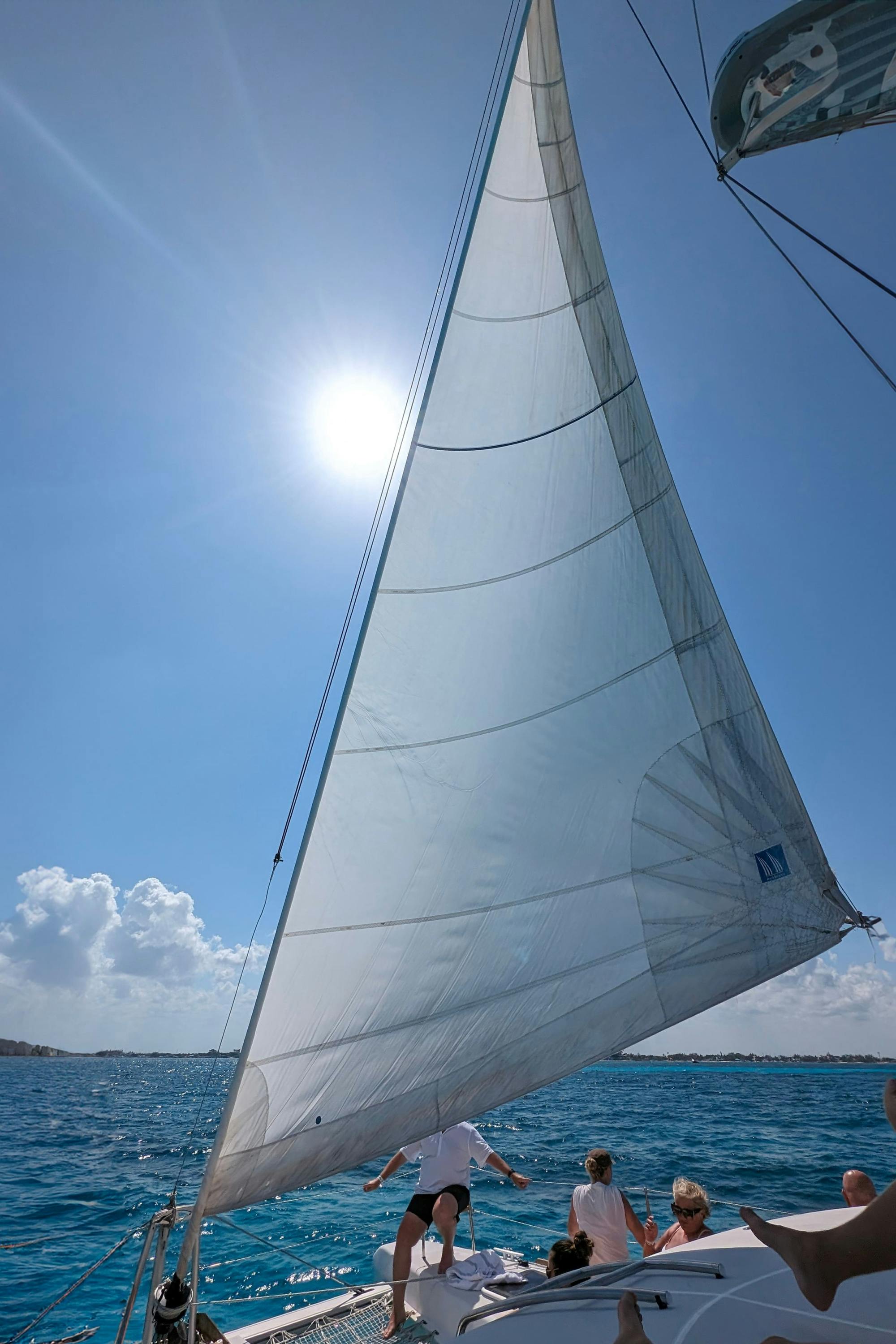
Isla Mujeres is a small Caribbean island off the coast of Cancún, Mexico, loved for turquoise water, soft white sand, colourful fishing boats, relaxed streets, golf cart rides, snorkelling, seafood, beach clubs and easy ferry access. It is close enough for a day trip from Cancún but charming enough for a longer stay.
The island’s name means Island of Women, linked with the Mayan goddess Ixchel and the island’s historic role as a sacred place. Today, Isla Mujeres blends beach holiday atmosphere with local fishing-island character. Visitors come for Playa Norte, Punta Sur, Garrafón reef, catamaran trips, sunset views, fresh ceviche, reef snorkelling and slow Caribbean wandering.
Unlike Cancún’s hotel zone, Isla Mujeres feels compact and easy to explore. Many travellers rent a golf cart for the day, circle the island, stop at beaches and viewpoints, eat seafood by the water, then return to Playa Norte for sunset.
Quick take: Musement.com offers a worldwide selection of tours and attractions
Isla Mujeres family cruise with snorkelling and lunch with shared golf… Mexico Isla Mujeres family cruise with snorkelling and lunch with shared golf cart tour is suited to travellers who enjoy combining sightseeing with local cuisine and conversation. Check current availability, inclusions and booking details before you go.
Why Visit Isla Mujeres?
Isla Mujeres is worth visiting because it offers a gentler Caribbean experience than Cancún while still being very easy to reach. The island has calm swimming beaches, reef snorkelling, scenic coastlines, casual restaurants, colourful streets and a laid-back atmosphere that works for couples, families, solo travellers and day trippers.
For a short visit, Isla Mujeres gives you a simple escape from Cancún’s high-rise resort strip. For a longer stay, it becomes a relaxing island base where mornings can start with a swim at Playa Norte and afternoons can be spent exploring the coast by golf cart.
Isla Mujeres is best for:
Day trips from Cancún
Beach lovers wanting calm turquoise water
Couples looking for a relaxed island escape
Families wanting easy beaches and short travel distances
Snorkellers interested in reefs and clear water
Travellers who enjoy golf cart island exploring
Visitors wanting catamaran tours, beach clubs and Caribbean scenery
Where Is Isla Mujeres?
Isla Mujeres lies in the Mexican Caribbean, just offshore from Cancún in the state of Quintana Roo. It sits between the Caribbean Sea and the waters near the Cancún coast, making it one of the easiest island escapes in the Riviera Maya region.
Location Detail
Traveller Notes
Destination
Isla Mujeres, Quintana Roo, Mexico
Closest major city
Cancún
Main access
Passenger ferry or boat from Cancún
Main beach
Playa Norte
Southern highlight
Punta Sur
Best visit style
Day trip, overnight beach stay, snorkelling tour, catamaran cruise or golf cart island route
How to Get to Isla Mujeres
The easiest way to reach Isla Mujeres is by ferry from Cancún. The most common route is from Puerto Juárez, though ferries and boat services may also operate from Cancún Hotel Zone departure points depending on current schedules.
Common ways to reach Isla Mujeres
Passenger ferry from Puerto Juárez: usually the most practical option for independent travellers.
Hotel Zone ferry: useful if staying near Playa Tortugas, Playa Caracol or nearby departure points.
Catamaran day tour: includes sailing, music, drinks, snorkelling and island free time depending on the package.
Private boat charter: best for groups, celebrations or flexible schedules.
Organised day trip: useful if you want transport, boat ride, snorkelling and lunch arranged together.
Before travelling, check current ferry times, departure terminal, return schedule and whether tickets are one-way or return. If you are staying in Cancún, allow extra time to reach the ferry terminal, especially during peak holiday periods.
What to Expect on Isla Mujeres
Expect a small, busy, colourful Caribbean island that is easy to enjoy without a complicated plan. The northern end is the liveliest area, with the ferry terminal, Playa Norte, restaurants, shops, beach clubs and walking streets. The southern end feels more open and scenic, with Punta Sur, coastal cliffs, sculptures and wide sea views.
Isla Mujeres is popular, so it is not a deserted island. Playa Norte can be busy, golf carts fill the roads, and catamaran groups arrive during the day. Even so, the island usually feels more relaxed than Cancún.
What you may find
Calm beaches with shallow turquoise water
Golf cart rentals and scooter-style transport
Seafood restaurants, beach bars and casual cafés
Snorkelling tours and reef parks
Catamaran cruises from Cancún
Colourful streets and souvenir shops
Punta Sur cliffs and sunrise views
Beach clubs with loungers, food and drinks
Sunsets over the water near Playa Norte
What not to expect
Do not expect Isla Mujeres to be empty or undiscovered.
Do not expect every beach to be good for swimming; some east-coast areas are rough.
Do not assume golf carts are cheap during peak season.
Do not forget the return ferry schedule if visiting for the day.
Do not snorkel on fragile reef without following local rules.
Do not expect all small businesses to accept cards.
Best Things to Do on Isla Mujeres
1. Swim at Playa Norte
Playa Norte is the island’s most famous beach and one of its biggest drawcards. The water is usually calm and shallow, the sand is soft, and the beach is close to restaurants, beach clubs and the ferry area.
2. Visit Punta Sur
Punta Sur is the southern tip of Isla Mujeres, known for dramatic sea views, cliffs, coastal paths, sculptures and the island’s connection with the Mayan goddess Ixchel. It is one of the best places for photos and sunrise.
3. Rent a golf cart
A golf cart is the classic way to explore Isla Mujeres. You can drive from the northern beach area to Punta Sur, stopping at viewpoints, beach clubs, restaurants, murals and coastal roads along the way.
4. Go snorkelling
Isla Mujeres is close to reef areas and snorkelling sites such as Garrafón, El Farito and Manchones, depending on tour type and conditions. Choose a responsible operator and avoid touching coral or marine life.
5. Take a catamaran tour from Cancún
Catamaran tours are a popular way to visit Isla Mujeres from Cancún. Many include sailing, snorkelling, drinks, lunch and free time on the island, though inclusions vary widely by operator.
6. Visit Garrafón Natural Reef Park
Garrafón is a south-island activity park with snorkelling, kayaking, ziplining and relaxation areas. It suits travellers who want a structured activity day rather than simply beach hopping independently.
7. Walk through El Centro
The northern town centre has colourful streets, restaurants, shops, bars and local island atmosphere. It is easy to explore on foot after arriving by ferry.
8. Eat fresh seafood
Try ceviche, grilled fish, shrimp tacos, lobster dishes, aguachile or simple beachside seafood. Isla Mujeres has everything from casual local restaurants to stylish beach clubs.
9. Watch sunset near Playa Norte
Playa Norte and nearby western-facing areas are among the best places on the island for sunset. Arrive early if you want a good seat at a beach club or restaurant.
10. Join a seasonal whale shark tour
Whale shark tours are seasonal and highly regulated. If this is a priority, check current dates, permit rules, ethical guidelines and sea conditions before booking.
Best Beaches on Isla Mujeres
Playa Norte
Playa Norte is the best-known beach on Isla Mujeres. It has pale sand, calm shallow water and easy access to restaurants and beach clubs. It is ideal for swimming, lounging and sunset.
Playa Centro
Playa Centro is close to the ferry area and town centre. It is convenient for a quick swim or beach stop if you are short on time.
Playa Sol
Playa Sol sits near the northern end and is another good sunset-facing area. It can be calmer than the busiest part of Playa Norte depending on the day.
Garrafón area
The Garrafón area is more about snorkelling, reef views and activity parks than a long sandy beach. It is a good choice if you want water activities and south-island scenery.
East-coast beaches
The east side of Isla Mujeres is beautiful but often rougher. It is better for views and photography than casual swimming. Pay attention to signs and local advice.
Snorkelling, Reefs and Boat Tours
Snorkelling is one of the best reasons to visit Isla Mujeres. The island is close to reef areas with clear water, tropical fish and boat-access snorkelling spots. Conditions vary by weather, current and visibility, so choose tours carefully.
Popular snorkelling and water areas
Garrafón reef area: structured snorkelling and activity park experience.
El Farito: a popular shallow snorkelling area often included on boat tours.
Manchones reef: known for reef life and dive/snorkel excursions.
MUSA underwater museum: underwater sculptures visited by snorkelling or diving tours depending on site and conditions.
Catamaran snorkel stop: usually included in many Cancún-to-Isla Mujeres day cruises.
Responsible snorkelling tips
Do not stand on coral.
Do not touch marine life.
Use reef-safe behaviour and follow guide instructions.
Wear a life jacket if required.
Do not feed fish.
Choose operators that respect reef protection rules.
Exploring Isla Mujeres by Golf Cart
Renting a golf cart is one of the most popular things to do on Isla Mujeres. The island is small enough for a relaxed loop, and the cart gives you freedom to stop at beaches, viewpoints, restaurants and Punta Sur without relying on taxis.
Suggested golf cart route
Start near the ferry terminal or Playa Norte.
Drive south along the west side of the island.
Stop for photos, coffee or beach views.
Visit Garrafón or nearby viewpoints if included in your plan.
Continue to Punta Sur for cliffs and sea views.
Return along the east coast for rougher ocean scenery.
Finish back at Playa Norte for sunset or dinner.
Drive carefully. Roads can be busy with carts, taxis, scooters, bicycles and pedestrians. Do not drink and drive, and check rental rules before signing.
Food and Drinks on Isla Mujeres
Isla Mujeres is excellent for casual Caribbean-Mexican food. Seafood is the highlight, but you will also find tacos, Yucatecan dishes, beach club menus, bakeries, cafés, cocktail bars and international restaurants.
Foods and drinks to try
Ceviche – fresh seafood with lime, chilli, onion and coriander.
Fish tacos – simple, fresh and ideal for lunch.
Tikin xic fish – Yucatecan-style fish with achiote and citrus flavours.
Shrimp tacos – popular at beach restaurants and casual taquerías.
Lobster dishes – widely promoted, though prices vary.
Aguachile – spicy, citrusy seafood dish.
Fresh coconut or agua fresca – refreshing in the heat.
Margaritas and mezcal cocktails – popular at beach bars, best enjoyed responsibly.
Suggested Isla Mujeres Itinerary Ideas
Option 1: Easy Day Trip from Cancún
Morning: Take the ferry from Cancún to Isla Mujeres.
Late morning: Walk to Playa Norte for swimming and beach time.
Lunch: Eat seafood or tacos in town.
Afternoon: Rent a golf cart and drive to Punta Sur.
Evening: Return to Playa Norte for sunset, then take the ferry back to Cancún.
Option 2: Golf Cart Island Loop
Morning: Pick up a golf cart near the ferry terminal.
First stop: Drive to Punta Sur before the day gets too hot.
Midday: Stop at Garrafón or a south-island restaurant.
Afternoon: Explore the east-coast road and scenic viewpoints.
Late afternoon: Return to town and relax at Playa Norte.
Option 3: Snorkelling and Beach Day
Morning: Join a snorkelling tour to reef sites such as El Farito, Manchones or MUSA depending on availability.
Lunch: Eat near the marina, town or beach.
Afternoon: Spend time at Playa Norte or Playa Centro.
Sunset: Choose a beach bar or casual restaurant facing west.
Option 4: Romantic Overnight Stay
Day 1: Arrive by ferry, check into a hotel near Playa Norte or the town centre.
Afternoon: Swim, relax and enjoy a slow sunset dinner.
Day 2: Visit Punta Sur early, explore by golf cart and return for a final beach swim.
Option 5: Catamaran Party Day
Morning: Board a catamaran from Cancún.
Midday: Snorkel, sail and enjoy included drinks or lunch if part of your package.
Afternoon: Have free time on Isla Mujeres.
Evening: Return to Cancún by boat with music and sunset views depending on the tour schedule.
Where to Stay on Isla Mujeres
Area
Best For
Traveller Notes
Playa Norte
Beach lovers, first-time visitors, easy swimming
Best location for beach access but often more expensive.
El Centro
Restaurants, ferry access, nightlife and shopping
Convenient for short stays and day-trip style exploring.
Mid-island
Quieter stays and better value
Useful if renting a golf cart or using taxis.
South island
Views, privacy and a slower pace
Less convenient for Playa Norte but beautiful for scenery.
West coast
Sunsets and calmer water views
Good for couples and relaxed stays.
Useful Booking Resources for Isla Mujeres Tours and Activities
Isla Mujeres can be explored independently, but booking platforms are useful for ferries, catamaran tours, snorkelling, golf cart experiences, Garrafón packages, private boats and Cancún transfers. The suppliers below are useful places to compare travel products. Skimlinks may automatically convert these merchant links into affiliate links if the merchant is active in your Skimlinks account.
KKday – offers local tours, attraction tickets, transport services and Mexico travel products useful for comparing Cancún and Isla Mujeres activities.
Tiqets – offers mobile-friendly tickets for attractions, museums and landmarks, useful for combining Isla Mujeres with Cancún or Riviera Maya sightseeing.
Musement – offers tours, attraction tickets, cultural activities and local experiences, including Cancún, Riviera Maya and wider Mexico travel products.
G Adventures – offers small-group and multi-day Mexico tours that may suit travellers planning a broader Yucatán or Mexico itinerary rather than a standalone island day trip.
Go City – offers bundled attraction passes in selected destinations, useful for readers comparing multi-attraction city and resort sightseeing options.
CityPASS – offers bundled attraction passes mainly for selected North American cities. It is not a main Isla Mujeres booking option, but may suit readers planning wider international travel.
Booking tip: Before booking an Isla Mujeres tour, check whether the price includes ferry or boat transport, snorkelling gear, reef fees, lunch, drinks, hotel pickup, golf cart rental, beach club access, guide language, child pricing, cancellation rules and exact return time. Do not assume every catamaran tour includes the same island time.
Isla Mujeres Travel Tips
Start early for a day trip
If visiting from Cancún, take an early ferry so you have enough time for Playa Norte, a golf cart loop, lunch and Punta Sur without rushing.
Check the ferry schedule
Return times matter, especially if you are not staying overnight. Check the latest schedule before planning dinner or onward transport.
Bring cash
Cards are common in larger businesses, but cash is useful for taxis, tips, small food stalls, beach chairs and local shops.
Rent a golf cart carefully
Inspect the cart, check fuel or battery rules, confirm the return time and avoid driving after drinking.
Use sun protection
The Caribbean sun is strong. Bring sunscreen, hat, sunglasses, water and lightweight clothing.
Respect reef rules
Do not touch coral, stand on reefs or feed fish. Choose responsible snorkelling operators.
Stay overnight if you can
Day trips are fun, but staying overnight lets you enjoy quieter mornings, sunset, dinner and the island after many tour groups leave.
Do not only visit Playa Norte
Playa Norte is beautiful, but Punta Sur, local restaurants, murals, coastal roads and south-island viewpoints add more depth to the visit.
Watch for seaweed conditions
Sargassum seaweed can affect Caribbean beaches seasonally. Conditions change quickly, so check recent reports close to your travel date.
Book popular tours ahead
Catamarans, snorkelling tours, whale shark trips and private charters can fill during peak holiday periods.
Is Isla Mujeres Worth Visiting?
Yes, Isla Mujeres is absolutely worth visiting, especially if you are staying in Cancún and want an easy island escape with beautiful water, relaxed streets, golf cart exploring and excellent beach time.
It may not suit travellers wanting a completely remote or undeveloped island, because Isla Mujeres is popular and can be busy. But its convenience, scenery and easygoing atmosphere make it one of the best short island trips in the Mexican Caribbean.
The best way to enjoy Isla Mujeres is to start early, swim at Playa Norte, explore by golf cart, visit Punta Sur, eat fresh seafood and stay for sunset if your ferry or accommodation allows.
FAQs About Isla Mujeres
Where is Isla Mujeres?
Isla Mujeres is a small island off the coast of Cancún in Quintana Roo, Mexico, in the Caribbean Sea.
How do you get to Isla Mujeres?
Most visitors take a ferry or boat from Cancún. Common departure areas include Puerto Juárez and selected Cancún Hotel Zone ferry points.
Is Isla Mujeres good for a day trip?
Yes. Isla Mujeres is one of the easiest and best day trips from Cancún because the ferry ride is short and the island is compact enough to explore in one day.
What is Isla Mujeres famous for?
Isla Mujeres is famous for Playa Norte, turquoise water, golf carts, snorkelling, catamaran tours, Punta Sur, Garrafón reef, seafood and relaxed Caribbean island atmosphere.
What is the best beach on Isla Mujeres?
Playa Norte is the most famous and usually the best all-round beach for swimming, soft sand, beach clubs and sunset.
Do you need a golf cart on Isla Mujeres?
You do not need one if you are only visiting Playa Norte and the town centre, but a golf cart is very useful for visiting Punta Sur and exploring the full island.
Can you snorkel on Isla Mujeres?
Yes. Isla Mujeres has snorkelling tours to reef areas such as Garrafón, El Farito, Manchones and MUSA, depending on conditions and tour type.
Is Isla Mujeres better than Cancún?
Isla Mujeres is smaller, calmer and more island-like than Cancún. Cancún has bigger resorts, nightlife and shopping, while Isla Mujeres is better for relaxed beach time and easy exploring.
How long should you spend on Isla Mujeres?
One day is enough for a good introduction, but one or two nights is better if you want quieter mornings, sunset, snorkelling and more relaxed island time.
Is Isla Mujeres worth visiting?
Yes. Isla Mujeres is one of the best island escapes near Cancún, with beautiful beaches, easy ferry access, snorkelling, food, golf cart exploring and a relaxed Caribbean feel.
Sponsored Popular Items
Quick take: Musement.com offers a worldwide selection of tours and attractions
Portland food carts, pods and patio tours United States Portland food carts, pods and patio tours adds structure, local context and purposeful sightseeing to the itinerary. Check current availability, inclusions and booking details before you go.
Lisbon Old Town is not one single walled district. It is a layered historic centre made up of atmospheric neighbourhoods such as Alfama, Baixa, Chiado, Bairro Alto, Mouraria, Graça and the riverfront around Praça do Comércio. Together, these areas reveal the Lisbon travellers dream of: tiled façades, yellow trams, steep lanes, miradouros, fado music, grand squares, old churches, cafés, azulejos, river views and everyday neighbourhood life.
Lisbon’s historic centre is best explored slowly. You can ride Tram 28 through narrow streets, climb to São Jorge Castle, listen to fado in Alfama, shop in Chiado, photograph the Santa Justa Lift, walk through the Pombaline grid of Baixa, and end the evening in Bairro Alto or at a sunset viewpoint overlooking the Tagus River.
This is a city where the streets are part of the attraction. Some of the best moments are not inside museums, but in tiled doorways, tiny staircases, laundry-hung alleys, old grocery shops, church bells, tram bells and sudden views across red rooftops to the water.
Quick take: Musement.com offers a worldwide selection of tours and attractions
Discovery Game Lisbon’s Alfama and Baixa Outdoor Art – Self-Guided Experience Portugal Discovery Game Lisbon’s Alfama and Baixa outdoor art is a convenient way to add structure, local context and purposeful sightseeing to the itinerary. Check current availability, inclusions and booking details before you go.
Why Visit Lisbon Old Town?
Lisbon Old Town is worth visiting because it combines beauty, history, culture and atmosphere in a very walkable area. Unlike cities where historic sights are spread far apart, Lisbon’s old centre lets you move from medieval lanes to grand 18th-century squares, hilltop viewpoints, riverfront promenades, shopping streets and nightlife districts in a single day.
Alfama gives you the older, maze-like Lisbon of steep lanes and fado houses. Baixa gives you elegant post-earthquake planning and wide streets. Chiado gives you cafés, theatres, bookshops and shopping. Bairro Alto gives you nightlife, restaurants and bars. Mouraria and Graça add local character, multicultural food, viewpoints and a less polished but very real Lisbon feel.
Lisbon Old Town is best for:
First-time visitors to Lisbon
Travellers who love walking, photography and historic streets
Couples looking for romantic viewpoints and atmospheric evenings
Food lovers interested in pastel de nata, seafood, petiscos and Portuguese wine
Music lovers wanting to hear fado in Alfama or Bairro Alto
Architecture fans interested in azulejos, churches, squares and Pombaline planning
Visitors who want easy access to trams, metro stations, riverfront walks and day trips
Where Is Lisbon Old Town?
Lisbon Old Town covers the historic heart of the city near the Tagus River. The most useful orientation point is Praça do Comércio, the grand riverfront square at the southern edge of Baixa. From there, Baixa rises north toward Rossio, Alfama climbs east toward São Jorge Castle, and Chiado and Bairro Alto rise west up the hill.
Area
Best For
Traveller Notes
Alfama
Fado, old lanes, viewpoints, castle access
One of Lisbon’s most atmospheric historic districts.
Baixa
Grand squares, shopping streets, easy navigation
The flatter central district rebuilt after the 1755 earthquake.
Chiado
Cafés, theatres, boutiques, bookshops
Elegant and central, between Baixa and Bairro Alto.
Bairro Alto
Nightlife, restaurants, bars, fado
Quiet by day, lively after dark.
Mouraria
Local character, multicultural food, fado history
Less polished but very interesting for repeat visitors.
Graça
Viewpoints and local neighbourhood atmosphere
Good for sunset views and a slower Lisbon feel.
Cais do Sodré
Riverfront, nightlife, Time Out Market, transport
Useful for ferries, trains and evening food stops.
Best Historic Neighbourhoods in Lisbon Old Town
Alfama
Alfama is the most romantic and old-world part of Lisbon. Its narrow lanes climb from the river toward São Jorge Castle, passing tiny squares, tiled houses, stairways, fado restaurants, churches and viewpoints. It is easy to get lost here, and that is part of the charm.
Baixa
Baixa is Lisbon’s downtown grid, rebuilt after the devastating 1755 earthquake. It is flatter and easier to navigate than Alfama or Bairro Alto, with elegant streets, shops, cafés and squares such as Rossio, Praça da Figueira and Praça do Comércio.
Chiado
Chiado is refined, literary and stylish. It is known for cafés, bookshops, theatres, boutiques and classic Lisbon elegance. It connects Baixa with Bairro Alto and is a good area for shopping, coffee and people-watching.
Bairro Alto
Bairro Alto is quiet during the day but comes alive at night. Its narrow streets fill with restaurants, bars and fado houses. It is one of the best areas for an evening meal or casual drinks, though it can be noisy if you stay directly in the nightlife zone.
Mouraria
Mouraria is one of Lisbon’s most culturally layered neighbourhoods. It is linked with fado history and has a strong multicultural food scene. The streets feel more local than polished, making it a rewarding area for curious travellers.
Graça
Graça sits above Alfama and Mouraria and is loved for its viewpoints. It has a neighbourhood feel, with cafés, tiled buildings, local shops and some of Lisbon’s best sunset views.
Best Things to See in Lisbon Old Town
São Jorge Castle
São Jorge Castle sits high above Lisbon and offers some of the best views over the red rooftops, Baixa grid and Tagus River. It is one of the strongest orientation points for understanding the city.
Praça do Comércio
Praça do Comércio is Lisbon’s grand riverfront square. With its yellow arcades, triumphal arch and open views toward the Tagus, it is one of the best places to begin or end a walk through the old town.
Rossio Square
Rossio is one of central Lisbon’s most important squares, known for its wave-pattern paving, fountains, cafés and lively city-centre atmosphere.
Santa Justa Lift
The Santa Justa Lift connects Baixa with the higher Carmo and Chiado area. It is both a transport feature and a historic landmark, with views over the city from the upper level.
Carmo Convent
Carmo Convent is one of Lisbon’s most moving ruins. Its roofless Gothic arches remain as a reminder of the 1755 earthquake and now create one of the city’s most atmospheric historic sites.
Lisbon Cathedral
Lisbon Cathedral, often called the Sé, is one of the city’s oldest and most important churches. It sits between Baixa and Alfama and is a natural stop on a walk toward the castle.
Miradouro de Santa Luzia
Miradouro de Santa Luzia is a beautiful viewpoint overlooking Alfama and the river. It is known for tiled panels, bougainvillea, arches and classic Lisbon views.
Miradouro da Senhora do Monte
Miradouro da Senhora do Monte offers one of the widest views across Lisbon. It is especially good around sunset, though it requires a climb or transport up to Graça.
Elevador da Bica
The Bica funicular is one of Lisbon’s most photographed transport scenes, climbing a steep street between Cais do Sodré and Bairro Alto.
Rua Augusta
Rua Augusta is Baixa’s main pedestrian shopping street, running between Rossio and Praça do Comércio through the Arco da Rua Augusta.
Best Lisbon Old Town Walking Routes
Route 1: Baixa to Alfama and the Castle
This is the classic first-time Lisbon walk. Start at Praça do Comércio, walk through Baixa, visit Lisbon Cathedral, climb into Alfama, stop at Miradouro de Santa Luzia and continue to São Jorge Castle.
Best for: first-time visitors, history and viewpoints
Time needed: 3 to 4 hours with stops
Difficulty: moderate because of steep hills
Route 2: Baixa, Chiado and Bairro Alto
Start at Rossio, walk through Baixa, ride or walk up toward Chiado, visit Carmo Convent, browse shops and cafés, then continue into Bairro Alto for dinner or drinks.
Best for: shopping, cafés, nightlife and easy central sightseeing
Time needed: 2 to 4 hours
Difficulty: moderate, with some hills
Route 3: Mouraria and Graça Viewpoint Walk
Begin near Martim Moniz, explore Mouraria’s lanes and food spots, then climb toward Graça and Miradouro da Senhora do Monte. Continue downhill into Alfama if you still have energy.
Best for: local character, food, fado history and views
Time needed: 3 hours
Difficulty: steep in sections
Route 4: Lisbon Night Walk
Start with sunset at a viewpoint, eat dinner in Alfama, Chiado or Bairro Alto, then enjoy fado or a relaxed evening drink. Stick to well-lit, busy streets if walking late.
Best for: couples, food lovers and atmosphere
Time needed: 3 to 5 hours
Difficulty: easy to moderate depending on route
Tram 28 and Historic Transport
Tram 28 is Lisbon’s most famous tram route and one of the classic ways to experience the old town. It passes through several historic districts, including Alfama, Baixa, Estrela and Graça, using vintage yellow trams that squeeze through narrow streets and climb steep hills.
It is scenic, but it is also very popular. Expect queues, crowds and pickpocket risk during peak times. For a more comfortable ride, board early in the morning or consider riding only part of the route rather than treating it as a full sightseeing tour.
Other useful historic transport
Santa Justa Lift – connects Baixa with Carmo and Chiado.
Bica Funicular – one of Lisbon’s most photogenic steep-street lifts.
Glória Funicular – connects Restauradores with Bairro Alto.
Lavra Funicular – one of the quieter historic lifts.
Metro – useful for reaching the old centre quickly from other areas.
Ferries from Cais do Sodré – good for views back toward Lisbon from across the river.
Food, Fado and Local Culture in Lisbon Old Town
Lisbon Old Town is one of the best areas for traditional Portuguese food, cafés, wine bars and fado music. Alfama and Bairro Alto are especially associated with fado houses, while Baixa and Chiado offer a wide range of cafés, bakeries, restaurants and historic dining rooms.
Foods and drinks to try
Pastel de nata – the famous Portuguese custard tart.
Bacalhau – salted cod, cooked in many different ways.
Sardines – especially popular during festival season.
Petiscos – Portuguese small plates, similar in spirit to tapas.
Bifana – pork sandwich, simple and satisfying.
Ginjinha – cherry liqueur often served in tiny bars around Baixa and Rossio.
Portuguese wine – try vinho verde, Douro reds or local Lisbon-region wines.
Seafood rice – rich, comforting and good for a longer meal.
Fado tips
Fado is deeply connected to Lisbon’s old neighbourhoods, especially Alfama and Mouraria. Choose a reputable fado house, check whether dinner is included, and expect a listening atmosphere rather than background music. During performances, keep conversation low and avoid flash photography.
Best Viewpoints in Lisbon Old Town
Viewpoint
Best For
Traveller Notes
Miradouro de Santa Luzia
Alfama rooftops, tiles and river views
Beautiful but popular; go early or late.
Miradouro das Portas do Sol
Classic Alfama panorama
Close to Santa Luzia and easy to combine.
Miradouro da Senhora do Monte
Wide city views and sunset
One of Lisbon’s best panoramic viewpoints.
São Jorge Castle
Historic setting and rooftop views
Ticketed but excellent for orientation.
Santa Justa Lift viewpoint
Baixa grid and Carmo views
Can be busy; check ticket and queue options.
Miradouro de São Pedro de Alcântara
Castle view from Bairro Alto side
Good before dinner or nightlife in Bairro Alto.
Suggested Lisbon Old Town Itinerary Ideas
Option 1: Classic One-Day Lisbon Old Town Route
Morning: Start at Praça do Comércio and walk through Baixa.
Late morning: Visit Lisbon Cathedral and climb into Alfama.
Midday: Stop at Miradouro de Santa Luzia or Portas do Sol.
Afternoon: Visit São Jorge Castle or explore Alfama’s lanes.
Evening: Eat dinner in Alfama and listen to fado.
Option 2: Baixa, Chiado and Bairro Alto Day
Morning: Explore Rossio, Rua Augusta and Praça do Comércio.
Lunch: Eat in Baixa or Chiado.
Afternoon: Visit Carmo Convent and browse Chiado shops.
Sunset: Go to Miradouro de São Pedro de Alcântara.
Night: Have dinner or drinks in Bairro Alto.
Option 3: Tram 28 and Viewpoints Route
Early morning: Ride Tram 28 before the biggest crowds.
Mid-morning: Get off near Graça or Alfama.
Late morning: Walk to Senhora do Monte viewpoint.
Afternoon: Explore Alfama, Mouraria or the castle area.
Option 4: Food and Fado Evening
Late afternoon: Walk through Alfama or Mouraria.
Sunset: Stop at a viewpoint overlooking the river.
Dinner: Book a fado restaurant in Alfama or Bairro Alto.
Night: Walk back carefully through main streets or take a taxi.
Option 5: Two-Day Lisbon Old Town Plan
Day 1: Baixa, Alfama, castle, cathedral and fado.
Day 2: Chiado, Carmo Convent, Bairro Alto, viewpoints, Cais do Sodré and riverfront.
Where to Stay in Lisbon Old Town
Area
Best For
Traveller Notes
Baixa
First-time visitors, flat streets, easy transport
Very convenient and central.
Chiado
Couples, shopping, restaurants, elegance
Excellent location but often more expensive.
Alfama
Atmosphere, fado, historic charm
Beautiful but hilly; check luggage access.
Bairro Alto
Nightlife and dining
Can be noisy at night; choose carefully.
Graça
Viewpoints and local feel
Good for slower stays but hillier.
Cais do Sodré
Transport, riverfront, nightlife
Useful for trains to Cascais and ferries.
Useful Booking Resources for Lisbon Old Town Tours and Activities
Lisbon Old Town is easy to explore independently, but guided walks, food tours, fado experiences, tram tours and skip-the-line tickets can add useful context. The suppliers below are useful places to compare tour styles, inclusions and cancellation rules. Skimlinks may automatically convert these merchant links into affiliate links if the merchant is active in your Skimlinks account.
GetYourGuide – offers Lisbon Old Town walking tours, Alfama and Baixa tours, fado shows, food tours, Tram 28-style experiences, São Jorge Castle tickets and day trips from Lisbon.
Viator – offers private Lisbon city tours, Alfama walking tours, food and wine experiences, fado nights, tuk-tuk tours, river cruises and customisable old town itineraries.
Klook – offers Lisbon attraction tickets, city passes, guided activities, transport products, SIM/eSIM options and Portugal travel add-ons.
KKday – offers Lisbon tours, attraction tickets, transfers, local experiences and wider Portugal travel products depending on current availability.
Tiqets – offers mobile-friendly tickets for Lisbon attractions, museums, castles, viewpoints and cultural experiences.
Musement – offers Lisbon city tours, food tours, fado experiences, attraction tickets and day trips across Portugal.
G Adventures – offers small-group and multi-day Portugal tours that may include Lisbon as part of a broader itinerary.
Go City – offers bundled attraction passes in selected destinations, useful for readers comparing multi-attraction city sightseeing options.
CityPASS – offers bundled attraction passes mainly for selected North American cities. It is not a main Lisbon booking option, but may suit readers planning wider international travel.
Booking tip: Before booking a Lisbon Old Town tour, check whether it includes Alfama, Baixa, Chiado, Bairro Alto, São Jorge Castle, fado, food tastings, Tram 28, guide language, hotel pickup, entry tickets, hill difficulty, cancellation rules and exact meeting point.
Lisbon Old Town Travel Tips
Wear proper walking shoes
Lisbon’s old streets are steep, cobbled and slippery in places. Comfortable shoes with grip make a big difference.
Start early in Alfama
Alfama is most atmospheric in the morning before the biggest walking tours and tram crowds arrive.
Be careful on Tram 28
Tram 28 is scenic but crowded. Watch bags and phones carefully, especially during busy periods.
Use viewpoints as route markers
Lisbon’s miradouros are perfect rest stops. Plan your walks from viewpoint to viewpoint rather than rushing uphill without breaks.
Do not overpack your first day
The old town looks compact, but hills slow everything down. Choose two or three neighbourhoods per day rather than trying to see everything.
Book fado ahead
Good fado houses can fill, especially on weekends. Book ahead and confirm whether dinner is included.
Use public transport strategically
Take the metro, trams, funiculars or taxis uphill, then walk down. This saves energy and makes sightseeing more enjoyable.
Carry small cash
Cards are widely accepted, but small cash is useful for kiosks, tips, old bars, public toilets and small purchases.
Watch for uneven pavements
Portuguese calçada paving is beautiful but can be uneven. Take extra care at night or in wet weather.
Stay central if it is your first visit
Baixa, Chiado and Alfama are the most convenient old town bases for first-time visitors.
Is Lisbon Old Town Worth Visiting?
Yes, Lisbon Old Town is absolutely worth visiting. It is the heart of the city and the best place to experience Lisbon’s history, hills, viewpoints, trams, fado, food and tiled architecture.
It may not suit travellers who dislike hills or crowds, especially in peak season, but careful planning makes it much easier. Start early, use public transport for steep climbs and explore beyond the busiest streets.
The best way to enjoy Lisbon Old Town is to walk slowly, choose a few neighbourhoods at a time, pause at viewpoints, eat local food, listen to fado and leave space for wandering. Lisbon rewards curiosity more than strict sightseeing checklists.
FAQs About Lisbon Old Town
What is considered Lisbon Old Town?
Lisbon Old Town usually refers to the historic central districts including Alfama, Baixa, Chiado, Bairro Alto, Mouraria, Graça and the riverfront around Praça do Comércio.
Which is the oldest part of Lisbon?
Alfama is often considered one of Lisbon’s oldest and most atmospheric neighbourhoods, with narrow lanes, steep stairways, old churches, fado houses and views over the Tagus River.
Is Lisbon Old Town walkable?
Yes, Lisbon Old Town is walkable, but it is very hilly. Baixa is relatively flat, while Alfama, Bairro Alto, Graça and the castle area involve steep climbs.
Is Tram 28 worth riding?
Tram 28 can be worth riding because it passes through classic historic districts, but it is often crowded. Ride early or use it for a short section rather than relying on it for the whole day.
Where should first-time visitors stay in Lisbon Old Town?
Baixa is the easiest area for first-time visitors because it is central and flatter. Chiado is stylish and convenient, while Alfama is best for atmosphere and fado.
What is the best viewpoint in Lisbon Old Town?
Miradouro da Senhora do Monte offers one of the widest city views, while Santa Luzia and Portas do Sol are classic viewpoints over Alfama and the Tagus River.
Can you visit Lisbon Old Town in one day?
Yes, you can see highlights in one day, but two days is better. Spend one day on Baixa and Alfama, then another on Chiado, Bairro Alto, Mouraria and viewpoints.
Is Lisbon Old Town safe at night?
Most central areas are busy and generally comfortable for visitors, but use normal city precautions. Watch belongings, avoid dark empty lanes late at night and take a taxi if unsure.
What should you eat in Lisbon Old Town?
Try pastel de nata, bacalhau, sardines, bifanas, petiscos, seafood rice, Portuguese wine and ginjinha.
Is Lisbon Old Town worth visiting?
Yes. Lisbon Old Town is the best place to experience the city’s historic streets, trams, viewpoints, food, fado, tiled façades and river views.
Sponsored Popular Items
Quick take: Musement.com offers a worldwide selection of tours and attractions
Discovery Game Lisbon’s Alfama and Baixa Outdoor Art – Self-Guided Experience Portugal Discovery Game Lisbon’s Alfama and Baixa outdoor art is a convenient way to add structure, local context and purposeful sightseeing to the itinerary. Check current availability, inclusions and booking details before you go.
Discovery Game Lisbon’s Bairro Alto and Bica – Self-Guided Experience Portugal Discovery Game Lisbon’s Bairro Alto and Bica is a convenient way to add structure, local context and purposeful sightseeing to the itinerary. Check current availability, inclusions and booking details before you go.
Lisbon Bairro Alto Evening Food & Wine Tour – Food & Drink Experience Portugal Dine around Lisbon: Bairro Alto evening food and wine USD adds structure, local context and purposeful sightseeing to the itinerary. Check current availability, inclusions and booking details before you go.
Whale & Bird Watching from Andenes is one of the most exciting wildlife experiences in Northern Norway. Set at the northern tip of Andøya in the Vesterålen Islands, Andenes is famous for whale safaris, open-ocean wildlife trips, Arctic seabirds, dramatic coastal scenery and nearby puffin colonies around Bleiksøya.
This is a destination where the continental shelf lies close to shore, making deep-water whale habitat unusually accessible by boat. On a good trip, visitors may see sperm whales, orcas, humpback whales, pilot whales, dolphins, seabirds and white-tailed sea eagles, depending on season, sea conditions and wildlife movement.
For bird lovers, nearby Bleik is the main base for puffin and seabird safaris to Bleiksøya Bird Cliff. The island is one of Norway’s best-known bird cliffs, with large numbers of puffins during the breeding season, plus guillemots, razorbills, cormorants, gulls and sea eagles.
Quick take: Musement.com offers a worldwide selection of tours and attractions
Arctic Explorer Icebreaker Cruise in Swedish Lapland Finland Plan Arctic Explorer Icebreaker Cruise in Swedish Lapland, a water-based experience, with practical tips on timing, inclusions and what to check before booking. Compare current availability, prices and booking conditions before you go.
Why Go Whale and Bird Watching from Andenes?
Andenes is worth visiting because it offers one of Europe’s most reliable and dramatic whale-watching settings. The deep ocean lies close to land, so tours can reach whale-feeding areas without travelling for an entire day. This makes Andenes especially appealing for travellers who want serious wildlife watching but still prefer a manageable half-day activity.
The birdwatching is also exceptional. Just south of Andenes, the village of Bleik faces Bleiksøya, a steep bird island where puffins and other seabirds gather in large numbers during the breeding season. Combining a whale safari from Andenes with a puffin safari from Bleik gives visitors a powerful Arctic wildlife itinerary in a compact area.
Whale & Bird Watching from Andenes is best for:
Wildlife lovers wanting whales, puffins and sea eagles
Photographers looking for Arctic marine wildlife
Families with older children who enjoy boat trips
Travellers visiting Vesterålen, Lofoten or Northern Norway
Birdwatchers interested in puffins, guillemots, razorbills and cormorants
Visitors who want a quieter alternative to busier Lofoten villages
Nature-focused travellers who value responsible wildlife tourism
Where Is Andenes?
Andenes is a small coastal town at the northern end of Andøya, part of the Vesterålen archipelago in Nordland, Northern Norway. It faces the open Norwegian Sea and is known for its harbour, lighthouse, whale-watching operators, Arctic landscape and easy access to deep ocean waters.
Andenes can be visited as part of a Vesterålen road trip, as a detour from Lofoten, or as a dedicated wildlife stop. It is more remote than Svolvær or Tromsø, so planning transport and accommodation ahead is important.
Whale Watching from Andenes
Whale watching is the headline experience in Andenes. Tours usually depart from the harbour and head toward deep offshore waters where whales feed. The exact route depends on weather, sea state, recent sightings and operator decisions.
The most iconic species associated with Andenes is the sperm whale. These deep-diving whales are often seen feeding in the waters off Andøya. Depending on season and movement, other species may include orcas, humpback whales, pilot whales, fin whales, minke whales, dolphins and harbour porpoises.
What to expect on a whale safari
Check-in at the operator’s office or harbour meeting point
Safety briefing and wildlife information
Boat trip into open sea
Searching for whales using crew knowledge and recent sightings
Possible sightings of sperm whales, orcas, humpbacks or other cetaceans
More exposed, colder and bumpier; usually has minimum age rules.
Research-linked safari
Travellers interested in whale science and ecology
Look for operators that combine tourism with research and education.
Winter whale trip
Arctic atmosphere, fewer crowds and dramatic light
Weather and daylight can be more challenging.
Whale sightings are never completely guaranteed because these are wild animals. Good operators should explain the likelihood honestly, follow responsible whale-watching practices and avoid chasing or crowding animals.
Bird Watching and Puffin Safari from Bleik
For birdwatching, the nearby village of Bleik is the key location. From there, small boat trips visit Bleiksøya, a steep bird island just offshore. The island is especially famous for puffins during the summer breeding season.
A puffin safari is usually shorter than a whale safari and can be easier to fit into an afternoon or evening. Visitors travel by boat around the bird cliff rather than landing on the island, helping protect the nesting birds.
Birds you may see around Bleiksøya
Atlantic puffins – the star species during breeding season.
White-tailed sea eagles – often seen circling near the bird cliffs.
Guillemots – common seabirds on northern bird cliffs.
Razorbills – black-and-white seabirds related to auks.
Cormorants – often seen perched on rocks or flying low over water.
Kittiwakes and gulls – noisy and active around the cliffs.
What to expect on a puffin safari
Short boat ride from Bleik toward Bleiksøya
Views of the cone-shaped bird island rising from the sea
Large numbers of seabirds in flight and on the water
Puffins carrying fish during the breeding season
Possible white-tailed sea eagle sightings
Guided commentary about seabirds and local nature
Cold wind and possible sea movement even on short trips
Bring binoculars or a zoom lens. Puffins are small and fast, and responsible boats do not disturb nesting birds by getting too close.
Wildlife You May See from Andenes and Bleik
The waters around Andøya are rich in wildlife, but sightings vary. Whales follow food, seabirds follow fish, and weather can change the day’s route. Treat every trip as a nature experience rather than a guaranteed checklist.
Wildlife
Where You May See It
Notes
Sperm whales
Offshore from Andenes
The signature whale species associated with Andenes.
Orcas
Seasonal and variable offshore waters
Possible, but not guaranteed.
Humpback whales
Seasonal feeding areas
More likely when fish movement supports feeding activity.
Pilot whales
Open sea around Vesterålen
Possible on some whale safaris.
Puffins
Bleiksøya near Bleik
Best during the breeding season.
White-tailed sea eagles
Bleik, Bleiksøya and coastal areas
Often a major highlight of bird safaris.
Guillemots, razorbills and cormorants
Bird cliffs and coastal waters
Common seabird safari species.
Seals and porpoises
Coastal waters around Andøya
Possible but not the main focus of every trip.
Best Season for Whale and Bird Watching from Andenes
Andenes has wildlife activity across much of the year, but the best season depends on whether you are focusing on whales, puffins or Arctic light.
Season
Best For
Traveller Notes
May to mid-September
Main summer whale-watching season
Long daylight, more tour departures and good wildlife focus.
June to August
Puffins, seabirds, whale safaris and midnight sun atmosphere
Best overall period for combining whales and birds.
September
Whales and changing autumn light
Fewer crowds, but weather may be less predictable.
Winter
Arctic atmosphere and possible whale trips
Short daylight, colder conditions and more weather disruption.
Spring
Early whale activity and returning seabirds
Check tour availability before travelling.
For most visitors, the best all-round time for Whale & Bird Watching from Andenes is summer, especially June to August, when puffins are present and whale safari options are strong.
Best Tour Types from Andenes and Bleik
1. Classic Whale Safari from Andenes
The classic whale safari is the main Andenes experience. Choose this if you want the strongest chance of seeing large whales and learning about the marine environment.
2. RIB Whale Safari
A RIB safari is faster, smaller and more adventurous. It suits travellers who are comfortable with cold wind, sea spray and a more exposed ride.
3. Puffin Safari from Bleik
The puffin safari is ideal for birdwatchers, photographers and families who want a shorter boat trip. It focuses on Bleiksøya’s seabird colony rather than open-ocean whale searching.
4. Sea Eagle and Seabird Safari
Some bird-focused trips highlight white-tailed sea eagles as well as puffins and other seabirds. These are excellent for wildlife photography.
5. Combined Wildlife Stay
Stay two or three nights in Andenes or Bleik and book both a whale safari and puffin safari. This gives you a better chance of good weather and a fuller wildlife experience.
6. Photography-Focused Trip
Wildlife photographers should choose dates carefully, bring a zoom lens, allow multiple days for weather flexibility and consider both whale and bird trips.
Things to Do Near Andenes
Andenes Lighthouse
Andenes Lighthouse is one of the town’s most recognisable landmarks. It is a good place for harbour photos, coastal views and a short walk before or after a whale safari.
Bleik Beach
Bleik Beach is one of Northern Norway’s most beautiful beaches, with pale sand, mountain views and the bird island of Bleiksøya offshore. It is excellent for photography, walking and sunset light.
Bleiksøya Bird Cliff
Bleiksøya is the main birdwatching target near Bleik. It is usually viewed by boat, not by landing.
Andøya Scenic Route
The road along Andøya offers wild coastal views, beaches, mountains, bog landscapes and fishing villages. It is one of the most rewarding drives in Vesterålen.
Spaceship Aurora
Spaceship Aurora is an educational visitor attraction linked to space, aurora science and Andøya’s role in atmospheric research.
Bleik Village
Bleik is a small fishing village close to Andenes, useful for puffin safaris, beach walks and quieter accommodation.
Måtind Viewpoint
Måtind is a famous hiking viewpoint above Bleik and the Andøya coast. It offers spectacular views over beaches, mountains and the ocean, but requires suitable weather and fitness.
Vesterålen Road Trip
Andenes fits well into a wider Vesterålen route including Sortland, Stø, Nyksund, Bø and other coastal villages.
Suggested Whale & Bird Watching from Andenes Itinerary Ideas
Option 1: Classic 2-Day Andenes Wildlife Trip
Day 1: Arrive in Andenes, walk around the harbour and visit Andenes Lighthouse.
Day 1 evening: Stay overnight in Andenes or Bleik.
Day 2 morning: Join a whale safari from Andenes.
Day 2 afternoon: Visit Bleik Beach or take a puffin safari if timing allows.
Option 2: Whale and Puffin Summer Weekend
Friday: Arrive in Andenes and check into accommodation.
Saturday morning: Take a whale safari from Andenes.
Saturday afternoon: Rest, visit the lighthouse or explore the coast.
Sunday: Take a puffin safari from Bleik to Bleiksøya.
Sunday afternoon: Drive the Andøya scenic route or continue through Vesterålen.
Option 3: Family-Friendly Wildlife Plan
Day 1: Arrive and keep the day light with a harbour walk and beach visit.
Day 2: Choose the larger traditional whale safari boat rather than a RIB if children prefer more space.
Day 3: Add a shorter puffin safari from Bleik if the weather is suitable.
Option 4: Photography-Focused Andøya Route
Morning: Photograph Bleik Beach and the view toward Bleiksøya.
Midday: Take a whale safari with a zoom lens and weather protection.
Evening: Photograph Andenes Lighthouse and harbour light.
Next day: Take the puffin safari and continue to Måtind or scenic viewpoints if conditions are good.
Option 5: Vesterålen and Lofoten Wildlife Extension
Days 1–2: Visit Svolvær or Lofoten fjords.
Day 3: Drive north through Vesterålen to Andenes.
Day 4: Whale safari from Andenes.
Day 5: Puffin safari from Bleik and coastal road trip south.
Useful Booking Resources for Whale & Bird Watching from Andenes
Whale and bird watching trips from Andenes and Bleik can be weather-dependent and popular in summer, so advance booking is recommended. The suppliers below are useful places to compare wildlife tours, local operators, transport and wider Norway itineraries. Skimlinks may automatically convert these merchant links into affiliate links if the merchant is active in your Skimlinks account.
GetYourGuide – offers Norway wildlife tours, whale-watching experiences, Arctic activities, Lofoten and Vesterålen day trips, northern lights tours and regional travel add-ons.
Klook – offers Europe and Norway activities, transport products, SIM/eSIM options and selected Arctic experiences depending on current availability.
KKday – offers local tours, activity tickets, transport services and Europe travel products that may help with broader Norway planning.
Tiqets – offers mobile-friendly tickets for museums, attractions and landmarks, useful for city stopovers before or after Northern Norway wildlife travel.
Musement – offers city tours, attraction tickets, cultural activities and local experiences, useful for comparing Norway and wider Europe travel options.
G Adventures – offers small-group and multi-day Norway or Arctic-style tours that may suit travellers wanting a broader Scandinavia itinerary rather than a standalone Andenes wildlife trip.
Go City – offers bundled city attraction passes in selected destinations. It is not a main Andenes booking option, but it may help readers planning city stopovers before or after Norway.
CityPASS – offers bundled attraction passes mainly for selected North American cities. It is not designed for Andenes or Norway, but may suit readers planning wider international travel.
Booking tip: Before booking whale or bird watching from Andenes, check the departure harbour, tour duration, boat type, minimum age, weather cancellation policy, seasickness advice, thermal clothing, guide language, wildlife guarantee policy if offered, refund rules and whether the trip is a whale safari, puffin safari or combined wildlife product.
Whale & Bird Watching from Andenes Travel Tips
Book more than one night
Weather can cancel or delay boat trips. Staying two or three nights gives you a better chance of joining your safari in suitable conditions.
Dress for open ocean
Even in summer, the sea can feel cold. Wear warm layers, windproof clothing, gloves and a hat.
Prepare for seasickness
Open-ocean whale safaris can be rough. Take suitable medication before boarding if you are prone to motion sickness.
Bring binoculars
Binoculars are useful for birds, distant whales and sea eagles. They are especially helpful on puffin safaris where responsible boats keep distance from nesting cliffs.
Use a camera strap
Boats move, wildlife appears quickly and sea spray is common. Secure cameras and phones.
Choose the right boat
A larger boat is usually better for comfort. A RIB is better for adventure but is colder and more exposed.
Keep expectations realistic
Whales, puffins and eagles are wild animals. Good sightings are likely in the right season, but never guaranteed.
Respect wildlife rules
Do not demand that boats chase animals, get too close to nesting cliffs or disturb whales and birds for photos.
Check puffin season
Puffins are seasonal. Do not book a bird safari expecting puffins outside the breeding period unless the operator confirms current sightings.
Allow time for the drive
Andenes looks close to Lofoten on a map, but road travel can take time. Plan fuel, food stops and weather delays.
Is Whale & Bird Watching from Andenes Worth It?
Yes, Whale & Bird Watching from Andenes is absolutely worth it if you enjoy wild nature, Arctic seas, whales, puffins and dramatic northern landscapes. It is one of Norway’s best places to combine marine mammals and seabird watching in one compact region.
It may not suit travellers who dislike boats, get severe seasickness or want guaranteed sightings on a strict schedule. The experience depends on weather, wildlife movement and operator safety decisions.
The best way to enjoy it is to stay at least two nights, book a whale safari from Andenes, add a puffin safari from Bleik during the breeding season, dress warmly and leave enough flexibility for weather changes.
FAQs About Whale & Bird Watching from Andenes
Where is Andenes?
Andenes is at the northern end of Andøya in the Vesterålen Islands, Nordland, Northern Norway. It is one of Norway’s best-known whale-watching bases.
What whales can you see from Andenes?
Sperm whales are the signature species off Andenes. Depending on season and movement, visitors may also see orcas, humpback whales, pilot whales, fin whales, minke whales, dolphins or porpoises.
When is the best time for whale watching from Andenes?
The main summer whale-watching season is generally from May to mid-September, with June to August offering long daylight and strong tour availability.
Where can you see puffins near Andenes?
The best place for puffins near Andenes is Bleiksøya, a bird cliff off the village of Bleik. Boat safaris from Bleik take visitors around the island during the breeding season.
How long is a puffin safari from Bleik?
Puffin safaris from Bleik are commonly listed as around 90 minutes, depending on operator, weather and sea conditions.
Can you see whales and puffins on the same day?
It may be possible in summer if tour times align, but it is better to allow two days in case weather delays one of the trips.
Are whale sightings guaranteed from Andenes?
No wildlife sighting can be completely guaranteed. Some operators may offer a whale guarantee or rebooking policy, but you should always check the exact terms before booking.
Is whale watching from Andenes suitable for children?
It can be suitable for children, especially on larger boats, but age rules vary. RIB tours often have stricter minimum age requirements.
Will I get seasick?
Possibly. Whale safaris travel into open sea, and conditions can be rough. Take seasickness precautions if you are sensitive to motion.
Is Whale & Bird Watching from Andenes worth it?
Yes. Andenes and nearby Bleik offer one of Northern Norway’s strongest wildlife combinations: whales offshore, puffins at Bleiksøya, sea eagles, seabirds and dramatic Arctic coastal scenery.
Sponsored Popular Items
Quick take: Musement.com offers a worldwide selection of tours and attractions
Arctic Explorer Icebreaker Cruise in Swedish Lapland Finland Plan Arctic Explorer Icebreaker Cruise in Swedish Lapland, a water-based experience, with practical tips on timing, inclusions and what to check before booking. Compare current availability, prices and booking conditions before you go.
1-Hour Arctic Circle Snowmobile Safari – Outdoor Adventure Finland 1-Hour Arctic Circle Snowmobile Safari places landscapes, habitats or wildlife at the centre of the experience. Check current availability, inclusions and booking details before you go.
Lofoten Svolvær Fjord is best understood as the spectacular fjord and coastal landscape surrounding Svolvær, one of the main towns and activity bases in Norway’s Lofoten Islands. From Svolvær harbour, travellers can join boat trips into Trollfjord, sea eagle safaris, kayaking tours, fishing trips, photography cruises and winter or summer fjord experiences framed by sharp Arctic mountains.
Svolvær is not a quiet hidden fishing village. It is a working harbour town, transport hub and adventure base with hotels, restaurants, galleries, tour operators, fishing boats and dramatic peaks rising directly behind the waterfront. Its biggest natural drawcard is access to the surrounding fjords, especially the famous Trollfjord, a narrow, steep-sided inlet reached by boat from Svolvær.
For travellers who want a classic Lofoten experience without constantly changing accommodation, Svolvær is a practical base. You can take a fjord cruise one day, drive to Henningsvær the next, photograph the harbour at blue hour, chase the northern lights in winter, or enjoy the midnight sun season in summer.
Quick take: Musement.com offers a worldwide selection of tours and attractions
Lofoten Winter Photography Tour Norway Planning Lofoten Winter Photography Tour For a guided sightseeing experience, compare the itinerary and logistics so the tour fits comfortably with the rest of your plans. Check current availability, inclusions and booking details before you go.
Why Visit Lofoten Svolvær Fjord?
Svolvær is one of the easiest places in Lofoten to get straight onto the water. The harbour is close to hotels, restaurants and tour offices, and many fjord trips depart within walking distance of the town centre. This makes it ideal for travellers who want impressive Arctic scenery without a complicated transfer.
The fjord scenery around Svolvær is dramatic in every season. In summer, you may see clear water, green slopes, waterfalls and long Arctic evenings. In winter, the same mountains are snow-covered, the light turns blue and gold, and the fjord feels colder, sharper and more cinematic.
Lofoten Svolvær Fjord is best for:
First-time visitors to Lofoten who want an easy fjord-cruise base
Travellers wanting to visit Trollfjord by boat
Wildlife lovers interested in white-tailed sea eagles
Photographers chasing Arctic light, mountains and reflections
Families wanting organised boat tours from a town base
Couples looking for scenic fjord cruises and harbour stays
Visitors combining Svolvær, Henningsvær, Kabelvåg and wider Lofoten road trips
Where Is Svolvær?
Svolvær is in the eastern part of the Lofoten Islands in northern Norway. It sits on the island of Austvågøya and is one of Lofoten’s main towns, with a harbour, airport access nearby, ferry and road connections, hotels, restaurants and tour departures.
Location Detail
Traveller Notes
Destination
Svolvær, Lofoten Islands
Country
Norway
Region
Nordland, Northern Norway
Main fjord trip
Trollfjord / Trollfjorden
Best departure point
Svolvær harbour
Best visit style
Fjord cruise, sea eagle safari, kayaking, road trip base or winter northern lights stay
When travellers say “Svolvær fjord”, they are often referring to the fjord, harbour and coastal scenery around Svolvær, plus boat trips from Svolvær into nearby fjords such as Trollfjord.
Trollfjord: The Classic Fjord Trip from Svolvær
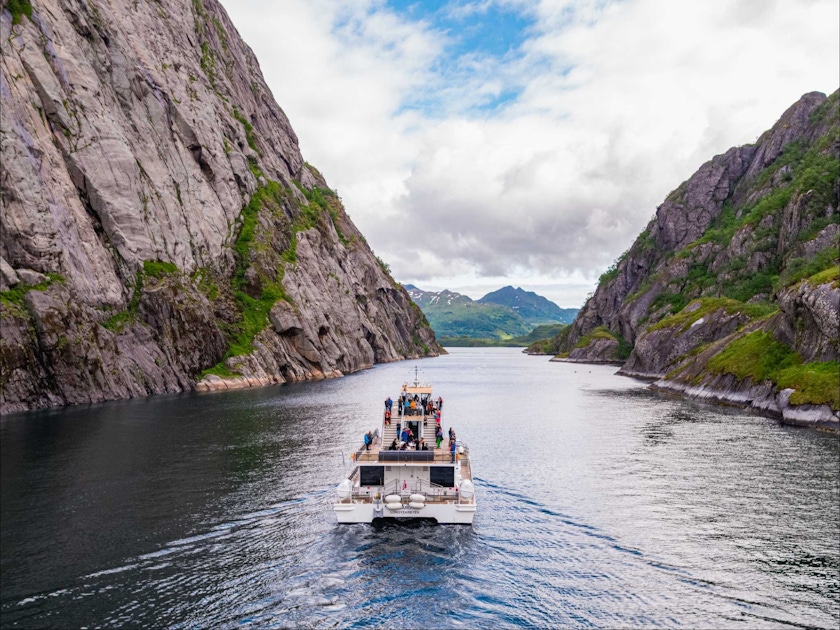
Trollfjord, or Trollfjorden, is the headline fjord experience from Svolvær. It is a narrow, dramatic side fjord reached by boat through the Raftsundet area. The entrance is famously tight, with steep mountains rising sharply from the water and a sense of entering a hidden natural amphitheatre.
The fjord is not long, but it feels powerful because of the scale. Boats glide between cliffs, waterfalls, high peaks and dark water. On some trips, passengers may also see white-tailed sea eagles soaring overhead or diving near the boat.
Why Trollfjord is special
It is one of the most dramatic short fjords in northern Norway.
The entrance is narrow, making the arrival feel cinematic.
Mountains rise steeply from the water, creating a strong sense of scale.
It is accessible by boat from Svolvær.
It is linked with sea eagle safaris and Lofoten wildlife experiences.
It is beautiful in both summer and winter.
It works well for travellers who want a memorable half-day activity.
Common ways to visit Trollfjord
Tour Type
Best For
Traveller Notes
Silent electric or hybrid fjord cruise
Comfort, photography, calmer sightseeing
Good for travellers who prefer warmth, space and slower viewing.
RIB sea eagle safari
Speed, adventure, wildlife and close-to-the-elements feeling
Usually colder and bumpier, but very exciting.
Classic boat cruise
General sightseeing and families
Check whether indoor seating, toilets and refreshments are included.
Kayak tour
Active travellers and quiet water-level views
Usually seasonal and weather-dependent.
Coastal cruise ship passage
Travellers on Hurtigruten or Havila-style routes
Large ships may enter or view the fjord only when conditions and schedule allow.
Best Fjord Experiences from Svolvær
1. Trollfjord Cruise
A Trollfjord cruise is the easiest and most iconic fjord experience from Svolvær. Choose a comfortable sightseeing boat if you want more shelter from wind and weather, especially in winter.
2. Sea Eagle Safari
Sea eagle safaris usually travel by fast RIB boat toward Trollfjord and surrounding waters. The trip combines mountain scenery, local stories, cold sea air and the chance to see white-tailed sea eagles.
3. Silent Electric Boat Cruise
A silent or hybrid-electric fjord cruise is ideal if you want a slower and quieter trip. It is especially good for photography, families, older travellers and anyone who prefers comfort over speed.
4. Kayaking from Svolvær
Kayaking gives a water-level view of the harbour, islands and surrounding mountains. Guided tours are best for visitors unfamiliar with Arctic waters, currents and weather changes.
5. Fishing Trip
Fishing is central to Lofoten’s identity. A fishing trip from Svolvær can connect the scenery with the region’s cod-fishing history and modern coastal life.
6. Winter Fjord Cruise
Winter fjord cruises can be cold but spectacular. Snow-covered peaks, blue light, dark water and fewer crowds create a completely different mood from summer.
7. Midnight Sun Season Cruise
In summer, long daylight and the midnight sun season create soft evening light over the fjords. This is one of the best times for photography and relaxed sightseeing.
8. Harbour Walk and Photography
You do not need a boat to enjoy Svolvær’s scenery. The harbour, rorbuer-style buildings, fishing boats, mountain backdrop and reflections are excellent for walking and photography.
Sea Eagles and Wildlife Around Svolvær
The white-tailed sea eagle is one of the star wildlife species around Svolvær and Trollfjord. These large birds are often seen gliding above the water, circling cliffs or diving near boats during guided safaris.
Wildlife sightings are never completely guaranteed, but the Trollfjord and Raftsundet area is well known for sea eagle activity. Some tours are specifically designed around finding and viewing them responsibly.
Wildlife you may see
White-tailed sea eagles – the main wildlife highlight on many trips.
Seabirds – gulls, cormorants and other coastal birds.
Seals – possible around rocky shores and quieter waters.
Porpoises or whales – possible but not guaranteed.
Cod and other fish – important to the region’s fishing culture.
Responsible wildlife tips
Choose operators that respect wildlife and local rules.
Do not shout at birds or animals to force movement.
Use a zoom lens rather than demanding closer approaches.
Follow guide instructions around feeding demonstrations or viewing protocols.
Avoid disturbing nesting areas, cliffs and shoreline habitats.
Best Time to Visit Lofoten Svolvær Fjord
Svolvær and the surrounding fjords can be visited year-round, but the experience changes sharply by season. Summer brings long daylight, easier roads and greener landscapes. Winter brings snow, northern lights potential and dramatic Arctic light.
Season
What to Expect
Advice
Winter
Snowy mountains, blue light, northern lights potential, colder boat trips
Dress very warmly and choose tours with good thermal gear.
Spring
Longer days, snow on peaks, changing weather and fishing culture
Good for photography and fewer crowds than summer.
Summer
Midnight sun season, long daylight, warmer tours and busy roads
Book accommodation and tours early.
Autumn
Moody light, fewer crowds, possible northern lights later in season
Bring rain and wind protection.
If your priority is fjord cruising, summer and early autumn are easier. If your priority is dramatic Arctic atmosphere, winter can be unforgettable, but you need warmer clothing and flexible plans.
Things to Do Near Svolvær
Svolvær Harbour
Svolvær Harbour is the town’s centrepiece, with fishing boats, tour boats, restaurants, rorbuer-style buildings and mountain views. It is especially photogenic at sunrise, sunset, blue hour and in winter light.
Svolværgeita
Svolværgeita, meaning “the Svolvær Goat”, is a distinctive twin-peaked mountain formation above the town. It is famous among climbers and easily recognised from around Svolvær.
Kabelvåg
Kabelvåg is a historic village near Svolvær with cultural sites, harbour views and links to Lofoten’s fishing heritage. It is a good short trip by car or bus.
Henningsvær
Henningsvær is one of Lofoten’s most photogenic fishing villages, famous for its harbour, galleries, cafés and island football pitch. It is an easy day trip from Svolvær.
Lofoten War Memorial Museum
The Lofoten War Memorial Museum in Svolvær is useful for visitors interested in World War II history, coastal Norway and local wartime stories.
Magic Ice Lofoten
Magic Ice is an ice bar and gallery-style attraction in Svolvær. It can be a fun indoor stop in poor weather.
Lofotpils Brewery
Lofotpils is a local brewery in Svolvær and can be a good stop for adults interested in local craft beer and harbour-town atmosphere.
Austnesfjorden Viewpoint
Austnesfjorden is a scenic viewpoint north-east of Svolvær, useful for photography, road-trip stops and fjord views from land.
Suggested Lofoten Svolvær Fjord Itinerary Ideas
Option 1: Classic Svolvær Fjord Day
Morning: Walk around Svolvær harbour and photograph the waterfront.
Midday: Join a Trollfjord cruise or silent electric boat trip.
Afternoon: Return to Svolvær for lunch or coffee.
Evening: Visit a local restaurant, brewery or harbour viewpoint.
Option 2: Sea Eagle Safari and Henningsvær Day
Morning: Take a RIB sea eagle safari from Svolvær to Trollfjord.
Lunch: Warm up in Svolvær after the boat trip.
Afternoon: Drive to Henningsvær for galleries, harbour views and cafés.
Evening: Return to Svolvær or stay in Henningsvær.
Option 3: Winter Svolvær Fjord Experience
Morning: Take a winter fjord cruise or sea eagle safari, weather permitting.
Afternoon: Visit Magic Ice, a museum or a café if the weather turns.
Evening: Watch for northern lights from a dark location away from town lights.
Night: Stay in Svolvær for easy tour access the next day.
Option 4: Summer Midnight Sun Route
Daytime: Explore Svolvær, Kabelvåg and nearby viewpoints.
Late afternoon: Join a fjord cruise or kayaking tour if available.
Evening: Drive or walk to a west-facing viewpoint for long Arctic light.
Late night: Photograph harbour reflections under the midnight sun season glow.
Option 5: Family-Friendly Svolvær Plan
Morning: Choose a comfortable boat cruise rather than a fast RIB if travelling with young children.
Lunch: Eat near the harbour.
Afternoon: Visit an indoor attraction, gallery or short viewpoint walk.
Evening: Keep dinner close to your accommodation.
Where to Stay in Svolvær
Area
Best For
Traveller Notes
Svolvær harbour
Tour departures, restaurants, easy walking
Best for first-time visitors and those without a car.
Svinøya
Rorbuer-style stays, harbour views, atmosphere
Good for classic Lofoten accommodation close to town.
Better for travellers wanting a more scenic village stay.
Accommodation in Lofoten can book out early, especially in summer and northern lights season. Reserve ahead if you want harbour views, rorbuer cabins or easy walking access to tour departures.
Useful Booking Resources for Lofoten Svolvær Fjord Tours and Norway Travel
Svolvær fjord activities can be booked locally or online, but advance booking is recommended for summer, northern lights season, cruise-ship call days and popular Trollfjord departures. The suppliers below are useful places to compare tour times, boat types, inclusions and cancellation rules. Skimlinks may automatically convert these merchant links into affiliate links if the merchant is active in your Skimlinks account.
GetYourGuide – offers Svolvær Trollfjord cruises, sea eagle safaris, silent electric boat tours, northern lights activities, Lofoten day trips and Norway travel experiences.
Klook – offers Norway and Europe activities, attraction tickets, transport products, SIM/eSIM options and selected Lofoten experiences depending on availability.
KKday – offers local tours, activity tickets, transfers and Europe travel products that may be useful for comparing Norway and Arctic travel add-ons.
Tiqets – offers mobile-friendly tickets for attractions, museums and landmarks. It is more useful for city-based sightseeing before or after a Lofoten trip.
Musement – offers city tours, attraction tickets, cultural activities and local experiences, useful for comparing Norway and wider Europe travel options.
G Adventures – offers small-group and multi-day Norway or Arctic-style tours that may suit travellers planning a broader Scandinavia itinerary rather than a standalone Svolvær fjord trip.
Go City – offers bundled city attraction passes in selected destinations. It is not a main Svolvær booking option, but it can help readers planning city stopovers before or after Norway.
CityPASS – offers bundled attraction passes mainly for selected North American cities. It is not designed for Lofoten or Norway, but may suit readers planning wider international travel.
Booking tip: Before booking a Svolvær fjord tour, check the departure point, duration, boat type, whether it enters Trollfjord, whether sea eagle viewing is included, thermal suit availability, toilet access, indoor seating, child rules, weather cancellation policy, guide language, accessibility and whether food or hot drinks are included.
Lofoten Svolvær Fjord Travel Tips
Book Trollfjord tours early
Popular departures can fill quickly, especially in summer, winter northern lights season and cruise-ship periods. Book ahead if your dates are fixed.
Choose the right boat type
A RIB is fast and exciting but colder and more exposed. A larger cruise boat is warmer, more stable and better for families, older travellers and photographers who want comfort.
Dress warmer than you think
Even in summer, it can feel cold on the water. Wear layers, wind protection, gloves and a hat if joining an exposed boat trip.
Protect your camera
Sea spray, rain and wind can affect phones and cameras. Use a dry bag or waterproof cover, especially on RIB safaris.
Be flexible with weather
Lofoten weather changes quickly. Boat trips can be delayed, rerouted or cancelled for safety. Keep spare time in your itinerary.
Check daylight in winter
Winter light is beautiful but limited. Choose daytime tours carefully and do not overpack the schedule.
Use Svolvær as a practical base
Svolvær is convenient for tours, food and transport. It is not the only beautiful place in Lofoten, but it is one of the easiest bases for fjord activities.
Respect local life
Lofoten is a living fishing region, not only a tourist backdrop. Respect private property, working harbours, fishing gear and residential areas.
Do not rely only on public transport
Public transport exists but can be limited for flexible sightseeing. Rent a car if you want to explore villages, beaches and viewpoints beyond Svolvær.
Stay more than one night if possible
A single night gives little room for weather delays. Two or three nights in Svolvær or nearby makes fjord tours, road trips and photography easier.
Is Lofoten Svolvær Fjord Worth Visiting?
Yes, Lofoten Svolvær Fjord is absolutely worth visiting if you want an accessible Arctic fjord experience with dramatic mountains, harbour scenery, Trollfjord cruises and sea eagle safaris. It is one of the easiest places in Lofoten to step from town directly onto a world-class fjord tour.
It may not suit travellers looking for a completely remote village with no tourism infrastructure. Svolvær is a working town and activity hub, which is exactly why it is so useful as a base.
The best way to enjoy it is to stay in or near Svolvær, book a Trollfjord cruise or sea eagle safari, allow flexibility for weather, and combine the fjord experience with nearby villages such as Kabelvåg and Henningsvær.
FAQs About Lofoten Svolvær Fjord
What is Lofoten Svolvær Fjord?
Lofoten Svolvær Fjord usually refers to the fjord, harbour and coastal scenery around Svolvær in the Lofoten Islands, plus nearby boat-trip destinations such as Trollfjord.
Where is Svolvær?
Svolvær is in the Lofoten Islands in northern Norway, on the island of Austvågøya. It is one of Lofoten’s main towns and activity bases.
Can you visit Trollfjord from Svolvær?
Yes. Svolvær is one of the best departure points for Trollfjord cruises, silent boat tours and sea eagle safaris.
How long is a Trollfjord cruise from Svolvær?
Tour lengths vary. RIB sea eagle safaris are often around 2 hours, while larger sightseeing or silent fjord cruises can take around 3 hours or more depending on the operator and route.
Can you see sea eagles near Svolvær?
Yes. White-tailed sea eagles are commonly associated with Trollfjord and the waters around Svolvær. Sightings are likely on dedicated sea eagle safaris but never completely guaranteed.
Is a RIB safari or silent cruise better?
A RIB safari is better for speed, excitement and close-to-the-elements adventure. A silent or larger cruise boat is better for comfort, photography, families and colder weather.
What is the best season for Svolvær fjord cruises?
Summer is easiest for long daylight and milder weather. Winter is colder but dramatic, with snow-covered mountains, blue light and northern lights potential.
Is Svolvær a good base for Lofoten?
Yes. Svolvær is a practical base with accommodation, restaurants, tour departures, transport links and easy access to nearby fjord trips and villages.
Do you need a car in Svolvær?
You can join fjord tours and walk around Svolvær without a car, but a car is very useful for exploring Henningsvær, Kabelvåg, beaches, viewpoints and the wider Lofoten road route.
Is Lofoten Svolvær Fjord worth visiting?
Yes. It is one of the most accessible and rewarding places in Lofoten for fjord scenery, Trollfjord cruises, sea eagle safaris, harbour photography and Arctic coastal atmosphere.
Sponsored Popular Items
Quick take: Musement.com offers a worldwide selection of tours and attractions
Lofoten Winter Photography Tour Norway Planning Lofoten Winter Photography Tour For a guided sightseeing experience, compare the itinerary and logistics so the tour fits comfortably with the rest of your plans. Check current availability, inclusions and booking details before you go.
Winter Photography Tour of the Lofoten Archipelago Norway Take unique and unrepeatable pictures Lofoten archipelago and discover the islands that continue to inspire artists from all over the world on your winter photography tour with you ticket from Musement. Check current availability, inclusions and booking details before you go.
Svolvær Cruises, Boat Tours & Water Experiences Guide Norway Svolvær is a principal Lofoten base, combining a working fishing harbour, steep mountains, cod-fishing heritage and cruises toward Trollfjord and coastal villages. Check current availability, inclusions and booking details before you go.
Shanghai Suzhou Creek, also known as the Suzhou River or 苏州河, is one of the most atmospheric waterways in the city. Flowing through central Shanghai before meeting the Huangpu River near the Bund, it links old warehouses, steel bridges, historic banks, art museums, former factories, residential lanes, public parks and some of Shanghai’s best urban walking routes.
For many travellers, the Huangpu River gets all the attention because of the Bund and the Lujiazui skyline. But Suzhou Creek tells a more intimate story. It shows Shanghai as a working port, industrial city, trading hub, wartime city, creative capital and modern waterfront destination.
Today, the creek is one of Shanghai’s best places for a relaxed city walk. You can start near Waibaidu Bridge, pass the Shanghai Postal Museum, continue toward Sihang Warehouse, explore the revived Suhewan area, or head farther west toward M50 Art District and Moganshan Road.
Quick take: Musement.com offers a worldwide selection of tours and attractions
Ho Chi Minh Airport Transfer to Districts 1, 3 and 10 - Travel Service Vietnam Ho Chi Minh Airport Transfer to Districts 1, 3 and 10 Ho Chi Minh Airport Transfer to Districts 1, 3 and 10 is designed to simplify transport in or around Ho Chi Minh City. Check current availability, inclusions and booking details before you go.
Why Visit Shanghai Suzhou Creek?
Suzhou Creek is worth visiting because it gives you a different view of Shanghai from the usual Bund skyline. The creek is quieter, more layered and more local. It has old bridges, riverside apartment blocks, restored warehouses, industrial heritage sites, art galleries, cafés, museums and everyday neighbourhood life.
This is where Shanghai’s past and present sit side by side. You can walk past historic buildings linked with finance, shipping, printing, flour mills, wartime memory and modern art. Then, within minutes, you can reach contemporary cafés, boutique galleries and newly landscaped riverfront paths.
Suzhou Creek is best for:
Travellers who enjoy city walks and urban photography
Visitors interested in Shanghai history beyond the Bund
People looking for a quieter riverside route
Art lovers visiting M50, Fotografiska Shanghai, Rockbund or Suhewan
Architecture fans interested in bridges, warehouses and Art Deco buildings
Couples wanting a relaxed sunset or evening walk
Repeat visitors who want a more local Shanghai experience
Where Is Suzhou Creek?
Suzhou Creek flows through several districts of Shanghai and joins the Huangpu River near the Bund and North Bund area. The most visitor-friendly section is the central stretch between Waibaidu Bridge, Shanghai Postal Museum, Sihang Warehouse, Suhewan and M50 Art District.
Location Detail
Traveller Notes
English names
Suzhou Creek / Suzhou River
Chinese name
苏州河
Historic name
Wusong River
City
Shanghai, China
Where it meets the Huangpu
Near Waibaidu Bridge, the Bund and North Bund
Best visit style
Self-guided walk, heritage walk, photography route, gallery day or short sightseeing cruise
The creek can be explored in sections. First-time visitors usually enjoy the stretch from Waibaidu Bridge to Sihang Warehouse because it is central, historic and easy to combine with the Bund.
What to Expect Along Shanghai Suzhou Creek
Expect a mix of old and new Shanghai. Some parts of the creek feel polished and redeveloped, with smooth riverside paths, new landscaping and restored heritage buildings. Other sections feel more local, with apartment blocks, bridges, quiet streets and neighbourhood life.
The experience is more about walking, looking and connecting places than visiting one single attraction. Suzhou Creek rewards slow travel. Stop at bridges, look back toward the skyline, notice old brick warehouses, photograph reflections, step into galleries and take breaks at cafés or public seating areas.
What you may find
Historic steel bridges and old river crossings
Restored warehouses and former industrial buildings
Shanghai Postal Museum and General Post Office architecture
Sihang Warehouse Battle Memorial Museum
M50 Art District and Moganshan Road galleries
Modern art museums and creative spaces
Riverside walking and cycling paths
Views toward the Bund and Lujiazui skyline
Quiet local neighbourhoods beside busy central Shanghai
What not to expect
Do not expect one single entrance or ticketed attraction called “Suzhou Creek”.
Do not expect every section to be equally scenic.
Do not expect all museums or galleries to open daily.
Do not assume the creek is as grand or wide as the Huangpu River.
Do not expect a long tourist promenade everywhere; some routes require street crossings.
Do not rush it. The creek is best enjoyed as a slow city walk.
Best Suzhou Creek Walking Routes
Route 1: Waibaidu Bridge to Sihang Warehouse
This is one of the best first-time Suzhou Creek walks. Start near Waibaidu Bridge, where Suzhou Creek meets the Huangpu River, then walk west along the riverfront toward the Shanghai Postal Museum, historic bridges and Sihang Warehouse.
Best for: first-time visitors, history, photography and classic Shanghai views
Time needed: about 1 to 2 hours at a relaxed pace
Highlights: Waibaidu Bridge, General Post Office, river views, Sihang Warehouse
Route 2: Suhewan and Sihang Warehouse Heritage Walk
This route focuses on the revived Suhewan area, a waterfront district where historic buildings, shopping, public spaces and river views come together. It is a good option if you want a compact walk with food, shopping and heritage nearby.
Best for: easy walking, cafés, shopping, riverfront photos and wartime history
Time needed: about 2 to 3 hours including stops
Highlights: Suhewan, Sihang Warehouse, riverside paths and restored buildings
Route 3: M50 Art District and Moganshan Road
This route is best for art lovers. M50 Art District sits near Suzhou Creek in a former industrial area and is known for galleries, studios, street art, cafés and creative spaces.
Best for: contemporary art, galleries, street art and creative Shanghai
Time needed: about 2 to 4 hours depending on gallery visits
Highlights: M50 galleries, Moganshan Road, industrial buildings and creek views
Route 4: Photography Walk from M50 to the Bund
For strong visual variety, walk from M50 east toward the Bund. This longer route gives you industrial buildings, bridges, apartment blocks, reflective water views, old warehouses and finally the dramatic meeting point of Suzhou Creek and the Huangpu River.
Best for: photographers and repeat Shanghai visitors
Time needed: half day if you stop for photos, cafés and galleries
Highlights: M50, bridges, Suzhou Creek bends, Sihang Warehouse, Waibaidu Bridge
Best Places to See Along Suzhou Creek
Waibaidu Bridge
Waibaidu Bridge, also called Garden Bridge, is one of Shanghai’s most recognisable historic bridges. It stands near the point where Suzhou Creek meets the Huangpu River and gives excellent views toward the Bund, North Bund and Lujiazui skyline.
Shanghai Postal Museum
The Shanghai Postal Museum occupies the impressive former General Post Office building. Its clock tower, grand façade and riverside position make it one of the best heritage landmarks along Suzhou Creek.
Sihang Warehouse
Sihang Warehouse is one of the most important historical sites along Suzhou Creek. It is strongly associated with the 1937 defence of the warehouse during the Battle of Shanghai and now functions as a memorial site and heritage landmark.
Suhewan
Suhewan is a redeveloped riverside area around Suzhou Creek with public space, shopping, restored buildings and modern urban design. It is a good place for visitors who want a polished, easy-to-walk section of the creek.
M50 Art District
M50 Art District on Moganshan Road is one of Shanghai’s best-known creative areas. Set in former industrial buildings near Suzhou Creek, it has galleries, studios, murals, design shops and cafés.
Zhapu Road Bridge
Zhapu Road Bridge is a popular photo spot because it frames views of Suzhou Creek, historic buildings and the modern skyline beyond. It is especially attractive around sunset or evening.
Zhejiang Road Bridge
Zhejiang Road Bridge is another photogenic crossing over Suzhou Creek, especially at night when bridge lights reflect in the water.
Rockbund
Rockbund sits close to the Bund and Suzhou Creek area. It combines restored heritage buildings, art spaces, lifestyle venues and architecture that reflects Shanghai’s early 20th-century international character.
Fotografiska Shanghai
Fotografiska Shanghai is a contemporary photography museum located in a restored historic building along Suzhou Creek. It is a strong stop for travellers interested in photography, exhibitions and adaptive reuse of old architecture.
North Bund Waterfront
The North Bund is close to the creek’s mouth and gives some of the best views of the Bund and Lujiazui skyline. It pairs well with a Suzhou Creek walk that begins or ends at Waibaidu Bridge.
Famous Bridges Over Suzhou Creek
Bridges are one of the best features of Suzhou Creek. Each crossing gives a different angle on Shanghai’s architecture, river life and skyline. Some are historic steel bridges, while others are newer or rebuilt structures with modern lighting.
Bridge
Best For
Traveller Notes
Waibaidu Bridge
Classic Shanghai photos and skyline views
Best near sunrise, sunset or evening lights.
Zhapu Road Bridge
Photography and river perspective
Good for views toward historic buildings and modern towers.
Sichuan Road Bridge
Central access and creek views
Useful when walking between the Bund area and Suzhou Creek.
Zhejiang Road Bridge
Night reflections and illuminated structure
Especially attractive after dark.
Xizang Road Bridge
Sihang Warehouse and Suhewan access
Useful for heritage walks around the central creek.
Changping Road Bridge
Western walking routes and local neighbourhood feel
Good if exploring beyond the most touristy central section.
Art, Museums and Creative Spaces Around Suzhou Creek
Suzhou Creek has become one of Shanghai’s most interesting art and culture corridors. Former warehouses and industrial sites have been restored or converted into galleries, museums, creative offices, design spaces, cafés and cultural venues.
Best art and culture stops
M50 Art District – galleries, studios, murals and creative spaces in former industrial buildings.
Fotografiska Shanghai – contemporary photography exhibitions in a restored riverside building.
Rockbund Art Museum – contemporary art in a historic area near the Bund and Suzhou Creek.
Sihang Warehouse Battle Memorial Museum – wartime history and Shanghai memory.
Shanghai Postal Museum – postal history, architecture and creekside heritage.
Suhe Haus and Suhewan spaces – restored buildings, cultural venues and modern riverfront design.
Check opening hours before visiting galleries or museums. Some are closed on Mondays, between exhibitions, or during private events.
Best Time to Visit Shanghai Suzhou Creek
Suzhou Creek can be visited year-round, but spring and autumn are the most comfortable seasons for walking. Summer can be hot and humid, while winter can be cold and grey but atmospheric.
Time
Best For
Advice
Morning
Quiet walking and softer light
Good for photography and avoiding crowds.
Afternoon
Museums, cafés and galleries
Best if combining the creek with art spaces.
Golden hour
Warm light, bridge photos and skyline views
One of the prettiest times to walk the creek.
Evening
Bridge lights and reflections
Good around Waibaidu Bridge, Zhapu Road Bridge and Zhejiang Road Bridge.
Rainy days
Moody photography and museum stops
Bring an umbrella and wear shoes with grip.
Suggested Shanghai Suzhou Creek Itinerary Ideas
Option 1: Classic 2-Hour Suzhou Creek Walk
Start: Waibaidu Bridge near the Bund.
Stop 1: Photograph the bridge, creek mouth and Lujiazui skyline.
Stop 2: Walk toward the Shanghai Postal Museum.
Stop 3: Continue west along the riverside path.
Finish: Visit Sihang Warehouse and nearby Suhewan.
Option 2: Art and Heritage Half-Day
Morning: Start at M50 Art District and visit galleries.
Lunch: Eat near Moganshan Road or Suhewan.
Afternoon: Walk east along Suzhou Creek toward Sihang Warehouse.
Late afternoon: Continue toward the Postal Museum and Waibaidu Bridge.
Evening: Finish at the Bund or North Bund for skyline views.
Option 3: Shanghai History Walk
Start: Sihang Warehouse Battle Memorial Museum.
Next: Walk the creekside to see former warehouses and riverfront buildings.
Continue: Visit the Shanghai Postal Museum.
Finish: Cross Waibaidu Bridge and continue to the Bund.
Option 4: Photography Route
Late afternoon: Begin at M50 or Suhewan.
Golden hour: Walk east, stopping at bridges for reflections and skyline views.
Sunset: Photograph Waibaidu Bridge and the creek mouth.
Night: Continue to the Bund and North Bund for city lights.
Option 5: Easy First-Time Shanghai Combination
Morning: Visit the Bund.
Midday: Walk to Waibaidu Bridge and Suzhou Creek.
Afternoon: Explore the Postal Museum, Suhewan or Sihang Warehouse.
Evening: Return to the Bund or Nanjing Road for dinner and lights.
Useful Booking Resources for Shanghai Suzhou Creek Walks, Cruises and City Tours
Suzhou Creek can be explored independently, but guided walks and city tours are useful if you want deeper context about Shanghai’s bridges, warehouses, wartime history, finance buildings, art districts and riverfront redevelopment. The suppliers below are useful places to compare travel products. Skimlinks may automatically convert these merchant links into affiliate links if the merchant is active in your Skimlinks account.
GetYourGuide – offers Shanghai walking tours, Suzhou Creek heritage routes, Bund tours, food tours, private guides, architecture walks and selected city cruise experiences.
Viator – offers Shanghai private tours, Bund and Suzhou Creek-style walks, food experiences, museum routes, architecture tours, transfers and customisable city itineraries.
Klook – offers Shanghai attraction tickets, city tours, river cruises, transport products, SIM/eSIM options and China travel add-ons useful for exploring Shanghai independently.
KKday – offers Shanghai local tours, attraction tickets, transport services, private guides and China travel products depending on current availability.
Tiqets – offers mobile-friendly tickets for museums, attractions and landmarks, useful for combining Suzhou Creek with Shanghai museums and observation decks.
Musement – offers city tours, attraction tickets, cultural activities and local experiences, useful for comparing Shanghai sightseeing and broader China travel options.
G Adventures – offers small-group and multi-day China tours that may include Shanghai as part of a broader itinerary rather than a standalone Suzhou Creek walk.
Go City – offers bundled city attraction passes in selected destinations. It is not a main Suzhou Creek booking option, but it can help readers planning multi-city stopovers before or after China.
CityPASS – offers bundled attraction passes mainly for selected North American cities. It is not designed for Shanghai, but may suit readers planning wider international travel.
Booking tip: Before booking a Suzhou Creek tour, check whether the route includes Waibaidu Bridge, Sihang Warehouse, Shanghai Postal Museum, M50 Art District, Rockbund, Suhewan, a river cruise, English-speaking guide, hotel pickup, museum tickets, food stops, cancellation rules and exact meeting point. If you are walking independently, check museum and gallery opening hours before you go.
Shanghai Suzhou Creek Travel Tips
Start near Waibaidu Bridge if it is your first visit
This gives you the strongest introduction because you can see where Suzhou Creek meets the Huangpu River, then continue into the creek’s historic waterfront.
Wear comfortable shoes
Suzhou Creek is best explored on foot. Expect riverside paths, bridges, street crossings and occasional detours around construction or private developments.
Use the metro
Useful stations for different sections include Tiantong Road, Qufu Road, Hanzhong Road, Shanghai Railway Station and nearby Bund-area stations, depending on your route.
Check museum opening days
Many museums and galleries in Shanghai close on Mondays or between exhibitions. Check before building your day around one venue.
Visit at golden hour for photos
Late afternoon and early evening are excellent for bridge reflections, skyline views and warmer light on the riverfront buildings.
Bring a camera or phone with good low-light performance
The creek is beautiful at night, especially around illuminated bridges and reflections.
Do not confuse it with Suzhou city
Suzhou Creek is in Shanghai. It is not the same as the city of Suzhou in Jiangsu Province, although the name is historically connected.
Combine with the Bund
The eastern end of Suzhou Creek connects naturally with the Bund, North Bund and Lujiazui skyline views.
Allow time for cafés and galleries
The creek is not a checklist destination. It is better when you stop, sit, browse exhibitions and watch local life.
Respect residential areas
Some riverfront sections pass close to apartment buildings and local neighbourhoods. Keep noise down and avoid photographing residents closely without permission.
Is Shanghai Suzhou Creek Worth Visiting?
Yes, Shanghai Suzhou Creek is worth visiting, especially if you enjoy history, architecture, art, bridges and riverside city walks. It gives a more layered view of Shanghai than the Bund alone and helps visitors understand how the city developed from a trading and industrial centre into a modern cultural capital.
It may not suit travellers who want one single landmark or a fast sightseeing stop. Suzhou Creek is best experienced slowly, as a connected route of bridges, warehouses, museums, galleries and everyday riverfront life.
The best way to enjoy it is to start at Waibaidu Bridge, walk west toward the Postal Museum and Sihang Warehouse, continue to Suhewan or M50 if time allows, and finish with sunset or evening views back toward the Bund.
FAQs About Shanghai Suzhou Creek
What is Shanghai Suzhou Creek?
Shanghai Suzhou Creek, also called Suzhou River, is a historic waterway running through central Shanghai before joining the Huangpu River near the Bund.
Is Suzhou Creek the same as Suzhou city?
No. Suzhou Creek is in Shanghai. Suzhou city is a separate city in Jiangsu Province, famous for gardens and canals.
Where is the best place to start a Suzhou Creek walk?
Waibaidu Bridge is one of the best starting points for first-time visitors because it sits near the meeting point of Suzhou Creek and the Huangpu River, close to the Bund.
What can you see along Suzhou Creek?
You can see historic bridges, Shanghai Postal Museum, Sihang Warehouse, Suhewan, M50 Art District, former industrial buildings, art galleries, riverside paths and skyline views.
Is Suzhou Creek free to visit?
Yes. Walking along the public riverside areas is free. Museums, galleries, tours, cruises, cafés and private venues may cost extra.
How long do you need for Suzhou Creek?
Allow 1 to 2 hours for a short walk from Waibaidu Bridge to Sihang Warehouse, or half a day if adding M50, galleries, museums and cafés.
Is Suzhou Creek good at night?
Yes. Several bridges and riverside areas are attractive at night, especially around Waibaidu Bridge, Zhapu Road Bridge, Zhejiang Road Bridge and the Bund-side creek mouth.
Can you take a cruise on Suzhou Creek?
Short sightseeing cruises and river experiences may be available depending on current operations. Check schedules, boarding points and routes before planning around a cruise.
What should you combine with Suzhou Creek?
Good combinations include the Bund, North Bund, Rockbund, Shanghai Postal Museum, Sihang Warehouse, Suhewan, M50 Art District and Nanjing Road.
Is Shanghai Suzhou Creek worth visiting?
Yes. It is one of Shanghai’s best areas for walking, photography, heritage buildings, art spaces and seeing a more local side of the city’s waterfront history.
Sponsored Popular Items
Quick take: Musement.com offers a worldwide selection of tours and attractions
Ho Chi Minh Airport Transfer to Districts 1, 3 and 10 - Travel Service Vietnam Ho Chi Minh Airport Transfer to Districts 1, 3 and 10 Ho Chi Minh Airport Transfer to Districts 1, 3 and 10 is designed to simplify transport in or around Ho Chi Minh City. Check current availability, inclusions and booking details before you go.
Taipei Shopping Guide: Night Markets, Malls & Local Shopping Districts Taiwan Vibrant Shopping in Taipei Taipei is a vibrant shopping destination with a wide variety of options ranging from high-end malls to bustling street markets and unique shopping districts. Check current availability, inclusions and booking details before you go.
Kanazawa Night Walking Tour: Samurai & Geisha Districts Best deals for Kanazawa Night Walking Tour: Samurai & Geisha Districts. Discover Kanazawa after dark on a guided walking tour through the Higashi Chaya District, Kazuemachi Chaya District, and Oyama Shrine. Experience the city’s history, culture, and atmosphere at night. Available from getyourguide.com.
Hualien whale watching is one of the best marine wildlife experiences on Taiwan’s east coast. Departing from Hualien Harbor, boat tours head into the deep blue Pacific Ocean in search of dolphins, whales, flying fish and seabirds, with the dramatic Central Mountain Range rising behind the city.
Although the activity is usually called “whale watching”, many visitors are more likely to see dolphins than large whales. Hualien’s offshore waters are known for dolphin activity, and sightings may include spinner dolphins, spotted dolphins or other cetaceans depending on season, weather and sea conditions.
A Hualien whale-watching tour is not just about the animals. It is also about the contrast of mountain and ocean: one side of the boat faces the vast Pacific, while the other looks back toward Hualien’s green mountains, cliffs and coastal plain. For travellers visiting Taroko Gorge, Qixingtan Beach or the East Rift Valley, a whale-watching cruise adds a memorable sea-based experience to the itinerary.
Quick take: Musement.com offers a worldwide selection of tours and attractions
Taiwan Taipei: Quick Photoshoot with Taiwan Photographer Best deals for Taiwan Taipei: Quick Photoshoot with Taiwan Photographer. Welcome to Taipei Taiwan! Say goodbye to selfies, I will be your personal photographer. Let me show you the beauty of Taipei, and capture the best of you! Check my IG: mason.taiwan.photographer Available from getyourguide.com.
Why Go Whale Watching in Hualien?
Hualien is one of Taiwan’s best-known whale and dolphin watching destinations because the deep Pacific waters lie close to shore. Boats do not need to travel for hours before reaching suitable marine-wildlife areas, making the experience easier to fit into a half-day itinerary.
The scenery also makes the cruise special. Hualien sits between the ocean and the mountains, so a whale-watching trip can feel dramatic even before wildlife appears. On clear days, the coastline, clouds and green peaks create a beautiful backdrop behind the boat.
Hualien whale watching is best for:
Travellers interested in dolphins, whales and marine wildlife
Families looking for a half-day nature activity
Couples wanting a scenic Pacific Ocean experience
Visitors combining Hualien with Taroko Gorge or Qixingtan Beach
Photographers wanting ocean, dolphins and mountain views
People who enjoy boat trips and coastal scenery
Travellers visiting Taiwan’s east coast between spring and autumn
Where Do Hualien Whale-Watching Tours Depart?
Most Hualien whale-watching tours depart from Hualien Harbor, also called Hualien Port. The harbor is close to Hualien City, making it easy to reach by taxi, hotel transfer, scooter or tour pickup.
Location Detail
Traveller Notes
Main activity
Hualien whale and dolphin watching
Departure point
Hualien Harbor / Hualien Port
City
Hualien City, eastern Taiwan
Sea area
Pacific Ocean off the Hualien coast
Typical duration
About 2 to 3 hours, depending on operator and conditions
Best visit style
Morning cruise, half-day marine wildlife tour or Hualien city add-on
Some tour packages include hotel pickup from Hualien City, while others require you to meet directly at the harbor. Always check the exact pier, check-in time and operator name before the tour date.
What to Expect on a Hualien Whale-Watching Cruise
Expect a practical marine-wildlife boat trip rather than a luxury cruise. After checking in at Hualien Harbor, you board a whale-watching vessel, receive a safety briefing and head out into the Pacific. Crew members or guides usually explain the local marine environment and help scan for wildlife.
The boat may travel for a while before sightings happen. Sometimes dolphins appear quickly; other times the crew may search across different areas. The experience depends heavily on sea conditions, weather, animal movement and luck.
What you may experience
Boat ride from Hualien Harbor into the Pacific Ocean
Views back toward Hualien’s mountains and coastline
Dolphin sightings, especially in suitable season
Possible whale sightings, depending on luck and season
Flying fish or seabirds in warmer months
Guided commentary about marine ecology
Sea spray, wind and strong sun
Some boat movement and possible seasickness
What not to expect
Do not expect whale sightings to be guaranteed.
Do not expect calm seas every day.
Do not expect a long-distance luxury cruise.
Do not expect every operator to provide English commentary.
Do not expect to swim with dolphins or whales.
Do not feed, touch or disturb marine animals.
Whales, Dolphins and Marine Wildlife
Hualien’s tours are often marketed as whale watching, but dolphin sightings are generally more common than large whale sightings. This is normal for many whale-watching destinations. The excitement comes from seeing wild animals in their natural ocean environment, not from a guaranteed checklist.
Marine wildlife you may see
Spinner dolphins – known for energetic movement and sometimes acrobatic spins.
Spotted dolphins – commonly associated with tropical and subtropical waters.
Bottlenose dolphins – possible in some areas, depending on season and movement.
Sperm whales – possible but much less predictable than dolphins.
Pilot whales or other cetaceans – possible but not guaranteed.
Flying fish – sometimes seen gliding over the water.
Seabirds – may follow fish activity or boat movement.
Responsible whale watching matters. Choose operators that follow safe viewing distances, avoid chasing animals and allow dolphins or whales to choose whether they approach the boat.
Best Season for Hualien Whale Watching
The best season for Hualien whale watching is generally from spring to early autumn, with many sources highlighting May to September as peak season and some operators running tours from around April to October. Sea conditions are usually more favourable outside typhoon periods, though weather can still change quickly.
Period
What to Expect
Advice
April
Early season for some operators
Check availability and sea conditions carefully.
May to September
Peak whale and dolphin watching season
Best overall period for most travellers.
July to August
Warm weather, school holidays and possible typhoon disruptions
Book ahead but keep your schedule flexible.
October
Late season for some operators
Availability may vary by company and conditions.
Winter
Fewer whale-watching departures
Look for other Hualien activities if tours are not running.
Morning cruises are often preferred because the sea may be calmer earlier in the day, but this is not guaranteed. Always follow the operator’s weather and sea-condition advice.
Types of Hualien Whale-Watching Tours
Tour Type
Best For
Traveller Notes
Standard whale and dolphin watching cruise
Most visitors
Usually around 2 to 3 hours from Hualien Harbor.
Hotel-transfer package
Travellers without a car or scooter
Useful if staying in Hualien City.
Eco-guided tour
Nature lovers and families
Look for operators with strong marine-ecology commentary.
Private or small-group package
Families, couples or photography-focused travellers
Less common and usually more expensive.
Whale watching plus Hualien day tour
Short-stay visitors
May combine the boat trip with Qixingtan, Taroko Gorge or coastal stops.
When comparing tours, do not only look at price. Check the operator’s safety standards, cancellation policy, guide language, pickup arrangements and whether seasickness advice is provided.
Who Is Hualien Whale Watching Best For?
Families
Hualien whale watching can be a great family activity, especially for children who enjoy animals and boats. Choose a reputable operator, check age rules and bring sun protection, water and seasickness precautions.
Couples
The ocean setting and mountain backdrop make this a scenic half-day experience for couples, especially when paired with Qixingtan Beach or a coastal café afterwards.
Older travellers
Older travellers can enjoy the cruise if they are comfortable boarding a boat and handling possible sea movement. Check boarding access and seating before booking.
Photographers
Bring a zoom lens if possible. Dolphins can move quickly, and the boat may rock. Use a camera strap and protect gear from spray.
Travellers prone to seasickness
Think carefully before booking. The Pacific can be choppy, and some people feel unwell once the boat slows or turns while searching for wildlife.
Things to Do Near Hualien Whale Watching
Qixingtan Beach
Qixingtan Beach is one of the best nearby stops after a whale-watching trip. It is known for its pebble shoreline, blue water, mountain backdrop and cycling paths.
Hualien Harbor
Hualien Harbor is the main departure point for whale-watching tours. Some areas nearby have seafood restaurants, harbor views and access to coastal roads.
Taroko Gorge
Taroko Gorge is Hualien’s most famous attraction, known for marble cliffs, river scenery, tunnels, shrines and walking trails. It is best done as a separate day or combined only with a light whale-watching schedule.
Dongdamen Night Market
Dongdamen Night Market is one of Hualien City’s main evening food stops. It is a good place for grilled foods, local snacks, drinks and casual dinner after a morning or afternoon cruise.
Pine Garden
Pine Garden is a historic cultural site in Hualien City with old buildings, pine trees and views toward the coast.
Pacific Park
Pacific Park is useful for a relaxed oceanfront walk, especially if you want a simple city-based coastal stop.
Liyu Lake
Liyu Lake is south of Hualien City and works well for a gentle afternoon if you want a quieter freshwater landscape after the ocean.
East Coast Scenic Route
Travellers with more time can continue south along Taiwan’s east coast for sea cliffs, beaches, indigenous culture, small fishing harbours and coastal viewpoints.
Suggested Hualien Whale Watching Itinerary Ideas
Option 1: Simple Half-Day Whale Watching Plan
Morning: Travel to Hualien Harbor and check in for your cruise.
Mid-morning: Join the whale and dolphin watching boat tour.
Midday: Return to the harbor and have lunch in Hualien City.
Afternoon: Visit Qixingtan Beach or Pacific Park.
Option 2: Whale Watching and Qixingtan Day
Morning: Take a whale-watching cruise from Hualien Harbor.
Lunch: Eat seafood or local food near the city.
Afternoon: Walk or cycle around Qixingtan Beach.
Evening: Visit Dongdamen Night Market for dinner.
Option 3: Taroko Gorge and Whale Watching Two-Day Plan
Day 1: Visit Taroko Gorge, including Shakadang Trail, Swallow Grotto or other open sections.
Day 1 evening: Eat at Dongdamen Night Market.
Day 2 morning: Join a Hualien whale-watching cruise.
Day 2 afternoon: Relax at Qixingtan Beach before leaving Hualien.
Option 4: Family-Friendly Hualien Plan
Morning: Choose an earlier cruise if sea conditions are suitable.
After cruise: Keep the afternoon easy with Qixingtan Beach or a short city stop.
Evening: Have a relaxed dinner rather than overpacking the day.
Backup plan: Prepare an indoor or city activity in case the cruise is cancelled by weather.
Option 5: Photography-Focused Hualien Route
Early morning: Photograph Hualien’s coastline or Qixingtan Beach.
Morning cruise: Join whale watching with a zoom lens and camera strap.
Afternoon: Capture mountain and ocean views from the coastal road.
Evening: Photograph food and night-market scenes at Dongdamen.
Useful Booking Resources for Hualien Whale Watching and Taiwan Tours
Hualien whale-watching tours can be booked locally or online. Advance booking is useful during peak season, weekends, school holidays and if you need hotel pickup. The suppliers below are useful places to compare tour times, inclusions and cancellation rules. Skimlinks may automatically convert these merchant links into affiliate links if the merchant is active in your Skimlinks account.
Viator – offers Hualien whale and dolphin watching tours, Taroko Gorge day trips, private Taiwan tours, transfers and customisable east coast itineraries.
Klook – offers Hualien whale-watching tours, Taiwan attraction tickets, Taroko activities, transport products, SIM/eSIM options and Hualien travel add-ons.
KKday – offers Hualien half-day whale and dolphin watching tours, guided ecology cruises, hotel-transfer options, Taiwan activities and local transport products.
Tiqets – offers mobile-friendly tickets for attractions, museums and landmarks. It is more useful for city-based sightseeing before or after a Hualien trip.
Musement – offers tours, attraction tickets, cultural activities and local experiences. It can help travellers compare Taiwan and broader Asia travel options.
G Adventures – offers small-group and multi-day tours that may suit travellers planning a broader Taiwan itinerary rather than a standalone Hualien whale-watching cruise.
Go City – offers bundled city attraction passes in selected destinations. It is not a main Hualien booking option, but it can help readers planning multi-city stopovers before or after Taiwan.
CityPASS – offers bundled attraction passes mainly for selected North American cities. It is not designed for Hualien or Taiwan, but may suit readers planning wider international travel.
Booking tip: Before booking a Hualien whale-watching tour, check the exact harbor meeting point, cruise duration, hotel pickup, guide language, child rules, seasickness advice, life jacket policy, cancellation rules, bad-weather arrangements and whether the operator follows responsible wildlife-viewing practices. Do not assume whale sightings are guaranteed.
Hualien Whale Watching Travel Tips
Book during the main season
For the best chance of favourable conditions, plan your trip between spring and early autumn, with May to September often considered the peak period.
Choose a morning cruise if possible
Morning trips may have calmer conditions, although this is not guaranteed. Check the weather and operator advice before departure.
Take seasickness precautions
If you are prone to motion sickness, take suitable medication before the cruise and avoid a heavy meal right before boarding.
Wear sun protection
The Pacific sun can be strong. Bring sunscreen, sunglasses, hat and lightweight long sleeves.
Bring a light jacket
Even in warm weather, it can feel windy on the water. A light windproof layer is useful.
Use a camera strap
Dolphins move quickly and boats can rock. Secure your phone or camera before leaning over the rail.
Keep expectations realistic
Wildlife sightings vary. Enjoy the ocean, mountain views and marine ecology even if whales do not appear.
Listen to the crew
Follow instructions about seating, viewing, movement on deck and safety. The crew knows how to respond when wildlife appears.
Do not disturb wildlife
Do not shout at animals, throw food, ask the boat to chase them or use drones unless legally permitted and operator-approved.
Keep a backup plan
Boat tours may be cancelled due to weather or sea conditions. Have a backup plan such as Qixingtan Beach, Pine Garden, Dongdamen Night Market or a city café.
Is Hualien Whale Watching Worth It?
Yes, Hualien whale watching is worth it if you enjoy marine wildlife, ocean scenery and nature-based experiences. It is one of the most accessible ways to experience Taiwan’s Pacific coast from the water.
It may not suit travellers who get severe seasickness or expect guaranteed whale sightings. Dolphins are more commonly seen than large whales, and every trip depends on weather, wildlife movement and sea conditions.
The best way to enjoy it is to book with a responsible operator during the main season, choose a suitable time of day, take seasickness precautions if needed and combine the cruise with nearby Hualien highlights such as Qixingtan Beach, Taroko Gorge and Dongdamen Night Market.
FAQs About Hualien Whale Watching
Where do Hualien whale-watching tours depart from?
Most Hualien whale-watching tours depart from Hualien Harbor, also known as Hualien Port, close to Hualien City on Taiwan’s east coast.
When is the best season for Hualien whale watching?
The peak season is generally May to September, although some operators run tours from around April to October depending on sea conditions and demand.
How long does a Hualien whale-watching tour take?
Most tours last around 2 to 3 hours, depending on the operator, route, weather and wildlife-search conditions.
Are whale sightings guaranteed in Hualien?
No. Whales and dolphins are wild animals, so sightings are never guaranteed. Dolphins are generally more commonly seen than large whales.
What animals can you see on a Hualien whale-watching tour?
You may see dolphins, possible whales, flying fish and seabirds. Species can include spinner dolphins, spotted dolphins and, if lucky, larger cetaceans such as sperm whales.
Is Hualien whale watching suitable for children?
Yes, it can be suitable for children who are comfortable on boats. Check age rules, life jackets, sea conditions and seasickness precautions before booking.
Can you get seasick on a Hualien whale-watching tour?
Yes. The Pacific Ocean can be choppy, and some travellers may feel seasick. Take precautions before boarding if you are sensitive to motion.
Should I book Hualien whale watching in advance?
Advance booking is recommended during peak season, weekends and holidays, especially if you need hotel pickup or a specific departure time.
What should I combine with Hualien whale watching?
Good combinations include Qixingtan Beach, Taroko Gorge, Dongdamen Night Market, Pine Garden, Pacific Park and Hualien coastal viewpoints.
Is Hualien whale watching worth it?
Yes, especially for travellers who enjoy dolphins, ocean scenery, marine ecology and Taiwan’s east coast landscapes. It is best enjoyed with realistic expectations and a responsible tour operator.
Sponsored Popular Items
Quick take: Musement.com offers a worldwide selection of tours and attractions
Taiwan Taipei: Quick Photoshoot with Taiwan Photographer Best deals for Taiwan Taipei: Quick Photoshoot with Taiwan Photographer. Welcome to Taipei Taiwan! Say goodbye to selfies, I will be your personal photographer. Let me show you the beauty of Taipei, and capture the best of you! Check my IG: mason.taiwan.photographer Available from getyourguide.com.
Taiwan Taipei: Half-day VIP Photoshoot Taiwan Photographer Best deals for Taiwan Taipei: Half-day VIP Photoshoot Taiwan Photographer. Wanna try local way to travel? Don't worry about the travel plan. Let me choose the iconic spots and hidden gems for you while capturing the best of you! Check my IG: mason.taipei.photographer Available from getyourguide.com.
Taiwan Tainan: Photoshoot with Taiwan Photographer Best deals for Taiwan Tainan: Photoshoot with Taiwan Photographer. Welcome to Tainan Taiwan! Say goodbye to selfies, I will be your personal photographer. Let me show you the beauty of Tainan, and capture the best of you! Check my IG: mason.taipei.photographer Available from getyourguide.com.
Chongqing Three Gorges usually refers to the famous Yangtze River cruise route that begins in the mountain city of Chongqing and sails downstream through the legendary Three Gorges toward Yichang in Hubei. It is one of China’s classic river journeys, combining steep cliffs, ancient poetry, dramatic river bends, temples, small-gorge excursions, modern cruise ships and the enormous Three Gorges Dam project.
The Three Gorges are Qutang Gorge, Wu Gorge and Xiling Gorge. Each has a different character. Qutang Gorge is short, narrow and dramatic; Wu Gorge is long, misty and graceful; Xiling Gorge is historically known for its dangerous shoals and rugged river scenery. Together, they form one of the most famous landscapes along the Yangtze River.
Most travellers experience the Three Gorges by taking a multi-day cruise between Chongqing and Yichang. The popular downstream journey from Chongqing to Yichang usually takes around four days and three nights, while the upstream route from Yichang to Chongqing usually takes longer because the ship travels against the river current.
Quick take: Musement.com offers a worldwide selection of tours and attractions
The Chongqing Three Gorges route is worth visiting because it combines natural scenery, river culture and modern Chinese engineering in one slow-moving journey. Unlike a fast city break, a Yangtze River cruise lets you watch China unfold from the water: steep hills, riverside towns, bridges, temples, misty cliffs, cargo ships, small boats and villages along the banks.
The journey is especially appealing for travellers who want a more comfortable way to see inland China. Instead of changing hotels every night, you sleep on board, eat on the ship and join organised shore excursions during the day.
The Chongqing Three Gorges route is best for:
First-time visitors wanting a classic Yangtze River cruise
Travellers interested in Chinese landscapes, history and poetry
Older travellers who prefer slower, comfortable sightseeing
Families wanting an organised multi-day China experience
Photographers looking for cliffs, mist, river bends and bridges
Visitors combining Chongqing, Yichang, Zhangjiajie, Wuhan or Shanghai
Travellers interested in the Three Gorges Dam and Yangtze River development
Where Are the Three Gorges?
The Three Gorges lie along the Yangtze River between the Chongqing Municipality area and Hubei Province. The classic cruise route usually starts in Chongqing, travels downstream through the gorges, and ends near Yichang, the gateway city for the Three Gorges Dam area.
Place
Best For
Traveller Notes
Chongqing
Cruise departure, mountain city views, hotpot, Hongya Cave, Ciqikou
Most downstream Three Gorges cruises board here in the evening.
Fengdu
Ghost City or cultural shore excursions
A common early cruise stop, depending on ship itinerary.
Fengjie / Baidi City
Qutang Gorge, Kuimen Gate, poetry and history
Often linked with the dramatic entrance to Qutang Gorge.
Wushan
Wu Gorge, Goddess Peak, Lesser Three Gorges or Shennv Stream
One of the most scenic sections of the cruise.
Yichang
Three Gorges Dam, cruise disembarkation, onward travel
Main endpoint for many downstream cruises.
Chongqing to Yichang Cruise Route
The classic downstream Yangtze cruise usually runs from Chongqing to Yichang. Travellers board in Chongqing, sleep on the ship, sail through the gorges and disembark in Yichang after visiting or passing near the Three Gorges Dam area.
Exact routes vary by cruise company, water conditions, dam operations, season, weather and shore-excursion arrangements. Some cruises start from central Chongqing’s Chaotianmen Wharf, while others may use another port or transfer arrangement depending on water levels and operational rules.
Typical downstream cruise structure
Day
Typical Experience
Notes
Day 1
Board in Chongqing during the evening
Settle into your cabin, attend safety briefing and prepare for departure.
Day 2
River cruising and shore excursion
Common stops may include Fengdu, depending on itinerary.
Day 3
Qutang Gorge, Wu Gorge and small-gorge excursion
This is often the scenic highlight day.
Day 4
Three Gorges Dam area and disembarkation in Yichang
Many cruises finish around midday, but timing varies.
Downstream vs upstream
Chongqing to Yichang: Usually shorter and more popular for first-time travellers.
Yichang to Chongqing: Usually longer because the ship travels upstream.
Chongqing to Wuhan or Shanghai: Longer cruise options exist but are less common for quick Three Gorges trips.
Luxury cruise: Better cabins, dining and service, but higher price.
Budget cruise: Cheaper but may have simpler cabins, food and English support.
The Three Gorges Explained
1. Qutang Gorge
Qutang Gorge is the shortest but often considered the most dramatic of the Three Gorges. It is famous for its narrow river channel, towering cliffs and the iconic Kuimen Gate, where steep rock walls frame the Yangtze like a natural gateway.
This section is especially important for photography. If your cruise schedule passes Qutang Gorge during daylight, be on deck early and ready with your camera. Mist, morning light and cliff shadows can make the gorge look especially powerful.
2. Wu Gorge
Wu Gorge is longer and more graceful, known for misty mountains, deep valleys and the famous Goddess Peak. Many travellers find Wu Gorge the most atmospheric section because the scenery changes slowly as the ship moves between layered ridges and cloud-covered peaks.
This is also the area where cruise itineraries often include a smaller-boat excursion into side valleys such as Shennv Stream or the Lesser Three Gorges, depending on the ship and water conditions.
3. Xiling Gorge
Xiling Gorge is the longest of the Three Gorges and historically was known for dangerous currents, shoals and difficult navigation. Today, the river environment has changed significantly because of the Three Gorges Dam, but the area still holds major historical and engineering significance.
Many travellers encounter this region near the end of the cruise before or after visiting the Three Gorges Dam area near Yichang.
Popular Shore Excursions on a Three Gorges Cruise
Shore excursions vary by cruise line and season. Some are included in the cruise fare, while others are optional extras. Always check the itinerary carefully before booking because two cruises with similar names may include very different stops.
Fengdu Ghost City
Fengdu Ghost City is a cultural and religious site associated with afterlife beliefs, temples, statues and folklore. It is one of the traditional shore excursions on Yangtze cruises, though not all ships include it.
Baidi City
Baidi City, also known as White Emperor City, sits near the entrance to Qutang Gorge. It is strongly associated with Chinese poetry, history and views toward Kuimen Gate.
Shennv Stream
Shennv Stream is a quieter tributary excursion near Wu Gorge. Visitors usually transfer to a smaller boat to explore narrower waters and steep valley scenery.
Lesser Three Gorges
The Lesser Three Gorges are a popular side-trip from Wushan, offering smaller-scale gorge scenery, cliffs, green water and traditional boat routes.
Three Gorges Tribe
Three Gorges Tribe near Yichang combines river scenery, cultural performances and traditional-style riverside village settings. It may appear on some itineraries or be added before or after the cruise.
Three Gorges Dam Site
The Three Gorges Dam is the major engineering stop near Yichang. Most downstream cruise passengers visit the dam area near the end of the route, depending on the cruise package.
Three Gorges Dam
The Three Gorges Dam is one of the largest and most discussed engineering projects in the world. It changed the Yangtze River landscape, improved navigation, generated hydroelectric power and reshaped communities and river systems along the Three Gorges region.
For travellers, the dam visit is usually a structured shore excursion. You may visit viewing platforms, exhibition areas and scenic overlooks rather than the operational parts of the dam itself. Security, access rules and routes can change, so follow the guide’s instructions carefully.
What to know before visiting the dam
The visit is usually organised by the cruise company.
Security and access rules may be strict.
Some areas may require shuttle transport.
Photography rules may vary by location.
The site is more about engineering and scale than natural scenery.
It is best understood in context with the river, reservoir and Three Gorges region.
What to Do in Chongqing Before the Cruise
Chongqing is worth at least one or two nights before boarding a Three Gorges cruise. It is a huge mountain city with dramatic river views, spicy food, layered streets, monorails, bridges and neon-lit night scenery.
Best Chongqing stops before your cruise
Hongya Cave – famous for stacked riverside buildings and night lights.
Jiefangbei – central shopping and dining district.
Ciqikou Ancient Town – historic-style lanes, snacks and souvenirs.
Liziba Monorail Station – known for the train passing through a building.
Yangtze and Jialing River viewpoints – ideal for understanding the city’s geography.
Chongqing hotpot – essential for food lovers, but choose spice level carefully.
Chaotianmen area – traditional river-port area and common cruise reference point.
If your cruise boards in the evening, spend the day sightseeing but keep your schedule realistic. Leave enough time to return to your hotel, collect luggage and reach the correct cruise pier or transfer point.
Best Time to Cruise the Three Gorges
The Three Gorges can be visited for much of the year, but the experience changes with season, weather and river conditions. Spring and autumn are usually the most comfortable seasons for scenery and temperature.
Season
What to Expect
Advice
Spring
Milder weather, greener hills, misty scenery
One of the best seasons for comfortable cruising.
Summer
Hot, humid and busier during holiday periods
Bring sun protection and light clothing.
Autumn
Clearer skies, pleasant temperatures and good visibility
Often the best overall season for photography.
Winter
Cooler weather, fewer crowds and misty landscapes
Some services or excursions may be reduced; pack warm layers.
Chinese public holidays
Higher demand and higher prices
Book early and avoid tight travel plans.
Suggested Chongqing Three Gorges Itinerary Ideas
Option 1: Classic 5-Day Chongqing and Three Gorges Cruise
Day 1: Arrive in Chongqing, visit Jiefangbei and Hongya Cave.
Day 2: Explore Ciqikou, river viewpoints and board the cruise in the evening.
Day 3: Cruise along the Yangtze with shore excursion depending on itinerary.
Day 4: Sail through Qutang Gorge and Wu Gorge, with a side-stream excursion.
Day 5: Visit the Three Gorges Dam area and disembark in Yichang.
Option 2: Chongqing City Break + Downstream Cruise
Day 1: Chongqing food and night views.
Day 2: Liziba Monorail, Ciqikou and hotpot dinner.
Day 3: Board Yangtze cruise in the evening.
Days 4–5: Three Gorges cruise scenery and shore excursions.
Day 6: Disembark in Yichang and continue to Wuhan, Zhangjiajie or Shanghai.
Option 3: Three Gorges Cruise + Zhangjiajie
Days 1–2: Chongqing sightseeing and cruise boarding.
Days 3–5: Yangtze River cruise through the Three Gorges.
Day 5: Disembark in Yichang.
Days 6–8: Continue to Zhangjiajie for sandstone peaks, Tianmen Mountain or Avatar-style scenery.
Option 4: Relaxed Senior-Friendly Route
Day 1: Arrive in Chongqing and rest.
Day 2: Light sightseeing and early arrival at cruise boarding point.
Days 3–5: Enjoy cruise scenery, onboard meals and gentle shore excursions.
Day 5: Disembark in Yichang and stay overnight rather than rushing onward.
Option 5: Photography-Focused Route
Chongqing: Photograph Hongya Cave, bridges and city night views.
Qutang Gorge: Be on deck early for Kuimen Gate and cliff scenery.
Wu Gorge: Capture misty ridges, Goddess Peak and river bends.
Side excursion: Photograph smaller gorges or Shennv Stream from a local boat.
Yichang: Finish with Three Gorges Dam viewpoints and river infrastructure.
Useful Booking Resources for Chongqing Three Gorges Cruises and China Tours
Three Gorges cruises vary widely in ship quality, cabin size, shore excursions, dining, language support and price. Booking ahead is recommended, especially in spring, autumn and Chinese holiday periods. The suppliers below are useful places to compare cruise products, city tours, transfers and broader China itineraries. Skimlinks may automatically convert these merchant links into affiliate links if the merchant is active in your Skimlinks account.
GetYourGuide – offers Chongqing city tours, China sightseeing, private guides, Yangtze River-related experiences and broader China travel products where available.
Viator – offers Chongqing tours, Yangtze River cruise packages, private transfers, Three Gorges itineraries and customisable China sightseeing experiences.
Klook – offers Yangtze River Three Gorges cruise products, Chongqing activities, transport, China attraction tickets, SIM/eSIM products and travel add-ons.
KKday – offers China local tours, attraction tickets, transport services, cruise-related products and regional travel experiences depending on current availability.
Tiqets – offers mobile-friendly tickets for attractions, museums and landmarks. It is more useful for city-based sightseeing before or after a Three Gorges cruise.
Musement – offers city tours, attraction tickets, cultural activities and local experiences. It can help travellers compare China sightseeing and broader Asia travel options.
G Adventures – offers small-group and multi-day China tours that may suit travellers wanting a broader guided itinerary rather than booking a standalone Yangtze cruise.
Go City – offers bundled city attraction passes in selected destinations. It is not a main Three Gorges booking option, but it can help readers planning multi-city stopovers before or after China.
CityPASS – offers bundled attraction passes mainly for selected North American cities. It is not designed for Chongqing or the Three Gorges, but may suit readers planning wider international travel.
Booking tip: Before booking a Chongqing Three Gorges cruise, check the exact ship name, cabin type, departure pier, boarding time, disembarkation city, included shore excursions, optional excursion costs, meals, English-speaking guide support, luggage arrangements, cancellation rules, visa requirements and whether transfers are included. Do not assume all cruises include the same stops.
Chongqing Three Gorges Travel Tips
Arrive in Chongqing at least one day early
Do not fly or train into Chongqing too close to cruise boarding time. Delays, traffic and pier changes can create stress. Arriving one day early is safer and lets you enjoy the city.
Confirm the boarding pier
Chongqing cruises often reference Chaotianmen, but actual boarding points can vary. Confirm the pier or transfer arrangement with your operator shortly before departure.
Choose your cabin carefully
A balcony cabin is worthwhile if you enjoy scenery and photography. Check deck level, cabin size, window type and whether the room faces outward.
Check included excursions
Some shore excursions are included, while others are optional. Compare total costs, not just the base cruise price.
Pack layers
Weather can change quickly on the river. Bring light layers, rain protection, comfortable shoes and a warmer layer outside summer.
Bring motion-sickness medication
The Yangtze is usually calmer than open sea, but sensitive travellers may still feel movement. Bring medication if needed.
Be on deck for the gorge sections
The scenic highlights can pass quickly. Listen for announcements and be ready before entering Qutang Gorge and Wu Gorge.
Use a translation app
English support varies by ship and excursion. A translation app helps with signs, menus, announcements and port information.
Do not overpack shore days
Shore excursions can involve steps, walking, buses and crowds. Wear comfortable shoes and carry only what you need.
Plan onward travel from Yichang carefully
Disembarkation times can vary. Avoid booking very tight onward trains or flights unless your cruise company confirms timing clearly.
Is a Chongqing Three Gorges Cruise Worth It?
Yes, a Chongqing Three Gorges cruise is worth it if you want a scenic, comfortable and culturally significant way to travel through inland China. It combines Chongqing’s dramatic mountain-city energy with one of the Yangtze River’s most famous landscapes.
It may not suit travellers who prefer independent hiking, boutique hotels or very flexible day-by-day travel. A cruise follows a set schedule, and the experience depends heavily on the ship, cabin and excursions you choose.
The best way to enjoy it is to spend at least one night in Chongqing before boarding, choose a cruise with clear excursion details, book a cabin that matches your comfort level, and stay flexible around weather, water levels and port arrangements.
FAQs About Chongqing Three Gorges
What are the Three Gorges?
The Three Gorges are Qutang Gorge, Wu Gorge and Xiling Gorge on the Yangtze River. They are famous for steep cliffs, river scenery, cultural history and the Three Gorges Dam region.
Where does the Chongqing Three Gorges cruise go?
The classic downstream cruise travels from Chongqing to Yichang, passing through the main Three Gorges and usually including shore excursions along the Yangtze River.
How long is the Chongqing to Yichang Three Gorges cruise?
The popular downstream Chongqing to Yichang route is commonly sold as a 4-day, 3-night cruise. Upstream Yichang to Chongqing cruises are usually longer.
Which gorge is the most beautiful?
Many travellers consider Qutang Gorge the most dramatic and Wu Gorge the most graceful. Xiling Gorge is historically important and closely linked with the Three Gorges Dam region.
Do Three Gorges cruises include the Three Gorges Dam?
Many downstream cruises include a visit to the Three Gorges Dam area near Yichang, but inclusions vary. Always check your exact itinerary before booking.
Is Chongqing worth visiting before the cruise?
Yes. Chongqing is worth at least one or two nights for Hongya Cave, Jiefangbei, Ciqikou, river views, hotpot and mountain-city scenery.
What is the best season for a Three Gorges cruise?
Spring and autumn are usually the most comfortable seasons, with milder temperatures and good scenery. Summer can be hot and busy, while winter is cooler and quieter.
Are Three Gorges cruises suitable for older travellers?
Yes, many cruises are suitable for older travellers because accommodation, meals and sightseeing are organised. Check walking demands, stairs, shore excursions and cabin access before booking.
Can you visit the Three Gorges without a cruise?
Yes, some areas can be visited by land, train, bus or local day tours from cities such as Chongqing, Wushan or Yichang. However, the classic experience is still the multi-day Yangtze River cruise.
Is a Chongqing Three Gorges cruise worth it?
Yes. It is one of China’s classic river journeys and a comfortable way to see Qutang Gorge, Wu Gorge, Xiling Gorge, Yangtze River towns and the Three Gorges Dam region.
Sponsored Popular Items
Quick take: Musement.com offers a worldwide selection of tours and attractions
Kalbarri: Inland and River Gorges Tour Australia Join a guided tour of Kalbarri National Park and see the Z Bend Lookout, Nature's Window, and the Kalbarri Skywalk. Learn about the area's geological formations, flora, and fauna from your guide.
Phillip Island seal watching is one of the best wildlife experiences in Victoria. Just off the rugged south-west coast of Phillip Island, Seal Rocks is home to one of Australia’s largest colonies of Australian fur seals. From a dedicated wildlife cruise, visitors can see thousands of seals resting on the rocks, swimming through the water, calling to each other, feeding their pups and sometimes approaching the boat with natural curiosity.
The most popular way to see the seals up close is on a Phillip Island Seal Cruise departing from Cowes. The cruise travels along the coastline to Seal Rocks, offering views of the island’s cliffs, beaches, seabirds and wild ocean scenery before reaching the seal colony.
This experience is very different from the famous Phillip Island Penguin Parade. The Penguin Parade happens at dusk on land, while seal watching is a daytime boat-based wildlife cruise. Many visitors combine both in one Phillip Island trip for a full day of coastal nature and native wildlife.
Quick take: Musement.com offers a worldwide selection of tours and attractions
Phillip Island: Seal Watching Cruise Australia See thousands of seals up close at Australia's largest fur seal colony whilst cruising Phillip Island's scenic coast. Enjoy regular dolphin, penguin and seabird sightings. Check current availability, inclusions and booking conditions.
Why Go Seal Watching on Phillip Island?
Seal watching on Phillip Island is worth doing because it gives you a close, natural wildlife encounter without needing to leave Victoria. The seals live at Seal Rocks year-round, so the cruise is not just a seasonal gimmick. Depending on the time of year, you may see pups, large adult bulls, playful juveniles, seals swimming around the boat, and large groups resting on the rocks.
The cruise also shows a wilder side of Phillip Island. From the water, you can see the coastline differently: dark rock shelves, wave-washed cliffs, seabirds, open Bass Strait views and the famous Nobbies area from offshore.
Phillip Island seal watching is best for:
Wildlife lovers wanting to see Australian fur seals up close
Families looking for a memorable nature experience
Photographers wanting seals, waves and rugged coastline views
Visitors combining the cruise with the Penguin Parade
Travellers staying in Cowes, San Remo or Phillip Island
Melbourne visitors planning a coastal day trip or overnight escape
Anyone who enjoys boat trips, marine wildlife and ocean scenery
Where Is Seal Rocks?
Seal Rocks lies off the south-western tip of Phillip Island, near The Nobbies and not far from the Penguin Parade area. The rocks sit offshore in Bass Strait, where Australian fur seals gather in large numbers.
Location Detail
Traveller Notes
Main wildlife site
Seal Rocks, Phillip Island
Nearest land landmark
The Nobbies, south-west Phillip Island
Main cruise departure
Cowes Jetty / Cowes foreshore area
Island
Phillip Island, Victoria, Australia
Best visit style
2-hour wildlife cruise, self-drive day trip or guided Phillip Island tour
Good combination
Seal cruise by day, Penguin Parade at dusk
Although you can view the general Seal Rocks area from The Nobbies boardwalk, the best close-up experience is from a dedicated seal watching cruise.
What to Expect on a Phillip Island Seal Watching Cruise
The standard Phillip Island seal watching experience is a coastal wildlife cruise from Cowes to Seal Rocks. The boat travels across Western Port and around the coastline before reaching the seal colony. Once near Seal Rocks, the vessel slows down so visitors can observe the seals in their natural environment.
Expect fresh sea air, movement on the water and excellent wildlife viewing. The seals may be resting on the rocks, diving into the sea, swimming close to the boat, calling loudly or interacting with each other. The smell can be strong near the colony, which is normal for a large wild seal population.
What you may see
Thousands of Australian fur seals at Seal Rocks
Seals resting, swimming, playing and calling
Seal pups during the right season
Large adult male seals during breeding season
Seabirds around the rocks and coastline
Views of The Nobbies and Phillip Island’s rugged coast
Occasional dolphins or other marine wildlife if lucky
Waves crashing over dark volcanic rocks
What not to expect
Do not expect to land on Seal Rocks.
Do not expect the boat to touch the seals or disturb them.
Do not expect calm water every day.
Do not expect whale sightings on a seal cruise, although other wildlife may sometimes appear.
Do not expect perfect photos if the sea is rough or the weather is misty.
Do not expect a luxury dinner cruise; this is a wildlife-focused coastal boat trip.
Australian Fur Seals at Seal Rocks
The seals at Phillip Island are Australian fur seals. They are strong swimmers, social animals and often surprisingly curious. On the rocks, they may look lazy and heavy, but in the water they are fast, agile and playful.
Seal Rocks is especially important because it supports a very large colony. This makes the cruise reliable compared with many wildlife experiences where sightings depend heavily on luck. The exact number visible on any day changes with season, weather, breeding activity and feeding patterns.
Seal behaviours to watch for
Resting on rocks – seals often lie in large groups between feeding trips.
Swimming close to the boat – curious seals may approach and look up at passengers.
Calling and barking – large colonies can be noisy, especially during busy social periods.
Pups near mothers – most likely during breeding and pupping season.
Young seals playing – juveniles may chase each other in the water.
Adult males displaying – large males can be seen holding space during breeding season.
Best Time to Go Seal Watching on Phillip Island
Seals are present at Seal Rocks year-round, so the cruise can be worthwhile in any season if conditions are safe. The best time depends on what you want to see and how comfortable you are with weather and sea conditions.
Season
What to Expect
Advice
Summer
Warmer weather, busy travel period, good family season
Book ahead and bring sun protection.
Autumn
Milder weather and often fewer crowds
A good balance for wildlife viewing and comfort.
Winter
Cooler, windier and more rugged conditions
Dress warmly and prepare for sea spray.
Spring
Breeding season approaches, coastal scenery improves
Good for combining wildlife with island walks.
October to December
Breeding season activity increases
A strong period for seeing colony behaviour and pups.
Morning and afternoon cruise conditions can vary with wind and swell. Always check the operator’s weather guidance before travelling.
Can You See Seals from The Nobbies?
You can see the Seal Rocks area from The Nobbies boardwalk and viewpoints, but the seals are offshore and usually too far away for a detailed view without binoculars. The Nobbies is still worth visiting because it offers dramatic coastal scenery, boardwalks, seabirds, blowhole views in rough conditions and excellent sunset light.
For a close wildlife encounter, the boat cruise is the better option. For a free land-based stop, The Nobbies is the best place to understand where Seal Rocks sits in the landscape.
Best way to combine both
Take the seal cruise from Cowes during the day.
Drive to The Nobbies later for coastal views.
Continue to the Penguin Parade at dusk if pre-booked.
Allow time between each activity so the day does not feel rushed.
Things to Do Near Phillip Island Seal Watching
Penguin Parade
The Phillip Island Penguin Parade is the island’s most famous wildlife attraction. At dusk, little penguins return from the sea and waddle across the beach to their burrows. It pairs naturally with a daytime seal cruise.
The Nobbies
The Nobbies offers boardwalks, ocean views, rugged cliffs and distant views toward Seal Rocks. It is one of Phillip Island’s most scenic free stops.
Cowes
Cowes is the main town on Phillip Island and the usual departure point for the seal cruise. It has cafés, restaurants, beaches, shops and accommodation.
Phillip Island Wildlife Park
Phillip Island Wildlife Park is a family-friendly stop where visitors can see Australian animals such as kangaroos, wallabies, wombats and birds.
Koala Conservation Reserve
The Koala Conservation Reserve offers boardwalks through eucalypt habitat where visitors can look for koalas in the trees.
Cape Woolamai
Cape Woolamai is famous for surf beaches, pink granite cliffs, walking tracks and coastal views. It is excellent for travellers who want a more active Phillip Island day.
Churchill Island
Churchill Island combines heritage farm buildings, gentle walks, bay views and family-friendly activities. It is a good contrast to the wild southern coastline.
San Remo
San Remo is the gateway town before crossing the bridge to Phillip Island. It is useful for fish and chips, pelican feeding times and coastal views.
Suggested Phillip Island Seal Watching Itinerary Ideas
Option 1: Seal Cruise and Penguin Parade Day
Morning: Drive from Melbourne to Phillip Island.
Midday: Have lunch in Cowes.
Afternoon: Join the Phillip Island Seal Watching Cruise from Cowes.
Late afternoon: Visit The Nobbies boardwalk.
Evening: Attend the Penguin Parade at dusk with pre-booked tickets.
Night: Stay overnight on Phillip Island or drive back carefully.
Option 2: Family-Friendly Wildlife Day
Morning: Visit the Koala Conservation Reserve.
Lunch: Eat in Cowes.
Afternoon: Take the seal watching cruise.
Late afternoon: Choose an easy beach stop or return to accommodation.
Evening: Add Penguin Parade only if children can handle a long day.
Option 3: Overnight Phillip Island Nature Escape
Day 1: Arrive from Melbourne, visit Churchill Island and Cowes.
Day 1 afternoon: Take the seal cruise or relax by the beach.
Day 1 evening: Attend the Penguin Parade.
Day 2: Walk Cape Woolamai, visit The Nobbies and enjoy a slower return to Melbourne.
Option 4: Photography-Focused Route
Morning: Photograph Cape Woolamai or Cowes foreshore.
Afternoon: Take the seal cruise for close-up wildlife and coastline photos.
Golden hour: Visit The Nobbies for dramatic ocean light.
Evening: Photograph the coastline before or after the Penguin Parade, following all wildlife rules.
Option 5: Relaxed Phillip Island Weekend
Friday night: Stay in Cowes or nearby.
Saturday: Seal cruise, beach lunch, The Nobbies and Penguin Parade.
Sunday: Slow breakfast, Koala Conservation Reserve, San Remo and return to Melbourne.
Useful Booking Resources for Phillip Island Seal Watching and Wildlife Tours
Phillip Island seal watching cruises are popular, especially on weekends, school holidays and during summer. Booking ahead is strongly recommended if you are combining the cruise with the Penguin Parade or travelling from Melbourne. The suppliers below are useful places to compare cruise times, inclusions and cancellation rules. Skimlinks may automatically convert these merchant links into affiliate links if the merchant is active in your Skimlinks account.
GetYourGuide – offers Phillip Island seal watching cruises, Penguin Parade tours, Melbourne day trips, wildlife experiences and combined Phillip Island itineraries.
Viator – offers Phillip Island seal cruises, Penguin Parade day tours, private Phillip Island trips, wildlife park visits and transport-inclusive options from Melbourne.
Klook – offers Phillip Island activities, wildlife tours, Penguin Parade tickets, seal watching products where available, Melbourne transfers and Australia travel add-ons.
KKday – offers local tours, attraction tickets, transport services and Australia travel products, useful for comparing Phillip Island and Melbourne day-trip options.
Tiqets – offers mobile-friendly tickets for attractions, museums and landmarks. It is useful for ticket-led sightseeing in Melbourne before or after a Phillip Island trip.
Musement – offers city tours, attraction tickets, cultural activities and local experiences, including Australia and Victoria travel products where available.
G Adventures – offers small-group and multi-day Australia tours that may suit travellers planning a broader Victoria or Australia itinerary rather than a standalone seal cruise.
Go City – offers bundled city attraction passes in selected destinations. It is not a main Phillip Island seal cruise booking option, but it can help readers planning wider Australia stopovers.
CityPASS – offers bundled attraction passes mainly for selected North American cities. It is not designed for Phillip Island or Melbourne, but may suit readers planning wider international travel.
Booking tip: Before booking a Phillip Island seal watching cruise, check the exact departure point, cruise duration, whether afternoon tea is included, weather cancellation policy, child pricing, accessibility, onboard toilets, indoor seating, sea-sickness advice and whether your ticket can be combined with Penguin Parade or other Phillip Island attractions.
Phillip Island Seal Watching Travel Tips
Book ahead
Seal cruises can sell out during busy periods. Book early if you are travelling on weekends, school holidays or during summer.
Dress warmly
Even on sunny days, it can feel cold and windy on the water. Bring layers, a windproof jacket and secure footwear.
Prepare for sea spray
The boat may encounter spray, especially near Seal Rocks or in windy conditions. Protect cameras, phones and glasses.
Take sea-sickness precautions
If you are prone to motion sickness, take suitable medication before departure and avoid a heavy meal immediately before the cruise.
Bring binoculars or a zoom lens
The boat gets close enough for good viewing, but binoculars or a zoom lens make wildlife details even better.
Arrive early at Cowes
Allow time for parking, check-in, toilets and boarding. Do not arrive at the last minute.
Respect the seals
Do not shout at wildlife, throw food or encourage seals to approach. Watch quietly and follow crew instructions.
Combine with The Nobbies
The Nobbies gives you a land-based view of the Seal Rocks area and is a strong addition before or after the cruise.
Do not overpack the day
If you are visiting from Melbourne and also attending the Penguin Parade, the day can be long. Consider staying overnight on Phillip Island.
Check weather before travelling
Boat cruises are weather-dependent. Check with the operator if conditions look rough or windy.
Is Phillip Island Seal Watching Worth It?
Yes, Phillip Island seal watching is absolutely worth it if you enjoy wildlife, boat trips and rugged coastal scenery. Seeing thousands of Australian fur seals at Seal Rocks is one of the most impressive marine wildlife experiences near Melbourne.
It may not suit travellers who get severe sea sickness or dislike windy boat conditions, but for most visitors the cruise is a memorable and highly visual experience. It is especially worthwhile when combined with The Nobbies and the Penguin Parade.
The best way to enjoy it is to book ahead, dress for wind and spray, take the 2-hour cruise from Cowes, then build the rest of your Phillip Island day around nearby wildlife and coastal stops.
FAQs About Phillip Island Seal Watching
Where can you see seals on Phillip Island?
The main place to see seals on Phillip Island is Seal Rocks, off the island’s south-west coast near The Nobbies. The best close-up viewing is from a seal watching cruise.
How long is the Phillip Island Seal Cruise?
The standard Phillip Island Seal Cruise is commonly listed as a 2-hour coastal wildlife cruise from Cowes to Seal Rocks.
Where does the seal watching cruise depart from?
Seal watching cruises usually depart from Cowes on Phillip Island. Check your ticket for the exact meeting point and boarding time.
Can you see seals from The Nobbies?
You can see the Seal Rocks area from The Nobbies, but the seals are usually too far away for detailed viewing without binoculars. A boat cruise gives the best close-up experience.
Are seals at Phillip Island all year?
Yes. Australian fur seals live at Seal Rocks year-round, although numbers and behaviour vary by season.
When is the best time to see seals on Phillip Island?
Seal watching can be good year-round. October to December is especially interesting because breeding season activity increases.
Is the seal cruise suitable for children?
Yes, it can be suitable for children who are comfortable on boats. Bring warm clothes, snacks if allowed, and sea-sickness precautions if needed.
Will I get seasick?
Some visitors may feel seasick, especially if the water is choppy. Take precautions before boarding if you are prone to motion sickness.
Can you combine seal watching with the Penguin Parade?
Yes. Many visitors take a daytime seal cruise, visit The Nobbies, then attend the Penguin Parade at dusk. Book both activities ahead during busy periods.
Is Phillip Island seal watching worth it?
Yes. It is one of the best wildlife experiences near Melbourne and a memorable way to see Australian fur seals in their natural coastal environment.
Sponsored Popular Items
Quick take: Musement.com offers a worldwide selection of tours and attractions
Phillip Island: Seal Watching Cruise Australia See thousands of seals up close at Australia's largest fur seal colony whilst cruising Phillip Island's scenic coast. Enjoy regular dolphin, penguin and seabird sightings. Check current availability, inclusions and booking conditions.
Melbourne: Phillip Island Penguin Parade and Seal Cruise Australia Experience Phillip Island on a premium small-group tour, featuring a two-hour wildlife cruise, with free time on the Island, followed by Golden Hour at The Nobbies and the world-famous… Check current availability, inclusions and booking conditions.
Kaikoura: Seal-Watching Pedal Kayak Tour New Zealand Glide through the water by pedalling your own kayak on a guided trip around the Kaikoura Peninsula. Travel along the dramatic coastline looking for New Zealand fur seals, penguins, and albatrosses
Penghu night squid fishing, known locally as 夜釣小管, is one of the most memorable night activities in Taiwan’s Penghu Islands. After sunset, visitors board a fishing boat, head out into Penghu’s dark waters, and try catching small neritic squid under bright fishing lights that glow green across the sea.
This is not a polished luxury cruise. It is a relaxed, local-style fishing experience that combines sea breeze, night views, simple hands-on fishing, fresh seafood and a taste of Penghu’s fishing culture. If you catch squid, the crew may help prepare it fresh. Even if you do not catch anything, many tours still serve squid noodles, sashimi or seafood snacks depending on the package.
For travellers visiting Penghu in summer, night squid fishing is a fun alternative to beach hopping, island tours and the Penghu Fireworks Festival. It is especially good for families, groups of friends, seafood lovers and anyone wanting a casual evening experience on the water.
Quick take: Musement.com offers a worldwide selection of tours and attractions
Taiwan Taipei: Quick Photoshoot with Taiwan Photographer Best deals for Taiwan Taipei: Quick Photoshoot with Taiwan Photographer. Welcome to Taipei Taiwan! Say goodbye to selfies, I will be your personal photographer. Let me show you the beauty of Taipei, and capture the best of you! Check my IG: mason.taiwan.photographer Available from getyourguide.com.
Why Try Penghu Night Squid Fishing?
Penghu is famous for clear water, basalt cliffs, seafood, island scenery and strong maritime culture. Night squid fishing gives visitors a hands-on way to experience that fishing identity rather than just eating seafood at a restaurant.
The appeal is simple: you board the boat at dusk or night, watch the sea turn dark, see bright lights attract squid beneath the surface, then try your luck with a fishing rod or lure. The atmosphere is part of the fun. The water glows, the boat rocks gently, people cheer when someone catches a squid, and the crew may cook up fresh seafood on board.
Penghu night squid fishing is best for:
Travellers who enjoy local food and fishing culture
Families looking for a relaxed night activity
Groups of friends wanting something different after dinner
Seafood lovers who want squid noodles or fresh squid tasting
Visitors travelling during summer squid season
People combining Penghu with the Fireworks Festival
Travellers who want an easy boat experience without a full island-hopping day
What Is Penghu Night Squid Fishing?
Night squid fishing is a traditional and tourism-friendly fishing activity where boats use bright lights to attract squid close to the vessel. Visitors then use simple fishing gear, usually a rod and lure rig, to try catching squid from the side of the boat.
The squid targeted in Penghu are often called small squid or neritic squid. In Chinese, the activity is commonly called 夜釣小管. The experience is easy to understand even for beginners, and the crew normally explains how to hold the rod, lower the lure and feel for movement.
How it usually works
You arrive at the meeting point or harbour and check in.
The crew provides basic instructions and safety guidance.
The boat sails out into Penghu Bay or nearby fishing waters.
Fishing lights are switched on to attract squid.
Visitors try catching squid using rods or lure rigs.
The crew may demonstrate local fishing techniques.
Fresh squid or squid noodles may be served depending on the package.
The boat returns to the harbour after the session.
Where Does Penghu Night Squid Fishing Take Place?
Night squid fishing tours operate from several areas around Penghu, especially around Magong and nearby harbours. Some operators promote departures from Penghu Bay, Chikan Port, Chitou, Shagang, Sougang or other fishing ports depending on season and tour style.
Area
Best For
Traveller Notes
Magong / Penghu Bay
Convenient access, city stays, evening tours
Good for visitors staying in Magong hotels.
Chikan Port
Squid-focused fishing tours
Some operators recommend this area for stronger catches and fewer crowds.
Chitou / Shagang / Sougang
Local fishing-port atmosphere
Check exact location carefully before booking.
Guanyin Pavilion area
Fireworks Festival combinations
Some packages may combine night fishing with sea views or fireworks timing.
Nanhai Visitor Center area
Boat departures from Magong
Useful for some tour operators and island-activity meeting points.
Always check the exact meeting point. Penghu has multiple ports and boat operators, and a “night squid fishing” booking may not depart from the same place as another tour.
Best Season for Penghu Night Squid Fishing
The classic season for Penghu night squid fishing is generally from June to around the Mid-Autumn Festival, with summer often promoted as the peak period. This is when squid activity is stronger and night fishing becomes one of Penghu’s signature evening activities.
Period
What to Expect
Advice
April to May
Some fishing and sea activities may operate
Check availability carefully; it may not be peak squid season.
June to September
Peak season for night squid fishing
Best time to book if catching squid is a priority.
Around Mid-Autumn Festival
Traditional season may taper depending on conditions
Check current operator schedules.
Winter
Fewer or no squid-focused night tours
Look for other Penghu activities instead.
Even in peak season, catches are never guaranteed. Squid fishing depends on sea conditions, tides, moonlight, water temperature, season and luck.
What to Expect on Board
Most Penghu night squid fishing experiences are casual and beginner-friendly. You do not need serious fishing experience. The crew usually shows visitors how to use the gear and where to stand or sit along the boat rail.
The boat may have bright deck lights and underwater or side lights that create a vivid green glow in the sea. Visitors line up along the side of the boat with rods, waiting for squid to approach the lure. When a squid is caught, it may spray ink, so wear clothing you do not mind getting splashed.
What may be included
Boat ride from the harbour
Fishing gear and basic instruction
Life jacket or safety equipment
Fishing lights used to attract squid
Fresh squid tasting, sashimi or squid noodles depending on the package
Basic crew support and fishing demonstration
Optional fireworks viewing on some seasonal packages
What may not be included
Hotel pickup unless stated
English-speaking guide unless clearly included
Guaranteed squid catch
Seasickness medicine
Rain gear
Drinks or extra food beyond the package
Professional photos
Important expectations
You might catch several squid, one squid or none at all.
The boat may rock more than expected.
Some visitors may feel seasick.
Fishing lines can tangle when many people fish together.
The best part may be the atmosphere, not the catch.
Fresh Squid, Noodles and Seafood
Food is a major reason travellers enjoy Penghu night squid fishing. Many tours include a simple squid dish, often fresh squid sashimi, squid noodles or another seafood snack. Some operators may prepare freshly caught squid, while others serve prepared squid dishes regardless of whether guests catch anything.
Common food experiences
Squid sashimi – fresh, clean and sweet when properly prepared.
Squid noodles – a warm, comforting dish often served after fishing.
Three-way squid tasting – some packages may promote squid served in multiple styles.
Seafood snacks – depends on operator and ticket type.
Tea, water or soft drinks – may or may not be included.
If you do not eat raw seafood, check before booking. If you have allergies, carry a translated note in Chinese and tell the operator before departure.
Who Is Penghu Night Squid Fishing Best For?
Families
Night squid fishing can be fun for families with older children who can sit safely, follow instructions and handle a boat environment. Check child age rules before booking.
Couples
It is a casual but memorable evening activity for couples, especially if you enjoy seafood and sea views. It is more fun than romantic in a polished way.
Groups of friends
This is one of the best Penghu night activities for groups. People can cheer each other on, share food and enjoy the novelty of fishing under lights.
Seafood lovers
If you enjoy squid, sashimi and local fishing culture, this is a strong choice. The food is simple but part of the experience.
Older travellers
Older travellers can join if they are comfortable boarding a boat, sitting or standing for a while, and handling mild sea motion. Check access before booking.
Travellers prone to seasickness
Think carefully before booking. Night fishing boats may rock, and some travellers feel seasick once the boat stops and drifts.
Things to Do Nearby in Penghu
Magong City
Magong is Penghu’s main city and the easiest base for night squid fishing. It has hotels, restaurants, harbour areas, temples, shops and transport links.
Guanyin Pavilion
Guanyin Pavilion is one of Magong’s key waterfront areas and is especially popular during the Penghu International Fireworks Festival.
Penghu Great Bridge
The Penghu Great Bridge is one of the islands’ famous landmarks and is usually visited during a North Ring road trip.
Erkan Historic Village
Erkan Historic Village is a traditional settlement with old stone houses and heritage atmosphere. It pairs well with a daytime island tour before night fishing.
Jibei Island
Jibei Island is known for beaches, sand spit scenery and water activities. It is usually a separate daytime trip.
Qimei Island
Qimei is famous for the Twin Hearts Stone Weir and scenic coastal views. It is usually visited by boat on a South Sea island-hopping route.
Aimen Beach
Aimen Beach is a popular beach near Magong Airport, useful for swimming and water activities in suitable weather.
Penghu Fireworks Festival
If your visit overlaps with the festival season, combine fireworks nights with seafood, harbour walks and a night squid fishing tour on another evening.
Suggested Penghu Night Squid Fishing Itinerary Ideas
Option 1: Simple Magong Evening
Afternoon: Explore Magong Old Street, temples or the harbour area.
Early evening: Have a light snack before the tour.
Night: Join a night squid fishing boat from Magong or Penghu Bay.
Afterwards: Return to your hotel or continue with a casual late-night snack.
Option 2: Fireworks Festival and Squid Fishing Trip
Day 1: Watch the Penghu Fireworks Festival near Guanyin Pavilion if operating.
Day 2 daytime: Explore beaches, basalt scenery or Penghu Great Bridge.
Day 2 night: Book night squid fishing as a separate evening activity.
Option 3: Family-Friendly Penghu Day
Morning: Visit a beach or easy cultural stop.
Afternoon: Rest at your hotel so children are not overtired.
Evening: Join an early night squid fishing session if available.
Return: Go straight back to the hotel after the boat ride.
Option 4: Seafood Lover’s Penghu Route
Morning: Visit a fishing village or local market.
Lunch: Eat Penghu seafood in Magong.
Afternoon: Rest or explore coastal viewpoints.
Night: Join squid fishing and enjoy squid noodles or sashimi on board.
Option 5: North Ring Day + Night Fishing
Daytime: Drive or join a North Ring tour to Penghu Great Bridge, Erkan Historic Village and coastal stops.
Late afternoon: Return to Magong and rest.
Evening: Join a night squid fishing tour from your assigned harbour.
Useful Booking Resources for Penghu Night Squid Fishing and Taiwan Tours
Penghu night squid fishing can be booked locally or online. Advance booking is useful during summer, weekends, public holidays and Penghu Fireworks Festival periods. The suppliers below are useful places to compare tour times, ports, inclusions and cancellation rules. Skimlinks may automatically convert these merchant links into affiliate links if the merchant is active in your Skimlinks account.
GetYourGuide – offers Taiwan tours, private guides, coastal activities and selected Penghu experiences where available, useful for comparing wider Taiwan sightseeing before or after Penghu.
Viator – offers Taiwan private tours, transfers, day trips and regional experiences that may help travellers arrange Penghu or broader Taiwan itineraries.
Klook – offers Penghu night squid fishing experiences, Penghu island tours, Taiwan attraction tickets, transport products, SIM/eSIM options and seasonal activities.
KKday – offers Penghu night squid fishing, seafood boat experiences, Penghu Fireworks Festival-related activities, island tours, transfers and Taiwan travel products.
Tiqets – offers mobile-friendly tickets for attractions and museums in many destinations. It is more useful for city-based sightseeing before or after a Penghu trip.
Musement – offers tours, attraction tickets, cultural activities and local experiences, useful for comparing Taiwan and broader Asia travel options.
G Adventures – offers small-group and multi-day tours that may suit travellers planning a broader Taiwan or East Asia itinerary rather than a standalone Penghu fishing experience.
Go City – offers bundled city attraction passes in selected destinations. It is not a main Penghu booking option, but it can help readers planning multi-city stopovers before or after Taiwan.
CityPASS – offers bundled attraction passes mainly for selected North American cities. It is not designed for Penghu or Taiwan, but may suit readers planning wider international travel.
Booking tip: Before booking Penghu night squid fishing, check the exact harbour, check-in time, departure time, duration, whether food is included, whether sashimi is served, language support, child rules, seasickness advice, cancellation policy, bad-weather arrangements and whether hotel pickup is included. Do not assume every tour leaves from Magong or includes the same meal.
Penghu Night Squid Fishing Travel Tips
Book during squid season
For the best chance of squid activity, travel during the main season from around June to Mid-Autumn Festival, with summer usually the strongest period.
Check the departure port carefully
Penghu has several fishing ports. Confirm your exact meeting point and allow time to get there.
Take seasickness precautions
The boat may rock once it stops for fishing. If you get motion sick, take suitable medication before departure and avoid heavy meals.
Wear practical clothes
Squid can spray ink. Wear clothes that are comfortable and not too precious.
Bring a light jacket
Even in summer, it can feel windy on the water at night.
Protect your phone
Use a strap or waterproof pouch. Boats can be wet, crowded and unstable when people move around.
Do not expect a guaranteed catch
Fishing depends on nature. Enjoy the night sea, boat atmosphere and food even if you do not catch squid.
Listen to the crew
Follow instructions about rods, hooks, lines, seating and safety. Fishing gear can tangle or injure people if handled carelessly.
Check food inclusions
Some tours include squid noodles or sashimi, while others may offer different snacks. Check before booking if the food matters to you.
Plan your return transport
Some tours finish late. Arrange a scooter, taxi, hotel pickup or ride back before departure.
Is Penghu Night Squid Fishing Worth It?
Yes, Penghu night squid fishing is worth it if you enjoy local experiences, seafood, casual boat trips and after-dark activities. It is one of Penghu’s most distinctive summer experiences and gives travellers a fun way to connect with the islands’ fishing culture.
It may not suit travellers who get strong seasickness, dislike fishing or expect a guaranteed catch. The activity is partly about luck, patience and atmosphere.
The best way to enjoy it is to book in season, choose a reputable operator, check the departure harbour, bring seasickness protection if needed, wear practical clothing and enjoy the glow of the night sea whether or not you catch a squid.
FAQs About Penghu Night Squid Fishing
What is Penghu night squid fishing?
Penghu night squid fishing is an evening boat activity where visitors try catching small neritic squid under bright fishing lights, usually with guidance from the boat crew.
When is the best season for Penghu night squid fishing?
The traditional season begins around June and runs until about the Mid-Autumn Festival. Summer, especially June to September, is usually promoted as the best period.
Where do Penghu night squid fishing tours depart from?
Tours may depart from Magong, Chikan, Chitou, Shagang, Sougang, Nanhai Visitor Center or other local ports depending on the operator. Always confirm the exact meeting point.
How long does Penghu night squid fishing take?
Many tours last around two hours, but duration varies by operator, harbour, package and weather conditions.
Do you need fishing experience?
No. Most tours are beginner-friendly, and the crew normally explains how to use the rod and lure.
Are squid catches guaranteed?
No. Squid catches depend on season, weather, tides, sea conditions and luck. Some nights are better than others.
What food is served on night squid fishing tours?
Many tours include squid noodles, squid sashimi or seafood snacks, but inclusions vary. Check the booking details before paying.
Is Penghu night squid fishing suitable for children?
It can be suitable for children who can follow safety instructions and handle a boat environment. Check age rules, life jacket availability and late-night timing before booking.
Can you get seasick?
Yes. The boat can rock, especially once it stops for fishing. Travellers prone to seasickness should take precautions before boarding.
Is Penghu night squid fishing worth it?
Yes, if you want a local, food-focused and memorable night activity in Penghu. It is especially worthwhile during the summer squid season.
Sponsored Popular Items
Quick take: Musement.com offers a worldwide selection of tours and attractions
Taiwan Taipei: Quick Photoshoot with Taiwan Photographer Best deals for Taiwan Taipei: Quick Photoshoot with Taiwan Photographer. Welcome to Taipei Taiwan! Say goodbye to selfies, I will be your personal photographer. Let me show you the beauty of Taipei, and capture the best of you! Check my IG: mason.taiwan.photographer Available from getyourguide.com.
Taiwan Taipei: Half-day VIP Photoshoot Taiwan Photographer Best deals for Taiwan Taipei: Half-day VIP Photoshoot Taiwan Photographer. Wanna try local way to travel? Don't worry about the travel plan. Let me choose the iconic spots and hidden gems for you while capturing the best of you! Check my IG: mason.taipei.photographer Available from getyourguide.com.
Taiwan Tainan: Photoshoot with Taiwan Photographer Best deals for Taiwan Tainan: Photoshoot with Taiwan Photographer. Welcome to Tainan Taiwan! Say goodbye to selfies, I will be your personal photographer. Let me show you the beauty of Tainan, and capture the best of you! Check my IG: mason.taipei.photographer Available from getyourguide.com.
Yilan Guishan Island: A Guide to Taiwan’s Turtle Island, Whale Watching and Volcanic Coast
Yilan Guishan Island, also known as Turtle Island or 龜山島, is one of the most distinctive natural landmarks off Taiwan’s north-east coast. Rising from the Pacific Ocean about 10 kilometres east of Toucheng in Yilan County, the island gets its name from its turtle-like shape, with a “head”, “shell” and “tail” visible from different viewpoints along the coast.
Guishan Island is famous for its volcanic landscape, sea cliffs, sulphur vents, turquoise “Milk Sea” waters, whale and dolphin watching, coastal boat tours and limited-access island landings. It is not a casual beach island where visitors can simply turn up and wander freely. Access is controlled, and travellers usually visit by organised boat tour from Wushi Harbor near Toucheng.
For visitors staying in Taipei, Yilan, Jiaoxi or Toucheng, Guishan Island makes a memorable half-day or full-day nature excursion. The best experience is usually a boat tour that combines whale or dolphin watching, a cruise around the island, Milk Sea views and, where available, an approved landing on the island itself.
Quick take: Musement.com offers a worldwide selection of tours and attractions
From Taipei: Two-Day Journey Through Hualien and Yilan Trip Best deals for From Taipei: Two-Day Journey Through Hualien and Yilan Trip. A two-day private car tour to explore Taroko Gorge, the Hualien coastline, and the cultural landmarks of Yilan. This route will take you through the essence of eastern Taiwan in a comfortable way. Available from getyourguide.com.
Why Visit Yilan Guishan Island?
Guishan Island is worth visiting because it gives travellers a very different view of Taiwan. Instead of temples, night markets or city streets, you get open sea, volcanic cliffs, marine wildlife, sulphur-tinged waters and dramatic views back toward the Yilan coast.
The island is especially memorable because it feels wild and protected. Visitor access is limited, and many people only see the island from the mainland or from a boat. A tour around Guishan Island lets you appreciate its unusual shape, rugged coastline and importance as a landmark of Yilan.
Guishan Island is best for:
Travellers interested in Taiwan’s volcanic landscapes
Whale and dolphin watching trips from Yilan
Nature lovers looking for a half-day coastal experience
Photographers wanting sea cliffs, blue water and island silhouettes
Visitors staying in Toucheng, Jiaoxi, Yilan or Taipei
Families who enjoy boat trips, if sea conditions are suitable
Travellers combining Yilan hot springs, beaches and coastal scenery
Where Is Guishan Island?
Guishan Island sits off the coast of Toucheng Township in Yilan County, north-eastern Taiwan. It is easily seen from coastal viewpoints around Toucheng, Wai’ao, Daxi and the Yilan coast on clear days.
Location Detail
Traveller Notes
English name
Guishan Island / Turtle Island
Chinese name
龜山島
County
Yilan County, Taiwan
Closest town
Toucheng
Main tour departure point
Wushi Harbor
Distance from coast
About 10 kilometres east of Toucheng’s coastline
Best visit style
Boat tour, whale watching, Milk Sea cruise or controlled island landing tour
Most travellers do not travel independently to the island. Instead, they book a licensed boat tour or package that handles boat transport, landing arrangements where applicable and safety requirements.
What to Expect on a Guishan Island Trip
Expect a sea-based nature trip rather than a relaxed beach resort day. Tours usually depart from Wushi Harbor and head toward the island by boat. Depending on the package, sea conditions and permits, the trip may include whale and dolphin watching, a cruise around the island, views of the Milk Sea and a landing on Guishan Island.
The experience is weather-dependent. Trips may be cancelled or changed if wind, waves or visibility make conditions unsafe. Seasickness can be a real issue for some travellers, especially when the Pacific is choppy.
What you may experience
Boat ride from Wushi Harbor
Views of Guishan Island’s turtle-shaped profile
Whale and dolphin watching, depending on season and luck
Milk Sea turquoise water near volcanic vents
Sea cliffs, caves and rugged coastline views
Controlled island landing if included and approved
Walking paths, lake views and old settlement traces on the island
Optional hiking routes on some tours
Strong sun, wind and sea spray
What not to expect
Do not expect to visit the island without advance arrangements.
Do not expect whale or dolphin sightings to be guaranteed.
Do not expect calm water every day.
Do not expect restaurants, shops or resort-style facilities on the island.
Do not expect every tour to include landing.
Do not assume summit hiking is included in a standard boat tour.
Main Guishan Island Experiences
Experience
Best For
Traveller Notes
Whale and dolphin watching
Wildlife lovers and families
Sightings depend on season, weather and marine movement.
Milk Sea cruise
Photography and volcanic scenery
Best in clear light when the water colour is visible.
Island circle cruise
First-time visitors
Good way to see the island’s turtle shape and coastal cliffs.
Island landing tour
Nature walkers and culture/history travellers
Requires advance application or authorised tour arrangements.
Summit or 401 Highland hike
Fit hikers and photographers
Usually requires a specific permit or tour; not suitable for all visitors.
Toucheng coastal viewing
Travellers short on time
See the island from Wai’ao Beach, Toucheng or coastal viewpoints without taking a boat.
Whale and Dolphin Watching Around Guishan Island
Guishan Island is one of Taiwan’s best-known whale and dolphin watching areas. Boat tours from Wushi Harbor search the surrounding waters for marine wildlife, especially during the warmer months when conditions are more favourable.
Commonly promoted sightings include dolphins, and some trips may also encounter whales depending on season, sea conditions and luck. Because these are wild animals, no ethical operator should guarantee sightings.
Whale and dolphin watching tips
Choose a reputable licensed operator.
Book during the main promoted season if marine wildlife is a priority.
Go with realistic expectations; sightings are never guaranteed.
Take seasickness medication if you are prone to motion sickness.
Use a camera strap or waterproof phone pouch.
Listen to crew instructions when wildlife appears.
Do not throw food, plastic or rubbish into the sea.
Choose operators that respect safe distances from animals.
Morning trips may offer calmer conditions on some days, but weather and sea state matter more than the clock. Check local forecasts and operator guidance before departure.
The Milk Sea Phenomenon
The Milk Sea is one of Guishan Island’s most striking sights. Near parts of the island, volcanic activity and underwater hot spring vents can mix mineral-rich water with seawater, creating pale turquoise, blue-white or milky-coloured patches against the darker Pacific Ocean.
The colour is best seen in good weather and clear light. On cloudy, rough or low-visibility days, the effect may be less dramatic. Boat tours often include Milk Sea viewing when conditions allow.
How to enjoy the Milk Sea responsibly
View it from the boat unless your guide says otherwise.
Do not swim in restricted or unsafe volcanic water areas.
Do not throw anything into the sea.
Photograph from a stable position on the boat.
Expect colours to vary by light, water movement and weather.
Landing on Guishan Island
Landing on Guishan Island is more restricted than taking a boat around it. The island is protected, and visitor numbers are controlled. Travellers who want to step ashore usually need to book through an authorised tour operator or apply in advance through the relevant scenic area system.
Landing tours may include walking paths, Guiwei Lake, old settlement areas, military-era traces, coastal scenery and views across the island’s volcanic landscape. Some tours may include more demanding hiking, but this should be checked carefully before booking.
Before booking a landing tour, check:
Whether landing is actually included
Whether the operator handles permit application
Whether passport or ID details are needed in advance
Whether the trip includes whale watching or only island landing
Whether hiking to higher viewpoints is included
Fitness requirements and number of stairs
Whether children or older travellers can join comfortably
Bad-weather cancellation and refund policy
If you only book a whale watching or Milk Sea cruise, you may not land on the island. Read the product details closely.
Things to Do Near Guishan Island
Wushi Harbor
Wushi Harbor is the main departure point for Guishan Island boat tours. It is also useful for seafood, harbour views and easy access to Toucheng attractions.
Wai’ao Beach
Wai’ao Beach is a black-sand surf beach with excellent views toward Guishan Island. It is one of the best places to photograph the island from the mainland.
Lanyang Museum
Lanyang Museum in Toucheng has striking modern architecture and exhibits on Yilan’s natural and cultural history. It pairs very well with a Guishan Island trip.
Toucheng Old Street
Toucheng Old Street offers a small-town heritage feel, snacks, historic buildings and a slower contrast to the harbour and coast.
Jiaoxi Hot Springs
Jiaoxi is famous for hot springs and is one of the best places to stay after a coastal day trip. It is especially good if you want a relaxing soak after a boat tour.
Waiao and Toucheng surf areas
The coast around Wai’ao and Toucheng is popular for surfing, beach walks and sea views. Conditions vary by season and weather.
Northeast and Yilan Coast Scenic Area
The wider scenic area includes coastal drives, geological landscapes, temples, fishing harbours, beaches and viewpoints along Taiwan’s north-east coast.
Yilan City
Yilan City is useful for food, accommodation, transport and night-market-style eating after returning from the coast.
Suggested Yilan Guishan Island Itinerary Ideas
Option 1: Simple Half-Day Guishan Island Boat Tour
Morning: Travel to Wushi Harbor from Taipei, Jiaoxi or Yilan.
Mid-morning: Join a Guishan Island boat tour for whale watching, island views or Milk Sea viewing.
Midday: Return to Wushi Harbor.
Afternoon: Visit Lanyang Museum or Wai’ao Beach.
Option 2: Island Landing and Yilan Coast Day
Early morning: Arrive at Wushi Harbor with your permit-backed tour booking.
Morning: Boat to Guishan Island and land if conditions and permits allow.
Midday: Explore walking paths, lake views or authorised island areas.
Afternoon: Return by boat and stop at Wai’ao Beach for island photos.
Evening: Stay in Jiaoxi for hot springs.
Option 3: Taipei to Guishan Island Day Trip
Morning: Take a train or private transfer from Taipei to Toucheng/Wushi Harbor.
Late morning: Join a whale watching and Milk Sea cruise.
Afternoon: Visit Lanyang Museum or Toucheng Old Street.
Evening: Return to Taipei or continue to Jiaoxi.
Option 4: Yilan Weekend Escape
Day 1: Stay in Jiaoxi, enjoy hot springs and local food.
Day 2 morning: Travel to Wushi Harbor for Guishan Island boat tour.
Day 2 afternoon: Visit Wai’ao Beach, Toucheng and Lanyang Museum.
Day 2 evening: Return to Taipei or stay another night in Yilan.
Option 5: Photography-Focused Route
Morning: Photograph Guishan Island from Wai’ao Beach or Toucheng coast.
Midday: Take a boat tour for cliff, sea and Milk Sea views.
Afternoon: Visit coastal viewpoints or Lanyang Museum.
Sunset: Return to Wai’ao or a coastal viewpoint for silhouette photos of Turtle Island.
Useful Booking Resources for Guishan Island, Whale Watching and Taiwan Tours
Guishan Island access usually requires an authorised boat tour, and landing requires advance arrangements. Booking platforms can help with Wushi Harbor departures, whale watching, Milk Sea cruises, landing permits, transport from Taipei or Yilan, and broader Taiwan itineraries. The suppliers below are useful places to compare travel products. Skimlinks may automatically convert these merchant links into affiliate links if the merchant is active in your Skimlinks account.
GetYourGuide – offers Taiwan tours, coastal day trips, private guides, nature experiences and selected Yilan activities where available. It is useful for comparing broader Taiwan travel options.
Viator – offers private Taiwan tours, Yilan day trips, coastal sightseeing, Taipei transfers and customisable routes that may be adapted to include Toucheng or Guishan Island viewing.
Klook – offers Guishan Island / Turtle Island activity listings, whale watching products, Taiwan transport, Yilan experiences, SIM/eSIM options and Taipei day-trip add-ons.
KKday – offers Yilan Guishan Island landing and whale watching half-day tours, Wushi Harbor departures, Milk Sea viewing packages, local transfers and Taiwan activity options.
Tiqets – offers mobile-friendly tickets for attractions, museums and landmarks. It is more useful for city-based sightseeing before or after a Yilan coastal trip.
Musement – offers city tours, attraction tickets, cultural activities and local experiences. It can help travellers compare Taiwan sightseeing and wider Asia travel options.
G Adventures – offers small-group and multi-day tours that may suit travellers planning a broader Taiwan or East Asia itinerary rather than a standalone Guishan Island visit.
Go City – offers bundled city attraction passes in selected destinations. It is not a main Guishan Island booking option, but it can help readers planning multi-city stopovers before or after Taiwan.
CityPASS – offers bundled attraction passes mainly for selected North American cities. It is not designed for Yilan or Taiwan, but may suit readers planning wider international travel.
Booking tip: Before booking a Guishan Island tour, check whether the price includes boat ticket, landing permit, whale watching, Milk Sea viewing, island circle cruise, hiking route, guide service, insurance, hotel pickup, child rules, seasickness advice, cancellation policy and bad-weather arrangements. Do not assume every tour includes landing on the island.
Yilan Guishan Island Travel Tips
Book ahead
Landing numbers are controlled and boat departures can fill during the main season. Book early if you want a specific date or landing tour.
Check whether landing is included
Some tours only circle the island or do whale watching. Others include landing. Read the booking details carefully before paying.
Bring ID or passport details
Permit-backed tours may require identification details in advance. International travellers should carry a passport or a copy as advised by the operator.
Prepare for seasickness
The sea around Guishan Island can be choppy. If you are prone to motion sickness, take suitable precautions before boarding.
Wear sun protection
Bring sunscreen, sunglasses, hat and lightweight long sleeves. Sun exposure is strong on the water.
Use secure footwear
If landing or walking on the island, wear comfortable shoes with grip. Avoid slippery sandals.
Pack light but smart
Bring water, snacks, rain jacket, dry bag, camera strap and any medication you need. Facilities on the island are limited.
Listen to the crew
Boat captains and guides know local sea conditions. Follow their instructions, especially when boarding, wildlife appears or waves increase.
Keep your itinerary flexible
Boat tours can be delayed or cancelled by weather. Do not schedule a tight train, flight or important booking immediately after the tour.
Respect the protected environment
Do not leave rubbish, take rocks, disturb wildlife, enter restricted areas or damage volcanic and coastal features.
Is Yilan Guishan Island Worth Visiting?
Yes, Yilan Guishan Island is worth visiting if you enjoy volcanic landscapes, boat trips, marine wildlife, dramatic coastal scenery and nature-based experiences. It is one of Taiwan’s most recognisable offshore landmarks and a strong addition to a Yilan or Taipei itinerary.
It may not suit travellers who dislike boats, get severe seasickness or expect an easy beach resort-style island. Guishan Island is better understood as a protected volcanic island and marine tour destination.
The best way to visit is to book a reputable Wushi Harbor tour, choose a package that matches your interests, check whether landing is included, prepare for wind and sun, and keep your schedule flexible in case sea conditions change.
FAQs About Yilan Guishan Island
What is Yilan Guishan Island?
Yilan Guishan Island, also called Turtle Island, is a volcanic island off the coast of Toucheng in Yilan County, Taiwan. It is known for its turtle-like shape, whale watching, Milk Sea waters and controlled island landings.
Where is Guishan Island?
Guishan Island is about 10 kilometres east of the Toucheng coastline in Yilan County, north-eastern Taiwan.
Why is Guishan Island called Turtle Island?
The island is called Turtle Island because its shape resembles a turtle, with a head, body and tail visible from different angles.
Can you land on Guishan Island?
Yes, but landing is controlled and requires advance arrangements or an authorised tour. Not every boat tour includes landing.
Where do Guishan Island tours depart from?
Most Guishan Island tours depart from Wushi Harbor near Toucheng in Yilan County.
What is the Milk Sea at Guishan Island?
The Milk Sea is a pale turquoise or blue-white water phenomenon near Guishan Island, linked with volcanic underwater hot spring activity and mineral-rich water mixing with seawater.
Can you see whales and dolphins at Guishan Island?
Yes, whale and dolphin watching tours operate around Guishan Island, especially in the warmer months. Sightings depend on season, weather and marine conditions and are not guaranteed.
Is Guishan Island suitable for children?
It can be suitable for children who are comfortable on boats, but sea conditions can be choppy. Check age rules, life jackets and weather before booking.
How long does a Guishan Island tour take?
Many boat tours take around a half day, while landing, hiking or combined whale watching packages may take longer. Check the exact duration before booking.
Is Guishan Island worth visiting from Taipei?
Yes, if you enjoy nature and boat trips. It can be visited as a day trip from Taipei, especially with transport to Wushi Harbor, but staying in Yilan or Jiaoxi makes the day easier.
Sponsored Popular Items
Quick take: Musement.com offers a worldwide selection of tours and attractions
From Taipei: Two-Day Journey Through Hualien and Yilan Trip Best deals for From Taipei: Two-Day Journey Through Hualien and Yilan Trip. A two-day private car tour to explore Taroko Gorge, the Hualien coastline, and the cultural landmarks of Yilan. This route will take you through the essence of eastern Taiwan in a comfortable way. Available from getyourguide.com.
Yilan: Animal Farm, Boba Tea Museum, and Night Market Tour Best deals for Yilan: Animal Farm, Boba Tea Museum, and Night Market Tour. Explore Yilan with a guided journey through its coastal scenery, cultural landmarks, and family-friendly attractions, before concluding your day with local flavors at Luodong Night Market. Available from getyourguide.com.
Yilan: Qingshui Geothermal Cooking & Farm Experience Best deals for Yilan: Qingshui Geothermal Cooking & Farm Experience. 【Zhang Mei Grandma’s Farm】 Family farm with animals. 【Qingshui Geothermal Park】 Geothermal cooking spot. 【National Center for Traditional Arts】 Traditional culture park. Available from getyourguide.com.
A Hoi An Lantern Cruise is one of the most memorable night experiences in central Vietnam. As the sun sets over Hoi An Ancient Town, the riverside glows with silk lanterns, yellow heritage buildings reflect in the water, and small wooden boats drift along the Hoai River carrying visitors who release floating paper lanterns for luck, love and peace.
This is not a long luxury cruise. It is usually a short, atmospheric boat ride through the old town’s lantern-lit riverfront. The appeal is the setting: gentle rowing, warm reflections, busy riverside streets, floating candles and the feeling of stepping into one of Vietnam’s most photogenic evening scenes.
Quick take: Musement.com offers a worldwide selection of tours and attractions
Hoi An: Basket Boat, Lantern Making Class & Hoai River Ride Vietnam Explore Hoi An by basket boat in Bay Mau Coconut Forest, make your own traditional lantern with a local artisan, then enjoy a private Hoai River boat ride and release a floating lantern
The experience is simple, affordable and easy to combine with dinner, the Hoi An Night Market, the Japanese Covered Bridge area, tailor shopping, street food and a slow walk through the UNESCO-listed Ancient Town.
Why Take a Hoi An Lantern Cruise?
A Hoi An Lantern Cruise is worth doing because it captures the mood of the old town after dark. Hoi An is beautiful during the day, but at night the lanterns, riverside lights and reflections create a completely different atmosphere.
The cruise gives you a water-level view of the Ancient Town. From the boat, you can see glowing shopfronts, bridges, market lights, people walking along the riverbank and hundreds of lantern reflections moving across the water.
A Hoi An Lantern Cruise is best for:
First-time visitors to Hoi An
Couples looking for a romantic evening activity
Families wanting a short and easy night experience
Photographers wanting river reflections and lantern scenes
Travellers interested in Vietnamese evening culture
Visitors combining the ride with the Hoi An Night Market
Anyone wanting a gentle activity after dinner
Where Does the Hoi An Lantern Cruise Take Place?
The lantern boat ride usually takes place on the Hoai River, the smaller river channel that runs through Hoi An Ancient Town and connects with the larger Thu Bon River system. Boats are commonly found along the riverside near Bach Dang Street, the night market area and the old town walking streets.
Location Detail
Traveller Notes
Main experience
Hoi An Lantern Cruise / Hoai River lantern boat ride
River
Hoai River, beside Hoi An Ancient Town
City
Hoi An, Quang Nam Province, Vietnam
Best access
Walk from Hoi An Ancient Town or nearby hotels
Typical ride style
Short wooden boat ride with optional floating lantern release
Best visit style
Evening walk, dinner, night market and lantern boat ride
Hoi An’s old town streets can become pedestrian-only during certain evening hours, so walking is usually the easiest way to reach the riverfront once you are in the heritage centre.
What to Expect on a Hoi An Lantern Cruise
Expect a short, atmospheric boat ride rather than a long sightseeing cruise. Most lantern boat rides are simple wooden rowboats, usually operated by local boatmen or boatwomen. You board from the riverside, sit low in the boat and float slowly along the lantern-lit section of the Hoai River.
The ride often lasts around 15 to 20 minutes, depending on the operator, crowd levels and river conditions. Some tickets include a lantern, while others require you to buy a lantern separately from riverside vendors.
What you may experience
Short boat ride along the Hoai River
Lantern-lit views of Hoi An Ancient Town
Floating paper lantern release
Reflections of yellow buildings and colourful lights
Busy riverside atmosphere
Photo opportunities from the water
Nearby night market stalls and street food
A calm contrast to the crowded walking streets
What not to expect
Do not expect a long cruise with commentary.
Do not expect luxury seating or large boats.
Do not assume every ticket includes lanterns.
Do not expect the river to be quiet during peak evening hours.
Do not expect perfect photos if it is raining or very crowded.
Do not release plastic, foil or non-biodegradable items into the river.
Best Time to Go on a Hoi An Lantern Cruise
The best time is usually just after sunset, when the sky still has colour and the lanterns are already glowing. This “blue hour” period often gives the prettiest photos because the buildings, boats and river are still visible, while the lanterns add warmth and atmosphere.
Time
Best For
Traveller Notes
Late afternoon
Quieter river, soft light
Good if travelling with children or avoiding crowds.
Just after sunset
Best photos and balanced light
Often the best overall time for the cruise.
7:00pm to 8:30pm
Busy lantern atmosphere
Very lively but can be crowded.
After 9:00pm
Calmer ride
Some stalls may begin closing, but crowds may ease.
Full moon / lantern festival nights
Most atmospheric
Beautiful but crowded; arrive early.
If you want atmosphere, go after dark. If you want easier photos and fewer crowds, go just before the peak evening rush.
Floating Lantern Release on the Hoai River
Releasing a floating lantern is the symbolic part of the experience. Visitors usually make a wish, light the candle inside a small paper lantern, and gently place it on the river so it joins the trail of glowing lights.
The lantern release is photogenic, but it should be done respectfully. Choose paper lanterns from responsible vendors, avoid plastic or metallic materials, and do not throw rubbish into the river. Hoi An’s beauty depends on keeping the waterways clean.
Lantern release tips
Buy a simple paper lantern from a riverside vendor or choose a ticket that includes one.
Hold the lantern carefully while the candle is lit.
Let the boat operator help if you are unsure.
Place the lantern gently on the water rather than throwing it.
Keep phones and cameras secured while leaning over the boat.
Do not use plastic decorations or anything that can harm the river.
Be respectful; for many visitors, the lantern carries personal meaning.
Hoi An Ancient Town at Night
The lantern cruise is best enjoyed as part of a wider evening in Hoi An Ancient Town. The old streets come alive after dark with lantern shops, restaurants, tailors, cafés, dessert stalls, riverside bars, street food and night market stalls.
Hoi An’s architecture reflects its history as a trading port, with influences from Vietnamese, Chinese, Japanese and European merchant cultures. At night, the yellow walls, wooden balconies and tiled roofs glow under lantern light, making the town one of Vietnam’s most atmospheric places to walk.
What to do before or after the boat ride
Walk along Bach Dang Street beside the river.
Visit the Hoi An Night Market on An Hoi Island.
Photograph lantern shops and old yellow buildings.
Try cao lầu, white rose dumplings or Hoi An chicken rice.
Stop for Vietnamese coffee, herbal tea or dessert.
Walk toward the Japanese Covered Bridge area.
Browse tailors, leather shops and craft stores.
Enjoy the riverfront atmosphere without rushing.
Things to Do Near the Hoi An Lantern Cruise
Hoi An Night Market
Hoi An Night Market is one of the easiest stops before or after a lantern cruise. It has lantern shops, souvenirs, street snacks, grilled food, desserts and a lively evening atmosphere.
Japanese Covered Bridge
The Japanese Covered Bridge is one of Hoi An’s most famous landmarks. It is close to the riverfront and easy to include in an old town walk.
Bach Dang Street
Bach Dang Street runs along the river and is one of the main areas for boat activity, restaurants and evening views.
An Hoi Island
An Hoi Island sits across the river from the old town and is home to night market activity, bars, restaurants and many accommodation options.
Hoi An Ancient Houses
Historic houses such as Tan Ky Old House and other merchant homes help explain Hoi An’s trading-port heritage. Visit during the day, then return at night for the lantern atmosphere.
Assembly Halls
Hoi An’s Chinese assembly halls are important cultural landmarks and are best visited during the day. They pair well with an evening lantern cruise.
Thu Bon River
Longer river cruises on the Thu Bon River can be arranged separately from the short Hoai River lantern boat ride. These are usually better for daytime or sunset countryside views.
An Bang Beach
If you are staying longer in Hoi An, spend the day at An Bang Beach, then return to the old town for dinner and a lantern cruise.
Suggested Hoi An Lantern Cruise Itinerary Ideas
Option 1: Classic Hoi An Evening
Late afternoon: Walk through Hoi An Ancient Town before sunset.
Dinner: Try cao lầu, white rose dumplings or Hoi An chicken rice.
After sunset: Take a Hoai River lantern boat ride.
Night: Visit Hoi An Night Market and browse lantern shops.
Option 2: Romantic Lantern Night
Sunset: Have drinks or dinner by the river.
Blue hour: Take a private or quiet lantern boat ride if available.
Afterwards: Walk slowly through the lantern-lit streets.
Finish: Stop for dessert, coffee or a riverside drink.
Option 3: Family-Friendly Evening
Early evening: Eat dinner before the busiest crowds arrive.
After dinner: Take a short lantern boat ride while children still have energy.
Night: Visit the night market for snacks or souvenirs.
Return: Head back to your hotel before the streets become too crowded.
Option 4: Photography-Focused Route
Late afternoon: Photograph old town buildings in warm light.
Blue hour: Photograph boats, lanterns and river reflections.
Night: Ride a lantern boat for water-level photos.
Afterwards: Capture lantern stalls and riverside scenes from the bridge.
Option 5: Hoi An Full-Day Culture and Lantern Plan
Morning: Visit ancient houses, assembly halls and the Japanese Covered Bridge area.
Lunch: Try a local Hoi An speciality.
Afternoon: Visit a tailor, craft shop or cooking class.
Evening: Enjoy the lantern cruise and night market.
Useful Booking Resources for Hoi An Lantern Cruises and Vietnam Tours
A Hoi An lantern boat ride can often be booked directly at the riverside, but online booking can be useful if you want a fixed time, combined walking tour, lantern-making class, food tour, private guide or hotel pickup. The suppliers below are useful places to compare travel products. Skimlinks may automatically convert these merchant links into affiliate links if the merchant is active in your Skimlinks account.
GetYourGuide – offers Hoi An lantern boat rides, Hoai River lantern release experiences, walking tours, food tours, lantern-making classes, basket boat rides and day trips from Da Nang.
Viator – offers Hoi An night tours, lantern boat rides, private walking tours, food experiences, cooking classes, basket boat trips and customisable central Vietnam itineraries.
Klook – offers Hoai River boat ride tickets, lantern release experiences, Hoi An activities, Da Nang transfers, SIM/eSIM products and Vietnam travel add-ons.
KKday – offers Hoi An activities, lantern experiences, local tours, attraction tickets, transfers and Vietnam travel products depending on current availability.
Tiqets – offers mobile-friendly tickets for attractions and museums in many destinations. It is more useful for city-based sightseeing before or after a Hoi An trip.
Musement – offers tours, attraction tickets, cultural activities and local experiences. It can help travellers compare Hoi An, Da Nang and wider Vietnam sightseeing options.
G Adventures – offers small-group and multi-day Vietnam tours that may include Hoi An as part of a broader itinerary.
Go City – offers bundled city attraction passes in selected destinations. It is not a main Hoi An booking option, but it can help readers planning multi-city stopovers before or after Vietnam.
CityPASS – offers bundled attraction passes mainly for selected North American cities. It is not designed for Vietnam, but may suit readers planning wider international travel.
Booking tip: Before booking a Hoi An lantern cruise, check whether the price includes the boat ride, floating lantern, old town entrance ticket, guide, hotel pickup, private or shared boat, exact meeting point, child pricing, cancellation rules and bad-weather policy. If booking locally, use the official ticket area where possible and confirm the price before boarding.
Hoi An Lantern Cruise Travel Tips
Go just after sunset
This is usually the best balance of atmosphere, visibility and photography. The lanterns are glowing, but the sky is not completely black.
Use an official ticket point where possible
Buying from an official booth or reputable platform helps reduce confusion about price, ride length and boat capacity.
Confirm whether the lantern is included
Some rides include a lantern; others do not. Ask before paying so there are no surprises.
Keep valuables secure
You will be sitting low in a small boat. Keep phones, wallets and cameras secure, especially when leaning over to release a lantern.
Wear comfortable shoes
You will probably walk through the old town before and after the ride. Streets can be crowded and uneven.
Expect crowds on full moon nights
Lantern festival evenings are beautiful but very busy. Arrive early and keep your group together.
Be careful with young children
The boats are small. Children should sit still, wear any provided safety gear and follow the boat operator’s instructions.
Respect the river
Use simple paper lanterns and avoid anything plastic or non-biodegradable. Do not throw rubbish into the water.
Bring small cash
Small cash is useful for lanterns, snacks, tips and local vendors around the river.
Check flood or weather conditions
Hoi An can flood during heavy rain periods. If the river is high or weather is poor, check locally before planning a boat ride.
Is the Hoi An Lantern Cruise Worth It?
Yes, the Hoi An Lantern Cruise is worth it if you want a short, atmospheric and memorable evening experience in one of Vietnam’s most beautiful heritage towns. It is simple, photogenic and easy to combine with dinner, the night market and a walk through the old town.
It may not suit travellers expecting a long guided river cruise or a quiet private experience during peak hours. The boats are small, the ride is short, and the river can be busy. But that busy lantern-lit atmosphere is also part of the charm.
The best way to enjoy it is to go just after sunset, choose a reputable ticket option, release a lantern respectfully, then continue wandering through Hoi An’s glowing streets at your own pace.
FAQs About the Hoi An Lantern Cruise
What is a Hoi An Lantern Cruise?
A Hoi An Lantern Cruise is a short evening boat ride on the Hoai River in Hoi An Ancient Town, often combined with releasing a floating paper lantern onto the water.
Where does the Hoi An lantern boat ride take place?
The ride takes place on the Hoai River beside Hoi An Ancient Town, usually near the riverside streets, night market area and Bach Dang Street.
How long does the Hoi An lantern boat ride take?
Many rides are commonly described as lasting around 15 to 20 minutes, depending on crowd levels, route and operator.
When is the best time for the Hoi An Lantern Cruise?
The best time is just after sunset, when the lanterns are glowing and there is still enough light for photos. Full moon lantern festival nights are beautiful but crowded.
Do you need to book the Hoi An Lantern Cruise in advance?
You can often book at the riverside, but advance booking is useful if you want a fixed time, combined tour, guide or smoother planning during busy periods.
Does the ticket include a lantern?
Some tickets include a floating lantern, while others do not. Check before booking or paying at the riverside.
Is the Hoi An lantern boat ride suitable for children?
Yes, it can be suitable for children because the ride is short, but the boats are small. Children should sit still and follow the boat operator’s instructions.
Is the Hoi An Lantern Cruise romantic?
Yes. It is one of Hoi An’s most romantic evening experiences, especially just after sunset when the old town lights reflect on the river.
What should I combine with a Hoi An Lantern Cruise?
Good combinations include dinner in the old town, Hoi An Night Market, the Japanese Covered Bridge area, lantern shops, street food and a walk along Bach Dang Street.
Is the Hoi An Lantern Cruise worth it?
Yes. It is short and simple, but the lantern-lit river, old town reflections and floating candles make it one of Hoi An’s most memorable night experiences.
Sponsored Popular Items
Quick take: Musement.com offers a worldwide selection of tours and attractions
Hoi An: Basket Boat, Lantern Making Class & Hoai River Ride Vietnam Explore Hoi An by basket boat in Bay Mau Coconut Forest, make your own traditional lantern with a local artisan, then enjoy a private Hoai River boat ride and release a floating lantern
Hoi An: Hoai River Boat Trip by Night with Lantern Release Vietnam Immerse yourself in Hoi An's extraordinary local culture on this nighttime boat trip. Travel through the city, and feel the magical sensation of releasing your own lantern into the sky as you go
Hoi An: Hoai River Boat Trip by Night and Floating Lantern Vietnam Enjoy a short evening boat ride in Hoi An Ancient Town. Walk to the river dock, board a private wooden boat for your group, release a paper lantern, and admire lantern-lit views of Hoi An by night
Bruny Island is one of Tasmania’s best day trips and short escapes, combining rugged coastlines, quiet beaches, wildlife, local produce, rainforest walks, dramatic lookouts and some of the freshest food experiences in southern Australia. Located off the south-east coast of Tasmania, Bruny is reached by a short vehicle ferry from Kettering, making it easy to visit from Hobart.
The island is effectively divided into North Bruny and South Bruny, joined by a narrow sandy isthmus known as The Neck. This famous lookout is one of the most photographed views in Tasmania, with ocean surf on one side and calm channel waters on the other.
Bruny Island suits travellers who love nature but also enjoy good food. In one day, you can climb The Neck lookout, taste oysters, cheese, chocolate or honey, walk through rainforest, visit Cape Bruny Lighthouse, look for white wallabies and finish with beach or coastal views. With more time, stay overnight and slow the pace down.
Quick take: Musement.com offers a worldwide selection of tours and attractions
Signature Bruny Island Tour - Hobart & SE Tasmania Australia On this tour you will have the opportunity to taste a diverse range of food, cheese, honey, wine, oysters and experience the amazing views of this beautiful island.
Why Visit Bruny Island?
Bruny Island is worth visiting because it combines the best parts of Tasmania in a compact, easy-to-reach island setting. You get wild cliffs, calm bays, white beaches, forests, wildlife, fresh seafood, artisan produce and a sense of remoteness without needing to travel far from Hobart.
The island feels slower and more natural than a standard city day trip. Roads wind through farmland, forest and coastal scrub. Beaches are often quiet. Food stops feel local. The southern end of the island becomes wilder, especially around South Bruny National Park and Cape Bruny Lighthouse.
Bruny Island is best for:
Day trips from Hobart
Food lovers wanting oysters, cheese, honey, whisky, chocolate and local produce
Nature lovers interested in beaches, cliffs, forests and wildlife
Couples looking for a relaxed Tasmanian escape
Families wanting an easy island adventure
Photographers wanting The Neck, lighthouse views and coastal scenery
Travellers who enjoy self-drive routes and scenic stops
Where Is Bruny Island?
Bruny Island sits off Tasmania’s south-east coast, south of Hobart, across the D’Entrecasteaux Channel. The ferry leaves from Kettering on the Tasmanian mainland and arrives at Roberts Point on North Bruny.
Location Detail
Traveller Notes
Destination
Bruny Island, Tasmania
Closest major city
Hobart
Main ferry port
Kettering
Island ferry arrival
Roberts Point, North Bruny
Ferry crossing time
About 20 minutes
Best visit style
Self-drive day trip, guided food tour, wildlife cruise or overnight island stay
Bruny is close enough for a day trip from Hobart, but the island is larger than many visitors expect. A full day is the minimum for a satisfying visit, and one or two nights is better if you want beaches, walks, wildlife and food without rushing.
How to Get to Bruny Island
The usual way to reach Bruny Island is by the SeaLink Bruny Island Ferry from Kettering. The ferry carries vehicles and passengers across to Roberts Point. You then drive south through North Bruny, cross The Neck and continue into South Bruny.
Basic ferry facts
The ferry runs between Kettering and Roberts Point.
The crossing takes about 20 minutes.
Services operate every day of the year.
Kettering is roughly 35 to 40 minutes south of Hobart by car.
Ferry schedules can change by season, weather, demand and special events.
Pre-purchasing tickets online can save time during busy periods.
During weekends, school holidays and summer, ferry queues can be long. Start early, check the latest timetable, and avoid planning a tight return if you have an evening flight or dinner booking in Hobart.
What to Expect on Bruny Island
Expect a self-drive island experience with limited public transport. Roads are a mix of sealed and gravel sections, and distances take longer than they look because you will want to stop often. Fuel, toilets, shops and food options are more limited than in Hobart, so plan ahead.
The island has a quiet, rural feel. North Bruny has farmland, bays and food stops. South Bruny is wilder, with national park scenery, beaches, forests, lighthouse views and longer drives.
What you may find
Scenic ferry crossing from Kettering
The Neck lookout and penguin rookery area
Adventure Bay and Two Tree Point
South Bruny National Park
Cape Bruny Lighthouse
Oysters, cheese, honey, whisky, chocolate and local produce
White wallabies and birdlife
Boat cruises along dramatic sea cliffs
Quiet beaches, forest walks and gravel roads
What not to expect
Do not expect fast roads everywhere.
Do not expect frequent public transport around the island.
Do not expect every café or producer to be open every day.
Do not expect mobile reception everywhere.
Do not underestimate ferry queues in peak periods.
Do not enter South Bruny National Park without the correct parks pass where required.
Best Places to Visit on Bruny Island
1. The Neck and Truganini Lookout
The Neck is the narrow isthmus connecting North and South Bruny. Climb the timber steps to Truganini Lookout for one of Tasmania’s most iconic coastal views. On one side is surf beach; on the other is the calmer D’Entrecasteaux Channel.
2. Cape Bruny Lighthouse
Cape Bruny Lighthouse is one of Bruny Island’s most important landmarks. Set high above rugged cliffs in South Bruny National Park, it offers sweeping views over the Southern Ocean and a strong sense of maritime history. Guided tours may be available, and a national parks pass is required for this area.
3. Adventure Bay
Adventure Bay is one of the island’s most practical bases and one of its best-known beaches. It is sheltered, scenic and useful for food stops, beach walks, boat tours and wildlife spotting.
4. Two Tree Point
Two Tree Point is a peaceful historic and scenic stop near Adventure Bay. It is good for a short walk, calm water views and photography.
5. South Bruny National Park
South Bruny National Park covers some of the island’s wildest coastal scenery, including cliffs, heathland, beaches, forest, walking tracks and the Cape Bruny Lighthouse area.
6. Cloudy Bay
Cloudy Bay is a beautiful southern beach with wild, windswept scenery. It is popular for beach walks, surfing in suitable conditions and a more remote feeling than the northern island stops.
7. Mavista Nature Walk
Mavista Nature Walk is a short rainforest-style walk near Adventure Bay. It is a good family-friendly stop and an easy way to experience Bruny’s wetter forest environment.
8. Bruny Island food trail
The island’s food stops are part of the attraction. Plan time for oysters, cheese, chocolate, honey, whisky, cider, berries or local bread depending on what is open during your visit.
9. Bruny Island Cruises
A wilderness cruise is one of the most dramatic ways to experience Bruny’s sea cliffs, wildlife and southern coastline. These tours are weather-dependent and should be booked ahead in busy periods.
10. Alonnah and Lunawanna
These small settlements on South Bruny are useful for accommodation, calm water views, local history and a quieter overnight base.
Bruny Island Food and Produce
Bruny Island is famous for local produce. Food is one of the main reasons many travellers choose a guided tour, because tours can link the island’s producers together without needing to self-drive, queue for the ferry or watch the clock.
Foods and drinks to look for
Fresh oysters – one of Bruny’s signature food experiences.
Artisan cheese – local cheese tastings are a classic Bruny stop.
Honey – Tasmanian honey products are popular souvenirs.
Chocolate and fudge – easy food gifts and family-friendly stops.
Whisky and spirits – suitable for adults on slower itineraries.
Berries – seasonal and best checked before visiting.
Seafood – look for oysters, fish and local seafood dishes.
Local bread, cider and beer – availability depends on opening days and operators.
Food travel tip
Check opening hours before building your whole day around one producer. Smaller island businesses may close on certain days, change seasonal hours or pause service during private events.
Wildlife and Nature on Bruny Island
Bruny Island is excellent for wildlife watching, but sightings are never guaranteed. The island is known for birdlife, marine wildlife and the chance of seeing white Bennett’s wallabies, especially around South Bruny and Adventure Bay areas.
Wildlife you may see
White wallabies
Bennett’s wallabies
Penguins near The Neck after dark, depending on season and conditions
Seabirds and shorebirds
Sea eagles
Fur seals on coastal cruises
Dolphins on boat tours
Whales during migration seasons, if lucky
Use wildlife-safe behaviour. Keep distance, drive slowly at dawn and dusk, do not feed animals, use red-light rules where signed around penguin areas, and stay on formed paths near sensitive habitat.
Best Walks and Beaches on Bruny Island
Walk or Beach
Best For
Traveller Notes
The Neck Lookout
Iconic views and photography
Short but involves stairs; go early or late for softer light.
Mavista Nature Walk
Easy forest experience
Good for families and a quick rainforest-style stop.
Grass Point
Easy coastal walk and history
Suitable for many visitors and close to Adventure Bay.
Fluted Cape
Clifftop views and a stronger walk
More demanding than Grass Point; check conditions and fitness.
Cloudy Bay
Wild beach scenery
Beautiful but exposed; check surf and weather conditions.
Adventure Bay Beach
Swimming, picnics and easy access
One of the island’s most practical beach stops.
East Cloudy Head
Longer walk and panoramic views
For experienced walkers with time and suitable weather.
Suggested Bruny Island Itinerary Ideas
Option 1: Classic Bruny Island Day Trip from Hobart
Early morning: Drive from Hobart to Kettering and take the ferry to Roberts Point.
Morning: Stop for oysters, cheese or another produce tasting on North Bruny.
Mid-morning: Climb The Neck lookout for the famous view.
Lunch: Eat near Adventure Bay or bring a picnic.
Afternoon: Visit Mavista Nature Walk, Two Tree Point or South Bruny National Park.
Late afternoon: Return to Roberts Point and take the ferry back to Kettering.
Option 2: Food Lover’s Day
Morning: Catch an early ferry and begin with oysters or cheese.
Late morning: Visit honey, chocolate, fudge or bakery-style stops.
Lunch: Choose a local restaurant or guided tasting lunch.
Afternoon: Add whisky, cider or another producer stop if you are not driving.
Evening: Return to Hobart or stay overnight on the island.
Option 3: Nature and Lighthouse Day
Early morning: Take the ferry and drive south.
First stop: The Neck lookout.
Midday: Continue to South Bruny National Park and Cape Bruny Lighthouse.
Afternoon: Walk a short beach or forest track depending on time.
Late afternoon: Return north, stopping for food if open.
Option 4: Overnight Bruny Island Escape
Day 1: Travel from Hobart, explore North Bruny, The Neck and Adventure Bay.
Night: Stay in Adventure Bay, Alonnah, Lunawanna or a secluded cabin.
Day 2: Visit Cape Bruny Lighthouse, Cloudy Bay or longer walks before returning to Hobart.
Option 5: Family-Friendly Bruny Island Plan
Morning: Take the ferry and make a simple food stop.
Mid-morning: Visit The Neck lookout if children can manage the stairs.
Lunch: Picnic or casual café stop around Adventure Bay.
Afternoon: Mavista Nature Walk or beach time at Adventure Bay.
Return: Catch the ferry before children are overtired.
Better if you want to reduce driving on arrival or departure.
Remote cabins and shacks
Romantic escapes and quiet retreats
Check road access, heating, supplies and mobile reception.
Book ahead in summer, school holidays and long weekends. Accommodation on Bruny is limited compared with Hobart, and the best cabins, beach houses and boutique stays can fill early.
Useful Booking Resources for Bruny Island Tours and Tasmania Travel
Bruny Island can be visited independently with a car, but tours are useful if you do not want to drive, want tastings included, prefer a lighthouse tour, or want a wildlife cruise. The suppliers below are useful places to compare travel products. Skimlinks may automatically convert these merchant links into affiliate links if the merchant is active in your Skimlinks account.
GetYourGuide – offers Bruny Island day trips from Hobart, food and sightseeing tours, wildlife cruises, private tours and broader Tasmania activities.
Viator – offers Bruny Island tours, Hobart day trips, food tastings, lighthouse itineraries, wilderness cruises, private transfers and customisable Tasmania sightseeing.
Klook – offers Australia activities, Hobart tours, day trips, transfers, SIM/eSIM products and selected Tasmania experiences depending on availability.
KKday – offers local tours, attraction tickets, transport services and Australia travel add-ons, useful for comparing Tasmania activity options.
Tiqets – offers mobile-friendly tickets for attractions, museums and landmarks. It is more useful for city-based sightseeing before or after a Bruny Island trip.
Musement – offers city tours, attraction tickets, cultural activities and local experiences, including Australia and Tasmania travel products where available.
G Adventures – offers small-group and multi-day adventure tours that may suit travellers planning a broader Tasmania or Australia itinerary rather than a standalone Bruny visit.
Go City – offers bundled city attraction passes in selected destinations. It is not a main Bruny Island booking option, but it can help readers planning wider Australia stopovers.
CityPASS – offers bundled attraction passes mainly for selected North American cities. It is not designed for Tasmania, but may suit readers planning wider international travel.
Booking tip: Before booking a Bruny Island tour, check whether the price includes Hobart pickup, ferry crossing, national park fees, Cape Bruny Lighthouse access, food tastings, lunch, wildlife cruise, guide service, child pricing, cancellation rules and exact return time. For self-drive trips, check ferry timetable, park pass requirements and producer opening hours before leaving Hobart.
Bruny Island Travel Tips
Start early
For a day trip, leave Hobart early. This gives you more time on the island and helps reduce stress around ferry queues and return travel.
Check the ferry timetable
The ferry runs frequently, but schedules can change by season or demand. Check the latest timetable before travelling.
Pre-purchase ferry tickets in busy periods
Online tickets can make the process smoother, especially during holidays, weekends and peak summer travel.
Bring a car or join a tour
Bruny is best explored by car. If you do not want to drive, a guided tour is the easiest option.
Allow extra time for gravel roads
Some southern island roads and access routes may be gravel. Drive slowly and check rental-car conditions if using a hire vehicle.
Pack layers
Bruny weather can change quickly. Bring a warm layer, rain jacket, hat and sun protection even if the morning looks clear.
Carry water and snacks
Food stops are excellent but not always open when you need them. Carry basics, especially if travelling with children.
Respect wildlife
Drive slowly at dawn and dusk, keep distance from wallabies and birds, and never feed wildlife.
Check national park pass requirements
South Bruny National Park requires the correct Tasmanian parks pass. Check current rules before visiting Cape Bruny Lighthouse or park walks.
Stay overnight if possible
A day trip is good, but an overnight stay makes Bruny feel far less rushed and gives you better chances for wildlife, sunrise, sunset and quiet beaches.
Is Bruny Island Worth Visiting?
Yes, Bruny Island is absolutely worth visiting, especially if you are staying in Hobart and want a day trip or overnight escape with food, wildlife, beaches and dramatic coastal scenery.
It is one of the best places in Tasmania for travellers who want variety without a long drive: ferry crossing, island roads, fresh produce, coastal lookouts, forest walks, lighthouse history and wildlife all fit into one compact route.
The best way to enjoy Bruny is to slow down. A rushed day trip can still be excellent, but one or two nights lets you experience the island properly: quiet beaches, early light at The Neck, evening wildlife, local food and the wilder southern coastline.
FAQs About Bruny Island
Where is Bruny Island?
Bruny Island is off Tasmania’s south-east coast, south of Hobart. It is reached by ferry from Kettering to Roberts Point.
How do you get to Bruny Island?
Drive from Hobart to Kettering, then take the SeaLink Bruny Island Ferry across to Roberts Point. The ferry crossing takes about 20 minutes.
Can you visit Bruny Island as a day trip from Hobart?
Yes. Bruny Island is one of the best day trips from Hobart, but you should start early and plan your route carefully.
Do you need a car on Bruny Island?
A car is strongly recommended because attractions are spread out and public transport is limited. If you do not have a car, book a guided tour from Hobart.
What is Bruny Island famous for?
Bruny Island is famous for The Neck lookout, Cape Bruny Lighthouse, South Bruny National Park, white wallabies, beaches, wildlife cruises, oysters, cheese, honey, whisky and chocolate.
How long should you spend on Bruny Island?
One full day is the minimum. One or two nights is better if you want to visit South Bruny, enjoy food stops, walk, see wildlife and avoid rushing.
Do you need a national parks pass for Bruny Island?
You need a Tasmanian parks pass for South Bruny National Park areas, including Cape Bruny Lighthouse and some park walks. Check current requirements before travelling.
Where is the best view on Bruny Island?
The Neck and Truganini Lookout is the classic view, with sweeping scenery over the narrow isthmus between North and South Bruny.
Can you see white wallabies on Bruny Island?
Yes, Bruny Island is known for white Bennett’s wallabies, especially around parts of South Bruny. Sightings are possible but not guaranteed.
Is Bruny Island worth visiting?
Yes. Bruny Island is one of Tasmania’s best island escapes, offering a strong mix of food, wildlife, beaches, cliffs, walks, lighthouse history and easy access from Hobart.
Sponsored Popular Items
Quick take: Musement.com offers a worldwide selection of tours and attractions
Signature Bruny Island Tour - Hobart & SE Tasmania Australia On this tour you will have the opportunity to taste a diverse range of food, cheese, honey, wine, oysters and experience the amazing views of this beautiful island.
Bruny Island: Cape Bruny Lighthouse Tour Australia Enjoy a fully-guided tour of the historic Cape Bruny Lighthouse, perched high on a cliff top above pounding seas. Climb the spiral stairs to the prism room and out onto the balcony!