Explore Australia's spectacular cities, national parks, tropical reefs, rugged outback and extraordinary coastline through our destination guides and travel articles.
Jervis Bay is one of the most beautiful coastal destinations on the New South Wales South Coast, known for its brilliant white-sand beaches, clear turquoise water, national parks and abundant marine life.
Located in the Shoalhaven region, Jervis Bay is popular for swimming, snorkelling, kayaking, bushwalking, dolphin cruises and whale watching. The main visitor centres include Huskisson, Vincentia and Hyams Beach.
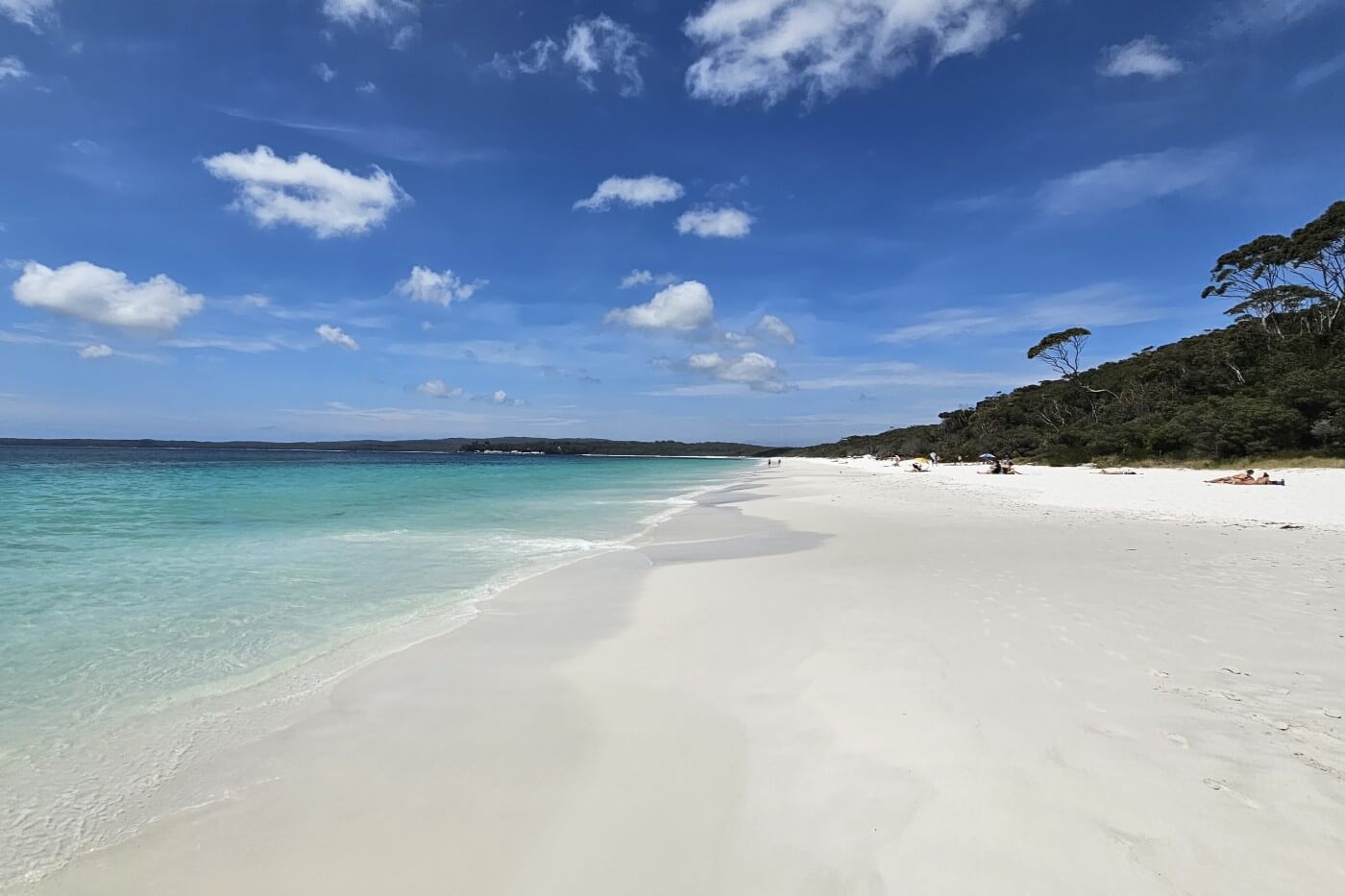
Hyams Beach in Jervis Bay, New South Wales.
About Jervis Bay
Jervis Bay combines sheltered beaches with national parks, walking tracks and protected marine environments.
The area includes Jervis Bay National Park, Booderee National Park and the Jervis Bay Marine Park, providing opportunities to see dolphins, whales, seals, seabirds and other wildlife.
The calm waters and numerous beaches make the region particularly popular with families and visitors interested in outdoor activities.
Hyams Beach
Hyams Beach is one of the best-known beaches in Jervis Bay and is famous for its exceptionally white sand and clear water.
The beach is popular for swimming, snorkelling, paddleboarding and relaxing beside the bay.
Hyams Beach can become very busy during summer, weekends and holiday periods, so arriving early is recommended.
White Sands Walk
The White Sands Walk is one of the most popular coastal walks in Jervis Bay.
The track passes a series of picturesque beaches and coastal forest, offering excellent opportunities for swimming, photography and wildlife spotting.
Beaches along this part of the coastline include:
Greenfield Beach
Chinamans Beach
Hyams Beach
Seamans Beach
Booderee National Park
Booderee National Park occupies much of the southern side of Jervis Bay and is jointly managed with the traditional Aboriginal owners of the area.
The park contains beautiful beaches, bushwalking tracks, camping areas and important Aboriginal cultural sites.
Popular places within Booderee National Park include:
Murrays Beach
Cave Beach
Green Patch
Scottish Rocks
Cape St George Lighthouse
Booderee Botanic Gardens
Murrays Beach
Murrays Beach is one of the most scenic beaches in Booderee National Park.
Its relatively sheltered water makes it popular for swimming and snorkelling, while the surrounding bushland provides a beautiful natural setting.
Huskisson
Huskisson is one of the main towns around Jervis Bay and a convenient base for exploring the region.
The waterfront town has cafés, restaurants, accommodation and shops, and many dolphin and whale-watching cruises depart from its harbour.
Dolphin Watching
Jervis Bay is well known for its resident population of bottlenose dolphins.
Dolphin-watching cruises regularly operate from Huskisson and provide visitors with an opportunity to see dolphins swimming through the protected waters of the bay.
Dolphins can also sometimes be spotted from beaches, headlands and walking tracks.
Whale Watching
Jervis Bay is an excellent destination for watching migrating humpback whales.
Whales migrate along the New South Wales coast generally between May and November.
Boat tours depart from Huskisson during the migration season, while land-based viewing is also possible from several headlands around the bay.
Snorkelling and Diving
The clear waters of Jervis Bay Marine Park make the region popular for snorkelling and scuba diving.
Visitors may encounter fish, rays, dolphins, seals and other marine species.
Popular snorkelling areas include Murrays Beach and other sheltered beaches around the bay.
Kayaking and Paddleboarding
The protected waters of Jervis Bay are ideal for kayaking and stand-up paddleboarding when conditions are suitable.
Equipment hire and guided kayaking tours are available in the area, allowing visitors to explore beaches, coves and sections of the coastline from the water.
Things to Do in Jervis Bay
Relax at Hyams Beach
Walk the White Sands Walk
Explore Booderee National Park
Swim at Murrays Beach
Join a dolphin-watching cruise
Go whale watching
Snorkel in Jervis Bay Marine Park
Kayak around the bay
Explore Huskisson
Visit Booderee Botanic Gardens
Walk to coastal lookouts
Photograph the white-sand beaches
Jervis Bay National Park
Jervis Bay National Park protects areas of coastal forest, wetlands and white-sand beaches around the northern and western sides of the bay.
Visitors can enjoy swimming, snorkelling, fishing, birdwatching and bushwalking.
The park also contains several picnic areas and walking tracks.
Best Time to Visit Jervis Bay
Jervis Bay can be visited throughout the year.
Summer is ideal for swimming, snorkelling and beach activities, although this is also the busiest period.
Spring and autumn are particularly pleasant for walking and exploring the national parks.
Winter is a good time for whale watching as humpback whales migrate north along the coast.
Getting to Jervis Bay
Jervis Bay is located approximately 140 kilometres south of Sydney along the New South Wales coast.
The drive from Sydney generally takes a little over three hours, depending on traffic and your destination around the bay.
Jervis Bay is also approximately three hours by road from Canberra.
Getting Around Jervis Bay
A car is the most convenient way to explore Jervis Bay because the beaches, national parks and towns are spread around a large area.
Huskisson and Vincentia are relatively close together, while attractions such as Booderee National Park and Hyams Beach are easier to reach by car.
How Long Should You Spend in Jervis Bay?
Jervis Bay can be visited on a long day trip, but spending 2 to 4 days allows much more time to enjoy the beaches, national parks and marine activities.
A longer stay is particularly worthwhile if you want to combine swimming, walking, kayaking and a dolphin or whale-watching cruise.
Suggested Jervis Bay Day
A good one-day itinerary could include:
Start the morning at Hyams Beach
Walk part of the White Sands Walk
Have lunch in Huskisson
Join a dolphin or whale-watching cruise
Explore the Huskisson waterfront
Finish the afternoon at one of the bay’s beaches
Travel Tip
Jervis Bay becomes extremely popular during summer holidays and long weekends. Arrive early when visiting well-known locations such as Hyams Beach, particularly if you need parking.
If you are visiting the national parks, check current park alerts, weather conditions and access information before setting out.
Sponsored Popular Items
Quick take: Musement.com offers a worldwide selection of tours and attractions
Jervis Bay Dolphin Cruise, Lunch, Berry & Kiama Blowhole Tour Australia Discover the beauty of Jervis Bay on a full-day tour from Sydney. Enjoy a dolphin cruise, a delicious lunch, and visit the spectacular Kiama Blowhole and the iconic Berry Donut Van.
Jervis Bay, Kiama & Kangaroo Valley Day Trip From Sydney-PVT Australia This exclusive private day trip offers a perfect blend of coastal wonders, countryside charm, and natural beauty, making it an ideal choice for those looking to explore the diverse landscapes of NSW.
Jervis Bay: 3 Hour Guided Kayak Tour with Morning Tea Australia Paddle through ancient mangrove forests on a guided kayak tour in Jervis Bay. Spot local wildlife, enjoy a morning tea picnic on the beach, and learn about the area from your guide.
The Hunter Valley is one of Australia’s best-known wine regions and a popular escape from Sydney. Located in New South Wales, the region is famous for its vineyards, cellar doors, restaurants, rolling countryside, hot-air balloon flights and attractive rural accommodation.
The main wine tourism areas include Pokolbin, Lovedale, Broke and Rothbury, with Pokolbin containing many of the region’s best-known wineries, restaurants and attractions.
Vineyards in the Hunter Valley, New South Wales. Photo: thinkrorbot / Wikimedia Commons. Public domain.
About the Hunter Valley
The Hunter Valley is one of Australia’s most established wine destinations and is particularly associated with Semillon and Shiraz.
Today the region combines traditional wineries with modern cellar doors, restaurants, boutique accommodation, breweries, distilleries and other visitor attractions.
Its proximity to Sydney makes the Hunter Valley suitable for a day trip, although staying for two or three days provides much more time to explore.
Visit the Wineries and Cellar Doors
Wine tasting is one of the main reasons people visit the Hunter Valley.
The region contains numerous cellar doors ranging from historic family-owned wineries to large modern estates.
Visitors can taste local wines, learn about winemaking and often purchase bottles directly from the producer.
Popular Hunter Valley wine varieties include:
Semillon
Shiraz
Chardonnay
Verdelho
Cabernet Sauvignon
Join a Hunter Valley Wine Tour
A guided wine tour can be a convenient option if you want to visit several wineries without driving.
Tours commonly include visits to multiple cellar doors and may also include cheese, chocolate, spirits or lunch.
Both small-group and private tours operate throughout the region.
Hot-Air Ballooning
Seeing the Hunter Valley from a hot-air balloon is one of the region’s most memorable experiences.
Flights generally depart around sunrise when weather conditions are usually calmer.
From the air, visitors can see vineyards, lakes, farms, mountains and the surrounding countryside. Some balloon experiences are followed by breakfast at a winery.
Hunter Valley Gardens
Hunter Valley Gardens at Pokolbin is one of the region’s major attractions.
The gardens cover approximately 14 hectares and contain around 8 kilometres of walking paths.
There are ten themed display gardens featuring native and exotic plants, waterfalls, statues and landscaped areas.
The gardens include:
Rose Garden
Storybook Garden
Italian Grotto
Chinese Garden
Oriental Garden
Sunken Garden
Hunter Valley Gardens also hosts seasonal events throughout the year, including major spring displays and the Christmas Lights Spectacular.
Food and Restaurants
The Hunter Valley has developed into an important food destination as well as a wine region.
Visitors can choose from winery restaurants, casual cafés, fine dining, local produce stores and gourmet tasting experiences.
Cheese, chocolate, olives and locally produced foods are often available alongside the region’s wines.
Breweries and Distilleries
Wine may be the Hunter Valley’s main attraction, but the region also has a growing selection of breweries and distilleries.
Visitors can sample craft beer, gin, vodka and other spirits at venues throughout the valley.
Things to Do in the Hunter Valley
Visit winery cellar doors
Take a guided wine tour
Fly over the vineyards in a hot-air balloon
Explore Hunter Valley Gardens
Enjoy lunch at a winery restaurant
Visit local breweries and distilleries
Sample local cheese and chocolate
Explore Pokolbin and Lovedale
Visit the smaller wine area around Broke
Stay overnight among the vineyards
Pokolbin
Pokolbin is at the heart of Hunter Valley wine country and is one of the most convenient places for first-time visitors to base themselves.
Many cellar doors, restaurants and accommodation properties are located within a relatively small area.
Hunter Valley Gardens is also located at Pokolbin.
Lovedale
Lovedale is another popular wine and food area with wineries, restaurants, galleries and accommodation.
It often has a quieter rural atmosphere than central Pokolbin and makes an attractive area to explore by car.
Broke
The village of Broke and the surrounding Broke Fordwich wine region provide a more relaxed alternative to the busier parts of the Hunter Valley.
The area contains boutique wineries, restaurants and rural scenery backed by mountains.
Best Time to Visit the Hunter Valley
The Hunter Valley can be visited throughout the year.
Autumn and spring are particularly pleasant for exploring vineyards, gardens and outdoor attractions.
Summer can be warm, while winter mornings and evenings can be quite cool.
Harvest season generally brings additional activity to the vineyards, while spring is particularly attractive at Hunter Valley Gardens.
Getting to the Hunter Valley
The Hunter Valley is approximately a two-hour drive north of Sydney, depending on your destination and traffic conditions.
Hunter Valley Gardens advises visitors travelling from Sydney to use the M1 and follow the Cessnock and vineyards exits towards Pokolbin.
Newcastle Airport is another useful gateway and is approximately 50 minutes by road from Hunter Valley Gardens.
Getting Around the Hunter Valley
A car provides the greatest flexibility because wineries and attractions are spread across a large rural area.
However, visitors planning to taste wine may prefer a guided tour, private driver or organised transfer service.
Many accommodation properties can also help arrange transport to nearby restaurants and wineries.
How Long Should You Spend in the Hunter Valley?
The Hunter Valley can be visited on a long day trip from Sydney, but this limits the number of wineries and attractions you can comfortably visit.
A stay of 2 to 3 days is ideal for combining wine tasting, restaurants, gardens and sightseeing without rushing.
Suggested Hunter Valley Day
A good one-day itinerary could include:
Arrive in Pokolbin in the morning
Visit one or two cellar doors
Enjoy lunch at a winery restaurant
Explore Hunter Valley Gardens
Visit another winery or distillery
Finish the afternoon with local cheese or chocolate
Travel Tip
If you plan to visit several wineries, consider booking an organised wine tour rather than driving yourself.
For a more relaxed experience, stay overnight in Pokolbin or Lovedale so you can explore the region over several days.
Image credit: thinkrorbot, via Wikimedia Commons. The image has been released into the public domain.
Sponsored Popular Items
Quick take: Musement.com offers a worldwide selection of tours and attractions
The Hunter Tasting - Wine Tasting Hunter Valley Australia Explore the flavors of the Hunter Valley with a wine tasting experience that highlights the history and future of Australian wine. Learn about the history of the region and the wines you are tasting.
Hunter Valley: Tastes of the Hunter Tour Australia Discover the Hunter Valley on a half-day tour visiting a trio of different venues. Enjoy tastings of premium wines, cheese plates, spirits, and artisan chocolates paired with wines.
Byron Bay is one of Australia’s best-known coastal towns, famous for its beaches, surfing, relaxed atmosphere, coastal walks and spectacular views from Cape Byron. Located on the far north coast of New South Wales, the town is also surrounded by rainforest, rolling hinterland and attractive villages.
Visitors come for everything from swimming and surfing to whale watching, kayaking, walking, dining and exploring the surrounding Northern Rivers region.
About Byron Bay
Byron Bay combines a lively coastal town with some of the most attractive beaches and headlands in northern New South Wales.
Popular beaches include Main Beach, Clarkes Beach, Wategos Beach and Belongil Beach. Main, Clarkes and Wategos beaches are patrolled throughout the year.
Cape Byron Lighthouse
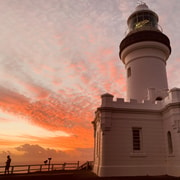
The Cape Byron Lighthouse is one of Byron Bay’s best-known landmarks.
Standing at the most easterly point of mainland Australia, the lighthouse overlooks the Pacific Ocean and Cape Byron Marine Park.
The lighthouse was completed in 1901 and remains an excellent location for viewing the coast, surrounding hinterland and marine life.
Dolphins, turtles and humpback whales can sometimes be seen from the headland. Whale sightings are particularly common during the annual migration season.
Walgun Cape Byron Walking Track
One of the best ways to explore Byron Bay is along the Walgun Cape Byron walking track.
The scenic 3.7-kilometre loop passes through rainforest, beaches, grasslands and clifftops before reaching Cape Byron Lighthouse.
NSW National Parks classifies the walk as Grade 3 and recommends allowing approximately 1 to 3 hours. The route contains some short steep hills and many steps.
Highlights along the route include:
Captain Cook Lookout
Clarkes Beach
The Pass
Wategos Beach
Little Wategos Beach
Cape Byron Lighthouse
Australia’s most easterly mainland point
Beaches in Byron Bay
Byron Bay has several beaches, each offering a slightly different experience.
Main Beach
Main Beach is closest to the town centre and is convenient for swimming, relaxing and watching the sunset.
Wategos Beach
Wategos Beach sits beneath Cape Byron and is one of the most scenic beaches in the area. It is popular for swimming, picnics and longboard surfing.
Clarkes Beach
Clarkes Beach lies between Main Beach and The Pass and offers a long stretch of sand suitable for swimming and walking.
Belongil Beach
Belongil Beach extends north from town and generally has a quieter atmosphere than Main Beach.
Surfing in Byron Bay
Byron Bay has long been associated with Australian surf culture.
The Pass and The Wreck are among the area’s best-known surf breaks, while several local surf schools offer lessons for beginners.
Conditions vary, so inexperienced surfers should use suitable beginner areas and follow local safety advice.
Whale Watching
Byron Bay is an excellent location for watching migrating humpback whales.
Whales can generally be seen during the migration period from around May to November, with particularly good viewing opportunities during winter and early spring.
Cape Byron and the lighthouse precinct provide excellent land-based viewpoints.
Julian Rocks
Julian Rocks lies approximately 2.5 kilometres offshore within the Cape Byron Marine Park.
The area is well known for scuba diving and snorkelling and supports a diverse range of marine life.
Guided dive and snorkelling trips operate from Byron Bay, depending on weather and ocean conditions.
Kayaking
Sea kayaking is another popular activity in Byron Bay.
Guided kayaking tours explore the waters around Cape Byron and may provide opportunities to see dolphins, turtles and, during migration season, whales.
Things to Do in Byron Bay
Visit Cape Byron Lighthouse
Walk the Walgun Cape Byron walking track
Swim at Main Beach
Relax at Wategos Beach
Take a surfing lesson
Go whale watching
Join a sea kayaking tour
Snorkel or dive at Julian Rocks
Explore the town’s cafés and restaurants
Visit nearby hinterland villages
Explore the Byron Bay Hinterland
The countryside surrounding Byron Bay provides an excellent contrast to the coast.
Visitors can explore rainforest, farms, waterfalls and small villages throughout the Northern Rivers hinterland.
Popular destinations include:
Bangalow
Brunswick Heads
Mullumbimby
Federal
Newrybar
Best Time to Visit Byron Bay
Byron Bay can be visited throughout the year.
Summer is popular for swimming and beach holidays, while autumn and spring usually provide pleasant temperatures for walking and exploring.
Winter is particularly attractive for visitors interested in whale watching.
Getting to Byron Bay
Location:
Byron Bay NSW 2481
Australia
Byron Bay is located on the north coast of New South Wales, south of the Queensland border.
The closest major airports include Ballina Byron Gateway Airport and Gold Coast Airport. Shuttle and transfer services operate between the airports and Byron Bay.
Travellers arriving by road can reach Byron Bay via the Pacific Motorway and surrounding regional roads.
Getting Around Byron Bay
The central area of Byron Bay is compact enough to explore on foot.
Walking or cycling can be particularly convenient because parking around the town centre and popular beaches can become busy.
A car is useful if you plan to explore the surrounding hinterland and neighbouring coastal towns.
How Long Should You Spend in Byron Bay?
A full day is enough to see the main highlights, including the lighthouse, walking track and beaches.
However, spending 2 to 4 days provides more time for surfing, swimming, kayaking, whale watching and exploring the hinterland.
Suggested Byron Bay Day
A good one-day itinerary is:
Start with breakfast in Byron Bay
Walk towards The Pass and Wategos Beach
Continue along the Cape Byron walking track
Visit Cape Byron Lighthouse
Return to town for lunch
Spend the afternoon at Main Beach or Clarkes Beach
Finish the day watching the sunset
Travel Tip
Start the Cape Byron walk early in the morning when temperatures are cooler and the tracks are generally quieter.
Take water, sun protection and comfortable footwear, particularly if completing the entire 3.7-kilometre loop.
Image credit: Kpravin2, via Wikimedia Commons. Licensed under Creative Commons Attribution-ShareAlike 4.0.
Sponsored Popular Items
Quick take: Musement.com offers a worldwide selection of tours and attractions
Byron Bay: Cape Byron Lighthouse Guided Sunrise Tour Australia Guests are taken on a hike through rainforest, beach and clifftops to be the first people in Australia to witness the spectacular sunrise at the most easterly point in the country.
Byron Bay: Behind The Bay Waterfalls & Hidden Gems Day Tour Australia Experience the best of Byron Bay's surrounds on a relaxing day tour. Immerse yourself in the beauty of Lennox Head and Lake Ainsworth, visit Killen Falls, and discover hidden beaches at Broken Head.
Byron Bay, Gold Coast, Brisbane, Noosa Hop-On Hop-Off Pass Australia Hop-on hop-off along Australia’s East Coast! Travel Byron Bay, Brisbane, Gold Coast, Noosa & Rainbow Beach at your pace, with local tips, must-see spots & exclusive discounts.
The Blue Mountains are one of New South Wales’ most spectacular natural regions and one of the most popular day trips from Sydney. Famous for dramatic sandstone cliffs, deep forested valleys, waterfalls, bushwalking tracks and panoramic lookouts, the region forms part of the Greater Blue Mountains World Heritage Area.
The main visitor centres include Katoomba, Leura, Wentworth Falls and Blackheath, with many of the best-known attractions concentrated around Katoomba.
The Three Sisters in the Blue Mountains. Photo: Diliff / Wikimedia Commons, CC BY-SA 2.5.
About the Blue Mountains
The Blue Mountains begin approximately 60 kilometres west of Sydney and cover a vast area of rugged escarpments, eucalyptus forests, waterfalls and sandstone plateaus.
The distinctive blue haze often visible across the valleys is associated with the region’s extensive eucalyptus forests.
The landscape is part of Country traditionally cared for by Aboriginal peoples, including the Gundungurra and Darug peoples.
Three Sisters
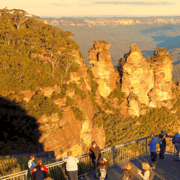
The Three Sisters are the best-known landmark in the Blue Mountains.
These three sandstone peaks rise above the Jamison Valley and can be viewed from Echo Point at Katoomba.
The Three Sisters have important Aboriginal cultural significance and are associated with several traditional stories.
The short Three Sisters Walk begins at Echo Point and is approximately 800 metres return. Most visitors can complete it in around 25 to 45 minutes.
Echo Point Lookout
Echo Point is one of the most popular viewpoints in the Blue Mountains and provides expansive views across the Jamison Valley towards the Three Sisters, Mount Solitary and surrounding sandstone escarpments.
Visitor facilities, toilets and walking tracks are available around the lookout area.
Scenic World
Scenic World in Katoomba offers several ways to experience the mountain scenery.
Scenic Railway
Scenic Skyway
Scenic Cableway
Scenic Walkway
The Scenic Railway descends into the Jamison Valley, while the Skyway travels high above the gorge and provides extensive views of the surrounding cliffs and rainforest.
Wentworth Falls
Wentworth Falls is another major attraction in the Blue Mountains.
The waterfall drops over sandstone cliffs into the Jamison Valley and can be viewed from several lookouts and walking tracks.
The area offers everything from short walks to more demanding bushwalking routes.
Govetts Leap
Located near Blackheath, Govetts Leap Lookout provides one of the most impressive panoramas in the Blue Mountains.
The viewpoint overlooks the Grose Valley and surrounding cliffs and is an excellent stop for photography and bushwalking.
Leura
The mountain village of Leura is known for its attractive streets, cafés, restaurants, gardens and boutique shops.
It makes a pleasant stop between visits to lookouts and walking tracks and is only a short distance from Katoomba.
Things to Do in the Blue Mountains
See the Three Sisters at Echo Point
Ride the Scenic Railway at Scenic World
Visit Wentworth Falls
Walk through eucalyptus forest
Explore Leura and Katoomba
Visit Govetts Leap Lookout
Go bushwalking
Photograph waterfalls and sandstone cliffs
Visit the Blue Mountains Heritage Centre
Explore the mountain villages
Bushwalking in the Blue Mountains
The Blue Mountains contain an extensive network of bushwalking tracks ranging from easy lookout walks to challenging full-day hikes.
Popular walking areas include:
Three Sisters and Echo Point
Wentworth Falls
Leura Cascades
Govetts Leap
Evans Lookout
Grand Cliff Top Walk
Narrow Neck
Weather conditions can change quickly in the mountains, so visitors planning longer walks should carry suitable clothing, water and navigation equipment.
Blue Mountains Heritage Centre
The Blue Mountains Heritage Centre at Blackheath is a useful place to begin exploring the national park.
The centre provides maps, walking information, local history and advice about current park conditions.
Best Time to Visit the Blue Mountains
The Blue Mountains can be visited throughout the year, with each season offering a different experience.
Spring and autumn are particularly pleasant for bushwalking, while winter can bring cold temperatures and crisp mountain views.
Summer is generally warmer, but visitors should always check bushfire warnings and national park alerts before travelling.
Getting to the Blue Mountains from Sydney
The Blue Mountains are easily accessible from Sydney by car or train.
Driving from central Sydney to Katoomba generally takes around 90 minutes to two hours, depending on traffic.
Train services operate from Sydney towards Katoomba, Wentworth Falls, Leura, Blackheath and Lithgow.
Express train services to Katoomba can take around 90 minutes, while stopping services may take closer to two hours.
Getting Around
Having a car provides the greatest flexibility, particularly if you want to visit several lookouts and villages in one day.
Public buses operate from Katoomba to attractions including Echo Point and Scenic World.
A hop-on hop-off sightseeing bus also operates around Katoomba and Leura, stopping at many popular attractions and lookouts.
How Long Should You Spend in the Blue Mountains?
The Blue Mountains can be visited as a full-day trip from Sydney, particularly if you concentrate on Katoomba, the Three Sisters, Scenic World and Leura.
However, staying for two or three days provides much more time for bushwalking, waterfalls, mountain villages and some of the quieter viewpoints.
Suggested Blue Mountains Day Trip
A good one-day itinerary from Sydney is:
Arrive in Katoomba in the morning
Visit Echo Point and the Three Sisters
Explore Scenic World
Have lunch in Katoomba or Leura
Visit Wentworth Falls
Explore Leura village
Stop at another lookout before returning to Sydney
Travel Tip
The temperature in the Blue Mountains can be considerably cooler than Sydney, even on the same day. Carry a jacket and suitable walking shoes, particularly if you plan to explore the bushwalking tracks.
For the best experience, check current weather, fire warnings and national park alerts before setting out.
Image credit: Diliff, via Wikimedia Commons. Licensed under Creative Commons Attribution-ShareAlike 2.5.
Sponsored Popular Items
Quick take: Musement.com offers a worldwide selection of tours and attractions
From Sydney: Blue Mountains Sightseeing And Sunset Day Tour Australia Discover the Blue Mountains with a private, luxury 9-hour tour. Enjoy stunning landscapes, iconic lookouts, and a magical sunset. Perfect for small groups, traveling in style and comfort.
Blue Mountains: Overcliff-Undercliff Guided Hike Australia Embark on a guided hike of the Overcliff-Undercliff hike in the Blue Mountains. Admire the views of the Jamison Valley, explore the beauty & see waterfalls within a part of the Blue Mountains.
Bondi Beach is one of Australia’s most famous beaches and one of Sydney’s best-known coastal attractions. Located in Sydney’s eastern suburbs, Bondi is known for its golden sand, surf culture, ocean pools, coastal walks and lively collection of cafés and restaurants.
The beach is popular with swimmers, surfers, walkers and visitors who simply want to enjoy the classic Sydney beach lifestyle. Professional lifesavers patrol Bondi throughout the year, and swimmers should always stay between the red and yellow flags. :chatgpt-content-reference{index=”0″}
Bondi Beach, Sydney. Photo: Alex Proimos / Wikimedia Commons, CC BY 2.0.
About Bondi Beach
Bondi Beach is closely associated with Australian surf culture and surf lifesaving. The Bondi Surf Bathers’ Life Saving Club, founded in 1907, is recognised as one of the world’s oldest surf lifesaving clubs.
The broad sandy beach attracts visitors throughout the year, while the surrounding streets offer restaurants, cafés, shops and accommodation within easy walking distance of the water. :chatgpt-content-reference{index=”1″}
Swimming at Bondi Beach
Bondi is a popular swimming beach, but ocean conditions can change quickly.
Professional lifesavers patrol the beach throughout the year. Visitors should swim only between the red and yellow flags and follow instructions from lifeguards and lifesavers. :chatgpt-content-reference{index=”2″}
Surfing at Bondi Beach
Surfing is an important part of life at Bondi, and surfers can often be seen in the water from early morning until evening.
Beginners can also take surfing lessons with local surf schools, making Bondi a convenient place to try surfing while visiting Sydney. :chatgpt-content-reference{index=”3″}
Bondi Icebergs
At the southern end of Bondi Beach is the famous Bondi Icebergs swimming club and ocean pool.
The 50-metre ocean pool sits immediately beside the sea, with waves sometimes breaking over the edge. The location has become one of Sydney’s most photographed coastal scenes. :chatgpt-content-reference{index=”4″}
Bondi to Coogee Coastal Walk
One of the best activities at Bondi is the spectacular Bondi to Coogee Coastal Walk.
The approximately 6-kilometre walk follows Sydney’s coastline past sandstone cliffs, beaches and ocean views.
The route passes:
Bondi Beach
Tamarama Beach
Bronte Beach
Clovelly Beach
Gordons Bay
Coogee Beach
The complete walk generally takes around 2 to 3 hours, although visitors may want to allow longer for swimming, photography and café stops. :chatgpt-content-reference{index=”5″}
Bondi Pavilion
The historic Bondi Pavilion is located directly behind the main beach area.
The pavilion provides visitor facilities and is also used for cultural activities, exhibitions and community events.
Its beachfront position makes it a useful landmark when arriving at Bondi.
Things to Do at Bondi Beach
Swim between the red and yellow flags
Take a surfing lesson
Walk from Bondi to Coogee
Swim at Bondi Icebergs
Relax on the beach
Visit Bondi Pavilion
Explore local cafés and restaurants
Photograph the coastline
Watch surfers from the promenade
Enjoy a coastal picnic
Best Time to Visit Bondi Beach
Bondi can be visited throughout the year.
Summer is popular for swimming and beach activities, although the beach can become very busy during weekends, school holidays and warm weather.
Early morning is particularly attractive for walking, photography and watching surfers.
Between approximately May and November, the coastal walking route can also provide opportunities to spot migrating whales offshore. :chatgpt-content-reference{index=”6″}
Getting to Bondi Beach
Address:
Campbell Parade
Bondi Beach NSW 2026
Australia
Bondi Beach is easily reached from central Sydney using public transport.
A common route is to take a train to Bondi Junction and then continue by bus to Bondi Beach.
Buses also operate between the eastern suburbs and the beach, making a car unnecessary for most visitors. :chatgpt-content-reference{index=”7″}
How Long Should You Allow?
Allow around 2 to 3 hours if you want to explore the beach, promenade and Bondi Icebergs area.
Allow at least half a day if you plan to swim, have lunch and explore the surrounding neighbourhood.
If completing the Bondi to Coogee Coastal Walk, allow approximately 2 to 3 hours for the walk alone, plus additional time for stops. :chatgpt-content-reference{index=”8″}
Nearby Attractions
Bondi Icebergs
Tamarama Beach
Bronte Beach
Coogee Beach
Bondi to Coogee Coastal Walk
Bondi Pavilion
Waverley Cemetery
Travel Tip
For a good Bondi experience, arrive early in the morning, walk along the beachfront, continue past Bondi Icebergs and begin part of the Bondi to Coogee Coastal Walk.
If you are swimming at Bondi Beach, always use the patrolled area between the red and yellow flags.
Image credit: Alex Proimos, via Wikimedia Commons. Licensed under Creative Commons Attribution 2.0.
Sponsored Popular Items
Quick take: Musement.com offers a worldwide selection of tours and attractions
Private Sydney Beaches Tour — Bondi, Manly & Hidden Coves Australia Skip the crowded bus tours. This private full-day tour takes you to Sydney's beaches and harbour spots most visitors miss — secluded coves, coastal lookouts, and the real Bondi locals know.
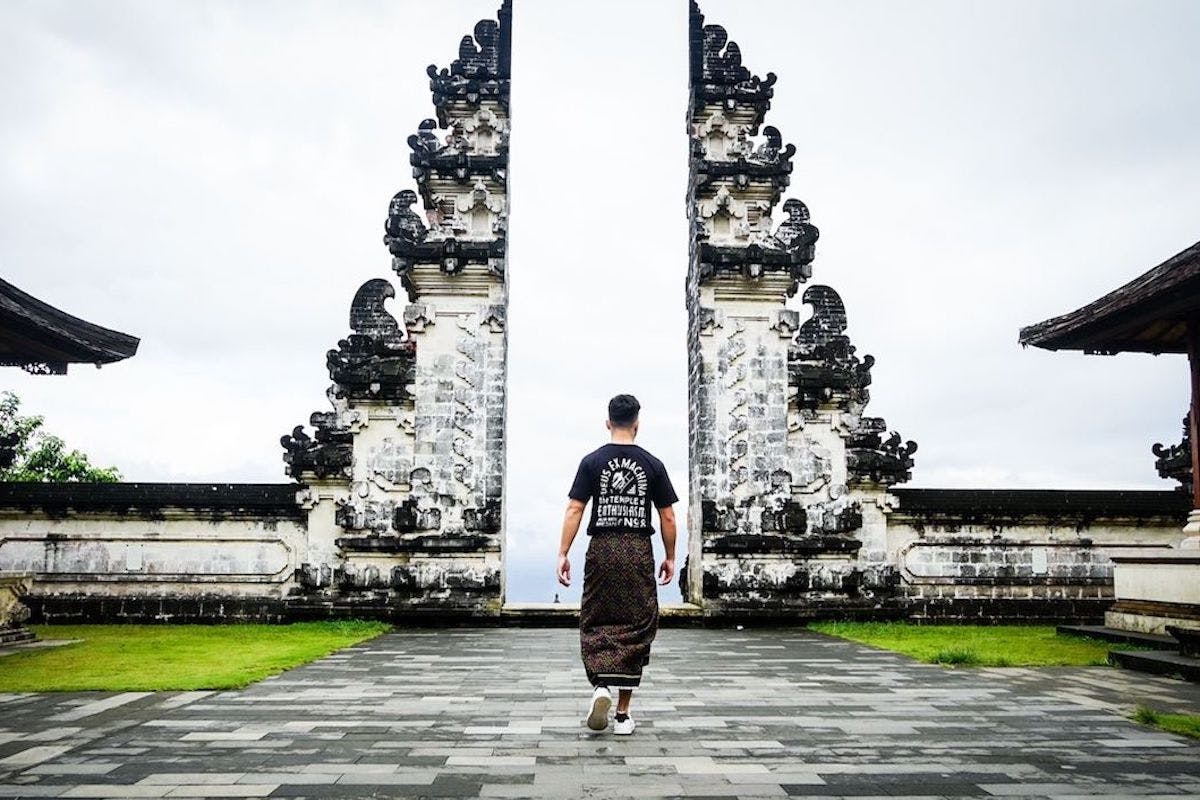
The Most Famous Spots in Bali Instagram Tour – Guided Tour Indonesia The most famous spots in Bali Instagram tour is a convenient way to add structure, local context and purposeful sightseeing to the itinerary. Check current availability, inclusions and booking details before you go.
Sydney: Discover Scuba Dive at Australia's most Iconic Beach Australia Explore the world of diving with PADI Discover Scuba Diving Experience at Dive Centre Bondi. Basic theory, guided dive, and marine life. See what lives under the waves in an exciting day!
The Sydney Harbour Bridge is one of Australia’s most famous landmarks and a defining feature of the Sydney skyline. Stretching across Sydney Harbour between The Rocks and Milsons Point, the bridge carries road traffic, trains, pedestrians and cyclists between the city centre and Sydney’s North Shore.
Nicknamed the “Coathanger” because of its enormous steel arch, the bridge opened in 1932 and remains one of the city’s most popular attractions.
Sydney Harbour Bridge from Circular Quay. Photo: JJ Harrison / Wikimedia Commons, CC BY-SA 3.0.
About the Sydney Harbour Bridge
The Sydney Harbour Bridge was built to provide a permanent connection between central Sydney and the northern suburbs.
Construction took approximately eight years and the bridge officially opened on 19 March 1932.
The main steel arch spans approximately 503 metres, while the top of the bridge rises about 134 metres above Sydney Harbour. Around 53,000 tonnes of steel were used in its construction.
Walk Across the Sydney Harbour Bridge
Walking across the Sydney Harbour Bridge is one of the best free activities in Sydney.
The pedestrian walkway is located on the eastern side of the bridge and provides excellent views across Sydney Harbour, including the Sydney Opera House, Circular Quay and the surrounding city skyline.
You can begin the walk from The Rocks on the southern side or from Milsons Point on the northern side.
Allow approximately 20 to 30 minutes to walk across the bridge without long stops, although photographers may want to allow considerably longer.
Climb the Sydney Harbour Bridge
For a very different experience, visitors can climb the steel arches of the bridge with BridgeClimb Sydney.
The climb takes visitors high above the harbour and offers panoramic views across Sydney, including the Opera House, Circular Quay, Barangaroo and the distant suburbs.
Different BridgeClimb experiences are available, including climbs reaching the summit of the bridge.
The main Summit Climb takes around 3 hours in total, including approximately two hours on the bridge itself.
Visit the Pylon Lookout
The Pylon Lookout is another excellent option for visitors who want elevated views without completing the full BridgeClimb experience.
Located in the south-eastern pylon, the lookout provides panoramic views over Sydney Harbour.
The entrance is accessible from the pedestrian walkway across the bridge.
Best Views of the Sydney Harbour Bridge
There are many excellent places around Sydney Harbour where you can photograph the bridge.
Circular Quay
Sydney Opera House
Mrs Macquarie’s Point
The Rocks
Milsons Point
Luna Park Sydney
Barangaroo
Blues Point Reserve
Sydney Harbour ferries
One of the classic Sydney views combines the Sydney Harbour Bridge with the Sydney Opera House across the harbour.
See the Bridge from the Water
A ferry trip from Circular Quay is one of the easiest ways to appreciate the scale of the Sydney Harbour Bridge.
Several ferry routes provide close views of the bridge as they travel across Sydney Harbour.
Popular destinations include:
Manly
Taronga Zoo
Milsons Point
Barangaroo
Parramatta
History of the Sydney Harbour Bridge
The bridge was constructed under the direction of engineer Dr John Bradfield, who played a major role in planning the project.
British company Dorman Long & Co was responsible for its construction.
The bridge’s two enormous steel arches gradually extended from opposite sides of the harbour before meeting above the centre of the water in 1930.
The bridge opened to the public in 1932 and quickly became one of Australia’s most recognisable structures.
Interesting Sydney Harbour Bridge Facts
The bridge opened on 19 March 1932.
The steel arch spans approximately 503 metres.
The top of the arch rises about 134 metres above the harbour.
Around 53,000 tonnes of steel were used.
Approximately six million rivets were used during construction.
The bridge carries vehicles, trains, cyclists and pedestrians.
It is commonly nicknamed the “Coathanger”.
Getting to the Sydney Harbour Bridge
The southern end of the bridge is located beside The Rocks, close to Circular Quay.
From Circular Quay railway station, it is approximately a 10 to 15-minute walk to the pedestrian bridge access.
On the northern side, Milsons Point railway station provides convenient access to the bridge, Luna Park and surrounding harbour attractions.
How Long Should You Allow?
Allow approximately 30 to 60 minutes if you simply want to walk across the bridge and take photographs.
Allow around 1 to 2 hours if you are also visiting the Pylon Lookout or exploring The Rocks and Milsons Point.
A BridgeClimb experience can take approximately 2.5 to 3 hours depending on the climb selected.
Nearby Attractions
The Sydney Harbour Bridge is surrounded by many of Sydney’s best-known attractions.
Sydney Opera House
Circular Quay
The Rocks
Luna Park Sydney
Royal Botanic Garden Sydney
Museum of Contemporary Art Australia
Barangaroo Reserve
Suggested Sydney Harbour Bridge Walk
A good sightseeing route is to begin at Circular Quay, walk through The Rocks and then cross the Sydney Harbour Bridge to Milsons Point.
From Milsons Point, continue towards Luna Park and the harbour foreshore before returning to the city by train or ferry.
Travel Tip
Walk across the bridge in the late afternoon for excellent harbour views, then stay around Milsons Point or The Rocks as the city lights begin to appear.
For one of the classic Sydney experiences, combine the Sydney Harbour Bridge with a visit to the nearby Sydney Opera House and Circular Quay.
Image credit: JJ Harrison, via Wikimedia Commons. Licensed under Creative Commons Attribution-ShareAlike 3.0.
Sponsored Popular Items
Quick take: Musement.com offers a worldwide selection of tours and attractions
Sydney: University of Sydney Student-Led Walking Tour Australia Discover the University of Sydney on a student-led walking tour. Explore the Main Quadrangle, Fisher Library, and the Chau Chak Wing Museum while learning about the university’s history.
Sydney: Sydney Harbour Sunset Photo Tour & Cruise Australia Explore one of the most picturesque city harbours with a local professional photographer guide. They will capture once-in-a-lifetime photos plus enjoy a 30 minute harbour cruise on Sydney Harbour.
Sydney: Sydney Harbor Lunch Cruise with Welcome Drink Australia Enjoy a lunch cruise on Sydney Harbour with a welcome glass of bubbles. Savor a delicious 2-course meal inspired by locally sourced, regionally inspired cuisines.
The Sydney Opera House is one of Australia’s most famous landmarks and one of the world’s most recognisable performing arts centres. Located on Bennelong Point beside Sydney Harbour, its distinctive roof sails have become an international symbol of Sydney and Australia.
Sydney Opera House. Photo: David Berkowitz / Wikimedia Commons, CC BY 2.0.
About the Sydney Opera House
The Sydney Opera House was designed by Danish architect Jørn Utzon. Construction began in 1959 and the building was officially opened on 20 October 1973.
Its dramatic shell-shaped roofs were unlike anything previously constructed on this scale and required innovative engineering techniques.
Today, the Sydney Opera House is both a major tourist attraction and a working performing arts centre hosting concerts, opera, theatre, ballet, comedy and other live performances throughout the year.
Why Visit the Sydney Opera House?
You do not need to attend a performance to enjoy the Sydney Opera House.
Visitors can explore the waterfront precinct, admire the architecture, take photographs, join a guided tour, dine overlooking Sydney Harbour or simply walk around Bennelong Point.
The views across the harbour towards the Sydney Harbour Bridge are particularly impressive.
Take a Sydney Opera House Tour
One of the best ways to explore the building is by joining a guided Sydney Opera House tour.
The standard tour introduces visitors to the building’s architecture, history and performance spaces. Tours generally last around one hour and provide access to parts of the Opera House that casual visitors may not otherwise see.
Specialist tours may also be available, including architectural tours, backstage experiences and accessible tours.
See a Performance
The Sydney Opera House is one of Australia’s leading performing arts venues.
Events may include:
Opera
Classical music
Ballet
Theatre
Contemporary music
Dance
Comedy
Family performances
Major performance spaces include the Concert Hall and the Joan Sutherland Theatre.
Explore the Architecture
The Sydney Opera House is considered one of the great architectural achievements of the twentieth century.
The distinctive roof structures resemble enormous white sails rising above Sydney Harbour.
The building was added to the UNESCO World Heritage List in 2007 in recognition of its outstanding architectural significance.
Best Places to Photograph the Sydney Opera House
There are many excellent places around Sydney Harbour for photographing the Opera House.
Mrs Macquarie’s Point
Circular Quay
Sydney Harbour Bridge
Royal Botanic Garden Sydney
Overseas Passenger Terminal
Sydney Harbour ferries
Opera House forecourt
Mrs Macquarie’s Point is particularly popular because it provides views of both the Sydney Opera House and Sydney Harbour Bridge.
Walk Around the Sydney Opera House
Walking around the exterior of the Sydney Opera House is one of the best free things to do in central Sydney.
From Circular Quay, follow the waterfront promenade around Sydney Cove towards Bennelong Point.
You can walk around the Opera House before continuing into the nearby Royal Botanic Garden.
The area is especially attractive around sunset and after dark when the city and harbour are illuminated.
Eating and Drinking
The Opera House precinct has several places to eat and drink, from casual waterfront options to more formal dining.
It is an excellent location for enjoying a meal or drink while overlooking Sydney Harbour.
Getting to the Sydney Opera House
Address:
Sydney Opera House
Bennelong Point
Sydney NSW 2000
Australia
The easiest public transport option for most visitors is to travel to Circular Quay.
Circular Quay is served by trains, ferries, buses and light rail.
From Circular Quay, the Sydney Opera House is approximately a 5 to 10-minute walk along the waterfront.
How Long Should You Allow?
Allow approximately 1 to 2 hours if you want to walk around the exterior, take photographs and explore the surrounding harbourfront.
Allow around 2 to 3 hours if you are also joining a guided tour or stopping for a meal.
If you are attending a performance, allow additional time before and after the show to enjoy the surrounding area.
Nearby Attractions
The Sydney Opera House is within walking distance of many of Sydney’s major attractions.
Sydney Harbour Bridge
Circular Quay
The Rocks
Royal Botanic Garden Sydney
Mrs Macquarie’s Chair
Museum of Contemporary Art Australia
Sydney Harbour
Suggested Sydney Opera House Walk
A good way to explore this part of Sydney is to start at Circular Quay, walk around the Sydney Opera House and then continue through the Royal Botanic Garden towards Mrs Macquarie’s Point.
This route provides excellent harbour views and several opportunities to photograph the Opera House and Sydney Harbour Bridge.
Travel Tip
Visit during the late afternoon so you can see the Sydney Opera House in daylight and then watch the harbour change as the sun sets.
If you would like to see inside the building, consider booking a guided tour or attending a performance.
Image credit: David Berkowitz, via Wikimedia Commons. Licensed under Creative Commons Attribution 2.0.
Sponsored Popular Items
Quick take: Musement.com offers a worldwide selection of tours and attractions
Sydney: University of Sydney Student-Led Walking Tour Australia Discover the University of Sydney on a student-led walking tour. Explore the Main Quadrangle, Fisher Library, and the Chau Chak Wing Museum while learning about the university’s history.
Sydney: Sydney Harbour Sunset Photo Tour & Cruise Australia Explore one of the most picturesque city harbours with a local professional photographer guide. They will capture once-in-a-lifetime photos plus enjoy a 30 minute harbour cruise on Sydney Harbour.
Sydney: Sydney Harbor Lunch Cruise with Welcome Drink Australia Enjoy a lunch cruise on Sydney Harbour with a welcome glass of bubbles. Savor a delicious 2-course meal inspired by locally sourced, regionally inspired cuisines.
Explore Hunter Valley experiences including wine tours, cellar doors, hot air balloon rides, vineyard picnics, horse riding, helicopter flights, gourmet tastings and family-friendly attractions.
The Hunter Valley is one of New South Wales’ best-loved food and wine destinations, known for vineyards, cellar doors, restaurants, scenic countryside, boutique accommodation, gardens, hot air ballooning, horse riding and relaxed weekend escapes. Located within easy reach of Sydney and Newcastle, it is ideal for couples, friends, families, food lovers, wine travellers and visitors looking for a slower regional break.
Whether you want a guided wine tasting tour, a sunrise balloon flight, a picnic among the vines, a premium cheese and wine pairing, a scenic helicopter flight, a family wildlife day or a relaxed country drive, the Hunter Valley offers a broad mix of experiences beyond the cellar door.
Book Hunter Valley Experiences
Compare Hunter Valley wine tours, hot air balloon rides, cellar door tastings, helicopter flights, horse riding, vineyard picnics, gourmet food experiences, family activities and special occasion packages. Check live availability, current prices, inclusions, reviews, cancellation terms and pickup options before booking.
Wine tours are one of the easiest ways to experience the Hunter Valley, especially if you want to visit several cellar doors without driving. Tours may include boutique wineries, well-known estates, cheese tastings, chocolate tastings, lunch stops and commentary from local guides.
Cellar Door Tastings
The Hunter Valley is famous for cellar door tasting experiences, from relaxed casual tastings to premium seated flights and private wine education sessions. Pokolbin, Lovedale, Rothbury, Mount View, Broke Fordwich and Around Hermitage are popular areas to explore.
Hot Air Balloon Rides
A sunrise hot air balloon ride is one of the Hunter Valley’s most memorable experiences. Floating above vineyards, paddocks and rolling countryside gives a completely different perspective on the region, often followed by breakfast or a celebratory drink depending on the package.
Wine and Cheese Tastings
Wine and cheese pairings are ideal if you want a relaxed gourmet experience without committing to a full-day tour. These tastings suit couples, small groups, first-time visitors and travellers who want to understand how local wines match with regional produce.
Picnic Among the Vines
Vineyard picnic experiences are a relaxed way to enjoy the Hunter Valley at your own pace. They are well suited to couples, anniversaries, birthdays, proposals, slower travel days and visitors who prefer scenic food experiences over structured tours.
Hunter Valley Gardens
Hunter Valley Gardens is one of the region’s best-known non-wine attractions. It is useful for families, couples, garden lovers and travellers visiting during seasonal events, light displays or school holiday programs.
Horse Riding and Carriage Experiences
Horse riding, bushland trail rides and horse-drawn carriage tours offer a slower country-style experience. These are good options for travellers who want views of vineyards, paddocks and mountain backdrops without focusing only on wine tasting.
Scenic Helicopter Flights
Helicopter flights are a premium way to see the Hunter Valley from above. Short scenic flights suit travellers wanting a quick aerial view, while longer packages may include lunch, wine tasting or vineyard landings.
Premium Winery Experiences
Premium winery experiences can include private tastings, vertical tastings, behind-the-scenes cellar tours, vineyard walks, masterclasses and guided pairings. These suit wine enthusiasts who want more depth than a standard tasting.
Food, Chocolate and Gourmet Tastings
The Hunter Valley is not only about wine. Look for experiences involving chocolate, cheese, olive oil, craft beer, distilleries, long lunches, barbecue masterclasses and local produce tastings.
Family-Friendly Hunter Valley Experiences
Families can enjoy gardens, wildlife encounters, horse rides, chocolate tastings, picnics, farm-style activities and relaxed sightseeing. Choose experiences carefully if travelling with children, as some wine-focused tours are better suited to adults.
Adventure and Special Occasion Experiences
For something different, consider rally driving, helicopter dining packages, private tastings, gourmet masterclasses, spa days, romantic picnics or celebration packages. These are useful for birthdays, anniversaries, proposals and weekend escapes.
Best Areas to Explore in the Hunter Valley
Pokolbin
Pokolbin is the main visitor hub for many Hunter Valley cellar doors, restaurants, accommodation options, tasting rooms, gardens and tour departures. It is the best base for first-time visitors who want convenience and plenty of choice.
Lovedale
Lovedale is popular for boutique wineries, guesthouses, country lanes, food experiences and a slightly quieter atmosphere than the busiest parts of Pokolbin. It suits couples, small groups and slower weekend stays.
Rothbury
Rothbury is useful for vineyard accommodation, golf, countryside drives and access to larger wine estates. It suits visitors who want scenic surroundings and resort-style stays.
Mount View
Mount View is known for elevated vineyard scenery, restaurants, smaller cellar doors and peaceful drives. It works well for travellers who want a quieter and more romantic Hunter Valley setting.
Broke Fordwich
Broke Fordwich is a more relaxed wine area with boutique vineyards, rural scenery and a less crowded feel. It is a good choice for repeat visitors who have already explored Pokolbin.
Cessnock
Cessnock is a practical gateway town for the Hunter Valley, often offering more affordable accommodation, supermarkets, services and easy road access into wine country.
Maitland
Maitland adds heritage, dining, riverfront areas and attractions such as Maitland Gaol to a broader Hunter itinerary. It is useful if you want to combine wine country with history and regional town exploring.
Who Should Book Hunter Valley Experiences?
Couples: Wine tastings, vineyard picnics, balloon rides, scenic flights and long lunches make the Hunter Valley one of NSW’s strongest romantic getaway destinations.
Food and wine lovers: Cellar doors, cheese pairings, chocolate tastings, winery restaurants and guided tours make the region especially rewarding for gourmet travellers.
Families: Choose gardens, wildlife-style activities, horse riding, picnics and low-alcohol or non-wine experiences if travelling with children.
Groups of friends: Guided wine tours are practical because no one needs to drive, and the day can include multiple cellar doors and food stops.
Older travellers: Seated tastings, scenic drives, gardens, lunch packages and short tours can be more comfortable than active adventure experiences.
Special occasion travellers: Balloon flights, helicopter packages, private tastings, vineyard picnics and premium dining experiences suit anniversaries, birthdays and proposals.
Day trippers from Sydney: A guided day tour can work well if you want to visit the Hunter Valley without staying overnight or organising transport.
How to Choose the Best Hunter Valley Experience
Choose a guided wine tour if nobody wants to drive: This is the safest and easiest option for multi-cellar-door tasting days.
Choose a balloon flight for a special occasion: It is one of the region’s most memorable premium experiences.
Choose a picnic or tasting if you want a slower day: These are good for couples and visitors who do not want a full itinerary.
Choose Pokolbin for convenience: It has a high concentration of cellar doors, restaurants, accommodation and attractions.
Choose Lovedale, Broke or Mount View for a quieter feel: These areas can be better for repeat visitors and slower romantic trips.
Check pickup points carefully: Some tours depart from Sydney, while others require you to already be in the Hunter Valley.
Book early for weekends: Saturdays, long weekends, concert weekends and school holidays can sell out quickly.
Best Time to Visit the Hunter Valley
The Hunter Valley is a year-round destination, but the best season depends on your travel style. Autumn is popular for vineyard scenery, mild weather and food-focused weekends. Winter is cosy, with fireplaces, red wine, long lunches and quieter midweek stays. Spring brings gardens, fresh growth and pleasant touring weather. Summer can be hot, so early morning activities, shaded tastings and pool accommodation are useful.
Weekends are the busiest times, especially for wine tours, restaurants, concerts and weddings. For a quieter experience, consider midweek travel or Sunday-to-Thursday stays.
Suggested Hunter Valley Itinerary Ideas
One-Day Hunter Valley Wine Trip
Book a guided wine tour with several cellar doors, cheese or chocolate tasting, lunch and return transfers. This is the simplest option if you are visiting from Sydney or Newcastle and do not want to drive.
Romantic Weekend Escape
Start with a sunset tasting or long lunch, stay overnight in vineyard accommodation, take a sunrise balloon flight, then spend the afternoon enjoying a picnic, spa treatment or scenic drive.
Family Weekend
Combine Hunter Valley Gardens, chocolate tasting, a relaxed picnic, horse riding or family-friendly food experiences with accommodation that has a pool or open space.
Luxury Food and Wine Break
Choose premium wine tastings, a fine-dining winery lunch, a private transfer, a helicopter scenic flight and boutique accommodation for a more polished Hunter Valley experience.
Repeat Visitor Slow Weekend
Base yourself outside the busiest Pokolbin core and explore Lovedale, Mount View, Broke Fordwich or Around Hermitage. Choose fewer tastings and spend more time enjoying each venue.
What to Bring
Comfortable shoes: Useful for cellar doors, gardens, vineyards and uneven country paths.
Sun protection: Bring sunscreen, sunglasses and a hat, especially for outdoor tastings, picnics and ballooning.
Light jacket: Early mornings, balloon flights and winter evenings can be cool.
Water bottle: Important if wine tasting or travelling in warmer months.
Camera or phone: Vineyards, balloons, gardens and scenic lookouts are very photo-friendly.
Booking confirmations: Keep tasting times, pickup details and vouchers handy.
Designated driver plan: If not on a tour, organise a sober driver, transfer or local transport.
Booking Tips
Check the departure location: Some experiences start in Pokolbin or the Hunter Valley, while others offer Sydney transfers.
Read what is included: Tastings, meals, transfers, breakfast, hotel pickup and extras vary between products.
Book restaurants separately: Popular winery restaurants can require advance bookings, especially on weekends.
Allow travel time between venues: Distances can look short but take longer on country roads.
Do not overbook tastings: Two or three quality cellar doors can be more enjoyable than rushing between many venues.
Check age restrictions: Wine tasting experiences are adult-focused, but some venues and family packages are child-friendly.
Check weather rules: Ballooning, helicopter flights and outdoor activities may be affected by wind, rain or poor visibility.
Check cancellation terms: Special offers, vouchers and dated experiences may have specific conditions.
Responsible Wine Touring
The Hunter Valley is best enjoyed at a relaxed pace. If you are wine tasting, avoid driving after drinking, drink water between tastings, eat properly and use guided tours or transfers when visiting multiple wineries. Many cellar doors also offer low-alcohol, non-alcoholic, food-focused or scenic experiences for travellers who prefer not to drink.
Nearby Places to Combine with the Hunter Valley
Newcastle
Newcastle is a coastal city with beaches, restaurants, ocean baths and a lively waterfront. It pairs well with a Hunter Valley trip if you want both wine country and the coast.
Port Stephens
Port Stephens offers beaches, dolphin cruises, sand dunes and family-friendly coastal activities. It can be combined with the Hunter Valley for a longer NSW holiday.
Maitland
Maitland offers heritage streets, dining, riverfront walks and Maitland Gaol, making it a useful cultural add-on to a wine country itinerary.
Singleton
Singleton provides access to the Upper Hunter, rural history, country pubs and parts of wine country away from the busiest visitor areas.
Wollombi
Wollombi is a historic village with sandstone buildings, country atmosphere and a quieter wine-region feel. It suits scenic drives and slower weekends.
Hunter Valley Experiences FAQ
What is the Hunter Valley best known for?
The Hunter Valley is best known for wine, cellar doors, vineyard restaurants, gourmet food experiences, hot air ballooning, gardens, scenic countryside and romantic weekend escapes.
What are the best things to do in the Hunter Valley?
Popular things to do include guided wine tours, cellar door tastings, hot air balloon rides, wine and cheese pairings, vineyard picnics, Hunter Valley Gardens, horse riding, scenic helicopter flights and premium food experiences.
Can you visit the Hunter Valley as a day trip from Sydney?
Yes. The Hunter Valley can be visited as a day trip from Sydney, but it is a long day. A guided tour is usually the easiest option because it removes the need to drive after wine tasting.
Where is the best area to stay in the Hunter Valley?
Pokolbin is the most convenient base for first-time visitors because it is close to many wineries, restaurants, tours and attractions. Lovedale, Mount View, Rothbury and Broke Fordwich are good for quieter stays.
Do I need to book wine tastings in advance?
Booking ahead is recommended, especially on weekends, public holidays, concert weekends and during busy travel periods. Premium tastings and restaurants can fill quickly.
Is the Hunter Valley good for families?
Yes, if you choose the right activities. Hunter Valley Gardens, picnics, chocolate tastings, horse riding, wildlife-style experiences and family-friendly accommodation can work well for children.
What is the best special occasion experience in the Hunter Valley?
Hot air ballooning, helicopter flights, private wine tastings, vineyard picnics, spa experiences and long winery lunches are strong choices for anniversaries, proposals, birthdays and romantic weekends.
Can I visit Hunter Valley wineries without a car?
Yes. Guided wine tours, transfers and local transport options make it possible to visit wineries without driving. This is strongly recommended if you plan to taste wine at multiple venues.
What should I wear in the Hunter Valley?
Wear smart-casual comfortable clothing, practical shoes, sun protection and layers. For ballooning, wear warm clothing and closed shoes suitable for early morning outdoor conditions.
How do I find current Hunter Valley experience prices?
Prices vary by date, package, inclusions, transfer option, group size, meal inclusion and cancellation policy. Compare live availability, current prices, recent reviews and booking conditions before choosing.
Ready to Book Your Hunter Valley Experience?
Search live Hunter Valley experiences, compare wine tours, hot air balloon rides, vineyard picnics, horse riding, helicopter flights, tastings, family activities and gourmet packages, and choose the best option for your NSW wine country escape.
The Hunter Tasting - Wine Tasting Hunter Valley Australia Explore the flavors of the Hunter Valley with a wine tasting experience that highlights the history and future of Australian wine. Learn about the history of the region and the wines you are tasting.
Hunter Valley: Tastes of the Hunter Tour Australia Discover the Hunter Valley on a half-day tour visiting a trio of different venues. Enjoy tastings of premium wines, cheese plates, spirits, and artisan chocolates paired with wines.
Save time and bundle four popular Sydney attractions with one combo pass covering SEA LIFE Sydney Aquarium, WILD LIFE Sydney Zoo, Sydney Tower Eye and Madame Tussauds Sydney.
The Sydney 4 Attraction Combo Pass is a convenient way to visit four of Sydney’s best-known family attractions with one ticket package. It includes entry to SEA LIFE Sydney Aquarium, WILD LIFE Sydney Zoo, Sydney Tower Eye and Madame Tussauds Sydney, making it a practical option for families, couples, first-time visitors, school holiday trips, rainy days and travellers who want several central Sydney experiences without buying each ticket separately.
Three of the attractions are located around Aquarium Wharf at Darling Harbour, while Sydney Tower Eye is in the Sydney CBD at Westfield Sydney. This makes the pass easy to plan over one busy sightseeing day or spread across multiple days if you prefer a slower pace.
Book the Sydney 4 Attraction Combo Pass
Compare live availability, current prices, participant options, booking conditions and attraction entry requirements before purchasing your Sydney 4 Attraction Combo Pass. Check the latest details for SEA LIFE Sydney Aquarium, WILD LIFE Sydney Zoo, Sydney Tower Eye and Madame Tussauds Sydney, including timed-entry requirements and validity rules.
The Sydney 4 Attraction Combo Pass gives one standard admission to four major Sydney attractions: SEA LIFE Sydney Aquarium, WILD LIFE Sydney Zoo, Sydney Tower Eye and Madame Tussauds Sydney. It is designed for visitors who want a simple, bundled ticket instead of buying separate admission to each attraction.
The pass is especially useful because the attractions are close to each other in central Sydney. SEA LIFE Sydney Aquarium, WILD LIFE Sydney Zoo and Madame Tussauds Sydney are all on the city side of Darling Harbour, while Sydney Tower Eye is a short CBD walk away at Westfield Sydney.
Attractions Included
SEA LIFE Sydney Aquarium
SEA LIFE Sydney Aquarium is one of Sydney’s most popular indoor attractions, located at Aquarium Wharf in Darling Harbour. It features Australian marine environments, reef displays, sharks, rays, penguins, tropical fish and underwater viewing areas. It is usually the first attraction you must visit to activate the combo pass.
WILD LIFE Sydney Zoo
WILD LIFE Sydney Zoo is a compact city-centre wildlife attraction beside SEA LIFE Sydney Aquarium. It focuses on Australian animals including koalas, kangaroos, wallabies, reptiles, wombats and a large saltwater crocodile exhibit. It is a good choice for visitors who want to see Australian wildlife without travelling out to a larger suburban zoo.
Sydney Tower Eye
Sydney Tower Eye is located in Westfield Sydney in the heart of the CBD. The standard pass includes access to the Observation Deck, where visitors can see 360-degree views over Sydney, including the harbour, CBD, Hyde Park, Darling Harbour, beaches and, on clear days, distant mountain views. SKYWALK is not normally included in the standard combo pass unless specifically purchased separately.
Madame Tussauds Sydney
Madame Tussauds Sydney is a wax museum at Darling Harbour where visitors can take photos with life-size figures from entertainment, sport, history, politics, music and popular culture. It is a fun, easy add-on because it sits close to SEA LIFE and WILD LIFE at Aquarium Wharf.
Why Buy a Combo Pass?
One pass, four attractions: Covers SEA LIFE Sydney Aquarium, WILD LIFE Sydney Zoo, Sydney Tower Eye and Madame Tussauds Sydney.
Good for families: The attractions suit children, teenagers and adults.
Great rainy-day option: Most of the included experiences are indoors or mostly weather-protected.
Central Sydney locations: Darling Harbour and the CBD are easy to reach by walking, light rail, train, ferry, bus or taxi.
Flexible timing: You can visit the attractions over the pass validity period instead of rushing them all in one day.
Mobile ticket entry: Mobile vouchers are accepted, making it easier for travellers without printed tickets.
Good first-time Sydney bundle: Combines marine life, Australian wildlife, skyline views and a photo-friendly entertainment attraction.
Important Pass Rules
SEA LIFE first: You must visit SEA LIFE Sydney Aquarium as your first attraction to activate the pass.
Timed entry: The time slot selected during booking is for SEA LIFE Sydney Aquarium only.
Remaining attractions: After your first SEA LIFE visit, you can visit Madame Tussauds Sydney, Sydney Tower Eye and WILD LIFE Sydney Zoo during the pass validity period.
Validity period: The remaining attractions are valid for up to 60 days after the initial SEA LIFE Sydney Aquarium visit.
Free timed-entry booking: You may need to book free timed-entry slots before visiting each remaining attraction.
Standard admission: The pass includes standard entry to the four listed attractions.
Sydney Tower Eye: Standard Sydney Tower Eye entry includes the Observation Deck only, not SKYWALK unless upgraded separately.
Children: Children under 16 must be accompanied by an adult aged 18 or over.
Cancellation terms: Check the latest cancellation and change conditions before booking, as attraction passes may be non-refundable.
Best Way to Use the Pass
Option 1: One Big Sydney Attraction Day
Start at SEA LIFE Sydney Aquarium in the morning, continue to WILD LIFE Sydney Zoo, visit Madame Tussauds Sydney after lunch, then walk to Sydney Tower Eye in the afternoon for skyline views. This is a full day, but it works well if you have limited time in Sydney.
Option 2: Two-Day Family Plan
Day one: visit SEA LIFE Sydney Aquarium and WILD LIFE Sydney Zoo around Darling Harbour. Day two: visit Madame Tussauds Sydney and Sydney Tower Eye, then add shopping or dining in the CBD. This pace is better for families with younger children.
Option 3: Spread It Across Your Sydney Stay
Use SEA LIFE Sydney Aquarium as your first attraction, then visit the other three attractions across the next few days. This works well if you are staying in Sydney for a week or want to combine the pass with harbour cruises, beaches, museums, markets and Blue Mountains day trips.
Suggested One-Day Itinerary
Morning: SEA LIFE Sydney Aquarium
Begin at SEA LIFE Sydney Aquarium because this is normally required as the first attraction. Allow time for marine displays, shark viewing, penguins, reef areas and family photos.
Late Morning: WILD LIFE Sydney Zoo
Walk next door to WILD LIFE Sydney Zoo. This keeps the first part of your day simple because both attractions are beside each other at Darling Harbour.
Lunch: Darling Harbour
Darling Harbour has many cafés, casual restaurants and waterfront dining options. It is a convenient place to pause before continuing to the next attraction.
Afternoon: Madame Tussauds Sydney
Visit Madame Tussauds Sydney for celebrity, sport, music and pop-culture photo opportunities. It is close to the aquarium and zoo, so there is no major transfer needed.
Late Afternoon: Sydney Tower Eye
Finish at Sydney Tower Eye for views over the city. Late afternoon can be a good time for changing light, but weather and visibility matter, so check conditions before choosing your time slot.
Who Is This Pass Best For?
First-time Sydney visitors: The pass covers four well-known attractions in central Sydney and gives a quick overview of Darling Harbour and the CBD.
Families: Aquarium animals, Australian wildlife, wax figures and tower views create variety for children and adults.
School holiday trips: The pass is practical for filling one or more days with structured indoor-friendly activities.
Rainy-day travellers: SEA LIFE, WILD LIFE and Madame Tussauds are particularly useful when outdoor sightseeing is affected by weather.
Couples: The pass can work as a fun city activity bundle, especially when paired with Darling Harbour dining or a CBD hotel stay.
Visitors without a car: The attractions are central and easy to reach using public transport or walking.
Short-stay travellers: If you only have one or two days in Sydney, the pass provides several attractions in close proximity.
Who Should Think Carefully Before Booking?
This pass may not suit visitors who only want one attraction, travellers who prefer outdoor harbour activities, people with very limited time, or anyone who cannot visit SEA LIFE Sydney Aquarium first. It may also be less useful if you already have separate tickets, attraction memberships, or a broader Sydney sightseeing pass that overlaps with these venues.
Location Guide
SEA LIFE Sydney Aquarium
SEA LIFE Sydney Aquarium is located at Aquarium Wharf, 1-5 Wheat Road, Darling Harbour, Sydney. It is on the city side of Darling Harbour and is the required first attraction for pass activation.
WILD LIFE Sydney Zoo
WILD LIFE Sydney Zoo is next to SEA LIFE Sydney Aquarium at Darling Harbour, making it easy to combine on the same morning or afternoon.
Madame Tussauds Sydney
Madame Tussauds Sydney is also located at Darling Harbour, close to SEA LIFE and WILD LIFE. It is one of the easiest attractions to pair with the aquarium and zoo.
Sydney Tower Eye
Sydney Tower Eye is located at Westfield Sydney on Pitt Street, in the CBD. It is a short walk or quick public transport trip from Darling Harbour, depending on your pace and starting point.
Getting There
By Train
Town Hall Station and Wynyard Station are useful for reaching Darling Harbour and the Sydney CBD. For Sydney Tower Eye, Town Hall and St James are convenient central stations, depending on your walking route.
By Light Rail
Light rail can be useful for reaching the Darling Harbour, Chinatown, Town Hall and CBD areas. Check the latest route and stop information before travelling.
By Ferry
Darling Harbour ferry services can be a scenic way to arrive, especially if you are staying around Circular Quay, Barangaroo or other harbour areas.
By Car
Parking is available in the city and Darling Harbour area, but it can be expensive. Public transport is usually easier for most visitors.
Booking Tips
Start with SEA LIFE: Do not try to visit WILD LIFE, Madame Tussauds or Sydney Tower Eye first unless your booking instructions say otherwise.
Book your first time slot carefully: The booked time usually applies to SEA LIFE Sydney Aquarium.
Reserve later attractions: Check whether you need to book free timed-entry slots for the remaining attractions.
Allow enough time: Four attractions in one day is possible, but families may prefer two days.
Check opening hours: Attraction hours can change by season, weekday, school holidays and events.
Check public holiday rules: Some dates may have different entry conditions, surcharges or availability.
Bring your mobile voucher: Mobile vouchers are accepted, but keep your phone charged.
Read cancellation terms: Passes may be non-refundable, so check the latest conditions before buying.
Accessibility and Family Notes
The Experience Oz listing marks the pass as wheelchair friendly, and the included attractions are central visitor attractions that are generally designed for a broad range of guests. However, accessibility needs vary by visitor, so check each attraction’s current accessibility information before booking if you require wheelchair access, carer access, sensory support, lifts, accessible bathrooms or step-free routes.
For families with prams, toddlers or older relatives, spreading the attractions across two days can be more comfortable than trying to complete all four in one long day.
What to Bring
Mobile voucher: Keep your ticket ready for entry and save a backup screenshot.
Portable charger: Useful if you are using mobile tickets, maps and photos all day.
Comfortable shoes: You will walk around Darling Harbour, the CBD and the attractions.
Water bottle: Helpful during a long sightseeing day.
Light jacket: Useful for air-conditioned indoor attractions or changeable Sydney weather.
Camera or phone: Madame Tussauds and Sydney Tower Eye are particularly photo-friendly.
Snacks for children: Check attraction rules, but keep small snacks handy for breaks outside the venues.
Nearby Things to Add
Darling Harbour
Darling Harbour is ideal for meals, waterfront walks, playgrounds, ferry connections, museums and family-friendly public spaces before or after your attraction visits.
Australian National Maritime Museum
Located nearby in Darling Harbour, the maritime museum is a strong add-on if you want ships, maritime history and harbour-related exhibits.
Queen Victoria Building
The Queen Victoria Building is an easy CBD shopping and architecture stop when walking between Darling Harbour and Sydney Tower Eye.
Hyde Park
Hyde Park is close to the CBD and can be combined with Sydney Tower Eye, St Mary’s Cathedral or a short city walk.
Circular Quay and The Rocks
If you still have energy, continue toward Circular Quay and The Rocks for Sydney Harbour Bridge views, Sydney Opera House views, historic streets and harbour dining.
Sydney 4 Attraction Combo Pass FAQ
What attractions are included in the Sydney 4 Attraction Combo Pass?
The pass includes standard entry to SEA LIFE Sydney Aquarium, WILD LIFE Sydney Zoo, Sydney Tower Eye and Madame Tussauds Sydney.
Which attraction do I visit first?
You must visit SEA LIFE Sydney Aquarium first. This activates the pass for the remaining attractions.
How long do I have to use the pass?
After your first visit to SEA LIFE Sydney Aquarium, you generally have up to 60 days to visit the remaining attractions. Always check your current booking conditions.
Can I visit all four attractions in one day?
Yes, it is possible, especially because three attractions are at Darling Harbour and Sydney Tower Eye is nearby in the CBD. Families may prefer spreading the visits across two days.
Is Sydney Tower Eye SKYWALK included?
Standard Sydney Tower Eye admission includes access to the Observation Deck only. SKYWALK is not included unless you buy it separately or choose a ticket that clearly includes it.
Is the pass good for children?
Yes. This is a strong family pass because it combines marine life, Australian animals, wax figures and city views. Children under 16 must be accompanied by an adult.
Is this a good rainy-day activity in Sydney?
Yes. SEA LIFE Sydney Aquarium, WILD LIFE Sydney Zoo and Madame Tussauds Sydney are especially useful during wet weather. Sydney Tower Eye is still open in many conditions, but views are best when visibility is clear.
Where are the attractions located?
SEA LIFE Sydney Aquarium, WILD LIFE Sydney Zoo and Madame Tussauds Sydney are at Darling Harbour. Sydney Tower Eye is at Westfield Sydney in the CBD.
Do I need to print my ticket?
Mobile vouchers are accepted, but you can also print your voucher if preferred. Keep your booking confirmation available throughout your visits.
Are tickets refundable?
Check the current booking terms carefully before purchase. Attraction passes may be non-refundable, though some changes may be possible within the stated conditions.
Ready to Book Your Sydney 4 Attraction Combo Pass?
Search live availability for the Sydney 4 Attraction Combo Pass, compare current inclusions and booking conditions, and choose the best date to start your SEA LIFE Sydney Aquarium, WILD LIFE Sydney Zoo, Sydney Tower Eye and Madame Tussauds Sydney experience.
Sydney: University of Sydney Student-Led Walking Tour Australia Discover the University of Sydney on a student-led walking tour. Explore the Main Quadrangle, Fisher Library, and the Chau Chak Wing Museum while learning about the university’s history.
Sydney: Sydney Harbour Sunset Photo Tour & Cruise Australia Explore one of the most picturesque city harbours with a local professional photographer guide. They will capture once-in-a-lifetime photos plus enjoy a 30 minute harbour cruise on Sydney Harbour.
Sydney: Sydney Harbor Lunch Cruise with Welcome Drink Australia Enjoy a lunch cruise on Sydney Harbour with a welcome glass of bubbles. Savor a delicious 2-course meal inspired by locally sourced, regionally inspired cuisines.
Join a half-day Hervey Bay whale watching cruise to see humpback whales in the protected waters near K’gari and the Great Sandy Strait.
A Hervey Bay half-day morning whale watch cruise is one of the best ways to experience Queensland’s famous humpback whale season. Departing from Urangan in Hervey Bay, this cruise takes travellers into the calm, sheltered waters where humpback whales pause, rest, play and interact during their annual migration.
Hervey Bay is often described as one of Australia’s best whale watching destinations because the whales do not simply pass by. During the season, many whales spend time in the bay near K’gari, giving visitors the chance to see behaviours such as breaching, tail slapping, spy-hopping, pectoral fin waving, mother-and-calf interactions and close approaches to vessels.
Book a Hervey Bay Morning Whale Watch Cruise
Compare live availability, departure dates, current prices, inclusions, family options, hotel pickup details, cancellation terms and seasonal whale watching times before booking your Hervey Bay whale cruise.
What Is the Hervey Bay Half Day Morning Whale Watch Cruise?
This is a half-day whale watching cruise from Hervey Bay, designed border-radius:6px; font-weight:bold;”>
Search Hervey Bay Whale Watch Cruise on Experience Oz
What Is the Her for travellers who want a shorter whale experience without committing to a full-day tour. The cruise travels into the waters off Hervey Bay and K’gari, where humpback whales are commonly seen during the winter and spring whale season.
The cruise is especially practical for visitors staying in Hervey Bay, Urangan, Torquay, Scarness or nearby Fraser Coast accommodation. It is also a good option for travellers combining Hervey Bay with K’gari, Bundaberg, Maryborough, Rainbow Beach or a wider Queensland road trip.
Tour Highlights
Half-day Hervey Bay whale watching cruise during the seasonal humpback whale migration.
Morning cruise option for travellers who prefer an earlier start and a free afternoon.
Whale sighting guarantee on eligible cruises, according to the current booking conditions.
Six viewing decks across multiple levels for better whale viewing angles.
Underwater viewing windows to help guests see below the waterline when conditions allow.
Hydrophone equipment to listen to whale song when available.
Expert commentary about humpback whales, Hervey Bay and K’gari.
Morning tea included on the morning cruise.
Courtesy transfers from selected Hervey Bay tourist accommodation when arranged correctly.
Family-friendly vessel with space to move around and whale viewing from different decks.
What to Expect on the Morning Cruise
Check-In at Whale Bay Marina
The cruise departs from Whale Bay Marina on Buccaneer Drive in Urangan, Hervey Bay. If you are using hotel pickup, follow the booking instructions carefully and reconfirm your pickup time before travel. If you are meeting at the marina, allow time for parking, check-in and boarding.
Morning Departure
Morning cruises are popular because you can enjoy the whale watching experience early in the day and still have the afternoon free for the Esplanade, beach walks, cafés, K’gari tours or a relaxed Hervey Bay evening.
Cruising Toward the Whale Watching Grounds
The vessel heads into the sheltered waters of Hervey Bay and the Great Sandy Strait. The crew scans for blows, splashes, tail movements and whale activity while providing commentary about the whales and the local marine environment.
Whale Encounters
Once whales are sighted, the boat positions for safe and respectful viewing. Every cruise is different. You may see whales travelling, resting, breaching, rolling, spy-hopping, slapping their tails or interacting with calves.
Viewing Decks and Underwater Windows
A key benefit of this vessel style is the ability to move between viewing areas. Multiple decks help passengers find different angles, while underwater windows may provide another perspective when whales come close enough and visibility allows.
Hydrophone Whale Song
When conditions are suitable, the crew may use a hydrophone so passengers can listen to whale sounds below the surface. This can add a memorable extra dimension to the experience.
Return to Hervey Bay
After whale watching, the cruise returns to the marina. The half-day format makes it easy to add lunch, an afternoon walk, a visit to the Hervey Bay Botanic Gardens, a sunset drink or a relaxed Esplanade dinner.
Best Time for Whale Watching in Hervey Bay
Hervey Bay’s whale watching season generally runs from July to October. The early part of the season can bring active adult whales, while later in the season visitors may have a better chance of seeing mothers and calves resting and interacting in the bay.
August and September are often considered peak whale watching months, although sightings and whale behaviour vary from day to day. If whale watching is a major reason for your trip, book early and allow more than one day in Hervey Bay in case weather or availability changes.
Morning vs Afternoon Whale Watching
A morning whale watch cruise is a good choice if you prefer cooler conditions, an earlier start and the flexibility to use the afternoon for other activities. It can also suit families, older travellers and anyone who likes to complete their main tour before lunch.
Whale behaviour is not completely predictable, so morning is not automatically better than afternoon. Whales are wild animals, and their activity changes with individuals, weather, tide, season timing and natural behaviour.
Who Is This Cruise Best For?
First-time whale watchers: The cruise offers an easy introduction to humpback whale watching from one of Australia’s best-known whale destinations.
Families: The half-day length, viewing decks, onboard commentary and child-friendly format can work well for families.
Older travellers: The larger vessel and multiple viewing areas can be more comfortable than smaller, faster boats, though guests should still be comfortable moving around a vessel.
Photographers: Breaches, tail slaps, blows and close whale encounters can create excellent photo opportunities. A zoom lens is useful.
Couples: A morning cruise is a memorable shared activity and leaves time for lunch or a relaxed afternoon in Hervey Bay.
K’gari travellers: Hervey Bay is a key gateway to K’gari, so whale watching pairs well with a Fraser Coast itinerary.
Short-stay visitors: The half-day format is useful if you only have one or two nights in Hervey Bay.
Who Should Think Carefully Before Booking?
This cruise may not suit travellers who are very prone to seasickness, dislike boats, have limited mobility, or need guaranteed calm conditions. Hervey Bay is generally more sheltered than many open-ocean whale watching locations, but weather, wind and sea conditions can still vary.
What to Bring
Camera or phone: Bring spare battery power if you plan to take photos or videos.
Sun protection: Hat, sunglasses and sunscreen are important on the water.
Light jacket: It can feel cooler on the boat, especially in the morning or when windy.
Comfortable clothing: Wear layers that suit sun, wind and sea spray.
Flat shoes: Choose non-slip footwear suitable for walking around the vessel.
Motion sickness tablets: Take them before departure if you are prone to seasickness and follow the medication directions.
Water bottle: Stay hydrated during the cruise.
Booking voucher: Have your mobile or printed voucher ready for check-in.
Whale Watching Tips
Scan the horizon: Look for whale blows, splashes, dark shapes, tail flukes and birds gathering.
Move between decks carefully: Different viewing levels can offer better angles depending on where whales appear.
Use burst mode for photos: Whale breaches and tail slaps happen quickly.
Protect your camera: Sea spray, wind and sudden movement can affect equipment.
Listen to the crew: Crew commentary can help you understand whale behaviour and know where to look.
Be patient: Whale watching involves waiting, scanning and then sudden moments of excitement.
Respect the whales: Do not throw anything overboard, make unnecessary noise or encourage unsafe behaviour.
Responsible Whale Watching
Whale watching should be enjoyable for visitors and safe for the whales. Keep noise respectful, follow crew instructions and allow the vessel crew to manage viewing distances and vessel positioning. The best experiences happen when whales choose to approach naturally.
Avoid littering, feeding wildlife or disturbing marine animals. Hervey Bay’s whale encounters are special because the whales use these protected waters to rest, socialise and care for calves during migration.
Where Does the Cruise Depart?
The cruise departs from Whale Bay Marina on Buccaneer Drive in Urangan, Hervey Bay. Urangan is the main marina and tour departure area for many Hervey Bay marine experiences, with access to whale watching, K’gari tours, fishing trips, cafés and waterfront accommodation.
Suggested Hervey Bay Itinerary Ideas
One-Day Hervey Bay Whale Stop
Start with the morning whale watch cruise, return around lunchtime, then spend the afternoon walking the Esplanade, visiting Urangan Pier or relaxing at the beach.
Two-Night Fraser Coast Break
Day one: arrive in Hervey Bay and explore the waterfront. Day two: join the morning whale watch cruise and enjoy a relaxed afternoon. Day three: add K’gari, Maryborough or a scenic drive along the Fraser Coast.
Whales and K’gari Combination
Combine a Hervey Bay whale watch with a separate K’gari day tour or overnight island stay. This is one of the best ways to experience the Fraser Coast’s marine and island landscapes.
Family Weekend
Book the morning whale cruise, then add WetSide Water Park, Urangan Pier, the Esplanade playgrounds and a casual waterfront dinner.
Nearby Things to Do in Hervey Bay
Urangan Pier
Urangan Pier is one of Hervey Bay’s best-known landmarks and a good spot for walking, fishing, photos and sea breezes before or after your cruise.
Hervey Bay Esplanade
The Esplanade links beaches, cafés, restaurants, parks, cycling paths and waterfront accommodation. It is a practical area to stay if you want easy access to the marina and relaxed coastal activities.
K’gari
K’gari is a major reason travellers visit Hervey Bay. Add a day tour or overnight stay if you want rainforest, lakes, beaches, sand tracks and World Heritage-listed island scenery.
Reefworld Aquarium
Reefworld Aquarium near Urangan can be a useful family-friendly activity, especially if travelling with children or filling time before a tour.
Maryborough
Maryborough is a historic Fraser Coast town with heritage streets, museums, riverfront walks and Mary Poppins connections, making it a good add-on for a slower regional itinerary.
Booking Tips
Book early during peak season: Whale season can be busy, especially in school holidays and popular winter travel periods.
Check the exact cruise time: Morning and afternoon cruises may both appear on booking pages, so confirm you have selected the correct departure.
Reconfirm hotel pickup: If using transfers, provide hotel details and reconfirm with the operator as instructed.
Allow time to check in: Arrive early if meeting directly at the marina.
Check cancellation rules: Weather, sea conditions and personal travel plans can affect your schedule.
Choose seating and decks based on comfort: Some travellers prefer shaded or lower areas, while photographers may want open deck access.
Do not overpack: Bring essentials, but keep your hands free for moving safely around the vessel.
Hervey Bay Morning Whale Watch Cruise FAQ
Is the Hervey Bay half-day whale watch cruise worth it?
Yes, especially during whale season. Hervey Bay is one of Australia’s most reliable and memorable places to see humpback whales, and the half-day format is practical for families, couples and short-stay visitors.
When is whale watching season in Hervey Bay?
Whale watching tours generally operate from July to October, with strong whale activity often seen in August and September. Exact sightings and behaviour vary because the whales are wild animals.
What time does the morning whale watch cruise depart?
The morning cruise is listed as departing at 8.30am and returning around 1pm. Always check your current booking confirmation in case times change.
Where does the cruise depart from?
The cruise departs from Whale Bay Marina on Buccaneer Drive, Urangan, Hervey Bay.
Is hotel pickup included?
Courtesy transfers between Hervey Bay tourist accommodation and the marina may be included when arranged correctly. Add your hotel details during booking and reconfirm pickup with the tour operator before travel.
Are whale sightings guaranteed?
The Experience Oz listing notes a whale sighting guarantee. Check the current conditions on the booking page, as guarantee terms can depend on the date, operator policy and season.
Is the cruise suitable for children?
Yes, the cruise is generally family-friendly, with viewing decks, commentary and kids’ activities listed among the inclusions. Children should be supervised at all times on board.
Will I get seasick?
Hervey Bay is usually more sheltered than many open-ocean whale watching areas, but motion sickness is still possible. If you are prone to seasickness, take suitable medication before departure and follow the instructions.
What whales will I see?
Humpback whales are the main whale species seen during Hervey Bay’s whale season. You may also see dolphins, turtles, seabirds or other marine life, but sightings vary by day.
Should I choose the morning or afternoon cruise?
Choose the morning cruise if you prefer an earlier start and a free afternoon. Choose the afternoon cruise if you want a slower morning. Whale behaviour can be excellent at either time because it depends on the whales, not just the clock.
Ready to Book Your Hervey Bay Whale Watch Cruise?
Search live availability for the Hervey Bay Half Day Morning Whale Watch Cruise, compare current inclusions and booking conditions, and choose the best date for your Fraser Coast whale watching experience.
Hervey Bay to K'gari/Fraser Island 3-Day Tour (Beach House) Australia Explore ancient rainforests, stunning lakes, and unique landscapes on a two-night tour in our beach house accommodation, shared rooms. Drive a pink 4WD vehicle with tips from your knowledgeable guide.
Hervey Bay: Premium Small-Group Whale Watching Safari Australia Join us for a premium adventure in Hervey Bay for our Whale Watching Safari. With small groups and a private beach stop, our tours offer the chance to get close to the whales.
From Hervey Bay: K'gari, Fraser Island Full-Day Coach Tour Australia Embark on a day trip to K'gari, Fraser Island, and learn about its natural features from your guide. Ride along sand tracks and see highlights, including Lake McKenzie, Eli Creek, and… Check current availability, inclusions and booking conditions.
The fortified citadel of Carcassonne is one of the most recognisable medieval sights in France. Dozens of stone towers rise above the River Aude, linked by two rings of defensive walls and crowned with pointed roofs that give the city its storybook appearance.
Known in French as the Cité Médiévale de Carcassonne, the citadel is not simply a castle. It is a complete walled district containing narrow streets, houses, restaurants, shops, a basilica, gateways, courtyards and the fortified Château Comtal.
Sponsored Popular Items
Quick take: Musement.com offers a worldwide selection of tours and attractions
Carcassonne Citadel Private Night Tour France Private guided tour of the Carcassonne citadel by night is a convenient way to add structure, local context and purposeful sightseeing to the itinerary. Check current availability, inclusions and booking details before you go.
Visitors can enter the medieval city and wander through its public streets without paying. A ticket is required only for the Count’s Castle and the sections of rampart operated as a national monument.
The distinction matters. A quick visitor may see the gates, lanes, basilica and outer fortifications for free, while a more complete visit should include the castle and rampart circuit.
This guide explains what to see, how the ticketing works, when to arrive, where to park, how to travel from the railway station and how much time to allow.
Carcassonne Citadel Quick Facts
Visitor information
Details
Official name
Cité Médiévale de Carcassonne
Location
Carcassonne, Aude, Occitanie, southern France
UNESCO status
World Heritage Site since 1997
General access
Public streets and gates are free
Paid attraction
Château Comtal and adjoining ramparts
High-season castle price
€19 for an adult ticket
Low-season castle price
€13 for an adult ticket
High-season hours
10:00 am–6:30 pm, last admission 5:30 pm
Low-season hours
9:30 am–5:00 pm, last admission 4:00 pm
Closed
1 January, 1 May and 25 December
Recommended visit
Four to six hours
Train station walk
Approximately 30 minutes
Main entrances
Porte Narbonnaise and Porte d’Aude
Best arrival time
Before 9:30 am or late afternoon
Walking conditions
Cobbles, slopes, stairs and uneven stone
Important: Ticket prices, opening hours, exhibitions and access routes can change. Confirm current information before travelling, especially during festivals, public holidays and restoration work.
What Is the Carcassonne Citadel?
Carcassonne contains two distinct urban areas.
The Cité Médiévale: The fortified hilltop city enclosed by towers and double walls.
The Bastide Saint-Louis: The later lower town on the opposite side of the River Aude.
The term “Carcassonne castle” can be misleading because the citadel is much larger than one castle.
Inside the fortifications are:
The Château Comtal.
The Basilica of Saint-Nazaire.
Houses and hotels.
Restaurants and cafés.
Small museums.
Shops.
Public streets and squares.
Historic wells and gateways.
The Château Comtal is a fortified castle within an already fortified city. Its additional walls, towers, moat and defences created a protected stronghold inside the larger enclosure.
What Is Free and What Requires a Ticket?
Free Areas
Visitors can enter the medieval city without purchasing a ticket.
Free areas normally include:
Porte Narbonnaise.
Porte d’Aude.
Public streets and squares.
The external walk around the fortifications.
Much of the space between the two wall systems.
The Basilica of Saint-Nazaire, subject to services and opening hours.
Views of the Château Comtal exterior.
Restaurants, shops and public lanes.
Paid Areas
The ticketed national monument includes:
The Château Comtal courtyards.
Interior exhibition areas.
Defensive galleries.
Selected towers.
Wall walks.
Wooden hoardings.
The lapidary collection.
Panoramic sections of the western and northern ramparts.
Visitors who only explore the free streets still see an impressive fortified town. However, the paid circuit provides the best understanding of how the defensive system worked.
A Short History of Carcassonne
Carcassonne’s strategic position explains why the site was fortified repeatedly.
The hill overlooks the River Aude and lies near historic routes connecting the Atlantic region, the Mediterranean and the Iberian Peninsula.
Pre-Roman and Roman Periods
Settlement in the area predates Roman rule.
The Romans strengthened the hilltop town during the later imperial period. Sections of the inner wall still preserve masonry and towers derived from late Roman defences.
Visigothic Carcassonne
After the decline of Roman authority, the Visigoths controlled the region and maintained the fortified site.
Carcassonne became an important stronghold between competing powers in southern Gaul and the Iberian Peninsula.
The Trencavel Period
During the Middle Ages, Carcassonne was associated with the powerful Trencavel family.
The Count’s Castle was developed during the 12th century as their residence and defensive centre.
The Albigensian Crusade
In 1209, Carcassonne was besieged during the Albigensian Crusade, the campaign directed against Cathar influence and southern lords who resisted northern French and papal authority.
Viscount Raymond-Roger Trencavel was captured, and the city came under the control of Simon de Montfort before passing eventually to the French Crown.
Royal Fortress
French royal authorities greatly strengthened Carcassonne during the 13th century.
The outer wall, royal towers and improved gateways turned the city into a major frontier fortress facing the Kingdom of Aragon.
Decline in Strategic Importance
The Treaty of the Pyrenees in 1659 moved the French frontier farther south.
Carcassonne was no longer a critical border fortress. Its military importance declined, and parts of the citadel deteriorated.
19th-Century Restoration
By the 19th century, demolition was considered for parts of the decaying walls.
A major campaign led by architect Eugène Viollet-le-Duc instead restored the fortifications and created much of the silhouette seen today.
Viollet-le-Duc and the Restoration Debate
Carcassonne’s pointed slate roofs and carefully completed towers are closely associated with Viollet-le-Duc’s restoration.
His objective was not simply to preserve every surviving fragment exactly as found. He sought to restore the monument to a coherent fortified form based on historical study and his interpretation of medieval architecture.
His decisions have been debated because:
Some tower roofs were reconstructed rather than preserved as ruins.
Slate was used where some local buildings traditionally used tile.
Missing defensive features were rebuilt.
The final appearance reflects 19th-century conservation ideas as well as medieval history.
UNESCO considers the restoration itself historically important because it influenced the development of modern architectural conservation.
Visitors should therefore view Carcassonne as both a medieval fortified city and a major 19th-century restoration project.
The Main Gates
Porte Narbonnaise
Porte Narbonnaise is the grand eastern entrance and the most commonly used gateway.
Its twin towers, drawbridge approach and defensive structures create the classic arrival experience.
The gate was developed during the period of French royal control and was designed to impress as well as defend.
Nearby is a reproduction statue associated with the legend of Dame Carcas.
Porte d’Aude
Porte d’Aude lies on the western side facing the lower town and River Aude.
The approach is steeper and more atmospheric than the main eastern entrance.
It provides excellent views of:
The outer walls.
The Château Comtal.
The lower town.
The River Aude.
Pont Vieux.
The route contains slopes and uneven stone and is less convenient for visitors carrying luggage or using wheelchairs.
Château Comtal
The Château Comtal was the residence and defensive centre of Carcassonne’s medieval rulers.
It occupies the western side of the Cité and was protected by its own walls, ditch and towers.
What You See Inside
The self-guided circuit may include:
Castle courtyards.
Stone chambers.
Roman and medieval architectural fragments.
Wall walks.
Defensive towers.
Reconstructed wooden hoardings.
Exhibitions explaining the site’s history.
Views over the Cité and lower town.
The Wooden Hoardings
Hoardings were covered wooden galleries projecting from the upper walls.
They allowed defenders to observe and attack the base of the wall while remaining partially protected.
The reconstructed examples at Carcassonne help visitors understand features that rarely survive from the Middle Ages.
How Long to Allow
A quick castle visit takes approximately one hour.
Allow 90 minutes to two hours when reading displays, using an audioguide and stopping for photographs.
Walking the Ramparts
The paid wall circuit is one of the main reasons to buy a ticket.
From the ramparts, visitors can see:
The tiled roofs within the Cité.
The Basilica of Saint-Nazaire.
The Bastide Saint-Louis.
The River Aude.
Vineyards and surrounding countryside.
The Pyrenees on exceptionally clear days.
The route includes stairs, narrow passages and exposed outdoor sections.
Strong wind, heat and rain can make the experience more tiring than the distance suggests.
North and West Ramparts
The ticketed route commonly includes wall sections linked with the castle rather than the complete perimeter of the Cité.
Different sections reveal Roman masonry, medieval reconstruction and later restoration.
The Space Between the Walls
The open area between the inner and outer defensive walls is known as the lices.
It served several defensive functions:
It created an exposed zone attackers had to cross.
It allowed defenders to move between fortifications.
It prevented enemies who breached the outer wall from immediately reaching the inner city.
It provided space for military activity.
Today, sections of the lists can be walked freely.
This is one of the best places to appreciate the scale of the double enclosure and the differences between towers.
The surface may include gravel, grass and uneven ground.
Basilica of Saint-Nazaire
The Basilica of Saint-Nazaire is the principal historic religious building inside the Cité.
It combines Romanesque and Gothic architecture and contains notable medieval stained glass.
Highlights
Romanesque nave.
Gothic transept and choir.
Medieval stained-glass windows.
Sculpture and funerary monuments.
Atmospheric stone interior.
Entry is generally free.
Visitors must respect services, prayer and temporary closures.
On Sundays, public visiting may pause during Mass.
Dogs are not permitted inside, and suitable behaviour and clothing are expected.
Exploring the Medieval Streets
The Cité contains narrow lanes, courtyards and small squares that reward slow exploration.
The most central streets can feel extremely commercial, with souvenir shops, restaurants and large tour groups.
Quieter corners can still be found by leaving the direct route between Porte Narbonnaise and the castle.
What to Look For
Stone and half-timbered façades.
Historic wells.
Small courtyards.
Views of towers between rooftops.
Old doorways and carved details.
Passages leading towards the walls.
The public streets remain inhabited and used by businesses. Visitors should avoid blocking entrances or photographing residents through windows.
The Best Views and Photography Locations
Pont Vieux
The old bridge across the River Aude provides one of the classic views of the fortified city rising above the riverbank.
Early morning and late afternoon provide softer light.
Porte d’Aude Approach
The steep western approach offers dramatic views of walls, towers and the castle.
Outside Porte Narbonnaise
The eastern entrance is best for symmetrical photographs of the twin gate towers.
The Lists
The space between the walls provides close views of towers and defensive masonry without street clutter.
Castle Ramparts
The ticketed wall route offers elevated views across rooftops, the basilica and the surrounding landscape.
Montée de la Porte d’Aude
The slopes below the citadel are especially photogenic around sunrise and sunset.
Night Photography
The walls are illuminated after sunset.
A tripod may be useful outside the Cité, but it should not obstruct paths or traffic.
Current Tickets and Opening Hours
Period
Opening hours
Last admission
Adult ticket
1 April–30 September
10:00 am–6:30 pm
5:30 pm
€19
1 October–31 March
9:30 am–5:00 pm
4:00 pm
€13
The Château Comtal and ramparts are closed on:
1 January.
1 May.
25 December.
Visitor capacity is limited, and online reservation is strongly recommended.
Purchasing in advance is particularly useful during:
July and August.
Weekends.
French school holidays.
Festival dates.
Public holidays.
Free and Reduced Admission
Current principal free-entry categories include:
Visitors under 18.
European Union citizens aged 18–25.
Non-European citizens aged 18–25 who are regular residents of France.
Visitors with qualifying disabilities and one accompanying person.
Eligible jobseekers.
Holders of specified French culture or education passes.
Proof of age, nationality, residence or eligibility is required.
Australians aged 18–25 are not automatically entitled to free entry unless they meet the French-residency condition.
Rules may differ for organised school or student groups.
Guided Tours and Audioguides
Audioguide
Audioguides are currently available in several languages, including English, French, Spanish, Italian and German.
The current published rental price is €4.
Discovery and Guided Visits
Scheduled guided options explain:
Roman fortifications.
The Trencavel dynasty.
The Albigensian Crusade.
Royal rebuilding.
Medieval defence.
Viollet-le-Duc’s restoration.
Most guided castle visits last approximately 90 minutes.
The tourist office also offers guided walking tours of the wider medieval city. Some of these explain the castle from outside and do not include paid castle admission.
Read tour inclusions carefully.
How Long Should You Spend?
Time available
Realistic experience
2 hours
Main streets, gates, basilica exterior and a quick look around the walls
3–4 hours
Castle and ramparts plus the principal free sights
5–6 hours
Complete citadel visit, lunch and photography
Full day
Citadel, Pont Vieux, Trivalle and part of the Bastide
Overnight
Quiet evening and early-morning exploration without day-trip crowds
Four to six hours is ideal for a first visit.
The Best Time to Visit
Early Morning
Arrive before the castle opens to explore the free streets and gates while they are relatively quiet.
This is the best time for photographs around Porte Narbonnaise and the lists.
Late Afternoon
Many coach groups leave during the later afternoon.
Light becomes warmer, and the public streets remain open after the castle closes.
Evening
Restaurants remain open, and the illuminated walls create a different atmosphere.
An overnight stay is the best way to experience this quieter period.
Spring
April to June offers pleasant temperatures, green surroundings and longer daylight.
Summer
July and August are hot and crowded.
Stone walls, courtyards and exposed ramparts can become extremely warm.
Autumn
September and October often provide excellent weather with fewer visitors than August.
Winter
Winter is quieter but can be cold, wet and windy.
Shorter castle hours must be considered.
Getting There by Train
Carcassonne railway station lies in the lower town near the Canal du Midi.
The walk to the medieval citadel takes approximately 30 minutes.
Walking Route
A typical route passes through or near:
The Bastide Saint-Louis.
Place Carnot or surrounding streets.
Square Gambetta.
Pont Vieux.
The Trivalle district.
The uphill approach to the Cité.
The final section is uphill.
Visitors with luggage, limited mobility or little time may prefer a bus, taxi or seasonal tourist train.
Regional Connections
Carcassonne has rail connections with cities including Toulouse, Narbonne and Montpellier.
Check current schedules and reserve long-distance services where required.
Getting There from Carcassonne Airport
Carcassonne Airport is west of the city.
An airport shuttle links arriving flights with locations including:
The medieval Cité.
Square Gambetta.
Carcassonne railway station and canal port.
Place Davilla.
The service is generally coordinated with flight arrivals rather than operating as a frequent urban bus.
Confirm the current stop and payment arrangements before flying.
Driving and Parking
Visitors cannot treat the medieval centre like a normal modern shopping district.
Vehicle access inside the Cité is controlled, and most visitors park outside the walls.
Useful Citadel Parking Areas
Municipal parking areas serving the Cité include designated facilities such as:
P0 Delteil.
P1 coach and motorhome areas.
Other signed visitor parking close to the fortifications.
Some municipal spaces can be reserved online.
Parking Advice
Follow official Cité parking signs rather than trying to reach the gate by navigation app.
Arrive before 10:00 am in summer.
Do not leave luggage visible in the vehicle.
Keep the parking ticket until departure.
Photograph the car-park name or location.
Check height restrictions when driving a motorhome or large vehicle.
Parking in the lower Bastide may be useful when combining both parts of Carcassonne.
Walking from the Lower Town
The walk from the Bastide to the Cité is one of the most enjoyable approaches.
Pont Vieux
Cross the historic bridge over the River Aude and look back towards the fortified skyline.
Trivalle District
Rue Trivalle climbs between the river and the citadel and contains cafés, small hotels and historic buildings.
Porte d’Aude or Porte Narbonnaise
Continue either:
Up the steep western route to Porte d’Aude.
Around towards the gentler and more formal Porte Narbonnaise entrance.
The Porte d’Aude approach is more dramatic but less convenient for wheelchairs, large pushchairs and heavy luggage.
Accessibility and Mobility
Carcassonne presents significant challenges because of its historic surfaces and defensive design.
Medieval City Streets
Visitors encounter:
Cobbles.
Slopes.
Uneven paving.
Narrow passages.
Crowds.
Some principal streets are manageable with assistance, but conditions are not uniformly step-free.
Castle and Ramparts
The self-guided castle route is only partially wheelchair accessible.
The complete route contains:
Numerous stairs.
Spiral staircases.
Narrow wall passages.
Sloping courtyards.
Long distances.
Visitors with reduced mobility are strongly advised to travel with a companion.
Adapted toilets and seating are available in selected castle areas.
Qualifying disabled visitors and one companion receive free admission with valid proof.
Assistance Dogs
Recognised assistance dogs are permitted within the monument.
Visiting with Children
The towers, gates and wall walks make Carcassonne highly appealing to children.
Good Family Experiences
Walking between the two walls.
Exploring the castle courtyard.
Seeing the wooden hoardings.
Looking for arrow slits and defensive features.
Walking across Pont Vieux.
Visiting after dark when the walls are illuminated.
Practical Limitations
Many stairs.
No unrestricted running on wall walks.
Hot exposed areas in summer.
Cobbles that make pushchairs difficult.
Long restaurant waits during peak lunch hours.
Pushchairs must be left in the designated castle parking area where required.
A child carrier may be more practical than a large pram.
Children should be supervised closely on battlements, stairs and busy lanes.
Food and Restaurants
The Cité contains numerous restaurants, crêperies, cafés and ice-cream shops.
Quality and value vary, and the most visible locations can be highly tourist-oriented.
Cassoulet
Carcassonne is one of the southern French cities associated with cassoulet, a slow-cooked dish based on white beans and meat.
Local versions may include:
Pork sausage.
Duck or goose.
Pork.
Mutton or partridge in some regional traditions.
Cassoulet is heavy and better suited to a relaxed lunch or evening meal than a rushed stop before climbing the ramparts.
Choosing a Restaurant
Read the displayed menu before sitting.
Check recent opening times.
Ask whether a fixed menu includes drinks.
Reserve dinner in summer.
Walk away from the busiest central street for quieter options.
The Trivalle district and Bastide Saint-Louis also contain restaurants and may offer better value.
Staying Inside the Citadel
Several hotels, guesthouses and rooms operate within the medieval walls.
Advantages
Quiet streets in the early morning.
Illuminated walls at night.
Easy access to restaurants.
No need to rush back to a coach or train.
Atmospheric views and historic surroundings.
Disadvantages
Restricted vehicle access.
Difficult luggage transfers.
Cobbles and stairs.
Tourist crowds during the day.
Potential noise near restaurants.
Higher room prices.
Ask the accommodation for precise parking and luggage instructions before arrival.
Things to See Near the Citadel
Pont Vieux
This historic bridge links the medieval city with the lower town and provides excellent views.
Bastide Saint-Louis
The lower town has a planned street grid, shops, restaurants and Place Carnot.
Canal du Midi
The UNESCO-listed canal passes near the railway station and offers boat trips and towpath walks.
Carcassonne Cathedral
Saint-Michel Cathedral stands in the Bastide and should not be confused with Saint-Nazaire inside the Cité.
Market and Local Streets
Place Carnot and the surrounding area show the everyday side of Carcassonne beyond the medieval tourist centre.
Aude Riverbanks
The riverside provides space for walking and photographs of the citadel above.
Suggested One-Day Carcassonne Itinerary
8:30 am: Arrive at the Cité
Walk around Porte Narbonnaise and the outer walls before the streets become crowded.
9:00 am: Explore the Lists
Walk between the two defensive walls and study the towers.
10:00 am: Enter Château Comtal
Use a reserved ticket and explore the castle and ramparts for approximately 90 minutes.
11:45 am: Basilica of Saint-Nazaire
Visit the Romanesque and Gothic interior, subject to services.
12:30 pm: Lunch
Choose a restaurant inside the Cité or descend towards Trivalle.
2:00 pm: Porte d’Aude
Leave by the western gate and photograph the castle and outer walls.
2:30 pm: Pont Vieux
Cross the river and look back towards the full fortified skyline.
3:00 pm: Bastide Saint-Louis
Walk through the lower town and stop at Place Carnot.
4:30 pm: Canal du Midi
Finish near the canal or return to the Cité for late-afternoon light.
Evening
Stay for dinner and see the illuminated walls when possible.
Suggested Three-Hour Visit
First 30 Minutes
Enter through Porte Narbonnaise and walk directly towards Château Comtal.
Next 90 Minutes
Visit the castle and ramparts.
Final Hour
See Saint-Nazaire Basilica, walk through quieter streets and exit through Porte d’Aude.
Skip a long restaurant lunch when travelling on a fixed train or coach schedule.
Visiting After Dark
The medieval city is illuminated every night under the current tourism arrangements.
Lighting usually continues:
From sunset until approximately 2:00 am between April and September.
From sunset until approximately midnight between October and March.
The castle interior will be closed during normal evenings, but the public streets remain accessible.
Night visits offer:
Fewer tour groups.
Atmospheric restaurants.
Illuminated towers.
Cooler summer temperatures.
Excellent photography from Pont Vieux and the riverbanks.
Is the Carcassonne Citadel Worth Visiting?
Carcassonne is highly worthwhile for visitors interested in medieval architecture, military history, photography or UNESCO sites.
Main Advantages
One of Europe’s most complete fortified-city silhouettes.
Free access to the medieval streets.
Excellent paid rampart circuit.
Roman, medieval and 19th-century history.
Easy rail access.
Good restaurants and accommodation nearby.
Impressive by day and at night.
Possible Drawbacks
Heavy summer crowds.
Commercial souvenir streets.
Hot exposed walls.
Cobbles and stairs.
Restored appearance rather than an untouched medieval ruin.
Expensive restaurants in prime locations.
The best experience comes from arriving early, buying the castle ticket, exploring beyond the busiest street and remaining until late afternoon or evening.
Frequently Asked Questions About Carcassonne Citadel
Is the Carcassonne Citadel free?
The public streets, gates, squares and most external areas are free. The Château Comtal and ticketed ramparts require admission.
How much is the castle ticket?
The current adult price is €19 from April through September and €13 from October through March.
Do I need to book?
Booking is strongly recommended because visitor capacity is limited.
What are the opening hours?
The castle opens from 10:00 am to 6:30 pm between April and September and from 9:30 am to 5:00 pm between October and March.
When is the last entry?
Last admission is one hour before closing.
Which days is the castle closed?
It closes on 1 January, 1 May and 25 December.
Is Carcassonne a real medieval city?
Yes. The site contains genuine Roman and medieval masonry, although much of its present upper silhouette was restored during the 19th century.
Why do the towers have pointed roofs?
Many were reconstructed during Viollet-le-Duc’s restoration campaign.
When did Carcassonne become a UNESCO site?
It was inscribed in 1997.
How many walls does Carcassonne have?
The fortified city has two principal defensive enclosures.
Can I walk all the way around the walls?
You can walk around much of the exterior and lists for free, but the complete upper wall circuit is not continuously open as one public route.
How long is the castle visit?
Allow 60–90 minutes, or up to two hours with an audioguide and photography stops.
How long should I spend in Carcassonne?
Four to six hours is suitable for the citadel. A full day allows time for the lower town and Pont Vieux.
Can I see Carcassonne in two hours?
Yes, but you must choose between a quick castle visit and a broader free walk through the Cité.
What is the main entrance?
Porte Narbonnaise is the principal and most convenient entrance.
Which gate has the best views?
Porte d’Aude provides the most dramatic western approach and views of the walls.
Is the Basilica of Saint-Nazaire free?
Yes, entry is normally free, subject to services and opening arrangements.
Can I attend Mass?
Religious services are held, and tourist access may pause during worship.
Can I bring a dog?
Dogs on a lead are permitted in the public streets of the medieval Cité but not inside the castle or basilica. Assistance dogs are excepted under applicable rules.
Can I take a pushchair into the castle?
Pushchair parking is provided, and the full route is not suitable for pushchairs because of stairs and narrow passages.
Are suitcases allowed?
No. Suitcases are not permitted in the castle monument.
Are there toilets?
Yes, toilets are available within the castle visitor facilities and elsewhere in the Cité.
Is the castle wheelchair accessible?
Only partly. Numerous stairs and spiral staircases prevent access to the complete route.
Do disabled visitors pay?
Qualifying disabled visitors and one companion receive free entry with valid proof.
Is Carcassonne suitable for children?
Yes. The walls, gates and castle are highly engaging, although stairs and heat can be tiring.
Is there an audioguide?
Yes. Audioguides currently cost €4 and are available in several languages, including English.
Are guided tours available?
Yes. Guided castle visits and wider medieval-city tours operate on selected dates.
Does every guided city tour include the castle?
No. Some tourist-office walking tours explain the castle from outside only.
Can I take photographs inside?
Photography is generally allowed, but flash is prohibited in the castle.
Can I picnic inside the castle?
No. Picnics are not permitted within the ticketed monument.
Can I picnic outside?
Use appropriate public spaces and remove all rubbish. Avoid blocking streets and monument entrances.
How far is the train station?
The station is approximately a 30-minute walk from the Cité.
Is the walk from the station difficult?
Most of the route is straightforward, but the final approach is uphill.
Is there a bus from the station?
Local transport options operate, and schedules should be checked through the current RTCA network.
Is there a tourist train?
A seasonal tourist train operates on selected dates between the lower town and medieval city.
Can I reach the Cité from the airport?
Yes. The airport shuttle serves the medieval city and several central stops.
Where should I park?
Follow signs for the official Cité parking areas, including the municipal visitor facilities near the walls.
Can I drive inside the medieval city?
General visitor vehicle access is restricted.
Is Carcassonne crowded?
It can be extremely crowded between late morning and mid-afternoon in summer.
What is the best time to arrive?
Before 9:30 am or during the later afternoon.
What is the best month to visit?
May, June, September and October often provide a good balance of weather and visitor numbers.
Is it hot in summer?
Yes. Temperatures on exposed stone ramparts can feel very high.
Is Carcassonne open in winter?
Yes, except for specific closure dates, but castle hours are shorter.
Can I visit after the castle closes?
Yes. The public streets of the Cité remain accessible.
Is the citadel illuminated at night?
Yes, the fortifications are illuminated nightly under the current schedule.
What is the best night viewpoint?
Pont Vieux and the River Aude banks provide excellent views.
What food should I try?
Cassoulet is the best-known regional dish.
Should I stay inside the walls?
It is worthwhile for atmosphere and quiet early-morning access, but parking and luggage handling are less convenient.
Can Carcassonne be visited from Toulouse?
Yes. Direct rail and road connections make it a practical day trip, although staying overnight allows a quieter visit.
What else is nearby?
Nearby sights include the Bastide Saint-Louis, Pont Vieux, Canal du Midi, the Aude riverbanks and the surrounding wine region.
Sponsored Popular Items
Quick take: Musement.com offers a worldwide selection of tours and attractions
Carcassonne Citadel Private Luxury Tour France Private luxury tour of the Carcassonne citadel is a convenient way to add structure, local context and purposeful sightseeing to the itinerary. Check current availability, inclusions and booking details before you go.
Final Thoughts
Carcassonne’s citadel is more than a picturesque skyline. It contains Roman foundations, medieval fortifications, royal defences, religious architecture and one of the most influential restoration projects in European conservation history.
The public streets can be enjoyed without charge, but the Château Comtal and ramparts provide the clearest understanding of how the city functioned as a fortress.
Arrive before the main crowds, explore the space between the walls, reserve the castle in advance and leave time for Saint-Nazaire Basilica and the Porte d’Aude approach.
For the most atmospheric experience, remain until evening or stay overnight. Once the coach groups leave and the towers are illuminated, Carcassonne feels far closer to the dramatic fortified city visitors expect to find.
Sponsored Popular Items
Quick take: Musement.com offers a worldwide selection of tours and attractions
Carcassonne Citadel Private Night Tour France Private guided tour of the Carcassonne citadel by night is a convenient way to add structure, local context and purposeful sightseeing to the itinerary. Check current availability, inclusions and booking details before you go.
Carcassonne Citadel Private Luxury Tour France Private luxury tour of the Carcassonne citadel is a convenient way to add structure, local context and purposeful sightseeing to the itinerary. Check current availability, inclusions and booking details before you go.
Tamborine Mountain rises above the Gold Coast hinterland as a cool, green retreat filled with rainforest, waterfalls, gardens, mountain views, wineries, galleries and locally owned food businesses.
It is close enough to Brisbane and the Gold Coast for an easy day trip, yet the mountain feels very different from the coastal resorts below. The plateau is more than 500 metres above sea level, and its elevation brings cooler temperatures, higher rainfall and pockets of subtropical rainforest.
Sponsored Popular Items
Quick take: Musement.com offers a worldwide selection of tours and attractions
Tamborine Mountain: High Ropes and Zipline Adventure Park Australia Enjoy a day of adventure at the Adventure Park at Tamborine Mountain. Test your limits on 8 courses with 140 activities and 13 ziplines. Check current availability, inclusions and booking conditions.
Many visitors arrive expecting one compact mountain village. In reality, Tamborine Mountain is spread across several residential and commercial areas, including North Tamborine, Eagle Heights and Mount Tamborine. Waterfalls, lookouts, shops, gardens and cellar doors are separated by winding roads, so a car or organised tour is normally the most practical way to explore.
The best day combines one or two nature walks with Gallery Walk, a relaxed meal and a lookout. Trying to visit every waterfall, paid attraction, winery and shop in one day usually leads to more time in the car than in the forest.
Tamborine Mountain Quick Facts
Visitor information
Details
Location
Scenic Rim, Gold Coast hinterland, Queensland
Distance from Brisbane
Approximately 80 kilometres
Distance from Southport
Approximately 36 kilometres
Distance from Nerang
Approximately 28 kilometres
Elevation
More than 500 metres above sea level
Recommended visit
One full day or one to two nights
Best transport
Car, organised day tour or winery transfer
Main shopping area
Gallery Walk on Long Road
Main natural attractions
Rainforest tracks, waterfalls, gardens and lookouts
National park admission
Free
Paid attractions
Rainforest Skywalk, Glow Worm Caves and private adventure parks
Best seasons
Autumn and spring
Busiest periods
Weekends, school holidays and public holidays
Current warning
Some national park tracks remain partly or fully closed after severe weather
Tamborine Mountain or Mount Tamborine?
Tamborine Mountain is the accepted name for the wider plateau, community and visitor destination.
The term Mount Tamborine is also widely used in conversation, accommodation names, older travel guides and business listings. Visitors may see both names on signs and websites.
Tamborine is spelt without the letter “u.” It is not named after the musical instrument.
When using a navigation app, enter the exact attraction rather than simply selecting Tamborine Mountain. The plateau covers a broad area, and two places described as being “on the mountain” may be several kilometres apart.
Why Visit Tamborine Mountain?
Tamborine Mountain is popular because it combines nature, food, shopping and family attractions without requiring a long journey from Brisbane or the Gold Coast.
A typical visit can include:
A short rainforest walk.
A waterfall viewpoint.
A winery, brewery or distillery.
Local coffee or lunch.
Gallery and craft shopping.
A garden or glow-worm tour.
A sunset lookout.
The mountain is also cooler than the coastal lowlands. This makes it attractive during hot and humid weather, although summer storms and heavy rain can make tracks slippery.
It suits visitors who want rainforest scenery without committing to a long wilderness hike. Most national park tracks can be completed in less than two hours, while many viewpoints and commercial attractions require only short walks.
Understanding the Mountain
Tamborine Mountain is not one pedestrian village.
The main areas include:
North Tamborine: Main Street, the visitor information centre, cafés, shops and access towards Witches Falls.
Eagle Heights: Gallery Walk, restaurants, shops and access towards Curtis Falls.
Mount Tamborine: Accommodation, western lookouts and rural properties.
Natural attractions are located in separate sections of Tamborine National Park, each with its own car park and track entrance.
Walking between Curtis Falls, Cedar Creek Falls, Gallery Walk and the Botanic Gardens is impractical for most visitors. Driving remains the easiest option.
Tamborine National Park
Tamborine National Park is divided into several separate forest sections rather than one continuous reserve.
The Witches Falls section was declared in 1908 and is recognised as Queensland’s first national park.
The park protects:
Subtropical rainforest.
Piccabeen palm groves.
Wet eucalypt forest.
Open forest.
Creeks and waterfalls.
Native wildlife habitat.
The mountain landscape was shaped by ancient volcanic activity. Basalt soils helped support fertile rainforest and farming areas, while erosion created cliffs, gullies and waterfalls.
National Park Rules
Stay on marked tracks.
Do not enter fenced waterfall pools.
Take all rubbish away because bins are generally not provided.
Do not feed wildlife.
Do not remove plants, rocks or fungi.
Fires are prohibited.
Dogs and other domestic pets are not permitted.
Bicycles are not permitted on walking tracks.
Current National Park Closures
Severe weather linked to Tropical Cyclone Alfred caused damage in Tamborine National Park.
At the time of writing, current restrictions include:
The Jenyns circuit in Palm Grove is closed because of washouts.
Part of the Sandy Creek circuit between Cameron Falls and Cameron Falls lookout is closed because of a landslide.
Visitors using the open part of Sandy Creek must return by the same route.
Tracks currently listed as available include:
Curtis Falls track.
Lower Creek circuit.
MacDonald Rainforest circuit.
Palm Grove circuit.
Witches Falls circuit.
Witches Chase track.
Cedar Creek Falls lookout track.
Selected facilities at The Knoll.
Closures can be extended beyond the date first published. Check the Queensland Parks alert on the morning of the visit.
Curtis Falls
Curtis Falls is the best-known waterfall on Tamborine Mountain.
The track begins in the Joalah section of Tamborine National Park near Dapsang Drive and Eagle Heights Road.
Curtis Falls Track
Distance: 1.1 kilometres return.
Time: Approximately 30 minutes.
Grade: 3.
The route descends through wet eucalypt forest into subtropical rainforest. Visitors pass flooded gums, strangler figs, vines, palms and large ferns.
The waterfall is viewed from a fenced platform above the pool.
Can You Swim at Curtis Falls?
No. Swimming and entry to the rock pool are prohibited.
The restrictions protect visitors and sensitive glow-worm and platypus habitat.
Remain behind the barrier even when the water appears calm.
Lower Creek Circuit
Visitors wanting a longer walk can add the Lower Creek circuit.
Distance: 2.5 kilometres return.
Time: Approximately one hour.
Grade: 4.
This extension includes rougher terrain, creek crossings and rock hopping. It can be muddy and slippery after rain.
Cedar Creek Falls
Cedar Creek Falls offers one of the mountain’s easiest lookout walks.
The day-use area has picnic facilities and toilets, although parking is limited.
Waterfall Lookout Track
Distance: 500 metres return.
Time: Approximately 15 minutes.
Grade: 1.
The path is suitable for strollers and assisted wheelchair access.
Rock Pool Track
A steeper 1.1-kilometre return route normally descends towards the lower pool area.
Current alerts should be checked before walking beyond the lookout, because access and swimming conditions can change after rain or track damage.
Swimming Safety
Some areas near the waterfall are permanently closed.
Where swimming is permitted:
There are no lifeguards.
Water depth changes quickly.
Submerged rocks may be hidden.
Currents become dangerous after rain.
Jumping and diving are unsafe.
Serious accidents have occurred at natural swimming areas. Follow signs rather than copying other visitors who ignore barriers.
Witches Falls
Witches Falls is historically important because it lies within Queensland’s oldest national park section.
Witches Falls Circuit
Distance: 3.6 kilometres return.
Time: Approximately one hour.
Grade: 4.
The track passes open forest, rainforest and seasonal wet areas.
The waterfall depends heavily on rainfall. During dry weather, it may be reduced to a light trickle.
Witches Chase Track
Distance: 2.6 kilometres return.
Time: Approximately one hour.
Grade: 4.
This route passes large red cedars, rainforest and eucalypt forest.
Witches Falls is a better choice for visitors interested in forest ecology and walking than for anyone expecting a guaranteed large waterfall.
MacDonald Rainforest Circuit
The MacDonald section protects a compact area of subtropical rainforest.
Distance: 1.4 kilometres return.
Time: Approximately 30 minutes.
Grade: 3.
The walk features large strangler figs, yellow carabeens and piccabeen palms.
It is often quieter than Curtis Falls and makes a useful alternative when the major car parks are full.
There are picnic tables and a small shelter, but no toilets.
Palm Grove
Palm Grove provides one of Tamborine Mountain’s most immersive rainforest walks.
Palm Grove Circuit
Distance: 2.7 kilometres.
Time: Approximately one hour.
Grade: 4.
The route passes dense palm forest, roots, vines and damp gullies.
It can remain muddy after rain, even when the weather has cleared.
Jenyns Circuit
The longer Jenyns circuit is currently closed because of washouts.
Do not follow old online maps or GPS files into the closed section.
The Knoll and Cameron Falls
The Knoll offers picnic facilities, forest walks and views towards the Scenic Rim and Brisbane region.
The normal Sandy Creek circuit is 2.6 kilometres and takes approximately one hour.
A landslide currently affects the section between Cameron Falls and Cameron Falls lookout. Visitors must obey temporary signs and return along the open route.
The day-use area remains a good location for a picnic, especially when Cedar Creek is crowded.
Tamborine Rainforest Skywalk
Tamborine Rainforest Skywalk is a privately operated attraction on 30 acres of rainforest beside Cedar Creek.
The 1.5-kilometre experience combines:
Forest-floor trails.
Approximately 300 metres of elevated steel walkways.
A 40-metre cantilevered platform.
Views from around 30 metres above the creek and forest.
An eco-gallery with wildlife and rainforest displays.
Allow approximately 45 minutes to one hour.
Current Hours and Prices
Opening: Daily from 9:30 am to 5:00 pm.
Last ticket sale: 4:00 pm.
Adult: $21.50.
Child aged 6–17: $10.50.
Children aged 0–5: Free with an adult.
Senior and eligible student: $18 with identification.
Normal family groups do not need to reserve, but large groups should contact the attraction.
Skywalk or National Park?
The Skywalk offers interpretation, elevated structures and easier navigation.
The national park provides free, less-developed bushwalking.
They are different experiences rather than direct substitutes.
Glow Worm Caves
The Glow Worm Caves at Cedar Creek Estate are a purpose-built conservation attraction rather than a naturally formed public cave.
The controlled environment allows visitors to see glow worms during daylight throughout the year.
What the Visit Includes
A guided 30-minute tour.
An explanation of glow-worm biology.
A dark chamber containing the colony.
Access to the Frog Hollow insect and frog display.
Important Rules
Photography and video are not allowed inside.
Phones and electronic lights must remain off.
Light-up shoes are not permitted.
Visitors must keep noise low.
Entry is by guided tour only.
Opening
The attraction currently operates from 10:00 am to 4:00 pm, seven days a week, with closure on Good Friday and Christmas Day.
Advance booking is recommended because time slots can sell out.
Accessibility
The approach is mostly level, but steps prevent normal wheelchair and pram access.
Visitors with mobility needs should contact the attraction before booking.
Gallery Walk
Gallery Walk is the mountain’s main shopping and café precinct.
It runs along Long Road in Eagle Heights and contains a dense collection of:
Art galleries.
Jewellery shops.
Craft stores.
Confectionery and fudge shops.
Tea and coffee businesses.
Speciality food retailers.
Fashion and gift shops.
Cafés and restaurants.
Cellar doors and tasting venues.
The area becomes extremely busy from late morning on weekends.
Best Time to Visit
Arrive before 10:00 am or after 3:00 pm for easier parking and quieter footpaths.
Individual businesses set their own opening days and hours, so not every shop opens early or trades every weekday.
How Long to Allow
Allow at least 90 minutes for casual browsing. A meal and several specialty shops can easily extend the visit to three hours.
Tamborine Mountain Botanic Gardens
Tamborine Mountain Regional Botanic Gardens combine temperate and subtropical planting in a sheltered setting.
The gardens are developed and maintained largely by volunteers.
Features include:
A central lake.
Japanese garden.
Camellia and magnolia collections.
Rose and perennial gardens.
Orchid areas.
Rainforest walk.
Picnic spaces.
Waterbirds, frogs and occasional turtles.
The gardens are open every day from dawn until dusk.
Admission is free, although donations support maintenance.
Most paths are easy, but the rainforest section is steeper and less suitable for visitors with reduced mobility.
Lookouts and Sunset Views
Tamborine Mountain offers views towards the Scenic Rim, Brisbane outskirts, the Gold Coast and the Pacific Ocean.
Rotary Lookout and Western Lookouts
Western-facing viewpoints are popular at sunset.
They overlook rural valleys and distant mountain ranges rather than the Gold Coast skyline.
Parking is limited and can fill shortly before sunset.
The Knoll
The Knoll provides picnic space and views towards Flinders Peak and Brisbane on clear days.
Eastern Views
Selected roads, accommodation properties and lookouts provide views towards the Gold Coast skyline and ocean.
Haze, smoke and cloud can reduce visibility.
Lookout Etiquette
Park only in legal spaces.
Keep clear of hang-glider launch areas.
Keep children away from cliff edges.
Take rubbish away.
Avoid blocking roads while taking photographs.
Food, Wineries and Distilleries
Tamborine Mountain has developed a strong food-and-drink scene.
Visitors can find:
Winery cellar doors.
Gin, vodka, schnapps and liqueur tastings.
Craft beer.
Coffee plantations and roasters.
Cheese and grazing plates.
Local fruit and preserves.
Bakeries and cafés.
Country pubs.
Fine-dining restaurants.
Well-known producers include Cedar Creek Estate, Witches Falls Winery, Hampton Estate Wines, Tamborine Mountain Distillery, Cauldron Distillery and Fortitude Brewing Company.
Opening days and tasting arrangements vary. Book weekend lunches and structured tastings in advance.
Driving and Alcohol
Mountain roads are steep and winding.
Use a designated driver, private transfer or organised wine tour when visiting several tasting venues.
Do not underestimate the concentration of alcohol in tasting samples.
Markets
Tamborine Mountain hosts several regular markets selling produce, plants, crafts, food and second-hand goods.
Market schedules may include:
A local producers market at the Green Shed.
Country markets.
School or community markets.
Special seasonal garden and craft events.
Dates and locations can change, so verify the current calendar before travelling specifically for a market.
Market mornings create additional traffic around Main Western Road, Long Road and surrounding streets.
Things to Do with Children
Tamborine Mountain works well for families because activities range from easy garden walks to adventure courses.
Good Options for Younger Children
Botanic Gardens.
Cedar Creek Falls lookout.
Glow Worm Caves.
Gallery Walk treats and shops.
Short MacDonald rainforest circuit.
Picnic areas.
Good Options for Older Children
Rainforest Skywalk.
Curtis Falls.
Palm Grove circuit.
Witches Falls.
TreeTop Challenge and zipline activities.
Thunderegg and crystal-related activities at private attractions.
Family Planning Tips
Do not plan several paid attractions back-to-back.
Carry water and snacks.
Use toilets before starting a national park walk.
Keep children behind waterfall barriers.
Bring spare shoes after rain.
Check minimum ages for adventure activities.
Wildlife and Rainforest
The mountain protects rainforest and wet forest habitat within an increasingly developed region.
Possible wildlife sightings include:
Australian brush-turkeys.
Red-necked pademelons.
Land mullets.
Possums.
Scrubwrens.
Noisy pittas.
Glossy black-cockatoos.
Albert’s lyrebirds.
Frogs.
Freshwater eels.
Albert’s lyrebirds are more often heard than seen. Their calls may imitate other birds and sounds in the forest.
Walk quietly, keep music off and never feed wildlife.
Getting to Tamborine Mountain
From Brisbane
Tamborine Mountain is around 80 kilometres south of Brisbane.
Common approaches include:
The Pacific Motorway to Oxenford, followed by Tamborine–Oxenford Road.
Beenleigh and Tamborine Village via inland roads.
Travel commonly takes around one to one and a half hours, depending on traffic and the starting suburb.
From the Gold Coast
Visitors can approach from:
Oxenford.
Nerang.
Canungra.
The mountain roads are winding and can be steep.
Large Vehicles
The steep roads from Nerang and Canungra are unsuitable for buses, caravans, trailers and trucks.
Drivers of large vehicles should use recommended routes rather than relying on the shortest navigation-app option.
Without a Car
Options include:
Organised sightseeing tours.
Wine and distillery tours.
Private transfers.
Selected hop-on-hop-off services.
There is no simple frequent public bus linking every waterfall, winery and shopping area.
Getting Around
A car is the most flexible option.
Distances are moderate, but separate national park sections and scattered attractions make walking between them inefficient.
Navigation Tips
Enter the full address of each attraction.
Download an offline map.
Collect a local visitor map.
Allow extra time for winding roads.
Watch for cyclists, pedestrians and wildlife.
Do not confuse Cedar Creek Falls with privately operated Cedar Creek attractions.
Parking and Crowds
Parking is one of the main practical problems on busy days.
Cedar Creek Falls
The car park is small and often fills during summer weekends and public holidays.
Illegal roadside parking can attract fines.
Curtis Falls
Dapsang Drive can become congested from late morning.
Arrive early or choose another walk when legal parking is unavailable.
Gallery Walk
Parking is distributed around the precinct.
Traffic moves slowly, and pedestrians frequently cross Long Road.
Lookouts
Sunset produces a short, intense demand for limited spaces.
Best Parking Strategy
Visit the most popular waterfall before 9:00 am, then move to commercial attractions later.
The Best Time to Visit
Summer
Summer is warm, humid and storm-prone.
Rainforest shade is pleasant, but tracks can be slippery and waterfalls can rise quickly after heavy rain.
Autumn
Autumn often provides comfortable walking conditions and good garden displays.
Heavy rainfall events can still occur.
Winter
Winter brings cool days and cold evenings.
It is a good season for fireplaces, accommodation stays and hearing Albert’s lyrebirds.
Bring warm clothing even when the Gold Coast forecast appears mild.
Spring
Spring is excellent for gardens, outdoor meals and forest walks.
Later spring can become hot and dry.
Best Time of Day
Early morning is best for:
Parking.
Cooler walking.
Bird activity.
Quieter waterfalls.
Late afternoon is best for lookouts and sunset.
Bushwalking and Waterfall Safety
Check park alerts before departure.
Wear shoes with good grip.
Carry drinking water.
Remain on the track.
Never cross a closure barrier.
Do not climb above waterfalls.
Do not dive into natural pools.
Supervise children continuously.
Turn back when creeks are flooded.
Leave exposed areas when thunder is heard.
Tell someone which track you are using.
Carry a charged phone.
Leeches can be present after rain. Long socks and insect repellent can help.
Accessibility
Accessibility varies between attractions.
Cedar Creek Falls Lookout
The 500-metre lookout path is suitable for strollers and assisted wheelchair users.
Accessible picnic tables, toilets and parking are available with assistance.
National Park Tracks
Most rainforest circuits contain roots, stairs, mud or steep slopes and are not wheelchair accessible.
Botanic Gardens
Many garden sections are easy to reach, although the rainforest walk is steeper.
Glow Worm Caves
The cave has steps and is not normally wheelchair or pram accessible.
Rainforest Skywalk
Visitors with mobility requirements should contact the attraction before arrival to confirm current access across the complete route.
Gallery Walk
Many shops have step-free entry, but slopes, crowds and older building layouts vary.
What to Bring
Walking shoes: Forest tracks stay damp after rain.
Water: Carry it on every walk.
Rain jacket: Weather changes quickly.
Warm layer: Useful year-round and essential in winter.
Sun protection: Lookouts and gardens are exposed.
Insect repellent: Useful in humid rainforest.
Offline map: Helpful between scattered attractions.
Picnic supplies: Useful at national park day-use areas.
Rubbish bag: Park bins are generally not provided.
Booking confirmations: Keep paid-attraction tickets available offline.
Where to Stay
Accommodation ranges from simple cabins to luxury rainforest retreats.
Options include:
Bed-and-breakfast rooms.
Romantic cottages.
Boutique hotels.
Rainforest lodges.
Holiday homes.
Family cabins.
Wellness retreats.
Private campgrounds outside the national park.
Best Area for Shops and Restaurants
Stay near Eagle Heights, Gallery Walk or Main Street.
Best Area for Quiet
Choose a rural property or forest-edge cottage away from the main roads.
Best Area for Sunset Views
Look for accommodation along the western escarpment.
Check evening transport before drinking at restaurants or cellar doors, because taxis and rideshare services can be limited.
Suggested One-Day Tamborine Mountain Itinerary
8:00 am: Arrive on the Mountain
Begin with breakfast or coffee in North Tamborine or Eagle Heights.
8:45 am: Walk to Curtis Falls
Complete the short rainforest walk before the car park becomes busy.
10:00 am: Visit Gallery Walk
Browse shops, galleries and specialty food businesses.
11:30 am: Choose One Paid Attraction
Visit either the Rainforest Skywalk or Glow Worm Caves rather than rushing through both.
1:00 pm: Lunch
Book a winery, café, brewery or restaurant in advance on weekends.
2:30 pm: Botanic Gardens
Walk around the lake, Japanese garden and flower collections.
4:00 pm: Short Walk or Tasting
Choose MacDonald Rainforest circuit or a tasting venue with a designated driver.
5:15 pm: Sunset Lookout
Finish at a western viewpoint and drive down carefully after dark.
Suggested Two-Day Tamborine Mountain Itinerary
Day One: Rainforest and Village
Curtis Falls early.
Gallery Walk.
Lunch.
Glow Worm Caves.
Botanic Gardens.
Sunset lookout.
Day Two: Wider Mountain
Cedar Creek Falls lookout.
Rainforest Skywalk.
Winery or distillery lunch.
MacDonald or Palm Grove circuit.
Main Street shopping.
Relaxed dinner near the accommodation.
Two days allow greater flexibility when rain, parking or track closures affect the original plan.
Is Tamborine Mountain Worth Visiting?
Tamborine Mountain is one of the most varied and convenient day trips from Brisbane and the Gold Coast.
Main Advantages
Easy access from major population centres.
Short rainforest walks.
Waterfalls and lookouts.
Cooler mountain climate.
Strong café, wine and food scene.
Family attractions.
Free national park entry and gardens.
Enough variety for repeat visits.
Possible Drawbacks
Heavy weekend traffic.
Limited parking.
Attractions are spread across the plateau.
Waterfall flow depends on rainfall.
Some tracks remain closed after severe weather.
Gallery Walk can feel crowded and commercial.
Public transport between attractions is limited.
Mountain roads can be tiring after dark.
The mountain is most enjoyable when visited early, with a realistic itinerary and no more than two major attractions before lunch.
Frequently Asked Questions About Tamborine Mountain
Where is Tamborine Mountain?
It is in the Scenic Rim and Gold Coast hinterland of South East Queensland.
How far is Tamborine Mountain from Brisbane?
It is approximately 80 kilometres south of Brisbane.
How long does the drive from Brisbane take?
Allow around one to one and a half hours, depending on traffic and your starting suburb.
How far is it from the Gold Coast?
It is approximately 28 kilometres from Nerang and 36 kilometres from Southport.
Is Tamborine Mountain the same as Mount Tamborine?
The terms are often used interchangeably, although Tamborine Mountain is the accepted name for the wider destination.
Do I need a car?
A car is the easiest option because attractions are spread across the plateau.
Can I visit without a car?
Yes, using an organised sightseeing, wine or private transfer tour.
Is Tamborine National Park free?
Yes. National park entry and walking tracks are free.
Are all the walking tracks open?
No. Some remain closed or partly closed because of storm damage. Check the official park alert before departure.
Which tracks are currently closed?
The Jenyns circuit is closed, and part of the Sandy Creek circuit near Cameron Falls is also closed.
Is Curtis Falls open?
The Curtis Falls track is currently listed as open, subject to any new alert.
Can I swim at Curtis Falls?
No. Entry to the pool is prohibited.
Can I swim at Cedar Creek Falls?
Swimming may be permitted only in designated lower areas when open and safe. Follow current signs.
Is Cedar Creek Falls suitable for wheelchairs?
The lookout track is suitable for assisted wheelchair access.
How long is the Curtis Falls walk?
It is 1.1 kilometres return and usually takes around 30 minutes.
How long is the Witches Falls walk?
The circuit is approximately 3.6 kilometres and takes around one hour.
What is the easiest rainforest walk?
The MacDonald Rainforest circuit is short, while Cedar Creek Falls lookout is the easiest graded path.
How much is the Rainforest Skywalk?
Adult admission is currently $21.50.
What are the Skywalk opening hours?
It is currently open daily from 9:30 am to 5:00 pm, with last ticket sales at 4:00 pm.
Are the Glow Worm Caves natural?
No. They are a purpose-built conservation sanctuary designed to provide controlled daytime viewing.
How long is the glow-worm tour?
Approximately 30 minutes.
Can I photograph the glow worms?
No. Photography and video are prohibited inside the cave.
Do I need to book the Glow Worm Caves?
Advance booking is recommended because tours operate at fixed times.
Is Gallery Walk free?
Yes. There is no admission charge, although shopping, food and tastings cost extra.
How long should I spend at Gallery Walk?
Allow between 90 minutes and three hours.
Are the Botanic Gardens free?
Yes. Entry is free, with donations welcomed.
What time do the Botanic Gardens open?
They are open daily from dawn until dusk.
What is the best lookout for sunset?
Western-facing viewpoints such as Rotary Lookout are popular for sunset.
What is the best time to arrive?
Before 9:00 am for easier parking and quieter walks.
What is the best month to visit?
April, May, September and October usually provide comfortable walking conditions.
Is Tamborine Mountain cold in winter?
It can feel quite cold, especially in the evening, wind and fog. Bring warm layers.
Does it snow?
Snow is extremely rare.
Are dogs allowed on the national park tracks?
No. Domestic pets are not permitted in Tamborine National Park.
Can I take a pram on the walks?
Cedar Creek Falls lookout is suitable, but most rainforest tracks contain stairs, roots and steep sections.
Is Tamborine Mountain suitable for children?
Yes. The gardens, glow worms, short walks, Gallery Walk and private adventure parks suit families.
Are there wineries on the mountain?
Yes. Several wineries, cellar doors, breweries and distilleries operate across the plateau.
Can I do wine tasting and drive?
Use a designated driver or organised transfer. The roads are steep and winding.
Are there public toilets?
Yes, at selected national park day-use areas, shopping areas and visitor attractions.
Is parking free?
Most national park and roadside parking is free, but spaces are limited.
Can large buses or caravans use every road?
No. The steep roads from Nerang and Canungra are unsuitable for large vehicles, caravans and trailers.
Can I visit in heavy rain?
Some commercial attractions remain open, but forest tracks may become slippery or close. Check alerts.
Are waterfalls better after rain?
Yes, but immediate post-storm conditions can also create dangerous currents, fallen trees and closures.
Is one day enough?
One full day is enough for a waterfall, Gallery Walk, one paid attraction and a lookout.
Is it worth staying overnight?
Yes. Staying overnight allows a slower pace, sunset, dinner and early access to walks before day-trippers arrive.
Sponsored Popular Items
Quick take: Musement.com offers a worldwide selection of tours and attractions
Tamborine Mountain: High Ropes and Ziplines Adrenaline Pass Australia Experience the best of both worlds with the Adrenaline Pass, combining Australia’s largest Zipline Tour and Australia’s biggest High Ropes Adventure Park. Check current availability, inclusions and booking conditions.
Final Thoughts
Tamborine Mountain combines rainforest, waterfalls, village shopping, gardens, wildlife and regional food in a destination that is easy to reach from Brisbane and the Gold Coast.
Its popularity can also create traffic and parking problems, particularly on weekends. The most successful visits begin early, concentrate on one part of the mountain at a time and leave space for an unplanned café, viewpoint or short walk.
Current storm-related track closures make advance checking essential. Do not rely on an older map or assume that a full circuit is available simply because the entrance is open.
Choose Curtis Falls for a classic rainforest walk, Cedar Creek for an easy lookout, Gallery Walk for browsing, the Botanic Gardens for a quiet free attraction and a western lookout for sunset.
With realistic planning and suitable footwear, Tamborine Mountain remains one of South East Queensland’s most enjoyable and varied hinterland escapes.
Sponsored Popular Items
Quick take: Musement.com offers a worldwide selection of tours and attractions
Tamborine Mountain: High Ropes and Zipline Adventure Park Australia Enjoy a day of adventure at the Adventure Park at Tamborine Mountain. Test your limits on 8 courses with 140 activities and 13 ziplines. Check current availability, inclusions and booking conditions.
Tamborine Mountain: High Ropes and Ziplines Adrenaline Pass Australia Experience the best of both worlds with the Adrenaline Pass, combining Australia’s largest Zipline Tour and Australia’s biggest High Ropes Adventure Park. Check current availability, inclusions and booking conditions.
Tamborine Mountain Distillery: Tour with Tastings Australia Discover the world of craft distilling at Tamborine Mountain Distillery. Enjoy a guided tour and tastings of four sample-size drinks. Check current availability, inclusions and booking conditions.