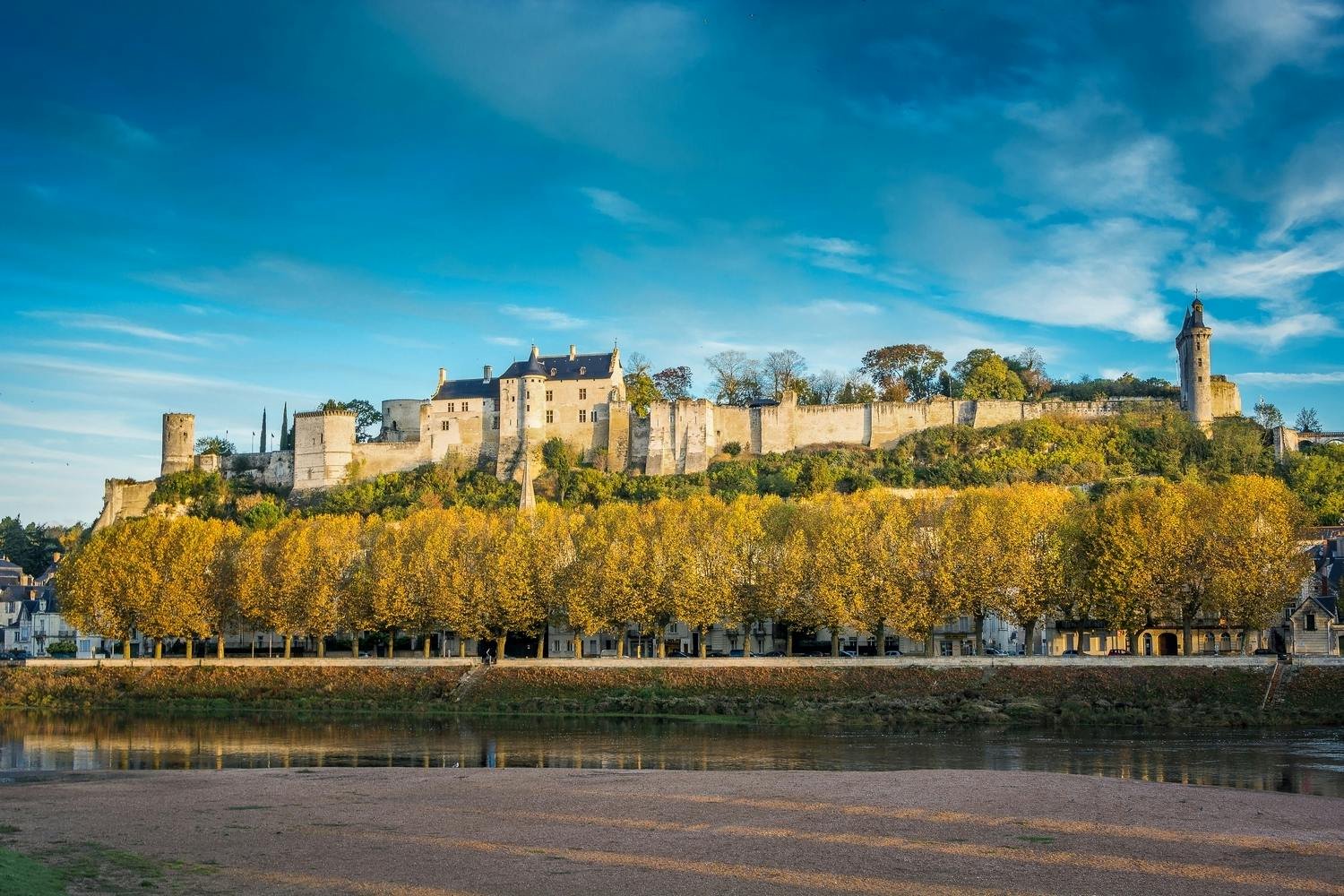
The Royal Fortress of Chinon stretches across a rocky ridge above the Vienne River in France’s Loire Valley. Its pale limestone walls dominate the town below, creating one of the region’s most dramatic medieval skylines.
Chinon differs from the elegant Renaissance châteaux for which the Loire Valley is famous. It is primarily a military and royal fortress rather than a decorative country palace. Visitors encounter defensive towers, ruined walls, deep ditches, reconstructed royal rooms, open courtyards and broad views across the town, river and surrounding vineyards.
Sponsored Popular Items
Quick take: Musement.com offers a worldwide selection of tours and attractions
Royal Fortress of Chinon Entry Ticket France Ticket to the Royal Fortress of Chinon provides a structured way to visit a notable attraction or cultural site. Check current availability, inclusions and booking details before you go.
The fortress is closely associated with some of the most important figures in medieval European history. Henry II of England made Chinon a central stronghold within the Plantagenet territories and died there in 1189. Eleanor of Aquitaine was held there during her conflict with Henry. Knights Templar were imprisoned in the Coudray Tower, while Joan of Arc came to Chinon in 1429 to meet the future Charles VII.
A modern visit combines surviving medieval architecture with digital interpretation. The included HistoPad reconstructs lost rooms and buildings, helping visitors understand spaces that are now partly ruined or completely absent.
This guide explains what to see, how long to allow, current admission prices, accessibility, transport, parking and how to combine the fortress with Chinon’s historic town and surrounding Loire Valley attractions.
Royal Fortress of Chinon Quick Facts
Visitor information
Details
Location
Chinon, Indre-et-Loire, Centre-Val de Loire, France
Address
4 Rue du Château, 37500 Chinon
Type of site
Medieval royal fortress divided into three fortified sections
Main historical figures
Henry II, Eleanor of Aquitaine, Philip Augustus, Jacques de Molay, Charles VII and Joan of Arc
Current adult admission
€12.50
Reduced admission
€10.50
Children under seven
Free
HistoPad
Included with normal paid admission, subject to availability
Recommended visit
Two to three hours
Train-station walk
Approximately 20 minutes
Drive from Tours
Approximately 40 minutes
Parking
Free visitor parking near the fortress
Closed
1 January and 25 December
Walking conditions
Cobbles, gravel, steep slopes, towers and irregular stairs
Best general seasons
May, June, September and early October
Important: Special events can alter access to particular towers, underground areas or roads approaching the fortress. Check the current programme before travelling.
What Is the Royal Fortress of Chinon?
The Royal Fortress of Chinon is a complex of medieval fortifications occupying a long limestone promontory above the town.
It is not a single intact castle built during one period. The site developed across many centuries and contains architecture associated with different rulers, defensive technologies and royal needs.
Its principal features include:
Three fortified zones separated by ditches.
Defensive walls and towers.
Royal residential buildings.
A monumental gate tower and clock.
Ruined domestic and religious structures.
Open lawns and courtyards.
Views across Chinon and the Vienne Valley.
Museum displays and digital reconstructions.
The fortress’s appearance is partly ruinous. Visitors should not expect every tower to contain furnished rooms or every wall to be complete.
The surviving architecture, archaeological remains and reconstructed royal lodgings are interpreted together to explain how the complex changed from a military stronghold into an important royal residence.
Why Visit Chinon Fortress?
Chinon is particularly worthwhile for visitors interested in medieval history rather than only the formal gardens and richly furnished interiors of later Loire châteaux.
Reasons to visit include:
Its importance within the Plantagenet territories.
Its connection with Henry II and Eleanor of Aquitaine.
The imprisonment of senior Knights Templar.
Joan of Arc’s meetings with Charles VII.
Clear examples of medieval defensive architecture.
Excellent views over Chinon and the Vienne River.
Interactive interpretation suitable for families.
Easy combination with Chinon’s old town and vineyards.
The fortress also reveals a less decorative side of the Loire Valley. While places such as Chenonceau and Villandry display Renaissance elegance, Chinon communicates political instability, siege warfare and royal power during the Middle Ages.
The Fortress’s Three Castles
Medieval documents describe the complex as three castles contained within one extended enclosure.
Fort Saint-Georges
Fort Saint-Georges occupied the eastern end of the ridge.
Henry II Plantagenet developed a palace there during the 12th century to accommodate an expanding royal court and administration.
Much of this section has disappeared, but its position illustrates the scale of the medieval fortress beyond the surviving central buildings.
The modern visitor reception area stands near the eastern approach.
The Middle Castle
The Middle Castle forms the central and most recognisable part of the site.
It contains:
The Clock Tower.
The surviving Royal Dwellings.
The Treasury Tower.
Important museum displays.
Routes towards the principal ramparts and viewpoints.
This was the main residential and administrative heart of the later royal fortress.
Fort du Coudray
Fort du Coudray occupies the western part of the ridge.
It was separated from the Middle Castle by a ditch and protected by the imposing Coudray Tower.
This section is strongly associated with Philip Augustus and the imprisonment of senior Knights Templar.
The western end also provides broad views along the Vienne Valley.
A Short History of Chinon Fortress
Ancient and Late Roman Occupation
The strategic ridge has been occupied for thousands of years.
Its elevation provided:
Views along the river.
Natural protection from steep slopes.
Control of river crossings and local roads.
Access to fertile land and trade routes.
The promontory was fortified during the later Roman period and remained occupied through the Merovingian and Carolingian eras.
Medieval Counts and the Plantagenets
Chinon became increasingly important under the counts of Anjou.
By the 12th century, it formed part of the territories controlled by Henry Plantagenet, who became King Henry II of England in 1154.
His combined lands extended across much of western France as well as England, making Chinon a strategically central royal residence.
Philip Augustus
French king Philip II Augustus captured Chinon in 1205 after a lengthy siege.
He strengthened the western defences and constructed the large Coudray Tower.
The change brought the fortress firmly under the control of the French Crown.
Late Medieval Royal Residence
During the 14th and 15th centuries, royal residential buildings were expanded.
Charles VII and Queen Marie of Anjou used Chinon during the difficult final stages of the Hundred Years’ War.
Decline
As military technology and royal preferences changed, Chinon gradually lost its strategic and residential importance.
Buildings deteriorated, roofs collapsed and parts of the fortress were dismantled or reused.
Preservation and Restoration
The fortress was classified as a French historical monument in 1840.
Modern conservation has stabilised ruins, restored sections of the Royal Dwellings and introduced archaeological and digital interpretation.
Henry II Plantagenet
Henry II became King of England in 1154 while already controlling extensive territories in France.
His possessions included:
Normandy.
Anjou.
Maine.
Aquitaine through his marriage to Eleanor.
Other territories controlled directly or through family relationships.
Chinon stood near the centre of this collection of lands and became an important administrative and financial stronghold.
Henry stored part of his treasury at Chinon and stayed there frequently.
Death at Chinon
Henry’s final years were marked by conflict with the French king and rebellion among his sons.
Ill and politically weakened, he died at Chinon in 1189.
His body was transported to Fontevraud Abbey, where his tomb effigy can still be seen beside that of Eleanor of Aquitaine.
Eleanor of Aquitaine
Eleanor of Aquitaine was one of the most powerful women of medieval Europe.
She became Queen of France through her marriage to Louis VII and later Queen of England after marrying Henry II.
Her marriage brought the vast Duchy of Aquitaine into the Plantagenet political world.
Family Conflict
Eleanor supported a revolt by her sons against Henry II in 1173.
After the rebellion failed, she was held under varying degrees of confinement. Chinon was among the places associated with her detention before she was moved to England.
After Henry’s death, Eleanor regained an important political role and supported the reigns of her sons Richard the Lionheart and John.
Understanding Eleanor at the Fortress
The HistoPad and interpretive displays help reconstruct the appearance of royal domestic rooms and explain how elite residents might have used them.
Visitors should remember that most furnishings are interpretive rather than an untouched collection belonging personally to Eleanor.
The Knights Templar at Chinon
One of Chinon’s most intriguing episodes occurred during the suppression of the Knights Templar.
In 1307, King Philip IV of France ordered the arrest of members of the order and accused them of serious religious offences.
Senior Templar officials were imprisoned at Chinon in 1308, including:
Jacques de Molay, the final Grand Master.
Other high-ranking officials of the order.
Templar Graffiti
Graffiti within the Coudray Tower has traditionally been associated with the imprisoned Templars.
The markings include religious forms such as:
Crosses.
An angel.
A soldier-like figure.
Symbols linked with the Passion of Christ.
Interpretation remains cautious because proving the individual creator of every mark is difficult.
The Chinon Parchment
The Templar interrogations at Chinon produced an important historical document commonly called the Chinon Parchment.
It provides evidence about the papal investigation and remains central to historical discussion of the order’s suppression.
Joan of Arc and Charles VII
Joan of Arc arrived in Chinon in February 1429 during a critical stage of the Hundred Years’ War.
Charles VII’s claim to the French throne remained contested, and English and Burgundian forces controlled large parts of the kingdom.
Joan believed she had a divine mission to:
Relieve the siege of Orléans.
Assist Charles in reaching Reims.
Help secure his coronation.
The Meeting at Chinon
The familiar legend describes Joan entering a crowded hall and immediately identifying Charles despite his attempt to hide among courtiers.
The historical events were more complex.
Joan had more than one meeting with Charles. Her first reception was relatively private, followed by examination of her claims and a later public presentation.
The Recognition Hall
The large medieval hall traditionally associated with the meeting no longer survives.
Its former position is interpreted near the Royal Dwellings and is referred to as the Recognition Hall.
Digital reconstruction helps visitors understand the size and arrangement of the lost building.
Why the Meeting Mattered
Joan subsequently joined the campaign that lifted the siege of Orléans.
Charles was crowned at Reims in July 1429, strengthening his legitimacy and changing the political direction of the war.
The Royal Dwellings
The surviving Royal Dwellings occupy the southern side of the Middle Castle.
The residential complex was once considerably larger and consisted of three wings around a courtyard.
Only the principal southern wing survives in recognisable form.
What Visitors See
The buildings contain:
Interpretive rooms.
Historical collections.
Reconstructions of royal interiors.
Displays concerning Joan of Arc.
Architectural information.
HistoPad stations.
The rooms are not filled with a complete original royal furniture collection.
Instead, the presentation combines surviving objects, modern reconstructions and digital imagery to show how the residence may have looked.
Architectural Features
Look for:
Stone fireplaces.
Mullioned windows.
Small corner turrets.
Slate roofs.
Views over the old town and river.
The Clock Tower
The Clock Tower forms the monumental gateway to the Middle Castle.
It rises through five levels and originally defended access with a drawbridge and portcullis.
Marie-Javelle Bell
The tower contains an old bell known as Marie-Javelle.
The bell and clock have marked time for Chinon since the late 14th century.
The historical mechanism used suspended stone weights that had to be raised manually.
The View
The tower offers one of the finest elevated views within the fortress.
Visitors can see:
Chinon’s tiled and slate roofs.
The Vienne River.
Bridges and riverbanks.
Vineyards and countryside.
The fortress walls extending along the ridge.
Access involves stairs and confined historic spaces.
Coudray Tower
The Coudray Tower is one of the strongest and most historically significant structures at Chinon.
Philip Augustus built it following the French capture of the fortress in 1205.
Defensive Features
The tower included:
Arrow slits on several levels.
A protected upper entrance.
A drawbridge.
Double portcullises.
A murder hole above the entrance.
Connections with surrounding wall walks.
Its thick masonry and restricted approach demonstrate how a keep could function as a final secure position within a larger fortress.
Templar Association
The imprisoned Templar dignitaries were held in this section during 1308.
The interior is consequently one of the most atmospheric parts of the visit.
Lighting can be subdued, stairs are irregular and some spaces feel confined.
Other Towers and Defences
Treasury Tower
Henry II constructed the Treasury Tower against the southern wall of the Middle Castle.
It was used to protect royal treasure in the form of documents, charters and administrative records as well as valuable objects.
Boissy Tower
The Boissy Tower helped guard the southern side of the fortress and later took its name from a captain associated with work undertaken there.
Mill Tower
The Mill Tower stands near the western end of the ridge.
It is associated with Richard the Lionheart’s period and provided surveillance over the valley and approaches.
Dog Tower
The Dog Tower’s name is connected with nearby royal kennels.
Its internal features included ovens associated with the service and domestic life of the fortress.
Argenton Tower
This later defensive tower demonstrates how the fortifications continued to change in response to military needs.
Ditches and Curtain Walls
The divisions between the three castles were reinforced by ditches.
These made it harder for attackers who captured one section to move immediately into another.
The HistoPad Experience
The HistoPad is included with standard paid admission, subject to availability.
It uses location-sensitive digital reconstruction to show spaces as they may have appeared during different historical periods.
What It Adds
360-degree reconstructions.
Recreated furniture and decoration.
Historical characters.
Explanations of missing buildings.
An interactive map.
A treasure hunt.
Historical costume photographs.
Languages
The current system is available in nine languages, including English.
Is the HistoPad Necessary?
It is particularly useful at Chinon because substantial buildings no longer survive.
Without reconstruction, lawns and ruined foundations can be difficult to interpret.
Visitors who prefer not to use a tablet can follow the physical signs and printed guide material instead.
Children’s Route
A separate self-guided family route designed for approximately five- to ten-year-old children is available in French and English.
The HistoPad treasure hunt is particularly suitable for older children who enjoy searching for objects and completing challenges.
Current Games and Activities
The fortress runs changing family programmes, guided visits and medieval demonstrations during school holidays and special weekends.
The 2026 programme currently includes:
The “Guardians of Time” monument game through 31 December 2026.
The “Building a Castle” GeoGaming experience through early March 2027.
Selected siege-engine demonstrations and medieval activities.
Seasonal guided visits.
Occasional access to normally closed spaces.
Some activities operate only in French or require a separate booking.
Check:
Language.
Minimum age.
Starting time.
Whether admission is included.
Whether spaces are limited.
The Best Views
Clock Tower
The Clock Tower provides a high panoramic perspective over Chinon.
Southern Ramparts
Views from the south side extend across the historic centre and Vienne River.
Western Fortress
The Fort du Coudray area looks along the river valley and surrounding countryside.
From the Vienne Riverbank
The classic external view shows the complete fortress rising above houses and trees.
From Chinon’s Bridges
Bridge viewpoints place the river in the foreground and are especially attractive in early morning or late afternoon light.
Photography Conditions
The pale limestone can appear flat under harsh midday sun.
Morning and late-afternoon light generally provide stronger texture and warmer colour.
Current Admission Prices
Ticket
Current price
Full adult admission
€12.50
Reduced admission
€10.50
Children under seven
Free
Green cyclist ticket
€11.50
Adult annual privilege pass
€25
Annual pass for ages 7–17
€20
Reduced Admission
Reduced admission currently applies to eligible categories including:
Visitors aged 7–18.
Students.
Visitors with disabilities.
One accompanying person.
Large-family card holders.
Selected education-pass holders.
Passengers holding a valid same-day TER Centre train ticket.
Groups of at least 15.
Valid evidence is required.
Free Admission
In addition to children under seven, free entry may apply to eligible jobseekers, journalists, museum professionals and authorised guides.
Cyclist Discount
Cyclists can currently receive a €1 reduction from the full adult price by presenting a photograph of themselves and their bicycle outside the reception building.
HistoPad Charges
The HistoPad is normally included for paying visitors.
Visitors receiving free entry may be charged separately for the tablet.
Opening Hours
Period
Opening hours
January–February
10:00 am–5:00 pm
March–June
9:30 am–6:00 pm
July–August
9:30 am–7:00 pm
September–October
9:30 am–6:00 pm
November–December
10:00 am–5:00 pm
The fortress is normally open daily except:
1 January.
25 December.
The ticket office and shop close 30 minutes before the site closes.
Arriving at the final ticket-sale time does not leave enough time for a meaningful visit. Enter at least two hours before closing whenever possible.
How Long Should You Spend?
Time available
Realistic experience
One hour
Quick walk through principal ruins and Royal Dwellings
Two hours
Main towers, HistoPad highlights and viewpoints
Three hours
Detailed visit with exhibitions, reconstructions and photography
Half day
Fortress plus Chinon old town and riverside
Full day
Fortress, town, lunch, wine tasting and surrounding countryside
Two to three hours is ideal for most first-time visitors.
Families using the HistoPad treasure hunt may need longer than adults following a straightforward historical route.
The Best Time to Visit
Early Morning
Arrive at opening for:
Quieter towers.
Easier parking.
Cooler summer conditions.
Clearer photographs.
Late Afternoon
Late afternoon provides attractive light over the town and river.
Allow enough time before closing to complete the towers and Royal Dwellings.
Spring
April to June offers green countryside, comfortable temperatures and long daylight.
Summer
July and August provide the longest hours and the most activities.
Open courtyards, towers and walls can become hot, while the most confined interiors may feel crowded.
Autumn
September and October combine mild conditions with vineyard colour and lower visitor numbers.
Winter
Winter visits are quieter and atmospheric.
Expect shorter hours, cold stone interiors, possible rain and fewer seasonal food services.
Getting to Chinon by Train
Regional TER trains connect Tours and Chinon.
The journey commonly takes approximately 46–55 minutes, depending on the service.
Trains may stop at places including:
Joué-lès-Tours.
Ballan.
Azay-le-Rideau.
Rivarennes.
From Paris
A typical journey involves:
A high-speed train from Paris Montparnasse to Saint-Pierre-des-Corps or Tours.
A connection to the regional Chinon service.
Total journey time varies considerably with the connection and is commonly around two and a half to three and a half hours.
From Chinon Station
The fortress is approximately a 20-minute walk from the station.
The route passes through the lower town and finishes with an uphill section.
A local bus can reduce the climb by stopping near the cemetery, approximately five minutes’ walk from the fortress.
Train Discount
Visitors holding a valid same-day TER Centre ticket currently qualify for the reduced fortress admission price.
Driving and Parking
From Tours
The drive from Tours takes approximately 40 minutes in normal traffic.
From Paris
Allow roughly two and a half to three hours via the A10 and A85, depending on traffic and starting point.
From Nearby Châteaux
The fortress is approximately 25 minutes by car from:
Free visitor parking is available near the fortress for:
Cars.
Coaches.
Motorhomes.
Bicycles.
The principal parking area on Avenue François Mitterrand includes electric-vehicle charging points.
Secure lockers for charging electric-bicycle batteries are also available.
Driving Advice
Follow fortress parking signs rather than entering narrow old-town streets.
Do not attempt to park directly in the medieval centre below.
Expect steep roads near the ridge.
Arrive early during summer events.
Do not leave luggage visible inside the vehicle.
Walking from Chinon Town
The fortress stands immediately above the old centre, but the change in elevation is significant.
Possible approaches include:
Stepped lanes from the medieval streets.
Sloping roads around the ridge.
The route from the railway station.
The climb rewards visitors with changing views over rooftops and the river.
Wear shoes with grip because stone and paving can become slippery after rain.
Accessibility and Reduced Mobility
Chinon is a protected historic monument built for defence rather than modern accessibility.
Main Difficulties
Cobbles.
Loose gravel.
A steep ramp after reception.
Irregular tower stairs.
Low doors.
Dark interior spaces.
Long distances between sections.
Parking and Drop-Off
Two reserved parking spaces are available close to reception.
Visitors using wheelchairs should normally be accompanied.
On request, a vehicle may be allowed into the park to drop a passenger near the Royal Dwellings before the driver returns to the designated parking area.
Accessible Facilities
Accessible toilets are provided in the reception building.
The HistoPad includes features for visitors with visual or hearing limitations, including audio substitution, magnification, written content and subtitled video.
Visitors requiring specific access should contact the fortress before arrival because not every tower or wall route is reachable.
Visiting with Children
Chinon is one of the more family-friendly historical sites in the Loire Valley.
Why Children May Enjoy It
Towers and battlements.
Stories of kings, Templars and Joan of Arc.
HistoPad reconstructions.
Treasure hunts.
Historical costume photographs.
Seasonal siege-engine demonstrations.
Large outdoor spaces.
Practical Challenges
Numerous stairs.
Steep drops and walls.
Hot open areas in summer.
Uneven surfaces unsuitable for running.
Dark rooms that may concern very young children.
Pushchair parking is available.
A lightweight folding pushchair or child carrier is more practical than a large pram.
Visiting with a Dog
Dogs are allowed in the outdoor park when kept on a lead.
Inside buildings, only animals carried in a person’s arms or in a suitable bag are normally accepted.
Temporary exhibitions in the Royal Dwellings may impose additional restrictions.
Recognised assistance dogs are allowed inside.
Owners should:
Carry water.
Remove all waste.
Avoid hot stone surfaces in summer.
Keep dogs away from walls and archaeological remains.
Food, Toilets and Visitor Facilities
Food
A seasonal food area operates within the fortress grounds.
The current schedule is generally:
Weekends during May and June.
Daily during July and August.
Approximately 11:00 am–6:00 pm.
Offerings may include:
Sandwiches.
Salads.
Crêpes.
Desserts.
Artisanal ice cream.
Local beer.
Loire Valley wine.
Outside the summer period, eat in Chinon town or bring water and a small snack.
Water and Drinks
The reception area has a water fountain and hot and cold drink machines.
Toilets
Toilets, including accessible facilities, are located near reception.
Left Luggage
Free left-luggage facilities are currently available.
Large suitcases are inconvenient on tower routes and should be stored before entering.
Wi-Fi
Public Val de Loire Wi-Fi is available in designated areas.
Chinon Historic Centre
The town below the fortress contains narrow streets, half-timbered houses, pale stone buildings, churches, restaurants and wine shops.
Rue Voltaire
Rue Voltaire is one of the main historic streets and contains medieval and Renaissance façades.
Place du Général de Gaulle
The central square is useful for cafés, restaurants and access to surrounding streets.
Vienne Riverfront
The riverside provides:
Views of the fortress.
Shaded walks.
Bridges and boating activity.
Picnic possibilities.
Good morning and evening photography.
Chapelle Sainte-Radegonde
The partly rock-cut chapel is associated with medieval wall paintings and Plantagenet history.
Opening arrangements can be limited, so confirm before planning the day around it.
Musée Le Carroi
The local museum presents Chinon’s art, history and archaeology through changing displays.
Chinon Wine
Chinon lies at the centre of an important Loire wine appellation.
Red Wine
Most Chinon red wine is produced from Cabernet Franc.
Styles range from:
Fresh, light and fruit-driven wines.
Structured wines suitable for ageing.
Earthy and herbal expressions.
Rosé and White Wine
The appellation also produces rosé and smaller quantities of white wine, commonly based on Chenin Blanc.
Wine Cellars
Some producers use caves excavated into the soft limestone hills.
Tastings may be available in:
Town wine shops.
Estate cellars.
Nearby vineyard villages.
Rock-cut cave systems.
Reserve estate visits in advance and use a designated driver.
Places to Visit Near Chinon
Fontevraud Abbey
Fontevraud is closely connected with Chinon’s Plantagenet history.
The abbey contains the famous tomb effigies of Henry II, Eleanor of Aquitaine and Richard the Lionheart.
It is one of the strongest historical additions to a Chinon visit.
Château d’Azay-le-Rideau
Azay-le-Rideau offers a contrasting Renaissance residence reflected in water.
It is approximately 25 minutes away by car.
Villandry
Villandry is best known for its formal ornamental and kitchen gardens.
It combines well with Chinon when visitors want both medieval fortifications and Renaissance landscaping.
Candes-Saint-Martin
This attractive village stands near the meeting of the Loire and Vienne rivers.
Its stone houses, collegiate church and riverside setting make it a useful short stop.
Montsoreau
Montsoreau contains a château beside the Loire and a historic village centre.
Rigny-Ussé
Château d’Ussé presents the more romantic, fairy-tale side of the Loire château tradition.
Vineyards and Cellars
Chinon’s surrounding countryside contains numerous wine estates, but opening days and tasting arrangements vary.
Suggested Half-Day Itinerary
9:30 am: Enter the Fortress
Collect the HistoPad and begin before tour groups arrive.
9:45 am: Fort Saint-Georges
Use the digital reconstruction to understand the largely vanished eastern palace.
10:15 am: Middle Castle
Visit the Clock Tower and Royal Dwellings.
11:15 am: Joan of Arc Displays
Explore the reconstructed royal rooms and the site of the Recognition Hall.
11:45 am: Fort du Coudray
See the Coudray Tower, Templar associations and western views.
12:30 pm: Descend into Chinon
Walk through the old streets for lunch.
Suggested One-Day Chinon Itinerary
9:30 am: Royal Fortress
Allow two and a half to three hours for the complete visit.
12:30 pm: Lunch in the Historic Centre
Choose a restaurant around the old streets or central square.
2:00 pm: Medieval Town Walk
Explore Rue Voltaire, old houses and local churches.
3:00 pm: Vienne Riverfront
Cross a bridge or follow the river for views back towards the fortress.
4:00 pm: Wine Tasting
Visit a pre-booked cellar or a town tasting room.
5:30 pm: Optional Excursion
Drive towards Candes-Saint-Martin or Fontevraud when daylight permits.
Is Chinon Fortress Worth Visiting?
The Royal Fortress of Chinon is highly worthwhile for travellers interested in medieval politics, Joan of Arc, Plantagenet history or military architecture.
Main Advantages
Major historical importance.
Association with English and French royalty.
Strong Joan of Arc interpretation.
Templar history.
Excellent views.
Interactive HistoPad included.
Family-friendly activities.
Free parking.
Easy combination with wine and the historic town.
Possible Drawbacks
Many buildings are ruined or missing.
Visitors expecting a fully furnished palace may be disappointed.
Stairs and gravel make access difficult.
Open grounds can be hot in summer.
Winter interiors can feel cold.
Seasonal food services are limited.
The fortress is most satisfying when visitors use the HistoPad and understand that the apparent empty spaces once contained a densely built royal complex.
Frequently Asked Questions About the Royal Fortress of Chinon
Where is the Royal Fortress of Chinon?
It stands above the town of Chinon in the Indre-et-Loire department of France’s Centre-Val de Loire region.
Is Chinon in the Loire Valley?
Yes. Chinon lies within the wider Loire Valley cultural landscape, although the fortress overlooks the Vienne River rather than the Loire itself.
Is Chinon Castle the same as the Royal Fortress?
Yes. “Chinon Castle” is a common informal name, but Royal Fortress of Chinon is more accurate.
Is it one castle?
No. The enclosure was historically divided into Fort Saint-Georges, the Middle Castle and Fort du Coudray.
How much is admission?
Current full adult admission is €12.50.
How much is the reduced ticket?
The reduced rate is currently €10.50.
Are children free?
Children under seven enter free. Visitors aged 7–18 qualify for the reduced rate.
Is the HistoPad included?
Yes, it is included with normal paid admission, subject to availability.
What languages are on the HistoPad?
It is currently available in nine languages, including English.
How long does the visit take?
Allow two to three hours.
Can I visit in one hour?
Yes, but you will need to skip many towers, reconstructions and displays.
What are the opening hours?
The fortress opens from 10:00 am to 5:00 pm in the quieter winter months, 9:30 am to 6:00 pm in spring and autumn, and 9:30 am to 7:00 pm in July and August.
Which days is it closed?
It is normally closed on 1 January and 25 December.
Do I need to reserve a ticket?
Advance booking is useful during summer, school holidays and special events, although ordinary visits may also be purchased at reception subject to availability.
Was Henry II really at Chinon?
Yes. Chinon was an important Plantagenet fortress, and Henry II died there in 1189.
Where is Henry II buried?
He is buried at Fontevraud Abbey.
Was Eleanor of Aquitaine imprisoned at Chinon?
She was held at Chinon during the conflict with Henry II before being confined in England.
Did Richard the Lionheart live at Chinon?
Richard was connected with the Plantagenet stronghold and is associated with work on parts of its defences.
Did Joan of Arc meet Charles VII at Chinon?
Yes. She met him at Chinon in 1429 before the campaign that lifted the siege of Orléans and led towards his coronation.
Did Joan identify Charles in a crowded hall?
The popular story is highly simplified. Historical evidence indicates more than one meeting and a longer process of investigation.
Does the hall where Joan met Charles still exist?
No. The great hall has disappeared, but its former position is interpreted as the Recognition Hall.
Were Knights Templar held at Chinon?
Yes. Senior officials, including Jacques de Molay, were imprisoned there in 1308.
Can I see Templar graffiti?
Graffiti in the Coudray Tower is traditionally attributed to the prisoners and is interpreted during the visit.
Is the fortress fully restored?
No. It contains restored buildings, stabilised ruins and archaeological remains.
Are the rooms furnished?
Some spaces contain interpretive furniture and displays, but the fortress does not preserve a complete original royal interior.
Is there a guided tour?
Guided tours operate on selected dates and times. Some are available only in French.
Are there activities for children?
Yes. Options include a HistoPad treasure hunt, a family route and seasonal games or medieval demonstrations.
Is the fortress suitable for young children?
Yes, but parents must supervise children closely around stairs, walls and uneven ground.
Can I use a pushchair?
Some outdoor areas are manageable, but stairs and gravel limit access. Pushchair parking is provided.
Is the fortress wheelchair accessible?
Only partly. The steep ramp, cobbles and tower stairs prevent access to the complete route.
Are accessible parking spaces available?
Yes. Two reserved spaces are located near reception.
Can a vehicle drop off a wheelchair user inside?
On request, vehicle drop-off near the Royal Dwellings may be arranged.
Are accessible toilets available?
Yes, in the reception building.
Can I bring a dog?
Dogs are allowed on a lead in the outdoor park. Inside buildings, they normally need to be carried.
Are assistance dogs allowed?
Yes.
Is there food inside the fortress?
A seasonal food outlet operates on weekends in May and June and daily in July and August.
Can I leave luggage?
Yes. Free left-luggage facilities are currently available.
Are there toilets?
Yes, near reception.
Is parking free?
Yes. Free car, coach, motorhome and bicycle parking is available near the site.
Are electric-car chargers available?
Yes, at the main parking area on Avenue François Mitterrand.
How far is the fortress from Chinon station?
Approximately a 20-minute walk.
Is the walk from the station steep?
The final section climbs towards the fortress.
Is there a bus from the station?
A local bus can travel towards the cemetery stop, around five minutes’ walk from the fortress.
How long is the train from Tours?
Direct regional trains commonly take around 46–55 minutes.
Can Chinon be visited from Paris in one day?
Yes, but the rail journey requires a connection and the day will be long. Staying overnight provides a more relaxed experience.
How far is Chinon from Tours?
The drive takes approximately 40 minutes.
Can I combine Chinon with Azay-le-Rideau?
Yes. Azay-le-Rideau is approximately 25 minutes away by car.
Can I combine Chinon with Villandry?
Yes. Villandry is also approximately 25 minutes away.
What is the best historical combination?
Chinon Fortress and Fontevraud Abbey provide the strongest Plantagenet-themed day.
Is Fontevraud close?
Yes. It is within easy driving distance and contains the tomb effigies of Henry II and Eleanor of Aquitaine.
What wine is Chinon known for?
It is best known for red wine made from Cabernet Franc.
Can I visit a winery?
Yes. Numerous estates and town tasting rooms operate nearby, but appointments are recommended.
Is Chinon Fortress a UNESCO World Heritage Site?
The fortress is not generally presented as a separately inscribed UNESCO property. It stands within the broader UNESCO-recognised Loire Valley cultural landscape.
What is the best month to visit?
May, June and September generally provide pleasant weather and fewer crowds than August.
Is it open during winter?
Yes, except for its two annual closure dates, but the hours are shorter.
Is it worth visiting in rain?
Yes, although walls, cobbles and steps become slippery. Several displays and Royal Dwelling rooms are indoors.
What should I wear?
Wear comfortable shoes and carry a waterproof or warm layer depending on the season.
Is Chinon better than other Loire châteaux?
It offers a different experience. Choose Chinon for medieval history and fortifications, and places such as Chenonceau or Villandry for Renaissance architecture and gardens.
What is the most important planning advice?
Allow enough time to use the HistoPad. The digital reconstruction is essential for understanding the large buildings that no longer survive.
Final Thoughts
The Royal Fortress of Chinon is one of the Loire Valley’s most historically important medieval sites.
Its power lies less in luxurious furnishing than in the events that occurred there. Henry II governed from Chinon and later died within its walls. Eleanor of Aquitaine was caught in the fortress’s family and political struggles. Templar leaders were imprisoned in the Coudray Tower, and Joan of Arc came to persuade Charles VII to pursue his crown.
The surviving towers and ramparts provide only part of the story. Large halls, chapels and residential buildings once filled spaces that now appear as lawns or foundations. The included HistoPad makes those lost structures understandable and turns an apparently fragmented ruin into a coherent royal complex.
Allow at least two hours, climb the Clock Tower when able and spend time in the Royal Dwellings rather than treating the fortress only as a viewpoint.
After the visit, descend into Chinon for lunch, walk beside the Vienne and try the region’s Cabernet Franc. Together, the fortress, medieval town and vineyards create one of the most complete historical day trips in the western Loire Valley.
Sponsored Popular Items
Quick take: Musement.com offers a worldwide selection of tours and attractions
Royal Fortress of Chinon Entry Ticket France Ticket to the Royal Fortress of Chinon provides a structured way to visit a notable attraction or cultural site. Check current availability, inclusions and booking details before you go.