Pamukkale is one of Türkiye’s most unusual destinations: a brilliant white hillside formed by thermal water, with the ruins of a major Greco-Roman spa city spread across the plateau immediately above it.
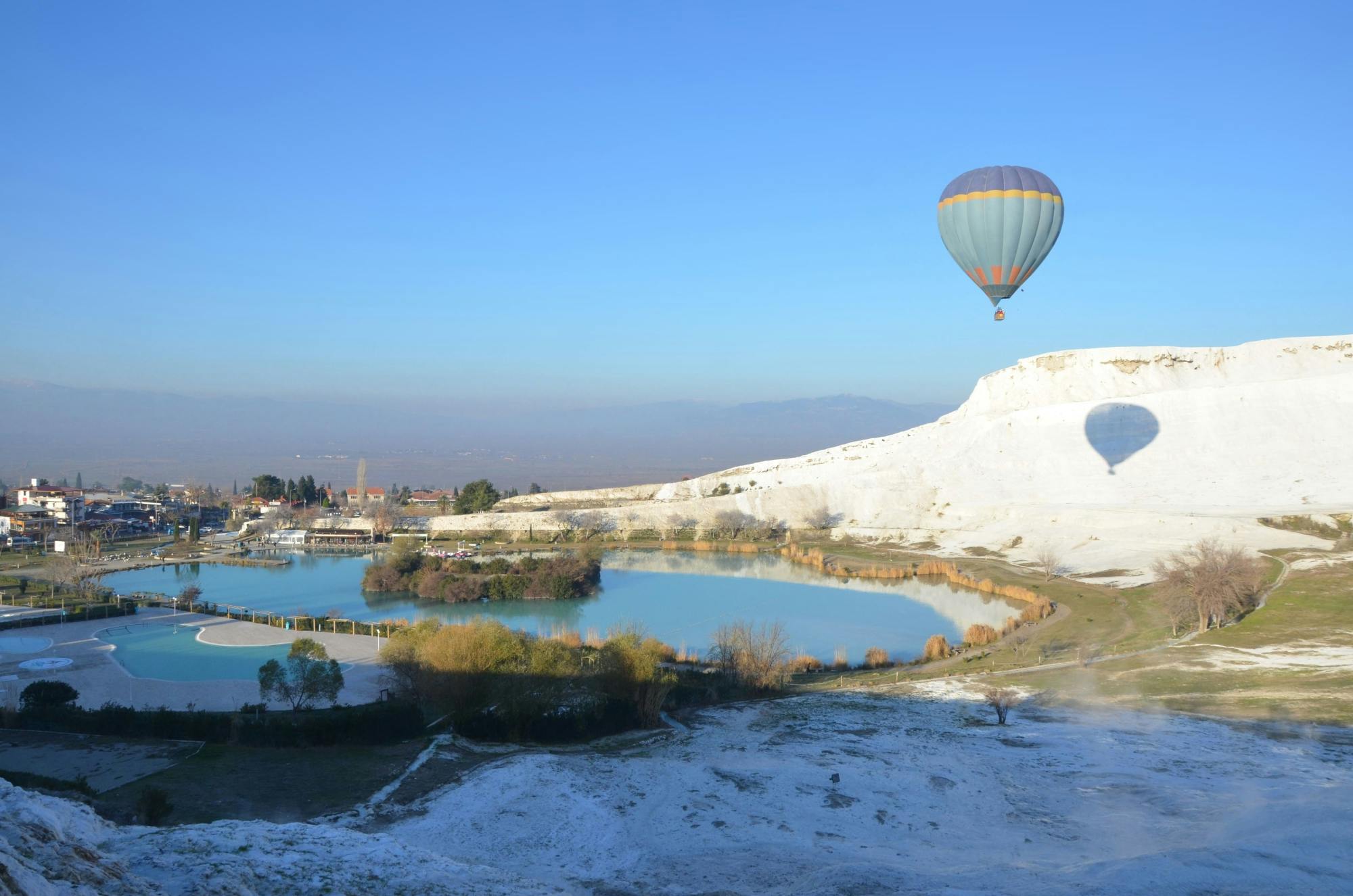
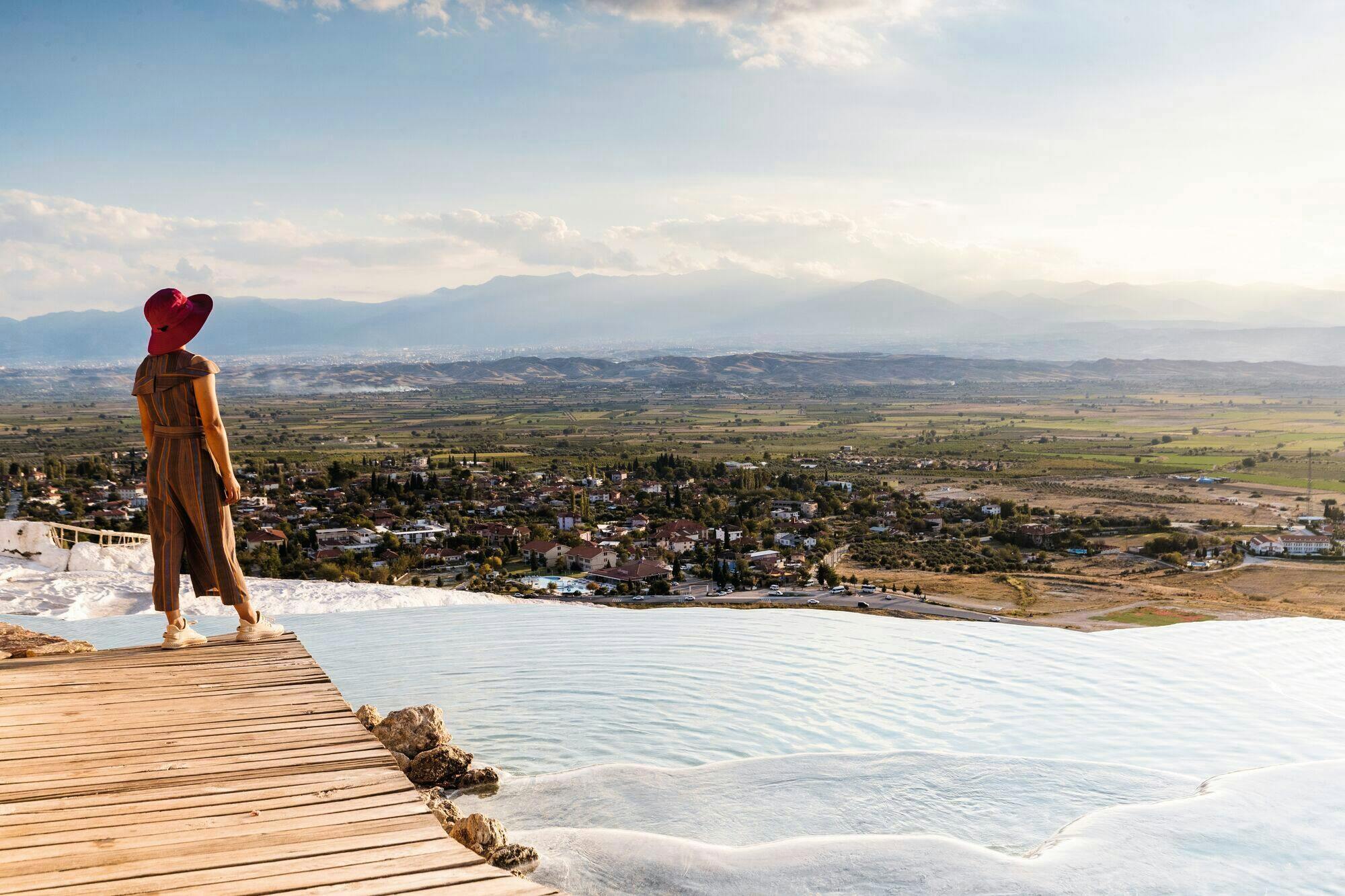
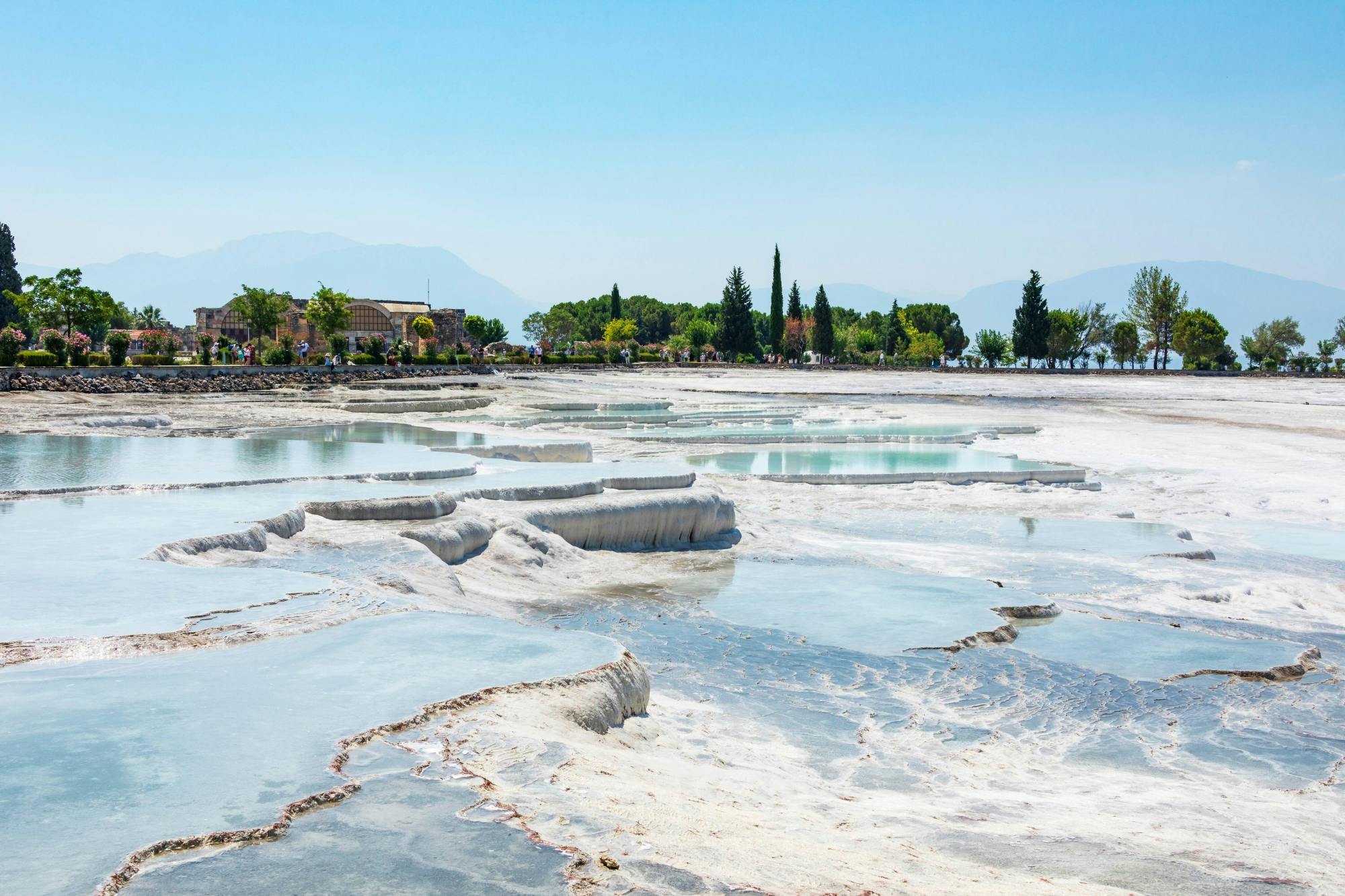
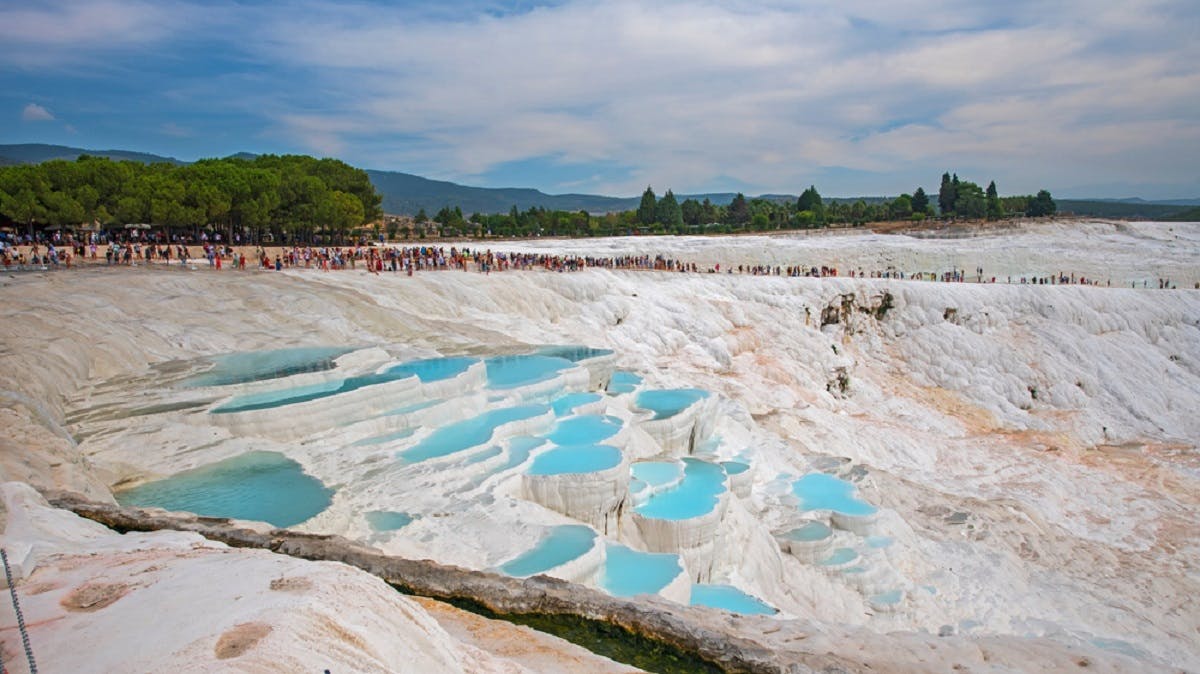
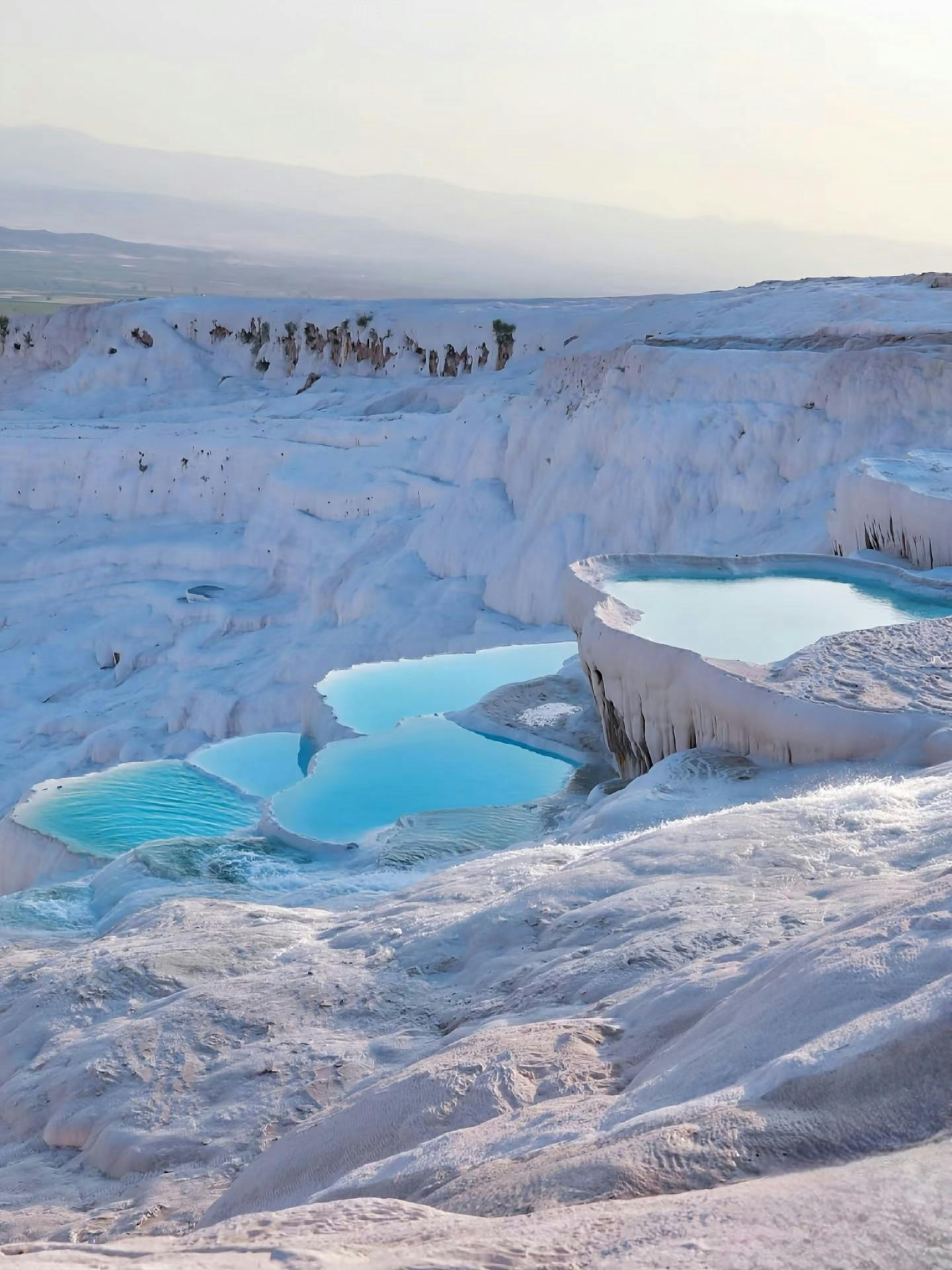
The name Pamukkale means “cotton castle” in Turkish. From the plain below, the mineral-covered slope resembles frozen waterfalls, snowfields or white clouds flowing down the hillside. Shallow blue pools and channels add to the effect, particularly during the softer light of early morning and sunset.
Sponsored Popular Items
Quick take: Musement.com offers a worldwide selection of tours and attractions
Pamukkale Sunrise Hot-Air Balloon & Hierapolis Tour Turkey Pamukkale Sunrise Hot Air Balloon Experience & Hierapolis Visit is a convenient way to add structure, local context and purposeful sightseeing to the itinerary. Check current availability, inclusions and booking details before you go.
The travertines are only half of the experience. A single admission ticket also covers Hierapolis, an extensive ancient city containing a Roman theatre, monumental gates, baths, temples, Christian buildings and one of the largest surviving necropolises in the region.
Visitors should allow far more time than they might expect from photographs. Pamukkale is not simply a row of pools beside a car park. The protected archaeological and natural site is large, exposed and physically demanding, particularly during summer.
This guide explains which entrance to use, where visitors may walk on the travertines, what to see in Hierapolis, how the Antique Pool works and how to avoid the most common planning mistakes.
Pamukkale Quick Facts
Visitor information
Details
Country
Türkiye
Province
Denizli
Distance from Denizli
Approximately 18 kilometres
UNESCO status
Mixed natural and cultural World Heritage Site since 1988
Main attractions
Travertines, Hierapolis, Roman theatre, necropolis and Antique Pool
Current combined admission
€30
Antique Pool
Open, with a separate swimming charge
Normal opening
From 8:00 am, with seasonal and entrance-specific closing times
Main entrances
Pedestrian, south and north gates
Recommended visit
At least four hours; a full day is better
Walking conditions
Barefoot wet travertine, rough archaeological paths and exposed slopes
Best seasons
April to May and September to October
Best light
Early morning and late afternoon
Best base without a car
Pamukkale village
Best thermal-hotel area
Karahayıt
Important: Opening times, water distribution, pool access and evening admission can change. Check the official museum listing immediately before travelling.
What Is Pamukkale?
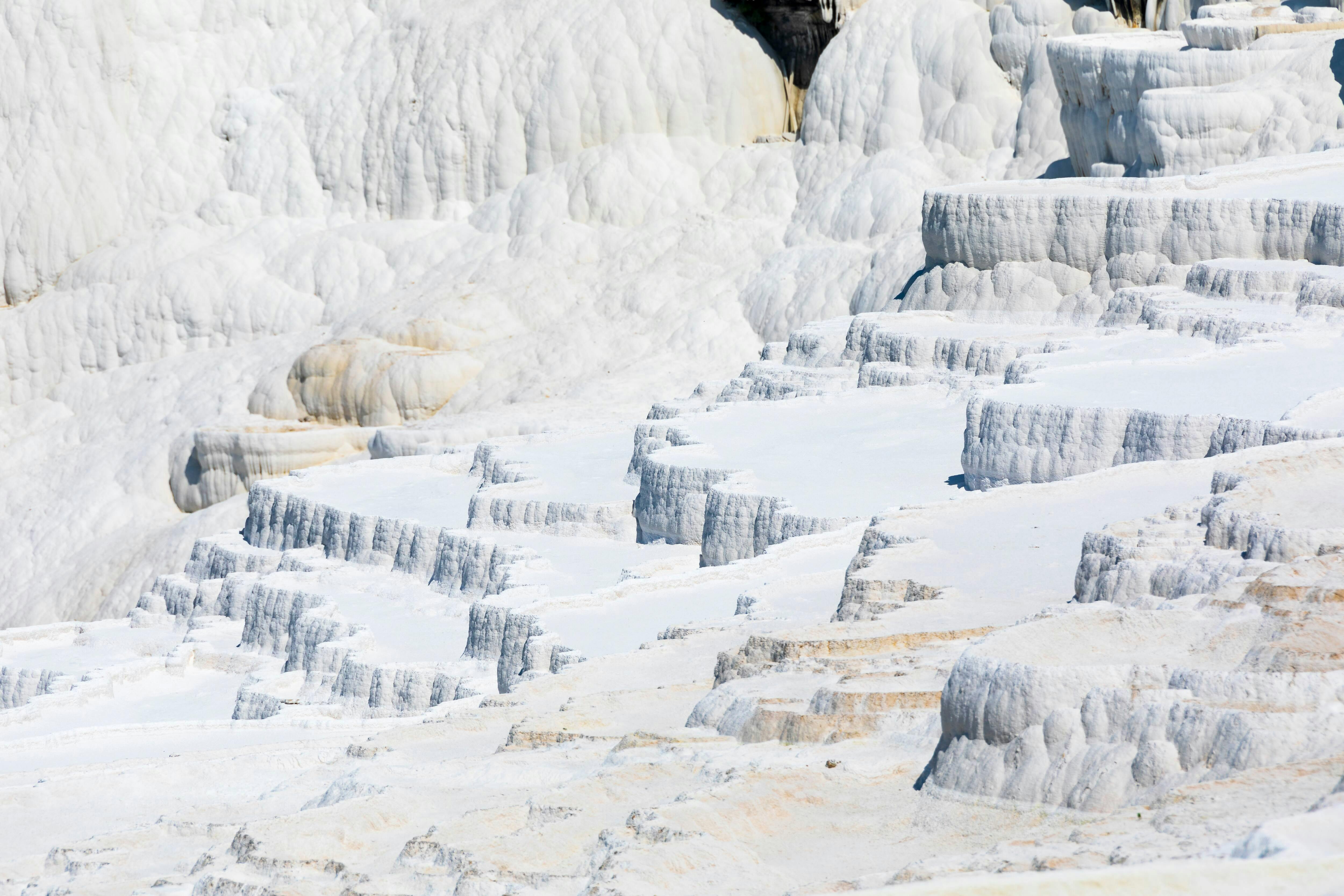
Pamukkale is a natural formation created by warm spring water containing high concentrations of dissolved calcium carbonate.
When the water reaches the surface, changes in temperature and pressure cause calcium carbonate to be deposited. Over thousands of years, these deposits have created:
White terraces.
Shallow basins.
Mineral ridges.
Stalactite-like formations.
Petrified waterfalls.
Channels carrying thermal water across the slope.
The formations are known as travertines. New deposits can appear dazzling white, while older or dry areas may develop cream, grey, brown or green colouring.
The white hillside is approximately 200 metres above the surrounding plain and forms the natural edge of the ancient city of Hierapolis.
What Is Hierapolis?
Hierapolis was an ancient spa city established near the thermal springs during the Hellenistic period.
The kings of Pergamon founded the principal city during the late second century BCE. It later passed to Roman control and became prosperous because of:
Thermal bathing.
Religious pilgrimage.
Textile production.
Regional trade.
Agriculture.
Its position on important Anatolian routes.
A destructive earthquake struck during the first century CE. Much of the city visible today dates from the extensive Roman rebuilding that followed.
Hierapolis later became an important Christian centre associated with Saint Philip. Byzantine churches and religious buildings were constructed among the older pagan monuments.
Repeated earthquakes, political change and the decline of regional settlement eventually led to the city’s abandonment.
Why Pamukkale Is World Heritage Listed
Pamukkale and Hierapolis form a rare combined natural and archaeological landscape.
The natural importance comes from:
The active thermal springs.
The brilliant calcite terraces.
The mineral pools and channels.
The scale of the cliff-side formation.
The continuing geological process.
The cultural importance comes from:
A major Greco-Roman thermal city.
Bath complexes.
A well-preserved Roman theatre.
The Temple of Apollo and Plutonium.
An extensive necropolis.
Early Christian monuments.
The direct relationship between the ancient city and its springs.
Hierapolis could not be understood without the thermal water, and the travertines cannot be separated historically from the people who used and managed the springs.
Current Tickets and Opening Hours
The current general ticket for international visitors costs €30.
The ticket covers:
Pamukkale’s designated travertine access.
The archaeological site of Hierapolis.
The Roman theatre.
The necropolis.
Public archaeological routes.
The Hierapolis Archaeology Museum under normal arrangements.
Swimming in the Antique Pool requires a separate payment.
Current Official Hours
The official listing currently shows:
Standard site opening: 8:00 am.
Published daytime closing: 6:45 pm.
Daytime ticket office closing: 6:00 pm.
Pedestrian gate: 8:00 am–6:00 pm.
North and south gates: Listed as operating until 9:00 pm under current seasonal arrangements.
Night museum programme: 7:00 pm–11:00 pm, with last ticket sales at 9:00 pm.
Because the central opening time and individual gate schedules do not completely match, treat the information for your chosen entrance as the most important and reconfirm it on the date of travel.
Museum Passes
Eligible Turkish Müzekart and international MuseumPass products are accepted according to their current conditions.
The MuseumPass does not cover swimming in the Antique Pool.
Children
Age-based free admission may be available with identification. Carry the child’s passport rather than assuming that age will be accepted without proof.
Choosing the Best Entrance
Pamukkale has three commonly used entrances. Selecting the right gate can improve the entire visit.
Pedestrian Gate
The pedestrian entrance begins in Pamukkale village at the bottom of the white slope.
Visitors remove their footwear and climb through the designated travertine channel towards Hierapolis.
Advantages
Easy to reach from village accommodation.
Provides the classic barefoot travertine experience.
No need for a taxi or car.
Excellent views while climbing.
Disadvantages
Long uphill walk.
Slippery mineral surfaces.
Very exposed in summer.
Less suitable for reduced mobility.
Earlier closing than the vehicle gates.
South Gate
The south entrance is the most practical gate for many independent drivers, tours and visitors who want to begin with Hierapolis.
Advantages
Vehicle access and parking.
Closer to central Hierapolis and the theatre.
Avoids the initial barefoot uphill climb.
Useful for early starts and evening visits.
Disadvantages
Can receive large tour groups.
Visitors must still walk considerable distances.
Less dramatic first view than entering from below.
North Gate
The north entrance is close to the large necropolis and Frontinus Gate.
Advantages
Best for starting with the necropolis.
Allows a broadly one-directional archaeological walk.
Useful for visitors especially interested in Roman tombs.
Disadvantages
Far from the main village entrance.
Requires transport.
A complete walk to the travertines is lengthy.
Best Choice for a First Visit
Use the pedestrian gate when staying in the village and physically comfortable with a barefoot climb.
Use the south gate when driving, visiting in intense heat or prioritising the ancient city.
Walking on the Travertines
Visitors may walk only within designated travertine channels and shallow pools.
Large areas of the white formations are closed to protect the fragile mineral surface.
Barefoot Rule
Footwear must be removed on the open travertine route.
This includes ordinary shoes, sandals and usually any footwear that could damage or dirty the deposits.
Carry a lightweight bag for your shoes so that both hands remain free for balance.
What the Surface Feels Like
The travertine is not uniformly smooth.
Visitors may encounter:
Rough calcium ridges.
Soft mineral sediment.
Warm flowing water.
Dry abrasive sections.
Slippery algae near some channels.
Small drops between pools.
Walk slowly and avoid carrying unnecessary items.
Respect the Barriers
Do not step over ropes or low barriers for photographs.
Closed areas may look dry or strong but remain vulnerable to contamination, erosion and damage.
Why Some Pools Are Empty
Photographs often create the impression that every Pamukkale terrace is permanently filled with bright blue water.
In reality, thermal water is carefully distributed across different sections of the formation.
Water may be redirected to:
Protect active travertine growth.
Prevent excessive erosion.
Maintain different sectors.
Support conservation work.
Supply authorised thermal facilities.
As a result:
Some terraces may be dry.
Some pools may be shallow.
Water colour varies with light and sediment.
Different sections may look better on different days.
A dry terrace does not necessarily mean the site has lost its thermal supply. It may reflect planned water management.
Can You Swim in the Travertines?
Visitors may sit or wade in selected shallow pools along the designated public route.
These are not conventional swimming pools.
Expect:
Shallow water.
Uneven mineral floors.
Many other visitors.
No diving.
No unrestricted access to natural basins.
Swimming in the protected display terraces outside the approved route is prohibited.
For deeper thermal bathing, use the separately operated Antique Pool or a thermal hotel.
The Antique Pool
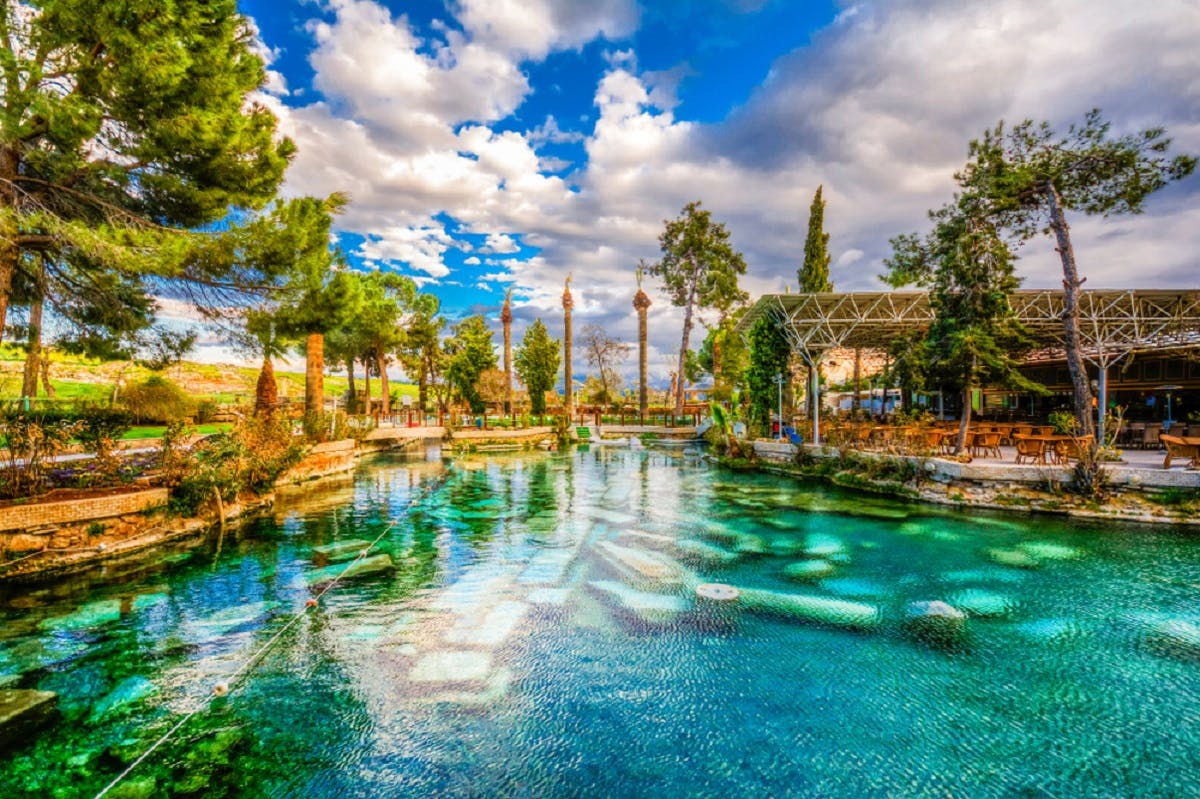
The Hierapolis Antique Pool is a thermal bathing area surrounded by palms and archaeological remains.
It is popularly called Cleopatra’s Pool, although there is no reliable evidence that Cleopatra personally bathed there.
Sections of fallen columns and stone blocks lie beneath the warm water, creating an unusual swimming environment.
Current Access
The pool is currently listed as open.
Swimming requires an additional ticket that is not included with general Hierapolis admission or the MuseumPass.
Facilities
The complex normally includes:
Changing rooms.
Lockers.
Showers.
Toilets.
A café or refreshment area.
Seating for non-swimmers.
Is It Worth Paying Extra?
The pool may be worthwhile for visitors who:
Want a proper thermal swim.
Are staying for a full day.
Enjoy historic spa experiences.
Do not mind a busy commercial setting.
It may be less appealing to travellers who:
Have limited time.
Expect a quiet natural pool.
Dislike crowded swimming areas.
Plan to use a thermal hotel in Karahayıt.
Safety
The submerged stones are uneven and can be slippery. Move carefully and follow any depth, age or health restrictions displayed at the pool.
Hierapolis Theatre
The Roman theatre is one of the most impressive monuments at Hierapolis.
It occupies a hillside above the central city and once accommodated thousands of spectators.
What to Look For
The steep semicircular seating area.
The multi-level stage building.
Architectural columns.
Reliefs depicting gods, myths and rituals.
Views across the archaeological site.
The theatre’s sculptural programme includes scenes associated with Apollo, Artemis, Dionysus and imperial ceremonies.
Access
Reaching the theatre involves an uphill walk and stairs.
The stone seating is exposed to direct sun, so visit early or late during summer.
The Plutonium or Gate of Hell
The Plutonium was a sanctuary associated with Pluto, the Roman god of the underworld.
It was constructed around a cave opening connected with the geological fault beneath Hierapolis.
Carbon dioxide escaping from the ground could collect at low level and kill small animals entering the enclosure. Ancient visitors interpreted this phenomenon as evidence of an entrance to the underworld.
Ancient Ritual
Priests were able to approach the dangerous area more safely than animals or uninformed visitors, probably because they understood where the gas accumulated and how to avoid prolonged exposure.
The sanctuary became famous throughout the Roman world.
Modern Visit
Visitors view the protected archaeological structure from outside the hazardous area.
Never cross barriers or approach openings where gas warnings are displayed.
Temple of Apollo
The Temple of Apollo stood close to the Plutonium and thermal springs.
This relationship connected religion, geology and healing.
The temple area contains:
Foundations and architectural fragments.
Evidence of repeated rebuilding.
Views towards the theatre.
Connections with the Plutonium sanctuary.
Earthquakes damaged the temple repeatedly, and many of its materials were reused in later construction.
The Northern Necropolis
Hierapolis has one of the most extensive surviving necropolises in Anatolia.
The burial area extends for more than two kilometres beyond the northern city gate.
Types of Tombs
Visitors can see:
Sarcophagi.
House-shaped tombs.
Large family mausoleums.
Burial mounds.
Tombs associated with different social classes and periods.
The size of the necropolis reflects both the city’s population and its importance as a healing destination. Some people travelled to Hierapolis seeking treatment and were buried there after dying.
Planning Advice
The necropolis is easy to overlook because it lies away from the famous terraces.
Allow at least 45 minutes when ancient history is a major interest.
Shade is limited, and the route becomes exhausting in midday summer heat.
Frontinus Gate and Colonnaded Street
Frontinus Gate marked an important monumental entrance into the Roman city.
The triple-arched gate leads towards the broad main street, which was once lined with public buildings, shops, fountains and colonnades.
Nearby Features
Public latrines.
Bath buildings.
Drainage systems.
Monumental façades.
Sections of the ancient street surface.
This area helps visitors imagine Hierapolis as a functioning city rather than a collection of isolated monuments.
Hierapolis Archaeology Museum
The archaeological museum occupies part of a large Roman bath complex.
Its collections include finds from Hierapolis and other ancient sites in the Denizli region.
Displays May Include
Statues.
Sarcophagi.
Architectural reliefs.
Coins.
Small archaeological objects.
Material from Laodicea and nearby settlements.
The museum provides valuable context for sculpture and decoration that would otherwise be difficult to understand among the ruins.
It also offers partial shelter from summer heat, although opening hours may be shorter than those of the wider archaeological site.
Saint Philip’s Martyrium
Hierapolis became an important Christian pilgrimage centre because of its association with Saint Philip.
A large octagonal martyrium was built on a hill beyond the main city.
The Walk
Reaching the site requires a longer uphill route than the central monuments.
Visitors should expect:
Steep sections.
Limited shade.
Rough paths.
Fewer crowds.
Wide views over Hierapolis and the valley.
The associated tomb and church complex are especially important to visitors interested in early Christianity.
Allow extra time and carry water.
Other Ruins Worth Seeing
Roman Baths
Bath complexes were central to Hierapolis’s identity as a thermal city.
Some were used for bathing, while others served travellers entering the city.
Nymphaeum
The monumental fountain distributed water and provided an elaborate civic display near the religious centre.
Agora
The commercial and public area demonstrates the enormous scale of Roman Hierapolis.
Byzantine Churches
Christian buildings show how the city changed after the Roman Empire adopted Christianity.
City Walls
Sections of later defensive walls reflect the city’s reduced size and changing security needs.
How Long Should You Spend?
Time available
Realistic experience
2 hours
Travertines and a very quick look at central Hierapolis
3–4 hours
Travertines, theatre, Antique Pool area and selected ruins
5–6 hours
Major Hierapolis monuments, museum and travertines
Full day
Complete archaeological visit, swimming and sunset
Two days
Pamukkale plus Laodicea, Karahayıt or another nearby attraction
Four to six hours is the practical minimum for a first visit.
A two-hour coach stop may provide photographs but does not allow a meaningful exploration of Hierapolis.
The Best Walking Route
Option One: From the Pedestrian Gate
Enter from Pamukkale village.
Remove footwear and climb the designated travertine route.
Explore the upper terrace and viewpoint.
Visit the Antique Pool area.
Continue to the museum.
Walk to the theatre.
See the Temple of Apollo and Plutonium.
Visit additional ruins according to time.
Return through the travertines before the pedestrian gate closes.
Option Two: From the South Gate
Enter through the south gate.
Visit the theatre before crowds and heat increase.
Continue to the Temple of Apollo and Plutonium.
Visit the museum and Antique Pool area.
Walk along the upper travertine edge.
Descend part or all of the barefoot route.
Return uphill to the south gate or exit into the village if transport is arranged.
Option Three: North-to-South Historical Route
Begin at the north entrance.
Explore the necropolis.
Pass through Frontinus Gate.
Walk along the ancient main street.
Visit central Hierapolis and the theatre.
Finish at the travertines.
Exit by the pedestrian or south gate.
This route requires transport coordination because the starting and finishing gates are different.
The Best Time to Visit
Spring
April and May bring mild temperatures, green surrounding countryside and comfortable archaeological walking.
Rain remains possible, and wet travertine can be slippery.
Summer
June through August is hot, dry and crowded.
Temperatures across the ruins can become extreme because:
Shade is limited.
White mineral surfaces reflect sunlight.
Ancient stone stores heat.
Most major monuments require walking.
Arrive at opening, rest during the hottest hours and return for sunset when possible.
Autumn
September and October are among the best months. Temperatures become more comfortable while evening opening and balloon operations may remain available.
Winter
Winter is quieter but can be cold, rainy and occasionally frosty.
The barefoot travertine walk may be uncomfortable, and daylight hours are shorter.
Sunrise and Sunset
Sunrise
Sunrise offers:
Cooler conditions.
Hot-air balloons in suitable weather.
Soft light over the valley.
Fewer visitors near early-opening gates.
The lower pedestrian gate may not open early enough for actual sunrise, making the south entrance or an organised experience more practical.
Sunset
Sunset is one of the best times to see the travertines.
The white formations can take on:
Gold.
Pink.
Orange.
Lavender and blue tones.
Remain aware of the closing time for your selected gate. The pedestrian gate may close before the north and south entrances.
Visiting Pamukkale at Night
Seasonal night museum operation allows visitors to experience illuminated parts of Hierapolis after sunset.
The current summer programme lists evening access from 7:00 pm until 11:00 pm, with last ticket sales earlier in the evening.
Advantages
Cooler temperatures.
Illuminated ruins.
A different atmosphere around the theatre and Plutonium.
Less intense sunlight for photography.
Limitations
Not every archaeological path is equally well lit.
The travertine experience differs after dark.
Gate arrangements may change.
Transport back to accommodation must be planned.
An additional evening ticket may apply to some pass holders.
Carry a small torch but do not shine powerful lights at other visitors or into protected areas.
Hot-Air Balloon Flights
Hot-air balloon flights normally operate around sunrise when weather permits.
The flight provides aerial views of:
The travertine hillside.
Hierapolis.
The Menderes Valley.
Nearby farmland and settlements.
What to Know
Flights are weather-dependent.
Cancellation is possible because of wind or poor visibility.
The precise route cannot be guaranteed.
Launch and landing locations change.
Flights may not pass directly over every famous feature.
Hotel pickup is commonly included by tour operators.
Book through a properly licensed operator and check whether the quoted price includes transport, insurance and the complete flight rather than only a deposit.
Paragliding
Tandem paragliding is another way to view the white hillside and surrounding plain.
Flights depend on:
Wind direction.
Thermal conditions.
Visibility.
Passenger weight and health requirements.
Current aviation permissions.
Confirm the landing area, insurance, transport and cancellation terms before booking.
Getting to Pamukkale
Pamukkale lies in Denizli Province in southwestern Türkiye.
The nearest major transport centre is Denizli, approximately 18 kilometres away.
Approximate Road Journeys
Starting point
Typical road journey
Denizli
30–40 minutes
İzmir
Approximately 3½–4 hours
Selçuk and Ephesus
Approximately 3 hours
Antalya
Approximately 3½–4 hours
Fethiye
Approximately 3–3½ hours
Bodrum
Approximately 3½–4 hours
Marmaris
Approximately 3–3½ hours
Journey times increase with traffic, rest stops and mountain-road conditions.
Travelling from Denizli
Bus or Minibus
Municipal buses and minibuses connect Denizli with Pamukkale.
Services may depart from or near:
Denizli intercity bus terminal.
Central city stops.
The Ulu Camii area on the municipal network.
Route 230 is associated with the Denizli–Pamukkale connection, but timetables and stop arrangements should be checked on the municipal transport portal or locally.
Taxi
A taxi is useful for:
Early-morning balloon flights.
Travellers with luggage.
Reaching the north or south gate.
Combining Pamukkale with Laodicea or Karahayıt.
Agree whether the fare is metered and confirm the pickup location for the return journey.
Train
Denizli railway station receives regional services from parts of western Türkiye.
Continue from the station by bus, minibus or taxi.
Airport
Denizli Çardak Airport is well outside the city and Pamukkale.
Use an airport shuttle, taxi or prearranged transfer. Allow substantial time rather than treating it as a nearby town airport.
Driving and Parking
Driving is convenient for visitors combining Pamukkale with nearby archaeological sites or thermal hotels.
Parking
Vehicle parking is available near the north and south entrances.
Parking charges may be separate from site admission.
Navigation Advice
Enter the exact gate rather than simply typing “Pamukkale.”
Navigation may otherwise direct drivers towards:
Pamukkale village.
The lower pedestrian gate.
A hotel.
A commercial thermal facility.
Rental Cars
Check:
Toll-road arrangements.
Fuel policy.
Parking rules.
Insurance conditions.
One-way fees when returning the car in another city.
Day Tours from Other Cities
Day tours operate from İzmir, Selçuk, Kuşadası, Antalya, Fethiye, Marmaris and Bodrum.
Advantages
No need to drive.
Hotel pickup may be included.
Guided explanation of Hierapolis.
Transport and lunch may be organised.
Disadvantages
Very long coach journeys.
Limited independent time.
Late-morning arrival with large crowds.
Optional shopping stops.
Insufficient time for the necropolis or Saint Philip’s Martyrium.
Before Booking
Confirm:
Whether the €30 site admission is included.
Whether Antique Pool swimming is extra.
The actual time inside Pamukkale.
The number of shopping stops.
Pickup and return times.
Lunch inclusions.
Maximum group size.
Where to Stay
Pamukkale Village
Best for:
Walking to the pedestrian entrance.
Budget hotels and guesthouses.
Sunset views from below.
Restaurants and small shops.
Short visits without a car.
Karahayıt
Karahayıt is a thermal resort area north of Hierapolis.
It is best for:
Spa hotels.
Thermal pools.
Red mineral formations.
Longer wellness stays.
Access to the north gate by taxi or hotel transport.
Denizli
Stay in Denizli for:
Rail and intercity bus connections.
A larger choice of restaurants.
Business hotels.
Early onward travel.
Denizli is less atmospheric for a short leisure visit and requires transport to Pamukkale.
What to Eat
Denizli Kebab
Denizli kebab is slow-roasted lamb traditionally served with flatbread, onion and tomato.
It is commonly eaten by hand rather than with cutlery.
Other Regional Choices
Gözleme filled flatbread.
Pide.
Grilled meats.
Lentil soup.
Yoghurt dishes.
Stuffed vegetables.
Seasonal fruit.
Turkish breakfast.
Restaurants Near the Site
Pamukkale village has restaurants aimed at both visitors and residents.
Check menus and prices before ordering, particularly at venues with direct terrace views.
Carry water and snacks into the archaeological site because food options inside are concentrated around the Antique Pool area.
Places to Visit Near Pamukkale
Karahayıt Red Springs
Karahayıt’s thermal water contains minerals that create red, green and white deposits.
The principal spring emerges at approximately 58°C.
The small public formation can be viewed independently, while surrounding hotels offer spa pools and treatments.
Laodicea
Laodicea was a major ancient city in the Lycus Valley and one of the Seven Churches mentioned in the Book of Revelation.
Its remains include:
Colonnaded streets.
Temples.
Churches.
Theatres.
A stadium.
Bath complexes.
It combines extremely well with Pamukkale for travellers interested in archaeology.
Kaklık Cave
Kaklık Cave is sometimes described as an underground Pamukkale because it contains small travertine formations and mineral water inside a cave.
Access and ventilation conditions should be checked before travelling.
Buldan
Buldan is known for:
Traditional weaving.
Textiles.
Colourful historic houses.
Wooden balconies.
Small workshops.
Aphrodisias
Aphrodisias is an outstanding ancient city associated with marble sculpture and the cult of Aphrodite.
It requires a longer road excursion but is one of the best archaeological additions to a Pamukkale trip.
Visiting with Children
Pamukkale can be memorable for children, but the combination of water, heat and ruins requires planning.
Good Family Experiences
Walking in the shallow travertine water.
Seeing the Roman theatre.
Swimming in the Antique Pool.
Watching hot-air balloons.
Exploring the museum.
Challenges
Slippery mineral surfaces.
Long distances.
Very little shade.
Unprotected archaeological edges.
Deep sections of the Antique Pool.
Extremely hot summer afternoons.
Bring a change of clothes and supervise children continuously on the travertines.
A pushchair is difficult on the barefoot slope and many ancient paths.
Accessibility and Reduced Mobility
The site’s natural and archaeological character creates significant accessibility challenges.
Pedestrian Gate
The barefoot travertine climb is steep, wet and uneven and is unsuitable for most wheelchair users.
South Gate
The south entrance is generally the most practical starting point for visitors avoiding the barefoot climb.
Some central archaeological areas can be approached along broader paths, but surfaces remain rough and distances are substantial.
North Gate
The north entrance provides access near the necropolis but involves a long route to the central attractions.
Mobility Assistance
Paid electric carts or similar services may operate within parts of the site, but availability, routes and wheelchair suitability should be confirmed on arrival.
Antique Pool
Changing facilities may be accessible, but entering the water requires care around submerged ruins and steps.
Contact the site directly when exact step-free access is essential.
Safety and Practical Advice
Walk slowly on wet travertine.
Keep footwear in a bag rather than carrying it loosely.
Do not enter closed terraces.
Drink water regularly.
Avoid the exposed ruins during extreme midday heat.
Use sunscreen even when the air feels cool.
Wear secure shoes in Hierapolis.
Do not climb unstable walls or sarcophagi.
Remain behind barriers around the Plutonium.
Secure phones and cameras near pools.
Check the gate closing time before sunset.
Do not rely on mobile reception for every ticket or map.
What to Bring
Comfortable walking shoes: Needed for Hierapolis.
Small shoe bag: Essential on the barefoot travertine route.
Swimwear: For shallow pools or the Antique Pool.
Towel: Bring a compact quick-drying towel.
Sun protection: Hat, sunglasses and high-factor sunscreen.
Water: Carry at least one large bottle per person.
Light clothing: Useful during summer.
Warm layer: Needed during winter and balloon flights.
Waterproof phone pouch: Helpful on the travertines.
Passport: Required for some age-based ticket conditions.
Cash and card: Separate pool, transport and locker systems vary.
Offline ticket: Save the booking before reaching the entrance.
Suggested One-Day Pamukkale Itinerary
7:30 am: Arrive Near the South Gate
Reach the site before the main day-tour coaches.
8:00 am: Enter Hierapolis
Walk directly towards the theatre while temperatures are comfortable.
9:00 am: Theatre and Religious Centre
Visit the theatre, Temple of Apollo and Plutonium.
10:30 am: Antique Pool and Museum
Swim if desired, then visit the archaeological museum.
12:30 pm: Lunch or Rest
Use the facilities near the Antique Pool or carry a light meal.
2:00 pm: Necropolis and Frontinus Gate
Explore the northern city when conditions are not excessively hot.
4:30 pm: Travertine Terraces
Return to the white slope and walk within the designated pools.
Sunset
Watch the changing colours from the upper edge.
Evening
Exit through the appropriate gate or continue into the night museum programme when operating and properly ticketed.
Suggested Two-Day Itinerary
Day One: Pamukkale and Hierapolis
Enter early through the south gate.
Visit the theatre and central ruins.
Explore the museum.
Swim in the Antique Pool if desired.
Walk on the travertines.
Remain for sunset.
Day Two: Ancient Cities and Thermal Springs
Visit Laodicea in the morning.
Have lunch in Denizli or Pamukkale.
Continue to Karahayıt.
See the red mineral spring.
Use a thermal hotel pool or spa.
Alternatively, replace Karahayıt with Kaklık Cave, Buldan or a longer excursion to Aphrodisias.
Is Pamukkale Worth Visiting?
Pamukkale is worth visiting for travellers interested in natural landscapes, ancient history, thermal bathing or photography.
Main Advantages
A landscape found in very few places worldwide.
Natural and archaeological attractions on one ticket.
An impressive Roman theatre.
A vast necropolis.
Thermal bathing opportunities.
Excellent sunrise and sunset light.
Hot-air balloon and paragliding options.
Easy overnight accommodation nearby.
Possible Drawbacks
Large tour groups.
Extreme summer heat.
Some terraces may be dry.
Strict access restrictions.
Slippery barefoot walking.
Extra charge for the Antique Pool.
Long travel times from coastal resorts.
A large site that requires substantial walking.
The experience is strongest when visitors stay overnight, arrive early and devote time to Hierapolis rather than treating the destination only as a place for terrace photographs.
Frequently Asked Questions About Pamukkale
Where is Pamukkale?
Pamukkale is in Denizli Province in southwestern Türkiye.
What does Pamukkale mean?
It means “cotton castle” in Turkish.
How far is Pamukkale from Denizli?
It is approximately 18 kilometres north of central Denizli.
Is Pamukkale a UNESCO World Heritage Site?
Yes. Hierapolis-Pamukkale was listed in 1988 for both natural and cultural values.
How were the white terraces formed?
Calcium-rich thermal water deposited layers of calcium carbonate over thousands of years.
Are the terraces natural?
Yes, although water is now carefully managed to protect the active formations.
Why are some pools empty?
Thermal water is rotated between different areas for conservation and controlled travertine growth.
Are the pools really blue?
The water can appear pale blue or turquoise under suitable light, but colour varies with depth, weather and mineral sediment.
Can I walk on the travertines?
Yes, but only within the designated public route.
Do I have to remove my shoes?
Yes. Visitors must normally walk barefoot on the protected travertine section.
Can I wear water shoes?
Do not assume they are permitted. Staff may require all footwear to be removed.
Does the travertine hurt your feet?
Some sections are rough or ridged, while others are smooth and slippery.
Can I swim in the terrace pools?
You can sit or wade in selected shallow public pools. Most natural terraces are closed.
Can I swim in Cleopatra’s Pool?
Yes. The Antique Pool is currently open, subject to its separate ticket and operating conditions.
Did Cleopatra swim there?
The pool is popularly linked with Cleopatra, but there is no firm historical proof that she used it.
Is the Antique Pool included in the main ticket?
No. Swimming costs extra.
Is the Antique Pool included with MuseumPass?
No.
How much is Pamukkale admission?
The current combined international visitor ticket costs €30.
Does the ticket include Hierapolis?
Yes. Pamukkale and Hierapolis use one combined admission ticket.
Does the ticket include the museum?
The archaeological museum is normally included within the site admission.
What time does Pamukkale open?
The official site currently lists opening from 8:00 am.
What time does it close?
Closing varies by gate, season and night-museum operation. Check the official date-specific listing.
Is Pamukkale open every day?
The current official listing states that it is open daily.
Can I visit after dark?
Seasonal night museum access currently operates during the summer period.
Which entrance is best?
The pedestrian gate is best for a barefoot climb from the village. The south gate is generally best for driving and starting with Hierapolis.
How many entrances are there?
The principal visitor entrances are the pedestrian, south and north gates.
How long do I need?
Allow four to six hours. A full day is better for a detailed visit.
Can I see Pamukkale in two hours?
You can see the terraces and a small part of Hierapolis, but the visit will be very rushed.
What is the best time of day?
Early morning and late afternoon provide cooler temperatures, softer light and fewer crowds.
What is the best month?
April, May, September and October generally provide the best balance of weather and visitor numbers.
Is Pamukkale hot in summer?
Yes. The exposed archaeological site can become extremely hot.
Is Pamukkale cold in winter?
Yes. The plateau can be cold, wet and windy, and barefoot walking may be uncomfortable.
Can I see sunrise?
Yes, but gate times may limit where independent visitors can stand. Balloon tours begin early when weather permits.
Is sunset worth staying for?
Yes. Sunset produces some of the best colour across the white terraces.
Are hot-air balloons available?
Yes. Flights normally operate around sunrise and depend on weather and aviation approval.
Are balloons guaranteed to fly?
No. Wind, visibility and safety conditions can cause cancellation.
Can I paraglide?
Tandem paragliding is available through local operators when conditions permit.
Is Hierapolis worth seeing?
Yes. The theatre, necropolis, religious centre and museum are essential parts of the destination.
What is the best ruin at Hierapolis?
The Roman theatre is the most visually impressive monument.
How large is the necropolis?
It extends for more than two kilometres.
What is the Gate of Hell?
It is the Plutonium, an ancient sanctuary built around a cave emitting toxic carbon dioxide.
Is the gas still present?
Geological gas continues to emerge, which is why visitors must remain outside protected areas.
Who was Saint Philip?
He was an early Christian apostle traditionally associated with martyrdom at Hierapolis.
Can I visit Saint Philip’s Martyrium?
Yes when its route is open, but it requires a longer uphill walk.
Can I reach Pamukkale by public transport?
Yes. Buses and minibuses operate from Denizli.
Which bus goes to Pamukkale?
Municipal route 230 is associated with the connection, but the current timetable should be checked locally.
Is there a train directly to Pamukkale?
No. Travel by train to Denizli and continue by road.
Can I visit from İzmir in one day?
Yes, but the return journey is long. An overnight stay provides a better experience.
Can I combine Pamukkale and Ephesus in one day?
It is possible on a very long organised tour, but each site deserves most of a day.
Can I visit from Antalya?
Yes, but allow approximately three and a half to four hours each way by road.
Where should I stay?
Stay in Pamukkale village for easy terrace access, Karahayıt for thermal hotels or Denizli for transport connections.
Is Pamukkale village walkable?
Yes. The village centre is compact and the pedestrian entrance is nearby.
Is Karahayıt the same as Pamukkale?
No. It is a nearby thermal resort known for red mineral deposits and spa hotels.
Is Pamukkale suitable for children?
Yes, but children need close supervision on slippery surfaces and around ancient ruins.
Can I use a pushchair?
A pushchair is difficult on the barefoot slope and rough archaeological paths. The south entrance is the most practical starting point.
Is Pamukkale wheelchair accessible?
Only partly. The pedestrian travertine climb is not accessible, while selected areas from the vehicle entrances may be manageable with assistance.
Are there toilets?
Yes, at the entrances and around the central visitor facilities.
Are there restaurants inside?
Food and refreshments are concentrated around the Antique Pool area. More choices are available in the village.
Can I bring food and water?
Water and modest personal supplies are advisable. Follow any restrictions displayed at the entrance.
Can I fly a drone?
Do not assume drone use is permitted. Archaeological sites and protected areas require official authorisation.
What should I wear?
Wear lightweight clothing, strong walking shoes and sun protection. Carry swimwear and a shoe bag.
What is the biggest visitor mistake?
Allowing only an hour or two and ignoring the ancient city of Hierapolis.
Is Pamukkale worth staying overnight?
Yes. Staying overnight allows an early start, sunset and a less rushed visit.
Sponsored Popular Items
Quick take: Musement.com offers a worldwide selection of tours and attractions
Pamukkale is much more than a background for photographs.
The white terraces remain extraordinary, but their meaning becomes clearer when seen together with Hierapolis. The thermal water that created the mineral hillside also supported baths, temples, healing rituals, trade and religious pilgrimage for centuries.
Arrive early, expect some terraces to be dry and allow at least half a day. Walk only within designated sections, protect the fragile white surface and bring proper footwear for the ancient city.
The strongest itinerary begins with Hierapolis before the heat increases and finishes beside the travertines as the afternoon light turns the white hillside gold and pink.
Visitors who stay long enough to explore the theatre, Plutonium, museum and necropolis will find that Pamukkale is not simply one of Türkiye’s great natural sights. It is also one of its most fascinating ancient landscapes.
Sponsored Popular Items
Quick take: Musement.com offers a worldwide selection of tours and attractions
Pamukkale Sunrise Hot-Air Balloon & Hierapolis Tour Turkey Pamukkale Sunrise Hot Air Balloon Experience & Hierapolis Visit is a convenient way to add structure, local context and purposeful sightseeing to the itinerary. Check current availability, inclusions and booking details before you go.
Pamukkale & Hierapolis Full-Day Guided Tour with Lunch – Heritage & Nature Experience Turkey Plan Pamukkale & Hierapolis Full-Day Guided Tour with Lunch – Heritage & Nature Experience, a food and drink experience, with practical tips on timing, inclusions and what to check before booking. Compare current availability, prices and booking conditions before you go.
Summer Tour of Pamukkale & Hierapolis with Lake Salda Turkey This summer tour takes you to Pamukkale, which means ‘cotton castle’ in Turkish – and you'll see why as soon as you set eyes upon its magical landscape. Check current availability, inclusions and booking details before you go.
Pamukkale, Hierapolis and Lake Salda Private Tour - Guided Sightseeing Tour Turkey This private tour takes you to Pamukkale, which means ‘cotton castle’ in Turkish – and you'll see why as soon as you set eyes upon its magical landscape. Check current availability, inclusions and booking details before you go.
Private Pamukkale & Hierapolis Tour - Guided Sightseeing Tour Turkey Private Pamukkale & Hierapolis Tour is a convenient way to add structure, local context and purposeful sightseeing to the itinerary. Check current availability, inclusions and booking details before you go.
Exploring Pamukkale and Hierapolis Ruins Group Tour from Denizli Turkey Exploring Pamukkale and Hierapolis ruins group tour from Denizli brings several elements of the destination together in one organised experience. Check current availability, inclusions and booking details before you go.
Pamukkale Hierapolis and Kaklık Cave Private Day Tour Turkey Pamukkale Hierapolis and Kaklık Cave private day tour is a convenient way to add structure, local context and purposeful sightseeing to the itinerary. Check current availability, inclusions and booking details before you go.
Pamukkale and Hierapolis Private Tour with Lunch Turkey Pamukkale and Hierapolis private tour with lunch is suited to travellers who enjoy combining sightseeing with local cuisine and conversation. Check current availability, inclusions and booking details before you go.