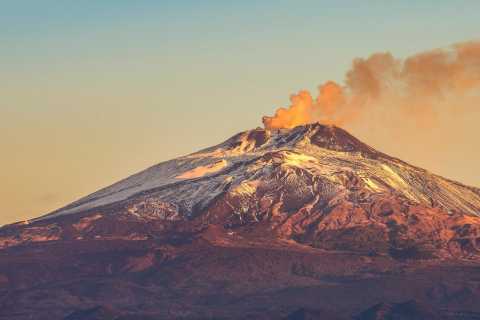
Mount Etna is one of Sicily’s most extraordinary natural attractions and one of the world’s most active volcanoes. Rising above the eastern side of the island, its enormous volcanic landscape can be seen from Catania, Taormina, Giardini Naxos and many surrounding towns.
A visit to Etna can be as easy or adventurous as you want it to be. You can walk around volcanic craters close to the road, ride a cable car above vast black lava fields, travel higher by 4WD vehicle, explore lava caves, hike with a volcanological guide or simply enjoy the views from the lower slopes.
Mount Etna is also a UNESCO World Heritage Site. UNESCO recognises its exceptional volcanic activity, geological importance and remarkably long documented history of eruptions.
Mount Etna at a Glance
Visitor Information
Details
Location
Eastern Sicily, near Catania
Type
Active stratovolcano
Height
Approximately 3,400 metres, although the summit height changes after eruptions
UNESCO status
World Heritage Site since 2013
Main southern access
Rifugio Sapienza, approximately 1,920 metres
Main northern access
Piano Provenzana, approximately 1,810 metres
Cable car
Etna South from Rifugio Sapienza
Best nearby city
Catania
Best nearby resort areas
Taormina and Giardini Naxos
Best gateway towns
Nicolosi, Zafferana Etnea and Linguaglossa
Recommended visit
Half day to full day
Is Mount Etna Really Active?
Yes. Mount Etna is an active volcano.
This is not an extinct volcanic landscape where eruptions ended thousands of years ago. Etna continues to produce lava flows, ash emissions, Strombolian explosions and occasional lava fountains.
At the time of writing in August 2026, Italy’s Civil Protection Department lists Etna at yellow alert level.
The latest weekly bulletin issued by Italy’s National Institute of Geophysics and Volcanology on 11 August 2026 reported significant recent activity at the summit, including strong Strombolian activity, a lava fountain from Voragine crater and active lava flows during the previous week.
This does not mean that the entire mountain is necessarily closed. Etna is enormous, and tourism frequently continues safely in authorised areas while activity occurs elsewhere.
However, access to higher sections can change with little notice.
Always check current volcanic activity, weather and official access restrictions on the day of your visit.
Why Mount Etna Is So Important
Etna has been erupting for hundreds of thousands of years, and humans have documented its volcanic activity for at least 2,700 years.
UNESCO describes it as an outstanding example of continuing geological and volcanic processes and one of the best-studied and most closely monitored volcanoes in the world.
The UNESCO World Heritage area covers more than 19,000 hectares of the highest and most scientifically important part of the volcano.
The landscape includes:
Summit craters
Historic lava flows
Hundreds of smaller volcanic cones
Lava caves
Ash fields
Forests
Vineyards and orchards
The enormous Valle del Bove depression
This diversity is one reason Etna deserves considerably more than a quick photograph from the coast.
Etna South or Etna North?
Mount Etna is so large that there is no single entrance.
Most visitors choose between two principal areas:
Etna South – Rifugio Sapienza
Etna North – Piano Provenzana
They offer different experiences.
Etna South – Rifugio Sapienza
Best for first-time visitors.
Etna South is the most developed and most frequently visited side of the volcano.
Rifugio Sapienza sits at approximately 1,920 metres and is the starting point for the Mount Etna cable car.
There are parking areas, restaurants, cafés, souvenir shops and tour operators around the base area.
This is also where you will find the easily accessible Silvestri Craters.
Etna North – Piano Provenzana
Best for a quieter and more natural experience.
Piano Provenzana lies at approximately 1,810 metres on Etna’s northern side and is normally approached from Linguaglossa.
The landscape is noticeably different from the south.
Forests extend higher onto the mountain, while old lava flows and craters created during major eruptions provide dramatic contrasts.
Etna North is also used for guided 4WD excursions and hiking.
Rifugio Sapienza
For most independent visitors, Rifugio Sapienza is the easiest introduction to Mount Etna.
The road climbs from the towns below through vegetation and old lava fields until reaching the large visitor area at around 1,920 metres.
From here you can:
Walk around the Silvestri Craters
Ride the Mount Etna cable car
Join a guided high-altitude excursion
Eat at one of the restaurants
Explore surrounding lava landscapes
Join organised hikes or tours
You do not have to take the cable car to have an interesting Etna experience.
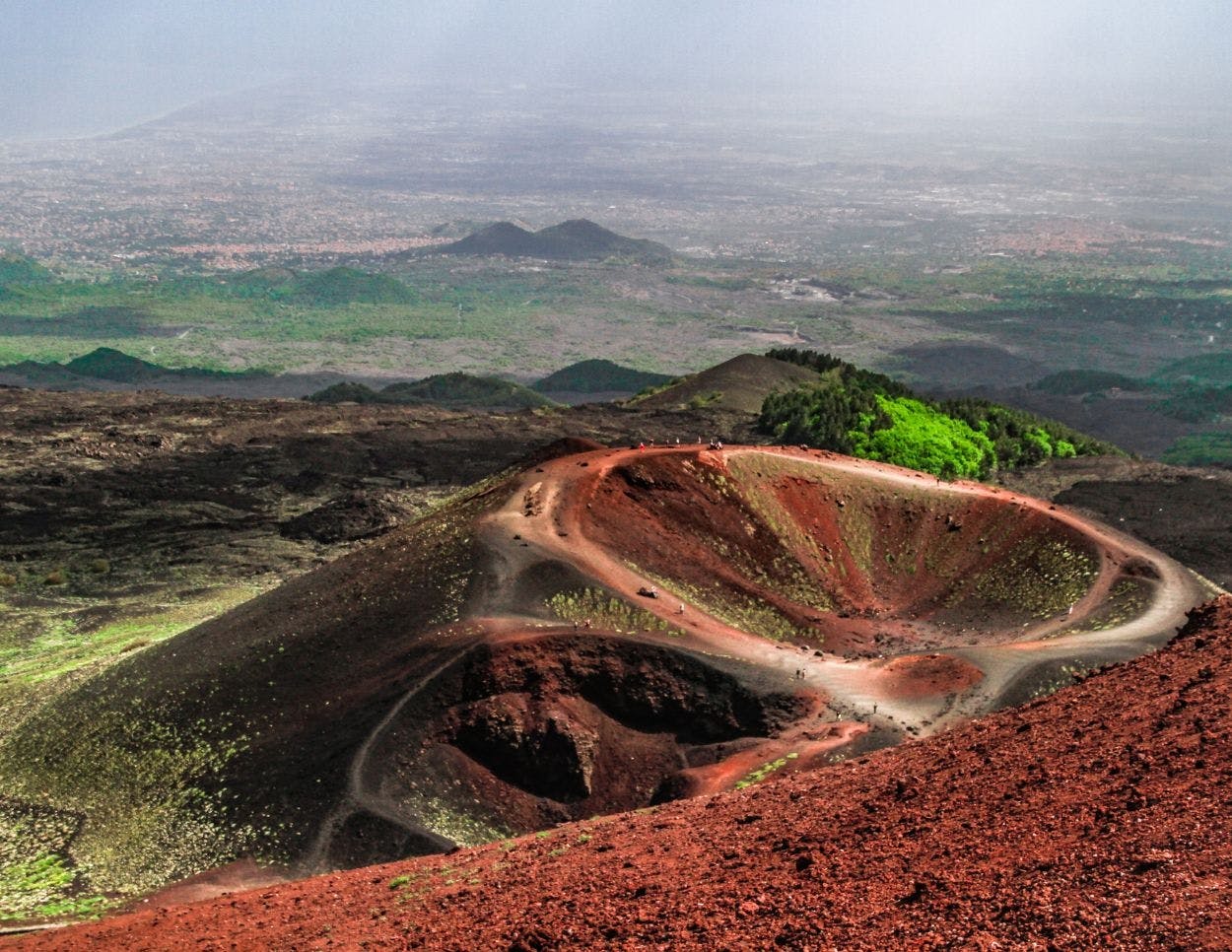
Silvestri Craters
The Silvestri Craters are among the easiest volcanic features to visit on Mount Etna.
They lie immediately around the Rifugio Sapienza area and were formed during the eruption of 1892.
Walking trails allow visitors to explore crater rims and volcanic terrain without undertaking a strenuous summit expedition.
The dark and reddish volcanic rock creates a dramatic landscape, while clear days provide extensive views towards the Sicilian coast.
This is an excellent option for:
Families
Older travellers
Visitors with limited time
Anyone who does not want a difficult hike
Footwear with good grip is still advisable because volcanic ash and loose gravel can be slippery.
Mount Etna Cable Car
The Funivia dell’Etna operates from Etna South at Rifugio Sapienza.
The lower station is at approximately 1,920 metres.
The cable car climbs roughly 650 vertical metres to approximately 2,500 metres.
The journey provides increasingly dramatic views across lava fields and, in clear weather, across eastern Sicily.
The cable car operates throughout the year, although weather and volcanic activity can affect operations.
How Much Does the Etna Cable Car Cost?
Current 2026 online prices published by Funivia dell’Etna include:
Experience
Adult
Child
Cable car to approximately 2,500 metres
€54
€31 for ages 5–10
Tour 3000
€82
€51 for ages 5–10
Prices can change, particularly between seasons, so confirm the current price before travelling.
What Is the Tour 3000?
The Tour 3000 is one of the easiest ways to experience Etna’s higher volcanic landscape without completing a demanding climb from the lower station.
The current tour combines three stages:
Cable car from approximately 1,920 metres to 2,500 metres
4WD bus in summer or snow vehicle in winter to around 2,800 metres
Short guided walk with a volcanological guide towards approximately 3,000 metres
The precise route depends on volcanic activity, weather and safety restrictions.
When Etna becomes more active, tours may be shortened, redirected or cancelled.
Do You Need to Go to 3,000 Metres?
No.
A great Etna visit does not require reaching the highest permitted altitude.
You can have an excellent experience simply by:
Driving to Rifugio Sapienza
Walking the Silvestri Craters
Taking the cable car to 2,500 metres
Exploring lower hiking trails
Visiting lava flows and volcanic caves with a guide
Going higher adds drama and a stronger sense of the active volcanic environment, but it also means colder temperatures, stronger wind, thinner air and greater dependence on conditions.
Can You Climb to the Summit Craters?
Access to Etna’s highest summit areas is controlled and changes according to volcanic activity.
Do not assume that because an old blog or map shows a summit trail you are permitted to walk there independently.
High-altitude routes should be undertaken with appropriately qualified guides where required, and temporary safety limits must be respected.
Sicily’s official tourism authority specifically recommends visiting the summit craters with expert guides and suitable clothing.
On an active volcano, yesterday’s permitted route may not be today’s permitted route.
Valle del Bove
One of Etna’s most impressive geological features is the enormous Valle del Bove on the eastern side of the volcano.
This vast depression is approximately 5 kilometres wide and 8 kilometres long, with steep walls reaching around 1,200 metres in places.
It acts as a natural collection area for many lava flows from the summit and eastern side of Etna.
Several hiking routes and viewpoints provide views into the valley.
From above, it looks like an enormous amphitheatre filled with layer upon layer of dark lava.
Explore a Lava Cave
Etna contains numerous lava tubes and volcanic caves.
These form when the outer surface of a lava flow cools and solidifies while molten lava continues moving underneath. When the lava drains away, a hollow tunnel can remain.
Some caves can be visited on organised excursions.
Sicily’s official tourism authority recommends exploring lava caves with experienced speleological guides.
Do not enter unknown caves independently. They can contain unstable rock, difficult passages, darkness and confusing routes.
Mount Etna in Winter
Etna is not only a summer destination.
During winter, snow can cover the upper slopes while the Mediterranean coast remains comparatively mild.
Skiing and snow activities operate when conditions allow, particularly around Piano Provenzana on Etna North.
The sight of snow-covered volcanic slopes above the blue Mediterranean is one of the more unusual landscapes in Europe.
Winter visitors need proper mountain clothing and should check road and lift conditions before leaving the coast.
What Is the Best Time of Year to Visit Mount Etna?
April to June
One of the best periods for hiking.
Temperatures on the lower slopes are generally pleasant, although snow can remain at high altitude.
July and August
The most popular period for visitors to Sicily.
Conditions around Catania and the coast can be extremely hot, but Etna’s high-altitude areas are considerably cooler.
Even in August, take warm clothing if travelling above 2,500 metres.
September and October
Another excellent period.
Temperatures generally become more comfortable while days remain suitable for hiking.
November to March
Expect winter mountain conditions at altitude.
Snow, wind and cold can significantly affect trails and transport, but Etna can be spectacular during this period.
What Should You Wear on Mount Etna?
One of the most common mistakes is leaving a warm Sicilian beach wearing shorts and sandals and assuming the weather will be similar on Etna.
It may not be.
The official Sicily tourism authority recommends closed footwear and a windproof jacket even during summer.
A sensible packing list includes:
Closed walking shoes or hiking boots
Windproof jacket
Warm layer
Long trousers for high-altitude excursions
Hat
Sunglasses
Sunscreen
Drinking water
Small backpack
Volcanic ash and loose rock can be rough on footwear, so this is not the place for your best white shoes.
Altitude and Health
The cable car and 4WD excursions can take visitors from near sea level to around 3,000 metres surprisingly quickly.
Some people may notice:
Shortness of breath
Headache
Light-headedness
Increased heart rate
Fatigue
Take your time and avoid unnecessary rushing at altitude.
Visitors with significant heart, lung or mobility problems should check whether a high-altitude excursion is appropriate before booking.
Mount Etna With Children
Etna can be an excellent family excursion if you choose an appropriate route.
Good options include:
Silvestri Craters
Rifugio Sapienza
The cable car
Lower volcanic trails
Guided family excursions
The Tour 3000 is marketed as suitable for families, although parents should still consider altitude, cold, wind and the individual child’s walking ability.
How Long Should You Allow?
2–3 Hours
Enough for Rifugio Sapienza and the Silvestri Craters.
Half Day
A good minimum for most visitors.
You can explore the Silvestri Craters and take the cable car or join a shorter guided excursion.
Full Day
Best overall experience.
A full day gives you time to travel from the coast, explore high-altitude areas, have lunch and stop at viewpoints or an Etna village on the return journey.
How to Reach Mount Etna
The easiest ways to visit Etna are:
Rental car
Organised tour
Private transfer
Limited public transport
Public transport on the volcano is considerably less flexible than in Sicily’s major cities.
If you want to explore independently, a car is usually the most practical option.
Driving to Etna South
For Etna South, follow the mountain roads towards Nicolosi and Rifugio Sapienza.
The drive climbs steadily through changing vegetation and increasingly dramatic lava fields.
Allow additional time for:
Photographic stops
Slow mountain traffic
Weather
Parking
Do not rush the drive itself. The changing landscape is part of the experience.
Driving to Etna North
Etna North is normally approached through Linguaglossa and the mountain road towards Piano Provenzana.
This side feels greener and more heavily forested than Etna South before eventually reaching the stark volcanic zone.
Where to Stay for Mount Etna
Catania
Best overall base for first-time visitors.
Catania sits directly beneath Etna and offers:
A major international airport
Extensive accommodation
Restaurants and markets
Historic Baroque architecture
Numerous organised Etna tours
Catania works particularly well if Mount Etna is one of several attractions on your eastern Sicily itinerary.
Nicolosi
Best for Etna South.
Nicolosi lies on the southern slopes and is one of the principal gateway towns for Rifugio Sapienza.
Choose Nicolosi if your priority is spending more time on the mountain rather than travelling up from the coast each day.
Zafferana Etnea
Best for a quieter foothill stay.
Zafferana Etnea sits on the southeastern slopes and is known for its mountain setting, local food and honey production.
It is well positioned for combining Etna with the Ionian coast.
Linguaglossa
Best for Etna North.
Linguaglossa provides convenient access towards Piano Provenzana and the northern slopes.
It is a good choice for hiking, nature and travellers wanting a quieter alternative to the southern tourist area.
Taormina
Best for combining Etna with one of Sicily’s most beautiful historic towns.
Numerous excursions operate from Taormina to Mount Etna.
This arrangement is particularly attractive if you want panoramic scenery, restaurants and sightseeing rather than staying directly on the volcano.
Giardini Naxos
Best for combining Mount Etna with a beach holiday.
Giardini Naxos sits below Taormina on the Ionian coast.
You can spend one day exploring Etna and return to the sea for an evening swim and dinner.
This combination of volcano in the morning and Mediterranean beach in the afternoon is one of eastern Sicily’s great travel experiences.
Combine Mount Etna With Taormina
Etna and Taormina are frequently combined because they offer completely different experiences within a relatively compact area.
A good two-day plan is:
Day 1 – Mount Etna
Spend the day exploring Rifugio Sapienza, the volcanic craters and higher slopes.
Day 2 – Taormina
Visit the Ancient Theatre, Corso Umberto, Piazza IX Aprile and the historic centre.
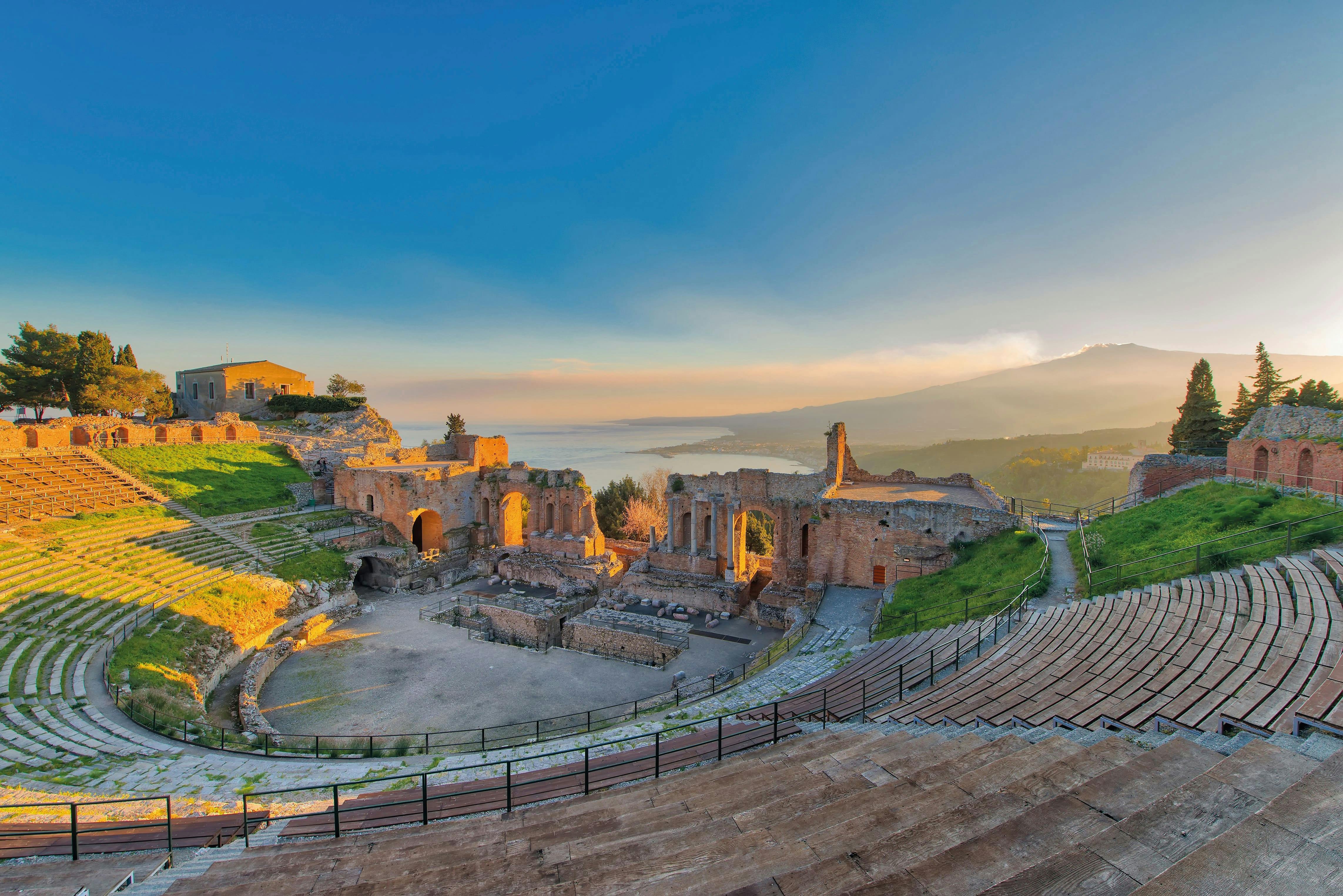
From Taormina’s ancient theatre you may also have magnificent views back towards Mount Etna.
Combine Etna With Giardini Naxos
If you prefer the beach to a hilltop town, stay in Giardini Naxos.
A particularly good itinerary is:
Day 1: Giardini Naxos beaches and ancient Naxos
Day 2: Mount Etna excursion
Day 3: Taormina
This makes Giardini Naxos an excellent base for a three- or four-night stay in eastern Sicily.
Visit the Alcantara Gorges
The Alcantara Gorges are another excellent natural attraction around the northern side of Etna.
The river has carved a dramatic canyon through ancient lava, exposing remarkable basalt formations.
In places, the gorge walls rise approximately 50 metres.
The contrast between the cold river, dark volcanic rock and vegetation makes the Alcantara landscape completely different from Etna’s exposed summit areas.
Mount Etna and the Alcantara Gorges can be combined during a full-day excursion, particularly from Taormina or Giardini Naxos.
Etna Wine Country
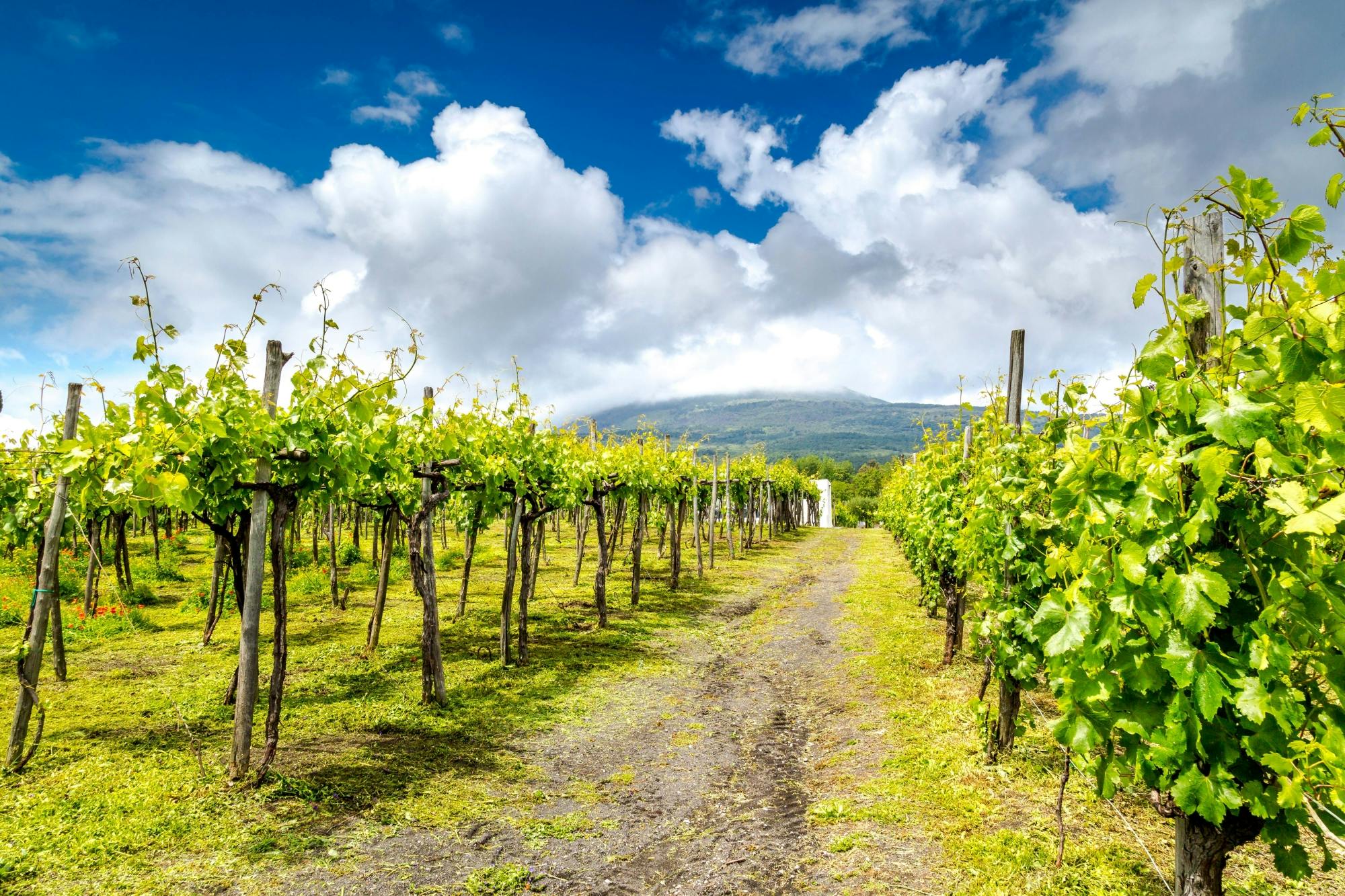
Volcanic soil also supports one of Sicily’s most interesting wine regions.
Vineyards cover parts of the lower slopes, particularly around the north and east of the volcano.
The landscape can change rapidly from black lava to vineyards, orchards and historic stone terraces.
A wine tasting can therefore be an excellent addition to an Etna visit.
For a less strenuous day, consider combining a lower volcanic walk with an Etna winery rather than travelling towards the highest permitted altitude.
Food Produced Around Mount Etna
The fertile volcanic soils surrounding Etna support an impressive range of local produce.
Depending on the area, you may encounter:
Etna wines
Bronte pistachios
Chestnuts
Hazelnuts
Apples
Pears
Peaches
Cherries
Honey
Olive oil
Mushrooms
The contrast between the apparently barren volcanic summit and fertile agricultural lower slopes is one of the most interesting features of the Etna region.
A Good Full-Day Mount Etna Itinerary
8:00 am – Leave Catania, Taormina or Giardini Naxos
Start early to give yourself plenty of time and improve your chances of clearer morning weather.
9:30 am – Arrive at Rifugio Sapienza
Park and spend some time taking in the volcanic landscape.
10:00 am – Silvestri Craters
Walk around one or more of the easily accessible crater areas.
11:00 am – Cable Car
Take the cable car towards approximately 2,500 metres.
Late Morning – High-Altitude Experience
Either remain around the upper cable-car station or continue on an authorised guided excursion if conditions permit.
1:30 pm – Lunch
Return towards Rifugio Sapienza or stop in one of the Etna villages.
3:00 pm – Lower-Slope Stop
Choose a winery, lava-flow viewpoint or another volcanic attraction.
Late Afternoon
Return to Catania, Taormina or Giardini Naxos.
Current 2026 Volcanic Activity
Mount Etna deserves additional planning in 2026 because the volcano remains actively erupting.
Italy’s National Institute of Geophysics and Volcanology reported significant activity during early August 2026, including:
Intense Strombolian activity at Voragine
A lava fountain during the night of 6–7 August
Ash emissions
Lava flows towards Valle del Leone and Valle del Bove
Explosive activity at the Northeast Crater
Italy’s Civil Protection Department currently lists the volcano at yellow alert level.
Conditions can evolve rapidly.
Do not use a travel article, printed guidebook or social-media post as confirmation that a particular trail is open.
Check official INGV information and follow instructions from local authorities, the Etna Park, cable-car staff and qualified guides.
What Happens if Etna Erupts During Your Visit?
An eruption does not automatically mean panic or evacuation across eastern Sicily.
Etna is extensively monitored, and authorities establish safety zones according to the type and location of activity.
However, eruptions can affect:
Summit access
Cable-car operations
Guided tours
Roads
Air quality
Flights at Catania Airport
Volcanic ash can occasionally disrupt aviation, so travellers flying from Catania during active periods should monitor their airline and airport information.
Important Mount Etna Safety Advice
Respect all barriers and closure notices.
Do not approach active lava or eruptive vents.
Use qualified guides for high-altitude routes where required.
Carry proper clothing even in summer.
Check the weather before travelling uphill.
Be prepared for strong wind and rapid temperature changes.
Take care on loose volcanic ash and gravel.
Carry water.
Do not enter lava caves without suitable knowledge or a guide.
The Etna Park notes that volcanic trails cross varied terrain including recent and historic lava flows, forests and areas without vegetation, with gradients changing according to the volcanic landscape.
Is a Guided Mount Etna Tour Worth It?
For many visitors, yes.
A knowledgeable guide can explain:
How Etna’s eruptions occur
Different types of lava
Historic eruptions
The formation of craters
Lava caves
Volcanic vegetation
Current safety zones
A guided tour is particularly worthwhile if you want to explore higher altitudes or less obvious parts of the volcano.
If you simply want to visit Rifugio Sapienza and walk around the Silvestri Craters, independent travel is much easier.
Is the Cable Car Worth It?
Yes, particularly on a clear day.
The cable car quickly transports you from the busy Rifugio Sapienza area into a much more dramatic high-altitude landscape.
At around 2,500 metres, vegetation becomes sparse and enormous lava fields dominate the scenery.
The main reason to skip it would be poor visibility, high winds, budget considerations or a preference for lower-level hiking.
If cloud completely covers the upper mountain, the expensive journey may provide fewer views than expected.
Mount Etna or Mount Vesuvius?
Travellers sometimes compare Etna with Mount Vesuvius near Naples.
Etna generally offers the more varied volcanic landscape, while Vesuvius has the stronger connection with Roman history.
Is Mount Etna Worth Visiting?
Absolutely.
Mount Etna is much more than a mountain visible in the distance from Taormina or Catania.
It is an enormous living volcanic landscape where forests and vineyards gradually give way to old lava fields, craters, black ash and high-altitude terrain.
You can make the visit easy by driving to Rifugio Sapienza and walking around the Silvestri Craters, or turn it into a much bigger adventure by taking the cable car and continuing higher with an authorised guide.
For most first-time visitors, a good plan is to allow at least half a day, and preferably a full day.
If you are staying in Catania, Taormina or Giardini Naxos, Etna is close enough to become one of the major highlights of an eastern Sicily itinerary.
Just remember that this is a genuinely active volcano.
In August 2026 Etna remains at yellow alert level and has experienced recent eruptive activity, so access conditions can change rapidly.
Check official conditions shortly before leaving, dress for mountain weather rather than beach weather, and respect every restriction you encounter.
Do that, and Mount Etna can provide one of the most memorable experiences anywhere in Sicily.
Sponsored Popular Items
Quick take: Musement.com offers a worldwide selection of tours and attractions
Sicily Day Trip from Malta with Mount Etna Visit Malta Sicily Tour with Mount Etna Visit is a convenient way to add structure, local context and purposeful sightseeing to the itinerary. Check current availability, inclusions and booking details before you go.
Visiting the former territory of William Adams in Miura Japan Best deals for Visiting the former territory of William Adams in Miura. Receiving a fiefdom from the first Shogun, William Adams became Japan's sole foreign feudal lord. We visit sites his former domain in Miura Peninsula to evoke closely his life. Available from getyourguide.com.
From Chiba: Mount Fuji Tour with all famous places Best deals for From Chiba: Mount Fuji Tour with all famous places. Discover Mount Fuji on a guided tour from Chiba with hotel pickup. Visit the 5th Station, take a speedboat ride on Lake Kawaguchiko, and explore the Ice Cave and Wind Cave. Available from getyourguide.com.
Yogyakarta: The Art of Practical Gamelan Music Class Indonesia Immerse yourself in the rich culture of Yogyakarta with this practical guide designed especially for beginners. You will learn to recognize the beat, tune the feel and immediately try playing the instrument
Mount Etna Italy Book your Mount Etna tickets online. Save time and money with our best price guarantee. Check current availability, inclusions and booking conditions.
Mount Etna 4x4 Tour with Wine Tasting & Local Lunch Italy Mount Etna 4x4 wine-tasting tour with local lunch is for travellers who want movement, scenery and a more active element in their itinerary. Check current availability, inclusions and booking details before you go.