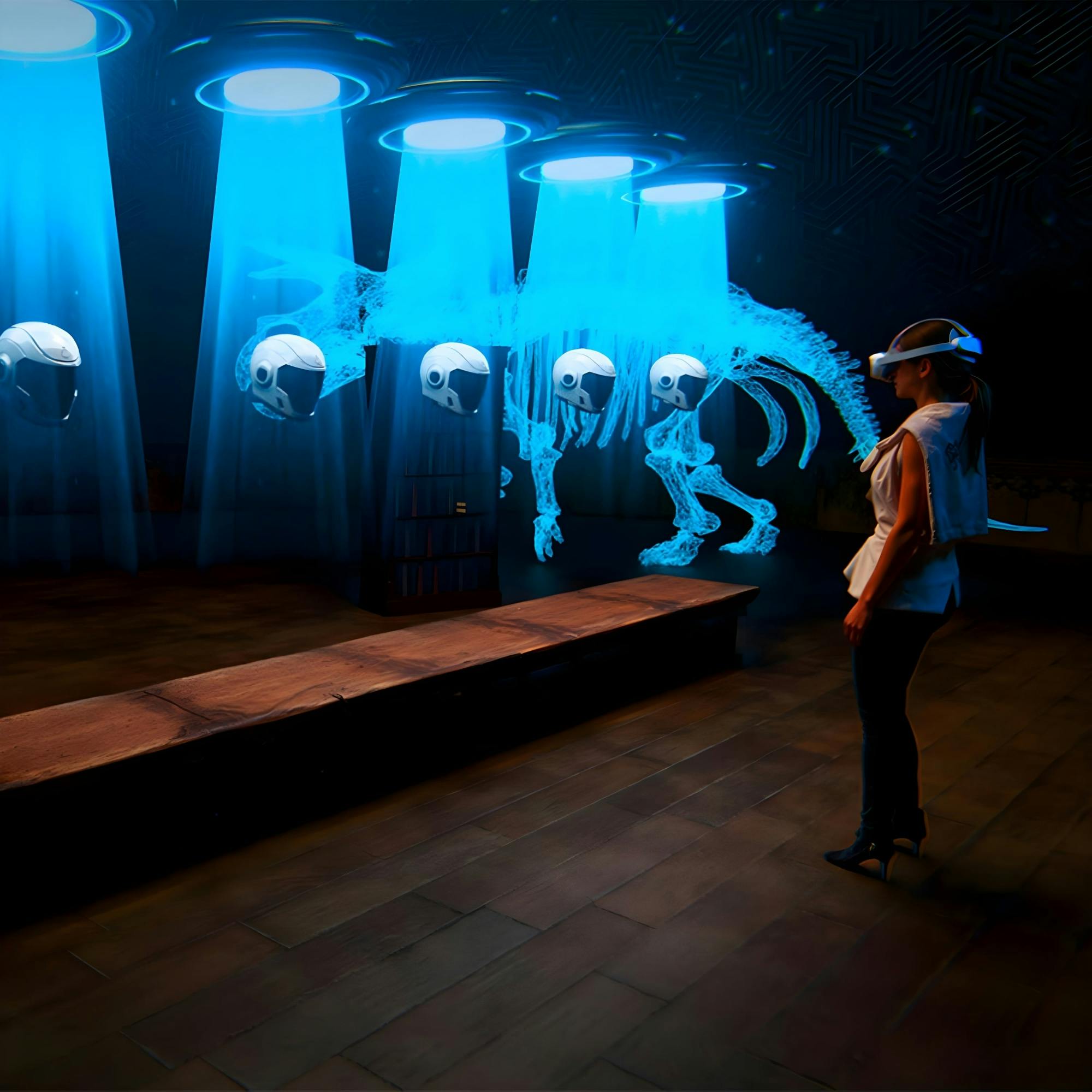
DinoVerse Atlanta combines virtual reality, real fossils, dinosaur skeletons and interactive activities into an indoor prehistoric adventure designed especially for families and dinosaur enthusiasts. Located at the Exhibition Hub Atlanta Art Center in Doraville, the attraction takes visitors through a walking VR journey before continuing into a fossil-filled Dino Hall and hands-on discovery areas.
The experience is particularly appealing if you want something different from Atlanta’s conventional museums and attractions. Rather than simply looking at dinosaur displays, visitors put on a VR headset and enter a prehistoric environment where dinosaurs appear around them as they move through the experience.
DinoVerse Atlanta at a Glance
Location: Exhibition Hub Atlanta Art Center, 5660 Buford Highway Northeast, Doraville, Georgia 30340.
Main attraction: approximately 30-minute walking virtual-reality dinosaur adventure.
Overall visit: allow around 45–60 minutes.
Age: the experience is not considered suitable for children under six.
Venue: indoor and air-conditioned.
Parking: free parking is available at the venue.
Accessibility: the venue is listed as wheelchair accessible.
Current schedules and ticket availability can change, so visitors should check the booking page for the date they intend to visit. As of August 2026, tickets and future sessions continue to be listed for DinoVerse Atlanta. :contentReference[oaicite:2]{index=2}
Step Into the Age of Dinosaurs
The centrepiece of DinoVerse is its 30-minute walking VR adventure. Visitors wear virtual-reality equipment and move through a digitally created prehistoric world rather than remaining seated in one position.
The idea is to create the feeling of travelling through a time portal and entering the age of dinosaurs. Prehistoric landscapes and life-sized digital creatures surround you as you make your way through the virtual environment.
Walking VR can feel considerably more immersive than conventional screen-based virtual reality because your physical movement becomes part of the experience. For younger visitors in particular, suddenly seeing enormous dinosaurs at apparently realistic scale can be one of the highlights of the attraction.
Visitors who have never used virtual reality before generally do not need previous experience. Staff provide the equipment and instructions before the experience begins.
Explore Dino Hall After the VR Adventure
DinoVerse is not entirely virtual. After travelling through its digital prehistoric world, visitors can explore the attraction’s Dino Hall.
The hall features more than 20 fossils, including a large Apatosaurus femur, together with two towering dinosaur skeletons. This gives the attraction an educational element and allows visitors to compare the computer-generated dinosaurs they have just encountered with evidence left behind by the real animals millions of years ago. :contentReference[oaicite:3]{index=3}
Interactive discovery areas introduce dinosaur science in a more hands-on format. There is also a dinosaur colouring area where younger visitors can create their own designs.
For families, this combination works well because the experience does not rely entirely on VR. Children have several different things to see and do during the visit.
Is DinoVerse Atlanta Good for Children?
DinoVerse is primarily promoted as a family attraction, but there is an important age restriction to consider. The organisers state that the experience is not suitable for children under six years of age. :contentReference[oaicite:4]{index=4}
For dinosaur-loving primary-school children and teenagers, however, DinoVerse can be particularly engaging. It combines entertainment with fossils, dinosaur anatomy and prehistoric science without feeling like a traditional classroom-style museum visit.
Adults do not need to be accompanying children to enjoy it. The scale of the virtual dinosaurs, walking VR technology and fossil collection can also make it interesting for adults who enjoy dinosaurs, immersive technology or unusual attractions.
How Long Does DinoVerse Take?
Allow approximately 45 to 60 minutes for the complete visit. The main walking VR experience lasts about 30 minutes, with additional time needed for Dino Hall and the interactive areas. :contentReference[oaicite:5]{index=5}
This makes DinoVerse relatively easy to fit into a day of sightseeing. It does not normally require half a day, although families with children who spend longer exploring the activities may want to allow some additional time.
Where Is DinoVerse Atlanta?
DinoVerse is held at:
Exhibition Hub Atlanta Art Center
5660 Buford Highway Northeast
Doraville, GA 30340
Doraville lies northeast of central Atlanta. The attraction’s official visitor information recommends travelling by car, and free parking is available on site. :contentReference[oaicite:6]{index=6}
Visitors staying in Downtown Atlanta, Midtown or elsewhere in the metropolitan area should allow additional time for Atlanta traffic, particularly during commuter periods.
DinoVerse Atlanta Tickets
DinoVerse uses timed admission, with visitors selecting a particular date and entry session when booking. The official experience information indicates that time slots are generally offered at regular intervals throughout operating days. :contentReference[oaicite:7]{index=7}
Ticket prices vary according to date, age category and demand. Rather than relying on a price seen weeks or months earlier, check the booking page for the exact cost of your preferred session.
Adult, child, senior/student and family ticket categories may be available. The ticketing platform was displaying sessions beyond August 2026 when checked, although availability can change. :contentReference[oaicite:8]{index=8}
Should You Book in Advance?
Advance booking is sensible, particularly if you want to visit on a weekend, during school holidays or at a particular time of day. Because admission is organised into timed sessions, arriving without a booking does not guarantee that your preferred session will be available.
Accessibility and Comfort
The venue is listed as wheelchair accessible. The attraction is also indoors and air-conditioned, which can make it a useful activity during Atlanta’s hot summer weather or on a rainy day. :contentReference[oaicite:9]{index=9}
The VR component involves wearing a headset and moving through the experience. Visitors with mobility, balance, vision or motion-sensitivity concerns should check the current accessibility requirements directly with the attraction before purchasing tickets.
Tips for Visiting DinoVerse Atlanta
Arrive before your ticket time. You may need time for admission and VR preparation.
Wear comfortable shoes. This is a walking VR experience rather than a seated simulator.
Allow about an hour. This gives you time for the VR adventure and the physical exhibits.
Check age requirements before booking. DinoVerse is not recommended for children under six.
Book popular sessions ahead. Weekends and school-holiday periods can be busier.
Do not rush out after the VR section. Dino Hall and its fossils are an important part of the experience.
Check current operating dates. Temporary immersive exhibitions can alter their schedules or eventually close.
Is DinoVerse Atlanta Worth Visiting?
DinoVerse is most worthwhile for families with dinosaur-obsessed children, visitors interested in VR and anyone looking for an unusual indoor Atlanta activity.
The strongest feature is the combination of technologies and traditional exhibits. A dinosaur museum might provide fossils and skeletons, while a VR attraction might offer impressive digital effects. DinoVerse attempts to combine both.
The attraction is comparatively short, so visitors looking for an entire day’s entertainment will need to combine it with other activities. As a one-hour experience, however, it can be an entertaining addition to an Atlanta itinerary.
Frequently Asked Questions
What is DinoVerse Atlanta?
DinoVerse is an immersive dinosaur attraction combining a walking virtual-reality adventure with fossils, dinosaur skeletons and interactive activities.
How long is the DinoVerse VR experience?
The walking VR section lasts approximately 30 minutes. Most visitors spend around 45–60 minutes at the complete attraction. :contentReference[oaicite:10]{index=10}
Where is DinoVerse Atlanta?
It is located at Exhibition Hub Atlanta Art Center, 5660 Buford Highway Northeast in Doraville, Georgia. :contentReference[oaicite:11]{index=11}
Is DinoVerse suitable for young children?
The organisers state that the experience is not suitable for children under six years old. :contentReference[oaicite:12]{index=12}
Is DinoVerse indoors?
Yes. The attraction is held indoors in an air-conditioned venue. :contentReference[oaicite:13]{index=13}
Does DinoVerse Atlanta have parking?
Yes. Free parking is available at the Exhibition Hub Atlanta Art Center. :contentReference[oaicite:14]{index=14}
Are there real dinosaur fossils?
Yes. Dino Hall features more than 20 fossils, including an Apatosaurus femur, together with two large dinosaur skeleton displays. :contentReference[oaicite:15]{index=15}
Do I need to buy tickets in advance?
Advance booking is advisable because entry uses timed sessions and your preferred date or time may sell out.
Final Thoughts
DinoVerse Atlanta offers a different way to explore prehistoric life by combining a walking VR adventure with real fossils, enormous skeletons and hands-on family activities. The attraction is relatively compact, making it easy to add to an Atlanta sightseeing day without committing several hours.
If dinosaurs are a major interest for your children—or you simply want to try an immersive VR attraction—the experience provides something considerably different from a conventional museum visit.
Before travelling: confirm the latest operating dates, ticket prices, session times, age restrictions and accessibility information with the attraction. Exhibition schedules and ticket conditions can change.
One useful point I found while checking these: your **Mainz Museum article should now carry a prominent 2026 closure warning**. The official Mainz and LEIZA pages both say the Museum of Ancient Seafaring is closed for renovation until **late autumn 2026**, when a redesigned permanent exhibition is expected to open. ([mainz.de][1])
[1]: https://www.mainz.de/en/vv/oe/Museum-fuer-Antike-Schifffahrt-des-LEIZA “Museum of Ancient Navigation of the LEIZA | Landeshauptstadt Mainz”
Sponsored Popular Items
Quick take: Musement.com offers a worldwide selection of tours and attractions
Entrance ticket to DinoVerse VR Experience in Atlanta United States Plan Entrance ticket to DinoVerse VR Experience in Atlanta, a ticket or attraction experience, with practical tips on timing, inclusions and what to check before booking. Compare current availability, prices and booking conditions before you go.
Atlanta Midtown Food Tour with Secret Dish United States Plan Atlanta Midtown Food Tour with Secret Dish, a food and drink experience, with practical tips on timing, inclusions and what to check before booking. Compare current availability, prices and booking conditions before you go.
Skydeck Chicago at Willis Tower is one of the city’s signature attractions, taking visitors to the 103rd floor of the former Sears Tower for panoramic views across Chicago and the famous Ledge—glass balconies projecting outside the face of the skyscraper.
The Skydeck stands approximately 1,353 feet (412 metres) above street level. On a clear day, the view can extend around 50 miles and potentially across parts of Illinois, Indiana, Wisconsin and Michigan.
The experience is no longer simply an elevator ride followed by a view. Admission now combines an interactive Chicago museum, the high-speed journey to the observation deck, 360-degree views and access to The Ledge.
Willis Tower Skydeck at a Glance
Visitor Information
Details
Location
Willis Tower, downtown Chicago
Address
233 S. Wacker Drive, Chicago, Illinois 60606
Skydeck entrance
Jackson Boulevard, south side of Willis Tower
Observation deck
103rd floor
Skydeck height
1,353 ft / 412 m
Willis Tower height
1,450 ft / 443 m to architectural roof
Building
110 stories
The Ledge
Five glass balconies projecting 4.3 ft outside the tower
2026 adult general admission
From US$32
2026 youth admission
From approximately US$22–24 depending on current pricing
Under age 3
Free
Expedited Entry
From US$55
Current summer hours
Generally 9:00 am–10:00 pm; Saturday from 8:30 am
Typical visit
45–60 minutes officially; allow 1½–2 hours for a relaxed visit
Accessibility
Wheelchair, scooter and stroller accessible, including The Ledge
Best for
City views, architecture, photography, families and first-time Chicago visitors
Willis Tower or Sears Tower?
They are the same building.
The skyscraper opened as the Sears Tower in 1973 after being commissioned as the headquarters of Sears, Roebuck and Company. The building was renamed Willis Tower in 2009, although many Chicago residents and visitors still refer to it by its original name.
If you search for “Sears Tower observation deck,” you are looking for Skydeck Chicago at Willis Tower.
A Skyscraper That Changed the Chicago Skyline
Construction began in 1970 and was substantially completed in 1973. More than 2,000 workers were involved in creating what was then the tallest building in the world.
Its structural design is closely associated with architect Bruce Graham and structural engineer Fazlur Rahman Khan of Skidmore, Owings & Merrill. Khan’s innovative bundled-tube structural system allowed an extraordinarily tall building to withstand Chicago’s powerful winds while remaining commercially practical.
The tower rises to approximately 1,450 feet and contains 110 stories. With its antennas included, its total height reaches around 1,730 feet.
It Was Once the World’s Tallest Building
When completed, the Sears Tower surpassed New York’s Empire State Building and remained the world’s tallest building for almost a quarter of a century.
Although newer skyscrapers have since surpassed it, Willis Tower remains Chicago’s most recognisable skyscraper and one of the most significant buildings in modern high-rise engineering.
What Is The Ledge?
The Ledge is the attraction that makes Skydeck different from a conventional observation deck.
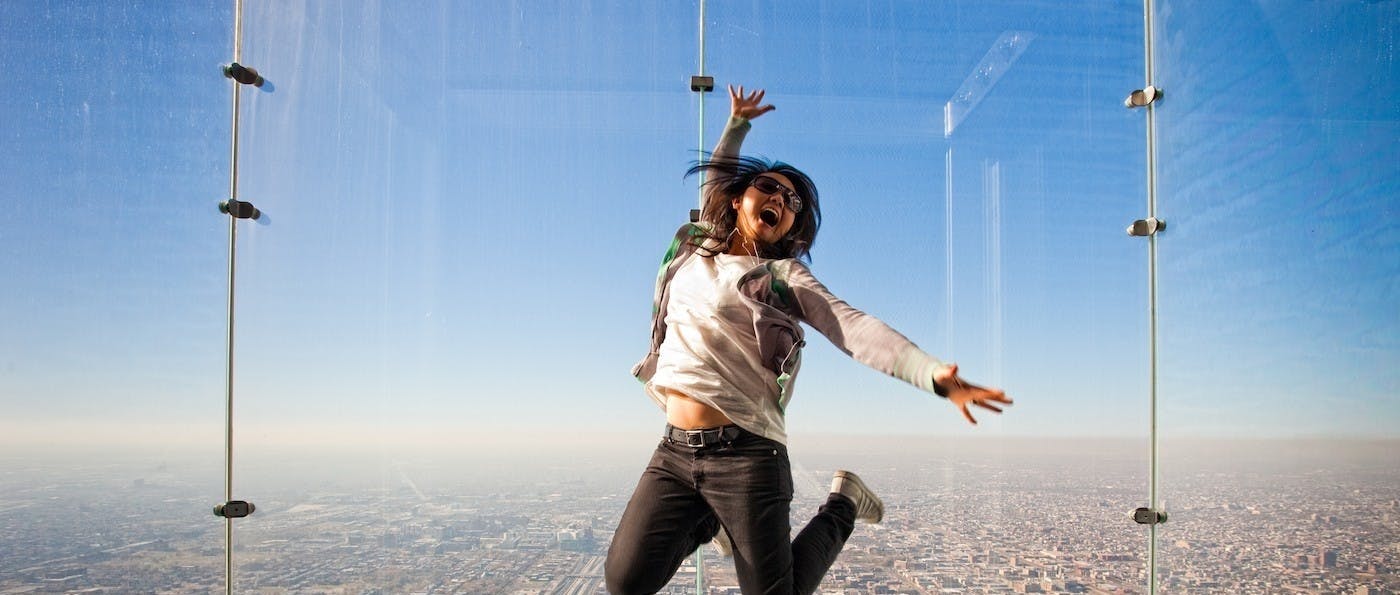
Five transparent glass balconies project approximately 4.3 feet outside the building from the 103rd floor. When you walk into one, the floor beneath your feet is transparent and the streets of Chicago appear more than 1,350 feet below.
The experience can look intimidating from inside the observation deck, but the balconies are fully enclosed. There is glass beneath your feet, around your sides and above you.
How Strong Is The Ledge?
Each balcony is constructed from three laminated layers of half-inch glass and is engineered to support up to approximately 10,000 pounds.
The glass boxes can retract back into the building for maintenance and cleaning. The original Ledge opened in July 2009.
How Long Do You Get on The Ledge?
The Ledge is extremely popular, so your private time inside a particular glass box is limited.
The official visitor guidance generally allows approximately 60 seconds for smaller parties and up to around 90 seconds for larger parties. Procedures can vary on busy days, and some Ledges may be shared between groups.
That sounds brief, but it is normally enough for several photographs if you decide what you want before entering.
Plan Your Ledge Photograph Before Your Turn
When the queue is busy, do not spend the first half of your allotted time deciding what pose to use.
Popular options include:
Standing and looking straight down
Sitting on the glass floor
Lying flat on the glass
A family photograph
A photograph looking towards the horizon
A photograph showing the city directly beneath your feet
Personal photography and video are encouraged, although tripods are not permitted. Monopods are currently allowed.
You Do Not Have to Step Onto The Ledge
If you dislike heights, you can still enjoy Skydeck without entering a glass balcony.
The observation floor provides enclosed panoramic windows around the building, so The Ledge is optional even though access is included in every standard admission ticket.
You can therefore accompany friends or family to the attraction without being forced to stand on transparent glass.
What Can You See From Skydeck?
The observation floor offers 360-degree views across downtown Chicago, Lake Michigan and the wider metropolitan area.
On exceptionally clear days, the official Skydeck information states that visibility may extend approximately 40–50 miles, allowing visitors to see territory belonging to four states:
Illinois
Indiana
Wisconsin
Michigan
Do not expect to see state borders marked on the landscape. The claim refers to the theoretical geographical distance visible under excellent atmospheric conditions.
Look Down at Chicago’s Street Grid
One of the most interesting aspects of Skydeck is not simply seeing distant scenery but understanding Chicago’s urban layout from above.
Railway lines, streets, the Chicago River, bridges and high-rise buildings form an enormous geometric pattern beneath the tower. The western and southern views are especially useful for appreciating how far the city’s regular grid extends beyond the downtown skyline.
Lake Michigan
Looking east, the enormous blue surface of Lake Michigan dominates the horizon. On clear days the contrast between the dense city and seemingly endless water is one of the strongest views from the tower.
The Chicago Museum Comes First
Visitors do not simply enter an elevator at street level.
The modern Skydeck experience begins with an interactive museum devoted to Chicago’s neighbourhoods, food, sports, music, architecture, history and popular culture.
Displays include playful recreations and photo opportunities rather than traditional rows of display cases. The attraction highlights subjects such as Chicago’s elevated trains, local food and entertainment history before you reach the skyscraper experience itself.
Allow Time for the Museum
Willis Tower currently describes the interactive section before the observation deck as approximately a 30–60 minute experience for visitors who explore it fully.
If your main interest is simply reaching The Ledge, you can move through more quickly. Families and first-time visitors may find the museum worth slowing down for.
The Elevator Ride
The ascent is part of the experience. Willis Tower’s elevators can operate at speeds of up to around 1,600 feet per minute.
Some passengers notice their ears popping as air pressure changes during the rapid climb. Swallowing or yawning usually helps in the same way it does during an aircraft ascent.
How Long Does a Skydeck Visit Take?
Skydeck’s current visitor information says most guests spend around 45–60 minutes completing the museum, observation deck and Ledge experience.
In practice, the time varies considerably.
45–60 Minutes
Enough for a relatively efficient visit when queues are short.
1½ Hours
A better allowance for most first-time visitors.
You can enjoy the museum, observation floor and Ledge without watching the clock continuously.
2 Hours
Recommended if you are visiting around sunset or during a busy holiday period.
Skydeck does not impose a normal fixed time limit on how long you remain on the observation deck after admission.
Current 2026 General Admission Prices
Skydeck uses timed and variable pricing, so the exact amount can depend on your chosen date and entry time.
As of August 2026, the official visitor page lists:
Visitor
Current Starting Price
Adult age 12+
US$32
Youth age 3–11
From approximately US$22
Child under 3
Free
Another current official Skydeck ticket page displays youth admission from US$24, confirming that advertised starting prices can vary. Use the live ticket calendar for the exact price on your chosen date.
What Does General Admission Include?
Standard admission includes:
The Chicago museum experience
The high-speed elevator journey
The 103rd-floor observation deck
360-degree views
Access to The Ledge
You do not need to buy a separate ticket simply to step onto The Ledge.
Expedited Entry
Visitors wanting to reduce waiting can purchase Expedited Entry, currently starting at approximately US$55 for visitors aged three and over.
This includes an express route to the elevators and a dedicated priority lane at The Ledge.
It becomes most valuable during weekends, holidays and popular sunset periods when ordinary lines are much longer.
Do You Need to Book Ahead?
Yes, advance booking is strongly recommended.
Skydeck now uses timed admission. Tickets are booked for a specific date and entry period, with the current system using approximately 30-minute entry windows.
Buying ahead does not mean the attraction will be empty, but it protects you against arriving when the available time slots have sold out.
Current Summer 2026 Opening Hours
For the current summer period from 26 May through 30 September 2026, Skydeck publishes:
Day
Hours
Sunday–Friday
9:00 am–10:00 pm
Saturday
8:30 am–10:00 pm
Last entry is 30 minutes before closing.
Skydeck operates 365 days a year, but seasonal hours change outside summer, so check the current schedule when visiting after September.
Best Time of Day to Visit
Opening Time
Best for shorter queues and clearer photographs.
Skydeck itself recommends early morning as one of the best periods for avoiding heavier visitor traffic.
Late Afternoon
Good if you want daylight views but prefer not to arrive first thing in the morning.
Sunset
Best overall experience if the weather cooperates.
You can see Chicago in daylight, watch the city change colour and then remain as the lights begin to appear.
Skydeck advises planning to arrive at least 30 minutes before sunset. Booking 45–60 minutes before sunset provides an additional buffer for queues and the museum.
Night
Nighttime views are dramatic, with Chicago’s illuminated street grid extending far into the distance.
The disadvantage is that you lose much of the detail visible across Lake Michigan and the surrounding landscape during daylight.
Sunset Tickets Can Be Popular
If sunset is important, reserve well ahead rather than waiting until the afternoon of your visit.
Timed admission limits the number of visitors entering during each period, and the combination of sunset views and city lights makes the late-afternoon slots particularly attractive.
What if the Weather Is Cloudy?
The view is naturally weather-dependent.
On a clear day, Skydeck advertises visibility of up to about 50 miles. Low cloud, fog, rain or haze can reduce that dramatically.
If panoramic views are the principal reason for your visit and your itinerary is flexible, check Chicago’s weather shortly before choosing your ticket time.
Accessibility
Skydeck is fully ADA compliant and The Ledge itself is wheelchair accessible.
Ramps and elevators accommodate:
Wheelchairs
Mobility scooters
Strollers
Complimentary wheelchairs are available on a first-come, first-served basis, and the attraction allows service animals.
Sensory Accessibility
Skydeck also provides options for guests who find highly stimulating environments difficult.
Current facilities include:
Sensory bypass doors around selected exhibits
Sensory kits
A quiet room available through staff
Is Skydeck Suitable for Children?
Yes.
The combination of interactive exhibits, elevators, skyline views and transparent balconies tends to work better for children than a traditional observation platform consisting only of windows.
Strollers are accommodated, and family bathrooms are available on Lower Level 2.
Children who are uncomfortable with heights can simply avoid stepping onto The Ledge.
There Are No Storage Lockers
Skydeck does not currently provide visitor storage lockers.
This is worth knowing if you are visiting between checking out of a hotel and travelling to the airport or railway station. Leave large luggage with your accommodation or use a dedicated luggage-storage service rather than arriving at Willis Tower expecting to store it onsite.
Photography Tips
Glass observation decks create reflections, particularly after dark.
For clearer photographs:
Move the camera or phone close to the window.
Turn off the flash.
Avoid brightly lit reflections behind you.
Photograph before sunset for better landscape detail.
Clean your phone camera lens before entering The Ledge.
The attraction itself recommends avoiding flash when shooting through windows and notes that tripods are prohibited.
Where Exactly Is the Entrance?
The official address is:
Willis Tower
233 South Wacker Drive
Chicago, IL 60606
United States
However, Skydeck visitors should enter from Jackson Boulevard on the south side of Willis Tower.
This detail can save time because arriving at the Wacker Drive side and assuming every entrance leads directly to Skydeck can be confusing in such a large building.
Arriving by Public Transport
Willis Tower sits in the heart of Chicago’s Loop and is straightforward to reach using downtown rail and bus services.
It is also within walking distance of Chicago Union Station, making Skydeck convenient for travellers arriving in central Chicago by intercity or commuter rail.
Because parking in downtown Chicago can be expensive and traffic can be heavy, public transport is usually the simplest choice for visitors already staying in the city centre.
Parking
Skydeck currently promotes advance discounted parking at garages at:
211 W. Adams Street
241 S. Franklin Street
Both are described as approximately a 2–5 minute walk from Willis Tower.
Food Inside Willis Tower
Willis Tower’s lower levels now contain a substantial dining and retail complex, so it is easy to eat before or after visiting Skydeck without immediately leaving the building.
Current options listed by Skydeck include businesses such as Shake Shack, Brown Bag Seafood, Do-Rite Donuts & Chicken, Tortazo, sweetgreen, Starbucks and Joe & The Juice.
These restaurants are separate from standard Skydeck admission.
Combine Skydeck With the Chicago Riverwalk
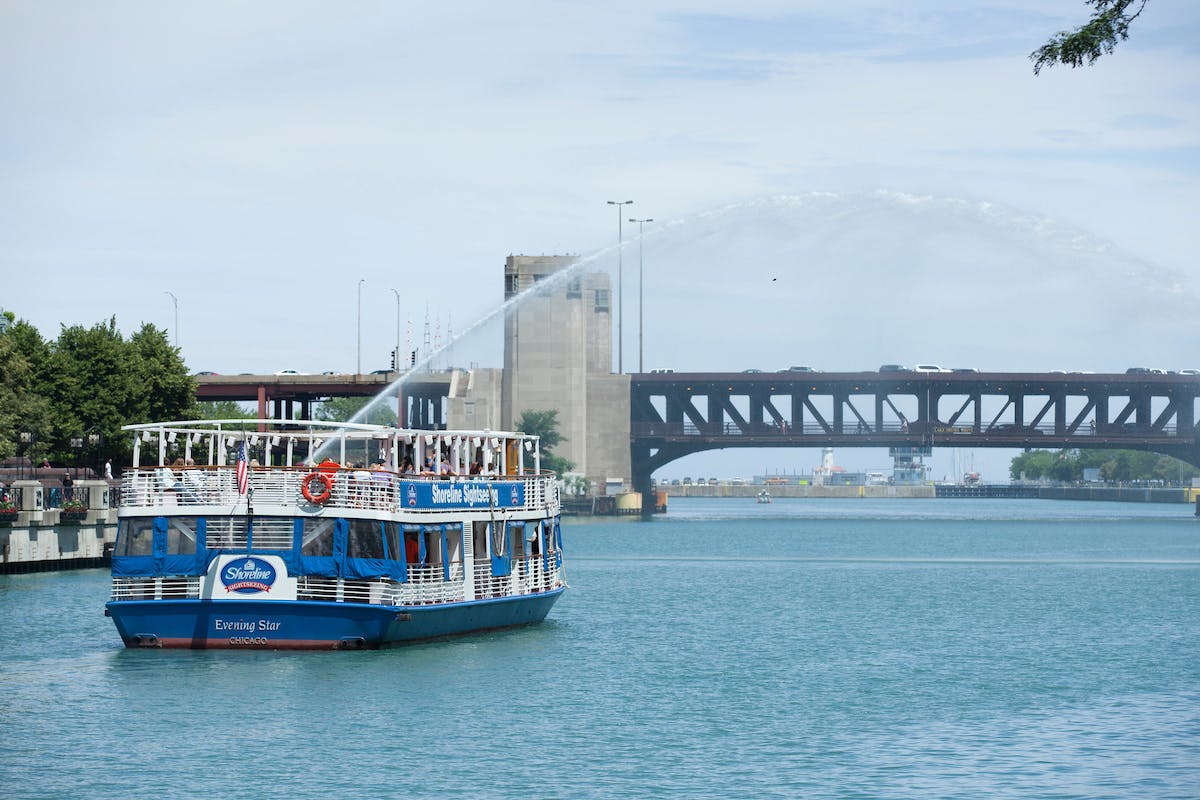
The Chicago Riverwalk makes a good addition before or after Skydeck because it provides the opposite architectural perspective: instead of looking down from one of Chicago’s tallest buildings, you walk among the skyscrapers at river level.
The combination works particularly well for anyone interested in architecture.
Combine It With Millennium Park
Millennium Park is another practical downtown addition. The contrast between Cloud Gate, landscaped public space and the panoramic tower view gives first-time visitors two very different perspectives on central Chicago.
If you have only half a day, Skydeck plus one of these nearby central attractions is usually more enjoyable than attempting to race through several major sights.
A Good Half-Day Chicago Plan
Morning
Explore central Chicago at street level.
Late Morning
Visit Willis Tower and work through the interactive museum.
Midday
Take the elevator to the 103rd floor, enjoy the panoramic views and step onto The Ledge.
Lunch
Eat inside Willis Tower or elsewhere in the Loop.
Afternoon
Continue to either the Chicago Riverwalk or Millennium Park.
Skydeck or 360 CHICAGO?
Chicago has another major observation deck at 875 North Michigan Avenue, commonly known as 360 CHICAGO.
Choose Skydeck If You Want:
The highest observation deck experience in Chicago
The famous glass Ledge
Willis Tower architecture and history
An interactive Chicago museum before the view
A classic first-time Chicago landmark
Consider 360 CHICAGO If:
Your itinerary is focused around the Magnificent Mile
You particularly want views along the Lake Michigan shoreline
You are interested in its separate TILT attraction
For a first visit to Chicago, Skydeck generally has the stronger historical connection because Willis Tower itself is such an important part of the city’s architectural identity.
Is Expedited Entry Worth the Extra Cost?
It depends heavily on when you visit.
Probably Not Essential
Early weekday mornings
Quiet periods outside holidays
When you have plenty of time
More Attractive
Summer weekends
School holidays
Sunset
When your Chicago itinerary is tightly scheduled
Expedited Entry currently provides priority access both for the elevator and The Ledge, so its main value is saving time rather than adding another attraction.
Best Time of Year
Spring
Potentially excellent visibility with fewer peak-summer visitors, although Chicago weather can change rapidly.
Summer
Long daylight hours make it easy to combine daytime and sunset views. This is also one of the busiest seasons, making advance tickets particularly useful.
Autumn
Often an excellent balance of comfortable weather and good visibility.
Winter
Clear winter air can produce extraordinary views, although seasonal opening hours are shorter on some days. Snow can transform the city grid into an especially striking landscape.
Common Mistakes to Avoid
Going to the Wrong Entrance
Remember that the visitor entrance for Skydeck is on Jackson Boulevard, not simply whichever Willis Tower door you reach first.
Assuming The Ledge Costs Extra
It is included with regular Skydeck admission.
Not Booking a Timed Ticket
Advance reservations are strongly recommended and secure your admission window.
Expecting Unlimited Time on The Ledge
Your observation-deck visit can be relaxed, but your individual Ledge turn is generally only around 60–90 seconds.
Arriving at Sunset Without a Reservation
Sunset is one of the most desirable visiting periods. Reserve ahead.
Bringing a Tripod
Tripods are not currently allowed.
Expecting Luggage Lockers
There are none.
Practical Tips
Book a timed ticket in advance.
Current adult admission starts at US$32.
The Ledge is already included.
Enter from Jackson Boulevard.
Allow 1½ hours even though the official average visit is shorter.
Book at least 30 minutes before sunset if you want changing light.
Prepare your Ledge photograph before your turn.
Turn off your flash when photographing through windows.
Do not bring a tripod.
Do not rely on Skydeck for luggage storage.
The entire experience, including The Ledge, is wheelchair accessible.
Is Willis Tower Skydeck Worth Visiting?
Yes, particularly on a first visit to Chicago.
The attraction combines several things that are strongly associated with the city: skyscraper engineering, Chicago’s architectural history, panoramic views and the unmistakable profile of what generations of visitors still know as the Sears Tower.
Willis Tower has dominated the skyline since 1973. At approximately 1,450 feet tall and 110 stories, it was the tallest building in the world for almost 25 years and remains one of the great achievements of 20th-century skyscraper engineering.
Skydeck itself sits at 1,353 feet on the 103rd floor. On a clear day, the view can extend roughly 50 miles, while The Ledge’s five glass balconies project 4.3 feet beyond the building and allow you to look directly down towards Chicago’s streets.
As of August 2026, general admission currently begins at about US$32 for adults, with children under three free. The ticket includes the Chicago museum, observation deck and The Ledge rather than charging separately for each component.
During the current summer period, Skydeck is open until 10:00 pm, making it possible to visit in daylight, at sunset or after dark.
For the strongest experience, reserve ahead, choose an early-morning slot for shorter queues or a late-afternoon slot for sunset, allow at least 90 minutes and do not rush through the museum purely to reach the elevator.
Even if stepping onto a transparent floor 103 stories above Chicago sounds terrifying, the combination of Willis Tower’s history, the extraordinary city panorama and The Ledge makes Skydeck one of the defining Chicago experiences.
Sponsored Popular Items
Quick take: Musement.com offers a worldwide selection of tours and attractions
Architecture cruise in Spanish on the Chicago River from Michigan Ave United States Chicago Architecture Cruise in Spanish from Michigan Avenue See Chicago's celebrated riverfront architecture on a Spanish-language cruise departing from Michigan Avenue. Check current availability, inclusions and booking details before you go.
Willis Tower Skydeck Chicago Tickets United States Plan Willis Tower Skydeck Chicago Tickets, a ticket or attraction experience, with practical tips on timing, inclusions and what to check before booking. Compare current availability, prices and booking conditions before you go.
Chicago Loop District Food Tour with Tastings United States Plan Chicago Loop District Food Tour with Tastings, a food and drink experience, with practical tips on timing, inclusions and what to check before booking. Compare current availability, prices and booking conditions before you go.