The Aquarium du Grand Lyon, officially known as the Aquarium de Lyon, is one of the best family attractions in Lyon for discovering freshwater and marine life. Located at La Mulatière, where the Rhône and Saône meet just south of central Lyon, the aquarium takes visitors from European rivers and tropical freshwater habitats to colourful coral reefs and a huge shark tank.
The attraction has changed substantially in recent years. A major 1,400-square-metre extension opened in December 2025, adding three new marine ecosystems and a large immersive attraction called Océan 360°. The expanded aquarium now reports approximately 3,500 specimens from 310 species, 42 recreated ecosystems and 3,500 square metres of public exhibition space. :contentReference[oaicite:1]{index=1}
Most visitors should allow around 1½ to 2 hours, although families who stop for educational presentations and the new immersive film can easily remain longer. :contentReference[oaicite:2]{index=2}
Aquarium de Lyon at a Glance
Visitor Information
Details
Official name
Aquarium de Lyon
Location
La Mulatière, Greater Lyon, France
Address
7 rue Stéphane Déchant, 69350 La Mulatière
Opened
2002
Major extension
December 2025
Current public exhibition area
Approximately 3,500 m²
Species
Approximately 310
Animals
Approximately 3,500 specimens
Ecosystems
42
Largest tank
Approximately 500,000 litres
Current opening hours
10:30 am–6:30 pm daily
Last admission
5:30 pm
Standard adult ticket
€19.50
Advance-dated adult ticket
€17
Children under 3
Free
Typical visit
1½–2 hours
Parking
Free
Best for
Families, children, marine life and rainy-day sightseeing
These figures reflect the aquarium after its 2025 expansion. The official history page now lists 42 ecosystems, while some older pages still refer to the pre-expansion total of 39. :contentReference[oaicite:3]{index=3}
Aquarium de Lyon Has Been Open Since 2002
The Aquarium de Lyon opened in the spring of 2002 after approximately two years of construction. It was developed at La Mulatière close to the confluence of Lyon’s two major rivers, an especially appropriate location for an attraction devoted to aquatic environments. :contentReference[oaicite:4]{index=4}
The aquarium was acquired by the Aspro group in 2005 and underwent a major redevelopment before a new version of the visitor experience opened in 2010. Another major transformation followed in December 2025 with the opening of the 1,400-square-metre extension. :contentReference[oaicite:5]{index=5}
A Journey From Rivers to Oceans
The aquarium is arranged as a journey through contrasting aquatic environments rather than simply displaying rows of unrelated tanks.
During the visit you encounter habitats including:
Temperate European freshwater
Tropical rivers and lakes
African freshwater ecosystems
Amazonian environments
Asian mangroves
Coral reefs
Tropical oceans
Cold-water kelp forests
Deep-water marine habitats
The large shark ecosystem
The current aquarium reports 42 ecosystems containing approximately 1.2 million litres of water in total. :contentReference[oaicite:6]{index=6}
Start With the Freshwater World
The first section introduces the freshwater ecosystems closest to Lyon and the rest of Europe.
These environments may appear less exotic than coral reefs, but they are important because visitors can discover fish that inhabit rivers and lakes relatively close to home.
Species highlighted by the aquarium include:
European catfish
Carp
Pike
Other freshwater river and lake species
The aquarium deliberately begins with local freshwater biodiversity to explain that conservation does not apply only to distant tropical oceans. :contentReference[oaicite:7]{index=7}
The Tropical Freshwater Zone
The journey then moves into warmer freshwater environments around the world.
Habitats represented include:
Lake Malawi in Africa
The Amazon basin
Asian mangrove environments
These tanks demonstrate the enormous differences that can exist between freshwater ecosystems, from colourful African lake fish to species adapted to large tropical rivers and flooded forests. :contentReference[oaicite:8]{index=8}
Lake Malawi
The African lake displays are particularly colourful.
Lake Malawi is famous for its extraordinary diversity of cichlid fish, many of which evolved only within the lake and occur nowhere else naturally.
The vivid colours make this part of the aquarium particularly popular with younger visitors and photographers.
The Amazon
The Amazonian exhibits introduce the much darker waters and large-scale river environments of South America.
The Amazon is important to the aquarium’s wider conservation message because freshwater ecosystems can be threatened by pollution, habitat destruction and changes to surrounding forests.
From Freshwater Into the Sea
As the route progresses, the displays move from rivers and lakes towards saltwater environments.
The visual transformation is dramatic. Freshwater greens and browns give way to brilliant reef fish, corals, anemones and the larger marine animals that many visitors associate with a major public aquarium.
Les Récifs du Monde – Reefs of the World
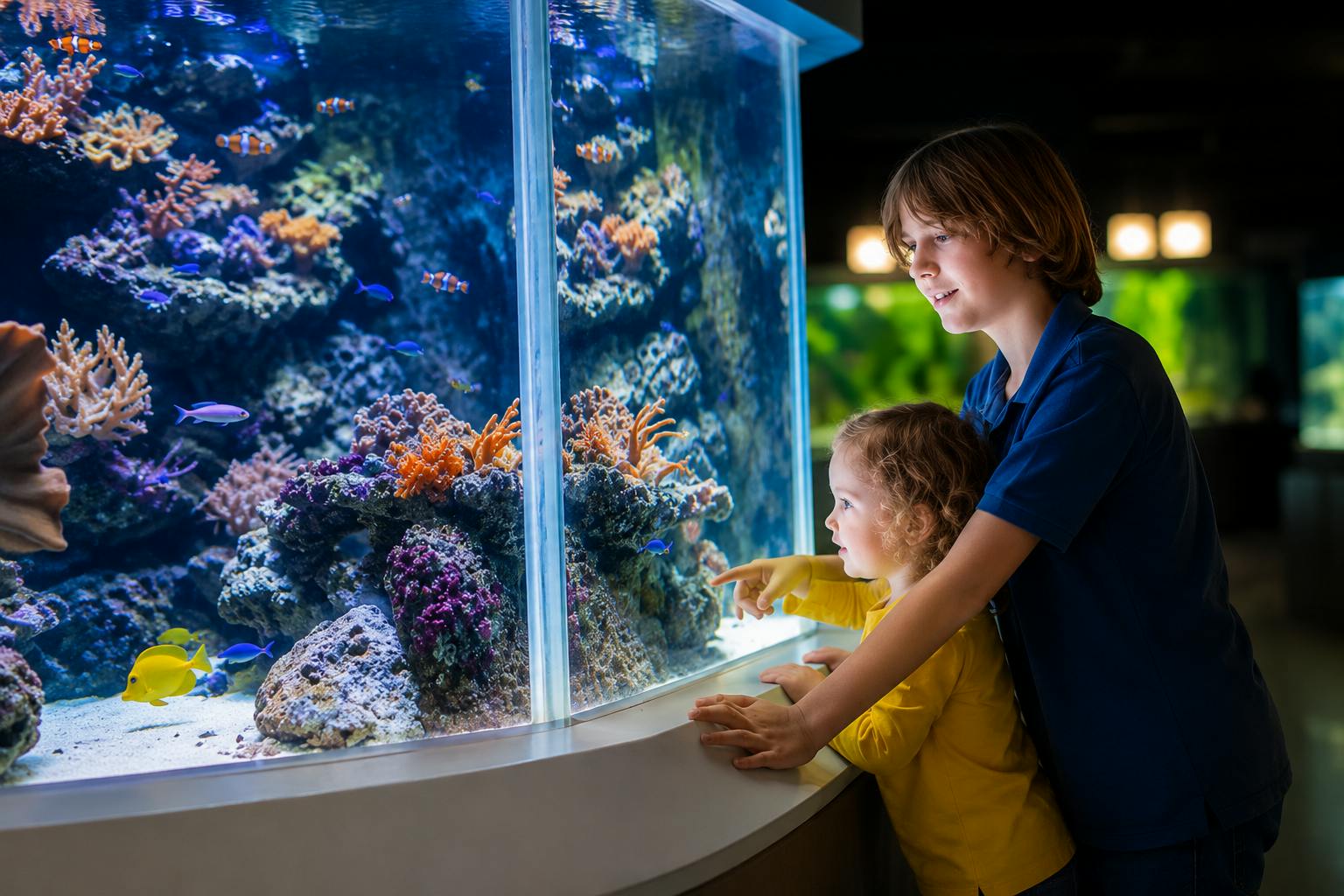
Les Récifs du Monde explores coral-reef ecosystems and some of the colourful species associated with tropical seas.
Displays draw inspiration from regions such as:
New Caledonia
The Banggai Islands
Indo-Pacific coral reefs
Fish represented in these environments can include surgeonfish, clownfish and Banggai cardinalfish. :contentReference[oaicite:9]{index=9}
Clownfish and Anemones
Clownfish are among the aquarium’s most recognisable residents.
The reef displays also help explain the relationship between clownfish and sea anemones. The fish obtain protection among the anemone’s tentacles while participating in a relationship that can also benefit the anemone.
This is a useful exhibit for children because it demonstrates that marine ecosystems depend on relationships between species rather than simply collections of individual animals. :contentReference[oaicite:10]{index=10}
The Shark Tank
The shark tank is one of the main highlights of the Aquarium de Lyon.
The aquarium’s largest ecosystem contains approximately:
500,000 litres of seawater.
The viewing window is made from thick methacrylate designed to withstand the enormous water pressure. The aquarium states that the panel varies from approximately 15 centimetres thick at the top to 25 centimetres at the bottom. :contentReference[oaicite:11]{index=11}
Rather than containing only sharks, the large ecosystem is shared by several species.
What Can You See in the Shark Tank?
Current educational programmes specifically identify animals including:
Leopard sharks
Stingrays
Napoleon wrasse
Large groupers
Other tropical marine fish
The enormous window provides one of the best places in the aquarium to stop for several minutes rather than simply moving from tank to tank. :contentReference[oaicite:12]{index=12}
Watch the Sharks Being Fed
One of the most useful times to visit the main tank is during a scheduled educational presentation.
The aquarium currently schedules feeding of the main shark ecosystem at 3:00 pm on Wednesdays and Sundays. Visitors can watch from the surrounding viewing areas while staff explain the animals’ diets and behaviour. :contentReference[oaicite:13]{index=13}
These programmes can occasionally be changed or cancelled for veterinary or operational reasons, so treat the schedule as planned rather than guaranteed.
Daily Shark Talks
When a feeding session is not taking place, the aquarium currently schedules commentary about the large tank at:
11:30 am
3:00 pm
The presentations explain the sharks, rays and other species sharing the ecosystem. :contentReference[oaicite:14]{index=14}
If you are visiting with children, arranging your route so that you reach the shark tank near one of these times can make the experience considerably more educational.
New for 2026: Les Lueurs Marines
One of the major reasons to revisit the aquarium in 2026 is the new Les Lueurs Marines section.
The experience explores the relationship between underwater life and light through three contrasting ecosystems:
Japan and deeper marine environments
Bali and tropical coral reefs
Brittany and cold-water kelp forests
The new habitats formed part of the major extension that opened in December 2025. :contentReference[oaicite:15]{index=15}
Japan and the Deep Ocean
The Japanese section introduces the mysterious conditions associated with deeper water.
The display explores adaptations that allow marine animals to survive where sunlight becomes extremely weak or disappears altogether.
The aquarium discusses features such as:
Bioluminescence
Translucent bodies
Specialised feeding adaptations
Slow metabolism
Adaptation to high pressure
An emblematic species highlighted in this section is the unusual snipefish, recognisable by its elongated body and long tubular snout. :contentReference[oaicite:16]{index=16}
Bali’s Coral Reefs
The Bali-inspired ecosystem provides a complete visual contrast.
Here the emphasis is on shallow, sunlit tropical water and colourful reef life.
The blue surgeonfish is one of the species highlighted in this environment. These herbivorous fish play an ecological role by grazing algae that could otherwise compete with reef-building corals. :contentReference[oaicite:17]{index=17}
Brittany’s Kelp Forests
The third new ecosystem looks much closer to France.
Cold coastal waters around Brittany support large kelp forests, where giant brown algae create complex underwater habitats for fish and invertebrates.
The section illustrates how marine biodiversity is not restricted to warm tropical reefs. France’s own Atlantic waters contain highly productive ecosystems with their own distinctive wildlife. :contentReference[oaicite:18]{index=18}
New for 2026: Océan 360°
Océan 360° is the aquarium’s major new immersive attraction.
Instead of looking through aquarium glass, visitors enter a 300-square-metre projection environment where imagery is displayed across the walls and floor. :contentReference[oaicite:19]{index=19}
The story places visitors aboard the fictional Subaqua Explorer submarine on an expedition into the deepest parts of the ocean.
The experience includes life-size representations of animals ranging from sea turtles to a giant sperm whale and deep-ocean species. :contentReference[oaicite:20]{index=20}
How Long Is Océan 360°?
The immersive film lasts approximately:
15 minutes.
The current final projection of the day begins at 5:45 pm. :contentReference[oaicite:21]{index=21}
If you arrive late in the afternoon, make sure you have enough time to reach this area before the final showing.
Marine Curiosities
The Curiosités Marines area concentrates on some of the stranger and less familiar forms of underwater life.
This is a useful contrast to the large charismatic animals because it encourages visitors to notice unusual body shapes, behaviours and adaptations among smaller species.
Children who arrive expecting only sharks frequently find these smaller tanks surprisingly interesting.
How Big Is the Aquarium?
Following the latest expansion, the aquarium reports:
3,500 m² of visitor exhibition space
2,000 m² of behind-the-scenes facilities
Approximately 3,500 animals
Approximately 310 species
42 ecosystems
Approximately 1,200 m³ of water
The aquarium also contains a 200-seat cinema and the new 300-square-metre Océan 360° projection space. :contentReference[oaicite:22]{index=22}
What Happens Behind the Scenes?
Maintaining dozens of different aquatic habitats requires much more than filling tanks with water.
The aquarium also operates separate warm- and cold-water quarantine facilities for newly arrived animals. :contentReference[oaicite:23]{index=23}
Shark Feeding Behind the Scenes
The aquarium states that its sharks can receive approximately 2–8 kilograms of fish per week, depending on species and requirements.
At the other extreme, smaller animals such as seahorses may require multiple daily feedings of tiny live foods. :contentReference[oaicite:24]{index=24}
This gives children an interesting understanding of just how different the care requirements can be across one aquarium.
Current 2026 Opening Hours
As of August 2026, the Aquarium de Lyon is currently open:
10:30 am–6:30 pm every day
with:
Last admission: 5:30 pm
Final Océan 360° projection: 5:45 pm
The aquarium operates throughout the year, including most public holidays, but is normally closed on 25 December and 1 January. :contentReference[oaicite:25]{index=25}
Current 2026 Ticket Prices
The aquarium currently offers two principal ticket types: the flexible Billet Liberté and cheaper advance-dated Billet Malin. :contentReference[oaicite:26]{index=26}
Billet Liberté
Visitor
Current Price
Age 11+
€19.50
Age 5–10
€15
Age 3–4
€10
Under 3
Free
Post-secondary student
€16.50 at ticket office with proof
The Liberté ticket can currently be used once within a 180-day validity period. :contentReference[oaicite:27]{index=27}
Billet Malin – Advance-Dated Ticket
Visitor
Current Price
Age 11+
€17
Age 5–10
€12.50
Age 3–4
€7
Under 3
Free
The cheaper Billet Malin must be purchased for a future date and cannot currently be bought for the same day. It is non-refundable and cannot be changed after purchase. :contentReference[oaicite:28]{index=28}
Summer 2026 Promotion
Visitors travelling during summer 2026 should also check the aquarium’s current booking page before paying the normal rate. As of August 2026, the aquarium homepage is advertising a seasonal promotion with full-price admission from approximately €14.50 and a reduced promotional rate from €10. Promotional availability and conditions can change. :contentReference[oaicite:29]{index=29}
Family Ticket
The aquarium currently sells family packages online.
A Family Malin package for two full-price visitors and two reduced-price visitors is currently listed at approximately €56, while the more flexible Family Liberté ticket is approximately €58 online. :contentReference[oaicite:30]{index=30}
For a family of four, checking the package price before buying four separate tickets can therefore save money.
Discount for Visitors With Disabilities
Current disability admission is:
Age 11+: €12.50
Age 5–10: €8
Supporting documentation is required. :contentReference[oaicite:31]{index=31}
Lyon City Card Discount
Visitors holding a qualifying Lyon City Card currently receive preferential aquarium rates rather than free admission.
The aquarium lists preferential prices of approximately:
€16.50 full rate
€12 reduced rate
€8 mini rate
The preferential rate can currently apply to the cardholder plus up to three accompanying people. :contentReference[oaicite:32]{index=32}
Do You Need to Book in Advance?
No, advance booking is not compulsory for ordinary individual visitors.
Tickets can be purchased at the aquarium ticket desk. However, online booking is recommended because it can provide cheaper ticket options and faster access once inside. :contentReference[oaicite:33]{index=33}
If you want the Billet Malin price, remember that it cannot be purchased for the same day.
Possible if you simply want to see the main tanks, but you will move quickly and may miss scheduled presentations.
1½ Hours
A reasonable visit for adults travelling without children.
2 Hours
Best for most first-time visitors.
You can spend time at the shark tank, explore the new 2026 ecosystems and include Océan 360°.
2½–3 Hours
Allow this if visiting with young children, attending a shark feeding or stopping for food during the visit.
Best Time of Day to Visit
The aquarium currently recommends visiting around lunchtime if you want to avoid the busiest periods. :contentReference[oaicite:35]{index=35}
10:30 am
Good if you want to begin shortly after opening and then continue sightseeing elsewhere in Lyon.
11:00 am–Noon
Useful if you want to catch the current 11:30 am shark presentation.
Lunch Period
Best for lower crowds according to the aquarium.
Mid-Afternoon
Excellent if you want to see the 3:00 pm shark commentary or Wednesday/Sunday feeding.
Excellent on a Rainy Day
The Aquarium de Lyon is one of the easiest attractions to add to a rainy-day itinerary because virtually the entire visitor route is indoors.
It also works well during extreme summer heat. The aquarium currently specifically promotes the building as air-conditioned. :contentReference[oaicite:36]{index=36}
Is the Aquarium Good for Children?
Yes. It is particularly well suited to families with younger children.
Children can move between very different displays relatively quickly, so they are not expected to spend an hour reading museum labels before encountering something new.
Popular family highlights include:
Sharks
Rays
Colourful reef fish
Clownfish
Freshwater giants
The new Lueurs Marines habitats
Océan 360°
Educational talks
The aquarium also runs special holiday activities, many of which are included with normal admission. :contentReference[oaicite:37]{index=37}
Summer 2026 Family Activities
During the current summer holiday programme, running from 4 July to 31 August 2026, the aquarium is offering additional activities for children on selected dates. These are included with admission and do not require a separate reservation. :contentReference[oaicite:38]{index=38}
Because the programme changes during each school holiday period, check the current schedule if visiting with children.
Are There Marine Mammals?
No.
The Aquarium de Lyon specifically states that it does not keep marine mammals. :contentReference[oaicite:39]{index=39}
The focus is instead on fish, sharks, rays, corals, invertebrates and different aquatic ecosystems.
Accessibility
The aquarium is accessible to visitors with reduced mobility and to families using pushchairs.
Lifts are available throughout the visitor route to make it easier to move between exhibition levels. :contentReference[oaicite:40]{index=40}
Several seats are also positioned around the route for visitors who need regular rest stops.
Pushchairs
Pushchairs are permitted and the lifts make the aquarium relatively straightforward for families with babies and toddlers. :contentReference[oaicite:41]{index=41}
The dark lighting in some aquarium areas can make it useful to keep young children close while moving between exhibits.
No Cloakroom or Luggage Storage
An important practical detail is that the aquarium currently has no cloakroom or luggage-storage service. :contentReference[oaicite:42]{index=42}
If you are travelling through Lyon with large suitcases, arrange luggage storage elsewhere rather than arriving at the aquarium expecting to leave bags at reception.
Can You Eat Inside?
The aquarium has a snack area partway through the visitor route.
Outside Zone A school holidays, the snack currently operates on:
Wednesday
Saturday
Sunday
During Zone A school holidays it operates daily. :contentReference[oaicite:43]{index=43}
Picnicking inside the aquarium is not permitted.
Can You Leave and Come Back?
No. The aquarium currently operates a no re-entry policy.
Once you leave, your visit is finished. :contentReference[oaicite:44]{index=44}
Use the toilets, shop and snack facilities before exiting if required.
Where Is the Aquarium de Lyon?
The aquarium is located at:
Aquarium de Lyon
7 rue Stéphane Déchant
69350 La Mulatière
France
It stands immediately south of central Lyon near the point where the Rhône and Saône rivers converge. :contentReference[oaicite:45]{index=45}
Getting There by Bus
Several current TCL bus services stop close to the aquarium.
Bus
Useful Stop
C7
Bastero Aquarium
C10
Bastero Aquarium
8
Bastero Aquarium
63
Bastero Aquarium
15
Maison du Confluent
The aquarium’s own current access information lists these routes as the principal bus connections. :contentReference[oaicite:46]{index=46}
Getting There by Tram
A particularly useful sightseeing route is to take Tram T1 to:
From there, cross the bridge between the museum and the aquarium and continue on foot. :contentReference[oaicite:47]{index=47}
This makes it very easy to combine the Aquarium de Lyon and Musée des Confluences during the same day.
Getting There From Lyon Part-Dieu
Visitors arriving at Lyon Part-Dieu railway station can connect to the aquarium using Lyon’s TCL public transport network.
The journey requires more time than travelling from the Confluence or Perrache area, so allow enough time if you have a fixed train later in the day. :contentReference[oaicite:48]{index=48}
Getting There From Lyon Perrache
Perrache is a particularly convenient transport hub for the aquarium because it lies close to the Confluence district.
Bus and tram connections make the journey relatively straightforward, and you can easily combine the aquarium with a visit to southern Lyon.
Getting There by Bicycle
A cycle route from Lyon’s Voies Lyonnaises network runs alongside the aquarium.
The aquarium provides:
Covered bicycle parking near the entrance
A Vélo’v bike-share station above the aquarium
This can be an enjoyable option in good weather if you are already exploring the Rhône or Saône riverfronts by bicycle. :contentReference[oaicite:49]{index=49}
Driving and Parking
The aquarium has its own parking area.
Parking is currently free for aquarium visitors. :contentReference[oaicite:50]{index=50}
The parking area is not supervised, so do not leave luggage, cameras or valuables visible inside your vehicle.
Combine the Aquarium With Musée des Confluences
The Musée des Confluences is the most obvious nearby attraction to combine with the aquarium.
The striking contemporary museum stands across the river connection only a relatively short walk away.
A very good family day is:
Musée des Confluences → lunch → Aquarium de Lyon
This pairing works particularly well because both attractions are indoors and the subjects are very different.
Explore the Confluence District
The broader Lyon Confluence area is also worth exploring before or after the aquarium.
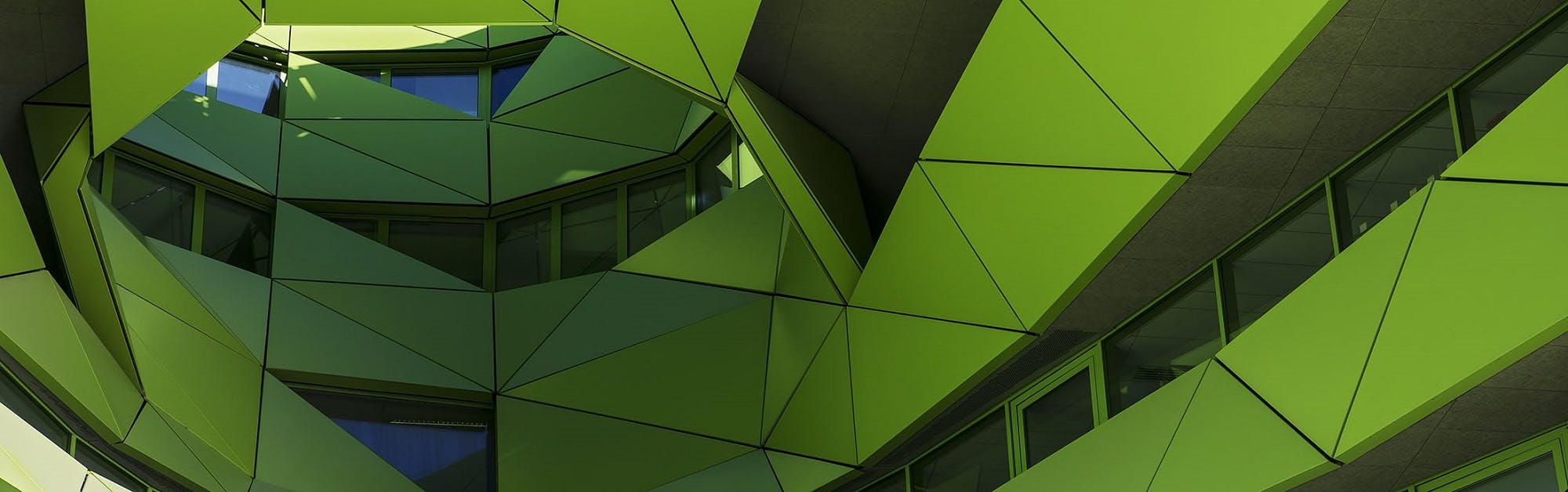
The former industrial district has been transformed with contemporary architecture, waterfront walks, restaurants and shops.
If you have already spent several days among the Renaissance streets of Vieux Lyon, Confluence provides a completely different view of the city.
A Good Half-Day Aquarium Itinerary
10:30 am – Arrive at the Aquarium
Begin shortly after opening and explore the freshwater galleries.
11:30 am – Shark Presentation
Reach the large shark ecosystem in time for the scheduled educational commentary.
Noon – Reefs and Marine Displays
Continue through the tropical and coral-reef areas.
12:45 pm – Lueurs Marines
Explore the three new marine ecosystems introduced for 2026.
1:15 pm – Océan 360°
Finish with the 15-minute immersive submarine experience.
1:30–2:00 pm – Continue to Confluence
Have lunch and explore the nearby district or visit Musée des Confluences.
A Good Family Day in Southern Lyon
Morning
Visit Musée des Confluences.
Lunch
Eat around the Confluence district.
2:00 pm – Aquarium
Walk or travel across to the Aquarium de Lyon.
3:00 pm – Shark Presentation
Catch the afternoon educational session or Wednesday/Sunday feeding.
Late Afternoon
Experience Océan 360° and finish your visit before closing.
Where to Stay Near the Aquarium
Lyon Confluence
Best if the aquarium, Musée des Confluences and modern Lyon are major parts of your visit.
This area offers:
Modern hotels
Riverfront walks
Restaurants
Shopping
Tram connections
Easy access to Perrache
The aquarium’s current accommodation information identifies several hotels around Confluence within approximately 5–15 minutes of the attraction by walking or public transport. :contentReference[oaicite:51]{index=51}
Presqu’île and Perrache
Best for visitors wanting easier access to the rest of central Lyon.
Staying farther north on the Presqu’île gives you better access to central restaurants, historic attractions and shopping while keeping the aquarium within an easy public-transport journey.
Is the Aquarium Suitable for Adults Without Children?
Yes, although it is especially family-oriented.
Adults interested in marine life can still enjoy the large shark ecosystem, freshwater biodiversity, reef displays and new 2026 areas.
The aquarium becomes particularly worthwhile for adults if you attend one of the educational presentations rather than simply walking quickly past every tank.
Is It Worth Visiting if You Have Seen Bigger Aquariums?
The Aquarium de Lyon is not attempting to compete in physical scale with the world’s largest aquariums.
Its strength is that it offers a manageable 1½–2-hour experience within easy reach of central Lyon.
The 2025 expansion has also substantially improved the attraction. Current figures now list 42 ecosystems, 310 species and 3,500 specimens, while the new Océan 360° installation adds a different type of immersive experience beyond traditional tanks. :contentReference[oaicite:52]{index=52}
Good Choice During Hot Weather
Summer days in Lyon can become extremely hot.
Because the aquarium is indoors and currently promotes itself as air-conditioned, it can be particularly useful during the middle of a hot afternoon. :contentReference[oaicite:53]{index=53}
You can visit outdoor attractions during the cooler morning and move into the aquarium during the hottest part of the day.
Tips for Photographing the Fish
Aquarium photography can be difficult because of reflections and low light.
Turn off your flash.
Move the camera or phone close to the glass.
Avoid standing directly opposite bright lights.
Wait for fish to swim into better-lit sections of the tank.
Use night or low-light mode carefully because moving fish can blur.
Spend several minutes at the shark tank rather than trying one quick photograph.
Always follow any photography restrictions displayed beside individual exhibits.
Practical Tips for Visiting
Allow around two hours.
Check advance tickets before paying full price.
Children under three enter free.
Try to catch a shark presentation.
Wednesday and Sunday at 3:00 pm currently feature shark feeding.
Do not arrive after 5:30 pm.
See Océan 360° before its final 5:45 pm projection.
Remember there is no luggage storage.
Picnics are not permitted inside.
Re-entry is not allowed once you leave.
Parking is free.
Lunch time is currently recommended for lower crowds.
Aquarium de Lyon or Musée des Confluences?
Choose the Aquarium If You Want:
Live animals
Sharks and rays
Colourful tropical fish
A family-focused attraction
An easy 1½–2-hour visit
An activity particularly suited to younger children
Choose Musée des Confluences If You Want:
Natural history
Science
Anthropology
Architecture
A larger traditional museum experience
If you have enough time, the best answer is to visit both. Their proximity makes them one of Lyon’s easiest two-attraction combinations.
Is the Aquarium du Grand Lyon Worth Visiting?
Yes, particularly for families, visitors travelling with children and anyone looking for an indoor attraction in Lyon.
The Aquarium de Lyon has become considerably more substantial since its latest expansion. It now reports around 3,500 specimens representing 310 species across 42 ecosystems, with the largest shark environment alone containing approximately half a million litres of seawater. :contentReference[oaicite:54]{index=54}
The new Les Lueurs Marines section adds three very different environments inspired by Japan’s deeper waters, Bali’s coral reefs and Brittany’s kelp forests. :contentReference[oaicite:55]{index=55}
The 2026 Océan 360° experience is another major addition, using floor and wall projections across a 300-square-metre space to simulate an underwater expedition. The film lasts approximately 15 minutes and is included within the broader aquarium experience. :contentReference[oaicite:56]{index=56}
Current standard admission is €19.50 for visitors aged 11 and over, while the advance-dated Billet Malin reduces that to €17. Children under three enter free. Seasonal promotions can reduce the price further. :contentReference[oaicite:57]{index=57}
The aquarium is currently open daily from 10:30 am to 6:30 pm, with last admission at 5:30 pm. :contentReference[oaicite:58]{index=58}
Its location is another advantage. Tram T1 takes visitors to Musée des Confluences, from where the aquarium can be reached across the bridge, while several bus routes stop at Bastero Aquarium. Drivers also have access to free parking. :contentReference[oaicite:59]{index=59}
For the best experience, allow about two hours, check the day’s educational programme before entering and try to time your route around a shark presentation.
With sharks, tropical reefs, freshwater giants and two major new immersive areas, the Aquarium de Lyon is an easy and worthwhile addition to a family visit to Lyon—especially when combined with the nearby Musée des Confluences.
Sponsored Popular Items
Quick take: Musement.com offers a worldwide selection of tours and attractions
Aquarium du Grand Lyon Entrance Ticket and 1GB eSIM France Plan Aquarium du Grand Lyon Entrance Ticket and 1GB eSIM, a ticket or attraction experience, with practical tips on timing, inclusions and what to check before booking. Compare current availability, prices and booking conditions before you go.
Guided Crime History Walking Tour in Lyon Presqu'île France Plan Guided Crime History Walking Tour in Lyon Presqu'île, a outdoor experience, with practical tips on timing, inclusions and what to check before booking. Compare current availability, prices and booking conditions before you go.
Lyon Murder Mystery City Exploration Game France Plan Lyon Murder Mystery City Exploration Game, a self-guided game or exploration experience, with practical tips on timing, inclusions and what to check before booking. Compare current availability, prices and booking conditions before you go.
3-Hour Electric Bike Tour of Lyon – Outdoor Adventure France 3-hour Electric Bike tour of Lyon adds structure, local context and purposeful sightseeing to the itinerary. Check current availability, inclusions and booking details before you go.
Traditional Food Tour in Lyon – Food & Drink Experience France Traditional food tour in Lyon explores the destination through flavour and regional customs. Check current availability, inclusions and booking details before you go.