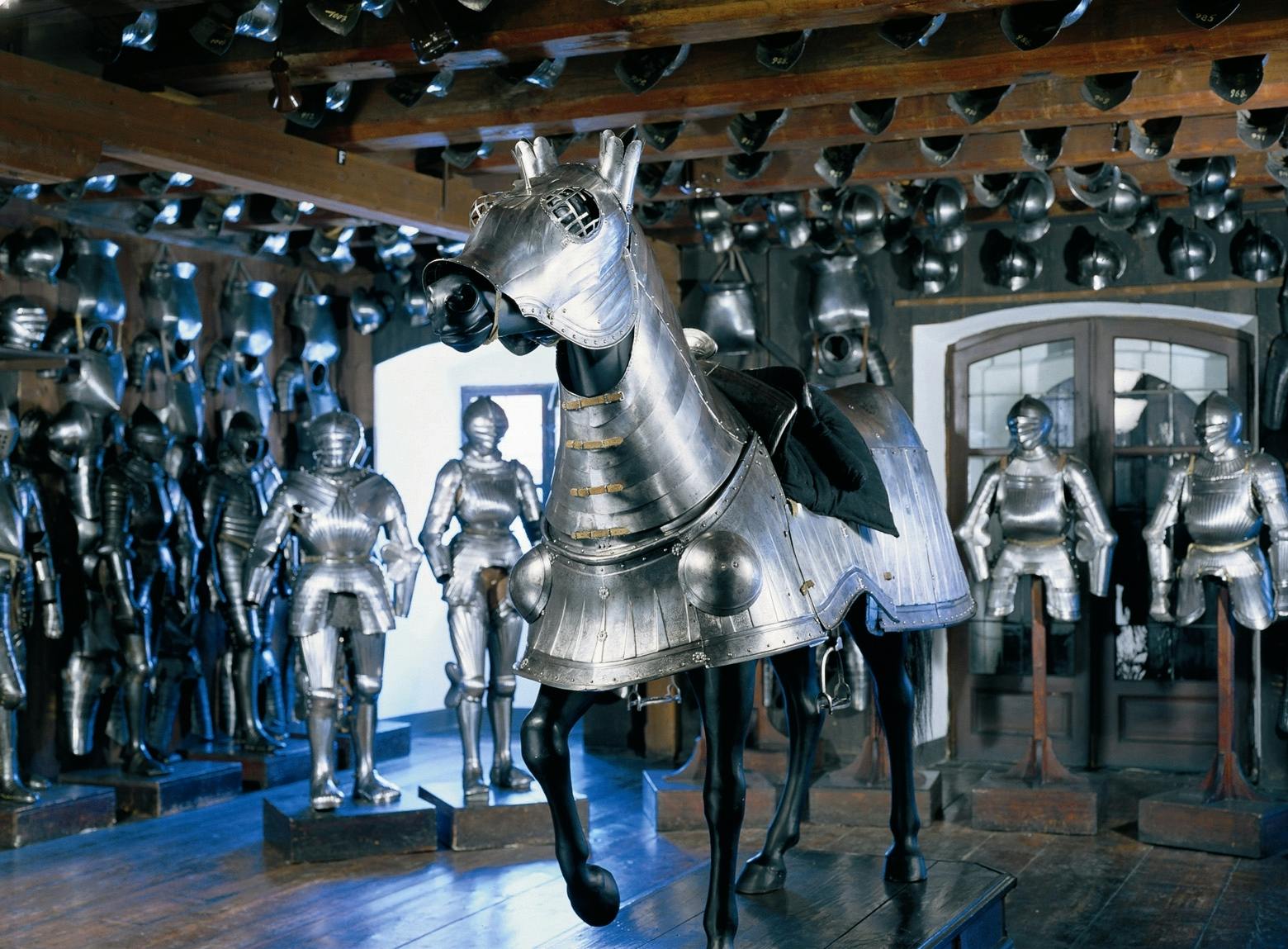
Behind an elegant Baroque entrance on Graz’s central Herrengasse lies one of Europe’s most remarkable historic collections. The Landeszeughaus, usually called the Styrian Armoury in English, contains around 32,000 pieces of armour, weaponry and military equipment arranged across four densely packed floors.
This is not a modern museum filled with reconstructed scenes. It is an original seventeenth-century arsenal whose timber floors, weapon racks and storage system have survived largely intact. Rows of dark helmets hang above narrow aisles, suits of armour stand in formation and racks of pikes appear to stretch into the distance.
Sponsored Popular Items
Quick take: Musement.com offers a worldwide selection of tours and attractions
Landeszeughaus Styrian Armoury Entry Ticket Graz Austria Landeszeughaus Styrian Armory Entrance Ticket provides a structured way to visit a notable attraction or cultural site. Landeszeughaus Styrian Armory Entrance Ticket: experience overview Experience the Landeszeughaus Styrian Armory entrance ticket to learn the history of Styria's war-torn past while you gaze upon the preserved weapons and tools. This makes the experience a useful option when planning time in Graz. The exact duration can depend on the selected date, option or operating schedule. Routes, start times, inclusions and meeting arrangements may vary, so the current booking page should be treated as the final source of operational information. At a glance…
Even travellers with little interest in military history may find the Landeszeughaus compelling. Its value lies not only in individual objects, but also in the extraordinary scale and atmosphere of the collection.
Landeszeughaus Quick Facts
Official name
Landeszeughaus, or Styrian Armoury
Location
Herrengasse 16, central Graz, Austria
Collection
Approximately 32,000 historic objects
Main period represented
From the late fifteenth century to the eighteenth century
Building dates
Constructed from 1642 to 1644
Exhibition levels
Four historic storage floors
Recommended visit
About 90 minutes, or up to two hours with a guided tour
Best for
History, architecture, craftsmanship and unusual museums
Nearest tram stop
Hauptplatz/Graz Congress
Why the Styrian Armoury Is Worth Visiting
The Landeszeughaus is often described as a weapons museum, but that description does not fully explain what makes it special. The building was created as a functioning regional armoury, and much of the collection remains arranged according to its original storage purpose.
The result feels less like a conventional exhibition and more like entering a seventeenth-century military warehouse that has been placed on pause. Instead of viewing a few isolated objects in glass cases, visitors see hundreds of helmets, breastplates, swords, muskets and polearms stored together in disciplined rows.
The overwhelming quantity is part of the experience. It shows the logistical scale of early modern warfare: equipment had to be ordered, manufactured, maintained and stored for thousands of soldiers who could be called upon to defend Styria.
The armoury is also a striking example of historic preservation. Its timber-lined interior helps regulate moisture, while specialist conservators continue the demanding work of protecting thousands of metal objects from corrosion.
The History of the Landeszeughaus
For centuries, Styria occupied a vulnerable position in the southeastern territories of the Habsburg monarchy. From the late fifteenth century onward, regional authorities faced repeated military pressure associated with Ottoman expansion, border warfare and conflict in neighbouring areas.
The Styrian estates gradually accumulated large stocks of defensive equipment. By the seventeenth century, the existing storage facilities were no longer sufficient, and a purpose-built armoury was commissioned beside the Styrian Landhaus.
The Italian-born architect Antonio Solar designed the narrow, multi-storey building, which was constructed between 1642 and 1644. Its location beside the provincial government building was practical: political administration and military preparation stood side by side.
At its peak, the armoury is believed to have held as many as 190,000 items. These were not primarily ceremonial treasures. Most were practical pieces of equipment intended for ordinary soldiers, including helmets, breastplates, firearms, pikes, swords, powder containers and tools.
During the eighteenth century, Empress Maria Theresa reorganised the military administration of the Habsburg lands and proposed closing regional armouries. The Styrian estates successfully argued that the Landeszeughaus should be retained as a historic monument.
That decision preserved both the building and a substantial portion of its contents. In April 2026, the Landeszeughaus received the European Heritage Label in recognition of its wider importance to European cultural history.
What to See Inside the Styrian Armoury
The historic storage rooms
The four main floors are the attraction’s defining feature. Wooden racks fill the galleries from floor to ceiling, creating long, symmetrical views through thousands of pieces of equipment.
Look beyond the individual weapons and notice how the rooms were organised. Similar items were grouped together so that equipment could be counted, maintained and distributed efficiently when troops were mobilised.
Suits of armour
The armoury contains thousands of pieces of protective equipment, including helmets, breastplates, backplates, arm and leg protection and several complete suits of armour.
Many belonged to ordinary infantrymen rather than wealthy knights. Their relatively standardised construction demonstrates that armour was produced on a considerable scale, although individual sizes and details still varied.
The horse armour
One of the collection’s most memorable exhibits is an almost completely preserved suit of armour for a horse. It dates from the early sixteenth century and is one of only a small number of comparable examples surviving worldwide.
The display gives visitors a clearer sense of the weight, cost and visual impact of armoured cavalry than isolated pieces could provide.
Pikes, halberds and other polearms
Long ranks of pikes and halberds form some of the armoury’s most dramatic displays. Pikes allowed groups of foot soldiers to create defensive formations, while halberds combined several functions in a single weapon.
Seen together in large numbers, these weapons reveal how military effectiveness depended on formations and coordinated movement rather than individual combat alone.
Historic firearms
The collection includes muskets, pistols and other early firearms, together with powder flasks, bullet moulds and associated equipment. These objects help trace the gradual transformation of European warfare as firearms became increasingly important.
Some weapons are relatively plain and practical, while others display highly skilled metalworking, decorative inlay and carved wooden stocks.
Swords and edged weapons
Swords, sabres, daggers and other cutting or thrusting weapons appear throughout the collection. Their shapes and construction differed according to purpose, period and the type of soldier expected to use them.
The finest examples demonstrate that weapon making could combine engineering, craftsmanship and artistic decoration.
The building itself
Do not focus only on the displays. The structure is a major part of the visit. Heavy wooden beams, worn floorboards and original storage fittings preserve the atmosphere of a working arsenal.
The exterior is relatively restrained, although the entrance is decorated with statues of Mars, the Roman god of war, and Minerva, associated with wisdom, strategy and the arts.
Should You Take a Guided Tour?
A guided tour is particularly valuable at the Landeszeughaus because the artefacts are not individually labelled inside the historic rooms. Extensive signs and display panels have deliberately been avoided to protect the character and fabric of the site.
Without interpretation, the enormous quantity of equipment is impressive but can become difficult to understand. A guide explains why the armoury was created, how weapons were stored, who used them and how the collection survived.
Regular English-language tours are generally offered at 12:30 pm, with German tours usually scheduled at 11:00 am and 2:00 pm. Tour times and availability can change, so confirm the current programme before visiting.
Visitors who prefer to explore independently can request a free printed visitor guide. A paid multimedia or audio guide is also available in several languages.
How Long to Spend at the Armoury
Allow approximately 90 minutes for a comfortable self-guided visit. History enthusiasts and visitors using an audio guide may want closer to two hours.
A quick visit can be completed in about an hour, but moving too quickly reduces the experience to repeated rows of metal objects. Taking time to examine the differences in armour, firearm mechanisms and craftsmanship makes the collection far more rewarding.
Four floors can also involve more walking and standing than expected, although a lift is available.
Tickets and Opening Hours
During the 2026 summer season, from 1 April to 31 October, the armoury is scheduled to open Tuesday to Sunday and on public holidays from 10:00 am until 6:00 pm. It is normally closed on Mondays, apart from certain public-holiday exceptions.
Winter access is more restricted and may depend on joining a guided tour. Limited independent admission is sometimes offered on selected weekends and holiday dates. Anyone visiting between November and March should check the current schedule before arriving.
Standard adult admission was listed at €13 in 2026, with discounted tickets for seniors, students, young people, visitors with disabilities and families. Children under six enter free. Prices may change after publication.
The museum is part of the Universalmuseum Joanneum. A 24-hour or 48-hour Joanneum ticket can offer better value when visiting several participating museums in Graz and elsewhere in Styria.
Entry is also included with qualifying versions of the Graz Card. Check the current card conditions because inclusions can be revised.
How to Get to the Landeszeughaus
The armoury is located at Herrengasse 16 in the heart of Graz’s Old Town. It is only a short walk from Hauptplatz, the city’s main square, and can easily be included in a walking tour of central Graz.
The nearest major public transport stop is Hauptplatz/Graz Congress. Several tram routes serve the stop, after which the armoury is reached by walking south along Herrengasse.
Driving into the historic centre is generally unnecessary. Central Graz is compact, pedestrian-friendly and well served by trams. Travellers arriving by car will usually find it easier to use a public parking garage outside the most restricted Old Town streets.
Accessibility
The Herrengasse entrance is accessible, and a lift provides access to the exhibition levels. The route through the museum is step-free.
Some upper-floor wooden surfaces are old and uneven, so wheelchair users and visitors with limited mobility should move carefully. An accessible toilet is available on the ground floor, reached by a ramp where some visitors may require assistance.
Wheelchairs may be borrowed free of charge at the ticket counter on presentation of photographic identification. Assistance dogs are permitted.
What to See Near the Styrian Armoury
Landhaus courtyard
The armoury stands beside the Styrian Landhaus, one of Graz’s finest Renaissance buildings. Its arcaded courtyard is free to enter when open and takes only a few minutes to explore.
Hauptplatz
Graz’s main square is lined with colourful historic façades and overlooked by the Rathaus. It is an easy starting point for exploring the Old Town.
Schlossberg and the Clock Tower
The wooded Schlossberg rises above the city centre. Visitors can walk, take the funicular or use the Schlossberg lift to reach panoramic viewpoints near the famous Clock Tower.
Graz Cathedral and the Mausoleum
The cathedral and the neighbouring Mausoleum of Emperor Ferdinand II provide a contrasting look at the religious and imperial history of Graz.
Kunsthaus Graz and Murinsel
Across the River Mur, the futuristic Kunsthaus and the floating Murinsel structure show the modern side of Graz. Both are within walking distance of the armoury.
Practical Tips for Visiting
Join the English tour when possible: The lack of individual labels means guided interpretation adds considerable value.
Visit earlier in the day: The narrow historic galleries are more atmospheric when they are less crowded.
Look up as well as around: Helmets and other equipment are stored above eye level throughout the building.
Wear stable footwear: Some of the centuries-old wooden floors are uneven.
Allow time for every level: The displays may initially appear similar, but each floor contains different types of equipment.
Check seasonal hours: Winter admission arrangements differ substantially from the main summer season.
Combine the visit with the Landhaus: The adjacent courtyard provides useful architectural and political context.
Ask about photography: Confirm the current museum rules at the entrance before taking photographs.
Frequently Asked Questions
What is the Landeszeughaus?
The Landeszeughaus is a historic regional armoury in Graz. It was built during the seventeenth century to store weapons and defensive equipment for Styrian troops.
Why is the Styrian Armoury famous?
It is considered the world’s largest preserved historic armoury. Around 32,000 objects remain inside the original building and its historic wooden storage system.
Is the Landeszeughaus a medieval armoury?
Some objects date from the late medieval period, but much of the collection belongs to the early modern era. The building itself was constructed from 1642 to 1644.
How many floors are open to visitors?
The principal collection is displayed across four historic storage levels. The building has an additional ground-floor area used for visitor services and other functions.
How long does a visit take?
Most visitors should allow between 90 minutes and two hours. A focused visit can be completed in around one hour.
Are there English-language tours?
Yes. An English tour is generally scheduled at 12:30 pm on operating days, although visitors should verify the time before arriving.
Are the weapons individually labelled?
No. Extensive labels have not been installed in the historic rooms. Visitors can use a printed guide, audio guide or guided tour for information about the collection.
Is the Styrian Armoury suitable for children?
School-aged children interested in knights, armour or history often enjoy the dramatic displays. Younger children may find four floors of similar-looking equipment repetitive, so a shorter visit may work better.
Is the building wheelchair accessible?
Yes. A lift reaches the exhibition floors and the visitor route is step-free. Some original wooden flooring is uneven, and assistance may be useful in certain areas.
Can I visit the Landeszeughaus in winter?
Yes, but access is more limited than during the summer season and may require a guided tour. Always check the current winter timetable before travelling.
Is the Styrian Armoury included with the Graz Card?
Admission is included with qualifying Graz Card products under the current arrangements. Check the latest card inclusions before purchase.
Is it worth visiting if I am not interested in weapons?
Yes. The authentic building, repeated visual patterns, craftsmanship and unusual survival of an original arsenal make it interesting as a historical and architectural site, not merely as a collection of weapons.
Final Thoughts
The Landeszeughaus is one of those rare attractions whose impact comes from the survival of an entire place rather than a single masterpiece. Thousands of objects remain surrounded by the timber racks and storerooms for which they were made, preserving a powerful record of Styria’s difficult frontier history.
Its rows of armour can be visually spectacular, but the deeper story is about administration, manufacturing, regional defence and the human cost of centuries of conflict. A guided tour helps reveal that context and transforms the armoury from an impressive store of old weapons into one of Graz’s most thought-provoking historic sites.
Sponsored Popular Items
Quick take: Musement.com offers a worldwide selection of tours and attractions
Landeszeughaus Styrian Armoury Entry Ticket Graz Austria Landeszeughaus Styrian Armory Entrance Ticket provides a structured way to visit a notable attraction or cultural site. Landeszeughaus Styrian Armory Entrance Ticket: experience overview Experience the Landeszeughaus Styrian Armory entrance ticket to learn the history of Styria's war-torn past while you gaze upon the preserved weapons and tools. This makes the experience a useful option when planning time in Graz. The exact duration can depend on the selected date, option or operating schedule. Routes, start times, inclusions and meeting arrangements may vary, so the current booking page should be treated as the final source of operational information. At a glance…