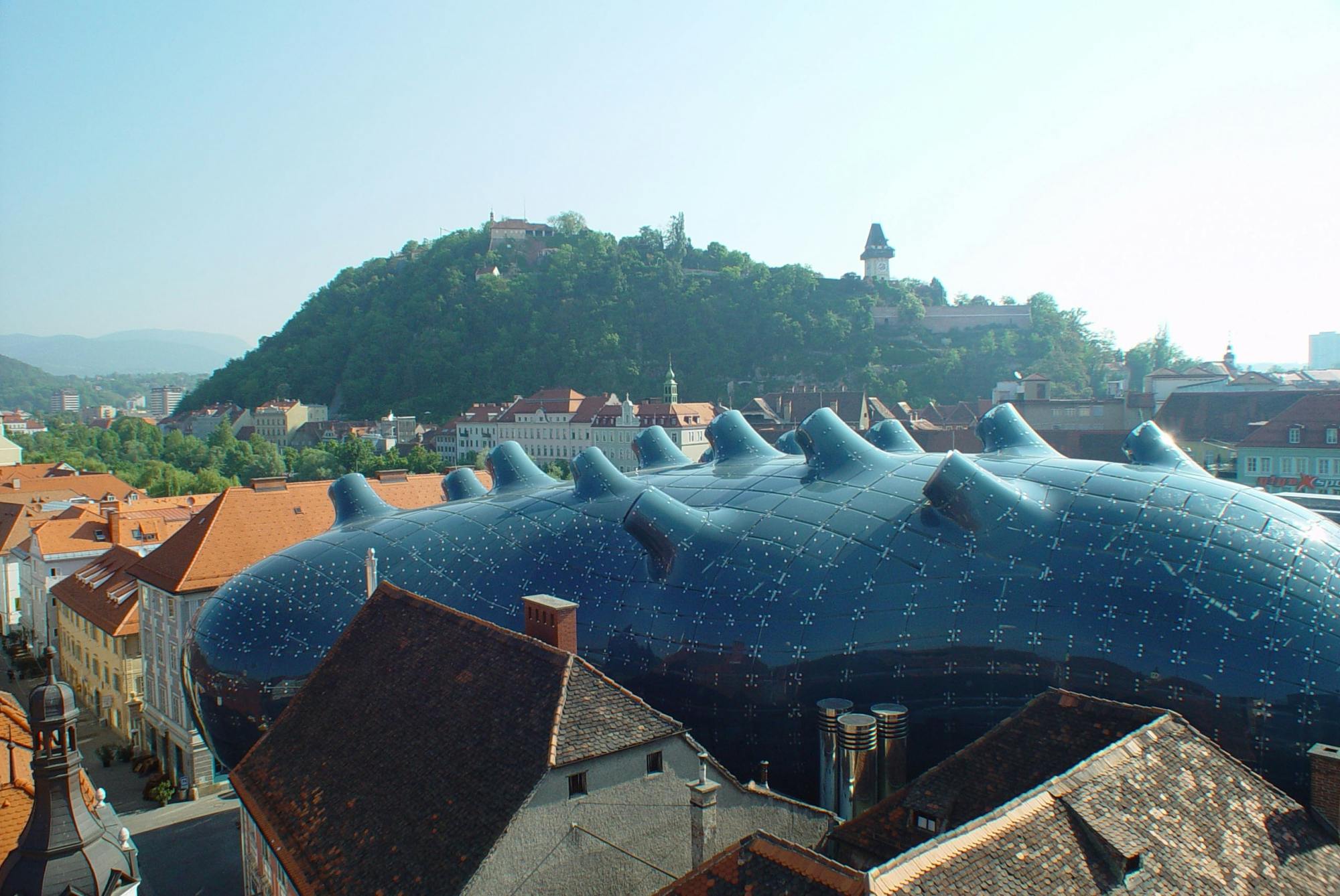
Kunsthaus Graz is one of Austria’s most recognisable contemporary buildings. Its swollen blue form rises beside the River Mur like a futuristic organism, contrasting dramatically with the tiled roofs, church towers and historic façades of central Graz.
The building is widely known as the “Friendly Alien,” a nickname that captures its unusual relationship with the surrounding city. It appears strange without feeling hostile, hovering above a transparent ground floor while curved nozzles project from its roof and hundreds of façade lights communicate with the streets after dark.
Sponsored Popular Items
Quick take: Musement.com offers a worldwide selection of tours and attractions
Kunsthaus Graz Austria Entry Ticket Austria Kunsthaus Graz entrance ticket provides a structured way to visit a notable attraction or cultural site. Kunsthaus Graz entrance ticket: experience overview Experience the Kunsthaus Graz entrance ticket to visit contemporary art exhibitions from the 1960s to present located inside the city's architectural landmark. This makes the experience a useful option when planning time in Graz. The exact duration can depend on the selected date, option or operating schedule. Routes, start times, inclusions and meeting arrangements may vary, so the current booking page should be treated as the final source of operational information. At a glance Experience type: Attraction entry…
Inside, Kunsthaus Graz is an exhibition centre for international contemporary art rather than a museum with a permanent collection. Displays change regularly and may include large installations, sculpture, photography, film, digital art, performance and projects responding directly to the building’s vast curved interior.
The architecture is therefore as important as the exhibition programme. Visitors enter beneath the blue shell, travel upward on long moving walkways, explore two expansive gallery levels and finish at a glass viewing platform overlooking Graz.
Kunsthaus Graz stands immediately across the river from the historic centre and only a short walk from the Murinsel, Hauptplatz and Schlossberg. It can be visited in approximately two hours or included in a full day combining contemporary art, historic Graz and panoramic city views.
Kunsthaus Graz Quick Facts
Visitor information
Details
Location
Lendkai 1, Graz, Austria
River
Mur
Opened
2003
Architects
Peter Cook and Colin Fournier
Nickname
The Friendly Alien
Main purpose
Changing exhibitions of international contemporary art
Permanent collection
No traditional permanent collection
Current adult single ticket
€13
Visitors under 19
Free single admission
Reduced single ticket
€11 for eligible visitors
Students aged 19–25
€6.50 with appropriate identification
Joanneum 24-hour ticket
€20 for adults
Joanneum 48-hour ticket
€26 for adults
Opening hours
Tuesday–Sunday and public holidays, 10:00 am–6:00 pm
Normal closing day
Monday
Recommended visit
One and a half to two hours
Nearest tram stop
Südtiroler Platz–Kunsthaus
Parking
Underground car park beneath the building
Included photography venue
Camera Austria exhibition rooms
Best exterior experience
After dark when the BIX façade is illuminated
Current-information note: The exhibition programme, room access, BIX displays and public-holiday schedule change throughout the year. Check current arrangements before travelling to see one particular exhibition.
What Is Kunsthaus Graz?
Kunsthaus Graz is a contemporary-art exhibition centre operated as part of the Universalmuseum Joanneum.
It presents temporary exhibitions rather than maintaining a conventional permanent display. The galleries can therefore look completely different from one visit to another.
Depending on the programme, visitors may encounter:
Large installations.
Painting and sculpture.
Film and video.
Photography.
Sound art.
Digital and interactive works.
Performance.
Architecture and design.
Ecological and socially engaged projects.
The building is also an artwork-like object in its own right. Many people visit primarily to experience its shape, internal circulation, BIX façade and relationship with Graz’s historic cityscape.
Why Visit Kunsthaus Graz?
Kunsthaus Graz offers two closely linked experiences: contemporary art and experimental architecture.
Main reasons to visit include:
Seeing one of Europe’s most unusual museum buildings.
Exploring changing international art exhibitions.
Travelling through the building on its distinctive moving walkways.
Looking through a nozzle towards the Schlossberg Clock Tower.
Experiencing the dark, curved gallery interiors.
Viewing Graz from the glass Needle.
Seeing the BIX media façade after dark.
Visiting Camera Austria with the same admission ticket.
Combining the museum easily with the historic centre.
The museum is especially rewarding for travellers interested in contemporary architecture, installation art, urban design and the way modern buildings can interact with historic cities.
History of Kunsthaus Graz
Plans for a major contemporary-art building in Graz developed during preparations for the city’s year as European Capital of Culture in 2003.
An earlier proposal for a museum near the Schlossberg generated significant public debate. The eventual location was chosen on the western bank of the Mur in the Lend district.
This position was symbolically important. Graz’s major historic attractions were concentrated primarily on the eastern side of the river, while the western districts had traditionally received less visitor attention.
Kunsthaus Graz helped connect the two sides of the city and contributed to the cultural renewal of the Lend and Gries areas.
Construction incorporated the historic Eisernes Haus while adding the radically different blue exhibition structure above and beside it.
The building opened in 2003 and quickly became one of Graz’s defining landmarks.
Graz European Capital of Culture 2003
Kunsthaus Graz was one of several important projects created for Graz’s European Capital of Culture year.
Another lasting project was the Murinsel, the artificial island and pedestrian structure in the river nearby.
The 2003 programme aimed to:
Strengthen Graz’s international cultural profile.
Encourage contemporary architecture.
Reconnect the city with the River Mur.
Create cultural activity outside the historic core.
Support new public spaces and institutions.
Both Kunsthaus Graz and the Murinsel were initially associated with a specific cultural year but became permanent parts of the city.
Peter Cook and Colin Fournier
Kunsthaus Graz was designed by British architect Peter Cook and architect Colin Fournier.
Cook was closely associated with Archigram, the influential experimental architecture group known for futuristic proposals involving movable cities, technology and flexible living environments.
The Kunsthaus reflects similar interests in:
Organic form.
Technology.
Movement.
Media.
Architecture resembling a living organism.
Flexible internal space.
Rather than imitating Graz’s historic buildings, the architects created an intentionally different structure capable of entering into visual conversation with them.
Why Is It Called the Friendly Alien?
The nickname “Friendly Alien” is associated with Colin Fournier’s description of the building.
It appears alien because its smooth blue body, rounded underside and tubular rooftop openings have little in common with the surrounding traditional architecture.
It appears friendly because:
Its shape is rounded rather than aggressive.
The transparent ground level remains open to the street.
It communicates with the city through light.
It does not attempt to dominate the historic buildings.
One nozzle deliberately faces the Clock Tower.
Visitors have compared the building with a whale, sea creature, heart, spaceship, baby hippopotamus and giant blue bubble.
The architects deliberately avoided assigning one fixed interpretation.
Understanding the Architecture
The building combines several visually different elements:
The blue biomorphic gallery body.
A transparent glass entrance level.
The restored Eisernes Haus.
Long internal travelators.
Curved dark exhibition spaces.
The BIX media façade.
The glass Needle extending towards the city.
The main blue form spans up to approximately 60 metres and contains two principal exhibition levels.
Its irregular shape was difficult to design and construct using traditional drafting alone. Computer modelling was used to translate the handmade architectural model into individually manufactured building components.
The Blue Acrylic Skin
The outer surface is formed from translucent blue acrylic elements over a double-layered structure.
During daylight, the skin reflects:
The sky.
Clouds.
The River Mur.
Neighbouring buildings.
Changing weather.
The colour can shift from deep navy to bright cobalt or metallic grey according to the light.
After dark, the surface becomes a screen for the BIX lighting system.
The Rooftop Nozzles
Sixteen trunk-like openings project from the building’s upper surface.
These are known as nozzles and serve primarily as sources of controlled daylight.
Most face north, helping to introduce indirect natural light rather than strong direct sunlight.
One nozzle points east towards the Schlossberg Clock Tower.
This creates a deliberate connection between:
Graz’s traditional landmark.
Its major contemporary landmark.
The old city on one side of the river.
The newer cultural district on the other.
Travelators and the Journey Inside
Visitors do not simply climb a normal staircase from the foyer to the galleries.
A long moving walkway, commonly called the Travelator or Pin, carries visitors upward through the blue shell.
The journey creates a gradual transition from:
The bright glass entrance.
The ordinary street environment.
The dark internal skin.
The controlled atmosphere of the galleries.
A second moving walkway connects the principal exhibition levels.
The travelators are among the building’s most memorable features, although lifts provide an alternative route for visitors who cannot or prefer not to use them.
Space01 and Space02
The principal galleries are known as Space01 and Space02.
Space02
Space02 is the first major exhibition level reached from the entrance.
Its wide floor and dark ceiling allow curators to create:
Open installations.
Temporary rooms.
Screening spaces.
Sculptural environments.
Flexible lighting arrangements.
Space01
Space01 occupies the higher level and reaches approximately eight metres at its tallest point.
It is especially suitable for:
Large sculpture.
Monumental installations.
Suspended works.
Immersive environments.
Projects responding to the building’s organic shape.
The curved walls and absence of conventional rectangular rooms can make orientation unusual. This is intentional and encourages visitors to explore rather than follow a rigid corridor.
The Needle Viewing Platform
The Needle is a glass extension projecting from the upper part of the building.
After experiencing the dark exhibition spaces, visitors emerge into this brighter linear platform.
Views may include:
The River Mur.
The historic centre.
Church towers.
Schlossberg.
The Clock Tower.
Roofs of the Lend district.
The view provides an important final connection between the exhibitions and the surrounding city.
The Historic Eisernes Haus
Kunsthaus Graz incorporates the Eisernes Haus, or Iron House, a historic building dating from the 19th century.
Its cast-iron construction was innovative for its time and is among the oldest surviving examples of this structural approach in Central Europe.
Rather than demolishing the building, the Kunsthaus project restored it and connected it to the new galleries by bridges.
The contrast demonstrates two different periods of technological ambition:
Industrial iron-and-glass construction.
Computer-modelled organic architecture.
Camera Austria occupies exhibition rooms within the Eisernes Haus section.
The BIX Media Façade
BIX is a combination of the words “big” and “pixels.”
The system was developed by the architecture and art studio realities:united.
Hundreds of circular lamps are integrated into the acrylic skin facing the Mur and historic centre.
Each light functions as a large, low-resolution pixel.
The façade can display:
Abstract movement.
Text.
Symbols.
Simple animations.
Artist-designed sequences.
Interactive projects.
BIX is not intended to compete with a high-resolution advertising screen. Its limited visual information creates images that are read from a distance and interpreted through movement, rhythm and brightness.
Seeing Kunsthaus Graz at Night
The exterior experience is strongest after dark, when BIX becomes visible across the river.
Good viewing positions include:
The Murinsel.
The eastern riverbank.
The Erzherzog-Johann Bridge.
Streets near Südtiroler Platz.
Elevated viewpoints on Schlossberg.
The exact display varies. Some evenings feature a current artistic project, while others use programmed sequences or reduced illumination.
Allow time to see the building both during daylight and after sunset when possible.
Does Kunsthaus Graz Have a Permanent Collection?
No conventional permanent collection is displayed.
Kunsthaus Graz is primarily an exhibition venue. Its programme changes several times each year.
This means visitors should check the current exhibitions before purchasing a ticket.
The advantage is that:
Every visit can provide a different experience.
Artists can respond directly to the architecture.
Large spaces can be completely transformed.
The programme can address current social and environmental themes.
The possible disadvantage is that visitors cannot expect to find a fixed group of famous masterpieces.
Current 2026 Exhibitions
As of June 2026, the principal Kunsthaus Graz exhibitions form part of the wider Universalmuseum Joanneum theme BLOOM.
Exhibition or project
Location
Dates
30% Dandelion
Space02
21 March–8 November 2026
Hybrid Pleasures: Helen Chadwick Supported by Liesl Raff
Space01
21 March–20 September 2026
Expanded Garden by Markus Jeschaunig
Terrace
21 March 2026–20 March 2027
Circadian Bloom by Anna Ridler
BIX façade
20 March–2 July 2026
Speak More Truth, Eat More Fruit by Maruša Sagadin
Forecourt
Until March 2027
Dates are useful for planning, but installations, terrace access and individual works may be affected by maintenance or events.
30% Dandelion
30% Dandelion brings together more than 35 works examining flowers as botanical organisms, cultural symbols, aesthetic forms and companions to human life.
The exhibition uses the dandelion as a symbol of:
Persistence.
Adaptation.
Healing.
Seed dispersal.
Shared ecosystems.
Resistance to control.
Life on overlooked margins.
Its themes connect flowers with ecological crisis, colonial histories, digital acceleration and different forms of coexistence.
The presentation includes contemporary art alongside material drawn from fields such as natural history, literature and cultural history.
It is more political and ecological than the title’s cheerful yellow flower may initially suggest.
Hybrid Pleasures
Hybrid Pleasures: Helen Chadwick Supported by Liesl Raff places works by influential British artist Helen Chadwick in dialogue with contemporary sculptures by Liesl Raff.
Chadwick’s practice challenged divisions between:
Beauty and disgust.
The body and technology.
Human and non-human life.
Organic and artificial materials.
Desire and mortality.
Raff’s works use materials such as latex and metal to respond to Chadwick’s investigation of bodies, language and hybrid forms.
The exhibition was adapted specifically to Kunsthaus Graz’s flowing upper gallery and includes a programme of performances and live events.
Some imagery and themes may be challenging for younger children. Families should ask staff about the current display before entering.
Expanded Garden
Markus Jeschaunig’s Expanded Garden occupies the Kunsthaus terrace.
The project extends the museum’s 2026 focus on flowers and ecology into an outdoor environment.
Terrace access can depend on:
Weather.
Maintenance.
Events.
Seasonal plant conditions.
Ask at the ticket counter whether the terrace is fully accessible on the day of the visit.
Camera Austria
Camera Austria is an independent institution devoted to photography and contemporary image culture.
Its exhibition rooms are located on the second floor of the Kunsthaus and Eisernes Haus complex.
A Kunsthaus Graz single ticket currently includes admission to Camera Austria.
The exhibitions may explore:
Contemporary photography.
Documentary practice.
Moving images.
Publishing.
Politics of representation.
Digital image culture.
Allow approximately 20–40 additional minutes when Camera Austria’s current exhibition is of interest.
Current Ticket Prices
Single Kunsthaus ticket
Current price
Adult
€13
Visitors under 19
Free
Senior citizens
€11
Eligible visitors with disabilities
€11
Groups of 12 or more
€11 per person
Students, apprentices and eligible service personnel aged 19–25
€6.50
Student groups and social institutions
€3 per person
Multimedia guide
€3
Scheduled guided tour supplement
€4
Identification is required for age-based or concession admission.
The single ticket permits one visit during the calendar day and includes the Camera Austria exhibition rooms.
Joanneum 24-Hour and 48-Hour Tickets
The Universalmuseum Joanneum operates numerous museums in Graz and across Styria.
Joanneum ticket
Adult
Age 6–18
24 hours
€20
€5
48 hours
€26
€6.50
The multi-museum ticket may be better value when combining Kunsthaus Graz with attractions such as:
Styrian Armoury.
Neue Galerie Graz.
Natural History Museum.
History Museum.
Schloss Eggenberg museums.
Folk Life Museum.
The validity period begins from purchase or activation according to the ticket conditions.
Guided tours and certain special events are normally charged separately.
Graz Card and Graz Card Light
The tourist Graz Card includes entry to selected attractions, including Kunsthaus Graz, together with additional benefits.
Card
24 hours
48 hours
72 hours
Graz Card with public transport
€32
€42
€47
Graz Card Light without public transport
€24
€30
€35
The full Graz Card currently includes:
Public transport within Zone 101.
Selected museum admission.
Schlossbergbahn funicular.
Schlossberg lift.
A guided historic-centre walk.
Additional attraction discounts.
Two children under 15 can be included with each adult card, but individual child tickets must be issued when purchasing.
The card is most valuable when visiting several museums and using transport or the Schlossberg services during the same period.
Current Opening Hours
Kunsthaus Graz normally opens:
Tuesday–Sunday: 10:00 am–6:00 pm.
Public holidays: 10:00 am–6:00 pm unless otherwise announced.
Monday: Closed under the normal weekly schedule.
For the remainder of 2026, the museum currently lists additional opening on 26 October.
It is scheduled to close on:
24 December 2026.
25 December 2026.
Individual galleries may begin closing shortly before the official building closure.
Do You Need to Book?
Advance booking is not usually necessary for an ordinary individual visit.
Booking is useful for:
Special events.
English-language tours.
Workshops.
Large groups.
School visits.
Opening weekends.
Prearranged group tours should generally be requested at least one week ahead.
The building can become busy during exhibition openings and free-admission events, but it rarely experiences the continuous queues associated with Europe’s major historic art museums.
How Long Should You Spend?
Time available
Realistic experience
45–60 minutes
Architecture and one principal exhibition
90 minutes
Both major galleries and Needle viewpoint
2 hours
Comfortable visit including Camera Austria
2½–3 hours
Detailed exhibitions, multimedia guide, terrace and café
Two hours is suitable for most first-time visitors.
Allow longer when the current exhibitions include extensive video works or when attending a guided tour.
The Best Route Through the Building
Walk around the exterior before entering.
Examine the transparent ground-floor relationship with the blue structure.
Check the current exhibitions and terrace access at the ticket desk.
Use the first travelator to reach Space02.
Explore the lower principal exhibition.
Continue by travelator or lift to Space01.
Visit the upper exhibition.
Look through the Clock Tower-facing nozzle where accessible.
Continue towards the Needle viewpoint.
Visit Camera Austria.
Return to the foyer, shop and café.
Cross the river to see the exterior from a distance.
One-Hour Highlights Visit
When time is limited:
Spend ten minutes examining the exterior.
Use the travelator to Space02.
Choose the exhibition most suited to your interests.
Continue briefly to the upper level.
Finish at the Needle viewpoint.
See the BIX façade from across the river later that evening.
Do not spend the full hour reading every introductory panel. The building itself deserves time and attention.
Detailed Two-Hour Visit
First 20 Minutes: Exterior and Foyer
Walk around the Lendkai and Südtiroler Platz sides, examine the nozzles and compare the new structure with the Eisernes Haus.
Next 40 Minutes: Space02
Explore 30% Dandelion or the current lower-level exhibition.
Next 40 Minutes: Space01
Visit Hybrid Pleasures or the current upper-level installation.
Final 20 Minutes
Visit the Needle, terrace if open and selected Camera Austria rooms.
Add additional time for the café, shop or multimedia guide.
Guided Tours and Multimedia Guides
Scheduled guided tours generally cost €4 in addition to admission.
A prebooked private group tour for up to approximately 25 people currently costs €55 plus admission.
English-language tours are offered on selected dates rather than continuously.
Guides can be especially helpful because contemporary installations may depend on:
Political context.
Material processes.
Performance history.
Site-specific design.
Concepts not immediately visible.
A multimedia guide is available for approximately €3, and free online audio material may accompany individual exhibitions.
Visiting with Children
Kunsthaus Graz can be enjoyable for children because the building feels unusual and exploratory.
Children may particularly enjoy:
The building’s creature-like appearance.
The moving walkways.
Looking through the nozzles.
Large installations.
Light and video works.
The glass Needle.
The BIX façade.
The actual suitability of exhibitions varies considerably.
Some contemporary displays may include:
Nudity.
Disturbing images.
Loud sounds.
Dark rooms.
Flashing light.
Complex political themes.
Ask staff for current family recommendations before beginning.
Visitors under 19 currently receive free single admission, making it inexpensive for families to enter briefly and concentrate on the building.
Accessibility
Kunsthaus Graz was designed with extensive step-free access.
Arrival
An underground car park is available beneath the building.
A designated accessible parking area is available on Grieskai.
Vehicles can stop briefly near the entrance for passenger drop-off and collection.
Automatic entrance doors are clearly marked.
Inside
Lifts connect the principal floors.
The ticket desk has tactile and visual features.
A guidance system assists navigation from the entrance.
Acoustic announcements operate in the lift.
Seating is available in the entrance area and Needle.
Staff can assist with individual access needs.
Visual Accessibility
A tactile model of the building stands outside and includes information in Braille.
White gloves may be provided so blind or partially sighted visitors can touch selected authorised objects.
Accessible Tours
Accessible guided tours can be arranged on published dates or by request and may be available in different languages.
Light, Sound and Sensory Considerations
Contemporary exhibitions may use:
Flashing light.
Rapid video projection.
Dark spaces.
Loud or repetitive sound.
Smoke or atmospheric effects.
Mirrors and disorienting surfaces.
Some effects may present a risk to visitors with photosensitive epilepsy.
Ask at the ticket desk whether the current exhibitions include flashing or rapidly changing light.
Visitors with sensory sensitivities may prefer opening time on a weekday, when the galleries are usually quieter.
Bags, Lockers and Visitor Rules
Large bags and backpacks may need to be stored before entering the galleries.
General rules normally include:
Do not touch artworks unless specifically invited.
Keep food and drinks outside exhibition rooms.
Follow floor markings around installations.
Supervise children closely.
Do not sit on art objects unless they are clearly designated as seating.
Follow staff instructions in dark or interactive spaces.
Installation requirements change, so an object that appears robust may still be fragile or operationally sensitive.
Photography
Personal photography is usually permitted in much of the building, but restrictions may apply to individual exhibitions or borrowed works.
Expect prohibitions on:
Flash.
Tripods.
Selfie sticks.
Professional filming without permission.
Photography of selected temporary works.
The best architectural photography locations include:
Südtiroler Platz.
The eastern bank of the Mur.
Murinsel.
Schlossberg.
The Needle.
Kunsthauscafé and Shop
Kunsthauscafé occupies the ground-floor area and can normally be entered without purchasing an exhibition ticket.
It serves as a café, restaurant and evening meeting place for the Lend district.
The café’s hours are separate from the museum’s and may continue after the galleries close.
The Kunsthaus shop offers items such as:
Exhibition catalogues.
Architecture books.
Contemporary-art publications.
Design objects.
Postcards.
Graz souvenirs.
Children’s creative products.
Getting to Kunsthaus Graz
Kunsthaus Graz stands at Lendkai beside the River Mur, directly opposite the historic centre.
Its central location makes it easy to reach by:
Tram.
Walking.
Bicycle.
Taxi.
Car.
Most visitors staying in central Graz do not need a car.
Arriving by Tram
The nearest stop is Südtiroler Platz–Kunsthaus.
Tram lines serving this stop currently include:
Line 1.
Line 4.
Line 6.
Line 7.
Tram lines 3 and 5 stop at Hauptplatz–Graz Congress, followed by a short walk through Murgasse and across the river.
Some sections of central Graz operate as a free Old Town tram zone. Check the current boundaries and ticket requirements before travelling beyond the free area.
Walking from Central Graz
Kunsthaus Graz is only a few minutes from Hauptplatz.
A pleasant route is:
Begin at Hauptplatz.
Walk west through Murgasse.
Cross the River Mur.
Continue towards Südtiroler Platz.
Approach the museum from the historic-centre side.
Another route crosses the Murinsel, providing attractive views of the building from the river.
Approximate walking times:
Starting point
Approximate walk
Hauptplatz
5–8 minutes
Murinsel
2–5 minutes
Schlossbergplatz
8–12 minutes
Joanneumsviertel
10–15 minutes
Graz Opera
20–25 minutes
From Graz Hauptbahnhof
From Graz’s main railway station, use a tram towards the city centre and leave at Südtiroler Platz–Kunsthaus.
The public-transport journey normally takes approximately ten minutes once aboard, depending on the service and waiting time.
Walking from the station takes approximately 20–30 minutes.
The route is mostly straightforward but is less attractive with heavy luggage. Store bags at accommodation or the station before visiting.
Driving and Parking
An underground parking garage is located directly beneath Kunsthaus Graz, with access from Lendkai.
Parking charges are separate from museum admission.
Driving in central Graz can involve:
One-way streets.
Tram lines.
Pedestrian areas.
Cycle lanes.
Limited street parking.
Use the underground garage rather than searching repeatedly for roadside spaces.
A car is unnecessary for a central sightseeing day and may be less convenient than public transport.
The Best Time to Visit
Tuesday to Friday Morning
Weekday opening time generally provides the quietest galleries.
Late Afternoon
A visit beginning around 3:30 or 4:00 pm allows time inside before seeing the exterior light change towards evening.
After Dark
Return to the opposite riverbank to see BIX.
The exact illumination time changes with daylight, programming and season.
Rainy Days
Kunsthaus Graz is a strong wet-weather attraction, although the exterior and city views are less striking during heavy rain.
Monday
The museum is normally closed. Use Monday for outdoor Graz attractions or museums with different closing schedules.
Attractions Near Kunsthaus Graz
The museum is exceptionally well placed for combining contemporary architecture with historic Graz.
Nearby attractions include:
Murinsel.
Hauptplatz.
Franciscan Church.
Schlossberg.
Clock Tower.
Graz Museum.
Styrian Armoury.
Joanneumsviertel.
Neue Galerie Graz.
Natural History Museum.
Murinsel
Murinsel is a shell-like structure floating in the River Mur a short walk from Kunsthaus Graz.
It was designed by New York artist Vito Acconci for Graz’s European Capital of Culture year in 2003.
The structure includes:
Pedestrian bridges.
A café.
An amphitheatre.
River-level views.
Night lighting.
Crossing the Murinsel is free.
It provides one of the best close views of Kunsthaus Graz and creates a natural modern-architecture pairing.
Schlossberg and Clock Tower
Schlossberg rises immediately above the historic centre.
Visitors can reach the summit by:
Stairs.
Paths.
Lift.
Funicular.
The hill provides excellent views of the Kunsthaus blue shell surrounded by traditional red roofs.
The Clock Tower is Graz’s best-known historic landmark and is deliberately framed by one of the Kunsthaus nozzles.
A combined Kunsthaus and Schlossberg visit demonstrates the dialogue between old and new Graz particularly clearly.
Graz Old Town
Graz’s historic centre is recognised as part of a UNESCO World Heritage property.
Important sights include:
Hauptplatz.
Graz Town Hall.
Landhaus courtyard.
Styrian Armoury.
Graz Cathedral.
Mausoleum of Emperor Ferdinand II.
Sporgasse.
Glockenspielplatz.
The Kunsthaus stands just outside the traditional core, making it easy to contrast different periods of the city in one walk.
Other Museums to Combine with Kunsthaus Graz
Neue Galerie Graz
Neue Galerie presents modern and contemporary art and provides a more collection-based complement to the changing Kunsthaus programme.
Styrian Armoury
The armoury contains an exceptional historic collection of weapons and armour stored in its original city arsenal setting.
Natural History Museum
This museum covers geology, zoology, botany and the natural environment of Styria.
CoSA
The Center of Science Activities offers interactive science experiences and is particularly suitable for families.
Schloss Eggenberg
The palace complex contains historic state rooms, gardens and several Joanneum collections.
It requires a tram journey from the centre and is best given at least half a day.
Suggested Half-Day Kunsthaus Graz Itinerary
10:00 am: Enter Kunsthaus Graz
Explore the architecture and current exhibitions for approximately two hours.
12:00 pm: Kunsthauscafé
Have coffee or an early lunch.
1:00 pm: Murinsel
Cross the river using the island structure and photograph Kunsthaus Graz from the water.
1:30 pm: Hauptplatz
Walk through Murgasse to Graz’s principal square.
2:00 pm: Schlossberg
Use the lift, funicular or walking route to reach the Clock Tower and panoramic viewpoints.
Suggested Full-Day Graz Itinerary
9:00 am: Historic Centre
Begin at Hauptplatz and explore the Landhaus courtyard and Herrengasse.
10:00 am: Styrian Armoury
Allow approximately one hour.
11:30 am: Kunsthaus Graz
Cross the Mur and spend approximately two hours in the museum.
1:30 pm: Lunch
Eat at Kunsthauscafé or in the Lend district.
3:00 pm: Murinsel
Cross the river and continue towards Schlossbergplatz.
3:30 pm: Schlossberg
Visit the Clock Tower, viewpoints and gardens.
5:30 pm: Old Town
Walk through Sporgasse or visit Graz Cathedral.
After Dark
Return to the river to see the illuminated Kunsthaus and Murinsel.
Is Kunsthaus Graz Worth Visiting?
Kunsthaus Graz is highly worthwhile for visitors interested in architecture, contemporary art or urban design.
Main Advantages
One of Austria’s most distinctive modern buildings.
Central location.
Changing international exhibitions.
Memorable interior circulation.
Excellent city views.
Camera Austria included.
Free single admission for visitors under 19.
Easy combination with Murinsel and the Old Town.
Impressive night-time façade.
Possible Drawbacks
No permanent collection.
Exhibition quality and personal appeal vary.
Some art may be conceptually difficult.
Dark rooms and media effects may not suit everyone.
Closed on Mondays.
The BIX display is more effective after dark than during a daytime-only visit.
Even visitors who are uncertain about contemporary art may find the architecture alone worth the admission.
Frequently Asked Questions About Kunsthaus Graz
Where is Kunsthaus Graz?
It is beside the River Mur at Lendkai 1, directly opposite Graz’s historic centre.
What is Kunsthaus Graz?
It is a contemporary-art exhibition centre and architectural landmark operated within the Universalmuseum Joanneum.
Why is it called the Friendly Alien?
The nickname refers to its unusual blue organic form and its deliberate but non-aggressive contrast with historic Graz.
Who designed the building?
Peter Cook and Colin Fournier designed it.
When did it open?
It opened in 2003 during Graz’s year as European Capital of Culture.
What does the building resemble?
Visitors have compared it with a spaceship, whale, sea creature, heart, bubble and baby hippopotamus.
Does it have a permanent collection?
No. It presents changing temporary exhibitions.
What type of art is shown?
The programme includes contemporary painting, sculpture, photography, installations, film, performance, digital art and socially engaged projects.
What exhibitions are running in June 2026?
The principal exhibitions are 30% Dandelion and Hybrid Pleasures: Helen Chadwick Supported by Liesl Raff.
When does 30% Dandelion end?
It is currently scheduled to continue until 8 November 2026.
When does Hybrid Pleasures end?
It is scheduled until 20 September 2026.
How much is admission?
A current adult single ticket costs €13.
Do children enter free?
Visitors under 19 currently receive free single admission.
How much is the student ticket?
Eligible students aged 19–25 currently pay €6.50.
Is Camera Austria included?
Yes. The Kunsthaus single ticket currently includes Camera Austria’s exhibition rooms.
What is the Joanneum 24-hour ticket?
It is a €20 adult ticket covering exhibitions at participating Universalmuseum Joanneum museums for 24 hours.
Is Kunsthaus Graz included in the Graz Card?
Yes, under the current Graz Card and Graz Card Light benefits.
What are the opening hours?
The museum normally opens Tuesday–Sunday and public holidays from 10:00 am to 6:00 pm.
Is it open on Monday?
It is normally closed on Mondays.
Does it close at Christmas?
It is currently scheduled to close on 24 and 25 December 2026.
Do I need an advance ticket?
Not normally for an individual visit, although booking is useful for tours, events and workshops.
How long does a visit take?
Allow one and a half to two hours.
Can I see it in one hour?
Yes, by concentrating on the building and one principal exhibition.
What are the nozzles?
They are trunk-like rooftop openings that introduce controlled natural light into the galleries.
How many nozzles are there?
There are sixteen.
Why does one nozzle face the Clock Tower?
It creates a visual dialogue between Graz’s traditional landmark and its modern architectural landmark.
What is the BIX façade?
It is a low-resolution media façade made from individually controlled circular lights integrated into the building’s skin.
What does BIX mean?
The name combines “big” and “pixels.”
When can I see BIX?
It is most visible after dark, although the exact programme and illumination time vary.
Where is the best view of BIX?
The eastern riverbank and Murinsel provide excellent views.
What is the Needle?
It is the glass viewing platform extending from the upper building.
What are the travelators?
They are long moving walkways carrying visitors from the entrance through the blue skin to the gallery levels.
Can I use a lift instead?
Yes. Lifts provide an alternative step-free route.
Is Kunsthaus Graz wheelchair accessible?
Yes. It has automatic entrances, lifts, accessible parking options and internal guidance systems.
Is there a tactile model?
Yes. A tactile model with Braille information is positioned outside the building.
Are there flashing lights?
Some temporary exhibitions use flashing light or video effects. Ask staff about current sensory conditions.
Is it suitable for children?
The architecture is family-friendly, but the suitability of temporary exhibitions varies.
Can I take photographs?
Personal photography is usually possible, but restrictions may apply to specific works and exhibitions.
Is there a café?
Yes. Kunsthauscafé occupies the ground-floor area and normally has separate opening hours from the museum.
Can I visit the café without a museum ticket?
Normally yes.
Is there a museum shop?
Yes. It sells art, architecture and design publications as well as gifts.
What is the nearest tram stop?
Südtiroler Platz–Kunsthaus.
Which tram lines stop there?
Lines 1, 4, 6 and 7 currently serve the stop.
How far is Kunsthaus Graz from Hauptplatz?
It is approximately a five- to eight-minute walk.
How far is it from Murinsel?
Only a few minutes on foot.
How far is it from Graz Hauptbahnhof?
The tram journey is short, while walking commonly takes around 20–30 minutes.
Is there parking?
Yes. An underground garage is located beneath the building, with entry from Lendkai.
Is the Murinsel free?
Yes. The pedestrian structure can be crossed without admission.
Can I combine Kunsthaus Graz and Schlossberg?
Yes. They form an excellent modern-and-historic architecture itinerary.
Can I combine it with Styrian Armoury?
Yes. The armoury is within walking distance and is included in the Joanneum multi-museum ticket.
Is the museum worth visiting when I do not like contemporary art?
Yes, particularly for the architecture, travelators, Needle viewpoint and BIX façade.
What is the biggest planning mistake?
Arriving on Monday or assuming that the museum has a fixed permanent collection.
Final Thoughts
Kunsthaus Graz demonstrates how a radically modern building can become part of a historic city without imitating its surroundings.
The blue Friendly Alien remains deliberately strange, yet its transparent ground floor, Clock Tower-facing nozzle, BIX façade and riverfront setting connect it closely with Graz.
The exhibition programme changes regularly, so checking the current artists and themes is essential. In 2026, the museum’s focus on flowers, ecology, bodies and hybrid forms makes particularly strong use of the building’s flowing spaces.
Allow approximately two hours inside, use the travelators rather than moving immediately to the lift, and finish at the Needle viewpoint. Afterwards, cross the Murinsel, explore the historic centre and climb Schlossberg.
Return to the river after dark. Seeing the blue skin transformed by BIX completes the experience and explains why Kunsthaus Graz has become far more than a temporary project from the 2003 European Capital of Culture year.
Sponsored Popular Items
Quick take: Musement.com offers a worldwide selection of tours and attractions
Kunsthaus Graz Austria Entry Ticket Austria Kunsthaus Graz entrance ticket provides a structured way to visit a notable attraction or cultural site. Kunsthaus Graz entrance ticket: experience overview Experience the Kunsthaus Graz entrance ticket to visit contemporary art exhibitions from the 1960s to present located inside the city's architectural landmark. This makes the experience a useful option when planning time in Graz. The exact duration can depend on the selected date, option or operating schedule. Routes, start times, inclusions and meeting arrangements may vary, so the current booking page should be treated as the final source of operational information. At a glance Experience type: Attraction entry…