Few political figures have become as deeply woven into the identity of a country as Eva Perón. Known throughout Argentina simply as Evita, she was never elected to public office and died at only 33 years of age. Yet her image, speeches, social work and relationship with Argentina’s working class helped shape a political movement that has influenced the country for more than eight decades.
Sponsored Popular Items
Quick take: Musement.com offers a worldwide selection of tours and attractions
Tickets to 'Evita' Starring Rachel Zegler on Broadway Best deals for Tickets to 'Evita' Starring Rachel Zegler on Broadway. See Rachel Zegler in 'Evita' on Broadway. Experience Tim Rice and Andrew Lloyd Webber's musical about Eva Perón with iconic songs and powerful storytelling. Available from musement.com.
For some Argentines, Evita remains a symbol of compassion, dignity and social justice. For others, she represents authoritarian politics, personality cults and the concentration of power. Both views form part of the story.
To understand Evita, it is necessary to understand Peronism. It was not simply a political party or a fixed ideology. Peronism became a broad national movement built around organised labour, economic nationalism, state intervention, charismatic leadership and the promise that ordinary workers would become recognised participants in Argentine political life.
This guide explains who Evita was, how Peronism emerged, why the movement became so powerful, and where visitors can explore this history in Buenos Aires.
Evita and Peronism: Quick Facts
Subject
Key information
Full name
María Eva Duarte de Perón
Popular name
Evita
Born
7 May 1919
Died
26 July 1952
Age at death
33
Husband
Juan Domingo Perón
Official political office
None elected
Main political movement
Peronism, also known as Justicialism
Important organisations
Eva Perón Foundation and Female Peronist Party
Major cause
Women’s political rights and social assistance
Resting place
Duarte family tomb, Recoleta Cemetery, Buenos Aires
Who Was Eva Perón?
Eva Duarte was born in the rural province of Buenos Aires in 1919. Her childhood was marked by limited means and the social stigma attached to being born outside marriage, an issue that carried considerable weight in conservative Argentine society.
As a teenager, she moved to Buenos Aires with ambitions of becoming an actress. She worked in theatre, film and, most successfully, radio. Radio drama was an important form of popular entertainment at the time, and it gave Eva a public voice before she entered politics.
Her early acting career is sometimes dismissed as unsuccessful, but this interpretation is misleading. She did not become a major international film star, yet she established herself as a recognisable radio performer and gained experience speaking directly to a mass audience.
Those skills later became central to her political power. She understood microphones, publicity, emotional storytelling and the importance of presenting politics in personal rather than abstract terms.
The Rise of Juan Perón
Juan Domingo Perón was an army officer who rose to prominence after the military coup of 1943. As head of the labour department and later secretary of labour and social welfare, he developed strong relationships with trade unions.
Perón supported improved wages, workplace protections, paid holidays, pensions and collective bargaining. These policies attracted workers who had moved from rural provinces into Argentina’s growing industrial cities.
Urban growth and industrialisation had created a large working population that was economically important but often treated with contempt by traditional political and social elites.
Perón recognised that these workers could form the base of a new political movement. His critics saw this as political manipulation. His supporters saw it as the first time the Argentine state had genuinely listened to working people.
How Eva Met Juan Perón
Eva Duarte met Juan Perón in 1944, around the time of a fundraising campaign for victims of the devastating San Juan earthquake. Their relationship quickly became both personal and political.
They married in 1945. By then, Perón had become one of the most powerful and controversial figures in the military government.
Eva was not content to remain a ceremonial partner. She became involved in his campaign, appeared publicly beside him and helped present Perón as the leader of a movement rather than simply another military officer seeking political office.
17 October 1945 and the Birth of Peronism
In October 1945, Perón’s opponents within the government forced him from office and had him detained. On 17 October, large numbers of workers marched into central Buenos Aires and gathered in Plaza de Mayo to demand his release.
The mobilisation became the symbolic founding event of Peronism. Supporters remember the date as the Day of Loyalty, or Día de la Lealtad.
Perón was released and addressed the crowd from the Casa Rosada. The event demonstrated that he possessed something his opponents had underestimated: a large and mobilised working-class following.
Popular retellings sometimes portray Eva as the principal organiser of the demonstration. Historians continue to debate the extent of her direct role. Trade unions and local labour activists were central to the mobilisation, while Eva’s importance to the movement grew dramatically during the months that followed.
Perón won the presidential election of 1946. Eva actively campaigned for him, which was highly unusual for the wife of an Argentine presidential candidate at that time.
What Is Peronism?
Peronism is one of the most difficult political movements to define. It has included nationalists, trade unionists, social conservatives, left-wing revolutionaries, business leaders, welfare advocates and free-market reformers at different points in its history.
Its formal name is Justicialism, derived from the Spanish word for justice. Traditional Peronist doctrine is commonly associated with three principles:
Social justice: Improving wages, working conditions and access to social services.
Economic independence: Reducing dependence on foreign capital and increasing Argentine control over major industries.
Political sovereignty: Maintaining national independence from external powers and foreign political influence.
Perón presented his approach as a “Third Position” between Soviet communism and Western laissez-faire capitalism.
In practice, early Peronism combined expanded social rights with state-directed economic development, nationalism, strong executive power and close control over organised labour.
Why Peronism Is Not Easily Classified
Peronism is often described as left-wing because of its support for workers, unions and welfare programs. It has also contained conservative, nationalist, military and authoritarian elements.
Later Peronist governments adopted policies that differed sharply from those of Juan Perón. Some expanded state intervention, while others introduced privatisation and market-oriented reforms.
Peronism is therefore best understood as a flexible political tradition and coalition rather than a single unchanging ideology.
Workers, Trade Unions and the Descamisados
The most loyal supporters of Juan and Eva Perón came from the working classes. They were often called the descamisados, meaning “the shirtless ones.”
The term had originally been used dismissively by opponents, but Peronists embraced it as a symbol of workers who lacked wealth and privilege but possessed dignity and political strength.
Under Perón, trade unions gained membership, legal recognition and greater influence. Wage increases, social security, workplace regulation and paid leave improved conditions for many employees.
Workers also gained a powerful symbolic presence in national politics. Peronist ceremonies, speeches and rallies placed the labouring population at the centre of the nation’s identity.
This relationship was not entirely independent. Unions gained influence, but Perón also expected loyalty. Union leaders who opposed the government could be marginalised or removed.
Evita’s Role in the Peronist Movement
Eva Perón held no elected government office, yet she became one of the most powerful people in Argentina.
She maintained close relationships with the major trade unions, addressed mass rallies, received people seeking assistance and acted as a direct link between the presidency and Perón’s working-class supporters.
Her speeches were emotional, confrontational and personal. She presented herself as the loyal companion of Perón and the devoted representative of the poor.
She often referred to her supporters as her “shirtless ones” and described the wealthy establishment in combative language. This strengthened her bond with workers but also deepened social and political divisions.
Evita’s power did not come from constitutional authority. It came from her personal access to the president, her command of the Peronist public image, her control of social assistance and the intense loyalty she inspired among supporters.
The Eva Perón Foundation
The Eva Perón Foundation was established in 1948 and became the main vehicle for Evita’s social work.
It built or supported hospitals, schools, nursing facilities, homes for older people, temporary accommodation for women, housing projects, holiday centres and children’s programs.
The Foundation also distributed clothing, food, household goods, toys, sewing machines, scholarships and financial assistance.
People seeking help often appealed directly to Evita. This gave the Foundation a highly personal character. Assistance was presented not as distant government administration but as a direct response from Evita to people in need.
Why the Foundation Was So Popular
Traditional charitable institutions in Argentina had often been controlled by elite women. Evita replaced this paternal model with an organisation that publicly celebrated workers and the poor.
Recipients were not expected to appear grateful to a superior social class. Peronism portrayed assistance as a matter of dignity and social justice.
For many families, the Foundation provided real and immediate help that had not been available through existing institutions.
Criticism of the Foundation
The Foundation was also criticised for its finances, political favouritism and lack of transparent public accounting.
Some business contributions were regarded as voluntary donations, while critics alleged that others were made under political pressure. Opponents argued that the Foundation blurred the boundary between public welfare, personal charity and political propaganda.
Supporters responded that these criticisms came largely from privileged groups hostile to the redistribution of wealth.
Both the material achievements and the political use of the Foundation are important to understanding its role.
Women’s Suffrage and Political Organisation
Argentina granted women the right to vote and stand for national office through Law 13,010 in 1947.
Evita played a major role in campaigning for the law and in presenting women’s political participation as a central achievement of Peronism.
However, the history of Argentine women’s suffrage began before Evita. Feminists and reformers such as Julieta Lanteri, Alicia Moreau de Justo, Elvira Rawson and Cecilia Grierson had campaigned for women’s rights over many years.
Evita did not begin the struggle, but her political influence helped bring it to legislative success under the Peronist government.
Argentine women voted in a national presidential election for the first time in 1951.
The Female Peronist Party
In 1949, Evita established the Female Peronist Party. It organised women through local units across Argentina and brought large numbers of women into formal political activity.
The party was loyal to Perón and operated within the Peronist movement rather than as an independent feminist organisation.
It nevertheless created opportunities for women to campaign, organise and hold political office at a scale not previously seen in Argentina.
The Attempt to Make Evita Vice-President
In 1951, the organised labour movement called for Evita to become Juan Perón’s vice-presidential running mate.
A vast rally was held in Buenos Aires to support the proposed ticket. Evita spoke to the crowd but did not immediately accept the nomination.
She later announced that she would not stand.
Her declining health was a major factor. She was suffering from cervical cancer. There was also resistance from senior military officers and conservative groups who were alarmed by her power and her close relationship with organised labour.
Had she become vice-president, she would have been in the constitutional line of succession. For opponents, that possibility was unacceptable.
The episode strengthened her image as a leader who had sacrificed personal power for the movement, although the decision was shaped by political opposition as well as illness.
The Controversies Surrounding Evita and Perón
The first Peronist government transformed labour relations and expanded the political power of working people. It was also increasingly intolerant of opposition.
Sponsored Popular Items
Quick take: Musement.com offers a worldwide selection of tours and attractions
Evita & Peronism Private Tour in Buenos Aires Argentina Evita and Peronism Private Tour in Buenos Aires: Museum, Casa Rosada and Recoleta Cemetery is a convenient way to add structure, local context and purposeful sightseeing to the itinerary. Evita and Peronism Private Tour in Buenos Aires: Museum, Casa Rosada and Recoleta Cemetery: experience overview Few political figures are as closely associated with Buenos Aires as María Eva Duarte de Perón, better known as Evita. Her life, public image, charitable work, political influence and early death continue to inspire admiration, criticism and intense debate throughout Argentina. This makes the experience a useful option when planning time in Buenos Aires. The…
Pressure on the Press
Opposition newspapers faced government pressure, restrictions and, in some cases, closure or takeover. The prominent newspaper La Prensa was expropriated and transferred to the labour movement.
Political Opposition
Opposition politicians were harassed, and critics argued that state institutions were used to weaken Perón’s rivals.
Universities and the Courts
The government intervened in universities and was accused of weakening judicial independence. Loyalty to the government became increasingly important within public institutions.
Personality Cult
Images, speeches and official ceremonies promoted Juan and Eva Perón as the personal embodiment of the nation and its people.
School materials, public buildings and political rituals reinforced this image. To supporters, these symbols honoured leaders who had transformed their lives. To critics, they represented political indoctrination.
Economic Difficulties
During the early years of Perón’s presidency, Argentina used its wartime financial reserves to support industrialisation, wage growth, welfare expansion and the nationalisation of important services.
The government nationalised railways and utilities, increased state control of foreign trade and encouraged domestic manufacturing.
After the initial expansion, the economy faced inflation, foreign-exchange shortages, falling reserves and difficulties in agricultural production. The government was forced to adopt more restrained economic policies.
Was Peronism Fascist?
Peronism has frequently been compared with European fascism because of Perón’s military background, nationalism, mass rallies, corporatist organisation and admiration for aspects of authoritarian European government.
However, describing Peronism simply as fascism fails to explain its enduring trade-union base, its electoral legitimacy, its social welfare policies and the very different political factions that later operated under the Peronist name.
Most serious historical interpretations recognise authoritarian and corporatist features without treating Peronism as an exact Argentine copy of Italian Fascism or German National Socialism.
It was a distinctive Argentine movement shaped by local class divisions, industrialisation, nationalism and mass electoral politics.
Evita’s Illness, Death and Funeral
Eva Perón’s health deteriorated rapidly during the final years of her life. She was suffering from cervical cancer, although the seriousness of her illness was not initially explained publicly.
She appeared at Juan Perón’s second presidential inauguration in June 1952 but was extremely weak.
Evita died on 26 July 1952 at the age of 33.
The announcement produced an extraordinary public response. Large crowds gathered to mourn, and many people waited for hours to view her body.
Her death transformed her from a political leader into a near-sacred figure for many supporters. She had already been officially named the Spiritual Leader of the Nation.
Some followers promoted the idea that she should be recognised as a saint, although she was never canonised by the Roman Catholic Church.
The Extraordinary Journey of Evita’s Body
After her death, Evita’s body was embalmed and displayed while plans were made for a monumental memorial.
Those plans were interrupted when Juan Perón was overthrown by a military coup in 1955.
The new anti-Peronist authorities feared that Evita’s body would become a political shrine. It was secretly removed, hidden and eventually transported to Italy, where it was buried under a false name.
For years, most Argentines did not know where it had been taken.
Her remains were returned to Juan Perón during his exile in Spain in 1971. They were later brought back to Argentina and eventually placed in the Duarte family mausoleum in Recoleta Cemetery.
The treatment of Evita’s body illustrates the extraordinary intensity of Argentina’s political conflict. Even in death, she was regarded as politically powerful.
Peronism After Evita
Juan Perón remained president until he was overthrown in 1955. The military government banned Peronism, removed its symbols and attempted to erase Perón and Evita from public life.
The strategy failed to eliminate the movement. Trade unions remained strongly Peronist, and millions of voters continued to identify with Perón despite political repression and his long exile.
Perón returned to Argentina and was elected president again in 1973. By then, Peronism had divided into competing right-wing and left-wing factions.
Perón died in 1974 and was succeeded by his third wife and vice-president, Isabel Perón. Her government was overthrown in 1976.
Following Argentina’s return to democracy in 1983, Peronist candidates and parties continued to play a major role in national government.
Why Has Peronism Survived?
Peronism survived because it became more than the personal organisation of Juan and Eva Perón.
It developed strong connections with:
Trade unions and organised labour.
Provincial political organisations.
Working-class neighbourhoods.
Social welfare networks.
Nationalist traditions.
Political leaders with very different economic policies.
Its flexibility has allowed it to adapt, but it also makes Peronism difficult to define consistently.
Why Evita Still Matters
Evita remains powerful because she represents several stories at once.
A Story of Social Mobility
She rose from an impoverished provincial childhood to the centre of national power. For supporters, her life challenged Argentina’s rigid class hierarchy.
A Champion of the Poor
Her Foundation provided practical assistance, and she treated working people as politically important citizens rather than passive recipients of charity.
A Pioneer for Women
She helped secure women’s suffrage and created a political organisation that mobilised women throughout Argentina.
A Symbol of Personalised Power
Her influence depended heavily on her marriage, her personal authority and the Peronist state. Critics argue that this reinforced loyalty to leaders rather than independent democratic institutions.
A Source of Political Division
Evita used the language of conflict. She divided society between the people and those she regarded as privileged enemies of the people.
This language inspired intense devotion but also deep hostility.
Evita in Film, Theatre and Popular Culture
Outside Argentina, many people first encountered Evita through the musical created by Andrew Lloyd Webber and Tim Rice.
The stage production and later film helped turn her into a global cultural icon. The song commonly associated with her balcony appearance is a theatrical creation, not a speech or song written by Eva Perón.
The musical presents a dramatic interpretation rather than a complete historical account. It emphasises ambition, celebrity and spectacle while simplifying the political and social conditions that produced Peronism.
Visitors interested in the real history should look beyond the musical and examine the labour movement, women’s political organisation, economic policy and bitter class divisions of 1940s Argentina.
Places Connected with Evita in Buenos Aires
Museo Evita
The Museo Evita is the best place to begin learning about her life. It occupies a townhouse in Palermo that was acquired by the Eva Perón Foundation and used as a temporary home for women in vulnerable circumstances.
The museum displays clothing, photographs, personal objects, films, campaign material and exhibits about her acting career, political work and Foundation.
At the time of writing, it generally opens from Tuesday to Sunday, from 11:00 am to 7:00 pm, and closes on Mondays. Visitors should confirm current opening hours and admission charges before travelling.
Location: Lafinur 2988, Palermo, Buenos Aires.
Recoleta Cemetery
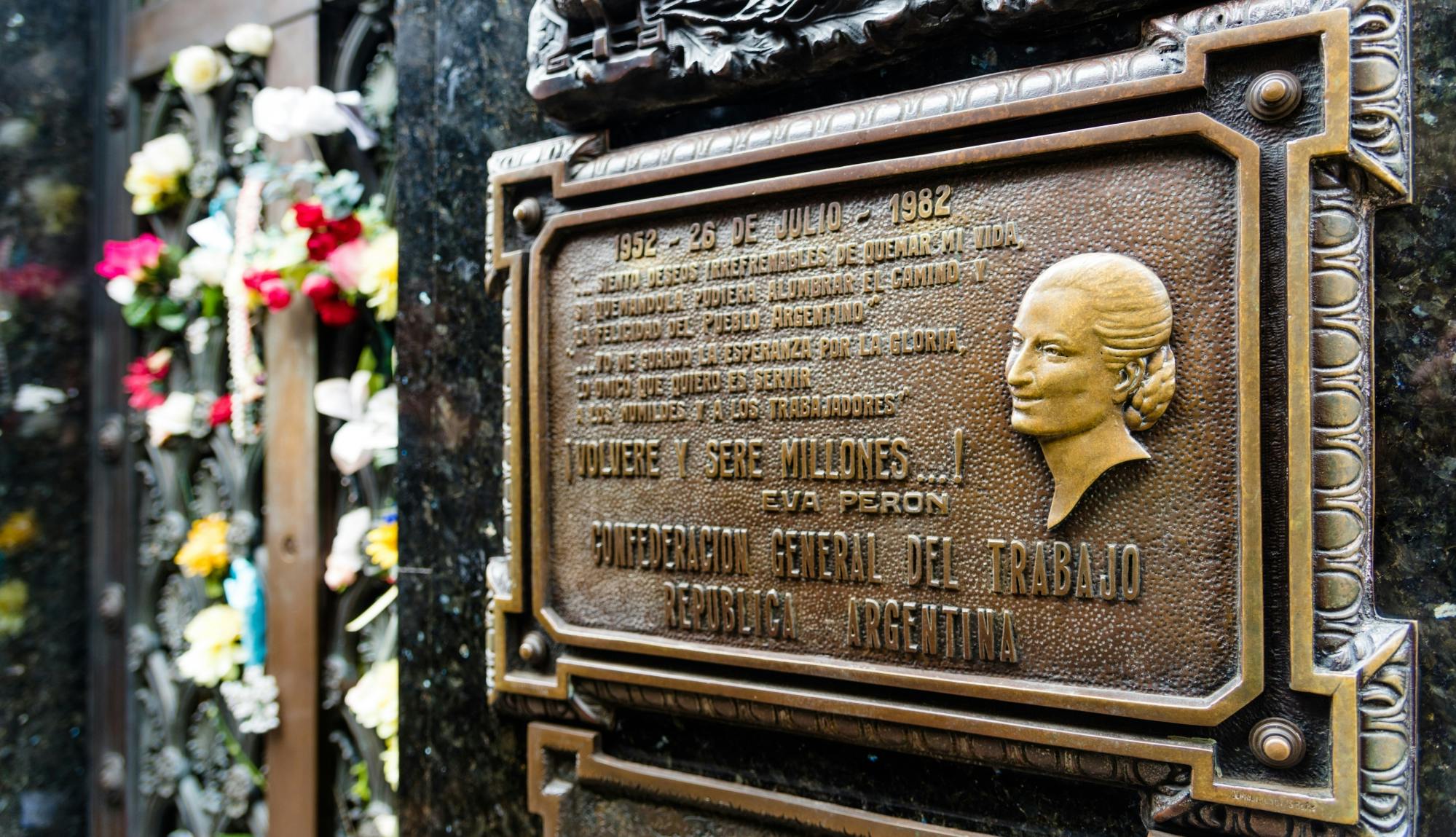
Evita is buried in the Duarte family mausoleum at Recoleta Cemetery.
The tomb is modest compared with some of the enormous monuments surrounding it. It is also one of the most visited places in the cemetery.
Visitors should remember that Recoleta remains an active cemetery and behave respectfully.
Plaza de Mayo
Plaza de Mayo was the central stage of Peronist political life. Workers gathered here on 17 October 1945, and Eva later addressed enormous crowds from the Casa Rosada.
The square remains one of the most important political spaces in Argentina.
Casa Rosada
The presidential palace is closely connected with the public memory of Juan and Eva Perón.
The famous balcony is associated with Peronist rallies, although popular culture sometimes combines or recreates events that occurred on different dates.
The Casa Rosada complex includes historical exhibition spaces, but visitor access and displays can change. Check official information before planning an interior visit.
The Evita Portraits on Avenida 9 de Julio
Large steel portraits of Evita are mounted high on the landmark former Ministry of Public Works building beside Avenida 9 de Julio.
One image shows her speaking into a microphone. The portraits are visible from a considerable distance and demonstrate how strongly her image remains embedded in the visual identity of Buenos Aires.
Buenos Aires City Legislature
The building of the city legislature is connected with the work of the Eva Perón Foundation, which used offices there during the height of its operations.
Interior access may depend on official tours and government schedules.
A One-Day Evita History Itinerary
Morning: Plaza de Mayo
Begin in Plaza de Mayo and view the Casa Rosada. This provides the political setting for the events of October 1945 and the mass rallies of the first Peronist government.
Late Morning: Avenida 9 de Julio
Walk or take public transport towards Avenida 9 de Julio to see the monumental steel portraits of Evita.
Early Afternoon: Recoleta Cemetery
Continue to Recoleta and visit the Duarte family tomb. Allow time to explore the cemetery’s architecture and the tombs of other important Argentine figures.
Late Afternoon: Museo Evita
Finish at the Museo Evita in Palermo. The museum provides the personal objects and historical interpretation needed to place the day’s locations in context.
The journey between Recoleta and Palermo is easiest by taxi, rideshare, bus or a combination of walking and public transport.
Frequently Asked Questions About Evita and Peronism
Was Evita ever president of Argentina?
No. Eva Perón was never president and never held elected office.
Was Evita vice-president?
No. She was proposed as Juan Perón’s vice-presidential running mate in 1951 but did not stand.
Why was she called Evita?
Evita is an affectionate diminutive of Eva. The name helped present her as close to ordinary people rather than as a distant official figure.
What is Peronism?
Peronism is an Argentine political movement created around Juan and Eva Perón. It traditionally emphasises social justice, organised labour, economic nationalism, political sovereignty and strong leadership.
Is Peronism left-wing or right-wing?
It has included both left-wing and right-wing factions. Different Peronist governments have followed sharply different economic and social policies.
What does Justicialism mean?
Justicialism is the formal name of Peronist doctrine. The term is derived from the concept of social justice.
Who were the descamisados?
The descamisados were the working-class supporters of Perón. The word literally means “shirtless ones.”
Did Evita give women the right to vote?
Evita was a major advocate for the 1947 women’s suffrage law, but the campaign for women’s political rights had begun decades earlier through the work of Argentine feminists and reformers.
What did the Eva Perón Foundation do?
It funded hospitals, schools, housing, homes, holiday centres and direct assistance. It distributed money, clothing, medicine, equipment and household goods to people in need.
Why was Evita controversial?
She was associated with meaningful social reform and help for poor families, but also with aggressive political rhetoric, personalistic government, disputed Foundation finances and an administration that restricted opposition.
How did Evita die?
She died from cervical cancer on 26 July 1952 at the age of 33.
Why was her body hidden?
After Perón was overthrown in 1955, the military authorities feared that her embalmed body would become a rallying point for Peronist resistance.
Where is Evita buried?
She is buried in the Duarte family tomb in Recoleta Cemetery in Buenos Aires.
Did Evita write “Don’t Cry for Me Argentina”?
No. The song was written for the musical Evita by Andrew Lloyd Webber and Tim Rice.
Is the musical historically accurate?
It is a dramatic interpretation rather than a complete documentary account. It captures aspects of her public image but simplifies Argentina’s political history.
Does Peronism still exist?
Yes. Peronism remains one of Argentina’s principal political traditions, although its parties, leaders and policies have changed considerably over time.
Final Thoughts
Evita cannot be understood simply as a saint, a dictator’s wife, a glamorous actress or the heroine of a musical. She was a skilled communicator, a powerful political organiser and the emotional centre of a movement that transformed Argentine society.
Her work helped give women a greater role in national politics and brought assistance to many families who had previously been ignored. At the same time, her power existed within a government that increasingly restricted criticism and concentrated authority around its leaders.
Peronism survived because it gave millions of workers a lasting sense of political identity. It also survived because it proved flexible enough to contain competing ideas and leaders.
More than seventy years after Evita’s death, Argentina continues to debate what she represented. That disagreement is not separate from her legacy. It is the reason her legacy remains so powerful.
Sponsored Popular Items
Quick take: Musement.com offers a worldwide selection of tours and attractions
Tickets to 'Evita' Starring Rachel Zegler on Broadway Best deals for Tickets to 'Evita' Starring Rachel Zegler on Broadway. See Rachel Zegler in 'Evita' on Broadway. Experience Tim Rice and Andrew Lloyd Webber's musical about Eva Perón with iconic songs and powerful storytelling. Available from musement.com.
Evita & Peronism Private Tour in Buenos Aires Argentina Evita and Peronism Private Tour in Buenos Aires: Museum, Casa Rosada and Recoleta Cemetery is a convenient way to add structure, local context and purposeful sightseeing to the itinerary. Evita and Peronism Private Tour in Buenos Aires: Museum, Casa Rosada and Recoleta Cemetery: experience overview Few political figures are as closely associated with Buenos Aires as María Eva Duarte de Perón, better known as Evita. Her life, public image, charitable work, political influence and early death continue to inspire admiration, criticism and intense debate throughout Argentina. This makes the experience a useful option when planning time in Buenos Aires. The…
Evita and Borges Buenos Aires legends Guided Tour – Art & Culture Experience Evita and Borges Buenos Aires legends guided tour adds structure, local context and purposeful sightseeing to the itinerary. Evita and Borges Buenos Aires legends guided tour: experience overview Visit the International Jorge Luis Borges Foundation to discover his literary legacy and explore the Evita Museum to learn more about this international icon. This makes the experience a useful option when planning time in Buenos Aires. The exact duration can depend on the selected date, option or operating schedule. Routes, start times, inclusions and meeting arrangements may vary, so the current booking page should be treated as the final source of…