Home » History & Architecture » Private Thai Floral Artisan Tour with Market and Temple Visit – Local Culture Experience
Private Thai Floral Artisan Tour with Market and Temple Visit – Local Culture Experience
$183.00
The private tour includes hands-on lotus folding and a 60-minute Thai flower-garland workshop led by local artisans. Check current availability, inclusions and booking details before you go.
The private tour includes hands-on lotus folding and a 60-minute Thai flower-garland workshop led by local artisans.
This private Bangkok experience combines a busy flower-market walk, two hands-on floral activities, a royal Buddhist temple and the historic Kudi Chin riverside community. Rather than concentrating only on major monuments, the tour explores the everyday craftsmanship and multicultural neighbourhoods that have shaped life beside the Chao Phraya River.
Musement lists the experience as a four-hour English-language private tour with an air-conditioned vehicle, hotel pickup and drop-off in central Bangkok, all entry fees, a private guide and travel insurance. The practical highlights are a lotus-folding session with a market vendor and a 60-minute workshop in which participants make a traditional Thai flower garland.
The route also visits Wat Kalayanamit Woramahawihan, an important royal temple with strong Thai-Chinese connections, and Baan Kudichin Museum, which presents the history of Bangkok’s long-established Thai-Portuguese community. The museum is closed on Mondays, and the listing does not state exactly how that part of the itinerary is replaced on Monday departures.
The Private Thai Floral Artisan Tour with Market and Temple Visit is supplied by Thailand Insight Travel. It is designed as a private cultural experience rather than a large-group city tour.
The excursion begins with a walk through Bangkok’s flower-market area, where fresh lotus buds, jasmine, roses, orchids, marigolds and prepared garlands are sold to temples, hotels, florists, households and individual worshippers.
A local vendor demonstrates how lotus petals are folded to transform a closed bud into a decorative offering. The route then crosses into the historic Thonburi side of the river to visit Wat Kalayanamit and the Kudi Chin neighbourhood.
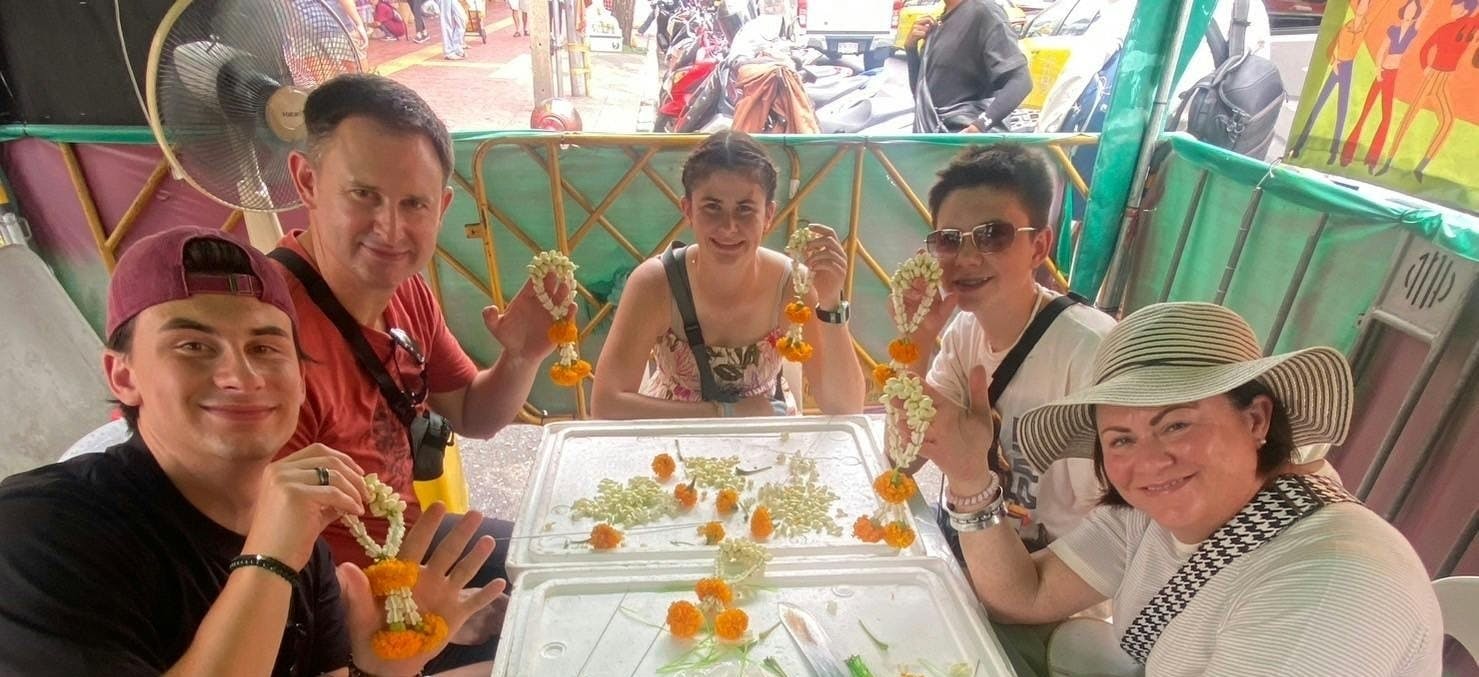
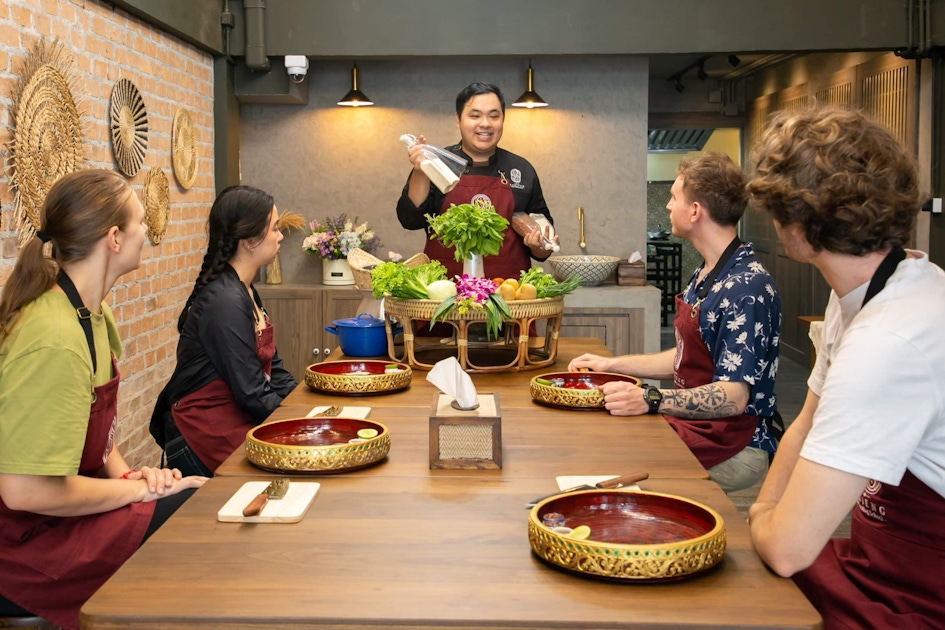
The final practical activity is a one-hour garland-making workshop led by local floral artisans. Musement describes the technique as requiring participants to thread numerous jasmine flowers carefully while keeping the pattern aligned.
The tour also has a community-support element. The product description explains that local artisans earn income by teaching their craft while gaining experience communicating with overseas visitors.
Quick facts
Experience
Private Thai floral artisan tour with market and temple visit
City
Bangkok, Thailand
Duration
4 hours
Tour format
Private guided tour
Language
English
Transport
Private air-conditioned vehicle
Pickup
Included from hotels in downtown Bangkok
Alternative meeting point
Café Amazon in front of Rajini School near MRT Sanam Chai
Main activities
Flower-market walk, lotus folding and a 60-minute Thai garland workshop
Cultural stops
Wat Kalayanamit and Baan Kudichin Museum
Monday restriction
Baan Kudichin Museum is closed on Mondays
Entrance fees
Included
Insurance
Health/travel insurance included
Food and drinks
Not included
Accessibility
Not wheelchair or stroller accessible
Mobility warning
Not recommended for people with back problems or walking difficulty
Infant seats
Unavailable; infants must sit on an adult’s lap during transfers
Voucher
Mobile and electronic vouchers accepted
Provider
Thailand Insight Travel
Starting price shown
From US$186 when checked on 23 June 2026; confirm whether the displayed amount is per person or per private booking
Cancellation policy
100% refund when cancelled up to 24 hours before the experience begins
Booking fee
No additional booking fee shown
Advertised itinerary
The order below reflects the Musement description, but the guide may alter the sequence because of traffic, temple activity, workshop availability or the Monday closure of Baan Kudichin Museum.
1. Hotel pickup or central meeting point
Travellers staying in downtown Bangkok are collected from their hotel. Guests outside the pickup area meet the guide near Rajini School, close to Sanam Chai MRT station and the flower-market district.
2. Flower-market walk
The guide leads a walk past wholesalers and retail vendors selling cut flowers, loose blossoms, lotus buds and finished ceremonial arrangements.
3. Lotus-folding lesson
A local vendor demonstrates a traditional technique for folding the outer petals of a lotus bud into a symmetrical decorative form.
4. Wat Kalayanamit
The tour continues to the riverside temple, where the guide explains the large Buddha image, royal-temple status and the site’s Thai-Chinese religious connections.
5. Baan Kudichin Museum
When open, the museum introduces the Thai-Portuguese history of the Kudi Chin community through photographs, domestic objects, family stories and cultural displays.
6. Thai garland-making workshop
The final workshop lasts approximately 60 minutes and involves arranging and threading small fresh flowers into a traditional Thai garland.
7. Return transfer
The private vehicle returns participants to their eligible downtown hotel or the agreed finishing point.
Bangkok’s flower-market district
Bangkok’s principal wholesale flower market is Pak Khlong Talat, close to the Chao Phraya River, Memorial Bridge and MRT Sanam Chai. The Musement itinerary refers generally to a bustling flower market, while its alternative meeting point is described as being only a short walk from the Flower Market.
Pak Khlong Talat supplies flowers to temples, event decorators, restaurants, hotels, shops and households across the city. Bangkok’s municipal information describes it as Thailand’s largest wholesale flower market.
Stalls display loose jasmine buds, marigolds, roses, orchids, lotus flowers, chrysanthemums, decorative leaves and completed garlands. Availability changes with the season and the time of day.
The market is a working commercial area rather than a staged tourist attraction. Trolleys, motorcycles, boxes, melting ice, water and flower waste can make the aisles busy and slippery.
Visitors should remain close to the guide, avoid blocking vendors and ask before taking close-up portraits. The purpose of the stop is to see the supply chain and meet a local artisan, not simply to browse souvenir stalls.
Lotus-folding workshop
Lotus buds are widely used in Thai Buddhist offerings. The flower is associated with spiritual purity and the idea of beauty emerging from difficult conditions.
In the workshop, the vendor folds the outer petals back one by one to expose the lighter inner layers and create a geometric floral form. Several folding styles exist, and the exact pattern taught can depend on the artisan and the condition of the flowers.
The activity requires gentle pressure. Lotus petals can tear if pulled too sharply, while a bud that is too open or too dry is harder to shape neatly.
No previous craft experience is required. The guide and vendor demonstrate the process, and the private format allows participants to work at their own pace.
The completed lotus can be understood as a cultural craft exercise. Ask the guide whether it is intended to be placed as an offering, retained during the tour or taken away.
Thai flower-garland workshop
The main workshop lasts approximately one hour. Participants learn to assemble a Thai floral garland, often called a phuang malai.
Musement describes the process as threading numerous jasmine flowers onto a skewer while maintaining the sequence and shape. The work looks simple from a distance but requires concentration, even spacing and careful handling of delicate buds.
Garlands can incorporate jasmine, marigold, crown flowers, roses, orchids, folded leaves and hanging floral tassels. The precise materials used on this tour will depend on market supply and the workshop design for that day.
The artisan may prepare some components before the session so visitors can complete a recognisable garland within the available time. More elaborate professional garlands can take considerably longer.
The product description does not explicitly state whether the finished garland is packaged to take away. Most participants will naturally expect to keep their work, but this should be confirmed with the guide.
Thai floral traditions and symbolism
Fresh flowers form part of everyday religious, social and ceremonial life in Thailand. Garlands may be presented at shrines and temples, offered to respected people, used during family ceremonies or placed in vehicles and businesses as expressions of respect and blessing.
Jasmine is closely associated with purity, affection and respect. Jasmine garlands are also linked with Mother’s Day and family blessings in Thailand.
Marigolds are valued for their vivid colour and are commonly seen in offerings and decorative garlands. Lotus flowers have strong Buddhist associations, while roses and orchids add colour and structure to contemporary designs.
The meaning of a garland depends on its form, materials and setting. Visitors should avoid treating religious offerings as simple costume accessories or comic props.
This tour’s strength is that it connects the finished floral object with the vendors, artisans, temple traditions and neighbourhoods that give it meaning.
Wat Kalayanamit Woramahawihan
Wat Kalayanamit Woramahawihan stands on the Thonburi bank of the Chao Phraya River. It is a second-class royal temple and one of the principal religious landmarks in the Kudi Chin area.
The temple was established during the reign of King Rama III by Chao Phraya Nikonbodin, also known as To Kalayanamit. Its architecture and devotional life reflect the long relationship between Thai and Chinese communities in this part of Bangkok.
The main sanctuary houses a monumental seated Buddha image known formally as Phra Buddha Trai Rattananayok and popularly as Luang Pho To or Sam Po Kong. The image is comparable in style and devotional importance to the large Buddha at Wat Phanan Choeng in Ayutthaya.
Visitors may hear bells, chanting or religious ceremonies during the stop. The site is an active temple rather than a museum, so worshippers should be given space.
Shoes must be removed before entering relevant interiors. Sit with feet directed away from Buddha images and monks, speak quietly and follow the guide’s instructions.
Kudi Chin community
Kudi Chin is a historic riverside neighbourhood in Thonburi. Its name is also written Kudeejeen, Kudichin or Kadi Chin.
The community developed after the establishment of Thonburi as the Siamese capital in the late 18th century. Portuguese-descended Catholics settled in the area, alongside Thai Buddhists, Chinese residents and Muslim communities.
This mixture of faiths and family histories remains visible in nearby temples, shrines, mosques, Santa Cruz Church, food traditions and the narrow residential lanes.
The Musement tour concentrates on Wat Kalayanamit and Baan Kudichin Museum. It does not explicitly promise entry to Santa Cruz Church, Kian Un Keng Shrine or other community landmarks.
The neighbourhood is residential. Keep noise low, avoid photographing inside homes and leave passage space in narrow alleys.
Baan Kudichin Museum
Baan Kudichin Museum occupies a restored house in the Kudi Chin community. It presents the history of Siamese-Portuguese families and their contribution to Bangkok’s multicultural development.
Displays include old photographs, household objects, maps, religious material, family histories and information about links between Portugal and Thailand.
The museum also explains aspects of local food and language. Portuguese influence can be traced in certain Thai sweets, loanwords and Catholic traditions maintained within the community.
The official museum website lists opening from Tuesday to Sunday, 9:30 am to 5:30 pm, with Monday closed. Opening hours can change for holidays or community events.
The museum is relatively small and personal rather than a large institutional collection. Its value lies in connecting broad national history with the stories of families who lived in the neighbourhood.
What happens on Mondays?
Musement clearly notes that Baan Kudichin Museum is closed on Mondays. The public product page does not explain whether Monday tours omit the museum, view it only from outside or substitute another nearby stop.
Anyone booking a Monday departure should contact the provider before payment and ask for the exact replacement itinerary.
The flower-market, lotus-folding, temple and garland-workshop components may still operate, but this should not be taken as a guarantee that every other part remains unchanged.
Travellers primarily interested in Thai-Portuguese history should choose a Tuesday-to-Sunday departure when possible.
What is included and not included
Included
Private English-speaking tour guide
Guided walking tour
Private air-conditioned vehicle
Hotel pickup and drop-off in downtown Bangkok
Lotus-folding activity
Approximately 60-minute Thai flower-garland workshop
Wat Kalayanamit visit
Baan Kudichin Museum visit when open
All entry fees
Health/travel insurance
Mobile-voucher acceptance
Instant confirmation
Not included
Food
Drinks
Pickup outside the stated downtown service area unless separately arranged
Infant car seats
Optional purchases from market vendors or local shops
Optional gratuities
The listing says all entry fees are included, but does not itemise the cost of each workshop or attraction. Retain the voucher in case clarification is needed on the day.
Hotel pickup and alternative meeting point
Pickup and drop-off are included for hotels in downtown Bangkok. After booking, travellers must email the local operator with the full names of all participants and the hotel name and location.
The Musement page does not publish a map defining “downtown Bangkok.” Hotels in central areas are more likely to qualify, while airport hotels and distant suburban districts may not.
Guests outside the pickup zone are instructed to meet at Café Amazon in front of Rajini School on Maha Rat Road. This location is near MRT Sanam Chai and within walking distance of the flower market.
Be ready in the hotel lobby or at the meeting point at the tour’s start time. The mobile ticket should be available for the guide to inspect.
Bangkok traffic can alter the sequence and return time. Do not schedule a tightly timed airport transfer or evening reservation immediately after the estimated finish.
Temple dress code
Musement publishes a detailed temple dress rule and warns that visitors can be refused entry when clothing is unsuitable.
Do not wear
Sleeveless shirts or vests
Short or cropped tops
Transparent or see-through tops
A scarf placed over an otherwise sleeveless blouse as a substitute for sleeves
Very short shorts or hot pants
Torn trousers
Very tight trousers
Cycling shorts
Mini skirts
Wear a top that covers the shoulders and upper body, with loose trousers or a skirt extending below the knees. Lightweight breathable fabrics are practical in Bangkok’s climate.
Choose shoes that are easy to remove and put back on because footwear must be removed before entering temple interiors.
Walking and accessibility
Musement states that the tour is not wheelchair or stroller accessible and is not recommended for people with back problems or walking difficulty.
Likely challenges include wet market floors, uneven pavements, narrow community lanes, temple thresholds, steps and repeated entry and exit from a private vehicle.
The four-hour duration is moderate, but participants may stand for extended periods during the market and workshops.
Travellers who can walk only short distances should ask the provider for the approximate walking length and whether the vehicle can remain close to each stop.
The private format may allow some pacing flexibility, but it does not make the physical environment step-free.
Children and infants
The practical craft activities may appeal to older children who can concentrate on delicate work and follow temple etiquette.
Infant seats are not available. Musement states that infants must sit on an adult’s lap during the transfer.
This arrangement may not match every family’s safety preference or the child-restraint standard they normally use. Parents should consider this carefully before booking.
The tour is not stroller accessible, so families with very young children may need to carry them through markets and community lanes.
Flowers, needles, skewers and small workshop materials should be kept away from unsupervised young children.
Heat, rain and market conditions
Bangkok is hot and humid for much of the year. The private vehicle is air-conditioned, but the market, temple grounds and neighbourhood walking sections are not.
Wear breathable clothing, drink water and use sun protection. Food and drinks are not included, so carry water unless the provider advises otherwise.
During the rainy season, short heavy downpours can occur with little warning. A compact umbrella or lightweight rain jacket is useful.
Flower-market floors can already be wet because vendors use water and ice to keep flowers fresh. Closed shoes with non-slip soles are safer than smooth sandals.
The tour normally continues in ordinary rain, though severe flooding or traffic disruption may alter the route.
Photography and cultural etiquette
Flower markets are highly photogenic, but they are also places of work. Ask permission before photographing vendors at close range and avoid delaying transactions.
At the temple, photography may be allowed in many areas, but signs and guide instructions take priority. Do not use flash during worship or photograph people praying without permission.
Keep feet pointed away from Buddha images and monks. Do not touch religious objects or use temple platforms as casual seating.
In Kudi Chin, respect residents’ privacy. Narrow lanes pass close to homes, and not every attractive doorway or courtyard is a public attraction.
Use the finished garland respectfully. Avoid wearing a religious offering as a joke or placing it on the ground.
What to wear and bring
Temple-appropriate clothing covering shoulders and knees
Comfortable closed walking shoes with non-slip soles
A bottle of water
Sun protection
A compact umbrella or lightweight rain jacket
The mobile voucher saved offline
A charged phone or camera
A portable power bank
Personal medication
A small secure bag
Money for drinks, snacks or optional local purchases
Tissues or hand sanitiser for the workshop and market
Avoid large luggage, expensive jewellery and clothing with loose sleeves that can interfere with floral work.
Who this tour suits
Travellers interested in Thai crafts and living traditions
Visitors wanting a private cultural activity rather than a large coach tour
People who enjoy hands-on workshops
Couples, friends and families with older children
Photographers interested in markets, flowers and local neighbourhoods
Visitors curious about Bangkok’s Thai-Chinese and Thai-Portuguese heritage
Travellers who value local artisan income and community-based tourism
The tour is less suitable for travellers with significant walking difficulty, wheelchair users, families requiring a stroller or infant car seat, and anyone unwilling to follow a conservative temple dress code.
It may also be less suitable for visitors who want a full meal, a long museum visit or an extensive survey of Bangkok’s most famous royal temples.
Booking and planning tips
Avoid Monday when visiting Baan Kudichin Museum is important.
Ask the provider what replaces the museum on Monday departures.
Confirm that your hotel falls inside the downtown pickup zone.
Email all participant names and hotel details after booking.
Clarify whether the displayed private-tour price is per person or per booking.
Wear temple-compliant clothing from the start rather than relying on a scarf.
Use closed, non-slip shoes for wet market surfaces.
Bring water because food and drinks are excluded.
Tell the provider in advance about allergies or skin sensitivity to flowers.
Ask whether the finished garland can be taken away.
Allow flexibility for Bangkok traffic.
Do not rely on a stroller or infant seat being available.
Contact the provider before booking if anyone has back or mobility problems.
Cancel at least 24 hours beforehand to qualify for the stated full refund.
Frequently asked questions
How long is the Thai floral artisan tour?
Musement lists the private tour as lasting four hours.
Is the tour private?
Yes. It includes a private English-speaking guide and a private air-conditioned vehicle.
What floral activities are included?
The tour includes a lotus-folding session with a market vendor and an approximately 60-minute Thai flower-garland workshop.
Which flower market does the tour visit?
The public itinerary describes a bustling flower market without naming it. The alternative meeting point is close to Bangkok’s Pak Khlong Talat flower-market district.
What is a Thai flower garland?
A Thai garland, often called a phuang malai, is made from carefully arranged fresh flowers and is used for offerings, blessings, greetings and ceremonial decoration.
Which temple is visited?
The tour visits Wat Kalayanamit Woramahawihan, a royal temple in Thonburi with important Thai-Chinese religious connections.
Does the tour visit Baan Kudichin Museum?
Yes, when it is open. The museum is closed on Mondays.
What happens on a Monday?
Musement does not state what replaces the closed museum. Contact the provider before booking a Monday tour.
Is hotel pickup included?
Yes, for hotels in downtown Bangkok. Guests outside the service area use the alternative meeting point near Rajini School.
Where is the alternative meeting point?
It is at Café Amazon in front of Rajini School on Maha Rat Road, near Sanam Chai MRT station.
Are all entry fees included?
Yes. Musement lists all entry fees as included.
Are food and drinks included?
No. Participants should bring water or money for drinks and snacks.
Is travel insurance included?
Yes. Health/travel insurance is listed among the inclusions.
What should I wear?
Wear clothing that covers the shoulders and knees. Sleeveless, transparent, torn, extremely tight or very short clothing can result in refused temple entry.
Is the tour wheelchair accessible?
No. Musement states that the experience is not wheelchair or stroller accessible.
Is it suitable for people with back or walking problems?
No. The product specifically says it is not recommended for people with back problems or walking difficulty.
Are infant seats available?
No. Infants must sit on an adult’s lap during the transfer.
Who operates the tour?
The listed provider is Thailand Insight Travel.
How much does the tour cost?
Musement showed a starting price of US$186 when checked on 23 June 2026. Confirm the final group price and whether it is quoted per person or per booking.
What is the cancellation policy?
Musement states that a full refund is available when the booking is cancelled up to 24 hours before the experience begins.
Important: Baan Kudichin Museum is closed on Mondays, downtown pickup boundaries are not defined publicly, and the tour is not wheelchair or stroller accessible. Confirm the Monday itinerary, hotel pickup and private-tour price before payment.
Ready to book Private Thai Floral Artisan Tour with Market and Temple Visit – Local Culture Experience?
Check the supplier for current availability, pricing, inclusions and booking conditions.
Bangkok: SEA LIFE Bangkok & Madame Tussauds Entry Ticket Thailand Discover two of Bangkok's must-visit sites in one package. Dive into SEA LIFE's magical underwater world with 400+ marine species, then pose with lifelike celebrities at interactive Madame Tussauds
Bangkok: Elephant Care Experience at Bangkok Elephant Park Thailand Enjoy a meaningful day at Bangkok Elephant Park with ethical elephant care and Thai culture. Feed, bathe, and join mud spa sessions while supporting internationally recognized welfare standards
Bangkok: Floating Market and Train Market Experience Thailand Experience a touristy but unique moment. Ride a train through a market, cruise the canals, and discover rural Thailand where tradition meets tourism with an English-speaking guide and audio guide in 28 languages
Bangkok: Forest Cafe & Handsome Show Show Evening Tour Thailand Escape the city for an afternoon at one of Thailand's most Instagram-worthy cafés, then head back to Bangkok to enjoy a dazzling male revue show, and end at Jodd Fair
From Bangkok: Lopburi Monkeys and Ayutthaya Day Trip Thailand Explore the ancient cities of Ayutthaya and Lopburi on a day trip from Bangkok. Visit historic temples, see the famous monkey temple, and learn about the history of the Ayutthaya Kingdom
Laem Chabang: Private Bangkok city & Tuk-Tuk Tour with Guide Thailand Discover Bangkok on a private shore excursion from Laem Chabang. Explore Mahanakhon, Sampeng Market and Chinatown with a guide, and experience the city aboard a traditional tuk-tuk
Laem Chabang: Bangkok Shopping Extravaganza Tour with Guide Thailand Shop your way through Bangkok on a private shore excursion with a guide. Explore Indra Market and Platinum Fashion Mall, visit Gems Gallery, and enjoy lunch with city views at Baiyoke Tower