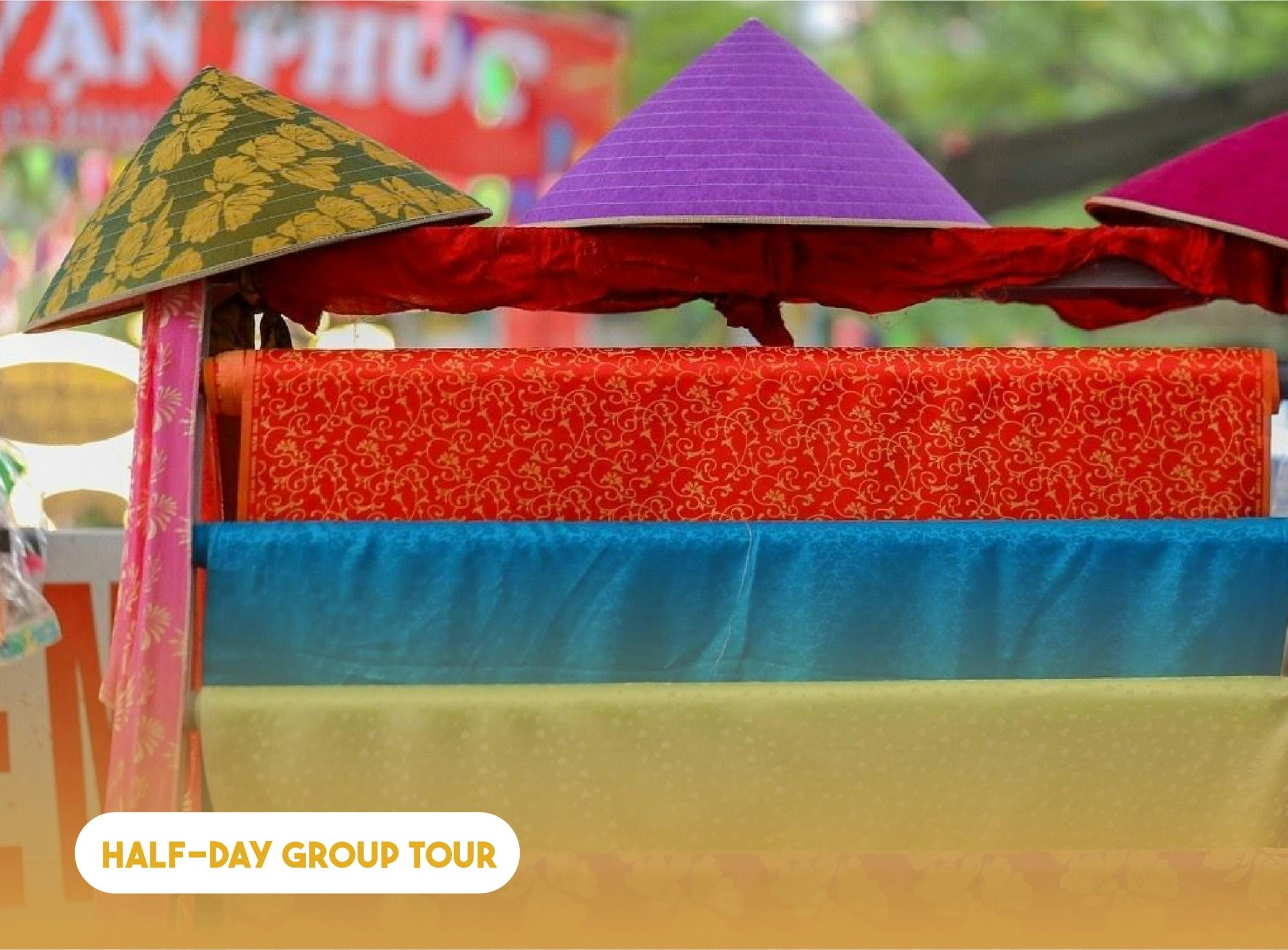
A Silk and Bamboo Villages tour from Hanoi provides an opportunity to leave the busy city centre and meet artisans preserving two of northern Vietnam’s best-known traditional crafts. The experience combines Vạn Phúc Silk Village, famous for weaving fine Vietnamese silk, with Phú Vinh Bamboo and Rattan Village, where craftspeople transform natural fibres into baskets, furniture, decorative pieces and intricate works of art.
Rather than simply shopping for handicrafts, a guided tour allows visitors to watch the production process, learn how the traditions developed and, at Phú Vinh, try some basic bamboo or rattan weaving themselves.
A current 2026 organised experience from Hanoi lasts approximately five hours, includes transport, entrance fees, an English-speaking local guide and bottled water, and currently starts from approximately US$97 per person.
Silk and Bamboo Villages Tour at a Glance
Tour Information
Details
Starting city
Hanoi
Main villages
Vạn Phúc Silk Village and Phú Vinh Bamboo & Rattan Village
Current tour duration
Approximately 5 hours
Current starting price
Approximately US$97
Language
English
Transport
Included on the current organised tour
Entrance fees
Included
Bottled water
Included
Food
Not included
Hotel pickup
Not included on the current Musement-listed tour
Meeting point
Tràng Tiền Plaza, central Hanoi
Hands-on activity
Bamboo and rattan weaving at Phú Vinh
Best for
Traditional crafts, culture, photography, shopping and artisan experiences
Why Visit Hanoi’s Traditional Craft Villages?
Hanoi is surrounded by communities that developed highly specialised crafts over generations. Individual villages became associated with products such as ceramics, silk, embroidery, conical hats, lacquerware, bamboo and rattan weaving.
Visiting one of these communities gives a different perspective on Vietnamese culture from exploring monuments and museums in central Hanoi.
You can see:
Traditional wooden looms in operation
Silk threads becoming patterned fabric
Bamboo and rattan being prepared for weaving
Artisans using skills inherited through generations
Traditional designs alongside contemporary products
Working craft communities rather than museum reconstructions
The combined Silk and Bamboo Villages tour concentrates on two contrasting materials: delicate silk at Vạn Phúc and strong natural bamboo and rattan at Phú Vinh.
Vạn Phúc Silk Village
Vạn Phúc Silk Village lies beside the Nhuệ River in Hà Đông, around 10 kilometres from central Hanoi.
Vietnam’s national tourism authority describes Vạn Phúc as one of the country’s most celebrated silk-weaving centres, with a tradition extending for more than 1,000 years.
Silk production has shaped the identity of the community for generations. While modern machinery is now used alongside older techniques, visitors can still see the relationship between traditional weaving knowledge and contemporary Vietnamese textile production.
More Than 1,000 Years of Silk Weaving
Traditional accounts associate the development of Vạn Phúc’s silk industry with the period of King Lý Thái Tổ.
Local legend tells of A La Thị Nương, a skilled woman from the old Sơn Tây region who introduced silk weaving to the community.
Over the centuries, Vạn Phúc silk became highly regarded for its quality and was associated with textiles supplied to Vietnam’s royal courts.
What Makes Vạn Phúc Silk Special?
Traditional Vạn Phúc silk is valued for characteristics including:
A smooth texture
Natural sheen
Light weight
Breathability
Durability
Detailed woven patterns
Traditional motifs can include:
Dragons and phoenixes
Lotus flowers
Cloud patterns
Seasonal motifs
Geometric designs
Modern Vạn Phúc workshops also produce contemporary colours and designs for clothing, scarves and interior decoration.
Watching Silk Being Woven
One of the main attractions of the guided tour is watching artisans working at looms.
The weaving process requires carefully controlled threads running in different directions to create a finished textile. More elaborate patterns require considerable precision because the decorative design is incorporated into the fabric rather than simply printed onto its surface.
The current half-day tour includes time walking through Vạn Phúc and observing artisans turn fine silk threads into finished material using established weaving techniques.
How Silk Becomes Fabric
The complete silk-making process involves considerably more than weaving.
Traditional production can include:
Raising silkworms
Collecting cocoons
Softening the cocoons
Reeling very fine silk filaments
Combining threads
Dyeing
Preparing the loom
Weaving
Finishing the fabric
Vạn Phúc tourism displays and workshops can introduce visitors to different parts of this process, including cocoon preparation, fibre reeling, weaving, dyeing and finishing.
Walk Through Vạn Phúc’s Silk Streets
Vạn Phúc is now both a working craft community and a visitor destination.
The village has streets containing textile workshops, showrooms and stores selling silk products.
The current organised tour includes time to explore the local market and browse items such as:
Silk scarves
Ties
Shirts
Dresses
Áo dài fabric
Shawls
Decorative textiles
Tailored clothing
Buying Silk at Vạn Phúc
Shopping is optional, but Vạn Phúc can be an interesting place to purchase Vietnamese textiles because you are visiting an established production centre rather than an ordinary souvenir market.
However, not every textile sold in a craft village should automatically be assumed to be handwoven locally or made from 100% natural silk.
If the material matters to you, ask:
Is it 100% silk?
Was it woven in Vạn Phúc?
Is the pattern woven or printed?
Can the seller explain where it was produced?
Is the quoted price for fabric by the metre or for a finished item?
A knowledgeable guide can be particularly helpful when distinguishing traditional locally produced material from the large variety of commercial textiles sold in the area.
The Vạn Phúc Silk Festival
Vạn Phúc’s craft heritage is celebrated through an annual cultural programme typically associated with November.
Activities can include:
Weaving demonstrations
Silk exhibitions
Traditional performances
Áo dài fashion presentations
Displays of local handicrafts
Festival dates and programmes can change from year to year, so travellers visiting Hanoi in November should check the current schedule before making a special trip.
From Silk to Bamboo
After exploring Vạn Phúc, the tour continues to Phú Vinh Bamboo and Rattan Village.
The contrast between the villages is one of the strengths of the excursion.
At Vạn Phúc, the emphasis is on extremely fine textile threads. At Phú Vinh, artisans work with much firmer natural materials that must first be split, smoothed and prepared before they can be woven.
Phú Vinh Bamboo and Rattan Village
Phú Vinh is in the Chương Mỹ area west of central Hanoi and has been associated with bamboo and rattan craftsmanship for more than 400 years.
According to Vietnam’s national rural-tourism authority, the craft developed around the 17th century, originally producing practical household objects.
Over time, the skills became increasingly sophisticated and artisans began producing decorative and artistic pieces alongside everyday items.
From Everyday Baskets to Works of Art
Early Phú Vinh products were practical objects used in everyday rural life, including:
Baskets
Trays
Sieves
Winnowing trays
Storage containers
Today artisans also produce:
Decorative baskets
Lamps
Furniture
Homewares
Souvenirs
Decorative panels
Complex artistic pieces
Products for export
National Intangible Cultural Heritage
Phú Vinh’s bamboo and rattan weaving received important national recognition in 2021, when the craft was inscribed as part of Vietnam’s National Intangible Cultural Heritage.
The recognition reflects not simply the finished products but also the accumulated knowledge involved in selecting, preparing and weaving natural materials.
How Bamboo and Rattan Are Prepared
Before an artisan can begin weaving, the raw material requires careful preparation.
The process can include:
Selecting bamboo or rattan of the correct age and quality
Cutting the material
Splitting it into workable lengths
Shaving the strands
Smoothing the fibres
Drying or treating the material
Dyeing when required
Sorting strands by thickness
Beginning the weaving process
Even a simple basket therefore represents far more work than may be apparent when looking at the finished product.
Watch the Artisans Work
Visitors can observe craftspeople weaving strands into increasingly complex shapes.
Patterns can incorporate traditional Vietnamese imagery, including:
Lotus flowers
Dragons
Phoenixes
Decorative geometric patterns
Stylised characters
The precision is easier to appreciate once you have attempted the process yourself.
Try Bamboo and Rattan Weaving Yourself
The current half-day tour goes beyond simply observing.
At Phú Vinh, participants take part in a hands-on weaving activity under the guidance of local craftspeople.
You learn some basic techniques and try weaving a simple piece yourself.
This is often one of the most memorable parts of the excursion because even a basic pattern demonstrates how much control is needed to keep the fibres evenly spaced and maintain the shape.
A task that looks effortless when performed by an experienced craftsperson can quickly reveal the years of practice behind the finished products.
Traditional Craft Meets Modern Design
Phú Vinh has survived partly because artisans have adapted their products to changing markets.
Traditional weaving techniques are now used for contemporary furniture, decorative objects and environmentally conscious homewares as well as classic baskets and household products.
Vietnam’s rural-tourism authority notes that artisans increasingly combine inherited techniques with contemporary design while responding to demand for products made from natural and sustainable materials.
Buying Bamboo and Rattan Products
Visitors may have opportunities to buy work directly from local producers.
Possible souvenirs include:
Small baskets
Trays
Coasters
Decorative containers
Handbags
Small ornaments
Home accessories
If you are travelling internationally, smaller products are obviously easier to pack than furniture or large decorative baskets.
Buying directly from genuine local craftspeople can also provide more direct support to the community preserving the tradition.
Current Half-Day Tour Itinerary
The exact sequence can change, but the current organised tour is structured around the two craft villages.
Meet in Central Hanoi
The current Musement-listed tour meets at:
Tràng Tiền Plaza
Hai Bà Trưng Street
Central Hanoi
Participants are asked to arrive approximately 10 minutes before departure.
Visit Vạn Phúc Silk Village
Walk through the silk village, see traditional weaving techniques and learn about the community’s long association with silk production.
There is also time to explore shops and the local textile market.
Continue to Phú Vinh
Travel onward to the bamboo and rattan weaving community.
Meet Local Craftspeople
Watch how bamboo and rattan are prepared and woven into everyday and decorative objects.
Try Weaving
Join a simple practical workshop with assistance from local artisans.
Return to Hanoi
The complete current programme lasts approximately five hours.
Current 2026 Tour Price
As of August 2026, the current US version of the tour listing advertises prices from approximately:
US$97 per person
Prices can vary according to date, availability, number of participants and whether a shared or private option is selected.
What Is Included?
The current tour includes:
Transportation during the excursion
Entrance fees
Local guide
English-language guiding
Bottled water
Visits to Vạn Phúc and Phú Vinh
Craft demonstrations
Bamboo and rattan weaving experience
What Is Not Included?
The current tour does not include:
Food
Additional drinks
Hotel pickup and drop-off
Personal purchases
Silk or bamboo souvenirs
Shared or Private Tour?
The current programme can be offered as either a shared tour or private tour.
The basic itinerary and inclusions remain similar, but the private option is reserved for your own booking party.
Choose the Shared Tour If:
You want the lower-cost option
You enjoy meeting other travellers
You do not need a flexible itinerary
Choose the Private Tour If:
You are travelling as a family or group
You want more interaction with your guide
You are particularly interested in textiles or crafts
You prefer not to travel with other participants
Important Cancellation Condition
Check the cancellation terms carefully before booking.
The current Musement listing states that this particular product is non-refundable and cannot be changed or cancelled under the provider’s present policy.
Other booking platforms may offer different conditions, so compare the exact terms before paying if flexibility is important.
What Should You Wear?
The current provider recommends comfortable clothes and comfortable shoes.
You will spend time walking through village streets and working areas, so practical footwear is preferable to formal shoes.
During hot weather, also consider:
Lightweight clothing
Hat
Sunscreen
Additional drinking water
Small umbrella or rain jacket during wet weather
Is the Tour Suitable for Children?
The combination of demonstrations and hands-on weaving can make this a more engaging cultural excursion for children than a long museum visit.
The current provider asks families travelling with children to advise them during the booking process.
Older children may particularly enjoy trying to weave bamboo and rattan.
For very young children, remember that the complete excursion lasts around five hours and includes road travel between the villages.
Accessibility
Traditional Vietnamese craft villages were not originally designed as modern tourist attractions.
Visitors may encounter:
Narrow village lanes
Uneven surfaces
Workshop thresholds
Steps
Small production spaces
If wheelchair access or limited walking is a concern, ask the tour provider about the specific vehicle, workshop entrances and toilet facilities before booking.
Photography
Both villages can be excellent places for photography.
Potential subjects include:
Traditional wooden looms
Rows of silk threads
Colourful fabric
Artisans working by hand
Bundles of bamboo and rattan
Partially completed baskets
Traditional village architecture
Always ask before taking close photographs of individual artisans or entering private workshop areas.
Should You Buy Souvenirs?
There is no obligation to buy anything, but craft villages are one of the better places to purchase souvenirs if you value knowing more about where an object was made.
Useful purchases include:
From Vạn Phúc
Silk scarves
Silk ties
Fabric
Shawls
Traditional clothing
From Phú Vinh
Small woven baskets
Trays
Decorative pieces
Natural-fibre accessories
Small household items
If you are flying home, think about size and fragility before purchasing large bamboo products.
Why a Guide Is Useful
It is possible to visit Vạn Phúc independently, but a combined guided tour has several advantages.
A guide can explain:
How the crafts developed
The difference between materials
How weaving techniques work
Which workshops participate in demonstrations
The meaning of traditional motifs
How the villages have adapted to modern markets
Transport between Vạn Phúc and Phú Vinh is also easier when already organised as part of the excursion.
Can You Visit Vạn Phúc Independently?
Yes.
Vạn Phúc is only around 10 kilometres from central Hanoi and is considerably easier to reach independently than some of the more distant craft villages.
Taxi or ride-hailing transport can be practical if your main interest is simply exploring the silk village and shopping.
A dedicated Vạn Phúc-only excursion may also suit travellers who have little interest in bamboo weaving.
Why the Combined Tour Is Better for Craft Enthusiasts
Visiting both communities illustrates how different materials lead to completely different skills.
At Vạn Phúc you see artisans handling very fine textile threads and controlling complex looms.
At Phú Vinh you see craftsmen shaping tougher natural fibres by splitting, smoothing and interlacing them.
The two traditions therefore complement each other rather than feeling repetitive.
Best Time of Day
A half-day departure works well because the activity does not require an entire day away from Hanoi.
A morning excursion allows you to return to the city for late-afternoon sightseeing and dinner.
An afternoon tour can be useful if you want to spend the morning visiting central Hanoi attractions.
Actual starting times depend on the tour date, so check availability when booking.
Best Time of Year
The villages can be visited throughout the year.
October to April
Generally more comfortable for outdoor walking because conditions are often cooler than during the height of summer.
May to September
Expect greater heat, humidity and periods of heavy rain.
The workshops themselves provide some shelter, but you will still walk outdoors between different areas.
November
Can be particularly interesting at Vạn Phúc because of cultural events associated with the village’s annual silk celebrations, although dates vary each year.
Combine the Tour With Hanoi’s Old Quarter
Because the tour begins and ends in central Hanoi, it can easily be combined with sightseeing around Hoàn Kiếm Lake and the Old Quarter.
A useful day could look like:
Morning
Explore the Old Quarter, Hoàn Kiếm Lake and surrounding streets.
Lunch
Eat in central Hanoi before meeting your tour.
Afternoon
Visit Vạn Phúc and Phú Vinh.
Evening
Return to central Hanoi for street food, a water-puppet performance or an evening walk.
Other Hanoi Craft Villages
Travellers particularly interested in traditional crafts can build a larger Hanoi itinerary around several specialist villages.
Other well-known craft traditions around Hanoi include:
Bát Tràng – ceramics
Quảng Phú Cầu – incense
Chàng Sơn – traditional fans
Chuyên Mỹ – mother-of-pearl inlay
Chương Village – conical hats
Vietnam has thousands of craft communities, and the Hanoi region remains one of the easiest places for travellers to experience several traditions during a single trip.
Silk and Bamboo Villages or Bát Tràng?
Choose Vạn Phúc and Phú Vinh If You Want:
Textile weaving
Bamboo craftsmanship
Rattan weaving
Two villages in one excursion
Hands-on weaving
Natural-fibre souvenirs
Choose Bát Tràng If You Want:
Pottery
Ceramic workshops
Painting ceramics
A larger established craft-tourism destination
If you have several days in Hanoi, the experiences are different enough to do both.
A Good Hanoi Craft Day
If traditional crafts are a major interest, dedicate an entire day to exploring them.
Morning – Vạn Phúc
Learn how silk is prepared and woven and browse the textile shops.
Late Morning – Phú Vinh
Watch bamboo and rattan craftspeople and try a simple weaving activity.
Afternoon – Return to Hanoi
Visit galleries or traditional shops around the Old Quarter.
Evening
Finish with a Vietnamese cultural performance or traditional meal.
Where to Stay
Hanoi Old Quarter
Best overall option for first-time visitors.
You remain close to restaurants, historical attractions, Hoàn Kiếm Lake and tour meeting points while using craft-village excursions as half-day trips outside the centre.
French Quarter
Particularly convenient for the current Tràng Tiền Plaza meeting point.
The area is quieter than parts of the Old Quarter and remains within easy walking distance of many central attractions.
Hà Đông
Only worth considering if Vạn Phúc is a major focus of your visit.
Most international visitors will find central Hanoi more convenient for the remainder of their sightseeing.
Practical Tips
Arrive at the meeting point 10 minutes early.
Wear comfortable shoes.
Carry some cash if you intend to buy directly from artisans.
Ask before photographing people closely.
Check whether silk is genuinely 100% silk before buying.
Choose compact bamboo souvenirs if flying home.
Do not expect every workshop to use only historic techniques. Modern equipment is part of today’s working craft economy.
Check cancellation conditions carefully.
Allow around five hours for the organised combined tour.
Is the Silk and Bamboo Villages Tour Worth Doing?
Yes, particularly for travellers who want to experience living Vietnamese craftsmanship rather than spend another half-day visiting monuments.
Vạn Phúc and Phú Vinh preserve two very different traditions.
Vạn Phúc has been associated with silk weaving for more than 1,000 years and remains one of Vietnam’s best-known silk communities. Visitors can see looms in operation, learn how silk moves from thread to finished fabric and browse products made in a village whose craft heritage stretches back through generations.
Phú Vinh adds a completely different experience. Its bamboo and rattan craft dates back more than 400 years and was recognised as National Intangible Cultural Heritage in 2021. Here, artisans transform relatively simple natural fibres into remarkably complex household and decorative objects.
The hands-on weaving element makes the combined tour particularly worthwhile. Trying even a basic pattern gives you a much better understanding of the patience and dexterity required to produce the finished pieces.
As of August 2026, the current organised experience lasts around five hours and starts at approximately US$97. Transport, entrance fees, an English-speaking local guide and bottled water are included, while meals, personal purchases and hotel pickup or drop-off are not.
For visitors staying in Hanoi, the excursion is also easy to fit into a larger itinerary. You can spend half a day among traditional looms and bamboo workshops and still return to the capital with enough time for an evening in the Old Quarter.
The real attraction is not simply seeing silk scarves and woven baskets. It is meeting the communities and observing the knowledge, precision and patience required to make them.
Sponsored Popular Items
Quick take: Musement.com offers a worldwide selection of tours and attractions
Private Transfer Between Vinh Airport and Vinh City Center - Travel Service Vietnam Private transfer between Vinh Airport and Vinh City Center is a practical option for travellers who want to simplify an important journey and reduce last-minute transport decisions. Check current availability, inclusions and booking details before you go.
Tete Batu, Waterfalls, Monkey Forest, Weaving & Bamboo Craft Indonesia Explore Lombok’s culture and countryside. Visit Sukarara, Loyok and Tetebatu. Enjoy flexible pickup and drop-off, with the option to finish in Senggigi, Mataram, Tetebatu or Kuta Lombok
From Hanoi: Conical Hat & Incense Craft Villages with Lunch Vietnam Discover Quang Phu Cau and Chuong villages on a day trip from Hanoi. Learn about incense and conical hat making, visit the Temple of Literature, and explore Hoa Lo Prison Museum
Hoi An: Bicycle Tour To Hidden Duy Vinh Island & Meet Locals Vietnam Discover the authentic countryside of Kim Tay on a guided cycling tour. Visit a mushroom farm, meet a bonsai artist, explore a local market, and learn about rice wine production
Phong Nha/Dong Hoi to Hue: Vinh Moc Tunnels & DMZ Vietnam Travel from Phong Nha to Hue with DMZ experience. Visit the historic Vinh Moc Tunnels, Hien Luong Bridge and Ben Hai River while enjoying a comfortable one-way transfer from Phong Nha to Hue
From Hue: Quang Tri DMZ Tour with Vinh Moc Tunnels & Lunch Vietnam Explore the historic war relics of Quang Tri Province on a day trip from Hue. Visit the Vinh Moc Tunnels, Quang Tri Citadel, Hien Luong Bridge, and Khe Sanh Combat Base
Hue: Half-Day DMZ Tour to Vinh Moc Tunnels by Private Car Vietnam Explore Vietnam's war history with a half-day private car tour from Hue. Visit historical sites such as Hien Luong Bridge, Ben Hai River, and the remarkable Vinh Moc Tunnels with a local guide at the sites