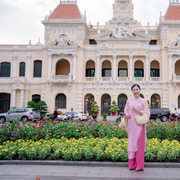
The Saigon Opera House, officially known as the Ho Chi Minh City Municipal Theatre, is one of the most elegant surviving examples of French-era architecture in Vietnam. Standing in the heart of District 1, the ornate theatre provides a striking contrast to the glass towers, luxury hotels and constant traffic of modern Ho Chi Minh City.
The theatre was completed at the beginning of the 20th century and remains a working performance venue rather than simply a historic monument. Visitors may see Vietnamese cultural productions, ballet, music, theatre and other special performances depending on the programme. :contentReference[oaicite:1]{index=1}
For international visitors, one of the easiest ways to experience the interior is to book a performance such as the acclaimed A O Show, a Vietnamese bamboo-circus production combining acrobatics, physical theatre, live music and imaginative bamboo staging. Performances are scheduled at the Opera House on selected dates rather than every day. :contentReference[oaicite:2]{index=2}
Saigon Opera House at a Glance
Visitor Information
Details
Official name
Ho Chi Minh City Municipal Theatre
Common name
Saigon Opera House
Location
Lam Son Square, District 1, Ho Chi Minh City
Construction began
1898
Opened
1 January 1900
First performance
17 January 1900
Capacity
Approximately 468 seats
National heritage status
National architectural and artistic relic
Popular visitor performance
A O Show
2026 A O Show tickets
Currently from approximately 800,000 VND
Best time to see exterior
Late afternoon and evening
Recommended performance visit
Allow around 1½–2 hours including arrival time
The theatre’s official cultural organisation states that construction began in 1898, the building was inaugurated on 1 January 1900 and the first performance took place later that month. The venue currently lists a capacity of approximately 468 spectators. :contentReference[oaicite:3]{index=3}
A Landmark From French-Era Saigon
The Opera House was constructed during a period when French colonial authorities were transforming central Saigon with broad streets, administrative buildings, hotels and European-inspired public architecture.
Its elaborate façade reflects the theatrical architectural tastes of late-19th-century France. Look closely at the building and you will notice ornamental reliefs, sculpted figures, decorative arches, classical columns and a richly decorated central entrance.
The building is particularly attractive because it occupies a prominent position at the end of one of central Ho Chi Minh City’s most important urban spaces rather than being hidden among narrow streets.
More Than 120 Years of History
The theatre has served several purposes during its long history.
It was originally created as a performance venue for colonial Saigon. During later periods of political change, its use altered considerably before it eventually returned to its role as a theatre.
The building was closed for major restoration in 1996 and reopened on 18 December 1998, coinciding with celebrations marking 300 years of Ho Chi Minh City. It was recognised as a national relic in 2012. :contentReference[oaicite:4]{index=4}
The Architecture
The Opera House is worth seeing even if you do not attend a performance.
Its symmetrical façade is dominated by a large central arch surrounded by elaborate decorative work. Sculptural details and ornamental panels give the building a distinctly European appearance.
The contrast becomes particularly noticeable when you turn around and look at the modern skyline surrounding Lam Son Square.
This mixture of historic French architecture and contemporary Asian cityscape is one of the defining characteristics of central Ho Chi Minh City.
See the Opera House After Dark
The Opera House is especially attractive in the evening.
Exterior lighting highlights the arches, columns and decorative details, while the surrounding streets become increasingly lively as restaurants, cafés and hotels fill with evening visitors.
If you are not attending a performance, late afternoon is an excellent time to arrive. Photograph the building in daylight, have dinner or a drink nearby and return after dark to see the illuminated façade.
Can You Go Inside the Saigon Opera House?
The Saigon Opera House is a working theatre, not a conventional museum with unrestricted daytime sightseeing.
The most reliable way for tourists to experience the interior is therefore to attend a scheduled performance or special event.
Do not assume that simply arriving during the day will allow you to walk through the auditorium. Access arrangements depend on rehearsals, performances and theatre operations.
Visitors primarily interested in seeing the interior should check the current performance calendar and purchase a ticket in advance.
A O Show
One of the best-known performances staged at the Saigon Opera House is the A O Show.
The production is described by its producer, Lune Production, as a form of Vietnamese Bamboo Circus. Rather than presenting a traditional Western circus, it combines:
Acrobatics
Contemporary dance
Physical theatre
Traditional Vietnamese elements
Live music
Bamboo props
Visual storytelling
The story moves between images of rural Vietnamese life and the rapid energy of modern urban Vietnam. Because the performance relies heavily on movement, music and visual storytelling, visitors do not need to understand Vietnamese to follow the experience. :contentReference[oaicite:5]{index=5}
Current 2026 A O Show Information
As of August 2026, Lune Production is continuing to schedule A O Show performances at the Saigon Opera House. Its current booking information lists performances from 17 August 2026 onward on selected dates. :contentReference[oaicite:6]{index=6}
Current ticket prices start at approximately:
800,000 VND per person
Higher-priced seating categories are also available.
Performance dates and prices can change, so check the programme for your actual travel date rather than assuming that the show operates every evening. :contentReference[oaicite:7]{index=7}
Which Seats Should You Choose?
The Opera House is relatively intimate, with only around 468 seats, so you are not dealing with the huge distances found in a modern arena. :contentReference[oaicite:8]{index=8}
For a visual production such as A O Show, a central seat provides the best overall perspective on the choreography and stage formations.
Premium seating is useful if you want to be closer to the performers, but a slightly more distant central position can sometimes give a better view of the complete stage.
How Early Should You Arrive?
For a performance, arrive approximately 30 minutes before the advertised starting time.
This gives you time to:
Find the correct entrance
Have your ticket checked
Use the facilities
Find your seat
Photograph the exterior before the performance
Avoid arriving at the last minute. Ho Chi Minh City traffic can be unpredictable, particularly during the evening rush.
What Should You Wear?
You do not generally need formal evening wear for a tourist-oriented cultural performance.
Smart casual clothing is a sensible choice.
Ho Chi Minh City is hot and humid for much of the year, but indoor air conditioning can feel cool after spending time outside, so carrying a light layer can be useful.
Photography During Performances
Performance photography and video rules depend on the production.
Do not assume that photography is allowed simply because phones are permitted inside the theatre.
Follow announcements and instructions from staff, particularly regarding flash photography and video recording.
The exterior, however, is an excellent photography subject both during the day and after dark.
Where Is the Saigon Opera House?
The Opera House stands in Lam Son Square in central District 1.
This is one of the most convenient locations for sightseeing in Ho Chi Minh City.
Vietnam’s official tourism authority recommends walking along Dong Khoi Street as a way to connect several of the city’s best-known central landmarks, including the Opera House. :contentReference[oaicite:9]{index=9}
Getting There
Walking
If you are staying in central District 1, walking is often the easiest option.
The theatre is surrounded by hotels, restaurants, shopping streets and major city attractions, making it easy to include in a walking itinerary.
Taxi or Grab
Taxi and ride-hailing services are widely available throughout Ho Chi Minh City.
Vietnam’s official tourism organisation notes that taxis are common and that travellers with mobile data can use ride-hailing services such as Grab. :contentReference[oaicite:10]{index=10}
Allow extra travel time before an evening performance because traffic can move slowly through central Ho Chi Minh City.
Walk Along Dong Khoi Street
Dong Khoi Street is one of the best streets to explore before or after visiting the Opera House.
The street connects historic architecture, hotels, shops and cafés within a compact part of central Ho Chi Minh City.
Vietnam’s national tourism authority specifically recommends Dong Khoi as a walking route for seeing central landmarks including the Opera House. :contentReference[oaicite:11]{index=11}
Visit Nguyen Hue Walking Street
The nearby Nguyen Hue Walking Street is particularly enjoyable in the evening.
The broad pedestrian boulevard becomes a major gathering place after temperatures fall, with families, couples, street performers and visitors enjoying the illuminated city centre.
A good evening plan is:
Nguyen Hue Walking Street → dinner → Saigon Opera House performance → evening drink in District 1
The historic building can be combined easily with Dong Khoi Street and the Opera House during a central Ho Chi Minh City walking tour.
Vietnam’s official tourism organisation recommends the Opera House and Central Post Office as part of the same central sightseeing area. :contentReference[oaicite:12]{index=12}
A Good Half-Day Around the Opera House
Afternoon – Explore Central District 1
Walk through the historic centre and explore the architecture surrounding Dong Khoi Street.
Late Afternoon – Opera House Photographs
Visit Lam Son Square while there is still daylight and photograph the building from several angles.
Early Evening – Dinner
Have dinner around central District 1.
Evening – Attend a Performance
Return to the theatre approximately 30 minutes before your scheduled performance.
After the Show
Walk towards Nguyen Hue and enjoy central Ho Chi Minh City after dark.
Saigon Opera House for Families
The building itself is easy to incorporate into a family sightseeing day because it is located in a very walkable part of District 1.
A visual performance such as A O Show can also work better for international children than a dialogue-heavy traditional theatre production because much of the storytelling uses movement, music and acrobatics.
Parents should check the current production’s age recommendations and ticket rules before booking.
Accessibility
The Opera House is a historic building dating from around 1900, so visitors with reduced mobility should check current access arrangements directly with the theatre or performance organiser before booking.
If stairs, wheelchair positioning or accessible seating are important, request confirmation for the specific performance and seating category rather than relying on general visitor information.
Best Time of Year to Visit
Because the main attraction is indoors, the Opera House can be visited throughout the year.
December to February
Generally one of the more comfortable periods for exploring Ho Chi Minh City on foot.
March to May
Conditions can become very hot, so an evening theatre performance provides a welcome indoor activity.
May to November
This is broadly Ho Chi Minh City’s wetter period. Vietnam Tourism describes the rainy season as extending from around May to November. :contentReference[oaicite:13]{index=13}
A performance can be an excellent evening option during the rainy season, but allow extra travelling time when heavy rain affects traffic.
Where to Stay Near the Saigon Opera House
Opera House and Dong Khoi Area
Best for first-time visitors wanting a very central location.
This part of District 1 places you within easy walking distance of the Opera House, Nguyen Hue, restaurants, shopping and several major historic landmarks.
It is particularly convenient if you enjoy exploring a city on foot and want plenty of evening dining choices close to your hotel.
Ben Thanh Area
Best for markets, food and easy access to the broader city centre.
Accommodation around Ben Thanh provides a busy, energetic atmosphere and remains close enough to reach the Opera House easily by walking, taxi or Grab.
Is It Worth Seeing the Exterior if You Are Not Attending a Show?
Yes.
The Opera House is one of the architectural highlights of central Ho Chi Minh City and can easily be included in a walking tour without purchasing a ticket.
The building is especially worth seeing twice:
Once during daylight, when the decorative façade is easiest to examine
Again after dark, when the exterior is illuminated
If you only have a short visit to Ho Chi Minh City, you can photograph the Opera House while exploring Dong Khoi and the surrounding central streets.
Is Attending a Performance Worth It?
Yes, if you want to experience more than the exterior architecture.
The key advantage of attending a performance is that it gives you a reason to enter a historic building that is otherwise not operated primarily as a daytime tourist museum.
A production such as A O Show also adds Vietnamese culture to what could otherwise be a sightseeing itinerary dominated by colonial architecture and historical museums.
Saigon Opera House or Hanoi Opera House?
Visitors travelling throughout Vietnam sometimes confuse the two.
They are separate historic theatres in different cities.
Saigon Opera House
Located in Ho Chi Minh City
Opened in 1900
Approximately 468 seats
Located in central District 1
Hosts Vietnamese cultural productions and other performances
Hanoi Opera House
Located in Hanoi
A separate French-era theatre
Considerably larger
Located in Hanoi’s French Quarter
Make sure you are booking the correct city when buying performance tickets online.
Practical Tips for Visiting
Check the performance calendar. Shows do not necessarily operate every evening.
Book popular productions ahead.
Allow for Ho Chi Minh City traffic.
Arrive around 30 minutes early for a performance.
Photograph the exterior before sunset and again after dark.
Combine the visit with Dong Khoi and Nguyen Hue.
Bring a light layer if you find air conditioning cool.
Check photography rules once inside.
Is the Saigon Opera House Worth Visiting?
Yes.
The Saigon Opera House is one of those attractions that works on two levels.
During the day it is an elegant architectural landmark that helps tell the story of French-era Saigon. After dark it becomes a living theatre, with illuminated façades outside and cultural performances taking place inside.
The building has stood in the centre of the city since 1900, has survived dramatic political and social changes and today remains an active cultural venue recognised as a national architectural and artistic relic. :contentReference[oaicite:14]{index=14}
For a quick visit, spend 15–30 minutes admiring the exterior while walking through District 1.
For the more memorable experience, book an evening performance. As of August 2026, A O Show continues to be scheduled at the Saigon Opera House on selected dates, with current tickets starting at approximately 800,000 VND. :contentReference[oaicite:15]{index=15}
Its central location also makes planning extremely easy. Combine the theatre with a walk along Dong Khoi, explore nearby central Ho Chi Minh City during the afternoon, have dinner and return to the illuminated Opera House for an evening performance.
That combination of architecture, history and live Vietnamese culture makes the Saigon Opera House one of the most rewarding evening attractions in Ho Chi Minh City.
Sponsored Popular Items
Quick take: Musement.com offers a worldwide selection of tours and attractions
Saigon Opera House and Café Tour in Ho Chi Minh City Vietnam Plan Saigon Opera House and Café Tour in Ho Chi Minh City, a guided sightseeing experience, with practical tips on timing, inclusions and what to check before booking. Compare current availability, prices and booking conditions before you go.
Ho Chi Minh City: Cu Chi Tunnels & Saigon Highlights Tour Vietnam Journey from the legendary Cu Chi Tunnels to Saigon’s iconic landmarks on a full-day adventure combining wartime history, colonial architecture, vibrant markets, culture, and local life
Sydney: Great Opera Hits Ticket at the Sydney Opera House Australia Join the stars of Opera Australia at the Sydney Opera House and listen to famous arias performed by some of Australia's finest singers. Check current availability, inclusions and booking conditions.
Ho Chi Minh City: Saigon River Boutique Cruise Vietnam Embark on a boat tour through the central district of Ho Chi Minh City as your guides show you the major landmarks of the city. Pass by Tran Hung Dao Statue, Dragon Wharf, and Bitexco Financial Tower
Ho Chi Minh City: Perfume Workshop with Scent of Saigon Vietnam Create your own signature scent in a perfume workshop in Ho Chi Minh City. Learn about fragrance families, choose your favorite notes, and take home a 15/30/50ml bottle of your custom perfume
Ho Chi Minh City: ICON Saigon Luxury Sunset Cruise Vietnam Discover Ho Chi Minh City from a new perspective on a sunset yacht cruise. Enjoy live music, cultural performances, and light refreshments as you sail along the Saigon River
Ho Chi Minh City: ICON Saigon Luxury Dinner Cruise Vietnam Cruise the Saigon River in Ho Chi Minh City and enjoy a sophisticated dinner on board. Savor a delicious fusion of Asian and European flavors for a memorable night
Ho Chi Minh City: Ao Dai Try-On Photo Experience in Saigon Vietnam Step into Vietnam’s heritage with a traditional Ao Dai fitting and photoshoot in Ho Chi Minh City. Visit iconic landmarks such as Pink Church, Central Post Office, Museum of Traditional Medicine
Ho Chi Minh : Romantic Saigon River Dinner Cruise Experience Vietnam Enjoy a delicious dinner aboard a scenic Saigon River cruise, surrounded by sparkling city lights, riverside landmarks, live entertainment, and unforgettable nighttime views of Ho Chi Minh City