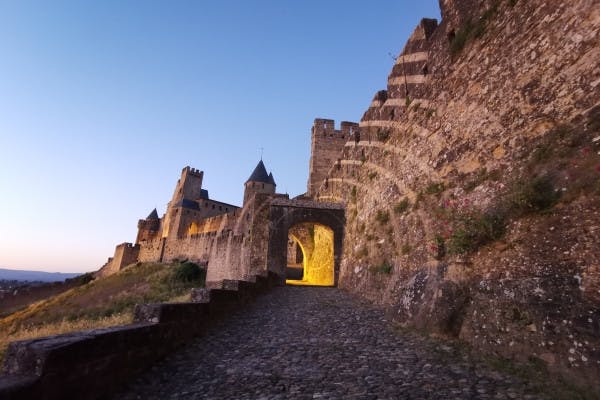
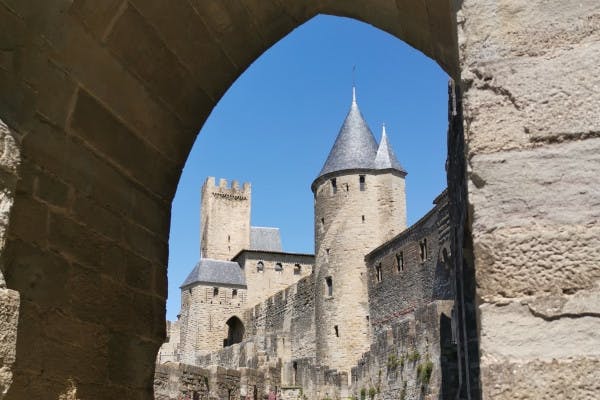
The fortified citadel of Carcassonne is one of the most recognisable medieval sights in France. Dozens of stone towers rise above the River Aude, linked by two rings of defensive walls and crowned with pointed roofs that give the city its storybook appearance.
Known in French as the Cité Médiévale de Carcassonne, the citadel is not simply a castle. It is a complete walled district containing narrow streets, houses, restaurants, shops, a basilica, gateways, courtyards and the fortified Château Comtal.
Sponsored Popular Items
Quick take: Musement.com offers a worldwide selection of tours and attractions
Carcassonne Citadel Private Night Tour France Private guided tour of the Carcassonne citadel by night is a convenient way to add structure, local context and purposeful sightseeing to the itinerary. Private guided tour of the Carcassonne citadel by night: experience overview Discover the beautiful medieval citadel of Carcassonne under the moonlight, learn about its history and see the Saint-Nazaire basilica. This makes the experience a useful option when planning time in Carcassonne. The exact duration can depend on the selected date, option or operating schedule. Routes, start times, inclusions and meeting arrangements may vary, so the current booking page should be treated as the final source…
Visitors can enter the medieval city and wander through its public streets without paying. A ticket is required only for the Count’s Castle and the sections of rampart operated as a national monument.
The distinction matters. A quick visitor may see the gates, lanes, basilica and outer fortifications for free, while a more complete visit should include the castle and rampart circuit.
This guide explains what to see, how the ticketing works, when to arrive, where to park, how to travel from the railway station and how much time to allow.
Carcassonne Citadel Quick Facts
Visitor information
Details
Official name
Cité Médiévale de Carcassonne
Location
Carcassonne, Aude, Occitanie, southern France
UNESCO status
World Heritage Site since 1997
General access
Public streets and gates are free
Paid attraction
Château Comtal and adjoining ramparts
High-season castle price
€19 for an adult ticket
Low-season castle price
€13 for an adult ticket
High-season hours
10:00 am–6:30 pm, last admission 5:30 pm
Low-season hours
9:30 am–5:00 pm, last admission 4:00 pm
Closed
1 January, 1 May and 25 December
Recommended visit
Four to six hours
Train station walk
Approximately 30 minutes
Main entrances
Porte Narbonnaise and Porte d’Aude
Best arrival time
Before 9:30 am or late afternoon
Walking conditions
Cobbles, slopes, stairs and uneven stone
Important: Ticket prices, opening hours, exhibitions and access routes can change. Confirm current information before travelling, especially during festivals, public holidays and restoration work.
What Is the Carcassonne Citadel?
Carcassonne contains two distinct urban areas.
The Cité Médiévale: The fortified hilltop city enclosed by towers and double walls.
The Bastide Saint-Louis: The later lower town on the opposite side of the River Aude.
The term “Carcassonne castle” can be misleading because the citadel is much larger than one castle.
Inside the fortifications are:
The Château Comtal.
The Basilica of Saint-Nazaire.
Houses and hotels.
Restaurants and cafés.
Small museums.
Shops.
Public streets and squares.
Historic wells and gateways.
The Château Comtal is a fortified castle within an already fortified city. Its additional walls, towers, moat and defences created a protected stronghold inside the larger enclosure.
What Is Free and What Requires a Ticket?
Free Areas
Visitors can enter the medieval city without purchasing a ticket.
Free areas normally include:
Porte Narbonnaise.
Porte d’Aude.
Public streets and squares.
The external walk around the fortifications.
Much of the space between the two wall systems.
The Basilica of Saint-Nazaire, subject to services and opening hours.
Views of the Château Comtal exterior.
Restaurants, shops and public lanes.
Paid Areas
The ticketed national monument includes:
The Château Comtal courtyards.
Interior exhibition areas.
Defensive galleries.
Selected towers.
Wall walks.
Wooden hoardings.
The lapidary collection.
Panoramic sections of the western and northern ramparts.
Visitors who only explore the free streets still see an impressive fortified town. However, the paid circuit provides the best understanding of how the defensive system worked.
A Short History of Carcassonne
Carcassonne’s strategic position explains why the site was fortified repeatedly.
The hill overlooks the River Aude and lies near historic routes connecting the Atlantic region, the Mediterranean and the Iberian Peninsula.
Pre-Roman and Roman Periods
Settlement in the area predates Roman rule.
The Romans strengthened the hilltop town during the later imperial period. Sections of the inner wall still preserve masonry and towers derived from late Roman defences.
Visigothic Carcassonne
After the decline of Roman authority, the Visigoths controlled the region and maintained the fortified site.
Carcassonne became an important stronghold between competing powers in southern Gaul and the Iberian Peninsula.
The Trencavel Period
During the Middle Ages, Carcassonne was associated with the powerful Trencavel family.
The Count’s Castle was developed during the 12th century as their residence and defensive centre.
The Albigensian Crusade
In 1209, Carcassonne was besieged during the Albigensian Crusade, the campaign directed against Cathar influence and southern lords who resisted northern French and papal authority.
Viscount Raymond-Roger Trencavel was captured, and the city came under the control of Simon de Montfort before passing eventually to the French Crown.
Royal Fortress
French royal authorities greatly strengthened Carcassonne during the 13th century.
The outer wall, royal towers and improved gateways turned the city into a major frontier fortress facing the Kingdom of Aragon.
Decline in Strategic Importance
The Treaty of the Pyrenees in 1659 moved the French frontier farther south.
Carcassonne was no longer a critical border fortress. Its military importance declined, and parts of the citadel deteriorated.
19th-Century Restoration
By the 19th century, demolition was considered for parts of the decaying walls.
A major campaign led by architect Eugène Viollet-le-Duc instead restored the fortifications and created much of the silhouette seen today.
Viollet-le-Duc and the Restoration Debate
Carcassonne’s pointed slate roofs and carefully completed towers are closely associated with Viollet-le-Duc’s restoration.
His objective was not simply to preserve every surviving fragment exactly as found. He sought to restore the monument to a coherent fortified form based on historical study and his interpretation of medieval architecture.
His decisions have been debated because:
Some tower roofs were reconstructed rather than preserved as ruins.
Slate was used where some local buildings traditionally used tile.
Missing defensive features were rebuilt.
The final appearance reflects 19th-century conservation ideas as well as medieval history.
UNESCO considers the restoration itself historically important because it influenced the development of modern architectural conservation.
Visitors should therefore view Carcassonne as both a medieval fortified city and a major 19th-century restoration project.
The Main Gates
Porte Narbonnaise
Porte Narbonnaise is the grand eastern entrance and the most commonly used gateway.
Its twin towers, drawbridge approach and defensive structures create the classic arrival experience.
The gate was developed during the period of French royal control and was designed to impress as well as defend.
Nearby is a reproduction statue associated with the legend of Dame Carcas.
Porte d’Aude
Porte d’Aude lies on the western side facing the lower town and River Aude.
The approach is steeper and more atmospheric than the main eastern entrance.
It provides excellent views of:
The outer walls.
The Château Comtal.
The lower town.
The River Aude.
Pont Vieux.
The route contains slopes and uneven stone and is less convenient for visitors carrying luggage or using wheelchairs.
Château Comtal
The Château Comtal was the residence and defensive centre of Carcassonne’s medieval rulers.
It occupies the western side of the Cité and was protected by its own walls, ditch and towers.
What You See Inside
The self-guided circuit may include:
Castle courtyards.
Stone chambers.
Roman and medieval architectural fragments.
Wall walks.
Defensive towers.
Reconstructed wooden hoardings.
Exhibitions explaining the site’s history.
Views over the Cité and lower town.
The Wooden Hoardings
Hoardings were covered wooden galleries projecting from the upper walls.
They allowed defenders to observe and attack the base of the wall while remaining partially protected.
The reconstructed examples at Carcassonne help visitors understand features that rarely survive from the Middle Ages.
How Long to Allow
A quick castle visit takes approximately one hour.
Allow 90 minutes to two hours when reading displays, using an audioguide and stopping for photographs.
Walking the Ramparts
The paid wall circuit is one of the main reasons to buy a ticket.
From the ramparts, visitors can see:
The tiled roofs within the Cité.
The Basilica of Saint-Nazaire.
The Bastide Saint-Louis.
The River Aude.
Vineyards and surrounding countryside.
The Pyrenees on exceptionally clear days.
The route includes stairs, narrow passages and exposed outdoor sections.
Strong wind, heat and rain can make the experience more tiring than the distance suggests.
North and West Ramparts
The ticketed route commonly includes wall sections linked with the castle rather than the complete perimeter of the Cité.
Different sections reveal Roman masonry, medieval reconstruction and later restoration.
The Space Between the Walls
The open area between the inner and outer defensive walls is known as the lices.
It served several defensive functions:
It created an exposed zone attackers had to cross.
It allowed defenders to move between fortifications.
It prevented enemies who breached the outer wall from immediately reaching the inner city.
It provided space for military activity.
Today, sections of the lists can be walked freely.
This is one of the best places to appreciate the scale of the double enclosure and the differences between towers.
The surface may include gravel, grass and uneven ground.
Basilica of Saint-Nazaire
The Basilica of Saint-Nazaire is the principal historic religious building inside the Cité.
It combines Romanesque and Gothic architecture and contains notable medieval stained glass.
Highlights
Romanesque nave.
Gothic transept and choir.
Medieval stained-glass windows.
Sculpture and funerary monuments.
Atmospheric stone interior.
Entry is generally free.
Visitors must respect services, prayer and temporary closures.
On Sundays, public visiting may pause during Mass.
Dogs are not permitted inside, and suitable behaviour and clothing are expected.
Exploring the Medieval Streets
The Cité contains narrow lanes, courtyards and small squares that reward slow exploration.
The most central streets can feel extremely commercial, with souvenir shops, restaurants and large tour groups.
Quieter corners can still be found by leaving the direct route between Porte Narbonnaise and the castle.
What to Look For
Stone and half-timbered façades.
Historic wells.
Small courtyards.
Views of towers between rooftops.
Old doorways and carved details.
Passages leading towards the walls.
The public streets remain inhabited and used by businesses. Visitors should avoid blocking entrances or photographing residents through windows.
The Best Views and Photography Locations
Pont Vieux
The old bridge across the River Aude provides one of the classic views of the fortified city rising above the riverbank.
Early morning and late afternoon provide softer light.
Porte d’Aude Approach
The steep western approach offers dramatic views of walls, towers and the castle.
Outside Porte Narbonnaise
The eastern entrance is best for symmetrical photographs of the twin gate towers.
The Lists
The space between the walls provides close views of towers and defensive masonry without street clutter.
Castle Ramparts
The ticketed wall route offers elevated views across rooftops, the basilica and the surrounding landscape.
Montée de la Porte d’Aude
The slopes below the citadel are especially photogenic around sunrise and sunset.
Night Photography
The walls are illuminated after sunset.
A tripod may be useful outside the Cité, but it should not obstruct paths or traffic.
Current Tickets and Opening Hours
Period
Opening hours
Last admission
Adult ticket
1 April–30 September
10:00 am–6:30 pm
5:30 pm
€19
1 October–31 March
9:30 am–5:00 pm
4:00 pm
€13
The Château Comtal and ramparts are closed on:
1 January.
1 May.
25 December.
Visitor capacity is limited, and online reservation is strongly recommended.
Purchasing in advance is particularly useful during:
July and August.
Weekends.
French school holidays.
Festival dates.
Public holidays.
Free and Reduced Admission
Current principal free-entry categories include:
Visitors under 18.
European Union citizens aged 18–25.
Non-European citizens aged 18–25 who are regular residents of France.
Visitors with qualifying disabilities and one accompanying person.
Eligible jobseekers.
Holders of specified French culture or education passes.
Proof of age, nationality, residence or eligibility is required.
Australians aged 18–25 are not automatically entitled to free entry unless they meet the French-residency condition.
Rules may differ for organised school or student groups.
Guided Tours and Audioguides
Audioguide
Audioguides are currently available in several languages, including English, French, Spanish, Italian and German.
The current published rental price is €4.
Discovery and Guided Visits
Scheduled guided options explain:
Roman fortifications.
The Trencavel dynasty.
The Albigensian Crusade.
Royal rebuilding.
Medieval defence.
Viollet-le-Duc’s restoration.
Most guided castle visits last approximately 90 minutes.
The tourist office also offers guided walking tours of the wider medieval city. Some of these explain the castle from outside and do not include paid castle admission.
Read tour inclusions carefully.
How Long Should You Spend?
Time available
Realistic experience
2 hours
Main streets, gates, basilica exterior and a quick look around the walls
3–4 hours
Castle and ramparts plus the principal free sights
5–6 hours
Complete citadel visit, lunch and photography
Full day
Citadel, Pont Vieux, Trivalle and part of the Bastide
Overnight
Quiet evening and early-morning exploration without day-trip crowds
Four to six hours is ideal for a first visit.
The Best Time to Visit
Early Morning
Arrive before the castle opens to explore the free streets and gates while they are relatively quiet.
This is the best time for photographs around Porte Narbonnaise and the lists.
Late Afternoon
Many coach groups leave during the later afternoon.
Light becomes warmer, and the public streets remain open after the castle closes.
Evening
Restaurants remain open, and the illuminated walls create a different atmosphere.
An overnight stay is the best way to experience this quieter period.
Spring
April to June offers pleasant temperatures, green surroundings and longer daylight.
Summer
July and August are hot and crowded.
Stone walls, courtyards and exposed ramparts can become extremely warm.
Autumn
September and October often provide excellent weather with fewer visitors than August.
Winter
Winter is quieter but can be cold, wet and windy.
Shorter castle hours must be considered.
Getting There by Train
Carcassonne railway station lies in the lower town near the Canal du Midi.
The walk to the medieval citadel takes approximately 30 minutes.
Walking Route
A typical route passes through or near:
The Bastide Saint-Louis.
Place Carnot or surrounding streets.
Square Gambetta.
Pont Vieux.
The Trivalle district.
The uphill approach to the Cité.
The final section is uphill.
Visitors with luggage, limited mobility or little time may prefer a bus, taxi or seasonal tourist train.
Regional Connections
Carcassonne has rail connections with cities including Toulouse, Narbonne and Montpellier.
Check current schedules and reserve long-distance services where required.
Getting There from Carcassonne Airport
Carcassonne Airport is west of the city.
An airport shuttle links arriving flights with locations including:
The medieval Cité.
Square Gambetta.
Carcassonne railway station and canal port.
Place Davilla.
The service is generally coordinated with flight arrivals rather than operating as a frequent urban bus.
Confirm the current stop and payment arrangements before flying.
Driving and Parking
Visitors cannot treat the medieval centre like a normal modern shopping district.
Vehicle access inside the Cité is controlled, and most visitors park outside the walls.
Useful Citadel Parking Areas
Municipal parking areas serving the Cité include designated facilities such as:
P0 Delteil.
P1 coach and motorhome areas.
Other signed visitor parking close to the fortifications.
Some municipal spaces can be reserved online.
Parking Advice
Follow official Cité parking signs rather than trying to reach the gate by navigation app.
Arrive before 10:00 am in summer.
Do not leave luggage visible in the vehicle.
Keep the parking ticket until departure.
Photograph the car-park name or location.
Check height restrictions when driving a motorhome or large vehicle.
Parking in the lower Bastide may be useful when combining both parts of Carcassonne.
Walking from the Lower Town
The walk from the Bastide to the Cité is one of the most enjoyable approaches.
Pont Vieux
Cross the historic bridge over the River Aude and look back towards the fortified skyline.
Trivalle District
Rue Trivalle climbs between the river and the citadel and contains cafés, small hotels and historic buildings.
Porte d’Aude or Porte Narbonnaise
Continue either:
Up the steep western route to Porte d’Aude.
Around towards the gentler and more formal Porte Narbonnaise entrance.
The Porte d’Aude approach is more dramatic but less convenient for wheelchairs, large pushchairs and heavy luggage.
Accessibility and Mobility
Carcassonne presents significant challenges because of its historic surfaces and defensive design.
Medieval City Streets
Visitors encounter:
Cobbles.
Slopes.
Uneven paving.
Narrow passages.
Crowds.
Some principal streets are manageable with assistance, but conditions are not uniformly step-free.
Castle and Ramparts
The self-guided castle route is only partially wheelchair accessible.
The complete route contains:
Numerous stairs.
Spiral staircases.
Narrow wall passages.
Sloping courtyards.
Long distances.
Visitors with reduced mobility are strongly advised to travel with a companion.
Adapted toilets and seating are available in selected castle areas.
Qualifying disabled visitors and one companion receive free admission with valid proof.
Assistance Dogs
Recognised assistance dogs are permitted within the monument.
Visiting with Children
The towers, gates and wall walks make Carcassonne highly appealing to children.
Good Family Experiences
Walking between the two walls.
Exploring the castle courtyard.
Seeing the wooden hoardings.
Looking for arrow slits and defensive features.
Walking across Pont Vieux.
Visiting after dark when the walls are illuminated.
Practical Limitations
Many stairs.
No unrestricted running on wall walks.
Hot exposed areas in summer.
Cobbles that make pushchairs difficult.
Long restaurant waits during peak lunch hours.
Pushchairs must be left in the designated castle parking area where required.
A child carrier may be more practical than a large pram.
Children should be supervised closely on battlements, stairs and busy lanes.
Food and Restaurants
The Cité contains numerous restaurants, crêperies, cafés and ice-cream shops.
Quality and value vary, and the most visible locations can be highly tourist-oriented.
Cassoulet
Carcassonne is one of the southern French cities associated with cassoulet, a slow-cooked dish based on white beans and meat.
Local versions may include:
Pork sausage.
Duck or goose.
Pork.
Mutton or partridge in some regional traditions.
Cassoulet is heavy and better suited to a relaxed lunch or evening meal than a rushed stop before climbing the ramparts.
Choosing a Restaurant
Read the displayed menu before sitting.
Check recent opening times.
Ask whether a fixed menu includes drinks.
Reserve dinner in summer.
Walk away from the busiest central street for quieter options.
The Trivalle district and Bastide Saint-Louis also contain restaurants and may offer better value.
Staying Inside the Citadel
Several hotels, guesthouses and rooms operate within the medieval walls.
Advantages
Quiet streets in the early morning.
Illuminated walls at night.
Easy access to restaurants.
No need to rush back to a coach or train.
Atmospheric views and historic surroundings.
Disadvantages
Restricted vehicle access.
Difficult luggage transfers.
Cobbles and stairs.
Tourist crowds during the day.
Potential noise near restaurants.
Higher room prices.
Ask the accommodation for precise parking and luggage instructions before arrival.
Things to See Near the Citadel
Pont Vieux
This historic bridge links the medieval city with the lower town and provides excellent views.
Bastide Saint-Louis
The lower town has a planned street grid, shops, restaurants and Place Carnot.
Canal du Midi
The UNESCO-listed canal passes near the railway station and offers boat trips and towpath walks.
Carcassonne Cathedral
Saint-Michel Cathedral stands in the Bastide and should not be confused with Saint-Nazaire inside the Cité.
Market and Local Streets
Place Carnot and the surrounding area show the everyday side of Carcassonne beyond the medieval tourist centre.
Aude Riverbanks
The riverside provides space for walking and photographs of the citadel above.
Suggested One-Day Carcassonne Itinerary
8:30 am: Arrive at the Cité
Walk around Porte Narbonnaise and the outer walls before the streets become crowded.
9:00 am: Explore the Lists
Walk between the two defensive walls and study the towers.
10:00 am: Enter Château Comtal
Use a reserved ticket and explore the castle and ramparts for approximately 90 minutes.
11:45 am: Basilica of Saint-Nazaire
Visit the Romanesque and Gothic interior, subject to services.
12:30 pm: Lunch
Choose a restaurant inside the Cité or descend towards Trivalle.
2:00 pm: Porte d’Aude
Leave by the western gate and photograph the castle and outer walls.
2:30 pm: Pont Vieux
Cross the river and look back towards the full fortified skyline.
3:00 pm: Bastide Saint-Louis
Walk through the lower town and stop at Place Carnot.
4:30 pm: Canal du Midi
Finish near the canal or return to the Cité for late-afternoon light.
Evening
Stay for dinner and see the illuminated walls when possible.
Suggested Three-Hour Visit
First 30 Minutes
Enter through Porte Narbonnaise and walk directly towards Château Comtal.
Next 90 Minutes
Visit the castle and ramparts.
Final Hour
See Saint-Nazaire Basilica, walk through quieter streets and exit through Porte d’Aude.
Skip a long restaurant lunch when travelling on a fixed train or coach schedule.
Visiting After Dark
The medieval city is illuminated every night under the current tourism arrangements.
Lighting usually continues:
From sunset until approximately 2:00 am between April and September.
From sunset until approximately midnight between October and March.
The castle interior will be closed during normal evenings, but the public streets remain accessible.
Night visits offer:
Fewer tour groups.
Atmospheric restaurants.
Illuminated towers.
Cooler summer temperatures.
Excellent photography from Pont Vieux and the riverbanks.
Is the Carcassonne Citadel Worth Visiting?
Carcassonne is highly worthwhile for visitors interested in medieval architecture, military history, photography or UNESCO sites.
Main Advantages
One of Europe’s most complete fortified-city silhouettes.
Free access to the medieval streets.
Excellent paid rampart circuit.
Roman, medieval and 19th-century history.
Easy rail access.
Good restaurants and accommodation nearby.
Impressive by day and at night.
Possible Drawbacks
Heavy summer crowds.
Commercial souvenir streets.
Hot exposed walls.
Cobbles and stairs.
Restored appearance rather than an untouched medieval ruin.
Expensive restaurants in prime locations.
The best experience comes from arriving early, buying the castle ticket, exploring beyond the busiest street and remaining until late afternoon or evening.
Frequently Asked Questions About Carcassonne Citadel
Is the Carcassonne Citadel free?
The public streets, gates, squares and most external areas are free. The Château Comtal and ticketed ramparts require admission.
How much is the castle ticket?
The current adult price is €19 from April through September and €13 from October through March.
Do I need to book?
Booking is strongly recommended because visitor capacity is limited.
What are the opening hours?
The castle opens from 10:00 am to 6:30 pm between April and September and from 9:30 am to 5:00 pm between October and March.
When is the last entry?
Last admission is one hour before closing.
Which days is the castle closed?
It closes on 1 January, 1 May and 25 December.
Is Carcassonne a real medieval city?
Yes. The site contains genuine Roman and medieval masonry, although much of its present upper silhouette was restored during the 19th century.
Why do the towers have pointed roofs?
Many were reconstructed during Viollet-le-Duc’s restoration campaign.
When did Carcassonne become a UNESCO site?
It was inscribed in 1997.
How many walls does Carcassonne have?
The fortified city has two principal defensive enclosures.
Can I walk all the way around the walls?
You can walk around much of the exterior and lists for free, but the complete upper wall circuit is not continuously open as one public route.
How long is the castle visit?
Allow 60–90 minutes, or up to two hours with an audioguide and photography stops.
How long should I spend in Carcassonne?
Four to six hours is suitable for the citadel. A full day allows time for the lower town and Pont Vieux.
Can I see Carcassonne in two hours?
Yes, but you must choose between a quick castle visit and a broader free walk through the Cité.
What is the main entrance?
Porte Narbonnaise is the principal and most convenient entrance.
Which gate has the best views?
Porte d’Aude provides the most dramatic western approach and views of the walls.
Is the Basilica of Saint-Nazaire free?
Yes, entry is normally free, subject to services and opening arrangements.
Can I attend Mass?
Religious services are held, and tourist access may pause during worship.
Can I bring a dog?
Dogs on a lead are permitted in the public streets of the medieval Cité but not inside the castle or basilica. Assistance dogs are excepted under applicable rules.
Can I take a pushchair into the castle?
Pushchair parking is provided, and the full route is not suitable for pushchairs because of stairs and narrow passages.
Are suitcases allowed?
No. Suitcases are not permitted in the castle monument.
Are there toilets?
Yes, toilets are available within the castle visitor facilities and elsewhere in the Cité.
Is the castle wheelchair accessible?
Only partly. Numerous stairs and spiral staircases prevent access to the complete route.
Do disabled visitors pay?
Qualifying disabled visitors and one companion receive free entry with valid proof.
Is Carcassonne suitable for children?
Yes. The walls, gates and castle are highly engaging, although stairs and heat can be tiring.
Is there an audioguide?
Yes. Audioguides currently cost €4 and are available in several languages, including English.
Are guided tours available?
Yes. Guided castle visits and wider medieval-city tours operate on selected dates.
Does every guided city tour include the castle?
No. Some tourist-office walking tours explain the castle from outside only.
Can I take photographs inside?
Photography is generally allowed, but flash is prohibited in the castle.
Can I picnic inside the castle?
No. Picnics are not permitted within the ticketed monument.
Can I picnic outside?
Use appropriate public spaces and remove all rubbish. Avoid blocking streets and monument entrances.
How far is the train station?
The station is approximately a 30-minute walk from the Cité.
Is the walk from the station difficult?
Most of the route is straightforward, but the final approach is uphill.
Is there a bus from the station?
Local transport options operate, and schedules should be checked through the current RTCA network.
Is there a tourist train?
A seasonal tourist train operates on selected dates between the lower town and medieval city.
Can I reach the Cité from the airport?
Yes. The airport shuttle serves the medieval city and several central stops.
Where should I park?
Follow signs for the official Cité parking areas, including the municipal visitor facilities near the walls.
Can I drive inside the medieval city?
General visitor vehicle access is restricted.
Is Carcassonne crowded?
It can be extremely crowded between late morning and mid-afternoon in summer.
What is the best time to arrive?
Before 9:30 am or during the later afternoon.
What is the best month to visit?
May, June, September and October often provide a good balance of weather and visitor numbers.
Is it hot in summer?
Yes. Temperatures on exposed stone ramparts can feel very high.
Is Carcassonne open in winter?
Yes, except for specific closure dates, but castle hours are shorter.
Can I visit after the castle closes?
Yes. The public streets of the Cité remain accessible.
Is the citadel illuminated at night?
Yes, the fortifications are illuminated nightly under the current schedule.
What is the best night viewpoint?
Pont Vieux and the River Aude banks provide excellent views.
What food should I try?
Cassoulet is the best-known regional dish.
Should I stay inside the walls?
It is worthwhile for atmosphere and quiet early-morning access, but parking and luggage handling are less convenient.
Can Carcassonne be visited from Toulouse?
Yes. Direct rail and road connections make it a practical day trip, although staying overnight allows a quieter visit.
What else is nearby?
Nearby sights include the Bastide Saint-Louis, Pont Vieux, Canal du Midi, the Aude riverbanks and the surrounding wine region.
Sponsored Popular Items
Quick take: Musement.com offers a worldwide selection of tours and attractions
Carcassonne Citadel Private Luxury Tour Private luxury tour of the Carcassonne citadel is a convenient way to add structure, local context and purposeful sightseeing to the itinerary. Private luxury tour of the Carcassonne citadel: experience overview Walk along the cobbled streets of the medieval citadel to see its military power and relive its 2600 years of history. This makes the experience a useful option when planning time in Carcassonne. The exact duration can depend on the selected date, option or operating schedule. Routes, start times, inclusions and meeting arrangements may vary, so the current booking page should be treated as the final source of operational…
Final Thoughts
Carcassonne’s citadel is more than a picturesque skyline. It contains Roman foundations, medieval fortifications, royal defences, religious architecture and one of the most influential restoration projects in European conservation history.
The public streets can be enjoyed without charge, but the Château Comtal and ramparts provide the clearest understanding of how the city functioned as a fortress.
Arrive before the main crowds, explore the space between the walls, reserve the castle in advance and leave time for Saint-Nazaire Basilica and the Porte d’Aude approach.
For the most atmospheric experience, remain until evening or stay overnight. Once the coach groups leave and the towers are illuminated, Carcassonne feels far closer to the dramatic fortified city visitors expect to find.
Sponsored Popular Items
Quick take: Musement.com offers a worldwide selection of tours and attractions
Carcassonne Citadel Private Night Tour France Private guided tour of the Carcassonne citadel by night is a convenient way to add structure, local context and purposeful sightseeing to the itinerary. Private guided tour of the Carcassonne citadel by night: experience overview Discover the beautiful medieval citadel of Carcassonne under the moonlight, learn about its history and see the Saint-Nazaire basilica. This makes the experience a useful option when planning time in Carcassonne. The exact duration can depend on the selected date, option or operating schedule. Routes, start times, inclusions and meeting arrangements may vary, so the current booking page should be treated as the final source…
Carcassonne Citadel Private Luxury Tour Private luxury tour of the Carcassonne citadel is a convenient way to add structure, local context and purposeful sightseeing to the itinerary. Private luxury tour of the Carcassonne citadel: experience overview Walk along the cobbled streets of the medieval citadel to see its military power and relive its 2600 years of history. This makes the experience a useful option when planning time in Carcassonne. The exact duration can depend on the selected date, option or operating schedule. Routes, start times, inclusions and meeting arrangements may vary, so the current booking page should be treated as the final source of operational…