A day trip from Benidorm to Guadalest replaces beaches, high-rise hotels and seafront promenades with mountain roads, medieval ruins and sweeping views across one of the Costa Blanca’s most distinctive valleys.
Officially named El Castell de Guadalest, the village occupies a rocky ridge high above the Guadalest reservoir. Whitewashed houses gather beneath the remains of an Islamic fortress, while a narrow tunnel carved through the rock controls access to the historic upper settlement.
Sponsored Popular Items
Quick take: Musement.com offers a worldwide selection of tours and attractions
Guadalest and Algar waterfalls full-day tour from Calpe Best deals for Guadalest and Algar waterfalls full-day tour from Calpe. Take in the best of the Costa Blanca with a visit to the hilltop village of Guadalest and the refreshing Algar Waterfalls. Explore Guadalest's historic streets, browse its museums or simply admire the mountain views before enjoying free time at the waterfalls, where natural pools are perfect for a refreshing dip. With return coach travel, waterfall entry and plenty of time in both locations, it's a day made for discovering at your own pace. Available from musement.com.
Guadalest is small enough to explore on foot, but it contains more than a scenic viewpoint. Visitors can walk through a historic noble house, climb to castle ruins, see an isolated bell tower, visit a surprising collection of small museums and eat traditional mountain food overlooking the valley.
The village is roughly 30 kilometres inland from Benidorm. Travelling by car usually takes around 40 to 50 minutes, depending on traffic and mountain-road conditions. Public excursion buses and organised coach tours are also available, although their schedules and the amount of free time can be restrictive.
Guadalest Day Trip Quick Facts
Visitor information
Details
Official name
El Castell de Guadalest
Location
Marina Baixa, Alicante Province, Spain
Distance from Benidorm
Roughly 30 kilometres
Driving time
Approximately 40–50 minutes
Road from Benidorm
CV-70 through La Nucía and Polop
Village elevation
Approximately 587 metres
Recommended visit
Four to six hours
Main attraction
Casa Orduña and the ruins of San José Castle
Public transport
Limited Line 16 excursion service from Benidorm
Walking difficulty
Moderate, with steep lanes, stairs and uneven stone
Best arrival time
Before 10:00 am
Best seasons
Spring and autumn
Typical combined excursion
Guadalest and Algar Waterfalls
Important: Bus schedules, museum hours, entry charges and parking arrangements can change. Check current information shortly before travelling.
Why Visit Guadalest from Benidorm?
Guadalest is one of the easiest ways to experience the mountainous interior of the Costa Blanca without travelling far from Benidorm.
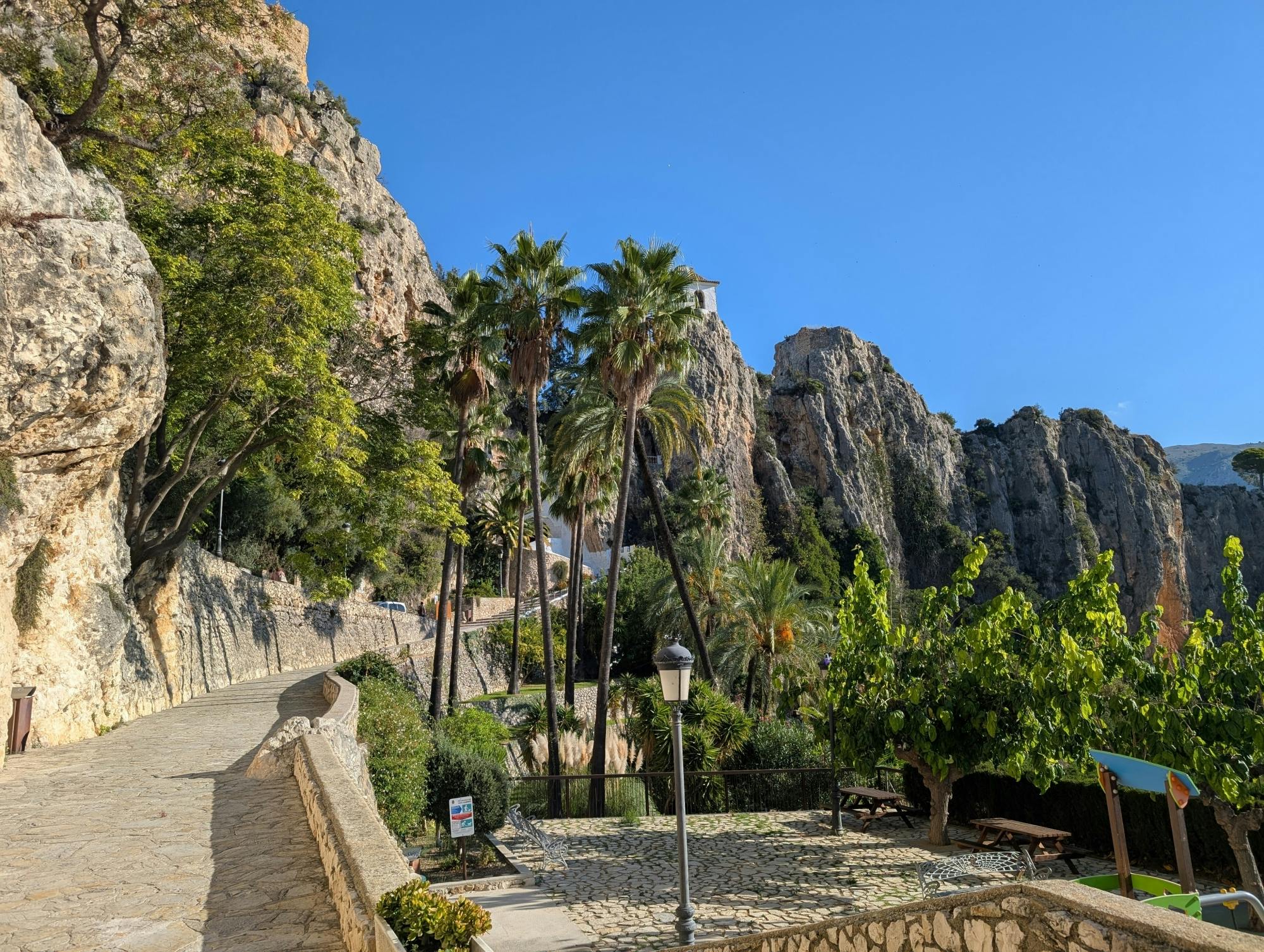
The contrast begins almost immediately. Beyond Benidorm, the road climbs through La Nucía, Polop and increasingly rugged countryside. The apartment towers disappear, replaced by citrus orchards, pine-covered slopes and grey limestone peaks.
Guadalest is particularly worthwhile for visitors interested in:
Historic villages.
Castle ruins.
Mountain scenery.
Photography.
Local food and crafts.
Small and unusual museums.
A cooler alternative to a hot day beside the coast.
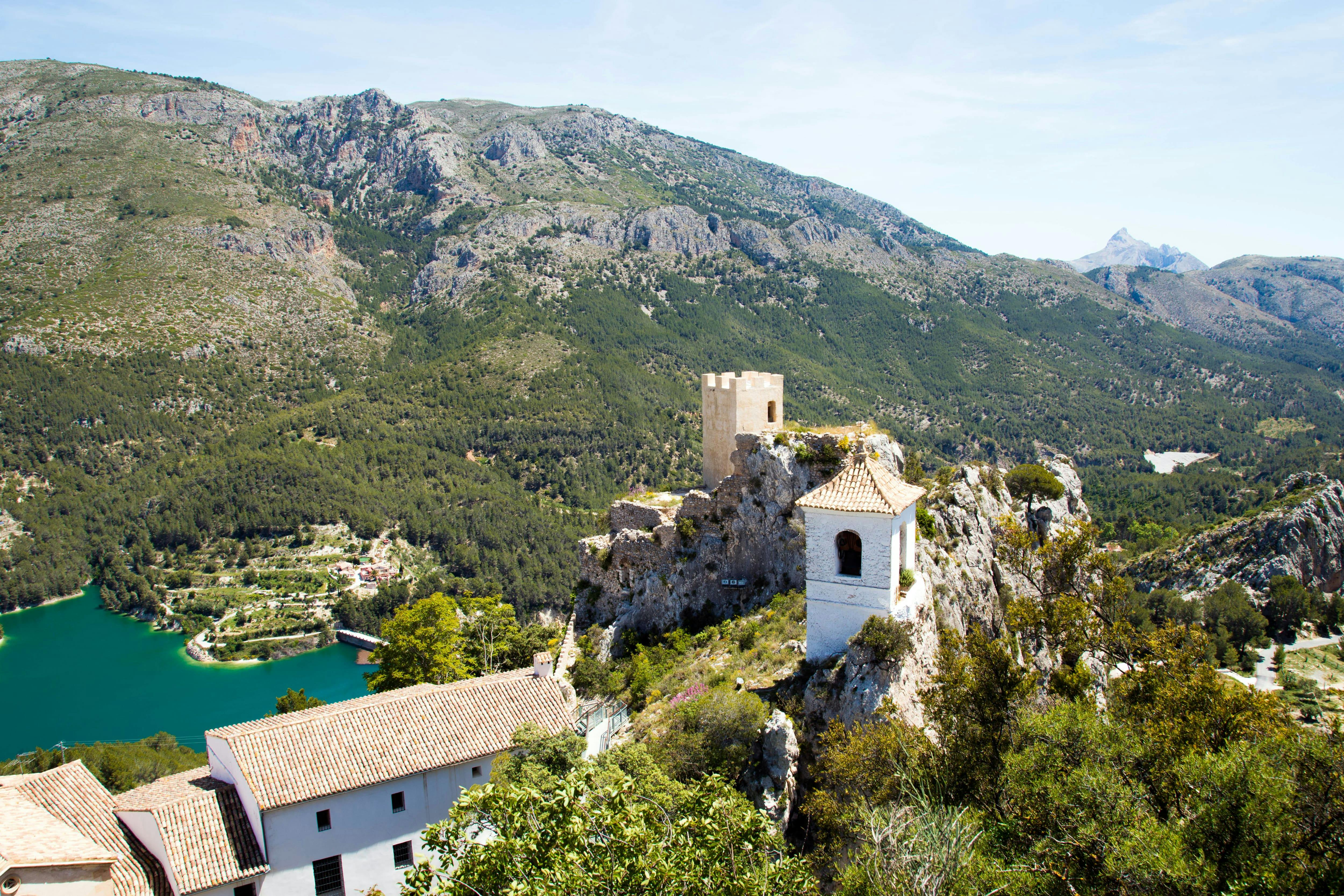
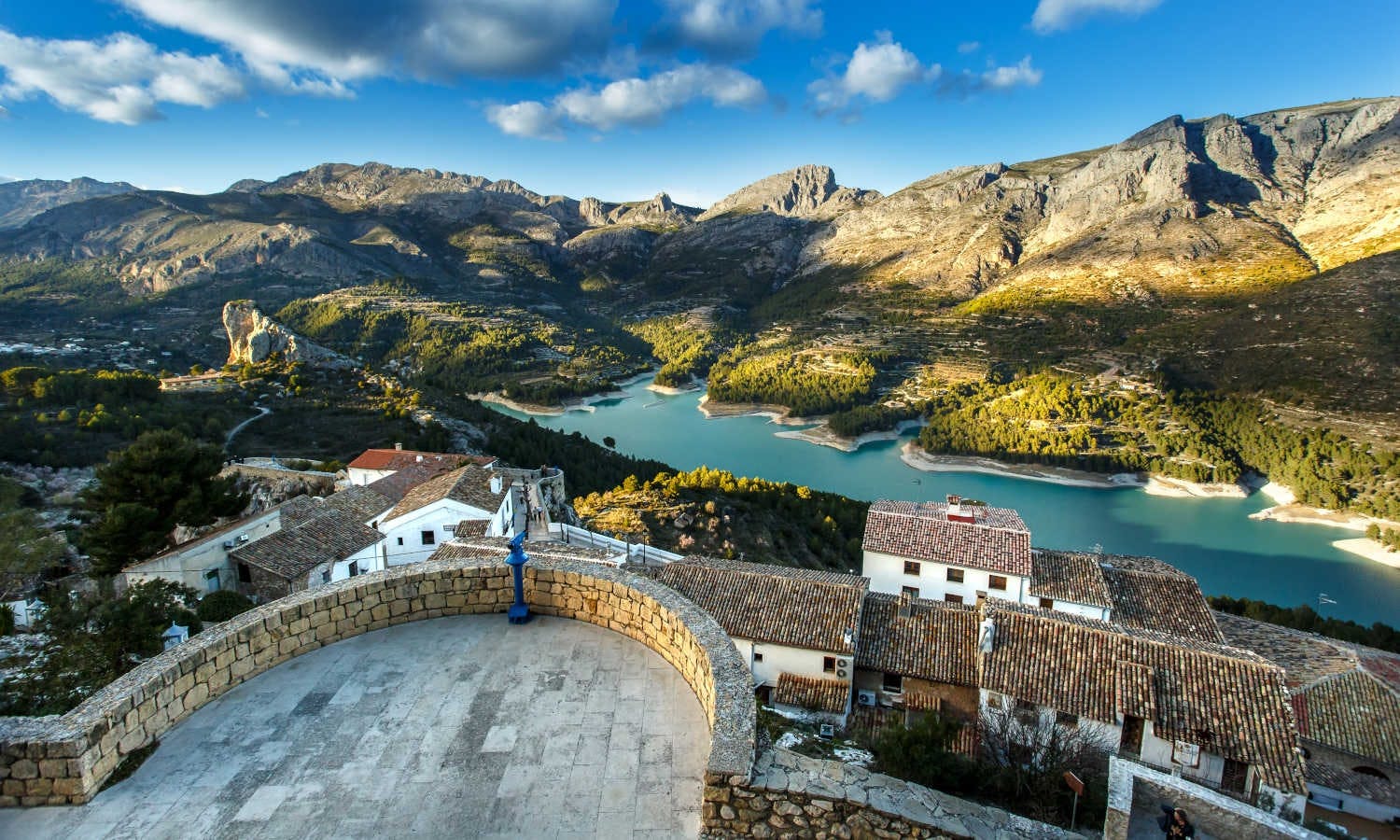
The village’s most famous view combines the white bell tower, castle rock, turquoise reservoir and surrounding mountains. Water levels and colour vary according to rainfall, season and light, but the landscape remains dramatic.
A Short History of Guadalest
Guadalest developed around Islamic fortifications built during the 11th century. Its high position provided control over the valley and made the settlement easier to defend.
Following the Christian conquest, Guadalest passed through the hands of noble families and became the centre of a marquisate. The Orduña family served for generations as governors and administrators of the fortress.
Several disasters shaped the village seen today.
Earthquakes in 1644 and 1748 damaged the castle and settlement.
An explosion in 1708, during the War of the Spanish Succession, destroyed additional sections of the fortress.
Parts of the church and historic buildings were damaged during later conflicts.
Only sections of the castles remain, but their position on the rock still explains Guadalest’s strategic importance.
The village was declared a historic-artistic ensemble in 1974 and later protected as a Site of Cultural Interest.
How to Get from Benidorm to Guadalest
Visitors can travel by hire car, public excursion bus, organised coach, taxi or private tour.
The best option depends on whether you want maximum flexibility, the lowest price or a simple transfer without navigating mountain roads.
Transport
Advantages
Possible drawbacks
Hire car
Flexible timing, reservoir access, easy stops
Mountain driving and parking required
Line 16 bus
Economical and direct
Limited timetable and fixed return
Organised coach
Simple pickup and return
Often only about three hours in the village
Taxi or private driver
Convenient and flexible
Most expensive option
Driving from Benidorm and Parking
Driving is the most practical option for an independent day trip.
From Benidorm, follow the CV-70 inland through La Nucía and Polop towards Callosa d’en Sarrià and Guadalest.
The road climbs steadily and becomes winding, but it is a normal surfaced route used by coaches, cars and local traffic.
Driving Tips
Allow around 40 to 50 minutes each way.
Drive slowly through bends and villages.
Watch for cyclists and motorcycles.
Do not stop on narrow bends for photographs.
Use recognised viewpoints or parking spaces.
Fill the car with fuel before leaving Benidorm when necessary.
Parking in Guadalest
Parking areas are located around the lower entrance to the village. From there, visitors continue uphill on foot.
Parking fees and conditions vary between municipal and private areas. Bring a payment card and some coins rather than relying on one method.
Spaces can fill during summer weekends, Easter and public holidays. Arriving before tour coaches is one of the best ways to avoid congestion.
Do not try to drive into the narrow historic upper settlement.
Travelling by Bus from Benidorm
Benidorm’s excursion network lists Line 16 for Guadalest, with pickup stops in the Poniente, central and Levante areas.
This is not a frequent urban service running every few minutes. Departures and returns can be limited, seasonal or adjusted according to demand.
Before Travelling by Bus
Confirm the operating day.
Check the exact pickup stop.
Confirm the return time from Guadalest.
Arrive early.
Ask whether a single ticket or tourist travel card is suitable.
Do not rely solely on an old online timetable.
The bus is convenient when you do not want to drive, but the fixed return time means you must plan museum visits and lunch carefully.
A limited bus schedule also makes it difficult to add the reservoir or neighbouring villages independently.
Organised Excursions from Benidorm
Organised coach excursions are widely sold by hotels, local agents and online tour companies.
A Guadalest-only excursion usually includes:
Pickup from a designated location in Benidorm or Albir.
Air-conditioned coach transport.
A representative or guide.
Approximately three hours of free time.
Return to the original pickup area.
Castle, museum and meal charges are often not included.
Guadalest and Algar Waterfalls Tours
Many full-day tours combine Guadalest with Fonts de l’Algar, commonly known as Algar Waterfalls.
These tours are efficient for visitors with limited time but may allow only a short stay in Guadalest.
Read the itinerary carefully. A tour advertising a full day may spend only one and a half to three hours in the village after pickups, transfers and the waterfall visit are considered.
Questions to Ask Before Booking
How much free time is provided in Guadalest?
Is Casa Orduña and castle admission included?
Does the tour stop at the reservoir?
Is lunch included?
Where is the exact pickup point?
Does the tour return directly to Benidorm?
Is the guide present inside the village?
How Long Should You Spend in Guadalest?
Allow at least four hours for a meaningful visit.
A comfortable visit with lunch requires five to six hours, excluding travel from Benidorm.
Time available
Realistic experience
2 hours
Village streets, viewpoints and a quick castle visit
3 hours
Casa Orduña, castle, village and one short museum
4–5 hours
Main sights, one or two museums and lunch
Full day
Relaxed village visit plus reservoir or nearby valley stop
The settlement looks tiny from a distance, but stairs, photographs, museum visits and lunch take longer than expected.
The Best Things to See in Guadalest
The essential route begins in the lower village, passes through the rock tunnel and continues to Casa Orduña, the castle ruins and panoramic viewpoints.
Visitors with additional time can choose from several small museums or drive towards the reservoir.
The Rock Tunnel
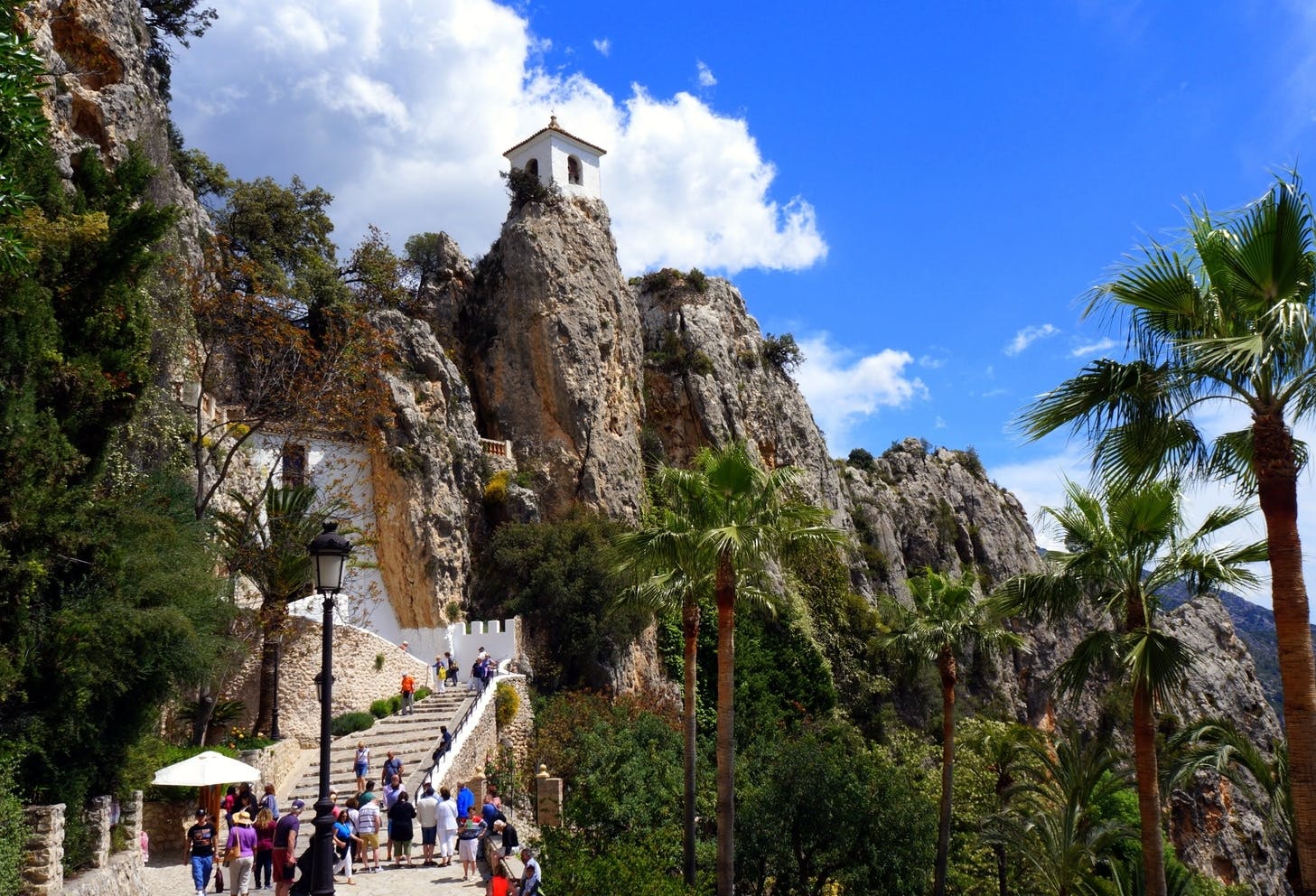
The entrance to historic Guadalest passes through the Portal de Sant Josep, a tunnel cut directly through the rock.
This narrow gateway once formed part of the settlement’s defences. Anyone entering the upper village had to pass through this controlled point.
The tunnel is short, but it creates a memorable transition. Shops and modern approach streets remain behind, while stone houses, viewpoints and historic buildings appear on the other side.
The floor may be smooth or slippery after rain. Visitors with mobility difficulties should proceed carefully.
Casa Orduña
Casa Orduña was constructed after the destructive earthquake of 1644 and became the home of the family responsible for administering Guadalest on behalf of the marquises.
The building is now the municipal museum and the normal access route to San José Castle.
Rooms contain period furniture, religious art, ceramics, maps, household objects and a historic library.
Highlights of Casa Orduña
The traditional kitchen and pantry.
Family rooms and furniture.
Historic maps printed in Paris.
Religious paintings.
A library containing more than a thousand volumes.
Views towards the reservoir and surrounding mountains.
The building contains several levels connected by stairs. Some rooms are narrow, reflecting the irregular rock and historic layout.
Opening Hours
Published hours currently vary by season:
High and middle season: approximately 10:15 am to 7:00 pm.
Low season: approximately 10:15 am to 6:00 pm.
Thursday and Sunday: a closure may apply from 2:00 pm to 3:00 pm.
Confirm the latest hours and admission price before planning a late visit.
San José Castle
San José Castle occupies the highest section of the rock.
The Muslims constructed the fortress during the 11th century. Its location allowed defenders to monitor movement through the Guadalest Valley and across the surrounding mountains.
Only ruins remain because earthquakes, warfare and an explosion destroyed large sections.
The value of the castle visit lies less in intact rooms than in the landscape and understanding of the site.
The remains known as Alcozaiba occupy another part of the fortified rock. Only a tower survives from this second 11th-century Muslim defensive structure.
Nearby, Guadalest’s white bell tower stands dramatically on a narrow outcrop.
The bell tower is one of the village’s most photographed features. Its separation from the main church and position above the valley create the classic Guadalest skyline.
Visitors generally view it from paths, castle areas and terraces rather than entering the tower itself.
Church of Our Lady of the Assumption
The parish church stands beside Casa Orduña in the historic upper settlement.
The present Baroque building was constructed during the 18th century on the site of an earlier church. It was later damaged and altered, including during the Spanish Civil War.
The interior is smaller than many visitors expect and provides a quiet contrast with the busy viewpoints outside.
Access may be restricted during services, events or maintenance.
Guadalest’s Unusual Museums
Guadalest has an unusually high concentration of small private museums.
You will not have time to visit all of them on a normal day trip, so choose one or two according to your interests.
Museum of Microminiatures
The exhibits include works created on grains of rice, pinheads and other extremely small surfaces.
Magnifying equipment allows visitors to inspect scenes and objects invisible to the unaided eye.
Micro-Gigantic Museum
This museum combines miniature artworks with oversized sculptures and optical curiosities.
It is entertaining rather than academically serious and suits visitors who enjoy unusual collections.
Museum of Salt and Pepper Shakers
Thousands of salt and pepper shakers are arranged by theme, design and period.
The collection is eccentric, colourful and more engaging than the name may initially suggest.
Ethnological Museum
This museum occupies a traditional 18th-century house and explains rural life in the Guadalest Valley.
Displays cover domestic life, farming, grain, olive oil, wine and traditional tools.
Dollhouse and Nativity Museum
Miniature houses, historic toys and detailed nativity scenes make this a popular family stop.
Historic Vehicle Museum
The vintage motorcycle and microcar collection lies outside the central village on the road between Guadalest and Callosa d’en Sarrià.
It is easiest to visit by car and contains around 140 motorcycles together with small cars and household objects.
Medieval Historical Museum
This privately operated attraction displays historic and reconstructed instruments of punishment and execution.
Its subject matter may not be appropriate for younger children or sensitive visitors.
Guadalest Reservoir
The reservoir below the village provides the bright blue or green water seen in most photographs of Guadalest.
Most visitors view it from the castle and upper terraces. Reaching the shoreline requires additional driving or a substantial descent and return climb.
Visiting by Car
Drivers can follow local roads towards the reservoir and neighbouring villages such as Beniardá.
This provides:
Closer views of the water.
Walking opportunities.
Quieter scenery away from tour groups.
Different perspectives of Guadalest above the valley.
Roads near the reservoir can be narrow and may not form the quickest return route to Benidorm.
Water Levels
The appearance of the reservoir changes with drought, rainfall and water-management requirements.
Do not assume that the water level or colour will match edited promotional photographs.
Swimming and Water Access
Do not assume that swimming, boating or access to every part of the shoreline is permitted.
Follow local signs and current regulations. Reservoir conditions and recreational rules can change.
Where and What to Eat
Guadalest has cafés and restaurants in the lower and upper village. Many have terraces overlooking the valley.
Menus range from simple sandwiches and tapas to traditional mountain dishes.
Local Foods to Look For
Rice dishes.
Grilled meats.
Rabbit.
Local sausages and cured meats.
Olives and olive oil.
Mountain stews.
Fresh bread with tomato.
Almond sweets.
Honey.
Products made from local loquats.
Restaurants become busy from around 1:30 pm, particularly when several coaches arrive together.
Eat slightly early, book a table or wait until the principal tour groups begin leaving.
Local Products and Souvenirs
Guadalest’s approach streets contain numerous souvenir and food shops.
Common products include:
Local honey.
Olive oil.
Herbal liqueurs.
Loquat preserves and drinks.
Cured meats.
Cheese.
Ceramics.
Textiles.
Decorative metalwork.
Some shops sell generic souvenirs unrelated to the region. Look for labels showing where food and craft products were made.
Travellers returning to Australia or another country with strict biosecurity controls should check import rules before buying meat, honey, seeds or plant products.
The Best Time to Visit Guadalest
Spring
March to May is one of the best periods. Temperatures are generally comfortable, vegetation is greener and the mountain landscape can be especially attractive.
Easter holidays bring larger crowds.
Summer
Guadalest is cooler than Benidorm because of its elevation, but exposed stone streets and castle paths can still become very hot.
Arrive early, use sun protection and avoid the steepest walking around midday.
Autumn
September and October offer comfortable conditions and fewer visitors than August.
Rain can make stone surfaces slippery.
Winter
Winter is quieter, and clear days can provide excellent views.
The village is considerably cooler than the coast. Wind, cloud and shorter museum hours should be expected.
Best Time of Day
Arrive before 10:00 am for easier parking and quieter lanes.
Late afternoon offers attractive light, but visitors relying on buses or museum access must not miss closing and return times.
Walking Difficulty and Accessibility
Guadalest is built on steep and irregular terrain.
The main route includes:
Sloping streets.
Cobbled or stone surfaces.
Stairs.
A rock tunnel.
Historic buildings without modern lifts.
Uneven castle paths.
The lower village and some viewpoints are more accessible than the complete castle route.
Casa Orduña occupies several levels and the castle contains difficult surfaces, making full access challenging for wheelchair users and visitors who cannot climb stairs.
Guadalest publishes an accessible route and resource guide, but individual requirements should be discussed with the tourist office before travelling.
Visitors with limited mobility may still enjoy lower viewpoints, cafés, shops and selected streets without climbing to every ruin.
Visiting Guadalest with Children
Guadalest can be a good family excursion when the day is not overloaded with museums.
Children often enjoy:
The tunnel through the rock.
Castle ruins.
Dollhouses and miniature displays.
The salt-and-pepper collection.
Looking down towards the reservoir.
Ice cream and local sweet shops.
Young children require close supervision near walls, steep steps and exposed castle areas.
A lightweight pushchair may work in parts of the lower village but becomes awkward on stairs and uneven surfaces. A child carrier is more practical for the upper historic area.
What to Bring
Comfortable shoes: Essential for stone streets and castle paths.
Water: Particularly important during summer.
Sun protection: Bring sunscreen, sunglasses and a secure hat.
Light jacket: Useful because the village is cooler and windier than Benidorm.
Camera or phone: The reservoir views are a major part of the visit.
Small amount of cash: Useful for minor admissions, parking or small shops.
Bus timetable: Essential when using public transport.
Medication: Carry anything needed during a steep walking day.
Suggested Independent Day-Trip Itinerary
8:30 am: Leave Benidorm
Drive inland on the CV-70 before the principal coach groups begin arriving.
9:15 am: Arrive and Park
Walk towards the village entrance and stop at the first reservoir viewpoint.
9:45 am: Explore the Lower Village
Walk past shops and historic façades towards the Portal de Sant Josep.
10:15 am: Visit Casa Orduña
Explore the rooms, library and historic collections before continuing to the castle.
11:15 am: Climb to San José Castle
Allow time for the ruins, reservoir views and photographs of the bell tower.
12:15 pm: Visit the Church and Upper Streets
See the parish church and wander through the small historic settlement.
12:45 pm: Choose One Museum
Select the Ethnological Museum for local history or one of the miniature museums for an unusual experience.
1:30 pm: Lunch
Choose a restaurant with valley views and try a traditional regional dish.
3:00 pm: Additional Museum or Shopping
Browse local food shops or visit one more compact museum.
4:00 pm: Optional Reservoir Drive
Drivers with time can descend towards the reservoir or continue through part of the Guadalest Valley.
5:30 pm: Return to Benidorm
Allow additional time when travelling during evening traffic.
Suggested Three-Hour Guadalest Visit
Visitors arriving by coach or limited public bus need to prioritise.
First Hour
Walk directly through the rock tunnel and enter Casa Orduña.
Second Hour
Continue to San José Castle and the principal reservoir viewpoints.
Third Hour
Walk through the village, see the church and choose either a quick museum visit or a light meal.
Do not begin a long restaurant lunch before confirming the coach or bus meeting time.
Combining Guadalest with Algar Waterfalls
Guadalest and Algar Waterfalls are often combined because both lie inland from Benidorm.
The combination works best with a car or full-day organised tour.
Advantages
Two major inland attractions in one day.
A mix of history, scenery and water.
Efficient use of a hire car.
Good option for visitors with limited holiday time.
Disadvantages
Less time in Guadalest.
A long and active day.
Summer crowds at both locations.
Additional admission and parking costs.
Little opportunity to visit the reservoir.
Best Order
During summer, visiting Guadalest early and Algar Waterfalls later can avoid some morning coach congestion in the village.
Alternatively, enter the waterfalls immediately after opening and visit Guadalest in the afternoon when some coach groups have departed.
Always verify closing times and reserve waterfall admission when required.
Is a Day Trip to Guadalest Worth It?
Guadalest is one of the most worthwhile day trips from Benidorm for visitors who want a genuine change from the coast.
Main Advantages
Dramatic mountain and reservoir scenery.
Easy driving distance from Benidorm.
A compact historic centre.
Interesting castle history.
A broad choice of small museums.
Traditional food and regional products.
Suitable for a half-day or full-day outing.
Possible Drawbacks
Heavy coach-tour crowds.
Steep and uneven walking.
Limited public-bus schedule.
Many separate museum entrance charges.
A commercial approach area with numerous souvenir shops.
Very hot exposed sections during summer.
The village can feel busy and commercial around midday. Arriving early and spending time beyond the principal shopping street reveals a more atmospheric side of Guadalest.
Frequently Asked Questions About a Guadalest Day Trip
How far is Guadalest from Benidorm?
It is roughly 30 kilometres inland from Benidorm.
How long does it take to drive?
The journey usually takes around 40 to 50 minutes, depending on traffic and road conditions.
What road should I take?
The usual route from Benidorm follows the CV-70 through La Nucía and Polop.
Can I travel by public bus?
Yes. Benidorm’s Line 16 excursion service travels to Guadalest, but departures are limited and should be confirmed in advance.
Where does the bus leave from?
Stops are available in the Poniente, central and Levante areas. The exact pickup point depends on the current schedule.
Can I use a Benidorm tourist travel card?
Current Benidorm tourist cards include Line 16 under the published conditions. Confirm the card type and validity when purchasing.
Is an organised tour easier?
Yes. A tour provides transport and fixed pickup arrangements, but usually offers less flexibility and limited free time.
How much time do organised tours provide?
Guadalest-only coach excursions commonly provide about three hours of free time. Combined tours may provide less.
Is Guadalest free to visit?
Walking through the village and enjoying public viewpoints is free. Casa Orduña, the castle route and most private museums charge admission.
Do I need to book castle tickets?
Advance booking is not normally essential for individual visitors, but group arrangements and special events may differ.
How do I enter the castle?
Normal access is through Casa Orduña, the municipal museum in the upper village.
Is the castle intact?
No. San José Castle survives mainly as ruins because of earthquakes and wartime destruction.
Is the view still worth the entry?
Yes. The elevated views over the reservoir and mountains are the principal reward.
What are the Casa Orduña opening hours?
Published hours are approximately 10:15 am to 7:00 pm in high and middle season and until 6:00 pm in low season, with a possible midday closure on Thursday and Sunday.
Can I see the reservoir without entering the castle?
Yes. Public viewpoints provide reservoir views, although the castle area offers some of the best perspectives.
Can I drive to the reservoir?
Yes. Local roads descend into the valley, but allow extra time and expect narrow sections.
Can I walk to the reservoir?
It is possible to descend on local routes, but the return climb is significant and unsuitable for a short coach visit.
Can I swim in the reservoir?
Do not assume that swimming is permitted. Follow current signs and local regulations.
Is Guadalest suitable for wheelchair users?
Parts of the lower village are accessible, but the historic centre, Casa Orduña and castle include steep slopes, stairs and uneven surfaces.
Is it suitable for young children?
Yes, but children need close supervision around castle paths, walls and stairs.
Can I take a pushchair?
A lightweight pushchair is usable in some lower areas but becomes difficult in the historic upper village.
Are there toilets?
Public and customer toilets are available around the village, although some restaurant facilities are reserved for patrons.
Are there restaurants?
Yes. Guadalest has cafés and restaurants serving snacks, tapas and traditional regional dishes.
What museum is best for local history?
The Ethnological Museum and Casa Orduña provide the strongest insight into local life and history.
Which museum is best for children?
The Dollhouse and Nativity Museum, Micro-Gigantic Museum and Salt and Pepper Shaker Museum are popular family choices.
What should I wear?
Wear comfortable shoes and layered clothing suitable for cooler, windier mountain conditions.
Is Guadalest cooler than Benidorm?
Usually yes. Its higher elevation produces cooler conditions, particularly in winter and early morning.
What is the best month to visit?
April, May, September and October generally provide comfortable walking temperatures.
What is the best time of day?
Arrive before 10:00 am for easier parking and fewer tour groups.
Can Guadalest and Algar Waterfalls be visited in one day?
Yes. This is a common combination by hire car or organised coach.
Which should I visit first?
Guadalest is often best early in the morning before the streets and castle become crowded.
Is Guadalest overly touristy?
The main approach contains many souvenir shops and receives large coach groups, but the historic setting, castle and mountain views remain worthwhile.
Can I visit in winter?
Yes. Winter is quieter, but temperatures are cooler and some attractions use reduced hours.
Is there enough to fill a full day?
Yes, when you include Casa Orduña, the castle, one or two museums, lunch and the reservoir or surrounding valley.
Sponsored Popular Items
Quick take: Musement.com offers a worldwide selection of tours and attractions
Guadalest Day Trip from Benidorm Alicante Province Spain Day trip to Guadalest from Benidorm is a convenient way to add structure, local context and purposeful sightseeing to the itinerary. Day trip to Guadalest from Benidorm: experience overview Guadalest sits high in the mountains behind the Costa Blanca, with a compact old village, dramatic valley views and a reservoir below. This coach trip provides transport from the Benidorm and Albir area while leaving visitors free to explore the village independently rather than following a fixed guided route. This makes the experience a useful option when planning time in Benidorm. The exact duration can depend on the selected date, option…
Final Thoughts
A day trip to Guadalest is one of the clearest demonstrations of how quickly the Costa Blanca changes beyond its beaches.
In less than an hour, visitors can leave Benidorm’s towers and arrive among castle ruins, whitewashed houses and mountain scenery.
The village’s popularity means it is no longer an undiscovered retreat. Coaches, souvenir shops and busy viewpoints are part of the modern experience. Arriving early, allowing sufficient time and selecting only the museums that genuinely interest you creates a much better visit.
For the most rewarding day, travel independently by car, enter Casa Orduña soon after it opens, continue to the castle before the largest groups arrive and remain for lunch after hurried excursions begin leaving.
Whether visited for three hours or a complete day, Guadalest provides history, unusual collections and some of the finest inland views within easy reach of Benidorm.
Sponsored Popular Items
Quick take: Musement.com offers a worldwide selection of tours and attractions
Guadalest and Algar waterfalls full-day tour from Calpe Best deals for Guadalest and Algar waterfalls full-day tour from Calpe. Take in the best of the Costa Blanca with a visit to the hilltop village of Guadalest and the refreshing Algar Waterfalls. Explore Guadalest's historic streets, browse its museums or simply admire the mountain views before enjoying free time at the waterfalls, where natural pools are perfect for a refreshing dip. With return coach travel, waterfall entry and plenty of time in both locations, it's a day made for discovering at your own pace. Available from musement.com.
Guadalest Day Trip from Benidorm Alicante Province Spain Day trip to Guadalest from Benidorm is a convenient way to add structure, local context and purposeful sightseeing to the itinerary. Day trip to Guadalest from Benidorm: experience overview Guadalest sits high in the mountains behind the Costa Blanca, with a compact old village, dramatic valley views and a reservoir below. This coach trip provides transport from the Benidorm and Albir area while leaving visitors free to explore the village independently rather than following a fixed guided route. This makes the experience a useful option when planning time in Benidorm. The exact duration can depend on the selected date, option…
Guadalest and Algar waterfalls tour from Alicante – Guided Sightseeing Guadalest and Algar waterfalls tour from Alicante is a convenient way to add structure, local context and purposeful sightseeing to the itinerary. Guadalest and Algar waterfalls tour from Alicante: experience overview Book your tour and discover the cultural richness of Guadalest and the natural beauty of the Algar Waterfalls on this day trip from Alicante. This makes the experience a useful option when planning time in Alicante. The exact duration can depend on the selected date, option or operating schedule. Routes, start times, inclusions and meeting arrangements may vary, so the current booking page should be treated as the final…
Costa Blanca Mountain Tour to Guadalest and Algar Falls – Guided Local Tour Costa Blanca mountain tour to Guadalest and Algar Falls: Practical Visitor Guide Quick overview: This experience is presented as admission, interpretation or a packaged visitor experience in Benidorm. The listing may offer admission, a guide, transport, a package or premium access. Read the complete live description because similarly named products can have different meeting points, durations and inclusions. Table of Contents About the experience What you may experience Planning the visit Booking checklist Frequently asked questions About This Experience A booking is most useful when it solves a practical problem: securing limited admission, providing reliable interpretation, arranging transport or making…
Day Trip to Guadalest, Altea and the Algar Waterfalls from Benidorm – Regional Day Trip Day Trip to Guadalest, Altea and the Algar Waterfalls from Benidorm: Practical Visitor Guide Quick overview: This experience is presented as a full or partial day beyond the departure city in Benidorm. The listing may offer admission, a guided visit, transport, a combination package or premium access. Read the exact live description because similarly named options can have different meeting points, durations and inclusions. Table of Contents About the experience What you may experience Planning the visit Booking checklist Frequently asked questions About This Experience A booking is most useful when it solves a practical problem: securing limited admission, providing…
Day Trip to Guadalest, Altea and the Algar Waterfalls from Alicante – Day Trips Day Trip to Guadalest, Altea and the Algar Waterfalls from Alicante: Tickets, Tours and Visitor Guide Quick overview: Day Trip to Guadalest, Altea and the Algar Waterfalls from Alicante is presented as a natural attraction or regional excursion in Alicante region. A listing may offer admission, a guided visit, transport, a combination package or premium access. Read the exact live description because similarly named options can have different meeting points, durations and inclusions. Table of Contents About the experience What you may experience Planning the visit Booking checklist Frequently asked questions About Day Trip to Guadalest, Altea and the Algar…