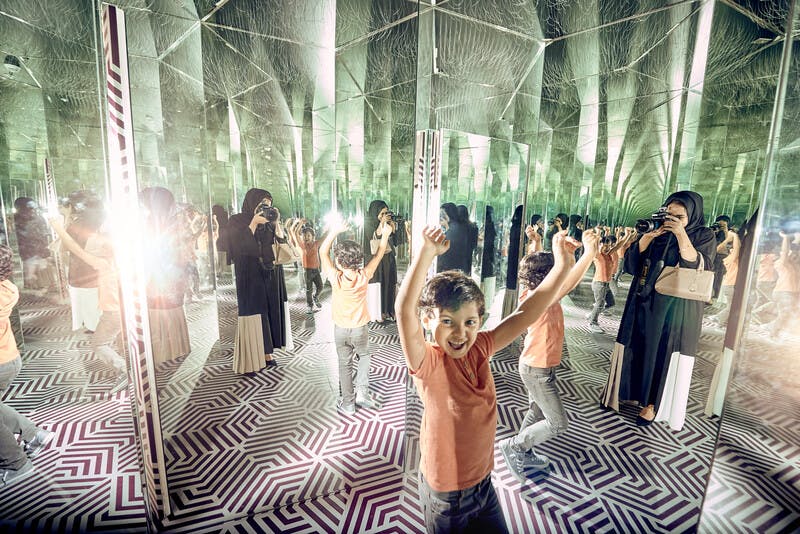
The Museum of Illusions Dubai is an interactive attraction where visitors are encouraged to question what they see, take unusual photographs and discover how easily the human brain can be confused.
Located in the heritage section of Al Seef beside Dubai Creek, the museum contains immersive rooms, optical illusions, holograms, perspective tricks and hands-on installations. Visitors can appear to grow or shrink, walk through a rotating tunnel, serve their own head on a platter or stand in a room where gravity seems to have stopped working.
Sponsored Popular Items
Quick take: Musement.com offers a worldwide selection of tours and attractions
Museum of Illusions Dubai Entry Tickets UAE Museum of Illusions Dubai Tickets: Complete Visitor Guide to Al Seef’s Interactive Attraction provides a structured way to visit a notable attraction or cultural site. Museum of Illusions Dubai Tickets: Complete Visitor Guide to Al Seef’s Interactive Attraction: experience overview The Museum of Illusions Dubai is an interactive indoor attraction filled with optical tricks, unusual perspective rooms, puzzles, holograms and installations designed to confuse the senses. This makes the experience a useful option when planning time in Dubai > Museum of Illusions - General admission. The exact duration can depend on the selected date, option or operating schedule. Routes, start…
This is not a traditional museum filled with historic objects and long information panels. It is a compact, playful experience designed around participation. The best exhibits work when visitors pose, move, experiment and take photographs from carefully marked positions.
The museum is particularly popular with families, couples, groups of friends and anyone looking for an air-conditioned activity during Dubai’s hotter months. It can also be combined easily with a walk around Al Seef, Al Fahidi Historical Neighbourhood and the old trading districts surrounding Dubai Creek.
Museum of Illusions Dubai Quick Facts
Visitor information
Details
Location
Heritage Area, Souk Al Seef, Dubai Creek
Type of attraction
Interactive optical illusion and perception museum
Typical visit
Approximately 45 to 90 minutes
Adult ticket
AED 90
Child ticket
AED 65 for children aged 3 to 15
Children aged 2 and under
Free admission
Monday to Thursday
10:00 am to 10:00 pm
Friday to Sunday
10:00 am to 11:00 pm
Public holidays
Normally 10:00 am to 11:00 pm
Nearest metro stations
BurJuman and Sharaf DG
Parking
Basement parking on the Heritage side of Al Seef
Food and drinks
Not permitted inside the museum
Important: Ticket prices, opening hours and special offers may change. Check the museum’s official booking page before travelling.
What Is the Museum of Illusions?
The Museum of Illusions is part of an international attraction concept built around vision, perspective, psychology and the ways in which the brain interprets information.
Some exhibits use mirrors and carefully calculated angles. Others rely on colour, movement, light or forced perspective. The visitor may understand that a room is level or that two people are the same height, yet the brain continues to interpret the scene differently.
The educational explanations are usually short and accessible. They describe why an illusion works without turning the visit into a lengthy science lesson.
The museum is divided broadly into three types of exhibit:
Illusion rooms: Large installations that visitors enter and physically experience.
Interactive installations: Smaller exhibits that use mirrors, angles and perspective.
Optical images and holograms: Pictures that appear to move, change or take on three-dimensional form.
Unlike many conventional museums, touching and interacting with the exhibits is part of the experience.
What to Expect During Your Visit
The museum is smaller than Dubai’s major theme parks and landmark attractions. Most visitors should think of it as a lively one-hour experience rather than an all-day destination.
After entering, visitors move through a series of rooms and exhibit areas. Some displays can be understood immediately, while others work only when viewed from a specific spot.
Staff members are often available to explain the illusions and help visitors find the correct position for photographs. This assistance can make a major difference because several displays look ordinary from the wrong angle.
The museum works best when visitors take their time. Rushing through without reading the instructions or taking photographs can make the experience feel much shorter.
It is also more enjoyable with at least one other person. Many of the most effective illusions require two people, and having a companion makes it easier to capture photographs.
The Best Exhibits and Illusion Rooms
Vortex Tunnel
The Vortex Tunnel is one of the museum’s best-known experiences. Visitors walk along a fixed platform while a brightly patterned cylinder rotates around them.
Although the walkway itself is not moving, the surrounding rotation can make the floor appear to tilt. Many people instinctively grip the handrail because their sense of balance no longer agrees with what their eyes are seeing.
The tunnel can feel disorientating. Visitors who experience vertigo, motion sickness or balance difficulties may prefer to view it from the entrance rather than walk through it.
Tilted Room
The Tilted Room uses angles and visual references to make standing upright feel surprisingly difficult. The walls and furnishings suggest one direction, while gravity pulls in another.
The effect is stronger in photographs, especially when visitors lean into the apparent slope or attempt poses that would normally be impossible.
Reversed Room
In the Reversed Room, the furniture and interior design are arranged to create an upside-down or gravity-defying photograph.
After the image is rotated, visitors may appear to be standing on the ceiling, hanging from furniture or walking along a wall.
It is one of the easiest exhibits for creating a memorable group photograph, but the final image depends on holding the camera at the correct orientation.
Ames Room
The Ames Room is designed so that two people standing in different corners appear to be dramatically different in size.
The room looks rectangular when viewed from the observation point, but its walls, floor and ceiling are actually distorted. The result makes one person appear tiny while another seems unusually large.
This exhibit is particularly popular with families because children can appear taller than their parents.
Anti-Gravity Room
The Anti-Gravity Room challenges normal expectations of balance and orientation. Visitors may appear to stand at impossible angles or resist the direction in which gravity should be pulling them.
As with several exhibits, the illusion is created by the room’s construction rather than by computer effects.
Beuchet Chair
The Beuchet Chair creates a dramatic size illusion by separating parts of a chair and placing visitors at different distances from the camera.
From the correct viewpoint, one person may appear enormous while another looks small enough to sit beside them.
The illusion demonstrates forced perspective, a technique also used in film sets and architectural photography.
Cloning Table
The Cloning Table uses mirrors to multiply a person’s reflection around a circular table.
From the camera’s perspective, it can look as though several identical versions of the same person are sitting together.
Head on a Platter
This playful exhibit makes it appear that a visitor’s head has been placed on a serving plate while the rest of the body has disappeared.
The effect is produced with carefully positioned mirrors. It is simple, humorous and particularly popular with children.
Holograms and Optical Images
The museum also contains holograms and static images that appear to move, change shape or reveal different subjects depending on the viewer’s position.
These quieter exhibits can be easy to overlook after the larger rooms, but they explain some of the most interesting aspects of visual perception.
Is the Museum of Illusions Dubai Worth Visiting?
The museum is worth considering for visitors who enjoy interactive activities, photography and unusual group experiences.
It is especially suitable for:
Families with school-aged children.
Couples and groups of friends.
Visitors looking for an indoor activity.
People interested in optical illusions and visual puzzles.
Travellers exploring Al Seef and Old Dubai.
Anyone wanting unusual holiday photographs.
It may be less satisfying for visitors expecting a large science centre, a full-day attraction or a traditional museum containing extensive historic collections.
The experience is fairly compact, and the ticket price may feel high when judged only by the time spent inside. Its value comes mainly from participation, shared photographs and interaction with the exhibits.
Visitors who dislike taking photos or prefer quiet, object-based museums may find it less compelling.
Tickets and Admission Prices
At the time of writing, standard admission prices are:
Ticket type
Price
Adult aged 16 and over
AED 90
Child aged 3 to 15
AED 65
Children aged 2 and under
Free
Family ticket: 2 adults and 2 children
AED 250
Family and Friends: 5 visitors
AED 370
Senior aged 60 and over
AED 75
Person of Determination
AED 40
Tickets can normally be purchased online or at the entrance. Door sales are subject to available capacity.
Online booking is the safer option during weekends, school holidays and busy tourism periods. The museum has also warned visitors about unofficial websites imitating its booking pages, so bookings should be made through the genuine museum website or a recognised travel platform.
Opening Hours
The museum’s published opening hours are:
Monday to Thursday: 10:00 am to 10:00 pm.
Friday, Saturday and Sunday: 10:00 am to 11:00 pm.
Public holidays: Normally 10:00 am to 11:00 pm.
Operating hours may be adjusted during Ramadan, religious holidays or special events. Visitors should check again shortly before travelling.
How Long Should You Allow?
Most visits last between 45 and 90 minutes.
Visitors who simply walk through and view each display may finish in less than an hour. Families and groups taking several photographs may remain considerably longer.
There is usually no need to reserve half a day for the museum itself. However, its location makes it easy to combine with several hours of sightseeing around Al Seef and Dubai Creek.
How to Get to the Museum of Illusions Dubai
Location
The museum is in the Heritage Area of Souk Al Seef beside Dubai Creek. The traditional-looking sand-coloured buildings can make individual shops difficult to identify, so allow a little time to locate the entrance.
By Dubai Metro
The closest practical metro stations are:
BurJuman: Served by the Red and Green lines.
Sharaf DG: Served by the Green line.
Both stations require a walk or short taxi journey to Al Seef. BurJuman is often convenient for visitors arriving from Downtown Dubai, Dubai Marina or areas served by the Red Line.
During the hottest months, the walk from the metro can be uncomfortable in the middle of the day. A short taxi journey may be preferable.
By Bus
The museum recommends the F70 bus to the Heritage Village stop. From there, the museum is a short walk away.
Dubai bus routes and stopping arrangements can change, so check the RTA journey planner on the day of travel.
By Taxi or Rideshare
A taxi is the simplest choice when travelling with young children or visiting during extreme heat.
Ask to be taken to the Heritage Area of Al Seef rather than simply saying Al Seef, as the waterfront development extends for a considerable distance.
By Car
Basement parking is available at Al Seef on the Heritage side. Follow signs for the heritage district and Museum of Illusions.
Allow time to walk from the parking area through the pedestrian lanes to the museum entrance.
By Boat
Al Seef is connected with Dubai’s marine transport network. Depending on the current schedule, visitors may be able to arrive by abra or water transport at an Al Seef marine station.
A boat journey is an enjoyable addition to the day, but it should not be relied upon without checking the current RTA timetable.
Accessibility
The museum building, grounds and parking are described as wheelchair and stroller accessible.
Three experiences are not fully accessible:
Vortex Tunnel.
Ames Room.
Anti-Gravity Room.
Visitors who have particular mobility, sensory or balance requirements should contact the museum before travelling.
The Vortex Tunnel may be uncomfortable for people who experience motion sickness, vertigo, migraines or sensory sensitivity. It can be skipped without preventing access to the rest of the museum.
Visiting with Children
The Museum of Illusions is designed to be family-friendly, but children of different ages will experience it differently.
Young children may enjoy the mirrors, size illusions and funny photographs without understanding the science. Older children can engage with the explanations about perspective, vision and the brain.
Children aged two and under do not require a ticket. Visitors aged 15 and under must be accompanied.
Parents should remain close to children in the Vortex Tunnel and rooms that affect balance. Running should be avoided because some spaces are deliberately disorientating.
The museum is stroller accessible apart from the three restricted exhibits, although a crowded weekend session may make a large stroller awkward to manoeuvre.
Photography Tips
Photography is an important part of the experience. A few simple techniques can improve the results considerably.
Read the instructions beside each exhibit before taking the picture.
Look for floor markings showing where the photographer should stand.
Use a wide-angle setting for room-sized illusions.
Keep the camera level unless the instructions say otherwise.
Ask a staff member for help when the illusion does not appear correctly.
Take several versions because small changes in position can alter the effect.
Use simple, exaggerated poses rather than standing normally.
Avoid blocking an exhibit for too long when other visitors are waiting.
Bright or contrasting clothing often shows clearly against the patterned rooms. Large bags can make posing more difficult, so travelling light is useful.
The Best Time to Visit
Weekday mornings are normally the best choice for a quieter experience.
The museum can become busier on Friday evenings, weekends, public holidays and during school breaks. Crowds matter more here than in a normal museum because each group needs space to pose and photograph the exhibits.
Late afternoon is a good option when combining the museum with Al Seef. Visitors can explore the indoor displays first and then walk beside Dubai Creek as the temperature falls and the waterfront lights begin to appear.
During summer, avoid planning a long outdoor walk between the metro and the museum during the hottest part of the day.
Things to Do Near the Museum
Explore Al Seef
Al Seef is a modern waterfront development designed to reflect the appearance of an older Arabian trading neighbourhood.
Its heritage section contains narrow lanes, wind-tower-style buildings, shops, cafés and restaurants. The waterfront promenade overlooks abras, dhows and other boats moving along Dubai Creek.
The setting is particularly attractive around sunset and after dark.
Visit Al Fahidi Historical Neighbourhood
Al Fahidi is one of the best areas in Dubai for exploring traditional courtyard houses, wind towers, galleries and narrow pedestrian lanes.
It provides a more historically grounded contrast to the playful Museum of Illusions.
Take an Abra Across Dubai Creek
A ride on a traditional abra is one of Dubai’s simplest and most memorable experiences.
Regular creek crossings connect Bur Dubai with Deira. Once across the water, visitors can explore the commercial streets and traditional markets on the Deira side.
Visit the Textile, Spice and Gold Souks
The Textile Souk is located on the Bur Dubai side of the creek. The Spice Souk and Gold Souk are in Deira and can be reached by abra.
These markets provide a very different experience from Dubai’s modern shopping malls.
Stop for a Creekside Meal
Al Seef contains a broad selection of cafés and restaurants. Visitors can choose from Emirati, Middle Eastern and international food while watching boats pass along the creek.
Food and drinks are not permitted inside the museum, so plan to eat before or after the visit.
Suggested Half-Day Itinerary
10:00 am: Arrive at Al Fahidi
Begin with a walk through the Al Fahidi Historical Neighbourhood before temperatures rise.
11:30 am: Walk to Al Seef
Continue towards the creek and explore the heritage-style lanes of Al Seef.
12:00 pm: Visit the Museum of Illusions
Allow approximately 60 to 90 minutes, including time for photographs.
1:30 pm: Lunch Beside Dubai Creek
Choose one of the restaurants or cafés along the Al Seef waterfront.
3:00 pm: Continue Along the Creek
Take an abra towards Deira or explore the Textile Souk on the Bur Dubai side.
Late Afternoon: Visit the Spice and Gold Souks
Finish the day among the traditional markets before returning by metro or taxi.
Practical Visitor Tips
Book ahead when visiting on a weekend or public holiday.
Use the official museum booking channel to avoid fraudulent ticket websites.
Visit with another person when possible, as many exhibits require a photographer.
Ask staff for help with camera positioning.
Allow 45 to 90 minutes inside.
Wear comfortable clothing that allows you to pose and move easily.
Skip the Vortex Tunnel if you are sensitive to motion.
Do not bring food or drinks into the museum.
Combine the visit with Al Seef rather than travelling across Dubai solely for a short museum session.
Confirm opening hours during Ramadan and public holidays.
Frequently Asked Questions
Where is the Museum of Illusions Dubai?
It is in the Heritage Area of Souk Al Seef beside Dubai Creek in Bur Dubai.
How much does admission cost?
At the time of writing, adult admission is AED 90 and admission for children aged 3 to 15 is AED 65. Children aged two and under enter free.
How long does the museum take?
Most visitors spend between 45 and 90 minutes inside.
Is it suitable for adults?
Yes. Although it is popular with families, many of the exhibits are designed for adults, couples and groups of friends as well as children.
Is the museum only for taking photographs?
No. The exhibits also explain perception, perspective and the way the brain interprets visual information. However, photography is a major part of the experience.
Can I buy tickets at the entrance?
Yes, provided the museum has not reached capacity. Booking online is recommended during busy periods.
What are the opening hours?
The museum normally opens from 10:00 am to 10:00 pm from Monday to Thursday and from 10:00 am to 11:00 pm from Friday to Sunday and on public holidays.
Is the museum wheelchair accessible?
Most of the museum and its parking facilities are accessible. The Vortex Tunnel, Ames Room and Anti-Gravity Room are exceptions.
Can I take a stroller inside?
Yes. The museum is generally stroller accessible, although three illusion rooms have access limitations.
Are food and drinks allowed?
No. Food and drinks are not permitted inside the museum.
Is the Vortex Tunnel really moving?
The platform remains stationary. The rotating cylinder surrounding it creates the sensation that the floor is moving or tilting.
Will the museum cause motion sickness?
Most exhibits do not, but the Vortex Tunnel can affect people who are sensitive to visual motion, vertigo or balance disturbances. It can be skipped.
What is the best metro station?
BurJuman and Sharaf DG are the closest practical metro stations. A walk or short taxi journey is still required.
Is parking available?
Yes. Basement parking is available on the Heritage side of Al Seef.
What else can I do nearby?
Nearby attractions include Al Seef, Al Fahidi Historical Neighbourhood, Dubai Creek, the abra crossings and the traditional souks of Bur Dubai and Deira.
Is the Museum of Illusions Dubai worth the price?
It offers the best value to families, couples and groups who actively try the exhibits and take photographs. Visitors looking for a large traditional museum may find the experience too short for the admission price.
Final Thoughts
The Museum of Illusions Dubai is a light-hearted attraction that works best when visitors participate rather than simply observe.
Its strongest exhibits use simple ideas—mirrors, angles, movement and perspective—to produce convincing results without relying entirely on screens or digital effects. The experience is compact, but it can produce some of the most unusual photographs of a Dubai holiday.
The museum’s Al Seef location is a major advantage. Rather than treating it as a destination on its own, combine it with a walk beside Dubai Creek, the historic lanes of Al Fahidi, an abra crossing and the traditional souks.
With realistic expectations, a charged phone and someone willing to take photographs, the Museum of Illusions can be a fun and memorable addition to a day in Old Dubai.
Sponsored Popular Items
Quick take: Musement.com offers a worldwide selection of tours and attractions
Museum of Illusions Dubai Entry Tickets UAE Museum of Illusions Dubai Tickets: Complete Visitor Guide to Al Seef’s Interactive Attraction provides a structured way to visit a notable attraction or cultural site. Museum of Illusions Dubai Tickets: Complete Visitor Guide to Al Seef’s Interactive Attraction: experience overview The Museum of Illusions Dubai is an interactive indoor attraction filled with optical tricks, unusual perspective rooms, puzzles, holograms and installations designed to confuse the senses. This makes the experience a useful option when planning time in Dubai > Museum of Illusions - General admission. The exact duration can depend on the selected date, option or operating schedule. Routes, start…