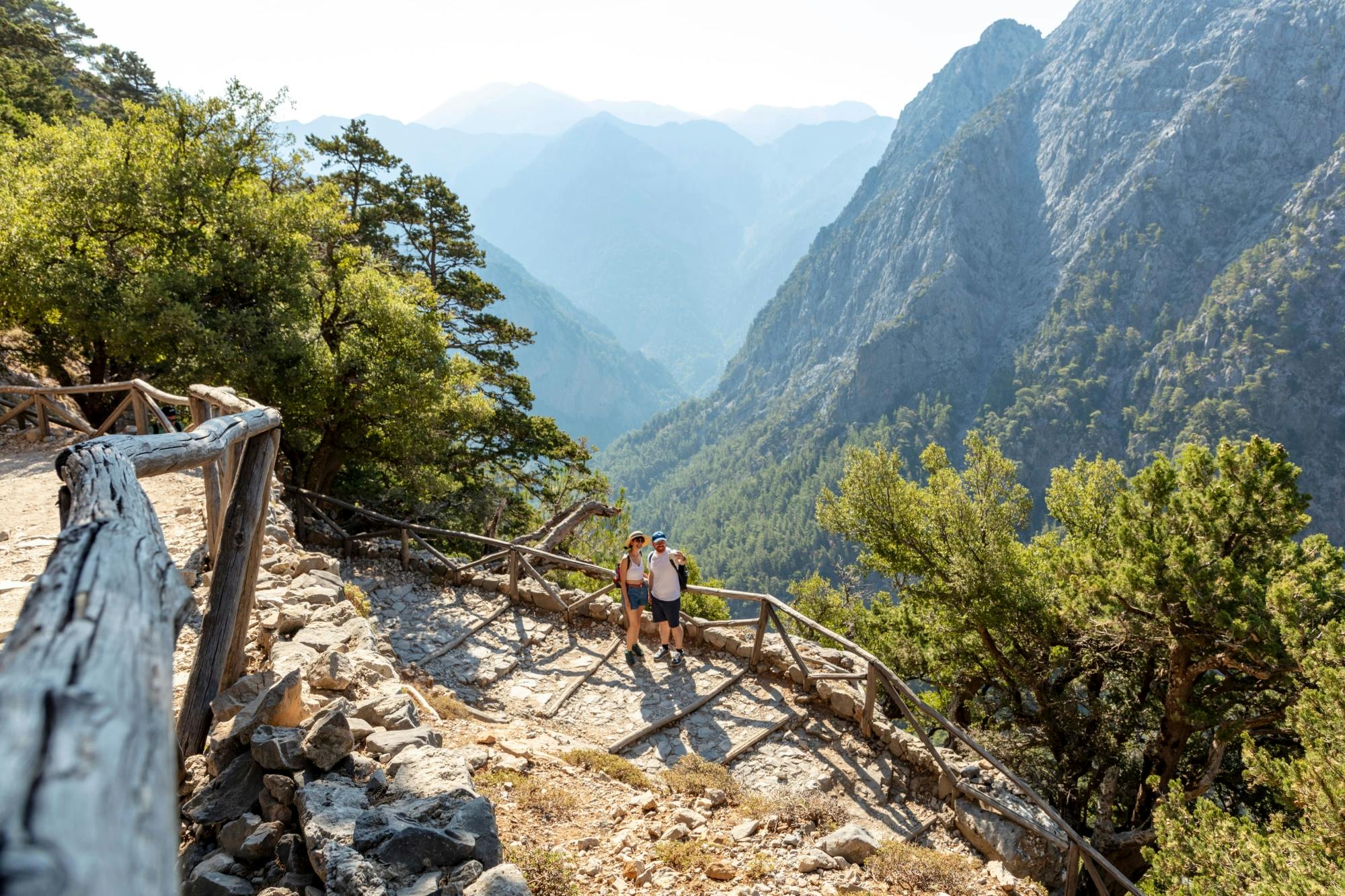
Sfakia is one of the most dramatic regions of Crete. Here, the White Mountains fall sharply towards the Libyan Sea, creating deep limestone gorges, isolated beaches, mountain villages and stretches of coastline that remain inaccessible by road.
Sponsored Popular Items
Quick take: Musement.com offers a worldwide selection of tours and attractions
Crete’s Samaria Gorge hike from Agia Galini and Matala Greece Plan Crete’s Samaria Gorge hike from Agia Galini and Matala, a outdoor experience, with practical tips on timing, inclusions and what to check before booking. Compare current availability, prices and booking conditions before you go.
The famous Samaria Gorge attracts most of the attention, but it is only one part of the story. Sfakia also contains the narrow Imbros Gorge, the wilder Aradena Gorge, the quieter Kallikratis Gorge and several remote canyons that are best attempted with local knowledge.
This is not a region where every walk is neatly circular or supported by frequent public transport. Some hikes finish beside the sea, where the only practical way out is by boat. Others require a taxi, a second vehicle or a carefully timed bus connection. With sensible planning, however, the gorges of Sfakia offer some of the finest walking experiences in Crete.
Where is Sfakia?
Sfakia occupies a rugged section of southwestern Crete in the Chania regional area. Its main coastal settlement is Chora Sfakion, also called Hora Sfakion or simply Sfakia.
To the north rise the Lefka Ori, or White Mountains. To the south lies the Libyan Sea. Between them, seasonal streams and geological erosion have cut a series of deep ravines through the limestone.
The landscape has helped keep Sfakia relatively undeveloped. Mountain roads twist across high plateaus, while coastal settlements such as Loutro and Agia Roumeli can be reached only on foot or by boat. This isolation is a large part of the region’s appeal, but it also makes transport planning essential.
Comparing the Main Gorges of Sfakia
Gorge
Approximate walking time
General difficulty
Typical route
Best suited to
Samaria
6–7 hours
Moderate to demanding
Xyloskalo to Agia Roumeli
Fit walkers wanting a full-day experience
Imbros
2–3 hours
Easy to moderate
Imbros village to Komitades
First-time gorge walkers and families with capable children
Aradena
3–4 hours, excluding onward travel
Moderate to difficult
Aradena village to Marmara Beach
Experienced walkers comfortable on rough terrain
Kallikratis
About 3.5 hours
Moderate
Kallikratis plateau towards Patsianos and Kapsodasos
Walkers seeking a quieter trail
Important: Walking times are approximate. Heat, fitness, trail conditions, rest stops and transport arrangements can add considerably to the length of the day.
Samaria Gorge: Crete’s Famous Full-Day Walk
Samaria Gorge is the best-known gorge in Crete and the centrepiece of the White Mountains National Park. The standard route begins at Xyloskalo, near the Omalos Plateau, at an elevation of more than 1,200 metres.
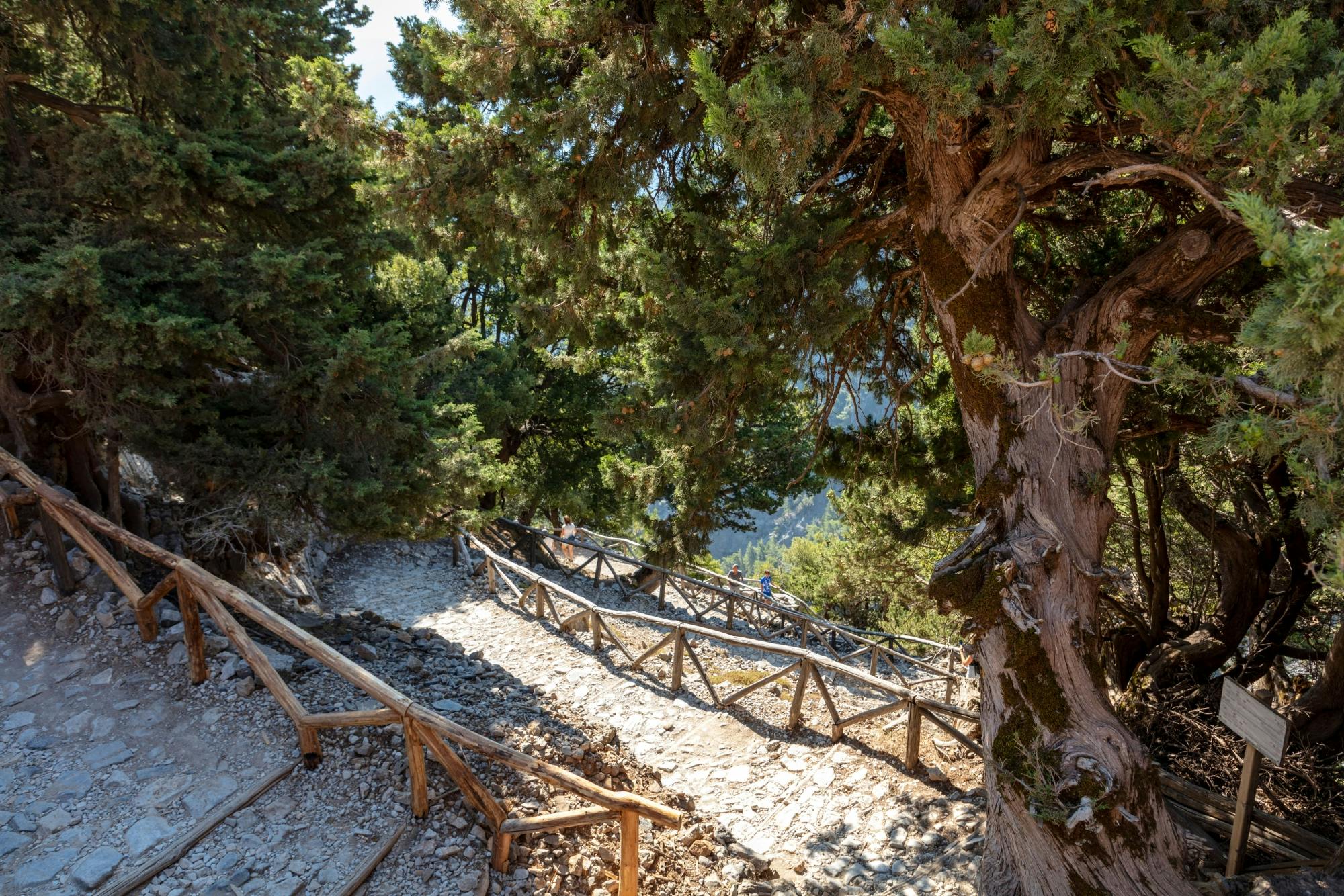
From the entrance, the path descends steeply through pine and cypress forest. The early section places considerable strain on knees and ankles, even though the route is mostly downhill.
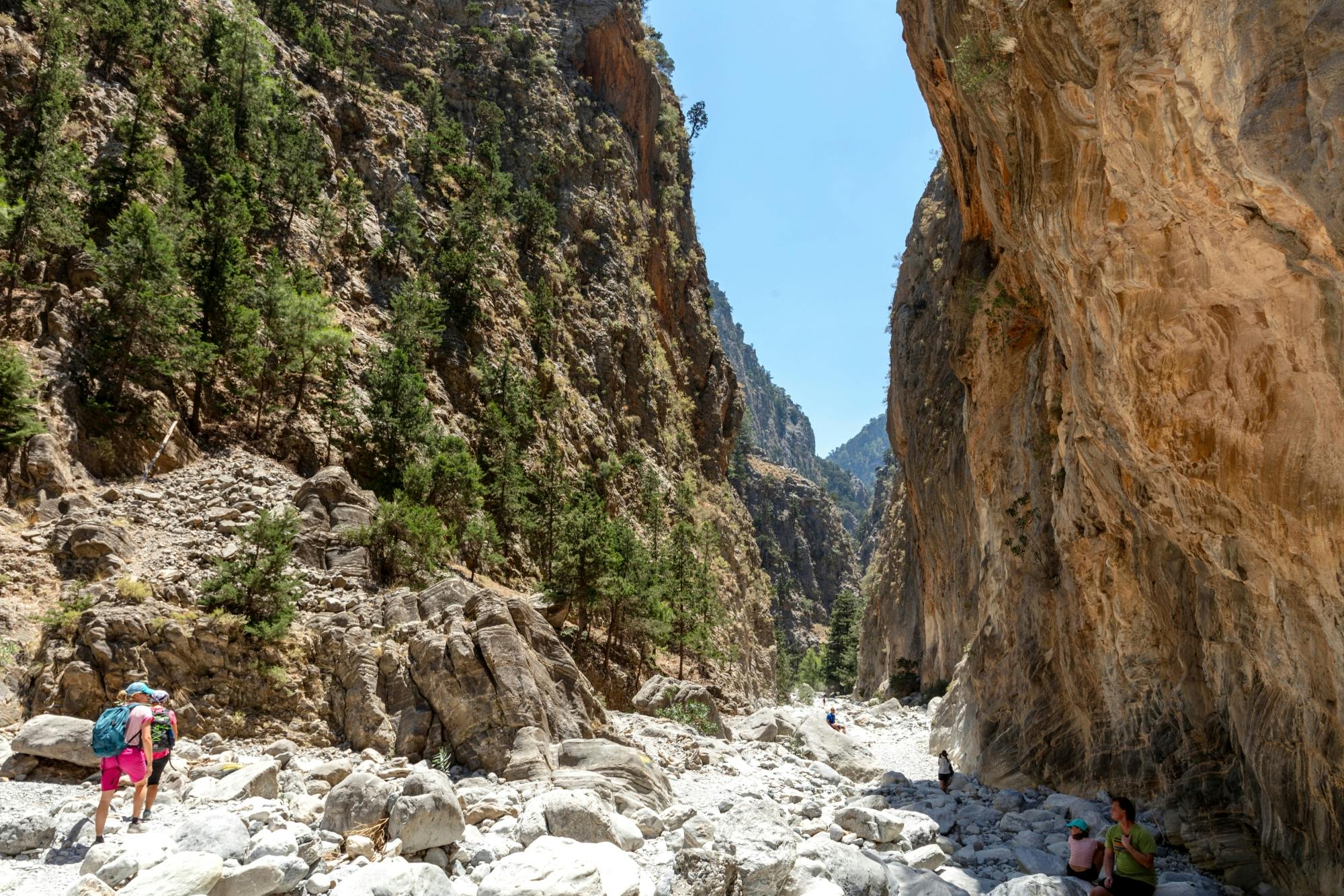
Farther inside the gorge, walkers pass the abandoned settlement of Samaria before entering the narrowest and most photographed section, commonly known as the Gates. The gorge walls close in dramatically as the trail follows the rocky riverbed towards the southern entrance.
The official path through the gorge is approximately 13 kilometres long. There is then another walk of about 3 kilometres from the park exit to Agia Roumeli, making the complete journey roughly 16 kilometres.
How difficult is Samaria Gorge?
Samaria is not a technical climb, but it should not be dismissed as an easy downhill stroll. Much of the surface is rocky and uneven, and walkers repeatedly cross the riverbed using bridges, stepping stones or rough sections of trail.
A reasonable level of fitness, good balance and supportive footwear are important. People with significant knee, hip or ankle problems may find the long descent uncomfortable.
What happens at the end?
Agia Roumeli has no road connection to the rest of Crete. After completing the walk, visitors normally take a ferry to Chora Sfakion, Sougia or Paleochora and continue by bus, taxi or prearranged tour transport.
This means the ferry is not an optional sightseeing extra. It is part of the transport chain. Walkers should check both the park status and ferry timetable before setting out.
Can you do a shorter Samaria walk?
Visitors who do not want to complete the entire route can travel by boat to Agia Roumeli and walk inland from the southern entrance. The famous narrow section of the gorge is relatively close to this end.
This shorter return walk provides a taste of Samaria without committing to the long descent from Omalos. Access rules still apply, and visitors must turn around in time for their return ferry.
Imbros Gorge: The Best Introduction to Gorge Walking
Imbros Gorge is shorter, easier to organise and less physically demanding than Samaria. It is therefore a strong choice for visitors who want a genuine Cretan gorge experience without spending an entire day on the trail.
The walk normally begins near the mountain village of Imbros, at an elevation of about 780 metres. From there, the trail descends for approximately 8 kilometres towards Komitades and the road leading to Chora Sfakion.
The gorge is particularly memorable for its narrow rock passages. At several points, the walls rise steeply on either side while the path contracts to only a few metres wide.
How long does Imbros Gorge take?
Most visitors take between two and three hours, although photographers and slower walkers may take longer. The path is easy to follow, but the surface remains rocky and proper footwear is advisable.
Why choose Imbros?
It is substantially shorter than Samaria.
The entrance and exit are both near roads.
It provides shade in several narrow sections.
It can often be walked when Samaria is seasonally closed.
Tavernas can usually be found near the starting and finishing areas.
Transport after the walk
Imbros is a linear walk, so visitors who leave a car near the entrance must arrange a return transfer. Local taxis commonly operate between the lower exit area and Imbros village, although availability should be confirmed before starting.
Another option is to continue towards Chora Sfakion for lunch or an overnight stay, using local transport where available.
Aradena Gorge: Wilder, Rougher and More Adventurous
Aradena Gorge begins near the abandoned stone village of Aradena, above the southern coast. The gorge is crossed near its upper end by a high metal bridge, one of the most striking sights in the Sfakia region.
The trail descends into the gorge and follows a rough route towards Marmara Beach on the Libyan Sea. Depending on the exact route and measuring point, the walk is generally described as roughly 6 to 7 kilometres and usually takes around three to four hours.
Aradena feels considerably more remote than Imbros. There are fewer walkers, less support and sections of rough ground where hikers may need to use their hands for balance. Route conditions and fixed aids can change, so local advice is especially valuable.
Who should walk Aradena Gorge?
Aradena is better suited to experienced walkers who are comfortable with uneven terrain, steep sections and exposure. It is not the best first gorge for nervous hikers or anyone uncomfortable with heights.
A guide is a sensible choice for visitors who do not know the route or who are uncertain about current conditions.
Finishing at Marmara Beach
The gorge reaches the sea at Marmara Beach, a small pebble beach surrounded by pale rock formations. After the walk, hikers may be able to take a seasonal boat to Loutro or continue on foot along the coastal trail.
The onward path to Loutro passes near the small coastal settlements of Lykos and Finikas. Although beautiful, this additional section extends the day and should not be underestimated in hot weather.
Boat availability is seasonal and weather-dependent. Never begin the gorge on the assumption that an unscheduled boat will definitely be waiting at the beach.
Kallikratis Gorge: A Quieter Walk with Sea Views
Kallikratis Gorge lies in the southeastern section of the White Mountains and forms part of the wider E4 walking network. It receives far fewer visitors than Samaria or Imbros.
The usual descent begins near the high village and plateau of Kallikratis. The path then drops towards the lower villages of Patsianos and Kapsodasos, not far from the Frangokastello plain.
The walk takes approximately three and a half hours. Some sections provide wide views towards the Libyan Sea and the coastal plain.
Kallikratis is a good choice for walkers who value quiet scenery and traditional mountain surroundings more than dramatic crowds of towering cliffs. Because public transport is limited, a taxi, second vehicle or arranged pickup is normally required.
The Lesser-Known Gorges of Sfakia
Beyond the four main walking routes, Sfakia contains numerous smaller and more remote gorges. These include the Sfakiano Gorge, Asfendou Gorge, Iligas Gorge, Eligia Gorge, Tripiti Gorge and Kladou Gorge.
They should not all be treated as ordinary marked hiking trails. Some involve long approaches, poorly defined paths, exposed terrain, rope work or canyoning equipment.
Sfakiano Gorge
The Sfakiano Gorge is a quieter, wooded route with a long approach. It is more complicated to organise than Imbros and is better for experienced independent walkers or those accompanied by a local guide.
Sponsored Popular Items
Quick take: Musement.com offers a worldwide selection of tours and attractions
Samaria Gorge Six-Hour Hiking Tour Greece Samaria Gorge Tour is a convenient way to add structure, local context and purposeful sightseeing to the itinerary. Check current availability, inclusions and booking details before you go.
Asfendou Gorge
The area around Asfendou contains impressive narrow terrain, but some routes are rough and may require specialist equipment. Visitors should not enter unfamiliar canyon sections solely on the basis of a basic online map.
Eligia, Tripiti and Kladou
These remote western gorges are serious undertakings rather than casual holiday walks. Routes may require mountaineering experience, navigation ability, ropes, more than one day and prearranged boat transport.
They are appropriate only for properly equipped parties with current local knowledge.
Which Gorge Should You Choose?
Choose Samaria if:
You want Crete’s most famous gorge.
You are fit enough for a long, rocky descent.
You are happy to commit an entire day.
You can coordinate buses, ferries or an organised excursion.
Choose Imbros if:
You have limited time.
You want a less strenuous walk.
You are visiting outside Samaria’s operating season.
You are travelling with active older children.
Choose Aradena if:
You have previous hiking experience.
You prefer a quieter and wilder landscape.
You are comfortable on rough, occasionally exposed terrain.
You have carefully arranged your onward transport.
Choose Kallikratis if:
You want to avoid the busiest trails.
You enjoy mountain villages and open views.
You have access to a car, taxi or arranged pickup.
Getting Around Sfakia
Chora Sfakion is the most practical coastal base for exploring the region. It has accommodation, tavernas, boat services and road connections to northern Crete.
The main drive from the Chania side passes through Vryses, the Askifou Plateau and Imbros before descending towards the coast. The road is paved but winding, and journey times are often longer than the distance suggests.
Using a hire car
A car provides flexibility for reaching Imbros, Anopoli, Aradena, Kallikratis and Frangokastello. However, a car does not solve every transport problem because most gorge walks are linear.
Leaving a car at the top of a gorge can mean arranging a taxi back later. For Samaria, driving to Xyloskalo creates the additional problem of recovering the vehicle after finishing at roadless Agia Roumeli.
Using buses and organised tours
Samaria is often easiest as an organised day trip because the bus, entrance, ferry connection and return transport can be coordinated together.
Public buses also serve parts of the region, but schedules may be seasonal and may be designed around ferry arrivals rather than frequent local travel.
Using ferries
Ferries connect Chora Sfakion with Loutro and Agia Roumeli, as well as other ports along the southwestern coast. Timetables vary by season and can be affected by wind and sea conditions.
Always verify the last practical departure before beginning a walk that finishes at the coast.
The Best Time to Visit the Gorges of Sfakia
Late spring and early autumn generally provide the most comfortable balance of daylight and temperature.
Spring
Spring brings greener slopes, wildflowers and more water in the mountain landscape. However, late rain or winter damage can delay the opening of Samaria or affect other trails.
Summer
Summer provides dependable holiday weather but can produce intense heat, particularly on exposed approaches and lower coastal sections. Begin early, carry sufficient water and avoid planning a strenuous remote walk during an extreme heat warning.
Autumn
September and early October can be excellent for hiking, with warm sea temperatures and fewer visitors. Storms become more likely later in the season, and ferry services may be disrupted by strong winds.
Winter
Samaria is normally closed during winter. Other gorges may not have formal gates, but flash flooding, loose rock and storm damage can make them dangerous.
A gorge that appears dry can fill quickly when rain falls higher in the mountains.
What to Take on a Gorge Walk
Supportive footwear: Hiking shoes or sturdy trainers with reliable grip.
Water: Carry more than you expect to need, especially in Aradena and the quieter gorges.
Food: Snacks or a light lunch, as shops are not available inside the trails.
Sun protection: A hat, sunscreen and lightweight protective clothing.
Basic first-aid supplies: Include blister treatment and any personal medication.
Offline map: Mobile reception can be weak or absent.
Charged phone and power bank: Useful for emergencies, even where reception is intermittent.
Cash: Small boats, taxis or tavernas may not always accept cards.
Swimming gear: Particularly useful for routes ending at Agia Roumeli or Marmara Beach.
Trekking poles can reduce strain during long descents, particularly in Samaria.
Important Safety Advice
Check the weather in the mountains, not only at the coast.
Do not enter a gorge when heavy rain or thunderstorms are forecast.
Start early and allow more time than the estimated walking duration.
Stay on recognised routes and obey park closures.
Do not rely completely on mobile reception.
Tell someone which route you are taking and when you expect to finish.
Confirm transport from the end of the walk before entering the gorge.
Avoid remote gorges alone unless you have suitable experience.
Carry all rubbish out with you.
Do not disturb wildlife, remove plants or light fires.
In an emergency anywhere in Greece, call 112.
Where to Stay When Exploring Sfakia
Chora Sfakion
The most convenient all-round base, with ferry connections, road access, restaurants and a useful choice of accommodation.
Loutro
A small roadless village reached by boat or on foot. It is ideal for coastal walking and relaxing after a gorge hike, but it is less convenient for reaching inland trailheads.
Anopoli
A traditional mountain village well placed for Aradena and high-level walks. Staying here allows an earlier start before the heat builds.
Frangokastello
A coastal base east of Chora Sfakion, convenient for Kallikratis, beaches and the wider southeastern part of the region.
Omalos
The best overnight base for walkers who want to enter Samaria Gorge early without travelling from Chania before dawn.
A Realistic Two-Gorge Itinerary
Day One: Arrive in Chora Sfakion
Settle into the village, confirm local transport and ferry schedules, and enjoy a short coastal walk rather than beginning with a major hike.
Day Two: Walk Imbros Gorge
Travel to Imbros village in the morning, descend the gorge and arrange transport from the Komitades area. Spend the afternoon in Chora Sfakion or at a nearby beach.
Day Three: Rest or Visit Loutro
Take a boat to Loutro, walk part of the coastal path or enjoy a quiet day by the sea. A rest day is sensible before another long descent.
Day Four: Samaria or Aradena
Choose Samaria for a long, organised full-day walk. Choose Aradena only when you have suitable experience and firm arrangements for reaching or leaving Marmara Beach.
Frequently Asked Questions
What is the easiest gorge in Sfakia?
Imbros is generally the easiest of the main gorges. It is shorter than Samaria, relatively straightforward to follow and accessible by road at both ends.
What is the most spectacular gorge?
Samaria offers the grandest scale and the most famous scenery. Aradena feels wilder and may appeal more to experienced hikers seeking fewer people.
How long does it take to walk Samaria Gorge?
The complete route is roughly 16 kilometres and normally takes around six to seven hours, excluding transport and waiting time.
Do I need a guide?
A guide is not normally necessary for Samaria or Imbros when the official trails are open and conditions are good. A guide is strongly recommended for remote routes and is useful for Aradena when walkers lack local experience.
Can children walk the gorges?
Active children may manage Imbros with close supervision. Samaria requires considerably more stamina. There is no single suitable age because fitness, heat tolerance, balance and hiking experience vary greatly.
Can I walk the gorges in ordinary trainers?
Sturdy trainers with strong grip may be adequate for Imbros in dry conditions. Supportive hiking shoes are preferable for Samaria, Aradena and rougher routes. Smooth-soled fashion shoes are unsuitable.
Is there drinking water inside the gorges?
Samaria has designated rest points and seasonal water sources, but visitors should still begin with water. Do not assume that water will be available in Imbros, Aradena or the smaller gorges.
Can I reach Agia Roumeli or Loutro by car?
No. Both settlements are roadless and are reached by boat or on foot.
When is Samaria Gorge open?
The official walking season normally runs from spring into autumn, but exact opening and closing dates depend on weather, water levels, trail repairs and safety inspections. Always check the official park announcement before travelling.
Can a gorge close during my holiday?
Yes. Heavy rain, high fire danger, rockfall, extreme heat or trail damage can cause temporary closures. Ferry cancellations can also disrupt walks that finish on the coast.
Where should first-time visitors stay?
Chora Sfakion is the most practical base for a first visit because it combines road access, ferry services, accommodation and local transport options.
Final Thoughts
The gorges of Sfakia reveal a side of Crete that cannot be experienced from a resort or roadside viewpoint. Their stone walls, abandoned villages, high plateaus and hidden coastal exits tell the story of a landscape shaped by geology and isolation.
Samaria may be the headline attraction, but Imbros, Aradena and Kallikratis each offer a different experience. The key is to choose a route that suits your fitness, prepare for the terrain and arrange the journey home before taking the first step into the gorge.
In Sfakia, the walk is only one part of the adventure. The mountain road, the ferry across the Libyan Sea and the quiet meal beside a harbour are all part of the same journey.
Sponsored Popular Items
Quick take: Musement.com offers a worldwide selection of tours and attractions
Crete’s Samaria Gorge hike from Agia Galini and Matala Greece Plan Crete’s Samaria Gorge hike from Agia Galini and Matala, a outdoor experience, with practical tips on timing, inclusions and what to check before booking. Compare current availability, prices and booking conditions before you go.
Samaria Gorge Six-Hour Hiking Tour Greece Samaria Gorge Tour is a convenient way to add structure, local context and purposeful sightseeing to the itinerary. Check current availability, inclusions and booking details before you go.