Description
The Bangkok Wat Arun Temple of Dawn self-guided walking tour offers a flexible way to explore one of Thailand’s most recognisable riverside landmarks using a smartphone audio guide.
Instead of meeting a human guide at a fixed departure time, visitors download the Action Tour Guide app, travel independently to Wat Arun Ferry Pier and follow a location-based route through the temple complex.
The app combines spoken narration, written explanations, a route map, stop information and animated historical material. Audio normally begins automatically as the visitor reaches the starting point and progresses around the grounds.
The tour itself does not provide entry to Wat Arun. Visitors must buy the temple admission ticket separately and arrange their own boat, taxi or public-transport journey.
This experience is particularly useful for travellers who prefer to explore slowly, stop frequently for photographs and avoid being tied to a conventional group-tour schedule.
Table of Contents
- Self-Guided Tour Overview
- Quick Tour Facts
- Musement and Direct Operator Price Difference
- How the Audio Tour Works
- How to Set Up the App
- Compatible Phones and Tablets
- Does the Tour Work Offline?
- Starting Point at Wat Arun Ferry Pier
- Tour Duration and Distance
- Typical Audio-Tour Route
- History of Wat Arun
- The Central Prang
- Porcelain and Seashell Decoration
- Main Cloister and Buddha Images
- The Buddha Footprint
- Ordination Hall
- Guardian Statues and Chinese Sculptures
- Wat Arun Admission Fee
- Opening Hours
- Dress Code
- Temple Etiquette
- Prang Stairs and Physical Demands
- Accessibility
- Visiting with Children
- What Is Included?
- What Is Not Included?
- Getting to Wat Arun
- Cross-River Ferry from Tha Tien
- Boat from Sathorn Pier
- Taxi and Rideshare
- Temple-Closed and Transport Scams
- Best Time to Visit
- Heat, Rain and Air Quality
- Photography Tips
- Headphones and Phone Battery
- Food, Drinks and Toilets
- Nearby Attractions
- Who Is This Audio Tour Best For?
- Is the Tour Good Value?
- Frequently Asked Questions
- Final Thoughts
Self-Guided Tour Overview
This experience is a smartphone-based walking tour rather than a guided admission ticket.
After booking, the traveller receives instructions by email for downloading and activating the Action Tour Guide app.
The app provides:
- English audio narration
- Written historical explanations
- A suggested walking route
- Location-based audio playback
- Offline map access
- A list of tour stops
- Animated videos at selected locations
No representative waits at the ferry pier, and there is no group to join.
Visitors begin whenever they choose during Wat Arun’s visitor opening hours.
Quick Tour Facts
- Experience: Wat Arun Temple of Dawn self-guided walking audio tour
- Current Musement price: From $14.99
- Current direct operator price: From $9.99 per person
- Duration: Approximately 1–2 hours
- Distance: Approximately 0.5 miles
- Audio stories: Nine
- Language: English
- Starting point: Wat Arun Ferry Pier
- Guide: Smartphone audio guide
- Human guide: Not included
- Temple admission: Not included
- Transport: Not included
- Offline use: Available after downloading
- Mobile voucher: Accepted
- Provider: Action Tour Guide
- Musement cancellation: Full refund up to 24 hours beforehand
- Musement reviews: No customer ratings currently displayed
Musement and Direct Operator Price Difference
Musement currently lists the audio tour from $14.99.
Action Tour Guide currently advertises the same individual Wat Arun tour from $9.99 per person.
The difference may result from:
- Platform pricing
- Currency conversion
- Promotions
- Cancellation terms
- Taxes or supplier arrangements
Compare the final price, refund policy and account conditions before purchasing.
The operator states that the walking tour is sold one per person. Do not assume one purchase automatically licenses an entire group unless the final booking terms specifically say so.
How the Audio Tour Works
The app acts as a combined guide, map and digital tour book.
The usual process is:
- Book the tour.
- Open the setup email.
- Download the Action Tour Guide app.
- Enter the supplied password or access code.
- Download the complete tour and offline map.
- Travel independently to Wat Arun Ferry Pier.
- Open the app and allow location access.
- Begin following the marked route.
Audio is designed to trigger according to the visitor’s position.
The tour can be paused while taking photographs, resting or exploring a building.
How to Set Up the App
Musement specifically advises visitors to search their email for the phrase:
“Set up your self-guided tour now”
Complete the setup before reaching Wat Arun.
Do not wait until standing outside the temple because:
- Mobile data may be slow
- International roaming may be expensive
- The download can require substantial data
- Email links may need account verification
- Location and audio permissions must be granted
After downloading, test that the tour opens and that audio can be heard through the intended headphones.
Compatible Phones and Tablets
Musement currently lists the following minimum device requirements:
- iPhone running iOS 15 or later
- Android phone running Android 9 or later
- iPad or tablet with GPS and cellular capability
A Wi-Fi-only tablet may not provide reliable real-time location positioning.
The device should have:
- Working GPS
- Enough free storage
- Functional speakers or headphones
- Sufficient battery life
- Location permission enabled
Does the Tour Work Offline?
Yes. The audio, route and map are designed to function without mobile data after they have been downloaded.
Offline operation is valuable because:
- Visitors may not have a Thai SIM card
- Roaming charges can be high
- Network coverage can fluctuate
- Temple grounds can be busy
GPS itself does not normally require an internet connection, but the complete tour package must already be stored on the device.
Starting Point at Wat Arun Ferry Pier
The tour begins at:
Wat Arun Ferry Pier
34 Thanon Wang Doem
Wat Arun, Bangkok Yai
Bangkok 10600
Thailand
The app should begin operating when the traveller reaches the starting point.
No guide or member of staff will be waiting to check in participants.
If the narration does not begin:
- Open the app manually
- Confirm location permission
- Check that the correct tour was downloaded
- Move closer to the pier marker
- Select the first stop manually if necessary
Tour Duration and Distance
Musement gives a broad duration of one to two hours.
The operator describes the route as approximately 0.5 miles with nine audio stories.
A visitor moving quickly may complete the narration in around one hour.
Allow closer to two hours when:
- Climbing the accessible section of the prang
- Entering the Ordination Hall
- Taking many photographs
- Stopping to rest
- Waiting for crowds to clear
- Listening to every explanation fully
The temple visit can take longer if combined with costume hire, worship activities or an extended riverside break.
Typical Audio-Tour Route
The exact stop order is controlled by the app, but the tour focuses on the principal parts of the Wat Arun complex.
Likely highlights include:
- Wat Arun Ferry Pier
- The temple entrance
- The central prang
- Porcelain and seashell mosaics
- The surrounding smaller prangs
- The main cloister
- Rows of Buddha images
- The Buddha footprint
- Guardian figures
- The Ordination Hall
- Riverside viewpoints
Some buildings may close temporarily for worship, ceremonies, maintenance or crowd management.
History of Wat Arun
The temple site existed before Bangkok became Thailand’s capital and was historically known by earlier names.
A popular tradition says King Taksin reached the location at dawn after escaping the fall of Ayutthaya in 1767.
He later established his capital at Thonburi and renovated the temple.
For a period, the sacred Emerald Buddha was housed at Wat Arun before being moved across the river to Wat Phra Kaew after Bangkok became the capital under the Chakri dynasty.
The temple underwent major rebuilding and enlargement during the reigns of Kings Rama II and Rama III.
The Central Prang
Wat Arun’s central prang rises approximately 82 metres above the riverside complex.
The tower is often interpreted as a symbolic representation of Mount Meru, the sacred cosmic mountain in Hindu and Buddhist cosmology.
Four smaller satellite prangs surround the central tower.
The structure’s steep vertical form produces one of Bangkok’s most recognisable silhouettes, particularly when viewed from the eastern bank of the Chao Phraya River.
Porcelain and Seashell Decoration
The central prang is covered with intricate floral and geometric decoration created from:
- Chinese porcelain
- Glazed ceramic fragments
- Coloured tiles
- Seashells
- Stucco sculpture
Many ceramic materials were historically associated with Chinese trading ships and Bangkok’s commercial links.
Close inspection reveals flowers, leaves, guardian figures and repeating geometric designs that are difficult to appreciate from across the river.
Main Cloister and Buddha Images
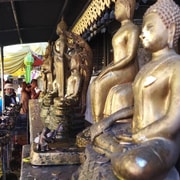
The temple’s main cloister contains more than 100 Buddha images arranged along covered galleries.
The repeated statues create a quieter and more contemplative atmosphere than the crowded central prang.
Visitors should:
- Speak quietly
- Avoid touching statues
- Keep walkways clear
- Do not pose disrespectfully
- Allow worshippers privacy
The Buddha Footprint
The Musement description highlights a chamber containing a carved representation of the Buddha’s footprint decorated with porcelain.
Sacred footprints are symbolic objects representing the Buddha’s spiritual presence and teachings rather than an ordinary anatomical impression.
Access may involve stairs and can change during ceremonies or maintenance.
Ordination Hall
The Ordination Hall is one of the most sacred buildings within the temple.
Its features include:
- A revered golden Buddha image
- Wall paintings illustrating events from the Buddha’s life
- Traditional Thai roof architecture
- Large guardian figures near the entrance
The ashes of King Rama II are associated with the base of the principal Buddha image.
Visitors must remove shoes where instructed before entering.
Guardian Statues and Chinese Sculptures
Large mythological guardians stand near important gateways and buildings.
The grounds also contain numerous Chinese stone sculptures, reflecting Bangkok’s historic trade and cultural contact with China.
Figures can include:
- Warriors
- Officials
- Animals
- Mythological beings
- Decorative garden guardians
These details are easily missed when visitors concentrate only on the central tower.
Wat Arun Admission Fee
The audio-tour purchase does not include entry to Wat Arun.
Current visitor information lists:
- Adult admission: 200 Thai baht
- Small children: Free
The definition of “small child” is not precisely stated on the visitor page.
Carry Thai baht and purchase admission from the authorised temple ticket area.
Prices can change, and additional charges may apply for optional activities such as costume rental.
Opening Hours
Current visitor information lists Wat Arun as open:
8:00am–6:00pm daily
The self-guided tour has flexible access, but it can only be used inside the paid temple area while that area is open.
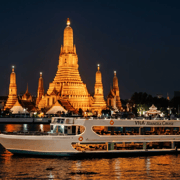
Although Wat Arun is beautifully illuminated after dark, ordinary visitors should expect to admire the evening lighting from outside or from the opposite riverbank after the temple closes.
Religious ceremonies, royal events, maintenance and security requirements can occasionally alter access.
Dress Code
Wat Arun applies a conservative temple dress code.
Wear clothing that covers:
- Shoulders
- Upper arms
- Chest and cleavage
- Knees
- Midriff
Avoid:
- Short shorts
- Mini skirts
- Strapless tops
- Spaghetti straps
- Transparent clothing
- Very low necklines
- Clothing with offensive imagery
Cover-up clothing may be available to rent at the temple, but arriving properly dressed is easier.
Temple Etiquette
Wat Arun remains an active Buddhist temple rather than only a tourist monument.
Visitors should:
- Speak quietly
- Remove shoes before entering designated buildings
- Never point feet toward Buddha images
- Avoid touching monks
- Ask before photographing worshippers
- Keep phones silent
- Do not climb barriers or restricted structures
- Avoid humorous or provocative poses beside sacred images
Women should not directly hand objects to a monk. Place the item on a surface or pass it through a male intermediary when appropriate.
Prang Stairs and Physical Demands
Wat Arun is famous for its steep central-prang stairs.
Only part of the structure is normally accessible to visitors, and access may close temporarily.
The stairs can be challenging because they are:
- Steep
- Narrow
- Exposed to sun and rain
- Crowded
- Difficult when descending
Use the handrail, face forward and take one step at a time.
Do not climb when experiencing dizziness, severe fear of heights, knee instability or balance problems.
Accessibility
The app itself may be used at any pace, but the physical temple complex is only partly accessible.
Potential barriers include:
- Ferry gangways
- Kerbs
- Uneven paving
- Steps into temple buildings
- Very steep prang stairs
- Crowded passages
A visitor with reduced mobility may still enjoy the riverfront, exterior architecture and parts of the grounds without climbing the prang.
No complete wheelchair-accessibility guarantee is included with the Musement product.
Visiting with Children
The self-guided format can suit families because parents can pause the narration and shorten the route.
Children may enjoy:
- Guardian statues
- Colourful porcelain details
- Boat travel
- Riverside views
- Animated app material
Parents should supervise children carefully around:
- Steep stairs
- River piers
- Crowded walkways
- Sacred objects
- Hot stone surfaces
Bring headphones suitable for the child or allow them to listen quietly from the phone without disturbing worshippers.
What Is Included?
The Musement booking includes:
- English audio-guided tour
- Downloadable Action Tour Guide app
- Suggested walking route
- Offline map
- Digital guidebook
- Written explanations
- Location-triggered audio
- Animated material at selected stops
- Lifetime or no-expiry access under current terms
- Mobile voucher
- Instant confirmation
What Is Not Included?
- Wat Arun admission
- Boat tickets
- Taxi or public transport
- Human guide
- Headphones
- Smartphone or tablet
- Mobile data
- Food and drinks
- Costume rental
- Professional photography
- Admission to Wat Pho or the Grand Palace
Getting to Wat Arun
Wat Arun is on the west bank of the Chao Phraya River in Bangkok Yai.
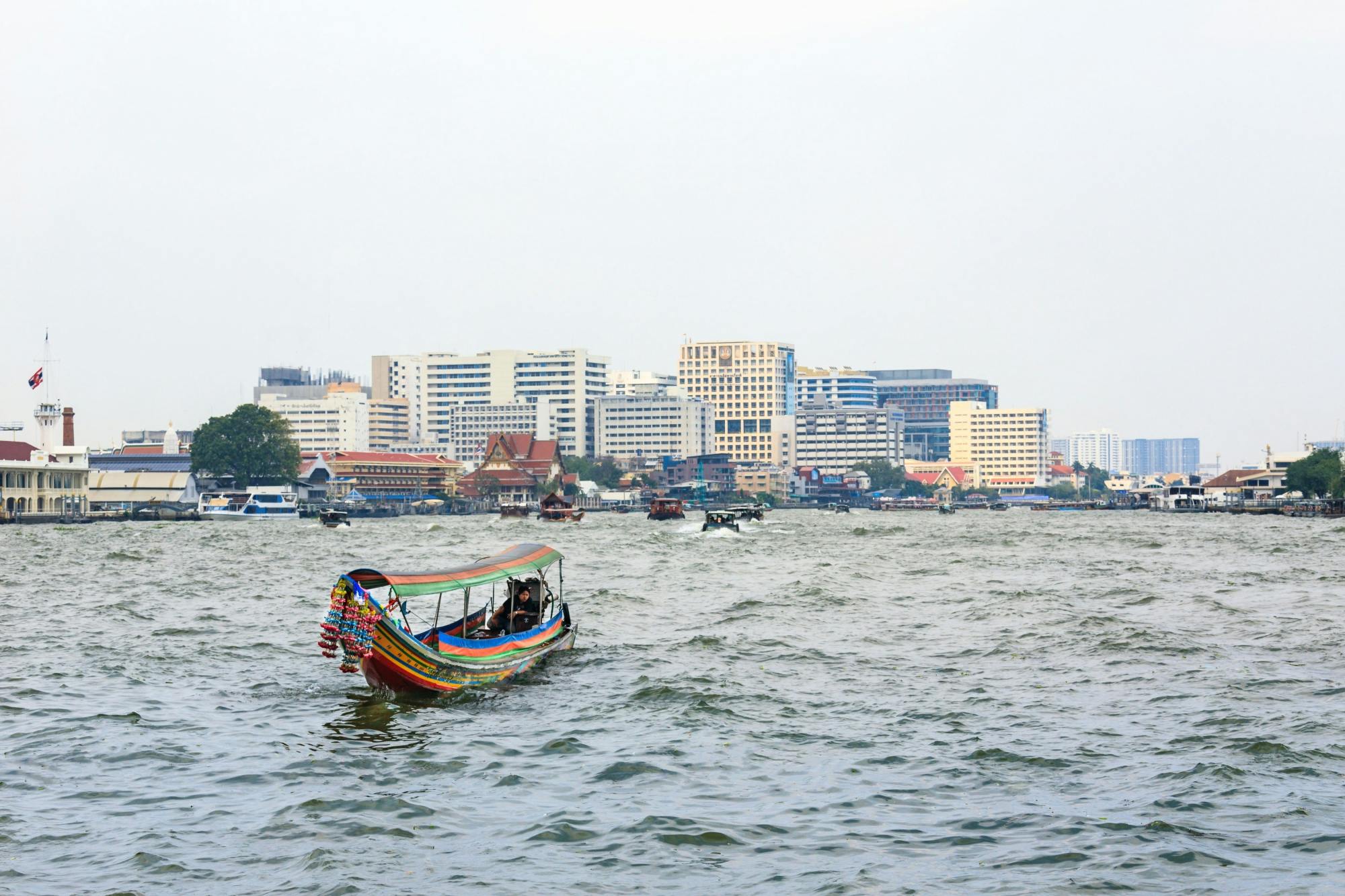
The most enjoyable route for many visitors is by boat.
Main options include:
- Cross-river ferry from the Wat Pho and Tha Tien area
- Chao Phraya passenger boat from Sathorn and other piers
- Taxi or rideshare directly to the temple
- Local bus
Boat routes, fares and operating hours change, so check the latest posted timetable on the day.
Cross-River Ferry from Tha Tien
Visitors combining Wat Pho and Wat Arun commonly use the short cross-river ferry.
A practical sequence is:
- Travel to MRT Sanam Chai or the Wat Pho area.
- Walk toward Tha Tien and the river pier.
- Follow signs for the Wat Arun crossing.
- Pay the current local fare.
- Cross directly to Wat Arun Pier.
The crossing is short, but queues can form during weekends and peak sightseeing hours.
Boat from Sathorn Pier
Travellers staying near Silom or the BTS network can travel to Saphan Taksin Station and walk to Sathorn Pier.
From there, use an appropriate Chao Phraya passenger service toward the old-city temple district.
The 2026 Chao Phraya Express Boat timetable varies between weekdays, Saturdays, public holidays and Sundays.
Confirm:
- Boat colour or flag
- Whether Wat Arun or Tha Tien is served
- Last practical return departure
- Current fare
Taxi and Rideshare
A taxi or rideshare can travel directly to the west-bank temple entrance.
This can be convenient for:
- Families
- Visitors with limited walking ability
- Early-morning arrivals
- Travellers staying in Thonburi
Road travel can be slow because of Bangkok traffic.
Ask the driver for:
Wat Arun Ratchawararam, Bangkok Yai
Temple-Closed and Transport Scams
Wat Arun’s current visitor information specifically warns travellers not to trust strangers claiming that the temple is closed.
A common approach involves someone saying:
- The temple is closed for a ceremony
- Foreigners cannot enter yet
- The ferry is not operating
- A different temple is open only today
- A cheap tuk-tuk tour is available
The person may then redirect the visitor to:
- A jewellery shop
- A tailor
- An overpriced private boat
- A commission-paying attraction
Continue to the authorised entrance or official pier and check the signs yourself.
Best Time to Visit
Shortly After 8:00am
This is usually the best period for lower temperatures, lighter crowds and easier photography.
Late Afternoon
The lower sun can emphasise the temple’s ceramic details, but allow enough time to complete the paid visit before the 6:00pm closing time.
Sunset View from Across the River
For the classic sunset silhouette, finish the interior visit and cross to the east bank. Riverside cafés and public viewpoints around the Wat Pho area face the temple across the Chao Phraya.
The name Temple of Dawn does not mean the paid complex opens before sunrise.
Heat, Rain and Air Quality
Bangkok is hot and humid during much of the year.
Visitors should prepare for:
- Strong sun
- High humidity
- Sudden tropical rain
- Slippery stone steps
- Seasonal air pollution
Carry water, use sunscreen and take breaks in shaded areas.
During thunderstorms, avoid exposed stairs and follow staff instructions.
Photography Tips
Photograph the Prang from the Entrance Area
A wider lens helps capture the scale of the central tower and surrounding structures.
Look Closely at the Decoration
Use detail shots to record flowers, guardians and porcelain patterns.
Use the River as Context
Photograph boats, piers and the opposite bank to show Wat Arun’s riverside setting.
Visit the East Bank for Sunset
The most famous sunset view is generally from across the Chao Phraya rather than from inside the temple grounds.
Respect Worship Areas
Obey signs regarding photography and do not use flash during ceremonies or close to worshippers.
Headphones and Phone Battery
Bring headphones for the audio narration.
Using the phone speaker can disturb worshippers and other visitors.
GPS, screen use and audio playback can drain the battery quickly.
Before leaving the hotel:
- Charge the phone fully
- Download the tour
- Reduce screen brightness
- Close unnecessary apps
- Bring a portable battery
- Carry the correct charging cable
Food, Drinks and Toilets
Food is not included with the audio tour.
Small shops and vendors can be found around the pier and surrounding neighbourhood.
Avoid eating inside sacred buildings or leaving rubbish within the temple grounds.
Toilet facilities may involve a small local charge or restricted access, so carry small Thai-baht notes.
Nearby Attractions
Wat Pho
Wat Pho is directly across the river and is famous for the Reclining Buddha and its association with traditional Thai massage.
The Grand Palace and Wat Phra Kaew
The royal complex lies within walking distance of Wat Pho and requires a separate admission ticket and strict dress code.
Museum Siam
This modern museum explores Thai identity and history and is near MRT Sanam Chai.
Pak Khlong Talat
Bangkok’s famous flower market can be reached from the old-city river area.
Thonburi Riverside
The Wat Arun side of the river contains smaller temples, residential lanes and traditional communities that receive fewer visitors than the Grand Palace district.
Who Is This Audio Tour Best For?
The tour is particularly suitable for:
- Independent travellers
- Couples
- Solo visitors
- Families wanting a flexible pace
- Visitors who dislike large tour groups
- Travellers interested in architecture and history
- People comfortable using smartphone apps
- Repeat visitors wanting more context
Who Might Prefer Another Tour?
A conventional guided tour may be better for:
- Visitors without a compatible smartphone
- People wanting to ask a guide questions
- Travellers uncomfortable navigating independently
- Groups wanting transport included
- Visitors who prefer another language
- People needing hands-on mobility assistance
- Travellers wanting admission bundled into one ticket
Is the Tour Good Value?
The value depends on how much historical context the visitor wants.
The audio tour provides:
- A structured route
- Nine narrated stories
- Offline maps
- Flexible timing
- Written explanations
- Reusable access under current terms
However, the total visit cost also includes:
- Wat Arun admission
- Boat or taxi fare
- Headphones if needed
- Optional food and drinks
The tour offers strongest value to visitors who would otherwise walk through the temple without understanding its history, symbols or architecture.
It offers less value to travellers who prefer reading free online information or joining a broader guided tour covering Wat Arun, Wat Pho and the Grand Palace together.
Frequently Asked Questions About the Wat Arun Self-Guided Tour
How much does the audio tour cost?
Musement currently lists the tour from $14.99, while the operator currently advertises direct pricing from $9.99 per person.
Is Wat Arun admission included?
No.
How much is Wat Arun admission?
Current visitor information lists adult admission at 200 Thai baht, with small children free.
What are Wat Arun’s opening hours?
The current published hours are 8:00am–6:00pm daily.
How long does the audio tour take?
Approximately one to two hours.
How long is the route?
Approximately 0.5 miles.
How many audio stories are included?
The operator currently lists nine stories.
Where does the tour begin?
At Wat Arun Ferry Pier, 34 Thanon Wang Doem.
Will someone meet me there?
No. This is entirely self-guided.
Does the audio start automatically?
It is designed to begin according to GPS location when the traveller reaches the starting point.
Can I begin at any time?
Yes, during Wat Arun’s opening hours.
Does the app need internet access?
No, provided the complete tour and offline map have been downloaded beforehand.
Which phones are compatible?
Musement currently requires iOS 15 or later or Android 9 or later.
Can I use an iPad?
Yes, when it has GPS and cellular capability.
Should I bring headphones?
Yes.
Can one person purchase the tour for the whole group?
The operator describes the product as one purchase per person. Follow the final licence and booking terms.
Does the tour expire?
Musement and the operator currently say access has no expiration date or remains valid indefinitely.
Can I pause the tour?
Yes.
Can I repeat the audio?
Yes. Stops can normally be replayed through the app.
What language is available?
This Musement product is in English.
Is transport included?
No.
What is the easiest way to reach Wat Arun?
Many visitors use the short cross-river ferry from the Wat Pho and Tha Tien area.
Can I travel from BTS Saphan Taksin?
Yes. Walk to Sathorn Pier and use an appropriate Chao Phraya boat service.
Does Wat Arun really open at dawn?
No. The current visitor opening time is 8:00am.
Can I visit at night?
The temple is illuminated and can be viewed from outside after dark, but the paid visitor complex currently closes at 6:00pm.
Can I climb the main prang?
Visitors may normally climb only the accessible lower section. Access can close temporarily.
Are the stairs steep?
Yes.
Is Wat Arun wheelchair accessible?
Only partly. Some exterior areas may be manageable, but the ferry, buildings and prang stairs present barriers.
What should I wear?
Wear conservative clothing covering the shoulders, knees, chest and midriff.
Can I rent a cover-up?
Current visitor guidance says cover-up clothing is available for rent.
Do I remove my shoes?
Remove them before entering buildings where signs or temple custom require it.
Can I take photographs?
Photography is generally permitted in many outdoor areas, but follow signs and respect worshippers.
Is the tour suitable for children?
Yes, particularly when children are comfortable listening to audio and walking in heat.
What happens if someone says the temple is closed?
Ignore unsolicited claims and check the authorised entrance or official visitor information.
Can I cancel the Musement booking?
Yes. A full refund is available when cancellation is completed at least 24 hours before the experience begins.
Are additional booking fees charged?
No additional Musement booking fee is currently listed.
Are customer reviews available?
The current Musement listing does not display customer ratings for this product.
Is the audio tour worth purchasing?
Yes, for independent visitors who want structured historical commentary and offline navigation. It is less suitable for anyone wanting transport, admission and a live guide in one booking.
Final Thoughts
The Wat Arun Temple of Dawn self-guided walking tour provides a flexible and informative alternative to joining a conventional Bangkok sightseeing group.
The app leads visitors from Wat Arun Ferry Pier through the temple grounds while explaining the central prang, porcelain decoration, Buddha images, sacred footprint, guardian figures and Ordination Hall.
The current Musement ticket includes the audio narration, map, downloadable app and digital guidebook but does not include temple admission or transport.
Wat Arun currently charges 200 Thai baht for adults and opens from 8:00am until 6:00pm daily.
Set up and download the app before leaving reliable Wi-Fi, carry headphones and bring a portable battery.
The temple applies a conservative dress code, and visitors should cover shoulders, knees, chest and midriff.
Travellers with limited mobility can enjoy many exterior views but should avoid the steep central-prang stairs.
The easiest itinerary is often to visit Wat Pho first, cross the Chao Phraya by ferry and begin the audio route at Wat Arun Pier.
For the best balance of cooler temperatures and smaller crowds, arrive shortly after 8:00am. For sunset photography, complete the temple visit before closing and view Wat Arun from the opposite bank as evening light falls across the river.